


History of the Roman Empire

Encyclopedia
The broader history of the Roman Empire extends through 16 centuries and includes several stages in the evolution of the Roman state. It encompasses the period of the ancient Roman Empire
, the period in which it was divided into western
and eastern halves, and the history of the Eastern Roman or Byzantine Empire
that continued through the Middle Ages
and to the beginning of the Modern Era.
 In -27 BC, Octavian made Lugdunum
the capital of Gaul
.
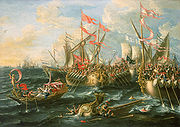
The Battle of Actium
resulted in the defeat and subsequent suicides of Mark Antony
and Cleopatra
. Octavian had also executed Cleopatra's young son and co-ruler, Caesarion
. Caesarion may have been the (only) son of Julius Caesar
. Therefore, by killing Caesarion, Octavian removed any possibility of a male rival emerging with closer blood ties to Julius Caesar. Octavian, now sole ruler of Rome, began a full-scale reformation of military, fiscal and political matters. These were intended to stabilise and pacify the Roman world and also to secure acceptance of the new regime.
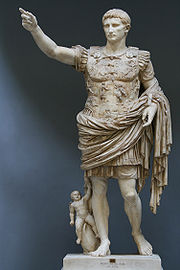
Upon Octavian's accession as ruler of the Roman world, the Roman Senate gave Octavian the name Augustus
. He had already adopted the title imperator
, "commander-in-chief", as his first name
. It was a term that dated back to the days of the Roman Republic
and later evolved into emperor
.
As adopted heir of Caesar, Augustus preferred to be called by this name. Caesar was a part of his family name. Julio-Claudian
rule lasted for 117 years (from Julius Caesar, the last Roman dictator
in 49 BC to the deposition of emperor Nero
in 68 AD). By the time of the Flavian Dynasty
(69-96), that is the reign of Vespasian
, and those of his two sons, Titus
and Domitian
, the term Caesar
had evolved, almost de facto
, from a family name into a formal title. Derivatives of this title (such as Tsar
and kaiser
) endure to this day.
The Roman legion
s, which had reached an unprecedented number (around 50) because of the Roman civil wars
, were reduced to 28. Several legions, particularly those with members of doubtful loyalties, were simply demobilised. Other legions were united, a fact hinted by the title Gemina (Twin). Augustus also created nine special cohorts
, allegedly to maintain the peace in Italia, keeping at least three of them stationed at Rome. These cohorts became known as the Praetorian Guard
.
Octavian realised that autocracy and kingship were things that Romans had not experienced for centuries, and were wary of. Octavian did not want to be viewed as a tyrant
and sought to retain the illusion of the constitutional republic. He attempted to make it seem as though the constitution of the Roman Republic
was still functional. Even Rome's past dictators, such as the brutal Lucius Cornelius Sulla
, had only ruled Rome for short spans of time, never more than a year or two. The sole exception was Julius Caesar, his term ending in his assassination
. In 27 BC, Octavian officially tried to hand over all his extraordinary powers to the Roman Senate
. In a carefully staged way, the senators, who by this time were mostly his partisans, refused and begged him to keep them for the sake of the republic and the people of Rome. Reportedly, the suggestion of Octavian stepping down as a Roman consul
led to rioting amongst the Plebeians
in Rome. A compromise was reached between the Senate and Octavian, known as the First Settlement. This agreement gave Augustus legitimacy as an autocrat of the people, and ensured that he would not be considered a tyrant, starting the long and prosperous period that would be known as Pax Romana
.
Octavian split with the Senate the governorships of the Roman province
s. The unruly provinces at the borders, where the vast majority of the legions were stationed, were administrated by imperial legates
, chosen by the emperor himself. These provinces were classified as imperial provinces. The governors of the peaceful senatorial provinces were chosen by the Senate. These provinces were usually peaceful and only a single legion was stationed in the senatorial province of Africa
.
 Before the Senate controlled the treasury, Augustus had mandated that the taxes of the Imperial provinces be destined to the Fiscus
, which was administrated by persons chosen by, and answerable only to, Augustus. The revenue of the senatorial provinces continued to be sent to the Aerarium
, under the supervision of the Senate. This effectively made Augustus richer than the Senate, and more than able to pay the salarium (salary) of the legionaries
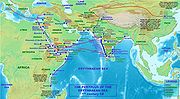
, ensuring their continued loyalty. This was ensured by the Imperial province of Roman Egypt, which was incredibly wealthy and also the most important grain supplier for the whole empire. Senators were forbidden to even visit this province, as it was largely considered the personal fiefdom of the emperor himself.
Augustus renounced his consulship in 23 BC, but retained his consular imperium, leading to a second compromise between Augustus and the Senate known as the Second Settlement. Augustus was granted the authority of a tribune
(tribunicia potestas), though not the title, which allowed him to call together the Senate and people at will and lay business before it, veto the actions of either the Assembly or the Senate, preside over elections, and gave him the right to speak first at any meeting. Also included in Augustus's tribunician authority were powers usually reserved for the Roman censor; these included the right to supervise public morals and scrutinise laws to ensure they were in the public interest, as well as the ability to hold a census and determine the membership of the Senate. No tribune of Rome ever had these powers, and there was no precedent within the Roman system for consolidating the powers of the tribune and the censor into a single position, nor was Augustus ever elected to the office of Censor. Whether censorial powers were granted to Augustus as part of his tribunician authority, or he simply assumed these responsibilities, is still a matter of debate.
In addition to tribunician authority, Augustus was granted sole imperium within the city of Rome itself; all armed forces in the city, formerly under the control of the prefects, were now under the sole authority of Augustus. Additionally, Augustus was granted imperium proconsulare maius (power over all proconsuls), the right to interfere in any province and override the decisions of any governor. With maius imperium, Augustus was the only individual able to grant a triumph
to a successful general as he was ostensibly the leader of the entire Roman army.
All of these reforms were highly unusual in the eyes of Roman republican tradition, but the Senate was no longer composed of the republican patricians who had the courage to murder Caesar. Most of these senators had died in the Civil Wars, and the leaders of the conservative Republicans in the senate, such as Cato the Younger
and Cicero
, had long since died. Octavian had purged the Senate of any remaining suspect elements and planted the body with his own partisans. How free a hand the Senate had in all these transactions, and what back-room deals were made, remains unknown.
Attempting to secure the borders of the empire upon the rivers Danube
and Elbe
, Octavian ordered the invasions of Illyria
, Moesia
, and Pannonia
(south of the Danube), and Germania
(west of the Elbe). At first everything went as planned, but then disaster struck. The Illyrian tribes revolted and had to be crushed, and three full legions under the command of Publius Quinctilius Varus
were ambushed and destroyed at the Battle of the Teutoburg Forest
in AD 9 by Germanic tribes led by Arminius
. Being cautious, Augustus secured all territories west of Rhine and contented himself with retaliatory raids. The rivers Rhine and Danube became the permanent borders of the Roman empire in the North.
wrote his magisterial history during Augustus's reign and his work covered all of Roman history through 9 BC, only epitome
s survive of his coverage of the late Republican and Augustan periods. Important primary sources for this period include:
Though primary accounts of this period are few, works of poetry, legislation and engineering from this period provide important insights into Roman life. Archaeology, including maritime archaeology
, aerial surveys, epigraphic
inscriptions on buildings, and Augustan coinage
, has also provided valuable evidence about economic, social and military conditions.
Secondary sources on the Augustan Age include Tacitus
, Dio Cassius
, Plutarch
and Lives of the Twelve Caesars
by Suetonius
. Josephus
's Jewish Antiquities is the important source for Judea
in this period, which became a province
during Augustus's reign.
:Gaius Caesar
, Lucius Caesar
and Agrippa Postumus
. None of the three lived long enough to succeed him. He therefore was succeeded by his stepson Tiberius
. Tiberius was the son of Livia
, the third wife of Octavian, by her first marriage to Tiberius Nero
. Augustus was a scion of the gens
Julia
(the Julian family), one of the most ancient patrician clans of Rome
, while Tiberius was a scion of the gens Claudia
, only slightly less ancient than the Julians. Their three immediate successors were all descended both from the gens Claudia, through Tiberius' brother Nero Claudius Drusus
, and from gens Julia, either through Julia the Elder, Augustus' daughter from his first marriage (Caligula
and Nero
), or through Augustus' sister Octavia Minor
(Claudius
). Historians thus refer to their dynasty as "Julio-Claudian".
. In 23 his own son Julius Caesar Drusus
died. More and more, Tiberius retreated into himself. He began a series of treason trials and executions.
He left power in the hands of the commander of the guard, Lucius Aelius Sejanus
. Tiberius himself retired to live at his villa on the island of Capri
in 26, leaving administration in the hands of Sejanus, who carried on the persecutions with contentment. Sejanus also began to consolidate his own power; in 31 he was named co-consul with Tiberius and married Livilla
, the emperor's niece. At this point he was "hoisted by his own petard
": the emperor's paranoia, which he had so ably exploited for his own gain, was turned against him. Sejanus was put to death, along with many of his associates, the same year. The persecutions continued until Tiberius' death in 37.
and Agrippina the Elder
. His paternal grandparents were Nero Claudius Drusus
and Antonia Minor
, his maternal grandparents were Marcus Vipsanius Agrippa
and Julia the Elder
. Consequently a descendant of both Augustus and Livia.
Caligula started out well, by putting an end to the persecutions and burning his uncle's records. Unfortunately, he quickly lapsed into illness. The Caligula that emerged in late 37 demonstrated features of mental instability that led modern commentators to diagnose him with such illnesses as encephalitis
, which can cause mental derangement, hyperthyroidism
, or even a nervous breakdown (perhaps brought on by the stress of his position). Whatever the cause, there was an obvious shift in his reign from this point on, leading his biographers to think he was insane.
Most of what history remembers of Caligula comes from Suetonius
, in his book Lives of the Twelve Caesars
. According to Suetonius, Caligula once planned to appoint his favourite horse Incitatus
to the Roman Senate. He ordered his soldiers to invade Britain to fight the Sea God Neptune
, but changed his mind at the last minute and had them pick sea shells on the northern end of France instead. It is believed he carried on incest
uous relations with his three sisters: Julia Livilla
, Drusilla and Agrippina the Younger
. He ordered a statue of himself to be erected in Herod's Temple at Jerusalem, which would have undoubtedly led to revolt had he not been dissuaded from this plan by his friend king Agrippa I
. He ordered people to be secretly killed, and then called them to his palace. When they did not appear, he would jokingly remark that they must have committed suicide.
In 41, Caligula was assassinated by the commander of the guard Cassius Chaerea
. Also killed were his fourth wife Caesonia
and their daughter Julia Drusilla
. The only member of the imperial family left to take charge was his paternal uncle, Tiberius Claudius Drusus Nero Germanicus.
. Claudius had long been considered a weakling and a fool by the rest of his family. He was, however, neither paranoid like his uncle Tiberius, nor insane like his nephew Caligula, and was therefore able to administer the empire with reasonable ability. He improved the bureaucracy and streamlined the citizenship and senatorial rolls. He also proceeded with the conquest and colonisation of Britain (in 43), and incorporated more Eastern provinces into the empire. He ordered the construction of a winter port for Rome, at Ostia Antica
, thereby providing a place for grain from other parts of the Empire to be brought in inclement weather.
In his own family life, Claudius was less successful. His wife Messalina
cuckold
ed him; when he found out, he had her executed and married his niece, Agrippina the Younger
. She, along with several of his freedmen, held an inordinate amount of power over him, and although there are conflicting accounts about his death, she may very well have poisoned him in 54. Claudius was deified later that year. The death of Claudius paved the way for Agrippina's own son, the 17-year-old Lucius Domitius Nero.
(58–63), the suppression of a revolt led by Boudica
in Britannia
(60–61) and improving cultural ties with Greece. However, he was egotistical and had severe troubles with his mother, whom he felt was controlling and over-bearing. After several attempts to kill her he finally had her stabbed to death. He believed himself a god and decided to build an opulent palace for himself. The so called Domus Aurea
, meaning golden house in Latin, was constructed atop the burnt remains of Rome after the Great Fire. Because of the convenience of this many believe that Nero was ultimately responsible for the fire spawning the legend of him fiddling while Rome burned which is almost certainly untrue. The Domus Aurea was a colossal feat of construction that covered a huge space and demanded new methods of construction in order to hold up the gold, jewel encrusted ceilings. By this time Nero was hugely unpopular despite his attempts to blame the Christians for most of his regime's problems.
A military coup drove Nero into hiding. Facing execution at the hands of the Roman Senate, he reportedly committed suicide in 68. According to Cassius Dio, Nero's last words were "Jupiter, what an artist perishes in me!"
, in 68, was followed by a brief period of civil war (the first Roman civil war since Antony
's death in 31 BC) known as the "year of the four emperors". Between June 68 and December 69, Rome
witnessed the successive rise and fall of Galba
, Otho
and Vitellius
until the final accession of Vespasian
, first ruler of the Flavian dynasty
. This period of civil war has become emblematic of the cyclic political disturbances in the history of the Roman Empire. The military and political anarchy created by this civil war had serious implications, such as the outbreak of the Batavian rebellion
.
 The Flavians, although a relatively short-lived dynasty, helped restore stability to an empire on its knees. Although all three have been criticised, especially based on their more centralised style of rule, they issued reforms that created a stable enough empire to last well into the 3rd century. However, their background as a military dynasty led to further marginalisation of the senate, and a conclusive move away from princeps, or first citizen, and toward imperator, or emperor.
was a remarkably successful Roman general who had been given rule over much of the eastern part of the Roman Empire. He had supported the imperial claims of Galba
, after whose death Vespasian became a major contender for the throne. Following the suicide of Otho
, Vespasian was able to take control of Rome's winter grain supply in Egypt, placing him in a good position to defeat his remaining rival, Vitellius. On December 20, 69, some of Vespasian's partisans were able to occupy Rome. Vitellius was murdered by his own troops and, the next day, Vespasian, then sixty years old, was confirmed as Emperor by the Senate.
Although Vespasian was considered an autocrat
by the Senate, he mostly continued the weakening of that body that had been going since the reign of Tiberius. The degree of the Senate's subservience can be seen from the post-dating of his accession to power, by the Senate, to July 1, when his troops proclaimed him emperor, instead of December 21, when the Senate confirmed his appointment. Another example was his assumption of the censorship in 73, giving him power over the make up of the Senate. He used that power to expel dissident senators. At the same time, he increased the number of senators from 200, at that low level because of the actions of Nero and the year of crisis that followed, to 1,000; most of the new senators coming not from Rome but from Italy and the urban centres within the western provinces.
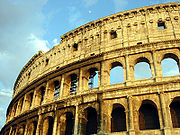 Vespasian was able to liberate Rome from the financial burdens placed upon it by Nero's excesses and the civil wars. To do this, he not only increased taxes, but created new forms of taxation. Also, through his power as censor, he was able to carefully examine the fiscal status of every city and province, many paying taxes based upon information and structures more than a century old. Through this sound fiscal policy, he was able to build up a surplus in the treasury and embark on public works projects. It was he who first commissioned the Amphitheatrum Flavium (Colosseum
); he also built a forum
whose centrepiece was a temple to Peace. In addition, he allotted sizeable subsidies to the arts, creating a chair of rhetoric at Rome.
Vespasian was also an effective emperor for the provinces in his decades of office, having posts all across the empire, both east and west. In the west he gave considerable favouritism to Hispania
(the Iberian Peninsula
, comprising modern Spain
and Portugal
) in which he granted Latin right
s to over three hundred towns and cities, promoting a new era of urbanisation throughout the western (formerly barbarian) provinces. Through the additions he made to the Senate he allowed greater influence of the provinces in the Senate, helping to promote unity in the empire. He also extended the borders of the empire, mostly done to help strengthen the frontier defences, one of Vespasian's main goals.
The crisis of 69 had wrought havoc on the army. One of the most marked problems had been the support lent by provincial legions to men who supposedly represented the best will of their province. This was mostly caused by the placement of native auxiliary units in the areas they were recruited in, a practice Vespasian stopped. He mixed auxiliary units with men from other areas of the empire or moved the units away from where they were recruited to help stop this. Also, to reduce further the chances of another military coup, he broke up the legions and, instead of placing them in singular concentrations, broke them up along the border. Perhaps the most important military reform he undertook was the extension of legion recruitment from exclusively Italy to Gaul
and Hispania
, in line with the Romanisation of those areas.
, the eldest son of Vespasian, had been groomed to rule. He had served as an effective general under his father, helping to secure the east and eventually taking over the command of Roman armies in Syria
and Iudaea, quelling the significant Jewish revolt going on at the time. He shared the consulship for several years with his father and received the best tutelage. Although there was some trepidation when he took office because of his known dealings with some of the less respectable elements of Roman society, he quickly proved his merit, even recalling many exiled by his father as a show of good faith.
However, his short reign was marked by disaster: in 79, Mount Vesuvius erupted in Pompeii
, and in 80, a fire destroyed much of Rome. His generosity in rebuilding after these tragedies made him very popular. Titus was very proud of his work on the vast amphitheater begun by his father. He held the opening ceremonies in the still unfinished edifice during the year 80, celebrating with a lavish show that featured 100 gladiator
s and lasted 100 days. Titus died in 81 at the age of 41 of what is presumed to be illness; it was rumoured that his brother Domitian murdered him in order to become his successor, although these claims have little merit. Whatever the case, he was greatly mourned and missed.
, an affront to the idea of what the Principate-era emperor's power was based upon: the emperor as the princeps
. His reputation in the Senate aside, he kept the people of Rome happy through various measures, including donations to every resident of Rome, wild spectacles in the newly finished Colosseum, and continuing the public works projects of his father and brother. He also apparently had the good fiscal sense of his father, because although he spent lavishly his successors came to power with a well-endowed treasury.
However, towards the end of his reign Domitian became extremely paranoid, which probably had its initial roots in the treatment he received by his father: although given significant responsibility, he was never trusted with anything important without supervision. This flowered into the severe and perhaps pathological repercussions following the short-lived rebellion in 89 of Lucius Antonius Saturninus
, a governor and commander in Germania Superior
. Domitian's paranoia led to a large number of arrests, executions, and seizures of property (which might help explain his ability to spend so lavishly). Eventually it got to the point where even his closest advisers and family members lived in fear, leading to his murder in 96, which was orchestrated by his enemies in the Senate, Stephanus (the steward of the deceased Julia Flavia
), members of the Praetorian Guard and empress Domitia Longina
.
and the Empire was prosperous. The emperors of this period were Nerva
(96–98), Trajan
(98–117), Hadrian
(117–138), Antoninus Pius
(138–161) and Marcus Aurelius (161–180), each being adopted by his predecessor as his successor during the former's lifetime. While their respective choices of successor were based upon the merits of the individual men they selected, it has been argued that the real reason for the lasting success of the adoptive scheme of succession lay more with the fact that none but the last had a natural heir.
The last 2 of the "Five Good Emperors" and Commodus are also called Antonines.
set a new tone: he released those imprisoned for treason, banned future prosecutions for treason, restored much confiscated property, and involved the Roman Senate in his rule. He probably did so as a means to remain relatively popular (and therefore alive), but this did not completely aid him. Support for Domitian in the army remained strong, and in October 97 the Praetorian Guard laid siege to the Imperial Palace on the Palatine Hill and took Nerva hostage. He was forced to submit to their demands, agreeing to hand over those responsible for Domitian's death and even giving a speech thanking the rebellious Praetorians. Nerva then adopted Trajan, a commander of the armies on the German frontier, as his successor shortly thereafter in order to bolster his own rule. Casperius Aelianus
, the Guard Prefect responsible for the mutiny against Nerva, was later executed under Trajan.
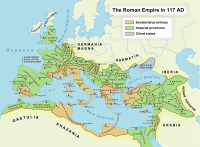 After his ascension to the throne, Trajan prepared and launched a carefully planned military campaign in Dacia
, a region north of the lower Danube
that had long been an opponent to Rome. In 101 Trajan personally crossed the Danube and defeated the armies of the Dacian king Decebalus
at Tapae
. The emperor decided not to press on towards a final conquest because his armies needed reorganisation, but he did impose very hard peace conditions on the Dacians. At Rome, Trajan was received as a hero and he took the name of Dacicus, a title that appears on his coinage of this period. Decebalus complied with the terms for a time, but before long he began inciting revolt. In 105 Trajan once again invaded and after a year long campaign ultimately defeated the Dacians by conquering their capital, Sarmizegetusa Regia. King Decebalus, cornered by the Roman cavalry, eventually committed suicide rather than being captured and humiliated in Rome. The conquest of Dacia was a major accomplishment for Trajan, who ordered 123 days of celebration throughout the empire. He also constructed Trajan's column
in Rome to glorify the victory.
In 112, Trajan was provoked by the decision of Osroes I of Parthia
to put his own nephew Exedares on the throne of the Kingdom of Armenia. The Arsacid Dynasty of Armenia
was a branch of the Parthian royal family, established back in 54. Since then the two great empires had shared hegemony over Armenia. The encroachment on the traditional sphere of influence of the Roman Empire by Osroes ended the peace which had lasted for some 50 years.
Trajan marched first on Armenia. He deposed the king and annexed it to the Roman Empire. Then he turned south into Parthia
itself, taking the cities of Babylon
, Seleucia
and finally the capital of Ctesiphon
in 116. He continued southward to the Persian Gulf
, whence he declared Mesopotamia
a new province of the empire and lamented that he was too old to follow in the steps of Alexander the Great and continue on eastward.
But he did not stop there. Later in 116, he captured the great city of Susa
. He deposed the Osroes I and put his own puppet ruler Parthamaspates on the throne. Never again would the Roman Empire advance so far to the east. During his rule, the Roman Empire was to its largest extent; it was quite possible for a Roman to travel from Britain
all the way to the Persian Gulf
without leaving Roman territory.
 Despite his own excellence as a military administrator, Hadrian's reign was marked by a general lack of major military conflicts but to defend the vast territories the empire had. He surrendered Trajan's conquests in Mesopotamia, considering them to be indefensible. There was almost a war with Vologases III of Parthia
around 121, but the threat was averted when Hadrian succeeded in negotiating a peace. Hadrian's army crushed the Bar Kokhba revolt, a massive Jewish uprising in Judea (132–135). The revolt was named after its leader, Simon Bar Kokhba
.
Hadrian was the first emperor to extensively tour the provinces, donating money for local construction projects as he went. In Britain, he ordered the construction of a wall, the famous Hadrian's Wall
as well as various other such defences in Germania
and Northern Africa. His domestic policy was one of relative peace and prosperity.
's reign was comparatively peaceful; there were several military disturbances throughout the Empire in his time, in Mauretania, Judaea, and amongst the Brigantes in Britain, but none of them are considered serious. The unrest in Britain is believed to have led to the construction of the Antonine Wall
from the Firth of Forth to the Firth of Clyde, although it was soon abandoned.
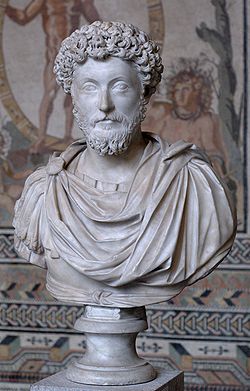 Germanic tribes and other people launched many raids along the long north European border, particularly into Gaul and across the Danube—Germans, in turn, may have been under attack from more warlike tribes farther east. His campaigns against them are commemorated on the Column of Marcus Aurelius
.
In Asia, a revitalised Parthian Empire renewed its assault. Marcus Aurelius sent his co-emperor Lucius Verus
to command the legions in the East to face it. Lucius was authoritative enough to command the full loyalty of the troops, but already powerful enough that he had little incentive to overthrow Marcus. The plan succeeded—Verus remained loyal until his death on campaign in 169.
In 175, while on campaign in the northern Germany in the Marcomannic Wars
, Marcus was forced to contend with a rebellion by Avidius Cassius
, a general who had been an officer during the wars against Persia. Cassius was proclaimed Roman Emperor and took the provinces of Egypt and Syria as his part of the empire. Reports say that Cassius had revolted because he had heard word that Marcus was dead. After three months Cassius was assassinated and Marcus took back the eastern part of the empire.
In the last years of his life Marcus, a philosopher as well as an emperor, wrote his book of Stoic
philosophy known as the Meditations
. The book has since been hailed as Marcus' great contribution to philosophy.
When Marcus died in 180 the throne passed to his son Commodus
, who had been elevated to the rank of co-emperor in 177. This ended the succession plan of the previous four emperors where the emperor would adopt his successor, although Marcus was the first emperor since Vespasian
to have a natural son that could succeed him, which probably was the reason he allowed the throne to pass to Commodus and not adopt an outside successor.
from 180 to 192. Commodus was the son of Marcus Aurelius, making him the first direct successor in a century, breaking the scheme of adoptive successors that had turned out so well. He was co-emperor with his father from 177. When he became sole emperor upon the death of his father in 180, it was at first seen as a hopeful sign by the people of the Roman Empire. Nevertheless, as generous and magnanimous as his father was, Commodus turned out to be just the opposite. In The Decline and Fall of the Roman Empire by Edward Gibbon
, it is noted that Commodus at first ruled the empire well. However, after an assassination attempt, involving a conspiracy by certain members of his family, Commodus became paranoid and slipped into insanity. The Pax Romana
, or "Roman Peace", ended with the reign of Commodus. One could argue that the assassination attempt began the long decline of the Roman Empire.
 The Severan Dynasty
includes the increasingly troubled reigns of Septimius Severus
(193–211), Caracalla
(211–217), Macrinus
(217–218), Elagabalus
(218–222), and Alexander Severus
(222–235). The founder of the dynasty, Lucius Septimius Severus, belonged to a leading native family of Leptis Magna
in Africa
who allied himself with a prominent Syrian family by his marriage to Julia Domna
. Their provincial background and cosmopolitan alliance, eventually giving rise to imperial rulers of Syrian background, Elagabalus and Alexander Severus, testifies to the broad political franchise and economic development of the Roman empire that had been achieved under the Antonines. A generally successful ruler, Septimius Severus cultivated the army
's support with substantial remuneration in return for total loyalty to the emperor and substituted equestrian officers for senators in key administrative positions. In this way, he successfully broadened the power base of the imperial administration throughout the empire, also by abolishing the regular standing jury courts of Republican
times.
Septimius Severus's son, Marcus Aurelius Antoninus—nicknamed "Caracalla
"—removed all legal and political distinction between Italians and provincials, enacting the Constitutio Antoniniana
in 212 which extended full Roman citizenship to all free inhabitants of the empire. Caracalla was also responsible for erecting the famous Baths of Caracalla
in Rome
, their design serving as an architectural model for many subsequent monumental public buildings. Increasingly unstable and autocratic, Caracalla was assassinated by the praetorian prefect
Macrinus
in 217, who succeeded him briefly as the first emperor not of senatorial rank.
The imperial court, however, was dominated by formidable women (Julia Maesa
, Julia Soaemias
, Julia Avita Mamaea
) who arranged the succession of Elagabalus
in 218, and Alexander Severus
, the last of the dynasty, in 222. In the last phase of the Severan principate, the power of the Senate was somewhat revived and a number of fiscal reforms were enacted. Despite early successes against the Sassanid Empire
in the East, Alexander Severus's increasing inability to control the army led eventually to its mutiny and his assassination in 235. The death of Alexander Severus ushered in a subsequent period of soldier-emperors and almost a half-century of civil war and strife. Thus the Pax Romana, which had started at the death of Octavian, ended after about 200 years.
After Augustus
declared an end to the Civil Wars of the 1st century BC, the Empire had enjoyed a period of limited external invasion, internal peace and economic prosperity (the Pax Romana
). In the 3rd century, however, the Empire underwent military, political and economic crises and began to collapse. There was constant barbarian invasion, civil war, and hyperinflation
. Part of the problem had its origins in the nature of the Augustan settlement. Augustus, intending to downplay his position, had not established rules for the succession
of emperors.
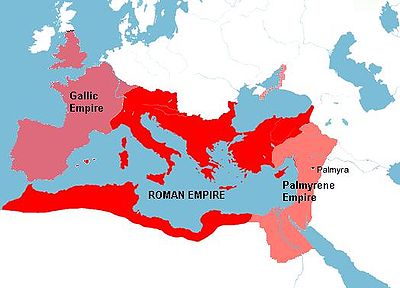 Already in the 1st and 2nd century, disputes about the succession had led to short civil wars, but in the 3rd century these civil wars became a constant factor, as no single candidate succeeded in quickly overcoming his opponents or holding on to the Imperial position for very long. Between 235 and 284 no fewer than 25 different emperors ruled Rome (the Soldier-Emperors). All but two of these emperors were either murdered or killed in battle. The organisation of the Roman military, concentrated on the borders, could provide no remedy against foreign invasions once the invaders had broken through. A decline in citizens' participation in local administration forced the Emperors to step in, gradually increasing the central government's responsibility.
This period ended with the accession of Diocletian
. Diocletian, either by skill or sheer luck, solved many of the acute problems experienced during this crisis. However, the core problems would remain and cause the eventual destruction of the western empire. The transitions of this period mark the beginnings of Late Antiquity
and the end of Classical Antiquity.
defeated rival Emperor Carinus
and briefly became sole emperor of the Roman Empire.
Diocletian saw that the vast Roman Empire was ungovernable by a single emperor in the face of internal pressures and military threats on two fronts. He therefore split the Empire in half along a northwest axis just east of Italy, and created two equal Emperors to rule under the title of Augustus
. Diocletian himself was the Augustus of the eastern half, and he made his long-time friend Maximian
Augustus of the western half. In doing so, he effectively created what would become the Western Roman Empire and the Eastern Roman Empire.
In 293 authority was further divided, as each Augustus took a junior Emperor called a Caesar
to aid him in administrative matters, and to provide a line of succession; Galerius
became Caesar under Diocletian and Constantius Chlorus
Caesar under Maximian. This constituted what is called the Tetrarchy
(in Greek
: "leadership of four") by modern scholars. After Rome had been plagued by bloody disputes about the supreme authority, this finally formalised a peaceful succession of the emperor: in each half a Caesar would rise up to replace the Augustus and select a new Caesar. On May 1, 305, Diocletian and Maximian abdicated in favour of their Caesars. Galerius named the two new Caesars: his nephew Maximinus
for himself, and Flavius Valerius Severus
for Constantius. The arrangement worked well under Diocletian and Maximian and shortly thereafter. The internal tensions within the Roman government were less acute than they had been. In The Decline and Fall of the Roman Empire, Edward Gibbon
notes that this arrangement worked well because of the affinity the four rulers had for each other. Gibbon says that this arrangement has been compared to a "chorus of music". With the withdrawal of Diocletian and Maximian, this harmony disappeared.
After an initial period of tolerance, Diocletian, who was a fervent pagan and was worried about the ever-increasing numbers of Christians in the Empire, persecuted them with zeal unknown since the time of Nero; this was to be one of the greatest persecutions the Christians endured in history.
.jpg) The Tetrarchy would effectively collapse with the death of Constantius Chlorus
The Tetrarchy would effectively collapse with the death of Constantius Chlorus
on July 25, 306. Constantius's troops in Eboracum
immediately proclaimed his son Constantine the Great
as Augustus. In August 306, Galerius promoted Severus to the position of Augustus. A revolt in Rome
supported another claimant to the same title: Maxentius
, son of Maximian, who was proclaimed Augustus on October 28, 306. His election was supported by the Praetorian Guard
. This left the Empire with five rulers: four Augusti (Galerius, Constantine, Severus and Maxentius) and one Caesar (Maximinus).
The year 307 saw the return of Maximian to the rank of Augustus alongside his son Maxentius, creating a total of six rulers of the Empire. Galerius and Severus campaigned against them in Italy. Severus was killed under command of Maxentius on September 16, 307. The two Augusti of Italy also managed to ally themselves with Constantine by having Constantine marry Fausta
, the daughter of Maximian and sister of Maxentius. At the end of 307, the Empire had four Augusti (Maximian, Galerius, Constantine and Maxentius) and a sole Caesar.
In 311 Galerius officially put an end to the persecution of Christians, and Constantine legalised Christianity definitively in 313 as evidenced in the so-called Edict of Milan
. Constantine defeated his brother-in-law Licinius
in 324, unifying the Empire under his control. He would rule until his death on 22 May 337.
The Empire was parted again among his three surviving sons. The Western Roman Empire
was divided among the eldest son Constantine II
and the youngest son Constans
. The Eastern Roman Empire along with Constantinople
were the share of middle son Constantius II
.
Constantine II was killed in conflict with his youngest brother in 340. Constans was himself killed in conflict with the army-proclaimed Augustus Magnentius
on January 18, 350. Magnentius was at first opposed in the city of Rome by self-proclaimed Augustus Nepotianus
, a paternal first cousin of Constans. Nepotianus was killed alongside his mother Eutropia
. His other first cousin Constantia convinced Vetriano to proclaim himself Caesar in opposition to Magnentius. Vetriano served a brief term from March 1 to December 25, 350. He was then forced to abdicate by the legitimate Augustus Constantius. The usurper Magnentius would continue to rule the Western Roman Empire until 353 while in conflict with Constantius. His eventual defeat and suicide left Constantius as sole Emperor.
Constantius's rule would however be opposed again in 360. He had named his paternal half-cousin and brother-in-law Julian
as his Caesar of the Western Roman Empire in 355. During the following five years, Julian had a series of victories against invading Germanic tribes, including the Alamanni
. This allowed him to secure the Rhine frontier. His victorious Gallic
troops thus ceased campaigning. Constantius sent orders for the troops to be transferred to the east as reinforcements for his own currently unsuccessful campaign against Shapur II
of Persia. This order led the Gallic troops to an insurrection. They proclaimed their commanding officer Julian to be an Augustus. Both Augusti were not ready to lead their troops to another Roman Civil War. Constantius's timely demise on 3 November 361 prevented this war from ever occurring.
would serve as the sole Emperor for two years. He had received his baptism
as a Christian
years before, but no longer considered himself one. His reign would see the ending of restriction and persecution of paganism introduced by his uncle and father-in-law Constantine I and his cousins and brothers-in-law Constantine II, Constans and Constantius II. He instead placed similar restrictions and unofficial persecution of Christianity
. His edict
of toleration in 362 ordered the reopening of pagan temples and the reinstitution of alienated temple properties, and, more problematically for the Christian Church
, the recalling of previously exiled Christian bishop
s. Returning Orthodox
and Arian
bishops resumed their conflicts, thus further weakening the Church as a whole.
Julian himself was not a traditional pagan. His personal beliefs were largely influenced by Neoplatonism
and Theurgy
; he reputedly believed he was the reincarnation
of Alexander the Great. He produced works of philosophy
arguing his beliefs. His brief renaissance of paganism would, however, end with his death. Julian eventually resumed the war against Shapur II
of Persia. He received a mortal wound in battle and died on June 26, 363. According to Gibbon in The Decline and Fall of the Roman Empire, upon being mortally wounded by a dart, he was carried back to his camp. He gave a farewell speech, in which he refused to name a successor. He then proceeded to debate the philosophical nature of the soul with his generals. He then requested a glass of water, and shortly after drinking it, died. He was considered a hero by pagan sources of his time and a villain by Christian ones. Gibbon wrote quite favourably about Julian. Contemporary historians have treated him as a controversial figure.
Julian died childless and with no designated successor. The officers of his army elected the rather obscure officer Jovian emperor. He is remembered for signing an unfavourable peace treaty
with Persia, ceding territories won from the Persians, dating back to Trajan
. He restored the privileges of Christianity. He is considered a Christian himself, though little is known of his beliefs. Jovian himself died on February 17, 364.
n officer Valentinian I
was elected Augustus in Nicaea
, Bithynia
. However, the army had been left leaderless twice in less than a year, and the officers demanded Valentinian choose a co-ruler. On March 28 Valentinian chose his own younger brother Valens
and the two new Augusti parted the Empire in the pattern established by Diocletian: Valentinian would administer the Western Roman Empire, while Valens took control over the Eastern Roman Empire.
Valens's election would soon be disputed. Procopius
, a Cilicia
n maternal cousin of Julian, had been considered a likely heir to his cousin but was never designated as such. He had been in hiding since the election of Jovian. In 365, while Valentinian was at Paris and then at Rheims to direct the operations of his generals against the Alamanni
, Procopius managed to bribe
two legions
assigned to Constantinople
and take control of the Eastern Roman capital. He was proclaimed Augustus on September 28 and soon extended his control to both Thrace
and Bithynia. War between the two rival Eastern Roman Emperors continued until Procopius was defeated. Valens had him executed on May 27, 366.
On August 4, 367, a third Augustus was proclaimed by the other two. His father Valentinian and uncle Valens chose the eight-year-old Gratian
as a nominal co-ruler, obviously as a means to secure succession.
In April 375 Valentinian I led his army in a campaign against the Quadi
, a Germanic tribe which had invaded his native province of Pannonia. During an audience with an embassy
from the Quadi at Brigetio on the Danube
, a town now part of modern-day Komárno
, Slovak republic, Valentinian suffered a burst blood vessel in the skull while angrily yelling at the people gathered. This injury resulted in his death on November 17, 375.
Succession did not go as planned. Gratian was then a 16-year-old and arguably ready to act as Emperor, but the troops in Pannonia proclaimed his infant half-brother emperor under the title Valentinian II
.
Gratian acquiesced in their choice and administered the Gallic part of the Western Roman Empire. Italy, Illyria
and Africa were officially administrated by his brother and his stepmother Justina. However the division was merely nominal as the actual authority still rested with Gratian.
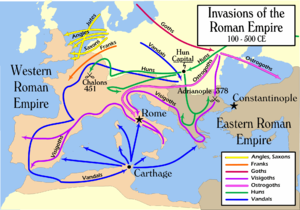 Meanwhile, the Eastern Roman Empire faced its own problems with Germanic tribes. The Thervingi, an East Germanic tribe, fled their former lands following an invasion by the Huns
. Their leaders Alavivus and Fritigern
led them to seek refuge in the Eastern Roman Empire. Valens indeed let them settle as foederati
on the southern bank of the Danube in 376. However, the newcomers faced problems from allegedly corrupted
provincial commanders and a series of hardships. Their dissatisfaction led them to revolt against their Roman hosts.
For the following two years conflicts continued. Valens personally led a campaign against them in 378. Gratian provided his uncle with reinforcements from the Western Roman army. However this campaign proved disastrous for the Romans. The two armies approached each other near Adrianople. Valens was apparently overconfident of the numerical superiority of his own forces over the Goths. Some of his officers advised caution and to await the arrival of Gratian, others urged an immediate attack and eventually prevailed over Valens, who, eager to have all of the glory for himself, rushed into battle. On August 9, 378, the Battle of Adrianople
resulted in the crushing defeat of the Romans and the death of Valens. Contemporary historian Ammianus Marcellinus
estimated that two-thirds of the Roman army were lost in the battle. The last third managed to retreat.
The battle had far-reaching consequences. Veteran soldiers and valuable administrators were among the heavy casualties. There were few available replacements at the time, leaving the Empire with the problems of finding suitable leadership. The Roman army would also start facing recruiting problems. In the following century much of the Roman army would consist of Germanic mercenaries.
For the moment however there was another concern. The death of Valens left Gratian and Valentinian II as the sole two Augusti. Gratian was now effectively responsible for the whole of the Empire. He sought however a replacement Augustus for the Eastern Roman Empire. His choice was Theodosius I
, son of formerly distinguished general Count Theodosius
. The elder Theodosius had been executed in early 375 for unclear reasons. The younger one was named Augustus of the Eastern Roman Empire on January 19, 379. His appointment would prove a deciding moment in the division of the Empire.
while Frankish
general Merobaudes
and bishop Ambrose
of Milan
jointly acted as the power behind the throne
. Gratian lost favor with factions of the Roman Senate
by prohibiting traditional paganism at Rome and relinquishing his title of Pontifex Maximus
. The senior Augustus also became unpopular with his own Roman troops because of his close association with so-called barbarian
s. He reportedly recruited Alans
to his personal service and adopted the guise of a Scythia
n warrior
for public appearances.
Meanwhile Gratian, Valentinian II and Theodosius were joined by a fourth Augustus. Theodosius proclaimed his oldest son Arcadius
an Augustus in January 383 in an obvious attempt to secure succession. The boy was still only five or six years old and held no actual authority. Nevertheless he was recognised as a co-ruler by all three Augusti.
The increasing unpopularity of Gratian would cause the four Augusti problems later that same year. Magnus Maximus
, a general from Hispania
, stationed in Roman Britain
, was proclaimed Augustus by his troops in 383 and rebelling against Gratian he invaded Gaul
. Gratian fled from Lutetia
(Paris
) to Lugdunum
(Lyon
), where he was assassinated on August 25, 383 at the age of 25.
Maximus was a firm believer of the Nicene Creed
and introduced state persecution on charges of heresy
, which brought him into conflict with Pope Siricius
who argued that the Augustus had no authority over church matters. But he was an Emperor with popular support, as is attested in Romano-British
tradition, where he gained a place in the Mabinogion
, compiled about a thousand years after his death.
Following Gratian's death, Maximus had to deal with Valentinian II, at the time only twelve years old, as the senior Augustus. The first few years the Alps
would serve as the borders between the respective territories of the two rival Western Roman Emperors. Maximus controlled Britain, Gaul, Hispania
and Africa. He chose Augusta Treverorum (Trier
) as his capital.
Maximus soon entered negotiations with Valentinian II and Theodosius, attempting to gain their official recognition. By 384, negotiations were unfruitful and Maximus tried to press the matter by settling succession as only a legitimate Emperor could do: proclaiming his own infant son Flavius Victor
an Augustus. The end of the year found the Empire having five Augusti (Valentinian II, Theodosius I, Arcadius, Magnus Maximus and Flavius Victor) with relations between them yet to be determined.
Theodosius was left a widower in 385, following the sudden death of Aelia Flaccilla
, his Augusta. He was remarried, to the sister of Valentinean II, Galla, and the marriage secured closer relations between the two legitimate Augusti.
In 386 Maximus and Victor finally received official recognition by Theodosius but not by Valentinian. In 387, Maximus apparently decided to rid himself of his Italian rival. He crossed the Alps into the valley of the Po
and threatened Milan
. Valentinian and his mother fled to Thessaloniki
from where they sought the support of Theodosius. Theodosius indeed campaigned west in 388 and was victorious against Maximus. Maximus himself was captured and executed in Aquileia
on July 28, 388. Magister militum
Arbogast
was sent to Trier with orders to also kill Flavius Victor. Theodosius restored Valentinian to power and through his influence had him converted to Orthodox Catholicism. Theodosius continued supporting Valentinian and protecting him from a variety of usurpations.
 In 392 Valentinian II
was murdered in Vienne
. Arbogast arranged for the appointment of Eugenius
as emperor. However, the eastern emperor Theodosius
refused to recognise Eugenius as emperor and invaded the West, defeating and killing Arbogast and Eugenius at the Battle of the Frigidus
. He thus reunited the entire Roman Empire under his rule.
Theodosius had two sons and a daughter, Pulcheria, from his first wife, Aelia Flacilla. His daughter and wife died in 385. By his second wife, Galla, he had a daughter, Galla Placidia
, the mother of Valentinian III
, who would be Emperor of the West.
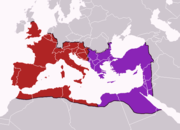
Theodosius was the last Emperor who ruled over the whole Empire. After his death in 395, he gave the two halves of the Empire to his two sons Arcadius
and Honorius
; Arcadius became ruler in the East, with his capital in Constantinople
, and Honorius became ruler in the West, with his capital in Milan
and later Ravenna
. The Roman state would continue to have two different emperors with different seats of power throughout the 5th century, though the Eastern Romans considered themselves Roman in full. Latin was used in official writings as much as, if not more than, Greek. The two halves were nominally, culturally and historically, if not politically, the same state.
After 395, the emperors in the Western Roman Empire
were usually figureheads. For most of the time, the actual rulers were military strongmen who took the title of magister militum
, patrician or both—Stilicho
from 395 to 408, Constantius
from about 411 to 421, Aëtius
from 433 to 454 and Ricimer
from about 457 to 472. The year 476 is generally accepted as the formal end of the Western Roman Empire. That year, Orestes refused the request of Germanic mercenaries in his service for lands in Italy. The dissatisfied mercenaries, including the Heruli
, revolted. The revolt was led by the Germanic chieftain Odoacer
. Odoacer and his men captured and executed Orestes. Within weeks, Ravenna was captured and Romulus Augustus was deposed, the event that has been traditionally considered the fall of the Roman Empire, at least in the West. Odoacer quickly conquered the remaining provinces of Italy.
Odoacer then sent the Imperial Regalia back to the emperor Zeno. Zeno soon received two deputations. One was from Odoacer requesting that his control of Italy be formally recognised by the Empire, in which case he would acknowledge Zeno's supremacy. The other deputation was from Nepos, asking for support to regain the throne. Zeno granted Odoacer the title Patrician. Zeno told Odoacer and the Roman Senate to take Nepos back; however, Nepos never returned from Dalmatia, even though Odoacer issued coins in his name. Upon Nepos's death in 480, Zeno claimed Dalmatia for the East; J. B. Bury
considers this the real end of the Western Roman Empire. Odoacer attacked Dalmatia, and the ensuing war ended with Theodoric the Great
, King of the Ostrogoths, conquering Italy under Zeno's authority.
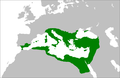 As the Western Roman Empire weakened and vanished in the 5th century, the richer Eastern Roman Empire (today known as Byzantine Empire
) managed to survive and to recover its strength. In the mid 6th century emperor Justinian I
managed to reconquer Italy
and parts of Illyria
from the Ostrogoths, North Africa from the Vandals
, and parts of southern Hispania
from the Visigoths.
Emperor Heraclius
conducted sweeping internal structural reforms in 610, changing the face and arguably the nature of the empire. Greek language became the language of government and the influence of Latin slowly waned. The Eastern Roman Empire was under strong and increasing Greek cultural influence and became what many current historians now call the Byzantine Empire
, although the Empire was never called thus by its inhabitants. They rather called it Romania, Basileia Romaion or Pragmata Romaion, meaning "Land of the Romans", "Kingdom of the Romans"), regarded themselves as Romans, and understood that their state was a direct continuation of the Roman Empire .
The Byzantine empire fell in 1453 to the Ottoman Turks
led by Mehmed II
with the conquest of Constantinople
and the death of Constantine XI
. The Greek ethnic self-descriptive name Roman survives to this day.
Roman Empire
The Roman Empire was the post-Republican period of the ancient Roman civilization, characterised by an autocratic form of government and large territorial holdings in Europe and around the Mediterranean....
, the period in which it was divided into western
Western Roman Empire
The Western Roman Empire was the western half of the Roman Empire after its division by Diocletian in 285; the other half of the Roman Empire was the Eastern Roman Empire, commonly referred to today as the Byzantine Empire....
and eastern halves, and the history of the Eastern Roman or Byzantine Empire
Byzantine Empire
The Byzantine Empire was the Eastern Roman Empire during the periods of Late Antiquity and the Middle Ages, centred on the capital of Constantinople. Known simply as the Roman Empire or Romania to its inhabitants and neighbours, the Empire was the direct continuation of the Ancient Roman State...
that continued through the Middle Ages
Middle Ages
The Middle Ages is a periodization of European history from the 5th century to the 15th century. The Middle Ages follows the fall of the Western Roman Empire in 476 and precedes the Early Modern Era. It is the middle period of a three-period division of Western history: Classic, Medieval and Modern...
and to the beginning of the Modern Era.
27 BC–AD 14: Augustus
Lugdunum
Colonia Copia Claudia Augusta Lugdunum was an important Roman city in Gaul. The city was founded in 43 BC by Lucius Munatius Plancus. It served as the capital of the Roman province Gallia Lugdunensis. To 300 years after its foundation Lugdunum was the most important city to the west part of Roman...
the capital of Gaul
Gaul
Gaul was a region of Western Europe during the Iron Age and Roman era, encompassing present day France, Luxembourg and Belgium, most of Switzerland, the western part of Northern Italy, as well as the parts of the Netherlands and Germany on the left bank of the Rhine. The Gauls were the speakers of...
.
The Battle of Actium
Battle of Actium
The Battle of Actium was the decisive confrontation of the Final War of the Roman Republic. It was fought between the forces of Octavian and the combined forces of Mark Antony and Cleopatra VII. The battle took place on 2 September 31 BC, on the Ionian Sea near the city of Actium, at the Roman...
resulted in the defeat and subsequent suicides of Mark Antony
Mark Antony
Marcus Antonius , known in English as Mark Antony, was a Roman politician and general. As a military commander and administrator, he was an important supporter and loyal friend of his mother's cousin Julius Caesar...
and Cleopatra
Cleopatra VII of Egypt
Cleopatra VII Philopator was the last pharaoh of Ancient Egypt.She was a member of the Ptolemaic dynasty, a family of Greek origin that ruled Egypt after Alexander the Great's death during the Hellenistic period...
. Octavian had also executed Cleopatra's young son and co-ruler, Caesarion
Caesarion
Ptolemy XV Philopator Philometor Caesar , better known by the nicknames Caesarion and Ptolemy Caesar , was the last king of the Ptolemaic dynasty of Egypt, who reigned jointly with his mother Cleopatra VII of Egypt, from September 2, 44 BC...
. Caesarion may have been the (only) son of Julius Caesar
Julius Caesar
Gaius Julius Caesar was a Roman general and statesman and a distinguished writer of Latin prose. He played a critical role in the gradual transformation of the Roman Republic into the Roman Empire....
. Therefore, by killing Caesarion, Octavian removed any possibility of a male rival emerging with closer blood ties to Julius Caesar. Octavian, now sole ruler of Rome, began a full-scale reformation of military, fiscal and political matters. These were intended to stabilise and pacify the Roman world and also to secure acceptance of the new regime.
Upon Octavian's accession as ruler of the Roman world, the Roman Senate gave Octavian the name Augustus
Augustus (honorific)
Augustus , Latin for "majestic," "the increaser," or "venerable", was an Ancient Roman title, which was first held by Gaius Julius Caesar Augustus , and subsequently came to be considered one of the titles of what are now known as the Roman Emperors...
. He had already adopted the title imperator
Imperator
The Latin word Imperator was originally a title roughly equivalent to commander under the Roman Republic. Later it became a part of the titulature of the Roman Emperors as part of their cognomen. The English word emperor derives from imperator via Old French Empreur...
, "commander-in-chief", as his first name
Praenomen
The praenomen was a personal name chosen by the parents of a Roman child. It was first bestowed on the dies lustricus , the eighth day after the birth of a girl, or the ninth day after the birth of a boy...
. It was a term that dated back to the days of the Roman Republic
Roman Republic
The Roman Republic was the period of the ancient Roman civilization where the government operated as a republic. It began with the overthrow of the Roman monarchy, traditionally dated around 508 BC, and its replacement by a government headed by two consuls, elected annually by the citizens and...
and later evolved into emperor
Emperor
An emperor is a monarch, usually the sovereign ruler of an empire or another type of imperial realm. Empress, the female equivalent, may indicate an emperor's wife or a woman who rules in her own right...
.
As adopted heir of Caesar, Augustus preferred to be called by this name. Caesar was a part of his family name. Julio-Claudian
Julio-Claudian Dynasty
The Julio-Claudian dynasty normally refers to the first five Roman Emperors: Augustus, Tiberius, Caligula , Claudius, and Nero, or the family to which they belonged; they ruled the Roman Empire from its formation, in the second half of the 1st century BC, until AD 68, when the last of the line,...
rule lasted for 117 years (from Julius Caesar, the last Roman dictator
Roman dictator
In the Roman Republic, the dictator , was an extraordinary magistrate with the absolute authority to perform tasks beyond the authority of the ordinary magistrate . The office of dictator was a legal innovation originally named Magister Populi , i.e...
in 49 BC to the deposition of emperor Nero
Nero
Nero , was Roman Emperor from 54 to 68, and the last in the Julio-Claudian dynasty. Nero was adopted by his great-uncle Claudius to become his heir and successor, and succeeded to the throne in 54 following Claudius' death....
in 68 AD). By the time of the Flavian Dynasty
Flavian dynasty
The Flavian dynasty was a Roman Imperial Dynasty, which ruled the Roman Empire between 69 and 96 AD, encompassing the reigns of Vespasian , and his two sons Titus and Domitian . The Flavians rose to power during the civil war of 69, known as the Year of the Four Emperors...
(69-96), that is the reign of Vespasian
Vespasian
Vespasian , was Roman Emperor from 69 AD to 79 AD. Vespasian was the founder of the Flavian dynasty, which ruled the Empire for a quarter century. Vespasian was descended from a family of equestrians, who rose into the senatorial rank under the Emperors of the Julio-Claudian dynasty...
, and those of his two sons, Titus
Titus
Titus , was Roman Emperor from 79 to 81. A member of the Flavian dynasty, Titus succeeded his father Vespasian upon his death, thus becoming the first Roman Emperor to come to the throne after his own father....
and Domitian
Domitian
Domitian was Roman Emperor from 81 to 96. Domitian was the third and last emperor of the Flavian dynasty.Domitian's youth and early career were largely spent in the shadow of his brother Titus, who gained military renown during the First Jewish-Roman War...
, the term Caesar
Caesar (title)
Caesar is a title of imperial character. It derives from the cognomen of Julius Caesar, the Roman dictator...
had evolved, almost de facto
De facto
De facto is a Latin expression that means "concerning fact." In law, it often means "in practice but not necessarily ordained by law" or "in practice or actuality, but not officially established." It is commonly used in contrast to de jure when referring to matters of law, governance, or...
, from a family name into a formal title. Derivatives of this title (such as Tsar
Tsar
Tsar is a title used to designate certain European Slavic monarchs or supreme rulers. As a system of government in the Tsardom of Russia and Russian Empire, it is known as Tsarist autocracy, or Tsarism...
and kaiser
Kaiser
Kaiser is the German title meaning "Emperor", with Kaiserin being the female equivalent, "Empress". Like the Russian Czar it is directly derived from the Latin Emperors' title of Caesar, which in turn is derived from the personal name of a branch of the gens Julia, to which Gaius Julius Caesar,...
) endure to this day.
The Roman legion
Roman legion
A Roman legion normally indicates the basic ancient Roman army unit recruited specifically from Roman citizens. The organization of legions varied greatly over time but they were typically composed of perhaps 5,000 soldiers, divided into maniples and later into "cohorts"...
s, which had reached an unprecedented number (around 50) because of the Roman civil wars
Roman civil wars
There were several Roman civil wars, especially during the late Republic. The most famous of these are the war in the 40s BC between Julius Caesar and the optimate faction of the senatorial elite initially led by Pompey and the subsequent war between Caesar's successors, Octavian and Mark Antony in...
, were reduced to 28. Several legions, particularly those with members of doubtful loyalties, were simply demobilised. Other legions were united, a fact hinted by the title Gemina (Twin). Augustus also created nine special cohorts
Cohort (military unit)
A cohort was the basic tactical unit of a Roman legion following the reforms of Gaius Marius in 107 BC.-Legionary cohort:...
, allegedly to maintain the peace in Italia, keeping at least three of them stationed at Rome. These cohorts became known as the Praetorian Guard
Praetorian Guard
The Praetorian Guard was a force of bodyguards used by Roman Emperors. The title was already used during the Roman Republic for the guards of Roman generals, at least since the rise to prominence of the Scipio family around 275 BC...
.
Octavian realised that autocracy and kingship were things that Romans had not experienced for centuries, and were wary of. Octavian did not want to be viewed as a tyrant
Tyrant
A tyrant was originally one who illegally seized and controlled a governmental power in a polis. Tyrants were a group of individuals who took over many Greek poleis during the uprising of the middle classes in the sixth and seventh centuries BC, ousting the aristocratic governments.Plato and...
and sought to retain the illusion of the constitutional republic. He attempted to make it seem as though the constitution of the Roman Republic
Constitution of the Roman Republic
The Constitution of the Roman Republic was a set of guidelines and principles passed down mainly through precedent. The constitution was largely unwritten, uncodified, and constantly evolving...
was still functional. Even Rome's past dictators, such as the brutal Lucius Cornelius Sulla
Lucius Cornelius Sulla
Lucius Cornelius Sulla Felix , known commonly as Sulla, was a Roman general and statesman. He had the rare distinction of holding the office of consul twice, as well as that of dictator...
, had only ruled Rome for short spans of time, never more than a year or two. The sole exception was Julius Caesar, his term ending in his assassination
Assassination of Julius Caesar
The assassination of Julius Caesar was the result of a conspiracy by approximately forty Roman senators who called themselves Liberators. Led by Gaius Cassius Longinus and Marcus Junius Brutus, they stabbed Julius Caesar to death in the Theatre of Pompey on the Ides of March 44 BC...
. In 27 BC, Octavian officially tried to hand over all his extraordinary powers to the Roman Senate
Roman Senate
The Senate of the Roman Republic was a political institution in the ancient Roman Republic, however, it was not an elected body, but one whose members were appointed by the consuls, and later by the censors. After a magistrate served his term in office, it usually was followed with automatic...
. In a carefully staged way, the senators, who by this time were mostly his partisans, refused and begged him to keep them for the sake of the republic and the people of Rome. Reportedly, the suggestion of Octavian stepping down as a Roman consul
Roman consul
A consul served in the highest elected political office of the Roman Republic.Each year, two consuls were elected together, to serve for a one-year term. Each consul was given veto power over his colleague and the officials would alternate each month...
led to rioting amongst the Plebeians
Plebs
The plebs was the general body of free land-owning Roman citizens in Ancient Rome. They were distinct from the higher order of the patricians. A member of the plebs was known as a plebeian...
in Rome. A compromise was reached between the Senate and Octavian, known as the First Settlement. This agreement gave Augustus legitimacy as an autocrat of the people, and ensured that he would not be considered a tyrant, starting the long and prosperous period that would be known as Pax Romana
Pax Romana
Pax Romana was the long period of relative peace and minimal expansion by military force experienced by the Roman Empire in the 1st and 2nd centuries AD. Since it was established by Caesar Augustus it is sometimes called Pax Augusta...
.
Octavian split with the Senate the governorships of the Roman province
Roman province
In Ancient Rome, a province was the basic, and, until the Tetrarchy , largest territorial and administrative unit of the empire's territorial possessions outside of Italy...
s. The unruly provinces at the borders, where the vast majority of the legions were stationed, were administrated by imperial legates
Legatus
A legatus was a general in the Roman army, equivalent to a modern general officer. Being of senatorial rank, his immediate superior was the dux, and he outranked all military tribunes...
, chosen by the emperor himself. These provinces were classified as imperial provinces. The governors of the peaceful senatorial provinces were chosen by the Senate. These provinces were usually peaceful and only a single legion was stationed in the senatorial province of Africa
Africa Province
The Roman province of Africa was established after the Romans defeated Carthage in the Third Punic War. It roughly comprised the territory of present-day northern Tunisia, and the small Mediterranean coast of modern-day western Libya along the Syrtis Minor...
.
Fiscus
Fiscus, from which comes the English term fiscal, was the name of the personal treasury of the emperors of Rome. The word is literally translated as "basket" or "purse" and was used to describe those forms of revenue collected from the provinces , which were then granted to the emperor...
, which was administrated by persons chosen by, and answerable only to, Augustus. The revenue of the senatorial provinces continued to be sent to the Aerarium
Aerarium
Aerarium was the name given in Ancient Rome to the public treasury, and in a secondary sense to the public finances....
, under the supervision of the Senate. This effectively made Augustus richer than the Senate, and more than able to pay the salarium (salary) of the legionaries
Legionary
The Roman legionary was a professional soldier of the Roman army after the Marian reforms of 107 BC. Legionaries had to be Roman citizens under the age of 45. They enlisted in a legion for twenty-five years of service, a change from the early practice of enlisting only for a campaign...
, ensuring their continued loyalty. This was ensured by the Imperial province of Roman Egypt, which was incredibly wealthy and also the most important grain supplier for the whole empire. Senators were forbidden to even visit this province, as it was largely considered the personal fiefdom of the emperor himself.
Augustus renounced his consulship in 23 BC, but retained his consular imperium, leading to a second compromise between Augustus and the Senate known as the Second Settlement. Augustus was granted the authority of a tribune
Tribune
Tribune was a title shared by elected officials in the Roman Republic. Tribunes had the power to convene the Plebeian Council and to act as its president, which also gave them the right to propose legislation before it. They were sacrosanct, in the sense that any assault on their person was...
(tribunicia potestas), though not the title, which allowed him to call together the Senate and people at will and lay business before it, veto the actions of either the Assembly or the Senate, preside over elections, and gave him the right to speak first at any meeting. Also included in Augustus's tribunician authority were powers usually reserved for the Roman censor; these included the right to supervise public morals and scrutinise laws to ensure they were in the public interest, as well as the ability to hold a census and determine the membership of the Senate. No tribune of Rome ever had these powers, and there was no precedent within the Roman system for consolidating the powers of the tribune and the censor into a single position, nor was Augustus ever elected to the office of Censor. Whether censorial powers were granted to Augustus as part of his tribunician authority, or he simply assumed these responsibilities, is still a matter of debate.
In addition to tribunician authority, Augustus was granted sole imperium within the city of Rome itself; all armed forces in the city, formerly under the control of the prefects, were now under the sole authority of Augustus. Additionally, Augustus was granted imperium proconsulare maius (power over all proconsuls), the right to interfere in any province and override the decisions of any governor. With maius imperium, Augustus was the only individual able to grant a triumph
Roman triumph
The Roman triumph was a civil ceremony and religious rite of ancient Rome, held to publicly celebrate and sanctify the military achievement of an army commander who had won great military successes, or originally and traditionally, one who had successfully completed a foreign war. In Republican...
to a successful general as he was ostensibly the leader of the entire Roman army.
All of these reforms were highly unusual in the eyes of Roman republican tradition, but the Senate was no longer composed of the republican patricians who had the courage to murder Caesar. Most of these senators had died in the Civil Wars, and the leaders of the conservative Republicans in the senate, such as Cato the Younger
Cato the Younger
Marcus Porcius Cato Uticensis , commonly known as Cato the Younger to distinguish him from his great-grandfather , was a politician and statesman in the late Roman Republic, and a follower of the Stoic philosophy...
and Cicero
Cicero
Marcus Tullius Cicero , was a Roman philosopher, statesman, lawyer, political theorist, and Roman constitutionalist. He came from a wealthy municipal family of the equestrian order, and is widely considered one of Rome's greatest orators and prose stylists.He introduced the Romans to the chief...
, had long since died. Octavian had purged the Senate of any remaining suspect elements and planted the body with his own partisans. How free a hand the Senate had in all these transactions, and what back-room deals were made, remains unknown.
Attempting to secure the borders of the empire upon the rivers Danube
Danube
The Danube is a river in the Central Europe and the Europe's second longest river after the Volga. It is classified as an international waterway....
and Elbe
Elbe
The Elbe is one of the major rivers of Central Europe. It rises in the Krkonoše Mountains of the northwestern Czech Republic before traversing much of Bohemia , then Germany and flowing into the North Sea at Cuxhaven, 110 km northwest of Hamburg...
, Octavian ordered the invasions of Illyria
Illyricum (Roman province)
The Roman province of Illyricum or Illyris Romana or Illyris Barbara or Illyria Barbara replaced most of the region of Illyria. It stretched from the Drilon river in modern north Albania to Istria in the west and to the Sava river in the north. Salona functioned as its capital...
, Moesia
Moesia
Moesia was an ancient region and later Roman province situated in the Balkans, along the south bank of the Danube River. It included territories of modern-day Southern Serbia , Northern Republic of Macedonia, Northern Bulgaria, Romanian Dobrudja, Southern Moldova, and Budjak .-History:In ancient...
, and Pannonia
Pannonia
Pannonia was an ancient province of the Roman Empire bounded north and east by the Danube, coterminous westward with Noricum and upper Italy, and southward with Dalmatia and upper Moesia....
(south of the Danube), and Germania
Germania
Germania was the Greek and Roman geographical term for the geographical regions inhabited by mainly by peoples considered to be Germani. It was most often used to refer especially to the east of the Rhine and north of the Danube...
(west of the Elbe). At first everything went as planned, but then disaster struck. The Illyrian tribes revolted and had to be crushed, and three full legions under the command of Publius Quinctilius Varus
Publius Quinctilius Varus
Publius Quinctilius Varus was a Roman politician and general under Emperor Augustus, mainly remembered for having lost three Roman legions and his own life when attacked by Germanic leader Arminius in the Battle of the Teutoburg Forest.-Life:His paternal grandfather was senator Sextus Quinctilius...
were ambushed and destroyed at the Battle of the Teutoburg Forest
Battle of the Teutoburg Forest
The Battle of the Teutoburg Forest took place in 9 CE, when an alliance of Germanic tribes led by Arminius of the Cherusci ambushed and decisively destroyed three Roman legions, along with their auxiliaries, led by Publius Quinctilius Varus.Despite numerous successful campaigns and raids by the...
in AD 9 by Germanic tribes led by Arminius
Arminius
Arminius , also known as Armin or Hermann was a chieftain of the Germanic Cherusci who defeated a Roman army in the Battle of the Teutoburg Forest...
. Being cautious, Augustus secured all territories west of Rhine and contented himself with retaliatory raids. The rivers Rhine and Danube became the permanent borders of the Roman empire in the North.
Sources
The age of Augustus is far more poorly documented than the late Republican period that preceded it. While LivyLivy
Titus Livius — known as Livy in English — was a Roman historian who wrote a monumental history of Rome and the Roman people. Ab Urbe Condita Libri, "Chapters from the Foundation of the City," covering the period from the earliest legends of Rome well before the traditional foundation in 753 BC...
wrote his magisterial history during Augustus's reign and his work covered all of Roman history through 9 BC, only epitome
Epitome
An epitome is a summary or miniature form; an instance that represents a larger reality, also used as a synonym for embodiment....
s survive of his coverage of the late Republican and Augustan periods. Important primary sources for this period include:
- Res Gestae Divi AugustiRes Gestae Divi AugustiRes Gestae Divi Augusti, is the funerary inscription of the first Roman emperor, Augustus, giving a first-person record of his life and accomplishments. The Res Gestae is especially significant because it gives an insight into the image Augustus portrayed to the Roman people...
, Augustus's highly partisan autobiography, - Historiae Romanae by Velleius Paterculus, a disorganised work which remains the best annalsAnnalsAnnals are a concise form of historical representation which record events chronologically, year by year. The Oxford English Dictionary defines annals as "a narrative of events written year by year"...
of the Augustan period, - Controversiae and Suasoriae of Seneca the ElderSeneca the ElderLucius or Marcus Annaeus Seneca, known as Seneca the Elder and Seneca the Rhetorician , was a Roman rhetorician and writer, born of a wealthy equestrian family of Cordoba, Hispania...
.
Though primary accounts of this period are few, works of poetry, legislation and engineering from this period provide important insights into Roman life. Archaeology, including maritime archaeology
Maritime archaeology
Maritime archaeology is a discipline within archaeology as a whole that specifically studies human interaction with the sea, lakes and rivers through the study of associated physical remains, be they vessels, shore side facilities, port-related structures, cargoes, human remains and submerged...
, aerial surveys, epigraphic
Epigraphy
Epigraphy Epigraphy Epigraphy (from the , literally "on-writing", is the study of inscriptions or epigraphs as writing; that is, the science of identifying the graphemes and of classifying their use as to cultural context and date, elucidating their meaning and assessing what conclusions can be...
inscriptions on buildings, and Augustan coinage
Roman currency
The Roman currency during most of the Roman Republic and the western half of the Roman Empire consisted of coins including the aureus , the denarius , the sestertius , the dupondius , and the as...
, has also provided valuable evidence about economic, social and military conditions.
Secondary sources on the Augustan Age include Tacitus
Tacitus
Publius Cornelius Tacitus was a senator and a historian of the Roman Empire. The surviving portions of his two major works—the Annals and the Histories—examine the reigns of the Roman Emperors Tiberius, Claudius, Nero and those who reigned in the Year of the Four Emperors...
, Dio Cassius
Dio Cassius
Lucius Cassius Dio Cocceianus , known in English as Cassius Dio, Dio Cassius, or Dio was a Roman consul and a noted historian writing in Greek...
, Plutarch
Plutarch
Plutarch then named, on his becoming a Roman citizen, Lucius Mestrius Plutarchus , c. 46 – 120 AD, was a Greek historian, biographer, essayist, and Middle Platonist known primarily for his Parallel Lives and Moralia...
and Lives of the Twelve Caesars
Lives of the Twelve Caesars
De vita Caesarum commonly known as The Twelve Caesars, is a set of twelve biographies of Julius Caesar and the first 11 emperors of the Roman Empire written by Gaius Suetonius Tranquillus.The work, written in AD 121 during the reign of the emperor Hadrian, was the most popular work of Suetonius,...
by Suetonius
Suetonius
Gaius Suetonius Tranquillus, commonly known as Suetonius , was a Roman historian belonging to the equestrian order in the early Imperial era....
. Josephus
Josephus
Titus Flavius Josephus , also called Joseph ben Matityahu , was a 1st-century Romano-Jewish historian and hagiographer of priestly and royal ancestry who recorded Jewish history, with special emphasis on the 1st century AD and the First Jewish–Roman War, which resulted in the Destruction of...
's Jewish Antiquities is the important source for Judea
Judea
Judea or Judæa was the name of the mountainous southern part of the historic Land of Israel from the 8th century BCE to the 2nd century CE, when Roman Judea was renamed Syria Palaestina following the Jewish Bar Kokhba revolt.-Etymology:The...
in this period, which became a province
Roman province
In Ancient Rome, a province was the basic, and, until the Tetrarchy , largest territorial and administrative unit of the empire's territorial possessions outside of Italy...
during Augustus's reign.
14–68: Julio-Claudian Dynasty
Augustus had three grandsons by his daughter Julia the ElderJulia the Elder
Julia the Elder , known to her contemporaries as Julia Caesaris filia or Julia Augusti filia was the daughter and only biological child of Augustus, the first emperor of the Roman Empire. Augustus subsequently adopted several male members of his close family as sons...
:Gaius Caesar
Gaius Caesar
Gaius Julius Caesar , most commonly known as Gaius Caesar or Caius Caesar, was the oldest son of Marcus Vipsanius Agrippa and Julia the Elder...
, Lucius Caesar
Lucius Caesar
Lucius Julius Caesar , most commonly known as Lucius Caesar, was the second son of Marcus Vipsanius Agrippa and Julia the Elder. He was born between 14 of June and 15 July 17 BC with the name Lucius Vipsanius Agrippa, but when he was adopted by his maternal grandfather Roman Emperor Caesar...
and Agrippa Postumus
Agrippa Postumus
Marcus Vipsanius Agrippa Postumus , also known as Agrippa Postumus or Postumus Agrippa, was a son of Marcus Vipsanius Agrippa and Julia the Elder. His maternal grandparents were Roman Emperor Augustus and his second wife Scribonia.Marcus Vipsanius Agrippa Postumus was born on June 26, 12 BC, the...
. None of the three lived long enough to succeed him. He therefore was succeeded by his stepson Tiberius
Tiberius
Tiberius , was Roman Emperor from 14 AD to 37 AD. Tiberius was by birth a Claudian, son of Tiberius Claudius Nero and Livia Drusilla. His mother divorced Nero and married Augustus in 39 BC, making him a step-son of Octavian...
. Tiberius was the son of Livia
Livia
Livia Drusilla, , after her formal adoption into the Julian family in AD 14 also known as Julia Augusta, was a Roman empress as the third wife of the Emperor Augustus and his adviser...
, the third wife of Octavian, by her first marriage to Tiberius Nero
Tiberius Nero
Not to be confused with his son Tiberius or his grandson Germanicus, who both had the name 'Tiberius Claudius Nero' at one time or another. Tiberius Claudius Nero was a member of the Claudian Family of ancient Rome. He was a descendant of the original Tiberius Claudius Nero a consul, son of...
. Augustus was a scion of the gens
Gens
In ancient Rome, a gens , plural gentes, referred to a family, consisting of all those individuals who shared the same nomen and claimed descent from a common ancestor. A branch of a gens was called a stirps . The gens was an important social structure at Rome and throughout Italy during the...
Julia
Julius
The gens Julia was one of the most ancient patrician families at Ancient Rome. Members of the gens attained the highest dignities of the state in the earliest times of the Republic. The first of the family to obtain the consulship was Gaius Julius Iulus in 489 BC...
(the Julian family), one of the most ancient patrician clans of Rome
Ancient Rome
Ancient Rome was a thriving civilization that grew on the Italian Peninsula as early as the 8th century BC. Located along the Mediterranean Sea and centered on the city of Rome, it expanded to one of the largest empires in the ancient world....
, while Tiberius was a scion of the gens Claudia
Claudius (gens)
The gens Claudia, sometimes written Clodia, was one of the most prominent patrician houses at Rome. The gens traced its origin to the earliest days of the Roman Republic...
, only slightly less ancient than the Julians. Their three immediate successors were all descended both from the gens Claudia, through Tiberius' brother Nero Claudius Drusus
Nero Claudius Drusus
Nero Claudius Drusus Germanicus , born Decimus Claudius Drusus also called Drusus, Drusus I, Nero Drusus, or Drusus the Elder was a Roman politician and military commander. He was a fully patrician Claudian on his father's side but his maternal grandmother was from a plebeian family...
, and from gens Julia, either through Julia the Elder, Augustus' daughter from his first marriage (Caligula
Caligula
Caligula , also known as Gaius, was Roman Emperor from 37 AD to 41 AD. Caligula was a member of the house of rulers conventionally known as the Julio-Claudian dynasty. Caligula's father Germanicus, the nephew and adopted son of Emperor Tiberius, was a very successful general and one of Rome's most...
and Nero
Nero
Nero , was Roman Emperor from 54 to 68, and the last in the Julio-Claudian dynasty. Nero was adopted by his great-uncle Claudius to become his heir and successor, and succeeded to the throne in 54 following Claudius' death....
), or through Augustus' sister Octavia Minor
Octavia Minor
Octavia the Younger , also known as Octavia Minor or simply Octavia, was the sister of the first Roman Emperor, Augustus , half-sister of Octavia the Elder, and fourth wife of Mark Antony...
(Claudius
Claudius
Claudius , was Roman Emperor from 41 to 54. A member of the Julio-Claudian dynasty, he was the son of Drusus and Antonia Minor. He was born at Lugdunum in Gaul and was the first Roman Emperor to be born outside Italy...
). Historians thus refer to their dynasty as "Julio-Claudian".
14–37: Tiberius
The early years of Tiberius's reign were peaceful and relatively pleasant. Tiberius secured the overall power of Rome and enriched its treasury. However, Tiberius's reign soon became characterised by paranoia and slander. In 19, he was widely blamed for the death of his nephew, the popular GermanicusGermanicus
Germanicus Julius Caesar , commonly known as Germanicus, was a member of the Julio-Claudian dynasty and a prominent general of the early Roman Empire. He was born in Rome, Italia, and was named either Nero Claudius Drusus after his father or Tiberius Claudius Nero after his uncle...
. In 23 his own son Julius Caesar Drusus
Julius Caesar Drusus
Nero Claudius Drusus, later Drusus Julius Caesar was the only child of Roman Emperor Tiberius and his first wife, Vipsania Agrippina...
died. More and more, Tiberius retreated into himself. He began a series of treason trials and executions.
He left power in the hands of the commander of the guard, Lucius Aelius Sejanus
Sejanus
Lucius Aelius Seianus , commonly known as Sejanus, was an ambitious soldier, friend and confidant of the Roman Emperor Tiberius...
. Tiberius himself retired to live at his villa on the island of Capri
Capri
Capri is an Italian island in the Tyrrhenian Sea off the Sorrentine Peninsula, on the south side of the Gulf of Naples, in the Campania region of Southern Italy...
in 26, leaving administration in the hands of Sejanus, who carried on the persecutions with contentment. Sejanus also began to consolidate his own power; in 31 he was named co-consul with Tiberius and married Livilla
Livilla
Livia Julia was the only daughter of Nero Claudius Drusus and Antonia Minor and sister of the Roman Emperor Claudius and Germanicus...
, the emperor's niece. At this point he was "hoisted by his own petard
Petard
A petard was a small bomb used to blow up gates and walls when breaching fortifications. The term has a French origin and dates back to the sixteenth century...
": the emperor's paranoia, which he had so ably exploited for his own gain, was turned against him. Sejanus was put to death, along with many of his associates, the same year. The persecutions continued until Tiberius' death in 37.
37–41: Caligula
At the time of Tiberius's death most of the people who might have succeeded him had been brutally murdered. The logical successor (and Tiberius' own choice) was his grandnephew, Gaius(better known as "Caligula" or "little boots"). He was a son of GermanicusGermanicus
Germanicus Julius Caesar , commonly known as Germanicus, was a member of the Julio-Claudian dynasty and a prominent general of the early Roman Empire. He was born in Rome, Italia, and was named either Nero Claudius Drusus after his father or Tiberius Claudius Nero after his uncle...
and Agrippina the Elder
Agrippina the elder
Vipsania Agrippina or most commonly known as Agrippina Major or Agrippina the Elder was a distinguished and prominent granddaughter of the Emperor Augustus. Agrippina was the wife of the general, statesman Germanicus and a relative to the first Roman Emperors...
. His paternal grandparents were Nero Claudius Drusus
Nero Claudius Drusus
Nero Claudius Drusus Germanicus , born Decimus Claudius Drusus also called Drusus, Drusus I, Nero Drusus, or Drusus the Elder was a Roman politician and military commander. He was a fully patrician Claudian on his father's side but his maternal grandmother was from a plebeian family...
and Antonia Minor
Antonia Minor
Antonia Minor , also known as Antonia the Younger or simply Antonia was the younger of two daughters of Roman politician Mark Antony and Octavia Minor. Tacitus Ann. 4.44.2 and 12.54.2 may have confused the two Antonia sisters...
, his maternal grandparents were Marcus Vipsanius Agrippa
Marcus Vipsanius Agrippa
Marcus Vipsanius Agrippa was a Roman statesman and general. He was a close friend, son-in-law, lieutenant and defense minister to Octavian, the future Emperor Caesar Augustus...
and Julia the Elder
Julia the Elder
Julia the Elder , known to her contemporaries as Julia Caesaris filia or Julia Augusti filia was the daughter and only biological child of Augustus, the first emperor of the Roman Empire. Augustus subsequently adopted several male members of his close family as sons...
. Consequently a descendant of both Augustus and Livia.
Caligula started out well, by putting an end to the persecutions and burning his uncle's records. Unfortunately, he quickly lapsed into illness. The Caligula that emerged in late 37 demonstrated features of mental instability that led modern commentators to diagnose him with such illnesses as encephalitis
Encephalitis
Encephalitis is an acute inflammation of the brain. Encephalitis with meningitis is known as meningoencephalitis. Symptoms include headache, fever, confusion, drowsiness, and fatigue...
, which can cause mental derangement, hyperthyroidism
Hyperthyroidism
Hyperthyroidism is the term for overactive tissue within the thyroid gland causing an overproduction of thyroid hormones . Hyperthyroidism is thus a cause of thyrotoxicosis, the clinical condition of increased thyroid hormones in the blood. Hyperthyroidism and thyrotoxicosis are not synonymous...
, or even a nervous breakdown (perhaps brought on by the stress of his position). Whatever the cause, there was an obvious shift in his reign from this point on, leading his biographers to think he was insane.
Most of what history remembers of Caligula comes from Suetonius
Suetonius
Gaius Suetonius Tranquillus, commonly known as Suetonius , was a Roman historian belonging to the equestrian order in the early Imperial era....
, in his book Lives of the Twelve Caesars
Lives of the Twelve Caesars
De vita Caesarum commonly known as The Twelve Caesars, is a set of twelve biographies of Julius Caesar and the first 11 emperors of the Roman Empire written by Gaius Suetonius Tranquillus.The work, written in AD 121 during the reign of the emperor Hadrian, was the most popular work of Suetonius,...
. According to Suetonius, Caligula once planned to appoint his favourite horse Incitatus
Incitatus
Incitatus was the favored horse of Roman emperor Caligula. Its name is a Latin adjective meaning "swift" or "at full gallop".According to Suetonius's Lives of the Twelve Caesars, Incitatus had a stable of marble, with an ivory manger, purple blankets, and a collar of precious stones...
to the Roman Senate. He ordered his soldiers to invade Britain to fight the Sea God Neptune
Neptune (mythology)
Neptune was the god of water and the sea in Roman mythology and religion. He is analogous with, but not identical to, the Greek god Poseidon. In the Greek-influenced tradition, Neptune was the brother of Jupiter and Pluto, each of them presiding over one of the three realms of the universe,...
, but changed his mind at the last minute and had them pick sea shells on the northern end of France instead. It is believed he carried on incest
Incest
Incest is sexual intercourse between close relatives that is usually illegal in the jurisdiction where it takes place and/or is conventionally considered a taboo. The term may apply to sexual activities between: individuals of close "blood relationship"; members of the same household; step...
uous relations with his three sisters: Julia Livilla
Julia Livilla
Julia Livilla was the youngest child of Germanicus and Agrippina the Elder and the youngest sister of the Emperor Caligula.-Life:Livilla was the youngest great granddaughter of Emperor Augustus, great-niece and adoptive granddaughter...
, Drusilla and Agrippina the Younger
Agrippina the Younger
Julia Agrippina, most commonly referred to as Agrippina Minor or Agrippina the Younger, and after 50 known as Julia Augusta Agrippina was a Roman Empress and one of the more prominent women in the Julio-Claudian dynasty...
. He ordered a statue of himself to be erected in Herod's Temple at Jerusalem, which would have undoubtedly led to revolt had he not been dissuaded from this plan by his friend king Agrippa I
Agrippa I
Agrippa I also known as Herod Agrippa or simply Herod , King of the Jews, was the grandson of Herod the Great, and son of Aristobulus IV and Berenice. His original name was Marcus Julius Agrippa, so named in honour of Roman statesman Marcus Vipsanius Agrippa, and he is the king named Herod in the...
. He ordered people to be secretly killed, and then called them to his palace. When they did not appear, he would jokingly remark that they must have committed suicide.
In 41, Caligula was assassinated by the commander of the guard Cassius Chaerea
Cassius Chaerea
Cassius Chaerea was a centurion in the army of Germanicus and served in the Praetorian Guard under the emperor Caligula, whom he eventually assassinated....
. Also killed were his fourth wife Caesonia
Caesonia
Milonia Caesonia was the fourth and last wife of the Roman Emperor Caligula.-Life:Milonia Caesonia was born between 2 and 4 June in an unknown year....
and their daughter Julia Drusilla
Julia Drusilla
Julia Drusilla was the only child and daughter of Roman Emperor Gaius and of his fourth and last wife Milonia Caesonia....
. The only member of the imperial family left to take charge was his paternal uncle, Tiberius Claudius Drusus Nero Germanicus.
41–54: Claudius
Claudius was a younger brother of GermanicusGermanicus
Germanicus Julius Caesar , commonly known as Germanicus, was a member of the Julio-Claudian dynasty and a prominent general of the early Roman Empire. He was born in Rome, Italia, and was named either Nero Claudius Drusus after his father or Tiberius Claudius Nero after his uncle...
. Claudius had long been considered a weakling and a fool by the rest of his family. He was, however, neither paranoid like his uncle Tiberius, nor insane like his nephew Caligula, and was therefore able to administer the empire with reasonable ability. He improved the bureaucracy and streamlined the citizenship and senatorial rolls. He also proceeded with the conquest and colonisation of Britain (in 43), and incorporated more Eastern provinces into the empire. He ordered the construction of a winter port for Rome, at Ostia Antica
Ostia Antica
Ostia Antica is a large archeological site, close to the modern suburb of Ostia , that was the location of the harbour city of ancient Rome, which is approximately 30 km to the northeast. "Ostia" in Latin means "mouth". At the mouth of the River Tiber, Ostia was Rome's seaport, but, due to...
, thereby providing a place for grain from other parts of the Empire to be brought in inclement weather.
In his own family life, Claudius was less successful. His wife Messalina
Messalina
Valeria Messalina, sometimes spelled Messallina, was a Roman empress as the third wife of the Emperor Claudius. She was also a paternal cousin of the Emperor Nero, second cousin of the Emperor Caligula, and great-grandniece of the Emperor Augustus...
cuckold
Cuckold
Cuckold is a historically derogatory term for a man who has an unfaithful wife. The word, which has been in recorded use since the 13th century, derives from the cuckoo bird, some varieties of which lay their eggs in other birds' nests...
ed him; when he found out, he had her executed and married his niece, Agrippina the Younger
Agrippina the Younger
Julia Agrippina, most commonly referred to as Agrippina Minor or Agrippina the Younger, and after 50 known as Julia Augusta Agrippina was a Roman Empress and one of the more prominent women in the Julio-Claudian dynasty...
. She, along with several of his freedmen, held an inordinate amount of power over him, and although there are conflicting accounts about his death, she may very well have poisoned him in 54. Claudius was deified later that year. The death of Claudius paved the way for Agrippina's own son, the 17-year-old Lucius Domitius Nero.
54–68: Nero
Nero ruled from 54 to 68. During his rule, Nero focused much of his attention on diplomacy, trade, and increasing the cultural capital of the empire. He ordered the building of theatres and promoted athletic games. His reign included a successful war and negotiated peace with the Parthian EmpireParthian Empire
The Parthian Empire , also known as the Arsacid Empire , was a major Iranian political and cultural power in ancient Persia...
(58–63), the suppression of a revolt led by Boudica
Boudica
Boudica , also known as Boadicea and known in Welsh as "Buddug" was queen of the British Iceni tribe who led an uprising against the occupying forces of the Roman Empire....
in Britannia
Britannia
Britannia is an ancient term for Great Britain, and also a female personification of the island. The name is Latin, and derives from the Greek form Prettanike or Brettaniai, which originally designated a collection of islands with individual names, including Albion or Great Britain. However, by the...
(60–61) and improving cultural ties with Greece. However, he was egotistical and had severe troubles with his mother, whom he felt was controlling and over-bearing. After several attempts to kill her he finally had her stabbed to death. He believed himself a god and decided to build an opulent palace for himself. The so called Domus Aurea
Domus Aurea
The Domus Aurea was a large landscaped portico villa, designed to take advantage of artificially created landscapes built in the heart of Ancient Rome by the Emperor Nero after the Great Fire of Rome had cleared away the aristocratic dwellings on the slopes of the Palatine...
, meaning golden house in Latin, was constructed atop the burnt remains of Rome after the Great Fire. Because of the convenience of this many believe that Nero was ultimately responsible for the fire spawning the legend of him fiddling while Rome burned which is almost certainly untrue. The Domus Aurea was a colossal feat of construction that covered a huge space and demanded new methods of construction in order to hold up the gold, jewel encrusted ceilings. By this time Nero was hugely unpopular despite his attempts to blame the Christians for most of his regime's problems.
A military coup drove Nero into hiding. Facing execution at the hands of the Roman Senate, he reportedly committed suicide in 68. According to Cassius Dio, Nero's last words were "Jupiter, what an artist perishes in me!"
68–69: Year of the Four Emperors
The forced suicide of emperor NeroNero
Nero , was Roman Emperor from 54 to 68, and the last in the Julio-Claudian dynasty. Nero was adopted by his great-uncle Claudius to become his heir and successor, and succeeded to the throne in 54 following Claudius' death....
, in 68, was followed by a brief period of civil war (the first Roman civil war since Antony
Mark Antony
Marcus Antonius , known in English as Mark Antony, was a Roman politician and general. As a military commander and administrator, he was an important supporter and loyal friend of his mother's cousin Julius Caesar...
's death in 31 BC) known as the "year of the four emperors". Between June 68 and December 69, Rome
Ancient Rome
Ancient Rome was a thriving civilization that grew on the Italian Peninsula as early as the 8th century BC. Located along the Mediterranean Sea and centered on the city of Rome, it expanded to one of the largest empires in the ancient world....
witnessed the successive rise and fall of Galba
Galba
Galba , was Roman Emperor for seven months from 68 to 69. Galba was the governor of Hispania Tarraconensis, and made a bid for the throne during the rebellion of Julius Vindex...
, Otho
Otho
Otho , was Roman Emperor for three months, from 15 January to 16 April 69. He was the second emperor of the Year of the four emperors.- Birth and lineage :...
and Vitellius
Vitellius
Vitellius , was Roman Emperor for eight months, from 16 April to 22 December 69. Vitellius was acclaimed Emperor following the quick succession of the previous emperors Galba and Otho, in a year of civil war known as the Year of the Four Emperors...
until the final accession of Vespasian
Vespasian
Vespasian , was Roman Emperor from 69 AD to 79 AD. Vespasian was the founder of the Flavian dynasty, which ruled the Empire for a quarter century. Vespasian was descended from a family of equestrians, who rose into the senatorial rank under the Emperors of the Julio-Claudian dynasty...
, first ruler of the Flavian dynasty
Flavian dynasty
The Flavian dynasty was a Roman Imperial Dynasty, which ruled the Roman Empire between 69 and 96 AD, encompassing the reigns of Vespasian , and his two sons Titus and Domitian . The Flavians rose to power during the civil war of 69, known as the Year of the Four Emperors...
. This period of civil war has become emblematic of the cyclic political disturbances in the history of the Roman Empire. The military and political anarchy created by this civil war had serious implications, such as the outbreak of the Batavian rebellion
Batavian rebellion
The Revolt of the Batavi took place in the Roman province of Germania Inferior between 69 and 70 AD. It was an uprising against Roman rule by the Batavians and other tribes in the province and in Gaul...
.
69–96: Flavian dynasty
69–79: Vespasian
VespasianVespasian
Vespasian , was Roman Emperor from 69 AD to 79 AD. Vespasian was the founder of the Flavian dynasty, which ruled the Empire for a quarter century. Vespasian was descended from a family of equestrians, who rose into the senatorial rank under the Emperors of the Julio-Claudian dynasty...
was a remarkably successful Roman general who had been given rule over much of the eastern part of the Roman Empire. He had supported the imperial claims of Galba
Galba
Galba , was Roman Emperor for seven months from 68 to 69. Galba was the governor of Hispania Tarraconensis, and made a bid for the throne during the rebellion of Julius Vindex...
, after whose death Vespasian became a major contender for the throne. Following the suicide of Otho
Otho
Otho , was Roman Emperor for three months, from 15 January to 16 April 69. He was the second emperor of the Year of the four emperors.- Birth and lineage :...
, Vespasian was able to take control of Rome's winter grain supply in Egypt, placing him in a good position to defeat his remaining rival, Vitellius. On December 20, 69, some of Vespasian's partisans were able to occupy Rome. Vitellius was murdered by his own troops and, the next day, Vespasian, then sixty years old, was confirmed as Emperor by the Senate.
Although Vespasian was considered an autocrat
Autocracy
An autocracy is a form of government in which one person is the supreme power within the state. It is derived from the Greek : and , and may be translated as "one who rules by himself". It is distinct from oligarchy and democracy...
by the Senate, he mostly continued the weakening of that body that had been going since the reign of Tiberius. The degree of the Senate's subservience can be seen from the post-dating of his accession to power, by the Senate, to July 1, when his troops proclaimed him emperor, instead of December 21, when the Senate confirmed his appointment. Another example was his assumption of the censorship in 73, giving him power over the make up of the Senate. He used that power to expel dissident senators. At the same time, he increased the number of senators from 200, at that low level because of the actions of Nero and the year of crisis that followed, to 1,000; most of the new senators coming not from Rome but from Italy and the urban centres within the western provinces.
Colosseum
The Colosseum, or the Coliseum, originally the Flavian Amphitheatre , is an elliptical amphitheatre in the centre of the city of Rome, Italy, the largest ever built in the Roman Empire...
); he also built a forum
Roman Forum
The Roman Forum is a rectangular forum surrounded by the ruins of several important ancient government buildings at the center of the city of Rome. Citizens of the ancient city referred to this space, originally a marketplace, as the Forum Magnum, or simply the Forum...
whose centrepiece was a temple to Peace. In addition, he allotted sizeable subsidies to the arts, creating a chair of rhetoric at Rome.
Vespasian was also an effective emperor for the provinces in his decades of office, having posts all across the empire, both east and west. In the west he gave considerable favouritism to Hispania
Hispania
Another theory holds that the name derives from Ezpanna, the Basque word for "border" or "edge", thus meaning the farthest area or place. Isidore of Sevilla considered Hispania derived from Hispalis....
(the Iberian Peninsula
Iberian Peninsula
The Iberian Peninsula , sometimes called Iberia, is located in the extreme southwest of Europe and includes the modern-day sovereign states of Spain, Portugal and Andorra, as well as the British Overseas Territory of Gibraltar...
, comprising modern Spain
Spain
Spain , officially the Kingdom of Spain languages]] under the European Charter for Regional or Minority Languages. In each of these, Spain's official name is as follows:;;;;;;), is a country and member state of the European Union located in southwestern Europe on the Iberian Peninsula...
and Portugal
Portugal
Portugal , officially the Portuguese Republic is a country situated in southwestern Europe on the Iberian Peninsula. Portugal is the westernmost country of Europe, and is bordered by the Atlantic Ocean to the West and South and by Spain to the North and East. The Atlantic archipelagos of the...
) in which he granted Latin right
Latin Right
Latin Rights was a civic status given by the Romans, intermediate between full Roman citizenship and non-citizen status , and extended originally to the people of Latium . The most important Latin Rights were commercium, connubium, and ius migrationis...
s to over three hundred towns and cities, promoting a new era of urbanisation throughout the western (formerly barbarian) provinces. Through the additions he made to the Senate he allowed greater influence of the provinces in the Senate, helping to promote unity in the empire. He also extended the borders of the empire, mostly done to help strengthen the frontier defences, one of Vespasian's main goals.
The crisis of 69 had wrought havoc on the army. One of the most marked problems had been the support lent by provincial legions to men who supposedly represented the best will of their province. This was mostly caused by the placement of native auxiliary units in the areas they were recruited in, a practice Vespasian stopped. He mixed auxiliary units with men from other areas of the empire or moved the units away from where they were recruited to help stop this. Also, to reduce further the chances of another military coup, he broke up the legions and, instead of placing them in singular concentrations, broke them up along the border. Perhaps the most important military reform he undertook was the extension of legion recruitment from exclusively Italy to Gaul
Gaul
Gaul was a region of Western Europe during the Iron Age and Roman era, encompassing present day France, Luxembourg and Belgium, most of Switzerland, the western part of Northern Italy, as well as the parts of the Netherlands and Germany on the left bank of the Rhine. The Gauls were the speakers of...
and Hispania
Hispania
Another theory holds that the name derives from Ezpanna, the Basque word for "border" or "edge", thus meaning the farthest area or place. Isidore of Sevilla considered Hispania derived from Hispalis....
, in line with the Romanisation of those areas.
79–81: Titus
TitusTitus
Titus , was Roman Emperor from 79 to 81. A member of the Flavian dynasty, Titus succeeded his father Vespasian upon his death, thus becoming the first Roman Emperor to come to the throne after his own father....
, the eldest son of Vespasian, had been groomed to rule. He had served as an effective general under his father, helping to secure the east and eventually taking over the command of Roman armies in Syria
Syria (Roman province)
Syria was a Roman province, annexed in 64 BC by Pompey, as a consequence of his military presence after pursuing victory in the Third Mithridatic War. It remained under Roman, and subsequently Byzantine, rule for seven centuries, until 637 when it fell to the Islamic conquests.- Principate :The...
and Iudaea, quelling the significant Jewish revolt going on at the time. He shared the consulship for several years with his father and received the best tutelage. Although there was some trepidation when he took office because of his known dealings with some of the less respectable elements of Roman society, he quickly proved his merit, even recalling many exiled by his father as a show of good faith.
However, his short reign was marked by disaster: in 79, Mount Vesuvius erupted in Pompeii
Pompeii
The city of Pompeii is a partially buried Roman town-city near modern Naples in the Italian region of Campania, in the territory of the comune of Pompei. Along with Herculaneum, Pompeii was destroyed and completely buried during a long catastrophic eruption of the volcano Mount Vesuvius spanning...
, and in 80, a fire destroyed much of Rome. His generosity in rebuilding after these tragedies made him very popular. Titus was very proud of his work on the vast amphitheater begun by his father. He held the opening ceremonies in the still unfinished edifice during the year 80, celebrating with a lavish show that featured 100 gladiator
Gladiator
A gladiator was an armed combatant who entertained audiences in the Roman Republic and Roman Empire in violent confrontations with other gladiators, wild animals, and condemned criminals. Some gladiators were volunteers who risked their legal and social standing and their lives by appearing in the...
s and lasted 100 days. Titus died in 81 at the age of 41 of what is presumed to be illness; it was rumoured that his brother Domitian murdered him in order to become his successor, although these claims have little merit. Whatever the case, he was greatly mourned and missed.
81–96: Domitian
All of the Flavians had rather poor relations with the Senate because of their autocratic rule; however, Domitian was the only one who encountered significant problems. His continuous control as consul and censor throughout his rule—the former his father having shared in much the same way as his Julio-Claudian forerunners, the latter presenting difficulty even to obtain—were unheard of. In addition, he often appeared in full military regalia as an imperatorImperator
The Latin word Imperator was originally a title roughly equivalent to commander under the Roman Republic. Later it became a part of the titulature of the Roman Emperors as part of their cognomen. The English word emperor derives from imperator via Old French Empreur...
, an affront to the idea of what the Principate-era emperor's power was based upon: the emperor as the princeps
Princeps
Princeps is a Latin word meaning "first in time or order; the first, chief, the most eminent, distinguished, or noble; the first man, first person."...
. His reputation in the Senate aside, he kept the people of Rome happy through various measures, including donations to every resident of Rome, wild spectacles in the newly finished Colosseum, and continuing the public works projects of his father and brother. He also apparently had the good fiscal sense of his father, because although he spent lavishly his successors came to power with a well-endowed treasury.
However, towards the end of his reign Domitian became extremely paranoid, which probably had its initial roots in the treatment he received by his father: although given significant responsibility, he was never trusted with anything important without supervision. This flowered into the severe and perhaps pathological repercussions following the short-lived rebellion in 89 of Lucius Antonius Saturninus
Lucius Antonius Saturninus
Lucius Antonius Saturninus was the Roman governor of the province Germania Superior during the reign of the Emperor Domitian. In the spring of 89, motivated by a personal grudge against the Emperor, he led a rebellion known as the Revolt of Saturninus, involving the legions Legio XIV Gemina and...
, a governor and commander in Germania Superior
Germania Superior
Germania Superior , so called for the reason that it lay upstream of Germania Inferior, was a province of the Roman Empire. It comprised an area of western Switzerland, the French Jura and Alsace regions, and southwestern Germany...
. Domitian's paranoia led to a large number of arrests, executions, and seizures of property (which might help explain his ability to spend so lavishly). Eventually it got to the point where even his closest advisers and family members lived in fear, leading to his murder in 96, which was orchestrated by his enemies in the Senate, Stephanus (the steward of the deceased Julia Flavia
Julia Flavia
Flavia Julia Titi was the daughter and only child to Emperor Titus from his second marriage to the well-connected Marcia Furnilla. Her parents divorced when Julia was an infant, due to her mother's family being connected to the opponents of Roman Emperor Nero...
), members of the Praetorian Guard and empress Domitia Longina
Domitia Longina
Domitia Longina was an Empress of Rome and wife to the Roman Emperor Domitian. She was the youngest daughter of the general and consul Gnaeus Domitius Corbulo. Domitia divorced her first husband Lucius Aelius Lamia in order to marry Domitian in 71...
.
96–180: Five Good Emperors
The next century came to be known as the period of the "Five Good Emperors", in which the succession was peaceful though not dynasticDynasty
A dynasty is a sequence of rulers considered members of the same family. Historians traditionally consider many sovereign states' history within a framework of successive dynasties, e.g., China, Ancient Egypt and the Persian Empire...
and the Empire was prosperous. The emperors of this period were Nerva
Nerva
Nerva , was Roman Emperor from 96 to 98. Nerva became Emperor at the age of sixty-five, after a lifetime of imperial service under Nero and the rulers of the Flavian dynasty. Under Nero, he was a member of the imperial entourage and played a vital part in exposing the Pisonian conspiracy of 65...
(96–98), Trajan
Trajan
Trajan , was Roman Emperor from 98 to 117 AD. Born into a non-patrician family in the province of Hispania Baetica, in Spain Trajan rose to prominence during the reign of emperor Domitian. Serving as a legatus legionis in Hispania Tarraconensis, in Spain, in 89 Trajan supported the emperor against...
(98–117), Hadrian
Hadrian
Hadrian , was Roman Emperor from 117 to 138. He is best known for building Hadrian's Wall, which marked the northern limit of Roman Britain. In Rome, he re-built the Pantheon and constructed the Temple of Venus and Roma. In addition to being emperor, Hadrian was a humanist and was philhellene in...
(117–138), Antoninus Pius
Antoninus Pius
Antoninus Pius , also known as Antoninus, was Roman Emperor from 138 to 161. He was a member of the Nerva-Antonine dynasty and the Aurelii. He did not possess the sobriquet "Pius" until after his accession to the throne...
(138–161) and Marcus Aurelius (161–180), each being adopted by his predecessor as his successor during the former's lifetime. While their respective choices of successor were based upon the merits of the individual men they selected, it has been argued that the real reason for the lasting success of the adoptive scheme of succession lay more with the fact that none but the last had a natural heir.
The last 2 of the "Five Good Emperors" and Commodus are also called Antonines.
96–98: Nerva
After his accession, NervaNerva
Nerva , was Roman Emperor from 96 to 98. Nerva became Emperor at the age of sixty-five, after a lifetime of imperial service under Nero and the rulers of the Flavian dynasty. Under Nero, he was a member of the imperial entourage and played a vital part in exposing the Pisonian conspiracy of 65...
set a new tone: he released those imprisoned for treason, banned future prosecutions for treason, restored much confiscated property, and involved the Roman Senate in his rule. He probably did so as a means to remain relatively popular (and therefore alive), but this did not completely aid him. Support for Domitian in the army remained strong, and in October 97 the Praetorian Guard laid siege to the Imperial Palace on the Palatine Hill and took Nerva hostage. He was forced to submit to their demands, agreeing to hand over those responsible for Domitian's death and even giving a speech thanking the rebellious Praetorians. Nerva then adopted Trajan, a commander of the armies on the German frontier, as his successor shortly thereafter in order to bolster his own rule. Casperius Aelianus
Casperius Aelianus
Casperius Aelianus, who served as Praetorian Prefect under the emperors Domitian and Nerva, was a Praetorian Prefect loyal to the Roman Emperor Domitian, the last of the Flavian dynasty...
, the Guard Prefect responsible for the mutiny against Nerva, was later executed under Trajan.
98–117: Trajan
Dacia
In ancient geography, especially in Roman sources, Dacia was the land inhabited by the Dacians or Getae as they were known by the Greeks—the branch of the Thracians north of the Haemus range...
, a region north of the lower Danube
Danube
The Danube is a river in the Central Europe and the Europe's second longest river after the Volga. It is classified as an international waterway....
that had long been an opponent to Rome. In 101 Trajan personally crossed the Danube and defeated the armies of the Dacian king Decebalus
Decebalus
Decebalus or "The Brave" was a king of Dacia and is famous for fighting three wars and negotiating two interregnums of peace without being eliminated against the Roman Empire under two emperors...
at Tapae
Second Battle of Tapae
The Battle of Tapae was the decisive battle of the first Dacian War, in which Roman Emperor Trajan defeated the Dacian King Decebalus's army. Other setbacks in the campaign delayed its completion until 102.-Background:...
. The emperor decided not to press on towards a final conquest because his armies needed reorganisation, but he did impose very hard peace conditions on the Dacians. At Rome, Trajan was received as a hero and he took the name of Dacicus, a title that appears on his coinage of this period. Decebalus complied with the terms for a time, but before long he began inciting revolt. In 105 Trajan once again invaded and after a year long campaign ultimately defeated the Dacians by conquering their capital, Sarmizegetusa Regia. King Decebalus, cornered by the Roman cavalry, eventually committed suicide rather than being captured and humiliated in Rome. The conquest of Dacia was a major accomplishment for Trajan, who ordered 123 days of celebration throughout the empire. He also constructed Trajan's column
Trajan's Column
Trajan's Column is a Roman triumphal column in Rome, Italy, which commemorates Roman emperor Trajan's victory in the Dacian Wars. It was probably constructed under the supervision of the architect Apollodorus of Damascus at the order of the Roman Senate. It is located in Trajan's Forum, built near...
in Rome to glorify the victory.
In 112, Trajan was provoked by the decision of Osroes I of Parthia
Osroes I of Parthia
Osroes I of Parthia ruled the Parthian Empire c. 109–129. He succeeded his brother Pacorus II. For the whole of his reign he contended with the rival king Vologases III based in the east of Parthia....
to put his own nephew Exedares on the throne of the Kingdom of Armenia. The Arsacid Dynasty of Armenia
Arsacid Dynasty of Armenia
The Arsacid dynasty or Arshakuni dynasty ruled the Kingdom of Armenia from 54 AD to 428 AD. Formerly a branch of the Iranian Parthian Arsacids, they became a distinctly Armenian dynasty. Arsacid Kings reigned intermittently throughout the chaotic years following the fall of the Artaxiad Dynasty...
was a branch of the Parthian royal family, established back in 54. Since then the two great empires had shared hegemony over Armenia. The encroachment on the traditional sphere of influence of the Roman Empire by Osroes ended the peace which had lasted for some 50 years.
Trajan marched first on Armenia. He deposed the king and annexed it to the Roman Empire. Then he turned south into Parthia
Parthia
Parthia is a region of north-eastern Iran, best known for having been the political and cultural base of the Arsacid dynasty, rulers of the Parthian Empire....
itself, taking the cities of Babylon
Babylon
Babylon was an Akkadian city-state of ancient Mesopotamia, the remains of which are found in present-day Al Hillah, Babil Province, Iraq, about 85 kilometers south of Baghdad...
, Seleucia
Seleucia
Seleucia was the first capital of the Seleucid Empire, and one of the great cities of antiquity standing in Mesopotamia, on the Tigris River.Seleucia may refer to:...
and finally the capital of Ctesiphon
Ctesiphon
Ctesiphon, the imperial capital of the Parthian Arsacids and of the Persian Sassanids, was one of the great cities of ancient Mesopotamia.The ruins of the city are located on the east bank of the Tigris, across the river from the Hellenistic city of Seleucia...
in 116. He continued southward to the Persian Gulf
Persian Gulf
The Persian Gulf, in Southwest Asia, is an extension of the Indian Ocean located between Iran and the Arabian Peninsula.The Persian Gulf was the focus of the 1980–1988 Iran-Iraq War, in which each side attacked the other's oil tankers...
, whence he declared Mesopotamia
Mesopotamia
Mesopotamia is a toponym for the area of the Tigris–Euphrates river system, largely corresponding to modern-day Iraq, northeastern Syria, southeastern Turkey and southwestern Iran.Widely considered to be the cradle of civilization, Bronze Age Mesopotamia included Sumer and the...
a new province of the empire and lamented that he was too old to follow in the steps of Alexander the Great and continue on eastward.
But he did not stop there. Later in 116, he captured the great city of Susa
Susa
Susa was an ancient city of the Elamite, Persian and Parthian empires of Iran. It is located in the lower Zagros Mountains about east of the Tigris River, between the Karkheh and Dez Rivers....
. He deposed the Osroes I and put his own puppet ruler Parthamaspates on the throne. Never again would the Roman Empire advance so far to the east. During his rule, the Roman Empire was to its largest extent; it was quite possible for a Roman to travel from Britain
Roman Britain
Roman Britain was the part of the island of Great Britain controlled by the Roman Empire from AD 43 until ca. AD 410.The Romans referred to the imperial province as Britannia, which eventually comprised all of the island of Great Britain south of the fluid frontier with Caledonia...
all the way to the Persian Gulf
Persian Gulf
The Persian Gulf, in Southwest Asia, is an extension of the Indian Ocean located between Iran and the Arabian Peninsula.The Persian Gulf was the focus of the 1980–1988 Iran-Iraq War, in which each side attacked the other's oil tankers...
without leaving Roman territory.
117–138: Hadrian
Vologases III of Parthia
Vologases III of Parthia claimed the throne of the Parthian Empire about 105, in the last days of Pacorus II of Parthia . He reigned over the eastern portion of the kingdom from 105 to 147...
around 121, but the threat was averted when Hadrian succeeded in negotiating a peace. Hadrian's army crushed the Bar Kokhba revolt, a massive Jewish uprising in Judea (132–135). The revolt was named after its leader, Simon Bar Kokhba
Simon bar Kokhba
Simon bar Kokhba was the Jewish leader of what is known as the Bar Kokhba revolt against the Roman Empire in 132 CE, establishing an independent Jewish state of Israel which he ruled for three years as Nasi...
.
Hadrian was the first emperor to extensively tour the provinces, donating money for local construction projects as he went. In Britain, he ordered the construction of a wall, the famous Hadrian's Wall
Hadrian's Wall
Hadrian's Wall was a defensive fortification in Roman Britain. Begun in AD 122, during the rule of emperor Hadrian, it was the first of two fortifications built across Great Britain, the second being the Antonine Wall, lesser known of the two because its physical remains are less evident today.The...
as well as various other such defences in Germania
Germania
Germania was the Greek and Roman geographical term for the geographical regions inhabited by mainly by peoples considered to be Germani. It was most often used to refer especially to the east of the Rhine and north of the Danube...
and Northern Africa. His domestic policy was one of relative peace and prosperity.
138–161: Antoninus Pius
Antoninus PiusAntoninus Pius
Antoninus Pius , also known as Antoninus, was Roman Emperor from 138 to 161. He was a member of the Nerva-Antonine dynasty and the Aurelii. He did not possess the sobriquet "Pius" until after his accession to the throne...
's reign was comparatively peaceful; there were several military disturbances throughout the Empire in his time, in Mauretania, Judaea, and amongst the Brigantes in Britain, but none of them are considered serious. The unrest in Britain is believed to have led to the construction of the Antonine Wall
Antonine Wall
The Antonine Wall is a stone and turf fortification built by the Romans across what is now the Central Belt of Scotland, between the Firth of Forth and the Firth of Clyde. Representing the northernmost frontier barrier of the Roman Empire, it spanned approximately 39 miles and was about ten feet ...
from the Firth of Forth to the Firth of Clyde, although it was soon abandoned.
161–180: Marcus Aurelius
Column of Marcus Aurelius
The Column of Marcus Aurelius is a Roman victory column in Piazza Colonna, Rome, Italy. It is a Doric column featuring a spiral relief: it was built in honour of Roman emperor Marcus Aurelius and modeled on Trajan's Column.- Construction :...
.
In Asia, a revitalised Parthian Empire renewed its assault. Marcus Aurelius sent his co-emperor Lucius Verus
Lucius Verus
Lucius Verus , was Roman co-emperor with Marcus Aurelius, from 161 until his death.-Early life and career:Lucius Verus was the first born son to Avidia Plautia and Lucius Aelius Verus Caesar, the first adopted son and heir of Roman Emperor Hadrian . He was born and raised in Rome...
to command the legions in the East to face it. Lucius was authoritative enough to command the full loyalty of the troops, but already powerful enough that he had little incentive to overthrow Marcus. The plan succeeded—Verus remained loyal until his death on campaign in 169.
In 175, while on campaign in the northern Germany in the Marcomannic Wars
Marcomannic Wars
The Marcomannic Wars were a series of wars lasting over a dozen years from about AD 166 until 180. These wars pitted the Roman Empire against the Marcomanni, Quadi and other Germanic peoples, along both sides of the upper and middle Danube...
, Marcus was forced to contend with a rebellion by Avidius Cassius
Avidius Cassius
Gaius Avidius Cassius was a Roman general and usurper who briefly ruled Egypt and Syria in 175.-Origins:He was the son of Gaius Avidius Heliodorus, a noted orator who was Prefect of Egypt from 137 to 142 under Hadrian, and wife Junia Cassia Alexandra...
, a general who had been an officer during the wars against Persia. Cassius was proclaimed Roman Emperor and took the provinces of Egypt and Syria as his part of the empire. Reports say that Cassius had revolted because he had heard word that Marcus was dead. After three months Cassius was assassinated and Marcus took back the eastern part of the empire.
In the last years of his life Marcus, a philosopher as well as an emperor, wrote his book of Stoic
STOIC
STOIC was a variant of Forth.It started out at the MIT and Harvard Biomedical Engineering Centre in Boston, and was written in the mid 1970s by Jonathan Sachs...
philosophy known as the Meditations
Meditations
Meditations is a series of personal writings by Marcus Aurelius, Roman Emperor 161–180 CE, setting forth his ideas on Stoic philosophy....
. The book has since been hailed as Marcus' great contribution to philosophy.
When Marcus died in 180 the throne passed to his son Commodus
Commodus
Commodus , was Roman Emperor from 180 to 192. He also ruled as co-emperor with his father Marcus Aurelius from 177 until his father's death in 180. His name changed throughout his reign; see changes of name for earlier and later forms. His accession as emperor was the first time a son had succeeded...
, who had been elevated to the rank of co-emperor in 177. This ended the succession plan of the previous four emperors where the emperor would adopt his successor, although Marcus was the first emperor since Vespasian
Vespasian
Vespasian , was Roman Emperor from 69 AD to 79 AD. Vespasian was the founder of the Flavian dynasty, which ruled the Empire for a quarter century. Vespasian was descended from a family of equestrians, who rose into the senatorial rank under the Emperors of the Julio-Claudian dynasty...
to have a natural son that could succeed him, which probably was the reason he allowed the throne to pass to Commodus and not adopt an outside successor.
180–192: Commodus
The period of the "Five Good Emperors" was brought to an end by the reign of CommodusCommodus
Commodus , was Roman Emperor from 180 to 192. He also ruled as co-emperor with his father Marcus Aurelius from 177 until his father's death in 180. His name changed throughout his reign; see changes of name for earlier and later forms. His accession as emperor was the first time a son had succeeded...
from 180 to 192. Commodus was the son of Marcus Aurelius, making him the first direct successor in a century, breaking the scheme of adoptive successors that had turned out so well. He was co-emperor with his father from 177. When he became sole emperor upon the death of his father in 180, it was at first seen as a hopeful sign by the people of the Roman Empire. Nevertheless, as generous and magnanimous as his father was, Commodus turned out to be just the opposite. In The Decline and Fall of the Roman Empire by Edward Gibbon
Edward Gibbon
Edward Gibbon was an English historian and Member of Parliament...
, it is noted that Commodus at first ruled the empire well. However, after an assassination attempt, involving a conspiracy by certain members of his family, Commodus became paranoid and slipped into insanity. The Pax Romana
Pax Romana
Pax Romana was the long period of relative peace and minimal expansion by military force experienced by the Roman Empire in the 1st and 2nd centuries AD. Since it was established by Caesar Augustus it is sometimes called Pax Augusta...
, or "Roman Peace", ended with the reign of Commodus. One could argue that the assassination attempt began the long decline of the Roman Empire.
193–235: Severan dynasty
Severan dynasty
The Severan dynasty was a Roman imperial dynasty, which ruled the Roman Empire between 193 and 235. The dynasty was founded by the Roman general Septimius Severus, who rose to power during the civil war of 193, known as the Year of the Five Emperors....
includes the increasingly troubled reigns of Septimius Severus
Septimius Severus
Septimius Severus , also known as Severus, was Roman Emperor from 193 to 211. Severus was born in Leptis Magna in the province of Africa. As a young man he advanced through the customary succession of offices under the reigns of Marcus Aurelius and Commodus. Severus seized power after the death of...
(193–211), Caracalla
Caracalla
Caracalla , was Roman emperor from 198 to 217. The eldest son of Septimius Severus, he ruled jointly with his younger brother Geta until he murdered the latter in 211...
(211–217), Macrinus
Macrinus
Macrinus , was Roman Emperor from 217 to 218. Macrinus was of "Moorish" descent and the first emperor to become so without membership in the senatorial class.-Background and career:...
(217–218), Elagabalus
Elagabalus
Elagabalus , also known as Heliogabalus, was Roman Emperor from 218 to 222. A member of the Severan Dynasty, he was Syrian on his mother's side, the son of Julia Soaemias and Sextus Varius Marcellus. Early in his youth he served as a priest of the god El-Gabal at his hometown, Emesa...
(218–222), and Alexander Severus
Alexander Severus
Severus Alexander was Roman Emperor from 222 to 235. Alexander was the last emperor of the Severan dynasty. He succeeded his cousin Elagabalus upon the latter's assassination in 222, and was ultimately assassinated himself, marking the epoch event for the Crisis of the Third Century — nearly fifty...
(222–235). The founder of the dynasty, Lucius Septimius Severus, belonged to a leading native family of Leptis Magna
Leptis Magna
Leptis Magna also known as Lectis Magna , also called Lpqy, Neapolis, Lebida or Lebda to modern-day residents of Libya, was a prominent city of the Roman Empire. Its ruins are located in Khoms, Libya, east of Tripoli, on the coast where the Wadi Lebda meets the sea...
in Africa
Africa
Africa is the world's second largest and second most populous continent, after Asia. At about 30.2 million km² including adjacent islands, it covers 6% of the Earth's total surface area and 20.4% of the total land area...
who allied himself with a prominent Syrian family by his marriage to Julia Domna
Julia Domna
Julia Domna was a member of the Severan dynasty of the Roman Empire. Empress and wife of Roman Emperor Lucius Septimius Severus and mother of Emperors Geta and Caracalla, Julia was among the most important women ever to exercise power behind the throne in the Roman Empire.- Family background...
. Their provincial background and cosmopolitan alliance, eventually giving rise to imperial rulers of Syrian background, Elagabalus and Alexander Severus, testifies to the broad political franchise and economic development of the Roman empire that had been achieved under the Antonines. A generally successful ruler, Septimius Severus cultivated the army
Roman army
The Roman army is the generic term for the terrestrial armed forces deployed by the kingdom of Rome , the Roman Republic , the Roman Empire and its successor, the Byzantine empire...
's support with substantial remuneration in return for total loyalty to the emperor and substituted equestrian officers for senators in key administrative positions. In this way, he successfully broadened the power base of the imperial administration throughout the empire, also by abolishing the regular standing jury courts of Republican
Roman Republic
The Roman Republic was the period of the ancient Roman civilization where the government operated as a republic. It began with the overthrow of the Roman monarchy, traditionally dated around 508 BC, and its replacement by a government headed by two consuls, elected annually by the citizens and...
times.
Septimius Severus's son, Marcus Aurelius Antoninus—nicknamed "Caracalla
Caracalla
Caracalla , was Roman emperor from 198 to 217. The eldest son of Septimius Severus, he ruled jointly with his younger brother Geta until he murdered the latter in 211...
"—removed all legal and political distinction between Italians and provincials, enacting the Constitutio Antoniniana
Constitutio Antoniniana
The Constitutio Antoniniana was an edict issued in 212 AD, by the Roman Emperor Caracalla...
in 212 which extended full Roman citizenship to all free inhabitants of the empire. Caracalla was also responsible for erecting the famous Baths of Caracalla
Baths of Caracalla
The Baths of Caracalla in Rome, Italy were Roman public baths, or thermae, built in Rome between AD 212 and 216, during the reign of the Emperor Caracalla.- History :...
in Rome
Rome
Rome is the capital of Italy and the country's largest and most populated city and comune, with over 2.7 million residents in . The city is located in the central-western portion of the Italian Peninsula, on the Tiber River within the Lazio region of Italy.Rome's history spans two and a half...
, their design serving as an architectural model for many subsequent monumental public buildings. Increasingly unstable and autocratic, Caracalla was assassinated by the praetorian prefect
Praetorian Guard
The Praetorian Guard was a force of bodyguards used by Roman Emperors. The title was already used during the Roman Republic for the guards of Roman generals, at least since the rise to prominence of the Scipio family around 275 BC...
Macrinus
Macrinus
Macrinus , was Roman Emperor from 217 to 218. Macrinus was of "Moorish" descent and the first emperor to become so without membership in the senatorial class.-Background and career:...
in 217, who succeeded him briefly as the first emperor not of senatorial rank.
The imperial court, however, was dominated by formidable women (Julia Maesa
Julia Maesa
Julia Maesa was a Roman citizen and daughter of Julius Bassianus, priest of the sun god Heliogabalus, the patron god of Emesa in the Roman province of Syria...
, Julia Soaemias
Julia Soaemias
Julia Soaemias Bassiana was the mother of Roman Emperor Elagabalus and ruled over the Roman Empire during the minority of her son's rule....
, Julia Avita Mamaea
Julia Avita Mamaea
Julia Avita Mamaea was the second daughter of Julia Maesa, a powerful Roman woman of Syrian origin and Syrian noble Julius Avitus. She was a niece of empress Julia Domna and emperor Septimius Severus and sister of Julia Soaemias...
) who arranged the succession of Elagabalus
Elagabalus
Elagabalus , also known as Heliogabalus, was Roman Emperor from 218 to 222. A member of the Severan Dynasty, he was Syrian on his mother's side, the son of Julia Soaemias and Sextus Varius Marcellus. Early in his youth he served as a priest of the god El-Gabal at his hometown, Emesa...
in 218, and Alexander Severus
Alexander Severus
Severus Alexander was Roman Emperor from 222 to 235. Alexander was the last emperor of the Severan dynasty. He succeeded his cousin Elagabalus upon the latter's assassination in 222, and was ultimately assassinated himself, marking the epoch event for the Crisis of the Third Century — nearly fifty...
, the last of the dynasty, in 222. In the last phase of the Severan principate, the power of the Senate was somewhat revived and a number of fiscal reforms were enacted. Despite early successes against the Sassanid Empire
Sassanid Empire
The Sassanid Empire , known to its inhabitants as Ērānshahr and Ērān in Middle Persian and resulting in the New Persian terms Iranshahr and Iran , was the last pre-Islamic Persian Empire, ruled by the Sasanian Dynasty from 224 to 651...
in the East, Alexander Severus's increasing inability to control the army led eventually to its mutiny and his assassination in 235. The death of Alexander Severus ushered in a subsequent period of soldier-emperors and almost a half-century of civil war and strife. Thus the Pax Romana, which had started at the death of Octavian, ended after about 200 years.
235–284: Crisis of the Third Century
The Crisis of the Third Century is a commonly applied name for the crumbling and near collapse of the Roman Empire between 235 and 284. It is also called the period of the "military anarchy".After Augustus
Augustus
Augustus ;23 September 63 BC – 19 August AD 14) is considered the first emperor of the Roman Empire, which he ruled alone from 27 BC until his death in 14 AD.The dates of his rule are contemporary dates; Augustus lived under two calendars, the Roman Republican until 45 BC, and the Julian...
declared an end to the Civil Wars of the 1st century BC, the Empire had enjoyed a period of limited external invasion, internal peace and economic prosperity (the Pax Romana
Pax Romana
Pax Romana was the long period of relative peace and minimal expansion by military force experienced by the Roman Empire in the 1st and 2nd centuries AD. Since it was established by Caesar Augustus it is sometimes called Pax Augusta...
). In the 3rd century, however, the Empire underwent military, political and economic crises and began to collapse. There was constant barbarian invasion, civil war, and hyperinflation
Hyperinflation
In economics, hyperinflation is inflation that is very high or out of control. While the real values of the specific economic items generally stay the same in terms of relatively stable foreign currencies, in hyperinflationary conditions the general price level within a specific economy increases...
. Part of the problem had its origins in the nature of the Augustan settlement. Augustus, intending to downplay his position, had not established rules for the succession
Order of succession
An order of succession is a formula or algorithm that determines who inherits an office upon the death, resignation, or removal of its current occupant.-Monarchies and nobility:...
of emperors.
This period ended with the accession of Diocletian
Diocletian
Diocletian |latinized]] upon his accession to Diocletian . c. 22 December 244 – 3 December 311), was a Roman Emperor from 284 to 305....
. Diocletian, either by skill or sheer luck, solved many of the acute problems experienced during this crisis. However, the core problems would remain and cause the eventual destruction of the western empire. The transitions of this period mark the beginnings of Late Antiquity
Late Antiquity
Late Antiquity is a periodization used by historians to describe the time of transition from Classical Antiquity to the Middle Ages, in both mainland Europe and the Mediterranean world. Precise boundaries for the period are a matter of debate, but noted historian of the period Peter Brown proposed...
and the end of Classical Antiquity.
284–301: Diocletian and the Tetrarchy
The transition from a single united empire to the later divided Western and Eastern empires was a gradual transformation. In July 285, DiocletianDiocletian
Diocletian |latinized]] upon his accession to Diocletian . c. 22 December 244 – 3 December 311), was a Roman Emperor from 284 to 305....
defeated rival Emperor Carinus
Carinus
Carinus , was Roman Emperor 282 to 285. The elder son of emperor Carus, he was appointed Caesar and co-emperor of the western portion of the empire upon his father's accession...
and briefly became sole emperor of the Roman Empire.
Diocletian saw that the vast Roman Empire was ungovernable by a single emperor in the face of internal pressures and military threats on two fronts. He therefore split the Empire in half along a northwest axis just east of Italy, and created two equal Emperors to rule under the title of Augustus
Augustus (honorific)
Augustus , Latin for "majestic," "the increaser," or "venerable", was an Ancient Roman title, which was first held by Gaius Julius Caesar Augustus , and subsequently came to be considered one of the titles of what are now known as the Roman Emperors...
. Diocletian himself was the Augustus of the eastern half, and he made his long-time friend Maximian
Maximian
Maximian was Roman Emperor from 286 to 305. He was Caesar from 285 to 286, then Augustus from 286 to 305. He shared the latter title with his co-emperor and superior, Diocletian, whose political brain complemented Maximian's military brawn. Maximian established his residence at Trier but spent...
Augustus of the western half. In doing so, he effectively created what would become the Western Roman Empire and the Eastern Roman Empire.
In 293 authority was further divided, as each Augustus took a junior Emperor called a Caesar
Caesar (title)
Caesar is a title of imperial character. It derives from the cognomen of Julius Caesar, the Roman dictator...
to aid him in administrative matters, and to provide a line of succession; Galerius
Galerius
Galerius , was Roman Emperor from 305 to 311. During his reign he campaigned, aided by Diocletian, against the Sassanid Empire, sacking their capital Ctesiphon in 299. He also campaigned across the Danube against the Carpi, defeating them in 297 and 300...
became Caesar under Diocletian and Constantius Chlorus
Constantius Chlorus
Constantius I , commonly known as Constantius Chlorus, was Roman Emperor from 293 to 306. He was the father of Constantine the Great and founder of the Constantinian dynasty. As Caesar he defeated the usurper Allectus in Britain and campaigned extensively along the Rhine frontier, defeating the...
Caesar under Maximian. This constituted what is called the Tetrarchy
Tetrarchy
The term Tetrarchy describes any system of government where power is divided among four individuals, but usually refers to the tetrarchy instituted by Roman Emperor Diocletian in 293, marking the end of the Crisis of the Third Century and the recovery of the Roman Empire...
(in Greek
Greek language
Greek is an independent branch of the Indo-European family of languages. Native to the southern Balkans, it has the longest documented history of any Indo-European language, spanning 34 centuries of written records. Its writing system has been the Greek alphabet for the majority of its history;...
: "leadership of four") by modern scholars. After Rome had been plagued by bloody disputes about the supreme authority, this finally formalised a peaceful succession of the emperor: in each half a Caesar would rise up to replace the Augustus and select a new Caesar. On May 1, 305, Diocletian and Maximian abdicated in favour of their Caesars. Galerius named the two new Caesars: his nephew Maximinus
Maximinus
Maximinus II , also known as Maximinus Daia or Maximinus Daza, was Roman Emperor from 308 to 313. He was born of Dacian peasant stock to the half sister of the emperor Galerius near their family lands around Felix Romuliana; a rural area then in the Danubian region of Moesia, now Eastern Serbia.He...
for himself, and Flavius Valerius Severus
Flavius Valerius Severus
Severus , sometimes known as Severus II, was a Western Roman Emperor from 306 to 307.- Officer in the Roman army :Severus was of humble birth, born in the Illyrian provinces around the middle of the third century AD...
for Constantius. The arrangement worked well under Diocletian and Maximian and shortly thereafter. The internal tensions within the Roman government were less acute than they had been. In The Decline and Fall of the Roman Empire, Edward Gibbon
Edward Gibbon
Edward Gibbon was an English historian and Member of Parliament...
notes that this arrangement worked well because of the affinity the four rulers had for each other. Gibbon says that this arrangement has been compared to a "chorus of music". With the withdrawal of Diocletian and Maximian, this harmony disappeared.
After an initial period of tolerance, Diocletian, who was a fervent pagan and was worried about the ever-increasing numbers of Christians in the Empire, persecuted them with zeal unknown since the time of Nero; this was to be one of the greatest persecutions the Christians endured in history.
Constantine and his sons
Constantius Chlorus
Constantius I , commonly known as Constantius Chlorus, was Roman Emperor from 293 to 306. He was the father of Constantine the Great and founder of the Constantinian dynasty. As Caesar he defeated the usurper Allectus in Britain and campaigned extensively along the Rhine frontier, defeating the...
on July 25, 306. Constantius's troops in Eboracum
Eboracum
Eboracum was a fort and city in Roman Britain. The settlement evolved into York, located in North Yorkshire, England.-Etymology:The first known recorded mention of Eboracum by name is dated circa 95-104 AD and is an address containing the Latin form of the settlement's name, "Eburaci", on a wooden...
immediately proclaimed his son Constantine the Great
Constantine I
Constantine the Great , also known as Constantine I or Saint Constantine, was Roman Emperor from 306 to 337. Well known for being the first Roman emperor to convert to Christianity, Constantine and co-Emperor Licinius issued the Edict of Milan in 313, which proclaimed religious tolerance of all...
as Augustus. In August 306, Galerius promoted Severus to the position of Augustus. A revolt in Rome
Rome
Rome is the capital of Italy and the country's largest and most populated city and comune, with over 2.7 million residents in . The city is located in the central-western portion of the Italian Peninsula, on the Tiber River within the Lazio region of Italy.Rome's history spans two and a half...
supported another claimant to the same title: Maxentius
Maxentius
Maxentius was a Roman Emperor from 306 to 312. He was the son of former Emperor Maximian, and the son-in-law of Emperor Galerius.-Birth and early life:Maxentius' exact date of birth is unknown; it was probably around 278...
, son of Maximian, who was proclaimed Augustus on October 28, 306. His election was supported by the Praetorian Guard
Praetorian Guard
The Praetorian Guard was a force of bodyguards used by Roman Emperors. The title was already used during the Roman Republic for the guards of Roman generals, at least since the rise to prominence of the Scipio family around 275 BC...
. This left the Empire with five rulers: four Augusti (Galerius, Constantine, Severus and Maxentius) and one Caesar (Maximinus).
The year 307 saw the return of Maximian to the rank of Augustus alongside his son Maxentius, creating a total of six rulers of the Empire. Galerius and Severus campaigned against them in Italy. Severus was killed under command of Maxentius on September 16, 307. The two Augusti of Italy also managed to ally themselves with Constantine by having Constantine marry Fausta
Fausta
Fausta Flavia Maxima was a Roman Empress, daughter of the Roman Emperor Maximianus. To seal the alliance between them for control of the Tetrarchy, in 307 Maximianus married her to Constantine I, who set aside his wife Minervina in her favour. Constantine and Fausta had been betrothed since...
, the daughter of Maximian and sister of Maxentius. At the end of 307, the Empire had four Augusti (Maximian, Galerius, Constantine and Maxentius) and a sole Caesar.
In 311 Galerius officially put an end to the persecution of Christians, and Constantine legalised Christianity definitively in 313 as evidenced in the so-called Edict of Milan
Edict of Milan
The Edict of Milan was a letter signed by emperors Constantine I and Licinius that proclaimed religious toleration in the Roman Empire...
. Constantine defeated his brother-in-law Licinius
Licinius
Licinius I , was Roman Emperor from 308 to 324. Co-author of the Edict of Milan that granted official toleration to Christians in the Roman Empire, for the majority of his reign he was the rival of Constantine I...
in 324, unifying the Empire under his control. He would rule until his death on 22 May 337.
The Empire was parted again among his three surviving sons. The Western Roman Empire
Western Roman Empire
The Western Roman Empire was the western half of the Roman Empire after its division by Diocletian in 285; the other half of the Roman Empire was the Eastern Roman Empire, commonly referred to today as the Byzantine Empire....
was divided among the eldest son Constantine II
Constantine II (emperor)
Constantine II , was Roman Emperor from 337 to 340. Co-emperor alongside his brothers, his short reign saw the beginnings of conflict emerge between the sons of Constantine the Great, and his attempt to exert his perceived rights of primogeniture ended up causing his death in a failed invasion of...
and the youngest son Constans
Constans
Constans , was Roman Emperor from 337 to 350. He defeated his brother Constantine II in 340, but anger in the army over his personal life and preference for his barbarian bodyguards saw the general Magnentius rebel, resulting in Constans’ assassination in 350.-Career:Constans was the third and...
. The Eastern Roman Empire along with Constantinople
Constantinople
Constantinople was the capital of the Roman, Eastern Roman, Byzantine, Latin, and Ottoman Empires. Throughout most of the Middle Ages, Constantinople was Europe's largest and wealthiest city.-Names:...
were the share of middle son Constantius II
Constantius II
Constantius II , was Roman Emperor from 337 to 361. The second son of Constantine I and Fausta, he ascended to the throne with his brothers Constantine II and Constans upon their father's death....
.
Constantine II was killed in conflict with his youngest brother in 340. Constans was himself killed in conflict with the army-proclaimed Augustus Magnentius
Magnentius
Flavius Magnus Magnentius was a usurper of the Roman Empire .-Early life and career:...
on January 18, 350. Magnentius was at first opposed in the city of Rome by self-proclaimed Augustus Nepotianus
Nepotianus
Iulius Nepotianus , commonly known in English as Nepotian, was a member of the Constantinian dynasty who reigned as a short-lived usurper of the Roman Empire...
, a paternal first cousin of Constans. Nepotianus was killed alongside his mother Eutropia
Eutropia
Eutropia a woman of Syrian origin, who was the wife of Emperor Maximian.- Marriage to Maximian and their children :In the late 3rd century, she married Maximian, though the exact date of this marriage is uncertain. By Maximian, she had two children, a boy, Maxentius , who was Western Roman...
. His other first cousin Constantia convinced Vetriano to proclaim himself Caesar in opposition to Magnentius. Vetriano served a brief term from March 1 to December 25, 350. He was then forced to abdicate by the legitimate Augustus Constantius. The usurper Magnentius would continue to rule the Western Roman Empire until 353 while in conflict with Constantius. His eventual defeat and suicide left Constantius as sole Emperor.
Constantius's rule would however be opposed again in 360. He had named his paternal half-cousin and brother-in-law Julian
Julian the Apostate
Julian "the Apostate" , commonly known as Julian, or also Julian the Philosopher, was Roman Emperor from 361 to 363 and a noted philosopher and Greek writer....
as his Caesar of the Western Roman Empire in 355. During the following five years, Julian had a series of victories against invading Germanic tribes, including the Alamanni
Alamanni
The Alamanni, Allemanni, or Alemanni were originally an alliance of Germanic tribes located around the upper Rhine river . One of the earliest references to them is the cognomen Alamannicus assumed by Roman Emperor Caracalla, who ruled the Roman Empire from 211 to 217 and claimed thereby to be...
. This allowed him to secure the Rhine frontier. His victorious Gallic
Gauls
The Gauls were a Celtic people living in Gaul, the region roughly corresponding to what is now France, Belgium, Switzerland and Northern Italy, from the Iron Age through the Roman period. They mostly spoke the Continental Celtic language called Gaulish....
troops thus ceased campaigning. Constantius sent orders for the troops to be transferred to the east as reinforcements for his own currently unsuccessful campaign against Shapur II
Shapur II
Shapur II the Great was the ninth King of the Persian Sassanid Empire from 309 to 379 and son of Hormizd II. During his long reign, the Sassanid Empire saw its first golden era since the reign of Shapur I...
of Persia. This order led the Gallic troops to an insurrection. They proclaimed their commanding officer Julian to be an Augustus. Both Augusti were not ready to lead their troops to another Roman Civil War. Constantius's timely demise on 3 November 361 prevented this war from ever occurring.
361–364: Julian and Jovian
JulianJulian the Apostate
Julian "the Apostate" , commonly known as Julian, or also Julian the Philosopher, was Roman Emperor from 361 to 363 and a noted philosopher and Greek writer....
would serve as the sole Emperor for two years. He had received his baptism
Baptism
In Christianity, baptism is for the majority the rite of admission , almost invariably with the use of water, into the Christian Church generally and also membership of a particular church tradition...
as a Christian
Christian
A Christian is a person who adheres to Christianity, an Abrahamic, monotheistic religion based on the life and teachings of Jesus of Nazareth as recorded in the Canonical gospels and the letters of the New Testament...
years before, but no longer considered himself one. His reign would see the ending of restriction and persecution of paganism introduced by his uncle and father-in-law Constantine I and his cousins and brothers-in-law Constantine II, Constans and Constantius II. He instead placed similar restrictions and unofficial persecution of Christianity
Christianity
Christianity is a monotheistic religion based on the life and teachings of Jesus as presented in canonical gospels and other New Testament writings...
. His edict
Edict
An edict is an announcement of a law, often associated with monarchism. The Pope and various micronational leaders are currently the only persons who still issue edicts.-Notable edicts:...
of toleration in 362 ordered the reopening of pagan temples and the reinstitution of alienated temple properties, and, more problematically for the Christian Church
Christian Church
The Christian Church is the assembly or association of followers of Jesus Christ. The Greek term ἐκκλησία that in its appearances in the New Testament is usually translated as "church" basically means "assembly"...
, the recalling of previously exiled Christian bishop
Bishop
A bishop is an ordained or consecrated member of the Christian clergy who is generally entrusted with a position of authority and oversight. Within the Catholic Church, Eastern Orthodox, Oriental Orthodox Churches, in the Assyrian Church of the East, in the Independent Catholic Churches, and in the...
s. Returning Orthodox
Eastern Orthodox Church
The Orthodox Church, officially called the Orthodox Catholic Church and commonly referred to as the Eastern Orthodox Church, is the second largest Christian denomination in the world, with an estimated 300 million adherents mainly in the countries of Belarus, Bulgaria, Cyprus, Georgia, Greece,...
and Arian
Arianism
Arianism is the theological teaching attributed to Arius , a Christian presbyter from Alexandria, Egypt, concerning the relationship of the entities of the Trinity and the precise nature of the Son of God as being a subordinate entity to God the Father...
bishops resumed their conflicts, thus further weakening the Church as a whole.
Julian himself was not a traditional pagan. His personal beliefs were largely influenced by Neoplatonism
Neoplatonism
Neoplatonism , is the modern term for a school of religious and mystical philosophy that took shape in the 3rd century AD, based on the teachings of Plato and earlier Platonists, with its earliest contributor believed to be Plotinus, and his teacher Ammonius Saccas...
and Theurgy
Theurgy
Theurgy describes the practice of rituals, sometimes seen as magical in nature, performed with the intention of invoking the action or evoking the presence of one or more gods, especially with the goal of uniting with the divine, achieving henosis, and perfecting oneself.- Definitions :*Proclus...
; he reputedly believed he was the reincarnation
Reincarnation
Reincarnation best describes the concept where the soul or spirit, after the death of the body, is believed to return to live in a new human body, or, in some traditions, either as a human being, animal or plant...
of Alexander the Great. He produced works of philosophy
Philosophy
Philosophy is the study of general and fundamental problems, such as those connected with existence, knowledge, values, reason, mind, and language. Philosophy is distinguished from other ways of addressing such problems by its critical, generally systematic approach and its reliance on rational...
arguing his beliefs. His brief renaissance of paganism would, however, end with his death. Julian eventually resumed the war against Shapur II
Shapur II
Shapur II the Great was the ninth King of the Persian Sassanid Empire from 309 to 379 and son of Hormizd II. During his long reign, the Sassanid Empire saw its first golden era since the reign of Shapur I...
of Persia. He received a mortal wound in battle and died on June 26, 363. According to Gibbon in The Decline and Fall of the Roman Empire, upon being mortally wounded by a dart, he was carried back to his camp. He gave a farewell speech, in which he refused to name a successor. He then proceeded to debate the philosophical nature of the soul with his generals. He then requested a glass of water, and shortly after drinking it, died. He was considered a hero by pagan sources of his time and a villain by Christian ones. Gibbon wrote quite favourably about Julian. Contemporary historians have treated him as a controversial figure.
Julian died childless and with no designated successor. The officers of his army elected the rather obscure officer Jovian emperor. He is remembered for signing an unfavourable peace treaty
Peace treaty
A peace treaty is an agreement between two or more hostile parties, usually countries or governments, that formally ends a state of war between the parties...
with Persia, ceding territories won from the Persians, dating back to Trajan
Trajan
Trajan , was Roman Emperor from 98 to 117 AD. Born into a non-patrician family in the province of Hispania Baetica, in Spain Trajan rose to prominence during the reign of emperor Domitian. Serving as a legatus legionis in Hispania Tarraconensis, in Spain, in 89 Trajan supported the emperor against...
. He restored the privileges of Christianity. He is considered a Christian himself, though little is known of his beliefs. Jovian himself died on February 17, 364.
Valentinian and Valens
The role of choosing a new Augustus fell again to army officers. On February 28, 364, PannoniaPannonia
Pannonia was an ancient province of the Roman Empire bounded north and east by the Danube, coterminous westward with Noricum and upper Italy, and southward with Dalmatia and upper Moesia....
n officer Valentinian I
Valentinian I
Valentinian I , also known as Valentinian the Great, was Roman emperor from 364 to 375. Upon becoming emperor he made his brother Valens his co-emperor, giving him rule of the eastern provinces while Valentinian retained the west....
was elected Augustus in Nicaea
Iznik
İznik is a city in Turkey which is primarily known as the site of the First and Second Councils of Nicaea, the first and seventh Ecumenical councils in the early history of the Church, the Nicene Creed, and as the capital city of the Empire of Nicaea...
, Bithynia
Bithynia
Bithynia was an ancient region, kingdom and Roman province in the northwest of Asia Minor, adjoining the Propontis, the Thracian Bosporus and the Euxine .-Description:...
. However, the army had been left leaderless twice in less than a year, and the officers demanded Valentinian choose a co-ruler. On March 28 Valentinian chose his own younger brother Valens
Valens
Valens was the Eastern Roman Emperor from 364 to 378. He was given the eastern half of the empire by his brother Valentinian I after the latter's accession to the throne...
and the two new Augusti parted the Empire in the pattern established by Diocletian: Valentinian would administer the Western Roman Empire, while Valens took control over the Eastern Roman Empire.
Valens's election would soon be disputed. Procopius
Procopius (usurper)
Procopius was a Roman usurper against Valens, and member of the Constantinian dynasty.- Life :According to Ammianus Marcellinus, Procopius was a native and spent his youth in Cilicia, probably in Corycus. On his mother's side, Procopius was related, a maternal cousin, to Emperor Julian, since...
, a Cilicia
Cilicia
In antiquity, Cilicia was the south coastal region of Asia Minor, south of the central Anatolian plateau. It existed as a political entity from Hittite times into the Byzantine empire...
n maternal cousin of Julian, had been considered a likely heir to his cousin but was never designated as such. He had been in hiding since the election of Jovian. In 365, while Valentinian was at Paris and then at Rheims to direct the operations of his generals against the Alamanni
Alamanni
The Alamanni, Allemanni, or Alemanni were originally an alliance of Germanic tribes located around the upper Rhine river . One of the earliest references to them is the cognomen Alamannicus assumed by Roman Emperor Caracalla, who ruled the Roman Empire from 211 to 217 and claimed thereby to be...
, Procopius managed to bribe
Bribery
Bribery, a form of corruption, is an act implying money or gift giving that alters the behavior of the recipient. Bribery constitutes a crime and is defined by Black's Law Dictionary as the offering, giving, receiving, or soliciting of any item of value to influence the actions of an official or...
two legions
Roman legion
A Roman legion normally indicates the basic ancient Roman army unit recruited specifically from Roman citizens. The organization of legions varied greatly over time but they were typically composed of perhaps 5,000 soldiers, divided into maniples and later into "cohorts"...
assigned to Constantinople
Constantinople
Constantinople was the capital of the Roman, Eastern Roman, Byzantine, Latin, and Ottoman Empires. Throughout most of the Middle Ages, Constantinople was Europe's largest and wealthiest city.-Names:...
and take control of the Eastern Roman capital. He was proclaimed Augustus on September 28 and soon extended his control to both Thrace
Thrace
Thrace is a historical and geographic area in southeast Europe. As a geographical concept, Thrace designates a region bounded by the Balkan Mountains on the north, Rhodope Mountains and the Aegean Sea on the south, and by the Black Sea and the Sea of Marmara on the east...
and Bithynia. War between the two rival Eastern Roman Emperors continued until Procopius was defeated. Valens had him executed on May 27, 366.
On August 4, 367, a third Augustus was proclaimed by the other two. His father Valentinian and uncle Valens chose the eight-year-old Gratian
Gratian
Gratian was Roman Emperor from 375 to 383.The eldest son of Valentinian I, during his youth Gratian accompanied his father on several campaigns along the Rhine and Danube frontiers. Upon the death of Valentinian in 375, Gratian's brother Valentinian II was declared emperor by his father's soldiers...
as a nominal co-ruler, obviously as a means to secure succession.
In April 375 Valentinian I led his army in a campaign against the Quadi
Quadi
The Quadi were a smaller Germanic tribe, about which little is definitively known. We only know the Germanic tribe the Romans called the 'Quadi' through reports of the Romans themselves...
, a Germanic tribe which had invaded his native province of Pannonia. During an audience with an embassy
Diplomatic mission
A diplomatic mission is a group of people from one state or an international inter-governmental organisation present in another state to represent the sending state/organisation in the receiving state...
from the Quadi at Brigetio on the Danube
Danube
The Danube is a river in the Central Europe and the Europe's second longest river after the Volga. It is classified as an international waterway....
, a town now part of modern-day Komárno
Komárno
Komárno is a town in Slovakia at the confluence of the Danube and the Váh rivers. Komárno was formed from part of a historical town in Hungary situated on both banks of the Danube. Following World War I, the border of the newly created Czechoslovakia cut the historical, unified town in half,...
, Slovak republic, Valentinian suffered a burst blood vessel in the skull while angrily yelling at the people gathered. This injury resulted in his death on November 17, 375.
Succession did not go as planned. Gratian was then a 16-year-old and arguably ready to act as Emperor, but the troops in Pannonia proclaimed his infant half-brother emperor under the title Valentinian II
Valentinian II
Flavius Valentinianus , commonly known as Valentinian II, was Roman Emperor from 375 to 392.-Early Life and Accession :...
.
Gratian acquiesced in their choice and administered the Gallic part of the Western Roman Empire. Italy, Illyria
Illyria
In classical antiquity, Illyria was a region in the western part of the Balkan Peninsula inhabited by the Illyrians....
and Africa were officially administrated by his brother and his stepmother Justina. However the division was merely nominal as the actual authority still rested with Gratian.
378: Battle of Adrianople
Huns
The Huns were a group of nomadic people who, appearing from east of the Volga River, migrated into Europe c. AD 370 and established the vast Hunnic Empire there. Since de Guignes linked them with the Xiongnu, who had been northern neighbours of China 300 years prior to the emergence of the Huns,...
. Their leaders Alavivus and Fritigern
Fritigern
Fritigern or Fritigernus was a Tervingian Gothic chieftain whose decisive victory at Adrinaople the Gothic War extracted favourable terms for the Goths when peace was made with Gratian in 382.-War against Athanaric:...
led them to seek refuge in the Eastern Roman Empire. Valens indeed let them settle as foederati
Foederati
Foederatus is a Latin term whose definition and usage drifted in the time between the early Roman Republic and the end of the Western Roman Empire...
on the southern bank of the Danube in 376. However, the newcomers faced problems from allegedly corrupted
Political corruption
Political corruption is the use of legislated powers by government officials for illegitimate private gain. Misuse of government power for other purposes, such as repression of political opponents and general police brutality, is not considered political corruption. Neither are illegal acts by...
provincial commanders and a series of hardships. Their dissatisfaction led them to revolt against their Roman hosts.
For the following two years conflicts continued. Valens personally led a campaign against them in 378. Gratian provided his uncle with reinforcements from the Western Roman army. However this campaign proved disastrous for the Romans. The two armies approached each other near Adrianople. Valens was apparently overconfident of the numerical superiority of his own forces over the Goths. Some of his officers advised caution and to await the arrival of Gratian, others urged an immediate attack and eventually prevailed over Valens, who, eager to have all of the glory for himself, rushed into battle. On August 9, 378, the Battle of Adrianople
Battle of Adrianople
The Battle of Adrianople , sometimes known as the Battle of Hadrianopolis, was fought between a Roman army led by the Roman Emperor Valens and Gothic rebels led by Fritigern...
resulted in the crushing defeat of the Romans and the death of Valens. Contemporary historian Ammianus Marcellinus
Ammianus Marcellinus
Ammianus Marcellinus was a fourth-century Roman historian. He wrote the penultimate major historical account surviving from Antiquity...
estimated that two-thirds of the Roman army were lost in the battle. The last third managed to retreat.
The battle had far-reaching consequences. Veteran soldiers and valuable administrators were among the heavy casualties. There were few available replacements at the time, leaving the Empire with the problems of finding suitable leadership. The Roman army would also start facing recruiting problems. In the following century much of the Roman army would consist of Germanic mercenaries.
For the moment however there was another concern. The death of Valens left Gratian and Valentinian II as the sole two Augusti. Gratian was now effectively responsible for the whole of the Empire. He sought however a replacement Augustus for the Eastern Roman Empire. His choice was Theodosius I
Theodosius I
Theodosius I , also known as Theodosius the Great, was Roman Emperor from 379 to 395. Theodosius was the last emperor to rule over both the eastern and the western halves of the Roman Empire. During his reign, the Goths secured control of Illyricum after the Gothic War, establishing their homeland...
, son of formerly distinguished general Count Theodosius
Count Theodosius
Flavius Theodosius or Theodosius the Elder was a senior military officer serving in the Western Roman Empire. He achieved the rank of Comes Britanniarum and as such, he is usually referred to as Comes Theodosius...
. The elder Theodosius had been executed in early 375 for unclear reasons. The younger one was named Augustus of the Eastern Roman Empire on January 19, 379. His appointment would prove a deciding moment in the division of the Empire.
383: Disturbed peace in the West
Gratian governed the Western Roman Empire with energy and success for some years, but he gradually sank into indolence. He is considered to have become a figureheadFigurehead
A figurehead is a carved wooden decoration found at the prow of ships largely made between the 16th and 19th century.-History:Although earlier ships had often had some form of bow ornamentation A figurehead is a carved wooden decoration found at the prow of ships largely made between the 16th and...
while Frankish
Franks
The Franks were a confederation of Germanic tribes first attested in the third century AD as living north and east of the Lower Rhine River. From the third to fifth centuries some Franks raided Roman territory while other Franks joined the Roman troops in Gaul. Only the Salian Franks formed a...
general Merobaudes
Merobaudes (general)
- Biography :Merobaudes was an official of Roman Emperor Julian . He was entrusted with the transportation of the corpse of the Emperor when Julian died during his military campaign against the Sasanids....
and bishop Ambrose
Ambrose
Aurelius Ambrosius, better known in English as Saint Ambrose , was a bishop of Milan who became one of the most influential ecclesiastical figures of the 4th century. He was one of the four original doctors of the Church.-Political career:Ambrose was born into a Roman Christian family between about...
of Milan
Milan
Milan is the second-largest city in Italy and the capital city of the region of Lombardy and of the province of Milan. The city proper has a population of about 1.3 million, while its urban area, roughly coinciding with its administrative province and the bordering Province of Monza and Brianza ,...
jointly acted as the power behind the throne
Power behind the throne
The phrase power behind the throne refers to a person or group that informally exercises the real power of an office. In politics, it most commonly refers to a spouse, aide, or advisor of a political leader who serves as de facto leader, setting policy through influence or manipulation.The...
. Gratian lost favor with factions of the Roman Senate
Roman Senate
The Senate of the Roman Republic was a political institution in the ancient Roman Republic, however, it was not an elected body, but one whose members were appointed by the consuls, and later by the censors. After a magistrate served his term in office, it usually was followed with automatic...
by prohibiting traditional paganism at Rome and relinquishing his title of Pontifex Maximus
Pontifex Maximus
The Pontifex Maximus was the high priest of the College of Pontiffs in ancient Rome. This was the most important position in the ancient Roman religion, open only to patricians until 254 BC, when a plebeian first occupied this post...
. The senior Augustus also became unpopular with his own Roman troops because of his close association with so-called barbarian
Barbarian
Barbarian and savage are terms used to refer to a person who is perceived to be uncivilized. The word is often used either in a general reference to a member of a nation or ethnos, typically a tribal society as seen by an urban civilization either viewed as inferior, or admired as a noble savage...
s. He reportedly recruited Alans
Alans
The Alans, or the Alani, occasionally termed Alauni or Halani, were a group of Sarmatian tribes, nomadic pastoralists of the 1st millennium AD who spoke an Eastern Iranian language which derived from Scytho-Sarmatian and which in turn evolved into modern Ossetian.-Name:The various forms of Alan —...
to his personal service and adopted the guise of a Scythia
Scythia
In antiquity, Scythian or Scyths were terms used by the Greeks to refer to certain Iranian groups of horse-riding nomadic pastoralists who dwelt on the Pontic-Caspian steppe...
n warrior
Warrior
A warrior is a person skilled in combat or warfare, especially within the context of a tribal or clan-based society that recognizes a separate warrior class.-Warrior classes in tribal culture:...
for public appearances.
Meanwhile Gratian, Valentinian II and Theodosius were joined by a fourth Augustus. Theodosius proclaimed his oldest son Arcadius
Arcadius
Arcadius was the Byzantine Emperor from 395 to his death. He was the eldest son of Theodosius I and his first wife Aelia Flaccilla, and brother of the Western Emperor Honorius...
an Augustus in January 383 in an obvious attempt to secure succession. The boy was still only five or six years old and held no actual authority. Nevertheless he was recognised as a co-ruler by all three Augusti.
The increasing unpopularity of Gratian would cause the four Augusti problems later that same year. Magnus Maximus
Magnus Maximus
Magnus Maximus , also known as Maximianus and Macsen Wledig in Welsh, was Western Roman Emperor from 383 to 388. As commander of Britain, he usurped the throne against Emperor Gratian in 383...
, a general from Hispania
Hispania
Another theory holds that the name derives from Ezpanna, the Basque word for "border" or "edge", thus meaning the farthest area or place. Isidore of Sevilla considered Hispania derived from Hispalis....
, stationed in Roman Britain
Roman Britain
Roman Britain was the part of the island of Great Britain controlled by the Roman Empire from AD 43 until ca. AD 410.The Romans referred to the imperial province as Britannia, which eventually comprised all of the island of Great Britain south of the fluid frontier with Caledonia...
, was proclaimed Augustus by his troops in 383 and rebelling against Gratian he invaded Gaul
Gaul
Gaul was a region of Western Europe during the Iron Age and Roman era, encompassing present day France, Luxembourg and Belgium, most of Switzerland, the western part of Northern Italy, as well as the parts of the Netherlands and Germany on the left bank of the Rhine. The Gauls were the speakers of...
. Gratian fled from Lutetia
Lutetia
Lutetia was a town in pre-Roman and Roman Gaul. The Gallo-Roman city was a forerunner of the re-established Merovingian town that is the ancestor of present-day Paris...
(Paris
Paris
Paris is the capital and largest city in France, situated on the river Seine, in northern France, at the heart of the Île-de-France region...
) to Lugdunum
Lugdunum
Colonia Copia Claudia Augusta Lugdunum was an important Roman city in Gaul. The city was founded in 43 BC by Lucius Munatius Plancus. It served as the capital of the Roman province Gallia Lugdunensis. To 300 years after its foundation Lugdunum was the most important city to the west part of Roman...
(Lyon
Lyon
Lyon , is a city in east-central France in the Rhône-Alpes region, situated between Paris and Marseille. Lyon is located at from Paris, from Marseille, from Geneva, from Turin, and from Barcelona. The residents of the city are called Lyonnais....
), where he was assassinated on August 25, 383 at the age of 25.
Maximus was a firm believer of the Nicene Creed
Nicene Creed
The Nicene Creed is the creed or profession of faith that is most widely used in Christian liturgy. It is called Nicene because, in its original form, it was adopted in the city of Nicaea by the first ecumenical council, which met there in the year 325.The Nicene Creed has been normative to the...
and introduced state persecution on charges of heresy
Heresy
Heresy is a controversial or novel change to a system of beliefs, especially a religion, that conflicts with established dogma. It is distinct from apostasy, which is the formal denunciation of one's religion, principles or cause, and blasphemy, which is irreverence toward religion...
, which brought him into conflict with Pope Siricius
Pope Siricius
Pope Saint Siricius, Bishop of Rome from December 384 until his death on 26 November 399, was successor to Damasus I and was himself succeeded by Anastasius I....
who argued that the Augustus had no authority over church matters. But he was an Emperor with popular support, as is attested in Romano-British
Romano-British
Romano-British culture describes the culture that arose in Britain under the Roman Empire following the Roman conquest of AD 43 and the creation of the province of Britannia. It arose as a fusion of the imported Roman culture with that of the indigenous Britons, a people of Celtic language and...
tradition, where he gained a place in the Mabinogion
Mabinogion
The Mabinogion is the title given to a collection of eleven prose stories collated from medieval Welsh manuscripts. The tales draw on pre-Christian Celtic mythology, international folktale motifs, and early medieval historical traditions...
, compiled about a thousand years after his death.
Following Gratian's death, Maximus had to deal with Valentinian II, at the time only twelve years old, as the senior Augustus. The first few years the Alps
Alps
The Alps is one of the great mountain range systems of Europe, stretching from Austria and Slovenia in the east through Italy, Switzerland, Liechtenstein and Germany to France in the west....
would serve as the borders between the respective territories of the two rival Western Roman Emperors. Maximus controlled Britain, Gaul, Hispania
Hispania
Another theory holds that the name derives from Ezpanna, the Basque word for "border" or "edge", thus meaning the farthest area or place. Isidore of Sevilla considered Hispania derived from Hispalis....
and Africa. He chose Augusta Treverorum (Trier
Trier
Trier, historically called in English Treves is a city in Germany on the banks of the Moselle. It is the oldest city in Germany, founded in or before 16 BC....
) as his capital.
Maximus soon entered negotiations with Valentinian II and Theodosius, attempting to gain their official recognition. By 384, negotiations were unfruitful and Maximus tried to press the matter by settling succession as only a legitimate Emperor could do: proclaiming his own infant son Flavius Victor
Flavius Victor
Flavius Victor was the son of Magnus Maximus by his wife Elen, allegedly the daughter of Octavius. He was proclaimed an Augustus by his father and ruled nominally from 384 to his death in 388....
an Augustus. The end of the year found the Empire having five Augusti (Valentinian II, Theodosius I, Arcadius, Magnus Maximus and Flavius Victor) with relations between them yet to be determined.
Theodosius was left a widower in 385, following the sudden death of Aelia Flaccilla
Aelia Flaccilla
Aelia Flavia Flaccilla , first wife of the Roman Emperor Theodosius I. She was of Hispanian Roman descent. During her marriage to Theodosius, she gave birth to two sons — future Emperors Arcadius and Honorius — and a daughter, Aelia Pulcheria...
, his Augusta. He was remarried, to the sister of Valentinean II, Galla, and the marriage secured closer relations between the two legitimate Augusti.
In 386 Maximus and Victor finally received official recognition by Theodosius but not by Valentinian. In 387, Maximus apparently decided to rid himself of his Italian rival. He crossed the Alps into the valley of the Po
Po River
The Po |Ligurian]]: Bodincus or Bodencus) is a river that flows either or – considering the length of the Maira, a right bank tributary – eastward across northern Italy, from a spring seeping from a stony hillside at Pian del Re, a flat place at the head of the Val Po under the northwest face...
and threatened Milan
Milan
Milan is the second-largest city in Italy and the capital city of the region of Lombardy and of the province of Milan. The city proper has a population of about 1.3 million, while its urban area, roughly coinciding with its administrative province and the bordering Province of Monza and Brianza ,...
. Valentinian and his mother fled to Thessaloniki
Thessaloniki
Thessaloniki , historically also known as Thessalonica, Salonika or Salonica, is the second-largest city in Greece and the capital of the region of Central Macedonia as well as the capital of the Decentralized Administration of Macedonia and Thrace...
from where they sought the support of Theodosius. Theodosius indeed campaigned west in 388 and was victorious against Maximus. Maximus himself was captured and executed in Aquileia
Aquileia
Aquileia is an ancient Roman city in what is now Italy, at the head of the Adriatic at the edge of the lagoons, about 10 km from the sea, on the river Natiso , the course of which has changed somewhat since Roman times...
on July 28, 388. Magister militum
Magister militum
Magister militum was a top-level military command used in the later Roman Empire, dating from the reign of Constantine. Used alone, the term referred to the senior military officer of the Empire...
Arbogast
Arbogast (general)
Flavius Arbogastes , or Arbogast was a Frankish general in the Roman Empire. It has been stated by some ancient historians that he was the son of Flavius Bauto, Valentinian II's former magister militum and protector before Arbogast, but modern scholars largely discount this claim...
was sent to Trier with orders to also kill Flavius Victor. Theodosius restored Valentinian to power and through his influence had him converted to Orthodox Catholicism. Theodosius continued supporting Valentinian and protecting him from a variety of usurpations.
Final partition of the Empire
Valentinian II
Flavius Valentinianus , commonly known as Valentinian II, was Roman Emperor from 375 to 392.-Early Life and Accession :...
was murdered in Vienne
Vienne
Vienne is the northernmost département of the Poitou-Charentes region of France, named after the river Vienne.- Viennese history :Vienne is one of the original 83 departments, established on March 4, 1790 during the French Revolution. It was created from parts of the former provinces of Poitou,...
. Arbogast arranged for the appointment of Eugenius
Eugenius
Flavius Eugenius was an usurper in the Western Roman Empire against Emperor Theodosius I. Though himself a Christian, he was the last Emperor to support Roman polytheism.-Life:...
as emperor. However, the eastern emperor Theodosius
Theodosius I
Theodosius I , also known as Theodosius the Great, was Roman Emperor from 379 to 395. Theodosius was the last emperor to rule over both the eastern and the western halves of the Roman Empire. During his reign, the Goths secured control of Illyricum after the Gothic War, establishing their homeland...
refused to recognise Eugenius as emperor and invaded the West, defeating and killing Arbogast and Eugenius at the Battle of the Frigidus
Battle of the Frigidus
The Battle of the Frigidus, also called the Battle of the Frigid River, was fought between September 5–6 394, between the army of the Eastern Emperor Theodosius I and the army of Western Roman ruler Eugenius....
. He thus reunited the entire Roman Empire under his rule.
Theodosius had two sons and a daughter, Pulcheria, from his first wife, Aelia Flacilla. His daughter and wife died in 385. By his second wife, Galla, he had a daughter, Galla Placidia
Galla Placidia
Aelia Galla Placidia , daughter of the Roman Emperor Theodosius I, was the Regent for Emperor Valentinian III from 423 until his majority in 437, and a major force in Roman politics for most of her life...
, the mother of Valentinian III
Valentinian III
-Family:Valentinian was born in the western capital of Ravenna, the only son of Galla Placidia and Flavius Constantius. The former was the younger half-sister of the western emperor Honorius, and the latter was at the time Patrician and the power behind the throne....
, who would be Emperor of the West.
Theodosius was the last Emperor who ruled over the whole Empire. After his death in 395, he gave the two halves of the Empire to his two sons Arcadius
Arcadius
Arcadius was the Byzantine Emperor from 395 to his death. He was the eldest son of Theodosius I and his first wife Aelia Flaccilla, and brother of the Western Emperor Honorius...
and Honorius
Honorius (emperor)
Honorius , was Western Roman Emperor from 395 to 423. He was the younger son of emperor Theodosius I and his first wife Aelia Flaccilla, and brother of the eastern emperor Arcadius....
; Arcadius became ruler in the East, with his capital in Constantinople
Constantinople
Constantinople was the capital of the Roman, Eastern Roman, Byzantine, Latin, and Ottoman Empires. Throughout most of the Middle Ages, Constantinople was Europe's largest and wealthiest city.-Names:...
, and Honorius became ruler in the West, with his capital in Milan
Milan
Milan is the second-largest city in Italy and the capital city of the region of Lombardy and of the province of Milan. The city proper has a population of about 1.3 million, while its urban area, roughly coinciding with its administrative province and the bordering Province of Monza and Brianza ,...
and later Ravenna
Ravenna
Ravenna is the capital city of the Province of Ravenna in the Emilia-Romagna region of Italy and the second largest comune in Italy by land area, although, at , it is little more than half the size of the largest comune, Rome...
. The Roman state would continue to have two different emperors with different seats of power throughout the 5th century, though the Eastern Romans considered themselves Roman in full. Latin was used in official writings as much as, if not more than, Greek. The two halves were nominally, culturally and historically, if not politically, the same state.
395–476: Decline of the Western Roman Empire
After 395, the emperors in the Western Roman Empire
Western Roman Empire
The Western Roman Empire was the western half of the Roman Empire after its division by Diocletian in 285; the other half of the Roman Empire was the Eastern Roman Empire, commonly referred to today as the Byzantine Empire....
were usually figureheads. For most of the time, the actual rulers were military strongmen who took the title of magister militum
Magister militum
Magister militum was a top-level military command used in the later Roman Empire, dating from the reign of Constantine. Used alone, the term referred to the senior military officer of the Empire...
, patrician or both—Stilicho
Stilicho
Flavius Stilicho was a high-ranking general , Patrician and Consul of the Western Roman Empire, notably of Vandal birth. Despised by the Roman population for his Germanic ancestry and Arian beliefs, Stilicho was in 408 executed along with his wife and son...
from 395 to 408, Constantius
Constantius III
Flavius Constantius , commonly known as Constantius III, was Western Roman Emperor for seven months in 421. A prominent general and politician, he was the power behind the throne for much of the 410s, and in 421 briefly became co-emperor of the Western Empire with Honorius.- Early life and rise to...
from about 411 to 421, Aëtius
Flavius Aëtius
Flavius Aëtius , dux et patricius, was a Roman general of the closing period of the Western Roman Empire. He was an able military commander and the most influential man in the Western Roman Empire for two decades . He managed policy in regard to the attacks of barbarian peoples pressing on the Empire...
from 433 to 454 and Ricimer
Ricimer
Flavius Ricimer was a Germanic general who achieved effective control of the remaining parts of the Western Roman Empire, during the middle of the 5th century...
from about 457 to 472. The year 476 is generally accepted as the formal end of the Western Roman Empire. That year, Orestes refused the request of Germanic mercenaries in his service for lands in Italy. The dissatisfied mercenaries, including the Heruli
Heruli
The Heruli were an East Germanic tribe who are famous for their naval exploits. Migrating from Northern Europe to the Black Sea in the third century They were part of the...
, revolted. The revolt was led by the Germanic chieftain Odoacer
Odoacer
Flavius Odoacer , also known as Flavius Odovacer, was the first King of Italy. His reign is commonly seen as marking the end of the Western Roman Empire. Though the real power in Italy was in his hands, he represented himself as the client of Julius Nepos and, after Nepos' death in 480, of the...
. Odoacer and his men captured and executed Orestes. Within weeks, Ravenna was captured and Romulus Augustus was deposed, the event that has been traditionally considered the fall of the Roman Empire, at least in the West. Odoacer quickly conquered the remaining provinces of Italy.
Odoacer then sent the Imperial Regalia back to the emperor Zeno. Zeno soon received two deputations. One was from Odoacer requesting that his control of Italy be formally recognised by the Empire, in which case he would acknowledge Zeno's supremacy. The other deputation was from Nepos, asking for support to regain the throne. Zeno granted Odoacer the title Patrician. Zeno told Odoacer and the Roman Senate to take Nepos back; however, Nepos never returned from Dalmatia, even though Odoacer issued coins in his name. Upon Nepos's death in 480, Zeno claimed Dalmatia for the East; J. B. Bury
J. B. Bury
John Bagnell Bury , known as J. B. Bury, was an Irish historian, classical scholar, Byzantinist and philologist.-Biography:...
considers this the real end of the Western Roman Empire. Odoacer attacked Dalmatia, and the ensuing war ended with Theodoric the Great
Theodoric the Great
Theodoric the Great was king of the Ostrogoths , ruler of Italy , regent of the Visigoths , and a viceroy of the Eastern Roman Empire...
, King of the Ostrogoths, conquering Italy under Zeno's authority.
476–1453: Eastern Roman Empire
Byzantine Empire
The Byzantine Empire was the Eastern Roman Empire during the periods of Late Antiquity and the Middle Ages, centred on the capital of Constantinople. Known simply as the Roman Empire or Romania to its inhabitants and neighbours, the Empire was the direct continuation of the Ancient Roman State...
) managed to survive and to recover its strength. In the mid 6th century emperor Justinian I
Justinian I
Justinian I ; , ; 483– 13 or 14 November 565), commonly known as Justinian the Great, was Byzantine Emperor from 527 to 565. During his reign, Justinian sought to revive the Empire's greatness and reconquer the lost western half of the classical Roman Empire.One of the most important figures of...
managed to reconquer Italy
Italy
Italy , officially the Italian Republic languages]] under the European Charter for Regional or Minority Languages. In each of these, Italy's official name is as follows:;;;;;;;;), is a unitary parliamentary republic in South-Central Europe. To the north it borders France, Switzerland, Austria and...
and parts of Illyria
Illyria
In classical antiquity, Illyria was a region in the western part of the Balkan Peninsula inhabited by the Illyrians....
from the Ostrogoths, North Africa from the Vandals
Vandals
The Vandals were an East Germanic tribe that entered the late Roman Empire during the 5th century. The Vandals under king Genseric entered Africa in 429 and by 439 established a kingdom which included the Roman Africa province, besides the islands of Sicily, Corsica, Sardinia and the Balearics....
, and parts of southern Hispania
Hispania
Another theory holds that the name derives from Ezpanna, the Basque word for "border" or "edge", thus meaning the farthest area or place. Isidore of Sevilla considered Hispania derived from Hispalis....
from the Visigoths.
Emperor Heraclius
Heraclius
Heraclius was Byzantine Emperor from 610 to 641.He was responsible for introducing Greek as the empire's official language. His rise to power began in 608, when he and his father, Heraclius the Elder, the exarch of Africa, successfully led a revolt against the unpopular usurper Phocas.Heraclius'...
conducted sweeping internal structural reforms in 610, changing the face and arguably the nature of the empire. Greek language became the language of government and the influence of Latin slowly waned. The Eastern Roman Empire was under strong and increasing Greek cultural influence and became what many current historians now call the Byzantine Empire
Byzantine Empire
The Byzantine Empire was the Eastern Roman Empire during the periods of Late Antiquity and the Middle Ages, centred on the capital of Constantinople. Known simply as the Roman Empire or Romania to its inhabitants and neighbours, the Empire was the direct continuation of the Ancient Roman State...
, although the Empire was never called thus by its inhabitants. They rather called it Romania, Basileia Romaion or Pragmata Romaion, meaning "Land of the Romans", "Kingdom of the Romans"), regarded themselves as Romans, and understood that their state was a direct continuation of the Roman Empire .
The Byzantine empire fell in 1453 to the Ottoman Turks
Ottoman Empire
The Ottoman EmpireIt was usually referred to as the "Ottoman Empire", the "Turkish Empire", the "Ottoman Caliphate" or more commonly "Turkey" by its contemporaries...
led by Mehmed II
Mehmed II
Mehmed II , was Sultan of the Ottoman Empire for a short time from 1444 to September 1446, and later from...
with the conquest of Constantinople
Fall of Constantinople
The Fall of Constantinople was the capture of the capital of the Byzantine Empire, which occurred after a siege by the Ottoman Empire, under the command of Ottoman Sultan Mehmed II, against the defending army commanded by Byzantine Emperor Constantine XI...
and the death of Constantine XI
Constantine XI
Constantine XI Palaiologos, latinized as Palaeologus , Kōnstantinos XI Dragasēs Palaiologos; February 8, 1404 – May 29, 1453) was the last reigning Byzantine Emperor from 1449 to his death as member of the Palaiologos dynasty...
. The Greek ethnic self-descriptive name Roman survives to this day.