

Lives of the Twelve Caesars

Encyclopedia
De vita Caesarum commonly known as The Twelve Caesars, is a set of twelve biographies of Julius Caesar
and the first 11 emperors
of the Roman Empire
written by Gaius Suetonius Tranquillus
.
The work, written in AD 121 during the reign of the emperor Hadrian
, was the most popular work of Suetonius
, at that time Hadrian's personal secretary, and is the largest among his surviving writings. It was dedicated to a friend, the Praetorian prefect
Gaius Septicius Clarus
.
The Twelve Caesars is considered very significant in antiquity and remains a primary source on Roman history. The book discusses the significant and critical period of the Principate
from the end of the Republic
to the reign of Domitian
; comparisons are often made with Tacitus
whose surviving works document a similar period.
However, critics say the book is founded on gossip and citations of historians who had lived in the time of the early emperors, rather than on primary sources of that time. The book can be described as very racy, packed with gossip, dramatic and sometimes amusing. There are times the author subjectively expresses his opinion and knowledge.
Though he was never a senator, Suetonius took the side of the Senate in most conflicts with the princeps
, as well as the senators' views of the emperor. This resulted in biases, both conscious and unconscious. Suetonius lost access to the official archives shortly after beginning his work. He was forced to rely on second-hand accounts when it came to Claudius (with the exception of Augustus' letters which had been gathered earlier) and does not quote the emperor.
Despite this, it provides valuable information on the heritage, personal habits, physical appearance, lives and political careers of the first Roman Emperors. It mentions details that other sources do not. For example, Suetonius is the main source on the life of Caligula
, his uncle Claudius
, and the heritage of Vespasian
(the relevant sections of the Annals
by his contemporary Tacitus being lost). Suetonius made a reference in this work to "Chrestus", which may refer to "Christ
". During the book on Nero, Suetonius mentions a sect known as the Christians (see Historicity of Jesus
). Like many of his contemporaries, Suetonius took omens seriously and carefully includes reports of omens portending Imperial births, accessions and deaths.
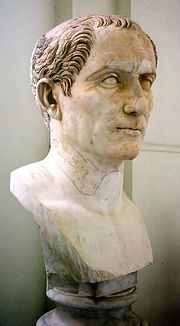
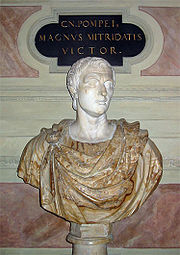
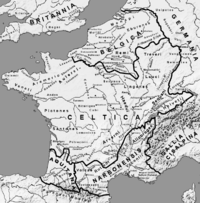 The first few chapters of this section are missing. Suetonius begins this section by describing Caesar's conquests, especially in Gaul and his Civil War against Pompey the Great. Several times Suetonius quotes Caesar. Suetonius includes Caesar's famous decree, "Veni, vidi, vici
" (I came, I saw, I conquered). In discussing Caesar's war against Pompey the Great, Suetonius quotes Caesar during a battle that Caesar nearly lost, "That man (Pompey) does not know how to win a war."
Suetonius describes an incident that would become one of the most memorable of the entire book. Caesar was captured by pirates in the Mediterranean Sea. Caesar engaged in debate and in philosophical discussion with the pirates while in captivity. He also promised that one day he would find them and crucify them (this was the standard punishment for piracy during this time). When told by the pirates that he would be held for a ransom of 20 talents of gold, Caesar laughed, and said that he must be worth at least 50 talents. Just as he had promised, after being released, Caesar captured the pirates and crucified them.
It is from Suetonius that we first learn of another incident during the life of Julius Caesar. While serving as governor in Hispania
, Caesar once visited a statue of Alexander the Great. Upon viewing this statue, Suetonius reports that Caesar fell to his knees, weeping. When asked what was wrong, Caesar sighed, and said that by the time Alexander was his (Caesar's) age, Alexander had conquered the whole world.
Suetonius describes Caesar's gift at winning the loyalty and admiration of his soldiers. Suetonius mentions Caesar commonly referring to them as "comrades" instead of "soldiers." When one of Caesar's legions took heavy losses in a battle, Caesar vowed not to trim his beard or hair until he had avenged the deaths of his soldiers. Suetonius describes an incident during a naval battle. One of Caesar's soldiers had his hand cut off. Despite the injury, this soldier still managed to board an enemy ship and subdue its crew. Suetonius mentions Caesar's famous crossing of the Rubicon River
, (the border between Italy and Cisalpine Gaul
), on his way to Rome to start a Civil War against Pompey and ultimately seize power.
Suetonius later describes Caesar's major reforms upon defeating Pompey and seizing power. One such reform was the modification of the Roman calendar. The calendar at the time had already used the same system of solar years and lunar months that our current calendar uses. Caesar updated the calendar so as to minimize the number of lost days due to the prior calendar’s imprecision regarding the exact amount of time in a solar year. Caesar also renamed the fifth month (also the month of his birth) in the Roman calendar July, in his honor (Roman years started in March, not January as they do under the current calendar). Suetonius says that Caesar had planned on invading and conquering the Parthian Empire
. These plans were not carried out due to Caesar's assassination.
 Suetonius then includes a description of Caesar's appearance and personality. Suetonius says that Caesar was semi-bald. Due to embarrassment regarding his premature baldness, Caesar combed his hair over and forward so as to hide this baldness. Caesar wore a senator's tunic with an orange belt. Caesar is described as routinely wearing loose clothes. Suetonius quotes the Roman dictator Lucius Cornelius Sulla
as saying, "Beware the boy with the loose clothes, for one day he will mean the ruin of the Republic." This quote referred to Caesar, as Caesar had been a young man during Sulla's Social War and subsequent dictatorship. Suetonius describes Caesar as taking steps so that others would not refer to him as king. Political enemies at the time had claimed that Caesar wanted to bring back the much reviled monarchy
.
Finally, Suetonius describes Caesar's assassination. Shortly before his assassination, Caesar told a friend that he wanted to die a sudden and spectacular death. Suetonius believes that several omens predicted the assassination. One such omen was a vivid dream Caesar had the night before his assassination.
The day of the assassination, Suetonius claims that Caesar was given a document describing the entire plot. Caesar took the document, but did not have a chance to read it before he was assassinated.
Suetonius says that others have claimed that Caesar reproached the conspirator Brutus
, asking "You too, my child?" (καὶ σὺ τέκνον—kai su, teknon). This specific wording varies slightly from the more famous quote, "Even you, Brutus?" (et tu, Brute) from Shakespeare
's Julius Caesar
.
However, Suetonius himself asserts that Caesar said nothing, apart from a single groan, as he was being stabbed. Instead Suetonius reports that Caesar exclaimed, "Why, this is violence!" as the attack began.
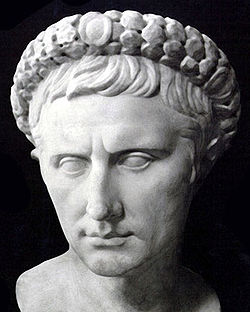 Before he died, Julius Caesar had designated his great nephew, Gaius Octavius (who would be named Augustus by the Roman Senate
after becoming emperor) as his adopted son and heir. Octavius' mother, Atia
, was the daughter of Caesar's sister, Julia Caesaris
.
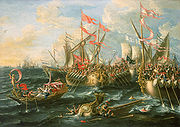
Octavian (not yet re-named Augustus) finished the civil wars started by his great-uncle, Julius Caesar. One by one, Augustus defeated the legion
s of the other generals who wanted to succeed Julius Caesar as the master of the Roman world. Suetonius includes descriptions of these civil wars, including the final one against Mark Antony
that ended with the Battle of Actium
. Antony had been Octavian's last surviving rival, but committed suicide after his defeat at Actium. It was after this victory in 31 BC that Octavian became master of the Roman world and imperator
(or emperor). His declaration of the end of the Civil Wars that had started under Julius Caesar marked the historic beginning of the Roman Empire
, and the Pax Romana
. Octavian at this point was given the title "Augustus" (meaning "the venerable") by the Roman Senate.
After describing the military campaigns of Augustus, Suetonius describes his personal life. A large section of the entire book is devoted to this. This is partly because after Actium, the reign of Augustus was mostly peaceful. It has also been noted by several sources that the entire work of The Twelve Caesars delves more deeply into personal details and gossip relative to other contemporary Roman histories.
 Suetonius describes a strained relationship between Augustus and his daughter Julia
. Augustus had originally wanted Julia, his only child, to provide for him a male heir. Due to difficulties regarding an heir, and Julia's promiscuity, Augustus banished Julia to the island of Pandateria
and considered having her executed. Suetonius quotes Augustus as repeatedly cursing his enemies by saying that they should have "a wife and children like mine."
According to Suetonius, Augustus lived a modest life, with few luxuries. Augustus lived in an ordinary Roman house, ate ordinary Roman meals, and slept in an ordinary Roman bed.
Suetonius describes certain omens and dreams that predicted the birth of Augustus. One dream described in the book suggested that his mother, Atia, was a virgin impregnated by a Roman God. In 63 BC, during the Consulship of Cicero
, several Roman Senators dreamt that a king would be born, and would rescue the Republic. 63 BC was also the year Augustus was born. One other omen described by Suetonius suggests that Julius Caesar decided to make Augustus his heir after seeing an omen while serving as the Roman Governor
of Hispania Ulterior
.
Suetonius includes a section regarding the only two military defeats Rome suffered under Augustus. Both of these defeats occurred in Germany. The first defeat was inconsequential. During the second, the Battle of Teutoburg Forest, three Roman Legions (Legio XVII
, Legio XVIII
, and Legio XIX
) were defeated by the West-Germanic resistance to Roman imperialism, led by Arminius. Much of what is known about this battle was written in this book. According to Suetonius, this battle "almost wrecked the empire." It is from Suetonius where we get the reaction of Augustus upon learning of the defeat. Suetonius writes that Augustus hit his head against a wall in despair, repeating, Quintili Vare, legiones redde! ('Quinctilius Varus, give me back my legions!') This defeat was one of the worst Rome suffered during the entire Principate. The result was the establishment of the rivers Rhine and Danube
as the natural northern border of the Roman Empire
. Rome would never again push its territory deeper into Germany. Suetonius suggests that Augustus never fully got over this defeat.
Augustus died on August 19, AD 14, a little over a month before his 76th birthday.
, which included his command of several Roman armies in Germany. It was his leadership in these German campaigns that convinced Augustus to adopt Tiberius and to make him his heir. According to Suetonius, Tiberius retired at a young age to Rhodes
, before returning to Rome some time before the death of Augustus. The ascendance of Tiberius to the throne was possible because the two grandsons that Augustus had died before Augustus, and the last grandson, Postumus Agrippa, although originally designated co-rule with Tiberius was later deemed morally unsound by Augustus.
Augustus began a long (and at times successful) tradition of adopting an heir, rather than allowing a son to succeed an emperor. Suetonius quotes from the will Augustus left. Suetonius suggests that not only was Tiberius not thought of highly by Augustus, but Augustus expected Tiberius to fail.
After briefly mentioning military and administrative successes, Suetonius tells of perversion, brutality and vice and goes into depth to describe depravities he attributes to Tiberius.
Despite the lurid tales, modern history looks upon Tiberius as a successful and competent Emperor who at his death left the state treasury much richer than when his reign began. Thus Suetonius' treatment of the character of Tiberius, like Claudius, must be taken with a pinch of salt.
Tiberius died of natural causes. Suetonius describes widespread joy in Rome upon his death. There was a desire to have his body thrown down the Gemonian stairs
and into the Tiber River, as this he had done many times previously to others. Tiberius had no living children when he died, although his (probable) natural grandson, Tiberius Julius Caesar Nero (Gemellus), and his adopted grandson, Gaius Caesar Caligula, both survived him. Tiberius designated both as his joint heirs, but seems to have favored Caligula over Gemellus, due to Gemellus' youth.
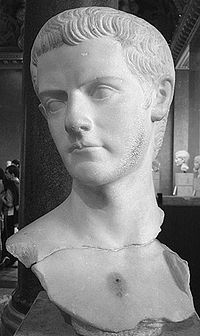 Most of what is known about the reign of Caligula
comes from Suetonius. Other contemporary Roman works, such as those of Tacitus
, contain little, if anything, about Caligula. Presumably most of what existed regarding his reign was lost long ago.
Suetonius refers to Caligula as Gaius during most of the work, his true name, Caligula -'little boots' - being the name given to him by his father's soldiers, because as a boy he would often dress in miniature battle gear and 'drill' the troops (without knowing the commands, but the troops loved him all the same and pretended to understand him). Caligula's father, Germanicus
, was loved throughout Rome as a brilliant military commander and example of Roman pietas
. Tiberius had adopted Germanicus as his heir, with the hope that Germanicus would succeed him. Germanicus died before he could succeed Tiberius in 19 AD.
Upon the death of Tiberius, Caligula became emperor. Initially the Romans loved Caligula due to their memory of his father. But most of what Suetonius says of Caligula is negative, and describes him as having an affliction that caused him to suddenly fall unconscious. Suetonius believed that Caligula knew that something was wrong with him.
He reports that Caligula married his sister, threatened to make his horse consul, and that he sent an army to the northern coast of Gaul
and as they prepared to invade Britain, one rumour had it that he had them pick sea shells on the shore (evidence shows that this could be a fabrication as the word for shell in Latin doubles as the word that the legionaries of the time used to call the 'huts' that the soldiers erected during the night while on campaign). He once built a walkway from his palace to a Temple
, so that he could be closer to his "brother," the Roman god Jupiter
, as Caligula believed himself to be a living deity. He would also have busts of his head replace those on statues of different gods.
He would call people to his palace in the middle of the night. When they arrived, he would hide and make strange noises. At other times, he would have people assassinated, and then call for them. When they did not show up, he would remark that they must have committed suicide.
Suetonius describes several omens that predicted the assassination of Caligula. He mentions a bolt of lightning that struck Rome on the Ides of March
, which was when Julius Caesar
was assassinated. Lightning was an event of immense superstition in the ancient world. The day of the assassination, Caligula sacrificed a flamingo
. During the sacrifice, blood splattered on his clothes. Suetonius also describes a comet that was seen shortly before the assassination. In the ancient world, comets were believed to foretell the death or assassination of important people. Suetonius even suggested that Caligula's name itself was a predictor of his assassination, noting that every Caesar named Gaius, such as the dictator Gaius Julius Caesar, had been assassinated (a statement which is not entirely accurate; Julius Caesar's father died from natural causes, as did Augustus).
Caligula was an avid fan of Gladiatorial combats and he was assassinated shortly after leaving a show by a disgruntled Praetorian guard
captain.
was the brother of Germanicus, the father of Caligula. He was descended from both the Julian and the Claudian clans, as was Caligula. He was about 50 years old at the time of Caligula's murder. He never held public office until late in his life, probably due to his family's concerns as to his health and mental abilities. Suetonius has much to say about Claudius' apparent disabilities, and how the imperial family viewed them, in the Life of Augustus.
The assassination of Caligula caused great terror in the Palace and, according to Suetonius, Claudius, being frightened by the sounds of soldiers scouring the Palace for further victims, hid behind some curtains, being convinced that he would be murdered as well. A soldier checking the room noticed feet sticking out from underneath the curtains, and upon pulling back the curtains discovered a terrified Claudius. Upon the arrival of other soldiers to the room, they acclaimed Claudius emperor and hustled him out of the Palace. Claudius was taken to the Praetorian camp, where he was quickly proclaimed emperor by the troops.
We learn from Suetonius that Claudius was the first Roman commander to invade Britain since Julius Caesar
a century earlier. Cassius Dio gives a more detailed account of this. He also went farther than Caesar, and made Britain subject to Roman rule. Caesar had "conquered" Britain, but left the Britons alone to rule themselves. Claudius was not as kind. The invasion of Britain was the major military campaign under his reign.
Suetonius says Claudius suffered from ill health all of his life until he became emperor, when his health suddenly became excellent. Claudius suffered from a variety of maladies, including fits and seizures, as well as several disagreeable personal habits like a bad stutter and excessive drooling. Suetonius accuses Claudius of cruelty and stupidity, assigning some of the blame to his wives and freedman.
Suetonius discusses several omens that foretold the assassination of Claudius. He mentions a comet that several Romans had seen shortly before the assassination. As mentioned earlier, comets were believed to foretell the deaths of significant people. Per Suetonius, Claudius, under suggestions from his wife Messalina, tried to shift this deadly fate from himself to others by various fictions, resulting in the execution of several Roman citizens, including some Senators and aristocrats.
Suetonius paints Claudius as a ridiculous figure, belittling many of his acts and attributing his good works to the influence of others. Thus the portrait of Claudius as the weak fool, controlled by those he supposedly ruled, was preserved for the ages. Claudius’ dining habits figure in the biography, notably his immoderate love of food and drink, and his affection for the city taverns.
His personal and moral failings aside however, most modern historians agree that Claudius generally ruled well. They cite his military success in Britannia as well as his extensive public works. His reign came to an end when he was murdered by eating from a dish of poisoned mushrooms, probably supplied by his last wife Agrippina
in an attempt to have her own son from a previous marriage, the future emperor Nero, ascend the throne.
in a similar fashion to that of Caligula—it begins with a recounting of how Nero assumed the throne ahead of Claudius' son Britannicus
and then descends into a recounting of various atrocities the young emperor allegedly performed.
One characteristic of Nero that Suetonius describes was Nero's fascination with music. Suetonius describes Nero as being a gifted musician. Nero would often give great concerts with attendance compelled for upper class Romans. These concerts would last for hours on end, and some women were rumored to give birth during them, or men faking death to escape (Nero forbade anyone from leaving the performance until it was completed).
Nero's eccentricities continued in the tradition of his predecessors in mind and personal perversions. According to Suetonius, Nero had one boy castrated, and then had sex with him as though he were a woman. Suetonius quotes one Roman who lived around this time who remarked that the world would have been better off if Nero's father Gnaeus Domitius Ahenobarbus had married someone more like the castrated boy.
It is in Suetonius we find the beginnings of the legend that Nero "fiddled as Rome burned." Suetonius recounts how Nero, while watching Rome burn, exclaimed how beautiful it was, and sang an epic poem about the sack of Troy
while playing the lyre.
Suetonius describes Nero's suicide, and remarks that his death meant the end of the reign of the Julio-Claudians (because Nero had no heir). According to Suetonius, Nero was condemned to die by the Senate. When Nero knew that soldiers had been dispatched by the Senate to kill him, he committed suicide.
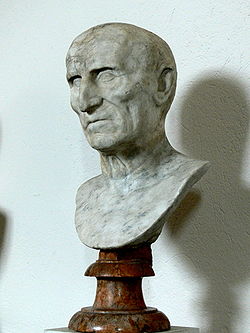 The book about Galba
is short. Galba was the first emperor of the Year of the Four Emperors
.
Galba was able to ascend to the throne because Nero's death meant the end of Julio-Claudian dynasty.
Suetonius includes a brief description of Galba's family history. Suetonius describes Galba as being of noble birth, and born into a noble patrician family. Suetonius also includes a brief list of omens regarding Galba and his assassination.
Most of this book describes Galba's ascension to the throne and his assassination, along with the usual side notes regarding his appearance and related omens. Suetonius does not spend much time describing either any accomplishments nor any failures of his reign.
According to Suetonius, Galba was killed by Otho's loyalists.
About this time, Suetonius has exhausted all his imperial archival sources.
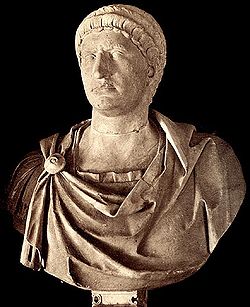 His full name was Marcus Salvius Otho
. Otho's reign was only a few months. Therefore, the book on Otho is short, much as the book on Galba had been.
Suetonius used a similar method to describe the life of Otho as he had used to describe the life of Galba. Suetonius describes Otho's family, and their history and nobility. And just as Suetonius had done with prior Caesars, he includes a list of omens regarding Otho's reign and assassination.
Suetonius spends most of the book describing the ascension of Otho, his assassination, and the other usual topics. Suetonius suggests that as soon as Otho ascended the throne, he started defending himself against competing claims to the throne.
According to Suetonius, Otho suffered a fate similar to the fate Galba had suffered. It was the loyalists of another aspiring emperor (in this case, the next emperor Vitellius) who wanted to kill him. Suetonius claims that one night Otho realized that he would soon be murdered. He contemplated suicide, but decided to sleep one more night before carrying out a suicide. That night he went to bed, with a dagger under his pillow. The next morning he woke up, and stabbed himself to death.
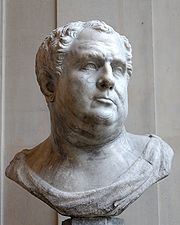 In the book of the last of the short-lived emperors, Suetonius briefly describes the reign of Vitellius
.
Suetonius says that it was the followers of Vitellius who had assassinated Otho.
This book gives an unfavorable picture of Vitellius; however it should be remembered that Suetonius' father was an army officer who had fought for Otho
and against Vitellius at the first Battle of Bedriacum
, and that Vespasian basically controlled history when he ascended to the throne. Anything written about Vitellius during the Flavian dynasty would have to paint him in a bad light.
Suetonius includes a brief description of the family history of Vitellius, and related omens.
Suetonius finally describes the assassination of Vitellius. According to Suetonius, Vitellius was dragged naked by Roman subjects, tied to a post, and had animal waste thrown at him before he was killed. However, unlike the prior two emperors, it was not the next emperor who killed Vitellius. The next emperor and his followers had been waging a war against the Jews in Judaea at the time. The death of Vitellius and subsequent ascendance of his successor ended the worst year of the early principate.
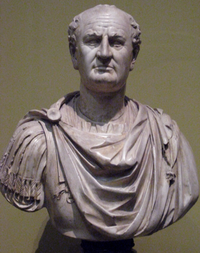 Suetonius begins by describing the humble antecedents of the founder of the Flavian dynasty and follows with a brief summary of his military and political career under Aulus Plautius Claudius and Nero and his suppression of the uprising in Judaea. Suetonius documents an early reputation for honesty but also a tendency toward avariciousness.
A detailed recounting of the omens and consultations with oracles follows which Suetonius suggests furthered Vespasian
's imperial pretensions. Suetonius then briefly recounts the escalating military support for Vespasian and even more briefly the events in Italy and Egypt that culminated in his accession.
Suetonius presents Vespasian's early imperial actions, the reimposition of discipline on Rome and her provinces and the rebuilding and repair of Roman infrastructure damaged in the civil war, in a favourable light, describing him as 'modest and lenient' and drawing clear parallels with Augustus. Vespasian is further presented as being extraordinarily just and with a preference for clemency over revenge.
Suetonius describes avarice as Vespasian's only serious failing, documenting his tendency for inventive taxation and extortion. However, he mitigates this failing by suggesting that the emptiness of state coffers left Vespasian little choice. Moreover, intermixed with accounts of greed and 'stinginess' are accounts of generosity and lavish rewards. Finally Suetonius gives a brief account of Vespasian's physical appearance and penchant for comedy.
Having contracted a 'bowel complaint,' he tried to continue his duties as emperor from what would be his deathbed, but on a sudden attack of diarrhea he said "An emperor ought to die standing," and died while struggling to do so.
was the elder son of Vespasian, and second emperor of the Flavian dynasty. As Suetonius writes: "The delight and darling of the human race." Titus was raised in the imperial court, having grown up with Britannicus. The two of them were told a prophesy pertaining to their future where Britannicus was told that he would never succeed his father and that Titus would. The two were so close that when Britannicus was poisoned Titus who was present tasted it and was nearly killed. "When Titus came of age, the beauty and talents that had distinguished him as a child grew even more remarkable." Titus was extremely adept at the arts of "war and peace." He made a name for himself as a colonel in Germany and Britain; however, he really flourished as a commander under his father in Judea and when he took over the siege of Jerusalem. Titus' near six month siege of Jerusalem ended with the destruction of the Herod's Temple and the expulsion of Jews from Jerusalem. The resulting period is known as the Jewish diaspora
(roughly from 70 till 1948). Titus had an love affair with the Jewish Queen Berenice, whom he brought briefly to Rome.
As Emperor he tried to be magnanimous and always heard petitions with an open-mind. And after going through a day having not granted any favors he commented that "I have wasted a day." During his reign he finished what would be the most enduring reminder of his family, the Flavian Amphitheater. His reign was tainted by the eruption of Mt. Vesuvius, a great fire in Rome, and one of the worst plagues "that had ever been known." These catastrophes did not destroy him, rather, as Suetonius remarks, he rose up like a father caring for his children. And although he was deified, his reign was short. He died from poison (possibly by his brother, Domitian), having only reigned for "two years, two months and twenty days." At the time of his death he "[drew] back the curtains, gazed up at the sky, and complained bitterly that life was being undeservedly taken from him-since only a single sin lay on his conscience." There is speculation about the "single sin," Suetonius believes it may have been attributed to an affair he allegedly had with his brother's wife. However, this is unlikely since she usually boasted about her infidelity and vehemently denied that she had slept with Titus.
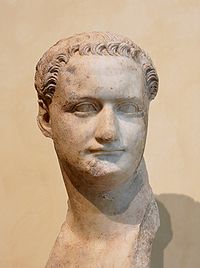 Younger brother of Titus
, second son of Vespasian, and third emperor of the Flavian dynasty. Recorded as having gained the throne through deliberately letting his brother die of a fever. During Titus' rule he had caused dissent and had sought the throne through rebellion. From the beginning of his reign Domitian ruled as a complete autocrat, partly because of his lack of political skills, but also because of his own nature. Having led a solitary early life, Domitian was suspicious of those around him, a difficult situation which gradually got worse.
Domitian's provincial government was so carefully supervised that Suetonius admits that the Empire enjoyed a period of unusually good government and security. Domitian's policy of employing members of the equestrian class rather than his own freedmen for some important posts was also an innovation. The Empire’s finances, which the recklessness of Titus had thrown into confusion, were restored despite building projects and foreign wars. Deeply religious, Domitian built temples and established ceremonies and even tried to enforce public morality by law.
Domitian personally took part in battles in Germany. The latter part of his reign saw increasing trouble on the lower Danube from the Dacia
ns, a tribe occupying roughly what is today Romania
. Led by their king Decebalus
, the Dacians invaded the Empire in 85 AD. The war ended in 88 in a compromise peace which left Decebalus as king and gave him Roman "foreign aid" in return for his promise to help defend the frontier.
One of the reasons Domitian failed to crush the Dacians was a revolt in Germany by the governor Antonius Saturninus. The revolt was quickly suppressed, but from then on, Suetonius informs us, Domitian's already suspicious temper grew steadily worse. Those closest to him suffered the most, and after a reign of terror at the imperial court Domitian was murdered in 96 AD, the group that killed him, according to Suetonius, including his wife, Domitia Longina
, and possibly his successor, Nerva
. The Senate, which had always hated him, quickly condemned his memory and repealed his acts, and Domitian joined the ranks of the tyrants of considerable accomplishments but evil memory. He was the last of the Flavian emperors, and his murder marked the beginning of the period of the so-called Five Good Emperors.
. This collection, apparently entitled Caesares, does not survive, but it was a source for a later biographical collection, known as Historia Augusta, which now forms a kind of sequel to Suetonius' work. The Historia Augusta is a collective biography, partly fictionalized, of Roman emperors and usurpers of the second and third centuries.
In the ninth century Einhard
modelled himself on Suetonius in writing the Life of Charlemagne, even borrowing phrases from Suetonius' physical description of Augustus in his own description of the character and appearance of Charlemagne.
Robert Graves
, though most famous for his historical novels I, Claudius
and Claudius the God (later dramatized
by the BBC
), made a widely read translation of The Twelve Caesars which was first published in Penguin Classics in 1957.
Julius Caesar
Gaius Julius Caesar was a Roman general and statesman and a distinguished writer of Latin prose. He played a critical role in the gradual transformation of the Roman Republic into the Roman Empire....
and the first 11 emperors
Roman Emperor
The Roman emperor was the ruler of the Roman State during the imperial period . The Romans had no single term for the office although at any given time, a given title was associated with the emperor...
of the Roman Empire
Roman Empire
The Roman Empire was the post-Republican period of the ancient Roman civilization, characterised by an autocratic form of government and large territorial holdings in Europe and around the Mediterranean....
written by Gaius Suetonius Tranquillus
Suetonius
Gaius Suetonius Tranquillus, commonly known as Suetonius , was a Roman historian belonging to the equestrian order in the early Imperial era....
.
The work, written in AD 121 during the reign of the emperor Hadrian
Hadrian
Hadrian , was Roman Emperor from 117 to 138. He is best known for building Hadrian's Wall, which marked the northern limit of Roman Britain. In Rome, he re-built the Pantheon and constructed the Temple of Venus and Roma. In addition to being emperor, Hadrian was a humanist and was philhellene in...
, was the most popular work of Suetonius
Suetonius
Gaius Suetonius Tranquillus, commonly known as Suetonius , was a Roman historian belonging to the equestrian order in the early Imperial era....
, at that time Hadrian's personal secretary, and is the largest among his surviving writings. It was dedicated to a friend, the Praetorian prefect
Praetorian prefect
Praetorian prefect was the title of a high office in the Roman Empire. Originating as the commander of the Praetorian Guard, the office gradually acquired extensive legal and administrative functions, with its holders becoming the Emperor's chief aides...
Gaius Septicius Clarus
Gaius Septicius Clarus
Gaius Septicius Clarus , was a prefect of the Roman imperial bodyguard, known as the Praetorian Guard and influential as a friend and supporter of famous Silver Age authors Pliny the Younger and Suetonius.-Praetorian prefect:...
.
The Twelve Caesars is considered very significant in antiquity and remains a primary source on Roman history. The book discusses the significant and critical period of the Principate
Principate
The Principate is the first period of the Roman Empire, extending from the beginning of the reign of Caesar Augustus to the Crisis of the Third Century, after which it was replaced with the Dominate. The Principate is characterized by a concerted effort on the part of the Emperors to preserve the...
from the end of the Republic
Roman Republic
The Roman Republic was the period of the ancient Roman civilization where the government operated as a republic. It began with the overthrow of the Roman monarchy, traditionally dated around 508 BC, and its replacement by a government headed by two consuls, elected annually by the citizens and...
to the reign of Domitian
Domitian
Domitian was Roman Emperor from 81 to 96. Domitian was the third and last emperor of the Flavian dynasty.Domitian's youth and early career were largely spent in the shadow of his brother Titus, who gained military renown during the First Jewish-Roman War...
; comparisons are often made with Tacitus
Tacitus
Publius Cornelius Tacitus was a senator and a historian of the Roman Empire. The surviving portions of his two major works—the Annals and the Histories—examine the reigns of the Roman Emperors Tiberius, Claudius, Nero and those who reigned in the Year of the Four Emperors...
whose surviving works document a similar period.
Critical approaches: Reliability
Suetonius used the imperial archives to research eyewitness accounts, information, and other evidence to produce the book.However, critics say the book is founded on gossip and citations of historians who had lived in the time of the early emperors, rather than on primary sources of that time. The book can be described as very racy, packed with gossip, dramatic and sometimes amusing. There are times the author subjectively expresses his opinion and knowledge.
Though he was never a senator, Suetonius took the side of the Senate in most conflicts with the princeps
Princeps
Princeps is a Latin word meaning "first in time or order; the first, chief, the most eminent, distinguished, or noble; the first man, first person."...
, as well as the senators' views of the emperor. This resulted in biases, both conscious and unconscious. Suetonius lost access to the official archives shortly after beginning his work. He was forced to rely on second-hand accounts when it came to Claudius (with the exception of Augustus' letters which had been gathered earlier) and does not quote the emperor.
Despite this, it provides valuable information on the heritage, personal habits, physical appearance, lives and political careers of the first Roman Emperors. It mentions details that other sources do not. For example, Suetonius is the main source on the life of Caligula
Caligula
Caligula , also known as Gaius, was Roman Emperor from 37 AD to 41 AD. Caligula was a member of the house of rulers conventionally known as the Julio-Claudian dynasty. Caligula's father Germanicus, the nephew and adopted son of Emperor Tiberius, was a very successful general and one of Rome's most...
, his uncle Claudius
Claudius
Claudius , was Roman Emperor from 41 to 54. A member of the Julio-Claudian dynasty, he was the son of Drusus and Antonia Minor. He was born at Lugdunum in Gaul and was the first Roman Emperor to be born outside Italy...
, and the heritage of Vespasian
Vespasian
Vespasian , was Roman Emperor from 69 AD to 79 AD. Vespasian was the founder of the Flavian dynasty, which ruled the Empire for a quarter century. Vespasian was descended from a family of equestrians, who rose into the senatorial rank under the Emperors of the Julio-Claudian dynasty...
(the relevant sections of the Annals
Annals (Tacitus)
The Annals by Tacitus is a history of the reigns of the four Roman Emperors succeeding Caesar Augustus. The surviving parts of the Annals extensively cover most of the reigns of Tiberius and Nero. The title Annals was probably not given by Tacitus, but derives from the fact that he treated this...
by his contemporary Tacitus being lost). Suetonius made a reference in this work to "Chrestus", which may refer to "Christ
Christ
Christ is the English term for the Greek meaning "the anointed one". It is a translation of the Hebrew , usually transliterated into English as Messiah or Mashiach...
". During the book on Nero, Suetonius mentions a sect known as the Christians (see Historicity of Jesus
Historicity of Jesus
The historicity of Jesus concerns how much of what is written about Jesus of Nazareth is historically reliable, and whether the evidence supports the existence of such an historical figure...
). Like many of his contemporaries, Suetonius took omens seriously and carefully includes reports of omens portending Imperial births, accessions and deaths.
Julius Caesar
Veni, vidi, vici
"Veni, vidi, vici" is a Latin sentence reportedly written by Julius Caesar in 47 BC as a comment on his short war with Pharnaces II of Pontus in the city of Zela ....
" (I came, I saw, I conquered). In discussing Caesar's war against Pompey the Great, Suetonius quotes Caesar during a battle that Caesar nearly lost, "That man (Pompey) does not know how to win a war."
Suetonius describes an incident that would become one of the most memorable of the entire book. Caesar was captured by pirates in the Mediterranean Sea. Caesar engaged in debate and in philosophical discussion with the pirates while in captivity. He also promised that one day he would find them and crucify them (this was the standard punishment for piracy during this time). When told by the pirates that he would be held for a ransom of 20 talents of gold, Caesar laughed, and said that he must be worth at least 50 talents. Just as he had promised, after being released, Caesar captured the pirates and crucified them.
It is from Suetonius that we first learn of another incident during the life of Julius Caesar. While serving as governor in Hispania
Hispania
Another theory holds that the name derives from Ezpanna, the Basque word for "border" or "edge", thus meaning the farthest area or place. Isidore of Sevilla considered Hispania derived from Hispalis....
, Caesar once visited a statue of Alexander the Great. Upon viewing this statue, Suetonius reports that Caesar fell to his knees, weeping. When asked what was wrong, Caesar sighed, and said that by the time Alexander was his (Caesar's) age, Alexander had conquered the whole world.
Suetonius describes Caesar's gift at winning the loyalty and admiration of his soldiers. Suetonius mentions Caesar commonly referring to them as "comrades" instead of "soldiers." When one of Caesar's legions took heavy losses in a battle, Caesar vowed not to trim his beard or hair until he had avenged the deaths of his soldiers. Suetonius describes an incident during a naval battle. One of Caesar's soldiers had his hand cut off. Despite the injury, this soldier still managed to board an enemy ship and subdue its crew. Suetonius mentions Caesar's famous crossing of the Rubicon River
Rubicon
The Rubicon is a shallow river in northeastern Italy, about 80 kilometres long, running from the Apennine Mountains to the Adriatic Sea through the southern Emilia-Romagna region, between the towns of Rimini and Cesena. The Latin word rubico comes from the adjective "rubeus", meaning "red"...
, (the border between Italy and Cisalpine Gaul
Cisalpine Gaul
Cisalpine Gaul, in Latin: Gallia Cisalpina or Citerior, also called Gallia Togata, was a Roman province until 41 BC when it was merged into Roman Italy.It bore the name Gallia, because the great body of its inhabitants, after the expulsion of the Etruscans, consisted of Gauls or Celts...
), on his way to Rome to start a Civil War against Pompey and ultimately seize power.
Suetonius later describes Caesar's major reforms upon defeating Pompey and seizing power. One such reform was the modification of the Roman calendar. The calendar at the time had already used the same system of solar years and lunar months that our current calendar uses. Caesar updated the calendar so as to minimize the number of lost days due to the prior calendar’s imprecision regarding the exact amount of time in a solar year. Caesar also renamed the fifth month (also the month of his birth) in the Roman calendar July, in his honor (Roman years started in March, not January as they do under the current calendar). Suetonius says that Caesar had planned on invading and conquering the Parthian Empire
Parthian Empire
The Parthian Empire , also known as the Arsacid Empire , was a major Iranian political and cultural power in ancient Persia...
. These plans were not carried out due to Caesar's assassination.
Lucius Cornelius Sulla
Lucius Cornelius Sulla Felix , known commonly as Sulla, was a Roman general and statesman. He had the rare distinction of holding the office of consul twice, as well as that of dictator...
as saying, "Beware the boy with the loose clothes, for one day he will mean the ruin of the Republic." This quote referred to Caesar, as Caesar had been a young man during Sulla's Social War and subsequent dictatorship. Suetonius describes Caesar as taking steps so that others would not refer to him as king. Political enemies at the time had claimed that Caesar wanted to bring back the much reviled monarchy
Monarchy
A monarchy is a form of government in which the office of head of state is usually held until death or abdication and is often hereditary and includes a royal house. In some cases, the monarch is elected...
.
Finally, Suetonius describes Caesar's assassination. Shortly before his assassination, Caesar told a friend that he wanted to die a sudden and spectacular death. Suetonius believes that several omens predicted the assassination. One such omen was a vivid dream Caesar had the night before his assassination.
The day of the assassination, Suetonius claims that Caesar was given a document describing the entire plot. Caesar took the document, but did not have a chance to read it before he was assassinated.
Suetonius says that others have claimed that Caesar reproached the conspirator Brutus
Marcus Junius Brutus
Marcus Junius Brutus , often referred to as Brutus, was a politician of the late Roman Republic. After being adopted by his uncle he used the name Quintus Servilius Caepio Brutus, but eventually returned to using his original name...
, asking "You too, my child?" (καὶ σὺ τέκνον—kai su, teknon). This specific wording varies slightly from the more famous quote, "Even you, Brutus?" (et tu, Brute) from Shakespeare
William Shakespeare
William Shakespeare was an English poet and playwright, widely regarded as the greatest writer in the English language and the world's pre-eminent dramatist. He is often called England's national poet and the "Bard of Avon"...
's Julius Caesar
Julius Caesar (play)
The Tragedy of Julius Caesar, also known simply as Julius Caesar, is a tragedy by William Shakespeare, believed to have been written in 1599. It portrays the 44 BC conspiracy against...
.
However, Suetonius himself asserts that Caesar said nothing, apart from a single groan, as he was being stabbed. Instead Suetonius reports that Caesar exclaimed, "Why, this is violence!" as the attack began.
Augustus
Roman Senate
The Senate of the Roman Republic was a political institution in the ancient Roman Republic, however, it was not an elected body, but one whose members were appointed by the consuls, and later by the censors. After a magistrate served his term in office, it usually was followed with automatic...
after becoming emperor) as his adopted son and heir. Octavius' mother, Atia
Atia
Atia Balba Caesonia , sometimes referred to as Atia Balba Secunda to differentiate her from her two sisters, was a Roman noblewoman...
, was the daughter of Caesar's sister, Julia Caesaris
Julia Caesaris (sister of Julius Caesar)
Julia is the name of two daughters of praetor Gaius Julius Caesar and Aurelia Cotta, the parents of dictator Gaius Julius Caesar. The sisters were born and raised in Rome....
.
Octavian (not yet re-named Augustus) finished the civil wars started by his great-uncle, Julius Caesar. One by one, Augustus defeated the legion
Roman legion
A Roman legion normally indicates the basic ancient Roman army unit recruited specifically from Roman citizens. The organization of legions varied greatly over time but they were typically composed of perhaps 5,000 soldiers, divided into maniples and later into "cohorts"...
s of the other generals who wanted to succeed Julius Caesar as the master of the Roman world. Suetonius includes descriptions of these civil wars, including the final one against Mark Antony
Mark Antony
Marcus Antonius , known in English as Mark Antony, was a Roman politician and general. As a military commander and administrator, he was an important supporter and loyal friend of his mother's cousin Julius Caesar...
that ended with the Battle of Actium
Battle of Actium
The Battle of Actium was the decisive confrontation of the Final War of the Roman Republic. It was fought between the forces of Octavian and the combined forces of Mark Antony and Cleopatra VII. The battle took place on 2 September 31 BC, on the Ionian Sea near the city of Actium, at the Roman...
. Antony had been Octavian's last surviving rival, but committed suicide after his defeat at Actium. It was after this victory in 31 BC that Octavian became master of the Roman world and imperator
Imperator
The Latin word Imperator was originally a title roughly equivalent to commander under the Roman Republic. Later it became a part of the titulature of the Roman Emperors as part of their cognomen. The English word emperor derives from imperator via Old French Empreur...
(or emperor). His declaration of the end of the Civil Wars that had started under Julius Caesar marked the historic beginning of the Roman Empire
Roman Empire
The Roman Empire was the post-Republican period of the ancient Roman civilization, characterised by an autocratic form of government and large territorial holdings in Europe and around the Mediterranean....
, and the Pax Romana
Pax Romana
Pax Romana was the long period of relative peace and minimal expansion by military force experienced by the Roman Empire in the 1st and 2nd centuries AD. Since it was established by Caesar Augustus it is sometimes called Pax Augusta...
. Octavian at this point was given the title "Augustus" (meaning "the venerable") by the Roman Senate.
After describing the military campaigns of Augustus, Suetonius describes his personal life. A large section of the entire book is devoted to this. This is partly because after Actium, the reign of Augustus was mostly peaceful. It has also been noted by several sources that the entire work of The Twelve Caesars delves more deeply into personal details and gossip relative to other contemporary Roman histories.
Julia the Elder
Julia the Elder , known to her contemporaries as Julia Caesaris filia or Julia Augusti filia was the daughter and only biological child of Augustus, the first emperor of the Roman Empire. Augustus subsequently adopted several male members of his close family as sons...
. Augustus had originally wanted Julia, his only child, to provide for him a male heir. Due to difficulties regarding an heir, and Julia's promiscuity, Augustus banished Julia to the island of Pandateria
Ventotene
Ventotene, in Roman times known as Pandataria or Pandateria from the Greek Pandoteira, is one of the Pontine Islands in the Tyrrhenian Sea, off the coast of Gaeta right at the border between Lazio and Campania, Italy...
and considered having her executed. Suetonius quotes Augustus as repeatedly cursing his enemies by saying that they should have "a wife and children like mine."
According to Suetonius, Augustus lived a modest life, with few luxuries. Augustus lived in an ordinary Roman house, ate ordinary Roman meals, and slept in an ordinary Roman bed.
Suetonius describes certain omens and dreams that predicted the birth of Augustus. One dream described in the book suggested that his mother, Atia, was a virgin impregnated by a Roman God. In 63 BC, during the Consulship of Cicero
Cicero
Marcus Tullius Cicero , was a Roman philosopher, statesman, lawyer, political theorist, and Roman constitutionalist. He came from a wealthy municipal family of the equestrian order, and is widely considered one of Rome's greatest orators and prose stylists.He introduced the Romans to the chief...
, several Roman Senators dreamt that a king would be born, and would rescue the Republic. 63 BC was also the year Augustus was born. One other omen described by Suetonius suggests that Julius Caesar decided to make Augustus his heir after seeing an omen while serving as the Roman Governor
Roman governor
A Roman governor was an official either elected or appointed to be the chief administrator of Roman law throughout one or more of the many provinces constituting the Roman Empire...
of Hispania Ulterior
Hispania Ulterior
During the Roman Republic, Hispania Ulterior was a region of Hispania roughly located in Baetica and in the Guadalquivir valley of modern Spain and extending to all of Lusitania and Gallaecia...
.
Suetonius includes a section regarding the only two military defeats Rome suffered under Augustus. Both of these defeats occurred in Germany. The first defeat was inconsequential. During the second, the Battle of Teutoburg Forest, three Roman Legions (Legio XVII
Legio XVII
Legio septima decima was a Roman legion levied by Augustus around 41 BC. The legion was destroyed in the Battle of Teutoburg Forest...
, Legio XVIII
Legio XVIII
Legio duodevigesima was a Roman legion levied by the future Augustus around 41 BC. The legion was, along with two others, destroyed in the Battle of Teutoburg Forest...
, and Legio XIX
Legio XIX
Legio undevigesima was a Roman legion levied in 41 or 40 BC by Augustus. It was destroyed in 9 in the Battle of the Teutoburg Forest...
) were defeated by the West-Germanic resistance to Roman imperialism, led by Arminius. Much of what is known about this battle was written in this book. According to Suetonius, this battle "almost wrecked the empire." It is from Suetonius where we get the reaction of Augustus upon learning of the defeat. Suetonius writes that Augustus hit his head against a wall in despair, repeating, Quintili Vare, legiones redde! ('Quinctilius Varus, give me back my legions!') This defeat was one of the worst Rome suffered during the entire Principate. The result was the establishment of the rivers Rhine and Danube
Danube
The Danube is a river in the Central Europe and the Europe's second longest river after the Volga. It is classified as an international waterway....
as the natural northern border of the Roman Empire
Roman Empire
The Roman Empire was the post-Republican period of the ancient Roman civilization, characterised by an autocratic form of government and large territorial holdings in Europe and around the Mediterranean....
. Rome would never again push its territory deeper into Germany. Suetonius suggests that Augustus never fully got over this defeat.
Augustus died on August 19, AD 14, a little over a month before his 76th birthday.
Tiberius
Suetonius describes the early career of TiberiusTiberius
Tiberius , was Roman Emperor from 14 AD to 37 AD. Tiberius was by birth a Claudian, son of Tiberius Claudius Nero and Livia Drusilla. His mother divorced Nero and married Augustus in 39 BC, making him a step-son of Octavian...
, which included his command of several Roman armies in Germany. It was his leadership in these German campaigns that convinced Augustus to adopt Tiberius and to make him his heir. According to Suetonius, Tiberius retired at a young age to Rhodes
Rhodes
Rhodes is an island in Greece, located in the eastern Aegean Sea. It is the largest of the Dodecanese islands in terms of both land area and population, with a population of 117,007, and also the island group's historical capital. Administratively the island forms a separate municipality within...
, before returning to Rome some time before the death of Augustus. The ascendance of Tiberius to the throne was possible because the two grandsons that Augustus had died before Augustus, and the last grandson, Postumus Agrippa, although originally designated co-rule with Tiberius was later deemed morally unsound by Augustus.
Augustus began a long (and at times successful) tradition of adopting an heir, rather than allowing a son to succeed an emperor. Suetonius quotes from the will Augustus left. Suetonius suggests that not only was Tiberius not thought of highly by Augustus, but Augustus expected Tiberius to fail.
After briefly mentioning military and administrative successes, Suetonius tells of perversion, brutality and vice and goes into depth to describe depravities he attributes to Tiberius.
Despite the lurid tales, modern history looks upon Tiberius as a successful and competent Emperor who at his death left the state treasury much richer than when his reign began. Thus Suetonius' treatment of the character of Tiberius, like Claudius, must be taken with a pinch of salt.
Tiberius died of natural causes. Suetonius describes widespread joy in Rome upon his death. There was a desire to have his body thrown down the Gemonian stairs
Gemonian stairs
The Gemonian Stairs were a flight of steps located in the ancient city of Rome. Nicknamed the Stairs of Mourning, the stairs are infamous in Roman history as a place of execution.- Location :...
and into the Tiber River, as this he had done many times previously to others. Tiberius had no living children when he died, although his (probable) natural grandson, Tiberius Julius Caesar Nero (Gemellus), and his adopted grandson, Gaius Caesar Caligula, both survived him. Tiberius designated both as his joint heirs, but seems to have favored Caligula over Gemellus, due to Gemellus' youth.
Caligula
Caligula
Caligula , also known as Gaius, was Roman Emperor from 37 AD to 41 AD. Caligula was a member of the house of rulers conventionally known as the Julio-Claudian dynasty. Caligula's father Germanicus, the nephew and adopted son of Emperor Tiberius, was a very successful general and one of Rome's most...
comes from Suetonius. Other contemporary Roman works, such as those of Tacitus
Tacitus
Publius Cornelius Tacitus was a senator and a historian of the Roman Empire. The surviving portions of his two major works—the Annals and the Histories—examine the reigns of the Roman Emperors Tiberius, Claudius, Nero and those who reigned in the Year of the Four Emperors...
, contain little, if anything, about Caligula. Presumably most of what existed regarding his reign was lost long ago.
Suetonius refers to Caligula as Gaius during most of the work, his true name, Caligula -'little boots' - being the name given to him by his father's soldiers, because as a boy he would often dress in miniature battle gear and 'drill' the troops (without knowing the commands, but the troops loved him all the same and pretended to understand him). Caligula's father, Germanicus
Germanicus
Germanicus Julius Caesar , commonly known as Germanicus, was a member of the Julio-Claudian dynasty and a prominent general of the early Roman Empire. He was born in Rome, Italia, and was named either Nero Claudius Drusus after his father or Tiberius Claudius Nero after his uncle...
, was loved throughout Rome as a brilliant military commander and example of Roman pietas
Pietas
Pietas was one of the Roman virtues, along with gravitas and dignitas. It is usually translated as "duty" or "devotion."-Definition:The word pietas is originally from Latin. The first printed record of the word’s use in English is from Anselm Bayly’s The Alliance of Music, Poetry, and Oratory,...
. Tiberius had adopted Germanicus as his heir, with the hope that Germanicus would succeed him. Germanicus died before he could succeed Tiberius in 19 AD.
Upon the death of Tiberius, Caligula became emperor. Initially the Romans loved Caligula due to their memory of his father. But most of what Suetonius says of Caligula is negative, and describes him as having an affliction that caused him to suddenly fall unconscious. Suetonius believed that Caligula knew that something was wrong with him.
He reports that Caligula married his sister, threatened to make his horse consul, and that he sent an army to the northern coast of Gaul
Gaul
Gaul was a region of Western Europe during the Iron Age and Roman era, encompassing present day France, Luxembourg and Belgium, most of Switzerland, the western part of Northern Italy, as well as the parts of the Netherlands and Germany on the left bank of the Rhine. The Gauls were the speakers of...
and as they prepared to invade Britain, one rumour had it that he had them pick sea shells on the shore (evidence shows that this could be a fabrication as the word for shell in Latin doubles as the word that the legionaries of the time used to call the 'huts' that the soldiers erected during the night while on campaign). He once built a walkway from his palace to a Temple
Temple
A temple is a structure reserved for religious or spiritual activities, such as prayer and sacrifice, or analogous rites. A templum constituted a sacred precinct as defined by a priest, or augur. It has the same root as the word "template," a plan in preparation of the building that was marked out...
, so that he could be closer to his "brother," the Roman god Jupiter
Jupiter (mythology)
In ancient Roman religion and myth, Jupiter or Jove is the king of the gods, and the god of the sky and thunder. He is the equivalent of Zeus in the Greek pantheon....
, as Caligula believed himself to be a living deity. He would also have busts of his head replace those on statues of different gods.
He would call people to his palace in the middle of the night. When they arrived, he would hide and make strange noises. At other times, he would have people assassinated, and then call for them. When they did not show up, he would remark that they must have committed suicide.
Suetonius describes several omens that predicted the assassination of Caligula. He mentions a bolt of lightning that struck Rome on the Ides of March
Ides of March
The Ides of March is the name of the 15th day of March in the Roman calendar, probably referring to the day of the full moon. The word Ides comes from the Latin word "Idus" and means "half division" especially in relation to a month. It is a word that was used widely in the Roman calendar...
, which was when Julius Caesar
Julius Caesar
Gaius Julius Caesar was a Roman general and statesman and a distinguished writer of Latin prose. He played a critical role in the gradual transformation of the Roman Republic into the Roman Empire....
was assassinated. Lightning was an event of immense superstition in the ancient world. The day of the assassination, Caligula sacrificed a flamingo
Flamingo
Flamingos or flamingoes are gregarious wading birds in the genus Phoenicopterus , the only genus in the family Phoenicopteridae...
. During the sacrifice, blood splattered on his clothes. Suetonius also describes a comet that was seen shortly before the assassination. In the ancient world, comets were believed to foretell the death or assassination of important people. Suetonius even suggested that Caligula's name itself was a predictor of his assassination, noting that every Caesar named Gaius, such as the dictator Gaius Julius Caesar, had been assassinated (a statement which is not entirely accurate; Julius Caesar's father died from natural causes, as did Augustus).
Caligula was an avid fan of Gladiatorial combats and he was assassinated shortly after leaving a show by a disgruntled Praetorian guard
Praetorian Guard
The Praetorian Guard was a force of bodyguards used by Roman Emperors. The title was already used during the Roman Republic for the guards of Roman generals, at least since the rise to prominence of the Scipio family around 275 BC...
captain.
Claudius
ClaudiusClaudius
Claudius , was Roman Emperor from 41 to 54. A member of the Julio-Claudian dynasty, he was the son of Drusus and Antonia Minor. He was born at Lugdunum in Gaul and was the first Roman Emperor to be born outside Italy...
was the brother of Germanicus, the father of Caligula. He was descended from both the Julian and the Claudian clans, as was Caligula. He was about 50 years old at the time of Caligula's murder. He never held public office until late in his life, probably due to his family's concerns as to his health and mental abilities. Suetonius has much to say about Claudius' apparent disabilities, and how the imperial family viewed them, in the Life of Augustus.
The assassination of Caligula caused great terror in the Palace and, according to Suetonius, Claudius, being frightened by the sounds of soldiers scouring the Palace for further victims, hid behind some curtains, being convinced that he would be murdered as well. A soldier checking the room noticed feet sticking out from underneath the curtains, and upon pulling back the curtains discovered a terrified Claudius. Upon the arrival of other soldiers to the room, they acclaimed Claudius emperor and hustled him out of the Palace. Claudius was taken to the Praetorian camp, where he was quickly proclaimed emperor by the troops.
We learn from Suetonius that Claudius was the first Roman commander to invade Britain since Julius Caesar
Julius Caesar
Gaius Julius Caesar was a Roman general and statesman and a distinguished writer of Latin prose. He played a critical role in the gradual transformation of the Roman Republic into the Roman Empire....
a century earlier. Cassius Dio gives a more detailed account of this. He also went farther than Caesar, and made Britain subject to Roman rule. Caesar had "conquered" Britain, but left the Britons alone to rule themselves. Claudius was not as kind. The invasion of Britain was the major military campaign under his reign.
Suetonius says Claudius suffered from ill health all of his life until he became emperor, when his health suddenly became excellent. Claudius suffered from a variety of maladies, including fits and seizures, as well as several disagreeable personal habits like a bad stutter and excessive drooling. Suetonius accuses Claudius of cruelty and stupidity, assigning some of the blame to his wives and freedman.
Suetonius discusses several omens that foretold the assassination of Claudius. He mentions a comet that several Romans had seen shortly before the assassination. As mentioned earlier, comets were believed to foretell the deaths of significant people. Per Suetonius, Claudius, under suggestions from his wife Messalina, tried to shift this deadly fate from himself to others by various fictions, resulting in the execution of several Roman citizens, including some Senators and aristocrats.
Suetonius paints Claudius as a ridiculous figure, belittling many of his acts and attributing his good works to the influence of others. Thus the portrait of Claudius as the weak fool, controlled by those he supposedly ruled, was preserved for the ages. Claudius’ dining habits figure in the biography, notably his immoderate love of food and drink, and his affection for the city taverns.
His personal and moral failings aside however, most modern historians agree that Claudius generally ruled well. They cite his military success in Britannia as well as his extensive public works. His reign came to an end when he was murdered by eating from a dish of poisoned mushrooms, probably supplied by his last wife Agrippina
Agrippina the Younger
Julia Agrippina, most commonly referred to as Agrippina Minor or Agrippina the Younger, and after 50 known as Julia Augusta Agrippina was a Roman Empress and one of the more prominent women in the Julio-Claudian dynasty...
in an attempt to have her own son from a previous marriage, the future emperor Nero, ascend the throne.
Nero
Suetonius portrays the life of NeroNero
Nero , was Roman Emperor from 54 to 68, and the last in the Julio-Claudian dynasty. Nero was adopted by his great-uncle Claudius to become his heir and successor, and succeeded to the throne in 54 following Claudius' death....
in a similar fashion to that of Caligula—it begins with a recounting of how Nero assumed the throne ahead of Claudius' son Britannicus
Britannicus
Tiberius Claudius Caesar Britannicus was the son of the Roman emperor Claudius and his third wife Valeria Messalina. He became the heir-designate of the empire at his birth, less than a month into his father's reign. He was still a young boy at the time of his mother's downfall and Claudius'...
and then descends into a recounting of various atrocities the young emperor allegedly performed.
One characteristic of Nero that Suetonius describes was Nero's fascination with music. Suetonius describes Nero as being a gifted musician. Nero would often give great concerts with attendance compelled for upper class Romans. These concerts would last for hours on end, and some women were rumored to give birth during them, or men faking death to escape (Nero forbade anyone from leaving the performance until it was completed).
Nero's eccentricities continued in the tradition of his predecessors in mind and personal perversions. According to Suetonius, Nero had one boy castrated, and then had sex with him as though he were a woman. Suetonius quotes one Roman who lived around this time who remarked that the world would have been better off if Nero's father Gnaeus Domitius Ahenobarbus had married someone more like the castrated boy.
It is in Suetonius we find the beginnings of the legend that Nero "fiddled as Rome burned." Suetonius recounts how Nero, while watching Rome burn, exclaimed how beautiful it was, and sang an epic poem about the sack of Troy
Troy
Troy was a city, both factual and legendary, located in northwest Anatolia in what is now Turkey, southeast of the Dardanelles and beside Mount Ida...
while playing the lyre.
Suetonius describes Nero's suicide, and remarks that his death meant the end of the reign of the Julio-Claudians (because Nero had no heir). According to Suetonius, Nero was condemned to die by the Senate. When Nero knew that soldiers had been dispatched by the Senate to kill him, he committed suicide.
Galba
Galba
Galba , was Roman Emperor for seven months from 68 to 69. Galba was the governor of Hispania Tarraconensis, and made a bid for the throne during the rebellion of Julius Vindex...
is short. Galba was the first emperor of the Year of the Four Emperors
Year of the Four Emperors
The Year of the Four Emperors was a year in the history of the Roman Empire, AD 69, in which four emperors ruled in a remarkable succession. These four emperors were Galba, Otho, Vitellius, and Vespasian....
.
Galba was able to ascend to the throne because Nero's death meant the end of Julio-Claudian dynasty.
Suetonius includes a brief description of Galba's family history. Suetonius describes Galba as being of noble birth, and born into a noble patrician family. Suetonius also includes a brief list of omens regarding Galba and his assassination.
Most of this book describes Galba's ascension to the throne and his assassination, along with the usual side notes regarding his appearance and related omens. Suetonius does not spend much time describing either any accomplishments nor any failures of his reign.
According to Suetonius, Galba was killed by Otho's loyalists.
About this time, Suetonius has exhausted all his imperial archival sources.
Otho
Otho
Otho , was Roman Emperor for three months, from 15 January to 16 April 69. He was the second emperor of the Year of the four emperors.- Birth and lineage :...
. Otho's reign was only a few months. Therefore, the book on Otho is short, much as the book on Galba had been.
Suetonius used a similar method to describe the life of Otho as he had used to describe the life of Galba. Suetonius describes Otho's family, and their history and nobility. And just as Suetonius had done with prior Caesars, he includes a list of omens regarding Otho's reign and assassination.
Suetonius spends most of the book describing the ascension of Otho, his assassination, and the other usual topics. Suetonius suggests that as soon as Otho ascended the throne, he started defending himself against competing claims to the throne.
According to Suetonius, Otho suffered a fate similar to the fate Galba had suffered. It was the loyalists of another aspiring emperor (in this case, the next emperor Vitellius) who wanted to kill him. Suetonius claims that one night Otho realized that he would soon be murdered. He contemplated suicide, but decided to sleep one more night before carrying out a suicide. That night he went to bed, with a dagger under his pillow. The next morning he woke up, and stabbed himself to death.
Vitellius
Vitellius
Vitellius , was Roman Emperor for eight months, from 16 April to 22 December 69. Vitellius was acclaimed Emperor following the quick succession of the previous emperors Galba and Otho, in a year of civil war known as the Year of the Four Emperors...
.
Suetonius says that it was the followers of Vitellius who had assassinated Otho.
This book gives an unfavorable picture of Vitellius; however it should be remembered that Suetonius' father was an army officer who had fought for Otho
Otho
Otho , was Roman Emperor for three months, from 15 January to 16 April 69. He was the second emperor of the Year of the four emperors.- Birth and lineage :...
and against Vitellius at the first Battle of Bedriacum
Battle of Bedriacum
The Battle of Bedriacum refers to two battles fought during the Year of the Four Emperors near the village of Bedriacum , about from the town of Cremona in northern Italy...
, and that Vespasian basically controlled history when he ascended to the throne. Anything written about Vitellius during the Flavian dynasty would have to paint him in a bad light.
Suetonius includes a brief description of the family history of Vitellius, and related omens.
Suetonius finally describes the assassination of Vitellius. According to Suetonius, Vitellius was dragged naked by Roman subjects, tied to a post, and had animal waste thrown at him before he was killed. However, unlike the prior two emperors, it was not the next emperor who killed Vitellius. The next emperor and his followers had been waging a war against the Jews in Judaea at the time. The death of Vitellius and subsequent ascendance of his successor ended the worst year of the early principate.
Vespasian
A detailed recounting of the omens and consultations with oracles follows which Suetonius suggests furthered Vespasian
Vespasian
Vespasian , was Roman Emperor from 69 AD to 79 AD. Vespasian was the founder of the Flavian dynasty, which ruled the Empire for a quarter century. Vespasian was descended from a family of equestrians, who rose into the senatorial rank under the Emperors of the Julio-Claudian dynasty...
's imperial pretensions. Suetonius then briefly recounts the escalating military support for Vespasian and even more briefly the events in Italy and Egypt that culminated in his accession.
Suetonius presents Vespasian's early imperial actions, the reimposition of discipline on Rome and her provinces and the rebuilding and repair of Roman infrastructure damaged in the civil war, in a favourable light, describing him as 'modest and lenient' and drawing clear parallels with Augustus. Vespasian is further presented as being extraordinarily just and with a preference for clemency over revenge.
Suetonius describes avarice as Vespasian's only serious failing, documenting his tendency for inventive taxation and extortion. However, he mitigates this failing by suggesting that the emptiness of state coffers left Vespasian little choice. Moreover, intermixed with accounts of greed and 'stinginess' are accounts of generosity and lavish rewards. Finally Suetonius gives a brief account of Vespasian's physical appearance and penchant for comedy.
Having contracted a 'bowel complaint,' he tried to continue his duties as emperor from what would be his deathbed, but on a sudden attack of diarrhea he said "An emperor ought to die standing," and died while struggling to do so.
Titus
TitusTitus
Titus , was Roman Emperor from 79 to 81. A member of the Flavian dynasty, Titus succeeded his father Vespasian upon his death, thus becoming the first Roman Emperor to come to the throne after his own father....
was the elder son of Vespasian, and second emperor of the Flavian dynasty. As Suetonius writes: "The delight and darling of the human race." Titus was raised in the imperial court, having grown up with Britannicus. The two of them were told a prophesy pertaining to their future where Britannicus was told that he would never succeed his father and that Titus would. The two were so close that when Britannicus was poisoned Titus who was present tasted it and was nearly killed. "When Titus came of age, the beauty and talents that had distinguished him as a child grew even more remarkable." Titus was extremely adept at the arts of "war and peace." He made a name for himself as a colonel in Germany and Britain; however, he really flourished as a commander under his father in Judea and when he took over the siege of Jerusalem. Titus' near six month siege of Jerusalem ended with the destruction of the Herod's Temple and the expulsion of Jews from Jerusalem. The resulting period is known as the Jewish diaspora
Jewish diaspora
The Jewish diaspora is the English term used to describe the Galut גלות , or 'exile', of the Jews from the region of the Kingdom of Judah and Roman Iudaea and later emigration from wider Eretz Israel....
(roughly from 70 till 1948). Titus had an love affair with the Jewish Queen Berenice, whom he brought briefly to Rome.
As Emperor he tried to be magnanimous and always heard petitions with an open-mind. And after going through a day having not granted any favors he commented that "I have wasted a day." During his reign he finished what would be the most enduring reminder of his family, the Flavian Amphitheater. His reign was tainted by the eruption of Mt. Vesuvius, a great fire in Rome, and one of the worst plagues "that had ever been known." These catastrophes did not destroy him, rather, as Suetonius remarks, he rose up like a father caring for his children. And although he was deified, his reign was short. He died from poison (possibly by his brother, Domitian), having only reigned for "two years, two months and twenty days." At the time of his death he "[drew] back the curtains, gazed up at the sky, and complained bitterly that life was being undeservedly taken from him-since only a single sin lay on his conscience." There is speculation about the "single sin," Suetonius believes it may have been attributed to an affair he allegedly had with his brother's wife. However, this is unlikely since she usually boasted about her infidelity and vehemently denied that she had slept with Titus.
Domitian
Titus
Titus , was Roman Emperor from 79 to 81. A member of the Flavian dynasty, Titus succeeded his father Vespasian upon his death, thus becoming the first Roman Emperor to come to the throne after his own father....
, second son of Vespasian, and third emperor of the Flavian dynasty. Recorded as having gained the throne through deliberately letting his brother die of a fever. During Titus' rule he had caused dissent and had sought the throne through rebellion. From the beginning of his reign Domitian ruled as a complete autocrat, partly because of his lack of political skills, but also because of his own nature. Having led a solitary early life, Domitian was suspicious of those around him, a difficult situation which gradually got worse.
Domitian's provincial government was so carefully supervised that Suetonius admits that the Empire enjoyed a period of unusually good government and security. Domitian's policy of employing members of the equestrian class rather than his own freedmen for some important posts was also an innovation. The Empire’s finances, which the recklessness of Titus had thrown into confusion, were restored despite building projects and foreign wars. Deeply religious, Domitian built temples and established ceremonies and even tried to enforce public morality by law.
Domitian personally took part in battles in Germany. The latter part of his reign saw increasing trouble on the lower Danube from the Dacia
Dacia
In ancient geography, especially in Roman sources, Dacia was the land inhabited by the Dacians or Getae as they were known by the Greeks—the branch of the Thracians north of the Haemus range...
ns, a tribe occupying roughly what is today Romania
Romania
Romania is a country located at the crossroads of Central and Southeastern Europe, on the Lower Danube, within and outside the Carpathian arch, bordering on the Black Sea...
. Led by their king Decebalus
Decebalus
Decebalus or "The Brave" was a king of Dacia and is famous for fighting three wars and negotiating two interregnums of peace without being eliminated against the Roman Empire under two emperors...
, the Dacians invaded the Empire in 85 AD. The war ended in 88 in a compromise peace which left Decebalus as king and gave him Roman "foreign aid" in return for his promise to help defend the frontier.
One of the reasons Domitian failed to crush the Dacians was a revolt in Germany by the governor Antonius Saturninus. The revolt was quickly suppressed, but from then on, Suetonius informs us, Domitian's already suspicious temper grew steadily worse. Those closest to him suffered the most, and after a reign of terror at the imperial court Domitian was murdered in 96 AD, the group that killed him, according to Suetonius, including his wife, Domitia Longina
Domitia Longina
Domitia Longina was an Empress of Rome and wife to the Roman Emperor Domitian. She was the youngest daughter of the general and consul Gnaeus Domitius Corbulo. Domitia divorced her first husband Lucius Aelius Lamia in order to marry Domitian in 71...
, and possibly his successor, Nerva
Nerva
Nerva , was Roman Emperor from 96 to 98. Nerva became Emperor at the age of sixty-five, after a lifetime of imperial service under Nero and the rulers of the Flavian dynasty. Under Nero, he was a member of the imperial entourage and played a vital part in exposing the Pisonian conspiracy of 65...
. The Senate, which had always hated him, quickly condemned his memory and repealed his acts, and Domitian joined the ranks of the tyrants of considerable accomplishments but evil memory. He was the last of the Flavian emperors, and his murder marked the beginning of the period of the so-called Five Good Emperors.
Influence on later literature
The Twelve Caesars served as a model for the biographies of 2nd and early 3rd century emperors compiled by Marius MaximusMarius Maximus
Marius Maximus was a Roman biographer, writing in Latin, who in the early decades of the 3rd century AD wrote a series of biographies of twelve Emperors, imitating and continuing Suetonius. Marius’s work is lost, but it was still being read in the late 4th century and was used as a source by...
. This collection, apparently entitled Caesares, does not survive, but it was a source for a later biographical collection, known as Historia Augusta, which now forms a kind of sequel to Suetonius' work. The Historia Augusta is a collective biography, partly fictionalized, of Roman emperors and usurpers of the second and third centuries.
In the ninth century Einhard
Einhard
Einhard was a Frankish scholar and courtier. Einhard was a dedicated servant of Charlemagne and his son Louis the Pious; his main work is a biography of Charlemagne, the Vita Karoli Magni, "one of the most precious literary bequests of the early Middle Ages."-Public life:Einhard was from the eastern...
modelled himself on Suetonius in writing the Life of Charlemagne, even borrowing phrases from Suetonius' physical description of Augustus in his own description of the character and appearance of Charlemagne.
Robert Graves
Robert Graves
Robert von Ranke Graves 24 July 1895 – 7 December 1985 was an English poet, translator and novelist. During his long life he produced more than 140 works...
, though most famous for his historical novels I, Claudius
I, Claudius
I, Claudius is a novel by English writer Robert Graves, written in the form of an autobiography of the Roman Emperor Claudius. As such, it includes history of the Julio-Claudian Dynasty and Roman Empire, from Julius Caesar's assassination in 44 BC to Caligula's assassination in AD 41...
and Claudius the God (later dramatized
I, Claudius (TV series)
I, Claudius is a 1976 BBC Television adaptation of Robert Graves' I, Claudius and Claudius the God. Written by Jack Pulman, it proved one of the corporation's most successful drama serials of all time...
by the BBC
BBC
The British Broadcasting Corporation is a British public service broadcaster. Its headquarters is at Broadcasting House in the City of Westminster, London. It is the largest broadcaster in the world, with about 23,000 staff...
), made a widely read translation of The Twelve Caesars which was first published in Penguin Classics in 1957.
Complete editions and translations
- Gaius Suetonius Tranquillus, The Twelve Caesars tr. Robert GravesRobert GravesRobert von Ranke Graves 24 July 1895 – 7 December 1985 was an English poet, translator and novelist. During his long life he produced more than 140 works...
. Harmondsworth: Penguin, 1957, revised by James B. Rives, 2007 - C. Suetoni Tranquilli opera, vol. I: De vita Caesarum libri VIII ed. Maximilianus Ihm. Leipzig: Teubner, 1908.
- Suetonius, with an English translation by J. C. Rolfe. London: Heinemann, 1913-4.
External links
- The Lives of the Twelve Caesars at LacusCurtius (Latin original, English translation from Loeb Classical LibraryLoeb Classical LibraryThe Loeb Classical Library is a series of books, today published by Harvard University Press, which presents important works of ancient Greek and Latin Literature in a way designed to make the text accessible to the broadest possible audience, by presenting the original Greek or Latin text on each...
(1914) by John Carew RolfeJohn Carew RolfeJohn Carew Rolfe, Ph.D. was an American classical scholar, the son of William J. Rolfe.He graduated from Harvard University in 1881 and from Cornell University in 1885....
) - Suetonius' works at Latin Library (Latin)
- The Lives of the Twelve Caesars at Project GutenbergProject GutenbergProject Gutenberg is a volunteer effort to digitize and archive cultural works, to "encourage the creation and distribution of eBooks". Founded in 1971 by Michael S. Hart, it is the oldest digital library. Most of the items in its collection are the full texts of public domain books...
(English translation of Alexander Thomson, M.D., Revised and corrected by T. ForesterForester250px|thumb|right|Foresters of [[Southern University of Chile|UACh]] in the [[Valdivian forest]]s of San Pablo de Tregua, ChileA forester is a person who practices forestry, the science, art, and profession of managing forests. Foresters engage in a broad range of activities including timber...
, Esq., A.M. - includes Lives Of The Grammarians, Rhetoricians, And Poets. 1796)
- The Lives of the Twelve Caesars at Project Gutenberg
- Gai Suetoni Tranquilli De vita Caesarum libri III-VI Cornell University Library Historical Monographs Collection.