

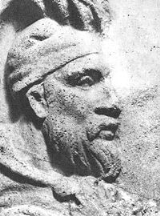
Decebalus

Encyclopedia
Decebalus or "The Brave" (originally named Diurpaneus) was a king of Dacia
(ruled the Dacians 87–106)
> and is famous for fighting three wars and negotiating two interregnums of peace without being eliminated against the Roman Empire
under two emperors. In the later short peace (end of 102-105) granted by Trajan, Decebalus continued to act as an independent king, rather than a conquered client and repeatedly annoyed or infuriated the Romans.
Consequently, the Legions under Trajan's orders went on the offensive again in 105 AD, reducing the Dacian capital Sarmizegetusa in 106. After that, Decebalus committed suicide.
, Dacia split into four then five smaller states. The situation lasted until Diurpaneus managed to consolidate the core of Dacia around Sarmizegetusa
, in today's Hunedoara county
. Though not yet king, he reorganized the Dacian army, which in 85 began minor raids upon the heavily fortified Roman province of Moesia
, located south of the Danube
under Dacian king Duras
.
In 86, the Duras ordered a more vigorous attack south into Roman province
of Moesia. Emperor
Domitian
personally advanced into the province with legions and relief supplies, reorganized it, and planned an attack into Dacia
the next campaign season. It did not turn out well.
sent his prefect of the Praetorian Guards, Cornelius Fuscus
, to punish the Dacians. His four or five legions suffered a major defeat when ambushed by the forces of Diurpaneus. Two Roman legions (among which was the V Alaudae
) were ambushed and defeated at a mountain pass the Romans called Tapae
(widely know as the Iron Gates along what is the modern Romania-Serbia border). Fuscus was killed. Diurpaneus dubbed himself Decebalus, meaning "with the strength of ten [men]" or simply "The Brave," and was crowned king.
described Decebalus as follows:
In 88, Tettius Iulianus commanded another Roman army under Domitian against the Dacians, who defeated the Romans at the Second Battle of Tapae
. Since German revolts along the Rhine were requiring augmented military force in Moesia
, the Romans were compelled to pay large sums in tribute
to the Dacians for maintaining peace. This humiliating situation lasted until Trajan
became Emperor in 98. Immediately he began preparations for wars that would expand the Roman Empire to its maximum extent.
in Dacia, and the Romans were forced again to send reinforcements, and this time Trajan decided to definitively conquer Dacia.
After a long siege of the Dacian Capital, Sarmizegetusa and a few skirmishes in the greater region, the Romans conquered Dacia. Decebalus managed to escape with his family.
 Hunted, having his army defeated and finally cornered by Roman detachments seeking his head, rather than being captured to be exhibited and humiliated at Rome, Decebalus committed suicide by slashing his own throat, as depicted on Trajan's Column
(spiral 22, panel b).
It is likely, however, that in the process of dying, Decebalus was captured by a Roman cavalry scout named Tiberius Claudius Maximus
from Legio VII Claudia
as is claimed on the funerary stele discovered at Gramini in Greece. His head and right hand were then taken to Trajan in "Ranisstorium" (an unidentified Dacian village, perhaps Piatra Craiului) by Claudius Maximus when he was decorated by the emperor, and the trophy sent to Rome where it was thrown on the Gemonian stairs
.
Tiberius Claudius Maximus' tomb cites two occasions where the legionary
was decorated for his part in the Dacian wars, one of which being the acquisition and recovery of Decebalus' head.
and has been portrayed in numerous literary works, movies (e.g. Dacii
, directed by Sergiu Nicolaescu
), sculptures, etc. His first known portrait has been preserved on Trajan's Column
, the commemorative stone column completed in 113. Trajan's Column depicts the key moments of the last two wars between Dacia and the Roman Empire in carved bas relief.
During the 1990s, a team of sculptors carved a 40-meter tall statue of Decebalus
from a stone outcrop near the city of Orşova
, Romania
.
Dacia
In ancient geography, especially in Roman sources, Dacia was the land inhabited by the Dacians or Getae as they were known by the Greeks—the branch of the Thracians north of the Haemus range...
(ruled the Dacians 87–106)
> and is famous for fighting three wars and negotiating two interregnums of peace without being eliminated against the Roman Empire
Roman Empire
The Roman Empire was the post-Republican period of the ancient Roman civilization, characterised by an autocratic form of government and large territorial holdings in Europe and around the Mediterranean....
under two emperors. In the later short peace (end of 102-105) granted by Trajan, Decebalus continued to act as an independent king, rather than a conquered client and repeatedly annoyed or infuriated the Romans.
Consequently, the Legions under Trajan's orders went on the offensive again in 105 AD, reducing the Dacian capital Sarmizegetusa in 106. After that, Decebalus committed suicide.
Recent history preceding
After the death of Great King BurebistaBurebista
Burebista was a king of the Getae and Dacians, who unified for the first time their tribes and ruled them between 82 BC and 44 BC. He led plunder and conquest raids across Central and Southeastern Europe, subjugating most of the neighbouring tribes...
, Dacia split into four then five smaller states. The situation lasted until Diurpaneus managed to consolidate the core of Dacia around Sarmizegetusa
Sarmizegetusa
Sarmizegetusa Regia was the capital and the most important military, religious and political center of Dacians...
, in today's Hunedoara county
Hunedoara County
Hunedoara is a county of Romania, in Transylvania, with its capital city at Deva.-Demographics:In 2002, it had a population of 485,712 and the population density was 69/km².*Romanians - 92%*Hungarians - 5%*Romas - 2%*Germans under 1%....
. Though not yet king, he reorganized the Dacian army, which in 85 began minor raids upon the heavily fortified Roman province of Moesia
Moesia
Moesia was an ancient region and later Roman province situated in the Balkans, along the south bank of the Danube River. It included territories of modern-day Southern Serbia , Northern Republic of Macedonia, Northern Bulgaria, Romanian Dobrudja, Southern Moldova, and Budjak .-History:In ancient...
, located south of the Danube
Danube
The Danube is a river in the Central Europe and the Europe's second longest river after the Volga. It is classified as an international waterway....
under Dacian king Duras
Duras
-Places:* Obsolete French spelling of the Albanian city of Durrës* Duras, Lot-et-Garonne, a commune of the Lot-et-Garonne département in France* Duras, Belgium, a constituent village of the commune of Sint-Truiden in the Belgian province of Limburg-People:...
.
In 86, the Duras ordered a more vigorous attack south into Roman province
Roman province
In Ancient Rome, a province was the basic, and, until the Tetrarchy , largest territorial and administrative unit of the empire's territorial possessions outside of Italy...
of Moesia. Emperor
Roman Empire
The Roman Empire was the post-Republican period of the ancient Roman civilization, characterised by an autocratic form of government and large territorial holdings in Europe and around the Mediterranean....
Domitian
Domitian
Domitian was Roman Emperor from 81 to 96. Domitian was the third and last emperor of the Flavian dynasty.Domitian's youth and early career were largely spent in the shadow of his brother Titus, who gained military renown during the First Jewish-Roman War...
personally advanced into the province with legions and relief supplies, reorganized it, and planned an attack into Dacia
Dacia
In ancient geography, especially in Roman sources, Dacia was the land inhabited by the Dacians or Getae as they were known by the Greeks—the branch of the Thracians north of the Haemus range...
the next campaign season. It did not turn out well.
War against Emperor Domitian
In 87, Emperor DomitianDomitian
Domitian was Roman Emperor from 81 to 96. Domitian was the third and last emperor of the Flavian dynasty.Domitian's youth and early career were largely spent in the shadow of his brother Titus, who gained military renown during the First Jewish-Roman War...
sent his prefect of the Praetorian Guards, Cornelius Fuscus
Cornelius Fuscus
Cornelius Fuscus was a Roman general who fought campaigns under the Emperors of the Flavian dynasty. During the reign of Domitian, he served as prefect of the imperial bodyguard, known as the Praetorian Guard, from 81 until his death in 86...
, to punish the Dacians. His four or five legions suffered a major defeat when ambushed by the forces of Diurpaneus. Two Roman legions (among which was the V Alaudae
Legio V Alaudae
Legio quinta Alaudae sometimes known as Gallica, was levied by Julius Caesar in 52 BC from native Gauls. Their emblem was an elephant, and their cognomen Alaudae came from the high crest on their helmets, typical of the Gauls, which made them look like larks...
) were ambushed and defeated at a mountain pass the Romans called Tapae
Tapae
Tapae was a Dacian outpost, guarding Sarmisegetuza, their main political centre. Its location was on the Iron Gates of Translylvania, a natural passage breaking between Ţarcului and Poiana Ruscă Mountains and connecting Banat to Ţara Haţegului. This made it one of the very few point through which...
(widely know as the Iron Gates along what is the modern Romania-Serbia border). Fuscus was killed. Diurpaneus dubbed himself Decebalus, meaning "with the strength of ten [men]" or simply "The Brave," and was crowned king.
Enemy's eye view
Regarding the Domitian wars Dio CassiusDio Cassius
Lucius Cassius Dio Cocceianus , known in English as Cassius Dio, Dio Cassius, or Dio was a Roman consul and a noted historian writing in Greek...
described Decebalus as follows:
In 88, Tettius Iulianus commanded another Roman army under Domitian against the Dacians, who defeated the Romans at the Second Battle of Tapae
Second Battle of Tapae
The Battle of Tapae was the decisive battle of the first Dacian War, in which Roman Emperor Trajan defeated the Dacian King Decebalus's army. Other setbacks in the campaign delayed its completion until 102.-Background:...
. Since German revolts along the Rhine were requiring augmented military force in Moesia
Moesia
Moesia was an ancient region and later Roman province situated in the Balkans, along the south bank of the Danube River. It included territories of modern-day Southern Serbia , Northern Republic of Macedonia, Northern Bulgaria, Romanian Dobrudja, Southern Moldova, and Budjak .-History:In ancient...
, the Romans were compelled to pay large sums in tribute
Tribute
A tribute is wealth, often in kind, that one party gives to another as a sign of respect or, as was often the case in historical contexts, of submission or allegiance. Various ancient states, which could be called suzerains, exacted tribute from areas they had conquered or threatened to conquer...
to the Dacians for maintaining peace. This humiliating situation lasted until Trajan
Trajan
Trajan , was Roman Emperor from 98 to 117 AD. Born into a non-patrician family in the province of Hispania Baetica, in Spain Trajan rose to prominence during the reign of emperor Domitian. Serving as a legatus legionis in Hispania Tarraconensis, in Spain, in 89 Trajan supported the emperor against...
became Emperor in 98. Immediately he began preparations for wars that would expand the Roman Empire to its maximum extent.
First war (101-102)
Decebalus was defeated by the Romans when they invaded Dacia beginning March 25, 101 AD, again in the fortifications of Tapae. After accepting harsh peace conditions including losses in territory, he was left as a client king under a Roman protectorate and a small local garrison.Second war (105-106) - The fall of Dacia
Three years later, Decebalus destroyed the small Roman garrisonGarrison
Garrison is the collective term for a body of troops stationed in a particular location, originally to guard it, but now often simply using it as a home base....
in Dacia, and the Romans were forced again to send reinforcements, and this time Trajan decided to definitively conquer Dacia.
After a long siege of the Dacian Capital, Sarmizegetusa and a few skirmishes in the greater region, the Romans conquered Dacia. Decebalus managed to escape with his family.
Death of Decebalus
Trajan's Column
Trajan's Column is a Roman triumphal column in Rome, Italy, which commemorates Roman emperor Trajan's victory in the Dacian Wars. It was probably constructed under the supervision of the architect Apollodorus of Damascus at the order of the Roman Senate. It is located in Trajan's Forum, built near...
(spiral 22, panel b).
It is likely, however, that in the process of dying, Decebalus was captured by a Roman cavalry scout named Tiberius Claudius Maximus
Tiberius Claudius Maximus
Tiberius Claudius Maximus was a Roman soldier who served with Legio VII Claudia in the Dacian Wars during the reign of emperor Domitian and emperor Trajan....
from Legio VII Claudia
Legio VII Claudia
Legio septima Claudia Pia Fidelis was a Roman legion. Its emblem, like that of all Caesar's legions, was the bull, together with the lion....
as is claimed on the funerary stele discovered at Gramini in Greece. His head and right hand were then taken to Trajan in "Ranisstorium" (an unidentified Dacian village, perhaps Piatra Craiului) by Claudius Maximus when he was decorated by the emperor, and the trophy sent to Rome where it was thrown on the Gemonian stairs
Gemonian stairs
The Gemonian Stairs were a flight of steps located in the ancient city of Rome. Nicknamed the Stairs of Mourning, the stairs are infamous in Roman history as a place of execution.- Location :...
.
Tiberius Claudius Maximus' tomb cites two occasions where the legionary
Legionary
The Roman legionary was a professional soldier of the Roman army after the Marian reforms of 107 BC. Legionaries had to be Roman citizens under the age of 45. They enlisted in a legion for twenty-five years of service, a change from the early practice of enlisting only for a campaign...
was decorated for his part in the Dacian wars, one of which being the acquisition and recovery of Decebalus' head.
Legacy of Decebalus
Decebalus is considered a national hero in RomaniaRomania
Romania is a country located at the crossroads of Central and Southeastern Europe, on the Lower Danube, within and outside the Carpathian arch, bordering on the Black Sea...
and has been portrayed in numerous literary works, movies (e.g. Dacii
Dacii (film)
Dacii is a 1967 historical drama film about Domitian's Dacian War fought between the Roman empire and the Dacians in AD 87-88. This film was directed by Romanian director Sergiu Nicolaescu...
, directed by Sergiu Nicolaescu
Sergiu Nicolaescu
Sergiu Florin Nicolaescu is a Romanian film director, actor and politician. He is best known for his historical films, such as Mihai Viteazul , Dacii , Razboiul Independenţei , as well as for his series of...
), sculptures, etc. His first known portrait has been preserved on Trajan's Column
Trajan's Column
Trajan's Column is a Roman triumphal column in Rome, Italy, which commemorates Roman emperor Trajan's victory in the Dacian Wars. It was probably constructed under the supervision of the architect Apollodorus of Damascus at the order of the Roman Senate. It is located in Trajan's Forum, built near...
, the commemorative stone column completed in 113. Trajan's Column depicts the key moments of the last two wars between Dacia and the Roman Empire in carved bas relief.
During the 1990s, a team of sculptors carved a 40-meter tall statue of Decebalus
Statue of Decebalus
The Statue of Dacian king Decebalus is a 40-meter high statue that is the tallest rock sculpture in Europe. It is located on the Danube's rocky bank, near the city of Orşova, Romania....
from a stone outcrop near the city of Orşova
Orsova
Orșova is a port city on the Danube river in southwestern Romania's Mehedinți County. It is one of four localities in the county located in the Banat historical region. It is situated just above the Iron Gates, on the spot where the Cerna River meets the Danube.- History :The first documented...
, Romania
Romania
Romania is a country located at the crossroads of Central and Southeastern Europe, on the Lower Danube, within and outside the Carpathian arch, bordering on the Black Sea...
.
See also
- Trajan's Dacian Wars
- RegalianusRegalianusP. C Regalianus was a Dacian general who turned against the Roman Empire and became himself emperor for a brief period, being murdered by the hands who raised him to power.-Career:...
was, according to Tyranni TrigintaThirty Tyrants (Roman)The Thirty Tyrants were a series of thirty rulers that appear in the Historia Augusta as having ostensibly been pretenders to the throne of the Roman Empire during the reign of the emperor Gallienus....
, a descendant of Decebalus. - Decebalus TreasureDecebalus TreasureThe Decebalus Treasure is a legendary story written by Cassius Dio concerning events said to have happened in the Roman world during the 2nd century AD.-The story:...
- List of Dacian kings