


Eboracum

Encyclopedia
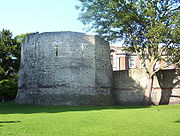
Eboracum was a fort
Castra
The Latin word castra, with its singular castrum, was used by the ancient Romans to mean buildings or plots of land reserved to or constructed for use as a military defensive position. The word appears in both Oscan and Umbrian as well as in Latin. It may have descended from Indo-European to Italic...
and city
City
A city is a relatively large and permanent settlement. Although there is no agreement on how a city is distinguished from a town within general English language meanings, many cities have a particular administrative, legal, or historical status based on local law.For example, in the U.S...
in Roman Britain
Roman Britain
Roman Britain was the part of the island of Great Britain controlled by the Roman Empire from AD 43 until ca. AD 410.The Romans referred to the imperial province as Britannia, which eventually comprised all of the island of Great Britain south of the fluid frontier with Caledonia...
. The settlement evolved into York
York
York is a walled city, situated at the confluence of the Rivers Ouse and Foss in North Yorkshire, England. The city has a rich heritage and has provided the backdrop to major political events throughout much of its two millennia of existence...
, located in North Yorkshire
North Yorkshire
North Yorkshire is a non-metropolitan or shire county located in the Yorkshire and the Humber region of England, and a ceremonial county primarily in that region but partly in North East England. Created in 1974 by the Local Government Act 1972 it covers an area of , making it the largest...
, England
England
England is a country that is part of the United Kingdom. It shares land borders with Scotland to the north and Wales to the west; the Irish Sea is to the north west, the Celtic Sea to the south west, with the North Sea to the east and the English Channel to the south separating it from continental...
.
Etymology
The first known recorded mention of Eboracum by name is dated circa 95-104 AD and is an address containing the Latin form of the settlement's name, "Eburaci", on a wooden stylusStylus
A stylus is a writing utensil, or a small tool for some other form of marking or shaping, for example in pottery. The word is also used for a computer accessory . It usually refers to a narrow elongated staff, similar to a modern ballpoint pen. Many styli are heavily curved to be held more easily...
tablet from the Roman fortress of Vindolanda
Vindolanda
Vindolanda was a Roman auxiliary fort just south of Hadrian's Wall in northern England. Located near the modern village of Bardon Mill, it guarded the Stanegate, the Roman road from the River Tyne to the Solway Firth...
in what is now the modern Northumberland
Northumberland
Northumberland is the northernmost ceremonial county and a unitary district in North East England. For Eurostat purposes Northumberland is a NUTS 3 region and is one of three boroughs or unitary districts that comprise the "Northumberland and Tyne and Wear" NUTS 2 region...
. During the Roman Period the name was also written in the form Eboracum and Eburacum.
The etymology
Etymology
Etymology is the study of the history of words, their origins, and how their form and meaning have changed over time.For languages with a long written history, etymologists make use of texts in these languages and texts about the languages to gather knowledge about how words were used during...
of Eboracum is uncertain as the language of the indigenous population
Indigenous peoples
Indigenous peoples are ethnic groups that are defined as indigenous according to one of the various definitions of the term, there is no universally accepted definition but most of which carry connotations of being the "original inhabitants" of a territory....
of the area was never recorded. However, the generally accepted view of British history, is that the inhabitants of Britain at this time spoke a Celtic language related to modern Welsh. This language has been reconstructed from Latin place names and modern Celtic languages
Celtic languages
The Celtic languages are descended from Proto-Celtic, or "Common Celtic"; a branch of the greater Indo-European language family...
, and has been called by scholars Common Brythonic. The name "Eboracum" is thought to have derived from the Common Brythonic Eborakon which probably means "place of the yew
Taxus baccata
Taxus baccata is a conifer native to western, central and southern Europe, northwest Africa, northern Iran and southwest Asia. It is the tree originally known as yew, though with other related trees becoming known, it may be now known as the English yew, or European yew.-Description:It is a small-...
trees". The word for yew was probably something like *eburos in Celtic , and this word is the basis for toponyms
Toponymy
Toponymy is the scientific study of place names , their origins, meanings, use and typology. The word "toponymy" is derived from the Greek words tópos and ónoma . Toponymy is itself a branch of onomastics, the study of names of all kinds...
in many other parts of Celtic-speaking Europe: Ebora (Évora), Eburobrittium (discovered near Óbidos) in Hispania Lusitania, Ebura in Hispania Baetica
Hispania Baetica
Hispania Baetica was one of three Imperial Roman provinces in Hispania, . Hispania Baetica was bordered to the west by Lusitania, and to the northeast by Hispania Tarraconensis. Baetica was part of Al-Andalus under the Moors in the 8th century and approximately corresponds to modern Andalucia...
, and in ethnic tribal names such as the Celtiberian
Celtiberians
The Celtiberians were Celtic-speaking people of the Iberian Peninsula in the final centuries BC. The group used the Celtic Celtiberian language.Archaeologically, the Celtiberians participated in the Hallstatt culture in what is now north-central Spain...
Eburanci, or the Eburones and Eburovices in Gaul. The name is then thought to have been Latin
Latin
Latin is an Italic language originally spoken in Latium and Ancient Rome. It, along with most European languages, is a descendant of the ancient Proto-Indo-European language. Although it is considered a dead language, a number of scholars and members of the Christian clergy speak it fluently, and...
ized by replacing -acon with -acum.
Origins
The RomanRoman Empire
The Roman Empire was the post-Republican period of the ancient Roman civilization, characterised by an autocratic form of government and large territorial holdings in Europe and around the Mediterranean....
conquest of Britain began in 43 AD but advance beyond the Humber
Humber
The Humber is a large tidal estuary on the east coast of Northern England. It is formed at Trent Falls, Faxfleet, by the confluence of the tidal River Ouse and the tidal River Trent. From here to the North Sea, it forms part of the boundary between the East Riding of Yorkshire on the north bank...
did not take place until the early 70s AD. This was because the people in the area known as the Brigantes
Brigantes
The Brigantes were a Celtic tribe who in pre-Roman times controlled the largest section of what would become Northern England, and a significant part of the Midlands. Their kingdom is sometimes called Brigantia, and it was centred in what was later known as Yorkshire...
by the Romans became a Roman client state
Client state
Client state is one of several terms used to describe the economic, political and/or military subordination of one state to a more powerful state in international affairs...
. When their leadership changed becoming more hostile to Rome Roman General Quintus Petillius Cerialis
Quintus Petillius Cerialis
Quintus Petilius Cerialis Caesius Rufus was a Roman general and administrator who served in Britain during Boudica's rebellion and who went on to participate in the civil wars after the death of Nero. He later defeated the rebellion of Julius Civilis and returned to Britain as its governor.His...
led the Ninth Legion north from Lincoln
Lincoln, Lincolnshire
Lincoln is a cathedral city and county town of Lincolnshire, England.The non-metropolitan district of Lincoln has a population of 85,595; the 2001 census gave the entire area of Lincoln a population of 120,779....
across the Humber. Eboracum was founded in 71 AD when Cerialis and the Ninth Legion constructed a military fortress (castra
Castra
The Latin word castra, with its singular castrum, was used by the ancient Romans to mean buildings or plots of land reserved to or constructed for use as a military defensive position. The word appears in both Oscan and Umbrian as well as in Latin. It may have descended from Indo-European to Italic...
) on flat ground above the River Ouse
River Ouse, Yorkshire
The River Ouse is a river in North Yorkshire, England. The river is formed from the River Ure at Cuddy Shaw Reach near Linton-on-Ouse, about 6 miles downstream of the confluence of the River Swale with the River Ure...
near its junction with the River Foss
River Foss
The River Foss is an improved river in North Yorkshire, England, and a tributary of the River Ouse. It rises in the Foss Crooks woods near Oulston reservoir close to the village of Yearsley and runs south through the Vale of York to the Ouse...
. In the same year Cerialis was appointed Governor of Britain.
A legion at full strength at that time numbered some 5,500 men, and provided new trading opportunities for enterprising local people, who doubtless flocked to Eboracum to take advantage of them. As a result permanent civilian settlement grew up around the fortress especially on its south-east side. Civilians also settled on the opposite side of the Ouse, initially along the main road from Eboracum to the south-west. By the later 2nd century, growth was rapid; streets were laid out, public buildings were erected and private houses spread out over terraces on the steep slopes above the river.
Military

Castra
The Latin word castra, with its singular castrum, was used by the ancient Romans to mean buildings or plots of land reserved to or constructed for use as a military defensive position. The word appears in both Oscan and Umbrian as well as in Latin. It may have descended from Indo-European to Italic...
of Eboracum covered an area of 50 acres (202,343 m²) the standard size for a legionary
Legionary
The Roman legionary was a professional soldier of the Roman army after the Marian reforms of 107 BC. Legionaries had to be Roman citizens under the age of 45. They enlisted in a legion for twenty-five years of service, a change from the early practice of enlisting only for a campaign...
fortress. The layout of the fortress also followed the standard for a legionary fortress with wooden buildings inside a square defensive boundary. These defences originally consisting of turf
Sod
Sod or turf is grass and the part of the soil beneath it held together by the roots, or a piece of thin material.The term sod may be used to mean turf grown and cut specifically for the establishment of lawns...
ramparts
Defensive wall
A defensive wall is a fortification used to protect a city or settlement from potential aggressors. In ancient to modern times, they were used to enclose settlements...
on a green wood foundation, were built by the Ninth Legion between 71 and 74 AD. Later these were replaced by a clay mound with a turf front on a new oak foundation, and eventually, wooden battlements were added which were then replaced by limestone
Limestone
Limestone is a sedimentary rock composed largely of the minerals calcite and aragonite, which are different crystal forms of calcium carbonate . Many limestones are composed from skeletal fragments of marine organisms such as coral or foraminifera....
walls and towers. The original wooden camp was refurbished by Agricola
Gnaeus Julius Agricola
Gnaeus Julius Agricola was a Roman general responsible for much of the Roman conquest of Britain. His biography, the De vita et moribus Iulii Agricolae, was the first published work of his son-in-law, the historian Tacitus, and is the source for most of what is known about him.Born to a noted...
in 81, before being completely rebuilt in stone between 107 and 108.
There is evidence that the Emperor Hadrian
Hadrian
Hadrian , was Roman Emperor from 117 to 138. He is best known for building Hadrian's Wall, which marked the northern limit of Roman Britain. In Rome, he re-built the Pantheon and constructed the Temple of Venus and Roma. In addition to being emperor, Hadrian was a humanist and was philhellene in...
visited in 122 on his way north to plan his great walled frontier. He certainly brought with him the Sixth Legion
Legio VI Victrix
Legio sexta Victrix was a Roman legion founded by Octavian in 41 BC. It was the twin legion of VI Ferrata and perhaps held veterans of that legion, and some soldiers kept to the traditions of the Caesarian legion....
to replace the existing garrison. Emperor Septimius Severus
Septimius Severus
Septimius Severus , also known as Severus, was Roman Emperor from 193 to 211. Severus was born in Leptis Magna in the province of Africa. As a young man he advanced through the customary succession of offices under the reigns of Marcus Aurelius and Commodus. Severus seized power after the death of...
visited Eboracum in 211 and made it his base for campaigning in Scotland. The fortress wall was probably reconstructed during his stay and at the east angle it is possible to see this work standing almost to full height. In that same year, Severus became the first of the two Roman Emperors to die in Eboracum and was succeeded by his sons, Caracalla
Caracalla
Caracalla , was Roman emperor from 198 to 217. The eldest son of Septimius Severus, he ruled jointly with his younger brother Geta until he murdered the latter in 211...
and Geta
Publius Septimius Geta
Geta , was a Roman Emperor co-ruling with his father Septimius Severus and his older brother Caracalla from 209 to his death.-Early life:Geta was the younger son of Septimius Severus by his second wife Julia Domna...
.
In the later 3rd century, the western Empire experienced political and economic turmoil and Britain was for some time ruled by usurpers independent of Rome
Rome
Rome is the capital of Italy and the country's largest and most populated city and comune, with over 2.7 million residents in . The city is located in the central-western portion of the Italian Peninsula, on the Tiber River within the Lazio region of Italy.Rome's history spans two and a half...
. It was after crushing the last of these that Emperor Constantius I came to Eboracum and, in 306, became the second Emperor to die there. His son Constantine
Constantine I
Constantine the Great , also known as Constantine I or Saint Constantine, was Roman Emperor from 306 to 337. Well known for being the first Roman emperor to convert to Christianity, Constantine and co-Emperor Licinius issued the Edict of Milan in 313, which proclaimed religious tolerance of all...
was instantly proclaimed as successor by the troops based in the fortress. Although it took Constantine eighteen years to become sole ruler of the Empire, he may have retained an interest in Eboracum and the reconstruction of the south-west front of the fortress with polygonally-fronted interval towers and the two great corner towers, one of which, the 'Multangular Tower', still survives, is probably his work. In the colonia, Constantine's reign was a time of prosperity and a number of extensive stone town houses of the period have been excavated.
Culture
As a busy portPort
A port is a location on a coast or shore containing one or more harbors where ships can dock and transfer people or cargo to or from land....
and a provincial capital Eboracum was a cosmopolitan city with residents from throughout the Roman Empire
Roman Empire
The Roman Empire was the post-Republican period of the ancient Roman civilization, characterised by an autocratic form of government and large territorial holdings in Europe and around the Mediterranean....
.
Religion
A range of evidence of Roman religious beliefsReligion in ancient Rome
Religion in ancient Rome encompassed the religious beliefs and cult practices regarded by the Romans as indigenous and central to their identity as a people, as well as the various and many cults imported from other peoples brought under Roman rule. Romans thus offered cult to innumerable deities...
among the people of Eboracum have been found including altar
Altar
An altar is any structure upon which offerings such as sacrifices are made for religious purposes. Altars are usually found at shrines, and they can be located in temples, churches and other places of worship...
s to Mars
Mars (mythology)
Mars was the Roman god of war and also an agricultural guardian, a combination characteristic of early Rome. He was second in importance only to Jupiter, and he was the most prominent of the military gods worshipped by the Roman legions...
, Hercules
Hercules
Hercules is the Roman name for Greek demigod Heracles, son of Zeus , and the mortal Alcmene...
, Jupiter
Jupiter (mythology)
In ancient Roman religion and myth, Jupiter or Jove is the king of the gods, and the god of the sky and thunder. He is the equivalent of Zeus in the Greek pantheon....
and Fortune
Fortuna
Fortuna can mean:*Fortuna, the Roman goddess of luck -Geographical:*19 Fortuna, asteroid*Fortuna, California, town located on the north coast of California*Fortuna, United States Virgin Islands...
, while phallic amulets are the most commonly found type of good luck charm. In terms of number of reference the most popular deities were the spiritual representation (genius
Genius (mythology)
In ancient Roman religion, the genius was the individual instance of a general divine nature that is present in every individual person, place or thing.-Nature of the genius:...
) of Eboracum and the Mother Goddess
Mother goddess
Mother goddess is a term used to refer to a goddess who represents motherhood, fertility, creation or embodies the bounty of the Earth. When equated with the Earth or the natural world such goddesses are sometimes referred to as Mother Earth or as the Earth Mother.Many different goddesses have...
. There is also evidence of local or regional deities. Evidence showing the worship of eastern deities has also been found during excavations in York. For example evidence of the Mithras cult, which was popular among the military, has been found including a sculpture showing Mithras slaying a bull and a dedication to Arimanius, the god of evil in the Mithraic tradition. Another example is the dedication of a temple to Serapis
Serapis
Serapis or Sarapis is a Graeco-Egyptian name of God. Serapis was devised during the 3rd century BC on the orders of Ptolemy I of Egypt as a means to unify the Greeks and Egyptians in his realm. The god was depicted as Greek in appearance, but with Egyptian trappings, and combined iconography...
a Hellenistic-Egyptian
Ancient Egypt
Ancient Egypt was an ancient civilization of Northeastern Africa, concentrated along the lower reaches of the Nile River in what is now the modern country of Egypt. Egyptian civilization coalesced around 3150 BC with the political unification of Upper and Lower Egypt under the first pharaoh...
God by the Commander of the Sixth Legion
Legio VI Victrix
Legio sexta Victrix was a Roman legion founded by Octavian in 41 BC. It was the twin legion of VI Ferrata and perhaps held veterans of that legion, and some soldiers kept to the traditions of the Caesarian legion....
.
There was also a Christian
Christian
A Christian is a person who adheres to Christianity, an Abrahamic, monotheistic religion based on the life and teachings of Jesus of Nazareth as recorded in the Canonical gospels and the letters of the New Testament...
community in Eboracum although it is unknown when this was first formed and in archaeological terms there is virtually no record of it. The first evidence of this community is a document noting the attendance of Bishop Eborius of Eboracum at the Council of Arles in 314. The Episcopal see
Episcopal See
An episcopal see is, in the original sense, the official seat of a bishop. This seat, which is also referred to as the bishop's cathedra, is placed in the bishop's principal church, which is therefore called the bishop's cathedral...
at Eboracum was called Eboracensis in Latin and Bishops from the See also attended the First Council of Nicaea
First Council of Nicaea
The First Council of Nicaea was a council of Christian bishops convened in Nicaea in Bithynia by the Roman Emperor Constantine I in AD 325...
in 325, the Council of Sardica, and the Council of Ariminum.
Government
For the RomansAncient Rome
Ancient Rome was a thriving civilization that grew on the Italian Peninsula as early as the 8th century BC. Located along the Mediterranean Sea and centered on the city of Rome, it expanded to one of the largest empires in the ancient world....
, Eboracum, was the major military base in the north of Britain and, following the third century division of the province of Britannia
Britannia
Britannia is an ancient term for Great Britain, and also a female personification of the island. The name is Latin, and derives from the Greek form Prettanike or Brettaniai, which originally designated a collection of islands with individual names, including Albion or Great Britain. However, by the...
, the capital of northern Britain, Britannia Inferior
Britannia Inferior
Britannia Inferior was a subdivision of the Roman province of Britannia established c. 214 by the emperor Caracalla, son of Septimius Severus. Located in modern northern England, the region was governed from the city of Eboracum by a praetorian legate in command of a single legion stationed in...
. By 237 Eboracum had been made a colonia
Colonia (Roman)
A Roman colonia was originally a Roman outpost established in conquered territory to secure it. Eventually, however, the term came to denote the highest status of Roman city.-History:...
, the highest legal status a Roman city could attain, one of only four in Britain and the others were founded for retired soldiers. This mark of Imperial favour was probably a recognition of Eboracum as the largest town in the north and the capital of Britannia Inferior
Britannia Inferior
Britannia Inferior was a subdivision of the Roman province of Britannia established c. 214 by the emperor Caracalla, son of Septimius Severus. Located in modern northern England, the region was governed from the city of Eboracum by a praetorian legate in command of a single legion stationed in...
. At around the same time Eboracum became self-governing, with a council made up of rich locals, including merchants, and veteran soldiers. In 296 Britannia Inferior
Britannia Inferior
Britannia Inferior was a subdivision of the Roman province of Britannia established c. 214 by the emperor Caracalla, son of Septimius Severus. Located in modern northern England, the region was governed from the city of Eboracum by a praetorian legate in command of a single legion stationed in...
was divided into two provinces of equal status with Eboracum becoming the provincial capital of Britannia Secunda
Britannia Secunda
Britannia Secunda was one of the provinces of Roman Britain in existence by c. 312 AD and probably created as part of the administrative reforms of the Roman Emperor Diocletian after the defeat of the usurper Allectus by Constantius Chlorus in 296 AD. The governors of Britannia Secunda were of...
.
Economy
The militaryMilitary
A military is an organization authorized by its greater society to use lethal force, usually including use of weapons, in defending its country by combating actual or perceived threats. The military may have additional functions of use to its greater society, such as advancing a political agenda e.g...
presence at Eboracum was the driving force behind early developments in its economy
Economy
An economy consists of the economic system of a country or other area; the labor, capital and land resources; and the manufacturing, trade, distribution, and consumption of goods and services of that area...
. In these early stages Eboracum operated as a command economy with workshops growing up outside the fortress to supply the needs of the 5000 troops garrison
Garrison
Garrison is the collective term for a body of troops stationed in a particular location, originally to guard it, but now often simply using it as a home base....
ed there. Production included military pottery until the mid-third century, military tile kilns have been found in the Aldwark-Peasholme Green area, glassworking at Coppergate, metalworks and leatherworks producing military equipment in Tanner Row.
Archaeological remains
Substantial remains of the headquarters building of the Roman legionary fortress were discovered under the Minster, and they are open to the public. A re-erected Roman column from the headquarters now stands on nearby Deangate. Other sites of excavated remains include a Roman bath, located under the Roman Bath pub in St Sampson's Square, a Roman templeTemple
A temple is a structure reserved for religious or spiritual activities, such as prayer and sacrifice, or analogous rites. A templum constituted a sacred precinct as defined by a priest, or augur. It has the same root as the word "template," a plan in preparation of the building that was marked out...
, near the foot of Lendal Bridge, and the site of a Roman bridge over the River Ouse
River Ouse, Yorkshire
The River Ouse is a river in North Yorkshire, England. The river is formed from the River Ure at Cuddy Shaw Reach near Linton-on-Ouse, about 6 miles downstream of the confluence of the River Swale with the River Ure...
. Some remains of the Roman city walls can be seen between Monk Bar and the Merchant Taylors' Hall, and a more substantial section can be seen between Museum Gardens and the Central Library, together with the late Roman Multangular Tower. Outside the city walls are the remains of substantial Roman cemeteries. A large number of Roman finds are now housed in the Yorkshire Museum
Yorkshire Museum
The Yorkshire Museum is a museum in York, England. It is the home of the Cawood sword, and has four permanent collections, covering biology, geology, archaeology and astronomy...
.