
All Topics  
Domitian

 
Domitian

   Email Print
   Bookmark   Link


Domitian


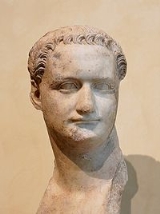
Titus Flavius Domitianus (24 October 51 – 18 September 96), commonly known as Domitian, was a Roman Emperor
Roman Emperor

The Roman Emperor was the ruler of the Roman Empire during the imperial period . The Romans had no single term for the office: Latin language titles such as imperator , Augustus , Caesar and princeps were all associated with it....
 who reigned from 14 September 81 until his death. Domitian was the last emperor of the Flavian dynasty
Flavian dynasty

The Flavian dynasty was a Ancient Rome imperial dynasty, which ruled the Roman Empire between 69 and 96 AD, encompassing the reigns of Vespasian , and his two sons Titus and Domitian ....
, which ruled the Roman Empire
Roman Empire

The Roman Empire was the Roman Republic phase of the Ancient Rome, characterised by an autocracy form of government and large territorial holdings in Europe and around the Mediterranean....
 between 69 and 96, encompassing the reigns of Domitian's father Vespasian
Vespasian

Titus Flavius Vespasianus, commonly known as Vespasian , was a Roman Emperor who reigned from 69 A.D. until his death in 79 A.D. Vespasian was the founder of the short lived Flavian dynasty, which ruled the Roman Empire between 69 A.D....
 (69–79), his elder brother Titus
Titus

Titus Flavius Vespasianus, commonly known as Titus , was a Roman Emperor who briefly reigned from 79 until his death in 81. Titus was the second emperor of the Flavian dynasty, which ruled the Roman Empire between 69 and 96, encompassing the reigns of Titus's father Vespasian , Titus himself and his younger brother Domitian ....
 (79–81), and that of Domitian himself.

Domitian spent much of his youth and early career in the shadow of his brother Titus, who gained military renown during the First Jewish-Roman War
First Jewish-Roman War

The first Jewish-Roman War , sometimes called The Great Revolt , was the first of three Jewish-Roman wars by the Jews of Iudaea Province against the Roman Empire ....
.


Discussion
Ask a question about 'Domitian'
Start a new discussion about 'Domitian'
Answer questions from other users
Full Discussion Forum


Recent Posts


Timeline

51   Born

70   Prince and later Emperor Domitian marries Domitia Longina.

73   Domitian is a Roman Consul.

83   Roman emperor Domitian fights the Chatti, a Germanic tribe. His victory allowed for the construction of a series of forts along the frontier.

84   Through his election as consul for ten years and censor for life, Domitian openly subordinated the republican aspect of the state to the monarchical.

85   Domitian repulsed a Dacian invasion of Moesia

86   Domitian introduces the Capitoline Games.

88   Two Egyptian obelisks erected in Benevento in front of the temple of Isis in honour of Domitian.

90   Domitian and Nerva are Roman Consuls.

92   Roman emperor Domitian is also a Roman Consul.


Encyclopedia


Titus Flavius Domitianus (24 October 51 – 18 September 96), commonly known as Domitian, was a Roman Emperor
Roman Emperor

The Roman Emperor was the ruler of the Roman Empire during the imperial period . The Romans had no single term for the office: Latin language titles such as imperator , Augustus , Caesar and princeps were all associated with it....
 who reigned from 14 September 81 until his death. Domitian was the last emperor of the Flavian dynasty
Flavian dynasty

The Flavian dynasty was a Ancient Rome imperial dynasty, which ruled the Roman Empire between 69 and 96 AD, encompassing the reigns of Vespasian , and his two sons Titus and Domitian ....
, which ruled the Roman Empire
Roman Empire

The Roman Empire was the Roman Republic phase of the Ancient Rome, characterised by an autocracy form of government and large territorial holdings in Europe and around the Mediterranean....
 between 69 and 96, encompassing the reigns of Domitian's father Vespasian
Vespasian

Titus Flavius Vespasianus, commonly known as Vespasian , was a Roman Emperor who reigned from 69 A.D. until his death in 79 A.D. Vespasian was the founder of the short lived Flavian dynasty, which ruled the Roman Empire between 69 A.D....
 (69–79), his elder brother Titus
Titus

Titus Flavius Vespasianus, commonly known as Titus , was a Roman Emperor who briefly reigned from 79 until his death in 81. Titus was the second emperor of the Flavian dynasty, which ruled the Roman Empire between 69 and 96, encompassing the reigns of Titus's father Vespasian , Titus himself and his younger brother Domitian ....
 (79–81), and that of Domitian himself.

Domitian spent much of his youth and early career in the shadow of his brother Titus, who gained military renown during the First Jewish-Roman War
First Jewish-Roman War

The first Jewish-Roman War , sometimes called The Great Revolt , was the first of three Jewish-Roman wars by the Jews of Iudaea Province against the Roman Empire ....
. This situation continued under the rule of Vespasian, who became emperor on 21 December 69, following a year of civil war
Civil war

A civil war is a war between organized groups to take control of a nation or region, or to change government policies. It is high-intensity conflict, often involving Regular Army, that is sustained, organized and large-scale....
 known as the Year of the Four Emperors
Year of the Four Emperors

The Year of the Four Emperors was a year in the history of the Roman Empire, AD 69, in which four emperors ruled in a remarkable succession. These four emperors were Galba, Otho, Vitellius, and Vespasian....
. While Titus effectually reigned as co-emperor with his father, Domitian was left with honours but no responsibilities. Vespasian died on 23 June 79 and was succeeded by Titus, whose own reign came to an unexpected end when he was struck by a fatal illness on 13 September 81. The following day Domitian was declared emperor by the Praetorian Guard
Praetorian Guard

The Praetorian Guard was a special force of guards used by Roman empire List of Roman Emperorss. Before being appropriated for the use of the Emperors' personal guards, the title was used for the guards of Roman generals, at least since the rise to prominence of the Scipio family around 275 BC....
, commencing a reign which lasted more than fifteen years—longer than any man who had governed Rome since Tiberius
Tiberius

Tiberius Julius Caesar Augustus, born Tiberius Claudius Nero , was the second Roman Emperor, from the death of Augustus in AD 14 until his own death in 37....
.

As emperor, Domitian strengthened the economy by reevaluating the Roman coinage, expanded the border defenses of the Empire, and initiated a massive building programme to restore the damaged city of Rome. In Britain, Gnaeus Julius Agricola
Gnaeus Julius Agricola

Gnaeus Julius Agricola was a Roman Empire general responsible for much of the Roman conquest of Roman Britain. His biography, the Agricola , was the first published work of his son-in-law, the historian Tacitus, and is the source for most of what is known about him....
 expanded the Roman Empire as far as modern day Scotland
Scotland

conventional_long_name = ScotlandAlba|common_name= Scotland|image_flag = Flag of Scotland.svg|flag_width = 130px...
, while in Dacia
Dacia

In ancient geography, Dacia was the land of the Dacians. It was named by the ancient Greeks "Getae". Dacia was a large district of East-Central Europe, bounded on the north by the Carpathian Mountains, on the south by the Danube, on the west by the Tisia or Tisza, on the east by the Tyras or Dniester, now in eastern Moldova....
, Domitian was unable to procure a decisive victory in the war against the Dacians
Dacians

The Dacians were an Indo-European people, the ancient inhabitants of Dacia , present-day Romania and Moldova, parts of Sarmatia and Scythia Minor in southeastern Europe ....
. On 18 September 96, Domitian was assassinated by court officials, and with him the Flavian dynasty came to an end. The same day he was succeeded by his friend and advisor Nerva
Nerva

Marcus Cocceius Nerva was a Roman Emperor who reigned from AD 96 until his death in 98. Nerva acceded to this position at the advanced age of 65, after a lifetime of imperial service under Nero and the rulers of the Flavian dynasty--Vespasian, Titus and Domitian....
, who founded the long-lasting Nervan-Antonian dynasty
Nervan-Antonian dynasty

Nervan-Antonian dynasty is a dynasty of six loosely connected Roman Emperors, who ruled over the Roman Empire for almost the whole 2nd century ....
. His memory was condemned to oblivion
Damnatio memoriae

Damnatio memoriae is the Latin language literally meaning "damnation of memory", in the sense of removed from the remembrance. It was a form of dishonor that could be passed by the Roman Senate upon treachery or others who brought discredit to the Roman State....
 by the Roman Senate, with which he had a notoriously difficult relationship throughout his reign. Senatorial authors such as Tacitus
Tacitus

Publius Cornelius Tacitus was a Roman Senate and a historian of the Roman Empire. The surviving portions of his two major works—the Annals and the Histories —examine the reigns of the Roman Emperors Tiberius, Claudius, Nero and those that reigned in the Year of the Four Emperors....
, Pliny the Younger
Pliny the Younger

Gaius Plinius Caecilius Secundus, born Gaius Caecilius or Gaius Caecilius Cilo , better known as Pliny the Younger, was a lawyer, author, and natural philosopher of Ancient Rome....
 and Suetonius
Suetonius

Gaius Suetonius Tranquillus, commonly known as Suetonius , was an equestrian and a historian during the Roman Empire. His most important surviving work is a set of biographies on the battles of twelve successive Roman rulers, from Julius Caesar until Domitian, entitled On the Life of the Caesars....
 published histories after his death, propagating the view of Domitian as a cruel and paranoid tyrant. Modern history has rejected these views, instead characterising Domitian as a ruthless but efficient autocrat, whose cultural, economic and political programme was a precursor to the peaceful 2nd century, rather than the twilight of the tumultuous 1st century.

Early life


Family

Domitian was born in Rome
Rome

Rome is the capital city of Italy and Lazio, and is Italy's largest and most populous city, with 2,724,347 residents in an urban area of some ....
 on 24 October 51, as the youngest son of Titus Flavius Vespasianus
Vespasian

Titus Flavius Vespasianus, commonly known as Vespasian , was a Roman Emperor who reigned from 69 A.D. until his death in 79 A.D. Vespasian was the founder of the short lived Flavian dynasty, which ruled the Roman Empire between 69 A.D....
—commonly known as Vespasian—and Flavia Domitilla Maior
Domitilla the Elder

Flavia Domitilla Major Flavia Domitilla the Elder or Domitilla the Elder was the wife of the Roman Emperor Vespasian. She was a daughter of Flavius Liberalis, a humble quaestor and later clerk....
. He had one older sister, Domitilla the Younger
Domitilla the Younger

Flavia Domitilla the Younger or Flavia Domitilla Minor was the only daughter of the Roman Emperor Vespasian and Domitilla the Elder. Her elder brother was Titus, and her younger brother Domitian....
 (b. 45), and one older brother, also named Titus Flavius Vespasianus (b. 39), but commonly referred to as Titus
Titus

Titus Flavius Vespasianus, commonly known as Titus , was a Roman Emperor who briefly reigned from 79 until his death in 81. Titus was the second emperor of the Flavian dynasty, which ruled the Roman Empire between 69 and 96, encompassing the reigns of Titus's father Vespasian , Titus himself and his younger brother Domitian ....
.

Decades of civil war during the 1st century BC had contributed greatly to the demise of the old aristocracy of Rome, which was gradually replaced in prominence by a new Italian nobility during the early part of the 1st century AD. One such family were the Flavians
Flavius

Flavius was the name of a gens in ancient Rome, meaning "blond". The feminine form was Flavia .After the end of the popular Flavian dynasty of emperors, Flavius/Flavia became a praenomen, common especially among royalty: the adoption of this praenomen by Constantine I set a precedent for some imperial dynasties, such as Justinian...
, or gens Flavia
Flavius

Flavius was the name of a gens in ancient Rome, meaning "blond". The feminine form was Flavia .After the end of the popular Flavian dynasty of emperors, Flavius/Flavia became a praenomen, common especially among royalty: the adoption of this praenomen by Constantine I set a precedent for some imperial dynasties, such as Justinian...
, which rose from relative obscurity to prominence in just four generations, acquiring wealth and status under the emperors of the Julio-Claudian dynasty
Julio-Claudian Dynasty

The Julio-Claudian Dynasty refers to the four Roman Emperors: Tiberius, Caligula , Claudius, and Nero. They ruled the Roman Empire from 27 BC to AD 68, when the last of the line, Nero, committed suicide....
. Domitian's great-grandfather, Titus Flavius Petro
Titus Flavius Petro

Titus Flavius Petro was the paternal grandfather of the Roman Emperor Vespasian. He was a son of a contracted labourer, who each summer crossed the Po to assist the Sabines with their harvests....
, had served as a centurion
Centurion

Centurion may refer to:...
 under Pompey
Pompey

Gnaeus Pompeius Magnus, commonly known as Pompey /'p?mpi/, Pompey the Great or Pompey the Triumvir , was a distinguished military and political leader of the late Roman Republic....
 during Caesar's civil war
Caesar's civil war

The Roman civil war of 49 BC, sometimes called Caesar's Civil War, is one of the last conflicts within the Roman Republic. It was a series of political and military confrontations between Julius Caesar, his political supporters, and his Roman legion, against the traditionalist conservative faction in the Roman Senate, sometimes known as the O...
. His military career ended in disgrace when he fled the battlefield at the Battle of Pharsalus
Battle of Pharsalus

The Battle of Pharsalus was a decisive battle of Caesar's civil war. On August 9, 48 BC, the battle was fought at Pharsalus in central Greece between forces of the Populares faction and forces of the Optimates faction....
 in 48 BC. Nevertheless, Petro managed to improve his status by marrying the extremely wealthy Tertulla, whose fortune guaranteed the upwards mobility of Petro's son Titus Flavius Sabinus I
Titus Flavius Sabinus (father of Vespasian)

See also Titus Flavius Sabinus for other men of this name.Titus Flavius Sabinus, was the son of Titus Flavius Petro and Tertulla. He was an Equestrian from Reate in the Sabina region of Italy....
, Domitian's grandfather. Sabinus himself amassed further wealth and possible equestrian
Equestrian (Roman)

The Roman equestrian order constituted the lower of the two aristocratic classes of ancient Rome, ranking below the Roman senate Order . A member of the order was known as an eques , which in Latin has the general meaning of any person mounted on a horse , but in this context carries the specific meaning of "knight"....
 status through his services as tax collector
Tax collector

A tax collector is a person who collects unpaid taxes from other people or corporations. Tax collectors are often portrayed in fiction as being evil, and in the modern world share a somewhat similar stereotype to that of lawyers....
 in Asia and banker in Helvetia
Helvetia

File:Zweifranken.jpgFile:Picswiss BS-53-07.jpgHelvetia is the Ancient Rome name for an ancient region of central Europe occupying a plateau between the Swiss Alps and the Jura Mountains....
 (modern Switzerland). By marrying Vespasia Polla
Vespasia Polla

Vespasia Polla was the mother of the Roman Emperor Vespasian, grandmother to Emperors to Titus and Domitian. Polla came from a good Equestrian family at Nursia....
 he allied himself to the more prestigious patrician
Patrician

The term "patrician" originally referred to a group of elitism citizens in ancient Rome, including both their natural and adopted members. In the late Roman empire, the class was broadened to include high council officials, and after the fall of the Western Empire became a term for Byzantine Imperial governors in the West....
 gens Vespasia, ensuring the elevation of his sons Titus Flavius Sabinus II
Titus Flavius Sabinus (consul 47)

See also Titus Flavius Sabinus for other men of this name.Titus Flavius Sabinus was the elder son of Titus Flavius Sabinus and Vespasia Polla....
 and Vespasian to the senatorial
Roman Senate

The Senate of the Roman Republic was a political institution in the ancient Roman Republic. According to the Greek historian Polybius, our principal source on the Constitution of the Roman Republic, the Roman Senate was the predominant branch of government....
 rank.

The political career
Cursus honorum

The cursus honorum was the Sequence order of public offices held by aspiring politicians in both the Roman Republic and the early Roman Empire....
 of Vespasian included the offices of quaestor
Quaestor

Quaestor is a type of public official.In the Roman Republic a quaestor was an elected official who supervised the treasury and financial affairs of the state, its armies and its officers....
, aedile
Aedile

Aedile was an office of the Roman Republic. Based in Rome, the aediles were responsible for maintenance of public buildings and regulation of public festivals....
 and praetor
Praetor

Praetor was a Title#Titles_for_heads_of_state granted by the government of Ancient Rome to men acting in one of two official capacities: the commander of an army, either before it was mustered or more typically in the field, or an elected Magistratus assigned duties that varied depending on the historical period....
, and culminated with a consulship
Roman consul

Consul was the highest elected political office of the Roman Republic and the Roman Empire.During the time of ancient Rome as a Republic, the Consuls were the highest civil and military magistrates, serving as the head of government for the Republic....
 in 51, the year Domitian was born. As a military commander, he gained early renown by participating in the Roman invasion of Britain
Roman conquest of Britain

By AD 43, the time of the main Roman invasion of Britain, Great Britain had already frequently been the target of invasions, planned and actual, by forces of the Roman Republic and Roman Empire....
 in 43. Nevertheless, ancient sources allege poverty for the Flavian family at the time of Domitian's upbringing, even claiming Vespasian had fallen into disrepute under the emperors Caligula
Caligula

Gaius Julius Caesar Augustus Germanicus , more commonly known by his nickname Caligula , was the third Roman Emperor, reigning from 16 March 37 until his assassination on 24 January 41....
 (37–41) and Nero
Nero

Nero Claudius Caesar Augustus Germanicus , born Lucius Domitius Ahenobarbus, also called Nero Claudius Caesar Drusus Germanicus, was the fifth and final Roman emperor of the Julio-Claudian dynasty....
 (54–68). Modern history has refuted these claims, suggesting these stories were later circulated under Flavian rule as part of a propaganda
Propaganda

Propaganda is the dissemination of information aimed at influencing the opinions or behaviors of large numbers of people. As opposed to Objectivity providing information, propaganda in its most basic sense presents information in order to influence its audience....
 campaign to diminish success under the less reputable Emperors of the Julio-Claudian dynasty, and maximize achievements under Emperor Claudius (41–54) and his son Britannicus
Britannicus

Tiberius Claudius Caesar Britannicus was the son of the Roman Empire Claudius and his third wife Valeria Messalina. He became the heir-designate of the empire at his birth, less than a month into his father's reign....
. By all appearances, imperial favour for the Flavians was high throughout the 40s and 60s. While Titus received a court education in the company of Britannicus, Vespasian pursued a successful political and military career. Following a prolonged period of retirement during the 50s, he returned to public office under Nero, serving as proconsul
Proconsul

Ancient RomeIn the Roman Republic, a proconsul was a promagistrate who, after serving as consul, spent a year as a Roman governor of a Roman province....
 of the Africa province
Africa Province

File:Roman Africa.JPGThe Roman province of Africa was established after the Romans defeated Carthage in the Third Punic War. It roughly comprised the territory of present-day northern Tunisia, north-eastern Algeria and the Mediterranean Sea coast of modern-day western Libya along the Syrtis Minor....
 in 63, and accompanying the emperor during an official tour of Greece
Greece

Greece , officially the Hellenic Republic , is a country in southeastern Europe, situated on the southern end of the Balkans. It has borders with Albania, Bulgaria and the former Yugoslav Republic of Macedonia to the north, and Turkey to the east....
 in 66. The same year the Jews of the Judaea province
Iudaea Province

Iudaea was a Roman province that extended over the former region of the Hasmonean and Herodian kingdoms of Israel. It was named after the tetrarchy of Judea of which it was an expansion, the latter name deriving from the Kingdom of Judah of the 6th century BCE....
 revolted against the Roman Empire, in what is now known as the First Jewish-Roman War
First Jewish-Roman War

The first Jewish-Roman War , sometimes called The Great Revolt , was the first of three Jewish-Roman wars by the Jews of Iudaea Province against the Roman Empire ....
. Vespasian was assigned to lead the Roman army
Roman army

The Roman Army was employed by the Roman Kingdom, the Roman Republic and later the Roman Empire, as part of the Roman military. Its most important infantry constituent for much of its history was the Roman legion....
 against the insurgents, with Titus—who had completed his military education by this time —in charge of a legion.

Youth and character

By 66, Domitian's mother and sister had long died, while his father and brother were continuously active in the Roman military, commanding armies in Germania
Germania

Germania was the Latin language exonym for a geographical area of land on the east bank of the River Rhine , which included regions of Sarmatia as well as an area under Ancient Rome control on the west bank of the Rhine....
 and Judaea. For Domitian, this meant that a significant part of his adolescence was spent in the absence of his near relatives. During the Jewish-Roman wars, he was likely taken under the care of his uncle Titus Flavius Sabinus II, at the time serving as city prefect
Praefectus urbi

Praefectus urbanus, or praefectus urbi, Prefect#Ancient Rome of the city of Rome, and later of Constantinople. The office originated under the Kingdom of Rome#Kings of Rome, continued during the Republic and Empire, and held high importance in late antiquity....
 of Rome; or possibly even Marcus Cocceius Nerva
Nerva

Marcus Cocceius Nerva was a Roman Emperor who reigned from AD 96 until his death in 98. Nerva acceded to this position at the advanced age of 65, after a lifetime of imperial service under Nero and the rulers of the Flavian dynasty--Vespasian, Titus and Domitian....
, a loyal friend of the Flavians and the future successor to Domitian.

He received the education of a young man of the privileged senatorial class, studying rhetoric
Rhetoric

Rhetoric is the art of using language as a means to persuade. Along with logic and dialectic, rhetoric is one of the three ancient arts of discourse....
 and literature
Literature

Literature is the art of written works. Literally translated, the word means "acquaintance with letters" . In Western culture the most basic written literary types include fiction and non-fiction....
. In his biography in the Lives of the Twelve Caesars, Suetonius
Suetonius

Gaius Suetonius Tranquillus, commonly known as Suetonius , was an equestrian and a historian during the Roman Empire. His most important surviving work is a set of biographies on the battles of twelve successive Roman rulers, from Julius Caesar until Domitian, entitled On the Life of the Caesars....
 attests to Domitian's ability to quote the important poets and writers such as Homer
Homer

Homer is traditionally held to be the author of the ancient Greek language epic poems the Iliad and the Odyssey, as well as of the Homeric Hymns....
 or Virgil
Virgil

Publius Vergilius Maro was a classical Roman poet, best known for three major works?the Bucolics , the Georgics and the Aeneid?although several Appendix Vergiliana are also attributed to him....
 on appropriate occasions, and describes him as a learned and educated adolescent, with elegant conversation. Among his first published works were poetry
Poetry

Poetry is a form of literature art in which language is used for its aesthetics and evocative qualities in addition to, or in lieu of, its apparent meaning ....
, as well as writings on law and administration. Unlike his brother Titus, Domitian was not educated at court. Whether he received formal military training is not recorded, but according to Suetonius, he displayed considerable marksmanship with the bow and arrow. A detailed description of Domitian's appearance and character is provided by Suetonius, who devotes a substantial part of his biography to his personality.

Domitian was allegedly extremely sensitive regarding his baldness, which he disguised in later life by wearing wigs. According to Suetonius, he even wrote a book on the subject of hair care
Hair care

Hair care is an overall term for parts of hygiene and cosmetology involving the hair on the human head. Hair care will differ according to one's hair type and according to various processes that can be applied to hair....
. With regard to Domitian's personality, however, the account of Suetonius alternates sharply between portraying Domitian as the emperor-tyrant, a man both physically and intellectually lazy, and the intelligent, refined personality drawn elsewhere. Brian Jones concludes in The Emperor Domitian that assessing the true nature of Domitian's personality is inherently complicated by the bias of the surviving sources. Common threads nonetheless emerge from the available evidence. He appears to have lacked the natural charisma of his brother and father. He was prone to suspicion, displayed an odd, sometimes self-deprecating
Self-deprecation

Self-deprecation is communication that expresses something negative about its originator, without this being called for in context by some other person....
 sense of humour, and often communicated in cryptic ways. This ambiguity of character was further exacerbated by his remoteness, and as he grew older, he increasingly displayed a preference for solitude, which may have stemmed from his isolated upbringing. Indeed, by the age of eighteen nearly all of his closest relatives had died by war or disease. Having spent the greater part of his early life in the twilight of Nero's reign, his formative years would have been strongly influenced by the political turmoil of the 60s, culminating with the civil war
Civil war

A civil war is a war between organized groups to take control of a nation or region, or to change government policies. It is high-intensity conflict, often involving Regular Army, that is sustained, organized and large-scale....
 of 69, which brought his family to power.

Rise of the Flavian dynasty


Year of the Four Emperors

On 9 June 68, amidst growing opposition of the Senate
Roman Senate

The Senate of the Roman Republic was a political institution in the ancient Roman Republic. According to the Greek historian Polybius, our principal source on the Constitution of the Roman Republic, the Roman Senate was the predominant branch of government....
 and the army, Nero committed suicide
Suicide

Suicide is the intentional taking of one's own life. Many dictionaries also note the metaphorical sense of "willful destruction of one's self-interest"....
, and with him the Julio-Claudian dynasty came to an end. Chaos ensued, leading to a year of brutal civil war known as the Year of the Four Emperors
Year of the Four Emperors

The Year of the Four Emperors was a year in the history of the Roman Empire, AD 69, in which four emperors ruled in a remarkable succession. These four emperors were Galba, Otho, Vitellius, and Vespasian....
, during which the four most influential generals in the Roman Empire
Roman Empire

The Roman Empire was the Roman Republic phase of the Ancient Rome, characterised by an autocracy form of government and large territorial holdings in Europe and around the Mediterranean....
Galba
Galba

Servius Sulpicius Galba , also called Servius Sulpicius Galba Caesar Augustus, was Roman Emperor from June 8, 68 until his death. He was the first emperor of the Year of the Four Emperors....
, Otho
Otho

For other uses, see Otho .Marcus Salvius Otho , also called Marcus Salvius Otho Caesar Augustus, was Roman Emperors from 15 January to 16 April 69, the second emperor of the Year of the four emperors....
, Vitellius
Vitellius

Aulus Vitellius Germanicus, born Aulus Vitellius and commonly known as Vitellius , was a Roman Emperors who reigned from 16 April 69 to 22 December of the same year....
 and Vespasian
Vespasian

Titus Flavius Vespasianus, commonly known as Vespasian , was a Roman Emperor who reigned from 69 A.D. until his death in 79 A.D. Vespasian was the founder of the short lived Flavian dynasty, which ruled the Roman Empire between 69 A.D....
—successively vied for imperial power. News of Nero's death reached Vespasian as he was preparing to besiege the city of Jerusalem
Jerusalem

Jerusalem is the capital of Israel and its List of Israeli cities in both population and area, with a population of 747,600 residents over an area of if Positions on Jerusalem East Jerusalem is included....
. Almost simultaneously the Senate had declared Galba, then governor of Hispania Tarraconensis
Hispania Tarraconensis

Hispania Tarraconensis was one of three Roman provinces in Hispania. It encompassed much of the Mediterranean coast of Spain along with the central plateau and the north coast, and part of northern Portugal....
 (modern Spain), as Emperor of Rome. Rather than continue his campaign, Vespasian decided to await further orders and send Titus to greet the new Emperor. Before reaching Italy however, Titus learnt that Galba had been murdered and replaced by Otho, the governor of Lusitania
Lusitania

Lusitania was an ancient Ancient Rome Roman province including approximately all of modern Portugal south of the Douro river, and part of modern Spain ....
 (modern Portugal). At the same time Vitellius and his armies in Germania
Germania

Germania was the Latin language exonym for a geographical area of land on the east bank of the River Rhine , which included regions of Sarmatia as well as an area under Ancient Rome control on the west bank of the Rhine....
 had risen in revolt, and prepared to march on Rome, intent on overthrowing Otho. Not wanting to risk being taken hostage by one side or the other, Titus abandoned the journey to Rome and rejoined his father in Judaea.

Otho and Vitellius realised the potential threat posed by the Flavian faction. With four legions at his disposal, Vespasian commanded a strength of nearly 80,000 soldiers. His position in Judaea further granted him the advantage of being nearest to the vital province of Egypt, which controlled the grain supply to Rome
Grain supply to the city of Rome

The megalopolis of ancient Rome could never be fed entirely from its own surrounding countryside, especially as this region was increasingly used to produce fruit, vegetables and other perishable goods, and also taken up with the villas and parks of the aristocracy....
. His brother Titus Flavius Sabinus II, as city prefect, commanded the entire city garrison
Cohortes urbanae

The cohortes urbanae , led by the urban prefect, of ancient Rome were created by Augustus to counterbalance the enormous power of the praetorian guard in the city of Rome and serve as a police force....
 of Rome. Tensions among the Flavian troops ran high, but so long as either Galba or Otho remained in power, Vespasian refused to take action. When Otho was defeated by Vitellius at the First Battle of Bedriacum however, the armies in Judaea and Egypt took matters into their own hands and declared Vespasian emperor on 1 July 69. Vespasian accepted, and entered an alliance with Gaius Licinius Mucianus
Mucianus

Gaius Licinius Mucianus was a general, statesman, and writer of ancient Rome.His name shows that he had passed by adoption from the Mucius to the Licinius gens....
, the governor of Syria, against Vitellius. A strong force drawn from the Judaean and Syrian legions marched on Rome under the command of Mucianus, while Vespasian himself travelled to Alexandria
Alexandria

Alexandria , with a population of 4.1 million, is the second-largest city in Egypt, and is the country's largest seaport, serving about 80% of Egypt's imports and exports....
, leaving Titus in charge of ending the Jewish rebellion.

In Rome meanwhile, Domitian was placed under house arrest
House arrest

In justice and law, house arrest is a measure by which a person is confined by the authorities to his or her House. Travel is usually restricted, if allowed at all....
 by Vitellius, as a safeguard against future Flavian aggression. Support for the old emperor was waning however, as more legions throughout the empire pledged their allegiance to Vespasian. On 24 October 69 the forces of Vitellius and Vespasian clashed at the Second Battle of Bedriacum, which ended in a crushing defeat for the armies of Vitellius. In despair, he attempted to negotiate a surrender. Terms of peace, including a voluntary abdication, were agreed upon with Titus Flavius Sabinus II, but the soldiers of the Praetorian Guard
Praetorian Guard

The Praetorian Guard was a special force of guards used by Roman empire List of Roman Emperorss. Before being appropriated for the use of the Emperors' personal guards, the title was used for the guards of Roman generals, at least since the rise to prominence of the Scipio family around 275 BC....
—the imperial bodyguard
Bodyguard

A bodyguard is a type of security guard or government agent who protects a person?usually a famous, wealthy, or politically important figure?from assault, kidnapping, assassination, stalking, loss of Confidentiality, or other threats....
—considered such a resignation disgraceful, and prevented Vitellius from carrying out the treaty. On the morning of 18 December, the emperor appeared to deposit the imperial insignia at the Temple of Concord
Temple of Concord

The Temple of Concord in the Rome, Italy was the city's primary temple dedicated to the Roman gods Concordia . It was situated at the western end of the Roman Forum....
, but at the last minute retraced his steps to the imperial palace. In the confusion, the leading men of the state gathered at Sabinus' house, proclaiming Vespasian Emperor, but the multitude dispersed when Vitellian cohorts clashed with the armed escort of Sabinus, who was forced to retreat to the Capitoline Hill
Capitoline Hill

The Capitoline Hill , between the Roman Forum and the Campus Martius, is one of the seven hills of Rome of Rome. By the 16th century, Capitolinus had become Campidoglio in the Romanesco....
. During the night, he was joined by his relatives, including Domitian. The armies of Mucianus were nearing Rome, but the besieged Flavian party did not hold out for longer than a day. On 19 December, Vitellianists burst onto the Capitol, and in the resulting skirmish, Sabinus was captured and executed. Domitian himself managed to escape by disguising himself as a worshipper of Isis
ISIS

ISIS is an industry standard interface for technologies, developed by Pixel Translations in 1990 .ISIS is an open standard for scanner control and a complete image-processing framework....
, and spent the night in safety with one of his father's supporters. By the afternoon of 20 December Vitellius was dead, his armies having been defeated by the Flavian legions. With nothing more to be feared from the enemy, Domitian came forward to meet the invading forces; he was universally saluted by the title of Caesar
Caesar (title)

Caesar , Latin: Caesar , is a title of emperor character. It derives from the Roman naming convention#Cognomen of Julius Caesar, the Roman dictator....
, and the mass of troops conducted him to his father's house. The following day, 21 December, the Senate proclaimed Vespasian emperor of the Roman Empire.

Aftermath of the war


Although the war had officially ended, a state of anarchy
Anarchy

Anarchy may refer to any of the following:* "No ruler ship or enforced authority." * "Absence of government; a state of lawlessness due to the absence or inefficiency of the supreme power; political disorder."...
 and lawlessness pervaded in the first days following the demise of Vitellius. Order was properly restored by Mucianus in early 70, but Vespasian did not return to Rome until September of that year. In the meantime Domitian acted as the representative of the Flavian family in the Roman Senate
Roman Senate

The Senate of the Roman Republic was a political institution in the ancient Roman Republic. According to the Greek historian Polybius, our principal source on the Constitution of the Roman Republic, the Roman Senate was the predominant branch of government....
. In addition to receiving the title of Caesar, he was appointed praetor
Praetor

Praetor was a Title#Titles_for_heads_of_state granted by the government of Ancient Rome to men acting in one of two official capacities: the commander of an army, either before it was mustered or more typically in the field, or an elected Magistratus assigned duties that varied depending on the historical period....
 with consular
Roman consul

Consul was the highest elected political office of the Roman Republic and the Roman Empire.During the time of ancient Rome as a Republic, the Consuls were the highest civil and military magistrates, serving as the head of government for the Republic....
 power. Domitian's authority was merely nominal however, foreshadowing what was to be his role for at least ten more years. By all accounts, Mucianus held the real power in Vespasian's absence, and he was careful to ensure that Domitian, still only eighteen years old, did not overstep the boundaries of his function. The ancient historian Tacitus
Tacitus

Publius Cornelius Tacitus was a Roman Senate and a historian of the Roman Empire. The surviving portions of his two major works—the Annals and the Histories —examine the reigns of the Roman Emperors Tiberius, Claudius, Nero and those that reigned in the Year of the Four Emperors....
 describes Domitian's first speech in the Senate as brief and measured, at the same time noting his ability to elude awkward questions. Strict control was also maintained over the young Caesar's entourage, promoting away influential generals such as Arrius Varus, Praetorian prefect
Praetorian prefect

Praetorian prefect was the constant title of a high office in the Roman Empire state that changed fundamentally in nature.The praetorian prefect was commander of the Praetorian Guard until Constantine I abolished the guard in 314....
, and Antonius Primus, who had led the Flavian forces at Bedriacum, and replacing them by more reliable men such as Arrecinus Clemens
Marcus Arrecinus Clemens (prefect 70)

Marcus Arrecinus Clemens , was a Praetorian prefect of the Ancient Rome imperial bodyguard, known as the Praetorian Guard. Clemens came from obscure origins and according to the historian Suetonius, his family were of Equestrian rank....
.

Equally curtailed by Mucianus were Domitian's military ambitions. The civil war of 69 had severely destabilized the provinces, leading to several local uprisings such as the Batavian revolt
Batavian rebellion

The Revolt of the Batavi took place in the Roman province of Germania Inferior between 69 and 70 AD. It was an uprising against Roman rule by the Batavi and other tribes in the province and in Gaul....
 in Gaul
Gaul

Gaul is the name used for the region of Western Europe comprising part of present day northern Italy, France, Belgium, western Switzerland and the parts of the Netherlands and Germany on the west bank of the River Rhine....
. Batavian
Batavians

The Batavians were a Germanic tribes tribe, originally part of the Chatti, reported by Gaius Cornelius Tacitus to have lived around the Rhine delta, in the area that is currently the Netherlands, "an uninhabited district on the extremity of the coast of Gaul, and also of a neighbouring island, surrounded by the ocean in...
 auxiliaries of the Rhine
Rhine

File:Swiss Grand Canyon.jpgThe Rhine is one of the longest and most important rivers in Europe, at , with an average discharge of more than ....
 legions, led by Gaius Julius Civilis
Gaius Julius Civilis

Gaius Julius Civilis was the leader of the Batavian rebellion against the Romans in 69. By his nomen, it can be told that he was made a Roman citizen by either Augustus or Caligula....
, had rebelled with the aid of a faction of Treveri
Treveri

The Treveri or Treviri were a tribe of Gauls who inhabited the lower valley of the Moselle River, within the southern fringes of the Arduenna Silva , a part of the vast Silva Carbonaria, in what are now Luxembourg, southeastern Belgium and western Germany....
 under the command of Julius Classicus. Seven legions were sent from Rome, led by Vespasian's brother-in-law Quintus Petillius Cerialis
Quintus Petillius Cerialis

Quintus Petilius Cerialis Caesius Rufus was a Ancient Rome general.His name suggests that he was an Adoption in Rome of a Caesius family into the Petilii....
. Although the revolt was quickly suppressed, exaggerated reports of disaster prompted Mucianus to depart the capital with reinforcements of his own. Domitian eagerly sought the opportunity to attain military glory, and joined the other officers with the intention of commanding a legion of his own. According to Tacitus, Mucianus was not keen on this prospect, but he considered Domitian a liability in any capacity that was entrusted to him and therefore preferred to keep him close at hand rather than in Rome. When news arrived of Cerialis' victory over Civilis, Mucianus tactfully dissuaded Domitian from pursuing further military endeavours. Domitian then wrote to Cerialis personally, suggesting he hand over command of his army but, once again, he was snubbed. With the return of Vespasian in late September, his political role was rendered all but obsolete, and Domitian withdrew from government devoting his time to arts and literature.

Marriage

Where his political and military career had ended in disappointment, Domitian's private affairs were more successful in 70. Vespasian attempted to arrange a dynastic marriage between his youngest son and the daughter of Titus, Julia Flavia
Julia Flavia

Flavia Julia Titi was daughter and only child to the Emperor Titus from his second marriage to the well-connected Marcia Furnilla. Her parents divorced when Julia was an infant, due to her mother's family being connected to the opponents of Roman Emperor Nero....
, but Domitian was adamant in his love for Domitia Longina
Domitia Longina

Domitia Longina was an Empress and wife to the Roman Emperor Domitian. She was the youngest daughter of the general and Roman consul Gnaeus Domitius Corbulo....
, going so far as to persuade her husband, Lucius Aelius Lamia
Domitia Longina

Domitia Longina was an Empress and wife to the Roman Emperor Domitian. She was the youngest daughter of the general and Roman consul Gnaeus Domitius Corbulo....
, to divorce her so that Domitian could marry her himself.

Domitia
Despite its initial recklessness, the alliance was very prestigious for both families. Domitia Longina was the younger daughter of Gnaeus Domitius Corbulo
Gnaeus Domitius Corbulo

Gnaeus Domitius Corbulo was a Ancient Rome general....
, a respected general and honoured politician. Following the failed Pisonian conspiracy
Pisonian conspiracy

The conspiracy of Gaius Calpurnius Piso in 65 represented one of the major turning points in the reign of the Roman emperor Nero ....
 against Nero
Nero

Nero Claudius Caesar Augustus Germanicus , born Lucius Domitius Ahenobarbus, also called Nero Claudius Caesar Drusus Germanicus, was the fifth and final Roman emperor of the Julio-Claudian dynasty....
 in 65, he had been forced to commit suicide. The new marriage not only re-established ties to senatorial opposition, but also served the broader Flavian propaganda of the time, which sought to diminish Vespasian's political success under Nero. Instead connections to Claudius and Britannicus were emphasised, and Nero's victims, or those otherwise disadvantaged by him, rehabilitated.

In 73, Domitia and Domitian's only attested son was born. It is not known what the boy's name was, but he died in childhood sometime between 77 and 81. Shortly following his accession as Emperor, Domitian bestowed the honorific title of Augusta upon Domitia, while their son was deified
Apotheosis

Apotheosis refers to the exaltation of a subject to divinity level. The term has meanings in theology, where it refers to a belief, and in art, where it refers to a genre....
, appearing as such on the reverse of coin types from this period. Nevertheless, the marriage appears to have faced a significant crisis in 83. For reasons unknown, Domitian briefly exile
Exile

Exile means to be away from one's home while either being explicitly refused permission to return and/or being threatened by prison or death upon return....
d Domitia, and then soon recalled her, either out of love or due to rumours that he was carrying on a relationship with his niece Julia Flavia. Jones argues that most likely he did so for her failure to produce an heir.

By 84, Domitia had returned to the palace, where she lived for the remainder of Domitian's reign without incident. Little is known of Domitia's activities as Empress, or how much influence she wielded in Domitian's government, but it seems her role was limited. From Suetonius, we know that she at least accompanied the Emperor to the amphitheatre
Amphitheatre

An amphitheatre is an open-air venue for spectator sports, concerts, rallies, or theatrical performances. There are two similar, but distinct types of amphitheatres: Ancient amphitheatres, built by the ancient Rome, were large central performance spaces surrounded by ascending seating, and were commonly used for spectator sports; these comp...
, while the Jewish
Judaism

Judaism is a set of beliefs and practices originating in the Hebrew Bible , as later further explored and explained in the Talmud and other texts....
 writer Josephus speaks of benefits he received from her. It is not known whether Domitian had other children, but he did not marry again during his lifetime. Despite allegations by Roman sources of adultery and divorce, the marriage appears to have been happy.

Ceremonial heir


Prior to becoming Emperor, Domitian's role in the Flavian government was largely ceremonial. In June of 71, Titus
Titus

Titus Flavius Vespasianus, commonly known as Titus , was a Roman Emperor who briefly reigned from 79 until his death in 81. Titus was the second emperor of the Flavian dynasty, which ruled the Roman Empire between 69 and 96, encompassing the reigns of Titus's father Vespasian , Titus himself and his younger brother Domitian ....
 returned triumphant from the war in Judaea. Ultimately, the rebellion had claimed the lives of over 1 million people, a majority of which were Jewish. The city and temple of Jerusalem
Second Temple

The Second Temple was the reconstructed Temple in Jerusalem which stood between 516 BCE and 70 CE. During this time, it was the center of Judaism worship, which focused on the sacrifices known as the korbanot....
 were completely destroyed, its most valuable treasures carried off by the Roman army, and nearly 100,000 people were captured and enslaved. For his victory, the Senate awarded Titus a Roman triumph
Roman triumph

A Roman triumph was a civil religion and religious rite of ancient Rome, held to publically celebrate the achievements of an army commander who had won great military successes, originally and traditionally, who had successfully completed a war....
. On the day of the festivities, the Flavian family rode into the capital, preceded by a lavish parade which displayed the spoils of the war. The family procession was headed by Vespasian and Titus, while Domitian, riding a magnificent white horse, followed with the remaining Flavian relatives. Leaders of the Jewish resistance were executed in the Forum Romanum, after which the procession closed with religious sacrifices at the Temple of Jupiter. A triumphal arch
Triumphal arch

A triumphal arch is a structure in the shape of a monumental arch, in theory built to celebrate a victory in war, actually used to celebrate a ruler....
, the Arch of Titus
Arch of Titus

The Arch of Titus is a Pentelic marble triumphal arch with a single arched opening, located on the Via Sacra just to the south-east of the Roman Forum in Rome....
, was erected at the south-east entrance to the Forum to commemorate the successful end of the war.

Yet the return of Titus further highlighted the comparative insignificance of Domitian, both militarily and politically. As the eldest and most experienced of Vespasian's sons, Titus shared tribunician power
Tribune

Tribune was a title shared by 10 elected officials in the Roman Republic. Tribunes had the power to convene the Plebeian Council and to act as its president, which also gave them the exclusive right to propose legislation before it....
 with his father, received seven consulships
Roman consul

Consul was the highest elected political office of the Roman Republic and the Roman Empire.During the time of ancient Rome as a Republic, the Consuls were the highest civil and military magistrates, serving as the head of government for the Republic....
, the censorship, and was given command
Praetorian prefect

Praetorian prefect was the constant title of a high office in the Roman Empire state that changed fundamentally in nature.The praetorian prefect was commander of the Praetorian Guard until Constantine I abolished the guard in 314....
 of the Praetorian Guard
Praetorian Guard

The Praetorian Guard was a special force of guards used by Roman empire List of Roman Emperorss. Before being appropriated for the use of the Emperors' personal guards, the title was used for the guards of Roman generals, at least since the rise to prominence of the Scipio family around 275 BC....
; powers which left no doubt he was the designated heir to the Empire. As a second son, Domitian held honorary titles, such as Caesar or Princeps Iuventutis, and several priesthoods, including those of augur
Augur

The augur was a priest and official in the classical world, especially ancient Rome and Etruscans. His main role was to interpret the will of the gods by studying the flight of the birds , known as "taking the auspices." The ceremony and function of the augur was central to any major undertaking in Roman society--public or private--includi...
, pontifex
Pontifex

PONTIFEX was a mid-1980s project that introduced a novel approach to complex aircraft fleet scheduling.Since the mathematical problems stemming from non trivial fleet scheduling easily become computationally unsolvable, the PONTIFEX idea consisted in a seamless merge of algorithms and heuristic knowledge embedded in rules....
, frater arvalis
Arval Brethren

Arval Brethren or Arval brothers were a body of priests in ancient Rome who offered annual sacrifices to lares and gods to guarantee good harvests....
, magister frater arvalium, and sacerdos collegiorum omnium, but no office with imperium
Imperium

Imperium in a broad sense translates as 'Power '. In ancient Rome the concept applied to people and meant something like 'power status' or 'authority' or could be used with a geographical connotation and meant something like 'territory'....
. He held six consulships during Vespasian's reign but only one of these, in 73, was an ordinary consulship. The other five were less prestigious suffect consulships
Roman consul

Consul was the highest elected political office of the Roman Republic and the Roman Empire.During the time of ancient Rome as a Republic, the Consuls were the highest civil and military magistrates, serving as the head of government for the Republic....
, which he held in 71, 75, 76, 77 and 79 respectively, usually replacing his father or brother in mid-January. While ceremonial, these offices no doubt gained Domitian valuable experience in the Roman Senate, and may have contributed to his later reservations about its relevance. Under Vespasian and Titus, non-Flavians were virtually excluded from the important public offices. Mucianus himself all but disappeared from historical records during this time, and it is believed he died sometime between 75 and 77. Real power was unmistakably concentrated in the hands of the Flavian faction; the weakened Senate only maintained the facade of democracy
Democracy

Democracy is a form of government in which power is held directly or indirectly by citizens under a free electoral system. It is derived from the Greek language d?????at?a , "popular government" which was coined from d???? , "people" and ???t?? , "rule, strength" in the middle of the 5th-4th century BC to denote the political syst...
.

Because Titus effectively acted as co-emperor with his father, no abrupt change in Flavian policy occurred when Vespasian died on 23 June 79. Titus assured Domitian that full partnership in the government would soon be his, but neither tribunician power nor imperium of any kind was conferred upon him during Titus' brief reign. Understandably, the new emperor was not eager to alter this arrangement: he would have expected to rule for at least another twenty or thirty years, and urgent attention was required to address the multitude of disasters which struck during 79 and 80. On 24 August 79, Mount Vesuvius erupted
Mount Vesuvius

Mount Vesuvius is an stratovolcano east of Naples Italy. It is the only volcano on the European mainland to have erupted within the last hundred years, although it is not currently eruption....
, burying the surrounding cities of Pompeii
Pompeii

Pompeii is a ruined and partially buried Ancient Rome town-city near modern Naples in the Italy region of Campania, in the territory of the comune of Pompei....
 and Herculaneum
Herculaneum

Herculaneum is an ancient Roman Empire town, located in the territory of the current commune of Ercolano. Its ruins can be found at the co-ordinates , in the Italy region of Campania....
 under metres of ash and lava; the following year, a fire broke out in Rome which lasted three days and which destroyed a number of important public buildings. Consequently, Titus spent much of his reign coordinating relief efforts and restoring damaged property. On 13 September 81 after barely two years in office, he unexpectedly died of fever during a trip to the Sabine
Sabine

The Sabines were an Ancient Italic peoples tribe that lived in ancient Italy, inhabiting Latium before the founding of Rome. Their language belonged to the Osco-Umbrian languages subgroup of Italic languages and shows some similarities to Oscan language and Umbrian language....
 territories.

Ancient authors have implicated Domitian in the death of his brother, either by directly accusing him of murder, or implying he left the ailing Titus for dead, even alleging that during his lifetime, Domitian was openly plotting against his brother. It is difficult to assess the factual veracity of these statements given the known bias
Bias

Bias is a term used to describe a tendency or preference towards a particular perspective , ideology or result, especially when the tendency interferes with the ability to be impartial, unprejudiced, or Objectivity ....
 of the surviving sources. Brotherly affection was likely at a minimum, but this was hardly surprising, considering that Domitian had barely seen Titus after the age of seven. Whatever the nature of their relationship, Domitian seems to have displayed little sympathy when his brother lay dying, instead making for the Praetorian camp
Castra Praetoria

Castra Praetoria were the ancient barracks of the Praetorian Guard of Imperial Rome.According to the Roman historian Suetonius, the barracks were built in 23 by Sejanus, the praetorian prefect serving under the emperor Tiberius, in an effort to consolidate the several divisions of the guards....
 where he was proclaimed emperor. The following day, 14 September, the Senate confirmed Domitian's powers, granting tribunician power, the office of Pontifex Maximus
Pontifex Maximus

The Pontifex Maximus was the high priest of the Ancient Rome College of Pontiffs. This was the most important position in the Ancient Roman religion, open only to patricians until 254 BC, when a plebeian first occupied this post....
, and the titles of Augustus, and Pater Patriae
Pater Patriae

Pater Patriae , also seen as Parens Patriae, is a Latin language honorific meaning "Father of the Country," or more literally, "Father of the Fatherland"....
.

Emperor


Administration


As Emperor, Domitian quickly dispensed with the Republican facade his father and brother had maintained during their reign. By moving the centre of government (more or less formally) to the imperial court
Court

A court is a body, often a government institution, with the authority to adjudication legal disputes and dispense private law, criminal justice, or administrative law justice in accordance with rules of law....
, Domitian openly rendered the Senate's powers obsolete. In his view, the Roman Empire was to be governed as a divine monarchy
Divine Right of Kings

The Divine Right of Kings is a politics and religion doctrine of royal absolutism. It asserts that a monarch is subject to no earthly authority, deriving his right to rule directly from the will of God....
 with himself as the benevolent despot
Enlightened absolutism

Enlightened absolutism is a form of absolute monarchy or despotism in which rulers were influenced by the Age of Enlightenment. Enlightened monarchs embraced the principles of the Enlightenment, especially its emphasis upon rationality, and applied them to their territories....
 at its head. In addition to exercising absolute political power, Domitian believed the emperor's role encompassed every aspect of daily life, guiding the Roman people as a cultural and moral authority. To usher in the new era, he embarked on ambitious economic, military and cultural programmes with the intention of restoring the Empire to the splendour it had seen under the emperor Augustus.

Despite these grand designs Domitian was determined to govern the Empire conscientiously and scrupulously. He became personally involved in all branches of the administration: edict
Edict

An edict is an announcement of a law, often associated with monarchy. The Pope and various micronational leaders are currently the only persons who still issue edicts....
s were issued governing the smallest details of everyday life and law, while taxation and public morals were rigidly enforced. According to Suetonius, the imperial bureaucracy
Bureaucracy

Bureaucracy is the structure and set of regulations in place to control activity, usually in large organizations and government. As opposed to adhocracy, it is represented by standardized procedure that dictates the execution of most or all processes within the body, formal division of powers, hierarchy, and relationships....
 never ran more efficiently than under Domitian, whose exacting standards and suspicious nature maintained historically low corruption among provincial governors
Roman governor

A Roman governor was an official either elected or appointed to be the chief administrator of Roman law throughout one or more of the many Roman province constituting the Roman Empire....
 and elected officials. Although he made no pretence regarding the significance of the Senate under his absolute rule, those senator
Roman Senate

The Senate of the Roman Republic was a political institution in the ancient Roman Republic. According to the Greek historian Polybius, our principal source on the Constitution of the Roman Republic, the Roman Senate was the predominant branch of government....
s he deemed unworthy were expelled from the Senate, and in the distribution of public offices he rarely favoured family members; a policy which stood in contrast to the nepotism
Nepotism

Nepotism is the showing of favoritism toward relatives or friends based upon that relationship, rather than on an objective evaluation of ability or suitability....
 practiced by Vespasian and Titus. Above all, however, Domitian valued loyalty and malleability in those he assigned to strategic posts, qualities he found more often in men of the equestrian
Equestrian (Roman)

The Roman equestrian order constituted the lower of the two aristocratic classes of ancient Rome, ranking below the Roman senate Order . A member of the order was known as an eques , which in Latin has the general meaning of any person mounted on a horse , but in this context carries the specific meaning of "knight"....
 order than in members of the Senate or his own family, whom he regarded with suspicion, and promptly removed from office if they disagreed with imperial policy.

The reality of Domitian's autocracy was further highlighted by the fact that, more than any emperor since Tiberius, he spent significant periods of time away from the capital. Although the Senate's power had been in decline since the fall of the Republic, under Domitian the seat of power was no longer even in Rome, but rather wherever the Emperor was. Until the completion of the Flavian Palace
Flavian Palace

The Flavian Palace, also known as Domus Flavia, is a part of the vast residential complex of the Roman Emperors on the Palatine Hill in Rome....
 on the Palatine Hill
Palatine Hill

The Palatine Hill is the centermost of the Seven Hills of Rome and is one of the most ancient parts of the city. It stands 40 metres above the Roman Forum, looking down upon it on one side, and upon the Circus Maximus on the other....
, the imperial court was situated at Alba or Circeo, and sometimes even farther afield. Domitian toured the European provinces extensively, and spent at least three years of his reign in Germania
Germania

Germania was the Latin language exonym for a geographical area of land on the east bank of the River Rhine , which included regions of Sarmatia as well as an area under Ancient Rome control on the west bank of the Rhine....
 and Illyricum
Illyricum (Roman province)

The Roman province of Illyricum replaced the formerly independent kingdom of Illyria. It stretched from the Drin River river in modern Albania to Istria in the west and to the Sava river in the north....
, conducting military campaigns on the frontiers of the Empire.

Economy

Domitian's tendency towards micromanagement
Micromanagement

In business management, micromanagement is a management style where a manager closely observes or controls the work of his or her subordinates or employees....
 was nowhere more evident than in his financial policy. The question of whether Domitian left the Roman Empire in debt or with a surplus at the time of his death has been fiercely debated. However the evidence points to a balanced economy for the greater part of Domitian's reign. Upon his accession he revalued the Roman currency
Roman currency

The main Roman currency during most of the Roman Republic and the western half of the Roman Empire consisted of coins including the aureus , the denarius , the sestertius , the dupondius , and the As ....
 to the standard of Augustus, increasing the silver content of the denarius
Denarius

The ancient Roman currency system included the 'denarius' after 211 BC, a small silver coin, and it was the most common coin produced for circulation but was slowly Debasement until its replacement by the antoninianus....
 by 12%. An imminent crisis in 85 forced a devaluation
Devaluation

Devaluation is a reduction in the value of a currency with respect to other monetary units. In common modern usage, it specifically implies an official lowering of the value of a country's currency within a fixed exchange rate system, by which the monetary authority formally sets a new fixed rate with respect to a foreign reference currency....
 to the Neronian standard of 65, but this was still higher than the level which Vespasian and Titus had maintained during their reign. Domitian's rigorous taxation policy ensured that this standard was sustained for the following eleven years. Coinage from this era displays a highly consistent degree of quality including meticulous attention to Domitian's titulature and refined artwork on the reverse portraits.

Jones estimates Domitian's annual income at more than 1,200 million sestertii
Sestertius

The sestertius, or sesterce, was an Ancient Rome coin. During the Roman Republic it was a small, silver coin issued only on rare occasions....
, of which over one third would presumably have been spent maintaining the Roman army. The other major expense was the extensive reconstruction of Rome. At the time of Domitian's accession the city was still suffering from the damage caused by the Great Fire of 64
Great Fire of Rome

According to the historian Tacitus, the Great Fire of Rome started on the night of 18 July in the year 64 CE, among the shops clustered around the Circus Maximus....
, the civil war of 69 and the fire in 79. Much more than a renovation project however, Domitian's building programme was intended to be the crowning achievement of an Empire-wide cultural renaissance
Renaissance

The Renaissance was a cultural movement that spanned roughly the 14th to the 17th century, beginning in Italy in the late Middle Ages and later spreading to the rest of Europe....
. Around fifty structures were erected, restored or completed, achievements second only to the those of Augustus. Among the most important new structures were an Odeum, a Stadium
Stadium

A modern stadium is a place, or venue, for outdoor sports, concerts or other events, consisting of a field or stage partly or completely surrounded by a structure designed to allow spectators to stand or sit and view the event....
, and an expansive palace on the Palatine Hill
Palatine Hill

The Palatine Hill is the centermost of the Seven Hills of Rome and is one of the most ancient parts of the city. It stands 40 metres above the Roman Forum, looking down upon it on one side, and upon the Circus Maximus on the other....
 known as the Flavian Palace
Flavian Palace

The Flavian Palace, also known as Domus Flavia, is a part of the vast residential complex of the Roman Emperors on the Palatine Hill in Rome....
 which was designed by Domitian's master architect Rabirius
Rabirius (architect)

Rabirius was an Ancient Rome architect who lived during the 1st and 2nd Century AD. His designs included the massive Flavian Palace, situated on the Palatine Hill at Rome, and the Alban Villa at present-day Castel Gandolfo, both erected on a commission by his patron, Roman Emperor Domitian....
. The most important building Domitian restored was the Temple of Jupiter on the Capitoline Hill
Capitoline Hill

The Capitoline Hill , between the Roman Forum and the Campus Martius, is one of the seven hills of Rome of Rome. By the 16th century, Capitolinus had become Campidoglio in the Romanesco....
, said to have been covered with a gilded
Gilding

Gilding is the technique of applying a thin layer of gold to a surface. Gilding is performed through a mechanical process, known as leafing, or using one of many chemical processes....
 roof. Among those completed were the Temple of Vespasian and Titus
Temple of Vespasian and Titus

The Temple of Vespasian and Titus is located in Rome at the western end of the Roman Forum between the Temple of Concordia and the Temple of Saturn....
, the Arch of Titus
Arch of Titus

The Arch of Titus is a Pentelic marble triumphal arch with a single arched opening, located on the Via Sacra just to the south-east of the Roman Forum in Rome....
, and the Colosseum
Colosseum

The Colosseum or Roman Coliseum, originally the Flavian Amphitheatre , is an elliptical amphitheatre in the center of the city of Rome, Italy, the largest ever built in the Roman Empire....
, to which he added a fourth level and finished the interior seating area.

In order to appease the people of Rome an estimated 135 million sestertii was spent on donatives, or congiaria
Congiarium

Of Ancient Roman containers, a congiarium, or congiary, was a vessel containing one congius, a measure of volume equal to six Ancient Roman units of measurement....
, throughout Domitian's reign. The Emperor also revived the practice of public banquets, which had been reduced to a simple distribution of food under Nero, while he invested large sums on entertainment and games. In 86 he founded the Capitoline Games
Capitoline Games

In Ancient Rome, the Capitoline Games were annual games, or combats instituted by Marcus Furius Camillus, 387 BC, in honor of Temple of Jupiter , and in commemoration of the Capitoline Hill's not being taken by the Gauls that same year....
, a quadrennial contest comprising athletic displays
Athletics (track and field)

Track and field athletics, commonly known as athletics or track and field, is a collection of sports events that involve running, throwing and jumping....
, chariot racing
Chariot racing

Chariot racing was one of the most popular Ancient Greece, Roman Empire and Byzantine empire sports. Chariot racing was often dangerous to both driver and horse?they frequently suffered serious injury and even death?but generated strong spectator enthusiasm....
, and competitions for oratory
Oratory

Oratory is a type of public speaking.Oratory may also refer to:* Oratory , a power metal band* Oratory , a place of worship* a religious order such as...
, music and acting. Domitian himself supported the travel of competitors from all corners of the Empire to Rome and distributed the prizes. Innovations were also introduced into the regular gladiator
Gladiator

A Gladiator was a slave, criminal or professional fighter in ancient Rome. Gladiators fought other gladiators, wild animals and condemned criminals, sometimes to the death, for the entertainment of Spectator sport in cities and towns of the Roman Republic and the Roman Empire, from the 3rd century BCE to the 5th century CE....
ial games such as naval contests, nighttime battles, and female and dwarf gladiator fights. Lastly, he added two new factions to the chariot races, Gold and Purple, to race against the existing White, Red, Green and Blue factions.

Military activity

The military campaigns undertaken during Domitian's reign were generally defensive in nature, as the Emperor rejected the idea of expansionist warfare. His most significant military contribution was the development of the Limes Germanicus
Limes Germanicus

The Limes Germanicus was a remarkable line of frontier forts that bounded the ancient Roman provinces of Germania Superior and Raetia, and divided the Roman Empire and the unsubdued Germanic tribes, from the years 83 to 260....
, which encompassed a vast network of roads, forts and watchtowers constructed along the Rhine
Rhine

File:Swiss Grand Canyon.jpgThe Rhine is one of the longest and most important rivers in Europe, at , with an average discharge of more than ....
 river to defend the Empire. Nevertheless, several important wars were fought in Gaul
Gaul

Gaul is the name used for the region of Western Europe comprising part of present day northern Italy, France, Belgium, western Switzerland and the parts of the Netherlands and Germany on the west bank of the River Rhine....
, against the Chatti
Chatti

The Chatti were an ancient Germanic tribes whose homeland was near the Weser. They settled in central and northern Hesse and southern Lower Saxony, along the upper reaches of the Weser river and in the valleys and mountains of the Eder, Fulda and Werra river regions, a district approximately corresponding to Hesse-Kassel, though probably so...
, and across the Danube
Danube

The Danube is the longest river in the European Union and Europe's second longest river after the Volga.The river originates in the Black Forest in Germany as the much smaller Brigach and Breg River rivers which join at the eponymously named German town Donaueschingen, after which it is known as the Danube and flows eastwards for a distance...
 frontier against the Suebi
Suebi

The Suebi or Suevi were a group of Germanic peoples who were first mentioned by Julius Caesar in connection with Ariovistus' campaign, c....
, the Sarmatians
Sarmatians

The Sarmatians, Sarmat? or Sauromat? were a people of Ancient Iranian peoples origin. Mentioned by Classics authors, they migrated from Central Asia to the Ural Mountains around fifth century B.C....
, and the Dacians
Dacians

The Dacians were an Indo-European people, the ancient inhabitants of Dacia , present-day Romania and Moldova, parts of Sarmatia and Scythia Minor in southeastern Europe ....
. The conquest of Britain continued under the command of Gnaeus Julius Agricola
Gnaeus Julius Agricola

Gnaeus Julius Agricola was a Roman Empire general responsible for much of the Roman conquest of Roman Britain. His biography, the Agricola , was the first published work of his son-in-law, the historian Tacitus, and is the source for most of what is known about him....
, who expanded the Roman Empire as far as Caledonia
Caledonia

Caledonia is the Latin name given by the Ancient Rome to the land in today's Scotland north of their Roman provinces of Roman Britain, beyond the Frontiers of the Roman Empire of their Roman Empire....
, or modern day Scotland
Scotland

conventional_long_name = ScotlandAlba|common_name= Scotland|image_flag = Flag of Scotland.svg|flag_width = 130px...
. Domitian also founded a new legion
Roman legion

The Roman Legion is a term that can apply both as a translation of legio to the entire Roman army and also, more narrowly , to the heavy infantry that was the basic military unit of the Roman army in the period of the late Roman Republic and the Roman Empire....
 in 82, the Legio I Minervia
Legio I Minervia

Legio prima Minervia was a Roman legion levied by emperor Domitian in 82, for the campaign against the Germanic tribe of the Chatti. Its cognomen is related to the goddess Minerva, the legion's protector....
, to fight against the Chatti.

Domitian's administration of the Roman army was characterized by the same fastidious involvement he exhibited in other branches of the government. His competence as a military strategist was criticised by his contemporaries however. Although he claimed several triumphs
Roman triumph

A Roman triumph was a civil religion and religious rite of ancient Rome, held to publically celebrate the achievements of an army commander who had won great military successes, originally and traditionally, who had successfully completed a war....
, these were largely propaganda manoeuvres. Tacitus derided Domitian's victory against the Chatti as a "mock triumph", and criticised his decision to retreat from Britain following the conquests of Agricola. Nevertheless, Domitian appears to have been very popular amongst the soldiers, spending an estimated three years of his reign among the army on campaigns—more than any emperor since Augustus—and raising their pay by one third. While the army command may have disapproved of his tactical and strategic decisions, the loyalty of the common soldier was unquestioned.

Campaign against the Chatti
Once Emperor, Domitian immediately sought to attain his long delayed military glory. As early as 82, or possibly 83, he went to Gaul, ostensibly to conduct a census
Census

A census is the procedure of systematically acquiring and recording information about the members of a given population. It is a regularly occurring and official count of a particular population....
, and suddenly ordered an attack on the Chatti. For this purpose, a new legion was founded, Legio I Minervia, which constructed some 75 kilometres (46 mi) of roads through Chattan territory to uncover the enemy's hiding places. Although little information survives of the battles fought, enough early victories were apparently achieved for Domitian to be back in Rome by the end of 83, where he celebrated an elaborate triumph and conferred upon himself the title of Germanicus. Domitian's supposed victory was much scorned by ancient authors, who described the campaign as "uncalled for", and a "mock triumph". The evidence lends some credence to these claims, as the Chatti would later play a significant role during the revolt of Saturninus in 89.

Conquest of Britain
One of the most detailed reports of military activity under the Flavian dynasty was written by Tacitus
Tacitus

Publius Cornelius Tacitus was a Roman Senate and a historian of the Roman Empire. The surviving portions of his two major works—the Annals and the Histories —examine the reigns of the Roman Emperors Tiberius, Claudius, Nero and those that reigned in the Year of the Four Emperors....
, whose biography of his father-in-law Gnaeus Julius Agricola
Gnaeus Julius Agricola

Gnaeus Julius Agricola was a Roman Empire general responsible for much of the Roman conquest of Roman Britain. His biography, the Agricola , was the first published work of his son-in-law, the historian Tacitus, and is the source for most of what is known about him....
 largely concerns the conquest of Britain between 77 and 84. Agricola arrived c. 77 as governor of Roman Britain, immediately launching campaigns into Caledonia
Caledonia

Caledonia is the Latin name given by the Ancient Rome to the land in today's Scotland north of their Roman provinces of Roman Britain, beyond the Frontiers of the Roman Empire of their Roman Empire....
: modern day Scotland
Scotland

conventional_long_name = ScotlandAlba|common_name= Scotland|image_flag = Flag of Scotland.svg|flag_width = 130px...
.

In 82 Agricola crossed an unidentified body of water and defeated peoples unknown to the Romans until then. He fortified the coast facing Ireland, and Tacitus recalls that his father-in-law often claimed the island could be conquered with a single legion and a few auxiliaries
Auxiliaries (Roman military)

Auxiliaries formed the standing non-citizen corps of the Roman army of the Principate , alongside the citizen Roman legion. By the 2nd century, the auxilia contained the same number of infantry as the legions and in addition provided almost all the Roman army's Roman cavalry and more specialised troops ....
. He had given refuge to an exiled Irish king whom he hoped he might use as the excuse for conquest. This conquest never happened, but some historians believe that the crossing referred to was in fact a small-scale exploratory or punitive expedition to Ireland. Turning his attention from Ireland, the following year Agricola raised a fleet and pushed beyond the Forth
River Forth

The River Forth , 47 km long, is the major river draining the eastern part of the central belt of Scotland.The Forth rises in Loch Ard in the Trossachs, a mountainous area some 30 km west of Stirling....
 into Caledonia. To aid the advance, a large legionary fortress was constructed at Inchtuthil
Inchtuthil

Inchtuthil is the name of a large, well-preserved Roman Empire castrum on the banks of the River Tay near Dunkeld, Perth and Kinross, Scotland....
. In the summer of 84, Agricola faced the armies of the Caledonians, led by Calgacus
Calgacus

According to Tacitus, Calgacus was a chieftain of the Caledonian Confederacy who fought the Ancient Rome army of Gnaeus Julius Agricola at the Battle of Mons Graupius in northern Scotland in AD 83 or 84....
, at the Battle of Mons Graupius
Battle of Mons Graupius

According to Gaius Cornelius Tacitus, the Battle of Mons Graupius took place in 83 or 84 AD. Gnaeus Julius Agricola, the List of Roman governors of Britain and Tacitus' father-in-law, had sent his fleet ahead to panic the Caledonians, and, with light infantry reinforced with British auxiliaries, reached the site, which he found occupied by th...
. Although the Romans inflicted heavy losses on the enemy, two thirds of the Caledonain army escaped and hid in the Scottish marshes and Highlands
Scottish Highlands

The Scottish Highlands include the rugged and mountainous regions of Scotland north and west of the Highland Boundary Fault, although the exact boundaries are not clearly defined, particularly to the east....
, ultimately preventing Agricola from bringing the entire British island under his control.

In 85, Agricola was recalled to Rome by Domitian, having served for more than six years as governor, longer than normal for consular legates during the Flavian era. Tacitus claims that Domitian ordered his recall because Agricola's successes outshone the Emperor's own modest victories in Germania. The relationship between Agricola and the Emperor is unclear: on the one hand, Agricola was awarded triumphal decorations and a statue, on the other, Agricola never again held a civil or military post in spite of his experience and renown. He was offered the governorship of the province of Africa
Africa Province

File:Roman Africa.JPGThe Roman province of Africa was established after the Romans defeated Carthage in the Third Punic War. It roughly comprised the territory of present-day northern Tunisia, north-eastern Algeria and the Mediterranean Sea coast of modern-day western Libya along the Syrtis Minor....
, but declined it, either due to ill health or, as Tacitus claims, the machinations of Domitian. Not long after Agricola's recall from Britain, the Roman Empire entered into war with the Kingdom of Dacia
Dacia

In ancient geography, Dacia was the land of the Dacians. It was named by the ancient Greeks "Getae". Dacia was a large district of East-Central Europe, bounded on the north by the Carpathian Mountains, on the south by the Danube, on the west by the Tisia or Tisza, on the east by the Tyras or Dniester, now in eastern Moldova....
 in the East. Reinforcements were needed, and in 87 or 88, Domitian ordered a large-scale strategic withdrawal
Withdrawal (military)

A withdrawal is a type of military operation, generally meaning retreating forces back while maintaining contact with the enemy. A withdrawal may be undertaken as part of a general retreat, to consolidate forces, to occupy ground that is more easily defended, or to lead the enemy into an ambush....
 of troops in the British province. The fortress at Inchtuthil was dismantled and the Caledonian forts and watchtowers abandoned, moving the Roman frontier some 120 kilometres (75 mi) further south. The army command may have resented Domitian's decision to retreat, but to him the Caledonian territories never represented anything more than a loss to the Roman treasury.

Dacian wars
The most significant threat the Roman Empire faced during the reign of Domitian arose from the northern provinces of Illyricum
Illyricum (Roman province)

The Roman province of Illyricum replaced the formerly independent kingdom of Illyria. It stretched from the Drin River river in modern Albania to Istria in the west and to the Sava river in the north....
, where the Suebi, the Sarmatians and the Dacia
Dacia

In ancient geography, Dacia was the land of the Dacians. It was named by the ancient Greeks "Getae". Dacia was a large district of East-Central Europe, bounded on the north by the Carpathian Mountains, on the south by the Danube, on the west by the Tisia or Tisza, on the east by the Tyras or Dniester, now in eastern Moldova....
ns continuously harassed Roman settlements along the Danube
Danube

The Danube is the longest river in the European Union and Europe's second longest river after the Volga.The river originates in the Black Forest in Germany as the much smaller Brigach and Breg River rivers which join at the eponymously named German town Donaueschingen, after which it is known as the Danube and flows eastwards for a distance...
 river. Of these, the Sarmatians and the Dacians were the most formidable. In approximately 84 or 85 the Dacians, led by King Decebalus
Decebalus

Decebalus or "The Brave One" was a king of Dacia and is famous for fighting three wars and negotiating two interregnums of peace without being eliminated against the Roman Empire under two emperors....
, crossed the Danube into the province of Moesia
Moesia

Moesia was an ancient region and Roman province situated in the areas of modern Serbia, Bulgaria and Romania along the south bank of the Danube River....
, wreaking havoc and killing the Moesian governor Oppius Sabinus. Domitian immediately launched a counteroffensive
Counterattack

A counterattack is a military military tactics used by some or all of a defense against their attackers. The general objective is to negate or thwart the advantage gained by the enemy in attack and the specific objectives are usually to regain lost ground or to destroy attacking enemy units....
, personally travelling to the region accompanied by a large force commanded by his Praetorian prefect
Praetorian prefect

Praetorian prefect was the constant title of a high office in the Roman Empire state that changed fundamentally in nature.The praetorian prefect was commander of the Praetorian Guard until Constantine I abolished the guard in 314....
 Cornelius Fuscus
Cornelius Fuscus

Cornelius Fuscus was a Ancient Rome general who fought campaigns under the Roman Emperor of the Flavian dynasty. During the reign of Domitian, he served as Praetorian prefect of the imperial bodyguard, known as the Praetorian Guard, from 81 until his death in 86....
. Fuscus successfully drove the Dacians back across the border in mid-85, prompting Domitian to return to Rome and celebrate his second triumph. The victory proved to be short-lived however, as early in 86, Fuscus embarked on an ill-fated expedition into Dacia, which resulted in the complete destruction of the fifth legion, Legio V Alaudae
Legio V Alaudae

Legio quinta Alaudae sometimes known as Gallica, was levied by Julius Caesar in 52 BC from native Gauls. Their emblem was an elephant, and their cognomen Alaudae came from the high crest on their helmets, typical of the Gauls, which made them look like larks....
, in the First Battle of Tapae
First Battle of Tapae

The two first battles of Tapae where fought in 87 and 88 AD between the Roman army and the Dacians. They were a consequence of Roman Emperor Domitian's campaign to protect the Roman province of Moesia, nearly two decades before the Second Battle of Tapae during the Dacian wars in Trajan's reign....
. Fuscus was killed, and the battle standard
Aquila (Roman)

The signa militaria were the Roman military ensigns or vexilloids. The most ancient standard employed by the Romans is said to have been a handful of straw fixed to the top of a spear or pole....
 of the Praetorian Guard was lost. The loss of the battle standard, or aquila, was indicative of a crushing defeat and a serious affront to Roman national pride.

Domitian returned to Moesia in August of 86. He divided the province into Lower Moesia and Upper Moesia, and transferred three additional legions to the Danube. In 87, the Romans invaded Dacia once more, this time under the command of Tettius Julianus, and finally defeated Decebalus in late 88 at the same site where Fuscus had previously perished. An attack on the Dacian capital Sarmizegetusa
Sarmizegetusa

Sarmizegetusa was the most important Dacian military, religious and political centre. Erected on top of a crag 1,200 metres high, the fortress was the core of the strategic defensive system in the Orastie Mountains , comprising six citadels....
 was forestalled however, when new troubles arose on the German frontier in 89. In order to avert having to conduct a war on two fronts, Domitian agreed to terms of peace with Decebalus, negotiating free access of Roman troops through the Dacian region while granting Decebalus an annual subsidy of 8 million sesterces. Contemporary authors severely criticised this treaty, which was considered shameful to the Romans and left the deaths of Sabinus and Fuscus unavenged. For the remainder of Domitian's reign Dacia remained a relatively peaceful client kingdom
Client state

Client state is one of several terms used to describe the subordination of one state to a more powerful state in international affairs. It is the least specific of these terms and may be treated as a broad category which includes satellite state, puppet state, neo-colony, protectorate, vassal state and tributary state....
, but Decebalus used the Roman money to fortify his defences, and continued to defy Rome. It was not until the reign of Trajan
Trajan

Marcus Ulpius Nerva Traianus, commonly known as Trajan , was a Roman Emperors who reigned from 98 until his death in 117. Born Marcus Ulpius Traianus into a nonpatrician family in the Hispania Baetica province , Trajan rose to prominence during the reign of emperor Domitian, serving as a general in the Roman army along the Limes G...
 that the Romans achieved a decisive victory against Decebalus in 106. Again, the Roman army sustained heavy losses, but Trajan succeeded in capturing Sarmizegetusa and, importantly, annexed the Dacian gold and silver mines.

Religious policy

Domitian firmly believed in the traditional Roman religion
Religion in ancient Rome

Ancient Roman religion encompasses the collection of beliefs and rituals practised in ancient Rome in the form of cult practices. It is therefore the practical counterpart of Roman mythology....
, and personally saw to it that ancient customs and morals were observed throughout his reign. In order to justify the divine nature of the Flavian rule, Domitian emphasized connections with the chief deity Jupiter
Jupiter (mythology)

In Roman mythology, Jupiter or Jove was the king of the gods,and the god of sky and thunder. He is the equivalent of Zeus in the Greek pantheon....
, perhaps most significantly through the impressive restoration of the Temple of Jupiter on the Capitoline Hill
Capitoline Hill

The Capitoline Hill , between the Roman Forum and the Campus Martius, is one of the seven hills of Rome of Rome. By the 16th century, Capitolinus had become Campidoglio in the Romanesco....
. A small chapel
Chapel

A chapel is a building used as a place for fellowship and of worship for Christians. It may be attached to an institution such as a large Church , a college, a hospital, a palace, a prison or a cemetery, or may be an entirely free-standing building, sometimes with its own grounds....
 dedicated to Jupiter Conservator was also constructed near the house where Domitian had fled to safety on 20 December, 69. Later in his reign, he replaced it with a more expansive building, dedicated to Jupiter Custos. The goddess he worshipped the most zealously however was Minerva
Minerva

Minerva was the Roman mythology name of Greek goddess Athena. She was considered to be the virgin goddess of warriors, poetry, medicine, wisdom, commerce, weaving,crafts, and the inventor of music....
. Not only did he keep a personal shrine dedicated to her in his bedroom, she regularly appeared on his coinage—in four different attested reverse types—and he founded a legion, Legio I Minervia, in her name.

Domitian also revived the practice of the imperial cult
Imperial cult (Ancient Rome)

The imperial cult in ancient Rome was the worship of a few select Roman Emperors as Roman godss once they were deceased; the only emperor to declare himself a god while still living was Domitian which caused outrage....
, which had fallen somewhat out of use under Vespasian. Significantly, his first act as an Emperor was the deification of his brother Titus. Upon their deaths, his infant son, and niece, Julia Flavia, were likewise enrolled among the Gods. To foster the worship of the imperial family, he erected a dynastic mausoleum
Mausoleum

A mausoleum is an external free-standing building constructed as a monument enclosing the interment space or burial chamber of a deceased person or persons....
 on the site of Vespasian's former house on the Quirinal
Quirinal Hill

The Quirinal Hill is one of the Seven Hills of Rome, at the north-east of the city center. It is the location of the official residence of the Italian Head of State, who resides in the Quirinal Palace....
, and completed the Temple of Vespasian and Titus
Temple of Vespasian and Titus

The Temple of Vespasian and Titus is located in Rome at the western end of the Roman Forum between the Temple of Concordia and the Temple of Saturn....
, a shrine dedicated to the worship of his deified father and brother. To memorialize the military triumphs of the Flavian family, he ordered the construction of the Templum Divorum and the Templum Fortuna Redux, and completed the Arch of Titus
Arch of Titus

The Arch of Titus is a Pentelic marble triumphal arch with a single arched opening, located on the Via Sacra just to the south-east of the Roman Forum in Rome....
.

Construction projects such as these constituted only the most visible part of Domitian's religious policy, which also concerned itself with the fulfilment of religious law and public morals. In 85, he nominated himself perpetual censor
Censor (ancient Rome)

A Censor was a Magistratus of high rank in the ancient Roman Republic. This position was responsible for maintaining the census, supervising public morality, and overseeing certain aspects of the government's finances....
, the office which held the task of supervising Roman morals and conduct. Once again, Domitian acquitted himself of this task dutifully, and with care. He renewed the Lex Iulia de Adulteriis Coercendis
Lex Julia

Lex Julia are Ancient Rome laws, introduced by any member of the Julii.In the narrow sense they refer to a series of laws relating to marriage and morals, introduced by Augustus in 18 BC-17 BC....
, under which adultery was punishable by exile
Exile

Exile means to be away from one's home while either being explicitly refused permission to return and/or being threatened by prison or death upon return....
. From the list of jurors he struck an equestrian who had divorced his wife and taken her back, while an ex-quaestor
Quaestor

Quaestor is a type of public official.In the Roman Republic a quaestor was an elected official who supervised the treasury and financial affairs of the state, its armies and its officers....
 was expelled from the Senate for acting and dancing. Domitian also heavily prosecuted corruption among public officials, removing jurors if they accepted bribes and rescinding legislation when a conflict of interest
Conflict of interest

A conflict of interest occurs when an individual or organization has an interest that might compromise their reliability. A conflict of interest exists even if no improper act results from it, and can create an appearance of impropriety that can undermine confidence in the conflicted individual or organization....
 was suspected. He ensured that libellous writings, especially those directed against himself, were punishable by exile or death. Actors were likewise regarded with suspicion, as their performances provided an opportunity for satire
Satire

Satire is often strictly defined as a literary genre; although, in practice, it is also found in the graphic arts and performing arts. In satire, human or individual vices, follies, abuses, or shortcomings are held up to censure by means of ridicule, derision, burlesque, irony, or other methods, ideally with the intent to bring about improv...
 at the expense of the government. Consequently, he forbade mime
MIME

Multipurpose Internet Mail Extensions is an Internet standard that extends the format of electronic mail to support:* Text in character sets other than ASCII...
s from appearing on stage in public. In 87, Vestal Virgin
Vestal Virgin

In Ancient Rome, the Vestal Virgins , were the virgin holy female priests of Vesta , the goddess of the hearth. Their primary task was to maintain the sacred fire of Vesta....
s were found to have broken their sacred vows of lifelong public chastity. As the Vestals were regarded as daughters of the community, this offence essentially constituted incest
Incest

Incest refers to any sexual activity between closely related persons that is illegal or socially taboo. The type of sexual activity and the nature of the relationship between persons that constitutes a breach of law or social taboo vary with culture and jurisdiction....
. Accordingly, those found guilty of any such transgression were condemned to death, either by a manner of their choosing, or according to the ancient fashion, which dictated that Vestals should be buried alive
Premature burial

Animals and humans may be Burial alive intentionally , voluntarily , accidentally , or unintentionally . Live burial is said to be one of the most widespread of human fears....
.

Foreign religions were tolerated in as much as they did not interfere with public order, or could be assimilated with traditional Roman religion. The worship of Egyptian deities in particular flourished under the Flavian dynasty, to an extent not seen again until the reign of Commodus
Commodus

Lucius Aurelius Commodus Antoninus , was a Roman Emperor who ruled from 180 to 192 . The name given here was his official name at his accession to sole rule; see 'Commodus#Changes of name' for earlier and later forms....
. Veneration of Serapis
Serapis

Serapis was a Syncretism Hellenistic-ancient Egypt god in classical antiquity. His most renowned temple was at Alexandria,. Under Ptolemy I of Egypt, efforts were made to integrate Egyptian religion with that of their Hellenic rulers....
 and Isis
ISIS

ISIS is an industry standard interface for technologies, developed by Pixel Translations in 1990 .ISIS is an open standard for scanner control and a complete image-processing framework....
, who were identified with Jupiter and Minerva respectively, was especially prominent. A tradition based upon 4th century writings by Eusebius of Caesarea
Eusebius of Caesarea

Eusebius of Caesarea became the bishop of Caesarea Maritima c 314. He is often referred to as the Father of Church History because of his work in recording the history of the early Christianity church, especially Chronicon and Church_History_....
 maintains that Jews
Judaism

Judaism is a set of beliefs and practices originating in the Hebrew Bible , as later further explored and explained in the Talmud and other texts....
 and Christian
Christianity

Christianity is a Monotheistic religion #Christian view religion centered on the life and teachings of Jesus as New Testament view on Jesus' life....
s were heavily persecuted toward the end of Domitian's reign. The Book of Revelation
Book of Revelation

The Book of Revelation, also called Revelation to John, Apocalypse of John , and Revelation of Jesus Christ is the last Biblical canon of the New Testament in the Christian Bible....
 is thought to have been written during this period, as a reaction against these persecutions. However no convincing evidence exists of any widespread religious oppression under Domitian. Although Jews were heavily taxed, no contemporary authors mention trials or executions based on religious offences other than those within the Roman religion.

Opposition


Revolt of Saturninus
On 1 January 89, the governor of Germania Superior
Germania Superior

Germania Superior , so called for the reason that it lay upstream of Germania Inferior, was a Roman province of the Roman Empire. It comprised the area of western Switzerland, the French Jura mountains and Alsace regions and south-western Germany....
, Lucius Antonius Saturninus
Lucius Antonius Saturninus

Lucius Antonius Saturninus was Roman governor of Germania Superior during the reign of the Emperor Domitian. In the Spring of 89, motivated by a personal grudge against the Emperor, he led a rebellion known as the Revolt of Saturninus, involving the legions Legio XIV Gemina and Legio XXI Rapax, camped in Moguntiacum ....
, and his two legions at Mainz
Mainz

Mainz is a city in Germany and the capital of the Germany States of Germany of Rhineland-Palatinate. It was a politically important seat of the Prince-elector of Mainz under the Holy Roman Empire, and previously was a Roman Empire fort city which commanded the west bank of the Rhine River and formed part of the northernmost frontier of th...
, Legio XIV Gemina
Legio XIV Gemina

Legio decima quarta Gemina was a Roman legion of the Roman Empire, levied by Augustus after 41 BC. The cognomen Gemina suggests that the legion resulted from fusion of two previous ones, one of them possibly being the Fourteenth legion that fought in the Battle of Alesia....
 and Legio XXI Rapax
Legio XXI Rapax

Legio vigesima prima Rapax was a Roman legion levied in 31 BC by Augustus, probably from men previously enlisted in other legions. The XXI Rapax was destroyed in 92 by the Dacians and Sarmatians....
, revolted against the Roman Empire with the aid of the Chatti. The precise cause for the rebellion is uncertain, although it appears to have been planned well in advance. The Senatorial officers may have disapproved of Domitian's military strategies, such as his decision to fortify the German frontier rather than attack, as well as his recent retreat from Britain, and finally the disgraceful policy of appeasement
Appeasement

Appeasement is "the policy of settling international quarrels by admitting and satisfying grievances through rational negotiation and compromise, thereby avoiding the resort to an armed conflict which would be expensive, bloody, and possibly dangerous." The term is most often applied to the foreign policy of United Kingdom Prime Minister of t...
 towards Decebalus. At any rate, the uprising was strictly confined to Saturninus' province, and quickly detected once the rumour spread across the neighbouring provinces. The governor of Germania Inferior
Germania Inferior

Germania Inferior was a Ancient Rome Roman provinces located on the left bank of the Rhine, in today's southern and western Netherlands, parts of Flanders, and North Rhine-Westphalia left of the Rhine....
, Lappius Maximus, moved to the region at once, assisted by the procurator of Rhaetia, Titus Flavius Norbanus. From Spain, Trajan was summoned, whilst Domitian himself came from Rome with the Praetorian Guard. By a stroke of luck, a thaw prevented the Chatti from crossing the Rhine and coming to Saturninus' aid. Within twenty-four days the rebellion was crushed, and its leaders at Mainz savagely punished. The mutinous legions where sent to the front in Illyricum
Illyricum (Roman province)

The Roman province of Illyricum replaced the formerly independent kingdom of Illyria. It stretched from the Drin River river in modern Albania to Istria in the west and to the Sava river in the north....
, while those who had assisted in their defeat were duly rewarded.

Lappius Maximus received the governorship to the province of Syria, a consulship in May of 95, and finally a priesthood which he still held in 102. Titus Flavius Norbanus may have been appointed to the prefecture of Egypt, but almost certainly became prefect of the Praetorian Guard by 94, with Titus Petronius Secundus
Titus Petronius Secundus

Titus Petronius Secundus was a Praetorian prefect of the Ancient Rome imperial bodyguard, known as the Praetorian Guard, under Roman emperors Domitian, from 94 until 96....
 as his colleague. Domitian opened the year following the revolt by sharing the consulship with Marcus Cocceius Nerva, suggesting the latter had played a part in uncovering the conspiracy, perhaps in a fashion similar to the one he played during the Pisonian conspiracy
Pisonian conspiracy

The conspiracy of Gaius Calpurnius Piso in 65 represented one of the major turning points in the reign of the Roman emperor Nero ....
 under Nero. Although little is known about the life and career of Nerva before his accession as Emperor in 96, he appears to have been a highly adaptable diplomat, surviving multiple regime changes and emerging as one of the Flavians' most trusted advisors. His consulship may therefore have been intended to emphasise the stability and status-quo of the regime. The revolt had been suppressed and the Empire returned to order.

Relationship with the Senate
Since the fall of the Republic
Roman Republic

The Roman Republic was the phase of the Ancient Rome characterized by a republican form of government; a period which began with the overthrow of the Roman Roman Kingdom, c....
, the authority of the Roman Senate
Roman Senate

The Senate of the Roman Republic was a political institution in the ancient Roman Republic. According to the Greek historian Polybius, our principal source on the Constitution of the Roman Republic, the Roman Senate was the predominant branch of government....
 had largely eroded under the quasi-monarchical system of government established by Augustus, known as the Principate
Principate

The Principate is the first period of the Roman Empire, extending from the beginning of the reign of Caesar Augustus to the Crisis of the Third Century, after which it was replaced with the Dominate....
. The Principate allowed the existence of a de facto dictatorial regime, while maintaining the formal framework of the Roman Republic. Most Emperors upheld the public facade of democracy, and in return the Senate implicitly acknowledged the Emperor's status as a de-facto monarch. Some rulers handled this arrangement with less subtlety than others however, among them Domitian. From the outset of his reign, he stressed the reality of his autocracy
Autocracy

An autocracy is a form of government in which the political power is held by a single, self-appointed ruler. The term autocrat is derived from the Greek language word 'a?t????t?? ....
. He disliked aristocrats
Aristocracy

Aristocracy is a form of government, in which a few of the most prominent citizens rule. This may be a hereditary elite, or it may be by a system of cooption where a council of prominent citizens add leading soldiers, merchants, land owners, priests, and lawyers to their number....
 and had no fear of showing it, withdrawing every decision-making power from the Senate, and instead relying on a small set of friends and equestrians to control the important offices of state. The dislike was mutual. After Domitian's assassination, the senators of Rome rushed to the Senate house, where they immediately passed a motion condemning his memory
Damnatio memoriae

Damnatio memoriae is the Latin language literally meaning "damnation of memory", in the sense of removed from the remembrance. It was a form of dishonor that could be passed by the Roman Senate upon treachery or others who brought discredit to the Roman State....
 to oblivion. Under the rulers of the Nervan-Antonian dynasty, senatorial authors published histories which elaborated on the view of Domitian as a tyrant.

Nevertheless, the evidence suggests that Domitian did make concessions toward senatorial opinion. Whereas his father and brother had concentrated consular power largely in the hands of the Flavian family, Domitian admitted a surprisingly large number of provincials and potential opponents to the consulship, allowing them to head the official calendar by opening the year as an ordinary consul. Whether this was a genuine attempt to reconcile with hostile factions in the Senate cannot be ascertained. By offering the consulship to potential opponents, Domitian may have wanted to compromise these senators in the eyes of their supporters. When their conduct proved unsatisfactory, they were almost invariably brought to trial and exiled or executed, and their property was confiscated.

Both Tacitus and Suetonius speak of escalating persecutions toward the end of Domitian's reign, identifying a point of sharp increase around 93, or sometime after the failed revolt of Saturninus in 89. At least twenty senatorial opponents were executed, including Domitia Longina's former husband Lucius Aelius Lamia and three of Domitian's own family members, Titus Flavius Sabinus IV
Titus Flavius Sabinus (consul 69)

See also Titus Flavius Sabinus for other men of this name.Titus Flavius Sabinus was the son of Titus Flavius Sabinus . He was suffect consul in May and June 69 and one of the generals who fought for Otho against Vitellius during the Year of the Four Emperors, although he submitted to Vitellius once Otho had been defeated....
, Titus Flavius Clemens
Titus Flavius Clemens (consul)

Titus Flavius Clemens was a great-nephew of the Roman Emperor Vespasian. He was the son of Titus Flavius Sabinus , brother to Titus Flavius Sabinus and a second cousin to Roman Emperors to Titus and Domitian....
 and Marcus Arrecinus Clemens
Marcus Arrecinus Clemens (prefect 70)

Marcus Arrecinus Clemens , was a Praetorian prefect of the Ancient Rome imperial bodyguard, known as the Praetorian Guard. Clemens came from obscure origins and according to the historian Suetonius, his family were of Equestrian rank....
. Some of these men were executed as early as 83 or 85 however, lending little credit to Tacitus' notion of a "reign of terror" late in Domitian's reign. According to Suetonius, some were convicted for corruption or treason, others on trivial charges, which Domitian justified through his suspicion:

Jones compares the executions of Domitian to those under Emperor Claudius
Claudius

Tiberius Claudius Caesar Augustus Germanicus or Claudius I was the fourth Roman Emperor, a member of the Julio-Claudian dynasty, ruling from January 24, AD 41 to his death in AD 54....
 (41–55), noting that Claudius executed around 35 senators and 300 equestrians, and yet was still deified by the Senate and regarded as one of the good Emperors of history. Domitian was apparently unable to gain support among the aristocracy, despite attempts to appease hostile factions with consular appointments. His autocratic style of government accentuated the Senate's loss of power, while his policy of treating patricians and even family members as equals to all Romans earned him their contempt.

Death and succession

Athena Ciste

Assassination


Domitian was murdered on 18 September 96, in a palace conspiracy organized by court officials. A highly detailed account of the plot and the assassination is provided by Suetonius, who alleges that Domitian's chamberlain Parthenius was the chief instigator behind the conspiracy, citing the recent execution of Domitian's secretary Epaphroditus
Epaphroditos

Epaphroditos or Epaphroditus was a freedman and secretary of the Roman Emperor Nero. He was later executed by Domitian for failing to prevent Nero's suicide....
 as the primary motive. The murder itself was carried out by a freedman of Parthenius named Maximus, and a steward of Domitian's niece Flavia Domitilla
Flavia Domitilla (saint)

Flavia Domitilla was daughter of Domitilla the Younger by an unknown father. She married her cousin, the consul Titus Flavius Clemens ....
, named Stephanus. The precise involvement of the Praetorian Guard is less clear. At the time the Guard was commanded by Titus Flavius Norbanus and Titus Petronius Secundus and the latter was almost certainly aware of the plot. Cassius Dio, writing nearly a hundred years after the assassination, includes Domitia Longina among the conspirators, but in light of her attested devotion to Domitian—even years after her husband had died—her involvement in the plot seems highly unlikely.

Dio further suggests that the assassination was improvised, while Suetonius implies a well organised conspiracy. For some days before the attack took place, Stephanus feigned an injury so as to be able to conceal a dagger
Dagger

A dagger is a typically double-edged blade used for stabbing or thrusting. They often fulfill the role of a companion weapon in close combat....
 beneath his bandages. On the day of the assassination the doors to the servants' quarters were locked while Domitian's personal weapon of last resort, a sword he concealed beneath his pillow, had been removed in advance. In accordance with an astrological
Astrology

Astrology is a group of systems, traditions, and beliefs which hold that the relative positions of astronomical object and related details can provide useful information about personality, human affairs, and other terrestrial matters....
 prediction the emperor believed that he would die around noon, and was therefore restless during this time of the day. On his last day, Domitian was feeling disturbed and asked a servant several times what time it was. The boy, included in the plot, lied, saying that it was much later than noon. More at ease, the emperor went to his desk to sign some decrees, where he was suddenly approached by Stephanus:

Domitian and Stephanus wrestled on the ground for some time, until the emperor was finally overpowered and fatally stabbed by the conspirators. Around noon Domitian, just one month short of his 45th birthday, was dead. His body was carried away on a common bier
Bier

A bier is a stand on which a dead body, or coffin containing a corpse, is placed to lie in state or to be carried to the grave.In Christian burial, the bier is often set up in the center of the nave with candles placed around it, and there it remains during the funeral....
, and unceremoniously cremated
Cremation

Cremation is the process of reducing human remains to basic Chemical element in the form of bone fragments through flame, heat, and vaporization....
 by his nurse Phyllis, who later mingled the ashes with those of his niece Julia, at the Flavian temple. According to Suetonius, a number of omen
Omen

An omen is a phenomenon that is believed to foretell the future, often signifying the advent of change. Omens may be considered "good" or "bad", but the term is more often used in a foreboding sense, as with the word "ominous"....
s had foretold Domitian's death. Several days prior to the assassination, Minerva
Minerva

Minerva was the Roman mythology name of Greek goddess Athena. She was considered to be the virgin goddess of warriors, poetry, medicine, wisdom, commerce, weaving,crafts, and the inventor of music....
 had appeared to him in a dream, announcing she had been disarmed by Jupiter
Jupiter (mythology)

In Roman mythology, Jupiter or Jove was the king of the gods,and the god of sky and thunder. He is the equivalent of Zeus in the Greek pantheon....
, and would no longer be able to protect him.

Succession and aftermath

Nerva Tivoli Massimo
The Fasti Ostienses
Fasti

Fasti, a Latin word, refers to the Roman calendar and almanac; and especially, to a long, possibly unfinished poem on the religious festivals of the Roman year and their mythology underpinnings, by the poet Ovid....
, the Ostian Calendar, records that the same day the Senate proclaimed Marcus Cocceius Nerva emperor. Despite his political experience, this was a remarkable choice. Nerva was old and childless, and had spent much of his career out of the public light, prompting both ancient and modern authors to speculate on his involvement in Domitian's assassination. According to Cassius Dio, the conspirators approached Nerva as a potential successor prior to the assassination, suggesting that he was at least aware of the plot. He does not appear in Suetonius' version of the events, but this may be understandable, since his works were published under Nerva's direct descendants Trajan and Hadrian. To suggest the dynasty owed its accession to murder would have been less than sensitive. On the other hand, Nerva lacked widespread support in the Empire, and as a known Flavian loyalist, his track record would not have recommended him to the conspirators. The precise facts have been obscured by history,, but modern historians believe Nerva was proclaimed Emperor solely on the initiative of the Senate, within hours after the news of the assassination broke. The decision may have been hasty so as to avoid civil war, but neither appears to have been involved in the conspiracy.

The Senate nonetheless rejoiced at the death of Domitian, and immediately following Nerva's accession as Emperor, passed damnatio memoriae
Damnatio memoriae

Damnatio memoriae is the Latin language literally meaning "damnation of memory", in the sense of removed from the remembrance. It was a form of dishonor that could be passed by the Roman Senate upon treachery or others who brought discredit to the Roman State....
 on his memory: his coins and statues were melted, his arches were torn down and his name was erased from all public records. Domitian is the only known emperor to have officially received a damnatio memoriae, though others may have received de facto ones. In many instances, existing portraits of Domitian, such as those found on the Cancelleria Reliefs
Cancelleria Reliefs

The Cancelleria Reliefs are a set of two incomplete bas-reliefs, believed to have been commissioned by the Roman Emperor Domitian . The reliefs originally depicted events from the life and reign of Domitian, but were partially recarved following the accession of emperor Nerva....
, were simply recarved to fit the likeness of Nerva, which allowed quick production of new images and recycling of previous material. Yet the order of the Senate was only partially executed in Rome, and wholly disregarded in most of the provinces outside Italy, indicating at least some popular support for Domitian.

According to Suetonius, the people of Rome met the news of Domitian's death with indifference, but the army was much grieved, calling for his deification
Apotheosis

Apotheosis refers to the exaltation of a subject to divinity level. The term has meanings in theology, where it refers to a belief, and in art, where it refers to a genre....
 immediately after the assassination, and in several provinces rioting. As a compensation measure, the Praetorian guard demanded the execution of Domitian's assassins, which Nerva refused. Instead he merely dismissed Titus Petronius Secundus, and replaced him with a former commander, Casperius Aelianus
Casperius Aelianus

Casperius Aelianus, who served as Praetorian Prefect under the emperors Domitian and Nerva, was a Praetorian Prefect loyal to the Roman Emperor Domitian, the last of the Flavian dynasty....
. Dissatisfaction with this state of affairs continued to loom over Nerva's reign, and ultimately erupted into a crisis in October of 97, when members of the Praetorian guard, led by Casperius Aelianus, laid siege
Siege

A siege is a military blockade of a city or fortress with the intent of conquering by Battle of attrition and/or assault. The term derives from sedere, Latin for "to sit." A siege occurs when an attacker encounters a city or fortress that cannot be easily taken by a coup de main and refuses to surrender ....
 to the Imperial Palace and took Nerva hostage. He was forced to submit to their demands, agreeing to hand over those responsible for Domitian's death and even giving a speech thanking the rebellious Praetorians. Titus Petronius Secundus and Parthenius were sought out and killed. Nerva was unharmed in this assault, but his authority was damaged beyond repair. Shortly thereafter he announced the adoption of Trajan
Trajan

Marcus Ulpius Nerva Traianus, commonly known as Trajan , was a Roman Emperors who reigned from 98 until his death in 117. Born Marcus Ulpius Traianus into a nonpatrician family in the Hispania Baetica province , Trajan rose to prominence during the reign of emperor Domitian, serving as a general in the Roman army along the Limes G...
 as his successor, and with this decision all but abdicated
Abdication

Abdication is the act of renouncing and resigning from a formal office, especially from the supreme office of state. In Roman law the term was also applied to the disowning of a family member, as the disinheriting of a son....
.

Legacy


Ancient sources

The classic view of Domitian is usually negative, since most of the antique sources were related to the Senatorial or aristocratic class, with which Domitian had a notoriously difficult relation. Furthermore, contemporary historians such as Pliny the Younger
Pliny the Younger

Gaius Plinius Caecilius Secundus, born Gaius Caecilius or Gaius Caecilius Cilo , better known as Pliny the Younger, was a lawyer, author, and natural philosopher of Ancient Rome....
, Tacitus
Tacitus

Publius Cornelius Tacitus was a Roman Senate and a historian of the Roman Empire. The surviving portions of his two major works—the Annals and the Histories —examine the reigns of the Roman Emperors Tiberius, Claudius, Nero and those that reigned in the Year of the Four Emperors....
 and Suetonius
Suetonius

Gaius Suetonius Tranquillus, commonly known as Suetonius , was an equestrian and a historian during the Roman Empire. His most important surviving work is a set of biographies on the battles of twelve successive Roman rulers, from Julius Caesar until Domitian, entitled On the Life of the Caesars....
 all authored the information on his reign after it had ended, and his memory had been condemned to oblivion. The work of Domitian's court poets Martial
Martial

Marcus Valerius Martialis , was a Latin language poet from Hispania best known for his twelve books of Epigrams, published in Ancient Rome between AD 86 and 103, during the reigns of the Roman emperor Domitian, Nerva and Trajan....
 and Statius
Statius

Publius Papinius Statius was a Roman poet of the Silver Age of Latin literature, born in Naples, Italy. Besides his poetry, he is best known for his appearance as a major character in the Purgatorio section of Dante Alighieri epic poem The Divine Comedy....
 constitutes virtually the only literary evidence concurrent with his reign. Perhaps equally unsurprising as the attitude of post-Domitianic historians, the poems of Martial and Statius are highly adulatory, praising Domitian's achievements as equalling those of the Gods.

The most extensive account of the life of Domitian to survive was written by the historian Suetonius, who was born during the reign of Vespasian, and published his works under Emperor Hadrian
Hadrian

Publius Aelius Hadrianus , as emperor Imperator Caesar Divi Traiani filius Traianus Hadrianus Augustus, and Divus Hadrianus after his apotheosis, known as Hadrian in English language, was Roman Emperor of Roman Empire from AD 117 to 138, as well as a Stoicism and Epicureanism philosopher....
 (117–138). His De Vita Caesarum is the source of much of what we know of Domitian. Although his text is predominantly negative, it neither exclusively condemns nor praises Domitian, and asserts that his rule started well, but gradually declined into terror. The biography is problematic however, in that it appears to contradict itself with regards to Domitian's rule and personality, at the same time presenting him as a conscientious, moderate man, and as a decadent libertine
Libertine

Libertine has come to mean one devoid of any restraints, especially one who ignores or even spurns religious norms, accepted morals, and forms of behaviour sanctioned by the larger society....
. According to Suetonius, Domitian wholly feigned his interest in arts and literature, and never bothered to acquaint himself with classic authors. Other passages, alluding to Domitian's love of epigram
Epigram

An Epigram is a brief, clever, and usually memorable statement. Derived from the "to write on - inscribe", the literary device has been employed for over two millennia....
matic expression, suggest that he was in fact familiar with classic writers, while he also patronized poets and architects, founded artistic olympics, and personally restored the library of Rome at great expense after it had burned down.

De Vita Caesarum is also the source of several outrageous stories regarding Domitian's marriage life. According to Suetonius, Domitia Longina was exiled in 83 because of an affair with a famous actor named Paris
Paris (actor under Domitian)

Paris was an actor in Rome in the 1st century AD.Born in Egypt, he came to Rome in the reign of Domitian, where his skills as a pantomimus won him popular favour, noblewomen as lovers, influence within the imperial court and the power to promote his favourites within the court....
. When Domitian found out, he allegedly murdered Paris in the street and promptly divorced his wife, with Suetonius further adding that once Domitia was exiled, Domitian took Julia as his mistress, who later died during a failed abortion
Abortion

An abortion is the termination of a pregnancy by the removal or expulsion of an embryo or fetus from the uterus, resulting in or caused by its death....
. Modern historians consider this highly implausible however, noting that malicious rumours such as those concerning Domitia's alleged infidelity were eagerly repeated by post-Domitianic authors, and used to highlight the hypocrisy of a ruler publicly preaching a return to Augustan morals, while privately indulging in excesses and presiding over a corrupt court. Nevertheless, the account of Suetonius has dominated imperial historiography for centuries.

Although Tacitus is usually considered to be the most reliable author of this era, his views on Domitian are complicated by the fact that his father-in-law, Gnaeus Julius Agricola, may have been a personal enemy of the Emperor. In his biographical work Agricola
Agricola (book)

The Agricola is a book by the ancient Rome historian Tacitus, written c 98, which recounts the life of his father-in-law Gnaeus Julius Agricola, an eminent Roman general....
, Tacitus maintains that Agricola was forced into retirement because his triumph over the Caledonians highlighted Domitian's own inadequacy as a military commander. Several modern authors such as Dorey have argued the opposite: that Agricola was in fact a close friend of Domitian, and that Tacitus merely sought to distance his family from the fallen dynasty once Nerva was in power. Tacitus' major historical works, including The Histories and Agricola's biography, were all written and published under Domitian's successors Nerva (96–98) and Trajan (98–117). Unfortunately, the part of Tacitus' Histories dealing with the reign of the Flavian dynasty is almost entirely lost. His views on Domitian survive through brief comments in its first five books, and the short but highly negative characterisation in Agricola in which he severely criticises Domitian's military endeavours. Nevertheless, Tacitus admits his debt to the Flavians with regard to his own public career.

Other influential 2nd century authors include Juvenal
Juvenal

The Satires are a collection of satire poems by the Latin author Juvenal written in the late 1st and early 2nd centuries A.D.Juvenal is credited with sixteen known poems divided among five scroll; all are in the Roman genre of Satire, which, at its most basic in the time of the author, comprised a wide-ranging discussion of society and soc...
 and Pliny the Younger
Pliny the Younger

Gaius Plinius Caecilius Secundus, born Gaius Caecilius or Gaius Caecilius Cilo , better known as Pliny the Younger, was a lawyer, author, and natural philosopher of Ancient Rome....
, the latter whom was a friend of Tacitus and in 100 delivered his famous Panygericus Traiani before Trajan and the Roman Senate, exalting the new era of restored freedom while condemning Domitian as a tyrant. Juvenal savagely satirized the Domitianic court in his Satires, depicting the Emperor and his entourage as corrupt, violent and unjust. As a consequence, the anti-Domitianic tradition was already well established by the end of the 2nd century, and by the 3rd century, even expanded upon by early Church historians, who identified Domitian as an early persecutor of Christians.

Modern revisionism

Hostile views of Domitian were propagated until well into the early 20th century, before archeological and numismatic
Numismatics

Numismatics is the study or collection of currency, including coins, tokens, paper money, and related objects. While numismatists are often characterized as students or collectors of coins, the discipline also includes a much larger study of payment-media used to resolve debts and the exchange of Good s....
 advances brought renewed attention to his reign, and necessitated a revision of the literary tradition established by Tacitus and Pliny. In 1930, Ronald Syme
Ronald Syme

Sir Ronald Syme, Order of Merit , Fellow of the British Academy was a New Zealand-born historian and classics....
 argued a complete reassessment of Domitian's financial policy, which had until then been largely viewed as a disaster, opening his paper with the following introduction:

Over the course of the 20th century, Domitian's military, administrative and economic policies were re-evaluated. New book length studies were not published until the 1990s however, nearly a hundred years after Stéphane Gsell's Essai sur le règne de l'empereur Domitien (1894). The most important of these was The Emperor Domitian, by Brian W. Jones. In his monograph
Monograph

A monograph is a work of writing upon a single subject, usually also by a single author. It is often a scholarly essay or learned treatise, and may be released in the manner of a book, journal article, editorial or written rant....
, Jones concludes that Domitian was a ruthless, but efficient autocrat. For the majority of his reign, there was no widespread dissatisfaction with the emperor or his rule. His harshness was felt by only a small, but highly vocal minority, who later exaggerated his despotism in favour of the well regarded Nervan-Antonian dynasty
Nervan-Antonian dynasty

Nervan-Antonian dynasty is a dynasty of six loosely connected Roman Emperors, who ruled over the Roman Empire for almost the whole 2nd century ....
 which followed.

Domitian's foreign policy was realistic, rejecting expansionist warfare and negotiating peace at a time when Roman military tradition dictated aggressive conquest. His economic programme, which was rigorously efficient, maintained the Roman currency at a standard it would never again achieve. Persecution of religious minorities finally, such as Jews and Christians, was non-existent. Domitian's government nonetheless exhibited totalitarian
Totalitarianism

Totalitarianism is a concept used to describe political systems whereby a state regulates nearly every aspect of public and private life. Totalitarian regimes or movements maintain themselves in political power by means of an official all-embracing ideology and propaganda disseminated through the state-controlled mass media, single-party st...
 characteristics. As Emperor, he saw himself as the new Augustus, an enlightened despot destined to guide the Roman Empire into a new era of Flavian renaissance. Religious, military and cultural propaganda
Propaganda

Propaganda is the dissemination of information aimed at influencing the opinions or behaviors of large numbers of people. As opposed to Objectivity providing information, propaganda in its most basic sense presents information in order to influence its audience....
 fostered a cult of personality
Cult of personality

A cult of personality or personality cult arises when a country's leader uses mass media to create a heroic public image through unquestioning flattery and praise....
. He deified three of his family members and erected massive structures to commemorate the Flavian achievements. Elaborate triumphs were celebrated in order to boost his image as a warrior-emperor, but many of these were either unearned or premature. By nominating himself perpetual censor, he sought to control public and private morals. He became personally involved in all branches of the government and successfully prosecuted corruption among public officials. The dark side of his censorial power involved a restriction in freedom of speech, and an increasingly oppressive attitude toward the Roman Senate. He punished libel with exile or death and, due to his suspicious nature, increasingly accepted information from informers to bring false charges of treason if necessary.

Although contemporary historians vilified Domitian after his death, his administration provided the foundation for the Principate of the peaceful 2nd century. His successors Nerva and Trajan were less restrictive, but in reality their policies differed little from Domitian's. Much more than a "gloomy coda to the...1st century" the Roman Empire prospered between 81 and 96, in a reign which Theodor Mommsen
Theodor Mommsen

Christian Matthias Theodor Mommsen was a Germany classics, historian, jurist, journalist, politician, archaeologist, and writer generally regarded as the greatest classicist of the 19th century....
 described as the sombre but intelligent despotism of Domitian.

Domitian in later arts


Literature

  • Domitia and Domitian (2000), a historical novel by David Corson based on the works of Brian Jones and Pat Southern, revolving around the titular characters.
  • The Marcus Didius Falco
    Marcus Didius Falco

    Marcus Didius Falco is the central character and narrator in a series of novels by Lindsey Davis. Using the conceits of modern detective stories , Davis portrays the world of the Roman Empire under Vespasian....
     series of crime novels (1989— ) by Lindsey Davis
    Lindsey Davis

    Lindsey Davis, historical novelist, was born in Birmingham, England in 1949. Having taken a degree in English literature at Oxford University , she became a Civil service....
    , set during the reign of Vespasian.
  • The Light Bearer
    The Light Bearer

    The Light Bearer is historical novel written by Donna Gillespie, about the Roman Empire and it's clash with the tribes of Germania, focusing on war and pagan rituals....
     (1994), a historical novel by Donna Gillespie.
  • The Roman Actor
    The Roman Actor

    The Roman Actor is a Caroline era stage play, a tragedy written by Philip Massinger; it was first performed in 1626 in literature, and first published in 1629 in literature....
     (1626), a play by Philip Massinger
    Philip Massinger

    Philip Massinger was an England dramatist. His finely plotted plays, including A New Way to Pay Old Debts, The City Madam and The Roman Actor, are noted for their satire and realism, and their political and social themes....
     which features Domitian as the main character.


Painting

  • The Triumph of Titus by Lawrence Alma-Tadema
    Lawrence Alma-Tadema

    Sir Lawrence Alma-Tadema, Order of Merit , Royal Academy was one of the most renowned painters of late nineteenth-century United Kingdom of Great Britain and Ireland....
     (1885). Oil on canvas. Private collection. This painting depicts the triumphal procession of Titus and his family. Alma-Tadema was known for his meticulous historical research on the ancient world. Vespasian, dressed as Pontifex Maximus
    Pontifex Maximus

    The Pontifex Maximus was the high priest of the Ancient Rome College of Pontiffs. This was the most important position in the Ancient Roman religion, open only to patricians until 254 BC, when a plebeian first occupied this post....
    , walks at the head of his family, followed by Domitian and his first wife Domitia Longina
    Domitia Longina

    Domitia Longina was an Empress and wife to the Roman Emperor Domitian. She was the youngest daughter of the general and Roman consul Gnaeus Domitius Corbulo....
    , who he had only recently married. Behind Domitian follows Titus, dressed in religious regalia. An exchange of glances between Titus and Domitia suggests an affair which historians have speculated upon.


Film and television

  • La Rivolta dei Pretoriani (1964), Italian
    Italy

    Italy , officially the Italian Republic , is a country located on the Italian Peninsula in Southern Europe and on the two largest islands in the Mediterranean Sea, Sicily and Sardinia....
     film directed by Alfonso Brescia
    Alfonso Brescia

    Alfonso Brescia was an Italy film director of low budget films, sometimes credited as Al Bradley....
    , concerning a fictional plot of the Praetorian guard to overthrow Domitian, with Piero Lulli as Domitian.
  • Dacii (1967), Romania
    Romania

    Romania is a country located in Southeastern Europe Central Europe, North of the Balkan Peninsula, on the Lower Danube, within and outside the Carpathian Mountains, bordering on the Black Sea....
    n film directed by Sergiu Nicolaescu
    Sergiu Nicolaescu

    Sergiu Florin Nicolaescu is a Romanian film director, actor and politician. He is best known for his historical movies, such as Mihai Viteazul , Dacii , Razboiul Independentei , as well as for his series of Thriller s that take place in the interwar period Kingdom of Romania, such as Un comisar acuza ....
     about the Dacian campaign
    Dacian Wars

    The Dacian Wars were two brief wars between the Roman Empire and Dacia during Emperor Trajan's rule. The conflict was a result of raiding across the Danube by Dacians in 86 AD into the south bank Danube Roman Province of Moesia....
     of Domitian, with György Kovács as Domitian.
  • Age of Treason (1993), English
    England

    native_name =|conventional_long_name = England|common_name = England|image_flag = Flag of England.svg|image_coat = England COA.svg|symbol_type = Royal Coat of Arms...
     television film, featuring Marcus Didius Falco from the crime novels by Lindsey Davis. The story is set during the reign of Vespasian, with Domitian, played by Jamie Glover
    Jamie Glover

    Jamie Glover is an England actor....
    , as a peripheral character.
  • San Giovanni - L'apocalisse (2003), English television film concerning the purported persecution of Christians under Domitian, who appears as a major character, played by Bruce Payne
    Bruce Payne

    Bruce Martyn Payne is an England actor and producer. Though better known for his villainous roles, Bruce Payne has played characters across the spectrum....
    .


Further reading


External links


Primary sources

  • Cassius Dio, , English translation
  • Suetonius
    Suetonius

    Gaius Suetonius Tranquillus, commonly known as Suetonius , was an equestrian and a historian during the Roman Empire. His most important surviving work is a set of biographies on the battles of twelve successive Roman rulers, from Julius Caesar until Domitian, entitled On the Life of the Caesars....
    , , Latin text with English translation
  • Tacitus
    Tacitus

    Publius Cornelius Tacitus was a Roman Senate and a historian of the Roman Empire. The surviving portions of his two major works—the Annals and the Histories —examine the reigns of the Roman Emperors Tiberius, Claudius, Nero and those that reigned in the Year of the Four Emperors....
    , Agricola, English translation
  • Tacitus
    Tacitus

    Publius Cornelius Tacitus was a Roman Senate and a historian of the Roman Empire. The surviving portions of his two major works—the Annals and the Histories —examine the reigns of the Roman Emperors Tiberius, Claudius, Nero and those that reigned in the Year of the Four Emperors....
    , Histories, English translation


Secondary material