

Battle of the Frigidus

Encyclopedia
The Battle of the Frigidus, also called the Battle of the Frigid River, was fought between September 5–6 394, between the army of the Eastern Emperor Theodosius I
and the army of Western Roman ruler
Eugenius
.
The defeat of Eugenius and his commander, the Frankish
magister militum
Arbogast
, put the whole empire back in the hands of a single emperor for the last time in Roman history. Most significantly, the battle was the last attempt to contest the Christianization of the empire; its outcome decided the fate of Christianity in the western Empire.
, conflict simmered between the Roman Senate
, many of whom were not Christian, and the emperors in Constantinople
and Milan
who officially subscribed to Christian teachings. The senators wrote letters and argued for a return to traditional Roman beliefs, often stressing the protection and good fortune the old Roman gods
had bestowed Rome since her beginnings as a small city-state. For their part, the Christian emperors emphasized the primacy of Christianity, although not all did so to the same extent. This clash between the Roman world's two main religions was for the most part merely an academic debate, without threats of armed uprisings, although small-scale violence was widespread.
 On 15 May 392, however, the Western Emperor Valentinian II
was found dead at his residence in Vienne
, Gaul
. Valentinian, who for a time showed some favoritism towards the Arians
, had continued the imperial policy of suppressing the interests of adherents of the old pagan religions while supporting Christians. This policy had resulted in increasing tensions between the emperor and the senators.
When the Eastern Emperor Theodosius heard the news of Valentinian's death, Arbogast
, who was the magister militum and de facto ruler of Western Empire, informed him that the young emperor had committed suicide.
Tensions between the two halves of the empire were heightened further that summer. Arbogast made several attempts to contact Theodosius, but apparently none got further than the ears of the Eastern praetorian prefect Rufinus
. The responses that Arbogast received from Rufinus were unhelpful. Theodosius himself was slowly coming around to the belief that Valentinian had been murdered, in no small part because his wife Galla was convinced her brother's death was caused by treachery.
For his part, Arbogast had few friends in the Eastern court, although his uncle Richomeres
was chief commander of the eastern cavalry. As it appeared increasingly likely that whatever course Theodosius decided upon would be hostile towards Arbogast, the Frank decided to make the first move.
On 22 August of that year, Arbogast elevated Flavius Eugenius
, the Western imperial court's magister scrinii, to the purple. Eugenius was a well-respected scholar of rhetoric, and a better claimant to the purple than Arbogast himself. His ascension was backed by the praetorian prefect
of Italy, Nicomachus Flavianus the Elder, and also by many of the pagan members of the Roman Senate. However, some senators, notably Symmachus
, were uneasy with this action.
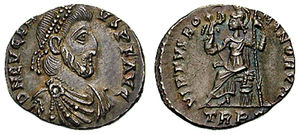 After his elevation to emperor, Eugenius appointed several important pagan senators to key positions in the Western government. He also supported a movement to advance the traditional Roman cause by granting it official recognition and by restoring important shrines such as the Altar of Victory
and the Temple of Venus and Rome. These actions earned Eugenius withering criticism from Ambrose
and did little to endear him to the fanatically Christian Theodosius.
As a Christian, Theodosius was distressed by the apparent pagan revival that was occurring under Eugenius's reign. In addition there was the issue of Valentinian's death, which had never been resolved to his satisfaction. Furthermore, Eugenius had removed all the high civil officers left by Theodosius when he had given the Western half of the empire to Valentinian, so that Theodosius had lost control of the Western Roman Empire.
When a party of Western ambassadors arrived in Constantinople to request that Eugenius be acknowledged as the Western augustus
, Theodosius was noncommittal, even if he received them with presents and vague promises. Whether he had already decided on an offensive against Eugenius and Arbogast at this point is unclear. In the end, however, after declaring his son Honorius
, then eight years old, as the western augustus in January of 393, Theodosius finally resolved to invade the West.
and most of his soldiers at the Battle of Adrianople
. It fell upon the generals Flavius Stilicho
and Timasius
both to restore discipline to the legions
and to bring them back up to strength through recruitment and conscription.
At the same time another of Theodosius's advisers, the eunuch Eutropius
, was sent out from Constantinople to seek the advice and wisdom of an aged Christian monk in the Egyptian town of Lycopolis. According to the accounts of the meeting given by Claudian
and Sozomen
, the old monk prophesied that Theodosius would achieve a costly but decisive victory over Eugenius and Arbogast.
The Eastern army set out towards the west from Constantinople in May 394. The re-galvanized legions were bolstered by numerous barbarian auxiliaries including over 20,000 Visigoth
federates and additional forces from Syria. Theodosius himself led the army; among his commanders were his own generals Stilicho and Timasius, the Visigoth chieftain Alaric
, and a Caucasian Iberia
n named Bacurios Hiberios
.
Their advance through Pannonia until the Julian Alps was unopposed, and Theodosius and his officers must have had suspicions about what lay ahead when they discovered that the eastern ends of the mountain passes were undefended. Arbogast had, based on his experiences fighting against the usurper Magnus Maximus
in Gaul, decided that the best strategy was to keep his forces united to defend Italy itself, and to that end he went so far as to leave the Alpine passes unguarded. Arbogast's forces consisted mainly of his fellow Franks and Gallo-Romans, plus his own Gothic auxiliaries.
Thanks to Arbogast's strategy of maintaining a single, relatively cohesive force, the Theodosian army passed unhindered through the Alps and descended towards the valley of the Frigidus River to the east of the Roman port of Aquileia
. It was in this narrow, mountainous region that they came upon the Western army's encampment within the Claustra Alpium Iuliarum
in a pass near present-day Vipava, Slovenia
, in the first days of September.
Day's end saw Eugenius celebrating his troops' successful defense of their position while Arbogast sent out detachments to close off the mountain passes behind Theodosius's forces.
After a sleepless night, Theodosius was cheered by the news that the men Arbogast had sent to bottle him up in the valley intended to desert to his side. Buoyed by this favorable development, Theodosius' men attacked once again. This time nature was on their side as a fierce tempest—apparently the bora
, a regular occurrence in the region—blew along the valley from the east. Other stories tell of Theodosius praying to God for a storm, which God subsequently granted. The high winds blew clouds of dust into the faces of the Western troops (legend also says, that the fierce winds even blew the Western troops' own arrows back at them). Buffeted by the winds, Arbogast's lines broke and Theodosius gained the decisive victory that the Egyptian monk had prophesied.
In the aftermath, Eugenius was captured and brought before the emperor. His pleas for mercy went unanswered and he was beheaded. Arbogast escaped the defeat and fled into the mountains, but after a few days' wandering, he concluded escape was impossible and committed suicide.
, were falsely branded as pagans after their defeat. The idea that Theodosius' enemies were pagans originates in the church historian Rufinus
, and only the sources dependent on Rufinus mention this idea.
In addition, the earliest source to mention the decisive bora wind was Ambrose of Milan, but he states in his sermon on Psalm 36 that the wind blew before that battle, and demoralized Theodosius' enemy before any fighting began. This idea was probably picked up by the poet Claudian, who, in his fanciful and propagandistic poetry for the Theodosian family, moved the wind to the decisive moment of the battle. Claudian
seems to have been making a classicizing allusion to Silius Italicus
, whose account of the Battle of Cannae mentioned a similar wind blowing spears and weapons back. From Claudian's poetry, which was popular in both eastern and western halves of the Roman Empire, the idea of the bora wind deciding the battle spread. It fit well with the other idea that the battle was one between pagans and Christians: Theodosius, as the Christian emperor, was aided by God in the form of the wind.
and Arcadius
. The resulting permanent split of the Empire between East and West doomed the Western Empire, which ended in 476.
Most significantly, the battle has often been seen as the last attempt to contest the Christianization of the empire. According to Rufinus
, the battle is on a par with the Battle of the Milvian Bridge in importance, for it was seen not only as a victory in a civil war, but a vindication of the Christian God and the triumph of Christianity – within a generation the elite pagan families of Rome would give up any serious resistance to Christianity and re-invent themselves as the papal families of Late Antiquity
.
However, the battle also accelerated the collapse of the Roman army in the west. The legions were already losing their effectiveness, due to reorganizations and a decline in the quality of their training and discipline, and the losses at the Battle of the Frigidus weakened the western legions—whose task in defending the empire from the barbarian invaders was much harder than the eastern ones—still further. This downturn in the capabilities of the Roman soldiers meant an increasing reliance by the Western Empire on barbarian mercenaries employed as foederati
, who often proved to be unreliable, or even treacherous.
The battle was also another turning point in the transition from infantry armies to ones based on cavalry, that would dominate until the end of the Middle Ages.
Theodosius I
Theodosius I , also known as Theodosius the Great, was Roman Emperor from 379 to 395. Theodosius was the last emperor to rule over both the eastern and the western halves of the Roman Empire. During his reign, the Goths secured control of Illyricum after the Gothic War, establishing their homeland...
and the army of Western Roman ruler
Western Roman Empire
The Western Roman Empire was the western half of the Roman Empire after its division by Diocletian in 285; the other half of the Roman Empire was the Eastern Roman Empire, commonly referred to today as the Byzantine Empire....
Eugenius
Eugenius
Flavius Eugenius was an usurper in the Western Roman Empire against Emperor Theodosius I. Though himself a Christian, he was the last Emperor to support Roman polytheism.-Life:...
.
The defeat of Eugenius and his commander, the Frankish
Franks
The Franks were a confederation of Germanic tribes first attested in the third century AD as living north and east of the Lower Rhine River. From the third to fifth centuries some Franks raided Roman territory while other Franks joined the Roman troops in Gaul. Only the Salian Franks formed a...
magister militum
Magister militum
Magister militum was a top-level military command used in the later Roman Empire, dating from the reign of Constantine. Used alone, the term referred to the senior military officer of the Empire...
Arbogast
Arbogast (general)
Flavius Arbogastes , or Arbogast was a Frankish general in the Roman Empire. It has been stated by some ancient historians that he was the son of Flavius Bauto, Valentinian II's former magister militum and protector before Arbogast, but modern scholars largely discount this claim...
, put the whole empire back in the hands of a single emperor for the last time in Roman history. Most significantly, the battle was the last attempt to contest the Christianization of the empire; its outcome decided the fate of Christianity in the western Empire.
Forebodings
For over two generations, since Constantine I had recognized the Christian faith and Theodosius I had made it the official religion of the State with the Edict of ThessalonicaEdict of Thessalonica
The Edict of Thessalonica, also known as Cunctos populos, was delivered on 27 February 380 by Theodosius I, Gratian, and Valentinian II in order that all their subjects should profess the faith of the bishops of Rome and Alexandria...
, conflict simmered between the Roman Senate
Roman Senate
The Senate of the Roman Republic was a political institution in the ancient Roman Republic, however, it was not an elected body, but one whose members were appointed by the consuls, and later by the censors. After a magistrate served his term in office, it usually was followed with automatic...
, many of whom were not Christian, and the emperors in Constantinople
Constantinople
Constantinople was the capital of the Roman, Eastern Roman, Byzantine, Latin, and Ottoman Empires. Throughout most of the Middle Ages, Constantinople was Europe's largest and wealthiest city.-Names:...
and Milan
Milan
Milan is the second-largest city in Italy and the capital city of the region of Lombardy and of the province of Milan. The city proper has a population of about 1.3 million, while its urban area, roughly coinciding with its administrative province and the bordering Province of Monza and Brianza ,...
who officially subscribed to Christian teachings. The senators wrote letters and argued for a return to traditional Roman beliefs, often stressing the protection and good fortune the old Roman gods
Religion in ancient Rome
Religion in ancient Rome encompassed the religious beliefs and cult practices regarded by the Romans as indigenous and central to their identity as a people, as well as the various and many cults imported from other peoples brought under Roman rule. Romans thus offered cult to innumerable deities...
had bestowed Rome since her beginnings as a small city-state. For their part, the Christian emperors emphasized the primacy of Christianity, although not all did so to the same extent. This clash between the Roman world's two main religions was for the most part merely an academic debate, without threats of armed uprisings, although small-scale violence was widespread.
Valentinian II
Flavius Valentinianus , commonly known as Valentinian II, was Roman Emperor from 375 to 392.-Early Life and Accession :...
was found dead at his residence in Vienne
Vienne
Vienne is the northernmost département of the Poitou-Charentes region of France, named after the river Vienne.- Viennese history :Vienne is one of the original 83 departments, established on March 4, 1790 during the French Revolution. It was created from parts of the former provinces of Poitou,...
, Gaul
Gaul
Gaul was a region of Western Europe during the Iron Age and Roman era, encompassing present day France, Luxembourg and Belgium, most of Switzerland, the western part of Northern Italy, as well as the parts of the Netherlands and Germany on the left bank of the Rhine. The Gauls were the speakers of...
. Valentinian, who for a time showed some favoritism towards the Arians
Arianism
Arianism is the theological teaching attributed to Arius , a Christian presbyter from Alexandria, Egypt, concerning the relationship of the entities of the Trinity and the precise nature of the Son of God as being a subordinate entity to God the Father...
, had continued the imperial policy of suppressing the interests of adherents of the old pagan religions while supporting Christians. This policy had resulted in increasing tensions between the emperor and the senators.
When the Eastern Emperor Theodosius heard the news of Valentinian's death, Arbogast
Arbogast
Arbogast is a Germanic name composed of arbi ‘inheritance’ + gast ‘stranger’.Arbogast may refer to:* Arbogast , a Frankish general in the late Roman Empire* Saint Arbogast, an Irish saint...
, who was the magister militum and de facto ruler of Western Empire, informed him that the young emperor had committed suicide.
Tensions between the two halves of the empire were heightened further that summer. Arbogast made several attempts to contact Theodosius, but apparently none got further than the ears of the Eastern praetorian prefect Rufinus
Rufinus (Byzantine official)
Flavius Rufinus was a 4th century Eastern Roman Empire statesman of Gaulish extraction who served as Praetorian prefect of the East for the emperor Theodosius I, as well as his son Arcadius, under whom Rufinus was the actual power behind the throne.He was the subject of the verse invective In...
. The responses that Arbogast received from Rufinus were unhelpful. Theodosius himself was slowly coming around to the belief that Valentinian had been murdered, in no small part because his wife Galla was convinced her brother's death was caused by treachery.
For his part, Arbogast had few friends in the Eastern court, although his uncle Richomeres
Richomeres
Flavius Richomeres was a Frank who lived in the late 4th century. He took service in the Roman army and made a career as comes, magister militum, and consul. He was married to Ascyla, with whom he had a son Theudemeres, who became king of the Franks...
was chief commander of the eastern cavalry. As it appeared increasingly likely that whatever course Theodosius decided upon would be hostile towards Arbogast, the Frank decided to make the first move.
On 22 August of that year, Arbogast elevated Flavius Eugenius
Eugenius
Flavius Eugenius was an usurper in the Western Roman Empire against Emperor Theodosius I. Though himself a Christian, he was the last Emperor to support Roman polytheism.-Life:...
, the Western imperial court's magister scrinii, to the purple. Eugenius was a well-respected scholar of rhetoric, and a better claimant to the purple than Arbogast himself. His ascension was backed by the praetorian prefect
Praetorian prefect
Praetorian prefect was the title of a high office in the Roman Empire. Originating as the commander of the Praetorian Guard, the office gradually acquired extensive legal and administrative functions, with its holders becoming the Emperor's chief aides...
of Italy, Nicomachus Flavianus the Elder, and also by many of the pagan members of the Roman Senate. However, some senators, notably Symmachus
Quintus Aurelius Symmachus
Quintus Aurelius Symmachus was a Roman statesman, orator, and man of letters. He held the offices of governor of Africa in 373, urban prefect of Rome in 384 and 385, and consul in 391...
, were uneasy with this action.
Altar of Victory
The Altar of Victory was located in the Roman Senate House bearing a gold statue of the goddess Victory. The altar was established by Octavian in 29 BC in honor of the defeat of Antony and Cleopatra at Actium. The statue depicted a winged woman, holding a palm and descending to present a laurel...
and the Temple of Venus and Rome. These actions earned Eugenius withering criticism from Ambrose
Ambrose
Aurelius Ambrosius, better known in English as Saint Ambrose , was a bishop of Milan who became one of the most influential ecclesiastical figures of the 4th century. He was one of the four original doctors of the Church.-Political career:Ambrose was born into a Roman Christian family between about...
and did little to endear him to the fanatically Christian Theodosius.
As a Christian, Theodosius was distressed by the apparent pagan revival that was occurring under Eugenius's reign. In addition there was the issue of Valentinian's death, which had never been resolved to his satisfaction. Furthermore, Eugenius had removed all the high civil officers left by Theodosius when he had given the Western half of the empire to Valentinian, so that Theodosius had lost control of the Western Roman Empire.
When a party of Western ambassadors arrived in Constantinople to request that Eugenius be acknowledged as the Western augustus
Augustus (honorific)
Augustus , Latin for "majestic," "the increaser," or "venerable", was an Ancient Roman title, which was first held by Gaius Julius Caesar Augustus , and subsequently came to be considered one of the titles of what are now known as the Roman Emperors...
, Theodosius was noncommittal, even if he received them with presents and vague promises. Whether he had already decided on an offensive against Eugenius and Arbogast at this point is unclear. In the end, however, after declaring his son Honorius
Honorius (emperor)
Honorius , was Western Roman Emperor from 395 to 423. He was the younger son of emperor Theodosius I and his first wife Aelia Flaccilla, and brother of the eastern emperor Arcadius....
, then eight years old, as the western augustus in January of 393, Theodosius finally resolved to invade the West.
Campaign preparation
Over the following year and a half Theodosius marshalled his forces for the invasion. The Eastern armies had atrophied since the death of the emperor ValensValens
Valens was the Eastern Roman Emperor from 364 to 378. He was given the eastern half of the empire by his brother Valentinian I after the latter's accession to the throne...
and most of his soldiers at the Battle of Adrianople
Battle of Adrianople
The Battle of Adrianople , sometimes known as the Battle of Hadrianopolis, was fought between a Roman army led by the Roman Emperor Valens and Gothic rebels led by Fritigern...
. It fell upon the generals Flavius Stilicho
Stilicho
Flavius Stilicho was a high-ranking general , Patrician and Consul of the Western Roman Empire, notably of Vandal birth. Despised by the Roman population for his Germanic ancestry and Arian beliefs, Stilicho was in 408 executed along with his wife and son...
and Timasius
Timasius
Flavius Timasius was a general of the Roman Empire, a relative of the Empress Aelia Flaccilla, wife of Theodosius I.- Life :Timasius was a officer under Emperor Valens, and survived to the battle of Adrianople , in which the Emperor lost his life. Theodosius I appointed Timasius comes and magister...
both to restore discipline to the legions
Roman legion
A Roman legion normally indicates the basic ancient Roman army unit recruited specifically from Roman citizens. The organization of legions varied greatly over time but they were typically composed of perhaps 5,000 soldiers, divided into maniples and later into "cohorts"...
and to bring them back up to strength through recruitment and conscription.
At the same time another of Theodosius's advisers, the eunuch Eutropius
Eutropius (Byzantine official)
Eutropius was a fourth century Eastern Roman official.He began his career as a eunuch in the palace of Theodosius I. After Theodosius' death in 395 he successfully arranged the marriage of the new emperor, Arcadius, to Aelia Eudoxia, having blocked an attempt by Arcadius' chief minister, Rufinus,...
, was sent out from Constantinople to seek the advice and wisdom of an aged Christian monk in the Egyptian town of Lycopolis. According to the accounts of the meeting given by Claudian
Claudian
Claudian was a Roman poet, who worked for Emperor Honorius and the latter's general Stilicho.A Greek-speaking citizen of Alexandria and probably not a Christian convert, Claudian arrived in Rome before 395. He made his mark with a eulogy of his two young patrons, Probinus and Olybrius, thereby...
and Sozomen
Sozomen
Salminius Hermias Sozomenus was a historian of the Christian church.-Family and Home:He was born around 400 in Bethelia, a small town near Gaza, into a wealthy Christian family of Palestine....
, the old monk prophesied that Theodosius would achieve a costly but decisive victory over Eugenius and Arbogast.
The Eastern army set out towards the west from Constantinople in May 394. The re-galvanized legions were bolstered by numerous barbarian auxiliaries including over 20,000 Visigoth
Visigoth
The Visigoths were one of two main branches of the Goths, the Ostrogoths being the other. These tribes were among the Germans who spread through the late Roman Empire during the Migration Period...
federates and additional forces from Syria. Theodosius himself led the army; among his commanders were his own generals Stilicho and Timasius, the Visigoth chieftain Alaric
Alaric I
Alaric I was the King of the Visigoths from 395–410. Alaric is most famous for his sack of Rome in 410, which marked a decisive event in the decline of the Roman Empire....
, and a Caucasian Iberia
Caucasian Iberia
Iberia , also known as Iveria , was a name given by the ancient Greeks and Romans to the ancient Georgian kingdom of Kartli , corresponding roughly to the eastern and southern parts of the present day Georgia...
n named Bacurios Hiberios
Bacurios Hiberios
Bacurius was a Roman general and a member of the royal family of Iberia mentioned by several Greco-Roman authors of the 4th and 5th centuries. It is accepted, but not universally, that all these refer to the same person, an Iberian "king" or "prince", who joined the Roman military ranks...
.
Their advance through Pannonia until the Julian Alps was unopposed, and Theodosius and his officers must have had suspicions about what lay ahead when they discovered that the eastern ends of the mountain passes were undefended. Arbogast had, based on his experiences fighting against the usurper Magnus Maximus
Magnus Maximus
Magnus Maximus , also known as Maximianus and Macsen Wledig in Welsh, was Western Roman Emperor from 383 to 388. As commander of Britain, he usurped the throne against Emperor Gratian in 383...
in Gaul, decided that the best strategy was to keep his forces united to defend Italy itself, and to that end he went so far as to leave the Alpine passes unguarded. Arbogast's forces consisted mainly of his fellow Franks and Gallo-Romans, plus his own Gothic auxiliaries.
Thanks to Arbogast's strategy of maintaining a single, relatively cohesive force, the Theodosian army passed unhindered through the Alps and descended towards the valley of the Frigidus River to the east of the Roman port of Aquileia
Aquileia
Aquileia is an ancient Roman city in what is now Italy, at the head of the Adriatic at the edge of the lagoons, about 10 km from the sea, on the river Natiso , the course of which has changed somewhat since Roman times...
. It was in this narrow, mountainous region that they came upon the Western army's encampment within the Claustra Alpium Iuliarum
Claustra Alpium Iuliarum
Claustra Alpium Iuliarum was a defense system within the Roman Empire between Italia and Pannonia that protected Italy from possible invasions from the East. It secured the Postojna Gate, the land link between the eastern and western part of the empire, and thus the Claustra represented an inner...
in a pass near present-day Vipava, Slovenia
Vipava, Slovenia
Vipava is a small town in western Slovenia with 1500 inhabitants. It is the center of a municipality with 5,185 people. Vipava is built near the numerous sources of the Vipava River, in the upper Vipava Valley, 102 m above sea level...
, in the first days of September.
The battle
Before the battle, Eugenius and Arbogast placed a statue of Jupiter on the edge of the battlefield, and had applied images of Hercules on the army banners. This way they hoped to repeat the victories of Rome in earlier days, when it had always relied on the old gods for support in battle. On the first day of battle the old gods seemed to be winning. Theodosius attacked almost immediately, having undertaken little to no prior reconnaissance of the field of battle. He committed his Gothic allies to action first, perhaps hoping to thin their ranks through attrition and lessen their potential threat to the Empire. The Eastern army's headlong attack resulted in heavy casualties but little gain, and the Georgian general Bacurius was among the dead.Day's end saw Eugenius celebrating his troops' successful defense of their position while Arbogast sent out detachments to close off the mountain passes behind Theodosius's forces.
After a sleepless night, Theodosius was cheered by the news that the men Arbogast had sent to bottle him up in the valley intended to desert to his side. Buoyed by this favorable development, Theodosius' men attacked once again. This time nature was on their side as a fierce tempest—apparently the bora
Bora (wind)
Bora or Bura is a northern to north-eastern katabatic wind in the Adriatic, Bosnia and Herzegovina, Croatia, Montenegro, Italy, Greece, Slovenia, and Turkey....
, a regular occurrence in the region—blew along the valley from the east. Other stories tell of Theodosius praying to God for a storm, which God subsequently granted. The high winds blew clouds of dust into the faces of the Western troops (legend also says, that the fierce winds even blew the Western troops' own arrows back at them). Buffeted by the winds, Arbogast's lines broke and Theodosius gained the decisive victory that the Egyptian monk had prophesied.
In the aftermath, Eugenius was captured and brought before the emperor. His pleas for mercy went unanswered and he was beheaded. Arbogast escaped the defeat and fled into the mountains, but after a few days' wandering, he concluded escape was impossible and committed suicide.
Modern Interpretation
While the version of the battle in which a divine wind defeated the pagan enemies of Theodosius became popular in late antiquity, modern historians, most notably Alan Cameron, have disputed the reliability of this version of events. Cameron asserts that the idea that Eugenius and Arbogastes were pagans or supporters of pagans was created to justify Theodosius' campaign against them, and that other usurpers, such as MagnentiusMagnentius
Flavius Magnus Magnentius was a usurper of the Roman Empire .-Early life and career:...
, were falsely branded as pagans after their defeat. The idea that Theodosius' enemies were pagans originates in the church historian Rufinus
Tyrannius Rufinus
Tyrannius Rufinus or Rufinus of Aquileia was a monk, historian, and theologian. He is most known as a translator of Greek patristic material into Latin—especially the work of Origen.-Life:...
, and only the sources dependent on Rufinus mention this idea.
In addition, the earliest source to mention the decisive bora wind was Ambrose of Milan, but he states in his sermon on Psalm 36 that the wind blew before that battle, and demoralized Theodosius' enemy before any fighting began. This idea was probably picked up by the poet Claudian, who, in his fanciful and propagandistic poetry for the Theodosian family, moved the wind to the decisive moment of the battle. Claudian
Claudian
Claudian was a Roman poet, who worked for Emperor Honorius and the latter's general Stilicho.A Greek-speaking citizen of Alexandria and probably not a Christian convert, Claudian arrived in Rome before 395. He made his mark with a eulogy of his two young patrons, Probinus and Olybrius, thereby...
seems to have been making a classicizing allusion to Silius Italicus
Silius Italicus
Silius Italicus, in full Tiberius Catius Asconius Silius Italicus , was a Roman consul, orator, and Latin epic poet of the 1st century CE,...
, whose account of the Battle of Cannae mentioned a similar wind blowing spears and weapons back. From Claudian's poetry, which was popular in both eastern and western halves of the Roman Empire, the idea of the bora wind deciding the battle spread. It fit well with the other idea that the battle was one between pagans and Christians: Theodosius, as the Christian emperor, was aided by God in the form of the wind.
Aftermath
It had been a costly but total victory for Theodosius, and a total loss for Eugenius. The western provinces quickly submitted to Theodosius, who became the last emperor of a united empire. A mere four months later he died, leaving the government in the hands of his young children HonoriusHonorius
Honorius may refer to:* Honorius , western Roman emperor 395–423* Honorius of Canterbury , archbishop of Canterbury 627–653* Honoratus of Amiens , bishop of Amiens...
and Arcadius
Arcadius
Arcadius was the Byzantine Emperor from 395 to his death. He was the eldest son of Theodosius I and his first wife Aelia Flaccilla, and brother of the Western Emperor Honorius...
. The resulting permanent split of the Empire between East and West doomed the Western Empire, which ended in 476.
Most significantly, the battle has often been seen as the last attempt to contest the Christianization of the empire. According to Rufinus
Tyrannius Rufinus
Tyrannius Rufinus or Rufinus of Aquileia was a monk, historian, and theologian. He is most known as a translator of Greek patristic material into Latin—especially the work of Origen.-Life:...
, the battle is on a par with the Battle of the Milvian Bridge in importance, for it was seen not only as a victory in a civil war, but a vindication of the Christian God and the triumph of Christianity – within a generation the elite pagan families of Rome would give up any serious resistance to Christianity and re-invent themselves as the papal families of Late Antiquity
Late Antiquity
Late Antiquity is a periodization used by historians to describe the time of transition from Classical Antiquity to the Middle Ages, in both mainland Europe and the Mediterranean world. Precise boundaries for the period are a matter of debate, but noted historian of the period Peter Brown proposed...
.
However, the battle also accelerated the collapse of the Roman army in the west. The legions were already losing their effectiveness, due to reorganizations and a decline in the quality of their training and discipline, and the losses at the Battle of the Frigidus weakened the western legions—whose task in defending the empire from the barbarian invaders was much harder than the eastern ones—still further. This downturn in the capabilities of the Roman soldiers meant an increasing reliance by the Western Empire on barbarian mercenaries employed as foederati
Foederati
Foederatus is a Latin term whose definition and usage drifted in the time between the early Roman Republic and the end of the Western Roman Empire...
, who often proved to be unreliable, or even treacherous.
The battle was also another turning point in the transition from infantry armies to ones based on cavalry, that would dominate until the end of the Middle Ages.