


Marcomannic Wars

Encyclopedia
The Marcomannic Wars were a series of wars lasting over a dozen years from about AD 166
until 180. These wars pitted the Roman Empire
against the Marcomanni
, Quadi
and other Germanic peoples
, along both sides of the upper and middle Danube
. The struggle against the Germanic invasions occupied the major part of the reign of Roman emperor
Marcus Aurelius, and it was during his campaigns against them that he started writing his philosophical work Meditations
, whose first book bears the note "Among the Quadi
at the Granua
".
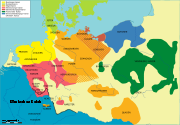 During the years succeeding the rule of Antoninus Pius
, the Roman Empire began to be attacked upon all sides. A war with Parthia
lasted from 161 to 166 (under the joint rule of Marcus Aurelius and Lucius Verus), and although it ended successfully, its unforeseen consequences for the Empire were great. The returning troops brought with them a plague (the so-called Antonine Plague
), which would eventually kill an estimated 5 million people, severely weakening the Empire. At the same time, in Central Europe, the first movements of the Great Migrations
were occurring, as the Goths
moved westwards, putting pressure on the Germanic tribes of the area. As a result, Germanic tribes and other nomadic people launched raids along Rome's northern border
, particularly into Gaul and across the Danube.
and Chauci
in the provinces of Raetia
and Germania Superior
was repulsed. In late 166 or early 167, a force of 6,000 Langobardi
, Ubii
and Lacringi
invaded Pannonia
. This invasion was defeated by local forces (vexillatio
ns of the Legio I Adiutrix
commanded by Candidus and the Ala I Ulpia Contariorum commanded by Vindex) with relative ease, but they marked the beginning of what was to come. In their aftermath, the military governor of Pannonia, Marcus Iallius Bassus, initiated negotiations with 11 tribes. In these negotiations, the Marcomannic king Ballomar, a Roman client, acted as a mediator. In the event, a truce was agreed upon and the tribes withdrew from Roman territory, but no permanent agreement was reached. In the same year, Vandals
(Astingi and Lacringi
) and the Sarmatian
Iazyges
invaded Dacia
, and succeeded in killing its governor, Calpurnius Proculus. To counter them, Legio V Macedonica
, a veteran of the Parthian campaign, was moved from Moesia Inferior to Dacia Superior, closer to the enemy.
he was planning to lead in person was postponed until 168. In the spring of that year, Marcus Aurelius, together with Lucius Verus
set forth from Rome, and established their headquarters at Aquileia
. The two emperors supervised a reorganization of the defences of Italy and the Illyricum, raised two new legions, Legio II Italica
and Legio III Italica
, and crossed the Alps into Pannonia. The Marcomanni and the Victuali had crossed the Danube into the province, but, at least according to the Historia Augusta, the approach of the imperial army to Carnuntum
was apparently sufficient to persuade them to withdraw and offer assurances of good conduct. The two emperors returned to Aquileia for the winter, but on the way, in January 169, Lucius Verus died. Marcus returned to Rome to oversee his co-emperor's funeral.
, who would become his closest aide during the war. The Romans had gathered their forces and intended to subdue the independent tribes (especially the Iazyges
), who lived between the Danube and the Roman province of Dacia. The Iazyges defeated and killed Claudius Fronto, Roman governor of Lower Moesia. However, while the Roman army was entangled in this campaign, making little headway, several tribes used the opportunity to cross the frontier and raid Roman territory.
To the east, the Costoboci
crossed the Danube, ravaged Thrace
and descended the Balkans, reaching Eleusis, near Athens
, where they destroyed the temple of the Eleusian Mysteries.
The most important and dangerous invasion however, was that of the Marcomanni in the west. Their leader, Ballomar, had formed a coalition of Germanic tribes. They crossed the Danube and won a decisive victory over a force of 20,000 Roman soldiers near Carnuntum. Ballomar then led the larger part of his host southwards towards Italy, while the remainder ravaged Noricum
. The Marcomanni razed Opitergium (Oderzo
) and besieged Aquileia
. This was the first time hostile forces had entered Italy since 101 BC
, when Gaius Marius
defeated the Cimbri
and Teutones. The army of praetorian prefect
Furius Victorinus tried to relieve the city, but was defeated and its general slain.
as one of his lieutenants. A new military command, the praetentura Italiae et Alpium was established to safeguard the roads into Italy, and the Danubian fleet was strengthened. Aquileia was relieved, and by the end of 171, the invaders had been evicted from Roman territory. Intense diplomatic activity followed, as the Romans tried to win over various barbarian tribes in preparation for a crossing of the Danube. A peace treaty was signed with the Quadi and the Iazyges, while the tribes of the Hasdingi
Vandals and the Lacringi became Roman allies.
 In 172, the Romans crossed the Danube into Marcomannic territory. Although few details are known, the Romans achieved success, subjugating the Marcomanni and their allies, the Varistae or Naristi and the Cotini. This fact is evident from the adoption of the title "Germanicus" by Marcus Aurelius, and the minting of coins with the inscription "Germania capta" ("subjugated Germania"). During this campaign, the chief of the Naristi was killed by the Roman General Marcus Valerius Maximianus
.
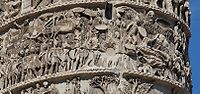
In 173, the Romans campaigned against the Quadi, who had broken their treaty and assisted their kin, and defeated and subdued them. During this campaign, a famous incident, the so-called "miracle of the rain", occurred, which was later depicted on the column of Marcus Aurelius
and on coins. According to Cassius Dio, the legio XII Fulminata
was hemmed in by a superior Quadi force and almost forced to surrender because of the heat and thirst. They were saved, however, by a sudden shower, which refreshed the Romans, while lightning struck the Quadi.Cassius Dio, LXXII.8-10 Contemporaries and historians attributed it to divine intervention: Dio claimed that it was called by an Egypt
ian magician praying to Mercury
, while Christian
writers such as Tertullian
attributed it to a prayer by Christians.
In the same year, Didius Iulianus, the commander of the Rhine frontier, repelled another invasion of the Chatti
and the Hermunduri
, while the Chauci
raided the shoreline of Gallia Belgica
.
In the next year, the Romans marched against the Quadi, whereupon the Quadi deposed their pro-Roman king, Furtius, and installed his rival, Ariogaesus, in his place. Marcus Aurelius refused to recognize him, and turning back, deposed and exiled him to Alexandria
. Thus, by late 174, the subjugation of the Quadi was complete. In typical Roman fashion, they were forced to surrender hostages and provide auxiliary contingents for the Roman army, while garrisons were installed throughout their territory.
After this, the Romans focused their attention on the Iazyges living in the plain of the river Tisza
(expeditio sarmatica). After a few victories, in 175, a treaty was signed. According to its terms, the Iazyges King Zanticus delivered 100,000 Roman prisoners and, in addition, provided 8,000 auxiliary cavalrymen, most of whom (5,500) were sent to Britain
. Upon this, Marcus assumed the victory title "Sarmaticus".
Marcus Aurelius may have intended to campaign against the remaining tribes, and together with his recent conquests establish two new Roman province
s, Marcomannia and Sarmatia, but whatever his plans, they were cut short by the rebellion of Avidius Cassius
in the East.
Marcus Aurelius marched eastwards with his army, accompanied by auxiliary detachments of Marcomanni, Quadi and Naristi under the command of Marcus Valerius Maximianus
. After the successful suppression of Cassius' revolt, the emperor returned to Rome for the first time in nearly 8 years. On 23 December 176, together with his son Commodus
, he celebrated a joint triumph
for his German victories ("de Germanis" and "de Sarmatis"). In commemoration of this, the Aurelian Column
was erected, in imitation of Trajan's Column
.
, Slovakia). The Quadi were chased westwards, deeper into Greater Germania, where the praetorian prefect Tarutenius Paternus later achieved another decisive victory against them, but on 17 March 180, the emperor died at Vindobona (modern Vienna
).
His successor Commodus
had little interest in pursuing the war. Against the advice of his senior generals, after negotiating a peace treaty with the Marcomanni and the Quadi, he left for Rome in early autumn 180, where he celebrated a triumph on October 22. Nevertheless, operations continued against the Iazyges, the Buri
and the so-called "free Dacians
" living between the Danube and Roman Dacia
. Not much is known about this war, except that the Roman generals included Marcus Valerius Maximianus
, Pescennius Niger
and Clodius Albinus
. At any rate, the victories they achieved were deemed sufficient for Commodus to claim the title "Germanicus Maximus" in mid-182.
s (16 out of 33) would be stationed along the Danube and the Rhine. For the Germanic tribes, although for the moment checked, the Marcomannic wars were only the prelude of the great invasions that would eventually disassemble and end the Western Roman Empire in the 4th and 5th centuries.
, and the 2000 Gladiator
start with a fictional account of a final battle of the Marcomannic Wars.
166
Year 166 was a common year starting on Tuesday of the Julian calendar. At the time, it was known as the Year of the Consulship of Pudens and Pollio...
until 180. These wars pitted the Roman Empire
Roman Empire
The Roman Empire was the post-Republican period of the ancient Roman civilization, characterised by an autocratic form of government and large territorial holdings in Europe and around the Mediterranean....
against the Marcomanni
Marcomanni
The Marcomanni were a Germanic tribe, probably related to the Buri, Suebi or Suevi.-Origin:Scholars believe their name derives possibly from Proto-Germanic forms of "march" and "men"....
, Quadi
Quadi
The Quadi were a smaller Germanic tribe, about which little is definitively known. We only know the Germanic tribe the Romans called the 'Quadi' through reports of the Romans themselves...
and other Germanic peoples
Germanic peoples
The Germanic peoples are an Indo-European ethno-linguistic group of Northern European origin, identified by their use of the Indo-European Germanic languages which diversified out of Proto-Germanic during the Pre-Roman Iron Age.Originating about 1800 BCE from the Corded Ware Culture on the North...
, along both sides of the upper and middle Danube
Danube
The Danube is a river in the Central Europe and the Europe's second longest river after the Volga. It is classified as an international waterway....
. The struggle against the Germanic invasions occupied the major part of the reign of Roman emperor
Roman Emperor
The Roman emperor was the ruler of the Roman State during the imperial period . The Romans had no single term for the office although at any given time, a given title was associated with the emperor...
Marcus Aurelius, and it was during his campaigns against them that he started writing his philosophical work Meditations
Meditations
Meditations is a series of personal writings by Marcus Aurelius, Roman Emperor 161–180 CE, setting forth his ideas on Stoic philosophy....
, whose first book bears the note "Among the Quadi
Quadi
The Quadi were a smaller Germanic tribe, about which little is definitively known. We only know the Germanic tribe the Romans called the 'Quadi' through reports of the Romans themselves...
at the Granua
Hron
Hron is a 298 km long left tributary of the Danube and the second longest river in Slovakia. It flows from its source located in the Low Tatra mountains through central and southern Slovakia, pouring into the Danube near Štúrovo and Esztergom...
".
Background
Antoninus Pius
Antoninus Pius , also known as Antoninus, was Roman Emperor from 138 to 161. He was a member of the Nerva-Antonine dynasty and the Aurelii. He did not possess the sobriquet "Pius" until after his accession to the throne...
, the Roman Empire began to be attacked upon all sides. A war with Parthia
Parthian Empire
The Parthian Empire , also known as the Arsacid Empire , was a major Iranian political and cultural power in ancient Persia...
lasted from 161 to 166 (under the joint rule of Marcus Aurelius and Lucius Verus), and although it ended successfully, its unforeseen consequences for the Empire were great. The returning troops brought with them a plague (the so-called Antonine Plague
Antonine Plague
The Antonine Plague, AD 165–180, also known as the Plague of Galen, who described it, was an ancient pandemic, either of smallpox or measles, brought back to the Roman Empire by troops returning from campaigns in the Near East...
), which would eventually kill an estimated 5 million people, severely weakening the Empire. At the same time, in Central Europe, the first movements of the Great Migrations
Migration Period
The Migration Period, also called the Barbarian Invasions , was a period of intensified human migration in Europe that occurred from c. 400 to 800 CE. This period marked the transition from Late Antiquity to the Early Middle Ages...
were occurring, as the Goths
Goths
The Goths were an East Germanic tribe of Scandinavian origin whose two branches, the Visigoths and the Ostrogoths, played an important role in the fall of the Roman Empire and the emergence of Medieval Europe....
moved westwards, putting pressure on the Germanic tribes of the area. As a result, Germanic tribes and other nomadic people launched raids along Rome's northern border
Limes Germanicus
The Limes Germanicus was a line of frontier fortifications that bounded the ancient Roman provinces of Germania Inferior, Germania Superior and Raetia, dividing the Roman Empire and the unsubdued Germanic tribes from the years 83 to about 260 AD...
, particularly into Gaul and across the Danube.
First invasions
Beginning in 162 and continuing until 165, an invasion of ChattiChatti
The Chatti were an ancient Germanic tribe whose homeland was near the upper Weser. They settled in central and northern Hesse and southern Lower Saxony, along the upper reaches of the Weser River and in the valleys and mountains of the Eder, Fulda and Weser River regions, a district approximately...
and Chauci
Chauci
The Chauci were an ancient Germanic tribe living in the low-lying region between the Rivers Ems and Elbe, on both sides of the Weser and ranging as far inland as the upper Weser. Along the coast they lived on artificial hills called terpen, built high enough to remain dry during the highest tide...
in the provinces of Raetia
Raetia
Raetia was a province of the Roman Empire, named after the Rhaetian people. It was bounded on the west by the country of the Helvetii, on the east by Noricum, on the north by Vindelicia, on the west by Cisalpine Gaul and on south by Venetia et Histria...
and Germania Superior
Germania Superior
Germania Superior , so called for the reason that it lay upstream of Germania Inferior, was a province of the Roman Empire. It comprised an area of western Switzerland, the French Jura and Alsace regions, and southwestern Germany...
was repulsed. In late 166 or early 167, a force of 6,000 Langobardi
Lombards
The Lombards , also referred to as Longobards, were a Germanic tribe of Scandinavian origin, who from 568 to 774 ruled a Kingdom in Italy...
, Ubii
Ubii
thumb|right|350px|The Ubii around AD 30The Ubii were a Germanic tribe first encountered dwelling on the right bank of the Rhine in the time of Julius Caesar, who formed an alliance with them in 55 BC in order to launch attacks across the river...
and Lacringi
Lacringi
The Lacringi were a Germanic peoples mentioned in ancient history for their role in the border wars conducted by the peoples along the Danube against the emperor, Marcus Aurelius. Julius Capitolinus in his Life of Marcus Antoninus tells us that the Lacringes were part of the general invasion over...
invaded Pannonia
Pannonia
Pannonia was an ancient province of the Roman Empire bounded north and east by the Danube, coterminous westward with Noricum and upper Italy, and southward with Dalmatia and upper Moesia....
. This invasion was defeated by local forces (vexillatio
Vexillatio
A vexillatio was a detachment of a Roman legion formed as a temporary task force created by the Roman Army of the Principate. It was named from the standards carried by legionary detachments, vexillum , which bore the emblem and name of the parent legion...
ns of the Legio I Adiutrix
Legio I Adiutrix
Legio prima Adiutrix , was a Roman legion formed in 68, possibly by Galba under orders of Nero. The last record mentioning the Adiutrix is in 344, when it was stationed at Brigetio , in the Roman province of Pannonia...
commanded by Candidus and the Ala I Ulpia Contariorum commanded by Vindex) with relative ease, but they marked the beginning of what was to come. In their aftermath, the military governor of Pannonia, Marcus Iallius Bassus, initiated negotiations with 11 tribes. In these negotiations, the Marcomannic king Ballomar, a Roman client, acted as a mediator. In the event, a truce was agreed upon and the tribes withdrew from Roman territory, but no permanent agreement was reached. In the same year, Vandals
Vandals
The Vandals were an East Germanic tribe that entered the late Roman Empire during the 5th century. The Vandals under king Genseric entered Africa in 429 and by 439 established a kingdom which included the Roman Africa province, besides the islands of Sicily, Corsica, Sardinia and the Balearics....
(Astingi and Lacringi
Lacringi
The Lacringi were a Germanic peoples mentioned in ancient history for their role in the border wars conducted by the peoples along the Danube against the emperor, Marcus Aurelius. Julius Capitolinus in his Life of Marcus Antoninus tells us that the Lacringes were part of the general invasion over...
) and the Sarmatian
Sarmatians
The Iron Age Sarmatians were an Iranian people in Classical Antiquity, flourishing from about the 5th century BC to the 4th century AD....
Iazyges
Iazyges
The Iazyges were an ancient nomadic tribe. Known also as Jaxamatae, Ixibatai, Iazygite, Jászok, Ászi, they were a branch of the Sarmatian people who, c. 200 BC, swept westward from central Asia onto the steppes of what is now Ukraine...
invaded Dacia
Roman Dacia
The Roman province of Dacia on the Balkans included the modern Romanian regions of Transylvania, Banat and Oltenia, and temporarily Muntenia and southern Moldova, but not the nearby regions of Moesia...
, and succeeded in killing its governor, Calpurnius Proculus. To counter them, Legio V Macedonica
Legio V Macedonica
Legio quinta Macedonica was a Roman legion. It was probably originally levied by consul Gaius Vibius Pansa Caetronianus and Octavian in 43 BC, and it was stationed in Moesia at least until 5th century. Its symbol was the bull, but the eagle was used as well...
, a veteran of the Parthian campaign, was moved from Moesia Inferior to Dacia Superior, closer to the enemy.
First Roman expedition in Pannonia (168)
During that time, as plague was ravaging the empire, Marcus Aurelius was unable to do more, and the punitive expeditionPunitive expedition
A punitive expedition is a military journey undertaken to punish a state or any group of persons outside the borders of the punishing state. It is usually undertaken in response to perceived disobedient or morally wrong behavior, but may be also be a covered revenge...
he was planning to lead in person was postponed until 168. In the spring of that year, Marcus Aurelius, together with Lucius Verus
Lucius Verus
Lucius Verus , was Roman co-emperor with Marcus Aurelius, from 161 until his death.-Early life and career:Lucius Verus was the first born son to Avidia Plautia and Lucius Aelius Verus Caesar, the first adopted son and heir of Roman Emperor Hadrian . He was born and raised in Rome...
set forth from Rome, and established their headquarters at Aquileia
Aquileia
Aquileia is an ancient Roman city in what is now Italy, at the head of the Adriatic at the edge of the lagoons, about 10 km from the sea, on the river Natiso , the course of which has changed somewhat since Roman times...
. The two emperors supervised a reorganization of the defences of Italy and the Illyricum, raised two new legions, Legio II Italica
Legio II Italica
Legio secunda Italica , was a Roman legion levied by emperor Marcus Aurelius in 165 together with I Italica at a time when the Roman Empire was fighting both in Germania and in Parthia. There are still records of the II Italica in Noricum in the beginning of the 5th century...
and Legio III Italica
Legio III Italica
Legio tertia Italica was a Roman legion levied by Marcus Aurelius around 165, for his campaign against the Marcomanni tribe. The cognomen Italica suggests that recruits were originally from Italy. The legion was still active in Raetia and other provinces in the early 5th century Legio tertia...
, and crossed the Alps into Pannonia. The Marcomanni and the Victuali had crossed the Danube into the province, but, at least according to the Historia Augusta, the approach of the imperial army to Carnuntum
Carnuntum
Carnuntum was a Roman army camp on the Danube in the Noricum province and after the 1st century the capital of the Upper Pannonia province...
was apparently sufficient to persuade them to withdraw and offer assurances of good conduct. The two emperors returned to Aquileia for the winter, but on the way, in January 169, Lucius Verus died. Marcus returned to Rome to oversee his co-emperor's funeral.
Roman expedition against the Iazyges and the great Germanic invasion of 170
In the autumn of 169, Marcus set out from Rome, together with his son-in-law Claudius PompeianusClaudius Pompeianus
Tiberius Claudius Pompeianus was a Roman general of emperor Marcus Aurelius. He married Aurelius' daughter Lucilla and rose to the rank of senior senator in Rome before twice refusing emperorship for himself....
, who would become his closest aide during the war. The Romans had gathered their forces and intended to subdue the independent tribes (especially the Iazyges
Iazyges
The Iazyges were an ancient nomadic tribe. Known also as Jaxamatae, Ixibatai, Iazygite, Jászok, Ászi, they were a branch of the Sarmatian people who, c. 200 BC, swept westward from central Asia onto the steppes of what is now Ukraine...
), who lived between the Danube and the Roman province of Dacia. The Iazyges defeated and killed Claudius Fronto, Roman governor of Lower Moesia. However, while the Roman army was entangled in this campaign, making little headway, several tribes used the opportunity to cross the frontier and raid Roman territory.
To the east, the Costoboci
Costoboci
The Costoboci were an ancient people located, during the Roman imperial era, between the Carpathian Mountains and the river Dniester.The Costoboci invaded the Roman empire in AD 170 or 171, pillaging its Balkan provinces as far as central Greece, until they were driven out by Romans...
crossed the Danube, ravaged Thrace
Thracia
Thracia is a Web-Based computer game created and developed by an exclusively Romanian team, part of Infotrend Consulting, and launched in 2009. At the time, it was the first endeavor of its kind. All browser games were text based, made up mostly of static content...
and descended the Balkans, reaching Eleusis, near Athens
Athens
Athens , is the capital and largest city of Greece. Athens dominates the Attica region and is one of the world's oldest cities, as its recorded history spans around 3,400 years. Classical Athens was a powerful city-state...
, where they destroyed the temple of the Eleusian Mysteries.
The most important and dangerous invasion however, was that of the Marcomanni in the west. Their leader, Ballomar, had formed a coalition of Germanic tribes. They crossed the Danube and won a decisive victory over a force of 20,000 Roman soldiers near Carnuntum. Ballomar then led the larger part of his host southwards towards Italy, while the remainder ravaged Noricum
Noricum
Noricum, in ancient geography, was a Celtic kingdom stretching over the area of today's Austria and a part of Slovenia. It became a province of the Roman Empire...
. The Marcomanni razed Opitergium (Oderzo
Oderzo
Oderzo is a town and comune in the province of Treviso, Veneto, northern Italy.It lies in the heart of the Venetian plain, about 66 km to the northeast of Venice...
) and besieged Aquileia
Aquileia
Aquileia is an ancient Roman city in what is now Italy, at the head of the Adriatic at the edge of the lagoons, about 10 km from the sea, on the river Natiso , the course of which has changed somewhat since Roman times...
. This was the first time hostile forces had entered Italy since 101 BC
101 BC
Year 101 BC was a year of the pre-Julian Roman calendar. At the time it was known as the Year of the Consulship of Marius and Aquillius...
, when Gaius Marius
Gaius Marius
Gaius Marius was a Roman general and statesman. He was elected consul an unprecedented seven times during his career. He was also noted for his dramatic reforms of Roman armies, authorizing recruitment of landless citizens, eliminating the manipular military formations, and reorganizing the...
defeated the Cimbri
Cimbri
The Cimbri were a tribe from Northern Europe, who, together with the Teutones and the Ambrones threatened the Roman Republic in the late 2nd century BC. The Cimbri were probably Germanic, though some believe them to be of Celtic origin...
and Teutones. The army of praetorian prefect
Praetorian prefect
Praetorian prefect was the title of a high office in the Roman Empire. Originating as the commander of the Praetorian Guard, the office gradually acquired extensive legal and administrative functions, with its holders becoming the Emperor's chief aides...
Furius Victorinus tried to relieve the city, but was defeated and its general slain.
The Roman counter-offensive and defeat of the Marcomanni
This disaster forced Marcus to re-evaluate his priorities. Forces from the various frontiers were dispatched against Ballomar. They came under the command of Claudius Pompeianus, with the future emperor PertinaxPertinax
Pertinax , was Roman Emperor for three months in 193. He is known as the first emperor of the tumultuous Year of the Five Emperors. A high ranking military and Senatorial figure, he tried to restore discipline in the Praetorian Guards, whereupon they rebelled and killed him...
as one of his lieutenants. A new military command, the praetentura Italiae et Alpium was established to safeguard the roads into Italy, and the Danubian fleet was strengthened. Aquileia was relieved, and by the end of 171, the invaders had been evicted from Roman territory. Intense diplomatic activity followed, as the Romans tried to win over various barbarian tribes in preparation for a crossing of the Danube. A peace treaty was signed with the Quadi and the Iazyges, while the tribes of the Hasdingi
Hasdingi
The Hasdingi were the southern tribes of the Vandals, an East Germanic tribe. They lived in areas of today's southern Poland, Slovakia and Hungary...
Vandals and the Lacringi became Roman allies.
Marcus Valerius Maximianus
Marcus Valerius Maximianus was an important Roman general of the period of the Marcomannic Wars during the reign of Marcus Aurelius. He was born in the Roman colony of Poetovio , where his father, also called Marcus Valerius Maximianus, was local censor and priest...
.
In 173, the Romans campaigned against the Quadi, who had broken their treaty and assisted their kin, and defeated and subdued them. During this campaign, a famous incident, the so-called "miracle of the rain", occurred, which was later depicted on the column of Marcus Aurelius
Column of Marcus Aurelius
The Column of Marcus Aurelius is a Roman victory column in Piazza Colonna, Rome, Italy. It is a Doric column featuring a spiral relief: it was built in honour of Roman emperor Marcus Aurelius and modeled on Trajan's Column.- Construction :...
and on coins. According to Cassius Dio, the legio XII Fulminata
Legio XII Fulminata
Legio duodecima Fulminata , also known as Paterna, Victrix, Antiqua, Certa Constans, and Galliena, was a Roman legion, levied by Julius Caesar in 58 BC and which accompanied him during the Gallic wars until 49 BC. The unit was still guarding the Euphrates River crossing near Melitene at the...
was hemmed in by a superior Quadi force and almost forced to surrender because of the heat and thirst. They were saved, however, by a sudden shower, which refreshed the Romans, while lightning struck the Quadi.Cassius Dio, LXXII.8-10 Contemporaries and historians attributed it to divine intervention: Dio claimed that it was called by an Egypt
Egypt
Egypt , officially the Arab Republic of Egypt, Arabic: , is a country mainly in North Africa, with the Sinai Peninsula forming a land bridge in Southwest Asia. Egypt is thus a transcontinental country, and a major power in Africa, the Mediterranean Basin, the Middle East and the Muslim world...
ian magician praying to Mercury
Mercury (mythology)
Mercury was a messenger who wore winged sandals, and a god of trade, the son of Maia Maiestas and Jupiter in Roman mythology. His name is related to the Latin word merx , mercari , and merces...
, while Christian
Christian
A Christian is a person who adheres to Christianity, an Abrahamic, monotheistic religion based on the life and teachings of Jesus of Nazareth as recorded in the Canonical gospels and the letters of the New Testament...
writers such as Tertullian
Tertullian
Quintus Septimius Florens Tertullianus, anglicised as Tertullian , was a prolific early Christian author from Carthage in the Roman province of Africa. He is the first Christian author to produce an extensive corpus of Latin Christian literature. He also was a notable early Christian apologist and...
attributed it to a prayer by Christians.
In the same year, Didius Iulianus, the commander of the Rhine frontier, repelled another invasion of the Chatti
Chatti
The Chatti were an ancient Germanic tribe whose homeland was near the upper Weser. They settled in central and northern Hesse and southern Lower Saxony, along the upper reaches of the Weser River and in the valleys and mountains of the Eder, Fulda and Weser River regions, a district approximately...
and the Hermunduri
Hermunduri
The Hermunduri, Hermanduri, Hermunduri, Hermunduli, Hermonduri, or Hermonduli were an ancient Germanic tribe, attested by the Roman historian Tacitus, who occupied the area around what is now Thuringia, Saxony, and Northern Bavaria, from the first to the third century...
, while the Chauci
Chauci
The Chauci were an ancient Germanic tribe living in the low-lying region between the Rivers Ems and Elbe, on both sides of the Weser and ranging as far inland as the upper Weser. Along the coast they lived on artificial hills called terpen, built high enough to remain dry during the highest tide...
raided the shoreline of Gallia Belgica
Gallia Belgica
Gallia Belgica was a Roman province located in what is now the southern part of the Netherlands, Belgium, Luxembourg, northeastern France, and western Germany. The indigenous population of Gallia Belgica, the Belgae, consisted of a mixture of Celtic and Germanic tribes...
.
In the next year, the Romans marched against the Quadi, whereupon the Quadi deposed their pro-Roman king, Furtius, and installed his rival, Ariogaesus, in his place. Marcus Aurelius refused to recognize him, and turning back, deposed and exiled him to Alexandria
Alexandria
Alexandria is the second-largest city of Egypt, with a population of 4.1 million, extending about along the coast of the Mediterranean Sea in the north central part of the country; it is also the largest city lying directly on the Mediterranean coast. It is Egypt's largest seaport, serving...
. Thus, by late 174, the subjugation of the Quadi was complete. In typical Roman fashion, they were forced to surrender hostages and provide auxiliary contingents for the Roman army, while garrisons were installed throughout their territory.
After this, the Romans focused their attention on the Iazyges living in the plain of the river Tisza
Tisza
The Tisza or Tisa is one of the main rivers of Central Europe. It rises in Ukraine, and is formed near Rakhiv by the junction of headwaters White Tisa, whose source is in the Chornohora mountains and Black Tisa, which springs in the Gorgany range...
(expeditio sarmatica). After a few victories, in 175, a treaty was signed. According to its terms, the Iazyges King Zanticus delivered 100,000 Roman prisoners and, in addition, provided 8,000 auxiliary cavalrymen, most of whom (5,500) were sent to Britain
Roman Britain
Roman Britain was the part of the island of Great Britain controlled by the Roman Empire from AD 43 until ca. AD 410.The Romans referred to the imperial province as Britannia, which eventually comprised all of the island of Great Britain south of the fluid frontier with Caledonia...
. Upon this, Marcus assumed the victory title "Sarmaticus".
Marcus Aurelius may have intended to campaign against the remaining tribes, and together with his recent conquests establish two new Roman province
Roman province
In Ancient Rome, a province was the basic, and, until the Tetrarchy , largest territorial and administrative unit of the empire's territorial possessions outside of Italy...
s, Marcomannia and Sarmatia, but whatever his plans, they were cut short by the rebellion of Avidius Cassius
Avidius Cassius
Gaius Avidius Cassius was a Roman general and usurper who briefly ruled Egypt and Syria in 175.-Origins:He was the son of Gaius Avidius Heliodorus, a noted orator who was Prefect of Egypt from 137 to 142 under Hadrian, and wife Junia Cassia Alexandra...
in the East.
Marcus Aurelius marched eastwards with his army, accompanied by auxiliary detachments of Marcomanni, Quadi and Naristi under the command of Marcus Valerius Maximianus
Marcus Valerius Maximianus
Marcus Valerius Maximianus was an important Roman general of the period of the Marcomannic Wars during the reign of Marcus Aurelius. He was born in the Roman colony of Poetovio , where his father, also called Marcus Valerius Maximianus, was local censor and priest...
. After the successful suppression of Cassius' revolt, the emperor returned to Rome for the first time in nearly 8 years. On 23 December 176, together with his son Commodus
Commodus
Commodus , was Roman Emperor from 180 to 192. He also ruled as co-emperor with his father Marcus Aurelius from 177 until his father's death in 180. His name changed throughout his reign; see changes of name for earlier and later forms. His accession as emperor was the first time a son had succeeded...
, he celebrated a joint triumph
Roman triumph
The Roman triumph was a civil ceremony and religious rite of ancient Rome, held to publicly celebrate and sanctify the military achievement of an army commander who had won great military successes, or originally and traditionally, one who had successfully completed a foreign war. In Republican...
for his German victories ("de Germanis" and "de Sarmatis"). In commemoration of this, the Aurelian Column
Column of Marcus Aurelius
The Column of Marcus Aurelius is a Roman victory column in Piazza Colonna, Rome, Italy. It is a Doric column featuring a spiral relief: it was built in honour of Roman emperor Marcus Aurelius and modeled on Trajan's Column.- Construction :...
was erected, in imitation of Trajan's Column
Trajan's Column
Trajan's Column is a Roman triumphal column in Rome, Italy, which commemorates Roman emperor Trajan's victory in the Dacian Wars. It was probably constructed under the supervision of the architect Apollodorus of Damascus at the order of the Roman Senate. It is located in Trajan's Forum, built near...
.
Second Marcomannic War
The respite was to be brief. In 177, the Quadi rebelled, followed soon by their neighbours, the Marcomanni and Marcus Aurelius once again headed north, to begin his second Germanic campaign (secunda expeditio germanica). He arrived at Carnuntum in August 178, and set out to quell the rebellion in a repeat of his first campaign, moving first against the Marcomanni, and in 179-180 against the Quadi. Under the command of Marcus Valerius Maximianus, the Romans fought and prevailed against the Quadi in a decisive battle at Laugaricio near (modern TrenčínTrencín
Trenčín is a city in western Slovakia of the central Váh River valley near the Czech border, around from Bratislava. It has a population of more than 56,000, which makes it the ninth largest municipality of the country and is the seat of the Trenčín Region and the Trenčín District...
, Slovakia). The Quadi were chased westwards, deeper into Greater Germania, where the praetorian prefect Tarutenius Paternus later achieved another decisive victory against them, but on 17 March 180, the emperor died at Vindobona (modern Vienna
Vienna
Vienna is the capital and largest city of the Republic of Austria and one of the nine states of Austria. Vienna is Austria's primary city, with a population of about 1.723 million , and is by far the largest city in Austria, as well as its cultural, economic, and political centre...
).
His successor Commodus
Commodus
Commodus , was Roman Emperor from 180 to 192. He also ruled as co-emperor with his father Marcus Aurelius from 177 until his father's death in 180. His name changed throughout his reign; see changes of name for earlier and later forms. His accession as emperor was the first time a son had succeeded...
had little interest in pursuing the war. Against the advice of his senior generals, after negotiating a peace treaty with the Marcomanni and the Quadi, he left for Rome in early autumn 180, where he celebrated a triumph on October 22. Nevertheless, operations continued against the Iazyges, the Buri
Buri (Germanic tribe)
The Buri were a Germanic tribe mentioned in the Germania of Tacitus, where they initially "close the back" of the Marcomanni and Quadi of Bohemia and Moravia. It is said that their speech and customs were like those of the Suebi...
and the so-called "free Dacians
Dacians
The Dacians were an Indo-European people, very close or part of the Thracians. Dacians were the ancient inhabitants of Dacia...
" living between the Danube and Roman Dacia
Roman Dacia
The Roman province of Dacia on the Balkans included the modern Romanian regions of Transylvania, Banat and Oltenia, and temporarily Muntenia and southern Moldova, but not the nearby regions of Moesia...
. Not much is known about this war, except that the Roman generals included Marcus Valerius Maximianus
Marcus Valerius Maximianus
Marcus Valerius Maximianus was an important Roman general of the period of the Marcomannic Wars during the reign of Marcus Aurelius. He was born in the Roman colony of Poetovio , where his father, also called Marcus Valerius Maximianus, was local censor and priest...
, Pescennius Niger
Pescennius Niger
Pescennius Niger was a Roman usurper from 193 to 194 during the Year of the Five Emperors. He claimed the imperial throne in response to the murder of Pertinax and the elevation of Didius Julianus, but was defeated by a rival claimant, Septimius Severus and killed while attempting to flee from...
and Clodius Albinus
Clodius Albinus
Clodius Albinus was a Roman usurper proclaimed emperor by the legions in Britain and Hispania upon the murder of Pertinax in 193.-Life:...
. At any rate, the victories they achieved were deemed sufficient for Commodus to claim the title "Germanicus Maximus" in mid-182.
Aftermath
The war had exposed the weakness of Rome's northern frontier, and henceforth, half of the Roman legionRoman legion
A Roman legion normally indicates the basic ancient Roman army unit recruited specifically from Roman citizens. The organization of legions varied greatly over time but they were typically composed of perhaps 5,000 soldiers, divided into maniples and later into "cohorts"...
s (16 out of 33) would be stationed along the Danube and the Rhine. For the Germanic tribes, although for the moment checked, the Marcomannic wars were only the prelude of the great invasions that would eventually disassemble and end the Western Roman Empire in the 4th and 5th centuries.
In popular culture
Two films, the 1964 The Fall of the Roman EmpireThe Fall of the Roman Empire (film)
The Fall of the Roman Empire is a 1964 English-language epic film produced by Samuel Bronston Productions and the Rank Organisation, and released by Paramount Pictures. It was directed by Anthony Mann and produced by Samuel Bronston with Jaime Prades and Michal Waszynski as associate producers. The...
, and the 2000 Gladiator
Gladiator (2000 film)
Gladiator is a 2000 historical epic film directed by Ridley Scott, starring Russell Crowe, Joaquin Phoenix, Connie Nielsen, Ralf Möller, Oliver Reed, Djimon Hounsou, Derek Jacobi, John Shrapnel and Richard Harris. Crowe portrays the loyal Roman General Maximus Decimus Meridius, who is betrayed...
start with a fictional account of a final battle of the Marcomannic Wars.
Primary sources
- The Historia Augusta, Lives of Marcus Aurelius 1 & 2, Lucius Verus and Commodus (Loeb Classical Library edition).
- Cassius Dio, Historia romana, Books LXXII & LXXIII
- HerodianHerodianHerodian or Herodianus of Syria was a minor Roman civil servant who wrote a colourful history in Greek titled History of the Empire from the Death of Marcus in eight books covering the years 180 to 238. His work is not entirely reliable although his relatively unbiased account of Elagabalus is...
, History of the Roman Empire since the Death of Marcus Aurelius, Book I, Ch. 1-6 - The column of Marcus AureliusColumn of Marcus AureliusThe Column of Marcus Aurelius is a Roman victory column in Piazza Colonna, Rome, Italy. It is a Doric column featuring a spiral relief: it was built in honour of Roman emperor Marcus Aurelius and modeled on Trajan's Column.- Construction :...
in Rome, which depicts the campaign