


Battle of Actium

Encyclopedia
The Battle of Actium was the decisive confrontation of the Final War of the Roman Republic
. It was fought between the forces of Octavian
and the combined forces of Mark Antony
and Cleopatra VII. The battle took place on 2 September 31 BC, on the Ionian Sea
near the city of Actium
, at the Roman province of Epirus vetus in Greece
. Octavian's fleet was commanded by Marcus Vipsanius Agrippa
, while Antony's fleet was supported by the ships of Queen Cleopatra of Ptolemaic Egypt
.
Octavian's victory enabled him to consolidate his power over Rome and its dominions. To that end, he adopted the title of Princeps
("first citizen") and some years after the victory was awarded the title of Augustus by the Roman Senate. This became the name by which he was known in later times. As Augustus, he would retain the trappings of a restored Republican leader; however, historians generally view this consolidation of power and the adoption of these honorifics as the end of the Roman Republic
and the beginning of the Roman Empire
.
, renewed for a five-year term in 38 BC, broke down when Octavian came to perceive Caesarion
, the son of Julius Caesar
and the Egyptian Queen Cleopatra, as a major threat to his power. That occurred when Mark Antony
, the other most influential member of the Triumvirate, abandoned his wife, Octavian's sister Octavia Minor
, and moved to Egypt to start a long-term romance with Cleopatra, thus becoming de facto stepfather to Caesarion. Such a love affair was doomed to become a political scandal. Antony was inevitably perceived by Octavian and the majority of the Roman Senate as the leader of a separatist movement that threatened to break the unity of the Roman Republic.
Octavian's prestige and, more importantly, the loyalty of his legions, had been initially boosted by Julius Caesar's legacy of 44 BC, by which the then nineteen-year-old Octavian had been officially adopted as the only son of the great Roman general and also established as the sole legitimate heir of his enormous wealth. Mark Antony had been the most important and most successful senior officer in Julius Caesar's army (magister equitum) and, thanks to his military record, could claim a substantial share of the political support of the Caesar's soldiers and veterans. Both Octavian and Mark Antony had fought against their common enemies in the civil war that followed the assassination of Julius Caesar.
After years of loyal cooperation with Octavian, Mark Antony started to act independently, eventually raising the suspicion that he was vying to become the sole master of Rome. When he openly left Octavian's sister, Octavia Minor, and moved to Alexandria
to become Cleopatra's official partner, he led many Roman politicians to believe that he was trying to become the unchecked ruler of Egypt and of other eastern kingdoms, while still maintaining his command over the many Roman legions in the East. As a personal challenge to Octavian's prestige, Antony tried to get Caesarion accepted as a true heir of Julius Caesar, even though the legacy did not mention him at all. In fact, Antony and Cleopatra formally elevated to power Caesarion, then thirteen years of age, in 34 BC, giving him the vague but alarming title of "King of the Kings"
(Donations of Alexandria
). Being a son of Julius Caesar, such an entitlement was obviously felt as a threat to Roman republican traditions. In fact, according to a widespread belief, Mark Antony had once offered a crown to Julius Caesar. Thereafter, Octavian started a propaganda war, denouncing Antony as an enemy of Rome, asserting that he was seeking to establish a personal monarchy over the entire Roman Empire on the behalf of Caesarion, completely circumventing the Roman Senate. It was also said that Antony intended to move the capital of the empire to Alexandria.
As the Second Triumvirate formally expired on the last day of 33 BC, Antony wrote to the Senate that he did not wish to be reappointed. He hoped that he might be regarded by them as their champion against the ambition of Octavian, who he presumed would not be willing to abandon his position in a similar manner. The causes of mutual dissatisfaction between the two had been continually accumulating. Antony complained that Octavian had exceeded his powers in deposing Lepidus
, in taking over the countries held by Sextus Pompeius
, in enlisting soldiers for himself without sending half to him. Octavian complained that Antony had no authority for being in Egypt; that his execution of Sextus Pompeius was illegal; that his treachery to the king of Armenia disgraced the Roman name; that he had not sent half the proceeds of the spoils to Rome according to his agreement; that his connection with Cleopatra and the acknowledgment of Caesarion as a legitimate son of Julius Caesar were a degradation of his office and a menace to himself.
During 32 BC, a third of the Senate and both consul
s allied with Antony. The consuls of that year had determined to conceal the extent of Antony's demands. Ahenobarbus
seems to have wished to keep quiet; but G. Sosius
on 1 January made an elaborate speech in favor of Antony, and would have proposed the confirmation of his acta had it not been vetoed by a tribune. Octavian was not present, but at the next meeting made a reply of such a nature that the consuls both left Rome to join Antony; and Antony, when he heard of it, after publicly divorcing Octavia, came at once to Ephesus
with Cleopatra, where a vast fleet was gathered from all parts of the East, of which Cleopatra furnished a large proportion. After staying a time with his allies at Samos, Antony removed to Athens. His land forces which had been in Armenia were brought down to the coast of Asia, and embarked under L. Canidius Crassus.
Octavian was not behind in his strategic preparations. Indeed, military operations began in 31 BC, when Octavian's general Agrippa captured Methone
, a Greek town allied to Antony. But, by the publication of Antony's will, which had been put into his hands by the traitor Plancus, and by carefully letting it be known at Rome what preparations were going on at Samos
, and how entirely Antony was acting as the agent of Cleopatra, Octavian produced such a violent outburst of feeling that he easily obtained Antony's deposition from the consulship of 31, for which he had been designated, and a vote for a proclamation of war against Cleopatra, well understood to mean against Antony, though he was not named. In doing this, the Senate issued a war declaration and deprived Antony of any legal authority.
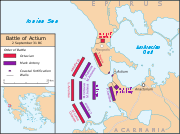 Antony meant to anticipate an attack by a descent upon Italy towards the end of 32, and went as far as Corcyra. But finding the sea guarded by a squadron of Octavian's ships, he retired to winter at Patrae, while his fleet for the most part lay in the Ambracian Gulf
, and his land forces encamped near the promontory of Actium, while the opposite side of the narrow strait into the Ambracian Gulf was also protected by a tower and a body of troops.
After Octavian's proposals for a conference with Antony had been scornfully rejected, both sides prepared for the final struggle next year. The early months passed without notable event, beyond some successes of Agrippa on the coasts of Greece, meant to divert Antony's attention. It was not until the latter part of August that troops were brought by land into the neighbourhood of Antony's camp on the north side of the strait. Still Antony could not be tempted out. It would take some months for his full strength to arrive from the various places in which his allies or his ships had wintered. But during these months not only was Agrippa continuing his descent upon Greek towns and coasts, but in various cavalry skirmishes, Octavian had so far prevailed that Antony abandoned the north side of the strait and confined his soldiers to the southern camp. Cleopatra now earnestly advised that garrisons should be put into strong towns, and that the main fleet should return to Alexandria. The large contingent furnished by Egypt gave her advice as much weight as her personal influence over Antony; and it appears that this movement was really resolved upon.
Octavian learned of this and debated how to prevent it. At first of a mind to let Anthony sail and then attack him, he was prevailed upon by Agrippa to give battle. On the first day of September, he issued an address to his fleet, preparing them for battle. The next day was wet and the sea was rough. When the trumpet signal for the start rang out, Antony's fleet began issuing from the straits, and the ships moved into line and remained quiet. Octavian, after a short hesitation, ordered his vessels to steer to the right and pass the enemy's ships. Then for fear of being surrounded, Antony was forced to give the word to attack.
furnished with towers full of armed men. He led these through the straits towards the open sea. Octavian had about 250 warships. Octavian's fleet was waiting beyond the straits, led by the experienced admiral Agrippa, commanding from the left wing of the fleet, Lucius Arruntius
commanding the centre and Marcus Lurius
commanding from the right. Titus Statilius Taurus
commanded Octavian's armies, who observed the battle from shore to the north of the straits. Mark Antony and Gellius Publicola commanded the right wing of the Antonian fleet, while Marcus Octavius and Marcus Insteius commanded the centre, with Cleopatra's squadron positioned behind them. Gaius Sosius
launched the initial attack from the left wing of the fleet, while Antony's chief lieutenant Publius Canidius Crassus
was in command of the triumvir's land forces.
s, huge galleys with massive rams, that could weigh up to three hundred tons. Antony's ships were often furnished with grappling irons, which were effective if hurled successfully; but, if they failed, were apt to damage the ship, or to cause so much delay as to expose the men on board to the darts from the smaller vessel. The bows of the galleys were armoured with bronze
plates and square-cut timbers, making a successful ramming attack with similar equipment difficult.
Unfortunately for Antony, many of his ships were undermanned; there had been a severe malaria outbreak while they were waiting for Octavian's fleet to arrive. Making the best of the situation, he burned those ships he could no longer man, while clustering the remainder tightly together. With many oarsmen dead or unfit to serve, the powerful, head-on ramming tactic for which the quinqueremes had been designed failed.
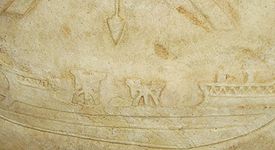 Octavian's fleet was largely made up of smaller, fully manned Liburnian
vessels, armed with better-trained, fresher crews. Octavian's ships were generally smaller, but more manageable in the heavy surf, capable of reversing their course on short notice and returning to the charge or, after pouring in a volley of darts on some huge adversary, able to retreat out of shot with speed. They were lighter and could out-maneuver the quinqueremes, where one objective was to ram the enemy ship and at the same time attack the above-deck crew with a shower of arrows and catapult-launched stones, which were large enough to decapitate a man.
Before the battle, one of Mark Antony's generals, Quintus Dellius
, had defected to Octavian, bringing with him Mark Antony's battle plans. Antony had hoped to use his biggest ships to drive back Agrippa's wing on the north end of his line, but Octavian's entire fleet, aware of this strategy, stayed out of range. Shortly after midday, Antony was forced to extend his line from the protection of the shore and finally engage the enemy. Cleopatra, in the rear, could not bear the suspense, and in an agony of anxiety, gave the signal for retreat. Cleopatra's fleet retreated to open sea without engaging. A breeze sprang up in the right direction, and the Egyptian ships were soon hurrying out of sight.
Antony had not observed the signal, and believing that it was mere panic and that all was lost, followed the flying squadron. The contagion spread fast; everywhere sails were seen unfurling, and towers and other heavy fighting gear going by the board. Yet some still fought on; and it was not until long after nightfall, when many a ship was blazing from the firebrands thrown upon them, that the work was done. Mark Antony transferred to a smaller vessel with his flag and managed to escape, taking a few ships with him as an escort to help break through Octavian's lines. Those that remained left behind, however, were captured or sunk by Octavian's forces.
J.M. Carter argues in The Battle of Actium: The Rise and Triumph of Augustus Caesar that Antony knew he was surrounded and had nowhere to run. To try to turn this to his advantage, Antony gathered his ships around him in a quasi-horseshoe formation, staying close to the shore for safety. Then, should Octavian's ships approach Antony's, the sea would push them into the shore. Antony foresaw that he would not be able to defeat Octavian's forces, so he and Cleopatra stayed in the rear of the formation. Eventually, Antony sent the ships on the northern part of the formation to attack. He had them move out to the north, spreading out Octavian's ships which up until now were tightly arranged. He sent Gaius Sosius
down to the south to spread the remaining ships out to the south. This left a hole in the middle of Octavian's formation. Antony seized the opportunity and with Cleopatra on her ship and him on a different ship, sped through the gap and escaped, abandoning his entire force.
With the end of the battle, Octavian exerted himself to save the crews of the burning vessels, and had to spend the whole night on board. Next day, such of the land army as had not escaped to their own lands submitted or were followed in their retreat to Macedonia and forced to surrender, and Antony's camp was occupied. It was all over, and the Empire had a single master.
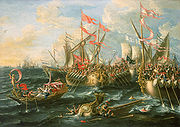 The political consequences of this battle were far-reaching. Under cover of darkness some 19 legions and 12,000 cavalry
fled before Antony was able to engage Octavian in a land battle. After Mark Antony lost his fleet, his army, which had been equal to that of Octavian, deserted in large numbers. Antony, though he had not laid down his imperium, was a fugitive and a rebel, without that shadow of a legal position which the presence of the consuls and senators had given him in the previous year. Some of the victorious fleet went in pursuit of him; but Octavian himself visited Greece and Asia, and spent the winter at Samos; though he was obliged to go for a short time to Brundisium to settle a mutiny and arrange for assignations of land.
At Samos, Octavian received a message from Cleopatra with the present of a gold crown and throne, offering to abdicate in favour of her sons. The queen was allowed to believe that she would be well treated, for Octavian was anxious to secure her for his triumph. Antony, who had found himself generally deserted, after vainly attempting to secure the army stationed near Paraetonium under Pinarius, and sending his eldest son Antyllus with money to Octavian and an offer to live at Athens as a private citizen, found himself in the spring attacked on two sides. C. Cornelius Gallus
was advancing from Paraetonium; and Octavian himself landed at Pelusium, with the connivance it was believed of Cleopatra. Antony was defeated by Gallus, and returning to Egypt, advanced on Pelusium.
Despite a victory at Alexandria on 31 July 30 BC, more of Mark Antony's men deserted, leaving him with insufficient forces to fight Octavian. A slight success over Octavian's tired soldiers encouraged him to make a general attack, in which he was decisively beaten. Mark Antony then tried to flee from the battle, and as a result of a communication breakdown, came to believe that Cleopatra had been captured, and hence committed suicide
. Failing to escape on board a ship, he stabbed himself; and, as he did not die at once, insisted on being taken to the mausoleum in which Cleopatra was shut up, and there died in her arms. The queen was shortly afterwards brought from this place to the palace and vainly attempted to move Octavian to pity.
After Mark Antony's death, Cleopatra eluded the vigilance of her guard Epaphroditus
and committed suicide, on 12 August 30 BC. In one account, she put an end to her life, as it was believed, by the bite of a snake (an asp
) conveyed to her in a basket of figs. Octavian had Caesarion
killed later that year, finally securing his legacy as Julius Caesar's only 'son'.
Thus, Octavian's victory at the Battle of Actium gave him sole and uncontested control of "Mare Nostrum" (Our Sea i.e. the Roman Mediterannean) and he became "Augustus Caesar" and the "first citizen" of Rome. This victory, consolidating his power over every Roman institution, marked the transition of Rome from Republic to Empire. Egypt's final surrender following Cleopatra's death also marks the final demise of both the Hellenistic Age and the Ptolemaic Kingdom.
Final war of the Roman Republic
The final war of the Roman Republic, also known as Antony's civil war or the war between Antony and Octavian, was the last of the Roman civil wars of the republic, fought between Cleopatra and Octavian...
. It was fought between the forces of Octavian
Augustus
Augustus ;23 September 63 BC – 19 August AD 14) is considered the first emperor of the Roman Empire, which he ruled alone from 27 BC until his death in 14 AD.The dates of his rule are contemporary dates; Augustus lived under two calendars, the Roman Republican until 45 BC, and the Julian...
and the combined forces of Mark Antony
Mark Antony
Marcus Antonius , known in English as Mark Antony, was a Roman politician and general. As a military commander and administrator, he was an important supporter and loyal friend of his mother's cousin Julius Caesar...
and Cleopatra VII. The battle took place on 2 September 31 BC, on the Ionian Sea
Ionian Sea
The Ionian Sea , is an arm of the Mediterranean Sea, south of the Adriatic Sea. It is bounded by southern Italy including Calabria, Sicily and the Salento peninsula to the west, southern Albania to the north, and a large number of Greek islands, including Corfu, Zante, Kephalonia, Ithaka, and...
near the city of Actium
Aktio–Vonitsa
Aktio–Vonitsa is a municipality in the Aetolia-Acarnania peripheral unit, West Greece Periphery, Greece. The seat of the municipality is the town Vonitsa.-Municipality:...
, at the Roman province of Epirus vetus in Greece
Greece
Greece , officially the Hellenic Republic , and historically Hellas or the Republic of Greece in English, is a country in southeastern Europe....
. Octavian's fleet was commanded by Marcus Vipsanius Agrippa
Marcus Vipsanius Agrippa
Marcus Vipsanius Agrippa was a Roman statesman and general. He was a close friend, son-in-law, lieutenant and defense minister to Octavian, the future Emperor Caesar Augustus...
, while Antony's fleet was supported by the ships of Queen Cleopatra of Ptolemaic Egypt
Ptolemaic Egypt
Ptolemaic Egypt began when Ptolemy I Soter invaded Egypt and declared himself Pharaoh of Egypt in 305 BC and ended with the death of queen Cleopatra VII of Egypt and the Roman conquest in 30 BC. The Ptolemaic Kingdom was a powerful Hellenistic state, extending from southern Syria in the east, to...
.
Octavian's victory enabled him to consolidate his power over Rome and its dominions. To that end, he adopted the title of Princeps
Princeps
Princeps is a Latin word meaning "first in time or order; the first, chief, the most eminent, distinguished, or noble; the first man, first person."...
("first citizen") and some years after the victory was awarded the title of Augustus by the Roman Senate. This became the name by which he was known in later times. As Augustus, he would retain the trappings of a restored Republican leader; however, historians generally view this consolidation of power and the adoption of these honorifics as the end of the Roman Republic
Roman Republic
The Roman Republic was the period of the ancient Roman civilization where the government operated as a republic. It began with the overthrow of the Roman monarchy, traditionally dated around 508 BC, and its replacement by a government headed by two consuls, elected annually by the citizens and...
and the beginning of the Roman Empire
Roman Empire
The Roman Empire was the post-Republican period of the ancient Roman civilization, characterised by an autocratic form of government and large territorial holdings in Europe and around the Mediterranean....
.
Prelude
The alliance commonly known as the Second TriumvirateSecond Triumvirate
The Second Triumvirate is the name historians give to the official political alliance of Octavius , Marcus Aemilius Lepidus, and Mark Antony, formed on 26 November 43 BC with the enactment of the Lex Titia, the adoption of which marked the end of the Roman Republic...
, renewed for a five-year term in 38 BC, broke down when Octavian came to perceive Caesarion
Caesarion
Ptolemy XV Philopator Philometor Caesar , better known by the nicknames Caesarion and Ptolemy Caesar , was the last king of the Ptolemaic dynasty of Egypt, who reigned jointly with his mother Cleopatra VII of Egypt, from September 2, 44 BC...
, the son of Julius Caesar
Julius Caesar
Gaius Julius Caesar was a Roman general and statesman and a distinguished writer of Latin prose. He played a critical role in the gradual transformation of the Roman Republic into the Roman Empire....
and the Egyptian Queen Cleopatra, as a major threat to his power. That occurred when Mark Antony
Mark Antony
Marcus Antonius , known in English as Mark Antony, was a Roman politician and general. As a military commander and administrator, he was an important supporter and loyal friend of his mother's cousin Julius Caesar...
, the other most influential member of the Triumvirate, abandoned his wife, Octavian's sister Octavia Minor
Octavia Minor
Octavia the Younger , also known as Octavia Minor or simply Octavia, was the sister of the first Roman Emperor, Augustus , half-sister of Octavia the Elder, and fourth wife of Mark Antony...
, and moved to Egypt to start a long-term romance with Cleopatra, thus becoming de facto stepfather to Caesarion. Such a love affair was doomed to become a political scandal. Antony was inevitably perceived by Octavian and the majority of the Roman Senate as the leader of a separatist movement that threatened to break the unity of the Roman Republic.
Octavian's prestige and, more importantly, the loyalty of his legions, had been initially boosted by Julius Caesar's legacy of 44 BC, by which the then nineteen-year-old Octavian had been officially adopted as the only son of the great Roman general and also established as the sole legitimate heir of his enormous wealth. Mark Antony had been the most important and most successful senior officer in Julius Caesar's army (magister equitum) and, thanks to his military record, could claim a substantial share of the political support of the Caesar's soldiers and veterans. Both Octavian and Mark Antony had fought against their common enemies in the civil war that followed the assassination of Julius Caesar.
After years of loyal cooperation with Octavian, Mark Antony started to act independently, eventually raising the suspicion that he was vying to become the sole master of Rome. When he openly left Octavian's sister, Octavia Minor, and moved to Alexandria
Alexandria
Alexandria is the second-largest city of Egypt, with a population of 4.1 million, extending about along the coast of the Mediterranean Sea in the north central part of the country; it is also the largest city lying directly on the Mediterranean coast. It is Egypt's largest seaport, serving...
to become Cleopatra's official partner, he led many Roman politicians to believe that he was trying to become the unchecked ruler of Egypt and of other eastern kingdoms, while still maintaining his command over the many Roman legions in the East. As a personal challenge to Octavian's prestige, Antony tried to get Caesarion accepted as a true heir of Julius Caesar, even though the legacy did not mention him at all. In fact, Antony and Cleopatra formally elevated to power Caesarion, then thirteen years of age, in 34 BC, giving him the vague but alarming title of "King of the Kings"
King of Kings
King of Kings is a title that has been used by several monarchies and empires throughout history. The title originates in the Ancient Near East. It is broadly the equivalent of the later title Emperor....
(Donations of Alexandria
Donations of Alexandria
The Donations of Alexandria were a religio-political statement by Cleopatra VII and Mark Antony in which they distributed lands held by Rome and Parthia amongst Cleopatra's children, and granted them many titles, especially for Caesarion, son of Julius Caesar...
). Being a son of Julius Caesar, such an entitlement was obviously felt as a threat to Roman republican traditions. In fact, according to a widespread belief, Mark Antony had once offered a crown to Julius Caesar. Thereafter, Octavian started a propaganda war, denouncing Antony as an enemy of Rome, asserting that he was seeking to establish a personal monarchy over the entire Roman Empire on the behalf of Caesarion, completely circumventing the Roman Senate. It was also said that Antony intended to move the capital of the empire to Alexandria.
As the Second Triumvirate formally expired on the last day of 33 BC, Antony wrote to the Senate that he did not wish to be reappointed. He hoped that he might be regarded by them as their champion against the ambition of Octavian, who he presumed would not be willing to abandon his position in a similar manner. The causes of mutual dissatisfaction between the two had been continually accumulating. Antony complained that Octavian had exceeded his powers in deposing Lepidus
Marcus Aemilius Lepidus (triumvir)
Marcus Aemilius Lepidus , was a Roman patrician who rose to become a member of the Second Triumvirate and Pontifex Maximus. His father, Marcus Aemilius Lepidus, had been involved in a rebellion against the Roman Republic.Lepidus was among Julius Caesar's greatest supporters...
, in taking over the countries held by Sextus Pompeius
Sextus Pompeius
Sextus Pompeius Magnus Pius, in English Sextus Pompey , was a Roman general from the late Republic . He was the last focus of opposition to the Second Triumvirate...
, in enlisting soldiers for himself without sending half to him. Octavian complained that Antony had no authority for being in Egypt; that his execution of Sextus Pompeius was illegal; that his treachery to the king of Armenia disgraced the Roman name; that he had not sent half the proceeds of the spoils to Rome according to his agreement; that his connection with Cleopatra and the acknowledgment of Caesarion as a legitimate son of Julius Caesar were a degradation of his office and a menace to himself.
During 32 BC, a third of the Senate and both consul
Consul
Consul was the highest elected office of the Roman Republic and an appointive office under the Empire. The title was also used in other city states and also revived in modern states, notably in the First French Republic...
s allied with Antony. The consuls of that year had determined to conceal the extent of Antony's demands. Ahenobarbus
Ahenobarbus
Ahenobarbus was the name of a plebeian family of the Domitia gens in the late Republic and early Principate of ancient Rome. The name means "red-beard" in Latin...
seems to have wished to keep quiet; but G. Sosius
Gaius Sosius
Gaius Sosius was a Roman general and politician.Gaius Sosius was elected quaestor in 66 BC and praetor in 49 BC. Upon the start of the civil war, he joined the party of the Senate sometimes called optimates by modern scholars...
on 1 January made an elaborate speech in favor of Antony, and would have proposed the confirmation of his acta had it not been vetoed by a tribune. Octavian was not present, but at the next meeting made a reply of such a nature that the consuls both left Rome to join Antony; and Antony, when he heard of it, after publicly divorcing Octavia, came at once to Ephesus
Ephesus
Ephesus was an ancient Greek city, and later a major Roman city, on the west coast of Asia Minor, near present-day Selçuk, Izmir Province, Turkey. It was one of the twelve cities of the Ionian League during the Classical Greek era...
with Cleopatra, where a vast fleet was gathered from all parts of the East, of which Cleopatra furnished a large proportion. After staying a time with his allies at Samos, Antony removed to Athens. His land forces which had been in Armenia were brought down to the coast of Asia, and embarked under L. Canidius Crassus.
Octavian was not behind in his strategic preparations. Indeed, military operations began in 31 BC, when Octavian's general Agrippa captured Methone
Methone
Methone can refer to:* Methone , one of the seven Alkyonides, daughters of the giant Alkyoneus in Greek mythology*Methone , a small moon of Saturn, discovered in 2004*Methoni, Messenia, a town in the prefecture of Messenia, Greece...
, a Greek town allied to Antony. But, by the publication of Antony's will, which had been put into his hands by the traitor Plancus, and by carefully letting it be known at Rome what preparations were going on at Samos
Samoš
Samoš is a village in Serbia. It is situated in the Kovačica municipality, in the South Banat District, Vojvodina province. The village has a Serb ethnic majority and its population numbering 1,247 people .-See also:...
, and how entirely Antony was acting as the agent of Cleopatra, Octavian produced such a violent outburst of feeling that he easily obtained Antony's deposition from the consulship of 31, for which he had been designated, and a vote for a proclamation of war against Cleopatra, well understood to mean against Antony, though he was not named. In doing this, the Senate issued a war declaration and deprived Antony of any legal authority.
The battle
Ambracian Gulf
The Ambracian Gulf, also known as the Gulf of Arta or the Gulf of Actium, and in some official documents as the Amvrakikos Gulf , is a gulf of the Ionian Sea in northwestern Greece. About long and wide, it is one of the largest enclosed gulfs in Greece...
, and his land forces encamped near the promontory of Actium, while the opposite side of the narrow strait into the Ambracian Gulf was also protected by a tower and a body of troops.
After Octavian's proposals for a conference with Antony had been scornfully rejected, both sides prepared for the final struggle next year. The early months passed without notable event, beyond some successes of Agrippa on the coasts of Greece, meant to divert Antony's attention. It was not until the latter part of August that troops were brought by land into the neighbourhood of Antony's camp on the north side of the strait. Still Antony could not be tempted out. It would take some months for his full strength to arrive from the various places in which his allies or his ships had wintered. But during these months not only was Agrippa continuing his descent upon Greek towns and coasts, but in various cavalry skirmishes, Octavian had so far prevailed that Antony abandoned the north side of the strait and confined his soldiers to the southern camp. Cleopatra now earnestly advised that garrisons should be put into strong towns, and that the main fleet should return to Alexandria. The large contingent furnished by Egypt gave her advice as much weight as her personal influence over Antony; and it appears that this movement was really resolved upon.
Octavian learned of this and debated how to prevent it. At first of a mind to let Anthony sail and then attack him, he was prevailed upon by Agrippa to give battle. On the first day of September, he issued an address to his fleet, preparing them for battle. The next day was wet and the sea was rough. When the trumpet signal for the start rang out, Antony's fleet began issuing from the straits, and the ships moved into line and remained quiet. Octavian, after a short hesitation, ordered his vessels to steer to the right and pass the enemy's ships. Then for fear of being surrounded, Antony was forced to give the word to attack.
Order of battle
The two fleets met outside the Gulf of Actium, on the morning of 2 September 31 BC. Antony's fleet numbered 500, of which 230 were large war galleysWarship
A warship is a ship that is built and primarily intended for combat. Warships are usually built in a completely different way from merchant ships. As well as being armed, warships are designed to withstand damage and are usually faster and more maneuvrable than merchant ships...
furnished with towers full of armed men. He led these through the straits towards the open sea. Octavian had about 250 warships. Octavian's fleet was waiting beyond the straits, led by the experienced admiral Agrippa, commanding from the left wing of the fleet, Lucius Arruntius
Lucius Arruntius
Lucius Arruntius was a Roman admiral. He saw action during the War with Sextus Pompeius, and the war of Mark Antony and Augustus. He is most notable for his participation during the Battle of Actium, where he was in command of victorious Augustus' central division...
commanding the centre and Marcus Lurius
Marcus Lurius
Marcus Lurius was a 1st century BC Roman admiral. Lurius is best known for holding an important command in the Battle of Actium.Around 40 BC Marcus Lurius, as governor of Sardinia, fought off an invasion of the island led by Menas, an admiral serving under Sextus Pompey who ruled Sicily at the time...
commanding from the right. Titus Statilius Taurus
Titus Statilius Taurus
Titus Statilius Taurus was the name of a line of Roman senators. The first known and most important of these was a Roman general and two-time consul prominent during the Triumviral and Augustan periods...
commanded Octavian's armies, who observed the battle from shore to the north of the straits. Mark Antony and Gellius Publicola commanded the right wing of the Antonian fleet, while Marcus Octavius and Marcus Insteius commanded the centre, with Cleopatra's squadron positioned behind them. Gaius Sosius
Gaius Sosius
Gaius Sosius was a Roman general and politician.Gaius Sosius was elected quaestor in 66 BC and praetor in 49 BC. Upon the start of the civil war, he joined the party of the Senate sometimes called optimates by modern scholars...
launched the initial attack from the left wing of the fleet, while Antony's chief lieutenant Publius Canidius Crassus
Publius Canidius Crassus
Publius Canidius Crassus was a Roman general and Mark Antony's lieutenant. He served under Lepidus in southern Gallia in 43 BC, and was henceforth allied with Antony. He became suffect consul in 40 BC and then served as a commander in Armenia whence he invaded, in 36 BC, Iberia , and forced its...
was in command of the triumvir's land forces.
Combat
The battle raged all afternoon without decisive result. The majority of Mark Antony's warships were quinqueremeQuinquereme
From the 4th century BC on, new types of oared warships appeared in the Mediterranean Sea, superseding the trireme and transforming naval warfare. Ships became increasingly bigger and heavier, including some of the largest wooden ships ever constructed...
s, huge galleys with massive rams, that could weigh up to three hundred tons. Antony's ships were often furnished with grappling irons, which were effective if hurled successfully; but, if they failed, were apt to damage the ship, or to cause so much delay as to expose the men on board to the darts from the smaller vessel. The bows of the galleys were armoured with bronze
Bronze
Bronze is a metal alloy consisting primarily of copper, usually with tin as the main additive. It is hard and brittle, and it was particularly significant in antiquity, so much so that the Bronze Age was named after the metal...
plates and square-cut timbers, making a successful ramming attack with similar equipment difficult.
Unfortunately for Antony, many of his ships were undermanned; there had been a severe malaria outbreak while they were waiting for Octavian's fleet to arrive. Making the best of the situation, he burned those ships he could no longer man, while clustering the remainder tightly together. With many oarsmen dead or unfit to serve, the powerful, head-on ramming tactic for which the quinqueremes had been designed failed.
Liburnians
The Liburnians were an ancient Illyrian tribe inhabiting the district called Liburnia, a coastal region of the northeastern Adriatic between the rivers Arsia and Titius in what is now Croatia....
vessels, armed with better-trained, fresher crews. Octavian's ships were generally smaller, but more manageable in the heavy surf, capable of reversing their course on short notice and returning to the charge or, after pouring in a volley of darts on some huge adversary, able to retreat out of shot with speed. They were lighter and could out-maneuver the quinqueremes, where one objective was to ram the enemy ship and at the same time attack the above-deck crew with a shower of arrows and catapult-launched stones, which were large enough to decapitate a man.
Before the battle, one of Mark Antony's generals, Quintus Dellius
Quintus Dellius
Quintus Dellius was a Roman commander and politician in the second half of the 1st century BC.He was a political opportunist and was called desultor bellorum civilium by Marcus Valerius Messalla Corvinus...
, had defected to Octavian, bringing with him Mark Antony's battle plans. Antony had hoped to use his biggest ships to drive back Agrippa's wing on the north end of his line, but Octavian's entire fleet, aware of this strategy, stayed out of range. Shortly after midday, Antony was forced to extend his line from the protection of the shore and finally engage the enemy. Cleopatra, in the rear, could not bear the suspense, and in an agony of anxiety, gave the signal for retreat. Cleopatra's fleet retreated to open sea without engaging. A breeze sprang up in the right direction, and the Egyptian ships were soon hurrying out of sight.
Antony had not observed the signal, and believing that it was mere panic and that all was lost, followed the flying squadron. The contagion spread fast; everywhere sails were seen unfurling, and towers and other heavy fighting gear going by the board. Yet some still fought on; and it was not until long after nightfall, when many a ship was blazing from the firebrands thrown upon them, that the work was done. Mark Antony transferred to a smaller vessel with his flag and managed to escape, taking a few ships with him as an escort to help break through Octavian's lines. Those that remained left behind, however, were captured or sunk by Octavian's forces.
J.M. Carter argues in The Battle of Actium: The Rise and Triumph of Augustus Caesar that Antony knew he was surrounded and had nowhere to run. To try to turn this to his advantage, Antony gathered his ships around him in a quasi-horseshoe formation, staying close to the shore for safety. Then, should Octavian's ships approach Antony's, the sea would push them into the shore. Antony foresaw that he would not be able to defeat Octavian's forces, so he and Cleopatra stayed in the rear of the formation. Eventually, Antony sent the ships on the northern part of the formation to attack. He had them move out to the north, spreading out Octavian's ships which up until now were tightly arranged. He sent Gaius Sosius
Gaius Sosius
Gaius Sosius was a Roman general and politician.Gaius Sosius was elected quaestor in 66 BC and praetor in 49 BC. Upon the start of the civil war, he joined the party of the Senate sometimes called optimates by modern scholars...
down to the south to spread the remaining ships out to the south. This left a hole in the middle of Octavian's formation. Antony seized the opportunity and with Cleopatra on her ship and him on a different ship, sped through the gap and escaped, abandoning his entire force.
With the end of the battle, Octavian exerted himself to save the crews of the burning vessels, and had to spend the whole night on board. Next day, such of the land army as had not escaped to their own lands submitted or were followed in their retreat to Macedonia and forced to surrender, and Antony's camp was occupied. It was all over, and the Empire had a single master.
Aftermath
Cavalry
Cavalry or horsemen were soldiers or warriors who fought mounted on horseback. Cavalry were historically the third oldest and the most mobile of the combat arms...
fled before Antony was able to engage Octavian in a land battle. After Mark Antony lost his fleet, his army, which had been equal to that of Octavian, deserted in large numbers. Antony, though he had not laid down his imperium, was a fugitive and a rebel, without that shadow of a legal position which the presence of the consuls and senators had given him in the previous year. Some of the victorious fleet went in pursuit of him; but Octavian himself visited Greece and Asia, and spent the winter at Samos; though he was obliged to go for a short time to Brundisium to settle a mutiny and arrange for assignations of land.
At Samos, Octavian received a message from Cleopatra with the present of a gold crown and throne, offering to abdicate in favour of her sons. The queen was allowed to believe that she would be well treated, for Octavian was anxious to secure her for his triumph. Antony, who had found himself generally deserted, after vainly attempting to secure the army stationed near Paraetonium under Pinarius, and sending his eldest son Antyllus with money to Octavian and an offer to live at Athens as a private citizen, found himself in the spring attacked on two sides. C. Cornelius Gallus
Cornelius Gallus
Gaius Cornelius Gallus , Roman poet, orator and politician, was born of humble parents at Forum Livii in Italy.At an early age he moved to Rome, where he was taught by the same master as Virgil and Varius Rufus. Virgil, who dedicated one of his eclogues to him, was in great measure indebted to...
was advancing from Paraetonium; and Octavian himself landed at Pelusium, with the connivance it was believed of Cleopatra. Antony was defeated by Gallus, and returning to Egypt, advanced on Pelusium.
Despite a victory at Alexandria on 31 July 30 BC, more of Mark Antony's men deserted, leaving him with insufficient forces to fight Octavian. A slight success over Octavian's tired soldiers encouraged him to make a general attack, in which he was decisively beaten. Mark Antony then tried to flee from the battle, and as a result of a communication breakdown, came to believe that Cleopatra had been captured, and hence committed suicide
Suicide
Suicide is the act of intentionally causing one's own death. Suicide is often committed out of despair or attributed to some underlying mental disorder, such as depression, bipolar disorder, schizophrenia, alcoholism, or drug abuse...
. Failing to escape on board a ship, he stabbed himself; and, as he did not die at once, insisted on being taken to the mausoleum in which Cleopatra was shut up, and there died in her arms. The queen was shortly afterwards brought from this place to the palace and vainly attempted to move Octavian to pity.
After Mark Antony's death, Cleopatra eluded the vigilance of her guard Epaphroditus
Epaphroditus (freedman of Augustus)
Epaphroditus was a freedman of Octavian, the later Emperor Augustus.After Octavian had succeeded in capturing the Egyptian Queen Cleopatra VII in her Mausoleum in Alexandria she was strictly guarded by Epaphroditus and some other guardians under his command, first in her Mausoleum, then in the...
and committed suicide, on 12 August 30 BC. In one account, she put an end to her life, as it was believed, by the bite of a snake (an asp
Asp (reptile)
Asp is the modern Anglicisation of the word aspis, which in antiquity referred to any one of several venomous snake species found in the Nile region. It is believed that the aspis referred to in Egyptian mythology is the modern Egyptian cobra....
) conveyed to her in a basket of figs. Octavian had Caesarion
Caesarion
Ptolemy XV Philopator Philometor Caesar , better known by the nicknames Caesarion and Ptolemy Caesar , was the last king of the Ptolemaic dynasty of Egypt, who reigned jointly with his mother Cleopatra VII of Egypt, from September 2, 44 BC...
killed later that year, finally securing his legacy as Julius Caesar's only 'son'.
Thus, Octavian's victory at the Battle of Actium gave him sole and uncontested control of "Mare Nostrum" (Our Sea i.e. the Roman Mediterannean) and he became "Augustus Caesar" and the "first citizen" of Rome. This victory, consolidating his power over every Roman institution, marked the transition of Rome from Republic to Empire. Egypt's final surrender following Cleopatra's death also marks the final demise of both the Hellenistic Age and the Ptolemaic Kingdom.