
All Topics  
Pannonia


   Email Print
   Bookmark   Link


Pannonia


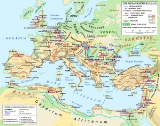
Pannonia is an ancient province of the Roman Empire
Roman Empire

The Roman Empire was the Roman Republic phase of the Ancient Rome, characterised by an autocracy form of government and large territorial holdings in Europe and around the Mediterranean....
 bounded north and east by the Danube
Danube

The Danube is the longest river in the European Union and Europe's second longest river after the Volga.The river originates in the Black Forest in Germany as the much smaller Brigach and Breg River rivers which join at the eponymously named German town Donaueschingen, after which it is known as the Danube and flows eastwards for a distance...
, coterminous westward with Noricum
Noricum

Noricum, in ancient history geography, was a Celtic kingdom stretching over the area of today's Austria and Slovenia. It became a Roman province of the Roman Empire....
 and upper Italy
Italy

Italy , officially the Italian Republic , is a country located on the Italian Peninsula in Southern Europe and on the two largest islands in the Mediterranean Sea, Sicily and Sardinia....
, and southward with Dalmatia
Dalmatia

Dalmatia is a region on the eastern coast of the Adriatic Sea, situated mostly in modern Croatia and spreading between the island of Rab in the northwest and the Bay of Kotor in the southeast....
 and upper Moesia
Moesia

Moesia was an ancient region and Roman province situated in the areas of modern Serbia, Bulgaria and Romania along the south bank of the Danube River....
. Pannonia was located over the territory of the present-day western half of Hungary
Hungary

Hungary , officially in English the Republic of Hungary , is a landlocked country in the Carpathian Basin of Central Europe, bordered by Austria, Slovakia, Ukraine, Romania, Serbia, Croatia, and Slovenia....
 with parts in Austria
Austria

Austria , officially the Republic of Austria , is a landlocked country in Central Europe. It borders both Germany and the Czech Republic to the north, Slovakia and Hungary to the east, Slovenia and Italy to the south, and Switzerland and Liechtenstein to the west....
, Croatia
Croatia

Croatia , officially the Republic of Croatia , is a Central European country at the crossroads of Pannonian Plain, Balkans, and the Mediterranean Sea....
, Serbia
Serbia

Serbia , officially the Republic of Serbia , is a country in Central Europe and Balkans Europe, covering the southern part of the Pannonian Plain and the central part of the Balkans....
, Slovenia
Slovenia

Slovenia , officially the Republic of Slovenia , is a country in southern Central Europe bordering Italy to the west, the Adriatic Sea to the southwest, Croatia to the south and east, Hungary to the northeast, and Austria to the north....
, Slovakia
Slovakia

Slovakia . It was amended in September 1998 to allow direct election of the president and again in February 2001 due to EU admission requirements....
 and Bosnia and Herzegovina
Bosnia and Herzegovina

Bosnia and Herzegovina is a country on the Balkans peninsula of South Eastern Europe with an area of 51,129 square kilometres . Bordered by Croatia to the north, west and south, Serbia to the east, and Montenegro to the south, Bosnia and Herzegovina is Landlocked#Nearly landlocked, except for 26 kilometres of the Adriatic Sea coas...
.

Today the term Pannonia is usually used for what is called Transdanubia
Transdanubia

Transdanubia is a traditional region of Hungary....
 (Dunántúl) in Hungary
Hungary

Hungary , officially in English the Republic of Hungary , is a landlocked country in the Carpathian Basin of Central Europe, bordered by Austria, Slovakia, Ukraine, Romania, Serbia, Croatia, and Slovenia....
, or simply the whole of Hungary.

lass="link1" onMouseover='showByLink("m80093",this)' onMouseout='hide("m80093")'href="http://www.absoluteastronomy.com/topics/Julius_Pokorny">Julius Pokorny
Julius Pokorny

Julius Pokorny was a scholar of the Celtic languages, particularly Irish language, and a supporter of Irish nationalism. He was born in Prague, Austria?Hungary and studied at the University of Vienna, where he also taught from 1913 to 1920....
 derived the name Pannonia from Illyrian
Illyrian languages

The Illyrian languages are a group of Indo-European languages that were spoken in the western part of the Balkans in former times by groups identified as Illyrians: Delmatae, Pannoni, Illyrians, Autariates, Taulanti ....
, from the Proto-Indo-European
Proto-Indo-European language

The Proto-Indo-European language is the unattested, linguistic reconstruction common ancestor of the Indo-European languages, spoken by the Proto-Indo-Europeans....
 root *pen-, "swamp, water, wet" (cf.


Discussion
Ask a question about 'Pannonia'
Start a new discussion about 'Pannonia'
Answer questions from other users
Full Discussion Forum


Timeline

7   Pannonians revolt with Dalmatians and Illyrian tribes against Roman rule.

9   Pannonia (modern-day Hungary) submits to Roman rule.

10   Illyria is divided into Pannonia and Dalmatia.

16   Noricans having joined with the Pannonians in invading Histria, are defeated by Publius Silius, proconsul of Illyricum.

92   Legio XXI ''Rapax'' is destroyed by the Sarmatians of Pannonia.

102   Trajan divides Pannonia into two portions sometime between this year and 107.

107   Trajan divided Pannonia into two portions sometime between 102 and this year.

136   The war against the Suebi begins. They will be defeated by the senator Tiberius Haterius Nepos Atinas, governor of Pannonia in 138

166   The Lombards invade Pannonia. They are quickly dispatched by the Roman Army.

179   Marcus Aurelius drives the Marcomanni out of the empire for good, and reinforces the border. To repopulate and rebuild a devastated Pannonia, Rome allows the first German colonists to enter territory controlled by Rome.


Encyclopedia


Rempire Pannonia
Pannonia is an ancient province of the Roman Empire
Roman Empire

The Roman Empire was the Roman Republic phase of the Ancient Rome, characterised by an autocracy form of government and large territorial holdings in Europe and around the Mediterranean....
 bounded north and east by the Danube
Danube

The Danube is the longest river in the European Union and Europe's second longest river after the Volga.The river originates in the Black Forest in Germany as the much smaller Brigach and Breg River rivers which join at the eponymously named German town Donaueschingen, after which it is known as the Danube and flows eastwards for a distance...
, coterminous westward with Noricum
Noricum

Noricum, in ancient history geography, was a Celtic kingdom stretching over the area of today's Austria and Slovenia. It became a Roman province of the Roman Empire....
 and upper Italy
Italy

Italy , officially the Italian Republic , is a country located on the Italian Peninsula in Southern Europe and on the two largest islands in the Mediterranean Sea, Sicily and Sardinia....
, and southward with Dalmatia
Dalmatia

Dalmatia is a region on the eastern coast of the Adriatic Sea, situated mostly in modern Croatia and spreading between the island of Rab in the northwest and the Bay of Kotor in the southeast....
 and upper Moesia
Moesia

Moesia was an ancient region and Roman province situated in the areas of modern Serbia, Bulgaria and Romania along the south bank of the Danube River....
. Pannonia was located over the territory of the present-day western half of Hungary
Hungary

Hungary , officially in English the Republic of Hungary , is a landlocked country in the Carpathian Basin of Central Europe, bordered by Austria, Slovakia, Ukraine, Romania, Serbia, Croatia, and Slovenia....
 with parts in Austria
Austria

Austria , officially the Republic of Austria , is a landlocked country in Central Europe. It borders both Germany and the Czech Republic to the north, Slovakia and Hungary to the east, Slovenia and Italy to the south, and Switzerland and Liechtenstein to the west....
, Croatia
Croatia

Croatia , officially the Republic of Croatia , is a Central European country at the crossroads of Pannonian Plain, Balkans, and the Mediterranean Sea....
, Serbia
Serbia

Serbia , officially the Republic of Serbia , is a country in Central Europe and Balkans Europe, covering the southern part of the Pannonian Plain and the central part of the Balkans....
, Slovenia
Slovenia

Slovenia , officially the Republic of Slovenia , is a country in southern Central Europe bordering Italy to the west, the Adriatic Sea to the southwest, Croatia to the south and east, Hungary to the northeast, and Austria to the north....
, Slovakia
Slovakia

Slovakia . It was amended in September 1998 to allow direct election of the president and again in February 2001 due to EU admission requirements....
 and Bosnia and Herzegovina
Bosnia and Herzegovina

Bosnia and Herzegovina is a country on the Balkans peninsula of South Eastern Europe with an area of 51,129 square kilometres . Bordered by Croatia to the north, west and south, Serbia to the east, and Montenegro to the south, Bosnia and Herzegovina is Landlocked#Nearly landlocked, except for 26 kilometres of the Adriatic Sea coas...
.

Today the term Pannonia is usually used for what is called Transdanubia
Transdanubia

Transdanubia is a traditional region of Hungary....
 (Dunántúl) in Hungary
Hungary

Hungary , officially in English the Republic of Hungary , is a landlocked country in the Carpathian Basin of Central Europe, bordered by Austria, Slovakia, Ukraine, Romania, Serbia, Croatia, and Slovenia....
, or simply the whole of Hungary.

Name

Julius Pokorny
Julius Pokorny

Julius Pokorny was a scholar of the Celtic languages, particularly Irish language, and a supporter of Irish nationalism. He was born in Prague, Austria?Hungary and studied at the University of Vienna, where he also taught from 1913 to 1920....
 derived the name Pannonia from Illyrian
Illyrian languages

The Illyrian languages are a group of Indo-European languages that were spoken in the western part of the Balkans in former times by groups identified as Illyrians: Delmatae, Pannoni, Illyrians, Autariates, Taulanti ....
, from the Proto-Indo-European
Proto-Indo-European language

The Proto-Indo-European language is the unattested, linguistic reconstruction common ancestor of the Indo-European languages, spoken by the Proto-Indo-Europeans....
 root *pen-, "swamp, water, wet" (cf. English fen, "marsh"; Hindi pani, "water" ).

History

Its original inhabitants were the Pannonii (Pannonians), a group of tribes akin to Illyrians
Illyrians

Illyrians has come to refer to a broad, ill-defined "Indo-European languages" group of peoples who inhabited the western Balkans and even possibly Messapia in Southern Italy ....
. From the 4th century BC it was invaded by various Celtic tribes. Little is heard of Pannonia until 35 BC, when its inhabitants, allies of the Dalmatia
Dalmatia

Dalmatia is a region on the eastern coast of the Adriatic Sea, situated mostly in modern Croatia and spreading between the island of Rab in the northwest and the Bay of Kotor in the southeast....
ns, were attacked by Augustus, who conquered and occupied Siscia (Sisak
Sisak

Sisak is a city in central Croatia. The city's population in 2001 was 52,236 and it is the administrative centre of Sisak-Moslavina county....
). The country was not, however, definitely subdued until 9 BC, when it was incorporated into Illyricum
Illyricum

Illyricum can refer to:* Illyricum * Diocese of Illyricum* Praetorian prefecture of Illyricum...
, the frontier of which was thus extended as far as the Danube.

In AD 6, the Pannonians, with the Dalmatians and other Illyrian tribes, revolted, and were overcome by Tiberius
Tiberius

Tiberius Julius Caesar Augustus, born Tiberius Claudius Nero , was the second Roman Emperor, from the death of Augustus in AD 14 until his own death in 37....
 and Germanicus
Germanicus

Germanicus Julius Caesar Claudianus . Born in Lugdunum, Gaul , was a member of the Julio-Claudian dynasty of the early Roman Empire. At birth he was named either Nero Claudius Drusus after his father or Tiberius Claudius Nero after his uncle and received the agnomen Germanicus, by which he is principally known, in 9 BC, when...
, after a hard-fought campaign which lasted for three years. After the rebellion was crushed in 9 AD, the province of Illyricum was dissolved, and its lands were divided between the new provinces of Pannonia in the north and Dalmatia
Dalmatia

Dalmatia is a region on the eastern coast of the Adriatic Sea, situated mostly in modern Croatia and spreading between the island of Rab in the northwest and the Bay of Kotor in the southeast....
 in the south. The date of the division is unknown, most certainly after AD 20 but before AD 50. The proximity of dangerous barbarian tribes (Quadi
Quadi

The Quadi were a smaller Germanic tribe, about which little definitive information is known. The history of non-literate peoples is written by their opponents, and we can only know the Germanic tribe the Romans called the 'Quadi' through Roman eyes....
, Marcomanni
Marcomanni

The Marcomanni were a Germanic tribe, probably related to the Buri , Suebi or Suevi....
) necessitated the presence of a large number of troops (seven legions in later times), and numerous fortresses were built on the bank of the Danube.

Some time between the years 102 and 107, between the first and second Dacian wars, Trajan
Trajan

Marcus Ulpius Nerva Traianus, commonly known as Trajan , was a Roman Emperors who reigned from 98 until his death in 117. Born Marcus Ulpius Traianus into a nonpatrician family in the Hispania Baetica province , Trajan rose to prominence during the reign of emperor Domitian, serving as a general in the Roman army along the Limes G...
 divided the province
Roman province

In Ancient Rome, a province was the basic, and until the Tetrarchy , largest territorial and administrative unit of the empire's territorial possessions outside of the Italia ....
 into Pannonia Superior (the western), and Pannonia Inferior (the eastern) portion. According to Ptolemy
Ptolemy

Claudius Ptolemaeus , known in English as Ptolemy , was a Roman Greek mathematics, Greek astronomy, geographer and astrologer. He lived in History of Roman Egypt, and was probably born there in a town in the Thebaid called Ptolemais Hermiou; he died in Alexandria around 168 AD....
, these divisions were separated by a line drawn from Arrabona (Gyor
Gyor

Gyor is the most important city of northwest Hungary, the capital of Gyor-Moson-Sopron and lies on one of the important roads of Central Europe, halfway between Budapest and Vienna....
) in the north to Servitium (Gradiška
Gradiška

Gradi?ka is a town and municipality in northwestern Bosnia and Herzegovina. Gradi?ka is situated in the northern part of the Republika Srpska entity and is one of the eastern most municipalities of the Bosanska Krajina region....
) in the south; later, the boundary was placed further east. The whole country was sometimes called the Pannonias (Pannoniae).

Pannonia Superior was under the consular legate, who had formerly administered the single province, and had three legions under his control: Pannonia Inferior at first under a praetorian legate with a single legion as garrison, after Marcus Aurelius
Marcus Aurelius

Marcus Aurelius Antoninus Augustus was Roman Emperor from 161 to his death in 180. He was the last of the "Five Good Emperors", and is also considered one of the most important stoicism philosophy....
 under a consular legate, still with only one legion. The frontier on the Danube was protected by the establishment of the two colonies Aelia Mursia (Osijek
Osijek

Osijek is the fourth largest city in Croatia with a population of 114,616 in 2001. It is the largest city and the economic and cultural centre of the eastern Croatian region of Slavonia, as well as the administrative centre of Osijek-Baranja county....
) and Aelia Aquincum
Aquincum

The ancient city of Aquincum was situated on the North-Eastern borders of the Pannonia province within the Roman Empire. The ruins of the city can be found today in Budapest, capital city of Hungary....
 (Óbuda
Óbuda

?buda was a historical city in Hungary. United with Buda and Pest in 1873 it now forms part of District III of Budapest. The name means Old Buda in Hungarian language ....
) by Hadrian.

Under Diocletian
Diocletian

Gaius Aurelius Valerius Diocletianus , born Diocles and commonly known as Diocletian , was Roman Emperor from November 20, 284 to May 1, 305....
 a fourfold division of the country was made:
  • Pannonia Prima
    Pannonia Prima

    Pannonia Prima was an ancient Ancient Rome province. It was formed in the year 296, during the reign of Emperor Diocletian. Previously, it was a part of the province of Pannonia, which was gradually divided into four administrative units: Pannonia Prima, Pannonia Secunda, Pannonia Valeria, and Savia....
     in the northwest, with capital in Savaria/Sabaria (Szombathely
    Szombathely

    Szombathely, is a city in Hungary. It is the administrative center of the Vas county in the west of the country, located near the border with Austria....
    ),
  • Pannonia Valeria
    Pannonia Valeria

    The Pannonia Valeria or simply Valeria was an ancient Roman Empire province. It was formed in the year 296, during the reign of emperor Diocletian....
     in the northeast, with capital in Sopianae (Pécs
    Pécs

    P?cs , , is the fifth largest city of Hungary, located in the south-west of the country, close to its border with Croatia. It is the administrative and economical centre of Baranya ....
    ),
  • Pannonia Savia
    Pannonia Savia

    The Pannonia Savia, also known as Savia and Pannonia Ripariensis, was an ancient Roman Empire province. It was formed in the year 296, during the reign of emperor Diocletian....
     in the southwest, with capital in Siscia (Sisak
    Sisak

    Sisak is a city in central Croatia. The city's population in 2001 was 52,236 and it is the administrative centre of Sisak-Moslavina county....
    ),
  • Pannonia Secunda
    Pannonia Secunda

    The Pannonia Secunda was ancient Roman Empire province. It was formed in the year 296, during the reign of emperor Diocletian. The capital of the province was Sirmium ....
     in the southeast, with capital in Sirmium
    Sirmium

    Sirmium was an ancient city in Roman Pannonia. Sirmium originally was an Illyrians town conquered by the Ancient Rome in the 1st century BC. It was a very important town in the later Roman Empire, being the economic capital of Roman Pannonia and one of the four capital cities of the Roman Empire....
     (Sremska Mitrovica
    Sremska Mitrovica

    Sremska Mitrovica is a city and municipality located in the Vojvodina province of Serbia at 44.98? North, 19.61? East, on the left bank of the Sava river....
    )


Diocletian also moved parts of today's Slovenia
Slovenia

Slovenia , officially the Republic of Slovenia , is a country in southern Central Europe bordering Italy to the west, the Adriatic Sea to the southwest, Croatia to the south and east, Hungary to the northeast, and Austria to the north....
 out of Pannonia and included them into Noricum
Noricum

Noricum, in ancient history geography, was a Celtic kingdom stretching over the area of today's Austria and Slovenia. It became a Roman province of the Roman Empire....
.

In the middle of the 5th century Pannonia was ceded to the Huns
Huns

The Huns were a confederation of Central Asian Eurasian nomads or semi-nomads, who had established an empire in Eurasia. The Huns may have stimulated the Migration Period, a contributing factor in the collapse of the Roman Empire....
 by Theodosius II
Theodosius II

Flavius Theodosius , called the Calligrapher, known in English as Theodosius II, was an Eastern Roman Empire , mostly known for the law code bearing his name, the Codex Theodosianus, and the Walls of Constantinople#The Theodosian Walls of Constantinople built during his reign....
, and after the death of Attila successively passed into the hands of the Ostrogoths (456-471), Lombards
Lombards

The Lombards were a Germanic peoples originally from Northern Europe who settled in the valley of the Danube and from there invaded Byzantine Italian peninsula in 568 under the leadership of Alboin....
 (530-568), Avars
Eurasian Avars

The 'Avars' were a highly organized and powerful Turkic confederation. They were ruled by a khagan, who was surrounded by a tight-knit retinue of nomad warriors, an organization characteristic of Turkic peoples groups....
 (560s - c.800), Slavs (living there since c. 480s; independent between c.800 - 900), Magyars (modern Hungarians) (since 900/901); Habsburgs
Habsburg Monarchy

The Habsburg Monarchy covered the territories ruled by the junior Austria branch of the House of Habsburg , and then by the successor House of Habsburg-Lorraine , between 1526 and 1867/1918....
 and Ottomans
Ottoman Empire

The Ottoman Empire , also known by its contemporaries as the Turkish Empire or Turkey , was an empire that lasted from 1299?1923. It was Treaty of Lausanne by the Republic of Turkey, which was officially proclaimed on October 29, 1923....
 (since 1526; the Ottoman rule ended in 1686). After the First World War, the region was divided between Austria
Austria

Austria , officially the Republic of Austria , is a landlocked country in Central Europe. It borders both Germany and the Czech Republic to the north, Slovakia and Hungary to the east, Slovenia and Italy to the south, and Switzerland and Liechtenstein to the west....
, Hungary
Hungary

Hungary , officially in English the Republic of Hungary , is a landlocked country in the Carpathian Basin of Central Europe, bordered by Austria, Slovakia, Ukraine, Romania, Serbia, Croatia, and Slovenia....
 and the Kingdom of Serbs, Croats and Slovenes (renamed to Yugoslavia
Yugoslavia

File:LocationYugoslavia2.pngYugoslavia is a term that describes three political entities that existed successively on the Balkan Peninsula in Europe, during most of the 20th century....
 in 1929).

Cities

The native settlements consisted of pagi (cantons) containing a number of vici (villages), the majority of the large towns being of Roman
Roman Empire

The Roman Empire was the Roman Republic phase of the Ancient Rome, characterised by an autocracy form of government and large territorial holdings in Europe and around the Mediterranean....
 origin. The cities and towns in Pannonia were:
  • Acumincum (Stari Slankamen
    Stari Slankamen

    Stari Slankamen , also known as Slankamen , is a village located in the Indija municipality, in the Srem District of Serbia. It is situated in the Autonomous Province of Vojvodina....
    , in present-day Serbia)
  • Ad Flexum
    Ad Flexum

    Ad Flexum may refer to:*Mosonmagyar?v?r, Hungary*San Pietro in Fine, Italy...
     (Mosonmagyaróvár
    Mosonmagyaróvár

    Mosonmagyar?v?r is a town in northwestern Hungary, county Gyor-Moson-Sopron. The town lies close to the Austrian and Slovakian border and has a population of 30,200 inhabitants ....
    , in present-day Hungary)
  • Ad Mures (Ács
    ACS

    ACS may refer to:Aviation and military* Air Cess, cargo airline based in Sharjah, United Arab Emirates* Auxiliary crane ship, a vessel of the United States Navy...
    , in present-day Hungary)
  • Ad Novas (Zmajevac
    Zmajevac

    Zmajevac is a settlement in the region of Baranya , Croatia. Administratively, it is located in the Kne?evi Vinogradi municipality within the Osijek-Baranja County....
    , in present-day Croatia)
  • Ad Statuas
    Ad Statuas

    Ad Statuas may refer to:*Mogente, in present-day Spain*San Cesareo, in present-day Italy*Vaspuszta, in present-day Hungary*V?rdomb, in present-day Hungary...
     (Vaspuszta, in present-day Hungary)
  • Ad Statuas
    Ad Statuas

    Ad Statuas may refer to:*Mogente, in present-day Spain*San Cesareo, in present-day Italy*Vaspuszta, in present-day Hungary*V?rdomb, in present-day Hungary...
     (Várdomb, in present-day Hungary)
  • Alisca (Szekszárd
    Szekszárd

    Szeksz?rd is a city in Hungary and the capital of Tolna county. By population Szeksz?rd is the smallest county capital in Hungary; by area it is the second smallest ...
    , in present-day Hungary)
  • Alba Regia (Székesfehérvár
    Székesfehérvár

    Sz?kesfeh?rv?r is a city in central Hungary, located around southwest of Budapest. It is inhabited by 106,346 people , with 138,995 in the direct vicinity, and is the centre of Fej?r county and the Regions of Hungary centre of Central Transdanubia....
    , in present-day Hungary)
  • Alta Ripa (Tolna, in present-day Hungary)
  • Andautonia (Šcitarjevo
    Šcitarjevo

    ?citarjevo is a settlement officially in the Town of Velika Gorica, Croatia, located near the Zagreb bypass and the recently built Homeland Bridge....
    , in present-day Croatia)
  • Aqua Viva (Varaždin
    Varaždin

    Vara?din is a city in northwestern Croatia, 81 km north of Zagreb on the highway A4 . City population is 41,434 on 34.22 km2, urban area population is 49,075 on 59.45 km2, and the metro area population is 80,991 on 243.75 km2 ....
    , in present-day Croatia)
  • Aquae Balisae (Daruvar
    Daruvar

    Daruvar is a town in central Croatia, population 9,815 , total municipality population 13,243 .Daruvar is a spa town, located in the western part of the Croatian plains, on the foothills of the fruitful Papuk mountain, with wine tradition longer than 2200 years, and along the fertile Toplica river....
    , in present-day Croatia)
  • Aquincum
    Aquincum

    The ancient city of Aquincum was situated on the North-Eastern borders of the Pannonia province within the Roman Empire. The ruins of the city can be found today in Budapest, capital city of Hungary....
      (Óbuda
    Óbuda

    ?buda was a historical city in Hungary. United with Buda and Pest in 1873 it now forms part of District III of Budapest. The name means Old Buda in Hungarian language ....
    , Budapest, in present-day Hungary)
  • Arrabona (Gyor
    Gyor

    Gyor is the most important city of northwest Hungary, the capital of Gyor-Moson-Sopron and lies on one of the important roads of Central Europe, halfway between Budapest and Vienna....
    , in present-day Hungary)
  • Bassianae (Donji Petrovci
    Donji Petrovci

    Donji Petrovci , also known as Petrovci , is a village in Serbia. It is situated in the Ruma municipality, Srem District, Vojvodina province....
    , in present-day Serbia)
  • Bononia
    Bononia

    Bononia is the Roman name of several cities, including:* Bologna, Italy* Boulogne-sur-Mer, France* Vidin, Bulgaria* Bano?tor, Serbia...
     (Banoštor
    Banoštor

    Bano?tor is a village in Serbia. It is situated in the Beocin municipality, in the Vojvodina province. Although, the village is geographically located in Syrmia, it is part of the South Backa District....
    , in present-day Serbia)
  • Brigetio (Szony, in present-day Hungary)
  • Burgenae (Novi Banovci
    Novi Banovci

    Novi Banovci is an urban neighborhood in Serbia by the Danube River. It is situated in the Stara Pazova municipality, in the Srem District, in Vojvodina province....
    , in present-day Serbia)
  • Caesariana (Baláca
    Balaca

    Balaca is a genus of moth in the family Arctiidae.References...
    , in present-day Hungary)
  • Campona (Nagytétény, in present-day Hungary)
  • Carnuntum
    Carnuntum

    Carnuntum was an important Roman Empire army camp in what is now Austria. It belonged originally to Noricum province, but after the 1st century was part of Pannonia....
     (Petronell, Bad Deutsch-Altenburg
    Bad Deutsch-Altenburg

    Bad Deutsch-Altenburg is a town in the district of Bruck an der Leitha in Lower Austria in Austria....
    , in present-day Austria)
  • Celeia (Celje
    Celje

    Celje is the List of cities in Slovenia city in Slovenia. Exhibiting the typical characteristics of a Central European city, it is the regional center of Lower Styria and the administrative seat of the municipality of the same name - the Urban Municipality of Celje ....
    , in present-day Slovenia)
  • Certissa (Đakovo
    Đakovo

    ?akovo is a town in the region of Slavonia, Croatia, 37 km to the southwest of Osijek and 34 km southeast of Nasice; elevation 111 m. It has a population of 20,912, with a total of 30,092 in the municipality ....
    , in present-day Croatia)
  • Cibalae (Vinkovci
    Vinkovci

    Vinkovci is a Croatian town in eastern Slavonia, with a population of 32,455 making it the largest town of the Vukovar-Srijem county. A large majority of its citizens are Croats with 88.99% ....
    , in present-day Croatia)
  • Cirpi (Dunabogdány
    Dunabogdány

    Dunabogd?ny is a village in Pest county, Budapest metropolitan area, Hungary.The population consisted of 3,101 inhabitants in 2007....
    , in present-day Hungary)
  • Contra-Aquincum (Budapest
    Budapest

    Budapest is the Capitals of Hungary of Hungary. As the largest city of Hungary, it serves as the country's principal political, cultural, commerce, Industry, and transportation center and is considered an important hub in Central Europe....
    , in present-day Hungary)
  • Contra Constantiam (Dunakeszi
    Dunakeszi

    Dunakeszi is a town in Pest county, Budapest metropolitan area, Hungary.External links ...
    , in present-day Hungary)
  • Contra Florentiam or Lugio (Dunaszekcső
    Dunaszekcso

    Dunaszekcso is a village in Baranya County, Hungary. This city is in the right side of Danube.External links **...
    , in present-day Hungary)
  • Cuccium (Ilok
    Ilok

    Ilok is the easternmost town and municipality in Croatia. Located in the Syrmia region, it lies on a hill overlooking the Danube river, which forms the border with the Vojvodina region of Serbia....
    , in present-day Croatia)
  • Cusum
    CUSUM

    CUSUM is a sequential analysis technique due to E. S. Page of the University of Cambridge. It is typically used for monitoring change detection....
     (Petrovaradin
    Petrovaradin

    Petrovaradin , formerly a fortified town, is part of the agglomeration of Novi Sad in Serbia . Lying across the river Danube from the main part of Novi Sad, it features a majestic fortress known as the "Gibraltar of the Danube" ....
    , in present-day Serbia)
  • Gerulata
    Gerulata

    Gerulata was a Roman Empire military camp located near today's Rusovce, a borough of Bratislava, Slovakia. It was part of the Roman province Pannonia and built in the 2nd century as a part of the Limes Romanus system....
     (Rusovce
    Rusovce

    Rusovce is a borough in southern Bratislava on the right bank of the Danube river, close to the Hungary border....
    , in present-day Slovakia)
  • Gorsium-Herculia (Tác
    TAC

    TAC may refer to:* T?c, Hungary* Pablo Tac, a Luise?o Indian who provided a rare contemporary Native American perspective on the institutions and early history of California...
    , in present-day Hungary)
  • Intercisa (Dunaújváros
    Dunaújváros

    Duna?jv?ros is a city in Central Hungary, along the Danube river. It is in the county of Fej?r....
    , in present-day Hungary)
  • Iovia or Iovia Botivo (Ludbreg
    Ludbreg

    Ludbreg is a town in Croatia, located halfway between Vara?din and Koprivnica near the river Drava. It has 3,465 inhabitants, and a total of 8,668 in the entire municipality ....
    , in present-day Croatia)
  • Lussonium (Dunakömlod, in present-day Hungary)
  • Marsonia (Slavonski Brod
    Slavonski Brod

    Slavonski Brod is a city in Croatia, with a population of 61,823 in 2001. The city was known as Marsonia in the Roman Empire, and as Brod na Savi 1244–1934....
    , in present-day Croatia)
  • Matrica (Százhalombatta
    Százhalombatta

    Sz?zhalombatta is a town in Pest county, Hungary. The name of this town in Hungarian literally means "One hundred tumuli" referring to the tumulus field at the edge of the town....
    , in present-day Hungary)
  • Morgentianae (Tüskevár
    Tüskevár

    T?skev?r is a village in Veszpr?m , Hungary.External links ...
    (?), in present-day Hungary)
  • Mursa (Osijek
    Osijek

    Osijek is the fourth largest city in Croatia with a population of 114,616 in 2001. It is the largest city and the economic and cultural centre of the eastern Croatian region of Slavonia, as well as the administrative centre of Osijek-Baranja county....
    , in present-day Croatia)
  • Mursella (Mórichida
    Mórichida

    M?richida is a village in Gyor-Moson-Sopron county, Hungary.External links ...
    , in present-day Hungary)
  • Neviodunum (Drnovo, in present-day Slovenia)
  • Poetovio (Ptuj
    Ptuj

    Ptuj is a city and one of 11 urban municipalities in Slovenia. It is situated in Lower Styria , and has about 23,000 inhabitants.It is a colorful city with a diverse nightlife....
    , in present-day Slovenia)
  • Quadrata (Lébény
    Lébény

    L?b?ny is a village in Gyor-Moson-Sopron county, Hungary. It has a Romanesque architecture family church from the 12th century. Similar medieval Hungarian clan / family financed "house" churches are in J?k, ?csa, Ny?rb?tor, Harina, Laslea....
    , in present-day Hungary)
  • Rittium (Surduk
    Surduk

    Surduk is a village in Serbia. It is situated in the Stara Pazova municipality, in the Srem District, Vojvodina province. The village has a Serb ethnic majority and its population numbering 1,589 people ....
    , in present-day Serbia)
  • Sala
    Sala

    Sala is the name of:...
      (Zalalövo
    Zalalövo

    Zalal?vo is a town in Zala county, Hungary.External links ...
    , in present-day Hungary)
  • Saldae (Brcko
    Brcko

    Brcko can refer to the following related geographical locations in Bosnia and Herzegovina:* Brcko District* Brcko ...
    , in present-day Bosnia and Herzegovina)
  • Savaria or Sabaria (Szombathely
    Szombathely

    Szombathely, is a city in Hungary. It is the administrative center of the Vas county in the west of the country, located near the border with Austria....
    , in present-day Hungary)
  • Scarbantia (Sopron
    Sopron

    Sopron ; , , Latin language: Scarbantia) is a city in Hungary near the Austrian border.HistoryAncient times-13th century...
    , in present-day Hungary)
  • Serbinum
    Serbinum

    Serbinum was an ancient Roman city in the Pannonia province. It was situated in the location of present-day Gradi?ka in Republika Srpska, Bosnia and Herzegovina....
     or Servitium (Gradiška
    Gradiška

    Gradi?ka is a town and municipality in northwestern Bosnia and Herzegovina. Gradi?ka is situated in the northern part of the Republika Srpska entity and is one of the eastern most municipalities of the Bosanska Krajina region....
    , in present-day Bosnia and Herzegovina)
  • Singidunum
    Singidunum

    Singidunum was an ancient Roman city, first settled by the Celts Scordisci tribe in the 3rd century BC, and later garrisoned and fortified by the Ancient Rome who romanized the name....
     (Beograd, in present-day Serbia)
  • Sirmium
    Sirmium

    Sirmium was an ancient city in Roman Pannonia. Sirmium originally was an Illyrians town conquered by the Ancient Rome in the 1st century BC. It was a very important town in the later Roman Empire, being the economic capital of Roman Pannonia and one of the four capital cities of the Roman Empire....
     (Sremska Mitrovica
    Sremska Mitrovica

    Sremska Mitrovica is a city and municipality located in the Vojvodina province of Serbia at 44.98? North, 19.61? East, on the left bank of the Sava river....
    , in present-day Serbia)
  • Siscia (Sisak
    Sisak

    Sisak is a city in central Croatia. The city's population in 2001 was 52,236 and it is the administrative centre of Sisak-Moslavina county....
    , in present-day Croatia)
  • Solva
    Solva (Hungary)

    Solva was an early name for what is now Esztergom, Hungary, in the province of Pannonia, during the Ancient Rome period. It was an important part of the Limes line along the Danube....
     (Esztergom
    Esztergom

    Esztergom is a city in northern Hungary, about 50 km north-west of the Capital Budapest. It lies in Kom?rom-Esztergom county, on the right bank of the river Danube, which forms the border with Slovakia there....
    , in present-day Hungary)
  • Sopianae (Pécs
    Pécs

    P?cs , , is the fifth largest city of Hungary, located in the south-west of the country, close to its border with Croatia. It is the administrative and economical centre of Baranya ....
    , in present-day Hungary)
  • Taurunum (Zemun
    Zemun

    Zemun is an List of Belgrade neighborhoods and one of the 17 municipalities which constitute the Belgrade, the capital of Serbia....
    , in present-day Serbia)
  • Ulcisia Castra (Szentendre
    Szentendre

    Szentendre is a riverside town in Pest county, Hungary, near the capital city of Budapest. Szentendre is known for its museums , galleries, and artists....
    , in present-day Hungary)
  • Valcum (Fenékpuszta, in present-day Hungary)
  • Vindobona
    Vindobona

    Vindobona was originally a Celtic settlement, and later a Ancient Rome military camp on the site of the modern city of Vienna in Austria. Around 15 B.C., the kingdom of Noricum was included in the Roman Empire....
     (Wien
    Wien

    Wien is the German language name for Vienna, the city and federal state in Austria.Wien may also refer to:*Wien International Scholarship, a scholarship instituted by Brandeis University...
    , in present-day Austria)


Economy and country features


The country was fairly productive, especially after the great forests had been cleared by Probus
Probus

Marcus Aurelius Probus was a Roman Emperor .A native of Sirmium , in Pannonia, at an early age he entered the army, where he distinguished himself under the Emperors Valerian , Aurelian and Marcus Claudius Tacitus....
 and Galerius
Galerius

Galerius Maximianus , formally Gaius Galerius Valerius Maximianus was Roman Emperor from 305 to 311....
. Before that time timber had been one of its most important exports. Its chief agricultural products were oat
Oat

The common oat is a species of Cereal Agriculture for its seed, which is known by the same name . While oats are suitable for human consumption as oatmeal and rolled oats, one of the most common uses is as livestock feed....
s and barley
Barley

Barley is an annual plant cereal grain derived from the grass Hordeum vulgare. It serves as a major animal feed crop, with smaller amounts used for malting and in health food, as well as the making of alcoholic beverages beer and whisky....
, from which the inhabitants brewed a kind of beer
Beer

Beer is the world's oldest and most widely consumed alcoholic beverage and the third most popular drink overall after water and tea. It is produced by the brewing and Fermentation of starches, mainly derived from cereal?the most common of which is malted barley, although wheat, maize , and rice are widely used....
 named sabaea. Vines and olive trees were little cultivated. Pannonia was also famous for its breed of hunting dogs. Although no mention is made of its mineral wealth by the ancients, it is probable that it contained iron
Iron

Iron is a chemical element with the symbol Fe and atomic number 26. Iron is a Group 8 element and period 4 element. Iron is lustrous and silvery in color....
 and silver
Silver

Silver is a chemical element with the chemical symbol Ag and atomic number 47. A soft, white, lustrous transition metal, it has the highest electrical conductivity of any element and the highest thermal conductivity of any metal....
 mines. Its chief rivers were the Dravus
Drava

Drava or Drave is a river in southern Central Europe, a tributary of the Danube. It begins in Dobbiaco, Italy, and flows east through East Tirol and Carinthia in Austria, into Slovenia , and then southeast, passing through Croatia and forming most of the border between Croatia and Hungary, before it joins the Danube near Osijek....
, Savus, and Arrabo
Rába

The R?ba is a river in southeastern Austria and western Hungary and a tributary of the Danube. Its source is in Austria, some kilometres east of Bruck an der Mur....
, in addition to the Danuvius
Danube

The Danube is the longest river in the European Union and Europe's second longest river after the Volga.The river originates in the Black Forest in Germany as the much smaller Brigach and Breg River rivers which join at the eponymously named German town Donaueschingen, after which it is known as the Danube and flows eastwards for a distance...
 (less correctly, Danubius), into which the first three rivers flow.

Legacy

The ancient name Pannonia is retained in the modern term Pannonian plain
Pannonian Plain

The Pannonian Plain is a large plain in Central Europe that remained when the Pliocene Pannonian Sea dried out. It is a geomorphology subsystem of the Alpide belt....
.

See also

  • Pannonian plain
    Pannonian Plain

    The Pannonian Plain is a large plain in Central Europe that remained when the Pliocene Pannonian Sea dried out. It is a geomorphology subsystem of the Alpide belt....
  • Roman provinces
  • Roman Empire
    Roman Empire

    The Roman Empire was the Roman Republic phase of the Ancient Rome, characterised by an autocracy form of government and large territorial holdings in Europe and around the Mediterranean....
  • Pannonian basin before Hungary


External links