
All Topics  
Licinius

 
Licinius

   Email Print
   Bookmark   Link


Licinius


:For other Romans of this name, see Licinius (gens)
Licinius (gens)

Licinius was a celebrated plebs gens of Ancient Rome. One person who belonged to the gens was Gaius Licinius Stolo, who helped in the efforts to allow plebeians to become consul....
.


Valerius
Valerius

Valerius originally was a Rome nomen of the gens Valeria, one of the oldest patrician families of the city. The name was in use throughout Roman history....
 Licinianus Licinius
(c. 250 - 325) was Roman emperor
Roman Emperor

The Roman Emperor was the ruler of the Roman Empire during the imperial period . The Romans had no single term for the office: Latin language titles such as imperator , Augustus , Caesar and princeps were all associated with it....
 from 308 to 324.

Of Dacia
Dacia

In ancient geography, Dacia was the land of the Dacians. It was named by the ancient Greeks "Getae". Dacia was a large district of East-Central Europe, bounded on the north by the Carpathian Mountains, on the south by the Danube, on the west by the Tisia or Tisza, on the east by the Tyras or Dniester, now in eastern Moldova....
n peasant origin, born in Moesia
Moesia

Moesia was an ancient region and Roman province situated in the areas of modern Serbia, Bulgaria and Romania along the south bank of the Danube River....
 Superior, Licinius accompanied his close childhood friend, the Emperor Galerius
Galerius

Galerius Maximianus , formally Gaius Galerius Valerius Maximianus was Roman Emperor from 305 to 311....
, on the Persian expedition in 297.


Discussion
Ask a question about 'Licinius'
Start a new discussion about 'Licinius'
Answer questions from other users
Full Discussion Forum


Timeline

250   Born

307   Galerius unsuccessfully invades Italy and names Licinius as Augustus.

308   The Congress of Carnuntum: Attempting to keep peace within the Roman Empire, the leaders of the Tetrarchy declare Maxentius and Licinius to be Augusti, while rival contender Constantine I is declared Caesar of Britain and Gaul

313   Licinius becomes emperor of the Eastern Roman Empire, defeating Maximinus at the battle of Tzirallum.

314   War between Constantine I and Licinius. Licinius is defeated at the Battle of Cibalae and loses all of his territory in Europe.

315   Constantine and Licinius battle the Sarmates, the Goths and the Carpians along the Danube. They reestablish the defence of the frontier.

316   Constantine I defeats Licinius in the Battle of Mardia, and gains some of his colleague's territory

317   Crispus and Constantine II, sons of Roman Emperor Constantine I, and Licinius iunior, son of Licinius, are made Caesares

323   Constantine the Great decisively defeats Licinius in the Battle of Chrysopolis, establishing Constantine's sole control over the Roman Empire.

324   Battle of Adrianople: Constantine I defeats Licinius, forcing him to retreat to Byzantium.


Encyclopedia


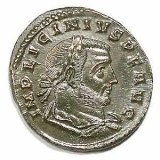
Aureus Licinius Nicomedia Ric Vii 021
:For other Romans of this name, see Licinius (gens)
Licinius (gens)

Licinius was a celebrated plebs gens of Ancient Rome. One person who belonged to the gens was Gaius Licinius Stolo, who helped in the efforts to allow plebeians to become consul....
.


Valerius
Valerius

Valerius originally was a Rome nomen of the gens Valeria, one of the oldest patrician families of the city. The name was in use throughout Roman history....
 Licinianus Licinius
(c. 250 - 325) was Roman emperor
Roman Emperor

The Roman Emperor was the ruler of the Roman Empire during the imperial period . The Romans had no single term for the office: Latin language titles such as imperator , Augustus , Caesar and princeps were all associated with it....
 from 308 to 324.

Of Dacia
Dacia

In ancient geography, Dacia was the land of the Dacians. It was named by the ancient Greeks "Getae". Dacia was a large district of East-Central Europe, bounded on the north by the Carpathian Mountains, on the south by the Danube, on the west by the Tisia or Tisza, on the east by the Tyras or Dniester, now in eastern Moldova....
n peasant origin, born in Moesia
Moesia

Moesia was an ancient region and Roman province situated in the areas of modern Serbia, Bulgaria and Romania along the south bank of the Danube River....
 Superior, Licinius accompanied his close childhood friend, the Emperor Galerius
Galerius

Galerius Maximianus , formally Gaius Galerius Valerius Maximianus was Roman Emperor from 305 to 311....
, on the Persian expedition in 297. After the death of Flavius Valerius Severus
Flavius Valerius Severus

Flavius Valerius Severus was a Western Roman Emperor from 306 to 307.Severus was of humble birth, born in the Illyrian provinces around the middle of the third century AD....
, Galerius elevated Licinius to the rank of Augustus in the West on November 11 308
308

Events...
. He received as his immediate command the provinces of Illyricum
Illyricum

Illyricum can refer to:* Illyricum * Diocese of Illyricum* Praetorian prefecture of Illyricum...
, Thrace
Thrace

Thrace is a historical and geographic area in southeast Europe. Today the name Thrace designates a region spread over southern Bulgaria , northeastern Greece , and European Turkey ....
 and Pannonia
Pannonia

Pannonia is an ancient province of the Roman Empire bounded north and east by the Danube, coterminous westward with Noricum and upper Italy, and southward with Dalmatia and upper Moesia....
.

On the death of Galerius, in May 311, Licinius shared the eastern empire with Maximinus
Maximinus

title = Roman Emperor of the Roman Empire|name=Maximinus Daia|full name =Gaius Valerius Galerius Maximinus Daia| image =...
 Daia, the Hellespont
Hellespont

Hellespont was the ancient name of the narrow strait, now known by the modern European term 'Dardanelles'. It was so called from Helle , the daughter of Athamas, who was drowned here in the mythology of the Golden Fleece....
 and the Bosporus
Bosporus

The Bosporus or Bosphorus , also known as the Istanbul Strait , is a strait that forms the boundary between the European part of Turkey and its Asian part ....
 being the dividing line.

In March 313 he married Flavia Julia Constantia
Flavia Julia Constantia

Flavia Julia Constantia, , was the daughter of the Roman Emperor Constantius Chlorus and his second wife, Flavia Maximiana Theodora.In 313, Emperor Constantine I, who was half-brother of Constantia, gave her in marriage to his co-emperor Licinius, on occasion of their meeting in Milan....
, half-sister of Constantine
Constantine I

Flavius Valerius Aurelius Constantinus , commonly known in English_language as Constantine I, Constantine the Great, or Saint Constantine , was Roman Emperor from 306, and the undisputed holder of that office from 324 until his death in 337....
, at Mediolanum (now Milan
Milan

Milan is the second largest city of Italy, located in the plains of Lombardy. It is the capital in the Province of Milan, as well as the Regions of Italy capital of Lombardy....
); they had a son, Licinius the Younger
Licinius II

Valerius Licinianus Licinius or Licinius II , was the son of Roman emperor Licinius. He nominally served as Caesar #Tetrarchy in the eastern empire from 317 to 324 A.D while his father was Augustus #In_the_divided_Roman_Empire....
, in 315. Their marriage was the occasion for the jointly-issued "Edict of Milan
Edict of Milan

The Edict of Milan was a letter signed by emperors Constantine I and Licinius that proclaimed religious toleration in the Roman Empire. The letter was issued in 313 AD, shortly after the conclusion of the Diocletian Persecution....
" that restored confiscated properties to Christian congregations and allowed Christianity
Christianity

Christianity is a Monotheistic religion #Christian view religion centered on the life and teachings of Jesus as New Testament view on Jesus' life....
 to be professed in the empire.

In the following month, on April 30, Licinius inflicted a decisive defeat on Maximinus at the Battle of Tzirallum
Battle of Tzirallum

The Battle of Tzirallum was fought in 313 between the armies of Licinius and Maximinus. Licinius was the victor and Maximinus was forced to flee. After this battle, Licinius became emperor of East Roman Empire....
, after Maximinus had tried attacking him. Then, Licinius established himself master of the East, while his brother-in-law, Constantine, was supreme in the West.

In 314, a civil war erupted between Licinius and Constantine, in which Constantine prevailed at the Battle of Cibalae
Battle of Cibalae

The Battle of Cibalae was fought on October 8, 314 , between the two Roman emperors Constantine I and Licinius. The site of the battle was approximately 350 kilometers within the territory of Licinius....
 in Pannonia
Pannonia

Pannonia is an ancient province of the Roman Empire bounded north and east by the Danube, coterminous westward with Noricum and upper Italy, and southward with Dalmatia and upper Moesia....
 (October 8, 314) and again two years later, when Licinius named Valerius Valens
Valerius Valens

Aurelius Valerius Valens was List of Roman Emperors from late 316 to March 1 317. Valens had previously been dux limitis in Dacia, but this is all we know of him....
 co-emperor, in the plain of Mardia
Battle of Mardia

The Battle of Mardia, also known as Battle of Campus Mardiensis or Battle of Campus Ardiensis, was fought, probably at modern Harmanli in Thrace, in late 316/early 317 between the forces of Roman Emperors Constantine I and Licinius....
 (also known as Campus Ardiensis) in Thrace
Thrace

Thrace is a historical and geographic area in southeast Europe. Today the name Thrace designates a region spread over southern Bulgaria , northeastern Greece , and European Turkey ....
. The emperors were reconciled after these two battles and Licinius had his co-emperor Valens killed.

Licinius' fleet of 350 ships was defeated by Constantine I's fleet in 323. In 324, Constantine, tempted by the "advanced age and unpopular vices" of his colleague, again declared war against him, and, having defeated his army of 170,000 men at the Battle of Adrianople
Battle of Adrianople (324)

The Battle of Adrianople was fought on July 3, 324 during a Roman civil war, the second to be waged between the two Roman emperor Constantine I and Licinius; Licinius suffered a heavy defeat....
 (July 3, 324), succeeded in shutting him up within the walls of Byzantium
Byzantium

Byzantium was an Ancient Greece city, which was founded by Greeks colonists from Megara in 667 BC and named after their king Byzas or Byzantas ....
. The defeat of the superior fleet of Licinius in the Battle of the Hellespont by Crispus
Crispus

Flavius Julius Crispus, also known as Flavius Claudius Crispus and Flavius Valerius Crispus was a Caesar of the Roman Empire. He was the first-born son of Constantine I and Minervina....
, Constantine’s eldest son and Caesar
Caesar (title)

Caesar , Latin: Caesar , is a title of emperor character. It derives from the Roman naming convention#Cognomen of Julius Caesar, the Roman dictator....
, compelled his withdrawal to Bithynia
Bithynia

Bithynia was an ancient region, kingdom and Roman province in the northwest of Asia Minor, adjoining the Propontis, the Thrace Bosporus and the Euxine ....
, where a last stand was made; the Battle of Chrysopolis
Battle of Chrysopolis

The Battle of Chrysopolis was fought on 18 September 324 in Chrysopolis , near Chalcedon , between the two Roman emperors Constantine I and Licinius....
, near Chalcedon
Chalcedon

Chalcedon was an ancient maritime town of Bithynia, in Anatolia, almost directly opposite Byzantium, south of ?sk?dar . Today, in modern Turkish language, Chalcedon is called Kadik?y, and is a district of Istanbul, Turkey....
 (September 18), resulted in Licinius' final submission. While Licinius' co-emperor Sextus Martinianus
Sextus Martinianus

Sextus Marcius Martinianus was Roman Emperor from July to September 18, 324. He had been appointed co-emperor by Licinius.In 324 the second civil war between Licinius and Constantine I was in full swing, and Licinius was losing....
 was killed, Licinius himself was spared due to the pleas of his wife, Constantine's sister, and interned at Thessalonica. The next year, Constantine had him killed, accusing him of conspiring to raise troops among the barbarians.

Trivia

Out of unknown reasons, Licinius was traditionally for centuries throughout the entire Serbia
Serbia

Serbia , officially the Republic of Serbia , is a country in Central Europe and Balkans Europe, covering the southern part of the Pannonian Plain and the central part of the Balkans....
n historiography considered as a Serb and as a forefather of the House of Nemanjic
House of Nemanjic

The House of Nemanjic was a medieval Serbian ruling dynasty.The "Stefan" dynasty - House of Nemanjic was named after Stefan Nemanja. It was descended from the cadet branch of the House of Vojislavljevic....
. This only changed with the historical school of Slavic
Slavic

Slavic and Slavonic are used interchangeably in English, with the former preferred in U.S. English, and the latter in UK English. The Oxford English Dictionary gives citations of Slavonic back to the mid-17th century, whereas it seems that Slavic only appeared in the 19th century....
 migrations being conceived in the 19th century.

External links