
All Topics  
Emperor

 
Emperor

   Email Print
   Bookmark   Link


Emperor


An emperor (from the Latin
Latin

Latin is an Italic language, historically spoken in Latium and Ancient Rome. Through the Military history of the Roman Empire, Latin spread throughout the Mediterranean and a large part of Europe....
 "imperator
Imperator

The Latin word Imperator was a title originally roughly equivalent to commander during the period of the Roman Republic. It later went on to become a part of the titulature of the Roman Emperors as part of their cognomen....
") is a (male) monarch, usually the sovereign
Sovereign

Sovereign may refer to:*Sovereignty, a philosophical concept or state*Sovereign *Sovereign Hill, Victoria, Australia*Lady Sovereign, a female MC and performing artist for Def Jam Recordings...
 ruler of an empire
Empire

Empire derives from the Latin word imperium, denoting ?military command? in Roman. Politically, an empire is a geographically extensive group of states and peoples united and ruled either by a monarch or an oligarchy....
 or another type of imperial realm. Empress is the female equivalent. As a title, "empress" may indicate the wife of an emperor (empress consort) or a woman who rules in her own right (empress regnant). Emperors and Empresses are generally recognized to be above kings and queens in honour
Honour

File:Hamilton-burr-duel.jpgHonour or Honor , is the evaluation of a person's trustworthiness and social social status based on that individual's espousals and actions....
 and rank
Royal and noble ranks

Traditional ranks among European monarch, peerage, and nobility are rooted in Late Antiquity and the Middle Ages. Although they vary over time and between geographic regions , the following is a fairly comprehensive list that provides information on both general ranks and specific differences....
.

Today the Emperor of Japan
Emperor of Japan

The of Japan is the symbol of the state and of the unity of the Japanese people. He is the head of the Imperial House of Japan. Under Japan's present constitution, the Emperor is the "symbol of the state and the unity of the people," and is a ceremonial figurehead in a constitutional monarchy ....
 is the only remaining emperor on a throne in the world.

kings and emperors are monarchs.


Discussion
Ask a question about 'Emperor'
Start a new discussion about 'Emperor'
Answer questions from other users
Full Discussion Forum


Timeline

58   Ming-Ti, new emperor of China, introduces Buddhism to China and the West Indus Valley.

68   The year of the four emperors: Galba (68), Otho (69) and Vitellius (69) all govern a very short time before Vespasian becomes emperor.

70   Prince and later Emperor Domitian marries Domitia Longina.

190   A part of Rome burns, and emperor Commodus orders the city to be rebuilt under the name ''Colonia Commodiana''.

220   Cao Pi succeeds his father Cao Cao as ruler of the Kingdom of Wei, and proclaims himself Emperor Wen of Wei

268   Victorinus becomes the fourth Emperor of the Gallic Empire, following the murders of his predecessors.

271   Victorinus, Emperor of the Gallic Empire is assassinated by Attitianus, reportedly for reasons of personal revenge. Domitianus presumably serves as Emperor for a few days before replaced by Tetricus I.

323   Jin Ming Di succeeds Jin Yuan Di as emperor of China.

410   Alaric I deposes Priscus Attalus as Emperor.

410   Emperor Honorius tells Britain to look to its own defences, effectively ending Roman rule in Britain.


Encyclopedia


An emperor (from the Latin
Latin

Latin is an Italic language, historically spoken in Latium and Ancient Rome. Through the Military history of the Roman Empire, Latin spread throughout the Mediterranean and a large part of Europe....
 "imperator
Imperator

The Latin word Imperator was a title originally roughly equivalent to commander during the period of the Roman Republic. It later went on to become a part of the titulature of the Roman Emperors as part of their cognomen....
") is a (male) monarch, usually the sovereign
Sovereign

Sovereign may refer to:*Sovereignty, a philosophical concept or state*Sovereign *Sovereign Hill, Victoria, Australia*Lady Sovereign, a female MC and performing artist for Def Jam Recordings...
 ruler of an empire
Empire

Empire derives from the Latin word imperium, denoting ?military command? in Roman. Politically, an empire is a geographically extensive group of states and peoples united and ruled either by a monarch or an oligarchy....
 or another type of imperial realm. Empress is the female equivalent. As a title, "empress" may indicate the wife of an emperor (empress consort) or a woman who rules in her own right (empress regnant). Emperors and Empresses are generally recognized to be above kings and queens in honour
Honour

File:Hamilton-burr-duel.jpgHonour or Honor , is the evaluation of a person's trustworthiness and social social status based on that individual's espousals and actions....
 and rank
Royal and noble ranks

Traditional ranks among European monarch, peerage, and nobility are rooted in Late Antiquity and the Middle Ages. Although they vary over time and between geographic regions , the following is a fairly comprehensive list that provides information on both general ranks and specific differences....
.

Today the Emperor of Japan
Emperor of Japan

The of Japan is the symbol of the state and of the unity of the Japanese people. He is the head of the Imperial House of Japan. Under Japan's present constitution, the Emperor is the "symbol of the state and the unity of the people," and is a ceremonial figurehead in a constitutional monarchy ....
 is the only remaining emperor on a throne in the world.

Distinction from other monarchs

Both kings and emperors are monarchs. Within the European context, "emperor" and "empress" are considered the highest of monarchical titles, ironic in that "emperor" began as a military honorific in a staunchly anti-monarchical republic
Democracy in Ancient Rome

Birth of the RepublicThe traditional founding of Rome was in 753 BC. The Etruscans, early Italian people settlers comprised of city-states throughout central Italy ruled Rome for over a century; the traditional dates are 616 BC for the accession of the first Etruscan King, Tarquinius Priscus, and 510 BC for the expulsion of the last ki...
. Emperors were once given precedence
Order of precedence

An order of precedence is a sequential hierarchy of nominal importance of items. Most often it is used in the context of people by many organizations and governments....
 over kings in international diplomatic relations; currently, precedence is decided by the length a head of state
Head of State

Head of state is the generic term for the individual or collective office that serves as the chief public representative of a monarchic or republican nation-state, federation, commonwealth or any other political state....
 is continuously in office. Some emperors claimed inheritance (translatio imperii
Translatio imperii

Translatio imperii, Latin language for "transfer of rule", is a concept invented in the Middle Ages for describing history as a linear development: a succession of transfers of power from one supreme ruler to the next....
) of the political and religious authority of the Roman Emperor
Roman Emperor

The Roman Emperor was the ruler of the Roman Empire during the imperial period . The Romans had no single term for the office: Latin language titles such as imperator , Augustus , Caesar and princeps were all associated with it....
s such as an important role in the state church; see Imperial cult
Imperial cult

An Imperial cult is a form of state religion in which an emperor, or a dynasty of emperors , are worshiped as messiahs, demigods or deity. "Cult " here is used to mean "worship," not in the modern pejorative sense....
 and Caesaropapism
Caesaropapism

Caesaropapism is the idea of combining the power of secularity government with, or making it superior to, the spiritual authority of the Christian Church; especially concerning the connection of the Christian Church with government....
. This inheritance has been claimed by, among others, the rulers of the Holy Roman Empire
Holy Roman Empire

The Holy Roman Empire was a union of territories in Central Europe during the Middle Ages and the Early modern Europe under a Holy Roman Emperor....
, the Byzantine Empire
Byzantine Empire

Byzantine Empire and Eastern Roman Empire are conventional names used to describe the Roman Empire during the Middle Ages, centered on its capital of Constantinople....
, and the Russian Empire
Russian Empire

File:Russian Emperor Flag.jpgFile:Romanov Flag.svgThe Russian Empire was a state that existed from 1721 until the Russian Revolution of 1917....
; however, all types of monarchies have played religious roles; see divine right of kings
Divine Right of Kings

The Divine Right of Kings is a politics and religion doctrine of royal absolutism. It asserts that a monarch is subject to no earthly authority, deriving his right to rule directly from the will of God....
 and divine king. Territorial size was of no importance; the title was a conscious attempt by monarchs to link themselves to the institutions and traditions of the Romans as part of state ideology. In contrast, many republics have named a legislative chamber after the Roman Senate
Roman Senate

The Senate of the Roman Republic was a political institution in the ancient Roman Republic. According to the Greek historian Polybius, our principal source on the Constitution of the Roman Republic, the Roman Senate was the predominant branch of government....
.

Outside the European context, "emperor" is a translation given to holders of titles who are accorded the same precedence as European emperors in diplomatic terms. In reciprocity, these rulers may accredit equal titles in their native languages to their European peers. Due to centuries of international convention, this has become the dominant rule to identifying an emperor in the modern era.

Also, historians have liberally used "emperor" and "empire" anachronistically and out of its Roman and European context to describe any large state and its ruler in the past and present. "Empire" became identified with vast territorial holdings rather than the title of its ruler by the mid-18th century. Voltaire
Voltaire

Fran?ois-Marie Arouet , better known by the pen name Voltaire, was a French Age of Enlightenment writer, essayist, and philosophy known for his wit, philosophical sport, and defense of civil liberty, including freedom of religion and free trade....
 sardonically described the Holy Roman Empire
Holy Roman Empire

The Holy Roman Empire was a union of territories in Central Europe during the Middle Ages and the Early modern Europe under a Holy Roman Emperor....
 as "neither Holy, nor Roman, nor an Empire" since by his time it was little more than an informal association of German states and its "Emperor", though at Voltaire's time ruler of Austria and king of Hungary and Bohemia, had almost no authority within the non-Austrian parts of the territory.

Roman tradition


In the Roman
Ancient Rome

Ancient Rome was a civilization that grew out of a small agricultural community founded on the Italian Peninsula as early as the 10th century BC....
 tradition a large variety in the meaning and importance of the imperial form of monarchy developed: in intention it was always the highest office, but it could as well fall down to a redundant title for nobility that had never been near to the "Empire" they were supposed to be reigning. Also the name of the position split in several branches of Western tradition, see below.

Importance and meaning of Coronation
Coronation

A coronation is a ceremony marking the investiture of a monarch with regal power, specifically involving the placement of a coronation crown upon his or her head, and the presentation of other items of regalia....
 ceremonies and regalia
Regalia

Regalia is Latin plurale tantum for the privileges and the insignia characteristic of a Sovereignty.The word stems from the Latin substantivation of the adjective regalis, 'regal', itself from Rex, 'king'....
 also varied within the tradition: for instance Holy Roman Emperors could only be crowned emperor by the pope
Pope

The Pope is the Bishop of Rome, the leader of the Roman Catholic Church and head of state of Vatican City. The current pope is Pope Benedict XVI, who was elected April 19, 2005 in Papal conclave, 2005....
, which meant the coronation ceremony usually took place in Rome, often several years after these emperors had ascended to the throne (as "king") in their home country. The first Latin Emperors of Constantinople on the other hand had to be present in the newly conquered capital of their Empire, because that was the only place where they could be granted to become Emperor.

Early Roman Emperor
Roman Emperor

The Roman Emperor was the ruler of the Roman Empire during the imperial period . The Romans had no single term for the office: Latin language titles such as imperator , Augustus , Caesar and princeps were all associated with it....
s avoided any type of ceremony or regalia different from what was already usual for 'republican' offices in the Roman Republic
Roman Republic

The Roman Republic was the phase of the Ancient Rome characterized by a republican form of government; a period which began with the overthrow of the Roman Roman Kingdom, c....
: the most intrusive change had been changing the color of their robe to 'purple'. Later new symbols of worldly and/or spiritual power, like the orb
Globus cruciger

The globus cruciger is an orb topped with a cross , a Christian symbol of authority used throughout the Middle Ages and even today on coins, iconography and royal regalia....
 became an essential part of the Imperial accessories.

Rules for indicating successors also varied: there was a tendency towards male inheritance of the supreme office, but as well election by noblemen, as ruling Empresses (for empires not too strictly under salic law
Salic law

Salic law was an important body of traditional law codified for governing the Salian Franks in the early Middle Ages during the reign of King Clovis I in the 6th century....
) are known. Ruling monarchs could additionally steer the succession by adoption, as often occurred in the two first centuries of Imperial Rome. Of course, intrigue, murder and military force could also mingle in for appointing successors, the Roman Imperial tradition made no exception to other monarchical traditions in this respect. Probably the epoch best known for this part of the Imperial tradition is Rome's third century
Roman Emperor (Crisis of the Third Century)

The Crisis of the Third Century marked the end of the Principate, the early phase of Roman Empire government. A series of soldiers, the Barracks Emperors, assumed the highest office, leading to the breakdown of the Roman Emperor of Imperial government, in which the Roman Emperor had functioned within the fiction of a preservation of the old Roman...
 rule.

Ancient Roman and Byzantine emperors


Classical Antiquity


When Republican Rome
Roman Republic

The Roman Republic was the phase of the Ancient Rome characterized by a republican form of government; a period which began with the overthrow of the Roman Roman Kingdom, c....
 turned into a monarchy
Monarchy

A monarchy is a form of government in which supreme power is absolutely or nominally lodged in an individual, who is the head of state, often for Life tenure or until abdication, and "is wholly set apart from all other members of the state." The person who heads a monarchy is called a monarch....
 again, in the second half of the 1st century BC, at first there was no name for the title of the new type of monarch: ancient Romans abhorred the name Rex ("king"), and after Julius Caesar
Julius Caesar

'Gaius Julius Caesar' , July 13, 100 BC ? March 15, 44 BC,) was a Roman Republic military and political leader. He played a critical role in the transformation of the Roman Republic into the Roman Empire....
 also Dictator
Roman dictator

Dictator was a political office of the Roman Republic. The dictator was above the three branches of government in the constitution of the Roman Republic as no other body or officer could check his power....
 (which was an acknowledged office in Republican Rome, Julius Caesar not being the first to hold it).

Augustus, who can be considered the first Roman Emperor
Roman Emperor

The Roman Emperor was the ruler of the Roman Empire during the imperial period . The Romans had no single term for the office: Latin language titles such as imperator , Augustus , Caesar and princeps were all associated with it....
, avoided naming himself anything that could be reminiscent of "monarchy" or "dictatorship". Instead, these first Emperors constructed their office as a complicated collection of offices, titles, and honours, that were consolidated around a single person and his closest relatives (while in the republic the "taking of turns", often in shared offices, had been the principle for passing on power). These early Roman emperors didn't need a specific name for their monarchy: they had enough offices and powers accumulated so that in any field of power they were "unsurpassable", and besides: it was clear who had supreme power. The supreme power could poison, exile, or try for treason any who did not obey.

As the first Roman Emperors did not rule by virtue of any particular republican or senatorial office, the name given to the office of "head of state
Head of State

Head of state is the generic term for the individual or collective office that serves as the chief public representative of a monarchic or republican nation-state, federation, commonwealth or any other political state....
" in this new monarchical form of government
Form of government

A form of government is a term that refers to the set of political institutions by which a government of a state is organized in order to exert its powers over a body politic....
 became different depending on tradition, none of these traditions consolidated in the early days of the Roman Empire
Roman Empire

The Roman Empire was the Roman Republic phase of the Ancient Rome, characterised by an autocracy form of government and large territorial holdings in Europe and around the Mediterranean....
:
  • Caesar
    Caesar (title)

    Caesar , Latin: Caesar , is a title of emperor character. It derives from the Roman naming convention#Cognomen of Julius Caesar, the Roman dictator....
     (as, for example, in Suetonius
    Suetonius

    Gaius Suetonius Tranquillus, commonly known as Suetonius , was an equestrian and a historian during the Roman Empire. His most important surviving work is a set of biographies on the battles of twelve successive Roman rulers, from Julius Caesar until Domitian, entitled On the Life of the Caesars....
    ' Twelve Caesars
    Lives of the Twelve Caesars

    De vita Caesarum commonly known as The Twelve Caesars, is a set of twelve biographies of Julius Caesar and the first 11 Roman Emperor of the Roman Empire written by Suetonius....
    ). This tradition continued in many languages: in German it became "Kaiser
    Kaiser

    Kaiser is the German language title meaning "Emperor", with Kaiserin being the female equivalent, "Empress". It is directly derived from the Latin Emperors' Caesar , which in turn is derived from the name of Julius Caesar....
    "; in certain Slavic languages
    Slavic languages

    File:Slavic europe.svgThe Slavic languages , a group of closely related languages of the Slavic peoples and a subgroup of Indo-European languages, have speakers in most of Eastern Europe, in much of the Balkans, in parts of Central Europe, and in the northern part of Asia....
     it became "Tsar
    Tsar

    Tsar or czar , occasionally spelled csar or tzar in English language, is a slavs term designating certain monarchs.Originally, the title Czar meant Emperor in the European medieval sense of the term, that is, a ruler who has the same rank as a Ancient Rome or Byzantine emperor due to recognition by another emperor or...
    "; in Hungarian it became "Császár
    Nobility and royalty of the Kingdom of Hungary

    This article deals with titles of the nobility and Royal family in the Kingdom of Hungary.differ between the period before the Habsburgs accession in Hungary in 1526 and after it....
    ", and several more variants. The name derived from Julius Caesar
    Julius Caesar

    'Gaius Julius Caesar' , July 13, 100 BC ? March 15, 44 BC,) was a Roman Republic military and political leader. He played a critical role in the transformation of the Roman Republic into the Roman Empire....
    's cognomen
    Cognomen

    The cognomen was originally a middle name of a citizen of Ancient Rome, under Roman naming conventions. The cognomen started as a nickname, but lost that purpose when it became hereditary ....
     "Caesar": this cognomen was adopted by all Roman emperors, exclusively by the ruling monarch after the Julio-Claudian dynasty
    Julio-Claudian Dynasty

    The Julio-Claudian Dynasty refers to the four Roman Emperors: Tiberius, Caligula , Claudius, and Nero. They ruled the Roman Empire from 27 BC to AD 68, when the last of the line, Nero, committed suicide....
     had died out. In this tradition Julius Caesar is sometimes described as the first Caesar/emperor (following Suetonius). This is one of the most enduring titles, Caesar and its transliterations appeared in every year from the time of Caesar Augustus to Tsar Simeon II of Bulgaria's removal from the throne in 1946.
  • Augustus was the honorific
    Honorific

    An honorific is a word or expression that conveys esteem or respect when used in addressing or referring to a person. "Honorific" may refer broadly to the style of language or particular words or grammatical markings used in this way, including words used to express honor to one perceived as a social superior....
     first bestowed on Emperor Augustus: after him all Roman emperors added it to their name. Although it had a high symbolical value, something like "akin to divinity", it was generally not used to indicate the office of Emperor itself. Exceptions include the title of the Augustan History, a half-mockumentary biography of the Emperors of the 2nd and 3rd century. Augustus had (by his last will) granted the feminine form of this honorific (Augusta) to his wife. Since there was no "title" of Empress(-consort) whatsoever, women of the reigning dynasty sought to be granted this honorific, as the highest attainable goal. Few were however granted the title, and certainly not as a rule all wives of reigning Emperors.
  • Imperator
    Imperator

    The Latin word Imperator was a title originally roughly equivalent to commander during the period of the Roman Republic. It later went on to become a part of the titulature of the Roman Emperors as part of their cognomen....
     (as, for example, in Pliny the Elder
    Pliny the Elder

    Gaius Plinius Secundus , better known as Pliny the Elder, was an ancient author, naturalist or natural philosopher and naval and military commander of some importance who wrote Natural History ....
    's Naturalis Historia
    Naturalis Historia

    Naturalis Historia is an encyclopedia written circa AD 77 by Pliny the Elder. It is one of the largest single works to have survived from the Roman empire to the modern day, and was one of the first reference works developed in the Classical period to examine natural and man-made objects, both organic and mineral, as well as many natura...
    ). In the Roman Republic
    Roman Republic

    The Roman Republic was the phase of the Ancient Rome characterized by a republican form of government; a period which began with the overthrow of the Roman Roman Kingdom, c....
     Imperator meant "(military) commander". In the late Republic, as in the early years of the new monarchy, Imperator was a title granted to Roman generals by their troops and the Roman Senate
    Roman Senate

    The Senate of the Roman Republic was a political institution in the ancient Roman Republic. According to the Greek historian Polybius, our principal source on the Constitution of the Roman Republic, the Roman Senate was the predominant branch of government....
     after a great victory, roughly comparable to field marshal
    Field Marshal

    Field marshal is a military officer rank. Today it is the highest rank in the armies in which it is used, one step above a general or colonel-general....
     (head or commander of the entire army). For example, in 15 AD Germanicus
    Germanicus

    Germanicus Julius Caesar Claudianus . Born in Lugdunum, Gaul , was a member of the Julio-Claudian dynasty of the early Roman Empire. At birth he was named either Nero Claudius Drusus after his father or Tiberius Claudius Nero after his uncle and received the agnomen Germanicus, by which he is principally known, in 9 BC, when...
     was proclaimed Imperator during the reign of his adoptive father Tiberius
    Tiberius

    Tiberius Julius Caesar Augustus, born Tiberius Claudius Nero , was the second Roman Emperor, from the death of Augustus in AD 14 until his own death in 37....
    . Soon thereafter "Imperator" became however a title reserved exclusively for the ruling monarch. This led to "Emperor" in English and, among other examples, "Empereur" in French. The Latin feminine form Imperatrix only developed after "Imperator" had gotten the connotation of "Emperor".
although the Greeks used equivalents of "Caesar" (?a?sa?) and "Augustus" (in two forms: or translated as "Sebastos") these were rather used as part of the name of the Emperor than as an indication of the office. Instead of developing a new name for the new type of monarchy, they used ("autokrator", only partly overlapping with the modern understanding of "autocrat") or ("basileus
Basileus

Basileus , signifies "Monarch" or "king". It is perhaps best known in English language as a title used by Byzantine Empire emperors, but also has a longer history of use for persons of authority in ancient Greece, as well as for the kings of modern Greece....
", until then the usual name for "sovereign"). "Autokrator" could be seen as a translation of the Latin "Imperator" (it was certainly used as its replacement in Greek-speaking part of the Roman Empire), but also here there is only partial overlap between the meaning of the original Greek and Latin concepts. For the Greeks "Autokrator" was not a military title, and was closer to the Latin dictator concept ("the one with unlimited power"), before it came to mean Emperor. Basileus appears not to have been used exclusively in the meaning of Emperor before the 7th century, although it was a standard informal designation of the emperor in the Greek-speaking East.


After the problematic year 69
Year of the Four Emperors

The Year of the Four Emperors was a year in the history of the Roman Empire, AD 69, in which four emperors ruled in a remarkable succession. These four emperors were Galba, Otho, Vitellius, and Vespasian....
, the Flavian Dynasty
Flavian dynasty

The Flavian dynasty was a Ancient Rome imperial dynasty, which ruled the Roman Empire between 69 and 96 AD, encompassing the reigns of Vespasian , and his two sons Titus and Domitian ....
 reigned for about half a century. The succeeding Nervan-Antonian Dynasty, ruling for most of the 2nd century, stabilised the Empire. This epoch became known as the era of the Five Good Emperors
Five Good Emperors

The Five Good Emperors is a term that refers to five consecutive emperors of the Roman Empire who represented a line of virtuous and just rule ? Nerva, Trajan, Hadrian, Antoninus Pius, and Marcus Aurelius....
, and was followed by the short-lived Severan Dynasty
Severan dynasty

The Severan dynasty was a Ancient Rome imperial dynasty, which ruled the Roman Empire between 193 and 235. The dynasty was founded by the African general Septimius Severus, who rose to power during the civil war of 193, known as the Year of the Five Emperors....
.

During the Crisis of the 3rd century, Barracks Emperor
Barracks emperor

A Barracks emperor was a Roman Emperor who seized power by virtue of his command of the army. Barracks emperors were especially common in the period from 235 through 284, during the Crisis of the Third Century....
s succeeded one another at short intervals. Three short lived secessionist attempts had their own emperors: the Gallic Empire
Gallic Empire

The Gallic Empire is the modern name for the independent realm that existed from 260 to 273, during the Roman Empire's Crisis of the Third Century....
, the Britannic Empire, and the Palmyrene Empire
Palmyrene Empire

The Palmyrene Empire was a splinter empire that broke off the Roman Empire during the Crisis of the Third Century. It encompassed the Roman provinces of Syria , Syria Palaestina, Aegyptus and large parts of Asia Minor....
 though the latter used rex more regularly. The next period, known as the Dominate
Dominate

The Dominate was the 'despotism' latter phase of government in the ancient Roman Empire from the conclusion of the Crisis of the Third Century of 235?284 until the formal date of the collapse of the Western Roman Empire in AD 476....
, started with the Tetrarchy
Tetrarchy

Tetrarchy can be applied to any system of government where power is divided between four individuals. The term is usually used to refer to the tetrarchy instituted by Roman Emperor Diocletian in 293 which lasted until c. 313....
 installed by Diocletian
Diocletian

Gaius Aurelius Valerius Diocletianus , born Diocles and commonly known as Diocletian , was Roman Emperor from November 20, 284 to May 1, 305....
.

Through most of the 4th century, there were separate emperors for the Western
Western Roman Empire

The Western Roman Empire refers to the western half of the Roman Empire, from its division by Diocletian in 285; the other half of the Roman Empire was the Eastern Roman Empire, today widely known as the Byzantine Empire....
 and Eastern part of the Empire. Although there were several dynastic relations between the Emperors of both parts, they also often were adversaries. The last Emperor to rule a unified Roman Empire was Theodosius
Theodosius I

Flavius Theodosius , also called Theodosius I and Theodosius the Great , was Roman Emperor from 379 to 395. Reuniting the eastern and western portions of the empire, Theodosius was the last emperor of both the Eastern Roman Empire and Western Roman Empire....
. Less than a century after his death
Roman Emperor (Late Empire)

The office of Roman Emperor underwent significant turbulence in the fourth and fifth centuries, after assuming Roman Emperor during the Dominate. In the West, its holders became puppets of a succession of barbarian monarchs....
 in 395, the last Emperor of the Western half of the Empire was driven out.

Byzantine period


Prior to the 4th Crusade
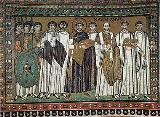
Meister Von San Vitale in Ravenna 003
Historians generally call the eastern part of the Roman Empire the Byzantine Empire
Byzantine Empire

Byzantine Empire and Eastern Roman Empire are conventional names used to describe the Roman Empire during the Middle Ages, centered on its capital of Constantinople....
 due to its capital Constantinople
Constantinople

Constantinople was the empire capital of the Roman Empire , the Byzantine Empire , the Latin Empire , and the Ottoman Empire . Strategically located between the Golden Horn and the Sea of Marmara at the point where Europe meets Asia, Byzantine Constantinople had been the capital of a Christendom empire, successor to ancient ancient Greece...
, whose ancient name was Byzantium
Byzantium

Byzantium was an Ancient Greece city, which was founded by Greeks colonists from Megara in 667 BC and named after their king Byzas or Byzantas ....
 (now Istanbul
Istanbul

Istanbul is the largest city in Turkey, List of metropolitan areas in Europe by population, and List of cities proper by population in the world with a population of 12.6 million....
). After the fall of Rome to barbarian
Barbarian

"Barbarian" is a pejorative term for an uncivilized person, either in a general reference to a member of a nation or ethnos, typically a tribal society as seen by an urban civilization either viewed as inferior, or admired as a noble savage....
 forces in 476, the title of "emperor" lived on in rulers of Constantinople (New Rome
New Rome

The term "New Rome" has been used in the following contexts.* It was a common name applied to Constantinople, the city founded by Roman Emperor Constantine the Great in 324 ....
).

The Byzantine Emperors completed the transition from the idea of the Emperor as a semi-republican official to the Emperor as a traditional monarch when Emperor Heraclius
Heraclius

Flavius Heraclius was a Byzantine Emperor, who ruled the Byzantine Empire for over thirty years, from October 5, 610 to February 11, 641. His rise to power began in 608, when he and his Heraclius the Elder, the viceregal Exarchate of Africa, successfully led a revolt against the unpopular usurper Phocas....
 retained the title of Basileus
Basileus

Basileus , signifies "Monarch" or "king". It is perhaps best known in English language as a title used by Byzantine Empire emperors, but also has a longer history of use for persons of authority in ancient Greece, as well as for the kings of modern Greece....
, already a synonym for "Emperor" (but which had earlier designated "King" in Greek
Greek language

Greek is an Indo-European languages native to the southern Balkan peninsula, the language of the Greek people. It forms an independent branch within Indo-European....
) in the first half of the seventh century. A specifically Byzantine development of emperor's position was cesaropapism, position as leader of Christians.

In general usage, the Byzantine imperial title evolved from simply "emperor" (basileus), to "emperor of the Romans" (basileus ton Romaion) in the 9th century, to "emperor and autocrat of the Romans" (basileus kai autokrator ton Romaion) in the 10th. In fact, none of these (and other) additional epithets and titles had ever been completely discarded.

The Byzantine empire produced also three reigning empresses: Irene
Irene (empress)

Irene Serantapechaina, known as Irene of Athens or Irene the Athenian was a Byzantine emperor regnant from 797 to 802, having previously been Empress consort from 775-780, and empress mother and regent from 780-797....
, Zoe
Zoe (empress)

Zoe , was Empress of the Byzantine Empire with co-rulers November 15, 1028–1050, and senior reigning Empress from April 19 to June 11, 1042....
, and Theodora
Theodora (11th century)

Theodora was a Byzantine emperor. She was co-empress from 1042 and from January 11, 1055 to after August 31, 1056 actively ruled the Eastern Roman Empire or, the Roman Empire of the Middle Ages that often is described as the Byzantine Empire....
.

Latin emperors
In 1204, the Fourth Crusade
Fourth Crusade

The Fourth Crusade was originally designed to conquer Islam Jerusalem by means of an invasion through Egypt. Instead, in April 1204, the Crusaders of Western Europe invaded and conquered the Christianity city of Constantinople, capital of the Byzantine Empire....
 captured Constantinople, and soon established a Latin Empire of Constantinople under one of the Crusader leaders. The Latin Empire was, however, unable to consolidate control of the whole of the former territories of the Byzantine Empire. Driven out of Constantinople in 1261, some territories in Greece still recognized their authority for some time. Eventually, the Imperial title became redundant and did not even contribute any longer to the prestige of the noblemen in their own country: it remained dormant after 1383. It produced three reigning empresses, two of which reigned outside of the city in the remnants of their empire.

After the 4th Crusade
In Asia Minor, after being driven out of Constantinople, relations of the last pre-Crusader emperors established the Empire of Nicaea
Empire of Nicaea

The Empire of Nicaea was the largest of the three Byzantine Greeks states founded by the aristocracy of the Byzantine Empire that fled after Constantinople was conquered during the Fourth Crusade....
 and the Empire of Trebizond
Empire of Trebizond

The Empire of Trebizond , founded in April 1204, was one of three Byzantine Empire successor states of the Byzantine Empire. However, the creation of the Empire of Trebizond was not directly related to the capture of Constantinople by the Fourth Crusade, rather it had broken away from the Byzantine Empire a few weeks prior to that event....
. Similarly, the Despotate of Epirus
Despotate of Epirus

The Despotate or Principality of Epirus was one of the Byzantine Greeks successor states of the Byzantine Empire that emerged in the aftermath of the Fourth Crusade in 1204....
 was founded in the Western Balkans (the rulers of the latter took the title of Emperor for a short time following their conquest of Thessalonica in 1224).

Eventually, the Nicaean Emperors were successful in reclaiming the Byzantine imperial title. They managed to force Epirus into submission and retake Constantinople by 1261, but Trebizond remained independent. The restored Byzantine empire finally fell due to Ottoman
Ottoman Empire

The Ottoman Empire , also known by its contemporaries as the Turkish Empire or Turkey , was an empire that lasted from 1299?1923. It was Treaty of Lausanne by the Republic of Turkey, which was officially proclaimed on October 29, 1923....
 invasion in 1453. The Trapezuntines
Empire of Trebizond

The Empire of Trebizond , founded in April 1204, was one of three Byzantine Empire successor states of the Byzantine Empire. However, the creation of the Empire of Trebizond was not directly related to the capture of Constantinople by the Fourth Crusade, rather it had broken away from the Byzantine Empire a few weeks prior to that event....
 produced three reigning empresses before they too were defeated by the Ottomans in 1461.

Emperors in Germany


Holy Roman Empire

The Roman of the Emperor's title was a reflection of the translatio imperii
Translatio imperii

Translatio imperii, Latin language for "transfer of rule", is a concept invented in the Middle Ages for describing history as a linear development: a succession of transfers of power from one supreme ruler to the next....
 (transfer of rule) principle that regarded the (Germanic) Holy Roman Emperors as the inheritors of the title of Emperor of the Western Roman Empire
Western Roman Empire

The Western Roman Empire refers to the western half of the Roman Empire, from its division by Diocletian in 285; the other half of the Roman Empire was the Eastern Roman Empire, today widely known as the Byzantine Empire....
, a title left unclaimed in the West after the death of Julius Nepos
Julius Nepos

Flavius Julius Nepos was a Roman Emperor of the West during the Roman Emperor of the Western Roman Empire. Some historians consider him to be the last De jure Western Emperor, others consider the western line to have ended with Romulus Augustus in 476....
 in 480.

From the time of Otto the Great
Otto I, Holy Roman Emperor

Otto I the Great , son of Henry I the Fowler and Matilda of Ringelheim, was Duchy of Saxony, King of Germany, King of Italy, and "the first of the Germans to be called the emperor of Italy" according to Arnulf of Milan....
 onward, much of the former Carolingian
Carolingian

File:Charlemagne denier Mayence 812 814.jpgThe Carolingian dynasty was a Frankish noble family with its origins in the Arnulfing and Pippinid clans of the 7th century....
 kingdom of Eastern Francia
Eastern Francia

East Francia , known variously as Francia Orientalis or the Kingdom of the East Franks, was the realm allotted to Louis the German by the 843 Treaty of Verdun....
 became the Holy Roman Empire. The various German princes elected one of their peers as King of the Germans
Kingdom of Germany

The Kingdom of Germany grew out of East Francia in the tenth century.The eastern partition of the Treaty of Verdun of 843 was never entirely Frankish and consisted also of large populations of Saxons, Bavarii, Thuringii, Alemanni and Frisii....
, after which he would be crowned as emperor by the Pope
Pope

The Pope is the Bishop of Rome, the leader of the Roman Catholic Church and head of state of Vatican City. The current pope is Pope Benedict XVI, who was elected April 19, 2005 in Papal conclave, 2005....
. The last emperor to be crowned by the pope was Charles V
Charles V, Holy Roman Emperor

Charles V was ruler of the Holy Roman Empire from 1519 and, as Charles I of Spain, of the Spanish realms from 1516 until his abdication in 1556....
; all emperors after him were technically emperors-elect, but were universally referred to as Emperor.

In the face of aggressions by Napoleon
Napoleon I of France

Napoleon Bonaparte later known as Emperor Napoleon I, was a military and political leader of France whose actions shaped European politics in the early 19th century....
, Francis feared for the future of the Holy Roman Empire
Holy Roman Empire

The Holy Roman Empire was a union of territories in Central Europe during the Middle Ages and the Early modern Europe under a Holy Roman Emperor....
 and wished to maintain his and his family's Imperial status in the event that the Holy Roman Empire should be dissolved, as it indeed was in 1806 when Austrian-led army suffered a humiliating defeat at the Battle of Austerlitz
Battle of Austerlitz

The Battle of Austerlitz also known as the Battle of the Three Emperors, was one of Napoleon I of France greatest victories, effectively destroying the Third Coalition against the First French Empire....
 and the victorious Napoleon proceeded to dismantle the old Reich by severing a good portion from the empire and turning it into a separate Confederation of the Rhine
Confederation of the Rhine

The Confederation of the Rhine or Rhine Confederation was a client state of the First French Empire. It was formed initially from 16 German states by Napoleon I of France after he defeated Austria's Francis II, Holy Roman Emperor and Russia's Alexander I of Russia in the Battle of Austerlitz....
. With the size of his imperial realm significantly reduced, Francis II, Holy Roman Emperor became Francis I, Emperor of Austria.

German Empire under Prussia

Under the guise of idealism giving way to realism, German nationalism rapidly shifted from its liberal and democratic character in 1848 to Prussian
Kingdom of Prussia

The Kingdom of Prussia was a Germany monarchy from 1701 to 1918 and, from 1871, was the leading state of the German Empire, comprising almost two-thirds of the area of the empire....
 prime minister Otto von Bismarck
Otto von Bismarck

Otto Eduard Leopold von Bismarck, Count of Bismarck-Sch?nhausen, Duke of Lauenburg, Prince of Bismarck, , was a Kingdom of Prussia and Germany statesman and aristocrat of the 19th century....
's authoritarian Realpolitik
Realpolitik

Realpolitik refers to politics or diplomacy based primarily on practical considerations, rather than ideological notions. The term realpolitik is often used pejoratively to imply politics that are coercive, amoral, or Machiavellian....
. Bismarck wanted to unify the rival German states to achieve his aim of a conservative, Prussian-dominated Germany. Three wars led to military successes and helped to convince German people to do this: the Second war of Schleswig
Second War of Schleswig

The Second Schleswig War was the second war due to the Schleswig-Holstein Question. The war began on February 1 1864 when Prussian forces crossed the border into Schleswig....
 against Denmark in 1864, the Austro-Prussian War
Austro-Prussian War

The Austro-Prussian War was a war fought in 1866 between the Austrian Empire and its German allies on one side and the Kingdom of Prussia with its German allies and Kingdom of Italy on the other, that resulted in Prussian dominance over the German states....
 against Austria
Austrian Empire

The Austrian Empire was a periodization successor state empire founded on a remnant of the Holy Roman Empire centered on what is today's Austria that officially lasted from 1804 to 1867....
 in 1866, and the Franco-Prussian War
Franco-Prussian War

The Franco-Prussian War or Franco-German War, often referred to in France as the 1870 War was a conflict between Second French Empire and Kingdom of Prussia, while Prussia was backed by the North German Confederation, of which it was a member, and the South German states of Grand Duchy of Baden, History of W?rttemberg#The Kingdom...
 against the Second French Empire
Second French Empire

The Second French Empire or Second Empire was the Imperial Bonapartist regime of Napoleon III from 1852 to 1870, between the French Second Republic and the French Third Republic, in France....
 in 1870–71. During the Siege of Paris
Siege of Paris

The Siege of Paris, lasting from September 19, 1870 – January 28, 1871, brought about French defeat in the Franco-Prussian War and led to the establishment of the German Empire....
 in 1871, the North German Confederation
North German Confederation

The North German Confederation , came into existence in August 1866 as a military alliance of 22 states of northern Germany with the Kingdom of Prussia as the leading state....
, supported by its allies from southern Germany
Southern Germany

The term Southern Germany is used to describe a region in the south of Germany. There is no specific boundary to the region, but it usually includes Bavaria, Baden-W?rttemberg, and the southern part of Hesse....
, formed the German Empire
German Empire

The German Empire is the name commonly used in English to describe Germany from the unification of Germany and proclamation of William I, German Emperor as German Emperor on 18 January 1871, to 1918, when it became Weimar republic after defeat in World War I and the abdication of William II, German Emperor ....
 with the proclamation of the Prussian king Wilhelm I as German Emperor in the Hall of Mirrors at the Palace of Versailles
Palace of Versailles

The Palace of Versailles, or simply Versailles, is a royal ch?teau in Versailles, the ?le-de-France region of France. In French language, it is known as the Ch?teau de Versailles....
, to the humiliation of the French, who ceased to resist only days later.

After his death he was succeeded by his son Frederick III
Frederick III, German Emperor

Frederick III was List of German monarchs and King of Prussia for 99 days in 1888 during the Year of the Three Emperors. Frederick William Nicholas Charles , known informally as Fritz, was the only son of Emperor Wilhelm I, and was raised in his family's tradition of military service....
 who was only emperor for 99 days. In the same year his son Wilhelm II became the third emperor with in a year. He was the last German emperor. After the empire's defeat in World War I
World War I

World War I, or the First World War , was a global military conflict which involved the Great powers, organized into two opposing military alliances: the Allies of World War I and the Central Powers....
 the empire ceased to exist.

Austrian Empire

The first Austrian Emperor was the last Holy Roman Emperor Francis II. In the face of aggressions by Napoleon
Napoleon I of France

Napoleon Bonaparte later known as Emperor Napoleon I, was a military and political leader of France whose actions shaped European politics in the early 19th century....
, Francis feared for the future of the Holy Roman Empire
Holy Roman Empire

The Holy Roman Empire was a union of territories in Central Europe during the Middle Ages and the Early modern Europe under a Holy Roman Emperor....
 and wished to maintain his and his family's Imperial status in the event that the Holy Roman Empire should be dissolved, as it indeed was in 1806 when Austrian-led army suffered a humiliating defeat at the Battle of Austerlitz
Battle of Austerlitz

The Battle of Austerlitz also known as the Battle of the Three Emperors, was one of Napoleon I of France greatest victories, effectively destroying the Third Coalition against the First French Empire....
 and the victorious Napoleon proceeded to dismantle the old Reich by severing a good portion from the empire and turning it into a separate Confederation of the Rhine
Confederation of the Rhine

The Confederation of the Rhine or Rhine Confederation was a client state of the First French Empire. It was formed initially from 16 German states by Napoleon I of France after he defeated Austria's Francis II, Holy Roman Emperor and Russia's Alexander I of Russia in the Battle of Austerlitz....
. With the size of his imperial realm significantly reduced, Francis II, Holy Roman Emperor became Francis I, Emperor of Austria. The new imperial title may have sounded less prestigious than the old one, but Francis' dynasty
Dynasty

A dynasty is a succession of rulers who belong to the same family for generations. A dynasty is also often called a "Royal House", e.g. the House of Saud or House of Habsburg....
 continued to rule from Austria and a Habsburg monarch was still an emperor (Kaiser), and not just merely a king (König), in name.

The title lasted just a little over one century until 1918, but it was never clear what territory constituted the "Empire of Austria
Austrian Empire

The Austrian Empire was a periodization successor state empire founded on a remnant of the Holy Roman Empire centered on what is today's Austria that officially lasted from 1804 to 1867....
". When Francis took the title in 1804, the Habsburg lands as a whole were dubbed the Kaisertum Österreich. Kaisertum might literally be translated as "emperordom" (on analogy with "kingdom") or "emperor-ship"; the term denotes specifically "the territory ruled by an emperor", and is thus somewhat more general than Reich
Reich

, is a German language loanword cognate with the English reign, region, and rich, but used most often to designate an empire, realm, or nation. The qualitative connotation from the German is "imperial, sovereign state." It is cognate with the North Germanic languages rike/rige, , , ; as found in bishopric....
, which in 1804 carried connotations of universal rule. Austria proper (as opposed to the complex of Habsburg lands as a whole) had been an Archduchy since the 15th century, and most of the other territories of the Empire had their own institutions and territorial history, although there were some attempts at centralization, especially between 1848 and 1859. When Hungary
Hungary

Hungary , officially in English the Republic of Hungary , is a landlocked country in the Carpathian Basin of Central Europe, bordered by Austria, Slovakia, Ukraine, Romania, Serbia, Croatia, and Slovenia....
 was given self-government in 1867, the non-Hungarian portions, although usually collectively called Austria, were officially known only as the "Kingdoms and Lands Represented in the Imperial Council (Reichsrat)". The title of Emperor of Austria and the associated Empire (if there was such) were both abolished at the end of the First World War
World War I

World War I, or the First World War , was a global military conflict which involved the Great powers, organized into two opposing military alliances: the Allies of World War I and the Central Powers....
 in 1918, when German Austria
German Austria

The Republic of German Austria was the initial rump state successor to the Austria-Hungary following World War I for areas with a predominantly ethnic German population....
 became a republic
Republic

A republic is a state or country that is not led by a hereditary monarch but in which the people have an impact on its government. The word originates from the Latin term res publica....
 and the other kingdoms and lands represented in the Imperial Council
Reichsrat (Austria)

Reichsrat was the Austrian Parliament from 1861 to 1918. It consisted of the Herrenhaus and the Abgeordnetenhaus .Cisleithania was officially called "The kingdoms and lands represented in the Reichsrat" ....
 established their independence or adhesion to other states.

Emperors of Eastern Europe

Byzantium
Byzantine Empire

Byzantine Empire and Eastern Roman Empire are conventional names used to describe the Roman Empire during the Middle Ages, centered on its capital of Constantinople....
's close cultural and political interaction with its Balkan neighbors Bulgaria
Bulgaria

The state of Bulgaria , Scientific transliteration Balgarija, officially the Republic of Bulgaria has played a significant role in the Balkans in south-eastern Europe for over fourteen centuries....
 and Serbia
Serbia

Serbia , officially the Republic of Serbia , is a country in Central Europe and Balkans Europe, covering the southern part of the Pannonian Plain and the central part of the Balkans....
, and with Russia (Kievan Rus', then Muscovy) led to the adoption of Byzantine imperial traditions in all of these countries.

Bulgaria

In 913 Simeon I of Bulgaria
Simeon I of Bulgaria

Simeon I the Great ruled over Bulgaria from 893 to 927, during the First Bulgarian Empire. Simeon's successful campaigns against the Byzantine Empire, Magyars and Serbs led Bulgaria to its greatest territorial expansion ever, making it the most powerful state in contemporary Eastern Europe....
 was crowned Emperor (Tsar
Tsar

Tsar or czar , occasionally spelled csar or tzar in English language, is a slavs term designating certain monarchs.Originally, the title Czar meant Emperor in the European medieval sense of the term, that is, a ruler who has the same rank as a Ancient Rome or Byzantine emperor due to recognition by another emperor or...
) by the Patriarch of Constantinople
Patriarch of Constantinople

The Ecumenical Patriarch of Constantinople is the Archbishop of Constantinople ? New Rome ? ranking as primus inter pares in the Eastern Orthodox Church organization, which is seen by followers as the One, Holy, Catholic, and Apostolic Church....
 and imperial regent Nicholas Mystikos
Nicholas Mystikos

Nicholas I Mystikos or Nicholas I Mysticus was the Patriarch of Constantinople from March 901 to February 906 and from May 912 to his death in 925....
 outside of the Byzantine capital. In its final simplified form, the title read "Emperor and Autocrat of all Bulgarians and Romans" (Tsar i samodaržec na vsicki balgari i garci in the modern vernacular). The "Roman" component in the Bulgarian imperial title indicateed both rulership over Greek speakers and the derivation of the imperial tradition from the Romans (represented by the "Roman" Byzantines).

Byzantine recognition of Simeon's imperial title was revoked by the succeeding Byzantine government. The decade 914–924 was spent in destructive warfare between Byzantium and Bulgaria over this and other matters of conflict. The Bulgarian monarch, who had further irritated his Byzantine counterpart by claiming the title "Emperor of the Romans" (basileus ton Romaion), was eventually recognized, as "Emperor of the Bulgarians" (basileus ton Boulgaron) by the Byzantine Emperor Romanos I Lakapenos in 924. Byzantine recognition of the imperial dignity of the Bulgarian monarch and the patriarchal dignity of the Bulgarian patriarch
Patriarch of All Bulgaria

The Patriarch of All Bulgaria is the Patriarch of the Bulgarian Orthodox Church. The Bulgarian patriarchate was re-established in 1953....
 was again confirmed at the conclusion of permanent peace and a Bulgarian-Byzantine dynastic marriage in 927. In the meantime, the Bulgarian imperial title may have been also confirmed by the Pope
Pope

The Pope is the Bishop of Rome, the leader of the Roman Catholic Church and head of state of Vatican City. The current pope is Pope Benedict XVI, who was elected April 19, 2005 in Papal conclave, 2005....
. The Bulgarian imperial title "Tsar" was adopted by all Bulgarian monarchs up to the fall of Bulgaria under Ottoman rule. 14th century Bulgarian literary compositions clearly denote the Bulgarian capital (Tarnovo
Veliko Tarnovo

Veliko Tarnovo is a city in north central Bulgaria and the administrative centre of Veliko Tarnovo Province. Often referred to as the "City of the Tsars", Veliko Turnovo is located on the Yantra River and is famous as the historical capital of the Second Bulgarian Empire, attracting many tourists with its unique architecture....
) as a successor of Rome
Rome

Rome is the capital city of Italy and Lazio, and is Italy's largest and most populous city, with 2,724,347 residents in an urban area of some ....
 and Constantinople
Constantinople

Constantinople was the empire capital of the Roman Empire , the Byzantine Empire , the Latin Empire , and the Ottoman Empire . Strategically located between the Golden Horn and the Sea of Marmara at the point where Europe meets Asia, Byzantine Constantinople had been the capital of a Christendom empire, successor to ancient ancient Greece...
, in effect, the "Third Rome".

It should be noted that after Bulgaria obtained full independence from the Ottoman Empire
Ottoman Empire

The Ottoman Empire , also known by its contemporaries as the Turkish Empire or Turkey , was an empire that lasted from 1299?1923. It was Treaty of Lausanne by the Republic of Turkey, which was officially proclaimed on October 29, 1923....
 in 1908, its monarch, who was previously styled "Knyaz", i.e Prince, took the traditional title of "Tsar", but was recognized internationally only as a King.

Serbia

In 1345 the Serbian King Stefan Uroš IV Dušan proclaimed himself Emperor (Tsar
Tsar

Tsar or czar , occasionally spelled csar or tzar in English language, is a slavs term designating certain monarchs.Originally, the title Czar meant Emperor in the European medieval sense of the term, that is, a ruler who has the same rank as a Ancient Rome or Byzantine emperor due to recognition by another emperor or...
) and was crowned as such at Skopje
Skopje

Skopje is the Capital of and List of cities in the Republic of Macedonia by population in the Republic of Macedonia, with more than a quarter of the population of the country, as well as its political, cultural, economic, and academic centre....
 on Easter
Easter

Easter is the most important religious feast in the Christianity liturgical year.Christians believe that Jesus was Resurrection of Jesus from the dead three days after his Crucifixion of Jesus, and celebrate this resurrection on Easter Day or Easter Sunday , two days after Good Friday....
 1346 by the newly created Patriarch of Serbia, and by the Patriarch of Bulgaria and the autocephalous Archbishop of Ohrid. His imperial title was recognized by Bulgaria and various other neighbors and trading partners but not by the Byzantine Empire. In its final simplified form, the Serbian imperial title read "Emperor of Serbians and Greeks" (car srbljem i grkom in the modern vernacular). It was only employed by Stefan Uroš IV Dušan and his son Stefan Uroš V in Serbia (until his death in 1371), after which it became extinct. A half-brother of Dušan, Simeon Uroš
Simeon Uroš

Simeon Uro? or Sini?a Uro?, also Symeon Ouresis Palaiologos , was the ruler of Despotate of Epirus from 1359 to 1366 and of Thessaly from 1359 until his death in c....
, and then his son Jovan Uroš, claimed the same title, until the latter's abdication in 1373, while ruling as dynasts in Thessaly
Thessaly

Thessaly is one of the 13 Peripheries of Greece of Greece, and is further sub-divided into 4 Prefectures of Greece. The capital of the periphery and traditional Regions of Greece is Larissa....
. The "Greek" component in the Serbian imperial title indicates both rulership over Greeks and the derivation of the imperial tradition from the Romans (represented by the "Greek" Byzantines).

Russia

In 1472, the niece of the last Byzantine emperor, Sophia Palaiologina
Sophia Paleologue

Zoe Palaiologina , Grand Duchess of Moscow, was a niece of the last Byzantine emperor Constantine XI and second wife of Ivan III of Russia.Her father was Thomas Palaeologus, the Despotate of Morea....
, married Ivan III
Ivan III of Russia

Ivan III Vasilevich , also known as Ivan the Great, was a Grand Duchy of Moscow and "Grand Prince of all Russia" Sometimes referred to as the "gatherer of the Russian lands", he tripled the territory of his state, renovated the Moscow Kremlin, and laid the foundations of the Russian state....
, grand prince of Moscow, who began championing the idea of Russia being the successor to the Byzantine Empire. This idea was represented more emphatically in the composition of the monk Filofej addressed their son Vasili III
Vasili III of Russia

Vasili III Ivanovich was the Grand Duchy of Moscow from 1505 to 1533. He was the son of Ivan III Vasiliyevich and Sophia Paleologue and was christened with the name Gavriil ....
. After ending Muscovy's dependence on its Mongol overlords in 1480, Ivan III began the usage of the titles Tsar
Tsar

Tsar or czar , occasionally spelled csar or tzar in English language, is a slavs term designating certain monarchs.Originally, the title Czar meant Emperor in the European medieval sense of the term, that is, a ruler who has the same rank as a Ancient Rome or Byzantine emperor due to recognition by another emperor or...
 and Autocrat (samoderžec' ). His insistence on recognition as such by the emperor of the Holy Roman Empire
Holy Roman Empire

The Holy Roman Empire was a union of territories in Central Europe during the Middle Ages and the Early modern Europe under a Holy Roman Emperor....
 since 1489 resulted in the granting of this recognition in 1514 by Emperor Maximilian I
Maximilian I, Holy Roman Emperor

Maximilian I of Habsburg was Holy Roman Empire from 1508 until his death, but had ruled jointly with his father for the last ten years of his reign, from circa 1483....
 to Vasili III. His son Ivan IV
Ivan IV of Russia

Ivan IV Vasilyevich , known in English language as Ivan the Terrible was Grand Duchy of Moscow from 1533. The epithet "Grozny" is associated with might, power and strictness, rather than poor performance, horror or cruelty....
 emphatically crowned himself Tsar (Tsar) on 16 January, 1547. The word Tsar derives from Latin Caesar,but this title was used in Russia as equivalent to King; the error occurred when medieval Russian clerics referred to the biblical Jewish kings with the same title that was used to designate Roman and Byzantine rulers - Caesar.

On 31 October, 1721 Peter I
Peter I of Russia

Peter I the Great or Pyotr Alexeyevich Romanov ruled Russia and later the Russian Empire from until his death, jointly ruling before 1696 with his weak and sickly half-brother, Ivan V of Russia....
 was proclaimed Emperor by the Senate-the title used was Latin "Imperator", which is a westernizing form equivalent to the traditional Slavic title "Tsar". He based his claim partially upon a letter discovered in 1717 written in 1514 from Maximilian I
Maximilian I, Holy Roman Emperor

Maximilian I of Habsburg was Holy Roman Empire from 1508 until his death, but had ruled jointly with his father for the last ten years of his reign, from circa 1483....
 to Vasili III
Vasili III of Russia

Vasili III Ivanovich was the Grand Duchy of Moscow from 1505 to 1533. He was the son of Ivan III Vasiliyevich and Sophia Paleologue and was christened with the name Gavriil ....
, Sophia's son and Ivan IV's father, in which the Holy Roman Emperor used the term in referring to Vasili. The title has not been used in Russia
Russia

Russia , or the Russian Federation , is a list of countries spanning more than one continent country extending over much of northern Eurasia....
 since the abdication of Emperor Nicholas II
Nicholas II of Russia

Nicholas II was the last Tsar of Russian Empire, Grand Prince of Finland, and claimant to the title of King of Poland. His official title was Nicholas II, Emperor and Autocrat of All the Russias and he is currently regarded as Saint Nicholas the Passion Bearer by the Russian Orthodox Church....
 on 15 March, 1917.

Imperial Russia produced four reigning Empresses, all in the eighteenth century.

Ottoman Empire

Ottoman rulers
Ottoman Dynasty

File:Barber cape.jpgThe Ottoman Dynasty ruled the Ottoman Empire from 1299 to 1922, beginning with Osman I , though the dynasty was not proclaimed until Orhan Bey declared himself sultan....
 held several titles denoting their Imperial status. These included:

Sultan (given name) Khan, Sovereign of the Imperial House of Osman, Sultan of Sultans, Khan of Khans, Commander of the Faithful and Successor of the Prophet of the Lord of the Universe (Caliph
Caliph

The Caliph is the head of state in a Caliphate, and the title for the leader of the Islamic Ummah, an Islamic community ruled by the Shari'ah....
), Protector of the Holy Cities of Mecca, Medina and Jerusalem, Emperor of The Three Cities of Constantinople, Andrinopole and Bursa, and of the Cities of Damascus and Cairo, of all Azerbaijan, of the Magris, of Barka, of Kairuan, of Aleppo, of Arabic Iraq and of Ajim, of Basra, of El Hasa, of Dilen, of Raka, of Mosul, of Parthia, of Diyarbakir, of Cicilia, of the Vilayets of Erzurum, of Sivas, of Adana, of Karaman, Van, of Barbary, of Abyssinia, of Tunisia, of Tripoli, of Damascus, of Cyprus, of Rhodes, of Candia, of the Vilayet of the Morea, of the Marmara Sea, the Black Sea and also its coasts, of Anatolia, of Rumelia, Baghdad, Kurdistan, Greece, Turkistan, Tartary, Circassia, of the two regions of Kabarda, of Georgia, of the plain of Kypshak, of the whole country of the Tartars, of Kefa and of all the neighbouring countries, of Bosnia and its dependencies, of the City and Fort of Belgrade, of the Vilayet of Serbia, with all the castles, forts and cities, of all Albania, of all Iflak and Bogdania, as well as all the dependencies and borders, and many other countries and cities.

Upon the conquering of the Roman Empire, the additional title of Kasar-i-Rum (Emperor of the Romans) was used.

Emperors in Western Europe


France

The kings of the Ancien Régime
Ancien Régime

Ancien R?gime refers primarily to the aristocracy, sociology, and politics system established in France under the Valois Dynasty and House of Bourbon dynasties ....
 and the July Monarchy used the title Empereur de France in diplomatic correspondence and treaties with the Ottoman
Ottoman Empire

The Ottoman Empire , also known by its contemporaries as the Turkish Empire or Turkey , was an empire that lasted from 1299?1923. It was Treaty of Lausanne by the Republic of Turkey, which was officially proclaimed on October 29, 1923....
 emperor from at least 1673 onwards. The Ottomans insisted on this elevated style while refusing to recognize the Holy Roman Emperors or the Russian tsars due to their rival claims of the Roman crown
Translatio imperii

Translatio imperii, Latin language for "transfer of rule", is a concept invented in the Middle Ages for describing history as a linear development: a succession of transfers of power from one supreme ruler to the next....
. In short, it was an indirect insult by the Ottomans to the HRE and the Russians. The French kings also used it for Morocco
Morocco

Morocco , officially the Kingdom of Morocco , is a country located in North Africa with a population of nearly 34 million and an area just under 447,000 km2....
 (1682) and Persia (1715).

First French Empire
See also: First French Empire
First French Empire

The Empire of the French , also known as the Greater French Empire or First French Empire, but more commonly known as the Napoleonic Empire, was the empire of Napoleon I of France in France....
Napoleon Bonaparte
Napoleon I of France

Napoleon Bonaparte later known as Emperor Napoleon I, was a military and political leader of France whose actions shaped European politics in the early 19th century....
 who was already First Consul of the French Republic (Premier Consul de la République française) for life, declared himself Emperor of the French (Empereur des Français) on May 18, 1804. Despite being ruled by an emperor, it continued to be the French Republic
French First Republic

The French First Republic was founded on 22 September, 1792, by the newly established National Convention. The First Republic lasted until the declaration of the First French Empire in 1804 under Napoleon....
 (République Française) until 1808, when it was renamed the French Empire
First French Empire

The Empire of the French , also known as the Greater French Empire or First French Empire, but more commonly known as the Napoleonic Empire, was the empire of Napoleon I of France in France....
 (Empire Français).

Napoleon relinquished the title of Emperor of the French on 6 April and again on April 11, 1814. Napoleon's infant son, Napoleon II
Napoleon II of France

Napol?on Fran?ois Joseph Charles Bonaparte, Duke of Reichstadt was the son of Napoleon I of France and his second wife, Marie Louise, Duchess of Parma....
, was recognized by the Council of Peers, as Emperor from the moment of his father's abdication, and therefore reigned (as opposed to ruled) as Emperor for fifteen days, June 22 to July 7 of 1815.

Elba
Since 3 May 1814, the Sovereign Principality of Elba
Elba

Elba is an island in Tuscany, Italy, from the coastal town of Piombino. It is the largest island of the Tuscan Archipelago, and the third largest List of islands of Italy after Sicily and Sardinia....
 was created a miniature non-hereditary Monarchy under the exiled French Emperor Napoleon I. Napoleon I was allowed, by the treaty of Fontainebleau with (27 April), to enjoy, for life, the imperial title. The islands were not restyled an empire.

On 26 February 1815, Napoleon abandoned Elba for France, reviving the French Empire for a Hundred Days
Hundred Days

The Hundred Days marked the period between Napoleon I of France's return from exile on Elba to Paris on 20 March 1815 and the second restoration of King Louis XVIII of France on 8 July 1815 ....
; the Allies declared an end to Napoleon's sovereignty over Elba on 25 March 1815, and on 31 March 1815 Elba was ceded to the restored Grand Duchy of Tuscany
Grand Duchy of Tuscany

The Grand Duchy of Tuscany 2 was a state in central Italy that existed from 1569 to 1859, replacing the Duchy of Florence, which had been created out of the old Republic of Florence in 1532, and which annexed the Republic of Siena in 1557....
 by the Congress of Vienna. After his final defeat, Napoleon was treated as a general by the British authorities during his second exile to Atlantic Isle of St. Helena. His title was a matter of dispute with the governor of St Helena, who insisted on addressing him as "General Bonaparte", despite the "historical reality that he had been an emperor" and therefore retained the title.

Second French Empire
See also: Second French Empire
Second French Empire

The Second French Empire or Second Empire was the Imperial Bonapartist regime of Napoleon III from 1852 to 1870, between the French Second Republic and the French Third Republic, in France....
Napoleon I's nephew, Napoleon III
Napoleon III of France

Napol?on III, also known as Louis-Napol?on Bonaparte was the first President of the French Republic and the only emperor of the Second French Empire....
, resurrected the title of emperor on December 2, 1852, after establishing the Second French Empire
Second French Empire

The Second French Empire or Second Empire was the Imperial Bonapartist regime of Napoleon III from 1852 to 1870, between the French Second Republic and the French Third Republic, in France....
 in a presidential coup, subsequently approved by a plebiscite. His reign was marked by large scale public works, the development of social policy, and the extension of France's influence in Asia. He was deposed on September 4, 1870, after France's defeat in the Franco-Prussian War
Franco-Prussian War

The Franco-Prussian War or Franco-German War, often referred to in France as the 1870 War was a conflict between Second French Empire and Kingdom of Prussia, while Prussia was backed by the North German Confederation, of which it was a member, and the South German states of Grand Duchy of Baden, History of W?rttemberg#The Kingdom...
. The Third Republic
French Third Republic

The French Third Republic was the political regime of France between the Second French Empire and the Vichy France. It was a republican parliamentary democracy that was created on 4 September 1870 following the collapse of the Empire of Napoleon III of France in the Franco-Prussian War....
 followed and after the death of his son Napoleon IV, in 1879 during the Zulu War, the Bonapartist movement split, and the Third Republic was to last until 1940.

Iberian Peninsula

The origins of the title Imperator totius Hispaniae
Imperator totius Hispaniae

The title of Imperator Hispaniae was borne, traditionally, by the List of Leonese monarchs, from at least the tenth century. It was used, somewhat sporadically, in the following two centuries as the kings of the various kingdoms of Christian Iberian Peninsula fought for supremacy and for the imperiale culmen, Le?n, Le?n....
 (Latin for Emperor of All Spain
Hispania

Hispania was the name given by the Ancient Rome to the whole of the Iberian Peninsula . When Rome was a Roman Republic, Hispania was divided into Roman provinces: Hispania Citerior and Hispania Ulterior....
) is murky. It was associated with the Leonese monarchy
List of Leonese monarchs

In the reign of Ordo?o I of Asturias , the kingdom began to be known as that of Le?n, Le?n. In 910, an independent Kingdom of Le?n was founded when the king of Asturias divided his territory amongst his three sons....
 perhaps as far back as Alfonso the Great (r. 866-910). The last two kings of its Pérez Dynasty
Pérez Dynasty

The P?rez Dynasty is the family of kings which ruled in Kingdom of Asturias, Kingdom of Galicia, and Kingdom of Le?n from the succession of Alfonso I of Asturias, son of Peter of Cantabria, duke of Cantabria....
 were called emperors in a contemporary source.

King Sancho III of Navarre
Sancho III of Navarre

Sancho III Garc?s , called the Great , was King of Navarre from 1004 until his death and claimed the overlordship of the List of Castilian monarchs from 1017 to his death, appearing in a charter as "king in Castile"....
 conquered Leon in 1034 and began using it. His son, Ferdinand I of Castile also took the title in 1039. Ferdinand's son, Alfonso VI of Castile
Alfonso VI of Castile

Alfonso VI , nicknamed the Brave or the Valiant, was King of Le?n from 1065 to 1109 and King of Castile from 1072 following the death of his brother Sancho II of Castile....
 took the title in 1077. It then passed to his son-in-law, Alfonso I of Aragon in 1109. His stepson and Alfonso VI's grandson, Alfonso VII was the only one who actually had an imperial coronation in 1135.

The title was not exactly hereditary but self proclaimed by those who had, wholly or partially, united the Christian northern part of the Iberian peninsula
Iberian Peninsula

The Iberian Peninsula, or Iberia, is located in the extreme southwest of Europe and includes modern-day Spain, Portugal, Andorra and Gibraltar and a very small area of France....
, often at the expense of killing rival siblings. The popes and Holy Roman emperors protested at the usage of the imperial title as a usurpation of leadership in western Christendom. After Alfonso VII's death in 1157, the title was abandoned.

After the fall of the Byzantine Empire, the legitimate heir to the throne, Andreas Palaiologos
Andreas Palaiologos

Andreas Palaiologos de jure Byzantine emperor and Despotate of Morea from 1465 until death in 1502.He was the nephew of Constantine XI Palaiologos, the last Byzantine Emperor of Constantinople....
, willed away his claim to Ferdinand and Isabella in 1503. This claim seems to have been forgotten or abandoned quietly for the last 300 years.

Britain

In the late 3rd century, by the end of the epoch of the barracks emperors in Rome, there were two Britannic Emperors
List of Roman Emperors

The title of Roman Emperor, although in some ways a modern concept, effectively summarises the position held by those individuals who wielded power in the Roman Empire....
, reigning for about a decade. After the Roman departure from Britain
Roman departure from Britain

The Roman departure from Britain was completed by 410. The archaeological records of the final decades of Roman rule show undeniable signs of decay....
, the Imperator Cunedda
Cunedda

Cunedda ap Edern , also known as Cunedda Wledig , was an important early Wales leader, and the progenitor of the royal dynasty of Kingdom of Gwynedd....
 forged the Kingdom of Gwynedd
Kingdom of Gwynedd

Gwynedd is one of several Wales successor states that emerged in 5th-century sub-Roman Britain. It was based on the former Brythonic tribal lands of the Ordovices, Gangani, and the Deceangli which were collectively known as Venedotia in late Romano-British documents....
 in northern Wales
Wales

native_name = Cymru|conventional_long_name = Wales|common_name = Wales|image_flag = Flag of Wales 2.svg|national_motto = ...
, but all his successors were titled kings and princes.

England
There was no set title for the king of England before 1066 and monarchs chose to style themselves as they pleased. Imperial titles were used inconsistently beginning with Athelstan in 930 and ended with the Norman conquest of England
Norman conquest of England

The Norman conquest of England began in 1066 AD with the invasion of the Kingdom of England by the troops of William I of England, Duke of Normandy , and his victory at the Battle of Hastings....
.

Henry VIII
Henry VIII of England

Henry VIII was King of England from 21 April 1509 until his death. He was also Lordship of Ireland and claimant to the Early Modern France. Henry was the second monarch of the House of Tudor, succeeding his father, Henry VII of England....
 began claiming his crown was an Imperial Crown
Imperial crown

An Imperial Crown is a crown used for the coronation of emperors. In Britain an Imperial Crown is a crown used by a monarch on state occasions other than the coronation, when a special coronation crown is used....
 during the Reformation
English Reformation

The English Reformation was the series of events in 16th century England by which the Church of England first broke away from the authority of the Pope and the Roman Catholic Church....
; however, this did not lead to the creation of the title of Emperor in England.

United Kingdom
In 1801, George III
George III of the United Kingdom

George III was Kingdom of Great Britain and Kingdom of Ireland from 25 October 1760 until the union of these two countries on 1 January 1801, after which he was King of the United Kingdom of Great Britain and Ireland until his death....
 rejected the title of Emperor when offered. The only period when British monarchs were given the title of Emperor in a dynastic succession started when the title Empress of India
Emperor of India

Emperor/Empress of India was used as a title by the last Mughal Empire emperor Bahadur Shah II, and revived by the colonial Monarchy of the United Kingdom during the British Raj in India....
 was created for Queen Victoria
Victoria of the United Kingdom

Victoria was from 20 June 1837 the Queen regnant of the United Kingdom of Great Britain and Ireland and from 1 May 1876 the first Empress of India of the British Raj until her death....
. The government led by Prime Minister
Prime Minister of the United Kingdom

The Prime Minister of the United Kingdom of Great Britain and Northern Ireland is the political leader of the United Kingdom and the head of government Her Majesty's Government....
 Benjamin Disraeli
Benjamin Disraeli, 1st Earl of Beaconsfield

Benjamin Disraeli, 1st Earl of Beaconsfield, Order of the Garter, Privy Council of the United Kingdom, Fellow of the Royal Society, born Benjamin D'Israeli, , was a United Kingdom of Great Britain and Ireland Conservative Party statesman and literary figure....
, conferred the additional title upon her by an Act of Parliament; it was also formally justified as the expression of Britain succeeding as paramount ruler
Paramount Ruler

The term Paramount Ruler, or sometimes Paramount King, is a generic description, though occasionally also used as an actual title, for a number of rulers' position in relative terms, as the summit of a feudal-type pyramid of rulers of lesser polities in a given historical and geographical context, often of different ranks, which all re...
 of the subcontinent the former Mughal 'Padishah
Padishah

Padishah, Padshah, Padeshah, Badishah or Badshah is a very prestigious title, which is composed from the Persian words pad "master" and the better-known title shah "king", which was adopted by several Islamic monarchy claiming the highest rank, roughly equivalent to Christian Emperors or the ancient notion of...
 of Hind', using indirect rule through hundreds of princely state
Princely state

For other uses, see Principality, Princely state#Other princely statesA Princely State was a nominally sovereign entity of British rule in India that was not directly administered by the British, but rather by an Indian ruler under a form of indirect rule such as suzerainty or paramountcy....
s formally under protection, not colonies, but accepting the British Sovereign as their 'feudal' suzerain. That title was relinquished by the last Kaisar-i-Hind George VI
George VI of the United Kingdom

George VI was British monarchy and the United Kingdom Dominions from 11 December 1936 until his death. He was the last Emperor of India and the last King of Ireland , and the first Head of the Commonwealth....
 when India
India

India, officially the Republic of India , is a country in South Asia. It is the List of countries and outlying territories by total area country by geographical area, the List of countries by population country, and the most populous liberal democracy in the world....
 was granted independence on August 15 1947.

Two decades earlier the Royal and Parliamentary Titles Act 1927
Royal and Parliamentary Titles Act 1927

Passed on April 12, 1927, the Royal and Parliamentary Titles Act 1927 was an Act of Parliament of the United Kingdom that formed a significant landmark in the constitutional history of the UK and British Empire as a whole....
 had stated that the United Kingdom and the dominions were "equal in status, in no way subordinate one to another in any aspect of their domestic or external affairs, though united by common allegiance to the Crown, and freely associated as members of the British Commonwealth of Nations
Commonwealth of Nations

The Commonwealth of Nations, also known as the Commonwealth or the British Commonwealth, is an intergovernmental organization of fifty-three independent member states....
". Along with the Statute of Westminster, 1931 this changed the way the British parliamentary monarchy ruled the overseas dominions, moving from a colonial British Empire towards a new structure for the interaction between the Commonwealth Realms and the Crown.

The last Empress of India was HM Queen Elizabeth, The Queen Mother.

Post-colonial emperors modeled on Europe


Post-Columbian Americas

Fala Do Trono
Brazil
When Napoleon I ordered the invasion of Portugal
Portugal

Portugal , officially the Portuguese Republic , is a country on the Iberian Peninsula. Located in southwestern Europe, Portugal is the westernmost country of mainland Europe and is bordered by the Atlantic Ocean to the west and south and by Spain to the north and east....
 in 1807 because it refused to join the Continental System
Continental System

The Continental System was the foreign policy of Napoleon I of France in his struggle against the United Kingdom of Great Britain and Ireland during the Napoleonic Wars....
, the Portuguese Braganças
House of Braganza

The Most Serene House of Braganza was the dynasty which ruled Portugal from 1640 to 1853 and the Empire of Brazil from 1822 to 1889. It is a collateral line of the House of Aviz, which ruled Portugal from 1385 until 1580....
 moved their capital to Rio de Janeiro
Rio de Janeiro

Rio de Janeiro , is the second largest city of Brazil and South America, behind S?o Paulo, and the third largest metropolitan area in South America, behind S?o Paulo and Buenos Aires....
 to avoid the fate of the Spanish Bourbons (Napoleon I arrested them and made his brother King). When General Junot (French) arrived in Lisbon
Lisbon

Lisbon is the Capital and largest city of Portugal. It is also the seat of the Lisbon and capital of the Lisbon region. Its municipalities of Portugal, which matches the city proper excluding the larger continuous conurbation, has a municipal population of 564,477 in , while the Lisbon Metropolitan Area in total has around 2.8 million inha...
, the Portuguese fleet had already left with all the local elite.

In 1808, under a British naval escort, the fleet arrived in Brazil
Brazil

Brazil , officially the Federative Republic of Brazil , is a country in South America. It is the List of countries and outlying territories by total area country by geographical area, occupying nearly half of South America, the List of countries by population country, and the fourth most populous democracy in the world....
. Later, in 1815, the Portuguese Prince Regent (since 1816 king John VI
John VI of Portugal

Don John Mary Joseph Francis Javier of Paula Louis Anthony Dominic Raphael of Braganza , the Clement , Kings of Portugal of the United Kingdom of Portugal, Brazil and the Algarves was born in Lisbon in 1767....
) proclaimed the United Kingdom of Portugal, Brazil and the Algarve, as a union of three kingdoms, lifting Brazil from its colonial status.

After the fall of Napolean I and the Liberal revolution
Liberal Wars

The Liberal Wars, also known as the Portuguese Civil War, the War of the Two Brothers, or Miguelite War, was a war between progressive constitutionalists and authoritarian absolutists in Portugal over royal succession that lasted from 1828 to 1834....
 in Portugal
Portugal

Portugal , officially the Portuguese Republic , is a country on the Iberian Peninsula. Located in southwestern Europe, Portugal is the westernmost country of mainland Europe and is bordered by the Atlantic Ocean to the west and south and by Spain to the north and east....
, the Portuguese Royals returned to Europe
Europe

Europe is, conventionally, one of the world's seven continents. Comprising the westernmost peninsula of Eurasia, Europe is generally divided from Asia to its east by the water divide of the Ural Mountains, the Ural , the Caspian Sea, and by the Caucasus Mountains to the southeast....
 (1820). Prince Peter of Braganza (King John’s older son) stayed in South America acting as regent of the local kingdom, but, two years later in 1822, he proclaimed himself Peter I
Peter I of Brazil

Pedro I , known as "Don Pedro Primeiro" , proclaimed Brazil independent from Portugal and became Brazil's first Brazilian Empire. He also held the Portuguese monarchs briefly as Pedro IV of Portugal, the Soldier-King , 28th king of Kingdom of Portugal....
, first Emperor of Brazil. He did, however, recognize his father, John VI, as Titular Emperor of Brazil - a purely honorific title - until John VI's death in 1826.

The empire came to an end in 1889, with the overthrow of Emperor Pedro II
Pedro II of Brazil

Pedro II, , or Dom Pedro de Alc?ntara; December 2, 1825 December 5, 1891) was the second and last Emperor of Brazil, having ruled for almost 50 years....
 (Pedro I's son and successor), when the Brazilian republic was proclaimed.

Haiti
Haiti
Haiti

Haiti , officially the Republic of Haiti , is a Haitian Creole language- and French language-speaking Caribbean country. Along with the Dominican Republic, it occupies the island of Hispaniola, in the Greater Antilles archipelago....
 was declared an empire by its ruler, Jean-Jacques Dessalines
Jean-Jacques Dessalines

Jean-Jacques Dessalines was a leader of the Haitian Revolution and the first ruler of an independent Haiti under the 1801 constitution. He was autocratic in his rule and crowned himself List of heads of state of Ha?ti in 1805....
, who made himself Jacques I, in 20 May, 1805. He was assassinated the next year. Haiti again became an empire from 1849 to 1859 under Faustin Soulouque.

Mexico
Maximilian of Mexico Winterhalter
In Mexico
Mexico

The United Mexican States , commonly known as Mexico , is a federalism constitutionalism republic in North America. It is bordered on the north by the United States; on the south and west by the Pacific Ocean; on the southeast by Guatemala, Belize, and the Caribbean Sea; and on the east by the Gulf of Mexico....
, the First Mexican Empire
First Mexican Empire

The Mexican Empire was the official name of independent Mexico under a monarchical regime from 1822 to 1823. The territory of the Mexican Empire included the continental intendencies and provinces of Viceroyalty of New Spain proper and those of the former Captaincy General of Guatemala....
 was the first of two empires created. Agustín de Iturbide
Agustín de Iturbide

Agust?n de Iturbide was born into a noble family in Valladolid, New Spain . He was commissioned into the colonial army when still in his teens....
, the general who helped secure Mexican independence from Spanish rule, was proclaimed Emperor Agustín I in 12 July, 1822, but was overthrown the next year.

In 1863, the invading French, under Napoleon III (see above), in alliance with Mexican conservatives, helped create the Second Mexican Empire
Second Mexican Empire

The Second Mexican Empire was the name of Mexico under the regime established from 1864 to 1867. Using the pretext of collecting overdue loans to Mexico, Napoleon III of France justified the invasion by French troops....
, and invited Archduke Maximilian, of the house of Habsburg-Lorraine, younger brother of the Austrian Emperor Franz Josef I
Franz Joseph I of Austria

Franz Joseph I Karl of the Habsburg was Emperor of Austrian Empire, Apostolic King of Kingdom of Hungary from 1848 until 1916 ....
, to become emperor Maximilian I of Mexico. The childless Maximilian and his consort Empress Carlota of Mexico
Charlotte of Belgium

Charlotte of Belgium , as Charlotte , Empress of Mexico was the consort of Emperor Maximilian I of Mexico, Archduke of Austria....
, daughter of Leopold I of Belgium
Leopold I of Belgium

Leopold I was from 21 July 1831 the first King of the Belgians. He was the founder of the Belgian line of the House of Saxe-Coburg-Gotha. His children included Leopold II of Belgium and Charlotte of Belgium....
, adopted Agustín's grandson as his heir to bolster his claim to the throne of Mexico. Maximilian and Carlota made Chapultepec Castle their home, which was the only palace in North America to house soveriegns. After the withdrawal of French protection in 1867, Maximilian was captured and executed by liberal forces. This empire led to French influence in the Mexican culture and also immigration from France, Belgium, and Switzerland to Mexico.

Pre-Columbian traditions

The Aztec and Inca traditions are unrelated to one another. Both were conquered under the reign of King Charles I of Spain who was simultaneously emperor-elect of the Holy Roman Empire
Holy Roman Empire

The Holy Roman Empire was a union of territories in Central Europe during the Middle Ages and the Early modern Europe under a Holy Roman Emperor....
 during the fall of the Aztecs and fully emperor during the fall of the Incas. Incidentally by being king of Spain, he was also Roman (Byzantine) emperor in pretence through Andreas Palaiologos
Andreas Palaiologos

Andreas Palaiologos de jure Byzantine emperor and Despotate of Morea from 1465 until death in 1502.He was the nephew of Constantine XI Palaiologos, the last Byzantine Emperor of Constantinople....
. The translations of their titles were provided by the Spanish.

Aztec Empire

The only pre-Columbian
Pre-Columbian

The pre-Columbian era incorporates all archaeology of the Americas in the history of the Americas before the appearance of significant European influences on the Americas continents....
 North American rulers to be commonly called emperors were the Hueyi Tlatoani of the Aztec Empire (1375–1521). It was an elected monarchy chosen by the elite. Spanish conquistador
Conquistador

Conquistador is the name given to the Spaniards soldiers, leaders, List of explorers, and adventurers involved in the conquest of the Americas following the discovery of the New World by Christopher Columbus in 1492....
 Hernán Cortés
Hernán Cortés

Hern?n Cort?s de Monroy y Pizarro, 1st Marqu?s del Valle de Oaxaca was a Spain conquistador who led an expedition that caused the conquest of the Aztec Empire and brought large portions of mainland Mexico under the Crown of Castile, in the early 16th century....
 slew Emperor Cuauhtémoc
Cuauhtémoc

Cuauht?moc was the Aztec ruler of Tenochtitlan from 1520 to 1521. The name Cuauhtemoc means "One That Has Descended Like an Eagle" in Nahuatl language ? commonly rendered in English as "Falling Eagle" ? and wrong was ....
 and installed puppet rulers who became vassals for Spain
Spain

Spain or the Kingdom of Spain , is a country located in Southern Europe on the Iberian Peninsula.The Spanish constitution does not establish any official denomination of the country, even though Espa?a , Estado espa?ol and Naci?n espa?ola are used interchangeably....
. Mexican Emperor Maximilian built his palace, Chapultepec Castle, over the ruins of an Aztec one.

Inca Empire

The only pre-Columbian South American rulers to be commonly called emperors were the Sapa Inca of the Inca Empire
Inca Empire

The Inca Empire was the largest empire in pre-Columbian America. The administrative, political and military center of the empire was located in Cuzco in modern-day Peru....
 (1438–1533). Spanish conquistador Francisco Pizarro
Francisco Pizarro

Francisco Pizarro Gonz?lez, 1st Marqu?s de los Atabillos was a Spain conquistador, conqueror of the Incan Empire and founder of Lima, the modern-day capital of Peru....
, conquered the Inca for Spain, killed Emperor Atahualpa
Atahualpa

Atahualpa, Atahuallpa, Atabalipa, or Atawallpa , was the last sovereign emperor of the Tahuantinsuyu, or the Inca Empire. He became emperor upon defeating his older half-brother Hu?scar in a civil war sparked by the death of their father, Inca Huayna Capac, from an infectious disease thought to be smallpox....
, and installed puppets as well. Atahualpa may actually be considered a usurper as he had achieved power by killing his half-brother
War of the Two Brothers

War of the Two Brothers refers to two different civil wars, one in Peru and one in Portugal. It may refer to:* The Inca Civil War in Peru of 1529-32...
 and he did not perform the required coronation with the imperial crown mascaipacha by the Huillaq Uma (high priest).

Persia


In Persia
Iran

Iran , officially the Islamic Republic of Iran and formerly known internationally as Persian Empire until 1935, is a country in Central Eurasia, located on the northeastern shore of the Persian Gulf and the southern shore of the Caspian Sea....
, from the time of Darius the Great, Persian rulers used the title "King of Kings
King of Kings

King of Kings is a title that has been used by several monarchies throughout history, and in many cases the literal title meaning "King of Kings", i.e....
" (Shahanshah
Shah

Shah is a Persian language term for a monarch that has been adopted in many other languages.Shah used as a last name by Jains and Hindus is unrelated....
 in modern Iranian) since they had dominion over peoples from India to Greece. Alexander the Great
Alexander the Great

Alexander the Great , also known as Alexander III of Macedon was an ancient Greeks King of Macedon . He was one of the most successful military commanders of all time and is presumed undefeated in battle....
 probably crowned himself shahanshah after conquering Persia, bringing the phrase basileus toon basileoon to Greek. It is also known that Tigranes the Great
Tigranes the Great

This article is about a king of Armenia in the 1st century Common Era. For other historical figures with the same name see Tigranes.Tigranes the Great was a king of Kingdom of Armenia under whom the country became, for a short time, the strongest state east of the Roman Republic....
, king of Armenia, was named as the king of kings when he made his empire after defeating the Parthians.

The last shahanshah was ousted in 1979 following the Iranian Revolution
Iranian Revolution

The Iranian Revolution was the revolution that transformed Iran from a Iranian monarchy under Shah Mohammad Reza Pahlavi to an Islamic republic under Ayatollah Ruhollah Khomeini, the leader of the revolution and founder of the Islamic Republic....
. Shahanshah is usually translated as king of kings or simply king for ancient rulers of the Achaemenid, Arsacid, and Sassanid dynasties, and often shortened to shah for rulers since the Safavid dynasty in the 16th century.

Indian subcontinent

The Sanskrit word for emperor is Samra? or Chakravarti(word stem: samraj). This word has been used as an epithet of various Vedic deities, like Varuna, and has been attested in the Holy Rig Veda
Rigveda

The Rigveda is an ancient Indian subcontinent sacred collection of Vedic Sanskrit hymns dedicated to the Rigvedic deities . It is counted among the four canonical sacred texts of Hinduism known as the Vedas....
, possibly the oldest compiled book among the Indo-Europeans. Chakravarti refers to the king of kings. A Chakravarti is not only a sovereign ruler but also has feudatories.

Typically, in the later Vedic age, a Hindu king (Maharajah) was only called Samra? after performing the Vedic Rajasuya sacrifice, enabling him by religious tradition to claim superiority over the other kings and princes. Another word for emperor is sarvabhauma. The title of Samra? has been used by many rulers of the Indian subcontinent as claimed by the Hindu mythologies. In proper history, most historians call Chandragupta Maurya the first samra? (emperor) of the Indian subcontinent, because of the huge empire he ruled. The most famous Hindu emperor was his grandson Ashoka the Great. Other dynasties that are considered imperial by historians are the Kushanas
Kushan Empire

The Kushan Empire of Ancient India originally formed in Bactria on either side of the middle course of the Oxus River or Syr Darya in what is now northern Afghanistan, Pakistan, southern Tajikistan and Uzbekistan....
, Guptas
Gupta Empire

The Gupta Empire was ruled by members of the Gupta dynasty from around 280 to 550 CE and covered most of Northern India, Southern and Eastern Pakistan, parts of Gujarat and Rajasthan and what is now western India and Bangladesh....
, Vijayanagara
Vijayanagara Empire

The Vijayanagara Empire was a South Indian empire based in the Deccan Plateau. Established in 1336 by Harihara I and his brother Bukka Raya I, it lasted until 1646 although its power declined after a major military defeat in 1565 by the Deccan sultanates....
, Hoysala
Hoysala Empire

The Hoysala Empire was a prominent South Indian Kannadiga empire that ruled most of the modern day States and territories of India of Karnataka between the 10th and the 14th centuries....
 and the Cholas
Chola Dynasty

The Chola Dynasty was a Tamil people dynasty that ruled primarily in southern India until the 13th century. The dynasty originated in the fertile valley of the Kaveri River....
.

After India was invaded by the Mongol Khans and Turkic Muslims, the rulers of their major states on the subcontinent were titled Sultan, In this manner, the only empress-regnant ever to have actually sat on the throne of Delhi was Razia Sultan. For the episode from 1877 to 1947 when British Emperors ruled colonial India as the pearl in the crown of the British Empire, see above.

Africa


Ethiopia

In Ethiopia
Ethiopia

Ethiopia , officially the Federal Democratic Republic of Ethiopia, is a landlocked country situated in the Horn of Africa. Ethiopia is bordered by Eritrea to the north, Sudan to the west, Kenya to the south, Somalia to the east and Djibouti to the northeast....
, the Solomonic dynasty
Solomonic dynasty

The Solomonic dynasty is the traditional Royal House of Ethiopia, claiming descent from King Solomon and the Queen of Sheba, who is said to have given birth to the traditional first king Menelik I after her Biblically-described visit to Solomon in Jerusalem: ....
 used, beginning in 1270, the title of "" which is literally "King of Kings". The use of the king of kings style began a millennium earlier in this region, however, with the title being used by the Kings of Aksum, beginning with Sembrouthes
Sembrouthes

Sembrouthes was a king of Kingdom of Axum. He is known only from a single inscription in Greek language that was found at Deqemhare or Deqqi Mehari in modern Eritrea, which is dated to his 24th regnal year....
 in the 3rd century. Another title used by this dynasty was "Itegue Zetopia".

"Itegue" translates as Empress, and was also used by the only female reigning Empress, Zauditu
Zauditu of Ethiopia

Zewditu was Emperor of Ethiopia from 1916 to 1930. The first woman head of an internationally-recognized state in Africa in the 1800s and 1900s, she was noted for opposing the reforms of Tafari Makonnen and for her strong religious devotion....
, along with the official title Negiste Negest (Queen of Kings).

In 1936, the Italian king Victor Emmanuel III
Victor Emmanuel III of Italy

Victor Emmanuel III was a member of the House of Savoy and King of Italy Kingdom of Italy . In addition, he was the claimed Emperor of Ethiopia Ethiopia and King of Albania Albania ....
 claimed the title of Emperor of Ethiopia
Emperor of Ethiopia

The Emperor of Ethiopia was the hereditary ruler of Ethiopia until the abolition of the monarchy in 1975. The Emperor was the head of state and head of government, with ultimate executive power, judicial power and legislative power in that country....
 after Ethiopia was occupied by Italy during the Second Italo-Abyssinian War
Second Italo-Abyssinian War

The Second Italo?Abyssinian War was a brief colonial war that started in October 1935 and ended in May 1936. The war was fought between the armed forces of the Kingdom of Italy and the armed forces of the Ethiopian Empire ....
. After the defeat of the Italians by the British
United Kingdom

The United Kingdom of Great Britain and Northern Ireland, commonly known as the United Kingdom , the UK or Britain,is a sovereign state located off the northwestern coast of continental Europe....
 in 1941, Haile Selassie
Haile Selassie I of Ethiopia

Haile Selassie I , born Tafari Makonnen, was Ethiopia's regent from 1916 to 1930 and Emperor of Ethiopia from 1930 to 1974. The heir to a dynasty that traced its origins to the 13th century, and from there by tradition back to King Solomon and the Queen of Sheba, Haile Selassie is a defining figure in both History of Ethiopia and Histor...
 was restored to the throne but Victor Emmanuel did not relinquish his claim to the title until 1943.

The Rastafari claimed Selassie as God incarnate before and even more so after the Second World War
World War II

World War II, or the Second World War , was a global military conflict which involved a Participants in World War II, including all of the great powers, organised into two opposing military alliances: the Allies of World War II and the Axis powers....
 (see Rastafari movement
Rastafari movement

The Rastafari movement is a monotheism, Abrahamic religions, new religious movement that accepts Haile Selassie I of Ethiopia, the former Emperor of Ethiopia, as the incarnation of God, called Jah or Jah Rastafari....
) which he did not endorse, though he was sympathetic. He was deposed in 1974, the imperial title ending the next year when his son, who had succeeded him, was deposed and exiled.

Central African Empire

In 1976, President Jean-Bédel Bokassa
Jean-Bédel Bokassa

Jean-B?del Bokassa was the military ruler of the Central African Republic from January 1 1966 and the Emperor of the Central African Empire from December 41976 until he was overthrown on 20 September 1979....
 of the Central African Republic
Central African Republic

The Central African Republic , is a landlocked country in Central Africa. It borders Chad in the north, Sudan in the east, the Republic of the Congo and the Democratic Republic of the Congo in the south, and Cameroon in the west....
, proclaimed the country to be an autocratic Central African Empire
Central African Empire

The Central African Empire was the name of the short-lived, self-declared autocracy monarchy that replaced the Central African Republic and was, in turn, replaced by the restoration of the republic....
, and made himself Emperor as Bokassa I. The expenses of his coronation ceremony actually bankrupted the country. He was overthrown three years later and the republic was restored.

East Asian tradition


China

The East Asian tradition is different from the Roman tradition, having arisen separately. What links them together is the use of the Chinese logographs ? (huáng) and ? () which together or individually are imperial. Due to the cultural influence of China, China's neighbors adopted these titles or had their native titles conform in hanzi.

In 221 BC, Ying Zheng
Qin Shi Huang

Qin Shi Huang , personal name Ying Zheng , was king of the Chinese Qin from 246 BCE to 221 BCE during the Warring States Period. He became the first emperor of a unified China in 221 BCE....
, who was king
Chinese sovereign

Chinese sovereign is the ruler of a particular period in ancient China. Several titles and naming schemes have been used throughout history....
 of Qin
Qin Dynasty

The Qin Dynasty was preceded by the feudal Zhou Dynasty and followed by the Han Dynasty in China. The unification of China in 221 BCE under the Qin Shi Huang marked the beginning of Imperial China, a period which lasted until the fall of the Qing Dynasty in 1912 CE....
 at the time, proclaimed himself shi huangdi, which translates as "first emperor". Huangdi is composed of huang ("august one", ?) and di ("sage-king", ?), and referred to legendary/mythological sage-emperors living several millennia earlier, of which three were huang and five were di. Thus Zheng became Qin Shi Huang
Qin Shi Huang

Qin Shi Huang , personal name Ying Zheng , was king of the Chinese Qin from 246 BCE to 221 BCE during the Warring States Period. He became the first emperor of a unified China in 221 BCE....
, abolishing the system where the huang/di titles were reserved to dead and/or mythological rulers. Although not as popular, the title ? wang (king or prince) was still used by many monarchs and dynasties in China up to the Taipings
Taiping Rebellion

The Taiping Rebellion was a large-scale revolt in China from 1850 to 1864, during the Qing Dynasty, by an army led by Heterodoxy Christianity convert Hong Xiuquan....
 in the 19th century. ? is pronounced vuong in Vietnamese, o in Japanese, and wang in Korean.

The imperial title continued in China
China

China is a Culture of China, an ancient civilization, and, depending on perspective, a national or multinational entity extending over a large area in East Asia....
 until the Qing Dynasty
Qing Dynasty

The Qing Dynasty , also known as the Manchu Dynasty, followed the Ming Dynasty in History of China, and was the last ruling Chinese Dynasties of China, ruling from 1644 to 1912 ....
 was overthrown in 1912. The title was briefly revived from December 12, 1915 to March 22, 1916 by President Yuan Shikai
Yuan Shikai

Yuan Shikai was an important Chinese people general and politician famous for his influence during the Qing Dynasty#Rule of Empress Dowager Cixi, his role in the events leading up to the abdication of the Pu Yi of China, his autocratic rule as the second President of the Republic of China of the Republic of China, and his short-lived attem...
 and again in early July, 1917 when General Zhang Xun
Zhang Xun (Republic of China)

Zhang Xun Qing-loyalist general who attempted to restore the abdicated emperor Puyi in 1917. He supported Yuan Shikai during his time as president....
 attempted to restore last Qing emperor Puyi
Puyi

Puyi , of the Manchu Aisin-Gioro ruling family, was the last Emperor of China. He ruled in two periods between 1908 and 1924, firstly as the Xuantong Emperor between 1908 and 1912, and nominally as a non-ruling puppet emperor for twelve days in 1917....
 to the throne. Puyi retained the title and attributes of a foreign emperor, as a personal status, until 1924. After the Japanese occupied Manchuria
Manchuria

Manchuria is a historical name given to a vast geographic region in northeast Asia. Depending on the definition of its extent, Manchuria either falls entirely within People's Republic of China, or is divided between China and Russia....
 in 1931, they proclaimed it to be the Empire of Manchukuo
Manchukuo

Manchukuo was a puppet state in Manchuria and eastern Inner Mongolia. The region was the Qing Dynasty's historical homeland, created by former Qing Dynasty officials with help from Imperial Japan in 1932....
, and Puyi became emperor of Manchukuo. This empire ceased to exist when it was occupied by Soviet troops in 1945.

In general, an emperor would have one empress (Huanghou, ??) at one time, although posthumous entitlement to empress for a concubine was not uncommon. The earliest known usage of huanghou was in the Han Dynasty
Han Dynasty

The Han Dynasty followed the Qin Dynasty and preceded the Three Kingdoms in China. The Han Dynasty was ruled by the family known as the Liu clan who had peasant origins....
. The emperor would generally select the empress from his harem
Harem

Harem refers to the sphere of women in a usually polygyny household and their quarters which is enclosed and forbidden to men. It originated in the Near East and came to the Western world via the Ottoman Empire....
. In subsequent dynasties, when the distinction between wife and concubine became more accentuated, the crown prince
Crown Prince

A Crown Prince or Crown Princess is the heir apparent to the throne in a royal or imperial monarchy. The wife of a crown prince is also titled crown princess....
 would have chosen an empress-designate before his reign. Imperial China
Early Imperial China

Early Imperial China begins with the unification of China by the Qin dynasty in 221 BC. It ended five centuries of feudal warfare that plagued the Eastern Zhou dynasty....
 produced only one reigning empress, Wu Zetian, and she used the same Chinese title as an emperor (Huangdi, ??). Wu Zetian then reigned for about 15 years.

Japan

Emperor Hirohito 1926
In some countries in the Ancient Japan
Japan

Japan is an island country in East Asia. Located in the Pacific Ocean, it lies to the east of the Sea of Japan, People's Republic of China, North Korea, South Korea and Russia, stretching from the Sea of Okhotsk in the north to the East China Sea and Taiwan in the south....
, the earliest titles for the sovereign were either ?????/?? (yamato okimi, Grand King of Yamato), ??/??? (wao/wakokuo, King of Wa, used externally), or ????? (amenoshita shiroshimesu okimi, Grand King who rules all under heaven, used internally). As early as the 7th century the word ?? (which can be read either as sumera no mikoto, divine order, or as tenno, Heavenly Emperor, the latter being derived from a Tang Chinese term referring to the Pole star around which all other stars revolve) began to be used. The earliest attested use of this term is on a wooden slat, or mokkan, that was unearthed in Asuka-mura, Nara Prefecture in 1998 and dated back to the reign of Emperor Temmu
Emperor Temmu

was the 40th emperor of Japan, according to the traditional order of succession. He ruled from 672 until his death in 686....
 and Empress Jito
Empress Jito

was the 41st Emperors of Japan of Japan, according to the traditional order of succession. She was the fourth woman to ascend the Chrysanthemum Throne....
. The reading 'Tenno' has become the standard title for the sovereign of Japan up to and including the present age. The term ? (mikado, Emperor) is also found in literary sources.

Japanese monarchs placed themselves from 607 on equal footing with Chinese emperors in titulary terms, but rarely was the Chinese-style "Son of Heaven
Son of Heaven

Son of Heaven may refer to:* Emperor of China* Son of God...
" term used. In the Japanese language, the word tenno is restricted to Japan's own monarch; kotei is used for foreign emperors. Historically, retired emperors have kept power over a child-emperor as de facto Regent. For a fairly long time, a shogun
Shogun

is a military rank and historical title for Hereditary Commanders in Chief of the Armed Forces of Japan. The Japanese word for "general", it is made up of two kanji characters: sho, meaning "commander", "general", or "admiral", and gun meaning military troops or warriors....
 (formally the imperial generalissimo, but made hereditary) or regent
Sessho and Kampaku

In Japan, Sessho was a title given to a regent who was named to assist either a child Emperor of Japan before his coming of age, or an Japanese empresses....
 wielded actual political power. In fact, through much of Japanese history, the emperor has been little more than a figurehead.

After World War II
World War II

World War II, or the Second World War , was a global military conflict which involved a Participants in World War II, including all of the great powers, organised into two opposing military alliances: the Allies of World War II and the Axis powers....
, all claims of divinity were dropped (see Ningen-sengen
Ningen-sengen

On January 1, 1946, the Hirohito issued the and the , commonly known collectively as the ....
). Parliamentary government has wielded the power, reducing the office of emperor again to a mere ceremonial function. By the end of the 20th century, Japan was the only country with an emperor on the throne.

As of the early 21st century, Japan's succession law prohibits a female from ascending the throne. With the birth of a daughter as the first child of the current Crown Prince
Crown Prince

A Crown Prince or Crown Princess is the heir apparent to the throne in a royal or imperial monarchy. The wife of a crown prince is also titled crown princess....
, Naruhito
Naruhito, Crown Prince of Japan

is the eldest son of Emperor Akihito and Empress Michiko, which makes him the heir apparent to the Chrysanthemum Throne of Japan....
, Japan considered abandoning that rule
Naruhito, Crown Prince of Japan

is the eldest son of Emperor Akihito and Empress Michiko, which makes him the heir apparent to the Chrysanthemum Throne of Japan....
. However, shortly after the announcement that Princess Kiko was pregnant with her third child, the proposal to alter the Imperial Household Law
Imperial Household Law

is a statute in Japanese law that governs the line of imperial succession, the membership of the Imperial House of Japan, and several other matters pertaining to the administration of the Imperial Household....
 was suspended by Prime Minister
Prime minister

A prime minister is the most senior minister of Cabinet in the Executive branch of government in a parliamentary system. The position is usually held by, but need not always be held by, a politician....
 Junichiro Koizumi
Junichiro Koizumi

is a Japanese politician who served as Prime Minister of Japan of Japan from 2001 to 2006. He is going to retire from politics when his term in parliament ends....
. On January 3, 2007, after the birth of her son, Prince Hisahito, Prime Minister Shinzo Abe
Shinzo Abe

was the 90th Prime Minister of Japan, elected by a special session of the Diet of Japan on 26 September 2006. He was Japan's youngest post-World War II prime minister and the first born after the war....
 announced that he would drop the proposal.

Currently, many believe the new prince of Japan will ascend the throne, as the law defines. Historically, Japan has had eight reigning empresses who used the genderless title Tenno, rather than the female consort title kogo or chugu. There is ongoing discussion of the Japanese Imperial succession controversy
Japanese imperial succession controversy

The Japanese imperial succession controversy refers to desires to change the laws of succession to the Japanese Imperial Throne, which is currently limited to males of the imperial family....
.

Although current Japanese law prohibits female succession, all Japanese emperors claim to trace their lineage to Amaterasu
Amaterasu

, or is in Japanese mythology a Solar deity and perhaps the most important Shinto . Her name, Amaterasu, means literally " illuminates Heaven"....
, the Sun Goddess of the Shinto
Shinto

is the former state religion of Japan and remains the most common name for the nation's non-Buddhist ethnic religion practices. It was formed from disparate local mythologies, beginning with the Kojiki of 712, into an imperial cult called State Shinto that solidified in the Meiji period....
 religion
Religion

A religion is an organized approach to human spirituality which usually encompasses a set of myth, symbols, beliefs and practices, often with a supernatural or transcendence quality, that give meaning to the practitioner's experiences of life through reference to a higher power or truth....
.

Vietnam

Although the Vietnamese rulers acknowledged the supremacy of China, and were known to the Chinese emperors as simply King of Annam (An Nam qu?c vuong) but some of them still proclaimed the title hoŕng d? such as Lý Bí (Lý Nam Đ?), Nguy?n Hu? (Quang Trung hoŕng d?) ; and many others was given this title by their successors posthumously. In 1806, they took on a full Chinese-style imperial regalia domestically and have inconsistently used the title hoŕng d? for a century though many were raised to that status posthumously so as not to antagonize relations with China. Axis
Axis Powers

The Axis powers were those countries that were opposed to the Allies of World War II during World War II. The three major Axis powers - Nazi Germany, Kingdom of Italy , and Empire of Japan - were part of a military alliance on the signing of the Tripartite Pact in September 1940, which officially founded the Axis powers....
-occupied Vietnam was declared an empire
Empire of Vietnam

The Empire of Vietnam was a short-lived puppet state of Empire of Japan governing the whole of Vietnam between March 11 and August 23, 1945....
 by the Japanese in March 1945. The line of emperors came to an end with B?o Đ?i, who was deposed after the war, although he later served as head of state of South Vietnam
South Vietnam

South Vietnam refers to an internationally recognized state which governed Vietnam south of the Vietnamese Demilitarized Zone until 1975. Its capital was Saigon and its origin can be traced to the French colony of Cochinchina, which consisted of the southern third of Vietnam....
 from 1949 to 1955.

Korea


The rulers of Goguryeo
Goguryeo

Goguryeo or Koguryo was an ancient Koreans Empire located in the northern and central parts of the Korean peninsula, southern Manchuria, and southern Primorsky Krai....
 used the title of Taewang
Taewang

Taewang, meaning "The Greatest of all Kings", was the title used by the rulers of Goguryeo , the northermost of the Three Kingdoms of Korea....
 (Hangul: ??, hanja:??), literally translated as the Greatest of the Kings but often to signify emperor. The rulers of Baekje
Baekje

Baekje , or Paekche , was a kingdom located in southwest Korea. It was one of the Three Kingdoms of Korea, together with Goguryeo and Silla....
 and Silla
Silla

Silla was one of the Three Kingdoms of Korea, and the longest sustaining dynasty in Asian history. Although it was founded by King Bak Hyeokgeose of Silla, who is also known to be the originator of the Korean family name Park , the dynasty was to see the Kyungju Kim clan hold rule for most of its 992-year history....
 used the title (Hangul: ??, hanja: ??) which means "Great King".

Rulers of the Goryeo Dynasty (from Gwangjong
Gwangjong of Goryeo

Gwangjong was the fourth emperor of the Goryeo which ruled Korea from the fall of Silla in 935 until the founding of Joseon in 1392.Gwangjong was a reformer....
 onward) took the title of emperor as a means of enhancing the prestige of the monarchy. The title was relinquished in the 13th century, however, after the agreement of peace with the Mongols, when the Korean rulers were pressured into use the title of Kings and as such tributary ally of Kublai Khan
Kublai Khan

Sorry, no overview for this topic
's China-based Mongol Yuan Dynasty
Yuan Dynasty

The Yuan Dynasty , or Great Yuan Empire was both the continuation of the Mongol Empire and the Mongol founded historical state in Mongolia and China, lasting officially from 1271 to 1368....
.

The full style of the ruler of the Joseon Dynasty
Joseon Dynasty

Joseon , was a sovereign state founded by Taejo Taejo of Joseon, and lasted for approximately five centuries. It was founded in the aftermath of the overthrow of the Goryeo Kingdom at what is today the city of Kaesong....
 was referred to by the terms Jusang Jeonha(Hangul: ????, "His Majesty") and Joseon
Joseon Dynasty

Joseon , was a sovereign state founded by Taejo Taejo of Joseon, and lasted for approximately five centuries. It was founded in the aftermath of the overthrow of the Goryeo Kingdom at what is today the city of Kaesong....
 Guk-wang
(Hangul: ????, "King of the Realm of Joseon") until 1895.

Following the Chinese defeat by Japan in 1895, Korea declared its total independence from China (see Treaty of Shimonoseki
Treaty of Shimonoseki

The Treaty of Shimonoseki , known as the Treaty of Maguan in China, was signed at the Shunpanro hall on April 17, 1895 between the Empire of Japan and Qing Dynasty, ending the First Sino-Japanese War....
) and King Gojong took the title of Daehan Hwangje, (Hangul: ????, translated as "Emperor of Great Han
Names of Korea

There are various names of Korea in use today, derived from ancient kingdoms and dynasties. The modern English name Korea is an exonym derived from the Goryeo period and is used by both North Korea and South Korea in international contexts....
"). Emperor Gojong also adopted the Yeonho (?? era name
Korean era name

Korean era names were used during the period of Silla, Goguryeo, Balhae, Taebong, Goryeo, Joseon, and the Korean Empire. Dangun-giwon, the era name originating from the foundation of Gojoseon is also widely used in Korea as an indication of long civilisation of Korea....
, of Gwangmu (Hangul: ??, Hanja: ??, meaning "Warrior of Light") on 1 January 1896. The full style of the ruler (7 January 1895 - 12 October 1897) called Daegunju Pyeha ("His Majesty the Great Monarch"), Joseon Guk-wang ("King of the Joseon State"). In the Korean Empire
Korean Empire

The Greater Korean Empire was a former empire of Korea that succeded the Joseon Dynasty that ruled the nation over the past 500 years.In 1897, Emperor Gojong of Korea proclaimed the new entity at Deoksugung Palace and oversaw the partially successful modernization of the military, economy, real property laws, education system, and various...
, since 12 October 1897, the full imperial style was Daehan Hwangje ("Emperor of Great Korean").

Mongolia

The title Khagan
Khagan

Khagan or Great Khan , is a title of empire rank in the Turkic languages and Mongolian language languages equal to the status of emperor and someone who rules a Khaganate ....
 (khan of khans or grand khan) was held by Genghis Khan
Genghis Khan

Genghis Khan , born , was the founder, Khan and Khagan of the Mongol Empire, the World's largest empires contiguous empire in history....
, founder of the Mongol Empire
Mongol Empire

The Mongol Empire was the List of largest empires#Contiguous Empires empire and the largest bar none. It emerged from the unification of Mongols and Turkic peoples tribes in modern day Mongolia, and grew through Mongol invasions, after Genghis Khan had been proclaimed ruler of all Mongols in 1206....
 in 1206. The empire fragmented since the early 1260s, though the emperors of the Yuan dynasty
Yuan Dynasty

The Yuan Dynasty , or Great Yuan Empire was both the continuation of the Mongol Empire and the Mongol founded historical state in Mongolia and China, lasting officially from 1271 to 1368....
 in China (who also took the Chinese title huangdi, or Chinese emperor
Emperor of China

The Emperor of China refers to any monarch of Imperial China reigning since the founding of the Qin Dynasty in 221 BC until the fall of the Qing Dynasty in 1912....
) were later seen as nominal Great Khans by the Mongol khanates to the west. Only the Khagans from Genghis Khan to the fall of the Yuan dynasty in China in 1368 are normally referred to as Emperors in English.

Fictional uses


There have been many fictional emperors in movies and books. To see a list of these emperors, see Category of fictional emperors and empresses.

See also

  • Auctoritas
    Auctoritas

    Auctoritas is a Latin word and is the origin of English "authority." While historically its use in English was restricted to discussions of the political history of Rome, the beginning of Phenomenology philosophy in the twentieth century changed the use of the word substantially....
  • Lists of emperors
    Lists of emperors

    Emperors of traditional empires...
  • Emperor of Mankind (Warhammer 40,000)


External links

  • :