

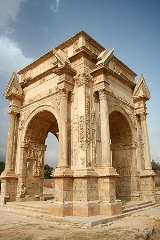
Leptis Magna

Encyclopedia
Leptis Magna also known as Lectis Magna (or Lepcis Magna as it is sometimes spelled), also called Lpqy, Neapolis, Lebida or Lebda to modern-day residents of Libya
, was a prominent city of the Roman Empire
. Its ruins are located in Khoms, Libya, 130 km (80.8 mi) east of Tripoli
, on the coast where the Wadi Lebda meets the sea. The site is one of the most spectacular and unspoiled Roman ruins in the Mediterranean.
n colonists sometime around 1100 BC, who gave it the Lybico-Berber
name Lpqy. The town did not achieve prominence until Carthage
became a major power in the Mediterranean Sea
in the 4th century BC. It nominally remained part of Carthage's dominions until the end of the Third Punic War
in 146 BC and then became part of the Roman Republic
, although from about 200 BC onward, it was for all intents and purposes an independent city.
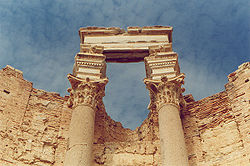 Leptis Magna remained as such until the reign of the Roman emperor Tiberius
, when the city and the surrounding area were formally incorporated into the empire as part of the province of Africa. It soon became one of the leading cities of Roman Africa and a major trading post.
Leptis achieved its greatest prominence beginning in 193, when a native son, Lucius Septimius Severus
, became emperor. He favored his hometown above all other provincial cities, and the buildings and wealth he lavished on it made Leptis Magna the third-most important city in Africa, rivaling Carthage and Alexandria
. In 205, he and the imperial family visited the city and received great honors.
Among the changes that Severus introduced were to create a magnificent new forum and to rebuild the docks. The natural harbour had a tendency to silt up, but the Severan changes made this worse, and the eastern wharves are extremely well preserved, since they were hardly used.
Leptis over-extended itself at this period. During the Crisis of the Third Century
, when trade declined precipitously, Leptis Magna's importance also fell into a decline, and by the middle of the fourth century, large parts of the city had been abandoned. Ammianus Marcellinus recounts that the crisis was worsened by a corrupt Roman governor named Romanus during a major tribal raid who demanded bribes to protect the city. The ruined city could not pay these and complained to the emperor Valentianian. Romanus then bribed people at court and arranged for the Leptan envoys to be punished "for bringing false accusations". It enjoyed a minor renaissance beginning in the reign of the emperor Theodosius I
.
In 439, Leptis Magna and the rest of the cities of Tripolitania
fell under the control of the Vandals
when their king, Gaiseric, captured Carthage from the Romans and made it his capital. Unfortunately for the future of Leptis Magna, Gaiseric ordered the city's walls demolished so as to dissuade its people from rebelling against Vandal rule. The people of Leptis and the Vandals both paid a heavy price for this in 523 when a group of Berber
raiders sacked the city.
Belisarius
recaptured Leptis Magna in the name of Rome ten years later, and in 534, he destroyed the kingdom of the Vandals. Leptis became a provincial capital of the Eastern Roman Empire (see Byzantine Empire
) but never recovered from the destruction wreaked upon it by the Berbers. It was the site of a massacre of Berber chiefs
by the Roman authorities in 543. By the time of the Arab conquest of Tripolitania in the 650s, the city was abandoned except for a Byzantine garrison force.
Part of an ancient temple was brought from Leptis Magna to the Fort Belvedere
royal residence in England in 1818. It now lies in part of Windsor Great Park
. The ruins are located between the south shore of Virginia Water
and Blacknest Road close to the junction with the A30
London Road and Wentworth Drive
.
had been working along the coast of Libya when they uncovered a 30 ft length of five colourful mosaic
s created during the 1st or 2nd century. The mosaics show with exceptional clarity depictions of a warrior in combat with a deer, four young men wrestling a wild bull to the ground, and a gladiator resting in a state of fatigue and staring at his slain opponent. The mosaics decorated the walls of a cold plunge pool in a bath house
within a Roman villa at Wadi Lebda in Leptis Magna. The gladiator mosaic is noted by scholars as one of the finest examples of representational mosaic art ever seen—a "masterpiece comparable in quality with the Alexander Mosaic
in Pompeii
." The mosaics were originally discovered in the year 2000 but were kept secret in order to avoid looting. They are currently on display in the Leptis Magna Museum.
. When asked about the possibility of conducting an air-strike on the historic site, NATO refused to rule out the possibility of such an action saying that it had not been able to confirm the rebels' report that weapons were being hidden at the location.
Libya
Libya is an African country in the Maghreb region of North Africa bordered by the Mediterranean Sea to the north, Egypt to the east, Sudan to the southeast, Chad and Niger to the south, and Algeria and Tunisia to the west....
, was a prominent city of the Roman Empire
Roman Empire
The Roman Empire was the post-Republican period of the ancient Roman civilization, characterised by an autocratic form of government and large territorial holdings in Europe and around the Mediterranean....
. Its ruins are located in Khoms, Libya, 130 km (80.8 mi) east of Tripoli
Tripoli
Tripoli is the capital and largest city in Libya. It is also known as Western Tripoli , to distinguish it from Tripoli, Lebanon. It is affectionately called The Mermaid of the Mediterranean , describing its turquoise waters and its whitewashed buildings. Tripoli is a Greek name that means "Three...
, on the coast where the Wadi Lebda meets the sea. The site is one of the most spectacular and unspoiled Roman ruins in the Mediterranean.
History as a city
The city appears to have been founded by PhoeniciaPhoenicia
Phoenicia , was an ancient civilization in Canaan which covered most of the western, coastal part of the Fertile Crescent. Several major Phoenician cities were built on the coastline of the Mediterranean. It was an enterprising maritime trading culture that spread across the Mediterranean from 1550...
n colonists sometime around 1100 BC, who gave it the Lybico-Berber
Berber languages
The Berber languages are a family of languages indigenous to North Africa, spoken from Siwa Oasis in Egypt to Morocco , and south to the countries of the Sahara Desert...
name Lpqy. The town did not achieve prominence until Carthage
Carthage
Carthage , implying it was a 'new Tyre') is a major urban centre that has existed for nearly 3,000 years on the Gulf of Tunis, developing from a Phoenician colony of the 1st millennium BC...
became a major power in the Mediterranean Sea
Mediterranean Sea
The Mediterranean Sea is a sea connected to the Atlantic Ocean surrounded by the Mediterranean region and almost completely enclosed by land: on the north by Anatolia and Europe, on the south by North Africa, and on the east by the Levant...
in the 4th century BC. It nominally remained part of Carthage's dominions until the end of the Third Punic War
Third Punic War
The Third Punic War was the third and last of the Punic Wars fought between the former Phoenician colony of Carthage, and the Roman Republic...
in 146 BC and then became part of the Roman Republic
Roman Republic
The Roman Republic was the period of the ancient Roman civilization where the government operated as a republic. It began with the overthrow of the Roman monarchy, traditionally dated around 508 BC, and its replacement by a government headed by two consuls, elected annually by the citizens and...
, although from about 200 BC onward, it was for all intents and purposes an independent city.
Tiberius
Tiberius , was Roman Emperor from 14 AD to 37 AD. Tiberius was by birth a Claudian, son of Tiberius Claudius Nero and Livia Drusilla. His mother divorced Nero and married Augustus in 39 BC, making him a step-son of Octavian...
, when the city and the surrounding area were formally incorporated into the empire as part of the province of Africa. It soon became one of the leading cities of Roman Africa and a major trading post.
Leptis achieved its greatest prominence beginning in 193, when a native son, Lucius Septimius Severus
Septimius Severus
Septimius Severus , also known as Severus, was Roman Emperor from 193 to 211. Severus was born in Leptis Magna in the province of Africa. As a young man he advanced through the customary succession of offices under the reigns of Marcus Aurelius and Commodus. Severus seized power after the death of...
, became emperor. He favored his hometown above all other provincial cities, and the buildings and wealth he lavished on it made Leptis Magna the third-most important city in Africa, rivaling Carthage and Alexandria
Alexandria
Alexandria is the second-largest city of Egypt, with a population of 4.1 million, extending about along the coast of the Mediterranean Sea in the north central part of the country; it is also the largest city lying directly on the Mediterranean coast. It is Egypt's largest seaport, serving...
. In 205, he and the imperial family visited the city and received great honors.
Among the changes that Severus introduced were to create a magnificent new forum and to rebuild the docks. The natural harbour had a tendency to silt up, but the Severan changes made this worse, and the eastern wharves are extremely well preserved, since they were hardly used.
Leptis over-extended itself at this period. During the Crisis of the Third Century
Crisis of the Third Century
The Crisis of the Third Century was a period in which the Roman Empire nearly collapsed under the combined pressures of invasion, civil war, plague, and economic depression...
, when trade declined precipitously, Leptis Magna's importance also fell into a decline, and by the middle of the fourth century, large parts of the city had been abandoned. Ammianus Marcellinus recounts that the crisis was worsened by a corrupt Roman governor named Romanus during a major tribal raid who demanded bribes to protect the city. The ruined city could not pay these and complained to the emperor Valentianian. Romanus then bribed people at court and arranged for the Leptan envoys to be punished "for bringing false accusations". It enjoyed a minor renaissance beginning in the reign of the emperor Theodosius I
Theodosius I
Theodosius I , also known as Theodosius the Great, was Roman Emperor from 379 to 395. Theodosius was the last emperor to rule over both the eastern and the western halves of the Roman Empire. During his reign, the Goths secured control of Illyricum after the Gothic War, establishing their homeland...
.
In 439, Leptis Magna and the rest of the cities of Tripolitania
Tripolitania
Tripolitania or Tripolitana is a historic region and former province of Libya.Tripolitania was a separate Italian colony from 1927 to 1934...
fell under the control of the Vandals
Vandals
The Vandals were an East Germanic tribe that entered the late Roman Empire during the 5th century. The Vandals under king Genseric entered Africa in 429 and by 439 established a kingdom which included the Roman Africa province, besides the islands of Sicily, Corsica, Sardinia and the Balearics....
when their king, Gaiseric, captured Carthage from the Romans and made it his capital. Unfortunately for the future of Leptis Magna, Gaiseric ordered the city's walls demolished so as to dissuade its people from rebelling against Vandal rule. The people of Leptis and the Vandals both paid a heavy price for this in 523 when a group of Berber
Berber people
Berbers are the indigenous peoples of North Africa west of the Nile Valley. They are continuously distributed from the Atlantic to the Siwa oasis, in Egypt, and from the Mediterranean to the Niger River. Historically they spoke the Berber language or varieties of it, which together form a branch...
raiders sacked the city.
Belisarius
Belisarius
Flavius Belisarius was a general of the Byzantine Empire. He was instrumental to Emperor Justinian's ambitious project of reconquering much of the Mediterranean territory of the former Western Roman Empire, which had been lost less than a century previously....
recaptured Leptis Magna in the name of Rome ten years later, and in 534, he destroyed the kingdom of the Vandals. Leptis became a provincial capital of the Eastern Roman Empire (see Byzantine Empire
Byzantine Empire
The Byzantine Empire was the Eastern Roman Empire during the periods of Late Antiquity and the Middle Ages, centred on the capital of Constantinople. Known simply as the Roman Empire or Romania to its inhabitants and neighbours, the Empire was the direct continuation of the Ancient Roman State...
) but never recovered from the destruction wreaked upon it by the Berbers. It was the site of a massacre of Berber chiefs
Timeline of the Muslim presence in the Iberian peninsula
This is a timeline of notable events in the Muslim presence in Iberia, which started with the Umayyad conquest in the 8th century.-Conquest :...
by the Roman authorities in 543. By the time of the Arab conquest of Tripolitania in the 650s, the city was abandoned except for a Byzantine garrison force.
History as a historical site
Today, the site of Leptis Magna is the site of some of the most impressive ruins of the Roman period.Part of an ancient temple was brought from Leptis Magna to the Fort Belvedere
Fort Belvedere, Surrey
Fort Belvedere is a country house on Shrubs Hill in Windsor Great Park, England, very near Sunningdale, Berkshire, but actually over the border in the borough of Runnymede in Surrey. It is a former royal residence - from 1750 to 1976 - and is most famous for being the home of King Edward VIII. It...
royal residence in England in 1818. It now lies in part of Windsor Great Park
Windsor Great Park
Windsor Great Park is a large deer park of , to the south of the town of Windsor on the border of Berkshire and Surrey in England. The park was, for many centuries, the private hunting ground of Windsor Castle and dates primarily from the mid-13th century...
. The ruins are located between the south shore of Virginia Water
Virginia Water
Virginia Water is an affluent village, a lake and, originally, a stream, the village being in the Runnymede Borough Council in Surrey and the bodies of water stretching over the borders of Runnymede, Old Windsor and Sunninghill and Ascot, England....
and Blacknest Road close to the junction with the A30
A30 road
The 284 miles A30 road from London to Land's End, historically known as the Great South West Road used to provide the most direct route from London to the south west; more recently the M3 motorway and A303 road performs this function for much of the route and only parts of A30 now retain trunk...
London Road and Wentworth Drive
Wentworth Estate
The Wentworth Estate is a 1920s development village of houses, shops and restaurants on an area of 700 hectares around the world famous Wentworth Club in Virginia Water, Surrey, England...
.
2005 discoveries
In June 2005, it was revealed that archaeologists from the University of HamburgUniversity of Hamburg
The University of Hamburg is a university in Hamburg, Germany. It was founded on 28 March 1919 by Wilhelm Stern and others. It grew out of the previous Allgemeines Vorlesungswesen and the Kolonialinstitut as well as the Akademisches Gymnasium. There are around 38,000 students as of the start of...
had been working along the coast of Libya when they uncovered a 30 ft length of five colourful mosaic
Mosaic
Mosaic is the art of creating images with an assemblage of small pieces of colored glass, stone, or other materials. It may be a technique of decorative art, an aspect of interior decoration, or of cultural and spiritual significance as in a cathedral...
s created during the 1st or 2nd century. The mosaics show with exceptional clarity depictions of a warrior in combat with a deer, four young men wrestling a wild bull to the ground, and a gladiator resting in a state of fatigue and staring at his slain opponent. The mosaics decorated the walls of a cold plunge pool in a bath house
Public bathing
Public baths originated from a communal need for cleanliness. The term public may confuse some people, as some types of public baths are restricted depending on membership, gender, religious affiliation, or other reasons. As societies have changed, public baths have been replaced as private bathing...
within a Roman villa at Wadi Lebda in Leptis Magna. The gladiator mosaic is noted by scholars as one of the finest examples of representational mosaic art ever seen—a "masterpiece comparable in quality with the Alexander Mosaic
Alexander Mosaic
The Alexander Mosaic, dating from circa 100 BC, is a famous Roman floor mosaic originally from the House of the Faun in Pompeii. It depicts a battle between the armies of Alexander the Great and Darius III of Persia and measures 5.82 x 3.13m .-Battle:The mosaic illustrates a battle in which...
in Pompeii
Pompeii
The city of Pompeii is a partially buried Roman town-city near modern Naples in the Italian region of Campania, in the territory of the comune of Pompei. Along with Herculaneum, Pompeii was destroyed and completely buried during a long catastrophic eruption of the volcano Mount Vesuvius spanning...
." The mosaics were originally discovered in the year 2000 but were kept secret in order to avoid looting. They are currently on display in the Leptis Magna Museum.
In the 2011 civil war
There were reports that Leptis Magna was used as a cover for tanks and military vehicles by pro-Gaddafi forces during the 2011 Libyan civil war2011 Libyan civil war
The 2011 Libyan civil war was an armed conflict in the North African state of Libya, fought between forces loyal to Colonel Muammar Gaddafi and those seeking to oust his government. The war was preceded by protests in Benghazi beginning on 15 February 2011, which led to clashes with security...
. When asked about the possibility of conducting an air-strike on the historic site, NATO refused to rule out the possibility of such an action saying that it had not been able to confirm the rebels' report that weapons were being hidden at the location.
Additional references
- Richard TalbertRichard TalbertRichard John Alexander Talbert is a contemporary British-American ancient historian and classicist on the faculty of the University of North Carolina at Chapel Hill, where he is William Rand Kenan, Jr., Professor of Ancient History and Classics. Talbert is a leading scholar of ancient geography...
, Barrington Atlas of the Greek and Roman WorldBarrington Atlas of the Greek and Roman WorldThe Barrington Atlas of the Greek and Roman World is a large-format English language atlas of ancient Europe, Asia, and North Africa, edited by Richard Talbert. The time period depicted is roughly from archaic Greek civilization through Late Antiquity . The atlas was published by Princeton...
, (ISBN 0-691-03169-X), p. 35.. - Kreikenbom, Detlev, "Leptis Magna vor der arabischen Eroberung," in Detlev Kreikenbom, Franz-Christoph Muth, Joerg Thielmann (hg), Arabische Christen - Christen in Arabien (Frankfurt am Main u.a., Peter Lang, 2007) (Nordostafrikanisch / Westasiatische Studien, 6), 35–54.