

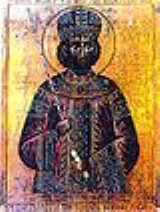
Constantine XI

Encyclopedia
Constantine XI Palaiologos, latinized as Palaeologus ( (Serbian
: Константин Палеолог Драгаш), Kōnstantinos XI Dragasēs Palaiologos; February 8, 1404 – May 29, 1453) was the last reigning Byzantine Emperor (and, as such, the last Roman Emperor
) from 1449 to his death as member of the Palaiologos dynasty
. After his death in battle during the fall of Constantinople
, he became a legendary figure in Greek folklore as the "Marble Emperor
" who would awaken and recover the Empire and Constantinople
from the Turks. His death marked the final end of the Roman Empire
, which had continued in the East
for just under one thousand years (980 years) after the fall of the Western Roman Empire
.
as the eighth of ten children to Manuel II Palaiologos
and Serbian
Helena Dragaš
, the daughter of the Serbian
prince Constantine Dragaš
. He spent most of his childhood in Constantinople under the supervision of his parents. During the absence of his older brother
in Italy
, Constantine was regent in Constantinople from 1437–1440.
or Lacedaemon due to its proximity to the ancient city, was a center of arts and culture rivalling Constantinople.
After establishing himself as the Despot, Constantine worked to strengthen the defence of the Morea, including reconstructing a wall across the Isthmus of Corinth
called the "Hexamilion"
(Six-mile-wall), after suggestion of the famous scholar and teacher of his, Plethon
.
In the summer of 1444, he launched an invasion of the Latin Duchy of Athens
from the Morea, swiftly conquering Thebes and Athens and forcing its Florentine
duke to pay him tribute. The Duchy was ruled by Nerio II Acciaioli
, a vassal
of the Ottoman Sultan.
The Turks, frustrated from the attempt of the Greeks to expand from the Morea into central Greece started raising an invading army. Two years later, in the autumn 1446, Sultan Murad II
who had come out of his retirement led an army of 50–60,000 soldiers into Greece to put an end to the pretensions of the Constantine. His purpose was not to conquer Morea but to teach Greeks and their Despotes a punitive lesson. Constantine and his brother Thomas braced for the attack at the Hexamilion, which the Ottoman army reached on November 27, 1446. While the wall could hold against medieval attacks, Sultan Murad used bombards
to supplement the usual siege engine
s and scaling ladders, leaving the Hexamilion in ruins by December 10. Constantine and Thomas barely escaped, and Morea was invaded. This put an end to Constantine's attempt to expand his Despotate.
, niece of Carlo I Tocco
of Epirus
, who died in November 1429; the second time to Caterina Gattilusio
, daughter of Dorino of Lesbos
, who also died, during childbirth, in 1442. He had no children by either marriage. After his coronation, in 1451, Constantine XI sent a commission under George Sphrantzes
asking Mara Branković
, daughter of the Serbian Despot Đurađ Branković and Byzantine princess Irene Kantakouzene, by then the widow of Murad II
, to marry him (Maria had been allowed to return to her parents in Serbia after the death of Murad). The proposal was welcomed by her father Đurađ Branković, but it foundered on the objection of Maria herself who had vowed that "if God ever released her from the hands of the infidel she would lead a life of celibacy and chastity for the rest of her days". Accordingly, the courtship failed and Sphrantzes took steps to arrange for a marriage with a princess either from Trebizond Empire
or the Kingdom of Georgia
. The choice eventually fell to an unnamed Georgian princess, daughter of George VIII
. He started official negotiations with the Georgian king, who had sent an ambassador in Constantinople for that reason. It was agreed that, next spring, Sphrantzes would sail for Georgia to bring the bride to Constantinople, but Constantine's plans were overtaken by the tragic events of 1453.
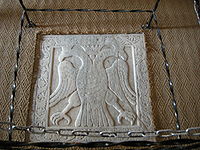 Despite the foreign and domestic difficulties during his reign, which culminated in the fall of Constantinople and of the Byzantine Empire, contemporary sources generally speak respectfully of the Emperor Constantine. When his brother, Emperor John VIII Palaiologos
, died childless, a dispute erupted between Constantine and his brother Demetrios Palaiologos
over the throne. Demetrios drew support for his opposition to the union between the Orthodox and Catholic churches. The Empress Helena, acting as regent, supported Constantine. They appealed to the Ottoman
Sultan Murad II
to arbitrate the disagreement.
Murad opined upon Constantine and on 6 January 1449 Constantine was crowned in the cathedral at Mistra by the local bishop. It was rare but not unprecedented for an emperor to be crowned in a provincial city. The founder of the dynasty of Palaiologos had been crowned at Nicaea
, Asia Minor, John Cantacuzene at Adrianople, Thrace. But they had been thought proper that a second coronation ceremony be held also at Constantinople, performed by the patriarch. Constantine was the exception. The patriarch at the time, Gregory III
, was a unionist, (see East–West Schism
) shunned by most of his clergy. Constantine knew that to receive his crown from Gregory would add fuel to the existing fires of religious discord in the capital. He sailed from Greece on a Venetian ship arrived in Constantinople on 12 March 1449.
Sultan Murad died in 1451, succeeded by his 19 year old son Mehmed II
. Soon afterwards, Mehmed II began agitating for the conquest of Constantinople. Responded to this, Constantine threatened to release Prince Orhan, a pretender to the Ottoman throne, unless Mehmed met some of his demands. By this, Mehmed considered Constantine to have broken the truce and the following winter of 1451–52, Mehmed built Rumelihisari
, a fortress on a hill at the European side of the Bosporus, just north of the city cutting the communication with the Black Sea
to the east. This came in addition to the building of Anadoluhisarı
, the fortress opposite of Rumelihisari on the Asian side, and gave the Ottomans absolute control over the sea traffic of the Bosporus Strait. For Constantine that was a clear prelude for a siege and immediately started organizing the defence.
He managed to raise funds to stockpile foods for the upcoming siege and to repair the old Theodosian walls, but the poor economics did not allow him to raise the necessary army to defend them against the massive Ottoman army. Desperate for any type of military assistance, Constantine XI appealed to the West reaffirming the union of Eastern and Roman Churches
which had been signed at the Council of Florence
, a condition the Catholic Church imposed before any help could be provided. The union had been overwhelmingly criticized by the strong anti-union ("anthenotiki") part of his subjects, while it dangerously estranged him from Loukas Notaras, his chief minister
and military commander who was a leading anti-union figure. Finally, although some troops did arrive from the mercantile city states in the north of Italy, the Western contribution was negligible compared to the needs, given the Ottoman strength. Constantine also sought assistance from his brothers in Morea, but any help was forestalled by an Ottoman invasion of the peninsula in 1452 which took place exactly for that reason. The siege of the city began in the winter of 1452. Constantine faced the siege defending his 60,000 people city with 7,000 men, confronting an Ottoman army numbering many times that, backed by a state-of-art siege equipment provided by a very competent Hungarian gunfounder Orban
.
, Mehmed II
made an offer to Constantine XI. In exchange for the surrender of Constantinople, the emperor's life would be spared and he would continue to rule in Mistra, to which, as preserved by G.Sphrantzes, Constantine's reply was:
He led the defence of the city and took an active part in the fighting alongside his troops in the land walls
. At the same time, he used his diplomatic skills to maintain the necessary unity between the Genovese, Venetian and the Greek troops.
He died on 29 May 1453, the day the city fell. His last recorded words were: "The city is fallen and I am still alive", and then he tore off his imperial ornaments as to let nothing to distinguish him from of any other soldier and led his remaining soldiers into a last charge
where he was killed.
Although it is alleged by some like Sphrantzes
, who doubted the truth of the story that the only way the Emperor was later identified was by his purple boots and that his body was decapitated and his head sent across Asia Minor to legitimize the victory, others claim that the Turks were never able to identify his body, and that he was very likely buried in a mass grave alongside his soldiers.
to conquer the city back for Christians.
While serving as ambassador to Russia in February 1834, Ahmed Pasha presented Tsar Nicholas
with a number of gifts, including a jewel-encrusted sword supposedly taken from Constantine XI's corpse.
Constantine XI's legacy was used as a rallying cry for Greeks during their war for Independence with the Ottoman Empire. Today the Emperor is considered a national hero in Greece.
During the Balkan Wars
and the Greco-Turkish War, under the influence of the Megali Idea
, the name of the then-Greek king
, Constantine, was used in Greece as a popular confirmation of the prophetic myth about the Marble King who would liberate Constantinople and recreate the lost Empire.
Constantine Palaiologos' legacy is still a popular theme in the Greek culture. The well known contemporary composers Apostolos Kaldaras and Stamatis Spanoudakis
have written elegies
for the Marble King.
consider Constantine XI a saint
(or a national martyr or ethnomartyr, Greek
: ). The Greek Orthodox Church
, however, has never canonized
him.
Serbian language
Serbian is a form of Serbo-Croatian, a South Slavic language, spoken by Serbs in Serbia, Bosnia and Herzegovina, Montenegro, Croatia and neighbouring countries....
: Константин Палеолог Драгаш), Kōnstantinos XI Dragasēs Palaiologos; February 8, 1404 – May 29, 1453) was the last reigning Byzantine Emperor (and, as such, the last Roman Emperor
Roman Emperor
The Roman emperor was the ruler of the Roman State during the imperial period . The Romans had no single term for the office although at any given time, a given title was associated with the emperor...
) from 1449 to his death as member of the Palaiologos dynasty
Palaiologos
Palaiologos , often latinized as Palaeologus, was a Byzantine Greek noble family, which produced the last ruling dynasty of the Byzantine Empire. After the Fourth Crusade, members of the family fled to the neighboring Empire of Nicaea, where Michael VIII Palaiologos became co-emperor in 1259,...
. After his death in battle during the fall of Constantinople
Fall of Constantinople
The Fall of Constantinople was the capture of the capital of the Byzantine Empire, which occurred after a siege by the Ottoman Empire, under the command of Ottoman Sultan Mehmed II, against the defending army commanded by Byzantine Emperor Constantine XI...
, he became a legendary figure in Greek folklore as the "Marble Emperor
King in the mountain
A king in the mountain, king under the mountain or sleeping hero is a prominent motif in folklore and mythology that is found in many folktales and legends...
" who would awaken and recover the Empire and Constantinople
Constantinople
Constantinople was the capital of the Roman, Eastern Roman, Byzantine, Latin, and Ottoman Empires. Throughout most of the Middle Ages, Constantinople was Europe's largest and wealthiest city.-Names:...
from the Turks. His death marked the final end of the Roman Empire
Roman Empire
The Roman Empire was the post-Republican period of the ancient Roman civilization, characterised by an autocratic form of government and large territorial holdings in Europe and around the Mediterranean....
, which had continued in the East
Byzantine Empire
The Byzantine Empire was the Eastern Roman Empire during the periods of Late Antiquity and the Middle Ages, centred on the capital of Constantinople. Known simply as the Roman Empire or Romania to its inhabitants and neighbours, the Empire was the direct continuation of the Ancient Roman State...
for just under one thousand years (980 years) after the fall of the Western Roman Empire
Western Roman Empire
The Western Roman Empire was the western half of the Roman Empire after its division by Diocletian in 285; the other half of the Roman Empire was the Eastern Roman Empire, commonly referred to today as the Byzantine Empire....
.
Biography
Constantine was born in ConstantinopleConstantinople
Constantinople was the capital of the Roman, Eastern Roman, Byzantine, Latin, and Ottoman Empires. Throughout most of the Middle Ages, Constantinople was Europe's largest and wealthiest city.-Names:...
as the eighth of ten children to Manuel II Palaiologos
Manuel II Palaiologos
Manuel II Palaiologos or Palaeologus was Byzantine Emperor from 1391 to 1425.-Life:...
and Serbian
Serbs
The Serbs are a South Slavic ethnic group of the Balkans and southern Central Europe. Serbs are located mainly in Serbia, Montenegro and Bosnia and Herzegovina, and form a sizable minority in Croatia, the Republic of Macedonia and Slovenia. Likewise, Serbs are an officially recognized minority in...
Helena Dragaš
Helena Dragaš
Helena Dragaš Helena was born to Constantine Dragaš of the noble House of Dejanović. Constantine was a Serbian provincial lord, ruling one of the principalities that emerged after the breakup of the Serbian Empire, centered at Velbăžd . Her mother was Constantine's unnamed first wife...
, the daughter of the Serbian
Serbs
The Serbs are a South Slavic ethnic group of the Balkans and southern Central Europe. Serbs are located mainly in Serbia, Montenegro and Bosnia and Herzegovina, and form a sizable minority in Croatia, the Republic of Macedonia and Slovenia. Likewise, Serbs are an officially recognized minority in...
prince Constantine Dragaš
Constantine Dragas
Constantine Dragaš Dejanović was a Serbian magnate that ruled the area around Kyustendil from 1378, during the fall of the Serbian Empire, until his death on May 17, 1395 at the battle of Rovine...
. He spent most of his childhood in Constantinople under the supervision of his parents. During the absence of his older brother
John VIII Palaiologos
John VIII Palaiologos or Palaeologus , was the penultimate reigning Byzantine Emperor, ruling from 1425 to 1448.-Life:John VIII Palaiologos was the eldest son of Manuel II Palaiologos and Helena Dragaš, the daughter of the Serbian prince Constantine Dragaš...
in Italy
Italy
Italy , officially the Italian Republic languages]] under the European Charter for Regional or Minority Languages. In each of these, Italy's official name is as follows:;;;;;;;;), is a unitary parliamentary republic in South-Central Europe. To the north it borders France, Switzerland, Austria and...
, Constantine was regent in Constantinople from 1437–1440.
Despot of the Morea
Constantine became the Despotes of the Morea (the medieval name for the Peloponnesus) in October 1443, ruling from the fortress and palace in Mistra. At the time, Mistra, a fortified town also called SpartaSparta
Sparta or Lacedaemon, was a prominent city-state in ancient Greece, situated on the banks of the River Eurotas in Laconia, in south-eastern Peloponnese. It emerged as a political entity around the 10th century BC, when the invading Dorians subjugated the local, non-Dorian population. From c...
or Lacedaemon due to its proximity to the ancient city, was a center of arts and culture rivalling Constantinople.
After establishing himself as the Despot, Constantine worked to strengthen the defence of the Morea, including reconstructing a wall across the Isthmus of Corinth
Isthmus of Corinth
The Isthmus of Corinth is the narrow land bridge which connects the Peloponnese peninsula with the rest of the mainland of Greece, near the city of Corinth. The word "isthmus" comes from the Ancient Greek word for "neck" and refers to the narrowness of the land. The Isthmus was known in the ancient...
called the "Hexamilion"
Hexamilion wall
The Hexamilion wall is a defensive wall constructed across the Isthmus of Corinth guarding the only land route into the Peloponnese peninsula from mainland Greece.- Early fortifications :...
(Six-mile-wall), after suggestion of the famous scholar and teacher of his, Plethon
Gemistus Pletho
Georgius Gemistus — later called Plethon or Pletho — was a Greek scholar of Neoplatonic philosophy. He was one of the chief pioneers of the revival of Greek learning in Western Europe...
.
In the summer of 1444, he launched an invasion of the Latin Duchy of Athens
Duchy of Athens
The Duchy of Athens was one of the Crusader States set up in Greece after the conquest of the Byzantine Empire during the Fourth Crusade, encompassing the regions of Attica and Boeotia, and surviving until its conquest by the Ottoman Empire in the 15th century....
from the Morea, swiftly conquering Thebes and Athens and forcing its Florentine
Florence
Florence is the capital city of the Italian region of Tuscany and of the province of Florence. It is the most populous city in Tuscany, with approximately 370,000 inhabitants, expanding to over 1.5 million in the metropolitan area....
duke to pay him tribute. The Duchy was ruled by Nerio II Acciaioli
Nerio II Acciaioli
Nerio II Acciaioli was the Duke of Athens on two separate occasions from 1435 to 1439 and again from 1441 to 1451. He was a member of the Acciaioli family of Florence, the son of Francesco Acciaioli, Lord of Sykaminon. His rule was contemporaneous with a renewed Italian philhellenism and...
, a vassal
Vassal
A vassal or feudatory is a person who has entered into a mutual obligation to a lord or monarch in the context of the feudal system in medieval Europe. The obligations often included military support and mutual protection, in exchange for certain privileges, usually including the grant of land held...
of the Ottoman Sultan.
The Turks, frustrated from the attempt of the Greeks to expand from the Morea into central Greece started raising an invading army. Two years later, in the autumn 1446, Sultan Murad II
Murad II
Murad II Kodja was the Sultan of the Ottoman Empire from 1421 to 1451 ....
who had come out of his retirement led an army of 50–60,000 soldiers into Greece to put an end to the pretensions of the Constantine. His purpose was not to conquer Morea but to teach Greeks and their Despotes a punitive lesson. Constantine and his brother Thomas braced for the attack at the Hexamilion, which the Ottoman army reached on November 27, 1446. While the wall could hold against medieval attacks, Sultan Murad used bombards
Bombard (weapon)
A bombard is a large-caliber, muzzle-loading medieval cannon or mortar, used chiefly in sieges for throwing heavy stone balls. The name bombarde was first noted and sketched in a French historical text around 1380. The modern term bombardment derives from this.Bombards were usually used during...
to supplement the usual siege engine
Siege engine
A siege engine is a device that is designed to break or circumvent city walls and other fortifications in siege warfare. Some have been operated close to the fortifications, while others have been used to attack from a distance. From antiquity, siege engines were constructed largely of wood and...
s and scaling ladders, leaving the Hexamilion in ruins by December 10. Constantine and Thomas barely escaped, and Morea was invaded. This put an end to Constantine's attempt to expand his Despotate.
Marriages
Constantine XI married twice: the first time on July 1, 1428 to Theodora ToccoTheodora Tocco
Theodora Tocco was the first wife of Constantine Palaiologos while he was Despot of Morea. Her husband would become the last Emperor of the Byzantine Empire.-Family:...
, niece of Carlo I Tocco
Carlo I Tocco
Carlo I Tocco was the ruler of Epirus from 1411 until his death on July 4, 1429.-Life:Carlo I was the son of Count Leonardo I Tocco of Cephalonia and Leukas by Maddalena de' Buondelmonti, sister of Esau de' Buondelmonti of Epirus...
of Epirus
Despotate of Epirus
The Despotate or Principality of Epirus was one of the Byzantine Greek successor states of the Byzantine Empire that emerged in the aftermath of the Fourth Crusade in 1204. It claimed to be the legitimate successor of the Byzantine Empire, along with the Empire of Nicaea, and the Empire of Trebizond...
, who died in November 1429; the second time to Caterina Gattilusio
Caterina Gattilusio
Caterina Gattilusio was the second wife of Constantine XI, the last Byzantine emperor, while he was still Despot of the Morea....
, daughter of Dorino of Lesbos
Dorino of Lesbos
Dorino Gattilusio, Lord of Lesbos was the fourth ruler of an independent Lesbos from 1428 to 1455.He was the second son of Francis II, Lord of Lesbos and Valentina Doria. He succeeded his older brother Jacopo of Lesbos in 1428....
, who also died, during childbirth, in 1442. He had no children by either marriage. After his coronation, in 1451, Constantine XI sent a commission under George Sphrantzes
George Sphrantzes
George Sphrantzes, also Phrantzes or Phrantza was a late Byzantine Greek historian. He was born in Constantinople. At an early age he became secretary to Manuel II Palaiologos; in 1432 protovestiarites; in 1446 prefect of Mistras, and subsequently great logothete...
asking Mara Branković
Mara Brankovic
Mara Branković , also known as Mara Hatun, Despina Hatun, or Amerissa, was the daughter of Serbian monarch Đurađ Branković and Eirene Kantakouzene...
, daughter of the Serbian Despot Đurađ Branković and Byzantine princess Irene Kantakouzene, by then the widow of Murad II
Murad II
Murad II Kodja was the Sultan of the Ottoman Empire from 1421 to 1451 ....
, to marry him (Maria had been allowed to return to her parents in Serbia after the death of Murad). The proposal was welcomed by her father Đurađ Branković, but it foundered on the objection of Maria herself who had vowed that "if God ever released her from the hands of the infidel she would lead a life of celibacy and chastity for the rest of her days". Accordingly, the courtship failed and Sphrantzes took steps to arrange for a marriage with a princess either from Trebizond Empire
Empire of Trebizond
The Empire of Trebizond, founded in April 1204, was one of three Byzantine successor states of the Byzantine Empire. However, the creation of the Empire of Trebizond was not directly related to the capture of Constantinople by the Fourth Crusade, rather it had broken away from the Byzantine Empire...
or the Kingdom of Georgia
Georgia (country)
Georgia is a sovereign state in the Caucasus region of Eurasia. Located at the crossroads of Western Asia and Eastern Europe, it is bounded to the west by the Black Sea, to the north by Russia, to the southwest by Turkey, to the south by Armenia, and to the southeast by Azerbaijan. The capital of...
. The choice eventually fell to an unnamed Georgian princess, daughter of George VIII
George VIII of Georgia
George VIII was a king of Georgia, though already fragmentised and dragged into a fierce civil war, from 1446 to 1465...
. He started official negotiations with the Georgian king, who had sent an ambassador in Constantinople for that reason. It was agreed that, next spring, Sphrantzes would sail for Georgia to bring the bride to Constantinople, but Constantine's plans were overtaken by the tragic events of 1453.
Reign as Emperor
John VIII Palaiologos
John VIII Palaiologos or Palaeologus , was the penultimate reigning Byzantine Emperor, ruling from 1425 to 1448.-Life:John VIII Palaiologos was the eldest son of Manuel II Palaiologos and Helena Dragaš, the daughter of the Serbian prince Constantine Dragaš...
, died childless, a dispute erupted between Constantine and his brother Demetrios Palaiologos
Demetrios Palaiologos
Demetrios Palaiologos or Demetrius Palaeologus , Despot in the Morea de facto 1436–1438 and 1451–1460 and de jure 1438–1451, previously governor of Lemnos 1422–1440, and of Mesembria 1440–1451...
over the throne. Demetrios drew support for his opposition to the union between the Orthodox and Catholic churches. The Empress Helena, acting as regent, supported Constantine. They appealed to the Ottoman
Ottoman Empire
The Ottoman EmpireIt was usually referred to as the "Ottoman Empire", the "Turkish Empire", the "Ottoman Caliphate" or more commonly "Turkey" by its contemporaries...
Sultan Murad II
Murad II
Murad II Kodja was the Sultan of the Ottoman Empire from 1421 to 1451 ....
to arbitrate the disagreement.
Murad opined upon Constantine and on 6 January 1449 Constantine was crowned in the cathedral at Mistra by the local bishop. It was rare but not unprecedented for an emperor to be crowned in a provincial city. The founder of the dynasty of Palaiologos had been crowned at Nicaea
Nicaea
Nicaea or Nikaia may be:*The ancient name of several places, including:** İznik, Turkey - formerly Nicaea capital of the Empire of Nicaea**Nice, France**Nicaea, Locris, a fortress city of the Locri Epicnemidii...
, Asia Minor, John Cantacuzene at Adrianople, Thrace. But they had been thought proper that a second coronation ceremony be held also at Constantinople, performed by the patriarch. Constantine was the exception. The patriarch at the time, Gregory III
Patriarch Gregory III of Constantinople
Patriarch Gregory III, surnamed Mammis or Μammas, was Ecumenical Patriarch during the period 1443-1450. Few things are known about his life and his patriarchate. Not even his surname is certain, with the names Mammis or Mammas being probably mocking appellations...
, was a unionist, (see East–West Schism
East–West Schism
The East–West Schism of 1054, sometimes known as the Great Schism, formally divided the State church of the Roman Empire into Eastern and Western branches, which later became known as the Eastern Orthodox Church and the Roman Catholic Church, respectively...
) shunned by most of his clergy. Constantine knew that to receive his crown from Gregory would add fuel to the existing fires of religious discord in the capital. He sailed from Greece on a Venetian ship arrived in Constantinople on 12 March 1449.
Sultan Murad died in 1451, succeeded by his 19 year old son Mehmed II
Mehmed II
Mehmed II , was Sultan of the Ottoman Empire for a short time from 1444 to September 1446, and later from...
. Soon afterwards, Mehmed II began agitating for the conquest of Constantinople. Responded to this, Constantine threatened to release Prince Orhan, a pretender to the Ottoman throne, unless Mehmed met some of his demands. By this, Mehmed considered Constantine to have broken the truce and the following winter of 1451–52, Mehmed built Rumelihisari
Rumelihisari
Rumelihisarı is a fortress located in the Sarıyer district of Istanbul, Turkey, on a hill at the European side of the Bosporus. It gives the name of the quarter around it. It was built by the Ottoman Sultan Mehmed II between 1451 and 1452, before he conquered Constantinople...
, a fortress on a hill at the European side of the Bosporus, just north of the city cutting the communication with the Black Sea
Black Sea
The Black Sea is bounded by Europe, Anatolia and the Caucasus and is ultimately connected to the Atlantic Ocean via the Mediterranean and the Aegean seas and various straits. The Bosphorus strait connects it to the Sea of Marmara, and the strait of the Dardanelles connects that sea to the Aegean...
to the east. This came in addition to the building of Anadoluhisarı
Anadoluhisari
Anadoluhisarı is a fortress located in Istanbul, Turkey on the Anatolian side of the Bosporus, which also gives its name to the quarter around it...
, the fortress opposite of Rumelihisari on the Asian side, and gave the Ottomans absolute control over the sea traffic of the Bosporus Strait. For Constantine that was a clear prelude for a siege and immediately started organizing the defence.
He managed to raise funds to stockpile foods for the upcoming siege and to repair the old Theodosian walls, but the poor economics did not allow him to raise the necessary army to defend them against the massive Ottoman army. Desperate for any type of military assistance, Constantine XI appealed to the West reaffirming the union of Eastern and Roman Churches
Roman Catholic Church
The Catholic Church, also known as the Roman Catholic Church, is the world's largest Christian church, with over a billion members. Led by the Pope, it defines its mission as spreading the gospel of Jesus Christ, administering the sacraments and exercising charity...
which had been signed at the Council of Florence
Council of Florence
The Council of Florence was an Ecumenical Council of the Roman Catholic Church. It began in 1431 in Basel, Switzerland, and became known as the Council of Ferrara after its transfer to Ferrara was decreed by Pope Eugene IV, to convene in 1438...
, a condition the Catholic Church imposed before any help could be provided. The union had been overwhelmingly criticized by the strong anti-union ("anthenotiki") part of his subjects, while it dangerously estranged him from Loukas Notaras, his chief minister
Megas Doux
The megas doux was one of the highest positions in the hierarchy of the later Byzantine Empire, denoting the commander-in-chief of the Byzantine navy. It is sometimes also given by the half-Latinizations megaduke or megadux...
and military commander who was a leading anti-union figure. Finally, although some troops did arrive from the mercantile city states in the north of Italy, the Western contribution was negligible compared to the needs, given the Ottoman strength. Constantine also sought assistance from his brothers in Morea, but any help was forestalled by an Ottoman invasion of the peninsula in 1452 which took place exactly for that reason. The siege of the city began in the winter of 1452. Constantine faced the siege defending his 60,000 people city with 7,000 men, confronting an Ottoman army numbering many times that, backed by a state-of-art siege equipment provided by a very competent Hungarian gunfounder Orban
Orban
Urban, also known as Orban, was a Hungarian gunfounder who cast superguns for the Ottoman siege of Constantinople in 1453.In 1452 he originally offered his services to the Byzantines, but emperor Constantine XI could not afford his high salary nor did he possess the materials necessary for...
.
Fall of Constantinople and death
Before the beginning of the siegeFall of Constantinople
The Fall of Constantinople was the capture of the capital of the Byzantine Empire, which occurred after a siege by the Ottoman Empire, under the command of Ottoman Sultan Mehmed II, against the defending army commanded by Byzantine Emperor Constantine XI...
, Mehmed II
Mehmed II
Mehmed II , was Sultan of the Ottoman Empire for a short time from 1444 to September 1446, and later from...
made an offer to Constantine XI. In exchange for the surrender of Constantinople, the emperor's life would be spared and he would continue to rule in Mistra, to which, as preserved by G.Sphrantzes, Constantine's reply was:
He led the defence of the city and took an active part in the fighting alongside his troops in the land walls
Walls of Constantinople
The Walls of Constantinople are a series of defensive stone walls that have surrounded and protected the city of Constantinople since its founding as the capital of the Eastern Roman Empire by Constantine the Great...
. At the same time, he used his diplomatic skills to maintain the necessary unity between the Genovese, Venetian and the Greek troops.
He died on 29 May 1453, the day the city fell. His last recorded words were: "The city is fallen and I am still alive", and then he tore off his imperial ornaments as to let nothing to distinguish him from of any other soldier and led his remaining soldiers into a last charge
Last stand
Last stand is a loose military term used to describe a body of troops holding a defensive position in the face of overwhelming odds. The defensive force usually takes very heavy casualties or is completely destroyed, as happened in "Custer's Last Stand" at the Battle of Little Big HornBryan Perrett...
where he was killed.
Although it is alleged by some like Sphrantzes
George Sphrantzes
George Sphrantzes, also Phrantzes or Phrantza was a late Byzantine Greek historian. He was born in Constantinople. At an early age he became secretary to Manuel II Palaiologos; in 1432 protovestiarites; in 1446 prefect of Mistras, and subsequently great logothete...
, who doubted the truth of the story that the only way the Emperor was later identified was by his purple boots and that his body was decapitated and his head sent across Asia Minor to legitimize the victory, others claim that the Turks were never able to identify his body, and that he was very likely buried in a mass grave alongside his soldiers.
Legacy
A legend tells that when the Ottomans entered the city, an angel rescued the emperor, turned him into marble and placed him in a cave under the earth near the Golden Gate, where he waits to be brought to life againKing in the mountain
A king in the mountain, king under the mountain or sleeping hero is a prominent motif in folklore and mythology that is found in many folktales and legends...
to conquer the city back for Christians.
While serving as ambassador to Russia in February 1834, Ahmed Pasha presented Tsar Nicholas
Nicholas I of Russia
Nicholas I , was the Emperor of Russia from 1825 until 1855, known as one of the most reactionary of the Russian monarchs. On the eve of his death, the Russian Empire reached its historical zenith spanning over 20 million square kilometers...
with a number of gifts, including a jewel-encrusted sword supposedly taken from Constantine XI's corpse.
Constantine XI's legacy was used as a rallying cry for Greeks during their war for Independence with the Ottoman Empire. Today the Emperor is considered a national hero in Greece.
During the Balkan Wars
Balkan Wars
The Balkan Wars were two conflicts that took place in the Balkans in south-eastern Europe in 1912 and 1913.By the early 20th century, Montenegro, Bulgaria, Greece and Serbia, the countries of the Balkan League, had achieved their independence from the Ottoman Empire, but large parts of their ethnic...
and the Greco-Turkish War, under the influence of the Megali Idea
Megali Idea
The Megali Idea was an irredentist concept of Greek nationalism that expressed the goal of establishing a Greek state that would encompass all ethnic Greek-inhabited areas, since large Greek populations after the restoration of Greek independence in 1830 still lived under Ottoman rule.The term...
, the name of the then-Greek king
Constantine I of Greece
Constantine I was King of Greece from 1913 to 1917 and from 1920 to 1922. He was commander-in-chief of the Hellenic Army during the unsuccessful Greco-Turkish War of 1897 and led the Greek forces during the successful Balkan Wars of 1912–1913, in which Greece won Thessaloniki and doubled in...
, Constantine, was used in Greece as a popular confirmation of the prophetic myth about the Marble King who would liberate Constantinople and recreate the lost Empire.
Constantine Palaiologos' legacy is still a popular theme in the Greek culture. The well known contemporary composers Apostolos Kaldaras and Stamatis Spanoudakis
Stamatis Spanoudakis
Stamatis Spanoudakis - Σταμάτης Σπανουδάκης is a Greek classical and new age composer. Early on he studied classical guitar. He went through a pop music phase, but then continued classical studies at the Würzburg State Conservatory with Bertold Hummel and later in Athens with Konstantinos Kydoniatis...
have written elegies
Elegy
In literature, an elegy is a mournful, melancholic or plaintive poem, especially a funeral song or a lament for the dead.-History:The Greek term elegeia originally referred to any verse written in elegiac couplets and covering a wide range of subject matter, including epitaphs for tombs...
for the Marble King.
Unofficial saint
Some Eastern Orthodox and Greek-CatholicsGreek Catholic Church
The Greek Catholic Church consists of the Eastern Catholic Churches which follow the Byzantine liturgical tradition and are thus in full communion with the Bishop of Rome, the Pope.-List of Greek Catholic Churches:...
consider Constantine XI a saint
Saint
A saint is a holy person. In various religions, saints are people who are believed to have exceptional holiness.In Christian usage, "saint" refers to any believer who is "in Christ", and in whom Christ dwells, whether in heaven or in earth...
(or a national martyr or ethnomartyr, Greek
Greek language
Greek is an independent branch of the Indo-European family of languages. Native to the southern Balkans, it has the longest documented history of any Indo-European language, spanning 34 centuries of written records. Its writing system has been the Greek alphabet for the majority of its history;...
: ). The Greek Orthodox Church
Greek Orthodox Church
The Greek Orthodox Church is the body of several churches within the larger communion of Eastern Orthodox Christianity sharing a common cultural tradition whose liturgy is also traditionally conducted in Koine Greek, the original language of the New Testament...
, however, has never canonized
Canonization
Canonization is the act by which a Christian church declares a deceased person to be a saint, upon which declaration the person is included in the canon, or list, of recognized saints. Originally, individuals were recognized as saints without any formal process...
him.