

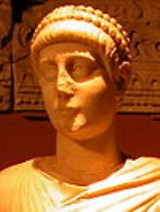
Valentinian II

Encyclopedia
Flavius Valentinianus commonly known as Valentinian II, was Roman Emperor
from 375 to 392.
and his second wife, Justina. He was the half-brother of Valentinian’s other son, Gratian
, who had shared the imperial title with his father since 367. He had three sisters Galla, Grata and Justa. The elder Valentinian died on campaign in Pannonia in 375. Neither Gratian (then in Trier
) nor his uncle Valens (emperor for the East) were consulted by the army commanders on the scene. Instead of merely acknowledging Gratian as his father’s successor, Valentinian I’s generals acclaimed the four-year old boy augustus
on 22 November 375. The army, and its Frankish general Merobaudes
, may have been uneasy about Gratian's lack of military ability, and so raised a boy who would not immediately aspire to military command.
, Hispania
, and Britain
), while Italy
, part of Illyricum
, and Africa
were under the rule of Valentinian. In 378, their uncle, the Emperor Valens
, was killed in battle with the Goths
at Adrianople
, and Gratian invited the general Theodosius
to be emperor in the East. As a child, Valentinian II was under the influence of his Arian
mother, the Empress Justina, and the imperial court at Milan
, an influence contested by the Catholic
bishop
of Milan, Ambrose
.
Justina used her influence over her young son to oppose the Nicean party which was championed by Ambrose. In 385 Ambrose, backed by Milan's populace, refused an imperial request to hand over the Portian basilica for the use of Arian troops. In 386 Justina and Valentinian received the Arian bishop Auxentius, and Ambrose was again ordered to hand over a church in Milan for Arian usage. Ambrose and his congregation barricaded themselves inside the church, and the imperial order was rescinded. Magnus Maximus
used the emperor’s heterodoxy against him, and even his eventual protector, Theodosius, cast aspersions on his Arianism. Valentinian also tried to restrain the despoiling of pagan temples in Rome
. Buoyed by this instruction, the pagan senators
, led by Aurelius Symmachus
, the Prefect of Rome
, petitioned in 384 for the restoration of the Altar of Victory
in the Senate House
, which had been removed by Gratian in 382. Valentinian, at the insistence of Ambrose, refused the request and, in so doing, rejected the traditions and rituals of pagan Rome to which Symmachus had appealed.
In 383, Magnus Maximus, commander of the armies in Britain, declared himself Emperor and established himself in Gaul and Hispania. Gratian died while fleeing him. For a time the court of Valentinian, through the mediation of Ambrose, came to an accommodation with the usurper, and Theodosius recognized Maximus as co-emperor of the West
. However, in 386 or 387, Maximus crossed the Alps
into the Po
valley and threatened Milan. Valentinian II and Justina fled to Theodosius in Thessalonica. The latter came to an agreement, cemented by his marriage to Valentinian’s sister Galla, to restore the young emperor in the West. In 388, Theodosius marched west and defeated Maximus. Although he was to appoint both of his sons emperor (Arcadius
in 383, Honorius
in 393), Theodosius remained loyal to the dynasty of Valentinian I.
 After the defeat of Maximus, Theodosius remained in Milan until 391. Valentinian took no part in Theodosius' triumphal celebrations
over Maximus. Valentinian and his court were installed at Vienne
in Gaul, while Theodoisus appointed key administrators in the West, and had coins minted which implied his guardianship over the 17 year old. Justina had already died, and Vienne was far away from the influence of Ambrose. Theodosius' trusted general, the Frank
Arbogast
, was appointed magister militum
for the Western provinces (bar Africa) and guardian of Valentinian. Acting in the name of Valentinian, Arbogast was actually subordinate only to Theodosius. While the general campaigned successfully on the Rhine, the young emperor remained at Vienne, in contrast to his warrior father and his older brother, who had campaigned at his age. Arbogast's domination over the emperor was considerable, and the general even murdered Harmonius, a friend of Valentinian suspected of taking bribes, in the emperor's presence.
The crisis reached a peak when Arbogast prohibited the emperor from leading the Gallic armies into Italy to oppose a barbarian threat. Valentinian, in response, formally dismissed Arbogast. The latter ignored the order, publicly tearing it up and arguing that Valentinian had not appointed him in the first place. The reality of where the power lay was openly displayed. Valentinian wrote to Theodosius and Ambrose complaining of his subordination to his general. In explicit rejection of his earlier Arianism, he invited Ambrose to come to Vienne to baptize
him.
However, on 15 May 392, Valentinian was found hanged in his residence in Vienne. Arbogast maintained that the emperor’s death was suicide. While our main source, Zosimus
writing in the early sixth century from Constantinople, states that the Frank had Valentinian murdered, ancient authorities are divided in their opinion. Ambrose's eulogy is the only contemporary Western source for Valentinian's death. It is ambiguous on the question of the emperor's death, which is not surprising, as Ambrose represents him as a model of Christian virtue. Suicide, not murder, would make the bishop dissemble on this key question.
The young man’s body was conveyed in ceremony to Milan for burial by Ambrose, mourned by his sisters Justa and Grata. He was laid in a porphyry
sarcophagus
next to his brother Gratian, most probably in the Chapel of Sant'Aquilino attached to San Lorenzo.
At first Arbogast recognized Theodosius's son Arcadius as emperor in the West, seemingly surprised by his charge's death. After three months, during which he had no communication from Theodosius, Arbogast selected an imperial official, Eugenius
, as emperor. Theodosius initially tolerated this regime but, in January 393, elevated the eight year old Honorius as augustus to succeed Valentinian II. Civil war ensued and, in 394, Theodosius defeated Eugenius and Arbogast.
, the empire had been ruled by powerful generals, a situation formalised by Diocletian
and his collegiate system. While Constantine
and his sons had been strong military figures, they had also re-established the practice of hereditary succession, adopted by Valentinian I. The obvious flaw in these two competing requirements came in the reign of Valentinian II, a child. His reign was a harbinger of the fifth century, when children or nonentities, reigning as emperors, were controlled by powerful generals and officials.
Roman Emperor
The Roman emperor was the ruler of the Roman State during the imperial period . The Romans had no single term for the office although at any given time, a given title was associated with the emperor...
from 375 to 392.
Early Life and Accession (371–375)
Flavius Valentinianus was born to Emperor Valentinian IValentinian I
Valentinian I , also known as Valentinian the Great, was Roman emperor from 364 to 375. Upon becoming emperor he made his brother Valens his co-emperor, giving him rule of the eastern provinces while Valentinian retained the west....
and his second wife, Justina. He was the half-brother of Valentinian’s other son, Gratian
Gratian
Gratian was Roman Emperor from 375 to 383.The eldest son of Valentinian I, during his youth Gratian accompanied his father on several campaigns along the Rhine and Danube frontiers. Upon the death of Valentinian in 375, Gratian's brother Valentinian II was declared emperor by his father's soldiers...
, who had shared the imperial title with his father since 367. He had three sisters Galla, Grata and Justa. The elder Valentinian died on campaign in Pannonia in 375. Neither Gratian (then in Trier
Trier
Trier, historically called in English Treves is a city in Germany on the banks of the Moselle. It is the oldest city in Germany, founded in or before 16 BC....
) nor his uncle Valens (emperor for the East) were consulted by the army commanders on the scene. Instead of merely acknowledging Gratian as his father’s successor, Valentinian I’s generals acclaimed the four-year old boy augustus
Augustus (honorific)
Augustus , Latin for "majestic," "the increaser," or "venerable", was an Ancient Roman title, which was first held by Gaius Julius Caesar Augustus , and subsequently came to be considered one of the titles of what are now known as the Roman Emperors...
on 22 November 375. The army, and its Frankish general Merobaudes
Merobaudes (general)
- Biography :Merobaudes was an official of Roman Emperor Julian . He was entrusted with the transportation of the corpse of the Emperor when Julian died during his military campaign against the Sasanids....
, may have been uneasy about Gratian's lack of military ability, and so raised a boy who would not immediately aspire to military command.
Reign from Milan (375–387)
Gratian, forced to accommodate the generals who supported his half-brother, governed the trans-alpine provinces (including GaulGaul
Gaul was a region of Western Europe during the Iron Age and Roman era, encompassing present day France, Luxembourg and Belgium, most of Switzerland, the western part of Northern Italy, as well as the parts of the Netherlands and Germany on the left bank of the Rhine. The Gauls were the speakers of...
, Hispania
Hispania
Another theory holds that the name derives from Ezpanna, the Basque word for "border" or "edge", thus meaning the farthest area or place. Isidore of Sevilla considered Hispania derived from Hispalis....
, and Britain
Roman Britain
Roman Britain was the part of the island of Great Britain controlled by the Roman Empire from AD 43 until ca. AD 410.The Romans referred to the imperial province as Britannia, which eventually comprised all of the island of Great Britain south of the fluid frontier with Caledonia...
), while Italy
Italy
Italy , officially the Italian Republic languages]] under the European Charter for Regional or Minority Languages. In each of these, Italy's official name is as follows:;;;;;;;;), is a unitary parliamentary republic in South-Central Europe. To the north it borders France, Switzerland, Austria and...
, part of Illyricum
Praetorian prefecture of Illyricum
The praetorian prefecture of Illyricum was one of four praetorian prefectures into which the Late Roman Empire was divided.The administrative centre of the prefecture was Sirmium , and, after 379, Thessalonica...
, and Africa
Africa Province
The Roman province of Africa was established after the Romans defeated Carthage in the Third Punic War. It roughly comprised the territory of present-day northern Tunisia, and the small Mediterranean coast of modern-day western Libya along the Syrtis Minor...
were under the rule of Valentinian. In 378, their uncle, the Emperor Valens
Valens
Valens was the Eastern Roman Emperor from 364 to 378. He was given the eastern half of the empire by his brother Valentinian I after the latter's accession to the throne...
, was killed in battle with the Goths
Goths
The Goths were an East Germanic tribe of Scandinavian origin whose two branches, the Visigoths and the Ostrogoths, played an important role in the fall of the Roman Empire and the emergence of Medieval Europe....
at Adrianople
Battle of Adrianople
The Battle of Adrianople , sometimes known as the Battle of Hadrianopolis, was fought between a Roman army led by the Roman Emperor Valens and Gothic rebels led by Fritigern...
, and Gratian invited the general Theodosius
Theodosius I
Theodosius I , also known as Theodosius the Great, was Roman Emperor from 379 to 395. Theodosius was the last emperor to rule over both the eastern and the western halves of the Roman Empire. During his reign, the Goths secured control of Illyricum after the Gothic War, establishing their homeland...
to be emperor in the East. As a child, Valentinian II was under the influence of his Arian
Arianism
Arianism is the theological teaching attributed to Arius , a Christian presbyter from Alexandria, Egypt, concerning the relationship of the entities of the Trinity and the precise nature of the Son of God as being a subordinate entity to God the Father...
mother, the Empress Justina, and the imperial court at Milan
Milan
Milan is the second-largest city in Italy and the capital city of the region of Lombardy and of the province of Milan. The city proper has a population of about 1.3 million, while its urban area, roughly coinciding with its administrative province and the bordering Province of Monza and Brianza ,...
, an influence contested by the Catholic
Catholic
The word catholic comes from the Greek phrase , meaning "on the whole," "according to the whole" or "in general", and is a combination of the Greek words meaning "about" and meaning "whole"...
bishop
Bishop
A bishop is an ordained or consecrated member of the Christian clergy who is generally entrusted with a position of authority and oversight. Within the Catholic Church, Eastern Orthodox, Oriental Orthodox Churches, in the Assyrian Church of the East, in the Independent Catholic Churches, and in the...
of Milan, Ambrose
Ambrose
Aurelius Ambrosius, better known in English as Saint Ambrose , was a bishop of Milan who became one of the most influential ecclesiastical figures of the 4th century. He was one of the four original doctors of the Church.-Political career:Ambrose was born into a Roman Christian family between about...
.
Justina used her influence over her young son to oppose the Nicean party which was championed by Ambrose. In 385 Ambrose, backed by Milan's populace, refused an imperial request to hand over the Portian basilica for the use of Arian troops. In 386 Justina and Valentinian received the Arian bishop Auxentius, and Ambrose was again ordered to hand over a church in Milan for Arian usage. Ambrose and his congregation barricaded themselves inside the church, and the imperial order was rescinded. Magnus Maximus
Magnus Maximus
Magnus Maximus , also known as Maximianus and Macsen Wledig in Welsh, was Western Roman Emperor from 383 to 388. As commander of Britain, he usurped the throne against Emperor Gratian in 383...
used the emperor’s heterodoxy against him, and even his eventual protector, Theodosius, cast aspersions on his Arianism. Valentinian also tried to restrain the despoiling of pagan temples in Rome
Rome
Rome is the capital of Italy and the country's largest and most populated city and comune, with over 2.7 million residents in . The city is located in the central-western portion of the Italian Peninsula, on the Tiber River within the Lazio region of Italy.Rome's history spans two and a half...
. Buoyed by this instruction, the pagan senators
Roman Senate
The Senate of the Roman Republic was a political institution in the ancient Roman Republic, however, it was not an elected body, but one whose members were appointed by the consuls, and later by the censors. After a magistrate served his term in office, it usually was followed with automatic...
, led by Aurelius Symmachus
Quintus Aurelius Symmachus
Quintus Aurelius Symmachus was a Roman statesman, orator, and man of letters. He held the offices of governor of Africa in 373, urban prefect of Rome in 384 and 385, and consul in 391...
, the Prefect of Rome
Praefectus urbi
The praefectus urbanus or praefectus urbi, in English the urban prefect, was prefect of the city of Rome, and later also of Constantinople. The office originated under the Roman kings, continued during the Republic and Empire, and held high importance in late Antiquity...
, petitioned in 384 for the restoration of the Altar of Victory
Altar of Victory
The Altar of Victory was located in the Roman Senate House bearing a gold statue of the goddess Victory. The altar was established by Octavian in 29 BC in honor of the defeat of Antony and Cleopatra at Actium. The statue depicted a winged woman, holding a palm and descending to present a laurel...
in the Senate House
Curia Julia
The Curia Hostilia was one of the original senate houses or 'curia' of the Roman Republic. It is believed to have begun as an Etruscan temple where the warring tribes laid down their arms during the reign of Romulus . During the early kingdom, the temple was for the use of the Senators who acted as...
, which had been removed by Gratian in 382. Valentinian, at the insistence of Ambrose, refused the request and, in so doing, rejected the traditions and rituals of pagan Rome to which Symmachus had appealed.
In 383, Magnus Maximus, commander of the armies in Britain, declared himself Emperor and established himself in Gaul and Hispania. Gratian died while fleeing him. For a time the court of Valentinian, through the mediation of Ambrose, came to an accommodation with the usurper, and Theodosius recognized Maximus as co-emperor of the West
Western Roman Empire
The Western Roman Empire was the western half of the Roman Empire after its division by Diocletian in 285; the other half of the Roman Empire was the Eastern Roman Empire, commonly referred to today as the Byzantine Empire....
. However, in 386 or 387, Maximus crossed the Alps
Alps
The Alps is one of the great mountain range systems of Europe, stretching from Austria and Slovenia in the east through Italy, Switzerland, Liechtenstein and Germany to France in the west....
into the Po
Po River
The Po |Ligurian]]: Bodincus or Bodencus) is a river that flows either or – considering the length of the Maira, a right bank tributary – eastward across northern Italy, from a spring seeping from a stony hillside at Pian del Re, a flat place at the head of the Val Po under the northwest face...
valley and threatened Milan. Valentinian II and Justina fled to Theodosius in Thessalonica. The latter came to an agreement, cemented by his marriage to Valentinian’s sister Galla, to restore the young emperor in the West. In 388, Theodosius marched west and defeated Maximus. Although he was to appoint both of his sons emperor (Arcadius
Arcadius
Arcadius was the Byzantine Emperor from 395 to his death. He was the eldest son of Theodosius I and his first wife Aelia Flaccilla, and brother of the Western Emperor Honorius...
in 383, Honorius
Honorius (emperor)
Honorius , was Western Roman Emperor from 395 to 423. He was the younger son of emperor Theodosius I and his first wife Aelia Flaccilla, and brother of the eastern emperor Arcadius....
in 393), Theodosius remained loyal to the dynasty of Valentinian I.
Reign from Vienne (388–392)
Roman triumph
The Roman triumph was a civil ceremony and religious rite of ancient Rome, held to publicly celebrate and sanctify the military achievement of an army commander who had won great military successes, or originally and traditionally, one who had successfully completed a foreign war. In Republican...
over Maximus. Valentinian and his court were installed at Vienne
Vienne, Isère
Vienne is a commune in south-eastern France, located south of Lyon, on the Rhône River. It is the second largest city after Grenoble in the Isère department, of which it is a subprefecture. The city's population was of 29,400 as of the 2001 census....
in Gaul, while Theodoisus appointed key administrators in the West, and had coins minted which implied his guardianship over the 17 year old. Justina had already died, and Vienne was far away from the influence of Ambrose. Theodosius' trusted general, the Frank
Franks
The Franks were a confederation of Germanic tribes first attested in the third century AD as living north and east of the Lower Rhine River. From the third to fifth centuries some Franks raided Roman territory while other Franks joined the Roman troops in Gaul. Only the Salian Franks formed a...
Arbogast
Arbogast (general)
Flavius Arbogastes , or Arbogast was a Frankish general in the Roman Empire. It has been stated by some ancient historians that he was the son of Flavius Bauto, Valentinian II's former magister militum and protector before Arbogast, but modern scholars largely discount this claim...
, was appointed magister militum
Magister militum
Magister militum was a top-level military command used in the later Roman Empire, dating from the reign of Constantine. Used alone, the term referred to the senior military officer of the Empire...
for the Western provinces (bar Africa) and guardian of Valentinian. Acting in the name of Valentinian, Arbogast was actually subordinate only to Theodosius. While the general campaigned successfully on the Rhine, the young emperor remained at Vienne, in contrast to his warrior father and his older brother, who had campaigned at his age. Arbogast's domination over the emperor was considerable, and the general even murdered Harmonius, a friend of Valentinian suspected of taking bribes, in the emperor's presence.
The crisis reached a peak when Arbogast prohibited the emperor from leading the Gallic armies into Italy to oppose a barbarian threat. Valentinian, in response, formally dismissed Arbogast. The latter ignored the order, publicly tearing it up and arguing that Valentinian had not appointed him in the first place. The reality of where the power lay was openly displayed. Valentinian wrote to Theodosius and Ambrose complaining of his subordination to his general. In explicit rejection of his earlier Arianism, he invited Ambrose to come to Vienne to baptize
Baptism
In Christianity, baptism is for the majority the rite of admission , almost invariably with the use of water, into the Christian Church generally and also membership of a particular church tradition...
him.
However, on 15 May 392, Valentinian was found hanged in his residence in Vienne. Arbogast maintained that the emperor’s death was suicide. While our main source, Zosimus
Zosimus
Zosimus was a Byzantine historian, who lived in Constantinople during the reign of the Byzantine Emperor Anastasius I . According to Photius, he was a comes, and held the office of "advocate" of the imperial treasury.- Historia Nova :...
writing in the early sixth century from Constantinople, states that the Frank had Valentinian murdered, ancient authorities are divided in their opinion. Ambrose's eulogy is the only contemporary Western source for Valentinian's death. It is ambiguous on the question of the emperor's death, which is not surprising, as Ambrose represents him as a model of Christian virtue. Suicide, not murder, would make the bishop dissemble on this key question.
The young man’s body was conveyed in ceremony to Milan for burial by Ambrose, mourned by his sisters Justa and Grata. He was laid in a porphyry
Porphyry (geology)
Porphyry is a variety of igneous rock consisting of large-grained crystals, such as feldspar or quartz, dispersed in a fine-grained feldspathic matrix or groundmass. The larger crystals are called phenocrysts...
sarcophagus
Sarcophagus
A sarcophagus is a funeral receptacle for a corpse, most commonly carved or cut from stone. The word "sarcophagus" comes from the Greek σαρξ sarx meaning "flesh", and φαγειν phagein meaning "to eat", hence sarkophagus means "flesh-eating"; from the phrase lithos sarkophagos...
next to his brother Gratian, most probably in the Chapel of Sant'Aquilino attached to San Lorenzo.
At first Arbogast recognized Theodosius's son Arcadius as emperor in the West, seemingly surprised by his charge's death. After three months, during which he had no communication from Theodosius, Arbogast selected an imperial official, Eugenius
Eugenius
Flavius Eugenius was an usurper in the Western Roman Empire against Emperor Theodosius I. Though himself a Christian, he was the last Emperor to support Roman polytheism.-Life:...
, as emperor. Theodosius initially tolerated this regime but, in January 393, elevated the eight year old Honorius as augustus to succeed Valentinian II. Civil war ensued and, in 394, Theodosius defeated Eugenius and Arbogast.
Significance
Valentinian himself seems to have exercised no real authority, and was a figurehead for various powerful interests: his mother, his co-emperors, and powerful generals. Since the Crisis of the Third CenturyCrisis of the Third Century
The Crisis of the Third Century was a period in which the Roman Empire nearly collapsed under the combined pressures of invasion, civil war, plague, and economic depression...
, the empire had been ruled by powerful generals, a situation formalised by Diocletian
Diocletian
Diocletian |latinized]] upon his accession to Diocletian . c. 22 December 244 – 3 December 311), was a Roman Emperor from 284 to 305....
and his collegiate system. While Constantine
Constantine I
Constantine the Great , also known as Constantine I or Saint Constantine, was Roman Emperor from 306 to 337. Well known for being the first Roman emperor to convert to Christianity, Constantine and co-Emperor Licinius issued the Edict of Milan in 313, which proclaimed religious tolerance of all...
and his sons had been strong military figures, they had also re-established the practice of hereditary succession, adopted by Valentinian I. The obvious flaw in these two competing requirements came in the reign of Valentinian II, a child. His reign was a harbinger of the fifth century, when children or nonentities, reigning as emperors, were controlled by powerful generals and officials.
External links
- This list of Roman laws of the fourth century shows laws passed by Valentinian II relating to Christianity.
- Walter F. Roberts, "Valentinian II" De Imperatoribus Romanis
- Walter F. Roberts, "Flavius Eugenius" De Imperatoribus Romanis
- Letter from Ambrose to Valentinian II regarding Auexentius