

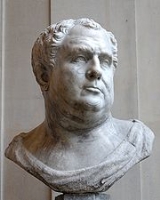
Vitellius

Encyclopedia
Vitellius was Roman Emperor
for eight months, from 16 April to 22 December 69. Vitellius was acclaimed Emperor following the quick succession of the previous emperors Galba
and Otho
, in a year of civil war known as the Year of the Four Emperors
. Vitellius was the first to add the honorific cognomen
Germanicus to his name instead of Caesar upon his accession; the latter name had fallen into disrepute in many quarters because of the actions of Nero
.
His claim to the throne was soon challenged by legions stationed in the eastern provinces, who proclaimed their commander Vespasian
emperor instead. War ensued, leading to a crushing defeat for Vitellius at the Second Battle of Bedriacum in northern Italy
. Once he realised his support was wavering, Vitellius prepared to abdicate in favour of Vespasian, but was executed in Rome by Vespasian's soldiers on December 22 of 69.
, and had one brother, Lucius Vitellius the Younger
. Suetonius
recorded two different accounts of the origins of the Vitellius (gens)
, one making them descendants of past rulers of Latium
, the other describing them as of lowly origins; Suetonius makes the sensible remark that both accounts might have been made by either flatterers or enemies of Vitellius—except that both were in circulation before Vitellius became emperor. Suetonius also recorded that when Vitellius was born his horoscope so horrified his parents that his father tried to prevent Aulus from becoming a consul.
He married firstly before the year 40 Petronia, daughter of Publius or Gaius Petronius Pontius Nigrinus, by whom he had a son Aulus Vitellius Petronianus, the universal heir of his mother and grandfather.
He married secondly circa 50 Galeria Fundana
(ca 40 – aft. 69), perhaps the granddaughter of Gaius Galerius (ca 15 BC – aft. 23), Praefectus Aeg. in 23. They had two children, a son called Germanicus and an unnamed daughter (b. ca 55). Settipani and Birley have suggested that this daughter married Libo Rupilius Frugi
, the father of Rupilia Faustina.
in 48, and assumed Proconsul
of Africa in either 60 or 61, in which capacity he is said to have acquitted himself with credit. At the end of 68 Galba
, to the general astonishment, selected him to command the army of Germania Inferior
, and here Vitellius made himself popular with his subalterns and with the soldiers by outrageous prodigality and excessive good nature, which soon proved fatal to order and discipline.
and Fabius Valens
, commanders of two legions on the Rhine. Through these two men a military revolution was speedily accomplished; they refused to renew their vows of allegiance to Emperor Galba
on 1 January 69, and early in 69 Vitellius was proclaimed emperor at Cologne
. More accurately, he was proclaimed Emperor of the armies of Germania Inferior and Superior
. The armies of Gaul, Brittania and Raetia sided with them shortly afterwards. By the time that they marched on Rome, however, it was Otho
, and not Galba, whom they had to confront.
In fact, he was never acknowledged as Emperor by the entire Roman world, though at Rome the Senate
accepted him and decreed to him the usual iImperial honours. He advanced into Italy at the head of a licentious and rough soldiery, and Rome became the scene of riot and massacre, gladiatorial shows and extravagant feasting. To reward his victorious legionaries, Vitellius disbanded the existing Praetorian Guard and installed his own men instead.
, whose father had fought for Otho
at Bedriacum
, gives an unfavourable account of Vitellius' brief administration: he describes him as unambitious and notes that Vitellius showed indications of a desire to govern wisely, but that Valens and Caecina encouraged him in a course of vicious excesses which threw his better qualities into the background. Vitellius is described as lazy and self-indulgent, fond of eating and drinking, and an obese glutton, eating banquets four times a day and feasting on rare foods he would send the Roman navy to procure. For these banquets, he had himself invited over to a different noble's house for each one. He is even reported to have starved his own mother to death—to fulfill a prophecy that he would rule long if his mother died first. Other writers, namely Tacitus
and Cassius Dio, disagree with some of Suetonius' assertions, even though their own accounts of Vitellius are scarcely positive ones.
Despite his short reign he made two important contributions to Roman government which outlasted him. Tacitus
describes them both in his Histories
:
Vitellius also banned astrologers from Rome and Italy from 1 October, 69. Some astrologers responded to his decree by anonymously publishing a decree of their own: "Decreed by all astrologers in blessing on our State Vitellius will be no more on the appointed date." In response, Vitellius executed any astrologers he came across.
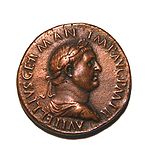 In July 69, Vitellius learned that the armies of the eastern provinces had proclaimed a rival emperor; their commander, Titus Flavius Vespasianus
. As soon as it was known that the armies of the East, Dalmatia
, and Illyricum
had declared for Vespasianus, Vitellius, deserted by many of his adherents, would have resigned the title of emperor.
. The terms of resignation had actually been agreed upon with Marcus Antonius Primus
, the commander of the sixth legion serving in Pannonia
and one of Vespasian’s chief supporters, but the praetorians refused to allow him to carry out the agreement, and forced him to return to the palace, when he was on his way to deposit the insignia of empire in the Temple of Concord. On the entrance of Vespasian's troops into Rome he was dragged out of some miserable hiding-place (according to Tacitus
a door-keeper's lodge), driven to the fatal Gemonian stairs
, and there struck down. His body was thrown into the Tiber according to Suetonius
; Cassius Dio's account is that Vitellius was beheaded and his head paraded around Rome, and his wife attended to his burial. "Yet I was once your emperor," were his last words. His brother and son were also killed.
Roman Emperor
The Roman emperor was the ruler of the Roman State during the imperial period . The Romans had no single term for the office although at any given time, a given title was associated with the emperor...
for eight months, from 16 April to 22 December 69. Vitellius was acclaimed Emperor following the quick succession of the previous emperors Galba
Galba
Galba , was Roman Emperor for seven months from 68 to 69. Galba was the governor of Hispania Tarraconensis, and made a bid for the throne during the rebellion of Julius Vindex...
and Otho
Otho
Otho , was Roman Emperor for three months, from 15 January to 16 April 69. He was the second emperor of the Year of the four emperors.- Birth and lineage :...
, in a year of civil war known as the Year of the Four Emperors
Year of the Four Emperors
The Year of the Four Emperors was a year in the history of the Roman Empire, AD 69, in which four emperors ruled in a remarkable succession. These four emperors were Galba, Otho, Vitellius, and Vespasian....
. Vitellius was the first to add the honorific cognomen
Cognomen
The cognomen nōmen "name") was the third name of a citizen of Ancient Rome, under Roman naming conventions. The cognomen started as a nickname, but lost that purpose when it became hereditary. Hereditary cognomina were used to augment the second name in order to identify a particular branch within...
Germanicus to his name instead of Caesar upon his accession; the latter name had fallen into disrepute in many quarters because of the actions of Nero
Nero
Nero , was Roman Emperor from 54 to 68, and the last in the Julio-Claudian dynasty. Nero was adopted by his great-uncle Claudius to become his heir and successor, and succeeded to the throne in 54 following Claudius' death....
.
His claim to the throne was soon challenged by legions stationed in the eastern provinces, who proclaimed their commander Vespasian
Vespasian
Vespasian , was Roman Emperor from 69 AD to 79 AD. Vespasian was the founder of the Flavian dynasty, which ruled the Empire for a quarter century. Vespasian was descended from a family of equestrians, who rose into the senatorial rank under the Emperors of the Julio-Claudian dynasty...
emperor instead. War ensued, leading to a crushing defeat for Vitellius at the Second Battle of Bedriacum in northern Italy
Italy
Italy , officially the Italian Republic languages]] under the European Charter for Regional or Minority Languages. In each of these, Italy's official name is as follows:;;;;;;;;), is a unitary parliamentary republic in South-Central Europe. To the north it borders France, Switzerland, Austria and...
. Once he realised his support was wavering, Vitellius prepared to abdicate in favour of Vespasian, but was executed in Rome by Vespasian's soldiers on December 22 of 69.
Family
He was the son of Lucius Vitellius Veteris and his wife SextiliaSextilia
Sextilia was the mother of Lucius Vitellius the Younger and Aulus Vitellius. Sextilia came from a distinguished family and lived intimately with imperial intrigue. Sextilia married the successful politician and friend of the emperor Claudius, Lucius Vitellius...
, and had one brother, Lucius Vitellius the Younger
Lucius Vitellius the younger
Lucius Vitellius was a Roman who lived in the 1st century. He was the second son of Lucius Vitellius the elder and Sextilia and younger brother of emperor Aulus Vitellius....
. Suetonius
Suetonius
Gaius Suetonius Tranquillus, commonly known as Suetonius , was a Roman historian belonging to the equestrian order in the early Imperial era....
recorded two different accounts of the origins of the Vitellius (gens)
Vitellius (gens)
The Gens Vitellia or Vitelii were a gens in ancient Rome. It is also spelled Vitullius in inscriptions.In the time of Suetonius it was controversial between Aulus Vitellius and his enemies whether it was old and noble or recent and obscure, even plebeian. It would have originated as a diminutive...
, one making them descendants of past rulers of Latium
Latium
Lazio is one of the 20 administrative regions of Italy, situated in the central peninsular section of the country. With about 5.7 million residents and a GDP of more than 170 billion euros, Lazio is the third most populated and the second richest region of Italy...
, the other describing them as of lowly origins; Suetonius makes the sensible remark that both accounts might have been made by either flatterers or enemies of Vitellius—except that both were in circulation before Vitellius became emperor. Suetonius also recorded that when Vitellius was born his horoscope so horrified his parents that his father tried to prevent Aulus from becoming a consul.
He married firstly before the year 40 Petronia, daughter of Publius or Gaius Petronius Pontius Nigrinus, by whom he had a son Aulus Vitellius Petronianus, the universal heir of his mother and grandfather.
He married secondly circa 50 Galeria Fundana
Galeria Fundana
Galeria Fundana was a Roman Empress, the second wife of Emperor Vitellius.-Life:Galeria was the daughter of an ex-praetor. She bore two children to her husband, a son and a daughter...
(ca 40 – aft. 69), perhaps the granddaughter of Gaius Galerius (ca 15 BC – aft. 23), Praefectus Aeg. in 23. They had two children, a son called Germanicus and an unnamed daughter (b. ca 55). Settipani and Birley have suggested that this daughter married Libo Rupilius Frugi
Libo Rupilius Frugi
Libo Rupilius Frugi , whose full name may have been Lucius Scribonius Libo Rupilius Frugi Bonus, was a Roman Suffect Consul and an ancestor to Roman Emperor Marcus Aurelius....
, the father of Rupilia Faustina.
Political and military career
He was ConsulRoman consul
A consul served in the highest elected political office of the Roman Republic.Each year, two consuls were elected together, to serve for a one-year term. Each consul was given veto power over his colleague and the officials would alternate each month...
in 48, and assumed Proconsul
Proconsul
A proconsul was a governor of a province in the Roman Republic appointed for one year by the senate. In modern usage, the title has been used for a person from one country ruling another country or bluntly interfering in another country's internal affairs.-Ancient Rome:In the Roman Republic, a...
of Africa in either 60 or 61, in which capacity he is said to have acquitted himself with credit. At the end of 68 Galba
Galba
Galba , was Roman Emperor for seven months from 68 to 69. Galba was the governor of Hispania Tarraconensis, and made a bid for the throne during the rebellion of Julius Vindex...
, to the general astonishment, selected him to command the army of Germania Inferior
Germania Inferior
Germania Inferior was a Roman province located on the left bank of the Rhine, in today's Luxembourg, southern Netherlands, parts of Belgium, and North Rhine-Westphalia left of the Rhine....
, and here Vitellius made himself popular with his subalterns and with the soldiers by outrageous prodigality and excessive good nature, which soon proved fatal to order and discipline.
Bid for power
He owed his elevation to the throne to CaecinaAulus Caecina Alienus
Aulus Caecina Alienus, Roman general, was born in Vicetia .He was quaestor of Hispania Baetica in AD 68. On the death of Nero, he attached himself to Galba, who appointed him to the command of Legio IV Macedonica at Mogontiacum in Germania Superior...
and Fabius Valens
Fabius Valens
Fabius Valens of Anagnia was a Roman commander favoured by Nero. In 69 he was commander of Legio I Germanica based in Germania Inferior...
, commanders of two legions on the Rhine. Through these two men a military revolution was speedily accomplished; they refused to renew their vows of allegiance to Emperor Galba
Galba
Galba , was Roman Emperor for seven months from 68 to 69. Galba was the governor of Hispania Tarraconensis, and made a bid for the throne during the rebellion of Julius Vindex...
on 1 January 69, and early in 69 Vitellius was proclaimed emperor at Cologne
Cologne
Cologne is Germany's fourth-largest city , and is the largest city both in the Germany Federal State of North Rhine-Westphalia and within the Rhine-Ruhr Metropolitan Area, one of the major European metropolitan areas with more than ten million inhabitants.Cologne is located on both sides of the...
. More accurately, he was proclaimed Emperor of the armies of Germania Inferior and Superior
Germania Superior
Germania Superior , so called for the reason that it lay upstream of Germania Inferior, was a province of the Roman Empire. It comprised an area of western Switzerland, the French Jura and Alsace regions, and southwestern Germany...
. The armies of Gaul, Brittania and Raetia sided with them shortly afterwards. By the time that they marched on Rome, however, it was Otho
Otho
Otho , was Roman Emperor for three months, from 15 January to 16 April 69. He was the second emperor of the Year of the four emperors.- Birth and lineage :...
, and not Galba, whom they had to confront.
In fact, he was never acknowledged as Emperor by the entire Roman world, though at Rome the Senate
Roman Senate
The Senate of the Roman Republic was a political institution in the ancient Roman Republic, however, it was not an elected body, but one whose members were appointed by the consuls, and later by the censors. After a magistrate served his term in office, it usually was followed with automatic...
accepted him and decreed to him the usual iImperial honours. He advanced into Italy at the head of a licentious and rough soldiery, and Rome became the scene of riot and massacre, gladiatorial shows and extravagant feasting. To reward his victorious legionaries, Vitellius disbanded the existing Praetorian Guard and installed his own men instead.
Administration
SuetoniusSuetonius
Gaius Suetonius Tranquillus, commonly known as Suetonius , was a Roman historian belonging to the equestrian order in the early Imperial era....
, whose father had fought for Otho
Otho
Otho , was Roman Emperor for three months, from 15 January to 16 April 69. He was the second emperor of the Year of the four emperors.- Birth and lineage :...
at Bedriacum
Battle of Bedriacum
The Battle of Bedriacum refers to two battles fought during the Year of the Four Emperors near the village of Bedriacum , about from the town of Cremona in northern Italy...
, gives an unfavourable account of Vitellius' brief administration: he describes him as unambitious and notes that Vitellius showed indications of a desire to govern wisely, but that Valens and Caecina encouraged him in a course of vicious excesses which threw his better qualities into the background. Vitellius is described as lazy and self-indulgent, fond of eating and drinking, and an obese glutton, eating banquets four times a day and feasting on rare foods he would send the Roman navy to procure. For these banquets, he had himself invited over to a different noble's house for each one. He is even reported to have starved his own mother to death—to fulfill a prophecy that he would rule long if his mother died first. Other writers, namely Tacitus
Tacitus
Publius Cornelius Tacitus was a senator and a historian of the Roman Empire. The surviving portions of his two major works—the Annals and the Histories—examine the reigns of the Roman Emperors Tiberius, Claudius, Nero and those who reigned in the Year of the Four Emperors...
and Cassius Dio, disagree with some of Suetonius' assertions, even though their own accounts of Vitellius are scarcely positive ones.
Despite his short reign he made two important contributions to Roman government which outlasted him. Tacitus
Tacitus
Publius Cornelius Tacitus was a senator and a historian of the Roman Empire. The surviving portions of his two major works—the Annals and the Histories—examine the reigns of the Roman Emperors Tiberius, Claudius, Nero and those who reigned in the Year of the Four Emperors...
describes them both in his Histories
Histories (Tacitus)
Histories is a book by Tacitus, written c. 100–110, which covers the Year of Four Emperors following the downfall of Nero, the rise of Vespasian, and the rule of the Flavian Dynasty up to the death of Domitian.thumb|180px|Tacitus...
:
- Vitellius ended the practice of Centurions selling furloughs and exemptions of duty to their men, a change Tacitus describes as being adopted by 'all good emperors'.
- He also expanded the offices of the Imperial Administration beyond the imperial pool of Freedmen allowing those of the Equites to take up positions in the Imperial Civil service.
Vitellius also banned astrologers from Rome and Italy from 1 October, 69. Some astrologers responded to his decree by anonymously publishing a decree of their own: "Decreed by all astrologers in blessing on our State Vitellius will be no more on the appointed date." In response, Vitellius executed any astrologers he came across.
Challenges
Vespasian
Vespasian , was Roman Emperor from 69 AD to 79 AD. Vespasian was the founder of the Flavian dynasty, which ruled the Empire for a quarter century. Vespasian was descended from a family of equestrians, who rose into the senatorial rank under the Emperors of the Julio-Claudian dynasty...
. As soon as it was known that the armies of the East, Dalmatia
Dalmatia (Roman province)
Dalmatia was an ancient Roman province. Its name is probably derived from the name of an Illyrian tribe called the Dalmatae which lived in the area of the eastern Adriatic coast in Classical antiquity....
, and Illyricum
Illyricum (Roman province)
The Roman province of Illyricum or Illyris Romana or Illyris Barbara or Illyria Barbara replaced most of the region of Illyria. It stretched from the Drilon river in modern north Albania to Istria in the west and to the Sava river in the north. Salona functioned as its capital...
had declared for Vespasianus, Vitellius, deserted by many of his adherents, would have resigned the title of emperor.
Resignation and death
Tacitus' Histories state that Vitellius awaited Vespasian's army at MevaniaMevania
Mevania , an ancient Roman town and municipium of , in the Augustan Regio VI. It lay on the western branch of the Via Flaminia, 13 km WSW of Forum Flaminii where the branches rejoin....
. The terms of resignation had actually been agreed upon with Marcus Antonius Primus
Marcus Antonius Primus
Marcus Antonius Primus was a Roman Empire general.Primus was born at Tolosa in Gaul. During the reign of Nero, he was resident in Rome and a member of the Senate, from which he was expelled for conspiring to forge a will with Valerius Fabianus, and was banished from the city...
, the commander of the sixth legion serving in Pannonia
Pannonia
Pannonia was an ancient province of the Roman Empire bounded north and east by the Danube, coterminous westward with Noricum and upper Italy, and southward with Dalmatia and upper Moesia....
and one of Vespasian’s chief supporters, but the praetorians refused to allow him to carry out the agreement, and forced him to return to the palace, when he was on his way to deposit the insignia of empire in the Temple of Concord. On the entrance of Vespasian's troops into Rome he was dragged out of some miserable hiding-place (according to Tacitus
Tacitus
Publius Cornelius Tacitus was a senator and a historian of the Roman Empire. The surviving portions of his two major works—the Annals and the Histories—examine the reigns of the Roman Emperors Tiberius, Claudius, Nero and those who reigned in the Year of the Four Emperors...
a door-keeper's lodge), driven to the fatal Gemonian stairs
Gemonian stairs
The Gemonian Stairs were a flight of steps located in the ancient city of Rome. Nicknamed the Stairs of Mourning, the stairs are infamous in Roman history as a place of execution.- Location :...
, and there struck down. His body was thrown into the Tiber according to Suetonius
Suetonius
Gaius Suetonius Tranquillus, commonly known as Suetonius , was a Roman historian belonging to the equestrian order in the early Imperial era....
; Cassius Dio's account is that Vitellius was beheaded and his head paraded around Rome, and his wife attended to his burial. "Yet I was once your emperor," were his last words. His brother and son were also killed.
Later arts
- Vitellius is an antagonist in Simon ScarrowSimon ScarrowSimon Scarrow is a UK-based author, born in Nigeria and now based in Norfolk. He completed a master's degree at the University of East Anglia after working at the Inland Revenue, and then went into teaching as a lecturer, firstly at East Norfolk Sixth Form College, then at City College Norwich.He...
's Eagle novels, based on Vespasian and the Legio II AugustaLegio II AugustaLegio secunda Augusta , was a Roman legion, levied by Gaius Vibius Pansa Caetronianus in 43 BC, and still operative in Britannia in the 4th century...
's exploits during the Roman conquest of BritainRoman conquest of BritainThe Roman conquest of Britain was a gradual process, beginning effectively in AD 43 under Emperor Claudius, whose general Aulus Plautius served as first governor of Britannia. Great Britain had already frequently been the target of invasions, planned and actual, by forces of the Roman Republic and...
.
Primary sources
- Life of Vitellius (Suetonius; English translation and Latin original)
- Cassius Dio, Book 64
- Continuité gentilice et continuité sénatoriale dans les familles sénatoriales romaines à l'époque impériale, 2000
Secondary Sources
- Biography at livius.org
- Biography at De Imperatoribus Romanis
- Aulus Vitellius entry in historical sourcebook by Mahlon H. Smith