
Home      Discussion      Topics      Dictionary      Almanac
Signup       Login
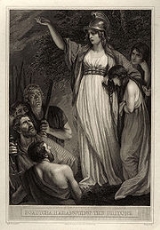
Boudica

Boudica

Overview
Boudica also known as Boadicea b and known in Welsh
Welsh language
Welsh is a member of the Brythonic branch of the Celtic languages spoken natively in Wales, by some along the Welsh border in England, and in Y Wladfa...

 as "Buddug" ˈbɨ̞ðɨ̞ɡ (d. AD 60 or 61) was queen of the British
Britons (historical)
The Britons were the Celtic people culturally dominating Great Britain from the Iron Age through the Early Middle Ages. They spoke the Insular Celtic language known as British or Brythonic...

 Iceni
Iceni
The Iceni or Eceni were a British tribe who inhabited an area of East Anglia corresponding roughly to the modern-day county of Norfolk between the 1st century BC and the 1st century AD...

 tribe who led an uprising against the occupying forces of the Roman Empire
Roman Empire
The Roman Empire was the post-Republican period of the ancient Roman civilization, characterised by an autocratic form of government and large territorial holdings in Europe and around the Mediterranean....

.
Discussion
Ask a question about 'Boudica'
Start a new discussion about 'Boudica'
Answer questions from other users
Full Discussion Forum
 
Unanswered Questions
Recent Discussions
Encyclopedia
Boudica also known as Boadicea b and known in Welsh
Welsh language
Welsh is a member of the Brythonic branch of the Celtic languages spoken natively in Wales, by some along the Welsh border in England, and in Y Wladfa...

 as "Buddug" ˈbɨ̞ðɨ̞ɡ (d. AD 60 or 61) was queen of the British
Britons (historical)
The Britons were the Celtic people culturally dominating Great Britain from the Iron Age through the Early Middle Ages. They spoke the Insular Celtic language known as British or Brythonic...

 Iceni
Iceni
The Iceni or Eceni were a British tribe who inhabited an area of East Anglia corresponding roughly to the modern-day county of Norfolk between the 1st century BC and the 1st century AD...

 tribe who led an uprising against the occupying forces of the Roman Empire
Roman Empire
The Roman Empire was the post-Republican period of the ancient Roman civilization, characterised by an autocratic form of government and large territorial holdings in Europe and around the Mediterranean....

.

Boudica's husband Prasutagus
Prasutagus
Prasutagus was king of a British Celtic tribe called the Iceni, who inhabited roughly what is now Norfolk, in the 1st century AD. He is best known as the husband of Boudica....

, ruler of the Iceni tribe who had ruled as a nominally independent ally of Rome, left his kingdom jointly to his daughters and the Roman Emperor in his will. However, when he died, his will was ignored — the kingdom was annexed as if conquered, Boudica was flogged, her daughters were raped, and Roman financiers called in their loans.

In AD 60 or 61, while the Roman governor, Gaius Suetonius Paulinus
Gaius Suetonius Paulinus
Gaius Suetonius Paulinus, also spelled Paullinus, was a Roman general best known as the commander who defeated the rebellion of Boudica.-Career:...

, was leading a campaign on the island of Anglesey
Anglesey
Anglesey , also known by its Welsh name Ynys Môn , is an island and, as Isle of Anglesey, a county off the north west coast of Wales...

 in northern Wales
Wales
Wales is a country that is part of the United Kingdom and the island of Great Britain, bordered by England to its east and the Atlantic Ocean and Irish Sea to its west. It has a population of three million, and a total area of 20,779 km²...

, Boudica led the Iceni people, along with the Trinovantes
Trinovantes
The Trinovantes or Trinobantes were one of the tribes of pre-Roman Britain. Their territory was on the north side of the Thames estuary in current Essex and Suffolk, and included lands now located in Greater London. They were bordered to the north by the Iceni, and to the west by the Catuvellauni...

 and others, in revolt. They destroyed Camulodunum
Camulodunum
Camulodunum is the Roman name for the ancient settlement which is today's Colchester, a town in Essex, England. Camulodunum is claimed to be the oldest town in Britain as recorded by the Romans, existing as a Celtic settlement before the Roman conquest, when it became the first Roman town, and...

 (modern Colchester
Colchester
Colchester is an historic town and the largest settlement within the borough of Colchester in Essex, England.At the time of the census in 2001, it had a population of 104,390. However, the population is rapidly increasing, and has been named as one of Britain's fastest growing towns. As the...

), formerly the capital of the Trinovantes, but now a colonia
Colonia (Roman)
A Roman colonia was originally a Roman outpost established in conquered territory to secure it. Eventually, however, the term came to denote the highest status of Roman city.-History:...

(a settlement for discharged Roman soldiers) and the site of a temple to the former emperor Claudius
Claudius
Claudius , was Roman Emperor from 41 to 54. A member of the Julio-Claudian dynasty, he was the son of Drusus and Antonia Minor. He was born at Lugdunum in Gaul and was the first Roman Emperor to be born outside Italy...

, which was built and maintained at local expense. They also routed a Roman legion, the IX Hispana
Legio IX Hispana
Legio Nona Hispana was a Roman legion, which operated from the first century BCE until mid 2nd century CE. The Spanish Legion's disappearance has raised speculations over its fate, largely of its alleged destruction in Scotland in about 117 CE, though some scholars believe it was destroyed in the...

, sent to relieve the settlement.

On hearing the news of the revolt Suetonius hurried to Londinium
Londinium
The city of London was established by the Romans around AD 43. It served as a major imperial commercial centre until its abandonment during the 5th century.-Origins and language:...

 (London), the twenty-year-old commercial settlement that was the rebels' next target. Concluding that he did not have the numbers to defend the settlement, Suetonius evacuated and abandoned it — Londinium was burnt to the ground, as was Verulamium
Verulamium
Verulamium was an ancient town in Roman Britain. It was sited in the southwest of the modern city of St Albans in Hertfordshire, Great Britain. A large portion of the Roman city remains unexcavated, being now park and agricultural land, though much has been built upon...

 (St Albans
St Albans
St Albans is a city in southern Hertfordshire, England, around north of central London, which forms the main urban area of the City and District of St Albans. It is a historic market town, and is now a sought-after dormitory town within the London commuter belt...

). An estimated 70,000–80,000 people were killed in the three cities (though the figures are suspect). Suetonius, meanwhile, regrouped his forces in the West Midlands
West Midlands (region)
The West Midlands is an official region of England, covering the western half of the area traditionally known as the Midlands. It contains the second most populous British city, Birmingham, and the larger West Midlands conurbation, which includes the city of Wolverhampton and large towns of Dudley,...

 and, despite being heavily outnumbered, defeated the Britons in the Battle of Watling Street
Battle of Watling Street
The Battle of Watling Street took place in Roman-occupied Britain in AD 60 or 61 between an alliance of indigenous British peoples led by Boudica and a Roman army led by Gaius Suetonius Paulinus. Although outnumbered, the Romans decisively defeated the allied tribes, inflicting heavy losses on them...

. The crisis caused the emperor Nero
Nero
Nero , was Roman Emperor from 54 to 68, and the last in the Julio-Claudian dynasty. Nero was adopted by his great-uncle Claudius to become his heir and successor, and succeeded to the throne in 54 following Claudius' death....

 to consider withdrawing all Roman forces from Britain, but Suetonius' eventual victory over Boudica re-secured Roman control of the province. Boudica then either killed herself so she would not be captured, or fell ill and died — the extant sources, Tacitus
Tacitus
Publius Cornelius Tacitus was a senator and a historian of the Roman Empire. The surviving portions of his two major works—the Annals and the Histories—examine the reigns of the Roman Emperors Tiberius, Claudius, Nero and those who reigned in the Year of the Four Emperors...

 and Cassius Dio, differ.

Interest in the history of these events was revived during the English Renaissance
English Renaissance
The English Renaissance was a cultural and artistic movement in England dating from the late 15th and early 16th centuries to the early 17th century. It is associated with the pan-European Renaissance that is usually regarded as beginning in Italy in the late 14th century; like most of northern...

 and led to a resurgence of Boudica's legendary fame during the Victorian era
Victorian era
The Victorian era of British history was the period of Queen Victoria's reign from 20 June 1837 until her death on 22 January 1901. It was a long period of peace, prosperity, refined sensibilities and national self-confidence...

, when Queen Victoria
Victoria of the United Kingdom
Victoria was the monarch of the United Kingdom of Great Britain and Ireland from 20 June 1837 until her death. From 1 May 1876, she used the additional title of Empress of India....

 was portrayed as her 'namesake
Namesake
Namesake is a term used to characterize a person, place, thing, quality, action, state, or idea that has the same, or a similar, name to another....

'. Boudica has since remained an important cultural symbol in the United Kingdom. The absence of native British literature during the early part of the first millennium means that Britain owes its knowledge of Boudica's rebellion solely to the writings of the Romans.

Boudica's name


Boudica has been known by several versions of her name. Raphael Holinshed
Raphael Holinshed
Raphael Holinshed was an English chronicler, whose work, commonly known as Holinshed's Chronicles, was one of the major sources used by William Shakespeare for a number of his plays....

 calls her Voadicia, while Edmund Spenser
Edmund Spenser
Edmund Spenser was an English poet best known for The Faerie Queene, an epic poem and fantastical allegory celebrating the Tudor dynasty and Elizabeth I. He is recognised as one of the premier craftsmen of Modern English verse in its infancy, and one of the greatest poets in the English...

 calls her "Bunduca", a version of the name that was used in the popular Jacobean play Bonduca
Bonduca
Bonduca is a Jacobean tragi-comedy in the Beaumont and Fletcher canon, generally judged by scholars to be the work of John Fletcher alone. It was acted by the King's Men c. 1613, and published in 1647 in the first Beaumont and Fletcher folio....

, in 1612. William Cowper
William Cowper
William Cowper was an English poet and hymnodist. One of the most popular poets of his time, Cowper changed the direction of 18th century nature poetry by writing of everyday life and scenes of the English countryside. In many ways, he was one of the forerunners of Romantic poetry...

's poem, Boadicea, an ode (1782) popularised an alternate version of the name. From the 19th century and much of the late 20th century, "Boadicea" was the most common version of the name, which is probably derived from a mistranscription when a manuscript of Tacitus
Tacitus
Publius Cornelius Tacitus was a senator and a historian of the Roman Empire. The surviving portions of his two major works—the Annals and the Histories—examine the reigns of the Roman Emperors Tiberius, Claudius, Nero and those who reigned in the Year of the Four Emperors...

 was copied in the Middle Ages
Middle Ages
The Middle Ages is a periodization of European history from the 5th century to the 15th century. The Middle Ages follows the fall of the Western Roman Empire in 476 and precedes the Early Modern Era. It is the middle period of a three-period division of Western history: Classic, Medieval and Modern...

. Her name was clearly spelled Boudicca in the best manuscripts of Tacitus, but also Βουδουικα, Βουνδουικα, and Βοδουικα in the (later and probably secondary) epitome of Cassius Dio. It is suggested that the most comparable English name would be "Victoria". The name is attested in inscriptions as "Boudica" in Lusitania
Lusitania
Lusitania or Hispania Lusitania was an ancient Roman province including approximately all of modern Portugal south of the Douro river and part of modern Spain . It was named after the Lusitani or Lusitanian people...

, "Boudiga" in Bordeaux
Bordeaux
Bordeaux is a port city on the Garonne River in the Gironde department in southwestern France.The Bordeaux-Arcachon-Libourne metropolitan area, has a population of 1,010,000 and constitutes the sixth-largest urban area in France. It is the capital of the Aquitaine region, as well as the prefecture...

, and "Bodicca" in Algeria. Kenneth Jackson
Kenneth H. Jackson
Kenneth Hurlstone Jackson was an English linguist and a translator who specialised in the Celtic languages. He demonstrated how the text of the Ulster Cycle of tales, written circa AD 1100, preserves an oral tradition originating some six centuries earlier and reflects Celtic Irish society of the...

 concludes, based on later development of Welsh and Irish, that it derives from the Proto-Celtic feminine adjective *boudīka, "victorious", derived from the Celtic
Celtic languages
The Celtic languages are descended from Proto-Celtic, or "Common Celtic"; a branch of the greater Indo-European language family...

 word *bouda, "victory" (cf. Irish
Irish language
Irish , also known as Irish Gaelic, is a Goidelic language of the Indo-European language family, originating in Ireland and historically spoken by the Irish people. Irish is now spoken as a first language by a minority of Irish people, as well as being a second language of a larger proportion of...

 bua (Classical Irish buadh), Buaidheach, Welsh
Welsh language
Welsh is a member of the Brythonic branch of the Celtic languages spoken natively in Wales, by some along the Welsh border in England, and in Y Wladfa...

 buddugoliaeth), and that the correct spelling of the name in the British language is Boudica, pronounced bɒʊˈdiːkaː (the closest English equivalent to the vowel in the first syllable is the ow in "bow-and-arrow"). The modern English pronunciation is ˈ.

Background


Tacitus and Dio agree that Boudica was of royal
Royal family
A royal family is the extended family of a king or queen regnant. The term imperial family appropriately describes the extended family of an emperor or empress, while the terms "ducal family", "grand ducal family" or "princely family" are more appropriate to describe the relatives of a reigning...

 descent. Dio says that she was "possessed of greater intelligence than often belongs to women", that she was tall, had hair described as reddish-brown or tawny hanging below her waist, a harsh voice and a piercing glare, and habitually wore a large golden necklace (perhaps a torc
Torc
A torc, also spelled torq or torque, is a large, usually rigid, neck ring typically made from strands of metal twisted together. The great majority are open-ended at the front, although many seem designed for near-permanent wear and would have been difficult to remove. Smaller torcs worn around...

), a many-coloured tunic, and a thick cloak fastened by a brooch
Brooch
A brooch ; also known in ancient times as a fibula; is a decorative jewelry item designed to be attached to garments. It is usually made of metal, often silver or gold but sometimes bronze or some other material...

.

Her husband, Prasutagus
Prasutagus
Prasutagus was king of a British Celtic tribe called the Iceni, who inhabited roughly what is now Norfolk, in the 1st century AD. He is best known as the husband of Boudica....

, was the king of Iceni
Iceni
The Iceni or Eceni were a British tribe who inhabited an area of East Anglia corresponding roughly to the modern-day county of Norfolk between the 1st century BC and the 1st century AD...

, people who inhabited roughly what is now Norfolk
Norfolk
Norfolk is a low-lying county in the East of England. It has borders with Lincolnshire to the west, Cambridgeshire to the west and southwest and Suffolk to the south. Its northern and eastern boundaries are the North Sea coast and to the north-west the county is bordered by The Wash. The county...

. They initially were not part of the territory under direct Roman control, having voluntarily allied themselves to Rome following Claudius
Claudius
Claudius , was Roman Emperor from 41 to 54. A member of the Julio-Claudian dynasty, he was the son of Drusus and Antonia Minor. He was born at Lugdunum in Gaul and was the first Roman Emperor to be born outside Italy...

' conquest
Roman conquest of Britain
The Roman conquest of Britain was a gradual process, beginning effectively in AD 43 under Emperor Claudius, whose general Aulus Plautius served as first governor of Britannia. Great Britain had already frequently been the target of invasions, planned and actual, by forces of the Roman Republic and...

 of AD 43. They were proud of their independence and had revolted in AD 47 when the then-governor Publius Ostorius Scapula
Publius Ostorius Scapula
Publius Ostorius Scapula was a Roman statesman and general who governed Britain from 47 until his death, and was responsible for the defeat and capture of Caratacus.-Career:...

 threatened to disarm them. Prasutagus had lived a long life of conspicuous wealth and, hoping to preserve his line, made the Roman emperor
Roman Emperor
The Roman emperor was the ruler of the Roman State during the imperial period . The Romans had no single term for the office although at any given time, a given title was associated with the emperor...

 co-heir to his kingdom, along with his wife and two daughters. It was normal Roman practice to allow allied kingdoms their independence only for the lifetime of their client king, who would agree to leave his kingdom to Rome in his will — the provinces of Bithynia
Bithynia
Bithynia was an ancient region, kingdom and Roman province in the northwest of Asia Minor, adjoining the Propontis, the Thracian Bosporus and the Euxine .-Description:...

 and Galatia
Galatia
Ancient Galatia was an area in the highlands of central Anatolia in modern Turkey. Galatia was named for the immigrant Gauls from Thrace , who settled here and became its ruling caste in the 3rd century BC, following the Gallic invasion of the Balkans in 279 BC. It has been called the "Gallia" of...

, for example, were incorporated into the Empire in just this way. Roman law
Roman law
Roman law is the legal system of ancient Rome, and the legal developments which occurred before the 7th century AD — when the Roman–Byzantine state adopted Greek as the language of government. The development of Roman law comprises more than a thousand years of jurisprudence — from the Twelve...

 also allowed inheritance
Inheritance
Inheritance is the practice of passing on property, titles, debts, rights and obligations upon the death of an individual. It has long played an important role in human societies...

 only through the male line, so when Prasutagus died his attempts to preserve his line were ignored and his kingdom was annexed as if it had been conquered; lands and property were confiscated and nobles treated like slaves. According to Tacitus
Tacitus
Publius Cornelius Tacitus was a senator and a historian of the Roman Empire. The surviving portions of his two major works—the Annals and the Histories—examine the reigns of the Roman Emperors Tiberius, Claudius, Nero and those who reigned in the Year of the Four Emperors...

, Boudica was flogged and her daughters were raped. Cassius Dio says that Roman financiers, including Seneca the Younger
Seneca the Younger
Lucius Annaeus Seneca was a Roman Stoic philosopher, statesman, dramatist, and in one work humorist, of the Silver Age of Latin literature. He was tutor and later advisor to emperor Nero...

, chose this time to call in their loans. Tacitus does not mention this, but does single out the procurator
Promagistrate
A promagistrate is a person who acts in and with the authority and capacity of a magistrate, but without holding a magisterial office. A legal innovation of the Roman Republic, the promagistracy was invented in order to provide Rome with governors of overseas territories instead of having to elect...

, Catus Decianus
Catus Decianus
Catus Decianus was the procurator of Roman Britain in AD 60 or 61. Tacitus blames his "rapacity" in part for provoking the rebellion of Boudica. Cassius Dio says he confiscated sums of money which had been given by the emperor Claudius to leading Britons, declaring them to be loans to be repaid...

, for criticism for his "avarice". Prasutagus, it seems, had lived well on borrowed Roman money, and on his death his subjects had become liable for the debt.

Boudica's uprising


In AD 60 or 61, while the current governor, Gaius Suetonius Paulinus
Gaius Suetonius Paulinus
Gaius Suetonius Paulinus, also spelled Paullinus, was a Roman general best known as the commander who defeated the rebellion of Boudica.-Career:...

, was leading a campaign against the island of Mona (modern Anglesey
Anglesey
Anglesey , also known by its Welsh name Ynys Môn , is an island and, as Isle of Anglesey, a county off the north west coast of Wales...

) in the north of Wales, which was a refuge for British rebels and a stronghold of the druid
Druid
A druid was a member of the priestly class in Britain, Ireland, and Gaul, and possibly other parts of Celtic western Europe, during the Iron Age....

s, the Iceni conspired with their neighbours the Trinovantes, amongst others, to revolt. Boudica was chosen as their leader. According to Tacitus, they drew inspiration from the example of Arminius
Arminius
Arminius , also known as Armin or Hermann was a chieftain of the Germanic Cherusci who defeated a Roman army in the Battle of the Teutoburg Forest...

, the prince of the Cherusci
Cherusci
The Cherusci were a Germanic tribe that inhabited parts of the northern Rhine valley and the plains and forests of northwestern Germany, in the area between present-day Osnabrück and Hanover, during the 1st century BC and 1st century AD...

 who had driven the Romans out of Germany in AD 9, and their own ancestors who had driven Julius Caesar
Julius Caesar
Gaius Julius Caesar was a Roman general and statesman and a distinguished writer of Latin prose. He played a critical role in the gradual transformation of the Roman Republic into the Roman Empire....

 from Britain. Dio says that at the outset Boudica employed a form of divination
Divination
Divination is the attempt to gain insight into a question or situation by way of an occultic standardized process or ritual...

, releasing a hare
Hare
Hares and jackrabbits are leporids belonging to the genus Lepus. Hares less than one year old are called leverets. Four species commonly known as types of hare are classified outside of Lepus: the hispid hare , and three species known as red rock hares .Hares are very fast-moving...

 from the folds of her dress and interpreting the direction in which it ran, and invoked Andraste
Andraste
Andraste, also known as Andrasta or Andred, was, according to the Roman historian Dio Cassius, an Icenic war goddess invoked by Boudica in her fight against the Roman occupation of Britain in AD 61. She may be the same as Andate, mentioned later by the same source, and described as "their name for...

, a British goddess
Goddess
A goddess is a female deity. In some cultures goddesses are associated with Earth, motherhood, love, and the household. In other cultures, goddesses also rule over war, death, and destruction as well as healing....

 of victory
Victoria (mythology)
In ancient Roman religion, Victoria was the personified goddess of victory. She is the Roman equivalent of the Greek goddess Nike, and was associated with Bellona. She was adapted from the Sabine agricultural goddess Vacuna and had a temple on the Palatine Hill...

.

The rebels' first target was Camulodunum
Camulodunum
Camulodunum is the Roman name for the ancient settlement which is today's Colchester, a town in Essex, England. Camulodunum is claimed to be the oldest town in Britain as recorded by the Romans, existing as a Celtic settlement before the Roman conquest, when it became the first Roman town, and...

 (Colchester
Colchester
Colchester is an historic town and the largest settlement within the borough of Colchester in Essex, England.At the time of the census in 2001, it had a population of 104,390. However, the population is rapidly increasing, and has been named as one of Britain's fastest growing towns. As the...

), the former Trinovantian capital and, at that time, a Roman colonia
Colonia (Roman)
A Roman colonia was originally a Roman outpost established in conquered territory to secure it. Eventually, however, the term came to denote the highest status of Roman city.-History:...

. The Roman veterans who had been settled there mistreated the locals and a temple to the former emperor Claudius
Claudius
Claudius , was Roman Emperor from 41 to 54. A member of the Julio-Claudian dynasty, he was the son of Drusus and Antonia Minor. He was born at Lugdunum in Gaul and was the first Roman Emperor to be born outside Italy...

 had been erected there at local expense, making the city a focus for resentment. The Roman inhabitants sought reinforcements from the procurator, Catus Decianus, but he sent only two hundred auxiliary troops
Auxiliaries (Roman military)
Auxiliaries formed the standing non-citizen corps of the Roman army of the Principate , alongside the citizen legions...

. Boudica's army fell on the poorly defended city and destroyed it, besieging the last defenders in the temple for two days before it fell. Archaeologists
Archaeology
Archaeology, or archeology , is the study of human society, primarily through the recovery and analysis of the material culture and environmental data that they have left behind, which includes artifacts, architecture, biofacts and cultural landscapes...

 have shown that the city was methodically demolished. The future governor Quintus Petillius Cerialis
Quintus Petillius Cerialis
Quintus Petilius Cerialis Caesius Rufus was a Roman general and administrator who served in Britain during Boudica's rebellion and who went on to participate in the civil wars after the death of Nero. He later defeated the rebellion of Julius Civilis and returned to Britain as its governor.His...

, then commanding the Legio IX Hispana
Legio IX Hispana
Legio Nona Hispana was a Roman legion, which operated from the first century BCE until mid 2nd century CE. The Spanish Legion's disappearance has raised speculations over its fate, largely of its alleged destruction in Scotland in about 117 CE, though some scholars believe it was destroyed in the...

, attempted to relieve the city, but suffered an overwhelming defeat
Massacre of the Ninth Legion
The Massacre of the Ninth Legion refers to the defeat of a large vexillation of the Legio IX Hispana during the revolt against Roman rule in Britain launched by Boudica, queen of the Iceni of Norfolk...

. His infantry was wiped out — only the commander and some of his cavalry escaped. The location of this famous battle is now claimed by the village of Great Wratting
Great Wratting
Great Wratting is a village and civil parish in England, about four miles from Haverhill, Suffolk, in the valley of the River Stour. There is a ford across the Stour in the centre of the village, where bathing and fishing are common pursuits.The river here is heavily populated by crayfish, a non...

, in Suffolk, which lies in the Stour Valley on the Icknield Way West of Colchester, and by a village in Essex. After this defeat, Catus Decianus fled to Gaul
Gaul
Gaul was a region of Western Europe during the Iron Age and Roman era, encompassing present day France, Luxembourg and Belgium, most of Switzerland, the western part of Northern Italy, as well as the parts of the Netherlands and Germany on the left bank of the Rhine. The Gauls were the speakers of...

.

When news of the rebellion reached him, Suetonius hurried along Watling Street
Watling Street
Watling Street is the name given to an ancient trackway in England and Wales that was first used by the Britons mainly between the modern cities of Canterbury and St Albans. The Romans later paved the route, part of which is identified on the Antonine Itinerary as Iter III: "Item a Londinio ad...

 through hostile territory to Londinium. Londinium was a relatively new settlement, founded after the conquest of 43AD, but it had grown to be a thriving commercial centre with a population of travellers, traders, and, probably, Roman officials. Suetonius considered giving battle there, but considering his lack of numbers and chastened by Petillius's defeat, decided to sacrifice the city to save the province.

...Alarmed by this disaster and by the fury of the province which he had goaded into war by his rapacity, the procurator Catus crossed over into Gaul. Suetonius, however, with wonderful resolution, marched amidst a hostile population to Londinium, which, though undistinguished by the name of a colony, was much frequented by a number of merchants and trading vessels. Uncertain whether he should choose it as a seat of war, as he looked round on his scanty force of soldiers, and remembered with what a serious warning the rashness of Petilius had been punished, he resolved to save the province at the cost of a single town. Nor did the tears and weeping of the people, as they implored his aid, deter him from giving the signal of departure and receiving into his army all who would go with him. Those who were chained to the spot by the weakness of their sex, or the infirmity of age, or the attractions of the place, were cut off by the enemy. - Tacitus


Londinium was abandoned to the rebels who burnt it down, slaughtering anyone who had not evacuated with Suetonius. Archaeology shows a thick red layer of burnt debris covering coins and pottery dating before 60 AD within the bounds of Roman Londinium. Verulamium
Verulamium
Verulamium was an ancient town in Roman Britain. It was sited in the southwest of the modern city of St Albans in Hertfordshire, Great Britain. A large portion of the Roman city remains unexcavated, being now park and agricultural land, though much has been built upon...

 (St Albans
St Albans
St Albans is a city in southern Hertfordshire, England, around north of central London, which forms the main urban area of the City and District of St Albans. It is a historic market town, and is now a sought-after dormitory town within the London commuter belt...

) was next to be destroyed.

In the three settlements destroyed, between seventy and eighty thousand people are said to have been killed. Tacitus says that the Britons had no interest in taking or selling prisoners, only in slaughter by gibbet
Gibbet
A gibbet is a gallows-type structure from which the dead bodies of executed criminals were hung on public display to deter other existing or potential criminals. In earlier times, up to the late 17th century, live gibbeting also took place, in which the criminal was placed alive in a metal cage...

, fire, or cross. Dio's account gives more detail; that the noblest women were impaled on spikes and had their breasts cut off and sewn to their mouths, "to the accompaniment of sacrifices, banquets, and wanton behaviour" in sacred places, particularly the groves of Andraste.

Romans rally


Suetonius regrouped with the XIV Gemina
Legio XIV Gemina
Legio quarta decima Gemina was a legion of the Roman Empire, levied by Julius Caesar in late 58 B.C. The cognomen Gemina suggests that the legion resulted from fusion of two previous ones, one of them being the Fourteenth legion that fought in the Battle of Alesia, the other being the Martia ...

, some vexillationes (detachments) of the XX Valeria Victrix
Legio XX Valeria Victrix
Legio vigesima Valeria Victrix was a Roman legion, probably raised by Augustus some time after 31 BC. It served in Hispania, Illyricum, and Germania before participating in the invasion of Britannia in 43 AD, where it remained and was active until at least the beginning of the 4th century...

, and any available auxiliaries. The prefect
Prefect
Prefect is a magisterial title of varying definition....

 of Legio II Augusta
Legio II Augusta
Legio secunda Augusta , was a Roman legion, levied by Gaius Vibius Pansa Caetronianus in 43 BC, and still operative in Britannia in the 4th century...

, Poenius Postumus
Poenius Postumus
Poenius Postumus was praefectus castrorum of the Roman Legion II Augusta, stationed in Britain during the rebellion of Boudica in 61 AD. In the general area of Exeter with his troops, he ignored the call to join the governor, Gaius Suetonius Paulinus, in putting down the rebellion...

, ignored the call, but nonetheless the governor was able to call on almost ten thousand men. He took a stand at an unidentified location, probably in the West Midlands
West Midlands (region)
The West Midlands is an official region of England, covering the western half of the area traditionally known as the Midlands. It contains the second most populous British city, Birmingham, and the larger West Midlands conurbation, which includes the city of Wolverhampton and large towns of Dudley,...

 somewhere along the Roman road
Roman road
The Roman roads were a vital part of the development of the Roman state, from about 500 BC through the expansion during the Roman Republic and the Roman Empire. Roman roads enabled the Romans to move armies and trade goods and to communicate. The Roman road system spanned more than 400,000 km...

 now known as Watling Street
Watling Street
Watling Street is the name given to an ancient trackway in England and Wales that was first used by the Britons mainly between the modern cities of Canterbury and St Albans. The Romans later paved the route, part of which is identified on the Antonine Itinerary as Iter III: "Item a Londinio ad...

, in a defile
Defile (geography)
Defile is a geographic term for a narrow pass or gorge between mountains or hills. It has its origins as a military description of a pass through which troops can march only in a narrow column or with a narrow front...

 with a wood behind him — but his men were heavily outnumbered. Dio says that, even if they were lined up one deep, they would not have extended the length of Boudica's line. By now the rebel forces were said to have numbered 230,000, however, this number should be treated with scepticism — Dio's account is known only from a late epitome
Epitome
An epitome is a summary or miniature form; an instance that represents a larger reality, also used as a synonym for embodiment....

, and ancient sources commonly exaggerate enemy numbers. While Boudica's army continued their assault in Verulamium (St. Albans), Suetonius regrouped his forces. According to Tacitus, he amassed a force including his own Legio XIV Gemina
Legio XIV Gemina
Legio quarta decima Gemina was a legion of the Roman Empire, levied by Julius Caesar in late 58 B.C. The cognomen Gemina suggests that the legion resulted from fusion of two previous ones, one of them being the Fourteenth legion that fought in the Battle of Alesia, the other being the Martia ...

, parts of the XX Valeria Victrix
Legio XX Valeria Victrix
Legio vigesima Valeria Victrix was a Roman legion, probably raised by Augustus some time after 31 BC. It served in Hispania, Illyricum, and Germania before participating in the invasion of Britannia in 43 AD, where it remained and was active until at least the beginning of the 4th century...

, and any available auxiliaries, a total of 10,000 men. A third legion, II Augusta
Legio II Augusta
Legio secunda Augusta , was a Roman legion, levied by Gaius Vibius Pansa Caetronianus in 43 BC, and still operative in Britannia in the 4th century...

, near Exeter
Exeter
Exeter is a historic city in Devon, England. It lies within the ceremonial county of Devon, of which it is the county town as well as the home of Devon County Council. Currently the administrative area has the status of a non-metropolitan district, and is therefore under the administration of the...

, failed to join him; a fourth, IX Hispana
Legio IX Hispana
Legio Nona Hispana was a Roman legion, which operated from the first century BCE until mid 2nd century CE. The Spanish Legion's disappearance has raised speculations over its fate, largely of its alleged destruction in Scotland in about 117 CE, though some scholars believe it was destroyed in the...

, had been routed trying to relieve Camulodunum.

Boudica exhorted her troops from her chariot
Chariot
The chariot is a type of horse carriage used in both peace and war as the chief vehicle of many ancient peoples. Ox carts, proto-chariots, were built by the Proto-Indo-Europeans and also built in Mesopotamia as early as 3000 BC. The original horse chariot was a fast, light, open, two wheeled...

, her daughters beside her. Tacitus gives her a short speech in which she presents herself not as an aristocrat
Aristocracy (class)
The aristocracy are people considered to be in the highest social class in a society which has or once had a political system of Aristocracy. Aristocrats possess hereditary titles granted by a monarch, which once granted them feudal or legal privileges, or deriving, as in Ancient Greece and India,...

 avenging her lost wealth, but as an ordinary person, avenging her lost freedom, her battered body, and the abused chastity of her daughters. She said their cause was just, and the deities were on their side; the one legion that had dared to face them had been destroyed. She, a woman, was resolved to win or die; if the men wanted to live in slavery, that was their choice.

However, the lack of manoeuvrability of the British forces, combined with lack of open-field tactics to command these numbers, put them at a disadvantage to the Romans, who were skilled at open combat due to their superior equipment and discipline. Also, the narrowness of the field meant that Boudica could put forth only as many troops as the Romans could at a given time.

First, the Romans stood their ground and used volleys of pila
Pilum
The pilum was a javelin commonly used by the Roman army in ancient times. It was generally about two metres long overall, consisting of an iron shank about 7 mm in diameter and 60 cm long with pyramidal head...

(heavy javelins) to kill thousands of Britons who were rushing toward the Roman lines. The Roman soldiers, who had now used up their pila, were then able to engage Boudica's second wave in the open. As the Romans advanced in a wedge
Flying wedge
A flying wedge is a configuration created from a body moving forward in a triangular formation. This V-shaped arrangement began as a successful military strategy in ancient times when infantry units would move forward in wedge formations to smash through an enemy's lines...

 formation, the Britons attempted to flee, but were impeded by the presence of their own families, whom they had stationed in a ring of wagons at the edge of the battlefield, and were slaughtered. This is not the first instance of this tactic — the women of the Cimbri
Cimbri
The Cimbri were a tribe from Northern Europe, who, together with the Teutones and the Ambrones threatened the Roman Republic in the late 2nd century BC. The Cimbri were probably Germanic, though some believe them to be of Celtic origin...

, in the Battle of Vercellae
Battle of Vercellae
The Battle of Vercellae, or Battle of the Raudine Plain, in 101 BC was the Roman victory of Consul Gaius Marius over the invading Germanic Cimbri tribe near the settlement of Vercellae in Cisalpine Gaul....

 against Gaius Marius
Gaius Marius
Gaius Marius was a Roman general and statesman. He was elected consul an unprecedented seven times during his career. He was also noted for his dramatic reforms of Roman armies, authorizing recruitment of landless citizens, eliminating the manipular military formations, and reorganizing the...

, were stationed in a line of wagons and acted as a last line of defence. Ariovistus
Ariovistus
Ariovistus was a leader of the Suebi and other allied Germanic peoples in the second quarter of the 1st century BC. He and his followers took part in a war in Gaul, assisting the Arverni and Sequani to defeat their rivals the Aedui, after which they settled in large numbers in conquered Gallic...

 of the Suebi
Suebi
The Suebi or Suevi were a group of Germanic peoples who were first mentioned by Julius Caesar in connection with Ariovistus' campaign, c...

 is reported to have done the same thing in his battle against Julius Caesar
Julius Caesar
Gaius Julius Caesar was a Roman general and statesman and a distinguished writer of Latin prose. He played a critical role in the gradual transformation of the Roman Republic into the Roman Empire....

. Tacitus reports that "according to one report almost eighty thousand Britons fell" compared with only four hundred Romans.

According to Tacitus in his Annals, Boudica poisoned herself, though in the Agricola which was written almost twenty years prior he mentions nothing of suicide and atributes the end of the revolt to socordiam indolence; Dio says she fell sick and died then given a lavish burial; though this may be a convenient way to remove her from the story. Considering Dio must have read Tacitus, it is worth noting he mentions nothing about suicide (which was also how Postumus and Nero also ended their lives)

Postumus, on hearing of the Roman victory, fell on his sword. Catus Decianus
Catus Decianus
Catus Decianus was the procurator of Roman Britain in AD 60 or 61. Tacitus blames his "rapacity" in part for provoking the rebellion of Boudica. Cassius Dio says he confiscated sums of money which had been given by the emperor Claudius to leading Britons, declaring them to be loans to be repaid...

, who had fled to Gaul, was replaced by Gaius Julius Alpinus Classicianus
Gaius Julius Alpinus Classicianus
Gaius Julius Alpinus Classicianus was procurator of Roman Britain from 61 to his death in 65.He was appointed after his predecessor, Catus Decianus, had fled to Gaul in the aftermath of the rebellion of Boudica. He expressed concern to the Emperor Nero that the punitive policies of the governor,...

. Suetonius conducted punitive operations, but criticism by Classicianus led to an investigation headed by Nero
Nero
Nero , was Roman Emperor from 54 to 68, and the last in the Julio-Claudian dynasty. Nero was adopted by his great-uncle Claudius to become his heir and successor, and succeeded to the throne in 54 following Claudius' death....

's freedman
Freedman
A freedman is a former slave who has been released from slavery, usually by legal means. Historically, slaves became freedmen either by manumission or emancipation ....

 Polyclitus
Polyclitus (freedman)
Polyclitus was an influential freedman in the court of the Roman emperor Nero. He was sent to Britain in 60 or 61 AD to head an enquiry in the aftermath of the rebellion of Boudica. As a result the governor, Gaius Suetonius Paulinus, was relieved of his command and replaced by Publius Petronius...

. Fearing Suetonius' actions would provoke further rebellion, Nero replaced the governor with the more conciliatory Publius Petronius Turpilianus
Publius Petronius Turpilianus
Publius Petronius Turpilianus was a Roman politician and general.He was consul in AD 61, but in the second half of that year he laid down that office and was appointed governor of Britain, replacing Gaius Suetonius Paulinus who had been removed from office in the wake of the rebellion of Boudica...

. The historian Gaius Suetonius Tranquillus
Suetonius
Gaius Suetonius Tranquillus, commonly known as Suetonius , was a Roman historian belonging to the equestrian order in the early Imperial era....

 tells us the crisis had almost persuaded Nero to abandon Britain.

Location of her defeat


The location of Boudica's defeat is unknown. Most historians favour a site in the West Midlands
West Midlands (county)
The West Midlands is a metropolitan county in western central England with a 2009 estimated population of 2,638,700. It came into existence as a metropolitan county in 1974 after the passage of the Local Government Act 1972, formed from parts of Staffordshire, Worcestershire and Warwickshire. The...

, somewhere along the Roman road now known as Watling Street
Watling Street
Watling Street is the name given to an ancient trackway in England and Wales that was first used by the Britons mainly between the modern cities of Canterbury and St Albans. The Romans later paved the route, part of which is identified on the Antonine Itinerary as Iter III: "Item a Londinio ad...

. Kevin K. Carroll suggests a site close to High Cross
High Cross, Leicestershire
High Cross is the name given to the former crossroads of the Roman roads of Watling Street and Fosse Way in Leicestershire, England. It is located about a mile west of the village of Claybrooke Magna and was located in the hundred of Guthlaxton...

 in Leicestershire
Leicestershire
Leicestershire is a landlocked county in the English Midlands. It takes its name from the heavily populated City of Leicester, traditionally its administrative centre, although the City of Leicester unitary authority is today administered separately from the rest of Leicestershire...

, on the junction of Watling Street and the Fosse Way
Fosse Way
The Fosse Way was a Roman road in England that linked Exeter in South West England to Lincoln in Lincolnshire, via Ilchester , Bath , Cirencester and Leicester .It joined Akeman Street and Ermin Way at Cirencester, crossed Watling Street at Venonis south...

, which would have allowed the Legio II Augusta
Legio II Augusta
Legio secunda Augusta , was a Roman legion, levied by Gaius Vibius Pansa Caetronianus in 43 BC, and still operative in Britannia in the 4th century...

, based at Exeter
Exeter
Exeter is a historic city in Devon, England. It lies within the ceremonial county of Devon, of which it is the county town as well as the home of Devon County Council. Currently the administrative area has the status of a non-metropolitan district, and is therefore under the administration of the...

, to rendezvous with the rest of Suetonius's forces, had they not failed to do so. Manduessedum
Manduessedum
Manduessedum was a Roman fort and later a civilian small town in the Roman Province of Britannia. Today it is known as Mancetter, located in the English county of Warwickshire.The fort was founded in around c AD 50-AD 60 on the Watling Street Roman road...

 (Mancetter
Mancetter
Mancetter is a village and civil parish on the outskirts of Atherstone in North Warwickshire, at the crossing of Watling Street over the River Anker.-History:...

), near the modern town of Atherstone
Atherstone
Atherstone is a town in Warwickshire, England. The town is located near the northernmost tip of Warwickshire, close to the border with Staffordshire and Leicestershire and is the administrative headquarters of the borough of North Warwickshire.-History:...

 in Warwickshire
Warwickshire
Warwickshire is a landlocked non-metropolitan county in the West Midlands region of England. The county town is Warwick, although the largest town is Nuneaton. The county is famous for being the birthplace of William Shakespeare...

, has also been suggested, as has 'The Rampart' near Messing in Essex
Essex
Essex is a ceremonial and non-metropolitan county in the East region of England, and one of the home counties. It is located to the northeast of Greater London. It borders with Cambridgeshire and Suffolk to the north, Hertfordshire to the west, Kent to the South and London to the south west...

, according to legend. More recently, a discovery of Roman artefacts in Kings Norton
Kings Norton
Kings Norton is an area of Birmingham, England. It is also a Birmingham City Council ward within the formal district of Northfield.-History:...

 close to Metchley Camp
Birmingham military history
The city of Birmingham, in England, has a long military history and has been for several centuries a major manufacturer of weapons.-Roman Britain:...

 has suggested another possibility, and a thorough examination of a stretch of Watling Street between St. Albans, Boudica's last known location, and the Fosse Way junction has suggested the Cuttle Mill area of Paulerspury
Paulerspury
Paulerspury is a civil parish and small village in South Northamptonshire, England. It is approximately south of Towcester and north of Milton Keynes along the A5 road...

 in Northamptonshire, which has topography very closely matching that described by Tacitus of the scene of the battle.

Historical sources


Tacitus, the most important Roman historian of this period, took a particular interest in Britain as Gnaeus Julius Agricola
Gnaeus Julius Agricola
Gnaeus Julius Agricola was a Roman general responsible for much of the Roman conquest of Britain. His biography, the De vita et moribus Iulii Agricolae, was the first published work of his son-in-law, the historian Tacitus, and is the source for most of what is known about him.Born to a noted...

, his father-in-law and the subject of his first book, served there three times. Agricola was a military tribune under Suetonius Paulinus, which almost certainly gave Tacitus an eyewitness source for Boudica's revolt. Cassius Dio's account is only known from an epitome, and his sources are uncertain. He is generally agreed to have based his account on that of Tacitus, but he simplifies the sequence of events and adds details, such as the calling in of loans, that Tacitus does not mention.

Gildas
Gildas
Gildas was a 6th-century British cleric. He is one of the best-documented figures of the Christian church in the British Isles during this period. His renowned learning and literary style earned him the designation Gildas Sapiens...

, in his 6th century De Excidio et Conquestu Britanniae
De Excidio et Conquestu Britanniae
De Excidio et Conquestu Britanniae is a work by the 6th-century British cleric Gildas. It is a sermon in three parts condemning the acts of Gildas' contemporaries, both secular and religious, whom he blames for the dire state of affairs in sub-Roman Britain...

, may have been alluding to Boudica when he wrote "A treacherous lioness butchered the governors who had been left to give fuller voice and strength to the endeavours of Roman rule."

History and literature


By the Middle Ages
Middle Ages
The Middle Ages is a periodization of European history from the 5th century to the 15th century. The Middle Ages follows the fall of the Western Roman Empire in 476 and precedes the Early Modern Era. It is the middle period of a three-period division of Western history: Classic, Medieval and Modern...

 Boudica was forgotten. She makes no appearance in Bede
Bede
Bede , also referred to as Saint Bede or the Venerable Bede , was a monk at the Northumbrian monastery of Saint Peter at Monkwearmouth, today part of Sunderland, England, and of its companion monastery, Saint Paul's, in modern Jarrow , both in the Kingdom of Northumbria...

's work, the Historia Brittonum, the Mabinogion
Mabinogion
The Mabinogion is the title given to a collection of eleven prose stories collated from medieval Welsh manuscripts. The tales draw on pre-Christian Celtic mythology, international folktale motifs, and early medieval historical traditions...

or Geoffrey of Monmouth
Geoffrey of Monmouth
Geoffrey of Monmouth was a cleric and one of the major figures in the development of British historiography and the popularity of tales of King Arthur...

's History of the Kings of Britain. But the rediscovery of the works of Tacitus during the Renaissance allowed Polydore Virgil to reintroduce her into British history as "Voadicea" in 1534. Raphael Holinshed also included her story in his Chronicles (1577), based on Tacitus and Dio, and inspired Shakespeare's
William Shakespeare
William Shakespeare was an English poet and playwright, widely regarded as the greatest writer in the English language and the world's pre-eminent dramatist. He is often called England's national poet and the "Bard of Avon"...

 younger contemporaries Francis Beaumont
Francis Beaumont
Francis Beaumont was a dramatist in the English Renaissance theatre, most famous for his collaborations with John Fletcher....

 and John Fletcher
John Fletcher (playwright)
John Fletcher was a Jacobean playwright. Following William Shakespeare as house playwright for the King's Men, he was among the most prolific and influential dramatists of his day; both during his lifetime and in the early Restoration, his fame rivalled Shakespeare's...

 to write a play, Bonduca
Bonduca
Bonduca is a Jacobean tragi-comedy in the Beaumont and Fletcher canon, generally judged by scholars to be the work of John Fletcher alone. It was acted by the King's Men c. 1613, and published in 1647 in the first Beaumont and Fletcher folio....

, in 1610. William Cowper
William Cowper
William Cowper was an English poet and hymnodist. One of the most popular poets of his time, Cowper changed the direction of 18th century nature poetry by writing of everyday life and scenes of the English countryside. In many ways, he was one of the forerunners of Romantic poetry...

 wrote a popular poem, "Boadicea, an ode," in 1782.

It was in the Victorian era
Victorian era
The Victorian era of British history was the period of Queen Victoria's reign from 20 June 1837 until her death on 22 January 1901. It was a long period of peace, prosperity, refined sensibilities and national self-confidence...

 that Boudica's fame took on legendary proportions as Queen Victoria
Victoria of the United Kingdom
Victoria was the monarch of the United Kingdom of Great Britain and Ireland from 20 June 1837 until her death. From 1 May 1876, she used the additional title of Empress of India....

 was seen to be Boudica's "namesake." Victoria's Poet Laureate
Poet Laureate
A poet laureate is a poet officially appointed by a government and is often expected to compose poems for state occasions and other government events...

, Alfred, Lord Tennyson, wrote a poem, "Boadicea," and several ships were named after her
HMS Boadicea
Four ships and a shore establishment of the Royal Navy have borne the name HMS Boadicea after Boadicea, queen of the Iceni in Roman Britain, whilst another ship was planned but never completed:...

. A great bronze statue of Boudica with her daughters in her war chariot (furnished with scythes
Scythed chariot
The scythed chariot was a war chariot with scythe-like blades mounted on each side, employed in ancient times.-History:The scythed chariot was a modified war chariot. The blades extended horizontally for about to each side of the wheels...

 after the Persian fashion) was commissioned by Prince Albert and executed by Thomas Thornycroft
Thomas Thornycroft
Thomas Thornycroft was an English sculptor and engineer.-Biography:Thomas Thornycroft was born near Gawsworth, Cheshire, the eldest son of John Thornycroft, a farmer. He was educated at Congleton Grammar School and then briefly apprenticed to a surgeon. He moved to London where he spent four...

. It was completed in 1905 and stands next to Westminster Bridge
Westminster Bridge
Westminster Bridge is a road and foot traffic bridge over the River Thames between Westminster on the north side and Lambeth on the south side, in London, England....

 and the Houses of Parliament
Palace of Westminster
The Palace of Westminster, also known as the Houses of Parliament or Westminster Palace, is the meeting place of the two houses of the Parliament of the United Kingdom—the House of Lords and the House of Commons...

, with the following lines from Cowper's poem, referring to the British Empire:


Regions Caesar never knew
Thy posterity shall sway.


Ironically, the great anti-imperialist rebel was now identified with the head of the British Empire
British Empire
The British Empire comprised the dominions, colonies, protectorates, mandates and other territories ruled or administered by the United Kingdom. It originated with the overseas colonies and trading posts established by England in the late 16th and early 17th centuries. At its height, it was the...

, and her statue stood guard over the city she razed to the ground.

In more recent times, Boudica has been the subject of numerous documentaries, including some by Discovery Channel
Discovery Channel
Discovery Channel is an American satellite and cable specialty channel , founded by John Hendricks and distributed by Discovery Communications. It is a publicly traded company run by CEO David Zaslav...

, History International Channel
History International
H2 , formerly History International , is a digital cable and satellite television channel that features historical documentaries, traditionally with an international focus...

, and the BBC
BBC
The British Broadcasting Corporation is a British public service broadcaster. Its headquarters is at Broadcasting House in the City of Westminster, London. It is the largest broadcaster in the world, with about 23,000 staff...

.

Boudica and King's Cross


The area of King's Cross, London was previously a village known as Battle Bridge which was an ancient crossing of the River Fleet
River Fleet
The River Fleet is the largest of London's subterranean rivers. Its two headwaters are two streams on Hampstead Heath; each is now dammed into a series of ponds made in the 18th century, the Hampstead Ponds and the Highgate Ponds. At the south edge of Hampstead Heath these two streams flow...

. The original name of the bridge was Broad Ford Bridge.

The name "Battle Bridge" led to a tradition that this was the site of a major battle between the Romans and the Iceni tribe led by Boudica. The tradition is not supported by any historical evidence and is rejected by modern historians. However Lewis Spence
Lewis Spence
James Lewis Thomas Chalmbers Spence was a Scottish journalist, whose efforts as a compiler of Scottish folklore have proved more durable than his efforts as a poet and occult scholar....

's 1937 book Boadicea - warrior queen of the Britons went so far as to include a map showing the positions of the opposing armies. There is a belief that she was buried between platforms 9 and 10 in King's Cross station
King's Cross station
King's Cross station may refer to::* London King's Cross railway station in London, England** King's Cross St. Pancras tube station for London Underground lines.** King's Cross Thameslink, a disused railway station in London, England...

 in London, England. There is no evidence for this and it is probably a post World War II invention.

Fiction


Boudica has been the subject of two feature films, the 1928 film Boadicea
Boadicea (film)
Boadicea is a 1928 British historical film directed by Sinclair Hill and starring Phyllis Neilson-Terry, Lillian Hall-Davis and Clifford McLaglen...

, where she was portrayed by Phyllis Neilson-Terry
Phyllis Neilson-Terry
Phyllis Neilson-Terry was an English actress. She was born in London, daughter of Julia Neilson and Fred Terry; her younger brother was actor Dennis Neilson-Terry. She made her first stage appearance in Henry of Navarre , and played Viola in Twelfth Night at the Haymarket in 1910...

, and 2003's Boudica
Boudica (film)
Boudica is a British film released in 2003. Starring Alex Kingston, Steven Waddington and Emily Blunt, the film is a biopic of the queen of the Iceni tribe, Boudica.- Production :...

(Warrior Queen in the US), a UK TV
Television
Television is a telecommunication medium for transmitting and receiving moving images that can be monochrome or colored, with accompanying sound...

 film written by Andrew Davies
Andrew Davies (writer)
Andrew Wynford Davies is a British author and screenwriter. He was made a Fellow of BAFTA in 2002.-Education and early career:...

 and starring Alex Kingston
Alex Kingston
Alexandra Elizabeth "Alex" Kingston is an English actress. She is most widely known for her roles as Dr. Elizabeth Corday on the NBC medical drama ER and as River Song in Doctor Who.-Early life and education:...

 as Boudica. She has also been the subject of a 1978 British TV series, Warrior Queen
Warrior Queen
Warrior Queen is a British television series made by Thames Television for ITV in 1978.Set in Britain under Roman rule, this historical drama starred Siân Phillips in the title role as Boudica, queen of the Iceni and chronicled her efforts to maintain the peace for her people and fight the Romans....

, starring Siân Phillips
Siân Phillips
Jane Elizabeth Ailwên "Siân" Phillips, CBE, is a Welsh actress.-Early life:Phillips was born in Gwaun-Cae-Gurwen, Neath Port Talbot, Wales, the daughter of Sally , a teacher, and David Phillips, a steelworker-turned-policeman...

 as Boudica. Jennifer Ward-Lealand
Jennifer Ward-Lealand
Jennifer Ward-Lealand, ONZM, is a New Zealand actress who has appeared on many films and television shows such as The Ugly and Shortland Street as well as the Australian comedy series Full Frontal....

 portrayed Boudica in an episode of Xena - Warrior Princess entitled "The Deliverer" in 1997.

The Viking Queen
The Viking Queen
The Viking Queen is a 1967 Hammer Films adventure film set in ancient Britain.-Synopsis:To honour her father's dying wish, Queen Salina shares the rule of Icena with Justinian, a fair and just Roman. This displeases the bloodthirsty Druids on one side and the more hard-line Romans on the other...

 is a 1967 Hammer Films adventure film set in ancient Britain, in which the role of Queen Salina is based upon the historical figure of Boudica.

In the fictional world of Ghosts of Albion
Ghosts of Albion
Ghosts of Albion started as a computer-animated web movie series on the BBC's website and has now spawned two book adaptations and two novels with a new role-playing game on the way.The works in order of release:...

, Queen Bodicea is one of three Ghosts who once were mystical protectors of Albion and assists the current protectors with advice and knowledge.

Boudica's story is the subject of several novels, including books by Rosemary Sutcliff
Rosemary Sutcliff
Rosemary Sutcliff CBE was a British novelist, and writer for children, best known as a writer of historical fiction and children's literature. Although she was primarily a children's author, the quality and depth of her writing also appeals to adults; Sutcliff herself once commented that she wrote...

, Pauline Gedge
Pauline Gedge
Pauline Gedge is a Canadian novelist best known for her historical fiction trilogies, Lords of the Two Lands and The King’s Men. She also writes science fiction, fantasy and horror. Her 13 novels have sold more than six million copies in 18 languages. -Life and career:Pauline Gedge was born...

, Manda Scott
Manda Scott
Manda Scott is a veterinary surgeon and writer. Born and educated in Glasgow, Scotland, she trained at the University of Glasgow School of Veterinary Medicine and now lives and works in Shropshire, sharing her life with her partner, Inca the lurcher and other assorted wildlife. She is known...

, Alan Gold
Alan Gold (author)
Alan David Gold, is an Australian novelist, literary critic and human rights activist.Gold was born in Leicester, UK and began his working life on British provincial newspapers such as the Leicester Mercury before becoming a freelance correspondent in the United Kingdom and Europe.He has written...

, Diana L. Paxson
Diana L. Paxson
Diana L. Paxson is an author, primarily in the fields of Paganism and Heathenism. Her published works include fantasy and historical fiction novels, as well as numerous short stories...

, David Wishart
David Wishart
-Life and work:Wishart was born in Arbroath, Scotland. He studied Greek and Latin classics at Edinburgh University and after graduation taught for four years in a secondary school. He then retrained as a teacher of English as a Foreign Language and worked abroad for eleven years, in Kuwait, Greece...

, George Shipway
George Shipway
George Shipway was a British author best known for his historical novels, but he also tried his hand at political satire in his book The Chilian Club.Shipway was born in 1908, and served in the Indian Cavalry until 1946. He died in 1982...

, Simon Scarrow
Simon Scarrow
Simon Scarrow is a UK-based author, born in Nigeria and now based in Norfolk. He completed a master's degree at the University of East Anglia after working at the Inland Revenue, and then went into teaching as a lecturer, firstly at East Norfolk Sixth Form College, then at City College Norwich.He...

 and J. F. Broxholme (a pseudonym of Duncan Kyle
Duncan Kyle
John Franklin Broxholme is an English thriller writer who published fifteen novels in a little over twenty years using the pen name of Duncan Kyle....

). She plays a central role in the first part of G. A. Henty
G. A. Henty
George Alfred Henty , was a prolific English novelist and a special correspondent. He is best known for his historical adventure stories that were popular in the late 19th century. His works include Out on the Pampas , The Young Buglers , With Clive in India and Wulf the Saxon .-Biography:G.A...

's novel Beric the Briton
Beric the Briton, A Story of the Roman Invasion
Beric the Briton, A Story of the Roman Invasion is a book by British author G.A. Henty. It was published by Blackie and Son Ltd, London. It tells of the Roman invasion of Britain through the eyes of a "half Romanized" Briton, Beric.-Plot:...

and in a children's novel by Henry Treece
Henry Treece
Henry Treece was a British poet and writer, who worked also as a teacher, and editor. He is perhaps best remembered now as a historical novelist, particularly as a children's historical novelist, although he also wrote some adult historical novels.-Life and work:Treece was born in Wednesbury,...

. One of the viewpoint characters of Ian Watson
Ian Watson (author)
Ian Watson is a British science fiction author. He currently lives in Northamptonshire, England.His first novel, The Embedding, winner of the Prix Apollo in 1975, is unusual for being based on ideas from generative grammar; the title refers to the process of center embedding...

's novel Oracle is an eyewitness to her defeat. She has also appeared in several comic book series, including the Sláine
Sláine (comics)
Sláine is a comic hero from the pages of 2000 AD - one of Britain's most popular comic books.Sláine is a barbarian fantasy adventure series based on Celtic myths and stories which first appeared in 1983, written by Pat Mills and initially drawn by his then wife, Angela Kincaid. Most of the early...

, which featured two runs, entitled "Demon Killer" and "Queen of Witches" giving a free interpretation of Boudica's story. Other comic appearances include Witchblade
Witchblade
Witchblade is an American comic book series published by Top Cow Productions, an imprint of Image Comics, from 1995 until present. The series was created by Top Cow editors Marc Silvestri and David Wohl, writers Brian Haberlin and Christina Z, and artist Michael Turner.The series follows Sara...

and From Hell
From Hell
From Hell is a comic book series by writer Alan Moore and artist Eddie Campbell, originally published from 1991 to 1996, speculating upon the identity and motives of Jack the Ripper. The title is taken from the first words of the "From Hell" letter, which some authorities believe was an authentic...

. Boudicca is a character in the animated series Gargoyles
Gargoyles (TV series)
Gargoyles is an American animated series created by Greg Weisman. It was produced by Greg Weisman and Frank Paur and aired from October 24, 1994 to February 15, 1997. Gargoyles is known for its dark tone, complex story arcs and melodrama...

. Additionally, in the alternate history novel Ruled Britannia
Ruled Britannia
Ruled Britannia is an alternate history novel by Harry Turtledove, first published in hardcover and paperback by Roc Books in 2002.-Plot introduction :The book is set in the year 1597, in an alternate universe where the Spanish Armada is successful...

by Harry Turtledove
Harry Turtledove
Harry Norman Turtledove is an American novelist, who has produced works in several genres including alternate history, historical fiction, fantasy and science fiction.- Life :...

, Boudicca is the subject of a play written by William Shakespeare to incite the people of Britain to revolt against Spanish conquerors.

Henry Purcell
Henry Purcell
Henry Purcell – 21 November 1695), was an English organist and Baroque composer of secular and sacred music. Although Purcell incorporated Italian and French stylistic elements into his compositions, his legacy was a uniquely English form of Baroque music...

's last major work, composed in 1695, was music for play entitled Bonduca, or the British Heroine (Z. 574). Selections include "To Arms," "Britons, Strike Home" and "O lead me to some peaceful gloom." Boudica has also been the primary subject of songs by Irish singer/songwriter Enya
Enya
Enya is an Irish singer, instrumentalist and songwriter. Enya is an approximate transliteration of how Eithne is pronounced in the Donegal dialect of the Irish language, her native tongue.She began her musical career in 1980, when she briefly joined her family band Clannad before leaving to...

, Dutch soprano Petra Berger, Scottish singer/songwriter Steve McDonald
Steve McDonald
Steve McDonald is a New Zealand composer, singer, and instrumentalist. He performed in several rock bands, including Human Instinct, before embarking on a solo career. He has composed musical scores for television shows and documentaries...

, English metal band Bal-Sagoth
Bal-Sagoth
Bal-Sagoth is a symphonic black metal band from Yorkshire, England, formed in 1993.Originally formed as an epic/symphonic black metal band with strong death metal elements, vocalist/lyricist Byron Roberts took the name 'Bal-Sagoth' from the Robert E. Howard short story "The Gods of Bal-Sagoth"...

, Faith and the Muse
Faith and the Muse
Faith and the Muse is an American, underground gothic/darkwave band composed of two musicians, Monica Richards and William Faith. They are well regarded in the gothic music scene as innovators and icons. Their music encompasses many genres, from folk-style songs to darker compositions. Richards is...

 and Dreams in the Witching House.

Other cultural references


In 2003, an LTR retrotransposon
Retrotransposon
Retrotransposons are genetic elements that can amplify themselves in a genome and are ubiquitous components of the DNA of many eukaryotic organisms. They are a subclass of transposon. They are particularly abundant in plants, where they are often a principal component of nuclear DNA...

 from the genome
Genome
In modern molecular biology and genetics, the genome is the entirety of an organism's hereditary information. It is encoded either in DNA or, for many types of virus, in RNA. The genome includes both the genes and the non-coding sequences of the DNA/RNA....

 of the human blood fluke
Schistosoma
A genus of trematodes, Schistosoma, commonly known as blood-flukes and bilharzia, includes flatworms which are responsible for a highly significant parasitic infection of humans by causing the disease schistosomiasis, and are considered by the World Health Organization as the second most...

 "Schistosoma mansoni" was named "Boudicca." The Boudicca retrotransposon, a high-copy retroviral-like element, was the first mobile genetic element of this type to be discovered in S. mansoni.

In July 2008, the UK Television series Bonekickers
Bonekickers
Bonekickers was a BBC drama about a team of archaeologists, set at the fictional Wessex University. It debuted on 8 July 2008 and ran for one series....

, dedicated an hour to Boudica in the episode named "The Eternal Fire."

On her 1987 debut album
Enya (album)
Enya is a soundtrack album by Irish singer Enya, released in 1987 , accompanying the BBC documentary The Celts.-Background:...

, the Irish singer Enya
Enya
Enya is an Irish singer, instrumentalist and songwriter. Enya is an approximate transliteration of how Eithne is pronounced in the Donegal dialect of the Irish language, her native tongue.She began her musical career in 1980, when she briefly joined her family band Clannad before leaving to...

 performed the song "Boadicea."

Various female politicians, including former Prime Minister
Prime minister
A prime minister is the most senior minister of cabinet in the executive branch of government in a parliamentary system. In many systems, the prime minister selects and may dismiss other members of the cabinet, and allocates posts to members within the government. In most systems, the prime...

 of New Zealand, Helen Clark
Helen Clark
Helen Elizabeth Clark, ONZ is a New Zealand political figure who was the 37th Prime Minister of New Zealand for three consecutive terms from 1999 to 2008...

 have been called Boadicea.

Róisín Murphy
Róisín Murphy
Róisín Marie Murphy is an Irish singer-songwriter and record producer, known for her electronic style.Murphy first came to note as part of the electronic music duo Moloko. Her partner in the band was then-boyfriend Mark Brydon. After the two ended their romantic relationship, Murphy released her...

 is featured in a song titled "Boadicea" from Mason (DJ)
Mason (DJ)
Mason is the stage name of the Dutch music producer duo Iason Chronis and Coen Berrier . They had a number one on the UK Dance Chart in 2007 with their track Exceeder. Exceeder had originally been an instrumental and had received a vinyl only release in the UK in 2006...

's 2010 debut album.

Boudicca is mentioned several times in the novel Clockwork Angel by Cassandra Clare.

Boudicca is referenced in the opening line of "The Good Old Days" by The Libertines, under the name Boadicea.

Boudica is discussed at length by Sir William Gull as an inspiration for carrying out the Jack the Ripper
Jack the Ripper
"Jack the Ripper" is the best-known name given to an unidentified serial killer who was active in the largely impoverished areas in and around the Whitechapel district of London in 1888. The name originated in a letter, written by someone claiming to be the murderer, that was disseminated in the...

 killings in the Alan Moore
Alan Moore
Alan Oswald Moore is an English writer primarily known for his work in comic books, a medium where he has produced a number of critically acclaimed and popular series, including Watchmen, V for Vendetta, and From Hell...

 graphic novel From Hell
From Hell
From Hell is a comic book series by writer Alan Moore and artist Eddie Campbell, originally published from 1991 to 1996, speculating upon the identity and motives of Jack the Ripper. The title is taken from the first words of the "From Hell" letter, which some authorities believe was an authentic...

.

External links


(Subscription required).