

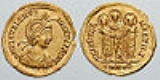
Valentinian III

Encyclopedia
Valentinian III was Western Roman Emperor from 425 to 455.
, the only son of Galla Placidia
and Flavius Constantius
. The former was the younger half-sister of the western emperor Honorius
, and the latter was at the time Patrician and the power behind the throne
.
Through his mother, Valentinian was a descendent both of Theodosius I
, who was his maternal grandfather, and of Valentinian I
, who was the father of his maternal grandmother
. It was also through his mother's side of the family that he was the nephew of Honorius and first cousin to Theodosius II
(the son of Honorius' brother Arcadius
), who was eastern emperor for most of Valentianian's life. Valentinian had a full sister, Justa Grata Honoria
, who was probably born in 417 or 418 (the history of Paul the Deacon
mentions her first when mentioning the children of the marriage, suggesting she was the eldest). His mother had previously been married to Ataulf
of the Visigoths, and had borne a son, Theodosius, in Barcelona
in 414; but the child had died early in the following year, thus eliminating an opportunity for a Romano-Visigothic line.
When Valentinian was less than two years old, Honorius appointed Constantius co-emperor, a dignity he would hold until his death seven months later. As a result of all these family ties, Valentinian was the son, grandson, great-grandson, cousin, and nephew (twice over) of Roman Emperor
s.
 After the death of his father in 421, Valentinian followed his mother and his sister (Justa Grata Honoria
) to Constantinople
, when Galla Placidia broke with her half-brother, Emperor Honorius
, and went to live at the court of Theodosius II
.
In 423, Honorius died, and the usurper
Joannes
took the power in Rome. To counter this threat to his power, Theodosius nominated Valentinian Caesar
of the west (October 23, 424), and betrothed him to his own daughter Licinia Eudoxia
(Valentinian would marry her in 437). In 425, after Joannes had been defeated in war, Valentinian was installed Western Emperor in Rome, on October 23, at the age of six.
Given his minority
, the new Augustus
ruled under the control first of his mother, and then, after 433, of the Magister militum
Flavius Aëtius
. Valentinian's reign is marked by the dismemberment of the Western Empire; the conquest of the province of Africa by the Vandals
in 439; the loss of great portions of Spain and Gaul
, in which the barbarians had established themselves; and the ravaging of Sicily
and of the western coasts of the Mediterranean by the fleets of Geiseric.
As an off-set against these calamities, there was the great victory of Roman general Aëtius
over Attila the Hun
in 451 near Châlons
. Aëtius had also campaigned successfully against the Visigoths in southern Gaul (426, 429, 436), and against various invaders on the Rhine and Danube
(428–431).
The burden of taxation became more and more intolerable as Rome's power decreased, and the loyalty of its remaining provinces was seriously impaired in consequence. Ravenna was Valentinian's usual residence, but he and the court eventually moved back to Rome. Rome proved safer on the approach of Attila, who, after ravaging the north of Italy
, died in 453.
In 454 Aëtius, whose son had married a daughter of the emperor, was murdered by Valentinian. On March 16 of the following year, however, the emperor himself was assassinated in Rome, by two Hunnish followers of Aëtius. These retainers may have been put up to the act by Petronius Maximus
, a wealthy senator taking revenge for the rape of his wife Lucina by Valentinian. The day after the assassination Petronius Maximus
had himself proclaimed emperor by the remnants of the Western Roman army after paying a large donative. He was not as prepared as he thought to take over and restabilize the depleted empire, however; after a reign of only 11 weeks, Maximus was stoned to death by a Roman mob. King Gaiseric and his Vandals
captured Rome
a few days later and sacked it for two weeks.
The opinion of most modern historians is that Valentinian not only lacked the ability to govern the empire in a time of crisis, but aggravated its dangers by his self-indulgence and vindictiveness.
in his play Valentinian
, c. 1612 (published 1647
).
He also appears in Handel
's 1731 opera Ezio, based on a libretto by Metastasio
.
The story of Valentinian and Aëtius was recounted in the pages of Hal Foster's Prince Valiant
.
Valentinian III was played by Reg Rogers in the 2001 miniseries Attila
.
Family
Valentinian was born in the western capital of RavennaRavenna
Ravenna is the capital city of the Province of Ravenna in the Emilia-Romagna region of Italy and the second largest comune in Italy by land area, although, at , it is little more than half the size of the largest comune, Rome...
, the only son of Galla Placidia
Galla Placidia
Aelia Galla Placidia , daughter of the Roman Emperor Theodosius I, was the Regent for Emperor Valentinian III from 423 until his majority in 437, and a major force in Roman politics for most of her life...
and Flavius Constantius
Constantius III
Flavius Constantius , commonly known as Constantius III, was Western Roman Emperor for seven months in 421. A prominent general and politician, he was the power behind the throne for much of the 410s, and in 421 briefly became co-emperor of the Western Empire with Honorius.- Early life and rise to...
. The former was the younger half-sister of the western emperor Honorius
Honorius (emperor)
Honorius , was Western Roman Emperor from 395 to 423. He was the younger son of emperor Theodosius I and his first wife Aelia Flaccilla, and brother of the eastern emperor Arcadius....
, and the latter was at the time Patrician and the power behind the throne
Power behind the throne
The phrase power behind the throne refers to a person or group that informally exercises the real power of an office. In politics, it most commonly refers to a spouse, aide, or advisor of a political leader who serves as de facto leader, setting policy through influence or manipulation.The...
.
Through his mother, Valentinian was a descendent both of Theodosius I
Theodosius I
Theodosius I , also known as Theodosius the Great, was Roman Emperor from 379 to 395. Theodosius was the last emperor to rule over both the eastern and the western halves of the Roman Empire. During his reign, the Goths secured control of Illyricum after the Gothic War, establishing their homeland...
, who was his maternal grandfather, and of Valentinian I
Valentinian I
Valentinian I , also known as Valentinian the Great, was Roman emperor from 364 to 375. Upon becoming emperor he made his brother Valens his co-emperor, giving him rule of the eastern provinces while Valentinian retained the west....
, who was the father of his maternal grandmother
Galla, wife of Theodosius I
Flavia Galla was a Princess of the Western Roman Empire and an Empress of the Roman Empire. She was the second Empress consort of Theodosius I.-Family:...
. It was also through his mother's side of the family that he was the nephew of Honorius and first cousin to Theodosius II
Theodosius II
Theodosius II , commonly surnamed Theodosius the Younger, or Theodosius the Calligrapher, was Byzantine Emperor from 408 to 450. He is mostly known for promulgating the Theodosian law code, and for the construction of the Theodosian Walls of Constantinople...
(the son of Honorius' brother Arcadius
Arcadius
Arcadius was the Byzantine Emperor from 395 to his death. He was the eldest son of Theodosius I and his first wife Aelia Flaccilla, and brother of the Western Emperor Honorius...
), who was eastern emperor for most of Valentianian's life. Valentinian had a full sister, Justa Grata Honoria
Justa Grata Honoria
Justa Grata Honoria, commonly referred to during her lifetime as Honoria, was the older sister of the Western Roman Emperor Valentinian III. Coins attest that she was granted the title of Augusta not long after the ascension of her brother in 426....
, who was probably born in 417 or 418 (the history of Paul the Deacon
Paul the Deacon
Paul the Deacon , also known as Paulus Diaconus, Warnefred, Barnefridus and Cassinensis, , was a Benedictine monk and historian of the Lombards.-Life:...
mentions her first when mentioning the children of the marriage, suggesting she was the eldest). His mother had previously been married to Ataulf
Ataulf
Ataulf was king of the Visigoths from 410 to 415...
of the Visigoths, and had borne a son, Theodosius, in Barcelona
Barcelona
Barcelona is the second largest city in Spain after Madrid, and the capital of Catalonia, with a population of 1,621,537 within its administrative limits on a land area of...
in 414; but the child had died early in the following year, thus eliminating an opportunity for a Romano-Visigothic line.
When Valentinian was less than two years old, Honorius appointed Constantius co-emperor, a dignity he would hold until his death seven months later. As a result of all these family ties, Valentinian was the son, grandson, great-grandson, cousin, and nephew (twice over) of Roman Emperor
Roman Emperor
The Roman emperor was the ruler of the Roman State during the imperial period . The Romans had no single term for the office although at any given time, a given title was associated with the emperor...
s.
Reign
Justa Grata Honoria
Justa Grata Honoria, commonly referred to during her lifetime as Honoria, was the older sister of the Western Roman Emperor Valentinian III. Coins attest that she was granted the title of Augusta not long after the ascension of her brother in 426....
) to Constantinople
Constantinople
Constantinople was the capital of the Roman, Eastern Roman, Byzantine, Latin, and Ottoman Empires. Throughout most of the Middle Ages, Constantinople was Europe's largest and wealthiest city.-Names:...
, when Galla Placidia broke with her half-brother, Emperor Honorius
Honorius (emperor)
Honorius , was Western Roman Emperor from 395 to 423. He was the younger son of emperor Theodosius I and his first wife Aelia Flaccilla, and brother of the eastern emperor Arcadius....
, and went to live at the court of Theodosius II
Theodosius II
Theodosius II , commonly surnamed Theodosius the Younger, or Theodosius the Calligrapher, was Byzantine Emperor from 408 to 450. He is mostly known for promulgating the Theodosian law code, and for the construction of the Theodosian Walls of Constantinople...
.
In 423, Honorius died, and the usurper
Roman usurper
Usurpers are individuals or groups of individuals who obtain and maintain the power or rights of another by force and without legal authority. Usurpation was endemic during roman imperial era, especially from the crisis of the third century onwards, when political instability became the rule.The...
Joannes
Joannes
Ioannes, known in English as Joannes, was a Roman usurper against Valentinian III.On the death of the Emperor Honorius , Theodosius II, the remaining ruler of the House of Theodosius hesitated in announcing his uncle's death...
took the power in Rome. To counter this threat to his power, Theodosius nominated Valentinian Caesar
Caesar (title)
Caesar is a title of imperial character. It derives from the cognomen of Julius Caesar, the Roman dictator...
of the west (October 23, 424), and betrothed him to his own daughter Licinia Eudoxia
Licinia Eudoxia
Licinia Eudoxia was a Roman Empress, daughter of Eastern Emperor Theodosius II and wife of the Western Emperors Valentinian III and Petronius Maximus.- Family :...
(Valentinian would marry her in 437). In 425, after Joannes had been defeated in war, Valentinian was installed Western Emperor in Rome, on October 23, at the age of six.
Given his minority
Minority reign
The term minority reign or royal minority refers to the period of a sovereign's rule when he or she is legally a minor. Minority reigns are of their nature times when politicians and advisors can be especially competitive....
, the new Augustus
Augustus (honorific)
Augustus , Latin for "majestic," "the increaser," or "venerable", was an Ancient Roman title, which was first held by Gaius Julius Caesar Augustus , and subsequently came to be considered one of the titles of what are now known as the Roman Emperors...
ruled under the control first of his mother, and then, after 433, of the Magister militum
Magister militum
Magister militum was a top-level military command used in the later Roman Empire, dating from the reign of Constantine. Used alone, the term referred to the senior military officer of the Empire...
Flavius Aëtius
Flavius Aëtius
Flavius Aëtius , dux et patricius, was a Roman general of the closing period of the Western Roman Empire. He was an able military commander and the most influential man in the Western Roman Empire for two decades . He managed policy in regard to the attacks of barbarian peoples pressing on the Empire...
. Valentinian's reign is marked by the dismemberment of the Western Empire; the conquest of the province of Africa by the Vandals
Vandals
The Vandals were an East Germanic tribe that entered the late Roman Empire during the 5th century. The Vandals under king Genseric entered Africa in 429 and by 439 established a kingdom which included the Roman Africa province, besides the islands of Sicily, Corsica, Sardinia and the Balearics....
in 439; the loss of great portions of Spain and Gaul
Gaul
Gaul was a region of Western Europe during the Iron Age and Roman era, encompassing present day France, Luxembourg and Belgium, most of Switzerland, the western part of Northern Italy, as well as the parts of the Netherlands and Germany on the left bank of the Rhine. The Gauls were the speakers of...
, in which the barbarians had established themselves; and the ravaging of Sicily
Sicily
Sicily is a region of Italy, and is the largest island in the Mediterranean Sea. Along with the surrounding minor islands, it constitutes an autonomous region of Italy, the Regione Autonoma Siciliana Sicily has a rich and unique culture, especially with regard to the arts, music, literature,...
and of the western coasts of the Mediterranean by the fleets of Geiseric.
As an off-set against these calamities, there was the great victory of Roman general Aëtius
Flavius Aëtius
Flavius Aëtius , dux et patricius, was a Roman general of the closing period of the Western Roman Empire. He was an able military commander and the most influential man in the Western Roman Empire for two decades . He managed policy in regard to the attacks of barbarian peoples pressing on the Empire...
over Attila the Hun
Attila the Hun
Attila , more frequently referred to as Attila the Hun, was the ruler of the Huns from 434 until his death in 453. He was leader of the Hunnic Empire, which stretched from the Ural River to the Rhine River and from the Danube River to the Baltic Sea. During his reign he was one of the most feared...
in 451 near Châlons
Battle of Chalons
The Battle of the Catalaunian Plains , also called the Battle of Châlons sur Marne, took place in AD 451 between a coalition led by the Visigothic king Theodoric I and the Roman general Flavius Aëtius, against the Huns and their allies commanded by their leader Attila...
. Aëtius had also campaigned successfully against the Visigoths in southern Gaul (426, 429, 436), and against various invaders on the Rhine and Danube
Danube
The Danube is a river in the Central Europe and the Europe's second longest river after the Volga. It is classified as an international waterway....
(428–431).
The burden of taxation became more and more intolerable as Rome's power decreased, and the loyalty of its remaining provinces was seriously impaired in consequence. Ravenna was Valentinian's usual residence, but he and the court eventually moved back to Rome. Rome proved safer on the approach of Attila, who, after ravaging the north of Italy
Italy
Italy , officially the Italian Republic languages]] under the European Charter for Regional or Minority Languages. In each of these, Italy's official name is as follows:;;;;;;;;), is a unitary parliamentary republic in South-Central Europe. To the north it borders France, Switzerland, Austria and...
, died in 453.
In 454 Aëtius, whose son had married a daughter of the emperor, was murdered by Valentinian. On March 16 of the following year, however, the emperor himself was assassinated in Rome, by two Hunnish followers of Aëtius. These retainers may have been put up to the act by Petronius Maximus
Petronius Maximus
Flavius Petronius Maximus was Western Roman Emperor for two and a half months in 455. A wealthy senator and a prominent aristocrat, he was instrumental in the murders of the Western Roman magister militum, Flavius Aëtius, and the Western Roman Emperor Valentinian III...
, a wealthy senator taking revenge for the rape of his wife Lucina by Valentinian. The day after the assassination Petronius Maximus
Petronius Maximus
Flavius Petronius Maximus was Western Roman Emperor for two and a half months in 455. A wealthy senator and a prominent aristocrat, he was instrumental in the murders of the Western Roman magister militum, Flavius Aëtius, and the Western Roman Emperor Valentinian III...
had himself proclaimed emperor by the remnants of the Western Roman army after paying a large donative. He was not as prepared as he thought to take over and restabilize the depleted empire, however; after a reign of only 11 weeks, Maximus was stoned to death by a Roman mob. King Gaiseric and his Vandals
Vandals
The Vandals were an East Germanic tribe that entered the late Roman Empire during the 5th century. The Vandals under king Genseric entered Africa in 429 and by 439 established a kingdom which included the Roman Africa province, besides the islands of Sicily, Corsica, Sardinia and the Balearics....
captured Rome
Sack of Rome (455)
The sack of 455 was the second of three barbarian sacks of Rome; it was executed by the Vandals, who were then at war with the usurping Western Roman Emperor Petronius Maximus....
a few days later and sacked it for two weeks.
The opinion of most modern historians is that Valentinian not only lacked the ability to govern the empire in a time of crisis, but aggravated its dangers by his self-indulgence and vindictiveness.
In literature
Valentinian III's life was dramatized by John FletcherJohn Fletcher (playwright)
John Fletcher was a Jacobean playwright. Following William Shakespeare as house playwright for the King's Men, he was among the most prolific and influential dramatists of his day; both during his lifetime and in the early Restoration, his fame rivalled Shakespeare's...
in his play Valentinian
Valentinian (play)
Valentinian is a Jacobean era stage play, a revenge tragedy written by John Fletcher was that originally published in the first Beaumont and Fletcher folio of 1647. The play dramatizes the story of Valentinian III, one of the last of the Roman Emperors, as recorded by the classical historian...
, c. 1612 (published 1647
1647 in literature
The year 1647 in literature involved some significant events.-Events:* Thomas Hobbes becomes tutor to the future Charles II of England.* Plagiarist Robert Baron publishes his Deorum Dona, a masque, and Gripus and Hegio, a pastoral, which draw heavily on the poems of Edmund Waller and John Webster's...
).
He also appears in Handel
HANDEL
HANDEL was the code-name for the UK's National Attack Warning System in the Cold War. It consisted of a small console consisting of two microphones, lights and gauges. The reason behind this was to provide a back-up if anything failed....
's 1731 opera Ezio, based on a libretto by Metastasio
Metastasio
Pietro Antonio Domenico Trapassi, better known by his pseudonym of Metastasio, was an Italian poet and librettist, considered the most important writer of opera seria libretti.-Early life:...
.
The story of Valentinian and Aëtius was recounted in the pages of Hal Foster's Prince Valiant
Prince Valiant
Prince Valiant in the Days of King Arthur, or simply Prince Valiant, is a long-run comic strip created by Hal Foster in 1937. It is an epic adventure that has told a continuous story during its entire history, and the full stretch of that story now totals more than 3700 Sunday strips...
.
Valentinian III was played by Reg Rogers in the 2001 miniseries Attila
Attila (TV Miniseries)
Attila was an American TV miniseries set during the waning days of the Western Roman Empire, in particular during the invasions of the Huns in Europe.-Synopsis:...
.
Ancestry
Primary sources
- ProsperProsper of AquitaineSaint Prosper of Aquitaine , a Christian writer and disciple of Saint Augustine of Hippo, was the first continuator of Jerome's Universal Chronicle.- Life :...
Chronicles - JordanesJordanesJordanes, also written Jordanis or Jornandes, was a 6th century Roman bureaucrat, who turned his hand to history later in life....
, Gothic History - Sidonius ApollinarisSidonius ApollinarisGaius Sollius Apollinaris Sidonius or Saint Sidonius Apollinaris was a poet, diplomat, and bishop. Sidonius is "the single most important surviving author from fifth-century Gaul" according to Eric Goldberg...
Secondary sources
- Oost, Galla Placidia Augusta, University Press, Chicago, 1968.
- Jones, A.H.M., The Later Roman Empire A.D. 284–602, Volume One. Johns Hopkins University Press, Baltimore, 1986.
- Elia, Fibronia, Valentiniano III, CULC, Catania, 1999.
External links
- This list of Roman laws of the fourth century shows laws passed by Valentinian III relating to Christianity.