
All Topics  
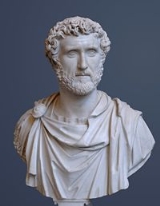
Antoninus Pius

 
Antoninus Pius

   Email Print
   Bookmark   Link


Antoninus Pius


Titus Aurelius Fulvus Boionius Arrius Antoninus (19 September, 86–7 March 161), generally known in English as Antoninus Pius was Roman emperor from 138 to 161. He was the fourth of the Five Good Emperors
Five Good Emperors

The Five Good Emperors is a term that refers to five consecutive emperors of the Roman Empire who represented a line of virtuous and just rule ? Nerva, Trajan, Hadrian, Antoninus Pius, and Marcus Aurelius....
 and a member of the Aurelii
Aurelii

The Aurelii were a Roman gens. The male form was Aurelius and the feminine form was Aurelia. Its members included:*Marcus Aurelius Cotta, consul...
. He did not possess the sobriquet
Sobriquet

A sobriquet is a nickname or a fancy name, usually a familiar name given by others as distinct from a pseudonym assumed as a disguise, but a nickname which is familiar enough such that it can be used in place of a real name without the need of explanation....
 "Pius
Pius

Pius is a male name, from the Latin word pius, the meaning of which is similar to the English "pious" from piety , meaning a desire and willingness to perform religious duties....
" until after his accession to the throne. Almost certainly, he earned the name "Pius" because he compelled the Senate to deify his adoptive father Hadrian
Hadrian

Publius Aelius Hadrianus , as emperor Imperator Caesar Divi Traiani filius Traianus Hadrianus Augustus, and Divus Hadrianus after his apotheosis, known as Hadrian in English language, was Roman Emperor of Roman Empire from AD 117 to 138, as well as a Stoicism and Epicureanism philosopher....
; the Historia Augusta, however, suggests that he may have earned the name by saving senators sentenced to death by Hadrian in his later years.

as the son and only child of Titus Aurelius Fulvus
Titus Aurelius Fulvus

In the 1st century there were two men with the name Titus Aurelius Fulvus. One was the paternal grandfather and the other the father to the Names of the Greeks Emperor Antoninus Pius....
, consul
Consul

Consul was the highest elected office of the Roman Republic and an appointive office under the Roman Empire. The title was also used in other city states, and revived in modern states, notably French Republic before the Napoleon I of Franceic counter-revolution....
 in 89 whose family came from Nemausus
Nemausus

Deus Nemausus is often said to have been the Celtic mythology patron god of Nemausus . The god does not seem to have been worshipped outside of this locality....
 (modern Nīmes
Nīmes

N?mes is a city in southern France. It is the capital of the Gard Departments of France. N?mes has a rich history, dating back to the Roman Empire, and it is a popular tourist destination....
) and was born near Lanuvium
Lanuvium

Lanuvium is an ancient city of Latium, some 32 km southeast of Rome, a little southwest of the Via Appia.Lanuvium was situated on an isolated hill projecting south from the main mass of the Alban Hills, and commanding an extensive view over the low country between it and the sea....
 and his mother was Arria Fadilla.


Discussion
Ask a question about 'Antoninus Pius'
Start a new discussion about 'Antoninus Pius'
Answer questions from other users
Full Discussion Forum


Encyclopedia


Titus Aurelius Fulvus Boionius Arrius Antoninus (19 September, 86–7 March 161), generally known in English as Antoninus Pius was Roman emperor from 138 to 161. He was the fourth of the Five Good Emperors
Five Good Emperors

The Five Good Emperors is a term that refers to five consecutive emperors of the Roman Empire who represented a line of virtuous and just rule ? Nerva, Trajan, Hadrian, Antoninus Pius, and Marcus Aurelius....
 and a member of the Aurelii
Aurelii

The Aurelii were a Roman gens. The male form was Aurelius and the feminine form was Aurelia. Its members included:*Marcus Aurelius Cotta, consul...
. He did not possess the sobriquet
Sobriquet

A sobriquet is a nickname or a fancy name, usually a familiar name given by others as distinct from a pseudonym assumed as a disguise, but a nickname which is familiar enough such that it can be used in place of a real name without the need of explanation....
 "Pius
Pius

Pius is a male name, from the Latin word pius, the meaning of which is similar to the English "pious" from piety , meaning a desire and willingness to perform religious duties....
" until after his accession to the throne. Almost certainly, he earned the name "Pius" because he compelled the Senate to deify his adoptive father Hadrian
Hadrian

Publius Aelius Hadrianus , as emperor Imperator Caesar Divi Traiani filius Traianus Hadrianus Augustus, and Divus Hadrianus after his apotheosis, known as Hadrian in English language, was Roman Emperor of Roman Empire from AD 117 to 138, as well as a Stoicism and Epicureanism philosopher....
; the Historia Augusta, however, suggests that he may have earned the name by saving senators sentenced to death by Hadrian in his later years.

Early life


Childhood and family

He was the son and only child of Titus Aurelius Fulvus
Titus Aurelius Fulvus

In the 1st century there were two men with the name Titus Aurelius Fulvus. One was the paternal grandfather and the other the father to the Names of the Greeks Emperor Antoninus Pius....
, consul
Consul

Consul was the highest elected office of the Roman Republic and an appointive office under the Roman Empire. The title was also used in other city states, and revived in modern states, notably French Republic before the Napoleon I of Franceic counter-revolution....
 in 89 whose family came from Nemausus
Nemausus

Deus Nemausus is often said to have been the Celtic mythology patron god of Nemausus . The god does not seem to have been worshipped outside of this locality....
 (modern Nīmes
Nīmes

N?mes is a city in southern France. It is the capital of the Gard Departments of France. N?mes has a rich history, dating back to the Roman Empire, and it is a popular tourist destination....
) and was born near Lanuvium
Lanuvium

Lanuvium is an ancient city of Latium, some 32 km southeast of Rome, a little southwest of the Via Appia.Lanuvium was situated on an isolated hill projecting south from the main mass of the Alban Hills, and commanding an extensive view over the low country between it and the sea....
 and his mother was Arria Fadilla. Antoninus’ father and paternal grandfather died when he was young and he was raised by Gnaeus Arrius Antoninus, his maternal grandfather, a man of integrity and culture and a friend of Pliny the Younger
Pliny the Younger

Gaius Plinius Caecilius Secundus, born Gaius Caecilius or Gaius Caecilius Cilo , better known as Pliny the Younger, was a lawyer, author, and natural philosopher of Ancient Rome....
. His mother married to Publius Julius Lupus (a man of consular rank), Suffect Consul
Roman consul

Consul was the highest elected political office of the Roman Republic and the Roman Empire.During the time of ancient Rome as a Republic, the Consuls were the highest civil and military magistrates, serving as the head of government for the Republic....
 in 98, and bore him a daughter called Julia Fadilla.

Marriage and children

As a private citizen between 110–115, he married Annia Galeria Faustina the Elder
Faustina the Elder

Annia Galeria Faustina, more familiarly referred to as Faustina the Elder , was a Roman Empress and wife of Roman Emperor Antoninus Pius....
. They had a very happy marriage. She was the daughter of consul Marcus Annius Verus
Marcus Annius Verus

Marcus Annius Verus was a Ancient Rome man who lived in the 1st century and 2nd century. He was the son of an elder Annius Verus, who gained the rank of senator and praetor....
 and Rupilia
Rupilia

Rupilia Faustina was a Roman woman. She was daughter to Salonina Matidia from her third marriage to Lucius Scribonius Libo Rupilio Frugi Bonus consul of 88, who died in 101....
 Faustina (a half-sister to Roman Empress Vibia Sabina
Vibia Sabina

Vibia Sabina was a Roman Empress, wife and third cousin to Roman Emperor Hadrian. She was the daughter to Salonina Matidia, niece of Roman Emperor Trajan and Lucius Vibius Sabinus, a man of consular rank....
). Faustina was a beautiful woman, renowned for her wisdom. She spent her whole life caring for the poor and assisting the most disadvantaged Romans.

Faustina bore Antoninus four children, two sons and two daughters. They were:
  • Marcus Aurelius Fulvus Antoninus (died before 138); his sepulchral inscription has been found at the Mausoleum of Hadrian in Rome.
  • Marcus Galerius Aurelius Antoninus (died before 138); his sepulchral inscription has been found at the Mausoleum of Hadrian in Rome. His name appears on a Greek Imperial coin.
  • Aurelia Fadilla (died in 135); she married Lucius Lamia Silvanus, consul 145. She appeared to have no children with her husband and her sepulchral inscription has been found in Italy
    Italy

    Italy , officially the Italian Republic , is a country located on the Italian Peninsula in Southern Europe and on the two largest islands in the Mediterranean Sea, Sicily and Sardinia....
    .
  • Annia Galeria Faustina Minor or Faustina the Younger
    Faustina the Younger

    Annia Galeria Faustina Minor , Faustina Minor or Faustina the Younger was a daughter of Roman Emperor Antoninus Pius and Roman Empress Faustina the Elder....
     (between 125-130-175), a future Roman Empress, married her maternal cousin, future Roman Emperor Marcus Aurelius
    Marcus Aurelius

    Marcus Aurelius Antoninus Augustus was Roman Emperor from 161 to his death in 180. He was the last of the "Five Good Emperors", and is also considered one of the most important stoicism philosophy....
    .


When Faustina died in 141, he was in complete mourning and did the following in memory of his wife:
  • Deified her as a goddess.
  • Had a temple built in the Roman Forum in her name, with priestesses in the temple.
  • Had various coins with her portrait struck in her honor. These coins were scripted ‘DIVAE FAUSTINA’ and were elaborately decorated.
  • He created a charity which he founded and called it Puellae Faustinianae or Girls of Faustina, which assisted orphaned girls.
  • Created a new alimenta (see Grain supply to the city of Rome
    Grain supply to the city of Rome

    The megalopolis of ancient Rome could never be fed entirely from its own surrounding countryside, especially as this region was increasingly used to produce fruit, vegetables and other perishable goods, and also taken up with the villas and parks of the aristocracy....
    ).


Favour with Hadrian

Having filled with more than usual success the offices of quaestor
Quaestor

Quaestor is a type of public official.In the Roman Republic a quaestor was an elected official who supervised the treasury and financial affairs of the state, its armies and its officers....
 and praetor
Praetor

Praetor was a Title#Titles_for_heads_of_state granted by the government of Ancient Rome to men acting in one of two official capacities: the commander of an army, either before it was mustered or more typically in the field, or an elected Magistratus assigned duties that varied depending on the historical period....
, he obtained the consulship in 120; he was next appointed by the Emperor Hadrian
Hadrian

Publius Aelius Hadrianus , as emperor Imperator Caesar Divi Traiani filius Traianus Hadrianus Augustus, and Divus Hadrianus after his apotheosis, known as Hadrian in English language, was Roman Emperor of Roman Empire from AD 117 to 138, as well as a Stoicism and Epicureanism philosopher....
 as one of the four proconsul
Proconsul

Ancient RomeIn the Roman Republic, a proconsul was a promagistrate who, after serving as consul, spent a year as a Roman governor of a Roman province....
s to administer Italia
Italia (Roman province)

Italia, under the Roman Republic and later Roman Empire, was the name of the Italian peninsula....
, then greatly increased his reputation by his conduct as proconsul
Proconsul

Ancient RomeIn the Roman Republic, a proconsul was a promagistrate who, after serving as consul, spent a year as a Roman governor of a Roman province....
 of Asia. He acquired much favor with the Emperor Hadrian, who adopted him as his son and successor on 25 February, 138, after the death of his first adopted son Lucius Aelius
Lucius Aelius

Lucius Aelius Verus Caesar became the adopted son and intended successor, of Roman Emperor Hadrian , but never attained the throne.Aelius was born with the name Lucius Ceionius Commodus Verus....
, on the condition that Antoninus would in turn adopt Marcus Annius Verus, the son of his wife's brother, and Lucius, son of Aelius Verus, who afterwards became the emperors Marcus Aurelius
Marcus Aurelius

Marcus Aurelius Antoninus Augustus was Roman Emperor from 161 to his death in 180. He was the last of the "Five Good Emperors", and is also considered one of the most important stoicism philosophy....
 and Lucius Verus
Lucius Verus

Lucius Aurelius Verus , born as Lucius Ceionius Commodus, known simply as Lucius Verus, was Roman Emperors with Marcus Aurelius , from 161 until his death....
 (colleague of Marcus Aurelius).

Emperor

Sesterius Antoninus Pius Italia Ric 0746a
On his accession, Antoninus' name became "Imperator Caesar Titus Aelius Hadrianus Antoninus Augustus Pontifex Maximus". One of his first acts as Emperor was to persuade the Senate
Roman Senate

The Senate of the Roman Republic was a political institution in the ancient Roman Republic. According to the Greek historian Polybius, our principal source on the Constitution of the Roman Republic, the Roman Senate was the predominant branch of government....
 to grant divine honours to Hadrian, which they had at first refused; his efforts to persuade the Senate to grant these honours is the most likely reason given for his title of Pius (dutiful in affection; compare pietas
Pietas

Pietas was one of the Ancient Rome virtues, along with gravitas and Dignitas . Pietas is usually translated as "duty" or "devotion," and it simultaneously suggests duty to the gods and duty to family - particularly to the father ....
). Two other reasons for this title are that he would support his aged father-in-law with his hand at Senate meetings, and that he had saved those men that Hadrian, during his period of ill-health, had condemned to death. He built temples, theaters, and mausoleums, promoted the arts and sciences, and bestowed honours and financial rewards upon the teachers of rhetoric
Rhetoric

Rhetoric is the art of using language as a means to persuade. Along with logic and dialectic, rhetoric is one of the three ancient arts of discourse....
 and philosophy
Philosophy

Philosophy is the study of general problems concerning matters such as existence, knowledge, truth, beauty, justice, validity, mind, and language....
.

In marked contrast to his predecessors Trajan
Trajan

Marcus Ulpius Nerva Traianus, commonly known as Trajan , was a Roman Emperors who reigned from 98 until his death in 117. Born Marcus Ulpius Traianus into a nonpatrician family in the Hispania Baetica province , Trajan rose to prominence during the reign of emperor Domitian, serving as a general in the Roman army along the Limes G...
 and Hadrian
Hadrian

Publius Aelius Hadrianus , as emperor Imperator Caesar Divi Traiani filius Traianus Hadrianus Augustus, and Divus Hadrianus after his apotheosis, known as Hadrian in English language, was Roman Emperor of Roman Empire from AD 117 to 138, as well as a Stoicism and Epicureanism philosopher....
, Antoninus was not a military man. One modern scholar has written "It is almost certain not only that at no time in his life did he ever see, let alone command, a Roman army, but that, throughout the twenty-three years of his reign, he never went within five hundred miles of a legion". His reign was the most peaceful in the entire history of the Principate
Principate

The Principate is the first period of the Roman Empire, extending from the beginning of the reign of Caesar Augustus to the Crisis of the Third Century, after which it was replaced with the Dominate....
; while there were several military disturbances throughout the Empire in his time, in Mauretania
Mauretania

In Antiquity, Mauretania was originally an independent Berber people monarchy on the Mediterranean coast of north Africa , corresponding to western Algeria, northern Morocco and Spain Plazas de soberan?a....
, Iudaea
Iudaea Province

Iudaea was a Roman province that extended over the former region of the Hasmonean and Herodian kingdoms of Israel. It was named after the tetrarchy of Judea of which it was an expansion, the latter name deriving from the Kingdom of Judah of the 6th century BCE....
, and amongst the Brigantes
Brigantes

The Brigantes were a List of Celtic tribes who in British Iron Age times controlled the largest section of Northern England and a significant part of the Midlands#The English Midlands....
 in Britannia
Roman Britain

Roman Britain refers to those parts of the island of Great Britain controlled by the Roman Empire between AD 43 and 410. The Romans referred to their province as Britannia....
, none of them are considered serious. The unrest in Britannia is believed to have led to the construction of the Antonine Wall
Antonine Wall

The Antonine Wall also known as the Severan Wall, is a rock and sod fortification, built by the Roman Empire across what is now the central belt of Scotland and is also known as the Clyde-Forth frontier line....
 from the Firth of Forth
Firth of Forth

The Firth of Forth is the estuary or firth of Scotland River Forth, where it flows into the North Sea between Fife to the north, and West Lothian, the City of Edinburgh, and East Lothian to the south....
 to the Firth of Clyde
Firth of Clyde

The Firth of Clyde forms a large area of coastal water, sheltered from the Atlantic ocean by the Kintyre peninsula which encloses the outer firth in Argyll and Ayrshire, Scotland....
, although it was soon abandoned. He was virtually unique among emperors in that he dealt with these crises without leaving Italy once during his reign, but instead dealt with provincial matters of war and peace through their governors or through imperial letters to the cities such as Ephesus (of which some were publicly displayed). This style of government was highly praised by his contemporaries and by later generations.

Of the public transactions of this period we have scant information, but, to judge by what we possess, those twenty-two years were not remarkably eventful in comparison to those before and after his; the surviving evidence is not complete enough to determine whether we should interpret, with older scholars, that he wisely curtailed the activities of the Roman Empire to a careful minimum, or perhaps that he was uninterested in events away from Rome and Italy
Italy

Italy , officially the Italian Republic , is a country located on the Italian Peninsula in Southern Europe and on the two largest islands in the Mediterranean Sea, Sicily and Sardinia....
 and his inaction contributed to the pressing troubles that faced not only Marcus Aurelius but also the emperors of the third century. German historian Ernst Kornemann has had it in his Römische Geschichte [2 vols., ed. by H. Bengtson, Stuttgart 1954] that the reign of Antoninus comprised "a succession of grossly wasted opportunities," given the upheavals that were to come. There is more to this argument, given that the Parthians in the East were themselves soon to make no small amount of mischief after Antoninus' passing. Kornemann's brief is that Antoninus might have waged preventive wars to head off these outsiders.

Scholars place Antoninus Pius as the leading candidate for fulfilling the role as a friend of Rabbi Judah the Prince
Judah haNasi

Rabbi Judah haNasi, , also known as "Rabbi" and "Rabeinu HaKadosh" , was a key leader of the Jewish community of Judea toward the end of the 2nd century CE, during the occupation by the Roman Empire....
. According to the Talmud
Talmud

The Talmud is a record of rabbinic discussions pertaining to Halakha, Jewish ethics, customs, and history. It is a central text of mainstream Judaism....
 (Avodah Zarah 10a-b), Rabbi Judah was very wealthy and greatly revered in Rome. He had a close friendship with "Antoninus", possibly Antoninus Pius, who would consult Rabbi Judah on various worldly and spiritual matters.

Romafororomanotempioantoninofaustina
After the longest reign since Augustus (surpassing Tiberius
Tiberius

Tiberius Julius Caesar Augustus, born Tiberius Claudius Nero , was the second Roman Emperor, from the death of Augustus in AD 14 until his own death in 37....
 by a couple of months), Antoninus died of fever at Lorium
Lorium

Lorium was an ancient village of Etruria, Italy, on the Via Aurelia, 19 kilometre west of Rome. Antoninus Pius, who was educated here, afterwards built a palace, in which he died....
 in Etruria
Etruria

Etruria — usually referred to in Greek language and Latin language source texts as Tyrrhenia — was a region of Central Italy, an area that covered part of what now are Tuscany, Latium, Emilia-Romagna and Umbria....
, about twelve miles (19 km) from Rome, on 7 March 161, giving the keynote to his life in the last word that he uttered when the tribune
Tribune

Tribune was a title shared by 10 elected officials in the Roman Republic. Tribunes had the power to convene the Plebeian Council and to act as its president, which also gave them the exclusive right to propose legislation before it....
 of the night-watch came to ask the password—"aequanimitas" (equanimity). His body was placed in Hadrian's mausoleum
Castel Sant'Angelo

The Mausoleum of Hadrian, usually known as the Castel Sant'Angelo, is a towering cylindrical building in Rome, initially commissioned by the Roman Emperor Hadrian as a mausoleum for himself and his family....
, a column
Column of Antoninus Pius

The Column of Antoninus Pius is an honorific column in Rome, devoted in 161 to the Roman emperor Antoninus Pius, in the Campus Martius, on the edge of the hill now known as Monte Citorio, and set up by his successors, the co-emperors Marcus Aurelius and Lucius Verus....
 was dedicated to him on the Campus Martius
Campus Martius

The Campus Martius , was a publicly owned area of ancient Rome about 2 km? in extent. In the Middle Ages it was the most populous area of Rome....
, and the temple
Temple of Antoninus and Faustina

The Temple of Antoninus and Faustina is an Ancient Rome temple in Rome, adapted to the church of San Lorenzo in Miranda. It stands in the Forum Romanum, on the Via Sacra, opposite the Regia....
 he had built in the Forum in 141 to his deified wife Faustina was rededicated to the deified Faustina and the deified Antoninus.

Historiography

The only account of his life handed down to us is that of the Augustan History, an unreliable and mostly fabricated work. Antoninus is unique among Roman emperors in that he has no other biographies. Historians have therefore turned to public records for what details we know.

In later scholarship

Antoninus in many ways was the ideal of the landed gentleman praised not only by ancient Romans, but also by later scholars of classical history, such as Edward Gibbon
Edward Gibbon

Edward Gibbon was an English historian and Member of Parliament. His most important work, The History of the Decline and Fall of the Roman Empire, was published in six volumes between 1776 and 1788....
 or the author of the article on Antoninus Pius in the ninth edition of the Encyclopedia Britannica:

External links

  • , Latin text with English translation
  • , English translation