


Africa Province

Encyclopedia
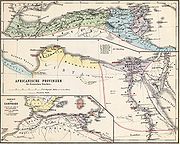
Roman province
In Ancient Rome, a province was the basic, and, until the Tetrarchy , largest territorial and administrative unit of the empire's territorial possessions outside of Italy...
of Africa was established after the Romans defeated Carthage
Carthage
Carthage , implying it was a 'new Tyre') is a major urban centre that has existed for nearly 3,000 years on the Gulf of Tunis, developing from a Phoenician colony of the 1st millennium BC...
in the Third Punic War
Third Punic War
The Third Punic War was the third and last of the Punic Wars fought between the former Phoenician colony of Carthage, and the Roman Republic...
. It roughly comprised the territory of present-day northern Tunisia
Tunisia
Tunisia , officially the Tunisian RepublicThe long name of Tunisia in other languages used in the country is: , is the northernmost country in Africa. It is a Maghreb country and is bordered by Algeria to the west, Libya to the southeast, and the Mediterranean Sea to the north and east. Its area...
, and the small Mediterranean
Mediterranean Sea
The Mediterranean Sea is a sea connected to the Atlantic Ocean surrounded by the Mediterranean region and almost completely enclosed by land: on the north by Anatolia and Europe, on the south by North Africa, and on the east by the Levant...
coast of modern-day western Libya
Libya
Libya is an African country in the Maghreb region of North Africa bordered by the Mediterranean Sea to the north, Egypt to the east, Sudan to the southeast, Chad and Niger to the south, and Algeria and Tunisia to the west....
along the Syrtis Minor. The Arab
Arab
Arab people, also known as Arabs , are a panethnicity primarily living in the Arab world, which is located in Western Asia and North Africa. They are identified as such on one or more of genealogical, linguistic, or cultural grounds, with tribal affiliations, and intra-tribal relationships playing...
s later named roughly the same region as the original province Ifriqiya
Ifriqiya
In medieval history, Ifriqiya or Ifriqiyah was the area comprising the coastal regions of what are today western Libya, Tunisia, and eastern Algeria. This area included what had been the Roman province of Africa, whose name it inherited....
, a rendering of Africa.
History
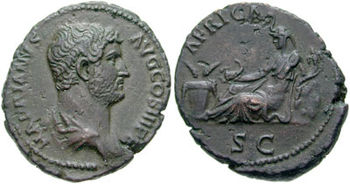
The land acquired for the province of Africa was the site of the ancient city of CarthageCarthage
Carthage , implying it was a 'new Tyre') is a major urban centre that has existed for nearly 3,000 years on the Gulf of Tunis, developing from a Phoenician colony of the 1st millennium BC...
. Other large cities in the region included Hadrumetum
Hadrumetum
Hadrumetum was a Phoenician colony that pre-dated Carthage and stood on the site of modern-day Sousse, Tunisia.-Ancient history:...
(modern Sousse
Sousse
Sousse is a city in Tunisia. Located 140 km south of the capital Tunis, the city has 173,047 inhabitants . Sousse is in the central-east of the country, on the Gulf of Hammamet, which is a part of the Mediterranean Sea. The name may be of Berber origin: similar names are found in Libya and in...
, Tunisia
Tunisia
Tunisia , officially the Tunisian RepublicThe long name of Tunisia in other languages used in the country is: , is the northernmost country in Africa. It is a Maghreb country and is bordered by Algeria to the west, Libya to the southeast, and the Mediterranean Sea to the north and east. Its area...
), capital of Byzacena
Byzacena
Byzacena was a Roman province in what is now Tunisia.At the end of the third century AD, the Emperor Diocletian divided the great Roman province of Africa Proconsularis into three smaller provinces: Zeugitana in the north, still governed by a proconsul and referred to as Proconsularis, Byzacena,...
, Hippo Regius
Hippo Regius
Hippo Regius is the ancient name of the modern city of Annaba, in Algeria. Under this name, it was a major city in Roman Africa, hosting several early Christian councils, and was the home of the philosopher and theologian Augustine of Hippo...
(modern Annaba, Algeria
Algeria
Algeria , officially the People's Democratic Republic of Algeria , also formally referred to as the Democratic and Popular Republic of Algeria, is a country in the Maghreb region of Northwest Africa with Algiers as its capital.In terms of land area, it is the largest country in Africa and the Arab...
). The province was established by the Roman Republic
Roman Republic
The Roman Republic was the period of the ancient Roman civilization where the government operated as a republic. It began with the overthrow of the Roman monarchy, traditionally dated around 508 BC, and its replacement by a government headed by two consuls, elected annually by the citizens and...
in 146 BC, following the Third Punic War
Third Punic War
The Third Punic War was the third and last of the Punic Wars fought between the former Phoenician colony of Carthage, and the Roman Republic...
. Rome established its first African colony, Africa Proconsularis or Africa Vetus (Old Africa), governed by a proconsul
Proconsul
A proconsul was a governor of a province in the Roman Republic appointed for one year by the senate. In modern usage, the title has been used for a person from one country ruling another country or bluntly interfering in another country's internal affairs.-Ancient Rome:In the Roman Republic, a...
, in the most fertile part of what was formerly Carthaginian territory. Utica
Utica, Tunisia
Utica is an ancient city northwest of Carthage near the outflow of the Medjerda River into the Mediterranean Sea, traditionally considered to be the first colony founded by the Phoenicians in North Africa...
was formed as the administrative capital. The remaining territory was left in the domain of the Numidia
Numidia
Numidia was an ancient Berber kingdom in part of present-day Eastern Algeria and Western Tunisia in North Africa. It is known today as the Chawi-land, the land of the Chawi people , the direct descendants of the historical Numidians or the Massyles The kingdom began as a sovereign state and later...
n client king Massinissa. At this time, the Roman policy in Africa was simply to prevent another great power from rising on the far side of Sicily
Sicily
Sicily is a region of Italy, and is the largest island in the Mediterranean Sea. Along with the surrounding minor islands, it constitutes an autonomous region of Italy, the Regione Autonoma Siciliana Sicily has a rich and unique culture, especially with regard to the arts, music, literature,...
. In 118 BC, the Numidian prince Jugurtha
Jugurtha
Jugurtha or Jugurthen was a King of Numidia, , born in Cirta .-Background:Until the reign of Jugurtha's grandfather Masinissa, the people of Numidia were semi-nomadic and indistinguishable from the other Libyans in North Africa...
attempted to reunify the smaller kingdoms. However, upon his death, much of Jugurtha's territory was placed in the control of the Mauretanian client king Bocchus
Bocchus
Bocchus is the name of 2 kings of Mauretania.* Bocchus I* Bocchus II...
; and, by that time, the romanization of Africa was firmly rooted. In 27 B.C, when the Republic
Roman Republic
The Roman Republic was the period of the ancient Roman civilization where the government operated as a republic. It began with the overthrow of the Roman monarchy, traditionally dated around 508 BC, and its replacement by a government headed by two consuls, elected annually by the citizens and...
had transformed into an Empire
Roman Empire
The Roman Empire was the post-Republican period of the ancient Roman civilization, characterised by an autocratic form of government and large territorial holdings in Europe and around the Mediterranean....
, the province of Africa began its Imperial
Imperialism
Imperialism, as defined by Dictionary of Human Geography, is "the creation and/or maintenance of an unequal economic, cultural, and territorial relationships, usually between states and often in the form of an empire, based on domination and subordination." The imperialism of the last 500 years,...
occupation under Roman rule.
Several political and provincial reforms were implemented by Augustus
Augustus
Augustus ;23 September 63 BC – 19 August AD 14) is considered the first emperor of the Roman Empire, which he ruled alone from 27 BC until his death in 14 AD.The dates of his rule are contemporary dates; Augustus lived under two calendars, the Roman Republican until 45 BC, and the Julian...
and later by Caligula
Caligula
Caligula , also known as Gaius, was Roman Emperor from 37 AD to 41 AD. Caligula was a member of the house of rulers conventionally known as the Julio-Claudian dynasty. Caligula's father Germanicus, the nephew and adopted son of Emperor Tiberius, was a very successful general and one of Rome's most...
, but Claudius
Claudius
Claudius , was Roman Emperor from 41 to 54. A member of the Julio-Claudian dynasty, he was the son of Drusus and Antonia Minor. He was born at Lugdunum in Gaul and was the first Roman Emperor to be born outside Italy...
finalized the territorial divisions into official Roman provinces. Africa was a senatorial province. After Diocletian
Diocletian
Diocletian |latinized]] upon his accession to Diocletian . c. 22 December 244 – 3 December 311), was a Roman Emperor from 284 to 305....
's administrative reforms, it was split into Africa Zeugitana (which retained the name Africa Proconsularis, as it was governed by a proconsul
Proconsul
A proconsul was a governor of a province in the Roman Republic appointed for one year by the senate. In modern usage, the title has been used for a person from one country ruling another country or bluntly interfering in another country's internal affairs.-Ancient Rome:In the Roman Republic, a...
) in the north and Africa Byzacena
Byzacena
Byzacena was a Roman province in what is now Tunisia.At the end of the third century AD, the Emperor Diocletian divided the great Roman province of Africa Proconsularis into three smaller provinces: Zeugitana in the north, still governed by a proconsul and referred to as Proconsularis, Byzacena,...
in the south, both of which were part of the Dioecesis Africae
Diocese of Africa
The Diocese of Africa was a diocese of the later Roman Empire, incorporating the provinces of North Africa, except Mauretania Tingitana. Its seat was at Carthage, and it was subordinate to the Praetorian prefecture of Italy....
. The region remained a part of the Roman Empire until the great Germanic migrations of the 5th century. The Vandals
Vandals
The Vandals were an East Germanic tribe that entered the late Roman Empire during the 5th century. The Vandals under king Genseric entered Africa in 429 and by 439 established a kingdom which included the Roman Africa province, besides the islands of Sicily, Corsica, Sardinia and the Balearics....
crossed into North Africa from Spain in 429 and overran the area by 439 and founded their own kingdom, including Sicily
Sicily
Sicily is a region of Italy, and is the largest island in the Mediterranean Sea. Along with the surrounding minor islands, it constitutes an autonomous region of Italy, the Regione Autonoma Siciliana Sicily has a rich and unique culture, especially with regard to the arts, music, literature,...
, Corsica
Corsica
Corsica is an island in the Mediterranean Sea. It is located west of Italy, southeast of the French mainland, and north of the island of Sardinia....
, Sardinia
Sardinia
Sardinia is the second-largest island in the Mediterranean Sea . It is an autonomous region of Italy, and the nearest land masses are the French island of Corsica, the Italian Peninsula, Sicily, Tunisia and the Spanish Balearic Islands.The name Sardinia is from the pre-Roman noun *sard[],...
and the Balearics
Balearic Islands
The Balearic Islands are an archipelago of Spain in the western Mediterranean Sea, near the eastern coast of the Iberian Peninsula.The four largest islands are: Majorca, Minorca, Ibiza and Formentera. The archipelago forms an autonomous community and a province of Spain with Palma as the capital...
. The Vandals controlled the country as a warrior-elite, enforcing a policy of strict separation and suppressing the local Romano-African population. They also persecuted the Catholic
Catholicism
Catholicism is a broad term for the body of the Catholic faith, its theologies and doctrines, its liturgical, ethical, spiritual, and behavioral characteristics, as well as a religious people as a whole....
faithful, as the Vandals were adherents of the Arian heresy (the semi-trinitarian doctrines of Arius, a priest of Egypt). In 476, when the Roman Empire
Roman Empire
The Roman Empire was the post-Republican period of the ancient Roman civilization, characterised by an autocratic form of government and large territorial holdings in Europe and around the Mediterranean....
, had finally fallen
Decline of the Roman Empire
The decline of the Roman Empire refers to the gradual societal collapse of the Western Roman Empire. Many theories of causality prevail, but most concern the disintegration of political, economic, military, and other social institutions, in tandem with foreign invasions and usurpers from within the...
, it became a remanent of the Empire
Western Roman Empire
The Western Roman Empire was the western half of the Roman Empire after its division by Diocletian in 285; the other half of the Roman Empire was the Eastern Roman Empire, commonly referred to today as the Byzantine Empire....
. Towards the end of the 5th century, the Vandal state fell into decline, abandoning most of the interior territories to the Mauri and other Berber tribes of the desert.
Belisarius
Flavius Belisarius was a general of the Byzantine Empire. He was instrumental to Emperor Justinian's ambitious project of reconquering much of the Mediterranean territory of the former Western Roman Empire, which had been lost less than a century previously....
to recover Africa. In a short campaign
Vandalic War
The Vandalic War was a war fought in North Africa, in the areas of modern Tunisia and eastern Algeria, in 533-534, between the forces of the Eastern Roman Empire and the Vandal Kingdom of Carthage...
, Belisarius defeated the Vandals, entered Carthage
Carthage
Carthage , implying it was a 'new Tyre') is a major urban centre that has existed for nearly 3,000 years on the Gulf of Tunis, developing from a Phoenician colony of the 1st millennium BC...
in triumph and succeeded in reestablishing Roman rule over the province. The restored Roman administration was successful in fending off the attacks of the Amazigh desert tribes, and by means of an extensive fortification network managed to extend its rule once again to the interior. The North African provinces, together with the Roman possessions in Spain, were grouped into the Exarchate of Africa
Exarchate of Africa
The Exarchate of Africa or of Carthage, after its capital, was the name of an administrative division of the Eastern Roman Empire encompassing its possessions on the Western Mediterranean, ruled by an exarch, or viceroy...
by Emperor Maurice
Maurice (emperor)
Maurice was Byzantine Emperor from 582 to 602.A prominent general in his youth, Maurice fought with success against the Sassanid Persians...
. The exarchate prospered, and from it resulted the overthrow of the tyrannical emperor Phocas
Phocas
Phocas was Byzantine Emperor from 602 to 610. He usurped the throne from the Emperor Maurice, and was himself overthrown by Heraclius after losing a civil war.-Origins:...
by Heraclius
Heraclius
Heraclius was Byzantine Emperor from 610 to 641.He was responsible for introducing Greek as the empire's official language. His rise to power began in 608, when he and his father, Heraclius the Elder, the exarch of Africa, successfully led a revolt against the unpopular usurper Phocas.Heraclius'...
in 610. Its stability and strength in the beginning of the 7th century can be seen from the fact that Heraclius briefly considered moving the imperial capital from Constantinople
Constantinople
Constantinople was the capital of the Roman, Eastern Roman, Byzantine, Latin, and Ottoman Empires. Throughout most of the Middle Ages, Constantinople was Europe's largest and wealthiest city.-Names:...
to Carthage. Faced with the onslaught of the Muslim Conquest after 640, and despite occasional setbacks, the exarchate managed to stave off the threat, but in 698, a Muslim army from Egypt
Egypt
Egypt , officially the Arab Republic of Egypt, Arabic: , is a country mainly in North Africa, with the Sinai Peninsula forming a land bridge in Southwest Asia. Egypt is thus a transcontinental country, and a major power in Africa, the Mediterranean Basin, the Middle East and the Muslim world...
sacked Carthage and conquered the exarchate, ending Roman and Christian rule in North Africa. Thus the last of the provinces of the Western Roman Empire had ceased to exist, 222 years after the fall of Rome and the last Western Roman emperor.
Roman Africans
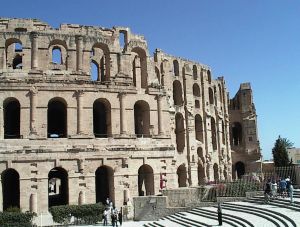
Roman army
The Roman army is the generic term for the terrestrial armed forces deployed by the kingdom of Rome , the Roman Republic , the Roman Empire and its successor, the Byzantine empire...
in early retirement who settled in Africa on farming plots promised for their military service. Historians like Theodore Mommsen estimated that under Hadrian
Hadrian
Hadrian , was Roman Emperor from 117 to 138. He is best known for building Hadrian's Wall, which marked the northern limit of Roman Britain. In Rome, he re-built the Pantheon and constructed the Temple of Venus and Roma. In addition to being emperor, Hadrian was a humanist and was philhellene in...
nearly 1/3 of the eastern Numidia population (roughly modern Tunisia
Tunisia
Tunisia , officially the Tunisian RepublicThe long name of Tunisia in other languages used in the country is: , is the northernmost country in Africa. It is a Maghreb country and is bordered by Algeria to the west, Libya to the southeast, and the Mediterranean Sea to the north and east. Its area...
) was descended from Roman veterans.
A sizable Latin
Latin
Latin is an Italic language originally spoken in Latium and Ancient Rome. It, along with most European languages, is a descendant of the ancient Proto-Indo-European language. Although it is considered a dead language, a number of scholars and members of the Christian clergy speak it fluently, and...
speaking population developed that was multinational in background, sharing the north African region with those speaking Punic and Berber
Berber languages
The Berber languages are a family of languages indigenous to North Africa, spoken from Siwa Oasis in Egypt to Morocco , and south to the countries of the Sahara Desert...
languages. Imperial security forces began to be drawn from the local population, including the Berbers.
Abun-Nasr, in his A History of the Maghrib, said that "What made the Berbers accept the Roman way of life all the more readily was that the Romans, though a colonizing people who captured their lands by the might of their arms, did not display any racial exclusiveness and were remarkably tolerant of Berber religious cults, be they indigenous or borrowed from the Carthaginians. However, the Roman territory in Africa was unevenly penetrated by Roman culture. Pockets of non-Romanized Berbers continued to exist throughout the Roman period, even in such areas as eastern Tunisia and Numidia."
By the end of the Western Roman Empire nearly all of the Maghreb was fully romanized
Romanization
In linguistics, romanization or latinization is the representation of a written word or spoken speech with the Roman script, or a system for doing so, where the original word or language uses a different writing system . Methods of romanization include transliteration, for representing written...
, according to Mommsen in his The Provinces of the Roman Empire and the Roman Africans enjoyed a high level of prosperity. This prosperity (and romanization) touched partially even the populations living outside the Roman limes (mainly the Garamantes
Garamantes
The Garamantes were a Saharan people who used an elaborate underground irrigation system, and founded a prosperous Berber kingdom in the Fezzan area of modern-day Libya, in the Sahara desert. They were a local power in the Sahara between 500 BC and 700 AD.There is little textual information about...
and the Getuli), who were reached with Roman expeditions to Sub-Saharan Africa.
Economics
The prosperity of most towns depended on agriculture. Called the "granary of the empire", North Africa, according to one estimate, produced one million tons of cereals each year, one-quarter of which was exported. Additional crops included beans, figs, grapes, and other fruits. By the second century, olive oil rivaled cereals as an export item. In addition to the cultivation of slaves, and the capture and transporting of exotic wild animals, the principal production and exports included the textiles, marble, wine, timber, livestock, pottery such as African Red SlipAfrican red slip
African red slip is a category of terra sigillata, or "fine" Ancient Roman pottery produced in the province of Africa Proconsularis, specifically that part roughly coinciding with the modern country of Tunisia and the Diocletianic provinces of Byzacena and Zeugitana. It is distinguished by a...
, and wool.
The incorporation of colonial cities into the Roman Empire brought an unparalleled degree of urbanization to vast areas of territory, particularly in North Africa. This level of rapid urbanization had a structural impact on the town economy, and artisan production in Roman cities became closely tied to the agrarian spheres of production. As Rome's population grew, so did her demand for North African produce. This flourishing trade allowed the North African provinces to increase artisan production in rapidly developing cities, making them highly organized urban centers. Many Roman cities shared both consumer and producer model city aspects, as artisanal activity was directly related to the economic role cities played in long-distance trade networks. The urban population became increasingly engaged in the craft and service sectors and less in agrarian employment, until a significant portion of the town’s vitality came from the sale or trade of products through middlemen to markets in areas both rural and abroad. The changes that occurred in the infrastructure for agricultural processing, like olive oil and wine production, as trade continued to develop both cities and commerce directly influenced the volume of artisan production. The scale, quality, and demand for these products reached its acme in Roman North Africa.
Pottery production
The North African provinces spanned across regions rich with olive plantations and potters' clay sources, which led to the early development of fine Ancient Roman potteryAncient Roman pottery
Pottery was produced in enormous quantities in ancient Rome, mostly for utilitarian purposes. It is found all over the former Roman Empire and beyond...
, especially African Red Slip
African red slip
African red slip is a category of terra sigillata, or "fine" Ancient Roman pottery produced in the province of Africa Proconsularis, specifically that part roughly coinciding with the modern country of Tunisia and the Diocletianic provinces of Byzacena and Zeugitana. It is distinguished by a...
terra sigillata
Terra sigillata
Terra sigillata is a term with at least three distinct meanings: as a description of medieval medicinal earth; in archaeology, as a general term for some of the fine red Ancient Roman pottery with glossy surface slips made in specific areas of the Roman Empire; and more recently, as a description...
tableware and clay oil lamp
Oil lamp
An oil lamp is an object used to produce light continuously for a period of time using an oil-based fuel source. The use of oil lamps began thousands of years ago and is continued to this day....
manufacture, as a crucial industry. Lamps provided the most common form of illumination in Rome. They were used for public and private lighting, as votive offerings in temples, lighting at festivals, and as grave goods. As the craft developed and increased in quality and craftsmanship, the North African creations began to rival their Italian and Grecian models and eventually surpassed them in merit and in demand. The innovative use of molds around the 1st c. BC allowed for a much greater variety of shapes and decorative style, and the skill of the lamp maker was demonstrated by the quality of the decoration found typically on the flat top of the lamp, or discus, and the outer rim, or shoulder. The production process took several stages. The decorative motifs were created using small individual molds, and were then added as appliqué to a plain archetype of the lamp. The embellished lamp was then used to make two plaster half molds, one lower half and one upper half mold, and multiple copies were then able to be mass produced. Decorative motifs ranged according to the lamp's function and to popular taste. Ornate patterning of squares and circles were later added to the shoulder with a stylus, as well as palm trees, small fish, animals, and flower patterns. The discus was reserved for conventional scenes of gods, goddesses, mythological subjects, scenes from daily life, erotic scenes, and natural images. The strongly Christian identity of post-Roman society in North Africa is exemplified in the later instances of North African lamps, on which scenes of Christian images like saints, crosses, and biblical figures became commonly articulated topics. However, traditional mythological symbols had enduring popularity as well, which can be traced back to North Africa's Punic heritage. Many of the early North African lamps that have been excavated, especially those of high quality, have the name of the manufacturer inscribed on the base, which gives evidence for a highly competitive and thriving local market that developed early and continued to influence and bolster the colonial economy.
After a period of artisanal, political, and social decline in the 3rd c. AD, lamp-making revived and accelerated artistry in the early Christian age to new heights. The introduction of fine local red-fired clays in the late fourth century triggered this revival. African Red Slip
African red slip
African red slip is a category of terra sigillata, or "fine" Ancient Roman pottery produced in the province of Africa Proconsularis, specifically that part roughly coinciding with the modern country of Tunisia and the Diocletianic provinces of Byzacena and Zeugitana. It is distinguished by a...
ware (ARS), or African Terra Sigillata, revolutionized the pottery and lamp-making industry. ARS ware was produced from the last third of the 1st c. AD onwards, and was of major importance in the mid to late Roman periods. Famous in antiquity as "fine" or high-quality tableware, it was distributed both regionally and throughout the Mediterranean basin along well-established and heavily-trafficked trade routes. North Africa's economy flourished as its products were dispersed and demand for its products dramatically increased. Initially, the ARS lamp designs imitated the simple design of third to fourth century courseware lamps, often with globules on the shoulder or with fluted walls. But new, more ornate designs appeared before the early fifth century as demand spurred on the creative process. The development and widespread distribution of ARS finewares marks the most distinctive phase of North African pottery-making.
These characteristic pottery lamps were produced in large quantities by efficiently organized production centers with large-scale manufacturing abilities, and can be attributed to specific pottery-making centers in northern and central Tunisia by way of modern chemical analysis, which allows modern archeologists to trace distribution patterns among trade routes both regional and across the Mediterranean. Some major ARS centers in central Tunisia are Sidi Marzouk Tounsi, Henchir el-Guellal (Djilma), and Henchir es-Srira, all of which have ARS lamp artifacts attributed to them by the microscopic chemical makeup of the clay fabric as well as macroscopic style prevalent in that region. This underscores the idea that these local markets fueled the economy of not only the town itself, but the entire region and supported markets abroad. Certain vessel forms, fabrics, and decorative techniques like rouletting, appliqué, and stamped décor, are specific for a certain region and even for a certain pottery center. If neither form nor decoration of the material to be classified is identifiable, it is possible to trace its origins, not just to a certain region but even to its place of production by comparing its chemical analysis to important northeastern and central Tunisian potteries with good representatives.
Republican era
Unless otherwise noted, names of governors in Africa and their dates are taken from T.R.S. Broughton, The Magistrates of the Roman Republic, (New York: American Philological Association, 1951, 1986), vol. 1, and vol. 2 (1952).146–100 BC
Inscriptional evidence is less common for this period than for the Imperial era, and names of those who held a provincia are usually recorded by historians only during wartime or by the triumphal fasti. After the defeat of Carthage in 146 BC, no further assignments to Africa among the senior magistrates or promagistrates are recorded until the Jugurthine WarJugurthine War
The Jugurthine War takes its name from the Berber king Jugurtha , nephew and later adopted son of Micipsa, King of Numidia.-Jugurtha and Numidia:...
(112–105 BC), when the command against Jugurtha
Jugurtha
Jugurtha or Jugurthen was a King of Numidia, , born in Cirta .-Background:Until the reign of Jugurtha's grandfather Masinissa, the people of Numidia were semi-nomadic and indistinguishable from the other Libyans in North Africa...
in Numidia
Numidia
Numidia was an ancient Berber kingdom in part of present-day Eastern Algeria and Western Tunisia in North Africa. It is known today as the Chawi-land, the land of the Chawi people , the direct descendants of the historical Numidians or the Massyles The kingdom began as a sovereign state and later...
became a consular province.
- P. Cornelius Scipio Africanus Aemilianus (146 BC)
- L. Calpurnius Bestia (111 BC)
- Sp. Postumius AlbinusSpurius Postumius Albinus (consul 110 BC)Spurius Postumius Albinus was a politician of ancient Rome, of patrician rank, of the 2nd century BC. He was consul in 110 BC, and obtained the province of Numidia to carry on the war against Jugurtha...
(110–109 BC) - Q. Caecilius Metellus NumidicusQuintus Caecilius Metellus NumidicusQuintus Caecilius Metellus Numidicus was the leader of the conservative faction of the Roman Senate and a bitter enemy of Gaius Marius....
(109–107 BC) - C. MariusGaius MariusGaius Marius was a Roman general and statesman. He was elected consul an unprecedented seven times during his career. He was also noted for his dramatic reforms of Roman armies, authorizing recruitment of landless citizens, eliminating the manipular military formations, and reorganizing the...
(107–105 BC) - L. Cornelius Sulla (105 BC)
90s–31 BC
During the civil wars of the 80s and 40s BCRoman civil wars
There were several Roman civil wars, especially during the late Republic. The most famous of these are the war in the 40s BC between Julius Caesar and the optimate faction of the senatorial elite initially led by Pompey and the subsequent war between Caesar's successors, Octavian and Mark Antony in...
, legitimate governors are difficult to distinguish from purely military commands, as rival factions were vying for control of the province by means of force.
- None known with reasonable certainty for the 90s
- P. SextiliusPublius SextiliusPublius Sextilius was a Roman praetor and governor of Africa during the civil wars between Sulla and Marius. As propraetor in 88 B.C., he refused Marius and his followers asylum in Africa.-Marius in Africa:...
(88–87 BC) - Q. Caecilius Metellus PiusQuintus Caecilius Metellus PiusQuintus Caecilius Metellus Pius was a pro-Sullan politician and general. He was named Pius because of his 99 BC petition to return his father from exile and was true to his cognomen for the constance and inflexibility with which he always fought for his father's rehabilitation and return to...
(86–84 BC) - C. Fabius Hadrianus (8484 BCYear 84 BC was a year of the pre-Julian Roman calendar. At the time it was known as the Year of the Consulship of Carbo and Cinna...
–82 BC82 BCYear 82 BC was a year of the pre-Julian Roman calendar. At the time it was known as the Year of the Consulship of Marius and Carbo...
) - Gn. Pompeius MagnusPompeyGnaeus Pompeius Magnus, also known as Pompey or Pompey the Great , was a military and political leader of the late Roman Republic...
(82–79 BC) - L. Licinius LucullusLucullusLucius Licinius Lucullus , was an optimate politician of the late Roman Republic, closely connected with Sulla Felix...
(77–76/75 BC) - A. Manlius Torquatus (69 BC or earlier)
- L. Sergius CatilinaCatilineLucius Sergius Catilina , known in English as Catiline, was a Roman politician of the 1st century BC who is best known for the Catiline conspiracy, an attempt to overthrow the Roman Republic, and in particular the power of the aristocratic Senate.-Family background:Catiline was born in 108 BC to...
(67–66 BC) - Q. Pompeius Rufus (62–60/59 BC)
- T. Vettius, cognomenCognomenThe cognomen nōmen "name") was the third name of a citizen of Ancient Rome, under Roman naming conventions. The cognomen started as a nickname, but lost that purpose when it became hereditary. Hereditary cognomina were used to augment the second name in order to identify a particular branch within...
possibly Sabinus (58–57 BC) - Q. Valerius OrcaQuintus Valerius OrcaQuintus Valerius Orca was a Roman praetor, a governor of the Roman province of Africa, and a commanding officer under Julius Caesar in the civil war against Pompeius Magnus and the senatorial elite...
(56 BC56 BCYear 56 BC was a year of the pre-Julian Roman calendar. At the time, it was known as the Year of the Consulship of Lentulus and Philippus...
) - P. Attius VarusPublius Attius VarusPublius Attius Varus was the Roman governor of Africa during the civil war between Julius Caesar and Pompeius Magnus . He declared war against Caesar, and initially fought and defeated Gaius Scribonius Curio, who was sent against him in 49 BC.-Political career:Varus held the office of praetor no...
(52 BC and probably earlier; see also below) - C. Considius LongusGaius Considius LongusGaius Considius Longus was a Roman politician and general in the last years of the Roman republic. As a commander in Africa, he fought on the Pompeian side in the Roman civil war and was killed by his own retinue in 46 BC as he attempted to escape after Julius Caesar's victory at...
(51–50 BC) - L. Aelius Tubero (49 BC; may never have assumed the post)
- P. Attius Varus (seized control again in 49 and held Africa till 48)
- Q. Caecilius Metellus Pius Scipio NasicaQuintus Caecilius Metellus Pius Scipio NasicaQuintus Caecilius Metellus Pius Scipio Nasica , in modern scholarship often as Metellus Scipio, was a Roman consul and military commander in the Late Republic. During the civil war between Julius Caesar and the senatorial faction led by Pompeius Magnus , he remained a staunch optimate...
(47 BC) - M. Porcius CatoCato the YoungerMarcus Porcius Cato Uticensis , commonly known as Cato the Younger to distinguish him from his great-grandfather , was a politician and statesman in the late Roman Republic, and a follower of the Stoic philosophy...
(jointly in 47 BC with special charge of UticaUtica, TunisiaUtica is an ancient city northwest of Carthage near the outflow of the Medjerda River into the Mediterranean Sea, traditionally considered to be the first colony founded by the Phoenicians in North Africa...
) - C. Caninius RebilusGaius Caninius RebilusGaius Caninius Rebilus, a member of the plebeian gens Caninia, was a Roman general and politician. As a reward for devoted service, Julius Caesar appointed him consul suffectus in 45 BC....
(46 BC) - C. Calvisius Sabinus (45–early 44 BC, Africa Vetus)
- C. Sallustius Crispus, the historian usually known in English as SallustSallustGaius Sallustius Crispus, generally known simply as Sallust , a Roman historian, belonged to a well-known plebeian family, and was born at Amiternum in the country of the Sabines...
(45 BC, Africa Nova) - Q. Cornificius (44–42 BC, Africa Vetus)
- T. Sextius (44–40 BC, Africa Nova)
- C. Fuficius Fango (41 BC)
- M. Aemilius LepidusMarcus Aemilius Lepidus (triumvir)Marcus Aemilius Lepidus , was a Roman patrician who rose to become a member of the Second Triumvirate and Pontifex Maximus. His father, Marcus Aemilius Lepidus, had been involved in a rebellion against the Roman Republic.Lepidus was among Julius Caesar's greatest supporters...
(40–36 BC) - T. Statilius TaurusTitus Statilius TaurusTitus Statilius Taurus was the name of a line of Roman senators. The first known and most important of these was a Roman general and two-time consul prominent during the Triumviral and Augustan periods...
(35 BC) - L. CornificiusLucius CornificiusLucius Cornificius, a member of the plebeian gens Cornificia, was a Roman politician and consul in 35 BC.Cornificius served as the accuser of Marcus Junius Brutus in the court which tried the murderers of Julius Caesar. In 38 BC Octavian gave him the command of a fleet in the war against Sextus...
(34–32 BC)
Reign of AugustusAugustusAugustus ;23 September 63 BC – 19 August AD 14) is considered the first emperor of the Roman Empire, which he ruled alone from 27 BC until his death in 14 AD.The dates of his rule are contemporary dates; Augustus lived under two calendars, the Roman Republican until 45 BC, and the Julian...
- Gaius Aelius Gallus (26–24 BC)
- Lucius Aelius LamiaLucius Aelius LamiaLucius Aelius Lamia was consul in the year 3 AD and afterwards served as governor of Germania, Pannonia and Africa. In 22 AD he was appointed imperial legate to Syria by Tiberius but was detained in Rome and never traveled to Syria in person...
- Publius Quinctilius VarusPublius Quinctilius VarusPublius Quinctilius Varus was a Roman politician and general under Emperor Augustus, mainly remembered for having lost three Roman legions and his own life when attacked by Germanic leader Arminius in the Battle of the Teutoburg Forest.-Life:His paternal grandfather was senator Sextus Quinctilius...
approx (9/8–4 BC)
Reign of TiberiusTiberiusTiberius , was Roman Emperor from 14 AD to 37 AD. Tiberius was by birth a Claudian, son of Tiberius Claudius Nero and Livia Drusilla. His mother divorced Nero and married Augustus in 39 BC, making him a step-son of Octavian...
- Lucius Nonius Asprenas
- Marcus Furius Camillus (1717Year 17 was a common year starting on Friday of the Julian calendar. At the time, it was known as the Year of the Consulship of Flaccus and Rufus...
–1919Year 19 was a common year starting on Sunday of the Julian calendar. At the time, it was known as the Year of the Consulship of Silanus and Balbus...
) - Lucius AproniusLucius AproniusLucius Apronius was a Roman military commander and a father-in-law of praetor Plautius Silvanus. Apronius shared in the achievements of Vibius Postumus and earned the ornaments of a triumph for his distinguished valor in Dalmatian revolt and Germanic Wars, along with Aulus Caecina Severus and Gaius...
(1919Year 19 was a common year starting on Sunday of the Julian calendar. At the time, it was known as the Year of the Consulship of Silanus and Balbus...
–2121Year 21 was a common year starting on Wednesday of the Julian calendar. At the time, it was known as the Year of the Consulship of Augustus and Caesar...
) - Quintus Junius BlaesusJunius BlaesusQuintus Junius Blaesus was a Roman novus homo who lived during the reigns of Augustus and Tiberius...
(2121Year 21 was a common year starting on Wednesday of the Julian calendar. At the time, it was known as the Year of the Consulship of Augustus and Caesar...
–2323Year 23 was a common year starting on Friday of the Julian calendar. At the time, it was known as the Year of the Consulship of Pollio and Vetus...
) - Publius Cornelius Dolabella (2323Year 23 was a common year starting on Friday of the Julian calendar. At the time, it was known as the Year of the Consulship of Pollio and Vetus...
–2424Year 24 was a leap year starting on Saturday of the Julian calendar. At the time, it was known as the Year of the Consulship of Cethegus and Varro...
)
Reign of ClaudiusClaudiusClaudius , was Roman Emperor from 41 to 54. A member of the Julio-Claudian dynasty, he was the son of Drusus and Antonia Minor. He was born at Lugdunum in Gaul and was the first Roman Emperor to be born outside Italy...
- Titus Statilius Taurus IVTitus Statilius TaurusTitus Statilius Taurus was the name of a line of Roman senators. The first known and most important of these was a Roman general and two-time consul prominent during the Triumviral and Augustan periods...
(51–53 CE) - Curtius RufusCurtius RufusCurtius Rufus was a Roman politician mentioned by Tacitus for actions during the reigns of the emperors Tiberius and Claudius. In all probability he is to be equated with the first century Roman historian Quintus Curtius Rufus.-Early life:...
Later Empire
Governors are directly chosen by the Emperors, without Roman SenateSenate
A senate is a deliberative assembly, often the upper house or chamber of a legislature or parliament. There have been many such bodies in history, since senate means the assembly of the eldest and wiser members of the society and ruling class...
approval.
- Iulianus, possibly Amnius Anicius JulianusAmnius Anicius Julianus- Biography :Anicius Julianus was consul in 322 with Petronius Probianus, praefectus urbi Romae between 326 and 329.He is identified with the proconsul of Africa proconsularis who, in 302, received a rescript from emperor Diocletian, which ordered the suppression of the Manichees in Africa,...
(302 circa) - Petronius ProbianusPetronius Probianus- Life :Probianus was a member of the Petronii Probi, a family of the senatorial aristocracy. He was the son of Pompeius Probus, consul in 310, the father of Petronius Probinus, consul in 341, and of the poet Faltonia Betitia Proba, the grandfather of Sextus Petronius Probus, consul in...
(315–317) - Aconius Catullinus (317–318)
- Cezeus Largus Maternianus (333-336)
- Quintus Flavius Maesius Egnatius Lollianus (336-337)
- Antonius Marcellinus (337-338)
- Aurelius Celsinus (338-339)
-
-
- Fabius Aconius Catullinus PhilomathiusFabius Aconius Catullinus PhilomathiusFabius Aconius Catullinus signo Philomathius was an aristocrat and a politician of the Late Roman Empire.- Biography :...
(vicariusVicariusVicarius is a Latin word, meaning substitute or deputy. It is the root and origin of the English word "vicar" and cognate to the Persian word most familiar in the variant vizier....
, 338–339)- Proculus (340-341)
- -lius Flavianus (357-358)
- Sextus Claudius Petronius ProbusSextus Claudius Petronius ProbusSextus Claudius Petronius Probus was a leading Roman aristocrat of the later 4th century, renowned for his wealth, power and social connections.-Family:...
(358-359) - Proclianus (359-361)
- Quintus Clodius Hermogenianus OlybriusQuintus Clodius Hermogenianus OlybriusQuintus Clodius Hermogenianus Olybrius was a Roman politician, praefectus urbi of Rome in 368–370 and Roman consul in 379...
(361-362) - Clodius Octavianus (363-364)
- P. Ampelius (364-365)
- ?Claudius Hermogenianus Caesarius (365-366)
- Julius Festus Hymetius (366-368)
- Petronius Claudius (368-371)
- Sextius Rusticus Julianus (371-373)
- Quintus Aurelius SymmachusQuintus Aurelius SymmachusQuintus Aurelius Symmachus was a Roman statesman, orator, and man of letters. He held the offices of governor of Africa in 373, urban prefect of Rome in 384 and 385, and consul in 391...
(373-374) - Paulus Constantius (374-375)
- Chilo (375-376)
- Decimius Hilarianus Hesperius (April 376-October 377)
- Thalassius (October 377-April 379)
- Flavius Afranius SyagriusFlavius Afranius SyagriusFlavius Afranius Syagrius was a Roman politician and administrator.- Life :Afranius' father was Clodoreius; it is unknown who his mother was. Afranius was also a member of the Gallic-Roman aristocratic family of the Syagrii, which originated in Lyon...
(379-380) - Helvius Vindicianus (380-381; possibly 382-383)
- Herasius (381-382)
- Virius Audentius Aemilianus (382-383; possibly 381-382)
- Flavius Eusignius (383-384)
- Messianus (385-386)
- Felix Juniorinus Polemius (388-389)
- Latinius Pacatus Drepanius (389-390)
- Flavius Rhodinus Primus (391-392)
- Aemilius Florus Paternus (392-393)
- Flaccianus (393-393)
- Marcianus (394)
- Flavius Herodes (394-395)
- EnnodiusEnnodius (Proconsul)Ennodius was a Proconsul of Africa in 395. He may have fathered a son, born in 380 and married to someone who was born in 385 and daughter of Flavius Julius Agricola, Consul of Rome in 421 and the father of Avitus, who were the parents of Flavius Magnus, Senator of Narbonne , Consul of Rome in...
(395-396) - Theodorus (396-397)
- Anicius ProbinusAnicius ProbinusFlavius Anicius Probinus was a politician and aristocrat of the Roman Empire.- Biography :A member of the noble gens Anicia, Probinus was the son of Sextus Claudius Petronius Probus, one of the most influential men of his era and consul in 371, and of Anicia Faltonia Proba; he was then the brother...
(397) - Seranus (397-398)
- Victorinus (398-399)
- Apollodorus (399-400)
- Gabinius Barbarus PompeianusGabinius Barbarus PompeianusGabinius Barbarus Pompeianus was a politician of the Western Roman Empire, praefectus urbi of Rome during the first siege of Alaric I.- Life :...
(400–401) - Helpidius (401-402 ?)
- Septiminus (402-404)
- Rufius Antonius Agrypnius VolusianusRufius Antonius Agrypnius VolusianusRufius Antonius Agrypnius Volusianus was a fifth century Roman aristocrat who held at least two important posts during the reign of the emperor Honorius. He is best known for his exchange of letters with St. Augustine.- Life :...
(404-405) - Flavius Pionius Diotimus (405-406)
- C. Aelius Pompeius Porphyrius Proculus (407-408)
- Donatus (408-409)
- Macrobius Palladius (409-410)
- Apringius (410-411)
- Eucharius (411-412)
- Q. Sentius Fabricius Iulianus (412-414)
- Aurelius Anicius SymmachusAurelius Anicius SymmachusAnicius Aurelius Symmachus was a politician of the Western Roman Empire.- Biography :He belonged to the Roman families of the Anicii and of the Symmachi; he was probably a relative of Quintus Aurelius Symmachus, perhaps the son of a brother or sister who had married a member of Anicii.In 415 he...
(415)
- Fabius Aconius Catullinus Philomathius
-
See also
- African RomanceAfrican RomanceAfrican Romance or African Latin is an extinct Romance language that is supposed to have been spoken in the Roman province of Africa during the later Roman and early Byzantine Empires, prior to the annexation of the region by the Umayyad Caliphate in 696...
- Lex MancianaLex MancianaThe Lex Manciana is a Roman law dealing with tenancy agreements of Imperial estates in North Africa.-Location:The Imperial estates in question are all from the Bagradas Valley region of Africa Proconsularis The Lex Manciana is a Roman law dealing with tenancy agreements of Imperial estates in North...
- Praetorian prefecture of AfricaPraetorian prefecture of AfricaThe praetorian prefecture of Africa was a major administrative division of the Eastern Roman Empire, established after the reconquest of northwestern Africa from the Vandals in 533-534 by emperor Justinian I...
- Fossatum AfricaeFossatum AfricaeFossatum Africae is a linear defensive structure claimed to extend over 750 km or more in northern Africa constructed during the Roman Empire as a measure to defend and control the southern borders of the Empire in Africa...
- Roman expeditions to Sub-Saharan Africa
- Roman limes