

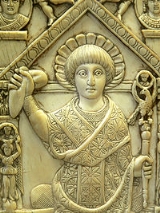
Roman consul

Encyclopedia
A consul served in the highest elected political office of the Roman Republic
.
Each year, two consuls were elected together, to serve for a one-year term. Each consul was given veto
power over his colleague and the officials would alternate each month. However, after the establishment of the Empire, the consuls were merely a figurative representative of Rome’s republican heritage and held very little power and authority, with the Emperor acting as the supreme leader.
King Lucius Tarquinius Superbus
and the end of the Roman Kingdom
, most of the powers and authority of the king were ostensibly given to the newly instituted consulship. Originally, consuls were called praetor
s ("leader"), referring to their duties as the chief military commanders. In 305 BC the name of the office was changed to consul; in Latin
, consulere means "to take counsel". The consul was believed by the Romans to date back to the traditional establishment of the Republic in 509 BC, but the succession of consuls was not continuous in the 5th century BC. Consuls had extensive capacities in peacetime (administrative, legislative and judicial), and in wartime often held the highest military command. Additional religious duties included certain rites which, as a sign of their formal importance, could only be carried out by the highest state officials. Consuls also read auguries, an essential step before leading armies into the field.
Two consuls were elected each year, serving together, each with veto power over the other's actions, a normal principle for magistracies. It is thought that originally only patricians were eligible for the consulship. Consuls were elected by the Comitia Centuriata, which had an aristocratic bias in its voting structure which only increased over the years from its foundation. However, they formally assumed powers only after the ratification of their election in the older Comitia Curiata, which granted the consuls their imperium
by enacting a law, the "lex curiata de imperio
".
According to tradition, the consulship was initially reserved for patricians and only in 367 BC did plebeians win the right to stand for this supreme office, when the Lex Licinia Sextia
provided that at least one consul each year should be plebeian. The first plebeian consul, Lucius Sextius
, was thereby elected the following year. Modern historians have questioned the traditional account of plebeian emancipation during the early Republic (see Conflict of the Orders
), noting for instance that about thirty percent of the consuls prior to Sextius had plebeian, not patrician, names. It is possible that only the chronology has been distorted, but it seems that one of the first consuls, Lucius Junius Brutus
, came from a plebeian family. Another possible explanation is that during the 5th century social struggles, the office of consul was gradually monopolized by a patrician elite.
During times of war, the primary qualification for consul was military skill and reputation, but at all times the selection was politically charged. With the passage of time, the consulship became the normal endpoint of the cursus honorum
, the sequence of offices pursued by the ambitious Roman. When Sulla regulated the cursus by law, the minimum age of election to consul became, in effect, 41 years of age.
Beginning in the late Republic, after finishing a consular year, a former consul would usually serve a lucrative term as a proconsul
, the Roman Governor
of one of the (senatorial) provinces. The most commonly chosen province for the proconsul
ship was Cisalpine Gaul
.
When Augustus
established the Principate
, he changed the political nature of the consulate, stripping it of most of its military powers. While still a great honor — in fact the constitutional head of state, hence eponymous — and a requirement for other offices, many consuls would resign part way through the year to allow other men to finish their term as suffects. Those who held the office on January 1, known as the consules ordinarii (singular, consul ordinarius), had the honor of associating their names with that year. As a result, about half of the men who held the rank of praetor
could also reach the consulship. Sometimes a suffect consul would in turn resign, and another suffect would be appointed. This practice reached its extreme under Commodus
, when in 190 twenty-five men held the consulship.
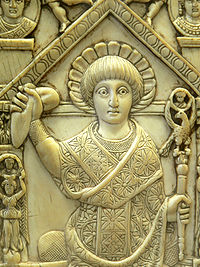 Emperors frequently appointed themselves, or their protégés or relatives, consuls, even without regard to the age requirements. For example, Emperor Honorius
was given the consulship at birth. Cassius Dio states that Caligula
intended to make his horse Incitatus
consul, but was assassinated before he could do so.
Holding the consulship was a great honor and the office was the major symbol of the still republican constitution. Probably as part of seeking formal legitimacy, the break-away Gallic Empire
had its own pairs of consuls during its existence (260–274). The list of consuls for this state is incomplete, drawn from inscriptions and coins.
One of the reforms of Constantine I
(r. 306–337) was to assign one of the consuls to the city of Rome
, and the other to Constantinople
. Therefore, when the Roman Empire was divided into two halves on the death of Theodosius I
(r. 379–395), the emperor of each half acquired the right of appointing one of the consuls—although one emperor did allow his colleague to appoint both consuls for various reasons. The consulship, bereft of any real power, continued to be a great honor, but the celebrations attending it – above all the chariot races – had come to involve considerable expense, which only a few citizens could afford, to the extent that part of the expense had to be covered by the state. In the 6th century, the consulship was increasingly sparsely given, until it was allowed to lapse under Justinian I
(r. 527–565): the western consulship lapsed in 534, with Decius Paulinus the last holder, and the consulship of the East in 541, with Anicius Faustus Albinus Basilius
. Consular dating had already been abolished in 537, when Justinian introduced dating
by the emperor's regnal year and the indiction
. The appointment to consulship became a part of the rite of proclamation of a new emperor from Justin II
(r. 565–578) on, and is last attested in the proclamation of the future Constans II
(r. 641–668) as consul in 632. In the early 9th century, when Emperor Leo the Wise (r. 886–912) finally abolished consular dating with Novel 94. By that time, the Greek titles for consul and ex-consul, "hypatos" and "apo hypaton", had been transformed to relatively lowly honorary dignities. For example, under Nicephorus II Phocas hypatos was a 7th rank in court hierarchy, under Constantine VIII Monomachus it became 8th, under Isaac I Comnenus it became 10th, under Michael VII Doucas it became 11th, under Nicephorus III it became 13th and finally under Alexius I
it occupied 26th position, after which point all ranks lower than 20th were abolished.
Despite this, the title of Roman consul was offered by the Pope to Charles Martel
in 739, although he refused it. In about 853 Alfred the Great
was made Roman consul by the Pope at the age of 4 or 5.
. While the Rex Sacrorum inherited the kings’ position as high priest of the state, the consuls were given the civil and military responsibilities (imperium
). However, to prevent abuse of the kingly power, the imperium was shared by two consuls, each of whom could veto the other’s actions.
The consuls were invested with the executive power
of the state and headed the government of the Republic. Initially, the consuls held vast executive and judicial power. In the gradual development of the Roman legal system, however, some important functions were detached from the consulship and assigned to new officers. Thus, in 443 BC, the responsibility to conduct the census
was taken from the consuls and given to the censors
. The second function taken from the consulship was their judicial power. Their position as chief judges was transferred to the praetor
s in 366 BC. After this time, the consul would only serve as judges in extraordinary criminal cases and only when called upon by decree of the Senate.
(the city of Rome), they were at the head of government
, and all the other magistrates, with the exception of the tribunes of the plebians
, were subordinate to them, but retained independence of office. The internal machinery of the Republic was under the consuls’ superintendence. In order to allow the consuls greater authority in executing laws, the consuls had the right of summons and arrest, which was limited only by the right of appeal from their judgment. This power of punishment even extended to inferior magistrates.
As part of their executive functions, the consuls were responsible for carrying into effect the decrees of the Senate and the laws of the assemblies
. Sometimes, in great emergencies, they might even act on their own authority and responsibility. The consuls also served as the chief diplomat of the Roman state. Before any foreign ambassadors reached the Senate, they met with the consuls. The consul would introduce ambassadors to the Senate, and they alone carried on the negotiations between the Senate and foreign states.
The consuls could convene the Senate, and presided over its meetings. Each consul served as president of the Senate for a month. They could also summon any of the three Roman assemblies
(Curiate, Centuriate, and Tribal) and presided over them. Thus, the consuls conducted the elections and put legislative measures to the vote. When neither consul was within the city, their civic duties were assumed by the praetor
urbanus.
Each consul was accompanied in every public appearance by twelve lictors, who displayed the magnificence of the office and served as his bodyguards. Each lictor
held a fasces
, a bundle of rods that contained an axe. The rods symbolized the power of scourging, and the axe the power of capital punishment. When inside the pomerium, the lictors removed the axes from the fasces to show that a citizen could not be executed without a trial. Upon entering the Comitia Centuriata, the lictors would lower the fasces to show that the powers of the consuls derive from the people (populus romanus).
of all Roman legions. It was in this function that the consuls were vested with full imperium. When legions were ordered by a decree of the Senate, the consuls conducted the levy
in the Campus Martius
. Upon entering the army, all soldiers had to take their oath of allegiance to the consuls. The consuls also oversaw the gathering of troops provided by Rome’s allies.
Within the city a consul could punish and arrest a citizen, but had no power to inflict capital punishment. When on campaign, however, a consul could inflict any punishment he saw fit on any soldier, officer, citizen or ally.
Each consul commanded an army, usually two legions strong, with the help of military tribunes and a quaestor
who had financial duties. In the rare case that both consuls marched together, each one held the command for a day respectively. A typical consular army was about 20,000 men strong and consisted of two citizen and two allied legions. In the early years of the Republic, Rome's enemies were located in central Italy, so campaigns lasted a few months. As Rome's frontiers expanded, in the 2nd century BC, the campaigns became lengthier. Rome was a warlike society, and very seldom did not wage war. So the consul upon entering office was expected by the Senate and the People to march his army against Rome's enemies, and expand the Roman frontiers. His soldiers expected to return to their homes after the campaign with spoils. If the consul won an overwhelming victory, he was hailed as imperator
by his troops, and could request to be granted a triumph
.
The consul could conduct the campaign as he saw fit, and had unlimited powers. However, after the campaign, he could be prosecuted for his misdeeds (for example for abusing the provinces, or wasting public money, as Scipio Africanus was accused by Cato in 205 BC).
was prevented with each consul given the power to veto
his colleague. Therefore, except in the provinces as commanders-in-chief where each consul’s power was supreme, the consuls could only act in unison, or, at least, not against each other's determined will. Against the sentence of one consul, an appeal could be brought before his colleague, which, if successful, would see the sentence overturned. In order to avoid unnecessary conflicts, only one consul would actually perform the office’s duties every month. This is not to say that the other consul held no power but merely allowed the first consul to act without direct interference. Then in the next month, the consuls would switch roles with one another. This would continue until the end of the consular term.
Another point which acted as a check against consuls was the certainty that after the end of their term they would be called to account for their actions while in office.
There were also three other restrictions on consular power. Their term in office was short (one year); their duties were pre-decided by the Senate; and they could not stand again for election immediately after the end of their office. Usually a period of ten years was expected between consulships.
Imperium, the consul would become a proconsul
and governor of one (or several) of Rome’s many provinces. As a proconsul, his imperium was limited to only a specified province and not the entire Republic. Any exercise of proconsular imperium in any other province was illegal. Also, a proconsul was not allowed to leave his province before his term was complete or before the arrival of his successor. Exceptions were given only on special permission of the Senate. Most terms as governor lasted between one and five years.
was appointed by the consuls for a period of no more than six months, after the proposition of the Senate. While the dictator held office, the imperium of the consuls was suspended.
became the first Roman emperor
in 27 BC with the establishment of the principate
, the consuls lost most of their powers and responsibilities under the Roman Empire
. Though still officially the highest office of the state, with the emperor’s superior imperium they were merely a symbol of Rome’s republican heritage. One of the two consular position was often occupied by emperors themselves and eventually became reserved solely for the Emperor. However, the imperial consuls still maintained the right to preside at meetings of the Senate, exercising this right at the pleasure of the Emperor. They partially administered justice in extraordinary cases, and presented games in the Circus Maximus
and all public solemnities in honor of the Emperor at their own expense.
After the expiration of their offices, the ex-consuls (proconsuls) went on to govern one of the provinces that were administered by the Senate. They usually served terms of three to five years.
in a monarchy) by the two consuls' names, though there was a more practical numerical dating ab urbe condita
(i.e. by the era
starting with the mythical foundation year of Rome). For instance, the year 59 BC in the modern calendar was called by the Romans "the consulship of Caesar and Bibulus", since the two colleagues in the consulship were (Gaius) Julius Caesar
and Marcus Calpurnius Bibulus
—although Caesar dominated the consulship so thoroughly that year that it was jokingly referred to as "the consulship of Julius and Caesar".
In Latin, the ablative absolute
construction is frequently used to express the date, such as "M. Messalla et M. Pupio Pisone consulibus", translated literally as "With Marcus Messalla
and Marcus Pupius Piso
being consuls", which appears in Caesar's De Bello Gallico.
Roman Republic
The Roman Republic was the period of the ancient Roman civilization where the government operated as a republic. It began with the overthrow of the Roman monarchy, traditionally dated around 508 BC, and its replacement by a government headed by two consuls, elected annually by the citizens and...
.
Each year, two consuls were elected together, to serve for a one-year term. Each consul was given veto
Veto
A veto, Latin for "I forbid", is the power of an officer of the state to unilaterally stop an official action, especially enactment of a piece of legislation...
power over his colleague and the officials would alternate each month. However, after the establishment of the Empire, the consuls were merely a figurative representative of Rome’s republican heritage and held very little power and authority, with the Emperor acting as the supreme leader.
Under the Republic
After the legendary expulsion of the last EtruscanEtruscan civilization
Etruscan civilization is the modern English name given to a civilization of ancient Italy in the area corresponding roughly to Tuscany. The ancient Romans called its creators the Tusci or Etrusci...
King Lucius Tarquinius Superbus
Lucius Tarquinius Superbus
Lucius Tarquinius Superbus was the legendary seventh and final King of Rome, reigning from 535 BC until the popular uprising in 509 BC that led to the establishment of the Roman Republic. He is more commonly known by his cognomen Tarquinius Superbus and was a member of the so-called Etruscan...
and the end of the Roman Kingdom
Roman Kingdom
The Roman Kingdom was the period of the ancient Roman civilization characterized by a monarchical form of government of the city of Rome and its territories....
, most of the powers and authority of the king were ostensibly given to the newly instituted consulship. Originally, consuls were called praetor
Praetor
Praetor was a title granted by the government of Ancient Rome to men acting in one of two official capacities: the commander of an army, usually in the field, or the named commander before mustering the army; and an elected magistratus assigned varied duties...
s ("leader"), referring to their duties as the chief military commanders. In 305 BC the name of the office was changed to consul; in Latin
Latin
Latin is an Italic language originally spoken in Latium and Ancient Rome. It, along with most European languages, is a descendant of the ancient Proto-Indo-European language. Although it is considered a dead language, a number of scholars and members of the Christian clergy speak it fluently, and...
, consulere means "to take counsel". The consul was believed by the Romans to date back to the traditional establishment of the Republic in 509 BC, but the succession of consuls was not continuous in the 5th century BC. Consuls had extensive capacities in peacetime (administrative, legislative and judicial), and in wartime often held the highest military command. Additional religious duties included certain rites which, as a sign of their formal importance, could only be carried out by the highest state officials. Consuls also read auguries, an essential step before leading armies into the field.
Two consuls were elected each year, serving together, each with veto power over the other's actions, a normal principle for magistracies. It is thought that originally only patricians were eligible for the consulship. Consuls were elected by the Comitia Centuriata, which had an aristocratic bias in its voting structure which only increased over the years from its foundation. However, they formally assumed powers only after the ratification of their election in the older Comitia Curiata, which granted the consuls their imperium
Imperium
Imperium is a Latin word which, in a broad sense, translates roughly as 'power to command'. In ancient Rome, different kinds of power or authority were distinguished by different terms. Imperium, referred to the sovereignty of the state over the individual...
by enacting a law, the "lex curiata de imperio
Lex curiata de imperio
In the constitution of ancient Rome, the lex curiata de imperio was the law confirming the rights of higher magistrates to hold power, or imperium...
".
According to tradition, the consulship was initially reserved for patricians and only in 367 BC did plebeians win the right to stand for this supreme office, when the Lex Licinia Sextia
Lex Licinia Sextia
Lex Licinia Sextia was a Roman law introduced around 376 BCE and enacted in 367 BCE. It restored the consulship, allegedly reserved one of the two consular positions for a plebeian , and introduced new limits on the possession of conquered land.- Authors :It is named for the plebeian tribunes Gaius...
provided that at least one consul each year should be plebeian. The first plebeian consul, Lucius Sextius
Lucius Sextius
Lucius Sextius Lateranus was a Roman tribune of the plebs and is noted for having been one of two men behind the Lex Licinia Sextia, permitting him in 366 BC to become what is often considered the "first plebeian consul"...
, was thereby elected the following year. Modern historians have questioned the traditional account of plebeian emancipation during the early Republic (see Conflict of the Orders
Conflict of the Orders
The Conflict of the Orders, also referred to as the Struggle of the Orders, was a political struggle between the Plebeians and Patricians of the ancient Roman Republic, in which the Plebeians sought political equality with the Patricians. It played a major role in the development of the...
), noting for instance that about thirty percent of the consuls prior to Sextius had plebeian, not patrician, names. It is possible that only the chronology has been distorted, but it seems that one of the first consuls, Lucius Junius Brutus
Lucius Junius Brutus
Lucius Junius Brutus was the founder of the Roman Republic and traditionally one of the first consuls in 509 BC. He was claimed as an ancestor of the Roman gens Junia, including Marcus Junius Brutus, the most famous of Caesar's assassins.- Background :...
, came from a plebeian family. Another possible explanation is that during the 5th century social struggles, the office of consul was gradually monopolized by a patrician elite.
During times of war, the primary qualification for consul was military skill and reputation, but at all times the selection was politically charged. With the passage of time, the consulship became the normal endpoint of the cursus honorum
Cursus honorum
The cursus honorum was the sequential order of public offices held by aspiring politicians in both the Roman Republic and the early Empire. It was designed for men of senatorial rank. The cursus honorum comprised a mixture of military and political administration posts. Each office had a minimum...
, the sequence of offices pursued by the ambitious Roman. When Sulla regulated the cursus by law, the minimum age of election to consul became, in effect, 41 years of age.
Beginning in the late Republic, after finishing a consular year, a former consul would usually serve a lucrative term as a proconsul
Proconsul
A proconsul was a governor of a province in the Roman Republic appointed for one year by the senate. In modern usage, the title has been used for a person from one country ruling another country or bluntly interfering in another country's internal affairs.-Ancient Rome:In the Roman Republic, a...
, the Roman Governor
Roman governor
A Roman governor was an official either elected or appointed to be the chief administrator of Roman law throughout one or more of the many provinces constituting the Roman Empire...
of one of the (senatorial) provinces. The most commonly chosen province for the proconsul
Proconsul
A proconsul was a governor of a province in the Roman Republic appointed for one year by the senate. In modern usage, the title has been used for a person from one country ruling another country or bluntly interfering in another country's internal affairs.-Ancient Rome:In the Roman Republic, a...
ship was Cisalpine Gaul
Cisalpine Gaul
Cisalpine Gaul, in Latin: Gallia Cisalpina or Citerior, also called Gallia Togata, was a Roman province until 41 BC when it was merged into Roman Italy.It bore the name Gallia, because the great body of its inhabitants, after the expulsion of the Etruscans, consisted of Gauls or Celts...
.
Consul suffectus
If a consul died during his term (not uncommon when consuls were in the forefront of battle) or was removed from office, another would be elected to serve the remainder of the term as consul suffectus, or suffect consul.When Augustus
Augustus
Augustus ;23 September 63 BC – 19 August AD 14) is considered the first emperor of the Roman Empire, which he ruled alone from 27 BC until his death in 14 AD.The dates of his rule are contemporary dates; Augustus lived under two calendars, the Roman Republican until 45 BC, and the Julian...
established the Principate
Principate
The Principate is the first period of the Roman Empire, extending from the beginning of the reign of Caesar Augustus to the Crisis of the Third Century, after which it was replaced with the Dominate. The Principate is characterized by a concerted effort on the part of the Emperors to preserve the...
, he changed the political nature of the consulate, stripping it of most of its military powers. While still a great honor — in fact the constitutional head of state, hence eponymous — and a requirement for other offices, many consuls would resign part way through the year to allow other men to finish their term as suffects. Those who held the office on January 1, known as the consules ordinarii (singular, consul ordinarius), had the honor of associating their names with that year. As a result, about half of the men who held the rank of praetor
Praetor
Praetor was a title granted by the government of Ancient Rome to men acting in one of two official capacities: the commander of an army, usually in the field, or the named commander before mustering the army; and an elected magistratus assigned varied duties...
could also reach the consulship. Sometimes a suffect consul would in turn resign, and another suffect would be appointed. This practice reached its extreme under Commodus
Commodus
Commodus , was Roman Emperor from 180 to 192. He also ruled as co-emperor with his father Marcus Aurelius from 177 until his father's death in 180. His name changed throughout his reign; see changes of name for earlier and later forms. His accession as emperor was the first time a son had succeeded...
, when in 190 twenty-five men held the consulship.
Under the Empire
Honorius (emperor)
Honorius , was Western Roman Emperor from 395 to 423. He was the younger son of emperor Theodosius I and his first wife Aelia Flaccilla, and brother of the eastern emperor Arcadius....
was given the consulship at birth. Cassius Dio states that Caligula
Caligula
Caligula , also known as Gaius, was Roman Emperor from 37 AD to 41 AD. Caligula was a member of the house of rulers conventionally known as the Julio-Claudian dynasty. Caligula's father Germanicus, the nephew and adopted son of Emperor Tiberius, was a very successful general and one of Rome's most...
intended to make his horse Incitatus
Incitatus
Incitatus was the favored horse of Roman emperor Caligula. Its name is a Latin adjective meaning "swift" or "at full gallop".According to Suetonius's Lives of the Twelve Caesars, Incitatus had a stable of marble, with an ivory manger, purple blankets, and a collar of precious stones...
consul, but was assassinated before he could do so.
Holding the consulship was a great honor and the office was the major symbol of the still republican constitution. Probably as part of seeking formal legitimacy, the break-away Gallic Empire
Gallic Empire
The Gallic Empire is the modern name for a breakaway realm that existed from 260 to 274. It originated during the Roman Empire's Crisis of the Third Century....
had its own pairs of consuls during its existence (260–274). The list of consuls for this state is incomplete, drawn from inscriptions and coins.
One of the reforms of Constantine I
Constantine I
Constantine the Great , also known as Constantine I or Saint Constantine, was Roman Emperor from 306 to 337. Well known for being the first Roman emperor to convert to Christianity, Constantine and co-Emperor Licinius issued the Edict of Milan in 313, which proclaimed religious tolerance of all...
(r. 306–337) was to assign one of the consuls to the city of Rome
Rome
Rome is the capital of Italy and the country's largest and most populated city and comune, with over 2.7 million residents in . The city is located in the central-western portion of the Italian Peninsula, on the Tiber River within the Lazio region of Italy.Rome's history spans two and a half...
, and the other to Constantinople
Constantinople
Constantinople was the capital of the Roman, Eastern Roman, Byzantine, Latin, and Ottoman Empires. Throughout most of the Middle Ages, Constantinople was Europe's largest and wealthiest city.-Names:...
. Therefore, when the Roman Empire was divided into two halves on the death of Theodosius I
Theodosius I
Theodosius I , also known as Theodosius the Great, was Roman Emperor from 379 to 395. Theodosius was the last emperor to rule over both the eastern and the western halves of the Roman Empire. During his reign, the Goths secured control of Illyricum after the Gothic War, establishing their homeland...
(r. 379–395), the emperor of each half acquired the right of appointing one of the consuls—although one emperor did allow his colleague to appoint both consuls for various reasons. The consulship, bereft of any real power, continued to be a great honor, but the celebrations attending it – above all the chariot races – had come to involve considerable expense, which only a few citizens could afford, to the extent that part of the expense had to be covered by the state. In the 6th century, the consulship was increasingly sparsely given, until it was allowed to lapse under Justinian I
Justinian I
Justinian I ; , ; 483– 13 or 14 November 565), commonly known as Justinian the Great, was Byzantine Emperor from 527 to 565. During his reign, Justinian sought to revive the Empire's greatness and reconquer the lost western half of the classical Roman Empire.One of the most important figures of...
(r. 527–565): the western consulship lapsed in 534, with Decius Paulinus the last holder, and the consulship of the East in 541, with Anicius Faustus Albinus Basilius
Anicius Faustus Albinus Basilius
Anicius Faustus Albinus Basilius was a high official of the Eastern Roman Empire and the last consul of Roman history, holding the office in 541.- Biography :...
. Consular dating had already been abolished in 537, when Justinian introduced dating
Byzantine calendar
The Byzantine calendar, also "Creation Era of Constantinople," or "Era of the World" was the calendar used by the Eastern Orthodox Church from c. 691 to 1728 in the Ecumenical Patriarchate. It was also the official calendar of the Byzantine Empire from 988 to 1453, and in Russia from c...
by the emperor's regnal year and the indiction
Indiction
An indiction is any of the years in a 15-year cycle used to date medieval documents throughout Europe, both East and West. Each year of a cycle was numbered: first indiction, second indiction, etc...
. The appointment to consulship became a part of the rite of proclamation of a new emperor from Justin II
Justin II
Justin II was Byzantine Emperor from 565 to 578. He was the husband of Sophia, nephew of Justinian I and the late Empress Theodora, and was therefore a member of the Justinian Dynasty. His reign is marked by war with Persia and the loss of the greater part of Italy...
(r. 565–578) on, and is last attested in the proclamation of the future Constans II
Constans II
Constans II , also called Constantine the Bearded , was Byzantine emperor from 641 to 668. He also was the last emperor to become consul in 642, becoming the last Roman consul in history....
(r. 641–668) as consul in 632. In the early 9th century, when Emperor Leo the Wise (r. 886–912) finally abolished consular dating with Novel 94. By that time, the Greek titles for consul and ex-consul, "hypatos" and "apo hypaton", had been transformed to relatively lowly honorary dignities. For example, under Nicephorus II Phocas hypatos was a 7th rank in court hierarchy, under Constantine VIII Monomachus it became 8th, under Isaac I Comnenus it became 10th, under Michael VII Doucas it became 11th, under Nicephorus III it became 13th and finally under Alexius I
Alexius I
Alexius I may refer to:*Alexios I Komnenos , Byzantine Emperor *Alexios I of Trebizond , great-great-grandson of the above, Emperor of Trapezunt...
it occupied 26th position, after which point all ranks lower than 20th were abolished.
Despite this, the title of Roman consul was offered by the Pope to Charles Martel
Charles Martel
Charles Martel , also known as Charles the Hammer, was a Frankish military and political leader, who served as Mayor of the Palace under the Merovingian kings and ruled de facto during an interregnum at the end of his life, using the title Duke and Prince of the Franks. In 739 he was offered the...
in 739, although he refused it. In about 853 Alfred the Great
Alfred the Great
Alfred the Great was King of Wessex from 871 to 899.Alfred is noted for his defence of the Anglo-Saxon kingdoms of southern England against the Vikings, becoming the only English monarch still to be accorded the epithet "the Great". Alfred was the first King of the West Saxons to style himself...
was made Roman consul by the Pope at the age of 4 or 5.
Republican duties
After the expulsion of the kings and the establishment of the Republic, all the powers that had belonged to the kings were transferred to two offices: that of the consuls and the Rex SacrorumRex Sacrorum
In ancient Roman religion, the rex sacrorum was a senatorial priesthood reserved for patricians. Although in the historical era the pontifex maximus was the head of Roman state religion, Festus says that in the ranking of priests, the rex sacrorum was of highest prestige, followed by the flamines...
. While the Rex Sacrorum inherited the kings’ position as high priest of the state, the consuls were given the civil and military responsibilities (imperium
Imperium
Imperium is a Latin word which, in a broad sense, translates roughly as 'power to command'. In ancient Rome, different kinds of power or authority were distinguished by different terms. Imperium, referred to the sovereignty of the state over the individual...
). However, to prevent abuse of the kingly power, the imperium was shared by two consuls, each of whom could veto the other’s actions.
The consuls were invested with the executive power
Executive (government)
Executive branch of Government is the part of government that has sole authority and responsibility for the daily administration of the state bureaucracy. The division of power into separate branches of government is central to the idea of the separation of powers.In many countries, the term...
of the state and headed the government of the Republic. Initially, the consuls held vast executive and judicial power. In the gradual development of the Roman legal system, however, some important functions were detached from the consulship and assigned to new officers. Thus, in 443 BC, the responsibility to conduct the census
Census
A census is the procedure of systematically acquiring and recording information about the members of a given population. It is a regularly occurring and official count of a particular population. The term is used mostly in connection with national population and housing censuses; other common...
was taken from the consuls and given to the censors
Censor (ancient Rome)
The censor was an officer in ancient Rome who was responsible for maintaining the census, supervising public morality, and overseeing certain aspects of the government's finances....
. The second function taken from the consulship was their judicial power. Their position as chief judges was transferred to the praetor
Praetor
Praetor was a title granted by the government of Ancient Rome to men acting in one of two official capacities: the commander of an army, usually in the field, or the named commander before mustering the army; and an elected magistratus assigned varied duties...
s in 366 BC. After this time, the consul would only serve as judges in extraordinary criminal cases and only when called upon by decree of the Senate.
Civil sphere
For the most part, power was divided between civil and military spheres. As long as the consuls were in the pomeriumPomerium
The pomerium or pomoerium , was the sacred boundary of the city of Rome. In legal terms, Rome existed only within the pomerium; everything beyond it was simply territory belonging to Rome.-Location and extensions:Tradition maintained that it was the original line ploughed by Romulus around the...
(the city of Rome), they were at the head of government
Head of government
Head of government is the chief officer of the executive branch of a government, often presiding over a cabinet. In a parliamentary system, the head of government is often styled prime minister, chief minister, premier, etc...
, and all the other magistrates, with the exception of the tribunes of the plebians
Tribune
Tribune was a title shared by elected officials in the Roman Republic. Tribunes had the power to convene the Plebeian Council and to act as its president, which also gave them the right to propose legislation before it. They were sacrosanct, in the sense that any assault on their person was...
, were subordinate to them, but retained independence of office. The internal machinery of the Republic was under the consuls’ superintendence. In order to allow the consuls greater authority in executing laws, the consuls had the right of summons and arrest, which was limited only by the right of appeal from their judgment. This power of punishment even extended to inferior magistrates.
As part of their executive functions, the consuls were responsible for carrying into effect the decrees of the Senate and the laws of the assemblies
Roman assemblies
The Legislative Assemblies of the Roman Republic were political institutions in the ancient Roman Republic. According to the contemporary historian Polybius, it was the people who had the final say regarding the election of magistrates, the enactment of new statutes, the carrying out of capital...
. Sometimes, in great emergencies, they might even act on their own authority and responsibility. The consuls also served as the chief diplomat of the Roman state. Before any foreign ambassadors reached the Senate, they met with the consuls. The consul would introduce ambassadors to the Senate, and they alone carried on the negotiations between the Senate and foreign states.
The consuls could convene the Senate, and presided over its meetings. Each consul served as president of the Senate for a month. They could also summon any of the three Roman assemblies
Roman assemblies
The Legislative Assemblies of the Roman Republic were political institutions in the ancient Roman Republic. According to the contemporary historian Polybius, it was the people who had the final say regarding the election of magistrates, the enactment of new statutes, the carrying out of capital...
(Curiate, Centuriate, and Tribal) and presided over them. Thus, the consuls conducted the elections and put legislative measures to the vote. When neither consul was within the city, their civic duties were assumed by the praetor
Praetor
Praetor was a title granted by the government of Ancient Rome to men acting in one of two official capacities: the commander of an army, usually in the field, or the named commander before mustering the army; and an elected magistratus assigned varied duties...
urbanus.
Each consul was accompanied in every public appearance by twelve lictors, who displayed the magnificence of the office and served as his bodyguards. Each lictor
Lictor
The lictor was a member of a special class of Roman civil servant, with special tasks of attending and guarding magistrates of the Roman Republic and Empire who held imperium, the right and power to command; essentially, a bodyguard...
held a fasces
Fasces
Fasces are a bundle of wooden sticks with an axe blade emerging from the center, which is an image that traditionally symbolizes summary power and jurisdiction, and/or "strength through unity"...
, a bundle of rods that contained an axe. The rods symbolized the power of scourging, and the axe the power of capital punishment. When inside the pomerium, the lictors removed the axes from the fasces to show that a citizen could not be executed without a trial. Upon entering the Comitia Centuriata, the lictors would lower the fasces to show that the powers of the consuls derive from the people (populus romanus).
Military sphere
Outside the walls of Rome, the powers of the consuls were far more extensive in their role as commanders-in-chiefCommander-in-Chief
A commander-in-chief is the commander of a nation's military forces or significant element of those forces. In the latter case, the force element may be defined as those forces within a particular region or those forces which are associated by function. As a practical term it refers to the military...
of all Roman legions. It was in this function that the consuls were vested with full imperium. When legions were ordered by a decree of the Senate, the consuls conducted the levy
Conscription
Conscription is the compulsory enlistment of people in some sort of national service, most often military service. Conscription dates back to antiquity and continues in some countries to the present day under various names...
in the Campus Martius
Campus Martius
The Campus Martius , was a publicly owned area of ancient Rome about in extent. In the Middle Ages, it was the most populous area of Rome...
. Upon entering the army, all soldiers had to take their oath of allegiance to the consuls. The consuls also oversaw the gathering of troops provided by Rome’s allies.
Within the city a consul could punish and arrest a citizen, but had no power to inflict capital punishment. When on campaign, however, a consul could inflict any punishment he saw fit on any soldier, officer, citizen or ally.
Each consul commanded an army, usually two legions strong, with the help of military tribunes and a quaestor
Quaestor
A Quaestor was a type of public official in the "Cursus honorum" system who supervised financial affairs. In the Roman Republic a quaestor was an elected official whereas, with the autocratic government of the Roman Empire, quaestors were simply appointed....
who had financial duties. In the rare case that both consuls marched together, each one held the command for a day respectively. A typical consular army was about 20,000 men strong and consisted of two citizen and two allied legions. In the early years of the Republic, Rome's enemies were located in central Italy, so campaigns lasted a few months. As Rome's frontiers expanded, in the 2nd century BC, the campaigns became lengthier. Rome was a warlike society, and very seldom did not wage war. So the consul upon entering office was expected by the Senate and the People to march his army against Rome's enemies, and expand the Roman frontiers. His soldiers expected to return to their homes after the campaign with spoils. If the consul won an overwhelming victory, he was hailed as imperator
Imperator
The Latin word Imperator was originally a title roughly equivalent to commander under the Roman Republic. Later it became a part of the titulature of the Roman Emperors as part of their cognomen. The English word emperor derives from imperator via Old French Empreur...
by his troops, and could request to be granted a triumph
Roman triumph
The Roman triumph was a civil ceremony and religious rite of ancient Rome, held to publicly celebrate and sanctify the military achievement of an army commander who had won great military successes, or originally and traditionally, one who had successfully completed a foreign war. In Republican...
.
The consul could conduct the campaign as he saw fit, and had unlimited powers. However, after the campaign, he could be prosecuted for his misdeeds (for example for abusing the provinces, or wasting public money, as Scipio Africanus was accused by Cato in 205 BC).
Abuse prevention
Abuse of consular powerAbuse of Power
Abuse of Power is a novel written by radio talk show host Michael Savage.- Plot :Jack Hatfield is a hardened former war correspondent who rose to national prominence for his insightful, provocative commentary...
was prevented with each consul given the power to veto
Veto
A veto, Latin for "I forbid", is the power of an officer of the state to unilaterally stop an official action, especially enactment of a piece of legislation...
his colleague. Therefore, except in the provinces as commanders-in-chief where each consul’s power was supreme, the consuls could only act in unison, or, at least, not against each other's determined will. Against the sentence of one consul, an appeal could be brought before his colleague, which, if successful, would see the sentence overturned. In order to avoid unnecessary conflicts, only one consul would actually perform the office’s duties every month. This is not to say that the other consul held no power but merely allowed the first consul to act without direct interference. Then in the next month, the consuls would switch roles with one another. This would continue until the end of the consular term.
Another point which acted as a check against consuls was the certainty that after the end of their term they would be called to account for their actions while in office.
There were also three other restrictions on consular power. Their term in office was short (one year); their duties were pre-decided by the Senate; and they could not stand again for election immediately after the end of their office. Usually a period of ten years was expected between consulships.
Governorship
After leaving office, the consuls were assigned by the Senate to a province to administer as governor. The provinces each consul was assigned were drawn by lot and determined before the end of his consulship. Transferring his consular imperium to proconsularPromagistrate
A promagistrate is a person who acts in and with the authority and capacity of a magistrate, but without holding a magisterial office. A legal innovation of the Roman Republic, the promagistracy was invented in order to provide Rome with governors of overseas territories instead of having to elect...
Imperium, the consul would become a proconsul
Proconsul
A proconsul was a governor of a province in the Roman Republic appointed for one year by the senate. In modern usage, the title has been used for a person from one country ruling another country or bluntly interfering in another country's internal affairs.-Ancient Rome:In the Roman Republic, a...
and governor of one (or several) of Rome’s many provinces. As a proconsul, his imperium was limited to only a specified province and not the entire Republic. Any exercise of proconsular imperium in any other province was illegal. Also, a proconsul was not allowed to leave his province before his term was complete or before the arrival of his successor. Exceptions were given only on special permission of the Senate. Most terms as governor lasted between one and five years.
Appointment of the dictator
In times of crisis ,when Rome's territory was in immediate danger, a dictatorRoman dictator
In the Roman Republic, the dictator , was an extraordinary magistrate with the absolute authority to perform tasks beyond the authority of the ordinary magistrate . The office of dictator was a legal innovation originally named Magister Populi , i.e...
was appointed by the consuls for a period of no more than six months, after the proposition of the Senate. While the dictator held office, the imperium of the consuls was suspended.
Imperial duties
After AugustusAugustus
Augustus ;23 September 63 BC – 19 August AD 14) is considered the first emperor of the Roman Empire, which he ruled alone from 27 BC until his death in 14 AD.The dates of his rule are contemporary dates; Augustus lived under two calendars, the Roman Republican until 45 BC, and the Julian...
became the first Roman emperor
Roman Emperor
The Roman emperor was the ruler of the Roman State during the imperial period . The Romans had no single term for the office although at any given time, a given title was associated with the emperor...
in 27 BC with the establishment of the principate
Principate
The Principate is the first period of the Roman Empire, extending from the beginning of the reign of Caesar Augustus to the Crisis of the Third Century, after which it was replaced with the Dominate. The Principate is characterized by a concerted effort on the part of the Emperors to preserve the...
, the consuls lost most of their powers and responsibilities under the Roman Empire
Roman Empire
The Roman Empire was the post-Republican period of the ancient Roman civilization, characterised by an autocratic form of government and large territorial holdings in Europe and around the Mediterranean....
. Though still officially the highest office of the state, with the emperor’s superior imperium they were merely a symbol of Rome’s republican heritage. One of the two consular position was often occupied by emperors themselves and eventually became reserved solely for the Emperor. However, the imperial consuls still maintained the right to preside at meetings of the Senate, exercising this right at the pleasure of the Emperor. They partially administered justice in extraordinary cases, and presented games in the Circus Maximus
Circus Maximus
The Circus Maximus is an ancient Roman chariot racing stadium and mass entertainment venue located in Rome, Italy. Situated in the valley between the Aventine and Palatine hills, it was the first and largest stadium in ancient Rome and its later Empire...
and all public solemnities in honor of the Emperor at their own expense.
After the expiration of their offices, the ex-consuls (proconsuls) went on to govern one of the provinces that were administered by the Senate. They usually served terms of three to five years.
Consular dating
The highest magistrates were eponymous, i.e. each year was officially identified (like a regnal yearRegnal year
A regnal year is a year of the reign of a sovereign, from the Latin regnum meaning kingdom, rule.The oldest dating systems were in regnal years, and considered the date as an ordinal, not a cardinal number. For example, a monarch could have a first year of rule, a second year of rule, a third, and...
in a monarchy) by the two consuls' names, though there was a more practical numerical dating ab urbe condita
Ab urbe condita
Ab urbe condita is Latin for "from the founding of the City ", traditionally set in 753 BC. AUC is a year-numbering system used by some ancient Roman historians to identify particular Roman years...
(i.e. by the era
Era
An era is a commonly used word for long period of time. When used in science, for example geology, eras denote clearly defined periods of time of arbitrary but well defined length, such as for example the Mesozoic era from 252 Ma–66 Ma, delimited by a start event and an end event. When used in...
starting with the mythical foundation year of Rome). For instance, the year 59 BC in the modern calendar was called by the Romans "the consulship of Caesar and Bibulus", since the two colleagues in the consulship were (Gaius) Julius Caesar
Julius Caesar
Gaius Julius Caesar was a Roman general and statesman and a distinguished writer of Latin prose. He played a critical role in the gradual transformation of the Roman Republic into the Roman Empire....
and Marcus Calpurnius Bibulus
Marcus Calpurnius Bibulus
Marcus Calpurnius Bibulus was a politician of the late Roman Republic.Bibulus was the son in law of Marcus Porcius Cato Uticencis. In 59 BC he was elected consul, supported by the optimates, conservative republicans in the Senate and opponents of Julius Caesar's triumvirate...
—although Caesar dominated the consulship so thoroughly that year that it was jokingly referred to as "the consulship of Julius and Caesar".
In Latin, the ablative absolute
Latin grammar
The grammar of Latin, like that of other ancient Indo-European languages, is highly inflected; consequently, it allows for a large degree of flexibility in choosing word order...
construction is frequently used to express the date, such as "M. Messalla et M. Pupio Pisone consulibus", translated literally as "With Marcus Messalla
Marcus Valerius Messalla Niger
Marcus Valerius Messalla Niger was a senator of the Roman Republic.He was praetor in the year of Cicero's consulship, 63 BC, and consul in 61, the year in which Publius Clodius profaned the mysteries of the Bona Dea, and Gnaeus Pompeius triumphed for his several victories over the Cilician pirates,...
and Marcus Pupius Piso
Marcus Pupius Piso Frugi Calpurnianus
Marcus Pupius Piso Frugi Calpurnianus belonged originally to the gens Calpurnia, but was adopted by Marcus Pupius, when the latter was an old man. He retained, however, his family-name Piso.Piso had attained some importance as early as the first civil war...
being consuls", which appears in Caesar's De Bello Gallico.
Lists of Roman consuls
For a complete list of Roman consuls, see:See also
- Constitution of the Roman RepublicConstitution of the Roman RepublicThe Constitution of the Roman Republic was a set of guidelines and principles passed down mainly through precedent. The constitution was largely unwritten, uncodified, and constantly evolving...
- French ConsulateFrench ConsulateThe Consulate was the government of France between the fall of the Directory in the coup of 18 Brumaire in 1799 until the start of the Napoleonic Empire in 1804...
- List of Roman consuls