


Praetorian Guard

Encyclopedia
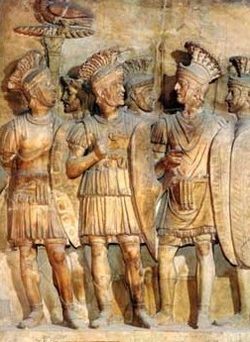
Bodyguard
A bodyguard is a type of security operative or government agent who protects a person—usually a famous, wealthy, or politically important figure—from assault, kidnapping, assassination, stalking, loss of confidential information, terrorist attack or other threats.Most important public figures such...
s used by Roman
Roman Empire
The Roman Empire was the post-Republican period of the ancient Roman civilization, characterised by an autocratic form of government and large territorial holdings in Europe and around the Mediterranean....
Emperors. The title was already used during the Roman Republic for the guards of Roman generals, at least since the rise to prominence of the Scipio
Scipio (cognomen)
Scipio is a Roman cognomen representing the Cornelii Scipiones, a branch of the Cornelii family. Any individual male of the branch must be named Cornelius Scipio and a female Cornelia. The nomen, Cornelius, signifies that the person belongs to the Cornelia gens, a legally defined clan composed of...
family around 275 BC. The Guard was dissolved by Emperor Constantine I
Constantine I
Constantine the Great , also known as Constantine I or Saint Constantine, was Roman Emperor from 306 to 337. Well known for being the first Roman emperor to convert to Christianity, Constantine and co-Emperor Licinius issued the Edict of Milan in 313, which proclaimed religious tolerance of all...
in the 4th century.
History
The term Praetorian derived from the tent of the commanding general or praetorPraetor
Praetor was a title granted by the government of Ancient Rome to men acting in one of two official capacities: the commander of an army, usually in the field, or the named commander before mustering the army; and an elected magistratus assigned varied duties...
of a Roman army
Roman army
The Roman army is the generic term for the terrestrial armed forces deployed by the kingdom of Rome , the Roman Republic , the Roman Empire and its successor, the Byzantine empire...
in the field—the praetorium
Praetorium
- Etemology :The praetorium, also spelled prœtorium or pretorium, was originally used to identify the general’s tent within a Roman Castra, Castellum, or encampment. The word originates from the name of the chief Roman magistrate, known as Praetor...
. They were an elite recruitment of Italians (Roman citizens and Latins). The emperors also often employed a small separate unit of bodyguards, distinct from and, in a degree, as a counterbalance to the Praetorian Guard . It was a habit of many Roman generals to choose from the ranks a private force of soldiers to act as guards of the tent or the person. They consisted of both infantry and cavalry. In time, this cohort
Cohort (military unit)
A cohort was the basic tactical unit of a Roman legion following the reforms of Gaius Marius in 107 BC.-Legionary cohort:...
came to be known as the cohors praetoria, and various notable figures possessed one, including Julius Caesar
Julius Caesar
Gaius Julius Caesar was a Roman general and statesman and a distinguished writer of Latin prose. He played a critical role in the gradual transformation of the Roman Republic into the Roman Empire....
, Mark Antony
Mark Antony
Marcus Antonius , known in English as Mark Antony, was a Roman politician and general. As a military commander and administrator, he was an important supporter and loyal friend of his mother's cousin Julius Caesar...
and Augustus
Augustus
Augustus ;23 September 63 BC – 19 August AD 14) is considered the first emperor of the Roman Empire, which he ruled alone from 27 BC until his death in 14 AD.The dates of his rule are contemporary dates; Augustus lived under two calendars, the Roman Republican until 45 BC, and the Julian...
(Octavian). As Caesar discovered with the Legio X Equestris
Legio X Equestris
Legio X Equestris , a Roman legion, was levied by Julius Caesar in 61 BC when he was the Governor of Hispania Ulterior. The Tenth was the first legion levied personally by Caesar, and was consistently his most trusted...
, a powerful unit more dangerous than its fellow legions was desirable in the field. When Augustus became the first ruler of the Roman Empire
Roman Empire
The Roman Empire was the post-Republican period of the ancient Roman civilization, characterised by an autocratic form of government and large territorial holdings in Europe and around the Mediterranean....
in 27 BC, he decided such a formation was useful not only on the battlefield but in politics also. Thus, from the ranks of the legions throughout the provinces, Augustus recruited the Praetorian Guard.
Original form of the Guard
The group that was formed initially differed greatly from the later Guard, which came to be a vital force in the power politics of Rome. While Augustus understood the need to have a protector in the maelstrom of RomeRome
Rome is the capital of Italy and the country's largest and most populated city and comune, with over 2.7 million residents in . The city is located in the central-western portion of the Italian Peninsula, on the Tiber River within the Lazio region of Italy.Rome's history spans two and a half...
, he was careful to uphold the Republican veneer of his regime. Thus he allowed only nine cohort
Cohort (military unit)
A cohort was the basic tactical unit of a Roman legion following the reforms of Gaius Marius in 107 BC.-Legionary cohort:...
s to be formed, originally of 500, then increased to 1,000 men each, and only three were kept on duty at any given time in the capital. A small number of detached cavalry units (turmae, sing. turma
Turma
A turma was a cavalry squadron in the Roman army of the Republic and Empire. In the Byzantine Empire, it became applied to the larger, regiment-sized military-cum-administrative divisions of a thema....
) of 30 men each were also organized. While they patrolled inconspicuously in the palace and major buildings, the others were stationed in the towns surrounding Rome; no threats were possible from these individual cohorts. This system was not radically changed with the appointment by Augustus
Augustus
Augustus ;23 September 63 BC – 19 August AD 14) is considered the first emperor of the Roman Empire, which he ruled alone from 27 BC until his death in 14 AD.The dates of his rule are contemporary dates; Augustus lived under two calendars, the Roman Republican until 45 BC, and the Julian...
in 2 BC of two Praetorian prefect
Praetorian prefect
Praetorian prefect was the title of a high office in the Roman Empire. Originating as the commander of the Praetorian Guard, the office gradually acquired extensive legal and administrative functions, with its holders becoming the Emperor's chief aides...
s, Quintus Ostorius Scapula and Publius Salvius Aper, although organization and command were improved.
Through the machinations of their ambitious prefect, Lucius Aelius Sejanus
Sejanus
Lucius Aelius Seianus , commonly known as Sejanus, was an ambitious soldier, friend and confidant of the Roman Emperor Tiberius...
, the Guard was brought from the Italian barracks into Rome itself. In 23, Sejanus convinced Tiberius
Tiberius
Tiberius , was Roman Emperor from 14 AD to 37 AD. Tiberius was by birth a Claudian, son of Tiberius Claudius Nero and Livia Drusilla. His mother divorced Nero and married Augustus in 39 BC, making him a step-son of Octavian...
to have the Castra Praetoria
Castra Praetoria
Castra Praetoria were the ancient barracks of the Praetorian Guard of Imperial Rome.-History:According to the Roman historian Suetonius, the barracks were built in 23 AD by Lucius Aelius Sejanus, the praetorian prefect serving under the emperor Tiberius, in an effort to consolidate the several...
(the fort of the Praetorians) built just outside of Rome. One of these cohorts held the daily guard at the imperial palace switching roles in between patrols (most of the guard in the imperial palace had shifted roles from morning till evening). Henceforth the entire Guard was at the disposal of the emperors, but the rulers were now equally at the mercy of the Praetorians. The reality of this was seen in 31 when Tiberius
Tiberius
Tiberius , was Roman Emperor from 14 AD to 37 AD. Tiberius was by birth a Claudian, son of Tiberius Claudius Nero and Livia Drusilla. His mother divorced Nero and married Augustus in 39 BC, making him a step-son of Octavian...
was forced to rely upon his own cohors praetoria against partisans of Sejanus. Although the Praetorian Guard proved faithful to the aging Tiberius, their potential political power had been made clear.
Participation in wars
While campaigning, the Praetorians were the equal of any formation in the Roman Army. On the death of Augustus in 14 A.D. his successor Tiberius was faced with mutinies among both the Rhine and Pannonian legions. According to Tacitus, the Pannonian forces were dealt with by Tiberius' son Drusus, accompanied by two Praetorian cohorts, the Praetorian cavalry and some of the German bodyguard. The German mutiny was put down by Tiberius' stepson GermanicusGermanicus
Germanicus Julius Caesar , commonly known as Germanicus, was a member of the Julio-Claudian dynasty and a prominent general of the early Roman Empire. He was born in Rome, Italia, and was named either Nero Claudius Drusus after his father or Tiberius Claudius Nero after his uncle...
, his intended heir, who then led the legions and detachments of the Guard in an invasion of Germany over the next two years. The Guard saw much action in 69, fighting well for Otho
Otho
Otho , was Roman Emperor for three months, from 15 January to 16 April 69. He was the second emperor of the Year of the four emperors.- Birth and lineage :...
at the first battle of Bedriacum
Battle of Bedriacum
The Battle of Bedriacum refers to two battles fought during the Year of the Four Emperors near the village of Bedriacum , about from the town of Cremona in northern Italy...
. Under Domitian
Domitian
Domitian was Roman Emperor from 81 to 96. Domitian was the third and last emperor of the Flavian dynasty.Domitian's youth and early career were largely spent in the shadow of his brother Titus, who gained military renown during the First Jewish-Roman War...
and Trajan
Trajan
Trajan , was Roman Emperor from 98 to 117 AD. Born into a non-patrician family in the province of Hispania Baetica, in Spain Trajan rose to prominence during the reign of emperor Domitian. Serving as a legatus legionis in Hispania Tarraconensis, in Spain, in 89 Trajan supported the emperor against...
, the guard took part in wars from Dacia
Dacia
In ancient geography, especially in Roman sources, Dacia was the land inhabited by the Dacians or Getae as they were known by the Greeks—the branch of the Thracians north of the Haemus range...
to Mesopotamia
Mesopotamia
Mesopotamia is a toponym for the area of the Tigris–Euphrates river system, largely corresponding to modern-day Iraq, northeastern Syria, southeastern Turkey and southwestern Iran.Widely considered to be the cradle of civilization, Bronze Age Mesopotamia included Sumer and the...
, while with Marcus Aurelius, years were spent on the Danubian frontier. Throughout the 3rd century, the Praetorians assisted the emperors in various campaigns.
Political role
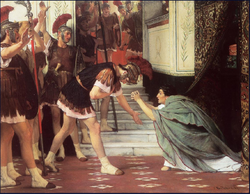
Sejanus
Lucius Aelius Seianus , commonly known as Sejanus, was an ambitious soldier, friend and confidant of the Roman Emperor Tiberius...
, who was sacrificed for the Donativum
Donativum
Donativum was the name given to the gifts of money dispersed to the soldiers of the Roman legions or to the Praetorian Guard by the Roman Emperors....
(imperial gift) promised by Tiberius, the Guards began to play an increasingly ambitious and bloody game in the Empire. With the right amount of money, or at will, they assassinated emperors, bullied their own prefects
Praetorian prefect
Praetorian prefect was the title of a high office in the Roman Empire. Originating as the commander of the Praetorian Guard, the office gradually acquired extensive legal and administrative functions, with its holders becoming the Emperor's chief aides...
, or turned on the people of Rome. In 41 Caligula
Caligula
Caligula , also known as Gaius, was Roman Emperor from 37 AD to 41 AD. Caligula was a member of the house of rulers conventionally known as the Julio-Claudian dynasty. Caligula's father Germanicus, the nephew and adopted son of Emperor Tiberius, was a very successful general and one of Rome's most...
was killed by conspirators from the senatorial class and from the Guard. The Praetorians placed Claudius
Claudius
Claudius , was Roman Emperor from 41 to 54. A member of the Julio-Claudian dynasty, he was the son of Drusus and Antonia Minor. He was born at Lugdunum in Gaul and was the first Roman Emperor to be born outside Italy...
on the throne, daring the Senate to oppose their decision.
During 69, the Year of the Four Emperors
Year of the Four Emperors
The Year of the Four Emperors was a year in the history of the Roman Empire, AD 69, in which four emperors ruled in a remarkable succession. These four emperors were Galba, Otho, Vitellius, and Vespasian....
, after the emperor Galba
Galba
Galba , was Roman Emperor for seven months from 68 to 69. Galba was the governor of Hispania Tarraconensis, and made a bid for the throne during the rebellion of Julius Vindex...
failed to provide a donative for the Praetorians, they transferred their allegiance to Otho
Otho
Otho , was Roman Emperor for three months, from 15 January to 16 April 69. He was the second emperor of the Year of the four emperors.- Birth and lineage :...
and assassinated the emperor. Otho acquiesced in the Praetorians' demands and granted them the right to appoint their own prefects, ensuring their loyalty. After defeating Otho, Vitellius
Vitellius
Vitellius , was Roman Emperor for eight months, from 16 April to 22 December 69. Vitellius was acclaimed Emperor following the quick succession of the previous emperors Galba and Otho, in a year of civil war known as the Year of the Four Emperors...
disbanded the guard and established a new one sixteen cohorts strong. Vespasian
Vespasian
Vespasian , was Roman Emperor from 69 AD to 79 AD. Vespasian was the founder of the Flavian dynasty, which ruled the Empire for a quarter century. Vespasian was descended from a family of equestrians, who rose into the senatorial rank under the Emperors of the Julio-Claudian dynasty...
relied in the war against Vitellius upon the disgruntled cohorts the emperor had dismissed, and reduced the number of cohorts back to nine upon becoming emperor himself. As a further safeguard, he appointed his son, Titus
Titus
Titus , was Roman Emperor from 79 to 81. A member of the Flavian dynasty, Titus succeeded his father Vespasian upon his death, thus becoming the first Roman Emperor to come to the throne after his own father....
as Praetorian Prefect
Praetorian prefect
Praetorian prefect was the title of a high office in the Roman Empire. Originating as the commander of the Praetorian Guard, the office gradually acquired extensive legal and administrative functions, with its holders becoming the Emperor's chief aides...
.
While the Guard had the power to kill emperors, it had no role in government administration, unlike the personnel of the palace, the Senate, and the bureaucracy. Often after an outrageous act of violence, revenge by the new ruler was forthcoming. In 193, Didius Julianus
Didius Julianus
Didius Julianus , was Roman Emperor for three months during the year 193. He ascended the throne after buying it from the Praetorian Guard, who had assassinated his predecessor Pertinax. This led to the Roman Civil War of 193–197...
purchased the Empire from the Guard for a vast sum, when the Guard auctioned it off after killing Pertinax
Pertinax
Pertinax , was Roman Emperor for three months in 193. He is known as the first emperor of the tumultuous Year of the Five Emperors. A high ranking military and Senatorial figure, he tried to restore discipline in the Praetorian Guards, whereupon they rebelled and killed him...
. Later that year Septimius Severus
Septimius Severus
Septimius Severus , also known as Severus, was Roman Emperor from 193 to 211. Severus was born in Leptis Magna in the province of Africa. As a young man he advanced through the customary succession of offices under the reigns of Marcus Aurelius and Commodus. Severus seized power after the death of...
marched into Rome, disbanded the Praetorians and started a new formation from his own Pannonian Legions. Unruly mobs in Rome fought often with the Praetorians in Maximinus Thrax
Maximinus Thrax
Maximinus Thrax , also known as Maximinus I, was Roman Emperor from 235 to 238.Maximinus is described by several ancient sources, though none are contemporary except Herodian's Roman History. Maximinus was the first emperor never to set foot in Rome...
's reign in vicious street battles.
In 271, Aurelian
Aurelian
Aurelian , was Roman Emperor from 270 to 275. During his reign, he defeated the Alamanni after a devastating war. He also defeated the Goths, Vandals, Juthungi, Sarmatians, and Carpi. Aurelian restored the Empire's eastern provinces after his conquest of the Palmyrene Empire in 273. The following...
sailed east to destroy the power of Palmyra, Syria, with a force of legionary detachments, Praetorian cohorts, and other cavalry units. The Palmyrenes were easily defeated. This led to the orthodox view that Diocletian
Diocletian
Diocletian |latinized]] upon his accession to Diocletian . c. 22 December 244 – 3 December 311), was a Roman Emperor from 284 to 305....
and his colleagues evolved the sacer comitatus (the field escort of the emperors), which included field units that utilized a selection process and command structure modeled after the old Praetorian cohorts, but was not of uniform composition and was much larger than a Praetorian cohort.
Guard's twilight years
In 284, DiocletianDiocletian
Diocletian |latinized]] upon his accession to Diocletian . c. 22 December 244 – 3 December 311), was a Roman Emperor from 284 to 305....
reduced the status of the Praetorians; they were no longer to be part of palace life, as Diocletian lived in Nicomedia
Nicomedia
Nicomedia was an ancient city in what is now Turkey, founded in 712/11 BC as a Megarian colony and was originally known as Astacus . After being destroyed by Lysimachus, it was rebuilt by Nicomedes I of Bithynia in 264 BC under the name of Nicomedia, and has ever since been one of the most...
, some 60 miles (100 km) from Byzantium
Byzantium
Byzantium was an ancient Greek city, founded by Greek colonists from Megara in 667 BC and named after their king Byzas . The name Byzantium is a Latinization of the original name Byzantion...
in Asia Minor
Asia Minor
Asia Minor is a geographical location at the westernmost protrusion of Asia, also called Anatolia, and corresponds to the western two thirds of the Asian part of Turkey...
. Two new corps, the Jovians and Herculians
Herculians
The Jovians and Herculians were the senior palatine imperial guard units of the Emperors of the late Roman Empire and the early Byzantine Empire from the 290s until the 7th century.-History:...
(named after the gods Jove, or Jupiter, and Hercules, associated with the senior and junior emperor), replaced the Praetorians as the personal protectors of the emperors, a practice that remained intact with the tetrarchy
Tetrarchy
The term Tetrarchy describes any system of government where power is divided among four individuals, but usually refers to the tetrarchy instituted by Roman Emperor Diocletian in 293, marking the end of the Crisis of the Third Century and the recovery of the Roman Empire...
. By the time Diocletian retired on May 1, 305, their Castra Praetoria
Castra Praetoria
Castra Praetoria were the ancient barracks of the Praetorian Guard of Imperial Rome.-History:According to the Roman historian Suetonius, the barracks were built in 23 AD by Lucius Aelius Sejanus, the praetorian prefect serving under the emperor Tiberius, in an effort to consolidate the several...
seems to have housed only a minor garrison of Rome.
The final act of the Praetorians in imperial history started in 306, when Maxentius
Maxentius
Maxentius was a Roman Emperor from 306 to 312. He was the son of former Emperor Maximian, and the son-in-law of Emperor Galerius.-Birth and early life:Maxentius' exact date of birth is unknown; it was probably around 278...
, son of the retired emperor Maximian
Maximian
Maximian was Roman Emperor from 286 to 305. He was Caesar from 285 to 286, then Augustus from 286 to 305. He shared the latter title with his co-emperor and superior, Diocletian, whose political brain complemented Maximian's military brawn. Maximian established his residence at Trier but spent...
, was passed over as a successor: the troops took matters into their own hands and elevated him to the position of emperor in Italy on October 28. Caesar
Caesar (title)
Caesar is a title of imperial character. It derives from the cognomen of Julius Caesar, the Roman dictator...
Flavius Valerius Severus
Flavius Valerius Severus
Severus , sometimes known as Severus II, was a Western Roman Emperor from 306 to 307.- Officer in the Roman army :Severus was of humble birth, born in the Illyrian provinces around the middle of the third century AD...
, following the orders of Galerius
Galerius
Galerius , was Roman Emperor from 305 to 311. During his reign he campaigned, aided by Diocletian, against the Sassanid Empire, sacking their capital Ctesiphon in 299. He also campaigned across the Danube against the Carpi, defeating them in 297 and 300...
, attempted to disband the Guard but only managed to lead the rest of them in revolting and joining Maxentius. When Constantine the Great, launching an invasion of Italy in 312, forced a final confrontation at the Milvian Bridge
Battle of Milvian Bridge
The Battle of the Milvian Bridge took place between the Roman Emperors Constantine I and Maxentius on 28 October 312. It takes its name from the Milvian Bridge, an important route over the Tiber. Constantine won the battle and started on the path that led him to end the Tetrarchy and become the...
, the Praetorian cohorts made up most of Maxentius' army. Later in Rome, the victorious Constantine definitively disbanded the Praetorian Guard. The soldiers were sent out to various corners of the Empire, and the Castra Praetoria
Castra Praetoria
Castra Praetoria were the ancient barracks of the Praetorian Guard of Imperial Rome.-History:According to the Roman historian Suetonius, the barracks were built in 23 AD by Lucius Aelius Sejanus, the praetorian prefect serving under the emperor Tiberius, in an effort to consolidate the several...
was demolished. For over 300 years they had served, and the destruction of their fortress was a grand gesture, inaugurating a new age of imperial history and ending that of the Praetorians.
Legacy
Although its name has become synonymous with intrigue, conspiracy, disloyalty and assassination, it could be argued that for the first two centuries of its existence the Praetorian Guard was generally very much a positive force within the Roman state. During this time it mostly removed (or allowed the removal of) cruel, weak, and unpopular emperors while supporting just, strong, and popular ones. By protecting these monarchs, thereby extending their reigns, and also by keeping the disorders of the Roman mobs and the intrigues of the Senate in line, the Guard helped to give the empire a much needed source of stability that contributed to the period known as the Pax RomanaPax Romana
Pax Romana was the long period of relative peace and minimal expansion by military force experienced by the Roman Empire in the 1st and 2nd centuries AD. Since it was established by Caesar Augustus it is sometimes called Pax Augusta...
.
It was only after the reign of Marcus Aurelius, when this period is considered to have ended, that the guard began to deteriorate into the meddling force of ruthless mercenaries for which it has become infamous. However, in this regard it was not alone; under the Severan dynasty
Severan dynasty
The Severan dynasty was a Roman imperial dynasty, which ruled the Roman Empire between 193 and 235. The dynasty was founded by the Roman general Septimius Severus, who rose to power during the civil war of 193, known as the Year of the Five Emperors....
, and afterwards during the Crisis of the Third Century
Crisis of the Third Century
The Crisis of the Third Century was a period in which the Roman Empire nearly collapsed under the combined pressures of invasion, civil war, plague, and economic depression...
the legions, the Senate, and the emperorship along with the rest of the Roman state began to fall into decline and inefficiency as well.
Relationships between emperors and their Guard
| Emperor | Year | Relationship with the Guard |
|---|---|---|
| Augustus Augustus Augustus ;23 September 63 BC – 19 August AD 14) is considered the first emperor of the Roman Empire, which he ruled alone from 27 BC until his death in 14 AD.The dates of his rule are contemporary dates; Augustus lived under two calendars, the Roman Republican until 45 BC, and the Julian... |
27 BC–14 | Created the Praetorian Guard, commanded their complete loyalty. |
| Tiberius Tiberius Tiberius , was Roman Emperor from 14 AD to 37 AD. Tiberius was by birth a Claudian, son of Tiberius Claudius Nero and Livia Drusilla. His mother divorced Nero and married Augustus in 39 BC, making him a step-son of Octavian... |
14–37 | Made Sejanus the sole Guard prefect Praetorian prefect Praetorian prefect was the title of a high office in the Roman Empire. Originating as the commander of the Praetorian Guard, the office gradually acquired extensive legal and administrative functions, with its holders becoming the Emperor's chief aides... (as opposed to having the usual two) allowed him to concentrate the guard in a single camp. Tiberius later had him executed and replaced with Macro. |
| Gaius Caligula | 37–41 | Accession smoothed by popularity with Macro, the Praetorian Prefect Praetorian prefect Praetorian prefect was the title of a high office in the Roman Empire. Originating as the commander of the Praetorian Guard, the office gradually acquired extensive legal and administrative functions, with its holders becoming the Emperor's chief aides... he later had executed. Murdered by the Guard. |
| Claudius Claudius Claudius , was Roman Emperor from 41 to 54. A member of the Julio-Claudian dynasty, he was the son of Drusus and Antonia Minor. He was born at Lugdunum in Gaul and was the first Roman Emperor to be born outside Italy... |
41–54 | Proclaimed emperor by the Guard and defended by them when in difficulty (e.g., Messalina and Gaius Silius' attempted coup). Began the process of formalised accession donatives on a large scale and his coinage reflects the fact with coin captioned imper.recep i.e. "position of emperor received from" with a picture of the Praetorian camp on. |
| Nero Nero Nero , was Roman Emperor from 54 to 68, and the last in the Julio-Claudian dynasty. Nero was adopted by his great-uncle Claudius to become his heir and successor, and succeeded to the throne in 54 following Claudius' death.... |
54–68 | Eventually deserted by the Guard |
| Galba Galba Galba , was Roman Emperor for seven months from 68 to 69. Galba was the governor of Hispania Tarraconensis, and made a bid for the throne during the rebellion of Julius Vindex... |
68–69 | Murdered by the Guard whose accession donative, promised on his behalf by Tigellinus and Otho, he refused to pay. |
| Otho Otho Otho , was Roman Emperor for three months, from 15 January to 16 April 69. He was the second emperor of the Year of the four emperors.- Birth and lineage :... |
69 | Elevated by the Guard who fought ferociously for him at Cremona before he committed suicide. |
| Vitellius Vitellius Vitellius , was Roman Emperor for eight months, from 16 April to 22 December 69. Vitellius was acclaimed Emperor following the quick succession of the previous emperors Galba and Otho, in a year of civil war known as the Year of the Four Emperors... |
69 | Deposed by the Guard then executed. |
| Vespasian Vespasian Vespasian , was Roman Emperor from 69 AD to 79 AD. Vespasian was the founder of the Flavian dynasty, which ruled the Empire for a quarter century. Vespasian was descended from a family of equestrians, who rose into the senatorial rank under the Emperors of the Julio-Claudian dynasty... |
69–79 | Reduced the size of the Guard after victory in 69 |
| Titus Titus Titus , was Roman Emperor from 79 to 81. A member of the Flavian dynasty, Titus succeeded his father Vespasian upon his death, thus becoming the first Roman Emperor to come to the throne after his own father.... |
79–81 | Served as Praetorian prefect Praetorian prefect Praetorian prefect was the title of a high office in the Roman Empire. Originating as the commander of the Praetorian Guard, the office gradually acquired extensive legal and administrative functions, with its holders becoming the Emperor's chief aides... , then as emperor. |
| Domitian Domitian Domitian was Roman Emperor from 81 to 96. Domitian was the third and last emperor of the Flavian dynasty.Domitian's youth and early career were largely spent in the shadow of his brother Titus, who gained military renown during the First Jewish-Roman War... |
81–96 | His election was supported by the Guard who remained fiercely loyal to him, especially as he increased the army's pay. Killed by influential palace freedmen. |
| Nerva Nerva Nerva , was Roman Emperor from 96 to 98. Nerva became Emperor at the age of sixty-five, after a lifetime of imperial service under Nero and the rulers of the Flavian dynasty. Under Nero, he was a member of the imperial entourage and played a vital part in exposing the Pisonian conspiracy of 65... |
96–98 | Forced by a rebelling guard to adopt Marcus Ulpius Traianus as his successor. |
| Trajan Trajan Trajan , was Roman Emperor from 98 to 117 AD. Born into a non-patrician family in the province of Hispania Baetica, in Spain Trajan rose to prominence during the reign of emperor Domitian. Serving as a legatus legionis in Hispania Tarraconensis, in Spain, in 89 Trajan supported the emperor against... |
98–117 | Had the Guard officers who led the rebellion against Nerva executed upon his succession. |
| Hadrian Hadrian Hadrian , was Roman Emperor from 117 to 138. He is best known for building Hadrian's Wall, which marked the northern limit of Roman Britain. In Rome, he re-built the Pantheon and constructed the Temple of Venus and Roma. In addition to being emperor, Hadrian was a humanist and was philhellene in... |
117–138 | Founded the Frumentarii Frumentarii Frumentarii acted as the secret service of the Roman Empire. There are two main sources of information about the frumentarii, inscriptions on gravestones and anecdotes where the actions of individual frumentarii are mentioned by historians. From what is known of the Frumentarii, they always worked... . |
| Antoninus Pius Antoninus Pius Antoninus Pius , also known as Antoninus, was Roman Emperor from 138 to 161. He was a member of the Nerva-Antonine dynasty and the Aurelii. He did not possess the sobriquet "Pius" until after his accession to the throne... |
138–161 | |
| Marcus Aurelius | 161–180 | Commanded the Guard in his war against the Germanian Tribes Germania Germania was the Greek and Roman geographical term for the geographical regions inhabited by mainly by peoples considered to be Germani. It was most often used to refer especially to the east of the Rhine and north of the Danube... . |
| Lucius Verus Lucius Verus Lucius Verus , was Roman co-emperor with Marcus Aurelius, from 161 until his death.-Early life and career:Lucius Verus was the first born son to Avidia Plautia and Lucius Aelius Verus Caesar, the first adopted son and heir of Roman Emperor Hadrian . He was born and raised in Rome... |
161–169 | |
| Commodus Commodus Commodus , was Roman Emperor from 180 to 192. He also ruled as co-emperor with his father Marcus Aurelius from 177 until his father's death in 180. His name changed throughout his reign; see changes of name for earlier and later forms. His accession as emperor was the first time a son had succeeded... |
180–192 | Retained the loyalty of the Guard. |
| Pertinax Pertinax Pertinax , was Roman Emperor for three months in 193. He is known as the first emperor of the tumultuous Year of the Five Emperors. A high ranking military and Senatorial figure, he tried to restore discipline in the Praetorian Guards, whereupon they rebelled and killed him... |
193 | Assassinated by the Guard. |
| Didius Julianus Didius Julianus Didius Julianus , was Roman Emperor for three months during the year 193. He ascended the throne after buying it from the Praetorian Guard, who had assassinated his predecessor Pertinax. This led to the Roman Civil War of 193–197... |
193 | Scandalously 'purchased' the Empire from the Guard and was soon deserted by them. |
| Septimius Severus Septimius Severus Septimius Severus , also known as Severus, was Roman Emperor from 193 to 211. Severus was born in Leptis Magna in the province of Africa. As a young man he advanced through the customary succession of offices under the reigns of Marcus Aurelius and Commodus. Severus seized power after the death of... |
193–211 | Disbanded the Guard and created a new one from the Danubian Legions. |
| Caracalla Caracalla Caracalla , was Roman emperor from 198 to 217. The eldest son of Septimius Severus, he ruled jointly with his younger brother Geta until he murdered the latter in 211... |
211–217 | Murdered in a plot by the Praetorian Prefect Macrinus Macrinus Macrinus , was Roman Emperor from 217 to 218. Macrinus was of "Moorish" descent and the first emperor to become so without membership in the senatorial class.-Background and career:... . |
| Macrinus Macrinus Macrinus , was Roman Emperor from 217 to 218. Macrinus was of "Moorish" descent and the first emperor to become so without membership in the senatorial class.-Background and career:... |
217–218 | |
| Elagabalus Elagabalus Elagabalus , also known as Heliogabalus, was Roman Emperor from 218 to 222. A member of the Severan Dynasty, he was Syrian on his mother's side, the son of Julia Soaemias and Sextus Varius Marcellus. Early in his youth he served as a priest of the god El-Gabal at his hometown, Emesa... |
218–222 | Murdered in the Castra Praetoria Castra Praetoria Castra Praetoria were the ancient barracks of the Praetorian Guard of Imperial Rome.-History:According to the Roman historian Suetonius, the barracks were built in 23 AD by Lucius Aelius Sejanus, the praetorian prefect serving under the emperor Tiberius, in an effort to consolidate the several... by the Guard. |
| Alexander Severus Alexander Severus Severus Alexander was Roman Emperor from 222 to 235. Alexander was the last emperor of the Severan dynasty. He succeeded his cousin Elagabalus upon the latter's assassination in 222, and was ultimately assassinated himself, marking the epoch event for the Crisis of the Third Century — nearly fifty... |
222–235 | Elevated by the Guard. |
| Maximinus Thrax Maximinus Thrax Maximinus Thrax , also known as Maximinus I, was Roman Emperor from 235 to 238.Maximinus is described by several ancient sources, though none are contemporary except Herodian's Roman History. Maximinus was the first emperor never to set foot in Rome... |
235–238 | |
| Gordian I Gordian I Gordian I , was Roman Emperor for one month with his son Gordian II in 238, the Year of the Six Emperors. Caught up in a rebellion against the Emperor Maximinus Thrax, he was defeated by forces loyal to Maximinus before committing suicide.-Early life:... |
238 | |
| Gordian II Gordian II Gordian II , was Roman Emperor for one month with his father Gordian I in 238, the Year of the Six Emperors. Seeking to overthrow the Emperor Maximinus Thrax, he died in battle outside of Carthage.-Early career:... |
238 | |
| Balbinus Balbinus Balbinus , was Roman Emperor with Pupienus for three months in 238, the Year of the Six Emperors.- Origins and career :Not much is known about Balbinus before his elevation to emperor. It has been conjectured that he descended from Publius Coelius Balbinus Vibullius Pius, the consul ordinarius of... |
238 | Murdered by the Guard. |
| Pupienus Pupienus Pupienus , also known as Pupienus Maximus, was Roman Emperor with Balbinus for three months in 238, the Year of the Six Emperors. The sources for this period are scant, and thus knowledge of the emperor is limited... |
238 | Murdered by the Guard. |
| Gordian III Gordian III Gordian III , was Roman Emperor from 238 to 244. Gordian was the son of Antonia Gordiana and an unnamed Roman Senator who died before 238. Antonia Gordiana was the daughter of Emperor Gordian I and younger sister of Emperor Gordian II. Very little is known on his early life before his acclamation... |
238–244 | Proclaimed emperor by the Guard but killed by his Prefect, Philip the Arab Philip the Arab Philip the Arab , also known as Philip or Philippus Arabs, was Roman Emperor from 244 to 249. He came from Syria, and rose to become a major figure in the Roman Empire. He achieved power after the death of Gordian III, quickly negotiating peace with the Sassanid Empire... . |
| Philip the Arab Philip the Arab Philip the Arab , also known as Philip or Philippus Arabs, was Roman Emperor from 244 to 249. He came from Syria, and rose to become a major figure in the Roman Empire. He achieved power after the death of Gordian III, quickly negotiating peace with the Sassanid Empire... |
244–249 | |
| Decius Decius Trajan Decius , was Roman Emperor from 249 to 251. In the last year of his reign, he co-ruled with his son Herennius Etruscus until they were both killed in the Battle of Abrittus.-Early life and rise to power:... |
249–251 | |
| Herennius Etruscus Herennius Etruscus Herennius Etruscus , was Roman emperor in 251, in a joint rule with his father Decius. Emperor Hostilian was his younger brother.Herennius was born in near Sirmium in Pannonia , during one of his father's military postings. His mother was Herennia Cupressenia Etruscilla, a Roman lady of an... |
251 | |
| Hostilian Hostilian Hostilian was Roman emperor in 251. Hostilian was born in Sirmium in Illyricum sometime after 230, as the son of the future emperor Decius by his wife Herennia Cupressenia Etruscilla... |
251 | |
| Trebonianus Gallus Trebonianus Gallus Trebonianus Gallus , also known as Gallus, was Roman Emperor from 251 to 253, in a joint rule with his son Volusianus.-Early life:Gallus was born in Italy, in a family with respected ancestry of Etruscan senatorial background. He had two children in his marriage with Afinia Gemina Baebiana: Gaius... |
251–253 | |
| Aemilianus Aemilianus Aemilianus , also known as Aemilian, was Roman Emperor for three months in 253.Commander of the Moesian troops, he obtained an important victory against the invading Goths and was, for this reason, acclaimed Emperor by his army... |
253 | |
| Publius Licinius Valerianus | 253–260 | |
| Gallienus Gallienus Gallienus was Roman Emperor with his father Valerian from 253 to 260, and alone from 260 to 268. He took control of the Empire at a time when it was undergoing great crisis... |
260-268 | |
| Claudius II Claudius II Claudius II , commonly known as Claudius Gothicus, was Roman Emperor from 268 to 270. During his reign he fought successfully against the Alamanni and scored a crushing victory against the Goths at the Battle of Naissus. He died after succumbing to a smallpox plague that ravaged the provinces of... |
268–270 | |
| Quintillus Quintillus Quintillus , commonly known as Quintillus, was Roman Emperor for less than a year in 270.-Early Life and Election as Emperor:Quintillus was born at Sirmium in Illyricum. Originally coming from a low born family, Quintillus came to prominence with the accession of his brother Claudius II Gothicus to... |
270 | |
| Aurelian Aurelian Aurelian , was Roman Emperor from 270 to 275. During his reign, he defeated the Alamanni after a devastating war. He also defeated the Goths, Vandals, Juthungi, Sarmatians, and Carpi. Aurelian restored the Empire's eastern provinces after his conquest of the Palmyrene Empire in 273. The following... |
270–275 | The Praetorians accompanied Aurelian on an expedition against Palmyra. Subsequently he was murdered by the Guard |
| Marcus Claudius Tacitus Marcus Claudius Tacitus Tacitus , was Roman Emperor from 275 to 276. During his short reign he campaigned against the Goths and the Heruli, for which he received the title Gothicus Maximus.-Biography:Tacitus was born in Interamna , in Italia... |
275–276 | |
| Florianus Florianus -Biography: Florian was reportedly a maternal half-brother to the Emperor Marcus Claudius Tacitus. Appointed Praetorian Prefect in Tacitus's army in his campaign against the Goths, according to the available sources, he was chosen by the army in the West to succeed Tacitus in 276, without the... |
276 | |
| Marcus Aurelius Probus | 276–282 | Murdered by Praetorian troops after a revolt. |
| Carus Carus Carus , was Roman Emperor from 282 to 283. During his short reign, Carus fought the Germanic tribes and Sarmatians along the Danube frontier with success. During his campaign against the Sassanid Empire he sacked their capital Ctesiphon, but died shortly thereafter... |
282–283 | |
| Carinus Carinus Carinus , was Roman Emperor 282 to 285. The elder son of emperor Carus, he was appointed Caesar and co-emperor of the western portion of the empire upon his father's accession... |
283–285 | |
| Numerian Numerian Numerian , was a Roman Emperor from 282 to 284 with his older brother Carinus. They were sons of Carus, a general raised to the office of praetorian prefect under Emperor Probus in 282.-Reign:... |
283–284 | |
| Diocletian Diocletian Diocletian |latinized]] upon his accession to Diocletian . c. 22 December 244 – 3 December 311), was a Roman Emperor from 284 to 305.... |
284–305 | Dismantled the political power of the Praetorians through sweeping reforms of the Imperial system. Reported to have reduced the size of the Guard. |
| Maximian Maximian Maximian was Roman Emperor from 286 to 305. He was Caesar from 285 to 286, then Augustus from 286 to 305. He shared the latter title with his co-emperor and superior, Diocletian, whose political brain complemented Maximian's military brawn. Maximian established his residence at Trier but spent... |
286–305, 307–308 | Praetorians accompanied Maximian to Africa in 297. |
| Galerius Galerius Galerius , was Roman Emperor from 305 to 311. During his reign he campaigned, aided by Diocletian, against the Sassanid Empire, sacking their capital Ctesiphon in 299. He also campaigned across the Danube against the Carpi, defeating them in 297 and 300... |
305–311 | |
| Constantius Chlorus Constantius Chlorus Constantius I , commonly known as Constantius Chlorus, was Roman Emperor from 293 to 306. He was the father of Constantine the Great and founder of the Constantinian dynasty. As Caesar he defeated the usurper Allectus in Britain and campaigned extensively along the Rhine frontier, defeating the... |
305–306 | |
| Flavius Valerius Severus Flavius Valerius Severus Severus , sometimes known as Severus II, was a Western Roman Emperor from 306 to 307.- Officer in the Roman army :Severus was of humble birth, born in the Illyrian provinces around the middle of the third century AD... |
306–307 | |
| Maxentius Maxentius Maxentius was a Roman Emperor from 306 to 312. He was the son of former Emperor Maximian, and the son-in-law of Emperor Galerius.-Birth and early life:Maxentius' exact date of birth is unknown; it was probably around 278... |
306–312 | Last emperor to command the guard. |
| Constantine I Constantine I Constantine the Great , also known as Constantine I or Saint Constantine, was Roman Emperor from 306 to 337. Well known for being the first Roman emperor to convert to Christianity, Constantine and co-Emperor Licinius issued the Edict of Milan in 313, which proclaimed religious tolerance of all... |
306–337 | Disbanded the Guard and destroyed the Castra Praetoria Castra Praetoria Castra Praetoria were the ancient barracks of the Praetorian Guard of Imperial Rome.-History:According to the Roman historian Suetonius, the barracks were built in 23 AD by Lucius Aelius Sejanus, the praetorian prefect serving under the emperor Tiberius, in an effort to consolidate the several... . |
Organization and conditions of service
Although the Praetorians resembled in some respects a LegionRoman legion
A Roman legion normally indicates the basic ancient Roman army unit recruited specifically from Roman citizens. The organization of legions varied greatly over time but they were typically composed of perhaps 5,000 soldiers, divided into maniples and later into "cohorts"...
, they were unlike any of the regular Legions
Roman legion
A Roman legion normally indicates the basic ancient Roman army unit recruited specifically from Roman citizens. The organization of legions varied greatly over time but they were typically composed of perhaps 5,000 soldiers, divided into maniples and later into "cohorts"...
of the Roman Empire
Roman Empire
The Roman Empire was the post-Republican period of the ancient Roman civilization, characterised by an autocratic form of government and large territorial holdings in Europe and around the Mediterranean....
. Their nine cohorts
Cohort (military unit)
A cohort was the basic tactical unit of a Roman legion following the reforms of Gaius Marius in 107 BC.-Legionary cohort:...
(one less than a legion) were larger, the pay and benefits were better, and its military abilities were reliable. They also received gifts of money called Donativum
Donativum
Donativum was the name given to the gifts of money dispersed to the soldiers of the Roman legions or to the Praetorian Guard by the Roman Emperors....
from the emperors. As conceived by Augustus, the Praetorian cohorts totaled around 9,000 men, recruited from the legions of the regular army or drawn from the most deserving youths in Etruria
Etruria
Etruria—usually referred to in Greek and Latin source texts as Tyrrhenia—was a region of Central Italy, an area that covered part of what now are Tuscany, Latium, Emilia-Romagna, and Umbria. A particularly noteworthy work dealing with Etruscan locations is D. H...
, Umbria
Umbria
Umbria is a region of modern central Italy. It is one of the smallest Italian regions and the only peninsular region that is landlocked.Its capital is Perugia.Assisi and Norcia are historical towns associated with St. Francis of Assisi, and St...
, and Latium
Latium
Lazio is one of the 20 administrative regions of Italy, situated in the central peninsular section of the country. With about 5.7 million residents and a GDP of more than 170 billion euros, Lazio is the third most populated and the second richest region of Italy...
(three provinces in central Italy). Over time the pool of recruits expanded to Macedonia
Macedonia (Roman province)
The Roman province of Macedonia was officially established in 146 BC, after the Roman general Quintus Caecilius Metellus defeated Andriscus of Macedon, the last Ancient King of Macedon in 148 BC, and after the four client republics established by Rome in the region were dissolved...
, Hispania Baetica
Hispania Baetica
Hispania Baetica was one of three Imperial Roman provinces in Hispania, . Hispania Baetica was bordered to the west by Lusitania, and to the northeast by Hispania Tarraconensis. Baetica was part of Al-Andalus under the Moors in the 8th century and approximately corresponds to modern Andalucia...
, Hispania Tarraconensis
Hispania Tarraconensis
Hispania Tarraconensis was one of three Roman provinces in Hispania. It encompassed much of the Mediterranean coast of Spain along with the central plateau. Southern Spain, the region now called Andalusia, was the province of Hispania Baetica...
, Lusitania
Lusitania
Lusitania or Hispania Lusitania was an ancient Roman province including approximately all of modern Portugal south of the Douro river and part of modern Spain . It was named after the Lusitani or Lusitanian people...
and Illyricum
Praetorian prefecture of Illyricum
The praetorian prefecture of Illyricum was one of four praetorian prefectures into which the Late Roman Empire was divided.The administrative centre of the prefecture was Sirmium , and, after 379, Thessalonica...
. Vitellius
Vitellius
Vitellius , was Roman Emperor for eight months, from 16 April to 22 December 69. Vitellius was acclaimed Emperor following the quick succession of the previous emperors Galba and Otho, in a year of civil war known as the Year of the Four Emperors...
formed a new Guard out of the Germanic legions, while Septimus Severus did the same with the Pannonia
Pannonia
Pannonia was an ancient province of the Roman Empire bounded north and east by the Danube, coterminous westward with Noricum and upper Italy, and southward with Dalmatia and upper Moesia....
n legions. He also chose replacements for the units' ranks from throughout the Roman Empire.
Around the time of Augustus
Augustus
Augustus ;23 September 63 BC – 19 August AD 14) is considered the first emperor of the Roman Empire, which he ruled alone from 27 BC until his death in 14 AD.The dates of his rule are contemporary dates; Augustus lived under two calendars, the Roman Republican until 45 BC, and the Julian...
(c. 5) each cohort of the Praetorians numbered 1,000 men, increasing to 1,500 men at some time. As with the normal legions, the body of troops actually ready for service was much smaller. Tacitus reports that the number of cohorts was increased to twelve from nine in 47. In 69 it was briefly increased to sixteen cohorts by Vitellius
Vitellius
Vitellius , was Roman Emperor for eight months, from 16 April to 22 December 69. Vitellius was acclaimed Emperor following the quick succession of the previous emperors Galba and Otho, in a year of civil war known as the Year of the Four Emperors...
, but Vespasian
Vespasian
Vespasian , was Roman Emperor from 69 AD to 79 AD. Vespasian was the founder of the Flavian dynasty, which ruled the Empire for a quarter century. Vespasian was descended from a family of equestrians, who rose into the senatorial rank under the Emperors of the Julio-Claudian dynasty...
quickly reduced it again to nine. Finally in 101 their number was increased once more to ten, resulting in a force of 10,000 troops, whose status was at least elite.
The training of guardsmen was more intense than in the legions because of the amount of free time available, when a cohort was not posted or traveling with the emperor. The Guard followed the same lines as those elsewhere. Equipment and armour were also the same with one notable exception — specially decorated breastplates, excellent for parade
Parade
A parade is a procession of people, usually organized along a street, often in costume, and often accompanied by marching bands, floats or sometimes large balloons. Parades are held for a wide range of reasons, but are usually celebrations of some kind...
s and state functions. Insignia of the "Moon and Stars" and the "Scorpion" were particularly associated with the Praetorians. Thus, each guardsman possessed two suits of armor, one for Roman duty and one for the field.
The Praetorians received substantially higher pay than other Roman soldiers in any of the legions, on a system known as sesquiplex stipendum, or by pay-and-a-half. So if the legionnaires received 250 denarii
Denarius
In the Roman currency system, the denarius was a small silver coin first minted in 211 BC. It was the most common coin produced for circulation but was slowly debased until its replacement by the antoninianus...
, the guards received 375 per annum. Domitian
Domitian
Domitian was Roman Emperor from 81 to 96. Domitian was the third and last emperor of the Flavian dynasty.Domitian's youth and early career were largely spent in the shadow of his brother Titus, who gained military renown during the First Jewish-Roman War...
and Septimius Severus
Septimius Severus
Septimius Severus , also known as Severus, was Roman Emperor from 193 to 211. Severus was born in Leptis Magna in the province of Africa. As a young man he advanced through the customary succession of offices under the reigns of Marcus Aurelius and Commodus. Severus seized power after the death of...
increased the stipendum (payment) to 1,500 denarii per year, distributed in January, May and September.
On special occasions they received special donativum
Donativum
Donativum was the name given to the gifts of money dispersed to the soldiers of the Roman legions or to the Praetorian Guard by the Roman Emperors....
from the emperor.
Upon retiring, a soldier of the Praetorians was granted 20,000 sesterces
Sestertius
The sestertius, or sesterce, was an ancient Roman coin. During the Roman Republic it was a small, silver coin issued only on rare occasions...
(5,000 denarii) which constitute more than 13 annual salaries. Furthermore, a gift of land and a diploma reading "to the warrior
Warrior
A warrior is a person skilled in combat or warfare, especially within the context of a tribal or clan-based society that recognizes a separate warrior class.-Warrior classes in tribal culture:...
who bravely and faithfully completed his service" were granted. Many chose to enter the Evocati, while others reenlisted in the hopes of gaining further promotion and other possible high positions in the Roman state.
Imperial Horseguard
From its beginnings, the guard usually included a small cavalry detachment, the equites singulares AugustiEquites singulares Augusti
The equites singulares Augusti during the Principate period of imperial Rome. Based in Rome, they escorted the Roman emperor whenever he left the City on campaign or on tours of the provinces.The regiment was reconstituted in the late 1st century AD as a milliary ala, under the command of a...
, to escort the emperors to important state functions and on military campaigns. It was composed chiefly of selected, highly trusted provincials, who wore their native dress and carried their own weapons. Trajan expanded this force, opening it up to citizens and made it a permanent part of the Praetorian establishment. Its size was that of an ala milliaria or about 720 horsemen in 24 turmae (squadrons). It was commanded by a tribunus militum and so was, in effect, a 10th Praetorian cohort. Later, Septimius Severus
Septimius Severus
Septimius Severus , also known as Severus, was Roman Emperor from 193 to 211. Severus was born in Leptis Magna in the province of Africa. As a young man he advanced through the customary succession of offices under the reigns of Marcus Aurelius and Commodus. Severus seized power after the death of...
(ruled 197-211) would expand its size to 2,000 men.
Rank and file
| Ranks of the Praetorian Guard, in ascending order | |
|---|---|
| Milites Milites Milites were the trained private footsoldiers of Rome. These men were the non-specialist regular soldiers that made up the bulk of a Legion's numbers. Alongside soldiering, they also performed guard duties, labour work, building and other non-combat roles... |
Regular soldiers of the guard. |
| Immunes Immunes Ancient Rome's military was highly advanced for its time, divided into multiple units to maximize efficiency and power. One such unit was the immune class. By definition, the immunes were legionary soldiers who possessed specialized skills, qualifying them to perform duties atypical of a Roman... |
Guardsmen with secondary specialist roles that exempted them from other less than desired duties. After five years these soldiers were allowed to serve in the Equites singulares (cavalry branch). |
| Evocati Augusti Evocati Augusti The Evocati Augusti, Evocati of the Praetorian Guard, had even greater social standing than the Evocati of the Legions.They would have served out their time and obtained their discharge with the Praetorian Guard, but then enlisted again voluntarily.... |
After 16 years of service guardsmen could retire with a sizeable cash payment. Guardsmen who chose to stay in service after the 16 year period were called Evocati and gained privileges. |
| Centurion Centurion A centurion was a professional officer of the Roman army .Centurion may also refer to:-Military:* Centurion tank, British battle tank* HMS Centurion, name of several ships and a shore base of the British Royal Navy... es |
Praetorian Centurions commanded centuries of guardsmen while the most senior centurions commanded entire cohorts. |
| Tribuni | These officers acted as staff officers and as deputies to the Praetorian Prefects. |
| Praefectus Praetorian prefect Praetorian prefect was the title of a high office in the Roman Empire. Originating as the commander of the Praetorian Guard, the office gradually acquired extensive legal and administrative functions, with its holders becoming the Emperor's chief aides... |
The highest rank in the Praetorian Guard, head of the Praetorian Guard. |
See the article Praetorian prefect
Praetorian prefect
Praetorian prefect was the title of a high office in the Roman Empire. Originating as the commander of the Praetorian Guard, the office gradually acquired extensive legal and administrative functions, with its holders becoming the Emperor's chief aides...
, which also lists the incumbents of the post of Praefectus praetorio and covers the essentially civilian second life of the office, since ca 300, as administrator of the territorial circumscriptions known as praetorian prefecture
Praetorian prefecture
The praetorian prefecture was the largest administrative division of the late Roman Empire, above the mid-level dioceses and the low-level provinces. Praetorian prefectures originated in the reign of Constantine I The praetorian prefecture was the largest administrative division of the late Roman...
s).
In popular culture
In Modern English, the phrase "praetorian guard(s)" designates an exclusive, unconditionally loyal group personally attached to powerful people, especially leaders such as Napoleon INapoleon I
Napoleon Bonaparte was a French military and political leader during the latter stages of the French Revolution.As Napoleon I, he was Emperor of the French from 1804 to 1815...
's Imperial Guard, Italian dictator Benito Mussolini
Benito Mussolini
Benito Amilcare Andrea Mussolini was an Italian politician who led the National Fascist Party and is credited with being one of the key figures in the creation of Fascism....
's Battalion M, Adolf Hitler
Adolf Hitler
Adolf Hitler was an Austrian-born German politician and the leader of the National Socialist German Workers Party , commonly referred to as the Nazi Party). He was Chancellor of Germany from 1933 to 1945, and head of state from 1934 to 1945...
's 1st SS Division Leibstandarte SS Adolf Hitler
1st SS Division Leibstandarte SS Adolf Hitler
The Leibstandarte SS Adolf Hitler was Adolf Hitler's personal bodyguard. Initially the size of a regiment, the LSSAH eventually grew into a divisional-sized unit...
troops, Romania's former communist leader Ceauşescu
Nicolae Ceausescu
Nicolae Ceaușescu was a Romanian Communist politician. He was General Secretary of the Romanian Communist Party from 1965 to 1989, and as such was the country's second and last Communist leader...
's Securitate
Securitate
The Securitate was the secret police agency of Communist Romania. Previously, the Romanian secret police was called Siguranţa Statului. Founded on August 30, 1948, with help from the Soviet NKVD, the Securitate was abolished in December 1989, shortly after President Nicolae Ceaușescu was...
, and, in current times, Khamenei
Ali Khamenei
Ayatollah Seyed Ali Hoseyni Khāmene’i is the Supreme Leader of Iran and the figurative head of the Muslim conservative establishment in Iran and Twelver Shi'a marja...
's IRGC in Iran
Iran
Iran , officially the Islamic Republic of Iran , is a country in Southern and Western Asia. The name "Iran" has been in use natively since the Sassanian era and came into use internationally in 1935, before which the country was known to the Western world as Persia...
(Islamic Revolutionary Guard Corps). However, the term is also used in unarmed, even private contexts: for example, a corporate officer or politician may have a small group of associates or followers whom a journalist
Journalist
A journalist collects and distributes news and other information. A journalist's work is referred to as journalism.A reporter is a type of journalist who researchs, writes, and reports on information to be presented in mass media, including print media , electronic media , and digital media A...
may describe as a "praetorian guard." Such use is often pejorative
Pejorative
Pejoratives , including name slurs, are words or grammatical forms that connote negativity and express contempt or distaste. A term can be regarded as pejorative in some social groups but not in others, e.g., hacker is a term used for computer criminals as well as quick and clever computer experts...
, meant to indicate that the followers are fanatics or extremists and/or that the leader is tyrannical or paranoid. Praetorianism is used to mean the advocacy or practice of military dictatorship
Military dictatorship
A military dictatorship is a form of government where in the political power resides with the military. It is similar but not identical to a stratocracy, a state ruled directly by the military....
. John Stockwell
John Stockwell
John R. Stockwell is a former CIA officer who became a critic of United States government policies after serving in the Agency for thirteen years serving seven tours of duty. After managing U.S...
, a former member of the CIA, used the title The Praetorian Guard for his book about the negative aspects of US foreign policy. The popular culture view of the Praetorians as an utterly loyal force is reflected in the naming use of many private security services, for example Praetorian Security and Surveillance, Praetorian Guards and Praetorian Secure.
The Praetorian Guard features in the 2000 film Gladiator
Gladiator (2000 film)
Gladiator is a 2000 historical epic film directed by Ridley Scott, starring Russell Crowe, Joaquin Phoenix, Connie Nielsen, Ralf Möller, Oliver Reed, Djimon Hounsou, Derek Jacobi, John Shrapnel and Richard Harris. Crowe portrays the loyal Roman General Maximus Decimus Meridius, who is betrayed...
and the TV-film Age of Treason (Columbia 1993). The Guard's soldiers appear as infantry units in Civilization IV
Civilization IV
Sid Meier's Civilization IV is a turn-based strategy, 4X computer game released in 2005 and developed by lead designer Soren Johnson under the direction of Sid Meier and Meier's studio Firaxis Games. It is the fourth installment of the Civilization series...
, Rome: Total War
Rome: Total War
Rome: Total War is a PC strategy game developed by The Creative Assembly and released on by Activision...
, Travian
Travian
Travian is a massively multiplayer online browser-based strategy game developed by the German software company Travian Games.The game's developers drew roughly from Classical antiquity and particularly from the Roman Empire to create a predominantly militaristic real-time strategy...
and in the video game with title being part of it Praetorians.
The Praetorians are a regiment of the Imperial Guard in the tabletop game Warhammer 40,000
Warhammer 40,000
Warhammer 40,000 is a tabletop miniature wargame produced by Games Workshop, set in a dystopian science fantasy universe. Warhammer 40,000 was created by Rick Priestley in 1987 as the futuristic companion to Warhammer Fantasy Battle, sharing many game mechanics...
.