

Magister militum

Encyclopedia
Roman Empire
The Roman Empire was the post-Republican period of the ancient Roman civilization, characterised by an autocratic form of government and large territorial holdings in Europe and around the Mediterranean....
, dating from the reign of Constantine. Used alone, the term referred to the senior military officer (equivalent to a war theatre commander, the emperor remaining the supreme commander) of the Empire. In Greek
Greek language
Greek is an independent branch of the Indo-European family of languages. Native to the southern Balkans, it has the longest documented history of any Indo-European language, spanning 34 centuries of written records. Its writing system has been the Greek alphabet for the majority of its history;...
sources, the term is translated either as strategos or as stratelates
Stratelates
Stratēlatēs was a Greek term designating a general, which also became a honorary dignity in the Byzantine Empire. In the former sense, it was often applied to military saints, such as Theodore Stratelates....
.
Establishment and development of the office
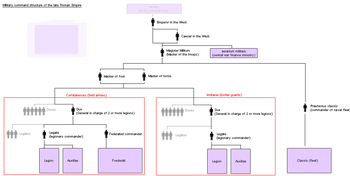
The title of magister militum was created in the 4th century, when Emperor Constantine the Great deprived the praetorian prefectPraetorian prefect
Praetorian prefect was the title of a high office in the Roman Empire. Originating as the commander of the Praetorian Guard, the office gradually acquired extensive legal and administrative functions, with its holders becoming the Emperor's chief aides...
s of their military functions. Initially two posts were created, one as head of the foot troops, as the magister peditum ("Master of the Foot"), and one for the more prestigious horse troops, the magister equitum ("Master of the Horse"). The latter title had existed since Republican times, as the second-in-command to a Roman dictator
Roman dictator
In the Roman Republic, the dictator , was an extraordinary magistrate with the absolute authority to perform tasks beyond the authority of the ordinary magistrate . The office of dictator was a legal innovation originally named Magister Populi , i.e...
. Under Constantine's successors, the title was also established at a territorial level: magistri peditum and magistri equitum were appointed for every praetorian prefecture
Praetorian prefecture
The praetorian prefecture was the largest administrative division of the late Roman Empire, above the mid-level dioceses and the low-level provinces. Praetorian prefectures originated in the reign of Constantine I The praetorian prefecture was the largest administrative division of the late Roman...
(per Gallias
Praetorian prefecture of Gaul
The praetorian prefecture of the Gauls was one of four large praetorian prefectures into which the Late Roman Empire was divided.- History :...
, per Italiam
Praetorian prefecture of Italy
The praetorian prefecture of Italy ) was one of four large Praetorian prefectures into which the Late Roman Empire was divided. It comprised the Italian peninsula, the Western Balkans, the Danubian provinces and parts of North Africa...
, per Illyricum
Praetorian prefecture of Illyricum
The praetorian prefecture of Illyricum was one of four praetorian prefectures into which the Late Roman Empire was divided.The administrative centre of the prefecture was Sirmium , and, after 379, Thessalonica...
, per Orientem
Praetorian prefecture of the East
The praetorian prefecture of the East or of Oriens was one of four large praetorian prefectures into which the Late Roman Empire was divided...
), and, in addition, for Thrace
Diocese of Thrace
The Diocese of Thrace was a diocese of the later Roman Empire, incorporating the provinces of the eastern Balkan Peninsula The Diocese of Thrace was a diocese of the later Roman Empire, incorporating the provinces of the eastern Balkan Peninsula The Diocese of Thrace was a diocese of the later...
and, sometimes, Africa
Diocese of Africa
The Diocese of Africa was a diocese of the later Roman Empire, incorporating the provinces of North Africa, except Mauretania Tingitana. Its seat was at Carthage, and it was subordinate to the Praetorian prefecture of Italy....
. On occasion, the offices would be combined under a single person, then styled magister equitum et peditum or magister utriusquae militiae ("master of both forces"). As such they were directly in command of the local mobile field army of the comitatenses
Comitatenses
Comitatenses is the Latin plural of comitatensis, originally the adjective derived from comitatus , itself rooting in Comes .However, historically it became the accepted name for...
, composed mostly of cavalry, which acted as a rapid reaction force
Rapid reaction force
A rapid reaction force is a military or police unit designed to respond in very short time frames to emergencies. When used in reference to police forces such as SWAT teams, the time frame is minutes, while in military applications, such as with the use of paratroops or other commandos, the time...
. Other magistri remained at the immediate disposal of the Emperors, and were termed in praesenti ("in the presence" of the Emperor). By the late 4th century, the regional commanders were termed simply magister militum.
In the Western Empire, a "commander-in-chief" was sometimes appointed with the title of magister utriusquae militiae. This powerful office was often the power behind the throne
Power behind the throne
The phrase power behind the throne refers to a person or group that informally exercises the real power of an office. In politics, it most commonly refers to a spouse, aide, or advisor of a political leader who serves as de facto leader, setting policy through influence or manipulation.The...
and was held by Stilicho
Stilicho
Flavius Stilicho was a high-ranking general , Patrician and Consul of the Western Roman Empire, notably of Vandal birth. Despised by the Roman population for his Germanic ancestry and Arian beliefs, Stilicho was in 408 executed along with his wife and son...
, Ricimer
Ricimer
Flavius Ricimer was a Germanic general who achieved effective control of the remaining parts of the Western Roman Empire, during the middle of the 5th century...
and others. In the East, there were two senior generals, who were appointed to the office of magister militum praesentalis. During the reign of Emperor Justinian I
Justinian I
Justinian I ; , ; 483– 13 or 14 November 565), commonly known as Justinian the Great, was Byzantine Emperor from 527 to 565. During his reign, Justinian sought to revive the Empire's greatness and reconquer the lost western half of the classical Roman Empire.One of the most important figures of...
, with increasing military threats and the expansion of the Eastern Empire, three new posts were created: the magister militum per Armeniam in the Armenian provinces, formerly part of the jurisdiction of the magister militum per Orientem, the magister militum per Africam in the reconquered African provinces
Praetorian prefecture of Africa
The praetorian prefecture of Africa was a major administrative division of the Eastern Roman Empire, established after the reconquest of northwestern Africa from the Vandals in 533-534 by emperor Justinian I...
(534), with a subordinate magister peditum, and the magister militum Spania
Spania
Spania was a province of the Roman Empire from 552 until 624 in the south of the Iberian Peninsula and the Balearic Islands. It was a part of the conquests of Roman Emperor Justinian I in an effort to restore the western half of the Empire....
e (ca. 562).
In the course of the 6th century, internal and external crises in the provinces often necessitated the temporary union of the supreme regional civil authority with the office of the magister militum. In the establishment of the exarchates of Ravenna
Exarchate of Ravenna
The Exarchate of Ravenna or of Italy was a centre of Byzantine power in Italy, from the end of the 6th century to 751, when the last exarch was put to death by the Lombards.-Introduction:...
and Carthage
Exarchate of Africa
The Exarchate of Africa or of Carthage, after its capital, was the name of an administrative division of the Eastern Roman Empire encompassing its possessions on the Western Mediterranean, ruled by an exarch, or viceroy...
in 584, this practice found its first permanent expression. Indeed, after the loss of the eastern provinces to the Muslim conquest in the 640s, the surviving field armies and their commanders formed the first themata.
Supreme military commanders sometimes also took this title in early medieval Italy, for example in the Papal States
Papal States
The Papal State, State of the Church, or Pontifical States were among the major historical states of Italy from roughly the 6th century until the Italian peninsula was unified in 1861 by the Kingdom of Piedmont-Sardinia .The Papal States comprised territories under...
and in Venice
Republic of Venice
The Republic of Venice or Venetian Republic was a state originating from the city of Venice in Northeastern Italy. It existed for over a millennium, from the late 7th century until 1797. It was formally known as the Most Serene Republic of Venice and is often referred to as La Serenissima, in...
, whose Doge
Doge
Doge is a dialectal Italian word that descends from the Latin dux , meaning "leader", especially in a military context. The wife of a Doge is styled a Dogaressa....
claimed to be the successor to the Exarch of Ravenna
Exarchate of Ravenna
The Exarchate of Ravenna or of Italy was a centre of Byzantine power in Italy, from the end of the 6th century to 751, when the last exarch was put to death by the Lombards.-Introduction:...
.
Unspecified commands
- 383-385/8: Flavius BautoFlavius BautoFlavius Bauto was a Romanised Frank who served as a magister militum of the Western Roman Empire.When the usurper Magnus Maximus invaded Italy in an attempt to replace Valentinian II, Bauto led the forces of the Eastern Emperor Theodosius I and defeated the rebel. He died soon after, likely of...
, magister militum under Valentinian IIValentinian IIFlavius Valentinianus , commonly known as Valentinian II, was Roman Emperor from 375 to 392.-Early Life and Accession :... - 385/8-394: ArbogastArbogast (general)Flavius Arbogastes , or Arbogast was a Frankish general in the Roman Empire. It has been stated by some ancient historians that he was the son of Flavius Bauto, Valentinian II's former magister militum and protector before Arbogast, but modern scholars largely discount this claim...
, magister militum under Valentinian IIValentinian IIFlavius Valentinianus , commonly known as Valentinian II, was Roman Emperor from 375 to 392.-Early Life and Accession :...
and EugeniusEugeniusFlavius Eugenius was an usurper in the Western Roman Empire against Emperor Theodosius I. Though himself a Christian, he was the last Emperor to support Roman polytheism.-Life:... - 421–432: Flavius GaudentiusFlavius GaudentiusFlavius Gaudentius was the father of the Roman magister militum Flavius Aetius. It is said that he was of Scythian birth.Gaudentius served under the Eastern Roman Emperor Theodosius I against the usurper Eugenius...
- 383–388: Andragathius
- 433–454: Flavius AetiusFlavius AëtiusFlavius Aëtius , dux et patricius, was a Roman general of the closing period of the Western Roman Empire. He was an able military commander and the most influential man in the Western Roman Empire for two decades . He managed policy in regard to the attacks of barbarian peoples pressing on the Empire...
- 455: AvitusAvitusEparchius Avitus was Western Roman Emperor from July 8 or July 9, 455 to October 17, 456. A Gallic-Roman aristocrat, he was a senator and a high-ranking officer both in the civil and military administration, as well as Bishop of Piacenza.A representative of the Gallic-Roman aristocracy, he...
- 455–472: RicimerRicimerFlavius Ricimer was a Germanic general who achieved effective control of the remaining parts of the Western Roman Empire, during the middle of the 5th century...
- 456: RemistusRemistusRemistus was a general of the Western Roman Empire, commander-in-chief of the army under Emperor Avitus.- Life :Remistus was a Visigoth, as shown by his Germanic name...
- 472–473: GundobadGundobadGundobad was King of the Burgundians , succeeding his father Gundioc of Burgundy. Previous to this, he had been a Patrician of the Western Roman Empire in 472–473, succeeding his uncle Ricimer.- Early life :...
- 475–476: Flavius Orestes
- ? – 480: OvidaOvidaOvida was a general during the late Western Roman Empire and the last Roman ruler of Dalmatia.Following Flavius Orestes's coup against the Western Roman Emperor Julius Nepos on August 28, 475, Ovida remained loyal to the Emperor and accompanied him on his escape to Dalmatia...
per GalliasRoman GaulRoman Gaul consisted of an area of provincial rule in the Roman Empire, in modern day France, Belgium, Luxembourg, and western Germany. Roman control of the area lasted for less than 500 years....
- 352–355: Claudius SilvanusClaudius SilvanusClaudius Silvanus was a Roman general of Frankish descent, usurper in Gaul against Emperor Constantius II for 28 days in 355.- Origin and career :...
- 362–364: Flavius Iovinus, magister equitum under JulianJulianJulian is a common male given name in Britain, United States, Ireland, Germany, Poland, the Netherlands, France , Spain, Latin America and elsewhere....
and Jovian - 410s–421: Flavius ConstantiusConstantius IIIFlavius Constantius , commonly known as Constantius III, was Western Roman Emperor for seven months in 421. A prominent general and politician, he was the power behind the throne for much of the 410s, and in 421 briefly became co-emperor of the Western Empire with Honorius.- Early life and rise to...
- 425–433: Flavius AetiusFlavius AëtiusFlavius Aëtius , dux et patricius, was a Roman general of the closing period of the Western Roman Empire. He was an able military commander and the most influential man in the Western Roman Empire for two decades . He managed policy in regard to the attacks of barbarian peoples pressing on the Empire...
- 452–456: AgrippinusAgrippinus (magister militum)Agrippinus was a general of the Western Roman Empire, Magister militum per Gallias under emperors Valentinian III, Petronius Maximus, Avitus and Libius Severus.- Biography :...
- 456–465: AegidiusAegidiusAegidius was a Gallo-Roman warlord of northern Gaul. He had been promoted as magister militum in Gaul under Aëtius around 450. An ardent supporter of Majorian, Aegidius rebelled when Ricimer deposed Majorian, engaging in several campaigns against the Visigoths and creating a Roman rump state that...
- 461/462: AgrippinusAgrippinus (magister militum)Agrippinus was a general of the Western Roman Empire, Magister militum per Gallias under emperors Valentinian III, Petronius Maximus, Avitus and Libius Severus.- Biography :...
- 465–486: SyagriusSyagriusSyagrius was the last Roman official in Gaul, whose defeat by king Clovis I of the Franks is considered the end of Roman rule outside of Italy. He came to this position through inheritance, for his father was Aegidius, the last Roman magister militum per Gallias...
per IllyricumPraetorian prefecture of IllyricumThe praetorian prefecture of Illyricum was one of four praetorian prefectures into which the Late Roman Empire was divided.The administrative centre of the prefecture was Sirmium , and, after 379, Thessalonica...
- ?-350: Vetranio, magister peditum under ConstansConstansConstans , was Roman Emperor from 337 to 350. He defeated his brother Constantine II in 340, but anger in the army over his personal life and preference for his barbarian bodyguards saw the general Magnentius rebel, resulting in Constans’ assassination in 350.-Career:Constans was the third and...
- 361: Flavius Iovinus, magister equitum under JulianJulianJulian is a common male given name in Britain, United States, Ireland, Germany, Poland, the Netherlands, France , Spain, Latin America and elsewhere....
- 365–375: Equitius, magister utriusquae militiae under Valentinian IValentinian IValentinian I , also known as Valentinian the Great, was Roman emperor from 364 to 375. Upon becoming emperor he made his brother Valens his co-emperor, giving him rule of the eastern provinces while Valentinian retained the west....
- 457?–468: Marcellinus
- 468–474: Julius NeposJulius NeposJulius Nepos was Western Roman Emperor de facto from 474 to 475 and de jure until 480. Some historians consider him to be the last Western Roman Emperor, while others consider the western line to have ended with Romulus Augustulus in 476...
- 477–479: OnoulphusOnoulphusOnoulphus, also Onoulf, Unulf and Hunulf was a Roman general of Scirian origin, magister militum per Illyricum from 477 to 479.- Biography :...
- 479–481: Sabinianus MagnusSabinianus MagnusSabinianus Magnus was a general of the Eastern Roman Empire, who fought in the rebellion of Theodoric Strabo against Emperor Zeno.- Biography :...
- 528: AscumAscumAscum was a general of the Byzantine Empire, active early in the reign of Justinian I . He was in command of the Praetorian prefecture of Illyricum. His name is reported by John Malalas. Both Theophanes the Confessor and George Kedrenos render his name "Ακούμ" .-Biography:Ascum was reportedly a...
- 530–536: Mundus
per OrientemPraetorian prefecture of the EastThe praetorian prefecture of the East or of Oriens was one of four large praetorian prefectures into which the Late Roman Empire was divided...
- ca. 347: Flavius Eusebius, magister utriusquae militiae
- 349–359: UrsicinusUrsicinus (Roman general)Ursicinus was a senior military officer, holding the rank of "master of cavalry" in the Eastern Roman Empire c. 349–359.In 351 or 352 he was entrusted with the suppression of the Jewish revolt against Caesar Constantius Gallus...
, magister equitum under ConstantiusConstantius IIConstantius II , was Roman Emperor from 337 to 361. The second son of Constantine I and Fausta, he ascended to the throne with his brothers Constantine II and Constans upon their father's death.... - 359–360: Sabinianus, magister equitum under ConstantiusConstantius IIConstantius II , was Roman Emperor from 337 to 361. The second son of Constantine I and Fausta, he ascended to the throne with his brothers Constantine II and Constans upon their father's death....
- 363–367: LupicinusLupicinusLupicinus was a Roman lieutenant of Valens in Thrace in the late fourth century AD.His reputed poor treatment of the Thervingi Goths under Fritigern lead to the Gothic Wars, and the Battle of Adrianople.-References:...
, magister equitum under Jovian and ValensValensValens was the Eastern Roman Emperor from 364 to 378. He was given the eastern half of the empire by his brother Valentinian I after the latter's accession to the throne... - 371–378: Iulius, magister equitum et Peditum under ValensValensValens was the Eastern Roman Emperor from 364 to 378. He was given the eastern half of the empire by his brother Valentinian I after the latter's accession to the throne...
- 383: Flavius RichomeresRichomeresFlavius Richomeres was a Frank who lived in the late 4th century. He took service in the Roman army and made a career as comes, magister militum, and consul. He was married to Ascyla, with whom he had a son Theudemeres, who became king of the Franks...
, magister equitum et peditum - 383–388: Ellebichus, magister equitum et peditum
- 392: Eutherius, magister equitum et peditum
- 393–396: Addaeus, magister equitum et peditum
- 395/400: FravittaFravittaFlavius Fravitta was a chieftain of the Visigoths, who entered in the Eastern Roman army, rising to its highest ranks.- Biography :Fravitta was a member of the Visigoth aristocracy...
- 433–446: Anatolius
- 447–451: ZenoZeno (consul 448)Flavius Zeno was an influential general and politician of the Eastern Roman Empire, of Isaurian origin, who reached the ranks of magister militum per Orientem, consul and patricius.- Biography :...
- 460s: Flavius Ardabur AsparAsparFlavius Ardabur Aspar was an Alan patrician and magister militum of the Eastern Roman Empire. Aspar's family exerted a great influence on the Eastern Roman Emperors for half a century, from the 420s to his death in 471, over Theodosius II, Marcian and Leo I, who, in the end, had him killed.Alans...
- -469: Iordanes
- 469–471: ZenoZeno (emperor)Zeno , originally named Tarasis, was Byzantine Emperor from 474 to 475 and again from 476 to 491. Domestic revolts and religious dissension plagued his reign, which nevertheless succeeded to some extent in foreign issues...
- 483–498: Ioannes Scytha
- c.503–505: Areobindus Dagalaiphus Areobindus
- 505–506: Pharesmanes
- ?516-?518: Hypatius
- ?518–529: Diogenianus
- 520-525/526: Hypatius
- 527: Libelarius
- 527–529: Hypatius
- 529–531: BelisariusBelisariusFlavius Belisarius was a general of the Byzantine Empire. He was instrumental to Emperor Justinian's ambitious project of reconquering much of the Mediterranean territory of the former Western Roman Empire, which had been lost less than a century previously....
- 531: Mundus
- 532–533: Belisarius
- 540: Buzes
- 542: Belisarius
- 543–544: Martinus
- 549–551: Belisarius
- 555: Amantius
- 556: Valerianus
- 569: ZemarchusZemarchusZemarchus was a Byzantine official, diplomat and traveller in the reign of Justin II.In the middle of the 6th century, the Göktürks conquered the Sogdiana and thus gained control of the silk trade, which then passed through Central Asia into Sassanid Persia. The Persian king, Chosroes I, dreading...
- 572–573: MarcianusMarcianus (nephew of Justin II)Marcianus was a Byzantine general, recorded to be a kinsman of Emperor Justin II.Theophanes the Confessor records him as a nephew of Justin II, commander of an army fighting the Moors in the Praetorian prefecture of Africa. Bibliotheca by Photios I of Constantinople records him as a mere cousin....
- 573: Theodorus
- 574: Eusebius
- 574/574-577: JustinianJustinian (general)Justinian was an East Roman aristocrat and general, and a member of the ruling Justinian dynasty. As a soldier, he had a distinguished career in the Balkans and in the East against Sassanid Persia...
- 577–582: MauriceMaurice (emperor)Maurice was Byzantine Emperor from 582 to 602.A prominent general in his youth, Maurice fought with success against the Sassanid Persians...
- 582–583: John MystaconJohn MystaconJohn, surnamed Mystacon, "the mustachioed", , was a prominent East Roman general in the wars with Sassanid Persia during the reigns of Byzantine emperors Tiberius II and Maurice ....
- 584-587/588: PhilippicusPhilippicus (general)Philippicus or Philippikos was an East Roman general, comes excubitorum, and brother-in-law of Emperor Maurice. His successful career as a general spanned several decades, chiefly against the Persians.- Under Maurice :...
- 588: PriscusPriscus (general)Priscus was a leading East Roman general during the reigns of the Byzantine emperors Maurice , Phocas and Heraclius . Although the contemporary sources are markedly biased in his favour, Priscus comes across as an effective and capable military leader...
- 588–589: PhilippicusPhilippicus (general)Philippicus or Philippikos was an East Roman general, comes excubitorum, and brother-in-law of Emperor Maurice. His successful career as a general spanned several decades, chiefly against the Persians.- Under Maurice :...
- 589–591: ComentiolusComentiolusComentiolus was a prominent Eastern Roman general at the close of the 6th century, during the reign of Emperor Maurice . He played a major role in Maurice's Balkan campaigns, and fought also in the East against the Persians.- Life :...
- 591–603: NarsesNarses (general under Maurice)Narses was a Byzantine general of Armenian ancestry active during the reigns of the emperors Maurice and Phocas in the late sixth and early seventh centuries. He commanded the army in Mesopotamia under Maurice; when Phocas overthrew Maurice and seized the throne, Narses refused to recognize the...
- 603-604 GermanusGermanus (general under Phocas)Germanus was a Byzantine general who served under Emperor Phocas in the early stages of the Byzantine-Sassanid War of 602–628....
- 604-605 Leontius
- 605-610 DomentziolusDomentziolus (nephew of Phocas)Domentziolus or Domnitziolus was a nephew of the Byzantine emperor Phocas , appointed curopalates and general in the East during his uncle's reign. He was one of the senior Byzantine military leaders during the opening stages of the Byzantine–Sassanid War of 602–628...
per ThraciasDiocese of ThraceThe Diocese of Thrace was a diocese of the later Roman Empire, incorporating the provinces of the eastern Balkan Peninsula The Diocese of Thrace was a diocese of the later Roman Empire, incorporating the provinces of the eastern Balkan Peninsula The Diocese of Thrace was a diocese of the later...
- 377–378: Flavius SaturninusSaturninus (consul 383)Flavius Saturninus was a politician and a military man of the Roman Empire.- Life :Saturninus was probably a Christian: it is known that he hosted a bishop, that he donated to a monastery and that was in touch for a short time with Gregory of Nazianzus.He followed the military career, and in...
, magister equitum under ValensValensValens was the Eastern Roman Emperor from 364 to 378. He was given the eastern half of the empire by his brother Valentinian I after the latter's accession to the throne... - 377–378: TraianusTraianus (magister peditum)Traianus was a Roman general under Emperor Valens with whom he died in the battle of Adrianople.- Life :...
, magister peditum under ValensValensValens was the Eastern Roman Emperor from 364 to 378. He was given the eastern half of the empire by his brother Valentinian I after the latter's accession to the throne... - 378: Sebastianus, magister peditum under ValensValensValens was the Eastern Roman Emperor from 364 to 378. He was given the eastern half of the empire by his brother Valentinian I after the latter's accession to the throne...
- 380–383: Flavius SaturninusSaturninus (consul 383)Flavius Saturninus was a politician and a military man of the Roman Empire.- Life :Saturninus was probably a Christian: it is known that he hosted a bishop, that he donated to a monastery and that was in touch for a short time with Gregory of Nazianzus.He followed the military career, and in...
, magister peditum under Theodosius ITheodosius ITheodosius I , also known as Theodosius the Great, was Roman Emperor from 379 to 395. Theodosius was the last emperor to rule over both the eastern and the western halves of the Roman Empire. During his reign, the Goths secured control of Illyricum after the Gothic War, establishing their homeland... - 392–393: Flavius Stilicho, magister equitum et peditum
- 412–414: ConstansConstans (consul 414)- Biography :Constans was magister militum per Thracias in 412. In 414 he held the consulship ; he took office in Constantinople....
- 441: Ioannes the Vandal, magister utriusque militiae
- 468–474: ArmatusArmatusFlavius Armatus was a Byzantine military commander, magister militum under Emperors Leo I, Basiliscus and Zeno, and consul. He was instrumental in the rebellion of Basiliscus against Zeno, and in his subsequent fall.- Origin and early career :...
- 474: Heraclius of EdessaHeraclius of EdessaHeraclius of Edessa was an Eastern Roman Empire general who took part in the failed campaign against the Vandals in 468.- Biography :...
- 530-533: ChilbudiusChilbudiusChilbudius or Chilbuldius was a Byzantine general, holding the rank of magister militum per Thracias in the early 530s. He was apparently killed in battle c. 533, but an impostor claimed his identity c. 545-546. The only source for both men is Procopius.- Origin :According to some scholars...
in praesenti
- 351–361: Flavius Arbitio, magister equitum under ConstantiusConstantius IIConstantius II , was Roman Emperor from 337 to 361. The second son of Constantine I and Fausta, he ascended to the throne with his brothers Constantine II and Constans upon their father's death....
- 361–363: Flavius Nevitta, magister equitum under JulianJulianJulian is a common male given name in Britain, United States, Ireland, Germany, Poland, the Netherlands, France , Spain, Latin America and elsewhere....
- 363–379: Victor, magister equitum under ValensValensValens was the Eastern Roman Emperor from 364 to 378. He was given the eastern half of the empire by his brother Valentinian I after the latter's accession to the throne...
- 366–378: Flavius Arinthaeus, magister peditum under ValensValensValens was the Eastern Roman Emperor from 364 to 378. He was given the eastern half of the empire by his brother Valentinian I after the latter's accession to the throne...
- 364–369: Flavius Iovinus, magister equitum under Valentinian IValentinian IValentinian I , also known as Valentinian the Great, was Roman emperor from 364 to 375. Upon becoming emperor he made his brother Valens his co-emperor, giving him rule of the eastern provinces while Valentinian retained the west....
- 364–366: Dagalaifus, magister peditum under Valentinian IValentinian IValentinian I , also known as Valentinian the Great, was Roman emperor from 364 to 375. Upon becoming emperor he made his brother Valens his co-emperor, giving him rule of the eastern provinces while Valentinian retained the west....
- 367–372: Severus, magister peditum under Valentinian IValentinian IValentinian I , also known as Valentinian the Great, was Roman emperor from 364 to 375. Upon becoming emperor he made his brother Valens his co-emperor, giving him rule of the eastern provinces while Valentinian retained the west....
- 369–373: Flavius Theodosius, magister equitum under Valentinian IValentinian IValentinian I , also known as Valentinian the Great, was Roman emperor from 364 to 375. Upon becoming emperor he made his brother Valens his co-emperor, giving him rule of the eastern provinces while Valentinian retained the west....
- 375–388: MerobaudesMerobaudes (general)- Biography :Merobaudes was an official of Roman Emperor Julian . He was entrusted with the transportation of the corpse of the Emperor when Julian died during his military campaign against the Sasanids....
, magister peditum under Valentinian IValentinian IValentinian I , also known as Valentinian the Great, was Roman emperor from 364 to 375. Upon becoming emperor he made his brother Valens his co-emperor, giving him rule of the eastern provinces while Valentinian retained the west....
, GratianGratianGratian was Roman Emperor from 375 to 383.The eldest son of Valentinian I, during his youth Gratian accompanied his father on several campaigns along the Rhine and Danube frontiers. Upon the death of Valentinian in 375, Gratian's brother Valentinian II was declared emperor by his father's soldiers...
and Magnus MaximusMagnus MaximusMagnus Maximus , also known as Maximianus and Macsen Wledig in Welsh, was Western Roman Emperor from 383 to 388. As commander of Britain, he usurped the throne against Emperor Gratian in 383... - 388-395: TimasiusTimasiusFlavius Timasius was a general of the Roman Empire, a relative of the Empress Aelia Flaccilla, wife of Theodosius I.- Life :Timasius was a officer under Emperor Valens, and survived to the battle of Adrianople , in which the Emperor lost his life. Theodosius I appointed Timasius comes and magister...
- 394–408: Flavius Stilicho, magister equitum et peditum
- 400: FravittaFravittaFlavius Fravitta was a chieftain of the Visigoths, who entered in the Eastern Roman army, rising to its highest ranks.- Biography :Fravitta was a member of the Visigoth aristocracy...
- 409: VaranesVaranes (consul 410)Varanes was a politician and general of the Western and Eastern Roman Empires.- Biography :His name suggests a Persian origin. In 393, Varanes was at the court in Constantinople...
and Arsacius - 419-: PlintaPlintaFlavius Plinta was a politician and general of the Eastern Roman Empire.- Biography :He was a Goth, related to Aspar , perhaps his father-in-law, and father of Armatius; in 450 his daughter was given in marriage by Theodosius to Constantius, the secretary of Attila...
- 443–451: ApolloniusApollonius (magister militum)- Biography :Apollonius was a Pagan and well-educated. Before 448 he converted to Christianity. He received two letters by Theodoret.He was magister militum praesentalis in the East at least since 443 and until 451, when he was sent to Attila as ambassador; in that occasion the King of the Huns...
- 450–451: Anatolius
- 475-477/478: ArmatusArmatusFlavius Armatus was a Byzantine military commander, magister militum under Emperors Leo I, Basiliscus and Zeno, and consul. He was instrumental in the rebellion of Basiliscus against Zeno, and in his subsequent fall.- Origin and early career :...
- 485-: LonginusLonginus (consul 486)Flavius Longinus was a politician of the Eastern Roman Empire, brother of Emperor Zeno and twice consul .- Biography :Longinus came from the region of Isauria, in Asia Minor...
- 492–499: John the HunchbackJohn the HunchbackJohn the Hunchback or John Gibbo was a general and a politician of the Eastern Roman Empire.- Biography :John was a native of Selymbria, modern Silivri in Turkey....
- 546–548: ArtabanesArtabanes (general)Artabanes was an East Roman general of Armenian origin who served under Justinian I . Initially a rebel against Byzantine authority, he fled to the Sassanid Persians but soon returned to Byzantine allegiance. He served in Africa, where he won great fame by killing the rebel general Guntharic and...
- 585-?: ComentiolusComentiolusComentiolus was a prominent Eastern Roman general at the close of the 6th century, during the reign of Emperor Maurice . He played a major role in Maurice's Balkan campaigns, and fought also in the East against the Persians.- Life :...
Western EmpireDiocese of AfricaThe Diocese of Africa was a diocese of the later Roman Empire, incorporating the provinces of North Africa, except Mauretania Tingitana. Its seat was at Carthage, and it was subordinate to the Praetorian prefecture of Italy....
- 373–375: Flavius Theodosius, magister equitum
- 386–398: GildoGildoGildo was a Roman general in the province of Mauretania. He revolted against Honorius and the western empire but was defeated and committed suicide....
, magister equitum et peditum
Eastern EmpirePraetorian prefecture of AfricaThe praetorian prefecture of Africa was a major administrative division of the Eastern Roman Empire, established after the reconquest of northwestern Africa from the Vandals in 533-534 by emperor Justinian I...
- 534–536: SolomonSolomon (Byzantine general)Solomon was an East Roman general from northern Mesopotamia, who distinguished himself as a commander in the Vandalic War and the reconquest of North Africa in 533–534. He spent most of the next decade in Africa as its governor general, combining the military post of magister militum with the...
- 536–539: Germanus
- 539–544: SolomonSolomon (Byzantine general)Solomon was an East Roman general from northern Mesopotamia, who distinguished himself as a commander in the Vandalic War and the reconquest of North Africa in 533–534. He spent most of the next decade in Africa as its governor general, combining the military post of magister militum with the...
- 544–546: Sergius
- 545–546: Areobindus
- 546: ArtabanesArtabanes (general)Artabanes was an East Roman general of Armenian origin who served under Justinian I . Initially a rebel against Byzantine authority, he fled to the Sassanid Persians but soon returned to Byzantine allegiance. He served in Africa, where he won great fame by killing the rebel general Guntharic and...
- 546–552: John TroglitaJohn TroglitaJohn Troglita was a 6th-century Byzantine general. His exploits against the Sassanid Persians in the East and especially against the Moorish rebels in North Africa are the subject of the last Latin epic poem of Antiquity, the Iohannis or de Bellis Libycis of Flavius Cresconius Corippus.- Origins...
- 578–590: GennadiusGennadius (6th century)Gennadius was an East Roman general and the first exarch of Africa.He was appointed as magister militum Africae in ca. 578, and quickly defeated the Romano-Moorish kingdom of Garmul in Mauretania. He held this post until named exarch by Emperor Maurice sometime between 585 and 591...
Venice
- 700s: Marcellus
- 737: Domenico LeoniDomenico LeoniDomenico Leoni was a Venetian statesman of Byzantine origin; he served as magister militum and Hypatus in 737.-Reference:* Samuele Romanin, Storia documentata di Venezia, Pietro Naratovich tipografo editore, Venezia, 1853....
under Leo III the IsaurianLeo III the IsaurianLeo III the Isaurian or the Syrian , was Byzantine emperor from 717 until his death in 741... - 738: Felice CornicolaFelice CornicolaFelice Cornicola was the ruler of Venice, Hypatus of 738 and magister militum....
under Leo III the IsaurianLeo III the IsaurianLeo III the Isaurian or the Syrian , was Byzantine emperor from 717 until his death in 741... - 739: Theodatus Ursus under Leo III the IsaurianLeo III the IsaurianLeo III the Isaurian or the Syrian , was Byzantine emperor from 717 until his death in 741...
- 741: Ioannes Fabriacius under Leo III the IsaurianLeo III the IsaurianLeo III the Isaurian or the Syrian , was Byzantine emperor from 717 until his death in 741...
- 764–787: Mauricius Galba
Later, less formal use of the term
By the twelfth century, the term was being used to describe a man who organized the military force of a political or feudal leader on his behalf. In the Gesta HerwardiGesta Herwardi
The Gesta Herewardi is the name of a Latin text probably written around 1109-31, recounting the deeds of Hereward the Wake. The Latin text of about 1109-31 claims to be a translation of an earlier work in Old English, with gaps in the damaged original filled out from oral history...
, the hero is several times described as magister militum by the man who translated the original Early English account into Latin. It seems possible that the writer of the original version, now lost, thought of him as the 'hereward' – the supervisor of the military force. That this later use of these terms was based on the classical concept seems clear.
Sources
- Prosopography of the Later Roman EmpireProsopography of the Later Roman EmpireProsopography of the Later Roman Empire is a set of three volumes collectively describing every person attested or claimed to have lived in the Roman world from AD 260, the date of the beginning of Gallienus' sole rule, to 641, the date of the death of Heraclius, which is commonly held to mark the...
(PLRE), Vols. I-III