


Galla Placidia

Encyclopedia
Aelia Galla Placidia daughter of the Roman Emperor
Theodosius I
, was the Regent for Emperor
Valentinian III
from 423 until his majority in 437, and a major force in Roman politics for most of her life. She was consort to Ataulf
king of the Goths
from 414-415 until his death, and Empress consort to Constantius III
from 417-422 until his death.
Theodosius I
and his second wife Galla
,, who was herself daughter of Emperor Valentinian I
and his second wife Justina. Her older brother Gratian died young. Her mother died in childbirth in 394, giving birth to John, who died with their mother. Placidia was a younger, paternal half-sister of Emperors Arcadius
and Honorius
. Her older half-sister Pulcheria
predeceased her parents as mentioned in the writings of Gregory of Nyssa
, placing the death of Pulcheria prior to the death of Aelia Flaccilla
, first wife of Theodosius I, in 385.
during 394. She was present at Theodosius' death on January 17, 395. She was granted the title of "Nobilissima Puella" ("Most Noble Girl") during her childhood.
Placidia spent most of her early years in the household of Stilicho
the Vandal
and his wife Serena
. She is presumed to have learned weaving
and embroidery
. She might have also been given a classical education
though no details are known. Serena was a first cousin of Arcadius, Honorius and Placidia. The poem "In Praise of Serena" by Claudian
and the "Historia Nova" by Zosimus
clarify that Serena's father was an elder Honorius, a brother to Theodosius I. According to "De Consulatu Stilichonis" by Claudian, Placidia was betrothed to Eucherius, only known son of Stilicho and Serena. Her scheduled marriage is mentioned in the text as the third union between Stilicho's family and the Theodosian dynasty
, following those of Stilicho to Serena and Maria
, their daughter, to Honorius.
Stilicho was the magister militum
of the Western Roman Empire
. He was the only known person to hold the rank of "magister militum in praesenti" from 394 to 408 in both the Western and the Eastern Roman Empire. He was also titled "magister equitum et peditum" ("Master of the Horse and of Foot"), placing him in charge of both the cavalry
and infantry
forces of the Western Roman Empire. In 408, Arcadius died and was succeeded by his son Theodosius II
, only seven years old. Stilicho planned to proceed to Constantinople
and "undertake the management of the affairs of Theodosius", convincing Honorius not to travel to the East himself. Shortly after, Olympius, "an officer of rank in the court-guards" attempted to convince Honorius that Stilicho was in fact conspiring to depose Theodosius II, to replace him with Eucherius. Olympius proceeded to lead a military coup d'état
which left him in control of Honorius and his court. Stilicho was arrested and executed on August 22, 408. Eucherius sought refuge in Rome
but was arrested there by Arsacius and Tarentius, two eunuchs following imperial command. They executed him not long after. Honorius appointed Tarentius imperial chamberlain, and gave the next post under him to Arsacius. Their deaths left Placidia effectively unattached.
the wives and children of the foederati
were slain. The foederati were considered loyalists of Stilicho and treated accordingly. The natural consequence of all this was that these men, to the number of 30,000, flocked to the camp of Alaric I
, King of the Visigoths, clamouring to be led against their cowardly enemies. Alaric accordingly led them across the Julian Alps
and, in September 408, stood before the Aurelian Walls
and began a strict blockade. Rome was under siege
, with minor interruptions, from 408 to August 24, 410. Zosimus
records that Placidia was within the city during the siege. When Serena was accused of conspiring with Alaric, "the whole senate
therefore, with Placidia, uterine sister to the emperor, thought it proper that she should suffer death". Her reasons for concurring to the execution of her cousin are not stated in the account.
Prior to the fall of Rome, Placidia was captured by Alaric. Her captivity was recorded by both Jordanes
and Marcellinus Comes
, though the exact circumstances are not mentioned. She followed the Visigoths in their move from the Italian Peninsula to Gaul
in 412. Their ruler Ataulf
, having succeeded Alaric, entered an alliance with Honorius against Jovinus
and Sebastianus
, rival Western Roman emperors located in Gaul. He managed to defeat and execute both Gallo-Roman
emperors in 413.
After the heads of Sebastianus and Jovinus arrived at Honorius' court in Ravenna
in late August, to be forwarded for display among other usurpers on the walls of Carthage
, relations between Ataulf and Honorius improved sufficiently for Ataulf to cement them by marrying Galla Placidia at Narbonne
on January 1, 414. The nuptials were celebrated with high Roman festivities and magnificent gifts from the Gothic booty. Priscus Attalus
gave the wedding speech, a classical epithalamium
. The marriage was recorded by Hydatius
. The historian Jordanes states that they married earlier, in 411 at Forum Livii (Forlì
). Jordanes's date may actually be when she and the Gothic king first became more than captor and captive.
Placidia and Ataulf had a single known son, Theodosius. He was born in Barcelona
by the end of 414. Theodosius died early in the following year, thus eliminating an opportunity for a Romano-Visigothic line. Years later the corpse was exhumed and reburied in the imperial mausoleum in St. Peter's Basilica
, Rome. In Hispania
, Ataulf imprudently accepted into his service a man identified as "Dubius" or "Eberwolf", a former follower of Sarus. Sarus was a Germanic chieftain who was killed while fighting under Jovinus and Sebastianus. His follower harbored a secret desire to avenge the death of his beloved patron. And so, in the palace at Barcelona, the man brought Ataulf's reign to a sudden end by killing him while he bathed in August/September, 415.
The Amali
faction proceeded to proclaim Sigeric
, a brother of Sarus, as the next king of the Visigoths. According to The History of the Decline and Fall of the Roman Empire
by Edward Gibbon
, the first act of Sigeric's reign "was the inhuman murder" of Ataulf's six children from a former marriage "whom he tore, without pity, from the feeble arms of a venerable bishop." (the latter being Sigesar, Bishop of the Goths). As for Galla Placidia, as Ataulf's widow, she was "treated with cruel and wanton insult" by being forced to walk more than twelve miles on foot among the crowd of captives driven ahead of the mounted Sigeric. Seeing the noble widow's sufferings, however, became one of the factors that roused indignant opponents of the usurper, who quickly assassinated Sigeric and replaced him with Wallia
, Ataulf's relative.
 According to the Chronicon Albeldense, included in the Roda Codex
, Wallia was desperate for food supplies. He surrendered to Constantius III
, at the time magister militum of Honorius, negotiating terms giving foederati status for the Visigoths. Placidia was returned to Honorius as part of the peace treaty. Her brother Honorius forced her into marriage to Constantius III on January 1, 417. Their daughter Justa Grata Honoria
was probably born in 417 or 418. The history of Paul the Deacon
mentions her first among the children of the marriage, suggesting that she was the eldest. Their son Valentinian III
was born July 2, 419.
Placidia intervened in the succession crisis following the death of Pope Zosimus
on December 26, 418. Two factions of the Roman clergy had proceeded to elect their own popes, the first electing Eulalius
(27 December) and the other electing Boniface I
(28 December). They acted as rival popes, both in Rome, and their factions plunged the city into tumult. Symmachus, Prefect of Rome, sent his report to the imperial court at Ravenna, requesting an imperial decision on the matter. Placidia and, presumably, Constantius petitioned the emperor in favor of Eulalius. This was arguably the first intervention by an Emperor in the Papal election.
Honorius initially confirmed Eulalius as the legitimate pope. As this failed to put an end to the controversy, Honorius called a synod
of Italian bishops at Ravenna to decide the matter. The synod met from February to March 419 but failed to reach a conclusion. Honorius called a second synod in May, this time including Gaulish and African bishops. In the meantime, the two rival popes were ordered to leave Rome. As Easter
approached, however, Eulalius returned to the city and attempted to seize the Basilica of St. John Lateran
in order to "preside at the paschal ceremonies". Imperial troops managed to repel him, and on Easter (March 30, 419) the ceremonies were led by Achilleus, Bishop of Spoleto. The conflict cost Eulalius the imperial favor, and Boniface was proclaimed the legitimate pope as of April 3, 419, returning to Rome a week later. Placidia had personally written to the African bishops, summoning them to the second synod. Three of her letters are known to have survived.
On February 8, 421, Constantius was proclaimed an Augustus
, becoming co-ruler with the childless Honorius. Placidia was proclaimed an Augusta. She was the only Empress in the West, since Honorius had divorced his second wife Thermantia
in 408 and had never remarried. Neither title was recognised by Theodosius II, the Eastern Roman Emperor. Constantius reportedly complained about the loss of personal freedom and privacy that came with the imperial office. He died of an illness on September 2, 421.
 Galla Placidia herself was now forced from the Western Empire. Though the motivation for this remains unclear, the public issue was the increasingly scandalous public caresses she received from her own brother Honorius—this at least was the interpretation of Olympiodorus of Thebes
, a historian used as a source by Zosimus
, Sozomen
and probably Philostorgius
, as J.F. Matthews has demonstrated. Gibbon had a different opinion: "The power of Placidia; and the indecent familiarity of her brother, which might be no more than the symptoms of a childish affection, were universally attributed to incestuous love."
According to Gibbon, "On a sudden, by some base intrigues of a steward and a nurse, this excessive fondness was converted into an irreconcilable quarrel: the debates of the emperor and his sister were not long confined within the walls of the palace; and as the Gothic soldiers adhered to their queen, the city of Ravenna was agitated with bloody and dangerous tumults, which could only be appeased by the forced or voluntary retreat of Placidia and her children. The royal exiles landed at Constantinople
, soon after the marriage of Theodosius, during the festival of the Persian victories. They were treated with kindness and magnificence; but as the statues of the emperor Constantius had been rejected by the Eastern court, the title of Augusta could not decently be allowed to his widow". The passage places the arrival of Placidia and her children after the marriage of Theodosius II to Aelia Eudocia
, known to have occurred on June 7, 421. The "Persian victories" mentioned were probably victory celebrations over a brief Roman-Persian War
, under the respective leadership of Theodosius II and Bahram V
of the Sassanid Empire
. This conflict took place from c. 420 to 422. "The general Ardaburius
operated in Arzanene
and gained a victory, autumn 421, which forced the Persians to retreat to Nisibis, which Ardaburius then besieged. He raised the siege on the arrival of an army under Varahran, who proceeded to attack Resaina
. Meanwhile the Saracens
of Hira
, under Al‑Mundhir, were sent to invade Syria
, and were defeated by Vitianus. During the peace negotiations the Persians attacked the Romans and were defeated by Procopius, son-in‑law of Anthemius
(Socrates, VII.18, 20). The Empress Eudocia celebrated the war in a poem in heroic metre (ib. 21)." The "Saracens of Hira" were the Lakhmids
of Al-Hirah.
On August 15, 423, Honorius died of dropsy
, perhaps pulmonary edema
. With no member of the Theodosian dynasty
present at Ravenna to claim the throne, Theodosius II was expected to nominate a Western co-emperor. However, Theodosius hesitated and the decision was delayed. Taking advantage of the power vacuum
, Castinus
the Patrician proceeded to become a kingmaker
. He declared Joannes
, the primicerius notariorum
("chief notary", head of the civil service
), to be the new Western Roman Emperor. Among their supporters was Flavius Aetius
. Aetius was a son of Flavius Gaudentius
, magister militum, and Aurelia. Joannes' rule was accepted in the provinces of Italia, Gaul
, Hispania
, but not in Africa Province
.
Theodosius II reacted by preparing Valentinian III for eventual promotion to the imperial office. In 423/424, Valentinian was named nobilissimus
. In 424, Valentinian was betrothed to Licinia Eudoxia
, his first cousin once removed. She was a daughter of Theodosius II and Aelia Eudocia. The year of their betrothal was recorded by Marcellinus Comes
. At the time of their betrothal, Valentinian was approximately four years old, Licinia only two. Gibbon attributes the betrothal to "the agreement of the three females who governed the Roman world", meaning Placidia and her nieces Eudocia and Pulcheria
. In the same year, Valentinian was proclaimed a Caesar
in the Eastern court.
The campaign against Joannes also started in the same year. Forces of the Byzantine army
gathered at Thessaloniki
, and were placed under the general command of Ardaburus, the victorious general of the Roman-Persian War. The invasion force was to cross the Adriatic Sea
by two routes. Aspar
, son of Ardaburius, led the cavalry by land, following the coast of the Adriatic from the Western Balkans
to Northern Italy
. Placidia and Valentinian joined this force. Ardaburius and the infantry boarded ships of the Byzantine navy
in an attempt to reach Ravenna by sea. Aspar marched his forces to Aquileia
, taking the city by surprise and with virtually no resistance. The fleet, on the other hand, was dispersed by a storm. Ardaburius and two of his galleys were captured by forces loyal to Joannes and were held prisoners in Ravenna.
Ardaburius was treated well by Joannes, who probably intended to negotiate with Theodosius for an end to the hostilities. The prisoner was allowed the "courteous freedom" of walking the court and streets of Ravenna during his captivity. He took advantage of this privilege to come into contact with the forces of Joannes and convinced some of them to defect
to Theodosius' side. The conspirators contacted Aspar and beckoned him to Ravenna. A shepherd led Aspar's cavalry force through the marsh
es of the Po River
to the gates of Ravenna; with the besiegers outside the walls and the defectors within, the city was quickly captured. Joannes was taken and his right hand cut off; he was then mounted on a donkey
and paraded through the streets, and finally beheaded in the Hippodrome
of Aquileia.
With Joannes dead, Valentinian was officially proclaimed the new Augustus of the Western Roman Empire on October 23, 425, in the presence of the Roman Senate
. Three days following Joannes' death, Aetius brought reinforcements for his army, a reported number of sixty thousand Huns
from across the Danube
. After some skirmishing, Placidia and Aetius came to an agreement that established the political landscape of the Western Roman Empire for the next thirty years. The Huns were paid off and sent home, while Aetius received the position of magister militum
per Gallias (commander-in-chief
of the Roman army
in Gaul).
of the Western Roman Empire
from 425 to 437, her regency ending when Valentinian reached his eighteenth birthday on July 2, 437. Among her early supporters was Bonifacius
, governor of the Diocese of Africa
. Aetius, his rival for influence, managed to secure Arles
against Theodoric I
of the Visigoths. The Visigoths concluded a treaty and were given Gallic noblemen as hostages. The later Emperor Avitus
visited Theodoric, lived at his court and taught his sons.
records that Aetius played the two against each other, warning Placidia against Bonifacius and advising her to recall him to Rome; simultaneously writing to Bonifacius, warning him that Placidia was about to summon him for no good reason in order to put him away.
Bonifacius, trusting the warning from Aetius, refused the summons; and, thinking his position untenable, sought an alliance with the Vandals
in Spain. The Vandals subsequently crossed from Spain into Libya to join him. To friends of Bonifacius in Rome, this apparent act of hostility toward the Empire seemed entirely out of character for Bonifacius. They traveled to Carthage at Placidia's behest to intercede with him, and he showed them the letter from Aetius. The plot now revealed, his friends returned to Rome to apprise Placidia of the true situation. She did not move against Aetius, as he wielded great influence, and as the Empire was already in danger; but she urged Bonifacius to return to Rome "and not to permit the empire of the Romans to lie under the hand of barbarians."
Bonifacius now regretted his alliance with the Vandals and tried to persuade them to return to Spain. Gaiseric offered battle instead, and Bonifacius was besieged at Hippo Regius
in Numidia
by the sea. (St. Augustine
was Bishop of Hippo and died in this siege.) Unable to take the city, the Vandals eventually raised the siege. The Romans, with reinforcements under Aspar, renewed the struggle but were routed and lost Africa to the Vandals.
Bonifacius had meanwhile returned to Rome, where Placidia raised him to the rank of patrician and made him "master-general of the Roman armie". Aetius returned from Gaul with an army of "barbarians", and was met by Bonifacius in the bloody Battle of Ravenna (432)
. Bonifacius won the battle, but was mortally wounded and died a few days later. Aetius was compelled to retire to Pannonia
.
Aetius later played a pivotal role in the defense of the Western Empire against Attila the Hun
. Attila was diverted from Constantinople towards Italy by a letter from Placidia's own daughter Justa Grata Honoria
in the spring of 450, asking him to rescue her from an unwanted marriage to a Roman senator
that the Imperial family, including Placidia, was trying to force upon her. Honoria included her engagement ring
with the letter. Though Honoria may not have intended a proposal of marriage, Attila chose to interpret her message as such. He accepted, asking for half of the western Empire as dowry
. When Valentinian discovered the plan, only the influence of Placidia persuaded him not to kill Honoria. Valentinian wrote to Attila denying the legitimacy of the supposed marriage proposal. Attila, unconvinced, sent an emissary to Ravenna to proclaim that Honoria was innocent, that the proposal had been legitimate, and that he would come to claim what was rightfully his. Honoria was quickly married to Flavius Bassus Herculanus, though this did not prevent Attila from pressing his claim.
Placidia died shortly afterwards at Rome in November 450, and did not live to see Attila ravage Italy in 451–453, in a much more brutal campaign than the Goths had waged, using Justa's letter as his sole "legitimate" excuse.
Christian. She was involved in the building and restoration of various churches throughout her period of influence. She restored and expanded the Basilica of Saint Paul Outside the Walls
in Rome
and the Church of the Holy Sepulchre
in Jerusalem. She built San Giovanni Evangelista, Ravenna
in thanks for the sparing of her life and those of her children in a storm while crossing the Adriatic Sea. The dedicatory inscription reads "Galla Placidia, along with her son Placidus Valentinian Augustus and her daughter Justa Grata Honoria Augusta, paid off their vow for their liberation from the danger of the sea."
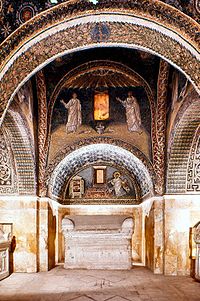
Her Mausoleum
in Ravenna was one of the UNESCO
World Heritage Site
s inscribed in 1996. However there is some doubt whether the building served as her tomb. The building was initially erected as a chapel dedicated to Lawrence of Rome. It is unknown whether the sarcophagi
therein contained the bodies of the members of the Theodosian dynasty, or when they were placed in the building.
Roman Emperor
The Roman emperor was the ruler of the Roman State during the imperial period . The Romans had no single term for the office although at any given time, a given title was associated with the emperor...
Theodosius I
Theodosius I
Theodosius I , also known as Theodosius the Great, was Roman Emperor from 379 to 395. Theodosius was the last emperor to rule over both the eastern and the western halves of the Roman Empire. During his reign, the Goths secured control of Illyricum after the Gothic War, establishing their homeland...
, was the Regent for Emperor
Roman Emperor
The Roman emperor was the ruler of the Roman State during the imperial period . The Romans had no single term for the office although at any given time, a given title was associated with the emperor...
Valentinian III
Valentinian III
-Family:Valentinian was born in the western capital of Ravenna, the only son of Galla Placidia and Flavius Constantius. The former was the younger half-sister of the western emperor Honorius, and the latter was at the time Patrician and the power behind the throne....
from 423 until his majority in 437, and a major force in Roman politics for most of her life. She was consort to Ataulf
Ataulf
Ataulf was king of the Visigoths from 410 to 415...
king of the Goths
King of the Goths
The title of King of the Goths was for many centuries borne by both the Kings of Sweden and the Kings of Denmark, denoting sovereignty or claimed sovereignty over the antique people of the Goths....
from 414-415 until his death, and Empress consort to Constantius III
Constantius III
Flavius Constantius , commonly known as Constantius III, was Western Roman Emperor for seven months in 421. A prominent general and politician, he was the power behind the throne for much of the 410s, and in 421 briefly became co-emperor of the Western Empire with Honorius.- Early life and rise to...
from 417-422 until his death.
Family
Placidia was the daughter of Roman EmperorRoman Emperor
The Roman emperor was the ruler of the Roman State during the imperial period . The Romans had no single term for the office although at any given time, a given title was associated with the emperor...
Theodosius I
Theodosius I
Theodosius I , also known as Theodosius the Great, was Roman Emperor from 379 to 395. Theodosius was the last emperor to rule over both the eastern and the western halves of the Roman Empire. During his reign, the Goths secured control of Illyricum after the Gothic War, establishing their homeland...
and his second wife Galla
Galla, wife of Theodosius I
Flavia Galla was a Princess of the Western Roman Empire and an Empress of the Roman Empire. She was the second Empress consort of Theodosius I.-Family:...
,, who was herself daughter of Emperor Valentinian I
Valentinian I
Valentinian I , also known as Valentinian the Great, was Roman emperor from 364 to 375. Upon becoming emperor he made his brother Valens his co-emperor, giving him rule of the eastern provinces while Valentinian retained the west....
and his second wife Justina. Her older brother Gratian died young. Her mother died in childbirth in 394, giving birth to John, who died with their mother. Placidia was a younger, paternal half-sister of Emperors Arcadius
Arcadius
Arcadius was the Byzantine Emperor from 395 to his death. He was the eldest son of Theodosius I and his first wife Aelia Flaccilla, and brother of the Western Emperor Honorius...
and Honorius
Honorius (emperor)
Honorius , was Western Roman Emperor from 395 to 423. He was the younger son of emperor Theodosius I and his first wife Aelia Flaccilla, and brother of the eastern emperor Arcadius....
. Her older half-sister Pulcheria
Pulcheria (daughter of Theodosius I)
Aelia Pulcheria was the daughter of Roman Emperor Theodosius I and Roman Empress Aelia Flaccilla. This Pulcheria apparently died in childhood and is not to be confused with her more famous niece of the same name....
predeceased her parents as mentioned in the writings of Gregory of Nyssa
Gregory of Nyssa
St. Gregory of Nyssa was a Christian bishop and saint. He was a younger brother of Basil the Great and a good friend of Gregory of Nazianzus. His significance has long been recognized in the Eastern Orthodox, Oriental Orthodox, Eastern Catholic and Roman Catholic branches of Christianity...
, placing the death of Pulcheria prior to the death of Aelia Flaccilla
Aelia Flaccilla
Aelia Flavia Flaccilla , first wife of the Roman Emperor Theodosius I. She was of Hispanian Roman descent. During her marriage to Theodosius, she gave birth to two sons — future Emperors Arcadius and Honorius — and a daughter, Aelia Pulcheria...
, first wife of Theodosius I, in 385.
Early life
Placidia was granted her own household by her father in the early 390s and was thus financially independent while underage. She was summoned to the court of her father in MediolanumMediolanum
Mediolanum, the ancient Milan, was an important Celtic and then Roman centre of northern Italy. This article charts the history of the city from its settlement by the Insubres around 600 BC, through its conquest by the Romans and its development into a key centre of Western Christianity and capital...
during 394. She was present at Theodosius' death on January 17, 395. She was granted the title of "Nobilissima Puella" ("Most Noble Girl") during her childhood.
Placidia spent most of her early years in the household of Stilicho
Stilicho
Flavius Stilicho was a high-ranking general , Patrician and Consul of the Western Roman Empire, notably of Vandal birth. Despised by the Roman population for his Germanic ancestry and Arian beliefs, Stilicho was in 408 executed along with his wife and son...
the Vandal
Vandals
The Vandals were an East Germanic tribe that entered the late Roman Empire during the 5th century. The Vandals under king Genseric entered Africa in 429 and by 439 established a kingdom which included the Roman Africa province, besides the islands of Sicily, Corsica, Sardinia and the Balearics....
and his wife Serena
Serena (Roman)
Serena was a noblewoman of the late Western Roman Empire.She was the adopted daughter of Theodosius. Theodosius adopted her as his daughter, and in 384 arranged her marriage to a rising military officer, Stilicho...
. She is presumed to have learned weaving
Weaving
Weaving is a method of fabric production in which two distinct sets of yarns or threads are interlaced at right angles to form a fabric or cloth. The other methods are knitting, lace making and felting. The longitudinal threads are called the warp and the lateral threads are the weft or filling...
and embroidery
Embroidery
Embroidery is the art or handicraft of decorating fabric or other materials with needle and thread or yarn. Embroidery may also incorporate other materials such as metal strips, pearls, beads, quills, and sequins....
. She might have also been given a classical education
Education in Ancient Rome
Education in ancient Rome influenced the development of educational systems throughout Western civilization. In the span of a few centuries, Rome went from an informal system of education in which knowledge was passed from parents to children, to a specialized, tiered system of schools inspired by...
though no details are known. Serena was a first cousin of Arcadius, Honorius and Placidia. The poem "In Praise of Serena" by Claudian
Claudian
Claudian was a Roman poet, who worked for Emperor Honorius and the latter's general Stilicho.A Greek-speaking citizen of Alexandria and probably not a Christian convert, Claudian arrived in Rome before 395. He made his mark with a eulogy of his two young patrons, Probinus and Olybrius, thereby...
and the "Historia Nova" by Zosimus
Zosimus
Zosimus was a Byzantine historian, who lived in Constantinople during the reign of the Byzantine Emperor Anastasius I . According to Photius, he was a comes, and held the office of "advocate" of the imperial treasury.- Historia Nova :...
clarify that Serena's father was an elder Honorius, a brother to Theodosius I. According to "De Consulatu Stilichonis" by Claudian, Placidia was betrothed to Eucherius, only known son of Stilicho and Serena. Her scheduled marriage is mentioned in the text as the third union between Stilicho's family and the Theodosian dynasty
Theodosian dynasty
The Theodosian dynasty was a Roman family that rose to eminence in the waning days of the Roman Empire.-History:Its founding father was Flavius Theodosius , a great general who had saved Britannia from the Great Conspiracy...
, following those of Stilicho to Serena and Maria
Maria, daughter of Stilicho
Maria was the first Empress consort of Honorius, Western Roman Emperor.-Family:She was a daughter of Stilicho, magister militum of the Western Roman Empire, and Serena. Maria was a sister of Eucherius and Thermantia. "De Consulatu Stilichonis" by Claudian reports that her unnamed paternal...
, their daughter, to Honorius.
Stilicho was the magister militum
Magister militum
Magister militum was a top-level military command used in the later Roman Empire, dating from the reign of Constantine. Used alone, the term referred to the senior military officer of the Empire...
of the Western Roman Empire
Western Roman Empire
The Western Roman Empire was the western half of the Roman Empire after its division by Diocletian in 285; the other half of the Roman Empire was the Eastern Roman Empire, commonly referred to today as the Byzantine Empire....
. He was the only known person to hold the rank of "magister militum in praesenti" from 394 to 408 in both the Western and the Eastern Roman Empire. He was also titled "magister equitum et peditum" ("Master of the Horse and of Foot"), placing him in charge of both the cavalry
Cavalry
Cavalry or horsemen were soldiers or warriors who fought mounted on horseback. Cavalry were historically the third oldest and the most mobile of the combat arms...
and infantry
Infantry
Infantrymen are soldiers who are specifically trained for the role of fighting on foot to engage the enemy face to face and have historically borne the brunt of the casualties of combat in wars. As the oldest branch of combat arms, they are the backbone of armies...
forces of the Western Roman Empire. In 408, Arcadius died and was succeeded by his son Theodosius II
Theodosius II
Theodosius II , commonly surnamed Theodosius the Younger, or Theodosius the Calligrapher, was Byzantine Emperor from 408 to 450. He is mostly known for promulgating the Theodosian law code, and for the construction of the Theodosian Walls of Constantinople...
, only seven years old. Stilicho planned to proceed to Constantinople
Constantinople
Constantinople was the capital of the Roman, Eastern Roman, Byzantine, Latin, and Ottoman Empires. Throughout most of the Middle Ages, Constantinople was Europe's largest and wealthiest city.-Names:...
and "undertake the management of the affairs of Theodosius", convincing Honorius not to travel to the East himself. Shortly after, Olympius, "an officer of rank in the court-guards" attempted to convince Honorius that Stilicho was in fact conspiring to depose Theodosius II, to replace him with Eucherius. Olympius proceeded to lead a military coup d'état
Coup d'état
A coup d'état state, literally: strike/blow of state)—also known as a coup, putsch, and overthrow—is the sudden, extrajudicial deposition of a government, usually by a small group of the existing state establishment—typically the military—to replace the deposed government with another body; either...
which left him in control of Honorius and his court. Stilicho was arrested and executed on August 22, 408. Eucherius sought refuge in Rome
Rome
Rome is the capital of Italy and the country's largest and most populated city and comune, with over 2.7 million residents in . The city is located in the central-western portion of the Italian Peninsula, on the Tiber River within the Lazio region of Italy.Rome's history spans two and a half...
but was arrested there by Arsacius and Tarentius, two eunuchs following imperial command. They executed him not long after. Honorius appointed Tarentius imperial chamberlain, and gave the next post under him to Arsacius. Their deaths left Placidia effectively unattached.
First marriage
In the disturbances that followed the fall of Stilicho, throughout the Italian PeninsulaItalian Peninsula
The Italian Peninsula or Apennine Peninsula is one of the three large peninsulas of Southern Europe , spanning from the Po Valley in the north to the central Mediterranean Sea in the south. The peninsula's shape gives it the nickname Lo Stivale...
the wives and children of the foederati
Foederati
Foederatus is a Latin term whose definition and usage drifted in the time between the early Roman Republic and the end of the Western Roman Empire...
were slain. The foederati were considered loyalists of Stilicho and treated accordingly. The natural consequence of all this was that these men, to the number of 30,000, flocked to the camp of Alaric I
Alaric I
Alaric I was the King of the Visigoths from 395–410. Alaric is most famous for his sack of Rome in 410, which marked a decisive event in the decline of the Roman Empire....
, King of the Visigoths, clamouring to be led against their cowardly enemies. Alaric accordingly led them across the Julian Alps
Julian Alps
The Julian Alps are a mountain range of the Southern Limestone Alps that stretches from northeastern Italy to Slovenia, where they rise to 2,864 m at Mount Triglav. They are named after Julius Caesar, who founded the municipium of Cividale del Friuli at the foot of the mountains...
and, in September 408, stood before the Aurelian Walls
Aurelian Walls
The Aurelian Walls is a line of city walls built between 271 and 275 in Rome, Italy, during the reign of the Roman Emperors Aurelian and Probus....
and began a strict blockade. Rome was under siege
Sack of Rome (410)
The Sack of Rome occurred on August 24, 410. The city was attacked by the Visigoths, led by Alaric I. At that time, Rome was no longer the capital of the Western Roman Empire, replaced in this position initially by Mediolanum and then later Ravenna. Nevertheless, the city of Rome retained a...
, with minor interruptions, from 408 to August 24, 410. Zosimus
Zosimus
Zosimus was a Byzantine historian, who lived in Constantinople during the reign of the Byzantine Emperor Anastasius I . According to Photius, he was a comes, and held the office of "advocate" of the imperial treasury.- Historia Nova :...
records that Placidia was within the city during the siege. When Serena was accused of conspiring with Alaric, "the whole senate
Roman Senate
The Senate of the Roman Republic was a political institution in the ancient Roman Republic, however, it was not an elected body, but one whose members were appointed by the consuls, and later by the censors. After a magistrate served his term in office, it usually was followed with automatic...
therefore, with Placidia, uterine sister to the emperor, thought it proper that she should suffer death". Her reasons for concurring to the execution of her cousin are not stated in the account.
Prior to the fall of Rome, Placidia was captured by Alaric. Her captivity was recorded by both Jordanes
Jordanes
Jordanes, also written Jordanis or Jornandes, was a 6th century Roman bureaucrat, who turned his hand to history later in life....
and Marcellinus Comes
Marcellinus Comes
Marcellinus Comes was a Latin chronicler of the Eastern Roman Empire. An Illyrian by birth, he spent most of his life at the court of Constantinople, which is the focus of his surviving work.-Works:...
, though the exact circumstances are not mentioned. She followed the Visigoths in their move from the Italian Peninsula to Gaul
Gaul
Gaul was a region of Western Europe during the Iron Age and Roman era, encompassing present day France, Luxembourg and Belgium, most of Switzerland, the western part of Northern Italy, as well as the parts of the Netherlands and Germany on the left bank of the Rhine. The Gauls were the speakers of...
in 412. Their ruler Ataulf
Ataulf
Ataulf was king of the Visigoths from 410 to 415...
, having succeeded Alaric, entered an alliance with Honorius against Jovinus
Jovinus
Jovinus was a Gallo-Roman senator and claimed to be Roman Emperor .Following the defeat of the usurper known with the name of Constantine III, Jovinus was proclaimed emperor at Mainz in 411, a puppet supported by Gundahar, king of the Burgundians, and Goar, king of the Alans...
and Sebastianus
Sebastianus
Sebastianus , a brother of Jovinus, was an aristocrat of southern Gaul. After Jovinus usurped in Gaul the throne of the western Roman Emperor Honorius in 411, he named Sebastianus as Augustus in 412...
, rival Western Roman emperors located in Gaul. He managed to defeat and execute both Gallo-Roman
Gallo-Roman culture
The term Gallo-Roman describes the Romanized culture of Gaul under the rule of the Roman Empire. This was characterized by the Gaulish adoption or adaptation of Roman mores and way of life in a uniquely Gaulish context...
emperors in 413.
After the heads of Sebastianus and Jovinus arrived at Honorius' court in Ravenna
Ravenna
Ravenna is the capital city of the Province of Ravenna in the Emilia-Romagna region of Italy and the second largest comune in Italy by land area, although, at , it is little more than half the size of the largest comune, Rome...
in late August, to be forwarded for display among other usurpers on the walls of Carthage
Carthage
Carthage , implying it was a 'new Tyre') is a major urban centre that has existed for nearly 3,000 years on the Gulf of Tunis, developing from a Phoenician colony of the 1st millennium BC...
, relations between Ataulf and Honorius improved sufficiently for Ataulf to cement them by marrying Galla Placidia at Narbonne
Narbonne
Narbonne is a commune in southern France in the Languedoc-Roussillon region. It lies from Paris in the Aude department, of which it is a sub-prefecture. Once a prosperous port, it is now located about from the shores of the Mediterranean Sea...
on January 1, 414. The nuptials were celebrated with high Roman festivities and magnificent gifts from the Gothic booty. Priscus Attalus
Priscus Attalus
Priscus Attalus was twice Roman usurper , against Emperor Honorius, with Visigothic support.Priscus Attalus was a Greek from Asia whose father had moved to Italy under Valentinian I. Attalus was an important senator in Rome, who served as praefectus urbi in 409...
gave the wedding speech, a classical epithalamium
Epithalamium
Epithalamium refers to a form of poem that is written specifically for the bride on the way to her marital chamber...
. The marriage was recorded by Hydatius
Hydatius
Hydatius or Idacius , bishop of Aquae Flaviae in the Roman province of Gallaecia was the author of a chronicle of his own times that provides us with our best evidence for the history of the Iberian Peninsula in the 5th century.-Life:Hydatius was born around the year 400 in the...
. The historian Jordanes states that they married earlier, in 411 at Forum Livii (Forlì
Forlì
Forlì is a comune and city in Emilia-Romagna, Italy, and is the capital of the province of Forlì-Cesena. The city is situated along the Via Emilia, to the right of the Montone river, and is an important agricultural centre...
). Jordanes's date may actually be when she and the Gothic king first became more than captor and captive.
Placidia and Ataulf had a single known son, Theodosius. He was born in Barcelona
Barcelona
Barcelona is the second largest city in Spain after Madrid, and the capital of Catalonia, with a population of 1,621,537 within its administrative limits on a land area of...
by the end of 414. Theodosius died early in the following year, thus eliminating an opportunity for a Romano-Visigothic line. Years later the corpse was exhumed and reburied in the imperial mausoleum in St. Peter's Basilica
St. Peter's Basilica
The Papal Basilica of Saint Peter , officially known in Italian as ' and commonly known as Saint Peter's Basilica, is a Late Renaissance church located within the Vatican City. Saint Peter's Basilica has the largest interior of any Christian church in the world...
, Rome. In Hispania
Hispania
Another theory holds that the name derives from Ezpanna, the Basque word for "border" or "edge", thus meaning the farthest area or place. Isidore of Sevilla considered Hispania derived from Hispalis....
, Ataulf imprudently accepted into his service a man identified as "Dubius" or "Eberwolf", a former follower of Sarus. Sarus was a Germanic chieftain who was killed while fighting under Jovinus and Sebastianus. His follower harbored a secret desire to avenge the death of his beloved patron. And so, in the palace at Barcelona, the man brought Ataulf's reign to a sudden end by killing him while he bathed in August/September, 415.
The Amali
Amali
The Amali, also called Amals or Amalings, were the leading dynasty of the Goths, a Germanic people who confronted the Roman Empire in its declining years in the west...
faction proceeded to proclaim Sigeric
Sigeric
Sigeric was a Visigoth king for seven days in 415 CE. His predecessor, Ataulf, had been mortally wounded in his stables at the palace of Barcelona by an assassin. The assassin was probably a loyal servant of Sarus, a Gothic noble and personal enemy whom Ataulf had earlier slain...
, a brother of Sarus, as the next king of the Visigoths. According to The History of the Decline and Fall of the Roman Empire
The History of the Decline and Fall of the Roman Empire
The History of the Decline and Fall of the Roman Empire is a non-fiction history book written by English historian Edward Gibbon and published in six volumes. Volume I was published in 1776, and went through six printings. Volumes II and III were published in 1781; volumes IV, V, VI in 1788–89...
by Edward Gibbon
Edward Gibbon
Edward Gibbon was an English historian and Member of Parliament...
, the first act of Sigeric's reign "was the inhuman murder" of Ataulf's six children from a former marriage "whom he tore, without pity, from the feeble arms of a venerable bishop." (the latter being Sigesar, Bishop of the Goths). As for Galla Placidia, as Ataulf's widow, she was "treated with cruel and wanton insult" by being forced to walk more than twelve miles on foot among the crowd of captives driven ahead of the mounted Sigeric. Seeing the noble widow's sufferings, however, became one of the factors that roused indignant opponents of the usurper, who quickly assassinated Sigeric and replaced him with Wallia
Wallia
Wallia was king of the Visigoths from 415 to 419, earning a reputation as a great warrior and prudent ruler. He was elected to the throne after Athaulf and then Sigeric were assassinated in 415....
, Ataulf's relative.
Second marriage
Roda Codex
The Roda Codex is a medieval manuscript which represents a unique source for details of the 9th century Kingdom of Navarre and neighbouring principalities, now Madrid, Real Academia de la Historia, cód...
, Wallia was desperate for food supplies. He surrendered to Constantius III
Constantius III
Flavius Constantius , commonly known as Constantius III, was Western Roman Emperor for seven months in 421. A prominent general and politician, he was the power behind the throne for much of the 410s, and in 421 briefly became co-emperor of the Western Empire with Honorius.- Early life and rise to...
, at the time magister militum of Honorius, negotiating terms giving foederati status for the Visigoths. Placidia was returned to Honorius as part of the peace treaty. Her brother Honorius forced her into marriage to Constantius III on January 1, 417. Their daughter Justa Grata Honoria
Justa Grata Honoria
Justa Grata Honoria, commonly referred to during her lifetime as Honoria, was the older sister of the Western Roman Emperor Valentinian III. Coins attest that she was granted the title of Augusta not long after the ascension of her brother in 426....
was probably born in 417 or 418. The history of Paul the Deacon
Paul the Deacon
Paul the Deacon , also known as Paulus Diaconus, Warnefred, Barnefridus and Cassinensis, , was a Benedictine monk and historian of the Lombards.-Life:...
mentions her first among the children of the marriage, suggesting that she was the eldest. Their son Valentinian III
Valentinian III
-Family:Valentinian was born in the western capital of Ravenna, the only son of Galla Placidia and Flavius Constantius. The former was the younger half-sister of the western emperor Honorius, and the latter was at the time Patrician and the power behind the throne....
was born July 2, 419.
Placidia intervened in the succession crisis following the death of Pope Zosimus
Pope Zosimus
Pope Saint Zosimus was Pope from March 18, 417 to December 26, 418 .He succeeded Innocent I, and was followed by Boniface I. Zosimus took a decided part in the protracted dispute in Gaul as to the jurisdiction of the see of Arles over that of Vienne, giving energetic decisions in favour of the...
on December 26, 418. Two factions of the Roman clergy had proceeded to elect their own popes, the first electing Eulalius
Antipope Eulalius
Antipope Eulalius was an antipope who reigned from December 418 to April 419, although elected the day before Pope Boniface I.At first the claims of Eulalius as the rightful Pope were recognized by the Emperor Honorius, who sent a letter dated 3 January 419 recognizing him and pardoning the...
(27 December) and the other electing Boniface I
Pope Boniface I
Pope Saint Boniface I was pope from December 28, 418 to September 4, 422. He was a contemporary of Saint Augustine of Hippo, who dedicated to him some of his works....
(28 December). They acted as rival popes, both in Rome, and their factions plunged the city into tumult. Symmachus, Prefect of Rome, sent his report to the imperial court at Ravenna, requesting an imperial decision on the matter. Placidia and, presumably, Constantius petitioned the emperor in favor of Eulalius. This was arguably the first intervention by an Emperor in the Papal election.
Honorius initially confirmed Eulalius as the legitimate pope. As this failed to put an end to the controversy, Honorius called a synod
Synod
A synod historically is a council of a church, usually convened to decide an issue of doctrine, administration or application. In modern usage, the word often refers to the governing body of a particular church, whether its members are meeting or not...
of Italian bishops at Ravenna to decide the matter. The synod met from February to March 419 but failed to reach a conclusion. Honorius called a second synod in May, this time including Gaulish and African bishops. In the meantime, the two rival popes were ordered to leave Rome. As Easter
Easter
Easter is the central feast in the Christian liturgical year. According to the Canonical gospels, Jesus rose from the dead on the third day after his crucifixion. His resurrection is celebrated on Easter Day or Easter Sunday...
approached, however, Eulalius returned to the city and attempted to seize the Basilica of St. John Lateran
Basilica of St. John Lateran
The Papal Archbasilica of St. John Lateran , commonly known as St. John Lateran's Archbasilica and St. John Lateran's Basilica, is the cathedral of the Diocese of Rome and the official ecclesiastical seat of the Bishop of Rome, who is the Pope...
in order to "preside at the paschal ceremonies". Imperial troops managed to repel him, and on Easter (March 30, 419) the ceremonies were led by Achilleus, Bishop of Spoleto. The conflict cost Eulalius the imperial favor, and Boniface was proclaimed the legitimate pope as of April 3, 419, returning to Rome a week later. Placidia had personally written to the African bishops, summoning them to the second synod. Three of her letters are known to have survived.
On February 8, 421, Constantius was proclaimed an Augustus
Augustus (honorific)
Augustus , Latin for "majestic," "the increaser," or "venerable", was an Ancient Roman title, which was first held by Gaius Julius Caesar Augustus , and subsequently came to be considered one of the titles of what are now known as the Roman Emperors...
, becoming co-ruler with the childless Honorius. Placidia was proclaimed an Augusta. She was the only Empress in the West, since Honorius had divorced his second wife Thermantia
Thermantia
Aemilia Materna Thermantia was the second Empress consort of Honorius, Western Roman Emperor.-Family:She was a daughter of Stilicho, magister militum of the Western Roman Empire, and Serena. Thermantia was a sister of Eucherius and Maria...
in 408 and had never remarried. Neither title was recognised by Theodosius II, the Eastern Roman Emperor. Constantius reportedly complained about the loss of personal freedom and privacy that came with the imperial office. He died of an illness on September 2, 421.
Widow
Olympiodorus of Thebes
Olympiodorus was an historical writer of classical education, a "poet by profession" as he says of himself, who was born at Thebes in Egypt, and was sent on a mission to the Huns on the Black Sea by Emperor Honorius about 412, and later lived at the court of Theodosius II, to whom his History was...
, a historian used as a source by Zosimus
Zosimus
Zosimus was a Byzantine historian, who lived in Constantinople during the reign of the Byzantine Emperor Anastasius I . According to Photius, he was a comes, and held the office of "advocate" of the imperial treasury.- Historia Nova :...
, Sozomen
Sozomen
Salminius Hermias Sozomenus was a historian of the Christian church.-Family and Home:He was born around 400 in Bethelia, a small town near Gaza, into a wealthy Christian family of Palestine....
and probably Philostorgius
Philostorgius
Philostorgius was an Anomoean Church historian of the 4th and 5th centuries. Anomoeanism questioned the Trinitarian account of the relationship between God the Father and Christ and was considered a heresy by the Orthodox Church, which adopted the term "homoousia" in the Nicene Creed. Very little...
, as J.F. Matthews has demonstrated. Gibbon had a different opinion: "The power of Placidia; and the indecent familiarity of her brother, which might be no more than the symptoms of a childish affection, were universally attributed to incestuous love."
According to Gibbon, "On a sudden, by some base intrigues of a steward and a nurse, this excessive fondness was converted into an irreconcilable quarrel: the debates of the emperor and his sister were not long confined within the walls of the palace; and as the Gothic soldiers adhered to their queen, the city of Ravenna was agitated with bloody and dangerous tumults, which could only be appeased by the forced or voluntary retreat of Placidia and her children. The royal exiles landed at Constantinople
Constantinople
Constantinople was the capital of the Roman, Eastern Roman, Byzantine, Latin, and Ottoman Empires. Throughout most of the Middle Ages, Constantinople was Europe's largest and wealthiest city.-Names:...
, soon after the marriage of Theodosius, during the festival of the Persian victories. They were treated with kindness and magnificence; but as the statues of the emperor Constantius had been rejected by the Eastern court, the title of Augusta could not decently be allowed to his widow". The passage places the arrival of Placidia and her children after the marriage of Theodosius II to Aelia Eudocia
Aelia Eudocia
Aelia Eudocia Augusta was the wife of Theodosius II, and a prominent historical figure in understanding the rise of Christianity during the beginning of the Byzantine Empire. Eudocia lived in a world where Greek paganism and Christianity were still coming together...
, known to have occurred on June 7, 421. The "Persian victories" mentioned were probably victory celebrations over a brief Roman-Persian War
Roman-Persian Wars
The Roman–Persian Wars were a series of conflicts between states of the Greco-Roman world and two successive Iranic empires: the Parthian and the Sassanid. Contact between the Parthian Empire and the Roman Republic began in 92 BC; wars began under the late Republic, and continued...
, under the respective leadership of Theodosius II and Bahram V
Bahram V
Bahram V was the fourteenth Sassanid King of Persia . Also called Bahram Gur or Bahramgur , he was a son of Yazdegerd I , after whose sudden death he gained the crown against the opposition of the grandees by the help of Mundhir, the Arab dynast of al-Hirah.- Reign and war with Rome :Bahram V...
of the Sassanid Empire
Sassanid Empire
The Sassanid Empire , known to its inhabitants as Ērānshahr and Ērān in Middle Persian and resulting in the New Persian terms Iranshahr and Iran , was the last pre-Islamic Persian Empire, ruled by the Sasanian Dynasty from 224 to 651...
. This conflict took place from c. 420 to 422. "The general Ardaburius
Flavius Ardabur
Ardabur or Ardaburius served as magister militum in the East Roman army in the 420s, under Theodosius II.During the Roman-Persian War of 421–422, he invaded Arzanene and Mesopotamia, besieging Nisibis and defeating seven Persian generals....
operated in Arzanene
Aghdznik
Aghdznik , also known as Altzniq or Arzanene, was a province of Greater Armenia. It covered an area of , divided into 11 districts:*Angegh-home*Tigranakert*Arzn*Qagh*Ketik*Tatik*Aznvadzor*Erkhetq*Gzeghq*Salnodzor*Sasun....
and gained a victory, autumn 421, which forced the Persians to retreat to Nisibis, which Ardaburius then besieged. He raised the siege on the arrival of an army under Varahran, who proceeded to attack Resaina
Resaena
Resaena was the ancient name of the city of Ras al-Ayn, Syria.Resaena was close to the frontier between the Roman Empire and the Sassanid Empire, and saw the alternate domination of the two powers between the 2nd and 4th century....
. Meanwhile the Saracens
Arab
Arab people, also known as Arabs , are a panethnicity primarily living in the Arab world, which is located in Western Asia and North Africa. They are identified as such on one or more of genealogical, linguistic, or cultural grounds, with tribal affiliations, and intra-tribal relationships playing...
of Hira
Al-Hirah
Al Hīra was an ancient city located south of al-Kufah in south-central Iraq.- Middle Ages:Al Hīra was a significant city in pre-Islamic Arab history. Originally a military encampment, in the 5th and 6th centuries CE it became the capital of the Lakhmids.The Arabs were migrating into the Near East...
, under Al‑Mundhir, were sent to invade Syria
Syria (Roman province)
Syria was a Roman province, annexed in 64 BC by Pompey, as a consequence of his military presence after pursuing victory in the Third Mithridatic War. It remained under Roman, and subsequently Byzantine, rule for seven centuries, until 637 when it fell to the Islamic conquests.- Principate :The...
, and were defeated by Vitianus. During the peace negotiations the Persians attacked the Romans and were defeated by Procopius, son-in‑law of Anthemius
Anthemius (praetorian prefect)
Flavius Anthemius was a high-ranking official of the late Roman Empire. He is notable as a Praetorian prefect of the East and effective regent of the Eastern Roman Empire during the later reign of Arcadius and the first years of Theodosius II, as well as for the construction of the first set of...
(Socrates, VII.18, 20). The Empress Eudocia celebrated the war in a poem in heroic metre (ib. 21)." The "Saracens of Hira" were the Lakhmids
Lakhmids
The Lakhmids , Banu Lakhm , Muntherids , were a group of Arab Christians who lived in Southern Iraq, and made al-Hirah their capital in 266. Poets described it as a Paradise on earth, an Arab Poet described the city's pleasant climate and beauty "One day in al-Hirah is better than a year of...
of Al-Hirah.
On August 15, 423, Honorius died of dropsy
Edema
Edema or oedema ; both words from the Greek , oídēma "swelling"), formerly known as dropsy or hydropsy, is an abnormal accumulation of fluid beneath the skin or in one or more cavities of the body that produces swelling...
, perhaps pulmonary edema
Pulmonary edema
Pulmonary edema , or oedema , is fluid accumulation in the air spaces and parenchyma of the lungs. It leads to impaired gas exchange and may cause respiratory failure...
. With no member of the Theodosian dynasty
Theodosian dynasty
The Theodosian dynasty was a Roman family that rose to eminence in the waning days of the Roman Empire.-History:Its founding father was Flavius Theodosius , a great general who had saved Britannia from the Great Conspiracy...
present at Ravenna to claim the throne, Theodosius II was expected to nominate a Western co-emperor. However, Theodosius hesitated and the decision was delayed. Taking advantage of the power vacuum
Power vacuum
A power vacuum is, in its broadest sense, an expression for a condition that exists when someone has lost control of something and no one has replaced them. It is usually used to refer to a political situation that can occur when a government has no identifiable central authority...
, Castinus
Castinus
Flavius Castinus held the position of patricius in the court of Roman Emperor Honorius at the time of the Emperor's death, and most likely for some time before. He also served as consul for the year 424.- Career :...
the Patrician proceeded to become a kingmaker
Kingmaker
Kingmaker is a term originally applied to the activities of Richard Neville, 16th Earl of Warwick — "Warwick the Kingmaker" — during the Wars of the Roses in England. The term has come to be applied more generally to a person or group that has great influence in a royal or political succession,...
. He declared Joannes
Joannes
Ioannes, known in English as Joannes, was a Roman usurper against Valentinian III.On the death of the Emperor Honorius , Theodosius II, the remaining ruler of the House of Theodosius hesitated in announcing his uncle's death...
, the primicerius notariorum
Notarius
A notarius is a public secretary who is appointed by competent authority to draw up official or authentic documents . In the Roman Catholic Church there have been apostolic notaries and even episcopal notaries...
("chief notary", head of the civil service
Civil service
The term civil service has two distinct meanings:* A branch of governmental service in which individuals are employed on the basis of professional merit as proven by competitive examinations....
), to be the new Western Roman Emperor. Among their supporters was Flavius Aetius
Flavius Aëtius
Flavius Aëtius , dux et patricius, was a Roman general of the closing period of the Western Roman Empire. He was an able military commander and the most influential man in the Western Roman Empire for two decades . He managed policy in regard to the attacks of barbarian peoples pressing on the Empire...
. Aetius was a son of Flavius Gaudentius
Flavius Gaudentius
Flavius Gaudentius was the father of the Roman magister militum Flavius Aetius. It is said that he was of Scythian birth.Gaudentius served under the Eastern Roman Emperor Theodosius I against the usurper Eugenius...
, magister militum, and Aurelia. Joannes' rule was accepted in the provinces of Italia, Gaul
Gaul
Gaul was a region of Western Europe during the Iron Age and Roman era, encompassing present day France, Luxembourg and Belgium, most of Switzerland, the western part of Northern Italy, as well as the parts of the Netherlands and Germany on the left bank of the Rhine. The Gauls were the speakers of...
, Hispania
Hispania
Another theory holds that the name derives from Ezpanna, the Basque word for "border" or "edge", thus meaning the farthest area or place. Isidore of Sevilla considered Hispania derived from Hispalis....
, but not in Africa Province
Africa Province
The Roman province of Africa was established after the Romans defeated Carthage in the Third Punic War. It roughly comprised the territory of present-day northern Tunisia, and the small Mediterranean coast of modern-day western Libya along the Syrtis Minor...
.
Theodosius II reacted by preparing Valentinian III for eventual promotion to the imperial office. In 423/424, Valentinian was named nobilissimus
Nobilissimus
Nobilissimus , in Byzantine Greek nōbelissimos was one of the highest imperial titles in the late Roman and Byzantine empires...
. In 424, Valentinian was betrothed to Licinia Eudoxia
Licinia Eudoxia
Licinia Eudoxia was a Roman Empress, daughter of Eastern Emperor Theodosius II and wife of the Western Emperors Valentinian III and Petronius Maximus.- Family :...
, his first cousin once removed. She was a daughter of Theodosius II and Aelia Eudocia. The year of their betrothal was recorded by Marcellinus Comes
Marcellinus Comes
Marcellinus Comes was a Latin chronicler of the Eastern Roman Empire. An Illyrian by birth, he spent most of his life at the court of Constantinople, which is the focus of his surviving work.-Works:...
. At the time of their betrothal, Valentinian was approximately four years old, Licinia only two. Gibbon attributes the betrothal to "the agreement of the three females who governed the Roman world", meaning Placidia and her nieces Eudocia and Pulcheria
Pulcheria
Aelia Pulcheria was the daughter of Eastern Roman Emperor Arcadius and Empress Aelia Eudoxia. She was the second child born to Arcadius and Eudoxia. Her oldest sister was Flaccilla born in 397, but is assumed she had died young. Her younger siblings were Theodosius II, the future emperor and...
. In the same year, Valentinian was proclaimed a Caesar
Caesar (title)
Caesar is a title of imperial character. It derives from the cognomen of Julius Caesar, the Roman dictator...
in the Eastern court.
The campaign against Joannes also started in the same year. Forces of the Byzantine army
Byzantine army
The Byzantine army was the primary military body of the Byzantine armed forces, serving alongside the Byzantine navy. A direct descendant of the Roman army, the Byzantine army maintained a similar level of discipline, strategic prowess and organization...
gathered at Thessaloniki
Thessaloniki
Thessaloniki , historically also known as Thessalonica, Salonika or Salonica, is the second-largest city in Greece and the capital of the region of Central Macedonia as well as the capital of the Decentralized Administration of Macedonia and Thrace...
, and were placed under the general command of Ardaburus, the victorious general of the Roman-Persian War. The invasion force was to cross the Adriatic Sea
Adriatic Sea
The Adriatic Sea is a body of water separating the Italian Peninsula from the Balkan peninsula, and the system of the Apennine Mountains from that of the Dinaric Alps and adjacent ranges...
by two routes. Aspar
Aspar
Flavius Ardabur Aspar was an Alan patrician and magister militum of the Eastern Roman Empire. Aspar's family exerted a great influence on the Eastern Roman Emperors for half a century, from the 420s to his death in 471, over Theodosius II, Marcian and Leo I, who, in the end, had him killed.Alans...
, son of Ardaburius, led the cavalry by land, following the coast of the Adriatic from the Western Balkans
Balkans
The Balkans is a geopolitical and cultural region of southeastern Europe...
to Northern Italy
Northern Italy
Northern Italy is a wide cultural, historical and geographical definition, without any administrative usage, used to indicate the northern part of the Italian state, also referred as Settentrione or Alta Italia...
. Placidia and Valentinian joined this force. Ardaburius and the infantry boarded ships of the Byzantine navy
Byzantine navy
The Byzantine navy was the naval force of the East Roman or Byzantine Empire. Like the empire it served, it was a direct continuation from its imperial Roman predecessor, but played a far greater role in the defense and survival of the state then its earlier iterations...
in an attempt to reach Ravenna by sea. Aspar marched his forces to Aquileia
Aquileia
Aquileia is an ancient Roman city in what is now Italy, at the head of the Adriatic at the edge of the lagoons, about 10 km from the sea, on the river Natiso , the course of which has changed somewhat since Roman times...
, taking the city by surprise and with virtually no resistance. The fleet, on the other hand, was dispersed by a storm. Ardaburius and two of his galleys were captured by forces loyal to Joannes and were held prisoners in Ravenna.
Ardaburius was treated well by Joannes, who probably intended to negotiate with Theodosius for an end to the hostilities. The prisoner was allowed the "courteous freedom" of walking the court and streets of Ravenna during his captivity. He took advantage of this privilege to come into contact with the forces of Joannes and convinced some of them to defect
Defection
In politics, a defector is a person who gives up allegiance to one state or political entity in exchange for allegiance to another. More broadly, it involves abandoning a person, cause or doctrine to whom or to which one is bound by some tie, as of allegiance or duty.This term is also applied,...
to Theodosius' side. The conspirators contacted Aspar and beckoned him to Ravenna. A shepherd led Aspar's cavalry force through the marsh
Marsh
In geography, a marsh, or morass, is a type of wetland that is subject to frequent or continuous flood. Typically the water is shallow and features grasses, rushes, reeds, typhas, sedges, other herbaceous plants, and moss....
es of the Po River
Po River
The Po |Ligurian]]: Bodincus or Bodencus) is a river that flows either or – considering the length of the Maira, a right bank tributary – eastward across northern Italy, from a spring seeping from a stony hillside at Pian del Re, a flat place at the head of the Val Po under the northwest face...
to the gates of Ravenna; with the besiegers outside the walls and the defectors within, the city was quickly captured. Joannes was taken and his right hand cut off; he was then mounted on a donkey
Donkey
The donkey or ass, Equus africanus asinus, is a domesticated member of the Equidae or horse family. The wild ancestor of the donkey is the African Wild Ass, E...
and paraded through the streets, and finally beheaded in the Hippodrome
Hippodrome
A hippodrome was a Greek stadium for horse racing and chariot racing. The name is derived from the Greek words "hippos and "dromos"...
of Aquileia.
With Joannes dead, Valentinian was officially proclaimed the new Augustus of the Western Roman Empire on October 23, 425, in the presence of the Roman Senate
Roman Senate
The Senate of the Roman Republic was a political institution in the ancient Roman Republic, however, it was not an elected body, but one whose members were appointed by the consuls, and later by the censors. After a magistrate served his term in office, it usually was followed with automatic...
. Three days following Joannes' death, Aetius brought reinforcements for his army, a reported number of sixty thousand Huns
Huns
The Huns were a group of nomadic people who, appearing from east of the Volga River, migrated into Europe c. AD 370 and established the vast Hunnic Empire there. Since de Guignes linked them with the Xiongnu, who had been northern neighbours of China 300 years prior to the emergence of the Huns,...
from across the Danube
Danube
The Danube is a river in the Central Europe and the Europe's second longest river after the Volga. It is classified as an international waterway....
. After some skirmishing, Placidia and Aetius came to an agreement that established the political landscape of the Western Roman Empire for the next thirty years. The Huns were paid off and sent home, while Aetius received the position of magister militum
Magister militum
Magister militum was a top-level military command used in the later Roman Empire, dating from the reign of Constantine. Used alone, the term referred to the senior military officer of the Empire...
per Gallias (commander-in-chief
Commander-in-Chief
A commander-in-chief is the commander of a nation's military forces or significant element of those forces. In the latter case, the force element may be defined as those forces within a particular region or those forces which are associated by function. As a practical term it refers to the military...
of the Roman army
Roman army
The Roman army is the generic term for the terrestrial armed forces deployed by the kingdom of Rome , the Roman Republic , the Roman Empire and its successor, the Byzantine empire...
in Gaul).
Regent
Galla Placidia was regentRegent
A regent, from the Latin regens "one who reigns", is a person selected to act as head of state because the ruler is a minor, not present, or debilitated. Currently there are only two ruling Regencies in the world, sovereign Liechtenstein and the Malaysian constitutive state of Terengganu...
of the Western Roman Empire
Western Roman Empire
The Western Roman Empire was the western half of the Roman Empire after its division by Diocletian in 285; the other half of the Roman Empire was the Eastern Roman Empire, commonly referred to today as the Byzantine Empire....
from 425 to 437, her regency ending when Valentinian reached his eighteenth birthday on July 2, 437. Among her early supporters was Bonifacius
Bonifacius
Comes Bonifacius was a Roman general and governor of the Diocese of Africa. Along with his rival, Flavius Aëtius, he is sometimes termed "the last of the Romans."...
, governor of the Diocese of Africa
Diocese of Africa
The Diocese of Africa was a diocese of the later Roman Empire, incorporating the provinces of North Africa, except Mauretania Tingitana. Its seat was at Carthage, and it was subordinate to the Praetorian prefecture of Italy....
. Aetius, his rival for influence, managed to secure Arles
Arles
Arles is a city and commune in the south of France, in the Bouches-du-Rhône department, of which it is a subprefecture, in the former province of Provence....
against Theodoric I
Theodoric I
Theodoric I sometimes called Theodorid and in Spanish, Portuguese and Italian Teodorico, was the King of the Visigoths from 418 to 451. An illegitimate son of Alaric, Theodoric is famous for defeating Attila at the Battle of the Catalaunian Plains in 451, where he was mortally wounded.-Early...
of the Visigoths. The Visigoths concluded a treaty and were given Gallic noblemen as hostages. The later Emperor Avitus
Avitus
Eparchius Avitus was Western Roman Emperor from July 8 or July 9, 455 to October 17, 456. A Gallic-Roman aristocrat, he was a senator and a high-ranking officer both in the civil and military administration, as well as Bishop of Piacenza.A representative of the Gallic-Roman aristocracy, he...
visited Theodoric, lived at his court and taught his sons.
Conflict between Bonifacius and Aetius
Conflict between Placidia and Bonifacius started in 429. Placidia appointed Bonifacius general of Libya. ProcopiusProcopius
Procopius of Caesarea was a prominent Byzantine scholar from Palestine. Accompanying the general Belisarius in the wars of the Emperor Justinian I, he became the principal historian of the 6th century, writing the Wars of Justinian, the Buildings of Justinian and the celebrated Secret History...
records that Aetius played the two against each other, warning Placidia against Bonifacius and advising her to recall him to Rome; simultaneously writing to Bonifacius, warning him that Placidia was about to summon him for no good reason in order to put him away.
Bonifacius, trusting the warning from Aetius, refused the summons; and, thinking his position untenable, sought an alliance with the Vandals
Vandals
The Vandals were an East Germanic tribe that entered the late Roman Empire during the 5th century. The Vandals under king Genseric entered Africa in 429 and by 439 established a kingdom which included the Roman Africa province, besides the islands of Sicily, Corsica, Sardinia and the Balearics....
in Spain. The Vandals subsequently crossed from Spain into Libya to join him. To friends of Bonifacius in Rome, this apparent act of hostility toward the Empire seemed entirely out of character for Bonifacius. They traveled to Carthage at Placidia's behest to intercede with him, and he showed them the letter from Aetius. The plot now revealed, his friends returned to Rome to apprise Placidia of the true situation. She did not move against Aetius, as he wielded great influence, and as the Empire was already in danger; but she urged Bonifacius to return to Rome "and not to permit the empire of the Romans to lie under the hand of barbarians."
Bonifacius now regretted his alliance with the Vandals and tried to persuade them to return to Spain. Gaiseric offered battle instead, and Bonifacius was besieged at Hippo Regius
Hippo Regius
Hippo Regius is the ancient name of the modern city of Annaba, in Algeria. Under this name, it was a major city in Roman Africa, hosting several early Christian councils, and was the home of the philosopher and theologian Augustine of Hippo...
in Numidia
Numidia
Numidia was an ancient Berber kingdom in part of present-day Eastern Algeria and Western Tunisia in North Africa. It is known today as the Chawi-land, the land of the Chawi people , the direct descendants of the historical Numidians or the Massyles The kingdom began as a sovereign state and later...
by the sea. (St. Augustine
St. Augustine
-People:* Augustine of Hippo or Augustine of Hippo , father of the Latin church* Augustine of Canterbury , first Archbishop of Canterbury* Augustine Webster, an English Catholic martyr.-Places:*St. Augustine, Florida, United States...
was Bishop of Hippo and died in this siege.) Unable to take the city, the Vandals eventually raised the siege. The Romans, with reinforcements under Aspar, renewed the struggle but were routed and lost Africa to the Vandals.
Bonifacius had meanwhile returned to Rome, where Placidia raised him to the rank of patrician and made him "master-general of the Roman armie". Aetius returned from Gaul with an army of "barbarians", and was met by Bonifacius in the bloody Battle of Ravenna (432)
Battle of Ravenna (432)
The Battle of Ravenna also known as the Battle of Rimini was fought in 432 between the two strong men of the Western Roman Empire, general Flavius Aëtius and comes Bonifacius ....
. Bonifacius won the battle, but was mortally wounded and died a few days later. Aetius was compelled to retire to Pannonia
Pannonia
Pannonia was an ancient province of the Roman Empire bounded north and east by the Danube, coterminous westward with Noricum and upper Italy, and southward with Dalmatia and upper Moesia....
.
Rise of Aetius
With the generals loyal to her having either died or defected to Aetius, Placidia acknowledged the inevitable: Aetius was recalled from exile in 433 and given the titles "magister militum" and "Patrician". The appointments effectively left Aetius in control of the entire Western Roman Army and gave him considerable influence over imperial policy. Placidia continued to act as regent until 437, though her direct influence over decisions was diminished. She would continue to exercise political influence until her death in 450—no longer, however, the only power at court.Aetius later played a pivotal role in the defense of the Western Empire against Attila the Hun
Attila the Hun
Attila , more frequently referred to as Attila the Hun, was the ruler of the Huns from 434 until his death in 453. He was leader of the Hunnic Empire, which stretched from the Ural River to the Rhine River and from the Danube River to the Baltic Sea. During his reign he was one of the most feared...
. Attila was diverted from Constantinople towards Italy by a letter from Placidia's own daughter Justa Grata Honoria
Justa Grata Honoria
Justa Grata Honoria, commonly referred to during her lifetime as Honoria, was the older sister of the Western Roman Emperor Valentinian III. Coins attest that she was granted the title of Augusta not long after the ascension of her brother in 426....
in the spring of 450, asking him to rescue her from an unwanted marriage to a Roman senator
Roman Senate
The Senate of the Roman Republic was a political institution in the ancient Roman Republic, however, it was not an elected body, but one whose members were appointed by the consuls, and later by the censors. After a magistrate served his term in office, it usually was followed with automatic...
that the Imperial family, including Placidia, was trying to force upon her. Honoria included her engagement ring
Engagement ring
An engagement ring is a ring indicating that the person wearing it is engaged to be married, especially in Western cultures. In the United Kingdom, Ireland and North America, engagement rings are traditionally worn only by women, and rings can feature diamonds or other gemstones. In other cultures...
with the letter. Though Honoria may not have intended a proposal of marriage, Attila chose to interpret her message as such. He accepted, asking for half of the western Empire as dowry
Dowry
A dowry is the money, goods, or estate that a woman brings forth to the marriage. It contrasts with bride price, which is paid to the bride's parents, and dower, which is property settled on the bride herself by the groom at the time of marriage. The same culture may simultaneously practice both...
. When Valentinian discovered the plan, only the influence of Placidia persuaded him not to kill Honoria. Valentinian wrote to Attila denying the legitimacy of the supposed marriage proposal. Attila, unconvinced, sent an emissary to Ravenna to proclaim that Honoria was innocent, that the proposal had been legitimate, and that he would come to claim what was rightfully his. Honoria was quickly married to Flavius Bassus Herculanus, though this did not prevent Attila from pressing his claim.
Placidia died shortly afterwards at Rome in November 450, and did not live to see Attila ravage Italy in 451–453, in a much more brutal campaign than the Goths had waged, using Justa's letter as his sole "legitimate" excuse.
Depictions in popular culture
- Galla Placidia is represented in the BBCBBCThe British Broadcasting Corporation is a British public service broadcaster. Its headquarters is at Broadcasting House in the City of Westminster, London. It is the largest broadcaster in the world, with about 23,000 staff...
's Ancient Rome: The Rise and Fall of an EmpireAncient Rome: The Rise and Fall of an EmpireAncient Rome: The Rise and Fall of an Empire is a 2006 BBC One docudrama series, with each episode looking at a different key turning point in the history of the Roman Empire.-Production:...
by Natasha Berrero - Spanish musician Jaume Pahissa wrote the opera Gal·la Placídia in 1913.
Public works
Placidia was a fervent ChalcedonianChalcedonian
Chalcedonian describes churches and theologians which accept the definition given at the Council of Chalcedon of how the divine and human relate in the person of Jesus Christ...
Christian. She was involved in the building and restoration of various churches throughout her period of influence. She restored and expanded the Basilica of Saint Paul Outside the Walls
Basilica of Saint Paul Outside the Walls
The Papal Basilica of St Paul Outside the Walls , commonly known as St Paul's Outside the Walls, is one of four churches that are the great ancient major basilicas or papal basilicas of Rome: the basilicas of St. John Lateran, St. Mary Major, and St. Peter's and Saint Paul Outside the Walls...
in Rome
Rome
Rome is the capital of Italy and the country's largest and most populated city and comune, with over 2.7 million residents in . The city is located in the central-western portion of the Italian Peninsula, on the Tiber River within the Lazio region of Italy.Rome's history spans two and a half...
and the Church of the Holy Sepulchre
Church of the Holy Sepulchre
The Church of the Holy Sepulchre, also called the Church of the Resurrection by Eastern Christians, is a church within the walled Old City of Jerusalem. It is a few steps away from the Muristan....
in Jerusalem. She built San Giovanni Evangelista, Ravenna
San Giovanni Evangelista, Ravenna
San Giovanni Evangelista is a church in Ravenna, Italy.It was built in the fifth century AD by the Roman imperial princess Galla Placidia.In the Middle Ages the Benedictines annexed to it an important monastery. In the 14th century both the church and the monastery were renovated in the Gothic...
in thanks for the sparing of her life and those of her children in a storm while crossing the Adriatic Sea. The dedicatory inscription reads "Galla Placidia, along with her son Placidus Valentinian Augustus and her daughter Justa Grata Honoria Augusta, paid off their vow for their liberation from the danger of the sea."
Her Mausoleum
Mausoleum of Galla Placidia
The Mausoleum of Galla Placidia is a Roman building in Ravenna, Italy. It was listed with seven other structures in Ravenna in the World Heritage List in 1996...
in Ravenna was one of the UNESCO
UNESCO
The United Nations Educational, Scientific and Cultural Organization is a specialized agency of the United Nations...
World Heritage Site
World Heritage Site
A UNESCO World Heritage Site is a place that is listed by the UNESCO as of special cultural or physical significance...
s inscribed in 1996. However there is some doubt whether the building served as her tomb. The building was initially erected as a chapel dedicated to Lawrence of Rome. It is unknown whether the sarcophagi
Sarcophagus
A sarcophagus is a funeral receptacle for a corpse, most commonly carved or cut from stone. The word "sarcophagus" comes from the Greek σαρξ sarx meaning "flesh", and φαγειν phagein meaning "to eat", hence sarkophagus means "flesh-eating"; from the phrase lithos sarkophagos...
therein contained the bodies of the members of the Theodosian dynasty, or when they were placed in the building.