

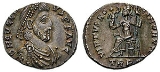
Eugenius

Encyclopedia
Flavius Eugenius was an usurper
in the Western Roman Empire
(392–394) against Emperor
Theodosius I
. Though himself a Christian, he was the last Emperor to support Roman polytheism.
magister militum
and of the de facto ruler of the Western Roman Empire, Arbogast
.
, Arbogast
, who had probably been the cause of Valentinian II's murder or suicide, elevated Eugenius to the purple (22 August 392). The choice of Eugenius, over proclaiming himself, offered to Arbogast two strong advantages: first, Eugenius, a Roman, was more suitable than Arbogast, a Frank, as an emperor; furthermore, the Roman Senate
would have been more likely to have supported Eugenius than Arbogast.
the Elder became Praetorian Prefect of Italy
, his son Nicomachus Flavianus
the Younger received the title of Prefect of Rome, while the new praefectus annonae
was Numerius Proiectus.
Eugenius was nominally a Christian, and therefore was reluctant to accept a program of imperial support to Polytheism
. His men, however, convinced Eugenius to use public money to fund 'Pagan' projects, such as the rededication of the Temple of Venus and Rome and the restoration of the Altar of Victory
within the Curia
(removed by Emperor Gratian
). This religious policy created tension with Theodosius and the powerful and influential Bishop Ambrose
, who left his see in Milan
when the imperial court of Eugenius arrived.
Eugenius was also successful in the military field, notably in the renovation of old alliances with Alamanni
and Franks. Arbogast, who was Frank and had also Alamanni and Frank soldiers in his ranks, marched to the Rhine frontier, where he impressed and pacified the Germanic tribes by parading his army in front of them.
to the rank of "Augustus
" of the West in January 393.
Theodosius then moved from Constantinople with his army, and met Eugenius and Arbogast in the Battle of the Frigidus
(on the modern Italy-Slovenia
border) on 6 September 394. The bloody battle lasted two days, and was marked by unusual astronomical and meteorological events, but in the end Theodosius won. Arbogast immediately committed suicide after the defeat, while Eugenius was held for execution as a criminal, his head afterward being displayed in Theodosius' camp.
Eugenius also represented the last opportunity for the Pagans, with the senatorial class, to oppose the Christianization of the Empire. The Battle of the Frigidus was part of a trend towards using increasing percentages of barbarian troops, especially in the west, where it led to the weakening of the Empire itself.
Roman usurper
Usurpers are individuals or groups of individuals who obtain and maintain the power or rights of another by force and without legal authority. Usurpation was endemic during roman imperial era, especially from the crisis of the third century onwards, when political instability became the rule.The...
in the Western Roman Empire
Western Roman Empire
The Western Roman Empire was the western half of the Roman Empire after its division by Diocletian in 285; the other half of the Roman Empire was the Eastern Roman Empire, commonly referred to today as the Byzantine Empire....
(392–394) against Emperor
Roman Emperor
The Roman emperor was the ruler of the Roman State during the imperial period . The Romans had no single term for the office although at any given time, a given title was associated with the emperor...
Theodosius I
Theodosius I
Theodosius I , also known as Theodosius the Great, was Roman Emperor from 379 to 395. Theodosius was the last emperor to rule over both the eastern and the western halves of the Roman Empire. During his reign, the Goths secured control of Illyricum after the Gothic War, establishing their homeland...
. Though himself a Christian, he was the last Emperor to support Roman polytheism.
Life
A former teacher of grammar and rhetoric, as well as magister scrinorum, Eugenius was an acquaintance of the FrankFranks
The Franks were a confederation of Germanic tribes first attested in the third century AD as living north and east of the Lower Rhine River. From the third to fifth centuries some Franks raided Roman territory while other Franks joined the Roman troops in Gaul. Only the Salian Franks formed a...
magister militum
Magister militum
Magister militum was a top-level military command used in the later Roman Empire, dating from the reign of Constantine. Used alone, the term referred to the senior military officer of the Empire...
and of the de facto ruler of the Western Roman Empire, Arbogast
Arbogast (general)
Flavius Arbogastes , or Arbogast was a Frankish general in the Roman Empire. It has been stated by some ancient historians that he was the son of Flavius Bauto, Valentinian II's former magister militum and protector before Arbogast, but modern scholars largely discount this claim...
.
Rise to power
Following the death of Valentinian IIValentinian II
Flavius Valentinianus , commonly known as Valentinian II, was Roman Emperor from 375 to 392.-Early Life and Accession :...
, Arbogast
Arbogast (general)
Flavius Arbogastes , or Arbogast was a Frankish general in the Roman Empire. It has been stated by some ancient historians that he was the son of Flavius Bauto, Valentinian II's former magister militum and protector before Arbogast, but modern scholars largely discount this claim...
, who had probably been the cause of Valentinian II's murder or suicide, elevated Eugenius to the purple (22 August 392). The choice of Eugenius, over proclaiming himself, offered to Arbogast two strong advantages: first, Eugenius, a Roman, was more suitable than Arbogast, a Frank, as an emperor; furthermore, the Roman Senate
Roman Senate
The Senate of the Roman Republic was a political institution in the ancient Roman Republic, however, it was not an elected body, but one whose members were appointed by the consuls, and later by the censors. After a magistrate served his term in office, it usually was followed with automatic...
would have been more likely to have supported Eugenius than Arbogast.
Civil, religious, and military policies
After being installed as Emperor, Eugenius changed the imperial administrators. When Theodosius had left the western half of the empire to Valentinian II, he had put his own men in the highest civil offices, to keep a strong grasp on the whole empire. Eugenius replaced these administrators with others loyal to himself, coming from the senatorial class. Virius Nicomachus FlavianusVirius Nicomachus Flavianus
Virius Nicomachus Flavianus was a grammarian, a historian and a politician of the Roman Empire.A pagan and close friend of Quintus Aurelius Symmachus, he was Praetorian prefect of Italy in 390–392 and, under usurper Eugenius , again praetorian prefect and consul...
the Elder became Praetorian Prefect of Italy
Praetorian prefecture of Italy
The praetorian prefecture of Italy ) was one of four large Praetorian prefectures into which the Late Roman Empire was divided. It comprised the Italian peninsula, the Western Balkans, the Danubian provinces and parts of North Africa...
, his son Nicomachus Flavianus
Nicomachus Flavianus (son)
Nicomachus Flavianus , sometimes referred to as Flavianus the younger, was a grammarian and a politician of the Roman Empire. He was the son of Virius Nicomachus Flavianus...
the Younger received the title of Prefect of Rome, while the new praefectus annonae
Grain supply to the city of Rome
In classical antiquity, the grain supply to the city of Rome could not be met entirely from the surrounding countryside, which was taken up by the villas and parks of the aristocracy and which produced mainly fruit, vegetables and other perishable goods...
was Numerius Proiectus.
Eugenius was nominally a Christian, and therefore was reluctant to accept a program of imperial support to Polytheism
Polytheism
Polytheism is the belief of multiple deities also usually assembled into a pantheon of gods and goddesses, along with their own mythologies and rituals....
. His men, however, convinced Eugenius to use public money to fund 'Pagan' projects, such as the rededication of the Temple of Venus and Rome and the restoration of the Altar of Victory
Altar of Victory
The Altar of Victory was located in the Roman Senate House bearing a gold statue of the goddess Victory. The altar was established by Octavian in 29 BC in honor of the defeat of Antony and Cleopatra at Actium. The statue depicted a winged woman, holding a palm and descending to present a laurel...
within the Curia
Curia
A curia in early Roman times was a subdivision of the people, i.e. more or less a tribe, and with a metonymy it came to mean also the meeting place where the tribe discussed its affairs...
(removed by Emperor Gratian
Gratian
Gratian was Roman Emperor from 375 to 383.The eldest son of Valentinian I, during his youth Gratian accompanied his father on several campaigns along the Rhine and Danube frontiers. Upon the death of Valentinian in 375, Gratian's brother Valentinian II was declared emperor by his father's soldiers...
). This religious policy created tension with Theodosius and the powerful and influential Bishop Ambrose
Ambrose
Aurelius Ambrosius, better known in English as Saint Ambrose , was a bishop of Milan who became one of the most influential ecclesiastical figures of the 4th century. He was one of the four original doctors of the Church.-Political career:Ambrose was born into a Roman Christian family between about...
, who left his see in Milan
Milan
Milan is the second-largest city in Italy and the capital city of the region of Lombardy and of the province of Milan. The city proper has a population of about 1.3 million, while its urban area, roughly coinciding with its administrative province and the bordering Province of Monza and Brianza ,...
when the imperial court of Eugenius arrived.
Eugenius was also successful in the military field, notably in the renovation of old alliances with Alamanni
Alamanni
The Alamanni, Allemanni, or Alemanni were originally an alliance of Germanic tribes located around the upper Rhine river . One of the earliest references to them is the cognomen Alamannicus assumed by Roman Emperor Caracalla, who ruled the Roman Empire from 211 to 217 and claimed thereby to be...
and Franks. Arbogast, who was Frank and had also Alamanni and Frank soldiers in his ranks, marched to the Rhine frontier, where he impressed and pacified the Germanic tribes by parading his army in front of them.
Fall
When he was elected emperor, Eugenius sent ambassadors to Theodosius's court, asking for recognition of his election. Theodosius received them, but started to gather troops to defeat Eugenius. Theodosius also promoted his eight-year-old son HonoriusHonorius (emperor)
Honorius , was Western Roman Emperor from 395 to 423. He was the younger son of emperor Theodosius I and his first wife Aelia Flaccilla, and brother of the eastern emperor Arcadius....
to the rank of "Augustus
Augustus (honorific)
Augustus , Latin for "majestic," "the increaser," or "venerable", was an Ancient Roman title, which was first held by Gaius Julius Caesar Augustus , and subsequently came to be considered one of the titles of what are now known as the Roman Emperors...
" of the West in January 393.
Theodosius then moved from Constantinople with his army, and met Eugenius and Arbogast in the Battle of the Frigidus
Battle of the Frigidus
The Battle of the Frigidus, also called the Battle of the Frigid River, was fought between September 5–6 394, between the army of the Eastern Emperor Theodosius I and the army of Western Roman ruler Eugenius....
(on the modern Italy-Slovenia
Slovenia
Slovenia , officially the Republic of Slovenia , is a country in Central and Southeastern Europe touching the Alps and bordering the Mediterranean. Slovenia borders Italy to the west, Croatia to the south and east, Hungary to the northeast, and Austria to the north, and also has a small portion of...
border) on 6 September 394. The bloody battle lasted two days, and was marked by unusual astronomical and meteorological events, but in the end Theodosius won. Arbogast immediately committed suicide after the defeat, while Eugenius was held for execution as a criminal, his head afterward being displayed in Theodosius' camp.
Evaluation
The reign of Eugenius marked the end of an era and the beginning of a new one. Five months later Theodosius died, dividing his empire between his two sons. This had happened many times before in the previous two centuries, but this time it was to be final - the Roman Empire never reunited, even under Leo I the Thracian, and soon after his reign, the western half fell.Eugenius also represented the last opportunity for the Pagans, with the senatorial class, to oppose the Christianization of the Empire. The Battle of the Frigidus was part of a trend towards using increasing percentages of barbarian troops, especially in the west, where it led to the weakening of the Empire itself.