


Cilicia

Encyclopedia
In antiquity, Cilicia ' onMouseout='HidePop("12613")' href="/topics/Armenian_language">Armenian
: Կիլիկիա, Greek
: Κιλικία, Middle Persian
: klkyʾy, Parthian
: kylkyʾ) was the south coastal region of Asia Minor
, south of the central Anatolian plateau
. It existed as a political entity from Hittite
times into the Byzantine empire
. Cilicia extends inland from the southeastern coast of modern Turkey
, due north and northeast of the island of Cyprus
.
, to the Amanus Mountains
, which separated it from Syria
. North and east of Cilicia lie the rugged Taurus Mountains
that separate it from the high central plateau of Anatolia, which are pierced by a narrow gorge, called in Antiquity the Cilician Gates
. Ancient Cilicia was naturally divided into Cilicia Trachaea and Cilicia Pedias divided by the Lamas Su. Salamis
, the city on the east coast of Cyprus, was included in its administrative jurisdiction. The Greeks invented for Cilicia an eponym
ous Hellene founder in the purely mythic Cilix
, but the historic founder of the dynasty that ruled Cilicia Pedias was Mopsus
, identifiable in Phoenician sources as Mpš, the founder of Mopsuestia
who gave his name to an oracle nearby. Homer
mentions the people of Mopsus, identified as Cilices, as from the Troad in the northernwesternmost part of the peninsula.
Cilicia Trachea ("rugged Cilicia"— Greek
: Κιλικία Τραχεία; the Assyrian Khilakku or Khilikku, also sometimes transcribed as Hilakku or Hilikku, classical "Cilicia") is a rugged mountain district formed by the spurs of Taurus, which often terminate in rocky headlands with small sheltered harbors, a feature which, in classical times, made the coast a string of havens for pirates, but which in the Middle Ages led to its occupation by Genoese
and Venetian
traders. The district is watered by the Calycadnus
and was covered in ancient times by forests that supplied timber to Phoenicia
and Egypt
. Cilicia lacked large cities.
Cilicia Pedias ("flat Cilicia"— Greek
: Κιλικία Πεδιάς; Assyrian Kue), to the east, included the rugged spurs of Taurus and a large coastal plain, with rich loamy soil, known to the Greeks such as Xenophon
, who passed through with his 10,000 Greek mercenaries, for its abundance (euthemia), filled with sesame
and millet
and olives and pasturage for the horses imported by Solomon
. Many of its high places were fortified. The plain is watered by the three great rivers, the Cydnus (Tarsus Çay), the Sarus (Seyhan
) and the Pyramus (Jihun), each of which brings down much silt from the deforested interior and which fed extensive wetlands. The Sarus now enters the sea almost due south of Tarsus, but there are clear indications that at one period it joined the Pyramus, and that the united rivers ran to the sea west of Kara-tash. Through the rich plain of Issus ran the great highway that linked east and west, on which stood the cities of Tarsus (Tarsa) on the Cydnus, Adana
(Adanija) on the Sarus, and Mopsuestia
(Missis) on the Pyramus.
The area had been known as Kizzuwatna
in the earlier Hittite
era (2nd millennium BC
). The region was divided into two parts, Uru Adaniya (flat Cilicia), a well-watered plain, and "rough" Cilicia (Tarza), in the mountainous west.
The Cilicians appear as Khilikku in Assyria
n inscriptions, and in the early part of the first millennium BC were one of the four chief powers of western Asia. Homer
mentions the plain as the "Aleian plain" in which Bellerophon
wandered, but he transferred the Cilicians far to the west and north and made them allies of Troy. The Cilician cities unknown to Homer already bore their pre-Greek names: Tarzu (Tarsus
), Ingira (Anchiale), Danuna-Adana
, which retains its ancient name, Pahri (perhaps modern Misis), Kundu (Kyinda, then Anazarbus
) and Karatepe
.
There exists evidence that circa 1650 BC both Hittite kings Hattusili I
and Mursili I
enjoyed freedom of movement along the Pyramus River
(now the Ceyhan River in southern Turkey
), proving they exerted strong control over Cilicia in their battles with Syria
. After the death of Murshili around 1595 BC, Hurrians
wrested control from the Hitties, and Cilicia was free for two centuries. The first king of free Cilicia, Isputahsu
, son of Pariyawatri, was recorded as a "great king" in both cuneiform
and Hittite heiroglyphs. Another record of Hittite origins, a treaty between Ishputahshu and Telepinu
, king of the Hittites, is recorded in both Hittite and Akkadian
.
In the next century, Cilician king Pilliya
finalized treaties with both King Zidanta II
of the Hittites and Idrimi
of Alalakh
, in which Idrimi mentions that he had assaulted several military targets throughout Eastern Cilicia. Niqmepa
, who succeeded Idrimi as king of Alalakh, went so far as to ask for help from a Hurrian rival, Shaushtatar
of Mitanni
, to try and reduce Cilicia's power in the region. It was soon apparent, however, that increased Hittite power would soon prove Niqmepa's efforts to be futile, as the city of Kizzuwatna soon fell to the Hittites, threatening all of Cilicia. King Sunassura II was forced soon after to accept vassalization under the Hittites, and became the last king of ancient Cilicia.
In the 13th century BC, a major population shift occurred as the Sea Peoples
, named by Egyptians
as part Philistine, Sicilian
, Tyrrhenian
, Etruscan
and Sardinian
, overran Cilicia. The Hurrians that resided there deserted the area and moved northeast towards the Taurus
, where they settled in the area of Cappadocia
.
In the 8th century BC, the region was unified under the rule of the dynasty of Mukšuš, whom the Greeks rendered Mopsos
and credited as the founder of Mopsuestia
, though the capital was Adana. Its multicultural character is reflected in the bilingual inscriptions of the 9th and 8th centuries, written both in Indo-European hieroglyphic Luwian
and West Semitic Phoenician.
In the 830s the Assyria
ns began to conquer the plain.
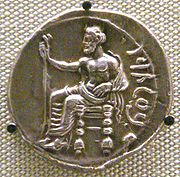 Under the Persian empire Cilicia was apparently governed by tributary
native kings, who bore a Hellenized name or title of "Syennesis"; but it was officially included in the fourth satrapy by Darius. Xenophon
found a queen in power, and no opposition was offered to the march of Cyrus the Younger
.
The great highway from the west existed before Cyrus conquered Cilicia. On its long rough descent from the Anatolian plateau to Tarsus, it ran through the narrow pass between walls of rock called the Cilician Gates
. After crossing the low hills east of the Pyramus it passed through a masonry (Cilician) gate, Demir Kapu, and entered the plain of Issus. From that plain one road ran southward through another masonry (Syrian) gate to Alexandretta, and thence crossed Mt. Amanus by the Syrian Gate, Beilan Pass, eventually to Antioch and Syria; and another ran northwards through a masonry (Armenian) gate, south of Toprak Kale, and crossed Mt. Amanus by the Armenian Gate, Baghche Pass, to northern Syria and the Euphrates. By the last pass, which was apparently unknown to Alexander, Darius crossed the mountains prior to the battle of Issus
. Both passes are short and easy, and connect Cilicia Pedias geographically and politically with Syria rather than with Asia Minor.
in the summer of 333 BC, ending up on the border of southeastern Phrygia
and Cilicia. He knew well the writings of Xenophon
, and how the Cilician Gates had been "impassable if obstructed by the enemy". Alexander reasoned that by force alone he could frighten the defenders and break through, and he gathered his men to do so. In the cover of night they attacked, startling the guards and sending them and their satrap into full flight, setting their crops aflame as they made for Tarsus
. This good fortune allowed Alexander and his army to pass unharmed through the Gates and into Cilicia.
After Alexander's death it was long a battleground of rival Hellenistic marshals and kingdoms, and for a time fell under Ptolemaic dominion (i.e. Egypt), but finally under that of the Seleucids, who, however, never held effectually more than the eastern half.
in 67 BC following a Battle of Korakesion
(modern Alanya
), and Tarsus was made the capital of the Roman province
of Cilicia.
Cilicia Pedias became Roman territory in 103 BC first conquered by Marcus Antonius Orator
in his campaign against pirates, with Sulla
acting as its first governor, foiling an invasion of Mithridates
, and the whole was organized by Pompey
, 64 BC, into a province which, for a short time, extended to and included part of Phrygia
.
It was reorganized by Julius Caesar
, 47 BC, and about 27 BC became part of the province Syria-Cilicia Phoenice. At first the western district was left independent under native kings or priest-dynasts, and a small kingdom, under Tarcondimotus, was left in the east; but these were finally united to the province by Vespasian
, AD 72. It had been deemed important enough to be governed by a proconsul
.
Under Emperor Diocletian's Tetrarchy
(circa 297), Cilicia was governed by a Consularis
; with Isauria and the Syrian, Mesopotamian, Egyptian and Libyan provinces, formed the Diocesis Orientis (in the third century the African component was split off as diocese Aegyptus), part of the pretorian prefecture also called Oriens ('the East', also including the dioceses Asiana and Pontus, both in Anatolia, and Thraciae on the Balkans), the rich bulk of the eastern Roman Empire
.
Cilicia had numerous Christian communities, and after Christianity became the official religion of the Roman Empire in the fourth century was included in the territories of the patriarchate of Antioch. The region was divided into two ecclesiastical provinces: Cilicia Prima, with a metropolitan diocese at Tarsus
and suffragan dioceses for Pompeiopolis
, Sebaste
, Augusta, Corycus
, Adana
, Mallus
and Zephyrium; and Cilicia Secunda, with a metropolitan diocese at Anazarbus
and suffragan dioceses for Mopsuestia
, Aegae
, Epiphania
, Irenopolis
, Flavias, Castabala
, Alexandria
, Citidiopolis and Rhosus
. Bishops from the various dioceses of Cilicia were well represented at the Council of Nicaea in 325 and at the later ecumenical councils.
In the 7th century Cilicia was invaded by the Muslim Arabs, who held the country until it was reoccupied by the Byzantine emperor Nicephorus II in 965.
Roman Cilicia exported the goats-hair cloth, Cilicium, of which tents were made. Tarsus was also the birthplace of the early Christian missionary and author St. Paul
, writer (or purported writer) of 13 of the 27 writings included in the New Testament
.
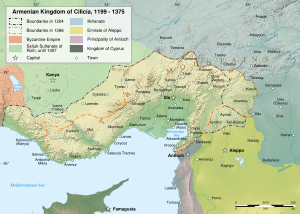 During the time of the Crusades
, the area was controlled by the Armenian Kingdom of Cilicia.
The Seljuk Turkish invasions of Armenia were followed by an exodus of Armenians migrating westward into the Byzantine Empire, and in 1080 Ruben
, a relative of the last king of Ani, founded in the heart of the Cilician Taurus a small principality which gradually expanded into the Armenian kingdom of Cilicia. This Christian state, surrounded by Muslim states hostile to its existence, had a stormy history of about 300 years, giving valuable support to the crusaders, and trading with the great commercial cities of Italy.
Gosdantin
(1095–1100) assisted the crusaders on their march to Antioch, and was created knight and marquis. Thoros I
(1100–1123), in alliance with the Christian princes of Syria, waged successful wars against the Byzantines and Seljuk Turks. Levond II
(Leo the Great (r. 1187-1219)), extended the kingdom beyond Mount Taurus
and established the capital at Sis
. He assisted the crusaders, was crowned King by the Archbishop of Mainz, and married one of the Lusignan
s of the crusader kingdom Cyprus.
Hetoum I (r. 1226-1270) made an alliance with the Mongols
, sending his brother Sempad
to the Mongol court to submit in person. The Mongols then assisted with the protection of Cilicia from the Mamluk
s of Egypt, until the Mongols themselves converted to Islam. When Levond V
died (1342), John of Lusignan was crowned king as Gosdantin IV
; but he and his successors alienated the native Armenians by attempting to make them conform to the Roman Church, and by giving all posts of honor to Latins, until at last the kingdom, falling prey to internal dissensions, succumbed in 1375 to the attacks of the Egyptian Mamluks.
Cilicia Trachea was conquered by the Ottomans
in the 15th century, but Cilicia Pedias remained independent until 1515.
dominion and officially became known as the Adana Vilayet
. Cilicia was one of the most important regions for the Ottoman Armenians because it managed very well to preserve Armenian character throughout the years. In fact, the Cilician highlands were densely populated by Armenian peasants in small but prosperous towns and villages such as Hadjin and Zeitun
, two mountainous areas where autonomy was maintained until the nineteenth century. In ports and cities of the Adana plain, commerce and industry were almost entirely in the hands of the Armenians and it remained so thanks to a constant influx of Armenians from the highlands. Their population was continuously increasing in numbers in Cilicia contrarily to other parts of the Ottoman Empire where it was, since 1878, receding due to repression. This is true despite the fact that in 1909, Armenians were subjected to a massacre in Adana
. During the 1915 Armenian genocide
, the Armenians of Zeitun had organized a successful resistance against the Turkish onslaught. In order to finally subjugate Zeitun, the Turks had to resort to treachery by forcing an Armenian delegation from Marash to ask the Zeituntsi-s to put down their arms. Both the Armenian delegation, and later, the inhabitants of Zeitun, were left with no choice.
From December 1918 to October 1921, after the defeat of the Ottoman Empire in World War I, the French controlled Cilicia. According to the Treaty of Sèvres
signed in 1920, Cilicia was to become an independent Armenian state under French Authority. That treaty had never gone into effect because of the Turkish War of Independence
. Measures were taken to repopulate the region with Armenians. More than 170,000 refugees, the majority of whom originated from Cilicia, were to be taken back to their homes by the French and British. The Armenians formed the Armenian National Union which acted as an unofficial Cilician Armenian government composed of the four major political parties and three Armenian religious denominations. However, rivalries between the French and British, and Kemalist incursions shattered Armenian aspirations for an autonomous Cilicia. On October 21, 1921, France signed the Treaty of Ankara with the Kemalist revolutionaries and relinquished Cilicia to Turkey.
the region become part of the Republic of Turkey
in 1921 with the Treaty of Lausanne
. The modern Turkish provinces
Mersin
, Adana
, and Osmaniye
are located in former Cilicia.
mentions another Cilicia, as a small region situated immediately southeast of the Troad in northwestern Asia Minor, facing the Gulf of Adramyttium. The connection (if any) between this Cilicia and the better-known and well-defined region mentioned above is unclear. This Trojan Cilicia is mentioned in Homer
's Iliad and Strabo
's Geography, and contained localities as Thebe, Lyrnessus
and Chryse
. These three cities were all attacked and sacked by Achilles
during the Trojan War
.
In Prometheus Bound
(v 353), Aeschylus
makes mention of the Cilician caves, where the earth-born, hundred-headed monster Typhon
dwelt before he withstood the gods and was stricken and charred by Zeus
's thunderbolt.
Armenian language
The Armenian language is an Indo-European language spoken by the Armenian people. It is the official language of the Republic of Armenia as well as in the region of Nagorno-Karabakh. The language is also widely spoken by Armenian communities in the Armenian diaspora...
: Կիլիկիա, Greek
Greek language
Greek is an independent branch of the Indo-European family of languages. Native to the southern Balkans, it has the longest documented history of any Indo-European language, spanning 34 centuries of written records. Its writing system has been the Greek alphabet for the majority of its history;...
: Κιλικία, Middle Persian
Middle Persian
Middle Persian , indigenously known as "Pârsig" sometimes referred to as Pahlavi or Pehlevi, is the Middle Iranian language/ethnolect of Southwestern Iran that during Sassanid times became a prestige dialect and so came to be spoken in other regions as well. Middle Persian is classified as a...
: klkyʾy, Parthian
Parthian language
The Parthian language, also known as Arsacid Pahlavi and Pahlavanik, is a now-extinct ancient Northwestern Iranian language spoken in Parthia, a region of northeastern ancient Persia during the rule of the Parthian empire....
: kylkyʾ) was the south coastal region of Asia Minor
Asia Minor
Asia Minor is a geographical location at the westernmost protrusion of Asia, also called Anatolia, and corresponds to the western two thirds of the Asian part of Turkey...
, south of the central Anatolian plateau
Anatolia
Anatolia is a geographic and historical term denoting the westernmost protrusion of Asia, comprising the majority of the Republic of Turkey...
. It existed as a political entity from Hittite
History of the Hittites
Hittites were an ancient people who spoke an Indo-European language and established a kingdom centered in Hattusa in northern Anatolia from the 18th century BC. In the 14th century BC, the Hittite Kingdom was at its height, encompassing central Anatolia, south-western Syria as far as Ugarit, and...
times into the Byzantine empire
Byzantine Empire
The Byzantine Empire was the Eastern Roman Empire during the periods of Late Antiquity and the Middle Ages, centred on the capital of Constantinople. Known simply as the Roman Empire or Romania to its inhabitants and neighbours, the Empire was the direct continuation of the Ancient Roman State...
. Cilicia extends inland from the southeastern coast of modern Turkey
Turkey
Turkey , known officially as the Republic of Turkey , is a Eurasian country located in Western Asia and in East Thrace in Southeastern Europe...
, due north and northeast of the island of Cyprus
Cyprus
Cyprus , officially the Republic of Cyprus , is a Eurasian island country, member of the European Union, in the Eastern Mediterranean, east of Greece, south of Turkey, west of Syria and north of Egypt. It is the third largest island in the Mediterranean Sea.The earliest known human activity on the...
.
Geography
Cilicia extended along the Mediterranean coast east from PamphyliaPamphylia
In ancient geography, Pamphylia was the region in the south of Asia Minor, between Lycia and Cilicia, extending from the Mediterranean to Mount Taurus . It was bounded on the north by Pisidia and was therefore a country of small extent, having a coast-line of only about 75 miles with a breadth of...
, to the Amanus Mountains
Nur Mountains
The Nur Mountains , also known as Gâvur Mountains , the ancient Amanus , is a mountain range in the Hatay Province of south-central Turkey, which runs roughly parallel to the Gulf of İskenderun....
, which separated it from Syria
Syria
Syria , officially the Syrian Arab Republic , is a country in Western Asia, bordering Lebanon and the Mediterranean Sea to the West, Turkey to the north, Iraq to the east, Jordan to the south, and Israel to the southwest....
. North and east of Cilicia lie the rugged Taurus Mountains
Taurus Mountains
Taurus Mountains are a mountain complex in southern Turkey, dividing the Mediterranean coastal region of southern Turkey from the central Anatolian Plateau. The system extends along a curve from Lake Eğirdir in the west to the upper reaches of the Euphrates and Tigris rivers in the east...
that separate it from the high central plateau of Anatolia, which are pierced by a narrow gorge, called in Antiquity the Cilician Gates
Cilician Gates
The Cilician Gates or Gülek Pass is a pass through the Taurus Mountains connecting the low plains of Cilicia to the Anatolian Plateau, by way of the narrow gorge of the Gökoluk River. Its highest elevation is about 1000m....
. Ancient Cilicia was naturally divided into Cilicia Trachaea and Cilicia Pedias divided by the Lamas Su. Salamis
Salamis, Cyprus
Salamis was an ancient Greek city-state on the east coast of Cyprus, at the mouth of the river Pedieos, 6 km north of modern Famagusta. According to tradition the founder of Salamis was Teucer, son of Telamon, who could not return home after the Trojan war because he had failed to avenge his...
, the city on the east coast of Cyprus, was included in its administrative jurisdiction. The Greeks invented for Cilicia an eponym
Eponym
An eponym is the name of a person or thing, whether real or fictitious, after which a particular place, tribe, era, discovery, or other item is named or thought to be named...
ous Hellene founder in the purely mythic Cilix
Cilix
In Greek mythology, Cilix was a son of Agenor and Telephassa or Argiope and brother of Cadmus, Phoenix and Europa.When Europa was carried off by Zeus, Agenor sent his three sons out to find her, telling them not to return until they find her. The search was unsuccessful. Cilix eventually settled...
, but the historic founder of the dynasty that ruled Cilicia Pedias was Mopsus
Mopsus
Mopsus or Mopsos was the name of two famous seers in Greek mythology. A historical/legendary Mopsus was the founder of a house in power at widespread sites in the coastal plains of Pamphylia and Cilicia during the early Iron Age.-Son of Manto and Rhacius or Apollo:Mopsus, a celebrated seer and...
, identifiable in Phoenician sources as Mpš, the founder of Mopsuestia
Mopsuestia
Mopsuestia , later Mamistra, is the ancient city of Cilicia Campestris on the Pyramus river located approximately 20 km east of ancient Antiochia in Cilicia .The founding of this city is attributed in legend to the soothsayer, Mopsus, who lived before the Trojan war, although...
who gave his name to an oracle nearby. Homer
Homer
In the Western classical tradition Homer , is the author of the Iliad and the Odyssey, and is revered as the greatest ancient Greek epic poet. These epics lie at the beginning of the Western canon of literature, and have had an enormous influence on the history of literature.When he lived is...
mentions the people of Mopsus, identified as Cilices, as from the Troad in the northernwesternmost part of the peninsula.
Cilicia Trachea ("rugged Cilicia"— Greek
Greek language
Greek is an independent branch of the Indo-European family of languages. Native to the southern Balkans, it has the longest documented history of any Indo-European language, spanning 34 centuries of written records. Its writing system has been the Greek alphabet for the majority of its history;...
: Κιλικία Τραχεία; the Assyrian Khilakku or Khilikku, also sometimes transcribed as Hilakku or Hilikku, classical "Cilicia") is a rugged mountain district formed by the spurs of Taurus, which often terminate in rocky headlands with small sheltered harbors, a feature which, in classical times, made the coast a string of havens for pirates, but which in the Middle Ages led to its occupation by Genoese
Genoa
Genoa |Ligurian]] Zena ; Latin and, archaically, English Genua) is a city and an important seaport in northern Italy, the capital of the Province of Genoa and of the region of Liguria....
and Venetian
Venice
Venice is a city in northern Italy which is renowned for the beauty of its setting, its architecture and its artworks. It is the capital of the Veneto region...
traders. The district is watered by the Calycadnus
Göksu
The Göksu is a river in Taşeli Peninsula . Both its sources arise in the Taurus Mountains—the northern in the Geyik Mountains and the southern in the Haydar Mountains...
and was covered in ancient times by forests that supplied timber to Phoenicia
Phoenicia
Phoenicia , was an ancient civilization in Canaan which covered most of the western, coastal part of the Fertile Crescent. Several major Phoenician cities were built on the coastline of the Mediterranean. It was an enterprising maritime trading culture that spread across the Mediterranean from 1550...
and Egypt
Egypt
Egypt , officially the Arab Republic of Egypt, Arabic: , is a country mainly in North Africa, with the Sinai Peninsula forming a land bridge in Southwest Asia. Egypt is thus a transcontinental country, and a major power in Africa, the Mediterranean Basin, the Middle East and the Muslim world...
. Cilicia lacked large cities.
Cilicia Pedias ("flat Cilicia"— Greek
Greek language
Greek is an independent branch of the Indo-European family of languages. Native to the southern Balkans, it has the longest documented history of any Indo-European language, spanning 34 centuries of written records. Its writing system has been the Greek alphabet for the majority of its history;...
: Κιλικία Πεδιάς; Assyrian Kue), to the east, included the rugged spurs of Taurus and a large coastal plain, with rich loamy soil, known to the Greeks such as Xenophon
Xenophon
Xenophon , son of Gryllus, of the deme Erchia of Athens, also known as Xenophon of Athens, was a Greek historian, soldier, mercenary, philosopher and a contemporary and admirer of Socrates...
, who passed through with his 10,000 Greek mercenaries, for its abundance (euthemia), filled with sesame
Sesame
Sesame is a flowering plant in the genus Sesamum. Numerous wild relatives occur in Africa and a smaller number in India. It is widely naturalized in tropical regions around the world and is cultivated for its edible seeds, which grow in pods....
and millet
Millet
The millets are a group of small-seeded species of cereal crops or grains, widely grown around the world for food and fodder. They do not form a taxonomic group, but rather a functional or agronomic one. Their essential similarities are that they are small-seeded grasses grown in difficult...
and olives and pasturage for the horses imported by Solomon
Solomon
Solomon , according to the Book of Kings and the Book of Chronicles, a King of Israel and according to the Talmud one of the 48 prophets, is identified as the son of David, also called Jedidiah in 2 Samuel 12:25, and is described as the third king of the United Monarchy, and the final king before...
. Many of its high places were fortified. The plain is watered by the three great rivers, the Cydnus (Tarsus Çay), the Sarus (Seyhan
Seyhan River
The Seyhan River is the longest river in Turkey that is flowing into Mediterranean Sea. The river is 560 km and flows southwest from its headwaters in the Tahtalı-Mountains in Anti-Taurus Mountains to the Mediterranean Sea via a broad delta...
) and the Pyramus (Jihun), each of which brings down much silt from the deforested interior and which fed extensive wetlands. The Sarus now enters the sea almost due south of Tarsus, but there are clear indications that at one period it joined the Pyramus, and that the united rivers ran to the sea west of Kara-tash. Through the rich plain of Issus ran the great highway that linked east and west, on which stood the cities of Tarsus (Tarsa) on the Cydnus, Adana
Adana
Adana is a city in southern Turkey and a major agricultural and commercial center. The city is situated on the Seyhan River, 30 kilometres inland from the Mediterranean, in south-central Anatolia...
(Adanija) on the Sarus, and Mopsuestia
Mopsuestia
Mopsuestia , later Mamistra, is the ancient city of Cilicia Campestris on the Pyramus river located approximately 20 km east of ancient Antiochia in Cilicia .The founding of this city is attributed in legend to the soothsayer, Mopsus, who lived before the Trojan war, although...
(Missis) on the Pyramus.
Early history
Cilicia was settled from the Neolithic period onwards. Dating of the ancient settlements of the region from Neolithic to Bronze Age is as follows: Aceramic/Neolithic: 8th and 7th millennia BC; Early Chalcolithic: 5800 BC; Middle Chalcolithic (correlated with Halaf and Ubaid developments in the east): ca. 5400-4500 BC; Late Chalcolithic: 4500- ca. 3400 BC; and Early Bronze Age IA: 3400-3000 BC; EBA IB: 3000-2700 BC; EBA II: 2700-2400 BC; EBA III A-B: 2400-2000 BC.The area had been known as Kizzuwatna
Kizzuwatna
Kizzuwatna , is the name of an ancient Anatolian kingdom in the second millennium BC. It was situated in the highlands of southeastern Anatolia, near the Gulf of İskenderun in modern-day Turkey. It encircled the Taurus Mountains and the Ceyhan river. The center of the kingdom was the city of...
in the earlier Hittite
History of the Hittites
Hittites were an ancient people who spoke an Indo-European language and established a kingdom centered in Hattusa in northern Anatolia from the 18th century BC. In the 14th century BC, the Hittite Kingdom was at its height, encompassing central Anatolia, south-western Syria as far as Ugarit, and...
era (2nd millennium BC
2nd millennium BC
The 2nd millennium BC marks the transition from the Middle to the Late Bronze Age.Its first half is dominated by the Middle Kingdom of Egypt and Babylonia. The alphabet develops. Indo-Iranian migration onto the Iranian plateau and onto the Indian subcontinent propagates the use of the chariot...
). The region was divided into two parts, Uru Adaniya (flat Cilicia), a well-watered plain, and "rough" Cilicia (Tarza), in the mountainous west.
The Cilicians appear as Khilikku in Assyria
Assyria
Assyria was a Semitic Akkadian kingdom, extant as a nation state from the mid–23rd century BC to 608 BC centred on the Upper Tigris river, in northern Mesopotamia , that came to rule regional empires a number of times through history. It was named for its original capital, the ancient city of Assur...
n inscriptions, and in the early part of the first millennium BC were one of the four chief powers of western Asia. Homer
Homer
In the Western classical tradition Homer , is the author of the Iliad and the Odyssey, and is revered as the greatest ancient Greek epic poet. These epics lie at the beginning of the Western canon of literature, and have had an enormous influence on the history of literature.When he lived is...
mentions the plain as the "Aleian plain" in which Bellerophon
Bellerophon
Bellerophon or Bellerophontes is a hero of Greek mythology. He was "the greatest hero and slayer of monsters, alongside of Cadmus and Perseus, before the days of Heracles", and his greatest feat was killing the Chimera, a monster that Homer depicted with a lion's head, a goat's body, and a...
wandered, but he transferred the Cilicians far to the west and north and made them allies of Troy. The Cilician cities unknown to Homer already bore their pre-Greek names: Tarzu (Tarsus
Tarsus (city)
Tarsus is a historic city in south-central Turkey, 20 km inland from the Mediterranean Sea. It is part of the Adana-Mersin Metropolitan Area, the fourth-largest metropolitan area in Turkey with a population of 2.75 million...
), Ingira (Anchiale), Danuna-Adana
Adana
Adana is a city in southern Turkey and a major agricultural and commercial center. The city is situated on the Seyhan River, 30 kilometres inland from the Mediterranean, in south-central Anatolia...
, which retains its ancient name, Pahri (perhaps modern Misis), Kundu (Kyinda, then Anazarbus
Anazarbus
Anazarbus in Ancient Cilicia was an ancient Cilician city, situated in Anatolia in modern Turkey, in the present Çukurova about 15 km west of the main stream of the present Ceyhan River and near its tributary the Sempas Su.A lofty isolated ridge formed its acropolis...
) and Karatepe
Karatepe
Karatepe is a late Hittite fortress and open air museum in Osmaniye Province in southern Turkey lying at a distance of about 23 km from the district center of Kadirli. It is sited in the Taurus Mountains, on the right bank of the Ceyhan River...
.
There exists evidence that circa 1650 BC both Hittite kings Hattusili I
Hattusili I
Hattusili I was a king of the Hittite Old Kingdom. He reigned ca. 1586–1556 BC .He used the title of Labarna at the beginning of his reign...
and Mursili I
Mursili I
Mursili I was a king of the Hittites ca. 1556–1526 BC , and was likely a grandson of his predecessor, Hattusili I. His sister was Harapšili.- Biography :...
enjoyed freedom of movement along the Pyramus River
Pyramus River
Ceyhan River Ceyhan River Ceyhan River (or historically Pyramos or Pyramus or the Leucosyrus in Anatolia in south of Turkey or Asia Minor- Course of the river :...
(now the Ceyhan River in southern Turkey
Turkey
Turkey , known officially as the Republic of Turkey , is a Eurasian country located in Western Asia and in East Thrace in Southeastern Europe...
), proving they exerted strong control over Cilicia in their battles with Syria
Syria
Syria , officially the Syrian Arab Republic , is a country in Western Asia, bordering Lebanon and the Mediterranean Sea to the West, Turkey to the north, Iraq to the east, Jordan to the south, and Israel to the southwest....
. After the death of Murshili around 1595 BC, Hurrians
Hurrians
The Hurrians were a people of the Ancient Near East who lived in Northern Mesopotamia and adjacent regions during the Bronze Age.The largest and most influential Hurrian nation was the kingdom of Mitanni. The population of the Hittite Empire in Anatolia to a large part consisted of Hurrians, and...
wrested control from the Hitties, and Cilicia was free for two centuries. The first king of free Cilicia, Isputahsu
Isputahsu
Isputahsu was a king of Kizzuwatna, probably during the mid 15th century BC . He signed a treaty of alliance with the Hittite king Telepinu....
, son of Pariyawatri, was recorded as a "great king" in both cuneiform
Cuneiform
Cuneiform can refer to:*Cuneiform script, an ancient writing system originating in Mesopotamia in the 4th millennium BC*Cuneiform , three bones in the human foot*Cuneiform Records, a music record label...
and Hittite heiroglyphs. Another record of Hittite origins, a treaty between Ishputahshu and Telepinu
Telepinu
Telipinu was a king of the Hittites ca. 1460 BC . At the beginning of his reign, the Hittite Empire had contracted to its core territories, having long since lost all of its conquests, made in the former era under Hattusili I and Mursili I -- to Arzawa in the West, Mitanni in the East, the Kaskas...
, king of the Hittites, is recorded in both Hittite and Akkadian
Akkadian language
Akkadian is an extinct Semitic language that was spoken in ancient Mesopotamia. The earliest attested Semitic language, it used the cuneiform writing system derived ultimately from ancient Sumerian, an unrelated language isolate...
.
In the next century, Cilician king Pilliya
Pilliya
Pilliya was king of Kizzuwatna ca. the 15th century BC . He signed a treaty with Idrimi of Alalakh, allying with the Mitanni empire....
finalized treaties with both King Zidanta II
Zidanta II
Zidanta II was a king of the Hittites , ca. late 15th century BC from 1480 to 1490 . He was probably a nephew of Hantili II. Zidanta made peace through the means of a parity treaty with a ruler named Pilliya, his counterpart in Kizzuwatna. This was the last parity treaty ever signed by a Hittite...
of the Hittites and Idrimi
Idrimi
Idrimi was the king of Alalakh in the 15th century BC.Idrimi was a Hurrianised Semitic son of the king of Aleppo who had been deposed by the new regional master, Barattarna, king of the Mitanni. Nevertheless he succeeded in regaining his seat and was recognized as a vassal by Barattarna. Idrimi...
of Alalakh
Alalakh
Alalakh is the name of an ancient city-state near modern Antakya in the Amuq River valley of Turkey's Hatay Province.Now represented by an extensive mound, the name of the modern archaeological site is Tell Atchana.-History:...
, in which Idrimi mentions that he had assaulted several military targets throughout Eastern Cilicia. Niqmepa
Niqmepa
Niqmepa was the fourth King of Ugarit, a city-state in northwestern Syria. Niqmepa was a contemporary of Mursili II and Hattusili III, the great Hittite kings, as well as Horemheb and Seti I of Egypt. His reign is well documented by cuneiform texts found at Ugarit. He ruled for about fifty years ...
, who succeeded Idrimi as king of Alalakh, went so far as to ask for help from a Hurrian rival, Shaushtatar
Shaushtatar
Shaushtatar also spelled Šauštatar , was a king of the Hurrian kingdom of Mitanni in the fifteenth century BC.- Invasion of Assyria :Shaushtatar was the son of Parshatatar. By the time he ascended the throne ca. the 15th century BC, his father had installed Hurrian client kings in a number of...
of Mitanni
Mitanni
Mitanni or Hanigalbat was a loosely organized Hurrian-speaking state in northern Syria and south-east Anatolia from ca. 1500 BC–1300 BC...
, to try and reduce Cilicia's power in the region. It was soon apparent, however, that increased Hittite power would soon prove Niqmepa's efforts to be futile, as the city of Kizzuwatna soon fell to the Hittites, threatening all of Cilicia. King Sunassura II was forced soon after to accept vassalization under the Hittites, and became the last king of ancient Cilicia.
In the 13th century BC, a major population shift occurred as the Sea Peoples
Sea Peoples
The Sea Peoples were a confederacy of seafaring raiders of the second millennium BC who sailed into the eastern Mediterranean, caused political unrest, and attempted to enter or control Egyptian territory during the late 19th dynasty and especially during year 8 of Ramesses III of the 20th Dynasty...
, named by Egyptians
Egyptians
Egyptians are nation an ethnic group made up of Mediterranean North Africans, the indigenous people of Egypt.Egyptian identity is closely tied to geography. The population of Egypt is concentrated in the lower Nile Valley, the small strip of cultivable land stretching from the First Cataract to...
as part Philistine, Sicilian
Sicily
Sicily is a region of Italy, and is the largest island in the Mediterranean Sea. Along with the surrounding minor islands, it constitutes an autonomous region of Italy, the Regione Autonoma Siciliana Sicily has a rich and unique culture, especially with regard to the arts, music, literature,...
, Tyrrhenian
Tyrrhenians
The Tyrrhenians or Tyrsenians is an exonym used by Greek authors to refer to a non-Greek people.- Earliest references :...
, Etruscan
Etruscan civilization
Etruscan civilization is the modern English name given to a civilization of ancient Italy in the area corresponding roughly to Tuscany. The ancient Romans called its creators the Tusci or Etrusci...
and Sardinian
Sardinian people
The Sardinian people or Sardinians are the people from or with origins in the island of Sardinia , in the Mediterranean sea, which forms part of southern Europe.-Origin and influences:...
, overran Cilicia. The Hurrians that resided there deserted the area and moved northeast towards the Taurus
Taurus Mountains
Taurus Mountains are a mountain complex in southern Turkey, dividing the Mediterranean coastal region of southern Turkey from the central Anatolian Plateau. The system extends along a curve from Lake Eğirdir in the west to the upper reaches of the Euphrates and Tigris rivers in the east...
, where they settled in the area of Cappadocia
Cappadocia
Cappadocia is a historical region in Central Anatolia, largely in Nevşehir Province.In the time of Herodotus, the Cappadocians were reported as occupying the whole region from Mount Taurus to the vicinity of the Euxine...
.
In the 8th century BC, the region was unified under the rule of the dynasty of Mukšuš, whom the Greeks rendered Mopsos
Mopsus
Mopsus or Mopsos was the name of two famous seers in Greek mythology. A historical/legendary Mopsus was the founder of a house in power at widespread sites in the coastal plains of Pamphylia and Cilicia during the early Iron Age.-Son of Manto and Rhacius or Apollo:Mopsus, a celebrated seer and...
and credited as the founder of Mopsuestia
Mopsuestia
Mopsuestia , later Mamistra, is the ancient city of Cilicia Campestris on the Pyramus river located approximately 20 km east of ancient Antiochia in Cilicia .The founding of this city is attributed in legend to the soothsayer, Mopsus, who lived before the Trojan war, although...
, though the capital was Adana. Its multicultural character is reflected in the bilingual inscriptions of the 9th and 8th centuries, written both in Indo-European hieroglyphic Luwian
Hieroglyphic Luwian
Hieroglyphic Luwian is a variant of the Luwian language, recorded in official and royal seals and a small number of monumental inscriptions. It is written in a hieroglyphic script known as Anatolian hieroglyphs...
and West Semitic Phoenician.
In the 830s the Assyria
Assyria
Assyria was a Semitic Akkadian kingdom, extant as a nation state from the mid–23rd century BC to 608 BC centred on the Upper Tigris river, in northern Mesopotamia , that came to rule regional empires a number of times through history. It was named for its original capital, the ancient city of Assur...
ns began to conquer the plain.
Persian Empire
Tributary
A tributary or affluent is a stream or river that flows into a main stem river or a lake. A tributary does not flow directly into a sea or ocean...
native kings, who bore a Hellenized name or title of "Syennesis"; but it was officially included in the fourth satrapy by Darius. Xenophon
Xenophon
Xenophon , son of Gryllus, of the deme Erchia of Athens, also known as Xenophon of Athens, was a Greek historian, soldier, mercenary, philosopher and a contemporary and admirer of Socrates...
found a queen in power, and no opposition was offered to the march of Cyrus the Younger
Cyrus the Younger
Cyrus the Younger, son of Darius II of Persia and Parysatis, was a Persian prince and general. The time of his birth is unknown, but he died in 401 B.C. The history of Cyrus and of the retreat of the Greeks is told by Xenophon in his Anabasis. Another account, probably from Sophaenetus of...
.
The great highway from the west existed before Cyrus conquered Cilicia. On its long rough descent from the Anatolian plateau to Tarsus, it ran through the narrow pass between walls of rock called the Cilician Gates
Cilician Gates
The Cilician Gates or Gülek Pass is a pass through the Taurus Mountains connecting the low plains of Cilicia to the Anatolian Plateau, by way of the narrow gorge of the Gökoluk River. Its highest elevation is about 1000m....
. After crossing the low hills east of the Pyramus it passed through a masonry (Cilician) gate, Demir Kapu, and entered the plain of Issus. From that plain one road ran southward through another masonry (Syrian) gate to Alexandretta, and thence crossed Mt. Amanus by the Syrian Gate, Beilan Pass, eventually to Antioch and Syria; and another ran northwards through a masonry (Armenian) gate, south of Toprak Kale, and crossed Mt. Amanus by the Armenian Gate, Baghche Pass, to northern Syria and the Euphrates. By the last pass, which was apparently unknown to Alexander, Darius crossed the mountains prior to the battle of Issus
Battle of Issus
The Battle of Issus occurred in southern Anatolia, in November 333 BC. The invading troops, led by the young Alexander of Macedonia, defeated the army personally led by Darius III of Achaemenid Persia in the second great battle for primacy in Asia...
. Both passes are short and easy, and connect Cilicia Pedias geographically and politically with Syria rather than with Asia Minor.
Alexander the Great
Alexander forded the Halys RiverHalys River
The Kızılırmak , also known as the Halys River , is the longest river in Turkey. It is a source of hydroelectric power and is not used for navigation.- Geography :...
in the summer of 333 BC, ending up on the border of southeastern Phrygia
Phrygia
In antiquity, Phrygia was a kingdom in the west central part of Anatolia, in what is now modern-day Turkey. The Phrygians initially lived in the southern Balkans; according to Herodotus, under the name of Bryges , changing it to Phruges after their final migration to Anatolia, via the...
and Cilicia. He knew well the writings of Xenophon
Xenophon
Xenophon , son of Gryllus, of the deme Erchia of Athens, also known as Xenophon of Athens, was a Greek historian, soldier, mercenary, philosopher and a contemporary and admirer of Socrates...
, and how the Cilician Gates had been "impassable if obstructed by the enemy". Alexander reasoned that by force alone he could frighten the defenders and break through, and he gathered his men to do so. In the cover of night they attacked, startling the guards and sending them and their satrap into full flight, setting their crops aflame as they made for Tarsus
Tarsus, Mersin
Tarsus is a historic city in south-central Turkey, 20 km inland from the Mediterranean Sea. It is part of the Adana-Mersin Metropolitan Area, the fourth-largest metropolitan area in Turkey with a population of 2.75 million...
. This good fortune allowed Alexander and his army to pass unharmed through the Gates and into Cilicia.
After Alexander's death it was long a battleground of rival Hellenistic marshals and kingdoms, and for a time fell under Ptolemaic dominion (i.e. Egypt), but finally under that of the Seleucids, who, however, never held effectually more than the eastern half.
Roman Cilicia
Cilicia Trachea became the haunt of pirates, who were subdued by PompeyPompey
Gnaeus Pompeius Magnus, also known as Pompey or Pompey the Great , was a military and political leader of the late Roman Republic...
in 67 BC following a Battle of Korakesion
Battle of Korakesion
The Battle of Korakesion, also known as the Battle of Coracesium, was a naval battle fought in 67 BC between the pirates of Cilicia and Pompey of ancient Rome. Plutarch describes it as the key battle of Pompey's clearing of the Mediterranean of pirates after several smaller battles...
(modern Alanya
Alanya
Alanya , formerly Alaiye, is a beach resort city and a component district of Antalya Province in the Mediterranean Region of Turkey, from the city of Antalya. On the southern coast of Turkey, the district has an area of 1,598.51 km2 and 248,286 inhabitants...
), and Tarsus was made the capital of the Roman province
Roman province
In Ancient Rome, a province was the basic, and, until the Tetrarchy , largest territorial and administrative unit of the empire's territorial possessions outside of Italy...
of Cilicia.
Cilicia Pedias became Roman territory in 103 BC first conquered by Marcus Antonius Orator
Marcus Antonius Orator
Marcus Antonius Orator was a Roman politician of the Antonius family and one of the most distinguished Roman orators of his time. He was also the grandfather of the famous general and triumvir, Mark Antony.-Career:...
in his campaign against pirates, with Sulla
Lucius Cornelius Sulla
Lucius Cornelius Sulla Felix , known commonly as Sulla, was a Roman general and statesman. He had the rare distinction of holding the office of consul twice, as well as that of dictator...
acting as its first governor, foiling an invasion of Mithridates
Mithridates II of Parthia
Mithridates II the Great was king of Parthian Empire from 123 to 88 BC. His name invokes the protection of Mithra. He adopted the title Epiphanes, "god manifest" and introduced new designs on his extensive coinage....
, and the whole was organized by Pompey
Pompey
Gnaeus Pompeius Magnus, also known as Pompey or Pompey the Great , was a military and political leader of the late Roman Republic...
, 64 BC, into a province which, for a short time, extended to and included part of Phrygia
Phrygia
In antiquity, Phrygia was a kingdom in the west central part of Anatolia, in what is now modern-day Turkey. The Phrygians initially lived in the southern Balkans; according to Herodotus, under the name of Bryges , changing it to Phruges after their final migration to Anatolia, via the...
.
It was reorganized by Julius Caesar
Julius Caesar
Gaius Julius Caesar was a Roman general and statesman and a distinguished writer of Latin prose. He played a critical role in the gradual transformation of the Roman Republic into the Roman Empire....
, 47 BC, and about 27 BC became part of the province Syria-Cilicia Phoenice. At first the western district was left independent under native kings or priest-dynasts, and a small kingdom, under Tarcondimotus, was left in the east; but these were finally united to the province by Vespasian
Vespasian
Vespasian , was Roman Emperor from 69 AD to 79 AD. Vespasian was the founder of the Flavian dynasty, which ruled the Empire for a quarter century. Vespasian was descended from a family of equestrians, who rose into the senatorial rank under the Emperors of the Julio-Claudian dynasty...
, AD 72. It had been deemed important enough to be governed by a proconsul
Proconsul
A proconsul was a governor of a province in the Roman Republic appointed for one year by the senate. In modern usage, the title has been used for a person from one country ruling another country or bluntly interfering in another country's internal affairs.-Ancient Rome:In the Roman Republic, a...
.
Under Emperor Diocletian's Tetrarchy
Tetrarchy
The term Tetrarchy describes any system of government where power is divided among four individuals, but usually refers to the tetrarchy instituted by Roman Emperor Diocletian in 293, marking the end of the Crisis of the Third Century and the recovery of the Roman Empire...
(circa 297), Cilicia was governed by a Consularis
Consularis
Consularis is a Latin word, derived from consulo, "take counsel".-Roman history:Originally it was simple and adjective meaning "consular", but more interestingly it has also become a substantive, used in technical meanings.* Any former consul...
; with Isauria and the Syrian, Mesopotamian, Egyptian and Libyan provinces, formed the Diocesis Orientis (in the third century the African component was split off as diocese Aegyptus), part of the pretorian prefecture also called Oriens ('the East', also including the dioceses Asiana and Pontus, both in Anatolia, and Thraciae on the Balkans), the rich bulk of the eastern Roman Empire
Roman Empire
The Roman Empire was the post-Republican period of the ancient Roman civilization, characterised by an autocratic form of government and large territorial holdings in Europe and around the Mediterranean....
.
Cilicia had numerous Christian communities, and after Christianity became the official religion of the Roman Empire in the fourth century was included in the territories of the patriarchate of Antioch. The region was divided into two ecclesiastical provinces: Cilicia Prima, with a metropolitan diocese at Tarsus
Tarsus, Mersin
Tarsus is a historic city in south-central Turkey, 20 km inland from the Mediterranean Sea. It is part of the Adana-Mersin Metropolitan Area, the fourth-largest metropolitan area in Turkey with a population of 2.75 million...
and suffragan dioceses for Pompeiopolis
Pompeiopolis
Pompeiopolis was a Roman city-state in ancient Paphlagonia, situated today in the Taşköprü district, Kastamonu, Turkey. The exact location is 45 km north of Kastamonu, to the north of Taşköprü, in the valley of the Gökırmak...
, Sebaste
Elaiussa Sebaste
Elaiussa Sebaste or Elaeousa Sebaste was an ancient Roman town located from Mersin in the direction of Silifke in Cilicia on the southern coast of Anatolia . Elaiussa, meaning olive, was founded in the 2nd century B.C...
, Augusta, Corycus
Corycus
Corycus was an ancient city in Cilicia Trachaea, Anatolia, located at the mouth of the river called Şeytan deresi; the site is now occupied by the town of Kızkalesi , Mersin Province, Turkey.-The city:...
, Adana
Adana
Adana is a city in southern Turkey and a major agricultural and commercial center. The city is situated on the Seyhan River, 30 kilometres inland from the Mediterranean, in south-central Anatolia...
, Mallus
Mallus
Mallus or Mallos was an ancient city of Cilicia Campestris lying near the mouth of the Pyramus river, in Anatolia. In ancient times, the city was situated at the mouth of the Pyramus , on a hill opposite Magarsus which served as its port. The district was called from it, Mallotis...
and Zephyrium; and Cilicia Secunda, with a metropolitan diocese at Anazarbus
Anazarbus
Anazarbus in Ancient Cilicia was an ancient Cilician city, situated in Anatolia in modern Turkey, in the present Çukurova about 15 km west of the main stream of the present Ceyhan River and near its tributary the Sempas Su.A lofty isolated ridge formed its acropolis...
and suffragan dioceses for Mopsuestia
Mopsuestia
Mopsuestia , later Mamistra, is the ancient city of Cilicia Campestris on the Pyramus river located approximately 20 km east of ancient Antiochia in Cilicia .The founding of this city is attributed in legend to the soothsayer, Mopsus, who lived before the Trojan war, although...
, Aegae
Aigai (Aeolian)
Aigai or Aegae was an ancient Greek city in Aeolis . Aegae is mentioned by both Herodotus and Strabo as being a member of the Aeolian dodecapolis. It was also an important sanctuary of Apollo...
, Epiphania
Epiphania, Cilicia
Epiphania was a city in Cilicia Secunda , in Anatolia.The city was originally called Oiniandos, and was located in the area of the famous Gülek Pass .In the 2nd century BC the city was renamed Epiphania, in honour of Antiochus IV Epiphanes, King of Syria from 175 BC to 164 BC.The city is mentioned...
, Irenopolis
Irenopolis
Irenopolis in Isauria is a Catholic titular see of Isauria, suffragan of Seleucia.Five of its bishops are known:*John *Menodorus *Paul *George *Euschemon ....
, Flavias, Castabala
Castabala
Castabala is a genus of moth in the family Arctiidae.-References:*...
, Alexandria
Alexandria
Alexandria is the second-largest city of Egypt, with a population of 4.1 million, extending about along the coast of the Mediterranean Sea in the north central part of the country; it is also the largest city lying directly on the Mediterranean coast. It is Egypt's largest seaport, serving...
, Citidiopolis and Rhosus
Rhosus
Rhosus is the name of several ancient sites and/or present Roman Catholic titular sees in what is now Turkey.-Cilician Rhosus:A titular bishopric in the former Roman province of Cilicia Secunda, suffragan to Anazarba. Rhosus or Rhossus was a seaport situated on the Gulf of Issus, later...
. Bishops from the various dioceses of Cilicia were well represented at the Council of Nicaea in 325 and at the later ecumenical councils.
In the 7th century Cilicia was invaded by the Muslim Arabs, who held the country until it was reoccupied by the Byzantine emperor Nicephorus II in 965.
Roman Cilicia exported the goats-hair cloth, Cilicium, of which tents were made. Tarsus was also the birthplace of the early Christian missionary and author St. Paul
Paul of Tarsus
Paul the Apostle , also known as Saul of Tarsus, is described in the Christian New Testament as one of the most influential early Christian missionaries, with the writings ascribed to him by the church forming a considerable portion of the New Testament...
, writer (or purported writer) of 13 of the 27 writings included in the New Testament
New Testament
The New Testament is the second major division of the Christian biblical canon, the first such division being the much longer Old Testament....
.
Armenian Kingdom
Crusades
The Crusades were a series of religious wars, blessed by the Pope and the Catholic Church with the main goal of restoring Christian access to the holy places in and near Jerusalem...
, the area was controlled by the Armenian Kingdom of Cilicia.
The Seljuk Turkish invasions of Armenia were followed by an exodus of Armenians migrating westward into the Byzantine Empire, and in 1080 Ruben
Ruben I of Armenia
Ruben I, , also Roupen I or Rupen I, was the first lord of Armenian Cilicia or “Lord of the Mountains” . He declared the independence of Cilicia from the Byzantine Empire, thus formally founding the beginning of Armenian rule there...
, a relative of the last king of Ani, founded in the heart of the Cilician Taurus a small principality which gradually expanded into the Armenian kingdom of Cilicia. This Christian state, surrounded by Muslim states hostile to its existence, had a stormy history of about 300 years, giving valuable support to the crusaders, and trading with the great commercial cities of Italy.
Gosdantin
Constantine I of Armenia
Constantine I or Kostandin I was the second lord of Armenian Cilicia or “Lord of the Mountains”...
(1095–1100) assisted the crusaders on their march to Antioch, and was created knight and marquis. Thoros I
Thoros I of Armenia
Toros I , also Thoros I, was the third lord of Armenian Cilicia or “Lord of the Mountains” ....
(1100–1123), in alliance with the Christian princes of Syria, waged successful wars against the Byzantines and Seljuk Turks. Levond II
Leo II of Armenia
Leo II , also Leon II, Levon II or Lewon II was the tenth lord of Armenian Cilicia or “Lord of the Mountains” , and the first king of Armenian Cilicia .During his reign, Leo succeeded in establishing Cilician Armenia as a powerful and a unified Christian...
(Leo the Great (r. 1187-1219)), extended the kingdom beyond Mount Taurus
Taurus Mountains
Taurus Mountains are a mountain complex in southern Turkey, dividing the Mediterranean coastal region of southern Turkey from the central Anatolian Plateau. The system extends along a curve from Lake Eğirdir in the west to the upper reaches of the Euphrates and Tigris rivers in the east...
and established the capital at Sis
Kozan, Adana
Kozan is a city in Adana Province, Turkey, 68 km north of the city of Adana, in the northern section of the Çukurova plain. The city is the capital of Kozan district. The Kilgen Stream, a tributary of the Ceyhan River , flows through Kozan crossing the plain south into the Mediterranean Sea....
. He assisted the crusaders, was crowned King by the Archbishop of Mainz, and married one of the Lusignan
Lusignan
The Lusignan family originated in Poitou near Lusignan in western France in the early 10th century. By the end of the 11th century, they had risen to become the most prominent petty lords in the region from their castle at Lusignan...
s of the crusader kingdom Cyprus.
Hetoum I (r. 1226-1270) made an alliance with the Mongols
Mongols
Mongols ) are a Central-East Asian ethnic group that lives mainly in the countries of Mongolia, China, and Russia. In China, ethnic Mongols can be found mainly in the central north region of China such as Inner Mongolia...
, sending his brother Sempad
Sempad the Constable
Sempad the Constable was a noble in Cilician Armenia, an older brother of King Hetoum I. He was an important figure in Cilicia, acting as a diplomat, judge, and military officer, holding the title of Constable or Sparapet, supreme commander of the Armenian armed forces...
to the Mongol court to submit in person. The Mongols then assisted with the protection of Cilicia from the Mamluk
Mamluk
A Mamluk was a soldier of slave origin, who were predominantly Cumans/Kipchaks The "mamluk phenomenon", as David Ayalon dubbed the creation of the specific warrior...
s of Egypt, until the Mongols themselves converted to Islam. When Levond V
Leo V of Armenia
Leo IV was the last Hethumid king of Cilicia, ruling from 1320 until his death. He was the son of Oshin of Armenia and Isabel of Korikos, and came to the throne on the death of his father. His name is sometimes spelled as Leo or Leon.He spent his minority under the regency of Oshin of Korikos...
died (1342), John of Lusignan was crowned king as Gosdantin IV
Constantine IV of Armenia
Constantine II , born Guy de Lusignan, was elected the first Latin King of Armenian Cilicia of the Lusignan dynasty, ruling from 1342 until his death in 1344.He was a son of Isabella, daughter of Leo II of Armenia, and Amalric, a son of Hugh III of Cyprus, and was...
; but he and his successors alienated the native Armenians by attempting to make them conform to the Roman Church, and by giving all posts of honor to Latins, until at last the kingdom, falling prey to internal dissensions, succumbed in 1375 to the attacks of the Egyptian Mamluks.
Cilicia Trachea was conquered by the Ottomans
Ottoman Empire
The Ottoman EmpireIt was usually referred to as the "Ottoman Empire", the "Turkish Empire", the "Ottoman Caliphate" or more commonly "Turkey" by its contemporaries...
in the 15th century, but Cilicia Pedias remained independent until 1515.
Ottoman Empire
In the fifteenth century, Cilicia fell under OttomanOttoman Empire
The Ottoman EmpireIt was usually referred to as the "Ottoman Empire", the "Turkish Empire", the "Ottoman Caliphate" or more commonly "Turkey" by its contemporaries...
dominion and officially became known as the Adana Vilayet
Adana Vilayet
The Vilayet of Adana was a vilayet of the Ottoman Empire in the south-east of Asia Minor, which included the ancient Cilicia.At the beginning of the 20th century it reportedly had an area of , while the preliminary results of the first Ottoman census of 1885 gave the population as 402,439...
. Cilicia was one of the most important regions for the Ottoman Armenians because it managed very well to preserve Armenian character throughout the years. In fact, the Cilician highlands were densely populated by Armenian peasants in small but prosperous towns and villages such as Hadjin and Zeitun
Süleymanli
Süleymanlı , Zeitun, Zeytun, Zeytunfimis or Zeytünfimis), is a town in the Kahramanmaraş Province, Turkey.-See also:* Zeitun Resistance by the Armenian militia in this town against the Ottoman Empire, on two occasions – events still highly controversial and seen in different ways in Armenian and...
, two mountainous areas where autonomy was maintained until the nineteenth century. In ports and cities of the Adana plain, commerce and industry were almost entirely in the hands of the Armenians and it remained so thanks to a constant influx of Armenians from the highlands. Their population was continuously increasing in numbers in Cilicia contrarily to other parts of the Ottoman Empire where it was, since 1878, receding due to repression. This is true despite the fact that in 1909, Armenians were subjected to a massacre in Adana
Adana massacre
The Adana massacre occurred in Adana Province, in the Ottoman Empire, in April 1909. An massacre of Armenian Christians in the city of Adana amidst governmental upheaval resulted in a series of anti-Armenian pogroms throughout the district...
. During the 1915 Armenian genocide
Armenian Genocide
The Armenian Genocide—also known as the Armenian Holocaust, the Armenian Massacres and, by Armenians, as the Great Crime—refers to the deliberate and systematic destruction of the Armenian population of the Ottoman Empire during and just after World War I...
, the Armenians of Zeitun had organized a successful resistance against the Turkish onslaught. In order to finally subjugate Zeitun, the Turks had to resort to treachery by forcing an Armenian delegation from Marash to ask the Zeituntsi-s to put down their arms. Both the Armenian delegation, and later, the inhabitants of Zeitun, were left with no choice.
From December 1918 to October 1921, after the defeat of the Ottoman Empire in World War I, the French controlled Cilicia. According to the Treaty of Sèvres
Treaty of Sèvres
The Treaty of Sèvres was the peace treaty between the Ottoman Empire and Allies at the end of World War I. The Treaty of Versailles was signed with Germany before this treaty to annul the German concessions including the economic rights and enterprises. Also, France, Great Britain and Italy...
signed in 1920, Cilicia was to become an independent Armenian state under French Authority. That treaty had never gone into effect because of the Turkish War of Independence
Turkish War of Independence
The Turkish War of Independence was a war of independence waged by Turkish nationalists against the Allies, after the country was partitioned by the Allies following the Ottoman Empire's defeat in World War I...
. Measures were taken to repopulate the region with Armenians. More than 170,000 refugees, the majority of whom originated from Cilicia, were to be taken back to their homes by the French and British. The Armenians formed the Armenian National Union which acted as an unofficial Cilician Armenian government composed of the four major political parties and three Armenian religious denominations. However, rivalries between the French and British, and Kemalist incursions shattered Armenian aspirations for an autonomous Cilicia. On October 21, 1921, France signed the Treaty of Ankara with the Kemalist revolutionaries and relinquished Cilicia to Turkey.
Republic of Turkey
After the Franco-Turkish war, and consequent battles during Turkish War of IndependenceTurkish War of Independence
The Turkish War of Independence was a war of independence waged by Turkish nationalists against the Allies, after the country was partitioned by the Allies following the Ottoman Empire's defeat in World War I...
the region become part of the Republic of Turkey
Turkey
Turkey , known officially as the Republic of Turkey , is a Eurasian country located in Western Asia and in East Thrace in Southeastern Europe...
in 1921 with the Treaty of Lausanne
Treaty of Lausanne
The Treaty of Lausanne was a peace treaty signed in Lausanne, Switzerland on 24 July 1923, that settled the Anatolian and East Thracian parts of the partitioning of the Ottoman Empire. The treaty of Lausanne was ratified by the Greek government on 11 February 1924, by the Turkish government on 31...
. The modern Turkish provinces
Provinces of Turkey
Turkey is divided into 81 provinces, called il in Turkish .A province is administered by an appointed governor , and was formerly termed a "governorate" ....
Mersin
Mersin Province
The Mersin Province is a province in southern Turkey, on the Mediterranean coast between Antalya and Adana. The provincial capital is the city of Mersin and the other major town is Tarsus, birthplace of St Paul...
, Adana
Adana Province
Adana Province is a province of Turkey located in south-central Anatolia. With a population of 2,085,225, it is the fifth most populous province in Turkey. The administrative seat of the province is the city of Adana, home to 78% of the residents of the province...
, and Osmaniye
Osmaniye Province
Osmaniye Province is a Turkish province located in southern Turkey. It became a province in 1996. The province was part of Adana Province. It covers an area of 3,767 km² and has a population of 479,221 . The province is situated in Çukurova, a geographical, economical and cultural region.The...
are located in former Cilicia.
Mythological namesake
Greek mythologyGreek mythology
Greek mythology is the body of myths and legends belonging to the ancient Greeks, concerning their gods and heroes, the nature of the world, and the origins and significance of their own cult and ritual practices. They were a part of religion in ancient Greece...
mentions another Cilicia, as a small region situated immediately southeast of the Troad in northwestern Asia Minor, facing the Gulf of Adramyttium. The connection (if any) between this Cilicia and the better-known and well-defined region mentioned above is unclear. This Trojan Cilicia is mentioned in Homer
Homer
In the Western classical tradition Homer , is the author of the Iliad and the Odyssey, and is revered as the greatest ancient Greek epic poet. These epics lie at the beginning of the Western canon of literature, and have had an enormous influence on the history of literature.When he lived is...
's Iliad and Strabo
Strabo
Strabo, also written Strabon was a Greek historian, geographer and philosopher.-Life:Strabo was born to an affluent family from Amaseia in Pontus , a city which he said was situated the approximate equivalent of 75 km from the Black Sea...
's Geography, and contained localities as Thebe, Lyrnessus
Lyrnessus
In Greek mythology Lyrnessus was a town or city in Dardania , inhabited by Cilicians. It was closely associated with the nearby Cilician Thebe. At the time of the Trojan War, it was said to have been ruled by a king named Mynes. His widowed wife is Briseis, who later became a prize of Achilles....
and Chryse
Chryse
In Greek mythology, Chryse may refer to:*Persons:**Chryse, a lover of Ares and mother of Phlegyas.**Chryse, nymph of Lemnos**Chryse, daughter of Pallas and consort of Dardanus*Places:...
. These three cities were all attacked and sacked by Achilles
Achilles
In Greek mythology, Achilles was a Greek hero of the Trojan War, the central character and the greatest warrior of Homer's Iliad.Plato named Achilles the handsomest of the heroes assembled against Troy....
during the Trojan War
Trojan War
In Greek mythology, the Trojan War was waged against the city of Troy by the Achaeans after Paris of Troy took Helen from her husband Menelaus, the king of Sparta. The war is among the most important events in Greek mythology and was narrated in many works of Greek literature, including the Iliad...
.
In Prometheus Bound
Prometheus Bound
Prometheus Bound is an Ancient Greek tragedy. In Antiquity, this drama was attributed to Aeschylus, but is now considered by some scholars to be the work of another hand, perhaps one as late as ca. 415 BC. Despite these doubts of authorship, the play's designation as Aeschylean has remained...
(v 353), Aeschylus
Aeschylus
Aeschylus was the first of the three ancient Greek tragedians whose work has survived, the others being Sophocles and Euripides, and is often described as the father of tragedy. His name derives from the Greek word aiskhos , meaning "shame"...
makes mention of the Cilician caves, where the earth-born, hundred-headed monster Typhon
Typhon
Typhon , also Typhoeus , Typhaon or Typhos was the last son of Gaia, fathered by Tartarus, and the most deadly monster of Greek mythology. He was known as the "Father of all monsters"; his wife Echidna was likewise the "Mother of All Monsters."Typhon was described in pseudo-Apollodorus,...
dwelt before he withstood the gods and was stricken and charred by Zeus
Zeus
In the ancient Greek religion, Zeus was the "Father of Gods and men" who ruled the Olympians of Mount Olympus as a father ruled the family. He was the god of sky and thunder in Greek mythology. His Roman counterpart is Jupiter and his Etruscan counterpart is Tinia.Zeus was the child of Cronus...
's thunderbolt.
Further reading
- Bulletin of the American Schools of Oriental Research, No. 282/283, Symposium: Chalcolithic Cyprus. pp. 167–175.
- Engels, David. 2008. Cicéron comme proconsul en Cilicie et la guerre contre les Parthes. In: Revue Belge de Philologie et d'Histoire 86, pp. 23–45.
- Pilhofer, Susanne. 2006. Romanisierung in Kilikien? Das Zeugnis der Inschriften (Quellen und Forschungen zur Antiken Welt 46). Munich: Herbert Utz Verlag.
- Yuri Babayan - Cilicia