


Nerva

Encyclopedia
Nerva was Roman Emperor
from 96 to 98. Nerva became Emperor at the age of sixty-five, after a lifetime of imperial service under Nero
and the rulers of the Flavian dynasty
. Under Nero, he was a member of the imperial entourage and played a vital part in exposing the Pisonian conspiracy
of 65. Later, as a loyalist to the Flavians, he attained consulships
in 71 and 90 during the reigns of Vespasian
and Domitian
respectively.
On 18 September 96, Domitian was assassinated in a palace conspiracy involving members of the Praetorian Guard
and several of his freedmen
. On the same day, Nerva was declared emperor by the Roman Senate
. This was the first time the Senate elected a Roman Emperor. As the new ruler of the Roman Empire
, he vowed to restore liberties which had been curtailed during the autocratic government of Domitian. However, Nerva's brief reign was marred by financial difficulties and his inability to assert his authority over the Roman army
. A revolt by the Praetorian Guard in October 97 essentially forced him to adopt
an heir. After some deliberation Nerva adopted Trajan
, a young and popular general, as his successor. After barely fifteen months in office, Nerva died of natural causes on 27 January 98. Upon his death he was succeeded and deified
by Trajan.
Although much of his life remains obscure, Nerva was considered a wise and moderate emperor by ancient historian
s. Recent historians have revised this assessment, characterizing Nerva as a well-intentioned but ultimately weak ruler, whose reign brought the Roman Empire to the brink of civil war
. Nerva's greatest success was his ability to ensure a peaceful transition of power after his death, thus founding the Nerva-Antonine dynasty.
, 50 kilometers north of Rome, to the family of Marcus Cocceius Nerva, Consul
Suffect in 40, and Sergia Plautilla. Ancient sources report the date as either 30 or 35. He had at least one attested sister, named Cocceia, who married Lucius Salvius Titianus Otho
, the brother of the future Emperor Otho
.
Like Vespasian
, the founder of the Flavian dynasty
, Nerva was a member of the Italian nobility rather than one of the elite of Rome. Nevertheless, the Cocceii were among the most esteemed and prominent political families of the late Republic
and early Empire, attaining consulships in each successive generation. The direct ancestors of Nerva on his father's side, all named Marcus Cocceius Nerva
, were associated with imperial circles since the time of Emperor Augustus
(27 BC–AD 14). His great-grandfather was Consul
in 36 BC (in replacement, and abdicated), and Governor of Asia in the same year. His grandfather became Consul
Suffect in 21 or July 22, and was known as a personal friend of Emperor Tiberius
(AD 14– 37), accompanying the emperor during his voluntary seclusion on Capri
from 23 onwards, dying in 33. Nerva's father, finally, attained the consulship in 40 under emperor Caligula
(37–41). The Cocceii were connected with the Julio-Claudian dynasty
through the marriage of Sergia Plautilla's brother Octavius Laenas, and Rubellia Bassa
, the great-granddaughter of Tiberius.
or military career. He was praetor
-elect in the year 65 and, like his ancestors, moved in imperial circles as a skilled diplomat and strategist. As an advisor to Emperor Nero
, he successfully helped detect and expose the Pisonian conspiracy
of 65. Exactly what his contribution to the investigation was is not known but his services must have been considerable, since they earned him rewards equal to those of Nero's guard prefect Tigellinus
. He received triumphal honors
—which was usually reserved for military victories—and the right to have his statues placed throughout the palace. According to the contemporary poet Martial
, Nero also held Nerva's literary abilities in high esteem, hailing him as the "Tibullus
of our time". Another prominent member of Nero's entourage was Vespasian, an old and respected general who had celebrated military triumphs during the 40s. It appears Vespasian befriended Nerva during his time as an imperial advisor, and may have asked to watch over his youngest son Domitian
when he departed for the Jewish war
in 67.
The suicide of Nero on 9 July 68 effectively brought an end to the Julio-Claudian rule. Chaos ensued, leading to a year of brutal civil war
known as the Year of the Four Emperors
, which saw the successive rise and fall of the emperors Galba
, Otho
and Vitellius
, until the accession of Vespasian on 21 December 69. Virtually nothing is known of Nerva's whereabouts during 69, but despite the fact that Otho was his brother-in-law, he appears to have been one of the earliest and strongest supporters of the Flavians. For services unknown, he was rewarded with a consulship early in Vespasian's reign in 71. This was a remarkable honour, not only because he held this office early under the new regime, but also because it was an "ordinary" consulship (instead of a less prestigious suffect consulship), making him one of the few non-Flavians to be honoured in this way under Vespasian. After 71 Nerva again disappears from historical record, presumably continuing his career as an inconspicuous advisor under Vespasian (69–79) and his sons Titus
(79–81) and Domitian (81–96).
He re-emerges during the revolt of Saturninus
in 89. On 1 January, 89, the governor of Germania Superior
, Lucius Antonius Saturninus
, and his two legions at Mainz
, Legio XIV Gemina
and Legio XXI Rapax
, revolted against the Roman Empire with the aid of a tribe of the Chatti
. The governor of
Germania Inferior
, Lappius Maximus, moved to the region at once, assisted by the procurator of Rhaetia, Titus Flavius Norbanus. Within twenty-four days the rebellion was crushed, and its leaders at Mainz savagely punished. The mutinous legions were sent to the front of Illyricum
, while those who had assisted in their defeat were duly rewarded. Domitian opened the year following the revolt by sharing the consulship with Nerva. Again, the honour suggested Nerva had played a part in uncovering the conspiracy, perhaps in a fashion similar to what he did during the Pisonian conspiracy under Nero. Alternatively, Domitian may have selected Nerva as his colleague to emphasise the stability and status-quo of the regime. The revolt had been suppressed, and the Empire could return to order.
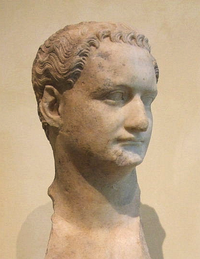 On 18 September, 96, Domitian was assassinated in a palace conspiracy organised by court officials. The Fasti Ostienses
, the Ostian Calendar, records that the same day the Senate proclaimed Marcus Cocceius Nerva emperor. Despite his political experience, this was a remarkable choice. Nerva was old and childless, and had spent much of his career out of the public light, prompting both ancient and modern authors to speculate on his involvement in Domitian's assassination. According to Cassius Dio, the conspirators approached Nerva as a potential successor prior to the assassination, which indicates that he was at least aware of the plot. Suetonius by contrast does not mention Nerva, but he may have omitted his role out of tactfulness. Considering the works of Suetonius were published under Nerva's direct descendants Trajan and Hadrian, it would have been less than sensitive of him to suggest the dynasty owed its accession to murder. On the other hand, Nerva lacked widespread support in the Empire, and as a known Flavian loyalist his track record would not have recommended him to the conspirators. The precise facts have been obscured by history, but modern historians believe Nerva was proclaimed Emperor solely on the initiative of the Senate, within hours after the news of the assassination broke. Although he appeared to be an unlikely candidate on account of his age and weak health, Nerva was considered a safe choice precisely because he was old and childless. Furthermore, he had close connections with the Flavian dynasty and commanded the respect of a substantial part of the Senate. Nerva had seen the anarchy
which had resulted from the death of Nero in 69; he knew that to hesitate even for a few hours could lead to violent civil conflict. Rather than decline the invitation and risk revolt
s, he accepted. The decision may have been hasty so as to avoid civil war, but neither the Senate nor Nerva appears to have been involved in the conspiracy against Domitian.
Following the accession of Nerva as emperor, the Senate passed damnatio memoriae
on Domitian: his coins and statues were melted, his arch
es were torn down and his name was erased from all public records. In many instances, existing portraits of Domitian, such as those found on the Cancelleria Reliefs
, were simply recarved to fit the likeness of Nerva. This allowed quick production of new images and recycling of previous material. In addition, the vast palace which Domitian had erected on the Palatine Hill
, known as the Flavian Palace
, was renamed the "House of the People", and Nerva himself took up residence in Vespasian's former villa, the Gardens of Sallust
.
 The change of government was a breath of relief for the Roman Senate, whose senators had suffered under the terrors of Domitian's regime. As an immediate gesture of goodwill towards his supporters, Nerva publicly swore that no senators would be put to death as long as he remained in office. He called an end to trials based on treason
, released those who had been imprisoned under these charges, and granted amnesty
to many who had been exile
d. All properties which had been confiscated by Domitian were returned to their respective families. Nerva also sought to involve the Senate in his government, but this was not entirely successful. He continued to rely largely on friends and advisors that were known and trusted, and by maintaining friendly relations with the pro-Domitianic faction of the Senate, he incurred hostility which may have been the cause for at least one conspiracy against his life.
Having been proclaimed emperor solely on the initiative of the Senate, Nerva had to introduce a number of measures to gain support among the Roman populace. As was custom by this time, a change of emperor was expected to bring with it a generous payment of gifts and money to the people and the army. Accordingly, a congiarium
of 75 denarii
per head was bestowed upon the citizens, while the soldiers of the Praetorian Guard received a donativum
which may have amounted to as much as 5000 denarii
per person. This was followed by a string of economic reforms intended to alleviate the burden of taxation from the most needy Romans. To the poorest, Nerva granted allotments of land worth up to 60 million sesterces
. He exempted parents and their children from a 5% inheritance tax
, and he made loans to Italian landowners on the condition that they pay interest
of 5% to their municipality to support the children of needy families; alimentary schemes which were later expanded by Trajan, Antoninus Pius
, and Marcus Aurelius. Furthermore, numerous taxes were remitted and privileges granted to Roman provinces.
Before long, Nerva's expenses strained the economy of Rome and, although perhaps not ruinous to the extent once suggested by Syme, necessitated the formation of a special commission
of economy to drastically reduce expenditures. The most superfluous religious sacrifices, games
and horse races
were abolished, while new income was generated from Domitian's former possessions, including the auctioning of ships, estates, and even furniture. Large amounts of money were obtained from Domitian's silver
and gold
statues, and Nerva forbade that similar images be made in his honor.
Because he reigned only briefly, Nerva's public works were few, instead completing projects which had been initiated under Flavian rule. This included extensive repairs to the Roman road
system and the expansion of the aqueduct
s. The latter program was headed by the former consul
Sextus Julius Frontinus
, who helped to put an end to abuses and later published a significant work on Rome's water supply, De Aquis Urbis Romae. The only major landmarks constructed under Nerva were a granary
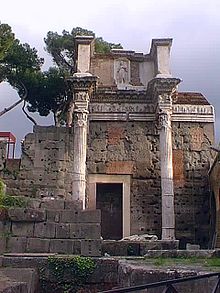
, known as the Horrea Nervae, and a small Imperial Forum begun by Domitian, which linked the Forum of Augustus
to the Temple of Peace. Little remains, partly because the Via dei Fori Imperiali
cuts across it.
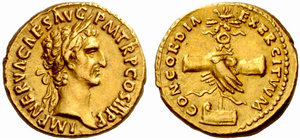 Despite Nerva's measures to remain popular with the Senate and the Roman people, support for Domitian remained strong in the army
, which had called for his deification
immediately after the assassination. In an attempt to appease the soldiers of the Praetorian Guard
, Nerva had dismissed their prefect Titus Petronius Secundus
—one of the chief conspirators against Domitian—and replaced him by a former commander, Casperius Aelianus
. Likewise, the generous donativum bestowed upon the soldiers following his accession was expected to swiftly silence any protests against the violent regime change. The Praetorians considered these measures insufficient, however, and demanded the execution of Domitian's assassins, which Nerva refused. Continued dissatisfaction with this state of affairs would ultimately lead to the gravest crisis of Nerva's reign.
While the swift transfer of power following Domitian's death had prevented a civil war
from erupting, Nerva's position as an emperor soon proved too vulnerable, and his benign nature turned into a reluctance to assert his authority. Upon his accession, he had ordered a halt to treason trials, but at the same time allowed the prosecution of informers
by the Senate to continue. This measure led to chaos, as everyone acted in his own interests while trying to settle scores with personal enemies, leading the consul Fronto to famously remark that Domitian's tyranny was ultimately preferable to Nerva's anarchy. Early in 97, a conspiracy led by senator Calpurnius Crassus failed, but once again Nerva refused to put the conspirators to death, much to the disapproval of the Senate.
The situation was further aggravated by the absence of a clear successor, made more pressing because of Nerva's old age and sickness. He had no natural children of his own and only distant relatives, who were unsuited for political office. A successor would have to be chosen from among the governors
or generals in the Empire and it appears that, by 97, Nerva was considering to adopt
Publius Cornelius Nigrinus, the powerful governor of Syria
. This was covertly opposed by those who supported the more popular military commander Marcus Ulpius Traianus
, commonly known as Trajan, a general of the armies at the German frontier
.
In October 97 these tensions came to a head when the Praetorian Guard, led by Casperius Aelianus, laid siege
to the Imperial Palace and took Nerva hostage. He was forced to submit to their demands, agreeing to hand over those responsible for Domitian's death and even giving a speech thanking the rebellious Praetorians. Titus Petronius Secundus and Parthenius, Domitian's former chamberlain, were sought out and killed. Nerva was unharmed in this assault, but his authority was damaged beyond repair. He realized that his position was no longer tenable without the support of an heir who had the approval of both the army and the people. Shortly thereafter, he announced the adoption of Trajan
as his successor, and with this decision all but abdicated
. Trajan was formally bestowed with the title of Caesar and shared the consulship with Nerva in 98:
Contrary to the view here popularized by Cassius Dio, however, Nerva had in fact little choice with regard to his successor. Faced with a major crisis, he desperately needed the support of a man who could restore his damaged reputation. The only candidate with sufficient military experience, consular ancestry, and connections was Trajan. Likewise, Edward Gibbon
's assertion that Nerva hereby established a tradition of succession through adoption among the Five Good Emperors has found little support among modern historians.
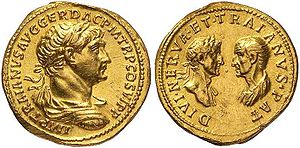 On 1 January, 98, at the start of his fourth consulship, Nerva suffered a stroke
during a private audience. Shortly thereafter he was struck by a fever and died at his villa in the Gardens of Sallust, on 28 January. He was deified by the Senate, and his ashes were laid to rest in the Mausoleum of Augustus
. Nerva was succeeded without incident by his adopted son Trajan, who was greeted by the Roman populace with much enthusiasm. According to Pliny the Younger
, Trajan dedicated a temple in honour of Nerva, yet no trace of it has ever been found; nor was a commemorative series of coins for the Deified Nerva issued until ten years after his death. According to Cassius Dio, however, the Guard prefect
responsible for the mutiny against Nerva, Casperius Aelianus, was 'dismissed' upon Trajan's accession.
Due to the lack of written sources on this period, much of Nerva's life has remained obscure. The most substantial surviving account of the reign of Nerva was written by the 2nd century historian Cassius Dio. His Roman History, which spans nearly a millennium
, from the arrival of Aeneas
in Italy until the year 229, was composed more than hundred years after Nerva had died. Further details are added by an abridged biography from the Epitome de Caesaribus, a work alleged to have been authored by the 3rd century historian Aurelius Victor
. A more comprehensive text, presumed to describe the life of Nerva in closer detail, is the Histories
, by the contemporary historian Tacitus
. The Histories is an account of the history of Rome covering three decades from the suicide of emperor Nero
in 69 until the death of Domitian in 96. Unfortunately, a substantial part of the work has been lost, with only the first five books covering the Year of the Four Emperors
remaining. In the introduction to his biography of Gnaeus Julius Agricola
however, Tacitus speaks highly of Nerva, describing his reign as "the dawn of a most happy age, [when] Nerva Caesar blended things once irreconcilable, sovereignty and freedom".
The surviving histories speak equally positively of Nerva's brief reign, although none offer a substantial commentary on his policies. Both Cassius Dio and Aurelius Victor emphasize his wisdom and moderation, with Dio commending his decision to adopt Trajan as his heir. These views were later popularized by the 18th century historian Edward Gibbon
in his History of the Decline and Fall of the Roman Empire. Gibbon considered Nerva the first of the Five Good Emperors, five successive rulers under whom the Roman Empire "was governed by absolute power, under the guidance of wisdom and virtue" from 96 until 180. Nevertheless, even Gibbon notes that, compared to his successors, Nerva may have lacked the necessary qualifications for a successful reign:
 Modern history has expanded upon this sentiment, characterizing Nerva as a well-intentioned but weak and ineffectual ruler. The Roman Senate enjoyed renewed liberties under his rule, but Nerva's mismanagement of the state finances and lack of authority over the army ultimately brought Rome near the edge of a significant crisis. The mutiny led by Casperius Aelianus was never intended as a coup, but a calculated attempt to put pressure on the emperor. The adoption of Trajan expanded his power base with a respected, reliable general as his successor. Murison concludes that Nerva's real talents were in fact ill-suited to the emperorship:
His place in Roman history is therefore summarized as a necessary, if tumultuous stop-gap before the Trajanic-Antonine dynasties. It is a fact of irony
that even the only major public work completed during his reign, the Forum of Nerva, ultimately became known as the Forum Transitorium, or transitional forum.
Today statues which commemorate Nerva can be found at Gloucester
, England at the entrance to Southgate Street, and at his alleged birthplace Narni
in Italy, at Cocceio Nerva street.
Nerva was played by Norman Wooland
in the in the 1951 film Quo Vadis
.
He was also played by Giuliano Gemma
in the 1964 film Revolt of the Praetorians
.
|-
|-
Roman Emperor
The Roman emperor was the ruler of the Roman State during the imperial period . The Romans had no single term for the office although at any given time, a given title was associated with the emperor...
from 96 to 98. Nerva became Emperor at the age of sixty-five, after a lifetime of imperial service under Nero
Nero
Nero , was Roman Emperor from 54 to 68, and the last in the Julio-Claudian dynasty. Nero was adopted by his great-uncle Claudius to become his heir and successor, and succeeded to the throne in 54 following Claudius' death....
and the rulers of the Flavian dynasty
Flavian dynasty
The Flavian dynasty was a Roman Imperial Dynasty, which ruled the Roman Empire between 69 and 96 AD, encompassing the reigns of Vespasian , and his two sons Titus and Domitian . The Flavians rose to power during the civil war of 69, known as the Year of the Four Emperors...
. Under Nero, he was a member of the imperial entourage and played a vital part in exposing the Pisonian conspiracy
Pisonian conspiracy
The conspiracy of Gaius Calpurnius Piso in AD 65 represented one of the major turning points in the reign of the Roman emperor Nero...
of 65. Later, as a loyalist to the Flavians, he attained consulships
Roman consul
A consul served in the highest elected political office of the Roman Republic.Each year, two consuls were elected together, to serve for a one-year term. Each consul was given veto power over his colleague and the officials would alternate each month...
in 71 and 90 during the reigns of Vespasian
Vespasian
Vespasian , was Roman Emperor from 69 AD to 79 AD. Vespasian was the founder of the Flavian dynasty, which ruled the Empire for a quarter century. Vespasian was descended from a family of equestrians, who rose into the senatorial rank under the Emperors of the Julio-Claudian dynasty...
and Domitian
Domitian
Domitian was Roman Emperor from 81 to 96. Domitian was the third and last emperor of the Flavian dynasty.Domitian's youth and early career were largely spent in the shadow of his brother Titus, who gained military renown during the First Jewish-Roman War...
respectively.
On 18 September 96, Domitian was assassinated in a palace conspiracy involving members of the Praetorian Guard
Praetorian Guard
The Praetorian Guard was a force of bodyguards used by Roman Emperors. The title was already used during the Roman Republic for the guards of Roman generals, at least since the rise to prominence of the Scipio family around 275 BC...
and several of his freedmen
Freedman
A freedman is a former slave who has been released from slavery, usually by legal means. Historically, slaves became freedmen either by manumission or emancipation ....
. On the same day, Nerva was declared emperor by the Roman Senate
Roman Senate
The Senate of the Roman Republic was a political institution in the ancient Roman Republic, however, it was not an elected body, but one whose members were appointed by the consuls, and later by the censors. After a magistrate served his term in office, it usually was followed with automatic...
. This was the first time the Senate elected a Roman Emperor. As the new ruler of the Roman Empire
Roman Empire
The Roman Empire was the post-Republican period of the ancient Roman civilization, characterised by an autocratic form of government and large territorial holdings in Europe and around the Mediterranean....
, he vowed to restore liberties which had been curtailed during the autocratic government of Domitian. However, Nerva's brief reign was marred by financial difficulties and his inability to assert his authority over the Roman army
Roman army
The Roman army is the generic term for the terrestrial armed forces deployed by the kingdom of Rome , the Roman Republic , the Roman Empire and its successor, the Byzantine empire...
. A revolt by the Praetorian Guard in October 97 essentially forced him to adopt
Adoption in Ancient Rome
In ancient Rome, adoption of boys was a fairly common procedure, particularly in the upper senatorial class. The need for a male heir and the expense of raising children were strong incentives to have at least one son, but not too many children. Adoption, the obvious solution, also served to...
an heir. After some deliberation Nerva adopted Trajan
Trajan
Trajan , was Roman Emperor from 98 to 117 AD. Born into a non-patrician family in the province of Hispania Baetica, in Spain Trajan rose to prominence during the reign of emperor Domitian. Serving as a legatus legionis in Hispania Tarraconensis, in Spain, in 89 Trajan supported the emperor against...
, a young and popular general, as his successor. After barely fifteen months in office, Nerva died of natural causes on 27 January 98. Upon his death he was succeeded and deified
Apotheosis
Apotheosis is the glorification of a subject to divine level. The term has meanings in theology, where it refers to a belief, and in art, where it refers to a genre.In theology, the term apotheosis refers to the idea that an individual has been raised to godlike stature...
by Trajan.
Although much of his life remains obscure, Nerva was considered a wise and moderate emperor by ancient historian
Historian
A historian is a person who studies and writes about the past and is regarded as an authority on it. Historians are concerned with the continuous, methodical narrative and research of past events as relating to the human race; as well as the study of all history in time. If the individual is...
s. Recent historians have revised this assessment, characterizing Nerva as a well-intentioned but ultimately weak ruler, whose reign brought the Roman Empire to the brink of civil war
Civil war
A civil war is a war between organized groups within the same nation state or republic, or, less commonly, between two countries created from a formerly-united nation state....
. Nerva's greatest success was his ability to ensure a peaceful transition of power after his death, thus founding the Nerva-Antonine dynasty.
Family
Marcus Cocceius Nerva was born in the village of NarniNarni
Narni is an ancient hilltown and comune of Umbria, in central Italy, with 20,100 inhabitants, according to the 2003 census. At an altitude of 240 m , it overhangs a narrow gorge of the Nera River in the province of Terni. It is very close to the Geographic center of Italy...
, 50 kilometers north of Rome, to the family of Marcus Cocceius Nerva, Consul
Roman consul
A consul served in the highest elected political office of the Roman Republic.Each year, two consuls were elected together, to serve for a one-year term. Each consul was given veto power over his colleague and the officials would alternate each month...
Suffect in 40, and Sergia Plautilla. Ancient sources report the date as either 30 or 35. He had at least one attested sister, named Cocceia, who married Lucius Salvius Titianus Otho
Titianus
Lucius Salvius Otho Titianus was the elder brother of the Roman Emperor Otho , and consul of Rome in 52 AD. He was married to Cocceia, the sister of the future Roman Emperor Marcus Cocceius Nerva , with whom he had a son, Lucius Salvius Otho Cocceianus...
, the brother of the future Emperor Otho
Otho
Otho , was Roman Emperor for three months, from 15 January to 16 April 69. He was the second emperor of the Year of the four emperors.- Birth and lineage :...
.
Like Vespasian
Vespasian
Vespasian , was Roman Emperor from 69 AD to 79 AD. Vespasian was the founder of the Flavian dynasty, which ruled the Empire for a quarter century. Vespasian was descended from a family of equestrians, who rose into the senatorial rank under the Emperors of the Julio-Claudian dynasty...
, the founder of the Flavian dynasty
Flavian dynasty
The Flavian dynasty was a Roman Imperial Dynasty, which ruled the Roman Empire between 69 and 96 AD, encompassing the reigns of Vespasian , and his two sons Titus and Domitian . The Flavians rose to power during the civil war of 69, known as the Year of the Four Emperors...
, Nerva was a member of the Italian nobility rather than one of the elite of Rome. Nevertheless, the Cocceii were among the most esteemed and prominent political families of the late Republic
Roman Republic
The Roman Republic was the period of the ancient Roman civilization where the government operated as a republic. It began with the overthrow of the Roman monarchy, traditionally dated around 508 BC, and its replacement by a government headed by two consuls, elected annually by the citizens and...
and early Empire, attaining consulships in each successive generation. The direct ancestors of Nerva on his father's side, all named Marcus Cocceius Nerva
Marcus Cocceius Nerva
Marcus Cocceius Nerva may refer to:*Nerva, the most famous bearer of this name who was the Roman Emperor from 96 to 98.*Marcus Cocceius Nerva , great-grandfather of the Roman Emperor...
, were associated with imperial circles since the time of Emperor Augustus
Augustus
Augustus ;23 September 63 BC – 19 August AD 14) is considered the first emperor of the Roman Empire, which he ruled alone from 27 BC until his death in 14 AD.The dates of his rule are contemporary dates; Augustus lived under two calendars, the Roman Republican until 45 BC, and the Julian...
(27 BC–AD 14). His great-grandfather was Consul
Roman consul
A consul served in the highest elected political office of the Roman Republic.Each year, two consuls were elected together, to serve for a one-year term. Each consul was given veto power over his colleague and the officials would alternate each month...
in 36 BC (in replacement, and abdicated), and Governor of Asia in the same year. His grandfather became Consul
Roman consul
A consul served in the highest elected political office of the Roman Republic.Each year, two consuls were elected together, to serve for a one-year term. Each consul was given veto power over his colleague and the officials would alternate each month...
Suffect in 21 or July 22, and was known as a personal friend of Emperor Tiberius
Tiberius
Tiberius , was Roman Emperor from 14 AD to 37 AD. Tiberius was by birth a Claudian, son of Tiberius Claudius Nero and Livia Drusilla. His mother divorced Nero and married Augustus in 39 BC, making him a step-son of Octavian...
(AD 14– 37), accompanying the emperor during his voluntary seclusion on Capri
Capri
Capri is an Italian island in the Tyrrhenian Sea off the Sorrentine Peninsula, on the south side of the Gulf of Naples, in the Campania region of Southern Italy...
from 23 onwards, dying in 33. Nerva's father, finally, attained the consulship in 40 under emperor Caligula
Caligula
Caligula , also known as Gaius, was Roman Emperor from 37 AD to 41 AD. Caligula was a member of the house of rulers conventionally known as the Julio-Claudian dynasty. Caligula's father Germanicus, the nephew and adopted son of Emperor Tiberius, was a very successful general and one of Rome's most...
(37–41). The Cocceii were connected with the Julio-Claudian dynasty
Julio-Claudian Dynasty
The Julio-Claudian dynasty normally refers to the first five Roman Emperors: Augustus, Tiberius, Caligula , Claudius, and Nero, or the family to which they belonged; they ruled the Roman Empire from its formation, in the second half of the 1st century BC, until AD 68, when the last of the line,...
through the marriage of Sergia Plautilla's brother Octavius Laenas, and Rubellia Bassa
Rubellia Bassa
Rubellia Bassa was a daughter of Gaius Rubellius Blandus, consul in 18 and possibly his wife Julia or an earlier wife.-Possible Imperial ancestry:...
, the great-granddaughter of Tiberius.
Imperial service
Not much of Nerva's early life or career is recorded, but it appears he did not pursue the usual administrativeCursus honorum
The cursus honorum was the sequential order of public offices held by aspiring politicians in both the Roman Republic and the early Empire. It was designed for men of senatorial rank. The cursus honorum comprised a mixture of military and political administration posts. Each office had a minimum...
or military career. He was praetor
Praetor
Praetor was a title granted by the government of Ancient Rome to men acting in one of two official capacities: the commander of an army, usually in the field, or the named commander before mustering the army; and an elected magistratus assigned varied duties...
-elect in the year 65 and, like his ancestors, moved in imperial circles as a skilled diplomat and strategist. As an advisor to Emperor Nero
Nero
Nero , was Roman Emperor from 54 to 68, and the last in the Julio-Claudian dynasty. Nero was adopted by his great-uncle Claudius to become his heir and successor, and succeeded to the throne in 54 following Claudius' death....
, he successfully helped detect and expose the Pisonian conspiracy
Pisonian conspiracy
The conspiracy of Gaius Calpurnius Piso in AD 65 represented one of the major turning points in the reign of the Roman emperor Nero...
of 65. Exactly what his contribution to the investigation was is not known but his services must have been considerable, since they earned him rewards equal to those of Nero's guard prefect Tigellinus
Tigellinus
Gaius Ofonius Tigellinus, also known as Ophonius Tigellinus and Sophonius Tigellinus , was a prefect of the Roman imperial bodyguard, known as the Praetorian Guard, from 62 until 68, during the reign of emperor Nero...
. He received triumphal honors
Roman triumph
The Roman triumph was a civil ceremony and religious rite of ancient Rome, held to publicly celebrate and sanctify the military achievement of an army commander who had won great military successes, or originally and traditionally, one who had successfully completed a foreign war. In Republican...
—which was usually reserved for military victories—and the right to have his statues placed throughout the palace. According to the contemporary poet Martial
Martial
Marcus Valerius Martialis , was a Latin poet from Hispania best known for his twelve books of Epigrams, published in Rome between AD 86 and 103, during the reigns of the emperors Domitian, Nerva and Trajan...
, Nero also held Nerva's literary abilities in high esteem, hailing him as the "Tibullus
Tibullus
Albius Tibullus was a Latin poet and writer of elegies.Little is known about his life. His first and second books of poetry are extant; many other texts attributed to Tibullus are of questionable origins. There are only a few references to him in later writers and a short Life of doubtful authority...
of our time". Another prominent member of Nero's entourage was Vespasian, an old and respected general who had celebrated military triumphs during the 40s. It appears Vespasian befriended Nerva during his time as an imperial advisor, and may have asked to watch over his youngest son Domitian
Domitian
Domitian was Roman Emperor from 81 to 96. Domitian was the third and last emperor of the Flavian dynasty.Domitian's youth and early career were largely spent in the shadow of his brother Titus, who gained military renown during the First Jewish-Roman War...
when he departed for the Jewish war
First Jewish-Roman War
The First Jewish–Roman War , sometimes called The Great Revolt , was the first of three major rebellions by the Jews of Judaea Province , against the Roman Empire...
in 67.
The suicide of Nero on 9 July 68 effectively brought an end to the Julio-Claudian rule. Chaos ensued, leading to a year of brutal civil war
Civil war
A civil war is a war between organized groups within the same nation state or republic, or, less commonly, between two countries created from a formerly-united nation state....
known as the Year of the Four Emperors
Year of the Four Emperors
The Year of the Four Emperors was a year in the history of the Roman Empire, AD 69, in which four emperors ruled in a remarkable succession. These four emperors were Galba, Otho, Vitellius, and Vespasian....
, which saw the successive rise and fall of the emperors Galba
Galba
Galba , was Roman Emperor for seven months from 68 to 69. Galba was the governor of Hispania Tarraconensis, and made a bid for the throne during the rebellion of Julius Vindex...
, Otho
Otho
Otho , was Roman Emperor for three months, from 15 January to 16 April 69. He was the second emperor of the Year of the four emperors.- Birth and lineage :...
and Vitellius
Vitellius
Vitellius , was Roman Emperor for eight months, from 16 April to 22 December 69. Vitellius was acclaimed Emperor following the quick succession of the previous emperors Galba and Otho, in a year of civil war known as the Year of the Four Emperors...
, until the accession of Vespasian on 21 December 69. Virtually nothing is known of Nerva's whereabouts during 69, but despite the fact that Otho was his brother-in-law, he appears to have been one of the earliest and strongest supporters of the Flavians. For services unknown, he was rewarded with a consulship early in Vespasian's reign in 71. This was a remarkable honour, not only because he held this office early under the new regime, but also because it was an "ordinary" consulship (instead of a less prestigious suffect consulship), making him one of the few non-Flavians to be honoured in this way under Vespasian. After 71 Nerva again disappears from historical record, presumably continuing his career as an inconspicuous advisor under Vespasian (69–79) and his sons Titus
Titus
Titus , was Roman Emperor from 79 to 81. A member of the Flavian dynasty, Titus succeeded his father Vespasian upon his death, thus becoming the first Roman Emperor to come to the throne after his own father....
(79–81) and Domitian (81–96).
He re-emerges during the revolt of Saturninus
Lucius Antonius Saturninus
Lucius Antonius Saturninus was the Roman governor of the province Germania Superior during the reign of the Emperor Domitian. In the spring of 89, motivated by a personal grudge against the Emperor, he led a rebellion known as the Revolt of Saturninus, involving the legions Legio XIV Gemina and...
in 89. On 1 January, 89, the governor of Germania Superior
Germania Superior
Germania Superior , so called for the reason that it lay upstream of Germania Inferior, was a province of the Roman Empire. It comprised an area of western Switzerland, the French Jura and Alsace regions, and southwestern Germany...
, Lucius Antonius Saturninus
Lucius Antonius Saturninus
Lucius Antonius Saturninus was the Roman governor of the province Germania Superior during the reign of the Emperor Domitian. In the spring of 89, motivated by a personal grudge against the Emperor, he led a rebellion known as the Revolt of Saturninus, involving the legions Legio XIV Gemina and...
, and his two legions at Mainz
Mainz
Mainz under the Holy Roman Empire, and previously was a Roman fort city which commanded the west bank of the Rhine and formed part of the northernmost frontier of the Roman Empire...
, Legio XIV Gemina
Legio XIV Gemina
Legio quarta decima Gemina was a legion of the Roman Empire, levied by Julius Caesar in late 58 B.C. The cognomen Gemina suggests that the legion resulted from fusion of two previous ones, one of them being the Fourteenth legion that fought in the Battle of Alesia, the other being the Martia ...
and Legio XXI Rapax
Legio XXI Rapax
Legio vigesima prima rapax was a Roman legion levied in 31 BC by Augustus, probably from men previously enlisted in other legions. The XXI Rapax was destroyed in 92 by the Dacians and Sarmatians...
, revolted against the Roman Empire with the aid of a tribe of the Chatti
Chatti
The Chatti were an ancient Germanic tribe whose homeland was near the upper Weser. They settled in central and northern Hesse and southern Lower Saxony, along the upper reaches of the Weser River and in the valleys and mountains of the Eder, Fulda and Weser River regions, a district approximately...
. The governor of
Roman governors of Germania Inferior
This is a list of Roman governors of Germania Inferior . Capital and largest city of Germania Inferior was Colonia Claudia Ara Agrippinensium , modern-day Cologne....
Germania Inferior
Germania Inferior
Germania Inferior was a Roman province located on the left bank of the Rhine, in today's Luxembourg, southern Netherlands, parts of Belgium, and North Rhine-Westphalia left of the Rhine....
, Lappius Maximus, moved to the region at once, assisted by the procurator of Rhaetia, Titus Flavius Norbanus. Within twenty-four days the rebellion was crushed, and its leaders at Mainz savagely punished. The mutinous legions were sent to the front of Illyricum
Illyricum (Roman province)
The Roman province of Illyricum or Illyris Romana or Illyris Barbara or Illyria Barbara replaced most of the region of Illyria. It stretched from the Drilon river in modern north Albania to Istria in the west and to the Sava river in the north. Salona functioned as its capital...
, while those who had assisted in their defeat were duly rewarded. Domitian opened the year following the revolt by sharing the consulship with Nerva. Again, the honour suggested Nerva had played a part in uncovering the conspiracy, perhaps in a fashion similar to what he did during the Pisonian conspiracy under Nero. Alternatively, Domitian may have selected Nerva as his colleague to emphasise the stability and status-quo of the regime. The revolt had been suppressed, and the Empire could return to order.
Accession
Fasti
In ancient Rome, the fasti were chronological or calendar-based lists, or other diachronic records or plans of official and religiously sanctioned events...
, the Ostian Calendar, records that the same day the Senate proclaimed Marcus Cocceius Nerva emperor. Despite his political experience, this was a remarkable choice. Nerva was old and childless, and had spent much of his career out of the public light, prompting both ancient and modern authors to speculate on his involvement in Domitian's assassination. According to Cassius Dio, the conspirators approached Nerva as a potential successor prior to the assassination, which indicates that he was at least aware of the plot. Suetonius by contrast does not mention Nerva, but he may have omitted his role out of tactfulness. Considering the works of Suetonius were published under Nerva's direct descendants Trajan and Hadrian, it would have been less than sensitive of him to suggest the dynasty owed its accession to murder. On the other hand, Nerva lacked widespread support in the Empire, and as a known Flavian loyalist his track record would not have recommended him to the conspirators. The precise facts have been obscured by history, but modern historians believe Nerva was proclaimed Emperor solely on the initiative of the Senate, within hours after the news of the assassination broke. Although he appeared to be an unlikely candidate on account of his age and weak health, Nerva was considered a safe choice precisely because he was old and childless. Furthermore, he had close connections with the Flavian dynasty and commanded the respect of a substantial part of the Senate. Nerva had seen the anarchy
Anarchy
Anarchy , has more than one colloquial definition. In the United States, the term "anarchy" typically is meant to refer to a society which lacks publicly recognized government or violently enforced political authority...
which had resulted from the death of Nero in 69; he knew that to hesitate even for a few hours could lead to violent civil conflict. Rather than decline the invitation and risk revolt
Rebellion
Rebellion, uprising or insurrection, is a refusal of obedience or order. It may, therefore, be seen as encompassing a range of behaviors aimed at destroying or replacing an established authority such as a government or a head of state...
s, he accepted. The decision may have been hasty so as to avoid civil war, but neither the Senate nor Nerva appears to have been involved in the conspiracy against Domitian.
Following the accession of Nerva as emperor, the Senate passed damnatio memoriae
Damnatio memoriae
Damnatio memoriae is the Latin phrase literally meaning "condemnation of memory" in the sense of a judgment that a person must not be remembered. It was a form of dishonor that could be passed by the Roman Senate upon traitors or others who brought discredit to the Roman State...
on Domitian: his coins and statues were melted, his arch
Arch
An arch is a structure that spans a space and supports a load. Arches appeared as early as the 2nd millennium BC in Mesopotamian brick architecture and their systematic use started with the Ancient Romans who were the first to apply the technique to a wide range of structures.-Technical aspects:The...
es were torn down and his name was erased from all public records. In many instances, existing portraits of Domitian, such as those found on the Cancelleria Reliefs
Cancelleria Reliefs
The Cancelleria Reliefs are a set of two incomplete bas-reliefs, believed to have been commissioned by the Roman Emperor Domitian...
, were simply recarved to fit the likeness of Nerva. This allowed quick production of new images and recycling of previous material. In addition, the vast palace which Domitian had erected on the Palatine Hill
Palatine Hill
The Palatine Hill is the centermost of the Seven Hills of Rome and is one of the most ancient parts of the city...
, known as the Flavian Palace
Flavian Palace
The Flavian Palace, also known as Domus Flavia, is a part of the vast residential complex of the Roman Emperors on the Palatine Hill in Rome...
, was renamed the "House of the People", and Nerva himself took up residence in Vespasian's former villa, the Gardens of Sallust
Gardens of Sallust
The Gardens of Sallust were Roman gardens developed by the Roman historian Sallust in the 1st century BC. The landscaped pleasure gardens occupied a large area in the northwestern sector of Rome, in what would become Region VI, between the Pincian and Quirinal hills, near the Via Salaria and later...
.
Administration
Law of majestas
The Law of Majestas, or lex maiestas, refers to any one of several ancient Roman laws throughout the republican and Imperial periods dealing with crimes against the Roman people, state, or Emperor....
, released those who had been imprisoned under these charges, and granted amnesty
Amnesty
Amnesty is a legislative or executive act by which a state restores those who may have been guilty of an offense against it to the positions of innocent people, without changing the laws defining the offense. It includes more than pardon, in as much as it obliterates all legal remembrance of the...
to many who had been exile
Exile
Exile means to be away from one's home , while either being explicitly refused permission to return and/or being threatened with imprisonment or death upon return...
d. All properties which had been confiscated by Domitian were returned to their respective families. Nerva also sought to involve the Senate in his government, but this was not entirely successful. He continued to rely largely on friends and advisors that were known and trusted, and by maintaining friendly relations with the pro-Domitianic faction of the Senate, he incurred hostility which may have been the cause for at least one conspiracy against his life.
Having been proclaimed emperor solely on the initiative of the Senate, Nerva had to introduce a number of measures to gain support among the Roman populace. As was custom by this time, a change of emperor was expected to bring with it a generous payment of gifts and money to the people and the army. Accordingly, a congiarium
Congiarium
Of Ancient Roman containers, a congiarium, or congiary, was a vessel containing one congius, a measure of volume equal to six sextarii....
of 75 denarii
Denarius
In the Roman currency system, the denarius was a small silver coin first minted in 211 BC. It was the most common coin produced for circulation but was slowly debased until its replacement by the antoninianus...
per head was bestowed upon the citizens, while the soldiers of the Praetorian Guard received a donativum
Donativum
Donativum was the name given to the gifts of money dispersed to the soldiers of the Roman legions or to the Praetorian Guard by the Roman Emperors....
which may have amounted to as much as 5000 denarii
Denarius
In the Roman currency system, the denarius was a small silver coin first minted in 211 BC. It was the most common coin produced for circulation but was slowly debased until its replacement by the antoninianus...
per person. This was followed by a string of economic reforms intended to alleviate the burden of taxation from the most needy Romans. To the poorest, Nerva granted allotments of land worth up to 60 million sesterces
Sestertius
The sestertius, or sesterce, was an ancient Roman coin. During the Roman Republic it was a small, silver coin issued only on rare occasions...
. He exempted parents and their children from a 5% inheritance tax
Inheritance tax
An inheritance tax or estate tax is a levy paid by a person who inherits money or property or a tax on the estate of a person who has died...
, and he made loans to Italian landowners on the condition that they pay interest
Interest
Interest is a fee paid by a borrower of assets to the owner as a form of compensation for the use of the assets. It is most commonly the price paid for the use of borrowed money, or money earned by deposited funds....
of 5% to their municipality to support the children of needy families; alimentary schemes which were later expanded by Trajan, Antoninus Pius
Antoninus Pius
Antoninus Pius , also known as Antoninus, was Roman Emperor from 138 to 161. He was a member of the Nerva-Antonine dynasty and the Aurelii. He did not possess the sobriquet "Pius" until after his accession to the throne...
, and Marcus Aurelius. Furthermore, numerous taxes were remitted and privileges granted to Roman provinces.
Before long, Nerva's expenses strained the economy of Rome and, although perhaps not ruinous to the extent once suggested by Syme, necessitated the formation of a special commission
Commission (remuneration)
The payment of commission as remuneration for services rendered or products sold is a common way to reward sales people. Payments often will be calculated on the basis of a percentage of the goods sold...
of economy to drastically reduce expenditures. The most superfluous religious sacrifices, games
Gladiator
A gladiator was an armed combatant who entertained audiences in the Roman Republic and Roman Empire in violent confrontations with other gladiators, wild animals, and condemned criminals. Some gladiators were volunteers who risked their legal and social standing and their lives by appearing in the...
and horse races
Horse racing
Horse racing is an equestrian sport that has a long history. Archaeological records indicate that horse racing occurred in ancient Babylon, Syria, and Egypt. Both chariot and mounted horse racing were events in the ancient Greek Olympics by 648 BC...
were abolished, while new income was generated from Domitian's former possessions, including the auctioning of ships, estates, and even furniture. Large amounts of money were obtained from Domitian's silver
Silver
Silver is a metallic chemical element with the chemical symbol Ag and atomic number 47. A soft, white, lustrous transition metal, it has the highest electrical conductivity of any element and the highest thermal conductivity of any metal...
and gold
Gold
Gold is a chemical element with the symbol Au and an atomic number of 79. Gold is a dense, soft, shiny, malleable and ductile metal. Pure gold has a bright yellow color and luster traditionally considered attractive, which it maintains without oxidizing in air or water. Chemically, gold is a...
statues, and Nerva forbade that similar images be made in his honor.
Because he reigned only briefly, Nerva's public works were few, instead completing projects which had been initiated under Flavian rule. This included extensive repairs to the Roman road
Roman road
The Roman roads were a vital part of the development of the Roman state, from about 500 BC through the expansion during the Roman Republic and the Roman Empire. Roman roads enabled the Romans to move armies and trade goods and to communicate. The Roman road system spanned more than 400,000 km...
system and the expansion of the aqueduct
Aqueduct
An aqueduct is a water supply or navigable channel constructed to convey water. In modern engineering, the term is used for any system of pipes, ditches, canals, tunnels, and other structures used for this purpose....
s. The latter program was headed by the former consul
Roman consul
A consul served in the highest elected political office of the Roman Republic.Each year, two consuls were elected together, to serve for a one-year term. Each consul was given veto power over his colleague and the officials would alternate each month...
Sextus Julius Frontinus
Sextus Julius Frontinus
Sextus Julius Frontinus was one of the most distinguished Roman aristocrats of the late 1st century AD, but is best known to the post-Classical world as an author of technical treatises, especially one dealing with the aqueducts of Rome....
, who helped to put an end to abuses and later published a significant work on Rome's water supply, De Aquis Urbis Romae. The only major landmarks constructed under Nerva were a granary
Granary
A granary is a storehouse for threshed grain or animal feed. In ancient or primitive granaries, pottery is the most common use of storage in these buildings. Granaries are often built above the ground to keep the stored food away from mice and other animals.-Early origins:From ancient times grain...
, known as the Horrea Nervae, and a small Imperial Forum begun by Domitian, which linked the Forum of Augustus
Forum of Augustus
The Forum of Augustus is one of the Imperial forums of Rome, Italy, built by Augustus. It includes the Temple of Mars Ultor.-History:The triumvir Octavian vowed to build a temple honoring Mars, the Roman God of War, during the battle of Philippi in 42 BC...
to the Temple of Peace. Little remains, partly because the Via dei Fori Imperiali
Via dei Fori Imperiali
The Via dei Fori Imperiali is a road in the centre of the city of Rome, Italy, that runs in a straight line from the Piazza Venezia to the Colosseum....
cuts across it.
Crisis of succession
Roman army
The Roman army is the generic term for the terrestrial armed forces deployed by the kingdom of Rome , the Roman Republic , the Roman Empire and its successor, the Byzantine empire...
, which had called for his deification
Apotheosis
Apotheosis is the glorification of a subject to divine level. The term has meanings in theology, where it refers to a belief, and in art, where it refers to a genre.In theology, the term apotheosis refers to the idea that an individual has been raised to godlike stature...
immediately after the assassination. In an attempt to appease the soldiers of the Praetorian Guard
Praetorian Guard
The Praetorian Guard was a force of bodyguards used by Roman Emperors. The title was already used during the Roman Republic for the guards of Roman generals, at least since the rise to prominence of the Scipio family around 275 BC...
, Nerva had dismissed their prefect Titus Petronius Secundus
Titus Petronius Secundus
Titus Petronius Secundus was a prefect of the Roman imperial bodyguard, known as the Praetorian Guard, under emperor Domitian, from 94 until 96...
—one of the chief conspirators against Domitian—and replaced him by a former commander, Casperius Aelianus
Casperius Aelianus
Casperius Aelianus, who served as Praetorian Prefect under the emperors Domitian and Nerva, was a Praetorian Prefect loyal to the Roman Emperor Domitian, the last of the Flavian dynasty...
. Likewise, the generous donativum bestowed upon the soldiers following his accession was expected to swiftly silence any protests against the violent regime change. The Praetorians considered these measures insufficient, however, and demanded the execution of Domitian's assassins, which Nerva refused. Continued dissatisfaction with this state of affairs would ultimately lead to the gravest crisis of Nerva's reign.
While the swift transfer of power following Domitian's death had prevented a civil war
Civil war
A civil war is a war between organized groups within the same nation state or republic, or, less commonly, between two countries created from a formerly-united nation state....
from erupting, Nerva's position as an emperor soon proved too vulnerable, and his benign nature turned into a reluctance to assert his authority. Upon his accession, he had ordered a halt to treason trials, but at the same time allowed the prosecution of informers
Delator
Delator is Latin for a denouncer, i.e. who indicates to a court another as having committed a punishable deed.-Secular Roman law:...
by the Senate to continue. This measure led to chaos, as everyone acted in his own interests while trying to settle scores with personal enemies, leading the consul Fronto to famously remark that Domitian's tyranny was ultimately preferable to Nerva's anarchy. Early in 97, a conspiracy led by senator Calpurnius Crassus failed, but once again Nerva refused to put the conspirators to death, much to the disapproval of the Senate.
The situation was further aggravated by the absence of a clear successor, made more pressing because of Nerva's old age and sickness. He had no natural children of his own and only distant relatives, who were unsuited for political office. A successor would have to be chosen from among the governors
Roman governor
A Roman governor was an official either elected or appointed to be the chief administrator of Roman law throughout one or more of the many provinces constituting the Roman Empire...
or generals in the Empire and it appears that, by 97, Nerva was considering to adopt
Adoption in Ancient Rome
In ancient Rome, adoption of boys was a fairly common procedure, particularly in the upper senatorial class. The need for a male heir and the expense of raising children were strong incentives to have at least one son, but not too many children. Adoption, the obvious solution, also served to...
Publius Cornelius Nigrinus, the powerful governor of Syria
Syria
Syria , officially the Syrian Arab Republic , is a country in Western Asia, bordering Lebanon and the Mediterranean Sea to the West, Turkey to the north, Iraq to the east, Jordan to the south, and Israel to the southwest....
. This was covertly opposed by those who supported the more popular military commander Marcus Ulpius Traianus
Trajan
Trajan , was Roman Emperor from 98 to 117 AD. Born into a non-patrician family in the province of Hispania Baetica, in Spain Trajan rose to prominence during the reign of emperor Domitian. Serving as a legatus legionis in Hispania Tarraconensis, in Spain, in 89 Trajan supported the emperor against...
, commonly known as Trajan, a general of the armies at the German frontier
Limes Germanicus
The Limes Germanicus was a line of frontier fortifications that bounded the ancient Roman provinces of Germania Inferior, Germania Superior and Raetia, dividing the Roman Empire and the unsubdued Germanic tribes from the years 83 to about 260 AD...
.
In October 97 these tensions came to a head when the Praetorian Guard, led by Casperius Aelianus, laid siege
Siege
A siege is a military blockade of a city or fortress with the intent of conquering by attrition or assault. The term derives from sedere, Latin for "to sit". Generally speaking, siege warfare is a form of constant, low intensity conflict characterized by one party holding a strong, static...
to the Imperial Palace and took Nerva hostage. He was forced to submit to their demands, agreeing to hand over those responsible for Domitian's death and even giving a speech thanking the rebellious Praetorians. Titus Petronius Secundus and Parthenius, Domitian's former chamberlain, were sought out and killed. Nerva was unharmed in this assault, but his authority was damaged beyond repair. He realized that his position was no longer tenable without the support of an heir who had the approval of both the army and the people. Shortly thereafter, he announced the adoption of Trajan
Trajan
Trajan , was Roman Emperor from 98 to 117 AD. Born into a non-patrician family in the province of Hispania Baetica, in Spain Trajan rose to prominence during the reign of emperor Domitian. Serving as a legatus legionis in Hispania Tarraconensis, in Spain, in 89 Trajan supported the emperor against...
as his successor, and with this decision all but abdicated
Abdication
Abdication occurs when a monarch, such as a king or emperor, renounces his office.-Terminology:The word abdication comes derives from the Latin abdicatio. meaning to disown or renounce...
. Trajan was formally bestowed with the title of Caesar and shared the consulship with Nerva in 98:
Contrary to the view here popularized by Cassius Dio, however, Nerva had in fact little choice with regard to his successor. Faced with a major crisis, he desperately needed the support of a man who could restore his damaged reputation. The only candidate with sufficient military experience, consular ancestry, and connections was Trajan. Likewise, Edward Gibbon
Edward Gibbon
Edward Gibbon was an English historian and Member of Parliament...
's assertion that Nerva hereby established a tradition of succession through adoption among the Five Good Emperors has found little support among modern historians.
Death and legacy
Stroke
A stroke, previously known medically as a cerebrovascular accident , is the rapidly developing loss of brain function due to disturbance in the blood supply to the brain. This can be due to ischemia caused by blockage , or a hemorrhage...
during a private audience. Shortly thereafter he was struck by a fever and died at his villa in the Gardens of Sallust, on 28 January. He was deified by the Senate, and his ashes were laid to rest in the Mausoleum of Augustus
Mausoleum of Augustus
The Mausoleum of Augustus is a large tomb built by the Roman Emperor Augustus in 28 BC on the Campus Martius in Rome, Italy. The Mausoleum, now located on the Piazza Augusto Imperatore, is no longer open to tourists, and the ravages of time and carelessness have stripped the ruins bare...
. Nerva was succeeded without incident by his adopted son Trajan, who was greeted by the Roman populace with much enthusiasm. According to Pliny the Younger
Pliny the Younger
Gaius Plinius Caecilius Secundus, born Gaius Caecilius or Gaius Caecilius Cilo , better known as Pliny the Younger, was a lawyer, author, and magistrate of Ancient Rome. Pliny's uncle, Pliny the Elder, helped raise and educate him...
, Trajan dedicated a temple in honour of Nerva, yet no trace of it has ever been found; nor was a commemorative series of coins for the Deified Nerva issued until ten years after his death. According to Cassius Dio, however, the Guard prefect
Praetorian prefect
Praetorian prefect was the title of a high office in the Roman Empire. Originating as the commander of the Praetorian Guard, the office gradually acquired extensive legal and administrative functions, with its holders becoming the Emperor's chief aides...
responsible for the mutiny against Nerva, Casperius Aelianus, was 'dismissed' upon Trajan's accession.
Due to the lack of written sources on this period, much of Nerva's life has remained obscure. The most substantial surviving account of the reign of Nerva was written by the 2nd century historian Cassius Dio. His Roman History, which spans nearly a millennium
Millennium
A millennium is a period of time equal to one thousand years —from the Latin phrase , thousand, and , year—often but not necessarily related numerically to a particular dating system....
, from the arrival of Aeneas
Aeneas
Aeneas , in Greco-Roman mythology, was a Trojan hero, the son of the prince Anchises and the goddess Aphrodite. His father was the second cousin of King Priam of Troy, making Aeneas Priam's second cousin, once removed. The journey of Aeneas from Troy , which led to the founding a hamlet south of...
in Italy until the year 229, was composed more than hundred years after Nerva had died. Further details are added by an abridged biography from the Epitome de Caesaribus, a work alleged to have been authored by the 3rd century historian Aurelius Victor
Aurelius Victor
Sextus Aurelius Victor was a historian and politician of the Roman Empire.Aurelius Victor was the author of a History of Rome from Augustus to Julian , published ca. 361. Julian honoured him and appointed him prefect of Pannonia Secunda...
. A more comprehensive text, presumed to describe the life of Nerva in closer detail, is the Histories
Histories (Tacitus)
Histories is a book by Tacitus, written c. 100–110, which covers the Year of Four Emperors following the downfall of Nero, the rise of Vespasian, and the rule of the Flavian Dynasty up to the death of Domitian.thumb|180px|Tacitus...
, by the contemporary historian Tacitus
Tacitus
Publius Cornelius Tacitus was a senator and a historian of the Roman Empire. The surviving portions of his two major works—the Annals and the Histories—examine the reigns of the Roman Emperors Tiberius, Claudius, Nero and those who reigned in the Year of the Four Emperors...
. The Histories is an account of the history of Rome covering three decades from the suicide of emperor Nero
Nero
Nero , was Roman Emperor from 54 to 68, and the last in the Julio-Claudian dynasty. Nero was adopted by his great-uncle Claudius to become his heir and successor, and succeeded to the throne in 54 following Claudius' death....
in 69 until the death of Domitian in 96. Unfortunately, a substantial part of the work has been lost, with only the first five books covering the Year of the Four Emperors
Year of the Four Emperors
The Year of the Four Emperors was a year in the history of the Roman Empire, AD 69, in which four emperors ruled in a remarkable succession. These four emperors were Galba, Otho, Vitellius, and Vespasian....
remaining. In the introduction to his biography of Gnaeus Julius Agricola
Gnaeus Julius Agricola
Gnaeus Julius Agricola was a Roman general responsible for much of the Roman conquest of Britain. His biography, the De vita et moribus Iulii Agricolae, was the first published work of his son-in-law, the historian Tacitus, and is the source for most of what is known about him.Born to a noted...
however, Tacitus speaks highly of Nerva, describing his reign as "the dawn of a most happy age, [when] Nerva Caesar blended things once irreconcilable, sovereignty and freedom".
The surviving histories speak equally positively of Nerva's brief reign, although none offer a substantial commentary on his policies. Both Cassius Dio and Aurelius Victor emphasize his wisdom and moderation, with Dio commending his decision to adopt Trajan as his heir. These views were later popularized by the 18th century historian Edward Gibbon
Edward Gibbon
Edward Gibbon was an English historian and Member of Parliament...
in his History of the Decline and Fall of the Roman Empire. Gibbon considered Nerva the first of the Five Good Emperors, five successive rulers under whom the Roman Empire "was governed by absolute power, under the guidance of wisdom and virtue" from 96 until 180. Nevertheless, even Gibbon notes that, compared to his successors, Nerva may have lacked the necessary qualifications for a successful reign:
His place in Roman history is therefore summarized as a necessary, if tumultuous stop-gap before the Trajanic-Antonine dynasties. It is a fact of irony
Irony
Irony is a rhetorical device, literary technique, or situation in which there is a sharp incongruity or discordance that goes beyond the simple and evident intention of words or actions...
that even the only major public work completed during his reign, the Forum of Nerva, ultimately became known as the Forum Transitorium, or transitional forum.
Today statues which commemorate Nerva can be found at Gloucester
Gloucester
Gloucester is a city, district and county town of Gloucestershire in the South West region of England. Gloucester lies close to the Welsh border, and on the River Severn, approximately north-east of Bristol, and south-southwest of Birmingham....
, England at the entrance to Southgate Street, and at his alleged birthplace Narni
Narni
Narni is an ancient hilltown and comune of Umbria, in central Italy, with 20,100 inhabitants, according to the 2003 census. At an altitude of 240 m , it overhangs a narrow gorge of the Nera River in the province of Terni. It is very close to the Geographic center of Italy...
in Italy, at Cocceio Nerva street.
In popular culture
FilmNerva was played by Norman Wooland
Norman Wooland
Norman Wooland was a German-born British character actor who appeared in many major films, notably in several Shakespearean ones....
in the in the 1951 film Quo Vadis
Quo Vadis (1951 film)
Quo Vadis is a 1951 epic film made by MGM. It was directed by Mervyn LeRoy and produced by Sam Zimbalist, from a screenplay by John Lee Mahin, S. N. Behrman and Sonya Levien, adapted from Henryk Sienkiewicz's classic 1896 novel Quo Vadis. The music score was by Miklós Rózsa and the cinematography...
.
He was also played by Giuliano Gemma
Giuliano Gemma
-Biography:Born in Rome, Gemma first worked as a stuntman, then was offered real acting parts by director Duccio Tessari, starting with the film Arrivano i titani . He also made an appearance in Luchino Visconti's Il Gattopardo as Garibaldi's General...
in the 1964 film Revolt of the Praetorians
Revolt of the Praetorians
La Rivolta dei Pretoriani is a 1964 film about the conspiracy to assassinate the emperor Domitian in the year AD 96, though the historical facts have been heavily fictionized...
.
Primary sources
- Cassius Dio, Roman History Book 68, English translation
- Aurelius Victor (attrib.), Epitome de Caesaribus Chapter 12, English translation
Secondary material
- Narnia web links, International links', International links from Narnia.it web site
|-
|-