

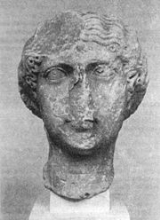
Livilla

Encyclopedia
- For the same-named sister of the Emperor CaligulaCaligulaCaligula , also known as Gaius, was Roman Emperor from 37 AD to 41 AD. Caligula was a member of the house of rulers conventionally known as the Julio-Claudian dynasty. Caligula's father Germanicus, the nephew and adopted son of Emperor Tiberius, was a very successful general and one of Rome's most...
, see Julia LivillaJulia LivillaJulia Livilla was the youngest child of Germanicus and Agrippina the Elder and the youngest sister of the Emperor Caligula.-Life:Livilla was the youngest great granddaughter of Emperor Augustus, great-niece and adoptive granddaughter...
.
(Claudia) Livia Julia (Classical Latin
Classical Latin
Classical Latin in simplest terms is the socio-linguistic register of the Latin language regarded by the enfranchised and empowered populations of the late Roman republic and the Roman empire as good Latin. Most writers during this time made use of it...
: LIVIA•IVLIA) (c. 13 BC – 31 A.D.
31
Year 31 was a common year starting on Monday of the Julian calendar. At the time, it was known as the Year of the Consulship of Augustus and Seianus...
) was the only daughter of Nero Claudius Drusus
Nero Claudius Drusus
Nero Claudius Drusus Germanicus , born Decimus Claudius Drusus also called Drusus, Drusus I, Nero Drusus, or Drusus the Elder was a Roman politician and military commander. He was a fully patrician Claudian on his father's side but his maternal grandmother was from a plebeian family...
and Antonia Minor
Antonia Minor
Antonia Minor , also known as Antonia the Younger or simply Antonia was the younger of two daughters of Roman politician Mark Antony and Octavia Minor. Tacitus Ann. 4.44.2 and 12.54.2 may have confused the two Antonia sisters...
and sister of the Roman Emperor
Roman Emperor
The Roman emperor was the ruler of the Roman State during the imperial period . The Romans had no single term for the office although at any given time, a given title was associated with the emperor...
Claudius
Claudius
Claudius , was Roman Emperor from 41 to 54. A member of the Julio-Claudian dynasty, he was the son of Drusus and Antonia Minor. He was born at Lugdunum in Gaul and was the first Roman Emperor to be born outside Italy...
and Germanicus
Germanicus
Germanicus Julius Caesar , commonly known as Germanicus, was a member of the Julio-Claudian dynasty and a prominent general of the early Roman Empire. He was born in Rome, Italia, and was named either Nero Claudius Drusus after his father or Tiberius Claudius Nero after his uncle...
. She was named after her grand-mother, Augustus
Augustus
Augustus ;23 September 63 BC – 19 August AD 14) is considered the first emperor of the Roman Empire, which he ruled alone from 27 BC until his death in 14 AD.The dates of his rule are contemporary dates; Augustus lived under two calendars, the Roman Republican until 45 BC, and the Julian...
' wife Livia Drusilla, and commonly known by her family nickname Livilla (the "little Livia").
She was twice married to the potential successor in the Julio-Claudian dynasty
Julio-Claudian Dynasty
The Julio-Claudian dynasty normally refers to the first five Roman Emperors: Augustus, Tiberius, Caligula , Claudius, and Nero, or the family to which they belonged; they ruled the Roman Empire from its formation, in the second half of the 1st century BC, until AD 68, when the last of the line,...
, first to Augustus
Augustus
Augustus ;23 September 63 BC – 19 August AD 14) is considered the first emperor of the Roman Empire, which he ruled alone from 27 BC until his death in 14 AD.The dates of his rule are contemporary dates; Augustus lived under two calendars, the Roman Republican until 45 BC, and the Julian...
' grandson Gaius Caesar (died 4 AD) and later to Tiberius
Tiberius
Tiberius , was Roman Emperor from 14 AD to 37 AD. Tiberius was by birth a Claudian, son of Tiberius Claudius Nero and Livia Drusilla. His mother divorced Nero and married Augustus in 39 BC, making him a step-son of Octavian...
' son Drusus (died 23 AD). Allegedly, she helped her lover Sejanus
Sejanus
Lucius Aelius Seianus , commonly known as Sejanus, was an ambitious soldier, friend and confidant of the Roman Emperor Tiberius...
in poisoning her husband and died shortly after Sejanus fell from power in 31 AD.
Marriages
Livilla was married twice, first in 2 BC to Gaius Caesar, AugustusAugustus
Augustus ;23 September 63 BC – 19 August AD 14) is considered the first emperor of the Roman Empire, which he ruled alone from 27 BC until his death in 14 AD.The dates of his rule are contemporary dates; Augustus lived under two calendars, the Roman Republican until 45 BC, and the Julian...
' grandson and potential successor. Thus, Augustus had chosen Livilla as the wife of the future Emperor. This splendid royal marriage probably gave Livilla grand aspirations for her future, perhaps at the expense of the ambition of Augustus' granddaughters, Agrippina the Elder
Agrippina the elder
Vipsania Agrippina or most commonly known as Agrippina Major or Agrippina the Elder was a distinguished and prominent granddaughter of the Emperor Augustus. Agrippina was the wife of the general, statesman Germanicus and a relative to the first Roman Emperors...
and Julia the Younger
Julia the Younger
Julia the Younger or Julilla , Vipsania Julia Agrippina, Iulilla, Julia, Augustus' granddaughter, or Julia Caesaris Minor, was a Roman noblewoman of the Julio-Claudian dynasty. She was the first daughter and second child of Marcus Vipsanius Agrippa and Julia the Elder...
. However, Gaius died in 4 AD, cutting short Augustus' and Livilla's plans.
In the same year, Livilla married her cousin Drusus Julius Caesar, the son of Tiberius
Tiberius
Tiberius , was Roman Emperor from 14 AD to 37 AD. Tiberius was by birth a Claudian, son of Tiberius Claudius Nero and Livia Drusilla. His mother divorced Nero and married Augustus in 39 BC, making him a step-son of Octavian...
. When Tiberius succeed Augustus as Emperor in 14 AD, Livilla again was the wife of a potential successor. Drusus and Livilla had three children, a daughter names Julia
Julia (daughter of Drusus the Younger)
Julia Drusi Caesaris Filia was the daughter of Drusus Julius Caesar and Livilla and granddaughter to the Roman Emperor Tiberius.-Chronology:At the time of Emperor Augustus' death in 14 Julia was ill...
in 5 AD and twin brothers in 19 AD: of these Germanicus Gemellus died in 23, whereas Tiberius Gemellus
Tiberius Gemellus
Tiberius Julius Caesar Nero Gemellus, known as Tiberius Gemellus was the son of Drusus and Livilla, the grandson of the Emperor Tiberius, and the cousin of the Emperor Caligula. Gemellus is a nickname meaning "the twin"...
survived his infancy.
Livilla's standing in her family
TacitusTacitus
Publius Cornelius Tacitus was a senator and a historian of the Roman Empire. The surviving portions of his two major works—the Annals and the Histories—examine the reigns of the Roman Emperors Tiberius, Claudius, Nero and those who reigned in the Year of the Four Emperors...
reports that Livilla was a remarkably beautiful woman, despite the fact she was rather ungainly as a child. The Senatus Consultum de Cn. Pisone patre indicates that she was held with the highest esteem by her uncle and father-in-law, Tiberius
Tiberius
Tiberius , was Roman Emperor from 14 AD to 37 AD. Tiberius was by birth a Claudian, son of Tiberius Claudius Nero and Livia Drusilla. His mother divorced Nero and married Augustus in 39 BC, making him a step-son of Octavian...
, and by her grandmother Livia Drusilla.
According to Tacitus, she felt resentment and jealousy against her sister-in-law Agrippina the Elder
Agrippina the elder
Vipsania Agrippina or most commonly known as Agrippina Major or Agrippina the Elder was a distinguished and prominent granddaughter of the Emperor Augustus. Agrippina was the wife of the general, statesman Germanicus and a relative to the first Roman Emperors...
, the wife of her brother Germanicus
Germanicus
Germanicus Julius Caesar , commonly known as Germanicus, was a member of the Julio-Claudian dynasty and a prominent general of the early Roman Empire. He was born in Rome, Italia, and was named either Nero Claudius Drusus after his father or Tiberius Claudius Nero after his uncle...
, to whom she was unfavourably compared. Indeed, Agrippina fared much better in producing imperial heirs to the household (being the mother of the Emperor Caligula
Caligula
Caligula , also known as Gaius, was Roman Emperor from 37 AD to 41 AD. Caligula was a member of the house of rulers conventionally known as the Julio-Claudian dynasty. Caligula's father Germanicus, the nephew and adopted son of Emperor Tiberius, was a very successful general and one of Rome's most...
and Agrippina the Younger
Agrippina the Younger
Julia Agrippina, most commonly referred to as Agrippina Minor or Agrippina the Younger, and after 50 known as Julia Augusta Agrippina was a Roman Empress and one of the more prominent women in the Julio-Claudian dynasty...
) and was much more popular. Suetonius
Suetonius
Gaius Suetonius Tranquillus, commonly known as Suetonius , was a Roman historian belonging to the equestrian order in the early Imperial era....
reports that she despised her younger brother Claudius
Claudius
Claudius , was Roman Emperor from 41 to 54. A member of the Julio-Claudian dynasty, he was the son of Drusus and Antonia Minor. He was born at Lugdunum in Gaul and was the first Roman Emperor to be born outside Italy...
; having heard he would one day become Emperor, she deplored publicly such a fate for the Roman people.
As most of the female members of the Julio-Claudian dynasty
Julio-Claudian Dynasty
The Julio-Claudian dynasty normally refers to the first five Roman Emperors: Augustus, Tiberius, Caligula , Claudius, and Nero, or the family to which they belonged; they ruled the Roman Empire from its formation, in the second half of the 1st century BC, until AD 68, when the last of the line,...
, she may also have been very ambitious, in particular for her male offspring.
Affair with Sejanus
Possibly even before the birth of the twins, Livilla had an affair with Lucius Aelius Sejanus, the praetorian prefectPraetorian prefect
Praetorian prefect was the title of a high office in the Roman Empire. Originating as the commander of the Praetorian Guard, the office gradually acquired extensive legal and administrative functions, with its holders becoming the Emperor's chief aides...
of Tiberius - later on, some (including Tiberius) suspected Sejanus to have fathered the twins. Drusus, heir apparent since the death of Germanicus
Germanicus
Germanicus Julius Caesar , commonly known as Germanicus, was a member of the Julio-Claudian dynasty and a prominent general of the early Roman Empire. He was born in Rome, Italia, and was named either Nero Claudius Drusus after his father or Tiberius Claudius Nero after his uncle...
in 23 AD, died in the same year, shortly after striking Sejanus in an argument. According to Tacitus
Tacitus
Publius Cornelius Tacitus was a senator and a historian of the Roman Empire. The surviving portions of his two major works—the Annals and the Histories—examine the reigns of the Roman Emperors Tiberius, Claudius, Nero and those who reigned in the Year of the Four Emperors...
, Suetonius
Lives of the Twelve Caesars
De vita Caesarum commonly known as The Twelve Caesars, is a set of twelve biographies of Julius Caesar and the first 11 emperors of the Roman Empire written by Gaius Suetonius Tranquillus.The work, written in AD 121 during the reign of the emperor Hadrian, was the most popular work of Suetonius,...
, Cassius Dio, Sejanus had poisoned Drusus, not only because he feared the wrath of the future Emperor but also because he had designs on the supreme power, and aimed at removing a potential competitor -, with Livilla as his accomplice. If Drusus was indeed poisoned, his death aroused no suspicions at the time.
Sejanus now wanted to marry the widowed Livilla. Tiberius in 25 rejected such a request but in 31 eventually gave way. In the same year, the Emperor received evidence from Antonia Minor
Antonia Minor
Antonia Minor , also known as Antonia the Younger or simply Antonia was the younger of two daughters of Roman politician Mark Antony and Octavia Minor. Tacitus Ann. 4.44.2 and 12.54.2 may have confused the two Antonia sisters...
, his sister-in-law, that Sejanus planned to overthrow him. Tiberius had Sejanus denounced in the Senate, then had him arrested and dragged off to prison to be put to death. A bloody purge then erupted in Rome, most of Sejanus' family (including his children) and followers sharing his fate.
Accusations and death
Hearing of the death of her children, Sejanus' former wife Apicata committed suicide. Before her death, she addressed a letter to Tiberius, accusing Sejanus and Livilla of having poisoned Drusus. Drusus' cupbearer Lygdus and Livilla's physician EudemusEudemus (physician)
Eudemus was the name of several Greek physicians, whom it is difficult to distinguish with certainty:* A druggist, who apparently lived in the 4th or 3rd century BC...
were questioned and under torture confirmed Apicata's accusation.
Livilla died shortly afterwards, either being killed or by suicide. According to Cassius Dio, Tiberius handed Livilla over to her mother, Antonia Minor
Antonia Minor
Antonia Minor , also known as Antonia the Younger or simply Antonia was the younger of two daughters of Roman politician Mark Antony and Octavia Minor. Tacitus Ann. 4.44.2 and 12.54.2 may have confused the two Antonia sisters...
, who locked her up in a room and starved her to death.
Early in 32, the Senate proposed "terrible decrees...against her very statues and memory".
Posthumously, there were further allegations of adultery with her physician Eudemus and with the senator and poet Mamercus Aemilius Scaurus
Mamercus Aemilius Scaurus
Mamercus Aemilius Scaurus was a Roman rhetorician, poet and senator, son of Marcus Aemilius Scaurus. He was a member of the senate in 14 AD at the time of Tiberius' accession to the throne.He first married Aemilia Lepida. Later he married Sextia...
.
Portraiture
.jpg)
Damnatio memoriae
Damnatio memoriae is the Latin phrase literally meaning "condemnation of memory" in the sense of a judgment that a person must not be remembered. It was a form of dishonor that could be passed by the Roman Senate upon traitors or others who brought discredit to the Roman State...
voted against her by the Senate after her death. Several possibilities have been advanced but none has to date received widespread acceptance. However, a portrait type that survives in at least three replicas and which we may refer to as the Alesia type may very well represent Livilla. As seen in the picture above, it shows the head of a lady in her blossom years, with a hairstyle clearly from the tiberian period. The physiognomy is close but not identical to portraits of Antonia Minor, Livilla's mother, and some replicas seem to bear the marks of voluntary damage (that one would expect from a damnatio memoriae). For all these reasons, it has been proposed to see in this portrait type a representation of Livilla.
A cameo portrait of a lady with the silhouettes of two infants, has been tentatively identified as Livilla. Although it may be possible that the seated woman on right on the Great Cameo of France
Great Cameo of France
The Great Cameo of France is a five-layered sardonyx cameo of circa 23 AD. It is 31 cm by 26.5 cm. It is first attested in the first inventory of the treasure of Sainte Chapelle before 1279...
represents Livilla, it seems more probable that the female figure seated on the left and holding a roll is in fact representing Livilla, depicted there as the widowed wife of Drusus the Younger, seen just above her as one of the three heavenly imperial male figures.
Appearance in media
The character of Livilla appeared in the 1968 British televisionTelevision
Television is a telecommunication medium for transmitting and receiving moving images that can be monochrome or colored, with accompanying sound...
series The Caesars
The Caesars (TV series)
The Caesars is a British television series produced by Granada Television for the ITV network in 1968. Made in black-and-white and written and produced by Philip Mackie, it covered similar dramatic territory to the later BBC adaptation of I, Claudius, dealing with the lives of the emperors of...
and was portrayed by Suzan Farmer
Suzan Farmer
Suzan Farmer is an English actress, mainly on television.She first appeared in an episode of the Patrick McGoohan series Danger Man entitled No Marks for Servility and went on to feature in many other ITC series in the 1960s and 70s including UFO, The Saint, Man in a Suitcase and The Persuaders!...
. She also appeared in the 1976 BBC TV series adoption of I, Claudius
I, Claudius (TV series)
I, Claudius is a 1976 BBC Television adaptation of Robert Graves' I, Claudius and Claudius the God. Written by Jack Pulman, it proved one of the corporation's most successful drama serials of all time...
and was played by Patricia Quinn
Patricia Quinn
Patricia Quinn, Lady Stephens is a Northern Irish actress best known for her role as Magenta in the film The Rocky Horror Picture Show . Hers were the red lips that appeared in the film's opening song "Science Fiction/Double Feature"...
. In the 1985 mini-series A.D. Anno Domini, which chronicles the very beginning of Christianity and its struggle with the Roman Empire, the character of Livilla was played by Susan Sarandon
Susan Sarandon
Susan Sarandon is an American actress. She has worked in films and television since 1969, and won an Academy Award for Best Actress for her performance in the 1995 film Dead Man Walking. She had also been nominated for the award for four films before that and has received other recognition for her...
.
Others with this same name
Julia LivillaJulia Livilla
Julia Livilla was the youngest child of Germanicus and Agrippina the Elder and the youngest sister of the Emperor Caligula.-Life:Livilla was the youngest great granddaughter of Emperor Augustus, great-niece and adoptive granddaughter...
, the youngest daughter of Germanicus
Germanicus
Germanicus Julius Caesar , commonly known as Germanicus, was a member of the Julio-Claudian dynasty and a prominent general of the early Roman Empire. He was born in Rome, Italia, and was named either Nero Claudius Drusus after his father or Tiberius Claudius Nero after his uncle...
, was named for her paternal aunt.