


Domus Aurea

Encyclopedia
The Domus Aurea was a large landscaped portico villa
, designed to take advantage of artificially created landscapes built in the heart of Ancient Rome
by the Emperor
Nero
after the Great Fire of Rome
(64 AD) had cleared away the aristocratic dwellings on the slopes of the Palatine Hill
.
in the few years between the fire and Nero's suicide in 68, the extensive gold-leaf that gave the villa its name was not the only extravagant element of its decor: stuccoed ceilings were applied with semi-precious stones and veneers of ivory while the walls were frescoed, coordinating the decoration into different themes in each major group of rooms. Pliny the Elder
watched it being built and mentions it in his Naturalis Historia
.
Suetonius claims this of Nero and the Domus Aurea:
Though the Domus Aurea complex covered parts of the slopes of the Palatine
, Esquiline
and Caelian hill
s, with a man-made lake in the marshy bottomlands, the estimated size of the Domus Aurea is an approximation, as much of it has not been excavated. Some scholars place it at over 300 acres (1.2 km²), while others estimate its size to have been under 100 acre (0.404686 km²). Suetonius describes the complex as "ruinously prodigal" as it included groves of trees, pastures with flocks, vineyards and an artificial lake— rus in urbe, "countryside in the city". Nero also commissioned from the Greek Zenodorus a colossal 35.5 m (120 RF
) high bronze statue
of himself, the Colossus Neronis
. Pliny the Elder, however, puts its height at only 30.3 m (106.5 RF). The statue was placed just outside the main palace entrance at the terminus of the Via Appia in a large atrium of porticoes that divided the city from the private villa. This statue may have represented Nero as the sun god Sol, as Pliny saw some resemblance. This idea is widely accepted among scholars but some are convinced that Nero was not identified with Sol while he was alive. The face of the statue was modified shortly after Nero’s death during Vespasian
’s reign to make it truly a statue of Sol. Hadrian
moved it, with the help of the architect Decrianus and 24 elephants, to a position next to the Flavian Amphitheater. This building took the name "Colosseum
" in the Middle Ages, after the statue nearby, or, as some historians believe, because of the sheer size of the building.
The Golden House was a party villa, as shown by the presence of 300 rooms without any sleeping quarter. Nero's own palace remained on the Quirinal Hill
. Strangely, no kitchens or latrines have been discovered yet either.
Rooms sheathed in dazzling polished white marble were given richly varied floor plans, shaped with niche
s and exedra
s that concentrated or dispersed the daylight. There were pools in the floors and fountains splashing in the corridors. Nero took great interest in every detail of the project, according to Tacitus
' Annals
, and oversaw the engineer-architects, Celer and Severus, who were also responsible for the attempted navigable canal with which Nero hoped to link Misenum with Lake Avernus
.
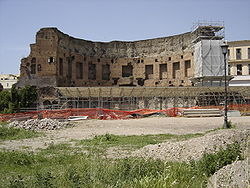 Some of the extravagances of the Domus Aurea had repercussions for the future. The architects designed two of the principal dining rooms to flank an octagonal court, surmounted by a dome with a giant central oculus to let in light. It was an early use of Roman concrete
construction. One innovation was destined to have an enormous influence on the art of the future: Nero placed mosaic
s, previously restricted to floors, in the vaulted ceilings. Only fragments have survived, but that technique was to be copied extensively, eventually ending up as a fundamental feature of Christian art: the apse mosaics that decorate so many churches in Rome, Ravenna, Sicily and Constantinople.
Celer and Severus also created an ingenious mechanism, cranked by slaves, that made the ceiling underneath the dome revolve like the heavens, while perfume was sprayed and rose petals were dropped on the assembled diners. According to some accounts, perhaps embellished by Nero's political enemies, on one occasion such quantities of rose petals were dropped that one unlucky guest was asphyxiated (a similar story is told of the emperor Elagabalus
).
"Nero gave the best parties, ever," archaeologist Wallace-Hadrill told an interviewer when the Golden House was reopened to visitors in 1999 after being closed for years for restorations. "Three hundred years after his death, tokens bearing his head were still being given out at public spectacles - a memento of the greatest showman of them all." Nero, who was obsessed with his status as an artist, certainly regarded parties as works of art. His official party planner was Petronius
.
Frescoes covered every surface that wasn't more richly finished. The main artist was one Famulus (or Fabulus according to some sources). Fresco technique, working on damp plaster, demands a speedy and sure touch: Famulus and his studio covered a spectacular amount of area. Pliny, in his Natural History, recounts how Famulus went for only a few hours each day to the Golden House, to work while the light was right. The swiftness of Famulus's execution gives a wonderful unity to his compositions and astonishing delicacy to their execution.
Pliny the Elder presents Amulius as one of the principal painters of the domus aurea:
"More recently, lived Amulius, a grave and serious personage, but a painter in the florid style. By this artist there was a Minerva, which had the appearance of always looking at the spectators, from whatever point it was viewed. He only painted a few hours each day, and then with the greatest gravity, for he always kept the toga on, even when in the midst of his implements. The Golden Palace of Nero was the prison-house of this artist's productions, and hence it is that there are so few of them to be seen elsewhere."
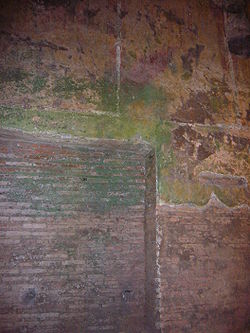 After Nero's death, the Golden House was a severe embarrassment to his successors. It was stripped of its marble, its jewels and its ivory within a decade. Soon after Nero’s death, the palace and grounds, encompassing 2.6 km² (c. 1 mi²), were filled with earth and built over: the Baths of Titus
were already being built on part of the site in 79 AD. On the site of the lake, in the middle of the palace grounds, Vespasian
built the Flavian Amphitheatre
, which could be reflooded at will, with the Colossus Neronis beside it. The Baths of Trajan
, and the Temple of Venus and Rome were also built on the site. Within 40 years, the Golden House was completely obliterated, buried beneath the new constructions, but paradoxically this ensured the wallpaintings' survival by protecting them from dampness.
filled with painted figures. Soon the young artists of Rome were having themselves let down on boards knotted to ropes to see for themselves. The fourth style frescoes that were uncovered then have faded to pale gray stains on the plaster now, but the effect of these freshly rediscovered grottesche
decorations was electrifying in the early Renaissance
, which was just arriving in Rome. When Pinturicchio
, Raphael
and Michelangelo
crawled underground and were let down shafts to study them, carving their names on the walls to let the world know they had been there, the paintings were a revelation of the true world of antiquity. Beside the graffiti signatures of later tourists, like Casanova
and the Marquis de Sade
scratched into a fresco inches apart (British Archaeology June 1999), are the autographs of Domenico Ghirlandaio
, Martin van Heemskerck, and Filippino Lippi
.
It was even claimed that various classical artworks found at this time - such as the Laocoön and his Sons
and Venus Kallipygos
- were found within or near the Domus's remains, though this is now accepted as unlikely (high quality artworks would have been removed - to the Temple of Peace, for example - before the Domus was covered over with earth).
The frescoes' effect on Renaissance artists was instant and profound (it can be seen most obviously in Raphael's decoration for the loggias in the Vatican), and the white walls, delicate swags, and bands of frieze — framed reserves containing figures or landscapes — have returned at intervals ever since, notably in late 18th century Neoclassicism
, making Famulus one of the most influential painters in the history of art.
Increasing concerns about the condition of the building and the safety of visitors resulted in its closing at the end of 2005 for further restoration work. The complex was partially reopened on February 6, 2007, but closed on March 25, 2008 because of safety concerns.
The likely remains of Nero's rotating banquet hall and its underlying mechanism were unveiled by archeologists on September 29, 2009.
The current administrative division of central Rome places it in rione
Monti
.
Sixty square meters (645 square feet) of the vault of a gallery collapsed on March 30, 2010.
Villa
A villa was originally an ancient Roman upper-class country house. Since its origins in the Roman villa, the idea and function of a villa have evolved considerably. After the fall of the Roman Republic, villas became small farming compounds, which were increasingly fortified in Late Antiquity,...
, designed to take advantage of artificially created landscapes built in the heart of Ancient Rome
Ancient Rome
Ancient Rome was a thriving civilization that grew on the Italian Peninsula as early as the 8th century BC. Located along the Mediterranean Sea and centered on the city of Rome, it expanded to one of the largest empires in the ancient world....
by the Emperor
Roman Empire
The Roman Empire was the post-Republican period of the ancient Roman civilization, characterised by an autocratic form of government and large territorial holdings in Europe and around the Mediterranean....
Nero
Nero
Nero , was Roman Emperor from 54 to 68, and the last in the Julio-Claudian dynasty. Nero was adopted by his great-uncle Claudius to become his heir and successor, and succeeded to the throne in 54 following Claudius' death....
after the Great Fire of Rome
Great Fire of Rome
The Great Fire of Rome was an urban fire that occurred beginning July 19, AD 64.-Background:According to Tacitus, the fire spread quickly and burned for six days. Only four of the fourteen districts of Rome escaped the fire; three districts were completely destroyed and the other seven suffered...
(64 AD) had cleared away the aristocratic dwellings on the slopes of the Palatine Hill
Palatine Hill
The Palatine Hill is the centermost of the Seven Hills of Rome and is one of the most ancient parts of the city...
.
Construction
Built of brick and concreteRoman concrete
Roman concrete was a material used in construction during the late Roman Republic through the whole history of the Roman Empire. Roman concrete was based on a hydraulic-setting cement with many material qualities similar to modern Portland cement...
in the few years between the fire and Nero's suicide in 68, the extensive gold-leaf that gave the villa its name was not the only extravagant element of its decor: stuccoed ceilings were applied with semi-precious stones and veneers of ivory while the walls were frescoed, coordinating the decoration into different themes in each major group of rooms. Pliny the Elder
Pliny the Elder
Gaius Plinius Secundus , better known as Pliny the Elder, was a Roman author, naturalist, and natural philosopher, as well as naval and army commander of the early Roman Empire, and personal friend of the emperor Vespasian...
watched it being built and mentions it in his Naturalis Historia
Naturalis Historia
The Natural History is an encyclopedia published circa AD 77–79 by Pliny the Elder. It is one of the largest single works to have survived from the Roman Empire to the modern day and purports to cover the entire field of ancient knowledge, based on the best authorities available to Pliny...
.
Suetonius claims this of Nero and the Domus Aurea:
- When the edifice was finished in this style and he dedicated it, he deigned to say nothing more in the way of approval than that he was at last beginning to be housed like a human being.
Though the Domus Aurea complex covered parts of the slopes of the Palatine
Palatine Hill
The Palatine Hill is the centermost of the Seven Hills of Rome and is one of the most ancient parts of the city...
, Esquiline
Esquiline Hill
The Esquiline Hill is one of the celebrated Seven Hills of Rome. Its southern-most cusp is the Oppius .-Etymology:The origin of the name Esquilino is still under much debate. One view is that the Hill was named after the abundance of holm-oaks, exculi, that resided there...
and Caelian hill
Caelian Hill
The Caelian Hill is one of the famous Seven Hills of Rome. Under reign of Tullus Hostilius, the entire population of Alba Longa was forcibly resettled on the Caelian Hill...
s, with a man-made lake in the marshy bottomlands, the estimated size of the Domus Aurea is an approximation, as much of it has not been excavated. Some scholars place it at over 300 acres (1.2 km²), while others estimate its size to have been under 100 acre (0.404686 km²). Suetonius describes the complex as "ruinously prodigal" as it included groves of trees, pastures with flocks, vineyards and an artificial lake— rus in urbe, "countryside in the city". Nero also commissioned from the Greek Zenodorus a colossal 35.5 m (120 RF
Ancient Roman units of measurement
The ancient Roman units of measurement were built on the Hellenic system with Egyptian, Hebrew, and Mesopotamian influences. The Roman units were comparatively consistent and well documented.-Length:Notes...
) high bronze statue
Bronze sculpture
Bronze is the most popular metal for cast metal sculptures; a cast bronze sculpture is often called simply a "bronze".Common bronze alloys have the unusual and desirable property of expanding slightly just before they set, thus filling the finest details of a mold. Then, as the bronze cools, it...
of himself, the Colossus Neronis
Colossus of Nero
The Colossus Neronis was an enormous, 30 m bronze statue that the Emperor Nero erected in the vestibule of his Domus Aurea, the imperial villa complex on the Palatine Hill. It was modified by Nero's successors into a statue of the sun god Sol Invictus. It is last mentioned in the 4th century AD...
. Pliny the Elder, however, puts its height at only 30.3 m (106.5 RF). The statue was placed just outside the main palace entrance at the terminus of the Via Appia in a large atrium of porticoes that divided the city from the private villa. This statue may have represented Nero as the sun god Sol, as Pliny saw some resemblance. This idea is widely accepted among scholars but some are convinced that Nero was not identified with Sol while he was alive. The face of the statue was modified shortly after Nero’s death during Vespasian
Vespasian
Vespasian , was Roman Emperor from 69 AD to 79 AD. Vespasian was the founder of the Flavian dynasty, which ruled the Empire for a quarter century. Vespasian was descended from a family of equestrians, who rose into the senatorial rank under the Emperors of the Julio-Claudian dynasty...
’s reign to make it truly a statue of Sol. Hadrian
Hadrian
Hadrian , was Roman Emperor from 117 to 138. He is best known for building Hadrian's Wall, which marked the northern limit of Roman Britain. In Rome, he re-built the Pantheon and constructed the Temple of Venus and Roma. In addition to being emperor, Hadrian was a humanist and was philhellene in...
moved it, with the help of the architect Decrianus and 24 elephants, to a position next to the Flavian Amphitheater. This building took the name "Colosseum
Colosseum
The Colosseum, or the Coliseum, originally the Flavian Amphitheatre , is an elliptical amphitheatre in the centre of the city of Rome, Italy, the largest ever built in the Roman Empire...
" in the Middle Ages, after the statue nearby, or, as some historians believe, because of the sheer size of the building.
The Golden House was a party villa, as shown by the presence of 300 rooms without any sleeping quarter. Nero's own palace remained on the Quirinal Hill
Quirinal Hill
The Quirinal Hill is one of the Seven Hills of Rome, at the north-east of the city center. It is the location of the official residence of the Italian Head of State, who resides in the Quirinal Palace; by metonymy "the Quirinal" has come to stand for the Italian President.- History :It was...
. Strangely, no kitchens or latrines have been discovered yet either.
Rooms sheathed in dazzling polished white marble were given richly varied floor plans, shaped with niche
Niche (architecture)
A niche in classical architecture is an exedra or an apse that has been reduced in size, retaining the half-dome heading usual for an apse. Nero's Domus Aurea was the first semi-private dwelling that possessed rooms that were given richly varied floor plans, shaped with niches and exedras;...
s and exedra
Exedra
In architecture, an exedra is a semicircular recess or plinth, often crowned by a semi-dome, which is sometimes set into a building's facade. The original Greek sense was applied to a room that opened onto a stoa, ringed with curved high-backed stone benches, a suitable place for a philosophical...
s that concentrated or dispersed the daylight. There were pools in the floors and fountains splashing in the corridors. Nero took great interest in every detail of the project, according to Tacitus
Tacitus
Publius Cornelius Tacitus was a senator and a historian of the Roman Empire. The surviving portions of his two major works—the Annals and the Histories—examine the reigns of the Roman Emperors Tiberius, Claudius, Nero and those who reigned in the Year of the Four Emperors...
' Annals
Annals (Tacitus)
The Annals by Tacitus is a history of the reigns of the four Roman Emperors succeeding Caesar Augustus. The surviving parts of the Annals extensively cover most of the reigns of Tiberius and Nero. The title Annals was probably not given by Tacitus, but derives from the fact that he treated this...
, and oversaw the engineer-architects, Celer and Severus, who were also responsible for the attempted navigable canal with which Nero hoped to link Misenum with Lake Avernus
Lake Avernus
Lake Avernus is a volcanic crater lake located in the Avernus crater in the Campania region of southern Italy, around northwest of Pozzuoli. It is near the volcanic field known as the Campi Flegrei and comprises part of the wider Campanian volcanic arc...
.
Roman concrete
Roman concrete was a material used in construction during the late Roman Republic through the whole history of the Roman Empire. Roman concrete was based on a hydraulic-setting cement with many material qualities similar to modern Portland cement...
construction. One innovation was destined to have an enormous influence on the art of the future: Nero placed mosaic
Mosaic
Mosaic is the art of creating images with an assemblage of small pieces of colored glass, stone, or other materials. It may be a technique of decorative art, an aspect of interior decoration, or of cultural and spiritual significance as in a cathedral...
s, previously restricted to floors, in the vaulted ceilings. Only fragments have survived, but that technique was to be copied extensively, eventually ending up as a fundamental feature of Christian art: the apse mosaics that decorate so many churches in Rome, Ravenna, Sicily and Constantinople.
Celer and Severus also created an ingenious mechanism, cranked by slaves, that made the ceiling underneath the dome revolve like the heavens, while perfume was sprayed and rose petals were dropped on the assembled diners. According to some accounts, perhaps embellished by Nero's political enemies, on one occasion such quantities of rose petals were dropped that one unlucky guest was asphyxiated (a similar story is told of the emperor Elagabalus
Elagabalus
Elagabalus , also known as Heliogabalus, was Roman Emperor from 218 to 222. A member of the Severan Dynasty, he was Syrian on his mother's side, the son of Julia Soaemias and Sextus Varius Marcellus. Early in his youth he served as a priest of the god El-Gabal at his hometown, Emesa...
).
"Nero gave the best parties, ever," archaeologist Wallace-Hadrill told an interviewer when the Golden House was reopened to visitors in 1999 after being closed for years for restorations. "Three hundred years after his death, tokens bearing his head were still being given out at public spectacles - a memento of the greatest showman of them all." Nero, who was obsessed with his status as an artist, certainly regarded parties as works of art. His official party planner was Petronius
Petronius
Gaius Petronius Arbiter was a Roman courtier during the reign of Nero. He is generally believed to be the author of the Satyricon, a satirical novel believed to have been written during the Neronian age.-Life:...
.
Frescoes covered every surface that wasn't more richly finished. The main artist was one Famulus (or Fabulus according to some sources). Fresco technique, working on damp plaster, demands a speedy and sure touch: Famulus and his studio covered a spectacular amount of area. Pliny, in his Natural History, recounts how Famulus went for only a few hours each day to the Golden House, to work while the light was right. The swiftness of Famulus's execution gives a wonderful unity to his compositions and astonishing delicacy to their execution.
Pliny the Elder presents Amulius as one of the principal painters of the domus aurea:
"More recently, lived Amulius, a grave and serious personage, but a painter in the florid style. By this artist there was a Minerva, which had the appearance of always looking at the spectators, from whatever point it was viewed. He only painted a few hours each day, and then with the greatest gravity, for he always kept the toga on, even when in the midst of his implements. The Golden Palace of Nero was the prison-house of this artist's productions, and hence it is that there are so few of them to be seen elsewhere."
Damnatio memoriae
Baths of Titus
The Baths of Titus were public baths built in Rome in 81 by Emperor Titus.The baths sat in the base of the Esquiline hill, an area of parkland and luxury estates which had been taken over by Nero for his Golden House or Domus Aurea...
were already being built on part of the site in 79 AD. On the site of the lake, in the middle of the palace grounds, Vespasian
Vespasian
Vespasian , was Roman Emperor from 69 AD to 79 AD. Vespasian was the founder of the Flavian dynasty, which ruled the Empire for a quarter century. Vespasian was descended from a family of equestrians, who rose into the senatorial rank under the Emperors of the Julio-Claudian dynasty...
built the Flavian Amphitheatre
Colosseum
The Colosseum, or the Coliseum, originally the Flavian Amphitheatre , is an elliptical amphitheatre in the centre of the city of Rome, Italy, the largest ever built in the Roman Empire...
, which could be reflooded at will, with the Colossus Neronis beside it. The Baths of Trajan
Baths of Trajan
The Baths of Trajan were a massive thermae, a bathing and leisure complex, built in ancient Rome starting from 104 AD and dedicated during the Kalends of July in 109...
, and the Temple of Venus and Rome were also built on the site. Within 40 years, the Golden House was completely obliterated, buried beneath the new constructions, but paradoxically this ensured the wallpaintings' survival by protecting them from dampness.
Renaissance
When a young Roman inadvertently fell through a cleft in the Aventine hillside at the end of the 15th century, he found himself in a strange cave or grottaGrotto
A grotto is any type of natural or artificial cave that is associated with modern, historic or prehistoric use by humans. When it is not an artificial garden feature, a grotto is often a small cave near water and often flooded or liable to flood at high tide...
filled with painted figures. Soon the young artists of Rome were having themselves let down on boards knotted to ropes to see for themselves. The fourth style frescoes that were uncovered then have faded to pale gray stains on the plaster now, but the effect of these freshly rediscovered grottesche
Grotesque
The word grotesque comes from the same Latin root as "Grotto", meaning a small cave or hollow. The original meaning was restricted to an extravagant style of Ancient Roman decorative art rediscovered and then copied in Rome at the end of the 15th century...
decorations was electrifying in the early Renaissance
Renaissance
The Renaissance was a cultural movement that spanned roughly the 14th to the 17th century, beginning in Italy in the Late Middle Ages and later spreading to the rest of Europe. The term is also used more loosely to refer to the historical era, but since the changes of the Renaissance were not...
, which was just arriving in Rome. When Pinturicchio
Pinturicchio
Bernardino di Betto, called Pintoricchio or Pinturicchio was an Italian painter of the Renaissance. He acquired his nickname, Pintoricchio , because of his small stature, and he used it to sign some of his works....
, Raphael
Raphael
Raffaello Sanzio da Urbino , better known simply as Raphael, was an Italian painter and architect of the High Renaissance. His work is admired for its clarity of form and ease of composition and for its visual achievement of the Neoplatonic ideal of human grandeur...
and Michelangelo
Michelangelo
Michelangelo di Lodovico Buonarroti Simoni , commonly known as Michelangelo, was an Italian Renaissance painter, sculptor, architect, poet, and engineer who exerted an unparalleled influence on the development of Western art...
crawled underground and were let down shafts to study them, carving their names on the walls to let the world know they had been there, the paintings were a revelation of the true world of antiquity. Beside the graffiti signatures of later tourists, like Casanova
Giacomo Casanova
Giacomo Girolamo Casanova de Seingalt was an Italian adventurer and author from the Republic of Venice. His autobiography, Histoire de ma vie , is regarded as one of the most authentic sources of the customs and norms of European social life during the 18th century...
and the Marquis de Sade
Marquis de Sade
Donatien Alphonse François, Marquis de Sade was a French aristocrat, revolutionary politician, philosopher, and writer famous for his libertine sexuality and lifestyle...
scratched into a fresco inches apart (British Archaeology June 1999), are the autographs of Domenico Ghirlandaio
Domenico Ghirlandaio
Domenico Ghirlandaio was an Italian Renaissance painter from Florence. Among his many apprentices was Michelangelo.-Early years:Ghirlandaio's full name is given as Domenico di Tommaso di Currado di Doffo Bigordi...
, Martin van Heemskerck, and Filippino Lippi
Filippino Lippi
Filippino Lippi was an Italian painter working during the High Renaissance in Florence, Italy.-Biography:...
.
It was even claimed that various classical artworks found at this time - such as the Laocoön and his Sons
Laocoön and his Sons
The statue of Laocoön and His Sons , also called the Laocoön Group, is a monumental sculpture in marble now in the Vatican Museums, Rome. The statue is attributed by the Roman author Pliny the Elder to three sculptors from the island of Rhodes: Agesander, Athenodoros and Polydorus...
and Venus Kallipygos
Venus Kallipygos
The Venus Kallipygos or Aphrodite Kallipygos , also known as the Callipygian Venus, all literally meaning "Venus of the beautiful buttocks", is an Ancient Roman marble statue, thought to be a copy of an older Greek original...
- were found within or near the Domus's remains, though this is now accepted as unlikely (high quality artworks would have been removed - to the Temple of Peace, for example - before the Domus was covered over with earth).
The frescoes' effect on Renaissance artists was instant and profound (it can be seen most obviously in Raphael's decoration for the loggias in the Vatican), and the white walls, delicate swags, and bands of frieze — framed reserves containing figures or landscapes — have returned at intervals ever since, notably in late 18th century Neoclassicism
Neoclassicism
Neoclassicism is the name given to Western movements in the decorative and visual arts, literature, theatre, music, and architecture that draw inspiration from the "classical" art and culture of Ancient Greece or Ancient Rome...
, making Famulus one of the most influential painters in the history of art.
20th century to present
Discovery led to the arrival of moisture starting the slow, inevitable process of decay. Heavy rain was blamed in the collapse of a chunk of ceiling.Increasing concerns about the condition of the building and the safety of visitors resulted in its closing at the end of 2005 for further restoration work. The complex was partially reopened on February 6, 2007, but closed on March 25, 2008 because of safety concerns.
The likely remains of Nero's rotating banquet hall and its underlying mechanism were unveiled by archeologists on September 29, 2009.
The current administrative division of central Rome places it in rione
Rioni of Rome
A rione is an Italian term used since the Middle Ages to name the districts of Rome, according to the administrative divisions of that time. The word originates from the Latin word regio A rione (pl. rioni) is an Italian term used since the Middle Ages to name the districts of Rome, according to...
Monti
Monti (rione of Rome)
Monti is the name of one of the twelve Rioni of Rome, rione I. The name literally means mountains in Italian and comes from the fact that the Esquiline and the Viminal Hills, and parts of the Quirinal and the Caelian Hills belonged to this rione...
.
Sixty square meters (645 square feet) of the vault of a gallery collapsed on March 30, 2010.
Commercial uses
The name Domus Aurea has in modern times come to signify wealth, opulence, and luxury. Commercial uses of the name have grown, ranging from luxury hotels to fine wines using the same name to market themselves to a segment of consumers that are aware of the historical significance as well as the indication of affluence that goes with the name Domus Aurea.Sources
- Pliny, C. SecundusPliny the ElderGaius Plinius Secundus , better known as Pliny the Elder, was a Roman author, naturalist, and natural philosopher, as well as naval and army commander of the early Roman Empire, and personal friend of the emperor Vespasian...
(c. 77). Natural History. - Spartianus, Aelius (117-284). Historia Augusta: The Life of Hadrian.
External links
- Great Buildings on-line: Domus Aurea