

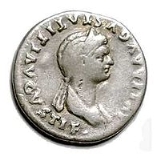
Julia Flavia

Encyclopedia

Titus
Titus , was Roman Emperor from 79 to 81. A member of the Flavian dynasty, Titus succeeded his father Vespasian upon his death, thus becoming the first Roman Emperor to come to the throne after his own father....
from his second marriage to the well-connected Marcia Furnilla
Marcia Furnilla
Marcia Furnilla was a Roman noble woman that lived in the 1st century. Furnilla was the second and last wife of the future Roman Emperor Titus.-Family:...
. Her parents divorced when Julia was an infant, due to her mother's family being connected to the opponents of Roman Emperor
Roman Emperor
The Roman emperor was the ruler of the Roman State during the imperial period . The Romans had no single term for the office although at any given time, a given title was associated with the emperor...
Nero
Nero
Nero , was Roman Emperor from 54 to 68, and the last in the Julio-Claudian dynasty. Nero was adopted by his great-uncle Claudius to become his heir and successor, and succeeded to the throne in 54 following Claudius' death....
. In 65, after the failure of the Pisonian conspiracy
Pisonian conspiracy
The conspiracy of Gaius Calpurnius Piso in AD 65 represented one of the major turning points in the reign of the Roman emperor Nero...
, the family of Marcia Furnilla was disfavored by Nero. Julia's father, Titus considered that he didn't want to be connected with any potential plotters and ended his marriage to Marcia Furnilla. Julia was raised by her father. Julia had been born in Rome
Rome
Rome is the capital of Italy and the country's largest and most populated city and comune, with over 2.7 million residents in . The city is located in the central-western portion of the Italian Peninsula, on the Tiber River within the Lazio region of Italy.Rome's history spans two and a half...
and Titus conquered Jerusalem
Siege of Jerusalem (70)
The Siege of Jerusalem in the year 70 AD was the decisive event of the First Jewish-Roman War. The Roman army, led by the future Emperor Titus, with Tiberius Julius Alexander as his second-in-command, besieged and conquered the city of Jerusalem, which had been occupied by its Jewish defenders in...
on Julia's sixth birthday.
When growing up, Titus offered her in marriage to his brother Domitian
Domitian
Domitian was Roman Emperor from 81 to 96. Domitian was the third and last emperor of the Flavian dynasty.Domitian's youth and early career were largely spent in the shadow of his brother Titus, who gained military renown during the First Jewish-Roman War...
, but he refused because of his infatuation with Domitia Longina
Domitia Longina
Domitia Longina was an Empress of Rome and wife to the Roman Emperor Domitian. She was the youngest daughter of the general and consul Gnaeus Domitius Corbulo. Domitia divorced her first husband Lucius Aelius Lamia in order to marry Domitian in 71...
. Later she married her second paternal cousin T. Flavius Sabinus
Titus Flavius Sabinus (consul 82)
See also Titus Flavius Sabinus for other men of this name.Titus Flavius Sabinus, son of Titus Flavius Sabinus and brother to Titus Flavius Clemens, was consul of the Roman Empire in 82...
, brother to consul T. Flavius Clemens
Titus Flavius Clemens (consul)
Titus Flavius Clemens was a great-nephew of the Roman Emperor Vespasian. He was the son of Titus Flavius Sabinus , brother to Titus Flavius Sabinus and a second cousin to Roman Emperors to Titus and Domitian.-In classical sources:...
, who married her first cousin Flavia Domitilla
Flavia Domitilla (saint)
Flavia Domitilla was daughter of Domitilla the Younger by an unknown father, perhaps Quintus Petillius Cerialis. She married her cousin, the consul Titus Flavius Clemens.-In Roman literature:...
. By then Domitian had seduced her.
When her father and husband died, in the words of Dio, Domitian:
- "lived with [her] as husband with wife, making little effort at concealment. Then upon the demands of the people he became reconciled with Domitia, but continued his relations with Julia nonetheless."
Juvenal
Juvenal
The Satires are a collection of satirical poems by the Latin author Juvenal written in the late 1st and early 2nd centuries AD.Juvenal is credited with sixteen known poems divided among five books; all are in the Roman genre of satire, which, at its most basic in the time of the author, comprised a...
condemns this liaison as follows:
- "Such a man was that adulterer [i.e. Domitian] who, after lately defiling himself by a union of the tragic style, revived the stern laws that were to be a terror to all men – ay, even to Mars and Venus – just as Julia was relieving her fertile womb and giving birth to abortions that displayed the likeness of her uncle."
Becoming pregnant, Julia died of what was rumored (though unlikely) to be a forced abortion. Julia was deified and her ashes were later mixed and smoked with Domitian's by an old nurse secretly in the Temple of the Flavians.
Ancestry
Further reference
- SuetoniusSuetoniusGaius Suetonius Tranquillus, commonly known as Suetonius , was a Roman historian belonging to the equestrian order in the early Imperial era....
, The Twelve Caesars – Titus & Domitian 17, 22. - Dio CassiusDio CassiusLucius Cassius Dio Cocceianus , known in English as Cassius Dio, Dio Cassius, or Dio was a Roman consul and a noted historian writing in Greek...
, lxvii. 3. - Pliny, Ep. iv. 11. § 6.
- PhilostratusPhilostratusPhilostratus or Lucius Flavius Philostratus , , called "the Athenian", was a Greek sophist of the Roman imperial period. His father was a minor sophist of the same name. He was born probably around 172, and is said by the Suda to have been living in the reign of emperor Philip the Arab . His death...
, Vit. Apoll. Tyan. vii. 3.