

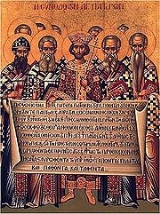
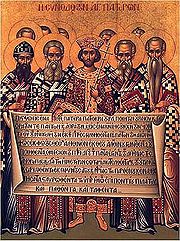
Nicene Creed

Encyclopedia
Creed
A creed is a statement of belief—usually a statement of faith that describes the beliefs shared by a religious community—and is often recited as part of a religious service. When the statement of faith is longer and polemical, as well as didactic, it is not called a creed but a Confession of faith...
or profession of faith
Faith
Faith is confidence or trust in a person or thing, or a belief that is not based on proof. In religion, faith is a belief in a transcendent reality, a religious teacher, a set of teachings or a Supreme Being. Generally speaking, it is offered as a means by which the truth of the proposition,...
(Greek
Greek language
Greek is an independent branch of the Indo-European family of languages. Native to the southern Balkans, it has the longest documented history of any Indo-European language, spanning 34 centuries of written records. Its writing system has been the Greek alphabet for the majority of its history;...
: ) that is most widely used in Christian
Christianity
Christianity is a monotheistic religion based on the life and teachings of Jesus as presented in canonical gospels and other New Testament writings...
liturgy
Liturgy
Liturgy is either the customary public worship done by a specific religious group, according to its particular traditions or a more precise term that distinguishes between those religious groups who believe their ritual requires the "people" to do the "work" of responding to the priest, and those...
. It is called Nicene (icon) because, in its original form, it was adopted in the city of Nicaea
Iznik
İznik is a city in Turkey which is primarily known as the site of the First and Second Councils of Nicaea, the first and seventh Ecumenical councils in the early history of the Church, the Nicene Creed, and as the capital city of the Empire of Nicaea...
by the first ecumenical council
Ecumenical council
An ecumenical council is a conference of ecclesiastical dignitaries and theological experts convened to discuss and settle matters of Church doctrine and practice....
, which met there in the year 325.
The Nicene Creed has been normative to the Anglican Church, the Church of the East
Church of the East
The Church of the East tāʾ d-Maḏnḥāʾ), also known as the Nestorian Church, is a Christian church, part of the Syriac tradition of Eastern Christianity. Originally the church of the Persian Sassanid Empire, it quickly spread widely through Asia...
, the Eastern Orthodox Church
Eastern Orthodox Church
The Orthodox Church, officially called the Orthodox Catholic Church and commonly referred to as the Eastern Orthodox Church, is the second largest Christian denomination in the world, with an estimated 300 million adherents mainly in the countries of Belarus, Bulgaria, Cyprus, Georgia, Greece,...
, the Oriental Orthodox churches
Oriental Orthodoxy
Oriental Orthodoxy is the faith of those Eastern Christian Churches that recognize only three ecumenical councils — the First Council of Nicaea, the First Council of Constantinople and the First Council of Ephesus. They rejected the dogmatic definitions of the Council of Chalcedon...
, the Roman Catholic Church
Roman Catholic Church
The Catholic Church, also known as the Roman Catholic Church, is the world's largest Christian church, with over a billion members. Led by the Pope, it defines its mission as spreading the gospel of Jesus Christ, administering the sacraments and exercising charity...
including the Eastern Catholic Churches, the Old Catholic Church
Old Catholic Church
The term Old Catholic Church is commonly used to describe a number of Ultrajectine Christian churches that originated with groups that split from the Roman Catholic Church over certain doctrines, most importantly that of Papal Infallibility...
, the Lutheran Church and most Protestant
Protestantism
Protestantism is one of the three major groupings within Christianity. It is a movement that began in Germany in the early 16th century as a reaction against medieval Roman Catholic doctrines and practices, especially in regards to salvation, justification, and ecclesiology.The doctrines of the...
denominations. The Apostles' Creed
Apostles' Creed
The Apostles' Creed , sometimes titled Symbol of the Apostles, is an early statement of Christian belief, a creed or "symbol"...
, which in its present form is later, is also broadly accepted in the West
Western Christianity
Western Christianity is a term used to include the Latin Rite of the Catholic Church and groups historically derivative thereof, including the churches of the Anglican and Protestant traditions, which share common attributes that can be traced back to their medieval heritage...
, but is not used in the East
Eastern Christianity
Eastern Christianity comprises the Christian traditions and churches that developed in the Balkans, Eastern Europe, Asia Minor, the Middle East, Northeastern Africa, India and parts of the Far East over several centuries of religious antiquity. The term is generally used in Western Christianity to...
. One or other of these two creeds is recited in the Roman Rite
Roman Rite
The Roman Rite is the liturgical rite used in the Diocese of Rome in the Catholic Church. It is by far the most widespread of the Latin liturgical rites used within the Western or Latin autonomous particular Church, the particular Church that itself is also called the Latin Rite, and that is one of...
Mass
Mass (liturgy)
"Mass" is one of the names by which the sacrament of the Eucharist is called in the Roman Catholic Church: others are "Eucharist", the "Lord's Supper", the "Breaking of Bread", the "Eucharistic assembly ", the "memorial of the Lord's Passion and Resurrection", the "Holy Sacrifice", the "Holy and...
directly after the homily
Homily
A homily is a commentary that follows a reading of scripture. In Catholic, Anglican, Lutheran, and Eastern Orthodox Churches, a homily is usually given during Mass at the end of the Liturgy of the Word...
on all Sundays and Solemnities
Solemnity
A Solemnity of the Roman Catholic Church is a principal holy day in the liturgical calendar, usually commemorating an event in the life of Jesus, his mother Mary, or other important saints. The observance begins with the vigil on the evening before the actual date of the feast...
(Tridentine
Tridentine Mass
The Tridentine Mass is the form of the Roman Rite Mass contained in the typical editions of the Roman Missal that were published from 1570 to 1962. It was the most widely celebrated Mass liturgy in the world until the introduction of the Mass of Paul VI in December 1969...
Feasts of the First Class). In the Byzantine Rite
Byzantine Rite
The Byzantine Rite, sometimes called the Rite of Constantinople or Constantinopolitan Rite is the liturgical rite used currently by all the Eastern Orthodox Churches, by the Greek Catholic Churches , and by the Protestant Ukrainian Lutheran Church...
Liturgy
Divine Liturgy
Divine Liturgy is the common term for the Eucharistic service of the Byzantine tradition of Christian liturgy. As such, it is used in the Eastern Orthodox and Eastern Catholic Churches. Armenian Christians, both of the Armenian Apostolic Church and of the Armenian Catholic Church, use the same term...
, the Nicene Creed is recited on all occasions, following the Litany of Supplication.
For current English translations of the Nicene Creed, see English versions of the Nicene Creed in current use
English versions of the Nicene Creed in current use
The Nicene Creed, composed in part and adopted at the First Council of Nicaea and revised with additions by the First Council of Constantinople , is a creed that summarises the orthodox faith of the Christian Church and is used in the liturgy of most Christian Churches...
.
Nomenclature
There are several designations for the two forms of the Nicene creed, some with overlapping meanings:- Nicene Creed is used to refer to the original version adopted at the First Council of NicaeaFirst Council of NicaeaThe First Council of Nicaea was a council of Christian bishops convened in Nicaea in Bithynia by the Roman Emperor Constantine I in AD 325...
(325), to the revised version adopted by the First Council of ConstantinopleFirst Council of ConstantinopleThe First Council of Constantinople is recognized as the Second Ecumenical Council by the Assyrian Church of the East, the Oriental Orthodox, the Eastern Orthodox, the Roman Catholics, the Old Catholics, and a number of other Western Christian groups. It was the first Ecumenical Council held in...
(381), to the Latin version that includes the phrase "Deum de Deo" and "Filioque", and to the Armenian version, and to the Armenian version, which does not include "and from the Son", but does include "God from God" and many other phrases. - Niceno-Constantinopolitan Creed can stand for the revised version of Constantinople (381) or the later Latin version or various other versions.
- Icon/Symbol of the Faith is the usual designation for the revised version of Constantinople 381 in the Orthodox churches, where this is the only creed used in the liturgy.
- Profession of Faith of the 318 Fathers refers specifically to the version of Nicea 325 (traditionally, 318 bishops took part at the First Council of Nicea).
- Profession of Faith of the 150 Fathers refers specifically to the version of Constantinople 381 (traditionally, 150 bishops took part at the First Council of Constantinople).
In musical settings, particularly when sung in Latin, this Creed is usually referred to by its first word, Credo
Credo
A credo |Latin]] for "I Believe") is a statement of belief, commonly used for religious belief, such as the Apostles' Creed. The term especially refers to the use of the Nicene-Constantinopolitan Creed in the Mass, either as text, Gregorian chant, or other musical settings of the...
.
History
The purpose of a creed is to act as a yardstick of correct beliefOrthodoxy
The word orthodox, from Greek orthos + doxa , is generally used to mean the adherence to accepted norms, more specifically to creeds, especially in religion...
. The creeds of Christianity have been drawn up at times of conflict about doctrine: acceptance or rejection of a creed served to distinguish believers and deniers of a particular doctrine or set of doctrines. For that reason a creed was called in Greek a σύμβολον, a word that meant half of a broken object which, when placed together with the other half, verified the bearer's identity. The Greek word passed through Latin "symbolum" into English "symbol", which only later took on the meaning of an outward sign of something. The Nicene Creed was adopted in the face of the Arian
Arianism
Arianism is the theological teaching attributed to Arius , a Christian presbyter from Alexandria, Egypt, concerning the relationship of the entities of the Trinity and the precise nature of the Son of God as being a subordinate entity to God the Father...
controversy. Arius
Arius
Arius was a Christian presbyter in Alexandria, Egypt of Libyan origins. His teachings about the nature of the Godhead, which emphasized the Father's divinity over the Son , and his opposition to the Athanasian or Trinitarian Christology, made him a controversial figure in the First Council of...
, a Libyan preacher, had declared that although Jesus Christ was divine, God had actually created him, and "there was when he was not," also worded by others of the era "there was once when he was not" and "he was made out of nothing." This made Jesus less than the Father and contradicted the doctrine of the Trinity
Trinity
The Christian doctrine of the Trinity defines God as three divine persons : the Father, the Son , and the Holy Spirit. The three persons are distinct yet coexist in unity, and are co-equal, co-eternal and consubstantial . Put another way, the three persons of the Trinity are of one being...
. Arius's teaching provoked a serious crisis.
The Nicene Creed of 325 explicitly affirms the divinity of Jesus, applying to him the term "God". The 381 version speaks of the Holy Spirit as worshipped and glorified with the Father and the Son. The Athanasian Creed
Athanasian Creed
The Athanasian Creed is a Christian statement of belief, focusing on Trinitarian doctrine and Christology. The Latin name of the creed, Quicumque vult, is taken from the opening words, "Whosoever wishes." The Athanasian Creed has been used by Christian churches since the sixth century...
describes in much greater detail the relationship between Father, Son and Holy Spirit. The Apostles' Creed
Apostles' Creed
The Apostles' Creed , sometimes titled Symbol of the Apostles, is an early statement of Christian belief, a creed or "symbol"...
makes no explicit statements about the divinity of the Son and the Holy Spirit, but, in the view of many who use it, the doctrine is implicit in it.
The original Nicene Creed of 325
The original Nicene Creed was first adopted in 325 at the First Council of NicaeaFirst Council of Nicaea
The First Council of Nicaea was a council of Christian bishops convened in Nicaea in Bithynia by the Roman Emperor Constantine I in AD 325...
. At that time, the text ended after the words "We believe in the Holy Spirit", after which an anathema
Anathema
Anathema originally meant something lifted up as an offering to the gods; it later evolved to mean:...
was added. (For other differences, see Comparison between Creed of 325 and Creed of 381, below.)
The Coptic Church has the tradition that the original creed was authored by Pope Athanasius I of Alexandria. F. J. A. Hort
Fenton John Anthony Hort
Fenton John Anthony Hort was an Irish theologian and editor, with Brooke Westcott of a critical edition of The New Testament in the Original Greek.-Life:...
and Adolf Harnack argued that the Nicene creed was the local creed of Caesarea (an important center of Early Christianity) brought to the council by Eusebius of Caesarea
Eusebius of Caesarea
Eusebius of Caesarea also called Eusebius Pamphili, was a Roman historian, exegete and Christian polemicist. He became the Bishop of Caesarea in Palestine about the year 314. Together with Pamphilus, he was a scholar of the Biblical canon...
. J.N.D. Kelly sees as its basis a baptismal creed of the Syro-Phoenician family, related to (but not dependent on) the creed cited by Cyril of Jerusalem
Cyril of Jerusalem
Cyril of Jerusalem was a distinguished theologian of the early Church . He is venerated as a saint by the Roman Catholic Church, the Eastern Orthodox Church, and the Anglican Communion. In 1883, Cyril was declared a Doctor of the Church by Pope Leo XIII...
and to the creed of Eusebius.
Soon after the Council of Nicaea, new formulae of faith were composed, most of them variations of the Nicene Symbol, to counter new phases of Arianism
Arianism
Arianism is the theological teaching attributed to Arius , a Christian presbyter from Alexandria, Egypt, concerning the relationship of the entities of the Trinity and the precise nature of the Son of God as being a subordinate entity to God the Father...
. The Catholic Encyclopedia identifies at least four before the Council of Sardica (341), where a new form was presented and inserted in the Acts of the Council, though it was not agreed on.
The Niceno–Constantinopolitan Creed of 381
It is traditionally believed that the second Ecumenical Council held in Constantinople in 381 added the section that follows the words "We believe in the Holy Spirit" (without the words "and the Son" relative to the procession of the Spirit); hence the name "Niceno-Constantinopolitan Creed", referring to the Creed as modified in the First Council of Constantinople. This is the received text of the Eastern Orthodox ChurchEastern Orthodox Church
The Orthodox Church, officially called the Orthodox Catholic Church and commonly referred to as the Eastern Orthodox Church, is the second largest Christian denomination in the world, with an estimated 300 million adherents mainly in the countries of Belarus, Bulgaria, Cyprus, Georgia, Greece,...
, with the exception that in its liturgy it changes verbs from the plural by which the Fathers of the Council collectively professed their faith to the singular of the individual Christian's profession of faith. Byzantine Rite
Byzantine Rite
The Byzantine Rite, sometimes called the Rite of Constantinople or Constantinopolitan Rite is the liturgical rite used currently by all the Eastern Orthodox Churches, by the Greek Catholic Churches , and by the Protestant Ukrainian Lutheran Church...
Eastern Catholic Churches use exactly the same form of the Creed, since the Catholic Church teaches that it is wrong to add "and the Son" to the Greek
Greek language
Greek is an independent branch of the Indo-European family of languages. Native to the southern Balkans, it has the longest documented history of any Indo-European language, spanning 34 centuries of written records. Its writing system has been the Greek alphabet for the majority of its history;...
verb "ἐκπορευόμενον", but correct to add it to the Latin
Latin
Latin is an Italic language originally spoken in Latium and Ancient Rome. It, along with most European languages, is a descendant of the ancient Proto-Indo-European language. Although it is considered a dead language, a number of scholars and members of the Christian clergy speak it fluently, and...
"qui procedit", which does not have precisely the same meaning.
Doubt has been cast on this explanation of the origin of the familiar Niceno-Constantinopolitan Creed, commonly called the Nicene Creed. On the basis of evidence both internal and external to the text, it has been argued that this creed originated not as an editing by the First Council of Constantinople of the original Nicene Creed, but as an independent creed (probably an older baptismal creed) modified to make it more like the Nicene Creed of 325 and attributed to the Council of 381 only later.
The third Ecumenical Council (Council of Ephesus of 431) reaffirmed the original 325 version of the Nicene Creed and declared that "it is unlawful for any man to bring forward, or to write, or to compose a different ( – more accurately translated as used by the Council to mean “different,” “contradictory,” and not “another”) Faith as a rival to that established by the holy Fathers assembled with the Holy Ghost in Nicæa" (i.e. the 325 creed) This statement has been interpreted as a prohibition against changing this creed or composing others, but not all accept this interpretation. This question is connected with the controversy whether a creed
Creed
A creed is a statement of belief—usually a statement of faith that describes the beliefs shared by a religious community—and is often recited as part of a religious service. When the statement of faith is longer and polemical, as well as didactic, it is not called a creed but a Confession of faith...
proclaimed by an Ecumenical Council
Ecumenical council
An ecumenical council is a conference of ecclesiastical dignitaries and theological experts convened to discuss and settle matters of Church doctrine and practice....
is definitive or whether additions can be made to it.
Comparison between Creed of 325 and Creed of 381
The following table juxtaposes the earlier (325 AD) and later (381 AD) forms of this Creed in the English translation given in Schaff'sPhilip Schaff
Philip Schaff , was a Swiss-born, German-educated Protestant theologian and a historian of the Christian church, who, after his education, lived and taught in the United States.-Biography:...
work, Creeds of Christendom, which indicates by [square brackets] the portions of the 325 text that were omitted or moved in 381, and uses italics to indicate what phrases, absent in the 325 text, were added in 381.
| First Council of Nicea (325) | First Council of Constantinople (381) |
|---|---|
| We believe in one God God in Christianity In Christianity, God is the eternal being that created and preserves the universe. God is believed by most Christians to be immanent , while others believe the plan of redemption show he will be immanent later... , the Father Almighty, Maker of all things visible and invisible. |
We believe in one God, the Father Almighty, Maker of heaven Heaven (Christianity) Traditionally, Christianity has taught Heaven as a place of eternal life and the dwelling place of Angels and the Throne of God, and a kingdom to which all the elect will be admitted... and earth, and of all things visible and invisible. |
| And in one Lord Jesus Christ, the Son of God, begotten of the Father [the only-begotten; that is, of the essence of the Father, God of God], Light of Light, very God of very God, begotten, not made, being of one substance with the Father; | And in one Lord Jesus Christ, the only-begotten Son of God, begotten of the Father before all worlds (æons), Light of Light, very God of very God, begotten, not made, being of one substance with the Father; |
| By whom all things were made [both in heaven and on earth]; | by whom all things were made; |
| Who for us men, and for our salvation, came down and was incarnate and was made man; | who for us men, and for our salvation, came down from heaven, and was incarnate by the Holy Ghost of the Virgin Mary, and was made man; |
| He suffered, and the third day he rose again, ascended into heaven; | he was crucified for us under Pontius Pilate, and suffered, and was buried, and the third day he rose again, according to the Scriptures, and ascended into heaven, and sitteth on the right hand of the Father; |
| From thence he shall come to judge the quick and the dead. | from thence he shall come again, with glory, to judge the quick and the dead; |
| whose kingdom shall have no end. | |
| And in the Holy Ghost. | And in the Holy Ghost, the Lord and Giver of life, who proceedeth from the Father, who with the Father and the Son together is worshiped and glorified, who spake by the prophets. |
| In one holy catholic and apostolic Church Four Marks of the Church The Four Marks of the Church is a term describing four specific adjectives—one, holy, catholic and apostolic—indicating four major distinctive marks or distinguishing characteristics of the Christian Church... ; we acknowledge one baptism for the remission of sins; we look for the resurrection of the dead Resurrection of the dead Resurrection of the Dead is a belief found in a number of eschatologies, most commonly in Christian, Islamic, Jewish and Zoroastrian. In general, the phrase refers to a specific event in the future; multiple prophesies in the histories of these religions assert that the dead will be brought back to... , and the life of the world to come World to Come The World to Come is an eschatological phrase reflecting the belief that the "current world" is flawed or cursed and will be replaced in the future by a better world or a paradise. The concept is similar to the concepts of Heaven and the afterlife, but Heaven is another place generally seen as... . Amen. |
|
| [But those who say: 'There was a time when he was not;' and 'He was not before he was made;' and 'He was made out of nothing,' or 'He is of another substance' or 'essence,' or 'The Son of God is created,' or 'changeable,' or 'alterable'—they are condemned by the holy catholic and apostolic Church.] |
Filioque controversy
In the late sixth century, the Latin-speaking churches of Western Europe added the words "and the Son" (Filioque) to the description of the procession of the Holy Spirit, in what Easterners have argued is a violation of Canon VII of the Third Ecumenical Council, since the words were not included in the text by either the Council of Nicaea or that of Constantinople.The Vatican
Pontifical Council for Promoting Christian Unity
The Pontifical Council for Promoting Christian Unity origins are associated with the Second Vatican Council which met intermittently from 1962–1965.Pope John XXIII wanted the Catholic Church to engage in the contemporary ecumenical movement...
has recently argued that, while these words would indeed be heretical
Christian heresy
Christian heresy refers to non-orthodox practices and beliefs that were deemed to be heretical by one or more of the Christian churches. In Western Christianity, the term "heresy" most commonly refers to those beliefs which were declared to be anathema by the Catholic Church prior to the schism of...
if associated with the Greek verb ἐκπορεύεσθαι of the text adopted by the Council of Constantinople, they are not heretical when associated with the Latin verb procedere, which corresponds instead to the Greek verb προϊέναι, with which some of the Greek Fathers also associated the same words. Latin has no word with the same overtones as ἐκπορεύεσθαι (ἐκπορευόμενον, in the original Greek text of the Creed, is the present participle of this verb), and in its translation can only use the verb procedere, which is broader in meaning.
Views on the importance of this creed
The view that the Nicene Creed can serve as a touchstone of true Christian faith is reflected in the name "symbol of faith", which was given to it in Greek and Latin, when in those languages the word "symbol" meant a "token for identification (by comparison with a counterpart)", and which continues in use even in languages in which "symbol" no longer has that meaning.In the Roman Rite
Roman Rite
The Roman Rite is the liturgical rite used in the Diocese of Rome in the Catholic Church. It is by far the most widespread of the Latin liturgical rites used within the Western or Latin autonomous particular Church, the particular Church that itself is also called the Latin Rite, and that is one of...
Mass
Mass (liturgy)
"Mass" is one of the names by which the sacrament of the Eucharist is called in the Roman Catholic Church: others are "Eucharist", the "Lord's Supper", the "Breaking of Bread", the "Eucharistic assembly ", the "memorial of the Lord's Passion and Resurrection", the "Holy Sacrifice", the "Holy and...
, the Latin text of the Niceno-Constantinopolitan Creed, with "Deum de Deo" (God from God) and "Filioque" (and from the Son), phrases absent in the original text, was previously the only form used for the "profession of faith". The Roman Missal
Roman Missal
The Roman Missal is the liturgical book that contains the texts and rubrics for the celebration of the Mass in the Roman Rite of the Catholic Church.-Situation before the Council of Trent:...
now refers to it jointly with the Apostles' Creed
Apostles' Creed
The Apostles' Creed , sometimes titled Symbol of the Apostles, is an early statement of Christian belief, a creed or "symbol"...
as "the Symbol or Profession of Faith or Creed", describing the second as "the baptismal Symbol of the Roman Church, known as the Apostles' Creed". Use of the 1962 edition of the Roman Missal
Roman Missal
The Roman Missal is the liturgical book that contains the texts and rubrics for the celebration of the Mass in the Roman Rite of the Catholic Church.-Situation before the Council of Trent:...
, which contains only the Latin text of the Niceno-Constantinopolitan Creed, is still permitted, with certain limitations on its public use. The liturgies of the ancient Churches of Eastern Christianity
Eastern Christianity
Eastern Christianity comprises the Christian traditions and churches that developed in the Balkans, Eastern Europe, Asia Minor, the Middle East, Northeastern Africa, India and parts of the Far East over several centuries of religious antiquity. The term is generally used in Western Christianity to...
(Eastern Orthodox Church
Eastern Orthodox Church
The Orthodox Church, officially called the Orthodox Catholic Church and commonly referred to as the Eastern Orthodox Church, is the second largest Christian denomination in the world, with an estimated 300 million adherents mainly in the countries of Belarus, Bulgaria, Cyprus, Georgia, Greece,...
, Oriental Orthodoxy
Oriental Orthodoxy
Oriental Orthodoxy is the faith of those Eastern Christian Churches that recognize only three ecumenical councils — the First Council of Nicaea, the First Council of Constantinople and the First Council of Ephesus. They rejected the dogmatic definitions of the Council of Chalcedon...
, Assyrian Church of the East
Assyrian Church of the East
The Assyrian Church of the East, officially the Holy Apostolic Catholic Assyrian Church of the East ʻIttā Qaddishtā w-Shlikhāitā Qattoliqi d-Madnĕkhā d-Āturāyē), is a Syriac Church historically centered in Mesopotamia. It is one of the churches that claim continuity with the historical...
) and the Eastern Catholic Churches), use the Niceno-Constantinopolitan Creed, never the Western Apostles' Creed.
In the Byzantine Rite
Byzantine Rite
The Byzantine Rite, sometimes called the Rite of Constantinople or Constantinopolitan Rite is the liturgical rite used currently by all the Eastern Orthodox Churches, by the Greek Catholic Churches , and by the Protestant Ukrainian Lutheran Church...
Mass
Mass (liturgy)
"Mass" is one of the names by which the sacrament of the Eucharist is called in the Roman Catholic Church: others are "Eucharist", the "Lord's Supper", the "Breaking of Bread", the "Eucharistic assembly ", the "memorial of the Lord's Passion and Resurrection", the "Holy Sacrifice", the "Holy and...
, the Creed is typically recited by the cantor, who in this capacity represents the whole congregation. Many, and sometimes all, members of the congregation join the cantor in rhythmic recitation. It is customary to invite, as a token of honor, any prominent lay member of the congregation who happens to be present (e.g. royalty, a visiting dignitary, the Mayor
Mayor
In many countries, a Mayor is the highest ranking officer in the municipal government of a town or a large urban city....
, etc.) to recite the Creed instead of the cantor. This practice stems from the tradition that the prerogative to recite the Creed belonged to the Emperor, speaking for all his people.
Some evangelical and other Christians consider the Nicene Creed helpful and to a certain extent authoritative, but not infallibly so in view of their belief that only Scripture is truly authoritative
Sola scriptura
Sola scriptura is the doctrine that the Bible contains all knowledge necessary for salvation and holiness. Consequently, sola scriptura demands that only those doctrines are to be admitted or confessed that are found directly within or indirectly by using valid logical deduction or valid...
. Other groups, such as the Church of the New Jerusalem, The Church of Jesus Christ of Latter-day Saints, and the Jehovah's Witnesses
Jehovah's Witnesses
Jehovah's Witnesses is a millenarian restorationist Christian denomination with nontrinitarian beliefs distinct from mainstream Christianity. The religion reports worldwide membership of over 7 million adherents involved in evangelism, convention attendance of over 12 million, and annual...
explicitly reject some of the statements in the Creed.
Ancient liturgical versions
This section is not intended to be a collection of the texts of all liturgical versions of the Nicene Creed, and provides only three, the Greek, the Latin, and the Armenian, which are of special interest. Others are mentioned separately, but without the texts. All ancient liturgical versions, even the Greek, differ at least to some small extent from the text adopted by the First Councils of Nicaea and Constantinople. The Creed was originally written in GreekGreek language
Greek is an independent branch of the Indo-European family of languages. Native to the southern Balkans, it has the longest documented history of any Indo-European language, spanning 34 centuries of written records. Its writing system has been the Greek alphabet for the majority of its history;...
, owing to the location of the two councils. But though the councils' texts have "Πιστεύομεν ... ὁμολογοῦμεν ... προσδοκοῦμεν" (we believe ... confess ... await), the Creed that the Churches of Byzantine tradition use in their liturgy has "Πιστεύω ... ὁμολογῶ ... προσδοκῶ" (I believe ... confess ... await), accentuating the personal nature of recitation of the Creed. The Latin text, as well as using the singular, has two additions: "Deum de Deo" (God from God) and "Filioque" (and from the Son). The Armenian text has many more additions, and is included as showing how that ancient church
Armenian Apostolic Church
The Armenian Apostolic Church is the world's oldest National Church, is part of Oriental Orthodoxy, and is one of the most ancient Christian communities. Armenia was the first country to adopt Christianity as its official religion in 301 AD, in establishing this church...
has chosen to recite the Creed with these numerous elaborations of its contents. An English translation of the Armenian text is added; English translations of the Greek and Latin liturgical texts are given at English versions of the Nicene Creed in current use
English versions of the Nicene Creed in current use
The Nicene Creed, composed in part and adopted at the First Council of Nicaea and revised with additions by the First Council of Constantinople , is a creed that summarises the orthodox faith of the Christian Church and is used in the liturgy of most Christian Churches...
.
Greek liturgical text
Latin liturgical version
- Credo in unum Deum,
- Patrem omnipoténtem,
- Factórem cæli et terræ,
- Visibílium ómnium et invisibílium.
- Et in unum Dóminum Iesum Christum,
- Fílium Dei Unigénitum,
- Et ex Patre natum ante ómnia sæcula.
- Deum de Deo, lumen de lúmine, Deum verum de Deo vero,
- Génitum, non factum, consubstantiálem Patri:
- Per quem ómnia facta sunt.
- Qui propter nos hómines et propter nostram salútem
- Descéndit de cælis.
- Et incarnátus est de Spíritu Sancto
- Ex María Vírgine, et homo factus est.
- Crucifíxus étiam pro nobis sub Póntio Piláto;
- Passus, et sepúltus est,
- Et resurréxit tértia die, secúndum Scriptúras,
- Et ascéndit in cælum, sedet ad déxteram Patris.
- Et íterum ventúrus est cum glória,
- Iudicáre vivos et mórtuos,
- Cuius regni non erit finis.
- Et in Spíritum Sanctum, Dóminum et vivificántem:
- Qui ex Patre Filióque procédit.
- Qui cum Patre et Fílio simul adorátur et conglorificátur:
- Qui locútus est per prophétas.
- Et unam, sanctam, cathólicam et apostólicam Ecclésiam.
- Confíteor unum baptísma in remissiónem peccatorum.
- Et expecto resurrectionem mortuorum,
- Et vitam ventúri sæculi. Amen.
The Latin text adds "Deum de Deo" and "Filioque" to the Greek. On the latter see The Filioque Controversy above. Inevitably also, the overtones of the terms used, such as "" (pantokratora) and "omnipotentem" differ ("pantokratora" meaning Ruler of all; "omnipotentem" meaning omnipotent, Almighty). The implications of this for the interpretation of "" and "qui ... procedit" was the object of the study The Greek and the Latin Traditions regarding the Procession of the Holy Spirit published by the Pontifical Council for Promoting Christian Unity
Pontifical Council for Promoting Christian Unity
The Pontifical Council for Promoting Christian Unity origins are associated with the Second Vatican Council which met intermittently from 1962–1965.Pope John XXIII wanted the Catholic Church to engage in the contemporary ecumenical movement...
in 1996. Again, the terms "" and "consubstantialem", translated as "of one being" or "consubstantial", have different overtones, being based respectively on Greek (stable being, immutable reality, substance, essence, true nature),http://www.perseus.tufts.edu/cgi-bin/ptext?doc=Perseus%3Atext%3A1999.04.0057%3Aentry%3D%2376030 and Latin substantia (that of which a thing consists, the being, essence, contents, material, substance).
"Credo", which in classical Latin is used with the accusative case of the thing held to be true (and with the dative of the person to whom credence is given), is here used three times with the preposition "in", a literal translation of the Greek "" (in unum Deum ..., in unum Dominum ..., in Spiritum Sanctum ...), and once in the classical preposition-less construction (unam, sanctam, catholicam et apostolicam Ecclesiam).
Armenian Liturgical Text
Հավատում ենք մեկ Աստծո` ամենակալ Հորը, երկնքի և երկրի, երևելիների և աներևույթների Արարչին: Եւ մեկ Տիրոջ` Հիսուս Քրիստոսին, Աստծո Որդուն, ծնված Հայր Աստծուց Միածին, այսինքն` Հոր էությունից: Աստված` Աստծուց, լույս` լույսից, ճշմարիտ Աստված` ճշմարիտ Աստծուց, ծնունդ և ոչ թե` արարած: Նույն ինքը` Հոր բնությունից, որի միջոցով ստեղծվեց ամեն ինչ երկնքում և երկրի վրա` երևելիներն ու անևերույթները: Որ հանուն մեզ` մարդկանց ու մեր փրկության համար` իջավ երկնքից, մարմնացավ, մարդացավ, ծնվեց կատարելապես Ս. Կույս Մարիամից Ս. Հոգով: Որով` ճշմարտապես, և ոչ կարծեցյալ կերպով առավ մարմին, հոգի և միտք և այն ամենը, որ կա մարդու մեջ: Չարչարվեց, խաչվեց, թաղվեց, երրորդ օրը Հարություն առավ, նույն մարմնով բարձրացավ երկինք, նստեց Հոր աջ կողմում: Գալու է նույն մարմնով և Հոր փառքով` դատելու ողջերին և մահացածներին: Նրա թագավորությունը չունի վախճան: Հավատում ենք նաև Սուրբ Հոգուն` անեղ և կատարյալ, որը խոսեց Օրենքի, մարգարեների և ավետարանների միջոցով: Որն իջավ Հորդանանի վրա, քարոզեց առաքյալների միջոցով և բնակություն հաստատեց սրբերի մեջ: Հավատում ենք նաև մեկ, ընդհանրական և առաքելական եկեղեցու, մի մկրտության, ապաշխարության, մեղքերի քավության և թողության: Մեռելների հարության, հոգիների և մարմինների հավիտենական դատաստանի, երկնքի արքայության և հավիտենական կյանքի:English translation of the Armenian version
- We believe in one God, the Father Almighty, the maker of heaven and earth, of things visible and invisible.
- And in one Lord Jesus Christ, the Son of God, the begotten of God the Father, the Only-begotten, that is of the essence of the Father.
- God of God, Light of Light, true God of true God, begotten and not made; of the very same nature of the Father, by Whom all things came into being, in heaven and on earth, visible and invisible.
- Who for us humanity and for our salvation came down from heaven, was incarnate, was made human, was born perfectly of the holy virgin Mary by the Holy Spirit.
- By whom He took body, soul, and mind, and everything that is in man, truly and not in semblance.
- He suffered, was crucified, was buried, rose again on the third day, ascended into heaven with the same body, [and] sat at the right hand of the Father.
- He is to come with the same body and with the glory of the Father, to judge the living and the dead; of His kingdom there is no end.
- We believe in the Holy Spirit, in the uncreated and the perfect; Who spoke through the Law, prophets, and Gospels; Who came down upon the Jordan, preached through the apostles, and lived in the saints.
- We believe also in only One, Universal, Apostolic, and [Holy] Church; in one baptism in repentance, for the remission, and forgiveness of sins; and in the resurrection of the dead, in the everlasting judgement of souls and bodies, and the Kingdom of Heaven and in the everlasting life.
Other ancient liturgical versions
The version in the Church Slavonic language, used by several of the Eastern Orthodox ChurchEastern Orthodox Church
The Orthodox Church, officially called the Orthodox Catholic Church and commonly referred to as the Eastern Orthodox Church, is the second largest Christian denomination in the world, with an estimated 300 million adherents mainly in the countries of Belarus, Bulgaria, Cyprus, Georgia, Greece,...
es and of the Byzantine Rite
Byzantine Rite
The Byzantine Rite, sometimes called the Rite of Constantinople or Constantinopolitan Rite is the liturgical rite used currently by all the Eastern Orthodox Churches, by the Greek Catholic Churches , and by the Protestant Ukrainian Lutheran Church...
Eastern Catholic Churches, is practically identical with the Greek liturgical version. The same can be said of the versions used by the Coptic Orthodox Church of Alexandria and the Ethiopian Orthodox Tewahedo Church
Ethiopian Orthodox Tewahedo Church
The Ethiopian Orthodox Tewahedo Church is the predominant Oriental Orthodox Christian church in Ethiopia. The Ethiopian Church was administratively part of the Coptic Orthodox Church until 1959, when it was granted its own Patriarch by Coptic Orthodox Pope of Alexandria and Patriarch of All...
, both of which, like the Armenian Apostolic Church
Armenian Apostolic Church
The Armenian Apostolic Church is the world's oldest National Church, is part of Oriental Orthodoxy, and is one of the most ancient Christian communities. Armenia was the first country to adopt Christianity as its official religion in 301 AD, in establishing this church...
, are part of Oriental Orthodoxy
Oriental Orthodoxy
Oriental Orthodoxy is the faith of those Eastern Christian Churches that recognize only three ecumenical councils — the First Council of Nicaea, the First Council of Constantinople and the First Council of Ephesus. They rejected the dogmatic definitions of the Council of Chalcedon...
, and the Assyrian Church of the East
Assyrian Church of the East
The Assyrian Church of the East, officially the Holy Apostolic Catholic Assyrian Church of the East ʻIttā Qaddishtā w-Shlikhāitā Qattoliqi d-Madnĕkhā d-Āturāyē), is a Syriac Church historically centered in Mesopotamia. It is one of the churches that claim continuity with the historical...
, except that some of them are reported to use the plural ("We believe"), as in the original text in Greek, and not the singular ("I believe"), as in the Greek liturgical text.
English translations
For English translations of the Nicene Creed, which of necessity are not as ancient as the above-mentioned versions, see English versions of the Nicene Creed in current useEnglish versions of the Nicene Creed in current use
The Nicene Creed, composed in part and adopted at the First Council of Nicaea and revised with additions by the First Council of Constantinople , is a creed that summarises the orthodox faith of the Christian Church and is used in the liturgy of most Christian Churches...
.
See also
- Apostles' CreedApostles' CreedThe Apostles' Creed , sometimes titled Symbol of the Apostles, is an early statement of Christian belief, a creed or "symbol"...
- Athanasian CreedAthanasian CreedThe Athanasian Creed is a Christian statement of belief, focusing on Trinitarian doctrine and Christology. The Latin name of the creed, Quicumque vult, is taken from the opening words, "Whosoever wishes." The Athanasian Creed has been used by Christian churches since the sixth century...
- English versions of the Nicene Creed in current useEnglish versions of the Nicene Creed in current useThe Nicene Creed, composed in part and adopted at the First Council of Nicaea and revised with additions by the First Council of Constantinople , is a creed that summarises the orthodox faith of the Christian Church and is used in the liturgy of most Christian Churches...
- One Holy Catholic and Apostolic Church
- HomoousianHomoousianHomoousian is a technical theological term used in discussion of the Christian understanding of God as Trinity. The Nicene Creed describes Jesus as being homooúsios with God the Father — that is, they are of the "same substance" and are equally God...
- First seven Ecumenical CouncilsFirst seven Ecumenical CouncilsIn the history of Christianity, the first seven Ecumenical Councils, from the First Council of Nicaea to the Second Council of Nicaea , represent an attempt to reach an orthodox consensus and to establish a unified Christendom as the State church of the Roman Empire...
External links
- Extensive discussion of the texts of the First Council of Nicea
- Philip Schaff, Creeds of Christendom Volume I: Nicene Creed
- Athanasius, De Decretis or Defence of the Nicene Definition
- Line-by-Line Roman Catholic Explanation of the Nicene Creed
- Nicene Creed in languages of the world
- Essays on the Nicene Creed from the Wisconsin Lutheran Seminary Library
- Modern English translations of the documents produced at Nicaea