

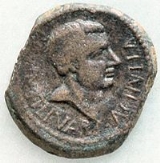
Publius Quinctilius Varus

Encyclopedia
Cremona
Cremona is a city and comune in northern Italy, situated in Lombardy, on the left bank of the Po River in the middle of the Pianura Padana . It is the capital of the province of Cremona and the seat of the local City and Province governments...
, Roman Republic – AD 9
9
Year 9 was a common year starting on Tuesday of the Julian calendar. At the time, it was known as the Year of the Consulship of Sabinus and Camerinus...
in Germania) was a Roman
Ancient Rome
Ancient Rome was a thriving civilization that grew on the Italian Peninsula as early as the 8th century BC. Located along the Mediterranean Sea and centered on the city of Rome, it expanded to one of the largest empires in the ancient world....
politician and general under Emperor Augustus
Augustus
Augustus ;23 September 63 BC – 19 August AD 14) is considered the first emperor of the Roman Empire, which he ruled alone from 27 BC until his death in 14 AD.The dates of his rule are contemporary dates; Augustus lived under two calendars, the Roman Republican until 45 BC, and the Julian...
, mainly remembered for having lost three Roman legion
Roman legion
A Roman legion normally indicates the basic ancient Roman army unit recruited specifically from Roman citizens. The organization of legions varied greatly over time but they were typically composed of perhaps 5,000 soldiers, divided into maniples and later into "cohorts"...
s and his own life when attacked by Germanic leader Arminius
Arminius
Arminius , also known as Armin or Hermann was a chieftain of the Germanic Cherusci who defeated a Roman army in the Battle of the Teutoburg Forest...
in the Battle of the Teutoburg Forest
Battle of the Teutoburg Forest
The Battle of the Teutoburg Forest took place in 9 CE, when an alliance of Germanic tribes led by Arminius of the Cherusci ambushed and decisively destroyed three Roman legions, along with their auxiliaries, led by Publius Quinctilius Varus.Despite numerous successful campaigns and raids by the...
.
Life
His paternal grandfather was senator Sextus Quinctilius Varus. Varus was a patrician, born to an aristocratic but long-impoverished and unimportant family in the Quinctilia gensGens
In ancient Rome, a gens , plural gentes, referred to a family, consisting of all those individuals who shared the same nomen and claimed descent from a common ancestor. A branch of a gens was called a stirps . The gens was an important social structure at Rome and throughout Italy during the...
. His mother was a daughter from consul Gaius Claudius Marcellus Minor
Gaius Claudius Marcellus Minor
:See Gaius Claudius Marcellus for other men of this name, or Gaius Claudius Marcellus Maior for his cousin, consul of 49 BC.Gaius Claudius Marcellus Minor was a Roman senator and consul. He was a member of the distinguished Claudius family...
's first marriage. His father was Sextus Quinctilius Varus, a senator aligned with the conservative republicans in the civil war
Caesar's civil war
The Great Roman Civil War , also known as Caesar's Civil War, was one of the last politico-military conflicts in the Roman Republic before the establishment of the Roman Empire...
against Julius Caesar
Julius Caesar
Gaius Julius Caesar was a Roman general and statesman and a distinguished writer of Latin prose. He played a critical role in the gradual transformation of the Roman Republic into the Roman Empire....
. Sextus survived their defeat, but it is unknown whether he was involved in Caesar's assassination. He committed suicide after the Battle of Philippi
Battle of Philippi
The Battle of Philippi was the final battle in the Wars of the Second Triumvirate between the forces of Mark Antony and Octavian and the forces of Julius Caesar's assassins Marcus Junius Brutus and Gaius Cassius Longinus in 42 BC, at Philippi in Macedonia...
(42 BC).
Despite his father's political allegiances, Varus became a supporter of Caesar's heir, Octavian, later known as Augustus
Augustus
Augustus ;23 September 63 BC – 19 August AD 14) is considered the first emperor of the Roman Empire, which he ruled alone from 27 BC until his death in 14 AD.The dates of his rule are contemporary dates; Augustus lived under two calendars, the Roman Republican until 45 BC, and the Julian...
. About 14 BC he married Vipsania Marcella
Vipsania Marcella
Vipsania Marcella Agrippina or Marcellina was the only daughter to Roman statesman Marcus Vipsanius Agrippa from his second wife Claudia Marcella Major. She was the first grandchild to Octavia Minor and first great-niece to Roman Emperor Augustus.About 14 BC, she married the Roman general and...
, the daughter of Marcus Vipsanius Agrippa
Marcus Vipsanius Agrippa
Marcus Vipsanius Agrippa was a Roman statesman and general. He was a close friend, son-in-law, lieutenant and defense minister to Octavian, the future Emperor Caesar Augustus...
and Claudia Marcella
Claudia Marcella
Claudia Marcella was the name of the two daughters of Octavia Minor, the sister of Emperor Augustus, by her first husband, the consul Gaius Claudius Marcellus Minor. According to Suetonius, they were known as The Marcellae sisters. The sisters were born in Rome...
Major and became a personal friend of both Agrippa and Augustus. Vipsania Marcella was a grandniece of Augustus
Augustus
Augustus ;23 September 63 BC – 19 August AD 14) is considered the first emperor of the Roman Empire, which he ruled alone from 27 BC until his death in 14 AD.The dates of his rule are contemporary dates; Augustus lived under two calendars, the Roman Republican until 45 BC, and the Julian...
. When Agrippa died, it was Varus who delivered the funeral eulogy. Thus, his political career was boosted and his cursus honorum
Cursus honorum
The cursus honorum was the sequential order of public offices held by aspiring politicians in both the Roman Republic and the early Empire. It was designed for men of senatorial rank. The cursus honorum comprised a mixture of military and political administration posts. Each office had a minimum...
finished as early as 13 BC, when he was elected consul
Consul
Consul was the highest elected office of the Roman Republic and an appointive office under the Empire. The title was also used in other city states and also revived in modern states, notably in the First French Republic...
junior partner of Tiberius
Tiberius
Tiberius , was Roman Emperor from 14 AD to 37 AD. Tiberius was by birth a Claudian, son of Tiberius Claudius Nero and Livia Drusilla. His mother divorced Nero and married Augustus in 39 BC, making him a step-son of Octavian...
, Augustus' stepson and future emperor.
Political career
Between 9 and 8 BC, following the consulship, Varus was governor of the province of Africa. After this, he went to govern SyriaSyria
Syria , officially the Syrian Arab Republic , is a country in Western Asia, bordering Lebanon and the Mediterranean Sea to the West, Turkey to the north, Iraq to the east, Jordan to the south, and Israel to the southwest....
, with four legions under his command. When he was governing Syria, he was known for his harsh rule and high taxes. The Jewish historian Josephus
Josephus
Titus Flavius Josephus , also called Joseph ben Matityahu , was a 1st-century Romano-Jewish historian and hagiographer of priestly and royal ancestry who recorded Jewish history, with special emphasis on the 1st century AD and the First Jewish–Roman War, which resulted in the Destruction of...
mentions the swift action of Varus against a messianic
Messiah
A messiah is a redeemer figure expected or foretold in one form or another by a religion. Slightly more widely, a messiah is any redeemer figure. Messianic beliefs or theories generally relate to eschatological improvement of the state of humanity or the world, in other words the World to...
revolt in Judaea
Judea
Judea or Judæa was the name of the mountainous southern part of the historic Land of Israel from the 8th century BCE to the 2nd century CE, when Roman Judea was renamed Syria Palaestina following the Jewish Bar Kokhba revolt.-Etymology:The...
after the death of Rome's client king Herod the Great
Herod the Great
Herod , also known as Herod the Great , was a Roman client king of Judea. His epithet of "the Great" is widely disputed as he is described as "a madman who murdered his own family and a great many rabbis." He is also known for his colossal building projects in Jerusalem and elsewhere, including his...
in 4 BC. After occupying Jerusalem, he crucified 2000 Jewish rebels, and may have thus been one of the prime objects of popular anti-Roman sentiment in Judaea, for Josephus, who made every effort to reconcile the Jewish people to Roman rule, felt it necessary to point out how lenient this judicial massacre had been. Indeed, at precisely this moment, the Jews, nearly en masse, began a full-scale boycott of Roman pottery (Red Slip Ware). Thus, the archaeological record seems to verify mass popular protest against Rome because of Varus' cruelty.
Following the governorship of Syria, Varus returned to Rome and remained there for the next few years. Following his first wife's death, he married Claudia Pulchra
Claudia Pulchra
Claudia Pulchra was the name of several women of Roman gens of Claudii during the 1st century BC and 1st century AD. The Latin pulchra is the root of the English word pulchritude .-Wife of Tiberius Gracchus:...
, daughter of Claudia Marcella
Claudia Marcella
Claudia Marcella was the name of the two daughters of Octavia Minor, the sister of Emperor Augustus, by her first husband, the consul Gaius Claudius Marcellus Minor. According to Suetonius, they were known as The Marcellae sisters. The sisters were born in Rome...
Minor (daughter of consul Gaius Claudius Marcellus Minor
Gaius Claudius Marcellus Minor
:See Gaius Claudius Marcellus for other men of this name, or Gaius Claudius Marcellus Maior for his cousin, consul of 49 BC.Gaius Claudius Marcellus Minor was a Roman senator and consul. He was a member of the distinguished Claudius family...
and Octavia Minor
Octavia Minor
Octavia the Younger , also known as Octavia Minor or simply Octavia, was the sister of the first Roman Emperor, Augustus , half-sister of Octavia the Elder, and fourth wife of Mark Antony...
, elder sister of Augustus
Augustus
Augustus ;23 September 63 BC – 19 August AD 14) is considered the first emperor of the Roman Empire, which he ruled alone from 27 BC until his death in 14 AD.The dates of his rule are contemporary dates; Augustus lived under two calendars, the Roman Republican until 45 BC, and the Julian...
) and consul Aemilius Lepidus Paullus
Aemilius Lepidus Paullus
Lucius Aemilius Lepidus Paullus or Paullus Aemilius Lepidus was a member of the Roman Senate. Paullus was a member of the gens Aemilia....
(nephew of Triumvir Marcus Aemilius Lepidus
Marcus Aemilius Lepidus
Marcus Aemilius Lepidus may refer to:* Marcus Aemilius Lepidus , consul in 232 BC and 221 BC, and augur* Marcus Aemilius Lepidus , consul in 187 BC and 175 BC, Pontifex Maximus 180–152 BC, and censor...
). She was a great niece of Augustus
Augustus
Augustus ;23 September 63 BC – 19 August AD 14) is considered the first emperor of the Roman Empire, which he ruled alone from 27 BC until his death in 14 AD.The dates of his rule are contemporary dates; Augustus lived under two calendars, the Roman Republican until 45 BC, and the Julian...
, which shows that Varus still enjoyed political favour. They had a son, Quinctilius Varus
Quinctilius Varus
Publius Quinctilius Varus Minor was the only child to Roman general and politician Publius Quinctilius Varus from his second marriage to Claudia Pulchra....
.
In the first years of the 1st century, Tiberius, his brother Drusus
Nero Claudius Drusus
Nero Claudius Drusus Germanicus , born Decimus Claudius Drusus also called Drusus, Drusus I, Nero Drusus, or Drusus the Elder was a Roman politician and military commander. He was a fully patrician Claudian on his father's side but his maternal grandmother was from a plebeian family...
, and Germanicus
Germanicus
Germanicus Julius Caesar , commonly known as Germanicus, was a member of the Julio-Claudian dynasty and a prominent general of the early Roman Empire. He was born in Rome, Italia, and was named either Nero Claudius Drusus after his father or Tiberius Claudius Nero after his uncle...
conducted a long campaign in Germania, the area north of the Upper Danube
Danube
The Danube is a river in the Central Europe and the Europe's second longest river after the Volga. It is classified as an international waterway....
and east of the Rhine, in an attempt at a further major expansion of the Empire's frontiers, and a shortening of its frontier line. They subdued several Germanic tribes, such as the Cherusci
Cherusci
The Cherusci were a Germanic tribe that inhabited parts of the northern Rhine valley and the plains and forests of northwestern Germany, in the area between present-day Osnabrück and Hanover, during the 1st century BC and 1st century AD...
. In AD 7
7
Year 7 was a common year starting on Saturday of the Julian calendar. At the time, it was known as the Year of the Consulship of Metellus and Nerva...
, the region was declared pacified and Varus was appointed to govern Germania. Tiberius, who would later succeed Augustus as Emperor, left the region to deal with the Great Illyrian Revolt
Great Illyrian revolt
The Great Illyrian Revolt, was a major conflict between an alliance of indigenous communities from Illyricum and Roman forces that lasted for four years beginning in AD 6 and ending in AD 9.-The war:...
.
Battle of the Teutoburg Forest
In 9 AD, Varus had stationed his armies near the Weser RiverWeser River
The Weser is a river in north-western Germany. Formed at Hann. Münden by the Fulda and Werra, it flows through Lower Saxony, then reaching the historic port city of Bremen before emptying into the North Sea 50 km further north at Bremerhaven, which is also a seaport...
with his three legions, the Seventeenth
Legio XVII
Legio septima decima was a Roman legion levied by Augustus around 41 BC. The legion was destroyed in the Battle of Teutoburg Forest...
, the Eighteenth
Legio XVIII
Legio duodevigesima was a Roman legion levied by the future Augustus around 41 BC. The legion was, along with two others, destroyed in the Battle of Teutoburg Forest...
and the Nineteenth
Legio XIX
Legio undevigesima was a Roman legion levied in 41 or 40 BC by Augustus. It was destroyed in 9 in the Battle of the Teutoburg Forest...
, when news arrived of a growing revolt in the Rhine area to the west. Despite a warning from Segestes
Segestes
Segestes was a noble of the Germanic tribe of the Cherusci involved in the events surrounding the Roman attempts to conquer northern Germany during the reign of Roman Emperor Augustus....
, Varus trusted Arminius
Arminius
Arminius , also known as Armin or Hermann was a chieftain of the Germanic Cherusci who defeated a Roman army in the Battle of the Teutoburg Forest...
, the man who appealed for his help, because he was a Romanised Germanic prince and commander of an auxiliary cavalry unit.
Not only was Varus' trust in Arminius a terrible misjudgement, but Varus compounded it by placing his legions in a position where their fighting strengths would be minimized and that of the Germanic tribesmen maximized. Arminius and the Cherusci
Cherusci
The Cherusci were a Germanic tribe that inhabited parts of the northern Rhine valley and the plains and forests of northwestern Germany, in the area between present-day Osnabrück and Hanover, during the 1st century BC and 1st century AD...
tribe, along with other allies, had skilfully laid an ambush, and in the Battle of the Teutoburg Forest
Battle of the Teutoburg Forest
The Battle of the Teutoburg Forest took place in 9 CE, when an alliance of Germanic tribes led by Arminius of the Cherusci ambushed and decisively destroyed three Roman legions, along with their auxiliaries, led by Publius Quinctilius Varus.Despite numerous successful campaigns and raids by the...
in September (east of modern Osnabrück
Osnabrück
Osnabrück is a city in Lower Saxony, Germany, some 80 km NNE of Dortmund, 45 km NE of Münster, and some 100 km due west of Hanover. It lies in a valley penned between the Wiehen Hills and the northern tip of the Teutoburg Forest...
), the Romans marched right into it.
The heavily forested, swampy terrain made the infantry manoeuvres of the legions impossible to execute and allowed the Germanic fighters to defeat the legions in detail
Defeat in detail
Defeat in detail is a military phrase referring to the tactic of bringing a large portion of one's own force to bear on small enemy units in sequence, rather than engaging the bulk of the enemy force all at once...
. On the third day of fighting, the Germans overwhelmed the Romans at Kalkriese
Kalkriese
Kalkriese is a 157-m high hill in Lower Saxony, Germany. It is hard to pass along Kalkriese's northern slope because one has to cross many deep brooks and rivulets. To the north of the Kalkriese is a large wetland, which stretches north for a large distance. It is a presumed archaeological site of...
Hill, north of Osnabrück. Accounts of the defeat are scarce, due to the totality of the defeat, but one account tells of some Roman cavalry which abandoned the infantry they were supposed to be supporting and fled to the Rhine, but were intercepted by the Germanic tribesmen and killed. Some captured Romans were placed inside wicker
Wicker
Wicker is hard woven fiber formed into a rigid material, usually used for baskets or furniture. Wicker is often made of material of plant origin, but plastic fibers are also used....
cages and burned alive (see Edward Gibbon); others were enslaved or ransomed. Tacitus
Tacitus
Publius Cornelius Tacitus was a senator and a historian of the Roman Empire. The surviving portions of his two major works—the Annals and the Histories—examine the reigns of the Roman Emperors Tiberius, Claudius, Nero and those who reigned in the Year of the Four Emperors...
reports that the victorious Germanic tribes sacrificed captive officers to their gods on altars that could still be seen years later. Varus himself, upon seeing all hope was lost, committed suicide
Suicide
Suicide is the act of intentionally causing one's own death. Suicide is often committed out of despair or attributed to some underlying mental disorder, such as depression, bipolar disorder, schizophrenia, alcoholism, or drug abuse...
(see Bunson, A Dictionary of the Roman Empire). Arminius cut off his head and sent it to Bohemia as a present to King Marbod
Marbod
Maroboduus , was king of the Marcomanni. The name "Maroboduus" can be broken down into two Celtic elements, māro- meaning "great" , and bodwos meaning "raven"...
of the Marcomanni
Marcomanni
The Marcomanni were a Germanic tribe, probably related to the Buri, Suebi or Suevi.-Origin:Scholars believe their name derives possibly from Proto-Germanic forms of "march" and "men"....
, the other most important Germanic leader, whom Arminius wanted to coax into an alliance, but Marbod declined the offer and sent the head on to Rome for burial. The Romans did later recover the lost legions' eagles (see Edward Gibbon), two of them in 15 AD – 16 AD, the third in 42 AD. See Battle of the Teutoburg Forest
Battle of the Teutoburg Forest
The Battle of the Teutoburg Forest took place in 9 CE, when an alliance of Germanic tribes led by Arminius of the Cherusci ambushed and decisively destroyed three Roman legions, along with their auxiliaries, led by Publius Quinctilius Varus.Despite numerous successful campaigns and raids by the...
. The Romans ultimately never succeeded in putting the north and east of Germany
Germany
Germany , officially the Federal Republic of Germany , is a federal parliamentary republic in Europe. The country consists of 16 states while the capital and largest city is Berlin. Germany covers an area of 357,021 km2 and has a largely temperate seasonal climate...
under direct Roman rule as were the regions on the Rhine, the Danube
Danube
The Danube is a river in the Central Europe and the Europe's second longest river after the Volga. It is classified as an international waterway....
, and the Agri Decumates
Agri Decumates
The agri decumates or decumates agri were a region of the Roman Empire's province of Germania superior , covering the Black Forest area between the Main river and the sources of Danube and Rhine rivers, presently in Southwestern Germany...
.
So great was the shame, and the ill luck thought to adhere to the numbers of the Legions, that XVII, XVIII and XIX never again appear in the Roman Army's order of battle. The Battle of the Teutoburg Forest was keenly felt by Augustus, darkening his remaining years. According to the biographer Suetonius
Suetonius
Gaius Suetonius Tranquillus, commonly known as Suetonius , was a Roman historian belonging to the equestrian order in the early Imperial era....
, upon hearing the news, Augustus tore his clothes, refused to cut his hair for months and, for years afterwards, was heard, upon occasion, to moan, "Quinctilius Varus, give me back my Legions!" ("Quintili Vare, legiones redde!"). Gibbon
Edward Gibbon
Edward Gibbon was an English historian and Member of Parliament...
describes Augustus' reaction to the defeat as one of the few times the normally stoic
STOIC
STOIC was a variant of Forth.It started out at the MIT and Harvard Biomedical Engineering Centre in Boston, and was written in the mid 1970s by Jonathan Sachs...
ruler lost his composure.
In fiction
- I, ClaudiusI, ClaudiusI, Claudius is a novel by English writer Robert Graves, written in the form of an autobiography of the Roman Emperor Claudius. As such, it includes history of the Julio-Claudian Dynasty and Roman Empire, from Julius Caesar's assassination in 44 BC to Caligula's assassination in AD 41...
(1934) by Robert GravesRobert GravesRobert von Ranke Graves 24 July 1895 – 7 December 1985 was an English poet, translator and novelist. During his long life he produced more than 140 works...
, a novelization of the reigns of the first four emperors. Varus does not actually appear in the novel, but his defeat by the Germans is an important event.
- The Iron Hand of MarsThe Iron Hand of Mars-Plot introduction:Set in Rome and Germania during AD 71, The Iron Hand of Mars stars Marcus Didius Falco, Informer and Imperial Agent. It is the fourth in her Falco series.-Explanation of the novel's title:...
(1994) by Lindsey DavisLindsey DavisLindsey Davis is an English historical novelist, best known as the author of the Falco series of crime stories set in ancient Rome and its empire.-Biography:...
; fourth book of the mystery series set during the reign of Vespasian, a portion of the novel occurs in the Teutoburger Wald.
- Give Me Back My Legions!Give Me Back My Legions!Give Me Back My Legions! is a 2009 historical novel by Harry Turtledove. While Turtledove is mainly known for alternate history novels, this novel is an historical novel, in which the real-life events leading up to the Battle of the Teutoburg Forest, as well as the battle itself, are...
(2009) by Harry TurtledoveHarry TurtledoveHarry Norman Turtledove is an American novelist, who has produced works in several genres including alternate history, historical fiction, fantasy and science fiction.- Life :...
, which details the events leading up to the battle, including a great deal of background information on Varus himself.
External links
- Varusbattle in Netherland
- Livius.org: Publius Quinctilius Varus
- Discussion on the meaning of the "VAR" countermark
- Arminius / Varus. The Battle of the Teutoburg Forest – Internet-Portal „Westfälische Geschichte“, LWL-Institut für westfälische Regionalgeschichte, Münster