
All Topics  
Roman currency

 
Roman Currency

   Email Print
   Bookmark   Link


Roman currency


The main Roman currency during most of the Roman Republic
Roman Republic

The Roman Republic was the phase of the Ancient Rome characterized by a republican form of government; a period which began with the overthrow of the Roman Roman Kingdom, c....
 and the western half of the Roman Empire
Roman Empire

The Roman Empire was the Roman Republic phase of the Ancient Rome, characterised by an autocracy form of government and large territorial holdings in Europe and around the Mediterranean....
 consisted of coins including the aureus
Aureus

The aureus was a gold coin of ancient Rome valued at 25 silver denarius. The aureus was regularly issued from the 1st century BC to the beginning of the 4th century AD, when it was replaced by the solidus ....
 (gold), the denarius
Denarius

The ancient Roman currency system included the 'denarius' after 211 BC, a small silver coin, and it was the most common coin produced for circulation but was slowly Debasement until its replacement by the antoninianus....
 (silver), the sestertius
Sestertius

The sestertius, or sesterce, was an Ancient Rome coin. During the Roman Republic it was a small, silver coin issued only on rare occasions....
 (bronze), the dupondius
Dupondius

The dupondius was a brass coin used during the Roman Empire and Roman Republic valued at 2 as .The dupondius was introduced during the Roman Republic as a large casting coin, although even at introduction it weighed less than 2 pounds....
 (bronze), and the as
As (coin)

The was a bronze, and later copper, coin used during the Roman Republic and Roman Empire, named after the homonymous weight unit , but not immune to weight depreciation....
 (copper). These were used from the middle of the third century BC until the middle of the third century AD.

They were still accepted as payment in Greek influenced territories, even though these regions issued their own base coinage and some silver in other denomination
Denomination (currency)

Denomination is a proper description of a currency amount, usually for coins or banknotes. Denominations may also be used with other means of payment like Scrips....
s, either called Greek Imperial or Roman provincial coins
Roman provincial coins

Roman Provincial coins are coins that were minted in the Roman Empire by civic authorities rather than by Imperial authorities. Often these coins were a continuation of the original currency system that existed prior to the arrival or conquest by the ancient Rome....
.

During the third century, the denarius was replaced by the double denarius, now usually known as the antoninianus
Antoninianus

The antoninianus was a coin used during the Roman Empire thought to have been valued at 2 denarius. It was initially silver, but was slowly debasement to bronze....
 or radiate, which was then itself replaced during the monetary reform of Diocletian
Diocletian

Gaius Aurelius Valerius Diocletianus , born Diocles and commonly known as Diocletian , was Roman Emperor from November 20, 284 to May 1, 305....
 which created denominations such as the argenteus
Argenteus

The argenteus was a silver coin produced by the Roman Empire from the time of Diocletian's coinage reform in 294 AD to ca. 310 AD. It was of similar weight and fineness as the denarius of the time of Nero....
 (silver) and the follis
Follis

Sorry, no overview for this topic
 (silvered bronze).


Discussion
Ask a question about 'Roman currency'
Start a new discussion about 'Roman currency'
Answer questions from other users
Full Discussion Forum


Encyclopedia


The main Roman currency during most of the Roman Republic
Roman Republic

The Roman Republic was the phase of the Ancient Rome characterized by a republican form of government; a period which began with the overthrow of the Roman Roman Kingdom, c....
 and the western half of the Roman Empire
Roman Empire

The Roman Empire was the Roman Republic phase of the Ancient Rome, characterised by an autocracy form of government and large territorial holdings in Europe and around the Mediterranean....
 consisted of coins including the aureus
Aureus

The aureus was a gold coin of ancient Rome valued at 25 silver denarius. The aureus was regularly issued from the 1st century BC to the beginning of the 4th century AD, when it was replaced by the solidus ....
 (gold), the denarius
Denarius

The ancient Roman currency system included the 'denarius' after 211 BC, a small silver coin, and it was the most common coin produced for circulation but was slowly Debasement until its replacement by the antoninianus....
 (silver), the sestertius
Sestertius

The sestertius, or sesterce, was an Ancient Rome coin. During the Roman Republic it was a small, silver coin issued only on rare occasions....
 (bronze), the dupondius
Dupondius

The dupondius was a brass coin used during the Roman Empire and Roman Republic valued at 2 as .The dupondius was introduced during the Roman Republic as a large casting coin, although even at introduction it weighed less than 2 pounds....
 (bronze), and the as
As (coin)

The was a bronze, and later copper, coin used during the Roman Republic and Roman Empire, named after the homonymous weight unit , but not immune to weight depreciation....
 (copper). These were used from the middle of the third century BC until the middle of the third century AD.

They were still accepted as payment in Greek influenced territories, even though these regions issued their own base coinage and some silver in other denomination
Denomination (currency)

Denomination is a proper description of a currency amount, usually for coins or banknotes. Denominations may also be used with other means of payment like Scrips....
s, either called Greek Imperial or Roman provincial coins
Roman provincial coins

Roman Provincial coins are coins that were minted in the Roman Empire by civic authorities rather than by Imperial authorities. Often these coins were a continuation of the original currency system that existed prior to the arrival or conquest by the ancient Rome....
.

During the third century, the denarius was replaced by the double denarius, now usually known as the antoninianus
Antoninianus

The antoninianus was a coin used during the Roman Empire thought to have been valued at 2 denarius. It was initially silver, but was slowly debasement to bronze....
 or radiate, which was then itself replaced during the monetary reform of Diocletian
Diocletian

Gaius Aurelius Valerius Diocletianus , born Diocles and commonly known as Diocletian , was Roman Emperor from November 20, 284 to May 1, 305....
 which created denominations such as the argenteus
Argenteus

The argenteus was a silver coin produced by the Roman Empire from the time of Diocletian's coinage reform in 294 AD to ca. 310 AD. It was of similar weight and fineness as the denarius of the time of Nero....
 (silver) and the follis
Follis

Sorry, no overview for this topic
 (silvered bronze). After the reforms Roman coinage consisted mainly of the gold solidus
Solidus (coin)

The solidus was originally a gold coin issued by the Ancient Rome.The solidus was first introduced by Diocletian around 301, struck at 60 to the Roman pound of pure gold and with an initial value equal to 1000 denarius....
 and small bronze denominations. This trend continued to the end of the Empire in the West. See also Byzantine currency.

Authority to mint coins

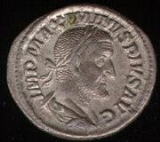
Maximinus Denarius
Unlike most modern coins, Roman coins had intrinsic
Intrinsic value (numismatics)

Intrinsic value, in general, is the argument that the value of a product is intrinsic within the product rather than dependent on the buyer's perception....
 value. While they contained precious metals, the value of a coin was higher than its precious metal content, so they were not bullion. Estimates of the value of the denarius
Denarius

The ancient Roman currency system included the 'denarius' after 211 BC, a small silver coin, and it was the most common coin produced for circulation but was slowly Debasement until its replacement by the antoninianus....
 range from 1.6 to 2.85 times its metal content, thought to equal the purchasing power of 10 modern British Pound Sterling (comparing bread prices) and around three days' pay for a Legionnaire.

The majority of the written information about coins that survives is in the form of papyri
Papyrus

Papyrus is a thick paper material produced from the pith of the papyrus plant, Cyperus papyrus, a wetland Cyperaceae that was once abundant in the Nile Delta of Egypt....
 preserved in Egypt’s dry climate. The coinage system that existed in Egypt
Egypt

Egypt is a country mainly in North Africa, with the Sinai Peninsula forming a land bridge in Western Asia. Covering an area of about , Egypt borders the Mediterranean Sea to the north, the Gaza Strip and Israel to the northeast, the Red Sea to the east, Sudan to the south and Libya to the west....
 till the time of Diocletian’s monetary reform was a closed system based upon the heavily debased tetradrachm
Tetradrachm

The tetradrachm was an Ancient Greece silver coin equivalent to four Greek drachmas. It was in wide circulation from 510 to 38 BC.Most tetradrachms were minted around the middle of the 5th century BC, when they were used in transactions....
. Although the value of these tetradrachmas can be reckoned as being equivalent in value to the denarius, their precious metal content was always much lower. Clearly, not all coins that circulated contained precious metals, as the value of these coins was too great to be convenient for everyday purchases. A dichotomy existed between the coins with an intrinsic value and those with only a token value. This is reflected in the infrequent and inadequate production of bronze coinage during the Republic, where from the time of Sulla till the time of Augustus no bronze coins were minted at all; even during the periods when bronze coins were produced, their workmanship was sometimes very crude and of low quality.

Later, during the Roman Empire
Roman Empire

The Roman Empire was the Roman Republic phase of the Ancient Rome, characterised by an autocracy form of government and large territorial holdings in Europe and around the Mediterranean....
, there was a division in the authority of minting coins of particular metals. While numerous local authorities were allowed to mint bronze coins, no local authority was authorized to strike silver coins. On the authority to mint coins Dio Cassius
Dio Cassius

Lucius Cassius Dio Cocceianus , known in English language as Cassius Dio, Dio Cassius, or Dio was a noted Roman Empire historian and public servant....
 writes, "None of the cities should be allowed to have its own separate coinage or a system of weights and measures; they should all be required to use ours." Only Rome itself struck precious metal coinage, and the mint was centralized in the city of Rome during the Republic and during the early centuries of the Empire. Some Eastern provinces struck coins in silver, but these coins were local denominations that were intended to circulate and to fill only a local need. The issue of bronze coins can be interpreted to be of little value, and of little importance to the central government of Rome, since expenditures of the state were large and could be more easily paid with coins of high value. It is known that during the first century AD an as
As (coin)

The was a bronze, and later copper, coin used during the Roman Republic and Roman Empire, named after the homonymous weight unit , but not immune to weight depreciation....
 could only buy a pound of bread or a litre of cheap wine
Wine

Wine is an alcoholic beverage often made of fermentation grape juice. The natural chemical balance of grapes is such that they can ferment without the addition of sugars, acids, enzymes or other nutrients....
 (or according to Pompeii
Pompeii

Pompeii is a ruined and partially buried Ancient Rome town-city near modern Naples in the Italy region of Campania, in the territory of the comune of Pompei....
an graffiti, the services of a cheap prostitute). The importance and the need for smaller denominations for the population of Rome was probably high. Evidence of this can be seen in the numerous imitations of imperial Claudian
Claudius

Tiberius Claudius Caesar Augustus Germanicus or Claudius I was the fourth Roman Emperor, a member of the Julio-Claudian dynasty, ruling from January 24, AD 41 to his death in AD 54....
 bronzes that, although probably not authorized by Rome, appear to have been tolerated and were struck in large numbers. Since the government required coins mainly as a means to pay its army and officials, it had little impetus or desire to fulfill the need for bronze coins.

The role of coins


Republican iconography

Another role that coins played in Roman society, although secondary to their economic role within Roman commerce
Roman commerce

Roman trade was the engine that drove the economy of the late Roman Republic and the early Roman Empire. Fashions and trends in historiography and in popular culture have tended to neglect the economic basis of the empire in favor of the lingua franca of Latin and the exploits of the Roman legions....
, was their ability to convey a meaning or relate an idea via their imagery and inscriptions. The interpretation of imagery featured on coins is clearly subjective, and has drawn criticism for over-interpreting minor details. The first images to appear on coins during the Republic were rather limited in diversity and generally represented the entire Roman state. The job of deciding what imagery to feature belonged to the committee of tresviri monetales
Moneyer

A moneyer is someone who physically creates money. Moneyers have a long tradition, dating back at least to ancient Greece. They became most prominent, however, in the Roman Republic, continuing into the empire....
 ('trio of money men'), young statesmen who aspired to be senators. The position of tresviri monetales (moneyers) was created in 289 BC and lasted until at least the middle of the third century AD. Although initially there were only three, the number was increased by Julius Caesar
Julius Caesar

'Gaius Julius Caesar' , July 13, 100 BC ? March 15, 44 BC,) was a Roman Republic military and political leader. He played a critical role in the transformation of the Roman Republic into the Roman Empire....
 to four during the end of the Republic.

Imagery on the earliest denarii usually consisted of the bust of Roma
Roma (mythology)

In Roman paganism and its Roman mythology, Roma was a deity personifying the Roman state, or a personification in art of the city of Rome ....
 on the obverse, and a deity driving a biga or quadriga on the reverse. There was no mention of the moneyer’s name, although occasionally coins featured control marks such as small symbols, letters, or monograms which might have been used to indicate who was responsible for a particular coin. Eventually, monograms and other symbols were replaced with abbreviated forms of the moneyer’s name. After the addition of their names, moneyers began to use the coins to display images that relate of their family history. An example of this are the coins of Sextus Pompeius Fostulus, which feature his traditional ancestor, Fostulus, watching Romulus and Remus
Romulus and Remus

Romulus and Remus are the traditional Founding Fathers of Rome, appearing in Roman mythology as the twin sons of the Vestal Virgin Rhea Silvia, fathered by the god of war, Mars ....
 being suckled by a she-wolf. While not every coin issued featured references to an ancestor of a moneyer, the number of references increased and the depictions became more and more of current interest. Self-promoting imagery on coins was part of the increasing competition amongst the ruling class in the Roman Republic. The Lex Gabinia
Lex Gabinia

The Lex Gabinia was a law established in ancient Rome in 67 BC. Its establishment was a result of the reforms made by Pompey and Crassus during their joint consulship in 70 BC....
, which introduced secret ballots in elections in order to reduce electoral corruption, is indicative of the degree of competition amongst the upper class of this time period. The imagery on Republican coins wasn’t meant to influence the populace; the messages were designed for and by the elite.

Imperial iconography

The imagery on coins took an important step when Julius Caesar
Julius Caesar

'Gaius Julius Caesar' , July 13, 100 BC ? March 15, 44 BC,) was a Roman Republic military and political leader. He played a critical role in the transformation of the Roman Republic into the Roman Empire....
 issued coins bearing his own portrait. While moneyers had earlier issued coins with portraits of ancestors, Caesar’s was the first Roman coinage to feature the portrait of a living individual. The tradition of putting one’s own portrait on coinage was not abandoned following the assassination of Caesar, although the imperators
Roman Emperor

The Roman Emperor was the ruler of the Roman Empire during the imperial period . The Romans had no single term for the office: Latin language titles such as imperator , Augustus , Caesar and princeps were all associated with it....
 from time to time also produced coins featuring the traditional deities and personifications found on earlier coins. The image of the Roman emperor took on a special importance in the centuries that followed, because during the empire, the emperor embodied the state and its policies. The names of moneyers continued to appear upon the coins until the middle of Augustus’ reign. Although the duty of moneyers during the Empire is not known, since the position was not abolished, it is believed that they still had some influence over the imagery of the coins.

The main focus of the imagery during the empire was on the portrait of the emperor. Coins were an important means of disseminating this image throughout the empire. Coins often attempted to make the emperor appear god-like through associating the emperor with attributes normally seen in divinities, or emphasizing the special relationship between the emperor and a particular deity by producing a preponderance of coins depicting that deity. During his campaign against Pompey, Caesar issued a variety of types that featured images of either Venus or Aeneas
Aeneas

This article is about the Roman hero. For other uses, see Aeneas .In Greco-Roman mythology, Aeneas was a Troy hero, the son of prince Anchises and the goddess Venus_....
, attempting to associate himself with his divine ancestors. An example of an emperor who went to an extreme in proclaiming divine status was Commodus
Commodus

Lucius Aurelius Commodus Antoninus , was a Roman Emperor who ruled from 180 to 192 . The name given here was his official name at his accession to sole rule; see 'Commodus#Changes of name' for earlier and later forms....
. In 192, he issued a series of coins depicting his bust clad in a lion-skin (the usual depiction of Hercules) on the obverse, and an inscription proclaiming that he was the Roman incarnation of Hercules on the reverse. Although Commodus was excessive in his depiction of his image, this extreme case is indicative of the objective of many emperors in the exploitation of their portraits. While the emperor is by far the most frequent portrait on the obverse of coins, heirs apparent, predecessors, and other family members, such as empresses, were also featured. To aid succession, the legitimacy of an heir was affirmed by producing coins for that successor. This was done from the time of Augustus till the end of the empire.

Featuring the portrait of an individual on a coin, which became legal in 44 BC, caused the coin to embody the attributes of the individual portrayed. Dio wrote that following the death of Caligula
Caligula

Gaius Julius Caesar Augustus Germanicus , more commonly known by his nickname Caligula , was the third Roman Emperor, reigning from 16 March 37 until his assassination on 24 January 41....
 the Senate demonetized his coinage, and ordered that they be melted. Regardless of whether or not this actually occurred, it demonstrates the importance and meaning that was attached to the imagery on a coin. The philosopher Epictetus
Epictetus

Epictetus was a Ancient Greece Stoicism philosophy. He was probably born a slave at Hierapolis, Phrygia , and lived in Rome until his exile to Nicopolis in northwestern Greece, where he lived most of his life and died....
 jokingly wrote: "Whose image does this sestertius
Sestertius

The sestertius, or sesterce, was an Ancient Rome coin. During the Roman Republic it was a small, silver coin issued only on rare occasions....
 carry? Trajan’s? Give it to me. Nero’s? Throw it away, it is unacceptable, it is rotten." Although the writer did not seriously expect people to get rid of their coins, this quotation demonstrates that the Romans attached a moral value to the images on their coins. Unlike the obverse, which during the imperial period almost always featured a portrait, the reverse was far more varied in its depiction. During the late Republic there were often political messages to the imagery, especially during the periods of civil war. However, by the middle of the Empire, although there were types that made important statements, and some that were overtly political or propagandistic in nature, the majority of the types were stock images of personifications or deities. While some images can be related to the policy or actions of a particular emperor, many of the choices seem arbitrary and the personifications and deities were so prosaic that their names were often omitted, as they were readily recognizable by their appearance and attributes alone.

It can be argued that within this backdrop of mostly indistinguishable types, exceptions would be far more pronounced. Atypical reverses are usually seen during and after periods of war, at which time emperors make various claims of liberation, subjugation, and pacification. Some of these reverse images can clearly be classified as propaganda. An example struck by emperor Philip
Philip the Arab

Marcus Julius Philippus or Philippus I Arabs , known in English language as Philip the Arab or formerly in English as Philip the Arabian, was a Roman Emperor from 244 to 249....
 in 244 features a legend proclaiming the establishment of peace with Persia
Persian Empire

The 'Persian Empire' was a series of successive Iranian or Persianization empires that ruled over the Iranian plateau, the original Persian homeland, and beyond in Southwest Asia, South Asia, Central Asia and the Caucasus....
; in truth, Rome had been forced to pay large sums in tribute to the Persians.

Although it is difficult to make accurate generalizations about reverse imagery, as this was something that varied by emperor, some trends do exist. An example is reverse types of the military emperors during the second half of the third century, where virtually all of the types were the common and standard personifications and deities. A possible explanation for the lack of originality is that these emperors were attempting to present conservative images to establish their legitimacy, something that many of these emperors lacked. Although these emperors relied on traditional reverse types, their portraits often emphasized their authority through stern gazes, and even featured the bust of the emperor clad in armor.

Further history of Roman coins

7antoninianii
The type of coins issued changed under the coinage reform of Diocletian
Diocletian

Gaius Aurelius Valerius Diocletianus , born Diocles and commonly known as Diocletian , was Roman Emperor from November 20, 284 to May 1, 305....
, the heavily debased antoninianus
Antoninianus

The antoninianus was a coin used during the Roman Empire thought to have been valued at 2 denarius. It was initially silver, but was slowly debasement to bronze....
 (double denarius) was replaced with a variety of new denominations, and a new range of imagery was introduced that attempted to convey different ideas. The new government set up by Diocletian was a tetrarchy, or rule by four, with each emperor receiving a separate territory to rule. The new imagery includes a large, stern portrait that is representative of the emperor. This image was not meant to show the actual portrait of a particular emperor, but was instead a caricature that embodied the power that the emperor possessed. The reverse type was equally universal, featuring the spirit (or genius) of the Romans. The introduction of a new type of government and a new system of coinage represents an attempt by Diocletian to return peace and security to Rome, after the previous century of constant warfare and uncertainty. Diocletian characterizes the emperor as an interchangeable authority figure by depicting him with a generalized image. He tries to emphasize unity amongst the Romans by featuring the spirit of Romans (Sutherland 254). The reverse types of coins of the late Empire emphasized general themes, and discontinued the more specific personifications depicted previously. The reverse types featured legends that proclaimed the glory of Rome, the glory of the army, victory against the "barbarians", the restoration of happy times, and the greatness of the emperor. These general types persisted even after the adoption of Christianity as the state religion of the Roman Empire. Muted Christian imagery, such as standards that featured Christograms (the chi-rho monogram for Jesus Christ’s name in Greek) were introduced, but with a few rare exceptions, there were no explicitly Christian themes. From the time of Constantine until the "end" of the Roman Empire, coins featured indistinguishable, idealized portraits and general proclamations of greatness.

Although the denarius remained the backbone of the Roman economy from its introduction in 211 BC until it ceased to be normally minted in the middle of the third century, the purity and weight of the coin slowly, but inexorably decreased. The problem of debasement in the Roman economy appears to be pervasive, although the severity of the debasement often paralleled the strength or weakness of the Empire. While it is not clear why debasement was such a common occurrence for the Romans, it's believed that it was caused by several factors, including a lack of precious metals, inadequacies in state finances, and inflation. When introduced, the denarius contained nearly pure silver at a theoretical weight of approximately 4.5 gram
Gram

The gram , ; symbol g, is a Physical unit of mass.Originally defined as "the absolute weight of a volume of pure water equal to the cube of the hundredth part of a metre, and at the temperature of melting ice" , a gram is now defined as one one-thousandth of the SI base unit, the kilogram, or Scientific notation kg, which itself is...
s. The theoretical standard, although not usually met in practice, remained fairly stable throughout the Republic, with the notable exception of times of war. The large number of coins required to raise an army and pay for supplies often necessitated the debasement of the coinage. An example of this is the denarii that were struck by Mark Antony
Mark Antony

Marcus Antonius , known in English as Marc Antony, was a Roman Republic politician and General. He was an important supporter and the best friend of Julius Caesar as a military commander and administrator, being Caesar's second cousin, once removed, by his mother Julia Antonia....
 to pay his army during his battles against Octavian. These coins, slightly smaller in diameter than a normal denarius, were made of noticeably debased silver. The obverse features a galley and the name Antony, while the reverse features the name of the particular legion that each issue was intended for (it is interesting to note that hoard evidence shows that these coins remained in circulation over 200 years after they were minted, due to their lower silver content). The coinage of the Julio-Claudians remained stable at 4 grams of silver, until the debasement of Nero in 64, when the silver content was reduced to 3.8 grams, perhaps due to the cost of rebuilding the city after fire consumed a considerable portion of Rome.

The denarius continued to decline slowly in purity, with a notable reduction instituted by Septimius Severus
Septimius Severus

Lucius Septimius Severus was a Roman Empire general, and Roman Emperor from April 14 193 to 211. He was born in what is now the Libyan part of Rome's historic Africa Province, making him the first emperor to be born in the Roman province of Africa Province....
. This was followed by the introduction of a double denarius piece, differentiated from the denarius by the radiate crown worn by the emperor. The coin is commonly called the antoninianus
Antoninianus

The antoninianus was a coin used during the Roman Empire thought to have been valued at 2 denarius. It was initially silver, but was slowly debasement to bronze....
 by numismatists after the emperor Caracalla, who introduced the coin in early in 215. Although nominally valued at two denarii, the antoninianus never contained more than 1.6 times the amount of silver of the denarius. The profit of minting a coin valued at two denarii, but weighing only about one and a half times as much is obvious; the reaction to these coins by the public is unknown. As the number of antoniniani minted increased, the number of denarii minted decreased, until the denarius ceased to be minted in significant quantities by the middle of the third century. Again, coinage saw its greatest debasement during times of war and uncertainty. The second half of the third century was rife with this war and uncertainty, and the silver content of the antonianus fell to only 2%, losing almost an appearance of being silver. During this time the aureus remained slightly more stable, before it too became smaller and more base before Diocletian’s reform.

The decline in the silver content to the point where coins contained virtually no silver at all was countered by the monetary reform of Aurelian
Aurelian

Lucius Domitius Aurelianus , known in English as Aurelian, Roman Emperor , was the second of several highly successful "soldier-emperors" who helped the Roman Empire regain its power during the latter part of the third century and the beginning of the fourth....
 in 274. The standard for silver in the antonianus was set at twenty parts copper to one part silver, and the coins were noticeably marked as containing that amount (XXI in Latin or KA in Greek). Despite the reform of Aurelian, silver content continued to decline, until the monetary reform of Diocletian. In addition to establishing the tetrarchy, Diocletian devised the following system of denominations: an aureus struck at the standard of 60 to the pound, a new silver coin struck at the old Neronian standard known as the argenteus
Argenteus

The argenteus was a silver coin produced by the Roman Empire from the time of Diocletian's coinage reform in 294 AD to ca. 310 AD. It was of similar weight and fineness as the denarius of the time of Nero....
, and a new large bronze coin that contained two percent silver. Diocletian issued an Edict on Maximum Prices
Edict on Maximum Prices

The Edict on Maximum Prices was issued in 301 by Roman Emperor Diocletian.During the Crisis of the Third Century, Roman coins had been greatly debased by the numerous emperors and Roman usurpers who minted their own coins of decreasing true metallic value to pay soldiers and public officials....
 in 301, which attempted to establish the legal maximum prices that could be charged for goods and services. The attempt to establish maximum prices was an exercise in futility as maximum prices were impossible to enforce. The Edict was reckoned in terms of denarii, although no such coin had been struck for over 50 years (it is believed that the bronze folles was valued at 12.5 denarii). Like earlier reforms, this too eroded and was replaced by an uncertain coinage consisting mostly of gold and bronze. The exact relationship and denomination of the bronze issues of a variety of sizes is not known, and is believed to have fluctuated heavily on the market.

The exact reason that Roman coinage sustained constant debasement is not known, but the most common theories involve inflation, trade with India, which drained silver from the Mediterranean world, and inadequacies in state finances. It is clear from papyri that the pay of the Roman soldier increased from 900 sestertii a year under Augustus to 2000 sestertii a year under Septimius Severus and the price of grain more than tripled indicating that fall in real wages and a moderate inflation occurred during this time.

Another reason for debasement was lack of raw metal with which to produce coins. Italy itself contains no large or reliable mines for precious metals, therefore the precious metals for coinage had to be obtained elsewhere. The majority of the precious metals that Rome obtained during its period of expansion arrived in the form of war booty from defeated territories, and subsequent tribute and taxes by new-conquered lands. When Rome ceased to expand, the precious metals for coinage then came from newly mined silver, such as from Greece
Greece

Greece , officially the Hellenic Republic , is a country in southeastern Europe, situated on the southern end of the Balkans. It has borders with Albania, Bulgaria and the former Yugoslav Republic of Macedonia to the north, and Turkey to the east....
 and Spain
Spain

Spain or the Kingdom of Spain , is a country located in Southern Europe on the Iberian Peninsula.The Spanish constitution does not establish any official denomination of the country, even though Espa?a , Estado espa?ol and Naci?n espa?ola are used interchangeably....
, and from melting older coins. Without a constant influx of precious metals from an outside source, and with the expense of continual wars, it would seem reasonable that coins might be debased to increase the amount that the government could spend. A simpler possible explanation for the debasement of coinage is that it allowed the state to spend more than it had. By decreasing the amount of silver in their coins, Rome could produce more coins and "stretch" their budget. As time progressed the trade deficit of the west because of its buying of grain and other commodities led to a currency drainage in Rome.

Relative values


Early Republic Values(after. 211 B.C.)
Denarius
Denarius

The ancient Roman currency system included the 'denarius' after 211 BC, a small silver coin, and it was the most common coin produced for circulation but was slowly Debasement until its replacement by the antoninianus....
 
Sestertius
Sestertius

The sestertius, or sesterce, was an Ancient Rome coin. During the Roman Republic it was a small, silver coin issued only on rare occasions....
 
Dupondius
Dupondius

The dupondius was a brass coin used during the Roman Empire and Roman Republic valued at 2 as .The dupondius was introduced during the Roman Republic as a large casting coin, although even at introduction it weighed less than 2 pounds....
 
As
As (coin)

The was a bronze, and later copper, coin used during the Roman Republic and Roman Empire, named after the homonymous weight unit , but not immune to weight depreciation....
 
Semis
Semis

The semis was small Roman bronze coin that was valued at half an as . During the Roman Republic, the semis was distinguished by an 'S' or 6 dots ....
 
Triens
Triens

The triens was an Ancient Rome bronze coin produced during the Roman Republic valued at one-third of an as . The most common design for the triens was the bust of Minerva and four pellets on the obverse and the prow of a galley on the reverse....
 
Quadrans
Quadrans

Image:Vecchi 283.jpg[Image:0808quad.jpg|thumb|Quadrans of Domitian]]The quadrans was a low-value Roman bronze coin worth one quarter of an As ....
 
Quincunx
Quincunx (coin)

The quincunx was an Ancient Rome bronze coin produced during the Roman Republic. The word quincunx comes from Latin "quinque" which means "five" and "uncia" which means "one twelfth", because the coin was valued at five-twelfths of an as ....
Denarius 1 4 5 10 20 30 40 24
Sestertius 1 5 10 6
Dupondius 1 2 4 6 8
As 1 2 3 4
Semis 1 2
Triens 1
Quadrans 1
Quincunx 1


Augustan Values(27 B.C. – 301 A.D.)
Aureus
Aureus

The aureus was a gold coin of ancient Rome valued at 25 silver denarius. The aureus was regularly issued from the 1st century BC to the beginning of the 4th century AD, when it was replaced by the solidus ....
 
Quinarius Aureus Denarius
Denarius

The ancient Roman currency system included the 'denarius' after 211 BC, a small silver coin, and it was the most common coin produced for circulation but was slowly Debasement until its replacement by the antoninianus....
 
Quinarius
Quinarius

The quinarius was a small silver Roman currency valued at half a denarius.The quinarius was struck for a few years, along with the silver sestertius, following the introduction of the denarius in 211 BC....
 
Sestertius
Sestertius

The sestertius, or sesterce, was an Ancient Rome coin. During the Roman Republic it was a small, silver coin issued only on rare occasions....
 
Dupondius
Dupondius

The dupondius was a brass coin used during the Roman Empire and Roman Republic valued at 2 as .The dupondius was introduced during the Roman Republic as a large casting coin, although even at introduction it weighed less than 2 pounds....
 
As
As (coin)

The was a bronze, and later copper, coin used during the Roman Republic and Roman Empire, named after the homonymous weight unit , but not immune to weight depreciation....
 
Quadrans
Quadrans

Image:Vecchi 283.jpg[Image:0808quad.jpg|thumb|Quadrans of Domitian]]The quadrans was a low-value Roman bronze coin worth one quarter of an As ....
Aureus 1 2 25 50 100 200 400 1600
Quinarius Aureus 1 25 50 100 200 800
Denarius 1 2 4 8 16 64
Quinarius Argenteus 1 2 4 8 32
Sestertius 1 2 4 16
Dupondius 1 2 8
As 1 4
Quadrans 1


Diocletian Values
Edict on Maximum Prices

The Edict on Maximum Prices was issued in 301 by Roman Emperor Diocletian.During the Crisis of the Third Century, Roman coins had been greatly debased by the numerous emperors and Roman usurpers who minted their own coins of decreasing true metallic value to pay soldiers and public officials....
(301 – 305 A.D.)
Solidus
Solidus (coin)

The solidus was originally a gold coin issued by the Ancient Rome.The solidus was first introduced by Diocletian around 301, struck at 60 to the Roman pound of pure gold and with an initial value equal to 1000 denarius....
 
Argenteus
Argenteus

The argenteus was a silver coin produced by the Roman Empire from the time of Diocletian's coinage reform in 294 AD to ca. 310 AD. It was of similar weight and fineness as the denarius of the time of Nero....
 
Nummus
Nummus

The coinage reform of 294 AD saw the introduction of several new coins. Most important was the one known to collectors as the Follis or Nummus. At about 10g and 30mm diameter these silver washed coins were quite impressive compared to the issues they replaced....
 
Radiate
Radiate (coin)

The radiate or Post-reform radiate , was introduced by Diocletian during his reforms. It looked very similar to an Antoninianus even with a radiated crown, except it misses the XXI that Numismatics believe was to represent 20 parts bronze to 1 part silver....
 
Laureate (coin) Denarius
Solidus 1 10 40 200 500 1000
Argenteus 1 4 20 50 100
Nummus 1 5 25
Radiate 1 5
Laureate 1 2
Denarius 1


Late Empire Coin Values(337 – 476 A.D.)
Solidus
Solidus (coin)

The solidus was originally a gold coin issued by the Ancient Rome.The solidus was first introduced by Diocletian around 301, struck at 60 to the Roman pound of pure gold and with an initial value equal to 1000 denarius....
 
Miliarense
Miliarense

A miliarense was the only fairly regularly minted silver coin issued by the late Roman and Byzantine Empires. It was struck with variable fineness, generally with a weight between 6.5 and 8.5 grams....
 
Siliqua
Siliqua

The siliqua is the modern name given to small, thin, Roman silver coins produced from 4th century and later.The term siliqua comes from the siliqua graeca, the seed of the carob tree, which in the Ancient Roman weights and measures is equivalent to 1/6 of a scruple ....
 
Follis
Follis

Sorry, no overview for this topic
 
Nummus
Solidus 1 12 24 180 7200
Miliarense 1 2 15 600
Siliqua 1 300
Follis 1 40
Nummus 1


See also

  • List of historical currencies
    List of historical currencies

    This is a list of historic currencies....
  • Roman Republic
    Roman Republic

    The Roman Republic was the phase of the Ancient Rome characterized by a republican form of government; a period which began with the overthrow of the Roman Roman Kingdom, c....
  • Roman Republican coinage
    Roman Republican coinage

    Coinage came late to the Roman Republic compared with the rest of the Mediterranean, especially Ancient Greek coinage where coins were invented in the 7th century BC....
  • Roman provincial coins
    Roman provincial coins

    Roman Provincial coins are coins that were minted in the Roman Empire by civic authorities rather than by Imperial authorities. Often these coins were a continuation of the original currency system that existed prior to the arrival or conquest by the ancient Rome....
  • Roman Republican moneyers
    Moneyer

    A moneyer is someone who physically creates money. Moneyers have a long tradition, dating back at least to ancient Greece. They became most prominent, however, in the Roman Republic, continuing into the empire....
  • Spintria
    Spintria

    A spintria is a Roman Empire Token coin, possibly for brothels, usually depicting sex acts or symbols....
  • Tessera
    Tessera

    Tessera has different meanings in different contexts....


Bibliographic References

  • Cohen, Henry
    Henry Cohen (numismatist)

    Henry Cohen , was a French people numismatist, bibliographer and composer.Cohen moved from Amsterdam to Paris, where he worked as a music teacher and served as curator of the Cabinet des M?dailles at the Biblioth?que nationale de France....
    , Description historiques des monnaies frappées sous l’Empire romain, Paris, 1882, 8 vols. There exists
  • Greene, Kevin. Archaeology of the Roman Economy. Berkeley, California: University of California Press, 1986.
  • Suarez, Rasiel. The Encyclopedia of Roman Imperial Coins. Dirty Old Books, 2005.
  • Van Meter, David. The Handbook of Roman Imperial Coins. Laurion Press, 1990.
  • Howgego, Christopher. Ancient History from Coins. London: Routledge, 1995.
  • Jones, A. H. M. The Roman Economy: Studies in Ancient Economic and Administrative History. Oxford: Basil Blackwell, 1974.
  • Reece, Richard. Roman Coins. London: Benn, 1970.
  • Salmon, E. Togo. Roman Coins and Public Life under the Empire. Ann Arbor, Michigan: The University of Michigan Press, 1999.
  • Sutherland, C. H. V. Roman Coins. New York: G. P.


Footnotes


External links

  • Identification, counterfeit detection, articles and photo galleries
  • - a tutorial for beginners
  • History and index/photo gallery of ancient Greek and Roman coins from Asia Minor (Anatolia/Turkey)