


Pontifex Maximus

Encyclopedia
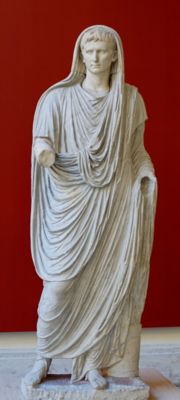
College of Pontiffs
The College of Pontiffs or Collegium Pontificum was a body of the ancient Roman state whose members were the highest-ranking priests of the polytheistic state religion. The college consisted of the Pontifex Maximus, the Vestal Virgins, the Rex Sacrorum, and the flamines...
(Collegium
Collegium (ancient Rome)
In Ancient Rome, a collegium was any association with a legal personality. Such associations had various functions.-Functioning:...
Pontificum) in ancient Rome
Ancient Rome
Ancient Rome was a thriving civilization that grew on the Italian Peninsula as early as the 8th century BC. Located along the Mediterranean Sea and centered on the city of Rome, it expanded to one of the largest empires in the ancient world....
. This was the most important position in the ancient Roman religion
Religion in ancient Rome
Religion in ancient Rome encompassed the religious beliefs and cult practices regarded by the Romans as indigenous and central to their identity as a people, as well as the various and many cults imported from other peoples brought under Roman rule. Romans thus offered cult to innumerable deities...
, open only to patricians until 254 BC, when a plebeian first occupied this post. A distinctly religious office under the early Roman Republic
Roman Republic
The Roman Republic was the period of the ancient Roman civilization where the government operated as a republic. It began with the overthrow of the Roman monarchy, traditionally dated around 508 BC, and its replacement by a government headed by two consuls, elected annually by the citizens and...
, it gradually became politicized until, beginning with Augustus
Augustus
Augustus ;23 September 63 BC – 19 August AD 14) is considered the first emperor of the Roman Empire, which he ruled alone from 27 BC until his death in 14 AD.The dates of his rule are contemporary dates; Augustus lived under two calendars, the Roman Republican until 45 BC, and the Julian...
, it was subsumed into the Imperial office. Its last use with reference to the emperors is in inscriptions of Gratian
Gratian
Gratian was Roman Emperor from 375 to 383.The eldest son of Valentinian I, during his youth Gratian accompanied his father on several campaigns along the Rhine and Danube frontiers. Upon the death of Valentinian in 375, Gratian's brother Valentinian II was declared emperor by his father's soldiers...
(reigned 375–383) who, however, then decided to omit the words "pontifex maximus" from his title.
The word "pontifex" later became a term used for Christian bishops, including the Bishop of Rome, and the title of "Pontifex Maximus" was applied within the Roman Catholic Church
Roman Catholic Church
The Catholic Church, also known as the Roman Catholic Church, is the world's largest Christian church, with over a billion members. Led by the Pope, it defines its mission as spreading the gospel of Jesus Christ, administering the sacraments and exercising charity...
to the Pope
Pope
The Pope is the Bishop of Rome, a position that makes him the leader of the worldwide Catholic Church . In the Catholic Church, the Pope is regarded as the successor of Saint Peter, the Apostle...
as its chief bishop. It is not included in the Pope's official titles, but appears on buildings, monuments and coins of popes of Renaissance
Renaissance
The Renaissance was a cultural movement that spanned roughly the 14th to the 17th century, beginning in Italy in the Late Middle Ages and later spreading to the rest of Europe. The term is also used more loosely to refer to the historical era, but since the changes of the Renaissance were not...
and modern times.
Etymology
According to the usual interpretation, the term pontifex literally means "bridge-builder" (pons + facere); "maximus" literally means "greatest". This was perhaps originally meant in a literal sense: the position of bridge-builder was indeed an important one in Rome, where the major bridgeBridge
A bridge is a structure built to span physical obstacles such as a body of water, valley, or road, for the purpose of providing passage over the obstacle...
s were over the Tiber
Tiber
The Tiber is the third-longest river in Italy, rising in the Apennine Mountains in Emilia-Romagna and flowing through Umbria and Lazio to the Tyrrhenian Sea. It drains a basin estimated at...
, the sacred river (and a deity): only prestigious authorities with sacral functions could be allowed to "disturb" it with mechanical additions. However, it was always understood in its symbolic sense as well: the pontifices were the ones who smoothed the "bridge" between gods and men (Van Haeperen).
An alternative view is that pontifex means "preparer of the road", derived from the Etruscan word pont, meaning "road". A minority opinion is that the word is a corruption of a similar-sounding but etymologically unrelated Etruscan
Etruscan language
The Etruscan language was spoken and written by the Etruscan civilization, in what is present-day Italy, in the ancient region of Etruria and in parts of Lombardy, Veneto, and Emilia-Romagna...
word for priest
Priest
A priest is a person authorized to perform the sacred rites of a religion, especially as a mediatory agent between humans and deities. They also have the authority or power to administer religious rites; in particular, rites of sacrifice to, and propitiation of, a deity or deities...
.
Origins in the Regal period
The Collegium Pontificum (College of Pontiffs) was the most important priesthood of ancient Rome. The foundation of this sacred college and the office of Pontifex Maximus is attributed to the second king of RomeKing of Rome
The King of Rome was the chief magistrate of the Roman Kingdom. According to legend, the first king of Rome was Romulus, who founded the city in 753 BC upon the Palatine Hill. Seven legendary kings are said to have ruled Rome until 509 BC, when the last king was overthrown. These kings ruled for...
, Numa Pompilius
Numa Pompilius
Numa Pompilius was the legendary second king of Rome, succeeding Romulus. What tales are descended to us about him come from Valerius Antias, an author from the early part of the 1st century BC known through limited mentions of later authors , Dionysius of Halicarnassus circa 60BC-...
. Much of what is known about the Regal period in Roman history is semi-legendary or mythical. The Collegium
Collegium (ancient Rome)
In Ancient Rome, a collegium was any association with a legal personality. Such associations had various functions.-Functioning:...
presumably acted as advisers to the rex
King
- Centers of population :* King, Ontario, CanadaIn USA:* King, Indiana* King, North Carolina* King, Lincoln County, Wisconsin* King, Waupaca County, Wisconsin* King County, Washington- Moving-image works :Television:...
(king) in religious matters. The collegium was headed by the pontifex maximus, and all the pontifices held their office for life. But the pontifical records of early Rome were most likely destroyed when the city was sacked by the Gauls in 387 BC, and the earliest accounts of Archaic Rome come from the literature of the Republic
Roman Republic
The Roman Republic was the period of the ancient Roman civilization where the government operated as a republic. It began with the overthrow of the Roman monarchy, traditionally dated around 508 BC, and its replacement by a government headed by two consuls, elected annually by the citizens and...
, most of it from the 1st century BC and later.
According to the Augustan
Augustus
Augustus ;23 September 63 BC – 19 August AD 14) is considered the first emperor of the Roman Empire, which he ruled alone from 27 BC until his death in 14 AD.The dates of his rule are contemporary dates; Augustus lived under two calendars, the Roman Republican until 45 BC, and the Julian...
-era historian
Roman historiography
Roman Historiography is indebted to the Greeks, who invented the form. The Romans had great models to base their works upon, such as Herodotus and Thucydides. Roman historiographical forms are different from the Greek ones however, and voice very Roman concerns. Unlike the Greeks, Roman...
Livy
Livy
Titus Livius — known as Livy in English — was a Roman historian who wrote a monumental history of Rome and the Roman people. Ab Urbe Condita Libri, "Chapters from the Foundation of the City," covering the period from the earliest legends of Rome well before the traditional foundation in 753 BC...
, Numa Pompilius
Numa Pompilius
Numa Pompilius was the legendary second king of Rome, succeeding Romulus. What tales are descended to us about him come from Valerius Antias, an author from the early part of the 1st century BC known through limited mentions of later authors , Dionysius of Halicarnassus circa 60BC-...
, a Sabine
Sabine
The Sabines were an Italic tribe that lived in the central Appennines of ancient Italy, also inhabiting Latium north of the Anio before the founding of Rome...
, devised Rome's system of religious rites, including the manner and timing of sacrifices, the supervision of religious funds, authority over all public and private religious institutions, instruction of the populace in the celestial and funerary rites including appeasing the dead, and expiation of prodigies. Numa is said to have founded Roman religion after dedicating an altar on the Aventine Hill
Aventine Hill
The Aventine Hill is one of the seven hills on which ancient Rome was built. It belongs to Ripa, the twelfth rione, or ward, of Rome.-Location and boundaries:The Aventine hill is the southernmost of Rome's seven hills...
to Jupiter Elicius and consulting the gods by means of augur
Augur
The augur was a priest and official in the classical world, especially ancient Rome and Etruria. His main role was to interpret the will of the gods by studying the flight of birds: whether they are flying in groups/alone, what noises they make as they fly, direction of flight and what kind of...
y. Numa wrote down and sealed these religious instructions, and gave them to the first Pontifex Maximus, Numa Marcius
Numa Marcius
Numa Marcius, son of Marcus, was the first Pontifex Maximus of Ancient Rome.He was appointed by the King Numa Pompilius who assigned to him the entire system of religious rites, which system was written out for him and sealed and included the manner and timing of sacrifices, the supervision of...
.
Roman Republic
In the Roman RepublicRoman Republic
The Roman Republic was the period of the ancient Roman civilization where the government operated as a republic. It began with the overthrow of the Roman monarchy, traditionally dated around 508 BC, and its replacement by a government headed by two consuls, elected annually by the citizens and...
, the Pontifex Maximus was the highest office in the state religion of ancient Rome
Religion in ancient Rome
Religion in ancient Rome encompassed the religious beliefs and cult practices regarded by the Romans as indigenous and central to their identity as a people, as well as the various and many cults imported from other peoples brought under Roman rule. Romans thus offered cult to innumerable deities...
and directed the College of Pontiffs. According to Livy, after the overthrow of the monarchy, the Romans created the priesthood of the rex sacrorum
Rex Sacrorum
In ancient Roman religion, the rex sacrorum was a senatorial priesthood reserved for patricians. Although in the historical era the pontifex maximus was the head of Roman state religion, Festus says that in the ranking of priests, the rex sacrorum was of highest prestige, followed by the flamines...
, or "king of sacred rites," to carry out certain religious duties and rituals previously performed by the king. The rex sacrorum was explicitly deprived of military and political power, but the pontifices were permitted to hold both magistracies and military commands.
The official residence of the Pontifex Maximus was the Domus Publica ("State House") which stood between the House of the Vestal Virgins and the Via Sacra
Via Sacra
The Via Sacra was the main street of ancient Rome, leading from the top of the Capitoline Hill, through some of the most important religious sites of the Forum , to the Colosseum....
, close to the Regia
Regia
The Regia was a structure in Ancient Rome, located in the Roman Forum. It was originally the residence of the kings of Rome or at least their main headquarters, and later the office of the Pontifex Maximus, the high priest of Roman religion. It occupied a triangular patch of terrain between the...
, in the Roman Forum
Roman Forum
The Roman Forum is a rectangular forum surrounded by the ruins of several important ancient government buildings at the center of the city of Rome. Citizens of the ancient city referred to this space, originally a marketplace, as the Forum Magnum, or simply the Forum...
. His religious duties were carried out from the Regia. Unless the pontifex maximus was also a magistrate at the same time, he was not allowed to wear the toga praetexta, i.e. toga with the purple border. In artistic representations, he can be recognized by his holding an iron knife (secespita) or the patera
Patera
A patera was a broad, shallow dish used for drinking, primarily in a ritual context such as a libation. These paterae were often used in Rome....
, and the distinctive robes or toga with part of the mantle covering the head (capite velato), in keeping with Roman practice.
The Pontifex was not simply a priest. He had both political and religious authority. It is not clear which of the two came first or had the most importance. In practice, particularly during the late Republic, the office of Pontifex Maximus was generally held by a member of a politically prominent family. It was a coveted position mainly for the great prestige it conferred on the holder; Julius Caesar
Julius Caesar
Gaius Julius Caesar was a Roman general and statesman and a distinguished writer of Latin prose. He played a critical role in the gradual transformation of the Roman Republic into the Roman Empire....
became pontifex in 73 BC and pontifex maximus in 63 BC.
The major Republican source on the pontiffs would have been the theological writings of Varro
Varro
Varro was a Roman cognomen carried by:*Marcus Terentius Varro, sometimes known as Varro Reatinus, the scholar*Publius Terentius Varro or Varro Atacinus, the poet*Gaius Terentius Varro, the consul defeated at the battle of Cannae...
, which survive only in fragments preserved by later authors such as Aulus Gellius
Aulus Gellius
Aulus Gellius , was a Latin author and grammarian, who was probably born and certainly brought up in Rome. He was educated in Athens, after which he returned to Rome, where he held a judicial office...
and Nonius Marcellus
Nonius Marcellus
Nonius Marcellus was a Roman grammarian of the 4th or 5th century AD. His only surviving work is the De compendiosa doctrina, a dictionary or encyclopedia in 20 books that shows his interests in antiquarianism and Latin literature from Plautus to Apuleius. Nonius may have come from...
. Other sources are Cicero
Cicero
Marcus Tullius Cicero , was a Roman philosopher, statesman, lawyer, political theorist, and Roman constitutionalist. He came from a wealthy municipal family of the equestrian order, and is widely considered one of Rome's greatest orators and prose stylists.He introduced the Romans to the chief...
, Livy
Livy
Titus Livius — known as Livy in English — was a Roman historian who wrote a monumental history of Rome and the Roman people. Ab Urbe Condita Libri, "Chapters from the Foundation of the City," covering the period from the earliest legends of Rome well before the traditional foundation in 753 BC...
, Dionysius of Halicarnassus
Dionysius of Halicarnassus
Dionysius of Halicarnassus was a Greek historian and teacher of rhetoric, who flourished during the reign of Caesar Augustus. His literary style was Attistic — imitating Classical Attic Greek in its prime.-Life:...
, Valerius Maximus
Valerius Maximus
Valerius Maximus was a Latin writer and author of a collection of historical anecdotes. He worked during the reign of Tiberius .-Biography:...
, Plutarch
Plutarch
Plutarch then named, on his becoming a Roman citizen, Lucius Mestrius Plutarchus , c. 46 – 120 AD, was a Greek historian, biographer, essayist, and Middle Platonist known primarily for his Parallel Lives and Moralia...
's Life of Numa Pompilius, Festus
Sextus Pompeius Festus
Sextus Pompeius Festus was a Roman grammarian, who probably flourished in the later 2nd century AD, perhaps at Narbo in Gaul.He made an epitome in 20 volumes of the encyclopedic treatise in many volumes De verborum significatu, of Verrius Flaccus, a celebrated grammarian who flourished in the...
' summaries of Verrius Flaccus
Verrius Flaccus
Marcus Verrius Flaccus was a Roman grammarian and teacher who flourished under Augustus and Tiberius.-Life:He was a freedman, and his manumitter has been identified with Verrius Flaccus, an authority on pontifical law; but for chronological reasons the name of Veranius Flaccus, a writer on augury,...
, and in later writers, including several of the Church Fathers
Church Fathers
The Church Fathers, Early Church Fathers, Christian Fathers, or Fathers of the Church were early and influential theologians, eminent Christian teachers and great bishops. Their scholarly works were used as a precedent for centuries to come...
. Some of these sources present an extensive list of everyday prohibitions for the Pontifex Maximus; it seems difficult to reconcile these lists with evidence that many Pontifices Maximi were prominent members of society who lived normal, non-restricted lives.
Election and number
The number of Pontifices, (s)elected by co-optatio (i.e. the remaining members nominate their new colleague) for life, was originally five, including the pontifex maximus. The pontifices, moreover, could only come from the old nobility, the patricians. However, in 300 BC/299 BC the lex Ogulnia opened the office of Pontifex Maximus to public election and permitted the plebsPlebs
The plebs was the general body of free land-owning Roman citizens in Ancient Rome. They were distinct from the higher order of the patricians. A member of the plebs was known as a plebeian...
(plebeians) to be co-opted as priests, so that part of the exclusivity of the title was lost. But it was only in 254 BC that Tiberius Coruncanius became the first plebeian Pontifex Maximus. The lex Ogulnia also increased the number of pontiffs to nine (the pontifex maximus included). In 104 BC the lex Domitia prescribed that the election of all pontiffs would henceforward be voted by the comitia tributa (an assembly of the people divided into voting districts); by the same law, only 17 of the 35 tribes (chosen by lot) of the city could vote. The law's promulgator, L. Domitius Ahenobarbus, was shortly afterwards elected Pontifex Maximus after the death of the incumbent Metellus Dalmaticus: something of a personal revenge because, the previous year, he had expected to be co-opted as a pontiff to replace his late father, but the pontifical college had appointed another candidate in his place. The office's next holder, Q. Mucius Scaevola, was also elected under the same law, though without controversy or opposition since he was a former consul and long-serving pontiff. This law was abolished in 81 BC by Sulla
Lucius Cornelius Sulla
Lucius Cornelius Sulla Felix , known commonly as Sulla, was a Roman general and statesman. He had the rare distinction of holding the office of consul twice, as well as that of dictator...
in his dictatorship, in the lex Cornelia de Sacerdotiis, which restored to the great priestly colleges their full right of co-optatio (Liv. Epit. 89; Pseudo-Ascon. in Divinat. p102, ed. Orelli; Dion Cass. xxxvii.37). Also under Sulla, the number of pontifices was increased to fifteen, the pontifex maximus included, and Sulla nominated Quintus Caecilius Metellus Pius
Quintus Caecilius Metellus Pius
Quintus Caecilius Metellus Pius was a pro-Sullan politician and general. He was named Pius because of his 99 BC petition to return his father from exile and was true to his cognomen for the constance and inflexibility with which he always fought for his father's rehabilitation and return to...
as the next holder of the office - the only truly unelected Pontifex Maximus in history, since even the other pontiffs did not get a vote in the matter. In 63 BC, the law of Sulla was abolished by the tribune Titus Labienus
Titus Labienus
Titus Atius Labienus was a professional Roman soldier in the late Roman Republic. He served as Tribune of the Plebs in 63 BC, and is remembered as one of Julius Caesar's lieutenants, mentioned frequently in the accounts of his military campaigns...
, and a modified form of the lex Domitia was reinstated providing for election by comitia tributa once again: Gaius Julius Caesar
Julius Caesar
Gaius Julius Caesar was a Roman general and statesman and a distinguished writer of Latin prose. He played a critical role in the gradual transformation of the Roman Republic into the Roman Empire....
followed Ahenobarbus's precedent by being elected by public vote, although Caesar at least had previously been a pontiff. Marcus Antonius later restored the right of co-optatio to the college (Dion Cass. xliv.53), in time for the election of Marcus Aemilius Lepidus. Also under Julius Caesar
Julius Caesar
Gaius Julius Caesar was a Roman general and statesman and a distinguished writer of Latin prose. He played a critical role in the gradual transformation of the Roman Republic into the Roman Empire....
, the number of pontifices were increased to sixteen, the pontifex maximus included - possibly because Caesar's own long absences from Rome necessitated the appointment of a deputy pontiff for those occasions when fifteen needed to be present? The number of pontifices varied during the Empire but is believed to have been regular at fifteen.
Extraordinary appointment of dictators
The office came into its own with the abolition of the monarchy, when most sacral powers previously vested in the King were transferred either to the Pontifex Maximus or to the Rex SacrorumRex Sacrorum
In ancient Roman religion, the rex sacrorum was a senatorial priesthood reserved for patricians. Although in the historical era the pontifex maximus was the head of Roman state religion, Festus says that in the ranking of priests, the rex sacrorum was of highest prestige, followed by the flamines...
, though traditionally a (non-political) dictator
Roman dictator
In the Roman Republic, the dictator , was an extraordinary magistrate with the absolute authority to perform tasks beyond the authority of the ordinary magistrate . The office of dictator was a legal innovation originally named Magister Populi , i.e...
(see also: basileus
Basileus
Basileus is a Greek term and title that has signified various types of monarchs in history. It is perhaps best known in English as a title used by the Byzantine Emperors, but also has a longer history of use for persons of authority and sovereigns in ancient Greece, as well as for the kings of...
, interrex
Interrex
The Interrex was literally a ruler "between kings" during the Roman Kingdom and the Roman Republic. He was in effect a short-term regent....
) was formally mandated by the Senate for one day, to perform a specific rite.
According to Livy in his "History of Rome", an ancient instruction written in archaic letters commands: "Let him who is the Praetor Maximus
Roman dictator
In the Roman Republic, the dictator , was an extraordinary magistrate with the absolute authority to perform tasks beyond the authority of the ordinary magistrate . The office of dictator was a legal innovation originally named Magister Populi , i.e...
fasten a nail on the Ides of September." This notice was fastened up on the right side of the Temple of Jupiter Optimus Maximus, next to the chapel of Minerva. This nail is said to have marked the number of the year. It was in accordance with this direction that the consul Horatius dedicated the Temple of Jupiter Optimus Maximus in the year following the expulsion of the kings; from the Consuls the ceremony of fastening the nails passed to the Dictators, because they possessed greater authority. As the custom had been subsequently dropped, it was felt to be of sufficient importance to require the appointment of a Dictator. L. Manlius was accordingly nominated but his appointment was due to political rather than religious reasons. He was eager to command in the war with the Hernici. He caused a very angry feeling among the men liable to serve by the inconsiderate way in which he conducted the enrolment. At last, in consequence of the unanimous resistance offered by the tribunes of the plebs, he gave way, either voluntarily or through compulsion, and laid down his Dictatorship. Since then, this rite has been performed by the Rex Sacrorum.
Duties
The main duty of the Pontifices was to maintain the pax deorum or "peace of the gods."The immense authority of the sacred college of pontiffs was centered on the Pontifex Maximus, the other pontifices forming his consilium or advising body. His functions were partly sacrificial or ritualistic, but these were the least important. His real power lay in the administration of jus divinum or divine law; the information collected by the pontifices related to the Roman religious tradition was bound in a corpus which summarized dogma
Dogma
Dogma is the established belief or doctrine held by a religion, or a particular group or organization. It is authoritative and not to be disputed, doubted, or diverged from, by the practitioners or believers...
and other concepts. The chief departments of jus divinum may be described as follows:
- The regulation of all expiatory ceremonials needed as a result of pestilence, lightning, etc.
- The consecration of all temples and other sacred places and objects dedicated to the gods.
- The regulation of the calendar; both astronomically and in detailed application to the public life of the state.
- The administration of the law relating to burials and burying-places, and the worship of the Manes or dead ancestors.
- The superintendence of all marriages by conferratio, i.e. originally of all legal patrician marriages.
- The administration of the law of adoption and of testamentary succession.
- The regulation of the public morals, and fining and punishing offending parties.
The pontifices had many relevant and prestigious functions such as being in charge of caring for the state archives, the keeping the official minutes of elected magistrates (see Fasti
Fasti
In ancient Rome, the fasti were chronological or calendar-based lists, or other diachronic records or plans of official and religiously sanctioned events...
) and list of magistrates, and they kept the records of their own decisions (commentarii) and of the chief events of each year, the so-called "public diaries", the Annales maximi
Annales maximi
The Annales maximi were annals kept by the Pontifex maximus in the Roman Republic. The chief priest of the Capitoline would record key public events and the names of each of the magistrates...
.
The Pontifex Maximus was also subject to several taboos. Among them was the prohibition to leave Italy. Plutarch described Publius Cornelius Scipio Nasica Serapio
Publius Cornelius Scipio Nasica Serapio
Publius Cornelius Scipio Nasica Serapio , the son of Publius Cornelius Scipio Nasica Corculum and his wife Cornelia Africana Major, was a member of the gens Cornelia and a politician of the ancient Roman Republic. He was consul in 138 BC.He was also a member of the gens Cornelia, a family of...
(141–132 BC) as the first to leave Italy, after being forced by the Senate to do so, and thus break the sacred taboo. Publius Licinius Crassus Dives Mucianus
Publius Licinius Crassus Dives Mucianus
Publius Licinius Crassus Dives Mucianus was the son by blood of Publius Mucius Scaevola, the consul of 175 BC, and brother of Publius Mucius Scaevola...
(132–130 BC) was the first to leave Italy voluntarily. Afterwards it became common and no longer against the law for the Pontifex Maximus to leave Italy. Among the most notable of those who did was Julius Caesar
Julius Caesar
Gaius Julius Caesar was a Roman general and statesman and a distinguished writer of Latin prose. He played a critical role in the gradual transformation of the Roman Republic into the Roman Empire....
(63–44 BC).
The Pontifices were in charge of the Roman calendar
Roman calendar
The Roman calendar changed its form several times in the time between the founding of Rome and the fall of the Roman Empire. This article generally discusses the early Roman or pre-Julian calendars...
and determined when intercalary day
Intercalation
Intercalation is the insertion of a leap day, week or month into some calendar years to make the calendar follow the seasons or moon phases. Lunisolar calendars may require intercalations of both days and months.- Solar calendars :...
s needed to be added to synchronize the calendar to the seasons. Since the Pontifices were often politicians, and because a Roman magistrate's term of office corresponded with a calendar year, this power was prone to abuse: a Pontifex could lengthen a year in which he or one of his political allies was in office, or refuse to lengthen one in which his opponents were in power. This caused the calendar to become out of step with the seasons; for example, Caesar's crossing of the Rubicon
Rubicon
The Rubicon is a shallow river in northeastern Italy, about 80 kilometres long, running from the Apennine Mountains to the Adriatic Sea through the southern Emilia-Romagna region, between the towns of Rimini and Cesena. The Latin word rubico comes from the adjective "rubeus", meaning "red"...
in January 49 BC actually took place in mid-autumn. Under his authority as Pontifex Maximus, Gaius Julius Caesar
Julius Caesar
Gaius Julius Caesar was a Roman general and statesman and a distinguished writer of Latin prose. He played a critical role in the gradual transformation of the Roman Republic into the Roman Empire....
introduced the calendar reform that created the Julian calendar
Julian calendar
The Julian calendar began in 45 BC as a reform of the Roman calendar by Julius Caesar. It was chosen after consultation with the astronomer Sosigenes of Alexandria and was probably designed to approximate the tropical year .The Julian calendar has a regular year of 365 days divided into 12 months...
, with a fault of less than a day per century, and which remained the standard till the Gregorian
Gregorian calendar
The Gregorian calendar, also known as the Western calendar, or Christian calendar, is the internationally accepted civil calendar. It was introduced by Pope Gregory XIII, after whom the calendar was named, by a decree signed on 24 February 1582, a papal bull known by its opening words Inter...
reform in the 16th century. It also, coincidentally, made 46 BC, the year of Julius's third consulship, 445 days long.
Roman Empire
After Julius Caesar's assassination in 44 BC, his ally Marcus Aemilius Lepidus was selected as Pontifex Maximus. Though Lepidus eventually fell out of political favor and was sent into exile as AugustusAugustus
Augustus ;23 September 63 BC – 19 August AD 14) is considered the first emperor of the Roman Empire, which he ruled alone from 27 BC until his death in 14 AD.The dates of his rule are contemporary dates; Augustus lived under two calendars, the Roman Republican until 45 BC, and the Julian...
consolidated power, he retained the priestly office until his death in 13 BC, at which point Augustus was selected to succeed him and given the right to appoint other pontifices. Thus, from the time of Augustus, the election of pontifices ended and membership into the sacred college was deemed a sign of imperial favour. With this attribution, the new office of Emperor was given a religious dignity and the responsibility for the entire Roman state cult. Most authors contend that the power of naming the Pontifices was not really used as an instrumentum regni, an enforcing power.
From this point on, Pontifex Maximus was one of the many titles of the Emperor, slowly losing its specific and historical powers and becoming simply a referent for the sacral aspect of imperial duties and powers. During the Imperial period, a promagister (vice-master) performed the duties of the pontifex maximus in lieu of the emperors whenever they were absent (Van Haeperen). In post-Severan times (post AD 235), the small number of pagan senators interested in becoming pontiffs led to a change in the pattern of office holding. In Republican and Imperial times no more than one family member of a gens was member of the College of Pontiffs
College of Pontiffs
The College of Pontiffs or Collegium Pontificum was a body of the ancient Roman state whose members were the highest-ranking priests of the polytheistic state religion. The college consisted of the Pontifex Maximus, the Vestal Virgins, the Rex Sacrorum, and the flamines...
, nor did one person hold more than one priesthood in this collegium. Obviously these rules where loosened in the later part of the 3rd century AD. In periods of joint rule, two pontifices maximi could serve together, as Pupienus and Balbinus
Pupienus and Balbinus
Marcus Clodius Pupienus Maximus and Decimus Caelius Calvinus Balbinus were two Roman co-emperors elected by the Roman senate on April 22, 238 after the failure of Gordian I and Gordian II to defeat the usurper Maximinus Thrax.- Pupienus :Pupienus, born about 178, was an example of ascension in the...
did in 238 — a situation unthinkable in Republican times. In the crisis of the Third Century
Crisis of the Third Century
The Crisis of the Third Century was a period in which the Roman Empire nearly collapsed under the combined pressures of invasion, civil war, plague, and economic depression...
, usurpers did not hesitate to claim for themselves the role not only of Emperor but of Pontifex Maximus as well. Even the early Christian Emperors continued to use it; it was only relinquished by Gratian
Gratian
Gratian was Roman Emperor from 375 to 383.The eldest son of Valentinian I, during his youth Gratian accompanied his father on several campaigns along the Rhine and Danube frontiers. Upon the death of Valentinian in 375, Gratian's brother Valentinian II was declared emperor by his father's soldiers...
, possibly in AD 376 at the time of his visit to Rome, or more probably in 383 when a delegation of pagan senators implored him to restore the Altar of Victory in the Senate House.
Roman Catholic use of the title
In Catholic circles, when TertullianTertullian
Quintus Septimius Florens Tertullianus, anglicised as Tertullian , was a prolific early Christian author from Carthage in the Roman province of Africa. He is the first Christian author to produce an extensive corpus of Latin Christian literature. He also was a notable early Christian apologist and...
, a Montanist
Montanism
Montanism was an early Christian movement of the late 2nd century, later referred to by the name of its founder, Montanus, but originally known by its adherents as the New Prophecy...
, furiously applied the term to Pope Callixtus I
Pope Callixtus I
Pope Saint Callixtus I or Callistus I was pope from about 217 to about 222, during the reigns of the Roman Emperors Elagabalus and Alexander Severus...
, with whom he was at odds, c. 220, over Callixtus's relaxation of the Church's penitential discipline allowing repentant adulterers and fornicators back into the Church, under his Petrine authority to "bind and loosen," it was in bitter irony:
It is not clear if the word Pontifex was commonly used by early 3rd-century Christianity
Christianity
Christianity is a monotheistic religion based on the life and teachings of Jesus as presented in canonical gospels and other New Testament writings...
, as it was later, to denote a bishop
Bishop
A bishop is an ordained or consecrated member of the Christian clergy who is generally entrusted with a position of authority and oversight. Within the Catholic Church, Eastern Orthodox, Oriental Orthodox Churches, in the Assyrian Church of the East, in the Independent Catholic Churches, and in the...
. Tertullian's usage is unusual in that most of the technical terms of Roman paganism were avoided in the vocabulary of Christian Latin
Latin
Latin is an Italic language originally spoken in Latium and Ancient Rome. It, along with most European languages, is a descendant of the ancient Proto-Indo-European language. Although it is considered a dead language, a number of scholars and members of the Christian clergy speak it fluently, and...
in favour of neologisms or Greek
Greek language
Greek is an independent branch of the Indo-European family of languages. Native to the southern Balkans, it has the longest documented history of any Indo-European language, spanning 34 centuries of written records. Its writing system has been the Greek alphabet for the majority of its history;...
words.
The last traces of Emperors being at the same time chief pontiffs are found in inscriptions of Valentinian I
Valentinian I
Valentinian I , also known as Valentinian the Great, was Roman emperor from 364 to 375. Upon becoming emperor he made his brother Valens his co-emperor, giving him rule of the eastern provinces while Valentinian retained the west....
, Valens
Valens
Valens was the Eastern Roman Emperor from 364 to 378. He was given the eastern half of the empire by his brother Valentinian I after the latter's accession to the throne...
, and Gratian
Gratian
Gratian was Roman Emperor from 375 to 383.The eldest son of Valentinian I, during his youth Gratian accompanied his father on several campaigns along the Rhine and Danube frontiers. Upon the death of Valentinian in 375, Gratian's brother Valentinian II was declared emperor by his father's soldiers...
(Orelli, Inscript. n1117, 1118). From the time of Theodosius I
Theodosius I
Theodosius I , also known as Theodosius the Great, was Roman Emperor from 379 to 395. Theodosius was the last emperor to rule over both the eastern and the western halves of the Roman Empire. During his reign, the Goths secured control of Illyricum after the Gothic War, establishing their homeland...
(r. 379–395), the emperors no longer appear in the dignity of pontiff, but the title was later applied to the Christian bishop of Rome. In 382, the Emperor Gratian, at the urging of Ambrose
Ambrose
Aurelius Ambrosius, better known in English as Saint Ambrose , was a bishop of Milan who became one of the most influential ecclesiastical figures of the 4th century. He was one of the four original doctors of the Church.-Political career:Ambrose was born into a Roman Christian family between about...
, removed the Altar of Victory
Altar of Victory
The Altar of Victory was located in the Roman Senate House bearing a gold statue of the goddess Victory. The altar was established by Octavian in 29 BC in honor of the defeat of Antony and Cleopatra at Actium. The statue depicted a winged woman, holding a palm and descending to present a laurel...
from the Forum, withdrew the state subsidies that funded many pagan activities and formally renounced the title of Pontifex Maximus. It is said that Pope Damasus I
Pope Damasus I
Pope Saint Damasus I was the bishop of Rome from 366 to 384.He was born around 305, probably near the city of Idanha-a-Velha , in what is present-day Portugal, then part of the Western Roman Empire...
was the first Bishop of Rome to assume the title, Other sources say that the use of such titles by bishops, including the Bishop of Rome, came later. The title pontifex continued to be a title for both the bishop of Rome and other bishops. In Emperor Theodosius's edict De fide catholica of 27 February 380, enacted in Thessalonica and published in Constantinople for the whole empire, by which he established Catholic Christianity as the official religion of the empire, he referred to Damasus as a pontifex, while calling Peter an episcopus : "... the profession of that religion which was delivered to the Romans by the divine Apostle Peter, as it has been preserved by faithful tradition and which is now professed by the Pontiff Damasus and by Peter, Bishop of Alexandria ... We authorize the followers of this law to assume the title Catholic Christians ..." Some see in this an implied significant differentiation, but the title pontifex maximus is not used in the text; pontifex is used instead: "... quamque pontificem damasum sequi claret et petrum alexandriae episcopum..." (Theodosian Code XVI.1.2; and Sozomen, "Ecclesiastical History", VII, iv.).
The Encyclopædia Britannica says that Pope Leo I
Pope Leo I
Pope Leo I was pope from September 29, 440 to his death.He was an Italian aristocrat, and is the first pope of the Catholic Church to have been called "the Great". He is perhaps best known for having met Attila the Hun in 452, persuading him to turn back from his invasion of Italy...
(440–461) assumed the title Pontifex Maximus, while other sources say Gregory I
Pope Gregory I
Pope Gregory I , better known in English as Gregory the Great, was pope from 3 September 590 until his death...
(590–604) was the first pope to employ the title in a formal sense. or on the contrary that Pope Siricius
Pope Siricius
Pope Saint Siricius, Bishop of Rome from December 384 until his death on 26 November 399, was successor to Damasus I and was himself succeeded by Anastasius I....
(384–399) assumed the title. The Oxford Dictionary of the Christian Church says that it was in the 15th century (when the Renaissance
Renaissance
The Renaissance was a cultural movement that spanned roughly the 14th to the 17th century, beginning in Italy in the Late Middle Ages and later spreading to the rest of Europe. The term is also used more loosely to refer to the historical era, but since the changes of the Renaissance were not...
stirred up new interest in ancient Rome) that "Pontifex Maximus" became a regular title of honour for Popes.
While the title Pontifex Maximus has for some centuries been used in inscriptions referring to the Popes, it has never been included in the official list of papal titles published in the Annuario Pontificio
Annuario Pontificio
The Annuario Pontificio is the annual directory of the Holy See. It lists all the popes to date and all officials of the Holy See's departments...
, which instead includes "Supreme Pontiff of the whole Church" (in Latin, Summus Pontifex Ecclesiae Universalis) as the fourth official title, the first being "Bishop of Rome".
The terms pontifex maximus and summus pontifex were for centuries used not only of the Bishop of Rome but of other bishops also. Hilary of Arles (d. 449) is styled "summus pontifex" by Eucherius of Lyons (P. L., L, 773), and Lanfranc is termed "primas et pontifex summus" by his biographer, Milo Crispin (P. L., CL, 10); they were doubtless originally employed with reference to the Jewish high-priest, whose place the Christian bishops were regarded as holding each in his own diocese (I Clement 40), but from the 11th century they appear to be applied only to the Pope. The Roman title of "Pontifex Maximus" was rendered in Greek inscriptions and literature of the time as "ἀρχιερεύς" (literally, "high priest"|) or by a more literal translation and order of words as "ἀρχιερεὺς μέγιστος" (literally, "greatest high priest". The term "ἀρχιερεύς" in the Septuagint text of the Old Testament
Old Testament
The Old Testament, of which Christians hold different views, is a Christian term for the religious writings of ancient Israel held sacred and inspired by Christians which overlaps with the 24-book canon of the Masoretic Text of Judaism...
and is used in the New Testament
New Testament
The New Testament is the second major division of the Christian biblical canon, the first such division being the much longer Old Testament....
to refer to the Jewish high priest.
The Oxford Dictionary of the Christian Church says that it was in the 15th century that "Pontifex Maximus" became a regular title of honor for Popes.
The title of "Pontifex Maximus", which is now applied to the pope, though not included in his official list of titles, thus has a very ancient history, dating back to the times of the Roman Republic
Roman Republic
The Roman Republic was the period of the ancient Roman civilization where the government operated as a republic. It began with the overthrow of the Roman monarchy, traditionally dated around 508 BC, and its replacement by a government headed by two consuls, elected annually by the citizens and...
. The only title applied to the Pope that has a longer documented history is the word "pope" itself (in Greek, "πάππας"), which is found already in the time of Homer
Homer
In the Western classical tradition Homer , is the author of the Iliad and the Odyssey, and is revered as the greatest ancient Greek epic poet. These epics lie at the beginning of the Western canon of literature, and have had an enormous influence on the history of literature.When he lived is...
. This title likewise is not included in the official list of his titles, but is used in official documents (such as the headings of encyclical
Encyclical
An encyclical was originally a circular letter sent to all the churches of a particular area in the ancient Catholic Church. At that time, the word could be used for a letter sent out by any bishop...
s and similar documents) far more commonly than the title "Pontifex Maximus", which is in practice used in little more than inscriptions of buildings.
- The title Pontifex Maximus was briefly used, from 1902 to 1906, by the head of the Philippine Independent ChurchPhilippine Independent ChurchThe Philippine Independent Church, The Philippine Independent Church, The Philippine Independent Church, (officially the or the IFI, also known as the Philippine Independent Catholic Church or in Ilocano: Siwawayawaya nga Simbaan ti Filipinas (in in Kinaray-a/Hiligaynon: Simbahan Hilway nga...
.
Tradition of sovereign as high priest
The practice of religious and secular authority united in the sovereign has a long history. In ancient AthensAthens
Athens , is the capital and largest city of Greece. Athens dominates the Attica region and is one of the world's oldest cities, as its recorded history spans around 3,400 years. Classical Athens was a powerful city-state...
, the Archon basileus
Archon basileus
Archon Basileus was a Greek title, meaning 'king magistrate': the term is derived the words archon "magistrate" and basileus "king" or "sovereign"....
was the principal religious dignitary of the state; according to legend, and as indicated in his title of "Basileus" (meaning "king"), he was supposed to inherit the religious functions of the king of Athens in earlier times.
Eastern traditions, from the ancient Egyptian to the Japanese, carried the concept even further, according their sovereigns demigod status.
With the adoption of Christianity, the Roman emperors took it on themselves to issue decrees on matters regarding the Christian Church. Unlike the Pontifex Maximus, they did not themselves function as priests, but they acted practically as head of the official religion, a tradition that continued with the Byzantine Emperors. In line with the theory of Moscow
Moscow
Moscow is the capital, the most populous city, and the most populous federal subject of Russia. The city is a major political, economic, cultural, scientific, religious, financial, educational, and transportation centre of Russia and the continent...
as the Third Rome
Third Rome
The term Third Rome describes the idea that some European city, state, or country is the successor to the legacy of the Roman Empire and its successor state, the Byzantine Empire ....
, the Russia
Russia
Russia or , officially known as both Russia and the Russian Federation , is a country in northern Eurasia. It is a federal semi-presidential republic, comprising 83 federal subjects...
n Tsar
Tsar
Tsar is a title used to designate certain European Slavic monarchs or supreme rulers. As a system of government in the Tsardom of Russia and Russian Empire, it is known as Tsarist autocracy, or Tsarism...
s exercised supreme authority over the Russian Orthodox Church
Russian Orthodox Church
The Russian Orthodox Church or, alternatively, the Moscow Patriarchate The ROC is often said to be the largest of the Eastern Orthodox churches in the world; including all the autocephalous churches under its umbrella, its adherents number over 150 million worldwide—about half of the 300 million...
.
With the English Reformation
English Reformation
The English Reformation was the series of events in 16th-century England by which the Church of England broke away from the authority of the Pope and the Roman Catholic Church....
, the sovereign of England became Supreme Governor of the Church of England
Supreme Governor of the Church of England
The Supreme Governor of the Church of England is a title held by the British monarchs which signifies their titular leadership over the Church of England. Although the monarch's authority over the Church of England is not strong, the position is still very relevant to the church and is mostly...
and insisted on being recognised as such. Much the same occurred in other countries affected by the Protestant Reformation
Protestant Reformation
The Protestant Reformation was a 16th-century split within Western Christianity initiated by Martin Luther, John Calvin and other early Protestants. The efforts of the self-described "reformers", who objected to the doctrines, rituals and ecclesiastical structure of the Roman Catholic Church, led...
.
Even in countries where there was no formal break with the Holy See
Holy See
The Holy See is the episcopal jurisdiction of the Catholic Church in Rome, in which its Bishop is commonly known as the Pope. It is the preeminent episcopal see of the Catholic Church, forming the central government of the Church. As such, diplomatically, and in other spheres the Holy See acts and...
, various sovereigns assumed similar authority. An example is Joseph II, Holy Roman Emperor
Joseph II, Holy Roman Emperor
Joseph II was Holy Roman Emperor from 1765 to 1790 and ruler of the Habsburg lands from 1780 to 1790. He was the eldest son of Empress Maria Theresa and her husband, Francis I...
, whose ecclesiastical policy is described in the Catholic Encyclopedia article on him.
A secular equivalent of the ruler as head of religion is that of the philosopher king
Philosopher king
Philosopher kings are the rulers, or Guardians, of Plato's Utopian Kallipolis. If his ideal city-state is to ever come into being, "philosophers [must] become kings…or those now called kings [must]…genuinely and adequately philosophize" .-In Book VI of The Republic:Plato defined a philosopher...
, based on a notion in Plato's Republic.
Incomplete list of Pontifices Maximi
- 753 BC to 712 BC – Duties and power of office (even if perhaps not the title) held by the Kings of Rome
- 712 BC – Numa MarciusNuma MarciusNuma Marcius, son of Marcus, was the first Pontifex Maximus of Ancient Rome.He was appointed by the King Numa Pompilius who assigned to him the entire system of religious rites, which system was written out for him and sealed and included the manner and timing of sacrifices, the supervision of...
- ...
- 509 BC – PapiriusPapirius (pontifex)Papirius was a Roman pontifex to whom is ascribed a collection of laws constituting the Roman code under the kings - Ius Papirianum or Ius Civile Papirianum.-References:...
- ...
- 449 BC – Quintus Furius
- 431 BC – Cornelius Cossus
- 420 BC – Spurius Minucius
- 390 BC – Follius Flaccinator
- ...
- 332 BC – Cornelius Callissa
- 304 BC – Cornelius Scipio Barbatus, possibly Lucius Cornelius Scipio BarbatusLucius Cornelius Scipio BarbatusLucius Cornelius Scipio Barbatus was one of the two elected Roman consuls in 298 BC. He led the Roman army to victory against the Etruscans near Volterra...
- ...
- 254 BC – Tiberius CoruncaniusTiberius CoruncaniusTiberius Coruncanius was Roman consul, and military commander in 280 BC – 279 BC, who was known for his military contests with Pyrrhus...
- 243 BC – Lucius Caecilius MetellusLucius Caecilius Metellus (died 221 BC)Lucius Caecilius Metellus was the son of Lucius Caecilius Metellus Denter. He was Consul in 251 BC and 247 BC, Pontifex Maximus in 243 BC and Dictator in 224 BC....
(d. 221 BC), resigned or removed from office circa 237 BC. - 237 BC – Lucius Cornelius Lentulus Caudinus (d. ca 213 BC)
- 212 BC – Publius Licinius Crassus DivesPublius Licinius Crassus Dives (consul 205 BC)Publius Licinius Crassus Dives Pontifex Maximus was consul in 205 BC with Publius Cornelius Scipio Africanus ; he was also Pontifex Maximus since 213 or 212 BC , and held several other important positions. Licinius Crassus is mentioned several times in Livy's Histories...
(d. 183 BC), - 183 BC – Gaius Servilius Geminus (d. 180 BC), possibly Gaius Servilius C.f. Geminus
- 180 BC – Marcus Aemilius LepidusMarcus Aemilius Lepidus (187 BC)Marcus Aemilius Lepidus was a Roman consul, Pontifex Maximus and censor.As a praetor he was governor of Sicily in 191 BC. He was elected consul in 187 BC. He and his colleague, Gaius Flaminius, subdued the Ligurians. From 180 BC onwards he was pontifex maximus and from 179 BC was princeps senatus....
(d. 152 BC) - 152 BC – vacant
- 150 BC – Publius Cornelius Scipio Nasica CorculumPublius Cornelius Scipio Nasica CorculumPublius Cornelius Scipio Nasica Corculum was a Roman statesman and member of the gens Cornelia.Corculum was the son of Publius Cornelius Scipio Nasica , and was thus a first cousin once removed of the Roman general Scipio Africanus...
(d. 141 BC) - 141 BC – Publius Cornelius Scipio Nasica SerapioPublius Cornelius Scipio Nasica SerapioPublius Cornelius Scipio Nasica Serapio , the son of Publius Cornelius Scipio Nasica Corculum and his wife Cornelia Africana Major, was a member of the gens Cornelia and a politician of the ancient Roman Republic. He was consul in 138 BC.He was also a member of the gens Cornelia, a family of...
(d. 132 BC Pergamum, Asia MinorAsia MinorAsia Minor is a geographical location at the westernmost protrusion of Asia, also called Anatolia, and corresponds to the western two thirds of the Asian part of Turkey...
) - 132 BC – Publius Licinius Crassus Dives MucianusPublius Licinius Crassus Dives MucianusPublius Licinius Crassus Dives Mucianus was the son by blood of Publius Mucius Scaevola, the consul of 175 BC, and brother of Publius Mucius Scaevola...
(killed in battle 131 BC, Asia MinorAsia MinorAsia Minor is a geographical location at the westernmost protrusion of Asia, also called Anatolia, and corresponds to the western two thirds of the Asian part of Turkey...
) - 130 BC – Publius Mucius ScaevolaPublius Mucius ScaevolaPublius Mucius Scaevola was a prominent Roman politician and jurist. He was tribune in 141 BC, praetor in 136 BC, and consul in 133 BC....
(d. 115 BC or 113 BC) - 115 BC – Lucius Caecilius Metellus DalmaticusLucius Caecilius Metellus DalmaticusLucius Caecilius Metellus Dalmaticus was a son of Lucius Caecilius Metellus Calvus. He was a Consul in 119 BC, a Censor in 115 BC and then Pontifex Maximus. He had eliminated from the Senate 32 of its members and fought Saturninus, thus contributing to the return to Rome, in 99 BC, of his brother...
, - 103 BC – Gnaeus Domitius Ahenobarbus (d. 88 BC)
- 89 BC – Quintus Mucius Scaevola PontifexQuintus Mucius Scaevola PontifexQuintus Mucius Scaevola Pontifex , the son of Publius Mucius Scaevola was a politician of the Roman Republic and an important early authority on Roman law. He is credited with founding the study of law as a systematic discipline...
(murdered 82 BC in the Temple of VestaTemple of VestaThe Temple of Vesta is an ancient edifice in Rome, Italy, located in the Roman Forum near the Regia and the House of the Vestal Virgins. The temple's most recognizable feature is its circular footprint. Since the worship of Vesta began in private homes, the architecture seems to be a reminder of...
) - 81 BC – Quintus Caecilius Metellus PiusQuintus Caecilius Metellus PiusQuintus Caecilius Metellus Pius was a pro-Sullan politician and general. He was named Pius because of his 99 BC petition to return his father from exile and was true to his cognomen for the constance and inflexibility with which he always fought for his father's rehabilitation and return to...
(d. ca 63 BC) - 63 BC – Gaius Julius CaesarJulius CaesarGaius Julius Caesar was a Roman general and statesman and a distinguished writer of Latin prose. He played a critical role in the gradual transformation of the Roman Republic into the Roman Empire....
(d. 44 BC) - 44 BC – Marcus Aemilius Lepidus, triumvir (d. 13 BC),
- 6 March 12 BC – AugustusAugustusAugustus ;23 September 63 BC – 19 August AD 14) is considered the first emperor of the Roman Empire, which he ruled alone from 27 BC until his death in 14 AD.The dates of his rule are contemporary dates; Augustus lived under two calendars, the Roman Republican until 45 BC, and the Julian...
- 12 BC to AD 376 – Held by the EmperorsConcise list of Roman EmperorsThis article provides a complete but concise list of those individuals who claimed the title of 'Emperor' between the inception of the imperial period and the end of the Western Roman Empire in c.480 AD; a nominal end point used to delineate the 'Roman' Empire from the "Hellenized Roman Empire",...
From some indeterminate later date to present, the title "Pontifex Maximus" is applied to the Popes.
Popular culture
- In C. S. LewisC. S. LewisClive Staples Lewis , commonly referred to as C. S. Lewis and known to his friends and family as "Jack", was a novelist, academic, medievalist, literary critic, essayist, lay theologian and Christian apologist from Belfast, Ireland...
's Christian novel The Voyage of the Dawn TreaderThe Voyage of the Dawn TreaderThe Voyage of the Dawn Treader is a fantasy novel for children by C. S. Lewis. Written in 1950, it was published in 1952 as the third book of The Chronicles of Narnia...
, AslanAslanAslan, the "Great Lion," is the central character in The Chronicles of Narnia, a series of seven fantasy novels for children written by C. S. Lewis. He is the eponymous lion of The Lion, the Witch and the Wardrobe, and his role in Narnia is developed throughout the remaining books...
refers to himself as "the great Bridge-Builder", a close translation of Pontifex Maximus. - In the dispensationalistDispensationalismDispensationalism is a nineteenth-century evangelical development based on a futurist biblical hermeneutic that sees a series of chronologically successive "dispensations" or periods in history in which God relates to human beings in different ways under different Biblical covenants.As a system,...
fiction series Left BehindLeft Behind (series)Left Behind is a series of 16 best-selling novels by Tim LaHaye and Jerry B. Jenkins, dealing with Christian dispensationalist End Times: pretribulation, premillennial, Christian eschatological viewpoint of the end of the world. The primary conflict of the series is the members of the Tribulation...
, the character Cardinal Peter Mathews is named Pontifex Maximus of the "Enigma Babylon One World FaithEnigma Babylon One World FaithEnigma Babylon One World Faith is a fictional world religion in the Left Behind series that ostensibly seeks to harmonise the remaining faiths on earth after the Rapture as portrayed in the novel....
", established by Nicolae Carpathia, Global CommunityGlobal CommunityThe Global Community is a the fictional world government/state described in the Left Behind series by Tim LaHaye and Jerry B. Jenkins. The Global Community was established as the successor of the United Nations by Nicolae Carpathia, the series' main antagonist.At its territorial peak, the GC...
Supreme PotentatePotentatePotentate is an informal term for a person with potent, usually supreme, power.-Ancient Arabic Order of the Nobles of the Mystic Shrine:...
and AntichristAntichristThe term or title antichrist, in Christian theology, refers to a leader who fulfills Biblical prophecies concerning an adversary of Christ, while resembling him in a deceptive manner...
. - In Robert SilverbergRobert SilverbergRobert Silverberg is an American author, best known for writing science fiction. He is a multiple nominee of the Hugo Award and a winner of the Nebula Award.-Early years:...
's Majipoor seriesMajipoor seriesThe Majipoor series is a series of novels and stories by Robert Silverberg, set on the planet Majipoor. The setting is a mixture of elements of science fiction and fantasy...
, the Pontifex is an important authority figure that represents the religious bureaucracy in the system of shared powers that control the fictional planet. - In the X Universe's game series, the leader of the Paranid alien race is also referred to as "Pontifex Maximus". In the game series, the Paranid are notorious for their extremist religious beliefs.
See also
- List of Pontifices maximi for an incomplete annotated version of this list.
- PontiffPontiffA pontiff was, in Roman antiquity, a member of the principal college of priests . The term "pontiff" was later applied to any high or chief priest and, in ecclesiastical usage, to a bishop and more particularly to the Bishop of Rome, the Pope or "Roman Pontiff".-Etymology:The English term derives...
External links
- article Pontifex in Smith's Dictionary of Greek and Roman Antiquities
- List from republican times
- Annotated Pontifex Maximus list
- List of roman consuls (Fasti consulares) 300 BC–AD 60 at http://www.tyndale.cam.ac.uk/Egypt/ptolemies/chron/chronology.htm – in the list of consuls the column on the right (Pontifex Maximus) lists those that are known in this period.
- Catholic Encyclopedia: Pope, section V. Primacy of Honour: Titles and Insignia