


Kaiser

Encyclopedia
German language
German is a West Germanic language, related to and classified alongside English and Dutch. With an estimated 90 – 98 million native speakers, German is one of the world's major languages and is the most widely-spoken first language in the European Union....
title meaning "Emperor
Emperor
An emperor is a monarch, usually the sovereign ruler of an empire or another type of imperial realm. Empress, the female equivalent, may indicate an emperor's wife or a woman who rules in her own right...
", with Kaiserin being the female equivalent, "Empress". Like the Russian
Russian language
Russian is a Slavic language used primarily in Russia, Belarus, Uzbekistan, Kazakhstan, Tajikistan and Kyrgyzstan. It is an unofficial but widely spoken language in Ukraine, Moldova, Latvia, Turkmenistan and Estonia and, to a lesser extent, the other countries that were once constituent republics...
Czar
Tsar
Tsar is a title used to designate certain European Slavic monarchs or supreme rulers. As a system of government in the Tsardom of Russia and Russian Empire, it is known as Tsarist autocracy, or Tsarism...
it is directly derived from the Latin Emperors' title of Caesar
Caesar (title)
Caesar is a title of imperial character. It derives from the cognomen of Julius Caesar, the Roman dictator...
, which in turn is derived from the personal name of a branch of the gens (clan) Julia, to which Gaius Julius Caesar
Julius Caesar
Gaius Julius Caesar was a Roman general and statesman and a distinguished writer of Latin prose. He played a critical role in the gradual transformation of the Roman Republic into the Roman Empire....
, the forebear of the first imperial family, belonged. Although the British monarchs styled "Emperor of India
Emperor of India
Emperor/Empress of India was used as a title by the last Mughal emperor Bahadur Shah II, and revived by the colonial British monarchs during the British Raj in India....
" were also called "Kaisar-i-Hind
Kaisar-i-Hind
The Kaisar-i-Hind was a medal awarded by the British monarch between 1900 and 1947, to civilians of any nationality who rendered distinguished service in the advancement of the interests of the British Raj....
" in Hindi
Hindi
Standard Hindi, or more precisely Modern Standard Hindi, also known as Manak Hindi , High Hindi, Nagari Hindi, and Literary Hindi, is a standardized and sanskritized register of the Hindustani language derived from the Khariboli dialect of Delhi...
and Urdu
Urdu
Urdu is a register of the Hindustani language that is identified with Muslims in South Asia. It belongs to the Indo-European family. Urdu is the national language and lingua franca of Pakistan. It is also widely spoken in some regions of India, where it is one of the 22 scheduled languages and an...
, this word, although ultimately sharing the same Latin origin, is derived from the Greek
Greek language
Greek is an independent branch of the Indo-European family of languages. Native to the southern Balkans, it has the longest documented history of any Indo-European language, spanning 34 centuries of written records. Its writing system has been the Greek alphabet for the majority of its history;...
Kaisar, not the German Kaiser.
In English, the term the Kaiser is usually reserved for the Emperors of the German Empire
German Empire
The German Empire refers to Germany during the "Second Reich" period from the unification of Germany and proclamation of Wilhelm I as German Emperor on 18 January 1871, to 1918, when it became a federal republic after defeat in World War I and the abdication of the Emperor, Wilhelm II.The German...
, the emperors of the Austrian Empire
Austrian Empire
The Austrian Empire was a modern era successor empire, which was centered on what is today's Austria and which officially lasted from 1804 to 1867. It was followed by the Empire of Austria-Hungary, whose proclamation was a diplomatic move that elevated Hungary's status within the Austrian Empire...
and those of the Austro-Hungarian Empire. During the First World War, the term the Kaiser — especially as applied to Wilhelm II of Germany
Germany
Germany , officially the Federal Republic of Germany , is a federal parliamentary republic in Europe. The country consists of 16 states while the capital and largest city is Berlin. Germany covers an area of 357,021 km2 and has a largely temperate seasonal climate...
— gained considerable pejorative connotations in English-speaking countries.
German history and antecedents of the title
The Holy Roman Emperors (962–1806) called themselves Kaiser, combining the imperial title with that of Roman King (assumed by the designated heir before the imperial coronation); they saw their rule as a continuation of that of the Roman EmperorRoman Emperor
The Roman emperor was the ruler of the Roman State during the imperial period . The Romans had no single term for the office although at any given time, a given title was associated with the emperor...
s and used the title derived from the title Caesar
Caesar (title)
Caesar is a title of imperial character. It derives from the cognomen of Julius Caesar, the Roman dictator...
to reflect their supposed heritage.
The rulers of the Austro-Hungarian
Austria-Hungary
Austria-Hungary , more formally known as the Kingdoms and Lands Represented in the Imperial Council and the Lands of the Holy Hungarian Crown of Saint Stephen, was a constitutional monarchic union between the crowns of the Austrian Empire and the Kingdom of Hungary in...
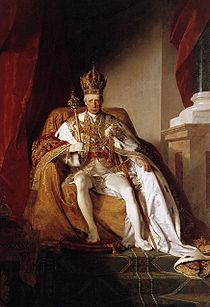
Empire (1804–1918) were born in the Habsburg dynasty, who provided most of Holy Roman Emperors since 1438. The Austrian-Hungarian rulers adopted the title Kaiser. There have only been three Kaisers of the Austrian Empire, the successor empire to the Holy Roman Empire of the German Nation (Heiliges Römisches Reich Deutscher Nation), and they have all belonged to the Habsburg
Habsburg
The House of Habsburg , also found as Hapsburg, and also known as House of Austria is one of the most important royal houses of Europe and is best known for being an origin of all of the formally elected Holy Roman Emperors between 1438 and 1740, as well as rulers of the Austrian Empire and...
dynasty. The successor empire to the Austrian Empire was termed the Austro-Hungarian Empire, which had only two Kaisers, both again from the Habsburg
Habsburg
The House of Habsburg , also found as Hapsburg, and also known as House of Austria is one of the most important royal houses of Europe and is best known for being an origin of all of the formally elected Holy Roman Emperors between 1438 and 1740, as well as rulers of the Austrian Empire and...
dynasty.
In 1871, there was much debate about the exact title for the monarch of those German territories (such as free imperial cities, principalities, duchies, and kingdoms) that agreed to unify under the leadership of Prussia
Prussia
Prussia was a German kingdom and historic state originating out of the Duchy of Prussia and the Margraviate of Brandenburg. For centuries, the House of Hohenzollern ruled Prussia, successfully expanding its size by way of an unusually well-organized and effective army. Prussia shaped the history...
, thereby forming the German Empire. Deutscher Kaiser ("German Emperor") was chosen over alternatives such as Kaiser von Deutschland ("Emperor of Germany"), or Kaiser der Deutschen ("Emperor of the Germans"), as the chosen title simply connoted that the new emperor, hearkening from Prussia, was a German, but did not imply that this new emperor had dominion over all German territories. There have only been three Kaisers of the (second) German Empire. All of them belonged to the Hohenzollern dynasty, which, as kings of Prussia, had been de facto leaders of lesser Germany.
In English
English language
English is a West Germanic language that arose in the Anglo-Saxon kingdoms of England and spread into what was to become south-east Scotland under the influence of the Anglian medieval kingdom of Northumbria...
the (untranslated) word Kaiser is mainly associated with the emperors of the unified German Empire
German Empire
The German Empire refers to Germany during the "Second Reich" period from the unification of Germany and proclamation of Wilhelm I as German Emperor on 18 January 1871, to 1918, when it became a federal republic after defeat in World War I and the abdication of the Emperor, Wilhelm II.The German...
(1871–1918), in particular with Kaiser Wilhelm II, and with the emperors of Austria-Hungary, in particular with Kaiser Franz Joseph I
Franz Joseph I of Austria
Franz Joseph I or Francis Joseph I was Emperor of Austria, King of Bohemia, King of Croatia, Apostolic King of Hungary, King of Galicia and Lodomeria and Grand Duke of Cracow from 1848 until his death in 1916.In the December of 1848, Emperor Ferdinand I of Austria abdicated the throne as part of...
.
The Kaisers of the Austrian Empire (1804–1867) and of the Austro-Hungarian Empire (1867–1918) were:
- Franz IFrancis I, Holy Roman EmperorFrancis I was Holy Roman Emperor and Grand Duke of Tuscany, though his wife effectively executed the real power of those positions. With his wife, Maria Theresa, he was the founder of the Habsburg-Lorraine dynasty...
(1804–1835) - Ferdinand IFerdinand I of AustriaFerdinand I was Emperor of Austria, President of the German Confederation, King of Hungary and Bohemia , as well as associated dominions from the death of his father, Francis II, Holy Roman Emperor, until his abdication after the Revolutions of 1848.He married Maria Anna of Savoy, the sixth child...
(1835–1848) - Franz Joseph IFranz Joseph I of AustriaFranz Joseph I or Francis Joseph I was Emperor of Austria, King of Bohemia, King of Croatia, Apostolic King of Hungary, King of Galicia and Lodomeria and Grand Duke of Cracow from 1848 until his death in 1916.In the December of 1848, Emperor Ferdinand I of Austria abdicated the throne as part of...
(1848–1916) - Karl I (1916–1918)
The Kaisers of the German Empire (1871–1918) were:
- Wilhelm IWilliam I, German EmperorWilliam I, also known as Wilhelm I , of the House of Hohenzollern was the King of Prussia and the first German Emperor .Under the leadership of William and his Chancellor Otto von Bismarck, Prussia achieved the unification of Germany and the...
(1871–1888); - Frederick IIIFrederick III, German EmperorFrederick III was German Emperor and King of Prussia for 99 days in 1888, the Year of the Three Emperors. Friedrich Wilhelm Nikolaus Karl known informally as Fritz, was the only son of Emperor William I and was raised in his family's tradition of military service...
(1888), who ruled for 99 days; - Wilhelm II (1888–1918), during whose reign the monarchy in Germany ended near the end of World War IWorld War IWorld War I , which was predominantly called the World War or the Great War from its occurrence until 1939, and the First World War or World War I thereafter, was a major war centred in Europe that began on 28 July 1914 and lasted until 11 November 1918...
.
See also
- German Monarchy
- German nobilityGerman nobilityThe German nobility was the elite hereditary ruling class or aristocratic class from ca. 500 B.C. to the Holy Roman Empire and what is now Germany.-Principles of German nobility:...
- List of German monarchs
- QaisarQaisarQaisar is the Arabic version of the name Caesar and it is used as a given name in Arabia The Roman and later Byzantine emperors were called Qaisar-e-Rum by the Arabs and Persians...