


Titus

Encyclopedia
Titus was Roman Emperor
from 79 to 81. A member of the Flavian dynasty
, Titus succeeded his father Vespasian
upon his death, thus becoming the first Roman Emperor to come to the throne after his own father.
Prior to becoming Emperor, Titus gained renown as a military commander, serving under his father in Judaea
during the First Jewish-Roman War
. The campaign came to a brief halt with the death of emperor Nero
in 68, launching Vespasian's bid for the imperial power during the Year of the Four Emperors
. When Vespasian was declared Emperor on 1 July 69, Titus was left in charge of ending the Jewish rebellion. In 70, he successfully laid siege to
and destroyed the city and Temple
of Jerusalem. For this achievement Titus was awarded a triumph
; the Arch of Titus
commemorates his victory to this day.
Under the rule of his father, Titus gained notoriety in Rome serving as prefect
of the Praetorian Guard
, and for carrying on a controversial relationship with the Jewish queen Berenice. Despite concerns over his character, Titus ruled to great acclaim following the death of Vespasian in 79, and was considered a good emperor by Suetonius
and other contemporary historians. As emperor, he is best known for completing the Colosseum
and for his generosity in relieving the suffering caused by two disasters, the Mount Vesuvius eruption of 79 and a fire in Rome in 80. After barely two years in office, Titus died of a fever
on 13 September 81. He was deified
by the Roman Senate
and succeeded by his younger brother Domitian
.
, probably on 30 December 39 AD, as the eldest son of Titus Flavius Vespasianus
—commonly known as Vespasian—and Domitilla the Elder
. He had one younger sister, Domitilla the Younger
(b. 45), and one younger brother, also named Titus Flavius Domitianus
(b. 51), but commonly referred to as Domitian.
Decades of civil war during the 1st century BC had contributed greatly to the demise of the old aristocracy of Rome, which was gradually replaced in prominence by a new provincial nobility during the early part of the 1st century. One such family was the gens Flavia
, which rose from relative obscurity to prominence in just four generations, acquiring wealth and status under the Emperors of the Julio-Claudian dynasty
. Titus's great-grandfather, Titus Flavius Petro
, had served as a centurion
under Pompey
during Caesar's civil war
. His military career ended in disgrace when he fled the battlefield at the Battle of Pharsalus
in 48 BC. Nevertheless, Petro managed to improve his status by marrying the extremely wealthy Tertulla, whose fortune guaranteed the upwards mobility of Petro's son Titus Flavius Sabinus I
, Titus's grandfather. Sabinus himself amassed further wealth and possible equestrian
status through his services as tax collector
in Asia and banker in Helvetia
. By marrying Vespasia Polla
he allied himself to the more prestigious patrician gens Vespasia, ensuring the elevation of his sons Titus Flavius Sabinus II
and Vespasian
to the senatorial rank.
The political career
of Vespasian included the offices of quaestor
, aedile
and praetor
, and culminated with a consulship
in 51, the year Domitian was born. As a military commander, he gained early renown by participating in the Roman invasion of Britain in 43. What little is known of Titus's early life has been handed down to us by Suetonius
, who records that he was brought up at the imperial court in the company of Britannicus
, the son of emperor Claudius
, who would be murdered by Nero
in 55. The story was even told that Titus was reclining next to Britannicus, the night he was murdered, and sipped of the poison
that was handed to him. Further details on his education are scarce, but it seems he showed early promise in the military arts
and was a skilled poet and orator both in Greek
and Latin
.
He died 2 years after being dismissed.
in Germania
. He also served in Britannia
, perhaps arriving c. 60 with reinforcements needed after the revolt of Boudica
. In c. 63 he returned to Rome and married Arrecina Tertulla, daughter of a former Prefect of the Praetorian Guard
. She died c. 65. Titus then took a new wife of a much more distinguished family, Marcia Furnilla
. However, Marcia's family was closely linked to the opposition to Nero
. Her uncle Barea Soranus
and his daughter Servilia
were among those who perished after the failed Pisonian conspiracy
of 65. Some modern historians theorize that Titus divorced his wife because of her family's connection to the conspiracy. He never re-married. Titus appears to have had multiple daughters, at least one of them by Marcia Furnilla. The only one known to have survived to adulthood was Julia Flavia
, perhaps Titus's child by Arrecina, whose mother was also named Julia. During this period Titus also practiced law and attained the rank of quaestor
.
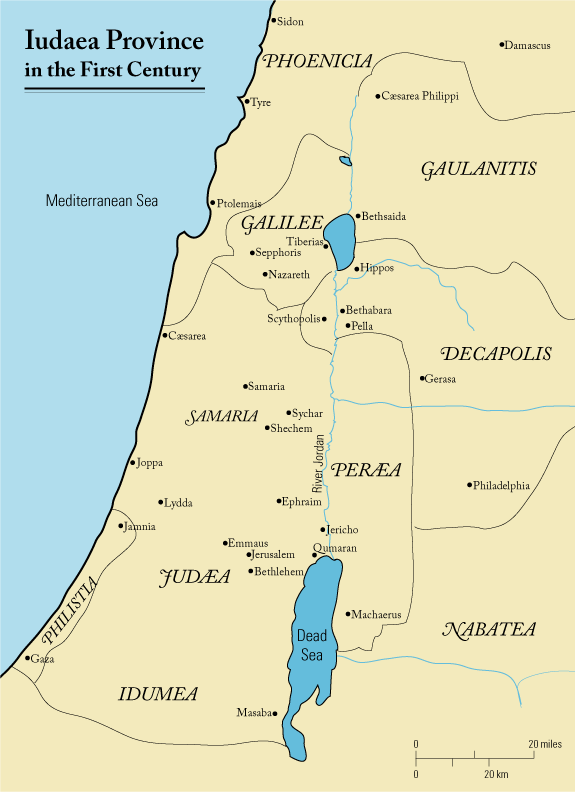 In 66 the Jews of the Judaea Province
revolted against the Roman Empire
. Cestius Gallus
, the legate of Syria, was defeated at the battle of
Beth-Horon
and forced to retreat from Jerusalem. The pro-Roman king Agrippa II
and his sister Berenice fled the city to Galilee
where they later gave themselves up to the Romans. Nero appointed Vespasian to put down the rebellion, who was dispatched to the region at once with the fifth
and tenth legions
. He was later joined by Titus at Ptolemais
, bringing with him the fifteenth legion
. With a strength of 60,000 professional soldiers, the Romans prepared to sweep across Galilee and march on Jerusalem.
The history of the war was covered in dramatic detail by the Roman-Jewish historian Josephus
in his work The Wars of the Jews
. Josephus served as a commander in the city of Jotapata when the Roman army invaded Galilee in 67. After an exhausting siege which lasted 47 days, the city fell, with an estimated 40,000 killed and the remaining Jewish resistance committing suicide
. Surviving a group suicide, Josephus surrendered to Vespasian and became a prisoner. He later wrote that he provided the Romans with intelligence on the ongoing revolt. By 68, the entire coast and the north of Judaea were subjugated by the Roman army, with decisive victories won at Taricheae
and Gamala
, where Titus distinguished himself as a skilled general.
was Jerusalem. The campaign came to a sudden halt when news arrived of Nero's death. Almost simultaneously, the Roman Senate
had declared Galba
, then governor of Hispania
, as Emperor of Rome. Vespasian decided to await further orders, and sent Titus to greet the new princeps
. Before reaching Italy, Titus learnt that Galba had been murdered and replaced by Otho
, governor of Lusitania
, and that Vitellius
and his armies in Germania
were preparing to march on the capital, intent on overthrowing Otho. Not wanting to risk being taken hostage by one side or the other, he abandoned the journey to Rome and rejoined his father in Judaea. Meanwhile, Otho was defeated in the First Battle of Bedriacum and committed suicide.
When the news spread across the armies in Judaea and Ægyptus, they took matters into their own hands and declared Vespasian emperor on July 1, 69. Vespasian accepted, and through negotiations by Titus, joined forces with Gaius Licinius Mucianus
, governor of Syria. A strong force drawn from the Judaean and Syrian legions marched on Rome under the command of Mucianus, while Vespasian travelled to Alexandria
, leaving Titus in charge to end the Jewish rebellion. By the end of 69, the forces of Vitellius had been beaten, and Vespasian was officially declared emperor by the Senate on December 21, thus ending the Year of the Four Emperors
.
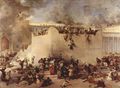 Meanwhile the Jews had become embroiled in a civil conflict
of their own, splitting the resistance in the city among two factions; the Sicarii
led by Simon Bar Giora
, and the Zealots led by John of Gischala. Titus seized the opportunity to begin the assault on Jerusalem
. The Roman army was joined by the twelfth legion
, which was previously defeated under Cestius Gallus
, and from Alexandria Vespasian sent Tiberius Julius Alexander
, governor of Ægyptus, to act as Titus's second in command. Titus surrounded the city, with three legions (Vth, XIIth and XVth) on the western side and one (Xth) on the Mount of Olives
to the east. He put pressure on the food and water supplies of the inhabitants by allowing pilgrim
s to enter the city to celebrate Passover
, and then refusing them egress. Jewish raids continuously harassed the Roman army, one of which nearly resulted in Titus being captured.
After attempts by Josephus to negotiate a surrender had failed, the Romans resumed hostilities and quickly breached the first and second walls of the city. To intimidate the resistance, Titus ordered deserters
from the Jewish side to be crucified
around the city wall. By this time the Jews had been exhausted by famine
, and when the weak third wall was breached, bitter street fighting ensued. The Romans finally captured the Antonia Fortress
and began a frontal assault on the gates of the Temple
. According to Josephus, Titus had ordered that the Temple should not be destroyed, but while the fighting around the gates continued, a soldier hurled a torch inside one of the windows, which quickly set the entire building ablaze. The later Christian chronicler Sulpicius Severus
, possibly drawing on a lost portion of Tacitus
' Histories
, claims that Titus favoured destruction of the Temple. The Temple was completely demolished, after which Titus's soldiers proclaimed him imperator
in honor of the victory. Jerusalem was sacked and much of the population killed or dispersed. Josephus claims that 1,100,000 people were killed during the siege, of which a majority were Jewish. 97,000 were captured and enslaved, including Simon Bar Giora and John of Gischala. Many fled to areas around the Mediterranean. Titus reportedly refused to accept a wreath
of victory, as he claimed there is "no merit in vanquishing people forsaken by their own God."
 Unable to sail to Italy during the winter, Titus celebrated elaborate games at Caesarea Maritima and Berytus, then travelled to Zeugma on the Euphrates
, where he was presented with a crown by Vologases I of Parthia
. While visiting Antioch
he confirmed the traditional rights of the Jews in that city. On his way to Alexandria
, he stopped in Memphis
to consecrate the sacred bull Apis
. According to Suetonius
, this caused consternation; the ceremony required Titus to wear a diadem
, which the Romans associated with kingship
, and the partisanship of Titus's legions had already led to fears that he might rebel against his father. Titus returned quickly to Rome – hoping, says Suetonius, to allay any suspicions about his conduct.
Upon his arrival in the city in 71, Titus was awarded a triumph
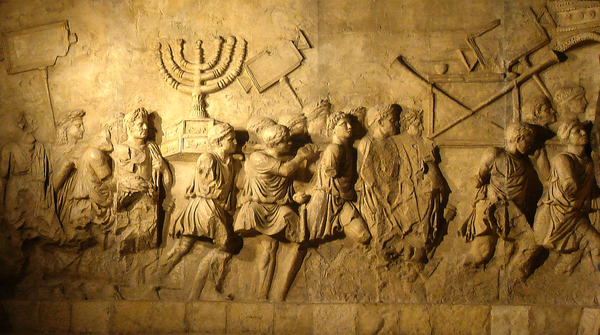
. Accompanied by Vespasian and Domitian he rode into the city, enthusiastically saluted by the Roman populace and preceded by a lavish parade containing treasures and captives from the war. Josephus describes a procession with large amounts of gold and silver carried along the route, followed by elaborate re-enactments of the war, Jewish prisoners, and finally the treasures taken from the Temple of Jerusalem, including the Menorah and the Pentateuch. Simon Bar Giora was executed in the Forum, after which the procession closed with religious sacrifices at the Temple of Jupiter.
The triumphal
Arch of Titus
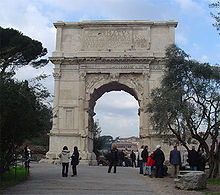
, which stands at one entrance to the Forum, memorializes the victory of Titus.
 With Vespasian declared emperor, Titus and his brother Domitian likewise received the title of Caesar from the Senate. In addition to sharing tribunician power
with his father, Titus held seven consul
ships during Vespasian's reign and acted as his secretary, appearing in the Senate on his behalf. More crucially, he was appointed commander of the Praetorian Guard
, ensuring their loyalty to the Emperor and further solidifying Vespasian's position as a legitimate ruler. In this capacity he achieved considerable notoriety in Rome for his violent actions, frequently ordering the execution of suspected traitors on the spot. When in 79, a plot by Aulus Caecina Alienus
and Eprius Marcellus to overthrow Vespasian was uncovered, Titus invited Alienus to dinner and ordered him to be stabbed before he had even left the room.
During the Jewish wars, Titus had begun a love affair with Berenice, sister of Agrippa II
. The Herodians
had collaborated with the Romans during the rebellion, and Berenice herself had supported Vespasian upon his campaign to become emperor. In 75, she returned to Titus and openly lived with him in the palace as his promised wife. The Romans were wary of the Eastern Queen and disapproved of their relationship. When the pair was publicly denounced by Cynics in the theatre, Titus caved in to the pressure and sent her away, but his reputation further suffered.
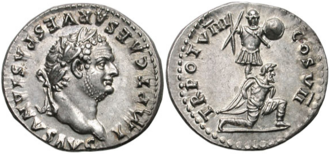 Vespasian died of an infection on June 23 79 AD, and was immediately succeeded by his son Titus. Because of his many alleged vice
s, many Romans feared at this point that he would be another Nero. Against these expectations, however, Titus proved to be an effective Emperor and was well-loved by the population, who praised him highly when they found that he possessed the greatest virtue
s instead of vices. One of his first acts as Emperor was to publicly order a halt to trials based on treason charges, which had long plagued the principate
. The law of treason
, or maiestas law
, was originally intended to prosecute those who had corruptly 'impaired the people and majesty of Rome' by any revolution
ary action. Under Augustus
, however, this custom had been revived and applied to cover slander or libellous writings
as well, eventually leading to a long cycle of trial
s and executions under such emperors as Tiberius
, Caligula
and Nero, spawning entire networks of informer
s that terrorized Rome's political system for decades. Titus put an end to this practice, against himself or anyone else, declaring:
Consequently, no senator
s were put to death during his reign; he thus kept to his promise that he would assume the office of Pontifex Maximus
"for the purpose of keeping his hands unstained
". The informants were publicly punished and banished
from the city, and Titus further prevented abuses by introducing legislation that made it unlawful for persons to be tried under different laws for the same offense
. Finally, when Berenice returned to Rome, he sent her away.
As Emperor he became known for his generosity, and Suetonius
states that upon realising he had brought no benefit to anyone during a whole day he remarked, "Friends, I have lost a day."
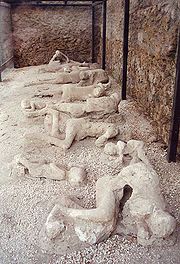 Although his administration was marked by a relative absence of major military or political conflicts, Titus faced a number of major disasters during his brief reign. On August 24, 79, two months after his accession, Mount Vesuvius erupted, resulting in the almost complete destruction of life and property in the cities and resort communities around the Bay of Naples. The cities of Pompeii
and Herculaneum
were buried under metres of stone and lava
, killing thousands of citizens. Titus appointed two ex-consuls to organise and coordinate the relief effort
, while personally donating large amounts of money from the imperial treasury to aid the victims of the volcano. Additionally, he visited Pompeii once after the eruption and again the following year.
During the second visit, in spring of AD 80, a fire broke out in Rome, burning large parts of the city for three days and three nights. Although the extent of the damage was not as disastrous as during the Great Fire
of 64—crucially sparing the many districts of insulae
—Cassius Dio records a long list of important public buildings that were destroyed, including Agrippa's Pantheon
, the Temple of Jupiter, the Diribitorium
, parts of Pompey's Theatre
and the Saepta Julia
among others. Once again, Titus personally compensated for the damaged regions. According to Suetonius, a plague similarly struck during the fire. The nature of the disease, however, or the death toll
are unknown.
Meanwhile war had resumed in Britannia
, where Gnaeus Julius Agricola
pushed further into Caledonia
and managed to establish several forts there. As a result of his actions, Titus received the title of Imperator for the fifteenth time.
His reign also saw the rebellion led by Terentius Maximus
, one of several false Neros who continued to appear throughout the 70s. Although Nero was primarily known as a universally hated tyrant
—there is evidence that for much of his reign, he remained highly popular in the eastern provinces. Reports that Nero had in fact survived the assassination attempts were fueled by the vague circumstances surrounding his death and several prophecies
foretelling his return. According to Cassius Dio, Terentius Maximus resembled Nero in voice and appearance and, like him, sang to the lyre
. Terentius established a following in Asia minor
but was soon forced to flee beyond the Euphrates
, taking refuge with the Parthians. In addition, sources state that Titus discovered that his brother Domitian was plotting against him but refused to have him killed or banished.
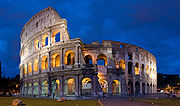 Construction of the Flavian Amphitheatre, presently better known as the Colosseum
, was begun in 70 under Vespasian
and finally completed in 80 under Titus. In addition to providing spectacular entertainments to the Roman populace, the building was also conceived as a gigantic triumphal monument to commemorate the military achievements of the Flavians during the Jewish wars
. The inaugural games
lasted for a hundred days and were said to be extremely elaborate, including gladiatorial combat
, fights between wild animals (elephant
s and cranes
), mock naval battle
s for which the theatre was flooded, horse races and chariot races. During the games, wooden balls were dropped into the audience, inscribed with various prizes (clothing
, gold
, or even slaves), which could then be traded for the designated item.
Adjacent to the amphitheatre, within the precinct of Nero's Golden House
, Titus had also ordered the construction of a new public bath-house
, which was to bear his name
. Construction of this building was hastily finished to coincide with the completion of the Flavian Amphitheatre.
Practice of the imperial cult
was revived by Titus, though apparently it met with some difficulty as Vespasian was not deified until six months after his death. To further honor and glorify the Flavian dynasty
, foundations were laid for what would later become the Temple of Vespasian and Titus
, which was finished by Domitian.
territories but fell ill at the first posting station where he died of a fever
, reportedly in the same farm-house as his father. Allegedly, the last words he uttered before passing away were: "I have made but one mistake". Titus had ruled the Roman Empire
for just over two years, from the death of his father in 79 to his own on September 13 81. He was succeeded by Domitian, whose first act as emperor was to deify
his brother.
Historians have speculated on the exact nature of his death, and to which mistake Titus alluded in his final words. Philostratus
writes that he was poisoned by Domitian with a sea hare
, and that his death had been foretold to him by Apollonius of Tyana
. Suetonius and Cassius Dio maintain he died of natural causes, but both accuse Domitian of having left the ailing Titus for dead. Consequently, Dio believes Titus's mistake refers to his failure to have his brother executed when he was found to be openly plotting against him.
According to the Babylonian Talmud (Gittin 56b), an insect
flew into Titus's nose and picked at his brain for seven years. He noticed that the sound of a blacksmith hammering caused the ensuing pain to abate, so he paid for blacksmiths to hammer nearby him; however, the effect wore off and the insect resumed its gnawing. When he died, they opened his skull and found the insect had grown to the size of a bird. The Talmud gives this as the cause of his death and interprets it as divine retribution for his wicked actions.
The Wars of the Jews
offers a first-hand, eye-witness
account on the Jewish rebellion and the character of Titus. The neutrality
of Josephus
' writings has come into question however as he was heavily indebted to the Flavians
. In 71, he arrived in Rome in the entourage of Titus, became a Roman citizen
and took on the Roman nomen
Flavius and praenomen
Titus from his patrons. He received an annual pension and lived in the palace. It was while in Rome, and under Flavian patronage
, that Josephus wrote all of his known works. The War of the Jews is heavily slanted against the leaders of the revolt, portraying the rebellion as weak and unorganized, and even blaming the Jews for causing the war. The credibility of Josephus as a historian has subsequently come under fire.
Another contemporary of Titus was Publius Cornelius Tacitus
, who started his public career in 80 or 81 and credits the Flavian dynasty with his elevation. The Histories
—his account of this period—was published during the reign of Trajan
. Unfortunately only the first five books from this work have survived until the present day, with the text on Titus's and Domitian's reign entirely lost.
Suetonius Tranquilius
gives a short but highly favourable account on Titus's reign in The Lives of Twelve Caesars, emphasizing his military achievements and his generosity as Emperor, in short describing him as follows:
Finally, Cassius Dio wrote his Roman History over a hundred years after the death of Titus. He shares a similar outlook as Suetonius, possibly even using the latter as a source, but is more reserved, noting:
Pliny the Elder
, who later died during the eruption of Mount Vesuvius, dedicated his Naturalis Historia to Titus.
In contrast to the ideal portrayal of Titus in Roman histories, in Jewish memory "Titus the Wicked" is remembered as an evil oppressor and destroyer of the Temple. For example, one legend in the Babylonian Talmud describes Titus as having had sex with a whore on a Torah scroll inside the Temple during its destruction.
 The war in Judaea and the life of Titus, particularly his relationship with Berenice, have inspired writers and artists through the centuries. The bas-relief in the Arch of Titus has been influential in the depiction of the destruction of Jerusalem, with the Menorah frequently being used to symbolise the looting of the Second Temple
.
Roman Emperor
The Roman emperor was the ruler of the Roman State during the imperial period . The Romans had no single term for the office although at any given time, a given title was associated with the emperor...
from 79 to 81. A member of the Flavian dynasty
Flavian dynasty
The Flavian dynasty was a Roman Imperial Dynasty, which ruled the Roman Empire between 69 and 96 AD, encompassing the reigns of Vespasian , and his two sons Titus and Domitian . The Flavians rose to power during the civil war of 69, known as the Year of the Four Emperors...
, Titus succeeded his father Vespasian
Vespasian
Vespasian , was Roman Emperor from 69 AD to 79 AD. Vespasian was the founder of the Flavian dynasty, which ruled the Empire for a quarter century. Vespasian was descended from a family of equestrians, who rose into the senatorial rank under the Emperors of the Julio-Claudian dynasty...
upon his death, thus becoming the first Roman Emperor to come to the throne after his own father.
Prior to becoming Emperor, Titus gained renown as a military commander, serving under his father in Judaea
Iudaea Province
Judaea or Iudaea are terms used by historians to refer to the Roman province that extended over parts of the former regions of the Hasmonean and Herodian kingdoms of Israel...
during the First Jewish-Roman War
First Jewish-Roman War
The First Jewish–Roman War , sometimes called The Great Revolt , was the first of three major rebellions by the Jews of Judaea Province , against the Roman Empire...
. The campaign came to a brief halt with the death of emperor Nero
Nero
Nero , was Roman Emperor from 54 to 68, and the last in the Julio-Claudian dynasty. Nero was adopted by his great-uncle Claudius to become his heir and successor, and succeeded to the throne in 54 following Claudius' death....
in 68, launching Vespasian's bid for the imperial power during the Year of the Four Emperors
Year of the Four Emperors
The Year of the Four Emperors was a year in the history of the Roman Empire, AD 69, in which four emperors ruled in a remarkable succession. These four emperors were Galba, Otho, Vitellius, and Vespasian....
. When Vespasian was declared Emperor on 1 July 69, Titus was left in charge of ending the Jewish rebellion. In 70, he successfully laid siege to
Siege of Jerusalem (70)
The Siege of Jerusalem in the year 70 AD was the decisive event of the First Jewish-Roman War. The Roman army, led by the future Emperor Titus, with Tiberius Julius Alexander as his second-in-command, besieged and conquered the city of Jerusalem, which had been occupied by its Jewish defenders in...
and destroyed the city and Temple
Second Temple
The Jewish Second Temple was an important shrine which stood on the Temple Mount in Jerusalem between 516 BCE and 70 CE. It replaced the First Temple which was destroyed in 586 BCE, when the Jewish nation was exiled to Babylon...
of Jerusalem. For this achievement Titus was awarded a triumph
Roman triumph
The Roman triumph was a civil ceremony and religious rite of ancient Rome, held to publicly celebrate and sanctify the military achievement of an army commander who had won great military successes, or originally and traditionally, one who had successfully completed a foreign war. In Republican...
; the Arch of Titus
Arch of Titus
The Arch of Titus is a 1st-century honorific arch located on the Via Sacra, Rome, just to the south-east of the Roman Forum. It was constructed in c.82 AD by the Roman Emperor Domitian shortly after the death of his older brother Titus to commemorate Titus' victories, including the Siege of...
commemorates his victory to this day.
Under the rule of his father, Titus gained notoriety in Rome serving as prefect
Praetorian prefect
Praetorian prefect was the title of a high office in the Roman Empire. Originating as the commander of the Praetorian Guard, the office gradually acquired extensive legal and administrative functions, with its holders becoming the Emperor's chief aides...
of the Praetorian Guard
Praetorian Guard
The Praetorian Guard was a force of bodyguards used by Roman Emperors. The title was already used during the Roman Republic for the guards of Roman generals, at least since the rise to prominence of the Scipio family around 275 BC...
, and for carrying on a controversial relationship with the Jewish queen Berenice. Despite concerns over his character, Titus ruled to great acclaim following the death of Vespasian in 79, and was considered a good emperor by Suetonius
Suetonius
Gaius Suetonius Tranquillus, commonly known as Suetonius , was a Roman historian belonging to the equestrian order in the early Imperial era....
and other contemporary historians. As emperor, he is best known for completing the Colosseum
Colosseum
The Colosseum, or the Coliseum, originally the Flavian Amphitheatre , is an elliptical amphitheatre in the centre of the city of Rome, Italy, the largest ever built in the Roman Empire...
and for his generosity in relieving the suffering caused by two disasters, the Mount Vesuvius eruption of 79 and a fire in Rome in 80. After barely two years in office, Titus died of a fever
Fever
Fever is a common medical sign characterized by an elevation of temperature above the normal range of due to an increase in the body temperature regulatory set-point. This increase in set-point triggers increased muscle tone and shivering.As a person's temperature increases, there is, in...
on 13 September 81. He was deified
Apotheosis
Apotheosis is the glorification of a subject to divine level. The term has meanings in theology, where it refers to a belief, and in art, where it refers to a genre.In theology, the term apotheosis refers to the idea that an individual has been raised to godlike stature...
by the Roman Senate
Roman Senate
The Senate of the Roman Republic was a political institution in the ancient Roman Republic, however, it was not an elected body, but one whose members were appointed by the consuls, and later by the censors. After a magistrate served his term in office, it usually was followed with automatic...
and succeeded by his younger brother Domitian
Domitian
Domitian was Roman Emperor from 81 to 96. Domitian was the third and last emperor of the Flavian dynasty.Domitian's youth and early career were largely spent in the shadow of his brother Titus, who gained military renown during the First Jewish-Roman War...
.
Early life
Titus was born in RomeRome
Rome is the capital of Italy and the country's largest and most populated city and comune, with over 2.7 million residents in . The city is located in the central-western portion of the Italian Peninsula, on the Tiber River within the Lazio region of Italy.Rome's history spans two and a half...
, probably on 30 December 39 AD, as the eldest son of Titus Flavius Vespasianus
Vespasian
Vespasian , was Roman Emperor from 69 AD to 79 AD. Vespasian was the founder of the Flavian dynasty, which ruled the Empire for a quarter century. Vespasian was descended from a family of equestrians, who rose into the senatorial rank under the Emperors of the Julio-Claudian dynasty...
—commonly known as Vespasian—and Domitilla the Elder
Domitilla the Elder
Flavia Domitilla Major Flavia Domitilla the Elder or Domitilla the Elder was the wife of the Roman Emperor Vespasian. She was a daughter of Flavius Liberalis, a humble quaestor’s clerk. Before her marriage, she was a formal mistress to an African knight. Vespasian married her around 38...
. He had one younger sister, Domitilla the Younger
Domitilla the Younger
Flavia Domitilla the Younger or Flavia Domitilla Minor was the only daughter of the Roman Emperor Vespasian and Flavia Domitilla the Elder. Her elder brother was Titus, and her younger brother Domitian...
(b. 45), and one younger brother, also named Titus Flavius Domitianus
Domitian
Domitian was Roman Emperor from 81 to 96. Domitian was the third and last emperor of the Flavian dynasty.Domitian's youth and early career were largely spent in the shadow of his brother Titus, who gained military renown during the First Jewish-Roman War...
(b. 51), but commonly referred to as Domitian.
Decades of civil war during the 1st century BC had contributed greatly to the demise of the old aristocracy of Rome, which was gradually replaced in prominence by a new provincial nobility during the early part of the 1st century. One such family was the gens Flavia
Flavius
Flavius was a gens of ancient Rome, meaning "blond". The feminine form was Flavia.After the end of the popular Flavian dynasty of emperors, Flavius/Flavia became a praenomen, common especially among royalty: the adoption of this praenomen by Constantine I set a precedent for some imperial...
, which rose from relative obscurity to prominence in just four generations, acquiring wealth and status under the Emperors of the Julio-Claudian dynasty
Julio-Claudian Dynasty
The Julio-Claudian dynasty normally refers to the first five Roman Emperors: Augustus, Tiberius, Caligula , Claudius, and Nero, or the family to which they belonged; they ruled the Roman Empire from its formation, in the second half of the 1st century BC, until AD 68, when the last of the line,...
. Titus's great-grandfather, Titus Flavius Petro
Titus Flavius Petro
Titus Flavius Petro was the paternal grandfather of the Roman Emperor Vespasian.He was a son of a contracted laborer, who each summer crossed the Po to assist the Sabines with their harvests....
, had served as a centurion
Centurion
A centurion was a professional officer of the Roman army .Centurion may also refer to:-Military:* Centurion tank, British battle tank* HMS Centurion, name of several ships and a shore base of the British Royal Navy...
under Pompey
Pompey
Gnaeus Pompeius Magnus, also known as Pompey or Pompey the Great , was a military and political leader of the late Roman Republic...
during Caesar's civil war
Caesar's civil war
The Great Roman Civil War , also known as Caesar's Civil War, was one of the last politico-military conflicts in the Roman Republic before the establishment of the Roman Empire...
. His military career ended in disgrace when he fled the battlefield at the Battle of Pharsalus
Battle of Pharsalus
The Battle of Pharsalus was a decisive battle of Caesar's Civil War. On 9 August 48 BC at Pharsalus in central Greece, Gaius Julius Caesar and his allies formed up opposite the army of the republic under the command of Gnaeus Pompeius Magnus...
in 48 BC. Nevertheless, Petro managed to improve his status by marrying the extremely wealthy Tertulla, whose fortune guaranteed the upwards mobility of Petro's son Titus Flavius Sabinus I
Titus Flavius Sabinus (father of Vespasian)
See also Titus Flavius Sabinus for other men of this name.Titus Flavius Sabinus was the son of Titus Flavius Petro and wife ... Tertulla....
, Titus's grandfather. Sabinus himself amassed further wealth and possible equestrian
Equestrian (Roman)
The Roman equestrian order constituted the lower of the two aristocratic classes of ancient Rome, ranking below the patricians , a hereditary caste that monopolised political power during the regal era and during the early Republic . A member of the equestrian order was known as an eques...
status through his services as tax collector
Tax collector
A tax collector is a person who collects unpaid taxes from other people or corporations. Tax collectors are often portrayed in fiction as being evil, and in the modern world share a somewhat similar stereotype to that of lawyers....
in Asia and banker in Helvetia
Helvetia
Helvetia is the female national personification of Switzerland, officially Confœderatio Helvetica, the "Helvetic Confederation".The allegory is typically pictured in a flowing gown, with a spear and a shield emblazoned with the Swiss flag, and commonly with braided hair, commonly with a wreath as...
. By marrying Vespasia Polla
Vespasia Polla
Vespasia Polla was the mother of the Roman Emperor Vespasian, grandmother to Emperors to Titus and Domitian. Polla came from a good equestrian family at Nursia. Suetonius states that her father was:She married a tax collector Titus Flavius Sabinus, and survived him...
he allied himself to the more prestigious patrician gens Vespasia, ensuring the elevation of his sons Titus Flavius Sabinus II
Titus Flavius Sabinus (consul 47)
Titus Flavius Sabinus was a Roman politician and soldier. He was the elder son of Titus Flavius Sabinus and Vespasia Polla and brother of the Emperor Vespasian.-Career:...
and Vespasian
Vespasian
Vespasian , was Roman Emperor from 69 AD to 79 AD. Vespasian was the founder of the Flavian dynasty, which ruled the Empire for a quarter century. Vespasian was descended from a family of equestrians, who rose into the senatorial rank under the Emperors of the Julio-Claudian dynasty...
to the senatorial rank.
The political career
Cursus honorum
The cursus honorum was the sequential order of public offices held by aspiring politicians in both the Roman Republic and the early Empire. It was designed for men of senatorial rank. The cursus honorum comprised a mixture of military and political administration posts. Each office had a minimum...
of Vespasian included the offices of quaestor
Quaestor
A Quaestor was a type of public official in the "Cursus honorum" system who supervised financial affairs. In the Roman Republic a quaestor was an elected official whereas, with the autocratic government of the Roman Empire, quaestors were simply appointed....
, aedile
Aedile
Aedile was an office of the Roman Republic. Based in Rome, the aediles were responsible for maintenance of public buildings and regulation of public festivals. They also had powers to enforce public order. There were two pairs of aediles. Two aediles were from the ranks of plebeians and the other...
and praetor
Praetor
Praetor was a title granted by the government of Ancient Rome to men acting in one of two official capacities: the commander of an army, usually in the field, or the named commander before mustering the army; and an elected magistratus assigned varied duties...
, and culminated with a consulship
Roman consul
A consul served in the highest elected political office of the Roman Republic.Each year, two consuls were elected together, to serve for a one-year term. Each consul was given veto power over his colleague and the officials would alternate each month...
in 51, the year Domitian was born. As a military commander, he gained early renown by participating in the Roman invasion of Britain in 43. What little is known of Titus's early life has been handed down to us by Suetonius
Suetonius
Gaius Suetonius Tranquillus, commonly known as Suetonius , was a Roman historian belonging to the equestrian order in the early Imperial era....
, who records that he was brought up at the imperial court in the company of Britannicus
Britannicus
Tiberius Claudius Caesar Britannicus was the son of the Roman emperor Claudius and his third wife Valeria Messalina. He became the heir-designate of the empire at his birth, less than a month into his father's reign. He was still a young boy at the time of his mother's downfall and Claudius'...
, the son of emperor Claudius
Claudius
Claudius , was Roman Emperor from 41 to 54. A member of the Julio-Claudian dynasty, he was the son of Drusus and Antonia Minor. He was born at Lugdunum in Gaul and was the first Roman Emperor to be born outside Italy...
, who would be murdered by Nero
Nero
Nero , was Roman Emperor from 54 to 68, and the last in the Julio-Claudian dynasty. Nero was adopted by his great-uncle Claudius to become his heir and successor, and succeeded to the throne in 54 following Claudius' death....
in 55. The story was even told that Titus was reclining next to Britannicus, the night he was murdered, and sipped of the poison
Poison
In the context of biology, poisons are substances that can cause disturbances to organisms, usually by chemical reaction or other activity on the molecular scale, when a sufficient quantity is absorbed by an organism....
that was handed to him. Further details on his education are scarce, but it seems he showed early promise in the military arts
Military science
Military science is the process of translating national defence policy to produce military capability by employing military scientists, including theorists, researchers, experimental scientists, applied scientists, designers, engineers, test technicians, and military personnel responsible for...
and was a skilled poet and orator both in Greek
Koine Greek
Koine Greek is the universal dialect of the Greek language spoken throughout post-Classical antiquity , developing from the Attic dialect, with admixture of elements especially from Ionic....
and Latin
Latin
Latin is an Italic language originally spoken in Latium and Ancient Rome. It, along with most European languages, is a descendant of the ancient Proto-Indo-European language. Although it is considered a dead language, a number of scholars and members of the Christian clergy speak it fluently, and...
.
He died 2 years after being dismissed.
Military career
From c. 57 to 59 he was a military tribuneTribune
Tribune was a title shared by elected officials in the Roman Republic. Tribunes had the power to convene the Plebeian Council and to act as its president, which also gave them the right to propose legislation before it. They were sacrosanct, in the sense that any assault on their person was...
in Germania
Germania
Germania was the Greek and Roman geographical term for the geographical regions inhabited by mainly by peoples considered to be Germani. It was most often used to refer especially to the east of the Rhine and north of the Danube...
. He also served in Britannia
Roman Britain
Roman Britain was the part of the island of Great Britain controlled by the Roman Empire from AD 43 until ca. AD 410.The Romans referred to the imperial province as Britannia, which eventually comprised all of the island of Great Britain south of the fluid frontier with Caledonia...
, perhaps arriving c. 60 with reinforcements needed after the revolt of Boudica
Boudica
Boudica , also known as Boadicea and known in Welsh as "Buddug" was queen of the British Iceni tribe who led an uprising against the occupying forces of the Roman Empire....
. In c. 63 he returned to Rome and married Arrecina Tertulla, daughter of a former Prefect of the Praetorian Guard
Praetorian prefect
Praetorian prefect was the title of a high office in the Roman Empire. Originating as the commander of the Praetorian Guard, the office gradually acquired extensive legal and administrative functions, with its holders becoming the Emperor's chief aides...
. She died c. 65. Titus then took a new wife of a much more distinguished family, Marcia Furnilla
Marcia Furnilla
Marcia Furnilla was a Roman noble woman that lived in the 1st century. Furnilla was the second and last wife of the future Roman Emperor Titus.-Family:...
. However, Marcia's family was closely linked to the opposition to Nero
Nero
Nero , was Roman Emperor from 54 to 68, and the last in the Julio-Claudian dynasty. Nero was adopted by his great-uncle Claudius to become his heir and successor, and succeeded to the throne in 54 following Claudius' death....
. Her uncle Barea Soranus
Barea Soranus
Quintus Marcius Barea Soranus was a Roman Senator in the 1st century. Soranus was from the gens Marcius. He was the son of Quintus Marcius Barea, who was Suffect Consul in 26 and was twice Proconsul of the Africa Province. Barea during his time in Africa was based in Leptis Magna...
and his daughter Servilia
Servilia (1st century)
Marcia Servilia Sorana or commonly known as Servilia was the daughter of Roman Senator Quintus Marcius Barea Soranus and her mother may have been from the gens Servilia. Servilia's paternal uncle was the Roman Senator Quintus Marcius Barea Sura, who was a friend to the future Roman Emperor Vespasian...
were among those who perished after the failed Pisonian conspiracy
Pisonian conspiracy
The conspiracy of Gaius Calpurnius Piso in AD 65 represented one of the major turning points in the reign of the Roman emperor Nero...
of 65. Some modern historians theorize that Titus divorced his wife because of her family's connection to the conspiracy. He never re-married. Titus appears to have had multiple daughters, at least one of them by Marcia Furnilla. The only one known to have survived to adulthood was Julia Flavia
Julia Flavia
Flavia Julia Titi was the daughter and only child to Emperor Titus from his second marriage to the well-connected Marcia Furnilla. Her parents divorced when Julia was an infant, due to her mother's family being connected to the opponents of Roman Emperor Nero...
, perhaps Titus's child by Arrecina, whose mother was also named Julia. During this period Titus also practiced law and attained the rank of quaestor
Quaestor
A Quaestor was a type of public official in the "Cursus honorum" system who supervised financial affairs. In the Roman Republic a quaestor was an elected official whereas, with the autocratic government of the Roman Empire, quaestors were simply appointed....
.
Judaean campaigns
Iudaea Province
Judaea or Iudaea are terms used by historians to refer to the Roman province that extended over parts of the former regions of the Hasmonean and Herodian kingdoms of Israel...
revolted against the Roman Empire
First Jewish-Roman War
The First Jewish–Roman War , sometimes called The Great Revolt , was the first of three major rebellions by the Jews of Judaea Province , against the Roman Empire...
. Cestius Gallus
Cestius Gallus
Gaius Cestius Gallus was the son of a consul in ancient Rome and himself a suffect consul in 42.He was legate of Syria from 63 or 65. He marched into Judea in 66 in an attempt to restore calm at the outset of the Great Jewish Revolt...
, the legate of Syria, was defeated at the battle of
Battle of Beth Horon (66)
The Battle of Beth Horon was a battle fought in 66 AD between the Roman army and Jewish rebel forces in the First Jewish-Roman War. The Battle of Beth Horon was the worst defeat the Romans suffered at the hands of rebels.-Background:...
Beth-Horon
Beth-horon
Bethoron was the name for two adjacent towns, Bethoron Elyon , and Bethoron Tahton , named for the Egypto-Canaanite deity Horon mentioned in Ugaritic literature and other texts...
and forced to retreat from Jerusalem. The pro-Roman king Agrippa II
Agrippa II
Agrippa II , son of Agrippa I, and like him originally named Marcus Julius Agrippa, was the seventh and last king of the family of Herod the Great, thus last of the Herodians. He was the brother of Berenice, Mariamne, and Drusilla...
and his sister Berenice fled the city to Galilee
Galilee
Galilee , is a large region in northern Israel which overlaps with much of the administrative North District of the country. Traditionally divided into Upper Galilee , Lower Galilee , and Western Galilee , extending from Dan to the north, at the base of Mount Hermon, along Mount Lebanon to the...
where they later gave themselves up to the Romans. Nero appointed Vespasian to put down the rebellion, who was dispatched to the region at once with the fifth
Legio V Macedonica
Legio quinta Macedonica was a Roman legion. It was probably originally levied by consul Gaius Vibius Pansa Caetronianus and Octavian in 43 BC, and it was stationed in Moesia at least until 5th century. Its symbol was the bull, but the eagle was used as well...
and tenth legions
Legio X Fretensis
Legio X Fretensis was a Roman legion levied by Augustus Caesar in 41/40 BC to fight during the period of civil war that started the dissolution of the Roman Republic...
. He was later joined by Titus at Ptolemais
Acre, Israel
Acre , is a city in the Western Galilee region of northern Israel at the northern extremity of Haifa Bay. Acre is one of the oldest continuously inhabited sites in the country....
, bringing with him the fifteenth legion
Legio XV Apollinaris
Legio quinta decima Apollinaris was a Roman legion. It was recruited by Octavian in 41/40 BC. The emblem of this legion was probably a picture of Apollo, or of one of his holy animals....
. With a strength of 60,000 professional soldiers, the Romans prepared to sweep across Galilee and march on Jerusalem.
The history of the war was covered in dramatic detail by the Roman-Jewish historian Josephus
Josephus
Titus Flavius Josephus , also called Joseph ben Matityahu , was a 1st-century Romano-Jewish historian and hagiographer of priestly and royal ancestry who recorded Jewish history, with special emphasis on the 1st century AD and the First Jewish–Roman War, which resulted in the Destruction of...
in his work The Wars of the Jews
The Wars of the Jews
The Jewish War , in full Flavius Josephus's Books of the History of the Jewish War against the Romans , also referred to in English as The Wars of the Jews and The History of the Destruction of Jerusalem, is a book written by the 1st century Jewish historian Josephus.It is a description of Jewish...
. Josephus served as a commander in the city of Jotapata when the Roman army invaded Galilee in 67. After an exhausting siege which lasted 47 days, the city fell, with an estimated 40,000 killed and the remaining Jewish resistance committing suicide
Suicide
Suicide is the act of intentionally causing one's own death. Suicide is often committed out of despair or attributed to some underlying mental disorder, such as depression, bipolar disorder, schizophrenia, alcoholism, or drug abuse...
. Surviving a group suicide, Josephus surrendered to Vespasian and became a prisoner. He later wrote that he provided the Romans with intelligence on the ongoing revolt. By 68, the entire coast and the north of Judaea were subjugated by the Roman army, with decisive victories won at Taricheae
Magdala
Magdala is the name of at least two places in ancient Israel mentioned in the Jewish Talmud and one place that may be mentioned in the Christian New Testament...
and Gamala
Gamla
Gamla was an ancient Jewish city in the Golan Heights. Inhabited since the Early Bronze Age, it is believed to have been founded as a Seleucid fort during the Syrian Wars. The site of a Roman siege during the Great Revolt of the 1st century CE, Gamla is a symbol of heroism for the modern state of...
, where Titus distinguished himself as a skilled general.
Year of the Four Emperors
The last and most significant fortress of Jewish resistanceZealotry
Zealotry was originally a political movement in 1st century Second Temple Judaism which sought to incite the people of Iudaea Province to rebel against the Roman Empire and expel it from the Holy land by force of arms, most notably during the Great Jewish Revolt...
was Jerusalem. The campaign came to a sudden halt when news arrived of Nero's death. Almost simultaneously, the Roman Senate
Roman Senate
The Senate of the Roman Republic was a political institution in the ancient Roman Republic, however, it was not an elected body, but one whose members were appointed by the consuls, and later by the censors. After a magistrate served his term in office, it usually was followed with automatic...
had declared Galba
Galba
Galba , was Roman Emperor for seven months from 68 to 69. Galba was the governor of Hispania Tarraconensis, and made a bid for the throne during the rebellion of Julius Vindex...
, then governor of Hispania
Hispania
Another theory holds that the name derives from Ezpanna, the Basque word for "border" or "edge", thus meaning the farthest area or place. Isidore of Sevilla considered Hispania derived from Hispalis....
, as Emperor of Rome. Vespasian decided to await further orders, and sent Titus to greet the new princeps
Princeps
Princeps is a Latin word meaning "first in time or order; the first, chief, the most eminent, distinguished, or noble; the first man, first person."...
. Before reaching Italy, Titus learnt that Galba had been murdered and replaced by Otho
Otho
Otho , was Roman Emperor for three months, from 15 January to 16 April 69. He was the second emperor of the Year of the four emperors.- Birth and lineage :...
, governor of Lusitania
Lusitania
Lusitania or Hispania Lusitania was an ancient Roman province including approximately all of modern Portugal south of the Douro river and part of modern Spain . It was named after the Lusitani or Lusitanian people...
, and that Vitellius
Vitellius
Vitellius , was Roman Emperor for eight months, from 16 April to 22 December 69. Vitellius was acclaimed Emperor following the quick succession of the previous emperors Galba and Otho, in a year of civil war known as the Year of the Four Emperors...
and his armies in Germania
Germania
Germania was the Greek and Roman geographical term for the geographical regions inhabited by mainly by peoples considered to be Germani. It was most often used to refer especially to the east of the Rhine and north of the Danube...
were preparing to march on the capital, intent on overthrowing Otho. Not wanting to risk being taken hostage by one side or the other, he abandoned the journey to Rome and rejoined his father in Judaea. Meanwhile, Otho was defeated in the First Battle of Bedriacum and committed suicide.
When the news spread across the armies in Judaea and Ægyptus, they took matters into their own hands and declared Vespasian emperor on July 1, 69. Vespasian accepted, and through negotiations by Titus, joined forces with Gaius Licinius Mucianus
Mucianus
Gaius Licinius Mucianus was a general, statesman and writer of ancient Rome.His name shows that he had passed by adoption from the gens Mucia to the gens Licinia. He was sent by Claudius to Armenia with Gnaeus Domitius Corbulo. Under Nero he is recorded as suffect consul ca...
, governor of Syria. A strong force drawn from the Judaean and Syrian legions marched on Rome under the command of Mucianus, while Vespasian travelled to Alexandria
Alexandria
Alexandria is the second-largest city of Egypt, with a population of 4.1 million, extending about along the coast of the Mediterranean Sea in the north central part of the country; it is also the largest city lying directly on the Mediterranean coast. It is Egypt's largest seaport, serving...
, leaving Titus in charge to end the Jewish rebellion. By the end of 69, the forces of Vitellius had been beaten, and Vespasian was officially declared emperor by the Senate on December 21, thus ending the Year of the Four Emperors
Year of the Four Emperors
The Year of the Four Emperors was a year in the history of the Roman Empire, AD 69, in which four emperors ruled in a remarkable succession. These four emperors were Galba, Otho, Vitellius, and Vespasian....
.
Siege of Jerusalem
Civil war
A civil war is a war between organized groups within the same nation state or republic, or, less commonly, between two countries created from a formerly-united nation state....
of their own, splitting the resistance in the city among two factions; the Sicarii
Sicarii
Sicarii is a term applied, in the decades immediately preceding the destruction of Jerusalem in 70 AD, to an extremist splinter group of the Jewish Zealots, who attempted to expel the Romans and their partisans from Judea using concealed daggers .-History:The Sicarii used...
led by Simon Bar Giora
Simon Bar Giora
Simon bar Giora d. 70 CE, was a leader of revolutionary forces during the First Jewish-Roman War in the 1st century Judea.- History :...
, and the Zealots led by John of Gischala. Titus seized the opportunity to begin the assault on Jerusalem
Siege of Jerusalem (70)
The Siege of Jerusalem in the year 70 AD was the decisive event of the First Jewish-Roman War. The Roman army, led by the future Emperor Titus, with Tiberius Julius Alexander as his second-in-command, besieged and conquered the city of Jerusalem, which had been occupied by its Jewish defenders in...
. The Roman army was joined by the twelfth legion
Legio XII Fulminata
Legio duodecima Fulminata , also known as Paterna, Victrix, Antiqua, Certa Constans, and Galliena, was a Roman legion, levied by Julius Caesar in 58 BC and which accompanied him during the Gallic wars until 49 BC. The unit was still guarding the Euphrates River crossing near Melitene at the...
, which was previously defeated under Cestius Gallus
Cestius Gallus
Gaius Cestius Gallus was the son of a consul in ancient Rome and himself a suffect consul in 42.He was legate of Syria from 63 or 65. He marched into Judea in 66 in an attempt to restore calm at the outset of the Great Jewish Revolt...
, and from Alexandria Vespasian sent Tiberius Julius Alexander
Tiberius Julius Alexander
Tiberius Julius Alexander was an equestrian governor and general in the Roman Empire. Born into a wealthy Jewish family of Alexandria but abandoning or neglecting the Jewish religion, he rose to become procurator of Judea under Claudius...
, governor of Ægyptus, to act as Titus's second in command. Titus surrounded the city, with three legions (Vth, XIIth and XVth) on the western side and one (Xth) on the Mount of Olives
Mount of Olives
The Mount of Olives is a mountain ridge in East Jerusalem with three peaks running from north to south. The highest, at-Tur, rises to 818 meters . It is named for the olive groves that once covered its slopes...
to the east. He put pressure on the food and water supplies of the inhabitants by allowing pilgrim
Pilgrim
A pilgrim is a traveler who is on a journey to a holy place. Typically, this is a physical journeying to some place of special significance to the adherent of a particular religious belief system...
s to enter the city to celebrate Passover
Passover
Passover is a Jewish holiday and festival. It commemorates the story of the Exodus, in which the ancient Israelites were freed from slavery in Egypt...
, and then refusing them egress. Jewish raids continuously harassed the Roman army, one of which nearly resulted in Titus being captured.
After attempts by Josephus to negotiate a surrender had failed, the Romans resumed hostilities and quickly breached the first and second walls of the city. To intimidate the resistance, Titus ordered deserters
Desertion
In military terminology, desertion is the abandonment of a "duty" or post without permission and is done with the intention of not returning...
from the Jewish side to be crucified
Crucifixion
Crucifixion is an ancient method of painful execution in which the condemned person is tied or nailed to a large wooden cross and left to hang until dead...
around the city wall. By this time the Jews had been exhausted by famine
Famine
A famine is a widespread scarcity of food, caused by several factors including crop failure, overpopulation, or government policies. This phenomenon is usually accompanied or followed by regional malnutrition, starvation, epidemic, and increased mortality. Every continent in the world has...
, and when the weak third wall was breached, bitter street fighting ensued. The Romans finally captured the Antonia Fortress
Antonia Fortress
The Antonia Fortress was a military barracks built by Herod the Great in Jerusalem on the site of earlier Ptolemaic and Hasmonean strongholds, named after Herod's patron Mark Antony...
and began a frontal assault on the gates of the Temple
Second Temple
The Jewish Second Temple was an important shrine which stood on the Temple Mount in Jerusalem between 516 BCE and 70 CE. It replaced the First Temple which was destroyed in 586 BCE, when the Jewish nation was exiled to Babylon...
. According to Josephus, Titus had ordered that the Temple should not be destroyed, but while the fighting around the gates continued, a soldier hurled a torch inside one of the windows, which quickly set the entire building ablaze. The later Christian chronicler Sulpicius Severus
Sulpicius Severus
Sulpicius Severus was a Christian writer and native of Aquitania. He is known for his chronicle of sacred history, as well as his biography of Saint Martin of Tours.-Life:...
, possibly drawing on a lost portion of Tacitus
Tacitus
Publius Cornelius Tacitus was a senator and a historian of the Roman Empire. The surviving portions of his two major works—the Annals and the Histories—examine the reigns of the Roman Emperors Tiberius, Claudius, Nero and those who reigned in the Year of the Four Emperors...
' Histories
Histories (Tacitus)
Histories is a book by Tacitus, written c. 100–110, which covers the Year of Four Emperors following the downfall of Nero, the rise of Vespasian, and the rule of the Flavian Dynasty up to the death of Domitian.thumb|180px|Tacitus...
, claims that Titus favoured destruction of the Temple. The Temple was completely demolished, after which Titus's soldiers proclaimed him imperator
Imperator
The Latin word Imperator was originally a title roughly equivalent to commander under the Roman Republic. Later it became a part of the titulature of the Roman Emperors as part of their cognomen. The English word emperor derives from imperator via Old French Empreur...
in honor of the victory. Jerusalem was sacked and much of the population killed or dispersed. Josephus claims that 1,100,000 people were killed during the siege, of which a majority were Jewish. 97,000 were captured and enslaved, including Simon Bar Giora and John of Gischala. Many fled to areas around the Mediterranean. Titus reportedly refused to accept a wreath
Wreath
A wreath is an assortment of flowers, leaves, fruits, twigs and/or various materials that is constructed to resemble a ring. They are used typically as Christmas decorations to symbolize the coming of Christ, also known as the Advent season in Christianity. They are also used as festive headdresses...
of victory, as he claimed there is "no merit in vanquishing people forsaken by their own God."
Heir to Vespasian
Euphrates
The Euphrates is the longest and one of the most historically important rivers of Western Asia. Together with the Tigris, it is one of the two defining rivers of Mesopotamia...
, where he was presented with a crown by Vologases I of Parthia
Vologases I of Parthia
Vologases I of Parthia, sometimes called Vologaeses or Vologeses or, following Zoroastrian usage, Valakhsh ruled the Parthian Empire from about 51 to 78. Son of Vonones II by a Thracian concubine, he succeeded his father in 51 AD. He gave the kingdom of Media Atropatene to his brother Pacorus II,...
. While visiting Antioch
Antioch
Antioch on the Orontes was an ancient city on the eastern side of the Orontes River. It is near the modern city of Antakya, Turkey.Founded near the end of the 4th century BC by Seleucus I Nicator, one of Alexander the Great's generals, Antioch eventually rivaled Alexandria as the chief city of the...
he confirmed the traditional rights of the Jews in that city. On his way to Alexandria
Alexandria
Alexandria is the second-largest city of Egypt, with a population of 4.1 million, extending about along the coast of the Mediterranean Sea in the north central part of the country; it is also the largest city lying directly on the Mediterranean coast. It is Egypt's largest seaport, serving...
, he stopped in Memphis
Memphis, Egypt
Memphis was the ancient capital of Aneb-Hetch, the first nome of Lower Egypt. Its ruins are located near the town of Helwan, south of Cairo.According to legend related by Manetho, the city was founded by the pharaoh Menes around 3000 BC. Capital of Egypt during the Old Kingdom, it remained an...
to consecrate the sacred bull Apis
Apis (Egyptian mythology)
In Egyptian mythology, Apis or Hapis , was a bull-deity worshipped in the Memphis region.According to Manetho, his worship was instituted by Kaiechos of the Second Dynasty. Hape is named on very early monuments, but little is known of the divine animal before the New Kingdom...
. According to Suetonius
Suetonius
Gaius Suetonius Tranquillus, commonly known as Suetonius , was a Roman historian belonging to the equestrian order in the early Imperial era....
, this caused consternation; the ceremony required Titus to wear a diadem
Diadem (personal wear)
A diadem is a type of crown, specifically an ornamental headband worn by Eastern monarchs and others as a badge of royalty. The word derives from the Greek "διάδημα" , "band" or "fillet", from "διαδέω" , "I bind round", or "I fasten"....
, which the Romans associated with kingship
Monarch
A monarch is the person who heads a monarchy. This is a form of government in which a state or polity is ruled or controlled by an individual who typically inherits the throne by birth and occasionally rules for life or until abdication...
, and the partisanship of Titus's legions had already led to fears that he might rebel against his father. Titus returned quickly to Rome – hoping, says Suetonius, to allay any suspicions about his conduct.
Upon his arrival in the city in 71, Titus was awarded a triumph
Roman triumph
The Roman triumph was a civil ceremony and religious rite of ancient Rome, held to publicly celebrate and sanctify the military achievement of an army commander who had won great military successes, or originally and traditionally, one who had successfully completed a foreign war. In Republican...
. Accompanied by Vespasian and Domitian he rode into the city, enthusiastically saluted by the Roman populace and preceded by a lavish parade containing treasures and captives from the war. Josephus describes a procession with large amounts of gold and silver carried along the route, followed by elaborate re-enactments of the war, Jewish prisoners, and finally the treasures taken from the Temple of Jerusalem, including the Menorah and the Pentateuch. Simon Bar Giora was executed in the Forum, after which the procession closed with religious sacrifices at the Temple of Jupiter.
The triumphal
Triumphal arch
A triumphal arch is a monumental structure in the shape of an archway with one or more arched passageways, often designed to span a road. In its simplest form a triumphal arch consists of two massive piers connected by an arch, crowned with a flat entablature or attic on which a statue might be...
Arch of Titus
Arch of Titus
The Arch of Titus is a 1st-century honorific arch located on the Via Sacra, Rome, just to the south-east of the Roman Forum. It was constructed in c.82 AD by the Roman Emperor Domitian shortly after the death of his older brother Titus to commemorate Titus' victories, including the Siege of...
, which stands at one entrance to the Forum, memorializes the victory of Titus.
Tribune
Tribune was a title shared by elected officials in the Roman Republic. Tribunes had the power to convene the Plebeian Council and to act as its president, which also gave them the right to propose legislation before it. They were sacrosanct, in the sense that any assault on their person was...
with his father, Titus held seven consul
Consul
Consul was the highest elected office of the Roman Republic and an appointive office under the Empire. The title was also used in other city states and also revived in modern states, notably in the First French Republic...
ships during Vespasian's reign and acted as his secretary, appearing in the Senate on his behalf. More crucially, he was appointed commander of the Praetorian Guard
Praetorian prefect
Praetorian prefect was the title of a high office in the Roman Empire. Originating as the commander of the Praetorian Guard, the office gradually acquired extensive legal and administrative functions, with its holders becoming the Emperor's chief aides...
, ensuring their loyalty to the Emperor and further solidifying Vespasian's position as a legitimate ruler. In this capacity he achieved considerable notoriety in Rome for his violent actions, frequently ordering the execution of suspected traitors on the spot. When in 79, a plot by Aulus Caecina Alienus
Aulus Caecina Alienus
Aulus Caecina Alienus, Roman general, was born in Vicetia .He was quaestor of Hispania Baetica in AD 68. On the death of Nero, he attached himself to Galba, who appointed him to the command of Legio IV Macedonica at Mogontiacum in Germania Superior...
and Eprius Marcellus to overthrow Vespasian was uncovered, Titus invited Alienus to dinner and ordered him to be stabbed before he had even left the room.
During the Jewish wars, Titus had begun a love affair with Berenice, sister of Agrippa II
Agrippa II
Agrippa II , son of Agrippa I, and like him originally named Marcus Julius Agrippa, was the seventh and last king of the family of Herod the Great, thus last of the Herodians. He was the brother of Berenice, Mariamne, and Drusilla...
. The Herodians
Herodian Dynasty
The Herodian Dynasty was a Jewish dynasty of Idumean descent, client Kings of Roman Judaea Province between 37 BCE and 92 CE.- Origin :During the time of the Hasmonean ruler John Hyrcanus 134-104 BCE, Israel conquered Edom and forced the Edomites to convert to Judaism.The Edomites were integrated...
had collaborated with the Romans during the rebellion, and Berenice herself had supported Vespasian upon his campaign to become emperor. In 75, she returned to Titus and openly lived with him in the palace as his promised wife. The Romans were wary of the Eastern Queen and disapproved of their relationship. When the pair was publicly denounced by Cynics in the theatre, Titus caved in to the pressure and sent her away, but his reputation further suffered.
Succession
Vice
Vice is a practice or a behavior or habit considered immoral, depraved, or degrading in the associated society. In more minor usage, vice can refer to a fault, a defect, an infirmity, or merely a bad habit. Synonyms for vice include fault, depravity, sin, iniquity, wickedness, and corruption...
s, many Romans feared at this point that he would be another Nero. Against these expectations, however, Titus proved to be an effective Emperor and was well-loved by the population, who praised him highly when they found that he possessed the greatest virtue
Virtue
Virtue is moral excellence. A virtue is a positive trait or quality subjectively deemed to be morally excellent and thus is valued as a foundation of principle and good moral being....
s instead of vices. One of his first acts as Emperor was to publicly order a halt to trials based on treason charges, which had long plagued the principate
Principate
The Principate is the first period of the Roman Empire, extending from the beginning of the reign of Caesar Augustus to the Crisis of the Third Century, after which it was replaced with the Dominate. The Principate is characterized by a concerted effort on the part of the Emperors to preserve the...
. The law of treason
Treason
In law, treason is the crime that covers some of the more extreme acts against one's sovereign or nation. Historically, treason also covered the murder of specific social superiors, such as the murder of a husband by his wife. Treason against the king was known as high treason and treason against a...
, or maiestas law
Law of majestas
The Law of Majestas, or lex maiestas, refers to any one of several ancient Roman laws throughout the republican and Imperial periods dealing with crimes against the Roman people, state, or Emperor....
, was originally intended to prosecute those who had corruptly 'impaired the people and majesty of Rome' by any revolution
Revolution
A revolution is a fundamental change in power or organizational structures that takes place in a relatively short period of time.Aristotle described two types of political revolution:...
ary action. Under Augustus
Augustus
Augustus ;23 September 63 BC – 19 August AD 14) is considered the first emperor of the Roman Empire, which he ruled alone from 27 BC until his death in 14 AD.The dates of his rule are contemporary dates; Augustus lived under two calendars, the Roman Republican until 45 BC, and the Julian...
, however, this custom had been revived and applied to cover slander or libellous writings
Slander and libel
Defamation—also called calumny, vilification, traducement, slander , and libel —is the communication of a statement that makes a claim, expressly stated or implied to be factual, that may give an individual, business, product, group, government, or nation a negative image...
as well, eventually leading to a long cycle of trial
Trial
A trial is, in the most general sense, a test, usually a test to see whether something does or does not meet a given standard.It may refer to:*Trial , the presentation of information in a formal setting, usually a court...
s and executions under such emperors as Tiberius
Tiberius
Tiberius , was Roman Emperor from 14 AD to 37 AD. Tiberius was by birth a Claudian, son of Tiberius Claudius Nero and Livia Drusilla. His mother divorced Nero and married Augustus in 39 BC, making him a step-son of Octavian...
, Caligula
Caligula
Caligula , also known as Gaius, was Roman Emperor from 37 AD to 41 AD. Caligula was a member of the house of rulers conventionally known as the Julio-Claudian dynasty. Caligula's father Germanicus, the nephew and adopted son of Emperor Tiberius, was a very successful general and one of Rome's most...
and Nero, spawning entire networks of informer
Delator
Delator is Latin for a denouncer, i.e. who indicates to a court another as having committed a punishable deed.-Secular Roman law:...
s that terrorized Rome's political system for decades. Titus put an end to this practice, against himself or anyone else, declaring:
"It is impossible for me to be insulted or abused in any way. For I do naught that deserves censure, and I care not for what is reported falsely. As for the emperors who are dead and gone, they will avenge themselves in case anyone does them a wrong, if in very truth they are demigods and possess any power."
Consequently, no senator
Roman Senate
The Senate of the Roman Republic was a political institution in the ancient Roman Republic, however, it was not an elected body, but one whose members were appointed by the consuls, and later by the censors. After a magistrate served his term in office, it usually was followed with automatic...
s were put to death during his reign; he thus kept to his promise that he would assume the office of Pontifex Maximus
Pontifex Maximus
The Pontifex Maximus was the high priest of the College of Pontiffs in ancient Rome. This was the most important position in the ancient Roman religion, open only to patricians until 254 BC, when a plebeian first occupied this post...
"for the purpose of keeping his hands unstained
Ritual purification
Ritual purification is a feature of many religions. The aim of these rituals is to remove specifically defined uncleanliness prior to a particular type of activity, and especially prior to the worship of a deity...
". The informants were publicly punished and banished
Exile
Exile means to be away from one's home , while either being explicitly refused permission to return and/or being threatened with imprisonment or death upon return...
from the city, and Titus further prevented abuses by introducing legislation that made it unlawful for persons to be tried under different laws for the same offense
Double jeopardy
Double jeopardy is a procedural defense that forbids a defendant from being tried again on the same, or similar charges following a legitimate acquittal or conviction...
. Finally, when Berenice returned to Rome, he sent her away.
As Emperor he became known for his generosity, and Suetonius
Suetonius
Gaius Suetonius Tranquillus, commonly known as Suetonius , was a Roman historian belonging to the equestrian order in the early Imperial era....
states that upon realising he had brought no benefit to anyone during a whole day he remarked, "Friends, I have lost a day."
Challenges
Pompeii
The city of Pompeii is a partially buried Roman town-city near modern Naples in the Italian region of Campania, in the territory of the comune of Pompei. Along with Herculaneum, Pompeii was destroyed and completely buried during a long catastrophic eruption of the volcano Mount Vesuvius spanning...
and Herculaneum
Herculaneum
Herculaneum was an ancient Roman town destroyed by volcanic pyroclastic flows in AD 79, located in the territory of the current commune of Ercolano, in the Italian region of Campania in the shadow of Mt...
were buried under metres of stone and lava
Lava
Lava refers both to molten rock expelled by a volcano during an eruption and the resulting rock after solidification and cooling. This molten rock is formed in the interior of some planets, including Earth, and some of their satellites. When first erupted from a volcanic vent, lava is a liquid at...
, killing thousands of citizens. Titus appointed two ex-consuls to organise and coordinate the relief effort
Humanitarian aid
Humanitarian aid is material or logistical assistance provided for humanitarian purposes, typically in response to humanitarian crises including natural disaster and man-made disaster. The primary objective of humanitarian aid is to save lives, alleviate suffering, and maintain human dignity...
, while personally donating large amounts of money from the imperial treasury to aid the victims of the volcano. Additionally, he visited Pompeii once after the eruption and again the following year.
During the second visit, in spring of AD 80, a fire broke out in Rome, burning large parts of the city for three days and three nights. Although the extent of the damage was not as disastrous as during the Great Fire
Great Fire of Rome
The Great Fire of Rome was an urban fire that occurred beginning July 19, AD 64.-Background:According to Tacitus, the fire spread quickly and burned for six days. Only four of the fourteen districts of Rome escaped the fire; three districts were completely destroyed and the other seven suffered...
of 64—crucially sparing the many districts of insulae
Insulae
In Roman architecture, an insula was a kind of apartment building that housed most of the urban citizen population of ancient Rome, including ordinary people of lower- or middle-class status and all but the wealthiest from the upper-middle class...
—Cassius Dio records a long list of important public buildings that were destroyed, including Agrippa's Pantheon
Pantheon, Rome
The Pantheon ,Rarely Pantheum. This appears in Pliny's Natural History in describing this edifice: Agrippae Pantheum decoravit Diogenes Atheniensis; in columnis templi eius Caryatides probantur inter pauca operum, sicut in fastigio posita signa, sed propter altitudinem loci minus celebrata.from ,...
, the Temple of Jupiter, the Diribitorium
Diribitorium
The diribitorium was a public voting hall situated on the campus Martius in Ancient Rome. In this building, the votes cast by the people were counted by election officials. Construction of the building was started by Marcus Agrippa but finished by Augustus in 7 BC...
, parts of Pompey's Theatre
Theatre of Pompey
The Theatre of Pompey was a structure in Ancient Rome built during the later part of the Roman Republican era. It was completed in seven years, starting from 55 BC, and was dedicated early in 52 BC before the structure was fully completed...
and the Saepta Julia
Saepta Julia
The Saepta Julia was a building in Ancient Rome where citizens gathered to cast votes. The building was conceived by Julius Caesar and dedicated by Marcus Vipsanius Agrippa in 26 BC. The building was originally built as a place for the comitia tributa to gather to cast votes . It replaced an older...
among others. Once again, Titus personally compensated for the damaged regions. According to Suetonius, a plague similarly struck during the fire. The nature of the disease, however, or the death toll
Death Toll
Death Toll is a 2008 action film starring DMX, Lou Diamond Phillips, Leila Arcieri and Keshia Knight Pulliam, written and produced by Daniel Garcia of the rap group Kane & Abel and directed by Phenomenon...
are unknown.
Meanwhile war had resumed in Britannia
Roman Britain
Roman Britain was the part of the island of Great Britain controlled by the Roman Empire from AD 43 until ca. AD 410.The Romans referred to the imperial province as Britannia, which eventually comprised all of the island of Great Britain south of the fluid frontier with Caledonia...
, where Gnaeus Julius Agricola
Gnaeus Julius Agricola
Gnaeus Julius Agricola was a Roman general responsible for much of the Roman conquest of Britain. His biography, the De vita et moribus Iulii Agricolae, was the first published work of his son-in-law, the historian Tacitus, and is the source for most of what is known about him.Born to a noted...
pushed further into Caledonia
Caledonia
Caledonia is the Latinised form and name given by the Romans to the land in today's Scotland north of their province of Britannia, beyond the frontier of their empire...
and managed to establish several forts there. As a result of his actions, Titus received the title of Imperator for the fifteenth time.
His reign also saw the rebellion led by Terentius Maximus
Terentius Maximus
Terentius Maximus was a Roman also known as the Pseudo-Nero who rebelled during the reign of Titus, but was suppressed. He resembled Nero in appearance and in action, as he was known to perform singing with the accompaniment of the lyre....
, one of several false Neros who continued to appear throughout the 70s. Although Nero was primarily known as a universally hated tyrant
Tyrant
A tyrant was originally one who illegally seized and controlled a governmental power in a polis. Tyrants were a group of individuals who took over many Greek poleis during the uprising of the middle classes in the sixth and seventh centuries BC, ousting the aristocratic governments.Plato and...
—there is evidence that for much of his reign, he remained highly popular in the eastern provinces. Reports that Nero had in fact survived the assassination attempts were fueled by the vague circumstances surrounding his death and several prophecies
Prophecy
Prophecy is a process in which one or more messages that have been communicated to a prophet are then communicated to others. Such messages typically involve divine inspiration, interpretation, or revelation of conditioned events to come as well as testimonies or repeated revelations that the...
foretelling his return. According to Cassius Dio, Terentius Maximus resembled Nero in voice and appearance and, like him, sang to the lyre
Lyre
The lyre is a stringed musical instrument known for its use in Greek classical antiquity and later. The word comes from the Greek "λύρα" and the earliest reference to the word is the Mycenaean Greek ru-ra-ta-e, meaning "lyrists", written in Linear B syllabic script...
. Terentius established a following in Asia minor
Asia Minor
Asia Minor is a geographical location at the westernmost protrusion of Asia, also called Anatolia, and corresponds to the western two thirds of the Asian part of Turkey...
but was soon forced to flee beyond the Euphrates
Euphrates
The Euphrates is the longest and one of the most historically important rivers of Western Asia. Together with the Tigris, it is one of the two defining rivers of Mesopotamia...
, taking refuge with the Parthians. In addition, sources state that Titus discovered that his brother Domitian was plotting against him but refused to have him killed or banished.
Public works
Colosseum
The Colosseum, or the Coliseum, originally the Flavian Amphitheatre , is an elliptical amphitheatre in the centre of the city of Rome, Italy, the largest ever built in the Roman Empire...
, was begun in 70 under Vespasian
Vespasian
Vespasian , was Roman Emperor from 69 AD to 79 AD. Vespasian was the founder of the Flavian dynasty, which ruled the Empire for a quarter century. Vespasian was descended from a family of equestrians, who rose into the senatorial rank under the Emperors of the Julio-Claudian dynasty...
and finally completed in 80 under Titus. In addition to providing spectacular entertainments to the Roman populace, the building was also conceived as a gigantic triumphal monument to commemorate the military achievements of the Flavians during the Jewish wars
First Jewish-Roman War
The First Jewish–Roman War , sometimes called The Great Revolt , was the first of three major rebellions by the Jews of Judaea Province , against the Roman Empire...
. The inaugural games
Inaugural games of the Flavian Amphitheatre
The inaugural games of the Flavian Amphitheatre were held in AD 80, on the orders of the Roman Emperor Titus, to celebrate the completion of the Colosseum, then known as the Flavian Amphitheatre . Vespasian began construction of the amphitheatre around AD 70, and it was completed by Titus...
lasted for a hundred days and were said to be extremely elaborate, including gladiatorial combat
Gladiator
A gladiator was an armed combatant who entertained audiences in the Roman Republic and Roman Empire in violent confrontations with other gladiators, wild animals, and condemned criminals. Some gladiators were volunteers who risked their legal and social standing and their lives by appearing in the...
, fights between wild animals (elephant
Elephant
Elephants are large land mammals in two extant genera of the family Elephantidae: Elephas and Loxodonta, with the third genus Mammuthus extinct...
s and cranes
Crane (bird)
Cranes are a family, Gruidae, of large, long-legged and long-necked birds in the order Gruiformes. There are fifteen species of crane in four genera. Unlike the similar-looking but unrelated herons, cranes fly with necks outstretched, not pulled back...
), mock naval battle
Naval battle
A naval battle is a battle fought using boats, ships or other waterborne vessels. Most naval battles have occurred at sea, but a few have taken place on lakes or rivers. The earliest recorded naval battle took place in 1210 BC near Cyprus...
s for which the theatre was flooded, horse races and chariot races. During the games, wooden balls were dropped into the audience, inscribed with various prizes (clothing
Clothing
Clothing refers to any covering for the human body that is worn. The wearing of clothing is exclusively a human characteristic and is a feature of nearly all human societies...
, gold
Gold
Gold is a chemical element with the symbol Au and an atomic number of 79. Gold is a dense, soft, shiny, malleable and ductile metal. Pure gold has a bright yellow color and luster traditionally considered attractive, which it maintains without oxidizing in air or water. Chemically, gold is a...
, or even slaves), which could then be traded for the designated item.
Adjacent to the amphitheatre, within the precinct of Nero's Golden House
Domus Aurea
The Domus Aurea was a large landscaped portico villa, designed to take advantage of artificially created landscapes built in the heart of Ancient Rome by the Emperor Nero after the Great Fire of Rome had cleared away the aristocratic dwellings on the slopes of the Palatine...
, Titus had also ordered the construction of a new public bath-house
Thermae
In ancient Rome, thermae and balnea were facilities for bathing...
, which was to bear his name
Baths of Titus
The Baths of Titus were public baths built in Rome in 81 by Emperor Titus.The baths sat in the base of the Esquiline hill, an area of parkland and luxury estates which had been taken over by Nero for his Golden House or Domus Aurea...
. Construction of this building was hastily finished to coincide with the completion of the Flavian Amphitheatre.
Practice of the imperial cult
Imperial cult (ancient Rome)
The Imperial cult of ancient Rome identified emperors and some members of their families with the divinely sanctioned authority of the Roman State...
was revived by Titus, though apparently it met with some difficulty as Vespasian was not deified until six months after his death. To further honor and glorify the Flavian dynasty
Flavian dynasty
The Flavian dynasty was a Roman Imperial Dynasty, which ruled the Roman Empire between 69 and 96 AD, encompassing the reigns of Vespasian , and his two sons Titus and Domitian . The Flavians rose to power during the civil war of 69, known as the Year of the Four Emperors...
, foundations were laid for what would later become the Temple of Vespasian and Titus
Temple of Vespasian and Titus
The Temple of Vespasian and Titus is located in Rome at the western end of the Roman Forum between the Temple of Concordia and the Temple of Saturn. It is dedicated to the deified Vespasian and his son, the deified Titus. It was begun by Titus in 79 after Vespasian's death and Titus's succession...
, which was finished by Domitian.
Death
At the closing of the games, Titus officially dedicated the amphitheatre and the baths, which was to be his final recorded act as Emperor. He set out for the SabineSabine
The Sabines were an Italic tribe that lived in the central Appennines of ancient Italy, also inhabiting Latium north of the Anio before the founding of Rome...
territories but fell ill at the first posting station where he died of a fever
Fever
Fever is a common medical sign characterized by an elevation of temperature above the normal range of due to an increase in the body temperature regulatory set-point. This increase in set-point triggers increased muscle tone and shivering.As a person's temperature increases, there is, in...
, reportedly in the same farm-house as his father. Allegedly, the last words he uttered before passing away were: "I have made but one mistake". Titus had ruled the Roman Empire
Roman Empire
The Roman Empire was the post-Republican period of the ancient Roman civilization, characterised by an autocratic form of government and large territorial holdings in Europe and around the Mediterranean....
for just over two years, from the death of his father in 79 to his own on September 13 81. He was succeeded by Domitian, whose first act as emperor was to deify
Apotheosis
Apotheosis is the glorification of a subject to divine level. The term has meanings in theology, where it refers to a belief, and in art, where it refers to a genre.In theology, the term apotheosis refers to the idea that an individual has been raised to godlike stature...
his brother.
Historians have speculated on the exact nature of his death, and to which mistake Titus alluded in his final words. Philostratus
Philostratus
Philostratus or Lucius Flavius Philostratus , , called "the Athenian", was a Greek sophist of the Roman imperial period. His father was a minor sophist of the same name. He was born probably around 172, and is said by the Suda to have been living in the reign of emperor Philip the Arab . His death...
writes that he was poisoned by Domitian with a sea hare
Sea hare
The clade Aplysiomorpha, commonly known as Sea hares or Sea Bags , are medium-sized to very large Opisthobranchia with a soft internal shell made of protein...
, and that his death had been foretold to him by Apollonius of Tyana
Apollonius of Tyana
Apollonius of Tyana was a Greek Neopythagorean philosopher from the town of Tyana in the Roman province of Cappadocia in Asia Minor. Little is certainly known about him...
. Suetonius and Cassius Dio maintain he died of natural causes, but both accuse Domitian of having left the ailing Titus for dead. Consequently, Dio believes Titus's mistake refers to his failure to have his brother executed when he was found to be openly plotting against him.
According to the Babylonian Talmud (Gittin 56b), an insect
Insect
Insects are a class of living creatures within the arthropods that have a chitinous exoskeleton, a three-part body , three pairs of jointed legs, compound eyes, and two antennae...
flew into Titus's nose and picked at his brain for seven years. He noticed that the sound of a blacksmith hammering caused the ensuing pain to abate, so he paid for blacksmiths to hammer nearby him; however, the effect wore off and the insect resumed its gnawing. When he died, they opened his skull and found the insect had grown to the size of a bird. The Talmud gives this as the cause of his death and interprets it as divine retribution for his wicked actions.
Ancestry
Historiography
Titus's record among ancient historians stands as one of the most exemplary of any emperor. All the surviving accounts from this period, many of them written by his own contemporaries, present a highly favourable view towards Titus. His character has especially prospered in comparison with that of his brother Domitian.The Wars of the Jews
The Wars of the Jews
The Jewish War , in full Flavius Josephus's Books of the History of the Jewish War against the Romans , also referred to in English as The Wars of the Jews and The History of the Destruction of Jerusalem, is a book written by the 1st century Jewish historian Josephus.It is a description of Jewish...
offers a first-hand, eye-witness
Witness
A witness is someone who has firsthand knowledge about an event, or in the criminal justice systems usually a crime, through his or her senses and can help certify important considerations about the crime or event. A witness who has seen the event first hand is known as an eyewitness...
account on the Jewish rebellion and the character of Titus. The neutrality
Neutrality (international relations)
A neutral power in a particular war is a sovereign state which declares itself to be neutral towards the belligerents. A non-belligerent state does not need to be neutral. The rights and duties of a neutral power are defined in Sections 5 and 13 of the Hague Convention of 1907...
of Josephus
Josephus
Titus Flavius Josephus , also called Joseph ben Matityahu , was a 1st-century Romano-Jewish historian and hagiographer of priestly and royal ancestry who recorded Jewish history, with special emphasis on the 1st century AD and the First Jewish–Roman War, which resulted in the Destruction of...
' writings has come into question however as he was heavily indebted to the Flavians
Flavian dynasty
The Flavian dynasty was a Roman Imperial Dynasty, which ruled the Roman Empire between 69 and 96 AD, encompassing the reigns of Vespasian , and his two sons Titus and Domitian . The Flavians rose to power during the civil war of 69, known as the Year of the Four Emperors...
. In 71, he arrived in Rome in the entourage of Titus, became a Roman citizen
Roman citizenship
Citizenship in ancient Rome was a privileged political and legal status afforded to certain free-born individuals with respect to laws, property, and governance....
and took on the Roman nomen
Roman naming conventions
By the Republican era and throughout the Imperial era, a name in ancient Rome for a male citizen consisted of three parts : praenomen , nomen and cognomen...
Flavius and praenomen
Praenomen
The praenomen was a personal name chosen by the parents of a Roman child. It was first bestowed on the dies lustricus , the eighth day after the birth of a girl, or the ninth day after the birth of a boy...
Titus from his patrons. He received an annual pension and lived in the palace. It was while in Rome, and under Flavian patronage
Patronage
Patronage is the support, encouragement, privilege, or financial aid that an organization or individual bestows to another. In the history of art, arts patronage refers to the support that kings or popes have provided to musicians, painters, and sculptors...
, that Josephus wrote all of his known works. The War of the Jews is heavily slanted against the leaders of the revolt, portraying the rebellion as weak and unorganized, and even blaming the Jews for causing the war. The credibility of Josephus as a historian has subsequently come under fire.
Another contemporary of Titus was Publius Cornelius Tacitus
Tacitus
Publius Cornelius Tacitus was a senator and a historian of the Roman Empire. The surviving portions of his two major works—the Annals and the Histories—examine the reigns of the Roman Emperors Tiberius, Claudius, Nero and those who reigned in the Year of the Four Emperors...
, who started his public career in 80 or 81 and credits the Flavian dynasty with his elevation. The Histories
Histories (Tacitus)
Histories is a book by Tacitus, written c. 100–110, which covers the Year of Four Emperors following the downfall of Nero, the rise of Vespasian, and the rule of the Flavian Dynasty up to the death of Domitian.thumb|180px|Tacitus...
—his account of this period—was published during the reign of Trajan
Trajan
Trajan , was Roman Emperor from 98 to 117 AD. Born into a non-patrician family in the province of Hispania Baetica, in Spain Trajan rose to prominence during the reign of emperor Domitian. Serving as a legatus legionis in Hispania Tarraconensis, in Spain, in 89 Trajan supported the emperor against...
. Unfortunately only the first five books from this work have survived until the present day, with the text on Titus's and Domitian's reign entirely lost.
Suetonius Tranquilius
Suetonius
Gaius Suetonius Tranquillus, commonly known as Suetonius , was a Roman historian belonging to the equestrian order in the early Imperial era....
gives a short but highly favourable account on Titus's reign in The Lives of Twelve Caesars, emphasizing his military achievements and his generosity as Emperor, in short describing him as follows:
Titus, of the same surname as his father, was the delight and darling of the human race; such surpassing ability had he, by nature, art, or good fortune, to win the affections of all men, and that, too, which is no easy task, while he was emperor.
Finally, Cassius Dio wrote his Roman History over a hundred years after the death of Titus. He shares a similar outlook as Suetonius, possibly even using the latter as a source, but is more reserved, noting:
His satisfactory record may also have been due to the fact that he survived his accession but a very short time, for he was thus given no opportunity for wrongdoing. For he lived after this only two years, two months and twenty days — in addition to the thirty-nine years, five months and twenty-five days he had already lived at that time. In this respect, indeed, he is regarded as having equalled the long reign of AugustusAugustusAugustus ;23 September 63 BC – 19 August AD 14) is considered the first emperor of the Roman Empire, which he ruled alone from 27 BC until his death in 14 AD.The dates of his rule are contemporary dates; Augustus lived under two calendars, the Roman Republican until 45 BC, and the Julian...
, since it is maintained that Augustus would never have been loved had he lived a shorter time, nor Titus had he lived longer. For Augustus, though at the outset he showed himself rather harsh because of the wars and the factional strife, was later able, in the course of time, to achieve a brilliant reputation for his kindly deeds; Titus, on the other hand, ruled with mildness and died at the height of his glory, whereas, if he had lived a long time, it might have been shown that he owes his present fame more to good fortune than to merit.
Pliny the Elder
Pliny the Elder
Gaius Plinius Secundus , better known as Pliny the Elder, was a Roman author, naturalist, and natural philosopher, as well as naval and army commander of the early Roman Empire, and personal friend of the emperor Vespasian...
, who later died during the eruption of Mount Vesuvius, dedicated his Naturalis Historia to Titus.
In contrast to the ideal portrayal of Titus in Roman histories, in Jewish memory "Titus the Wicked" is remembered as an evil oppressor and destroyer of the Temple. For example, one legend in the Babylonian Talmud describes Titus as having had sex with a whore on a Torah scroll inside the Temple during its destruction.
Titus in later arts
Second Temple
The Jewish Second Temple was an important shrine which stood on the Temple Mount in Jerusalem between 516 BCE and 70 CE. It replaced the First Temple which was destroyed in 586 BCE, when the Jewish nation was exiled to Babylon...
.
Literature
- BéréniceBéréniceBerenice is a five-act tragedy by the French 17th-century playwright Jean Racine. Berenice was not played often between the 17th and the 20th centuries. Today it is one of Racine's more popular plays, after Phèdre, Andromaque and Britannicus.It was first performed in 1670...
, a play by Jean RacineJean RacineJean Racine , baptismal name Jean-Baptiste Racine , was a French dramatist, one of the "Big Three" of 17th-century France , and one of the most important literary figures in the Western tradition...
(1670) which focuses on the love affair between Titus and Berenice. - Tite et BéréniceTite et BéréniceTite et Bérénice is a tragedy by the 17th-century French playwright Pierre Corneille.It was first performed in 1670, the same year as the more famous tragedy on the same theme written by Corneille's rival Jean Racine, Bérénice....
, a play by Pierre CorneillePierre CorneillePierre Corneille was a French tragedian who was one of the three great seventeenth-century French dramatists, along with Molière and Racine...
which was in competition with Racine the same year, and concerns the same subject matter. - La clemenza di TitoLa clemenza di TitoLa clemenza di Tito , K. 621, is an opera seria in two acts composed by Wolfgang Amadeus Mozart to an Italian libretto by Caterino Mazzolà, after Metastasio...
, an operaOperaOpera is an art form in which singers and musicians perform a dramatic work combining text and musical score, usually in a theatrical setting. Opera incorporates many of the elements of spoken theatre, such as acting, scenery, and costumes and sometimes includes dance...
by MozartWolfgang Amadeus MozartWolfgang Amadeus Mozart , baptismal name Johannes Chrysostomus Wolfgangus Theophilus Mozart , was a prolific and influential composer of the Classical era. He composed over 600 works, many acknowledged as pinnacles of symphonic, concertante, chamber, piano, operatic, and choral music...
, about a fictional romance between Emperor Titus and Vitellia, daughter of VitelliusVitelliusVitellius , was Roman Emperor for eight months, from 16 April to 22 December 69. Vitellius was acclaimed Emperor following the quick succession of the previous emperors Galba and Otho, in a year of civil war known as the Year of the Four Emperors...
. - The Josephus Trilogy, novels by Lion FeuchtwangerLion FeuchtwangerLion Feuchtwanger was a German-Jewish novelist and playwright. A prominent figure in the literary world of Weimar Germany, he influenced contemporaries including playwright Bertolt Brecht....
, about the life of Flavius JosephusJosephusTitus Flavius Josephus , also called Joseph ben Matityahu , was a 1st-century Romano-Jewish historian and hagiographer of priestly and royal ancestry who recorded Jewish history, with special emphasis on the 1st century AD and the First Jewish–Roman War, which resulted in the Destruction of...
and his relation with the Flavian dynasty.- Der jüdische Krieg (Josephus), 1932
- Die Söhne (The Jews of Rome), 1935
- Der Tag wird kommen (The day will come, Josephus and the Emperor), 1942
- The Marcus Didius FalcoMarcus Didius FalcoMarcus Didius Falco is the central character and narrator in a series of novels by Lindsey Davis. Using the concepts of modern detective stories , Davis portrays the world of the Roman Empire under Vespasian...
novels, which take place during the reign of Vespasian. - The Roman MysteriesThe Roman MysteriesThe Roman Mysteries is a series of historical novels for children by Caroline Lawrence. The first book, The Thieves of Ostia, was published in 2001, finishing with The Man from Pomegranate Street, published in 2009, and 17 more novels were planned, plus a number of "mini-mysteries" and companion...
, a series of children's books which take place during the reign of Titus. - The High School Latin textbook series Ecce RomaniEcce RomaniEcce Romani is the title of a series of Latin textbooks that has been produced in four major editions since 1971. It teaches the Latin language through a series of stories, beginning with introductory Latin and moving on to involve deeper concepts and vocabulary...
takes place during the reign of Titus.
Paintings
- The Destruction of Jerusalem by Titus by Wilhelm von KaulbachWilhelm von KaulbachWilhelm von Kaulbach was a German painter, noted mainly as a muralist, but also as a book illustrator. His murals decorate buildings in Munich.-Education:...
(1846). Oil on canvas, 585 x 705 cm. Neue Pinakothek, MunichMunichMunich The city's motto is "" . Before 2006, it was "Weltstadt mit Herz" . Its native name, , is derived from the Old High German Munichen, meaning "by the monks' place". The city's name derives from the monks of the Benedictine order who founded the city; hence the monk depicted on the city's coat...
. An allegorical depiction of the destruction of Jerusalem, dramatically centered around the figure of Titus. - The Destruction of the Temple at Jerusalem by Nicolas PoussinNicolas PoussinNicolas Poussin was a French painter in the classical style. His work predominantly features clarity, logic, and order, and favors line over color. His work serves as an alternative to the dominant Baroque style of the 17th century...
(1637). Oil on canvas, 147 x 198,5 cm. Kunsthistorisches Museum, Vienna. Depicts the destruction and looting of the Second Temple by the Roman army led by Titus. - The Destruction of the Temple of Jerusalem by Francesco HayezFrancesco HayezFrancesco Hayez was an Italian painter, the leading artist of Romanticism in mid-19th-century Milan, renowned for his grand historical paintings, political allegories and exceptionally fine portraits.-Biography:...
(1867). Oil on canvas, 183 x 252 cm. Galleria d'Arte Moderna, VeniceVeniceVenice is a city in northern Italy which is renowned for the beauty of its setting, its architecture and its artworks. It is the capital of the Veneto region...
. Depicts the destruction and looting of the Second Temple by the Roman army. - The Siege and Destruction of Jerusalem by the Romans Under the Command of Titus, A.D. 70 by David RobertsDavid Roberts (painter)David Roberts RA was a Scottish painter. He is especially known for a prolific series of detailed lithograph prints of Egypt and the Near East that he produced during the 1840s from sketches he made during long tours of the region . These, and his large oil paintings of similar subjects, made him...
(1850). Oil on canvas, 136 x 197 cm. Private collection. Depicts the burning and looting of Jerusalem by the Roman army under Titus. - The Triumph of Titus and Vespasian by Giulio RomanoGiulio RomanoGiulio Romano was an Italian painter and architect. A pupil of Raphael, his stylistic deviations from high Renaissance classicism help define the 16th-century style known as Mannerism...
(1540). Oil on wood, 170 x 120 cm. LouvreLouvreThe Musée du Louvre – in English, the Louvre Museum or simply the Louvre – is one of the world's largest museums, the most visited art museum in the world and a historic monument. A central landmark of Paris, it is located on the Right Bank of the Seine in the 1st arrondissement...
, ParisParisParis is the capital and largest city in France, situated on the river Seine, in northern France, at the heart of the Île-de-France region...
. Depicts Titus and Vespasian as they ride into Rome on a triumphal chariot, preceded by a parade carrying spoils from the war in Judaea. The painting anachronisticallyAnachronismAn anachronism—from the Greek ανά and χρόνος — is an inconsistency in some chronological arrangement, especially a chronological misplacing of persons, events, objects, or customs in regard to each other...
features the Arch of Titus, which was not completed until the reign of Domitian. - The Triumph of Titus by Lawrence Alma-TademaLawrence Alma-TademaLawrence Alma-Tadema, OM, RA was a Dutch painter.Born in Dronrijp, the Netherlands, and trained at the Royal Academy of Antwerp, Belgium, he settled in England in 1870 and spent the rest of his life there...
(1885). Oil on canvas. Private collection. This painting depicts the triumphal procession of Titus and his family. Alma-Tadema was known for his meticulous historical research on the ancient world. Vespasian, dressed as Pontifex MaximusPontifex MaximusThe Pontifex Maximus was the high priest of the College of Pontiffs in ancient Rome. This was the most important position in the ancient Roman religion, open only to patricians until 254 BC, when a plebeian first occupied this post...
, walks at the head of his family, followed by Domitian and his first wife Domitia LonginaDomitia LonginaDomitia Longina was an Empress of Rome and wife to the Roman Emperor Domitian. She was the youngest daughter of the general and consul Gnaeus Domitius Corbulo. Domitia divorced her first husband Lucius Aelius Lamia in order to marry Domitian in 71...
, who he had only recently married. Behind Domitian follows Titus, dressed in religious regalia. An exchange of glances between Titus and Domitia suggests an affair which historians have speculated upon.
Primary sources
- Suetonius, The Lives of Twelve Caesars, Life of Titus, Latin text with English translation
- Cassius Dio, Roman History, Books 65 and 66, English translation
- Josephus, The War of the Jews, English translation
- Tacitus, Histories, Books 2, 4 and 5, English translation
Secondary material
- Coinage of Titus at Wildwinds.com
- A private collection of Titus denarii.
- Biography of Titus at roman-emperors.org
- http://homeros.godsong.org/FRANKS_CASKET.pdf (Austin Simmons, The Cipherment of the Franks Casket) Titus is twice depicted on the back side of the Franks CasketFranks CasketThe Franks Casket is a small Anglo-Saxon whalebone chest from the seventh century, now in the British Museum. The casket is densely decorated with knife-cut narrative scenes in flat two-dimensional low-relief and with inscriptions mostly in Anglo-Saxon runes...
.