
Encyclopedia
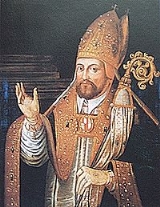
A
bishop is an ordained member of the
Christian clergy who, in certain
Christian churches, holds a position of authority.
Etymology
Bishop comes from the Greek word
episkopos , which can be generally translated as
bishop,
overseer,
superintendent,
supervisor,
the first,
leader or
foreman. From the word
episkopos are derived the English words
episcopacy,
episcopate and
episcopal.
Bishops in the New Testament
The
New Testament uses the word
episkopos five times.
- Acts of the Apostles 20:28
- Epistle to the Philippians 1:1
- First Epistle to Timothy 3:2
- Epistle to Titus 1:7
- First Epistle of Peter 2:25
Words related to
episkopos are used in two other verses. Some English Bibles translate this word as
bishop , while others, attempting to distance themselves from certain types of church hierarchy, use an alternative such as "overseer" .
The ministry of these
New Testament episkopoi, according to some writers, was not explicitly commissioned by
Jesus Christ as far as the
Gospels tell, but appears to be a natural, practical development of the church of the apostles during the first and second centuries AD. Others maintain, that the episcopal structure of the Church was present from the beginning, being a direct institution by Jesus Himself, referring to the
apostles who clearly lead the first local churches, governed and laid on hands. Supporting this latter view, the portions of the New Testament that mention
episkopoi do not appear to be ordering a new type of ministry, but giving instructions for an already existing position within the early Church. In places it appears that the position of
episkopos is often similar or the same as that of
presbyter , or elder and
priest. The Epistle to Timothy mentions
deacons in a manner that suggests that the office of deacon differs from the office of the bishop, and is subordinate to it, though it carries similar qualifications.
In the
Acts of the Apostles, episkopoi are mentioned as being
shepherds of the
flock, imagery that is still in use today. The other passages from the
New Testament describe them as stewards, leaders or administrators, and teachers. In 1 Timothy episkopoi are required to be 'the husband of but one wife'. It is unclear whether this forbids men who have married a second time in series, or
polygamists. However, it is clear that the New Testament has no prohibition against bishops being married and already having children. The most famous example of this is the
Apostle Peter himself, who was married and had children. It remains unclear however, whether a kind of celibacy or abstinence had to be practiced by these first bishops and
apostles after their appointment or
episcopal consecration.
It is interesting to note that in the second chapter of 1 Peter,
Jesus is described as 'the Shepherd and
Episkopos of your souls' .
Bishops in the Apostolic Fathers
At the turn of the first century AD, the church started to acquire a clear organisation. In the works of the Apostolic Fathers, and
Ignatius of Antioch in particular, the role of the episkopos, or bishop, became more important or, rather, already was very important and being clearly defined.
"Plainly therefore we ought to regard the bishop as the Lord Himself" — Epistle of Ignatius to the Ephesians 6:1.
"your godly bishop" — Epistle of Ignatius to the Magnesians 2:1.
"the bishop presiding after the likeness of God and the presbyters after the likeness of the council of the Apostles, with the deacons also who are most dear to me, having been entrusted with the diaconate of Jesus Christ" — Epistle of Ignatius to the Magnesians 6:1.
"Therefore as the Lord did nothing without the Father, [being united with Him], either by Himself or by the Apostles, so neither do ye anything without the bishop and the presbyters." — Epistle of Ignatius to the Magnesians 7:1.
"Be obedient to the bishop and to one another, as Jesus Christ was to the Father [according to the flesh], and as the Apostles were to Christ and to the Father, that there may be union both of flesh and of spirit." — Epistle of Ignatius to the Magnesians 13:2.
"In like manner let all men respect the deacons as Jesus Christ, even as they should respect the bishop as being a type of the Father and the presbyters as the council of God and as the college of Apostles. Apart from these there is not even the name of a church." — Epistle of Ignatius to the Trallesians 3:1.
"follow your bishop, as Jesus Christ followed the Father, and the presbytery as the Apostles; and to the deacons pay respect, as to God's commandment" — Epistle of Ignatius to the Smyrnans 8:1.
"He that honoureth the bishop is honoured of God; he that doeth aught without the knowledge of the bishop rendereth service to the devil" — Epistle of Ignatius to the Smyrnans 9:1.
It is clear that, by this period, a single bishop was expected to lead the church in each centre of Christian mission, supported by a council of presbyters with a pool of
deacons. As the Church continued to expand, new churches in important cities gained their own bishop, but churches in the regions around an important city were served by presbyters and deacons from the bishop's city church. Thus, in time, the bishop changed from being the leader of a single church confined to an urban area to being the leader of the churches of a given geographical area.
Clement of Alexandria writes about the ordination of a certain Zachæus as bishop by the imposition of
Simon Peter Bar-Jonah's hands. The words bishop and ordination are used in their technical meaning by the same Clement of Alexandria. The bishops in the
2nd century are defined also as the only clergy to whom the ordination to
priesthood and diaconate is entrusted: "a priest lays on hands, but does not ordain."
At the end of the
2nd century and the beginning of the
3rd century, we have Hippolytus of Rome describing another feature of the ministry of a bishop, which is that of the
"Spiritum primatus sacerdotii habere potestatem dimittere peccata": the primate of sacrificial priesthood and the power to forgive sins.
Bishops and civil government
The efficient infrastructure of the
Roman Empire became the template for the organization of the church in the
fourth century, particularly after the Edict of Milan. As the church moved from the shadows of privacy into the public forum it acquired land for churches, burials and clergy. In 391,
Theodosius I decreed that any land that had been confiscated from the church by Roman authorities be returned.
The most usual term for the geographical area of a bishop's authority and ministry, the
diocese, began as part of the structure of the
Roman Empire under
Diocletian. As Roman authority began to fail in the western portion of the empire, the church took over much of the civil administration. This can be clearly seen in the ministry of two
popes:
Pope Leo I in the
fifth century, and
Pope Gregory I in the
sixth century. Both of these men were statesmen and public administrators in addition to their role as Christian pastors, teachers and leaders. In the Eastern churches, latifundia entailed to a bishop's see were much less common, the state power did not collapse the way it did in the West, and thus the tendency of bishops acquiring secular power was much weaker than in the West. However, the role of Western bishops as civil authorities, often called
prince bishops, continued throughout much of the Middle Ages.
Bishops ruling temporal states
The most important of these
prince bishops was the
Pope, who ruled as monarch of the
Papal States by virtue of his title as Bishop of
Rome. His claim to this fief rested on the forged
Donation of Constantine, but in fact his authority over this kingdom in central Italy grew slowly after the collapse of Roman and
Byzantine authority in the area. The Papal States were abolished when
King Victor Emmanuel II took possession of Rome in 1870 and completed the reunification of Italy. This became a perennial source of tension between the Papacy and the government of Italy. In 1929,
Pope Pius XI made a deal with the
Fascist government of
Benito Mussolini and became the independent sovereign of the
Vatican, while giving up any rights to the rest of the former Papal States. He was recognised as an independent monarch by the Lateran Treaties, an authority the current Pope continues to hold. The only other bishop who currently is a
head of state is the
Bishop of Urgell, a Co-Prince of Andorra.
Three senior bishops served as
Electors in the
Holy Roman Empire. By the terms of the
Golden Bull of 1356, the
Archbishops of Mainz, Trier, and Cologne were made permanent electors, who chose the next
Holy Roman Emperor upon the death of his predecessor. The Archbishop of Mainz was President of the Electors and Archchancellor of Germany. Likewise, the Archbishop of Cologne was Archchancellor of
Italy, and the Archbishop of Trier was Archchancellor of
Burgundy. A number of other bishops within the Holy Roman Empire, although not being Electors, were sovereign prince-bishops in their own lands.
Bishops holding political office
As well as the Archchancellors of the
Holy Roman Empire, bishops generally served as chancellors to mediaeval monarchs, serving as head of the justiciary and chief
chaplain. The
Lord Chancellor of
England was almost always a bishop up until the dismissal of
Thomas Cardinal Wolsey by
Henry VIII. Likewise, the position of
Kanclerz in the Polish kingdom was always a bishop until the
sixteenth century.
In
France before the
French Revolution, representatives of the clergy — in practice, bishops and
abbots of the largest
monasteries — comprised the First Estate of the Estates-General, until their role was abolished during the
French Revolution.
The more senior bishops of the
Church of England continue to sit in the
House of Lords of the
Parliament of the United Kingdom, as representatives of the established church, and are known as Lords Spiritual. The Bishop of Sodor and Man, whose
diocese lies outside of the
United Kingdom, is
ex officio a member of the Legislative Council of the
Isle of Man. In the past, the Bishop of Durham, known as a
prince bishop, had extensive viceregal powers within his northern diocese — the power to mint money, collect taxes and raise an army to defend against the
Scots.
Eastern Orthodox bishops, along with all other members of the clergy, are canonically forbidden to hold political office. Occasional exceptions to this rule are tolerated when the alternative is political chaos. A recent prominent example of this was Archbishop
Makarios III of
Cyprus, who served as President of the Republic of Cyprus from 1960 to 1977.
Episcopacy during the English Civil War
During the period of the
English Civil War , the role of bishops as wielders of political power and as upholders of the established church became a matter of heated political controversy.
John Calvin formulated a doctrine of
Presbyterianism, which held that in the New Testament the offices of
presbyter and
episkopos were identical; he rejected the doctrine of apostolic succession. Calvin's follower
John Knox brought Presbyterianism to
Scotland when the Scottish church was reformed in 1560. In practice, Presbyterianism meant that committees of lay elders had a substantial voice in church government, as opposed to merely being subjects to a ruling hierarchy.
This vision of at least partial
democracy in ecclesiology paralleled the struggles between
Parliament and
the King. A body within the Puritan movement in the
Church of England sought to abolish the office of bishop and remake the Church of England along Presbyterian lines. The Martin Marprelate tracts, applying the pejorative name of
prelacy to the church hierarchy, attacked the office of bishop with satire that deeply offended
Elizabeth I and her
Archbishop of Canterbury John Whitgift. The
vestments controversy also related to this movement, seeking further reductions in church ceremony, and labelling the use of elaborate vestments as "unedifying" and even idolatrous.
King
James I, reacting against the perceived contumacy of his Presbyterian Scottish subjects, adopted "No Bishop, no King" as a slogan; he tied the hierarchical authority of the bishop to the absolute authority he sought as king, and viewed attacks on the authority of the bishops as attacks on his own authority. Matters came to a head when King
Charles I appointed
William Laud as the Archbishop of Canterbury; Laud aggressively attacked the Presbyterian movement and sought to impose the full Anglican liturgy on each church. The controversy eventually lead to Laud's
impeachment for treason by a bill of attainder in 1645, and subsequent execution. Charles also attempted to impose episcopacy on Scotland; the Scots' violent rejection of bishops and liturgical worship sparked the Bishops' Wars in 1639-1640.
During the height of Puritan power in
the Commonwealth and
the Protectorate, episcopacy was abolished in the Church of England in 1649. The Church of England remained Presbyterian until the
Restoration of
Charles II in 1660.
Bishops in Catholic, Orthodox and Anglican churches
Although many Protestant churches have rejected the place of bishops in church leadership, churches rooted in tradition continue to ordain bishops to lead the church. Bishops form the leadership in the
Roman Catholic Church, the
Eastern Orthodox Church, the Oriental Orthodox Churches, the
Anglican Communion, and the Independent Catholic Churches.
The traditional role of a bishop is as pastor of a
diocese . Dioceses vary considerably in their size of area and population. Some dioceses around the
Mediterranean Sea which were Christianized early are rather compact; whereas dioceses in areas of rapid modern growth in Christian commitment, as in some parts of
Sub-Saharan Africa,
South America and the
Far East, are much larger and more populous.
As well as traditional diocesan bishops, many churches have a well-developed structure of church leadership that involves a number of layers of authority and responsibility.
;
Archbishop:An archbishop is the bishop of an
archdiocese. This is usually a prestigious diocese with an important place in local church history. In the Roman Catholic Church, the title is purely honorific and carries no extra jurisdiction, though most archbishops are also metropolitan bishops. In most provinces of the Anglican Communion, however, an archbishop has metropolitical and primatial power.
;Metropolitan bishop:A metropolitan bishop is an archbishop in charge of an ecclesiastical province, or group of dioceses, and exercises some oversight over the other dioceses. Sometimes a metropolitan may also be the head of an autocephalous,
sui juris, or autonomous church.
;
Suffragan bishop:A
suffragan bishop is a bishop subordinate to a Metropolitan. In the
Roman Catholic Church this term is applied to all non-metropolitan bishops . In the
Anglican Communion, the term applies to a bishop who is a full-time assistant to a diocesan bishop: the Bishop of
Warwick is suffragan to the
Bishop of Coventry , though both live in
Coventry. Some Anglican suffragans are given the responsibility for a geographical area within the diocese .
;
Titular bishop:A
titular bishop is a bishop without a diocese. Rather, the bishop is head of a
titular see, which is usually an ancient city that used to have a bishop, but, for some reason or other, does not have one now. Titular bishops often serve as
auxiliary bishops. In the
Eastern Orthodox Church, bishops of modern diocese are often given a titular see alongside their modern one .
;
Auxiliary bishop:An
auxiliary bishop is a full-time assistant to a diocesan bishop . Auxiliaries are almost always
titular bishops, and are appointed as the vicar general of the diocese in which they serve. In the
Maronite Church, an auxiliary bishop is often known as a Chorbishop.
;
Coadjutor bishop:A
coadjutor bishop is a bishop who is given automatic right to succeed the incumbent diocesan bishop. The appointment of coadjutors is often seen as a means of providing for continuity of church leadership.
;Honorary assistant bishop:This title is usually applied to retired bishops who are given a general license to minister as episcopal pastors under a diocesan's oversight.
;
Primate:A primate is usually the bishop of the oldest church of a nation. Sometimes this carries jurisdiction over metropolitan bishops, but usually it is another honorific. An exarch is like a primate in the Eastern churches. The title
Presiding or
President Bishop is often used for the head of a national Anglican church, but this title is not usually associated with a particular episcopal see like a primate. The primate of the
Scottish Episcopal Church is chosen from among the diocesan bishops, and, while retaining diocesan responsibility, is called
Primus.
;Cardinal:A cardinal, although not necessarily a bishop , is usually a
primate,
patriarch or
titular bishop within the
Roman Catholic Church. Their primary duty is to elect the pope.
;Major archbishop:Major archbishops are the heads of some of the
Eastern Rite Catholic Churches. Their authority within their
sui juris church is equal to that of a patriarch, but they receive fewer ceremonial honors.
;Catholicos:Catholicoi are the heads of some of the
Eastern Orthodox and Oriental Orthodox churches, roughly similar to a Catholic major archbishop.
;
Patriarch:
Patriarchs are the heads of certain ancient autocephalous or
sui juris churches. Some of these churches call their leaders
Catholicos; the patriarch of the Orthodox Church of Alexandria, Egypt, is called
Pope. While most patriarchs in the
Roman Catholic Church have jurisdiction, all Latin Rite patriarchs, except for the
Pope, are honorary.
Bishops in all of these communions are
ordained by other bishops. Depending on the church, there need to be two or three bishops for validity or legality .
Roman Catholic doctrine holds that any bishop, even one, can validly ordain another male as a bishop.
Apart from the ordination, which is always done by other bishops, there are different methods in different churches as to the actual
choosing of a candidate for ordination as bishop. In the
Roman Catholic Church today, the Congregation for Bishops oversees the selection of new bishops with the approval of the
Pope. Most Eastern Orthodox churches allow varying amounts of more or less formalized laity and/or lower clergy influence on the choice of bishops.
More information on this topic is needed.Only a bishop can ordain a bishop,
priest, or
deacon.
In the Eastern liturgical tradition, a priest can celebrate the Divine Liturgy only with the blessing of a bishop. An
antimension signed by the bishop is kept on the altar partly as a reminder of whose altar it is and under whose
omophorion the priest at a local parish is serving.
The
Pope, in addition to being the Bishop of Rome and head of the
Roman Catholic Church, is the Patriarch of the Latin Catholic Church. Each bishop within the Latin Catholic Church is only answerable directly to the Pope and not any other bishop except to metropolitans in certain oversight instances.
In the Roman Catholic and Orthodox Churches and the Anglican Communion, the
cathedral of a diocese will have a special chair set aside for the exclusive use of the bishop. This is the bishop's
cathedra is the chair [i] or throne [i] of a bishop [i]....
, which is often called the bishop's
throne. In some other Christian denominations, other churches besides the cathedral will maintain a chair for the use of a Bishop when he visits their parish.
Catholic, Anglican, and Orthodox Christian bishops claim to be part of a continuous sequence of ordained bishops since the days of the apostles, the
apostolic succession. Since
Pope Leo XIII issued the bull
Apostolicae Curae in 1896, the Roman Catholic Church has insisted that Anglican orders are invalid because of that church's changes in the ordination rites. The Roman Catholic Church does recognize as valid ordinations done by breakaway Roman Catholic, Old Catholic, Eastern Orthodox or Oriental Orthodox bishops, and groups descended from them, so long as the people receiving the ordination conform to other canonical requirements and as long as an orthodox rite of episcopal consecration, expressing the proper functions and sacramental status of a bishop, is used; this gives rise to the phenomenon of
episcopi vagantes. Roman Catholics recognize the validity of bishops of
Eastern Orthodox, Independent Catholic,
Old Catholic, Oriental Orthodox and
Assyrian Nestorian churches.
Some provinces of the
Anglican Communion have begun ordaining women as bishops in recent decades. The first woman ordained a bishop was Barbara Clementine Harris, who was ordained to the Anglican episcopate in 1989.
Bishops in other churches
Some other churches, such as
Lutherans,
Methodists and
The Church of Jesus Christ of Latter-day Saints , also have bishops, but their roles differ significantly from the Catholic, Orthodox, and Anglican ones.
Evangelical Lutheran Church in America
In the
Evangelical Lutheran Church in America, the largest Lutheran denomination in the United States, and based largely on the
Nordic Lutheran state churches , bishops are elected by synod councils, consisting of both lay members and clergy, for a term of 6 years, which can be renewed, depending upon the local synod's "constitution" . Currently, they are responsible for, since going into ecumenical communion with the
Episcopal Church in the United States, with the ordaining of all pastors, consecrating all diaconal ministers, giving approvals to "roster" all current pastors , and upholding the teachings of Luther, the ELCA and synod constitutions. The Presiding Bishop of the ELCA, the national bishop, is elected for a single 6-year term, and handles all episcopal consecrations, as well as presiding at the General Assembly, which is held every 2 years. A similar structure exists with the Evangelical Lutheran Church in Canada , except that its bishops cover entire provinces .
United Methodist Bishops
In the
United Methodist Church, bishops serve as administrative and pastoral superintendents of the church. They are elected for life from among the clergy by vote of the delegates in regional conferences, and are consecrated by the other bishops present at the conference through the laying on of hands. Within the United Methodist Church only bishops are empowered to consecrate bishops and ordain clergy for ministry within the church. Among their most critical duties is the ordination and appointment of clergy to serve local churches as pastor, presiding at sessions of the Annual, Jurisdictional, and General Conferences, providing pastoral ministry for the clergy under their charge, and safeguarding the doctrine and discipline of the Church. In all of these areas, United Methodist Bishops function very much as Bishops in the historic meaning of the term. In each Annual Conference, United Methodist bishops serve for four year terms, and may serve up to three terms before either retirement or appointment to a new Conference. United Methodist bishops may be male or female, with the Rev. Marjorie Matthews being the first woman to be consecrated a bishop in 1980.
John Wesley consecreated Thomas Coke a "General Superintendent," and directed that
Francis Asbury also be consecrated for the
United States of America in 1784, where the
Methodist Episcopal Church first became a separate denomination apart from the
Church of England