

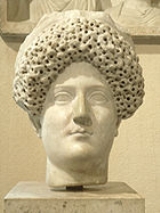
Domitia Longina

Encyclopedia
Domitia Longina was an Empress of Rome and wife to the Roman Emperor
Domitian
. She was the youngest daughter of the general and consul
Gnaeus Domitius Corbulo
. Domitia divorced her first husband Lucius Aelius Lamia in order to marry Domitian in 71. The marriage produced only one son, whose early death is believed to have been the cause of temporary rift between Domitia and her husband in 83. She became Empress of Rome upon Domitian's accession in 81, and remained so until his assassination
in 96. She is believed to have died sometime between 126 and 130.
and Cassia Longina. Through her mother (a great-great-great granddaughter of Augustus), Domitia Longina was a direct descendant of Augustus Caesar and one of the last remaining members of the Julian lineage. Her paternal aunt was Milonia Caesonia, Roman Empress to Caligula
. Her elder sister, Domitia Corbula
, married the senator Lucius Annius Vinicianus. Domitia's father Corbulo had been one of Rome's most respected Senators and generals, serving as consul
under Caligula, and conducting military campaigns in Germania
and Parthia
under Claudius
and Nero
. Following the failed Pisonian conspiracy
against Emperor Nero
in 65 however, Corbulo was disgraced when his family was brought in connection to the conspirators. Corbulo himself was forced to commit suicide
, while Annius Vicinianus and his brother Annius Pollio, were executed in the ensueing purges.
Little is known about the life of Domitia before her marriage to Domitian, but sometime before 70, Domitia was married to Lucius Aelius Plautius Lamia Aelianus
, a man of senatorial
rank.
 Following Nero's suicide on June 9, 68, the Roman Empire plunged into a year long civil war
known as the Year of the Four Emperors
, which saw the successive rise and fall of the Emperors Galba
, Otho
and Vitellius
. The crisis came to an end with the accession of Vespasian
, who re-established peace in the Empire and founded the short-lived Flavian dynasty
. In 71, Vespasian attempted to arrange a dynastic marriage between his youngest son Domitian, and the daughter of his eldest son Titus
, Julia Flavia
. By this time however, Domitian had already met and fallen in love with Domitia Longina, and managed to persuade Lamia to divorce her, so that Domitian could marry her himself. Despite its initial recklessness, the alliance was very prestigious for both families. The new marriage rehabilitated Corbulo's family, while serving the broader Flavian propaganda
of the time, which sought to diminish Vespasian's political success under the less reputable emperors of the Julio-Claudian dynasty
. Instead connections to Claudius and Britannicus were emphasised, and Nero's victims, or those otherwise disadvantaged by him, rehabilitated.
In 73, Domitia and Domitian's only attested son was born. It is not known what the boy's name was, but he died in childhood sometime between 77 and 81. During this time, Domitian's role in the Flavian government was largely ceremonial
. While his elder brother Titus shared almost equal powers with his father, Domitian was left with honours but no responsibilities. This situation remained unchanged when Titus succeeded Vespasian as Emperor on June 23, 79, leading both ancient and modern authors to suggest a mutual animosity between the two brothers. In 80, Titus granted a suffect consulship
to Domitia's former husband Aelius Lamia, according to Gsell as a personal insult against Domitian. On another occasion, when Titus urged Lamia to marry again, Lamia asked whether "he too was looking for a wife".
After barely two years in office, Titus unexpectedly died of brain fever on September 13, 81. His last words were reported to have been: "I have made but one mistake". The contemporary historian Suetonius
speculated on the possible involvement of Domitian in his brother's death, attributing his final words to a popular rumour of the time, which held that Titus had carried on an affair with Domitia Longina. However even he dismisses the story as highly unlikely.
On September 14, the Roman Senate
confirmed Domitian as Titus' successor, granting tribunician power, the office of Pontifex Maximus
, and the titles of Augustus
, and Pater Patriae
. Consequently, Domitia Longina became Empress of Rome.
upon Domitia, while their late son was deified
. Both appeared on Domitian's coinage during this time. Nevertheless, the marriage appears to have faced a significant crisis in 83. For reasons unknown, Domitian briefly exile
d Domitia, and then soon recalled her, either out of love or amidst rumours he was carrying on a relationship with his niece Julia Flavia. According to Suetonius, Domitia was exiled because of an affair with a famous actor named Paris
. When Domitian found out, he allegedly murdered Paris in the street, and promptly divorced his wife. Suetonius further adds that, once Domitia was exiled, Domitian took Julia as his mistress, who later died during a failed abortion
.
Modern historians consider this highly implausible however, noting that many of these stories were propagated by hostile senatorial authors, who condemned Domitian as a tyrant
after his death. Malicious rumours, such as those concerning Domitia's alleged infidelity, were eagerly repeated, and used to highlight the hypocrisy
of a ruler publicly preaching a return to Augustan
morals, while privately indulging in excesses and presiding over a corrupt court
. Domitian did exile his wife, but Jones argues that most likely he did so for her failure to produce an heir. Nevertheless, rumours regarding Domitia's alleged misconduct with Paris circulated even in Domitian's time, and he did not take insults directed at his marriage lightly. Not long after his accession, Aelius Lamia was put to death for the joking remarks made earlier during the reign of Titus. In 93, a son of Helvidius Priscus
was executed for having composed a farce
satirizing Domitian's separation from his wife. Stories of Domitian's affair with Julia were likely an invention of post-Domitianic writers however. She died a natural death, and was subsequently deified by Domitian.
By 84, Domitia had returned to the palace, where she lived for the remainder of Domitian's reign without incident. Little is known of Domitia's precise activities as Empress, or how much influence she wielded in Domitian's government, but it seems her role was largely limited to ceremonial appearances. From Suetonius, we know that she at least accompanied the Emperor to the theatre
, while the Jewish
writer Josephus speaks of benefits he received from her. Despite the crisis of 83, their relationship appears to have been happy. Domitian never married another woman in his life.
, and unceremoniously cremated
by his nurse Phyllis, who mingled the ashes with those of his niece Julia at the Flavian temple. The same day, he was succeeded by his friend and advisor, Marcus Cocceius Nerva
. Ancient sources have implicated Domitia in the conspiracy against Domitian, either by direct involvement, or advance awareness of the assassination. The historian Cassius Dio, writing more than a century after the assassination, claimed that Domitia chanced upon a list of courtiers Domitian intended to put to death, and passed the information to his chamberlain Parthenius
. The story is most likely apocryphal however, with Herodian
attributing a similar tale to the assassination of Commodus
. According to Jones, the evidence suggests that Domitia remained devoted to Domitian, even after his death. Twenty-five years after her husband's assassination, and despite the fact that his memory had been damned
by the Senate, she still referred to herself as "Domitia, wife of Domitian".
Sometime between 126 and 140, a temple dedicated to Domitia was erected in Gabii
. She died peacefully.
Roman Emperor
The Roman emperor was the ruler of the Roman State during the imperial period . The Romans had no single term for the office although at any given time, a given title was associated with the emperor...
Domitian
Domitian
Domitian was Roman Emperor from 81 to 96. Domitian was the third and last emperor of the Flavian dynasty.Domitian's youth and early career were largely spent in the shadow of his brother Titus, who gained military renown during the First Jewish-Roman War...
. She was the youngest daughter of the general and consul
Roman consul
A consul served in the highest elected political office of the Roman Republic.Each year, two consuls were elected together, to serve for a one-year term. Each consul was given veto power over his colleague and the officials would alternate each month...
Gnaeus Domitius Corbulo
Gnaeus Domitius Corbulo
Gnaeus Domitius Corbulo was a Roman general and a brother-in-law of the emperor Caligula.-Descent:Corbulo was born in Italy into a senatorial family...
. Domitia divorced her first husband Lucius Aelius Lamia in order to marry Domitian in 71. The marriage produced only one son, whose early death is believed to have been the cause of temporary rift between Domitia and her husband in 83. She became Empress of Rome upon Domitian's accession in 81, and remained so until his assassination
Assassination
To carry out an assassination is "to murder by a sudden and/or secret attack, often for political reasons." Alternatively, assassination may be defined as "the act of deliberately killing someone, especially a public figure, usually for hire or for political reasons."An assassination may be...
in 96. She is believed to have died sometime between 126 and 130.
Family
Domitia Longina was born sometime between 50 and 55, as the youngest daughter of Gnaeus Domitius CorbuloGnaeus Domitius Corbulo
Gnaeus Domitius Corbulo was a Roman general and a brother-in-law of the emperor Caligula.-Descent:Corbulo was born in Italy into a senatorial family...
and Cassia Longina. Through her mother (a great-great-great granddaughter of Augustus), Domitia Longina was a direct descendant of Augustus Caesar and one of the last remaining members of the Julian lineage. Her paternal aunt was Milonia Caesonia, Roman Empress to Caligula
Caligula
Caligula , also known as Gaius, was Roman Emperor from 37 AD to 41 AD. Caligula was a member of the house of rulers conventionally known as the Julio-Claudian dynasty. Caligula's father Germanicus, the nephew and adopted son of Emperor Tiberius, was a very successful general and one of Rome's most...
. Her elder sister, Domitia Corbula
Domitia Corbula
Domitia Corbula was a Roman noble woman born in 47 AD. She was the eldest daughter to Roman Consul and General Gnaeus Domitius Corbulo and Cassia Longina. Her younger sister was Domitia Longina, a future Roman Empress who would marry Emperor Domitian. Her paternal aunt was Caligula's fourth wife...
, married the senator Lucius Annius Vinicianus. Domitia's father Corbulo had been one of Rome's most respected Senators and generals, serving as consul
Roman consul
A consul served in the highest elected political office of the Roman Republic.Each year, two consuls were elected together, to serve for a one-year term. Each consul was given veto power over his colleague and the officials would alternate each month...
under Caligula, and conducting military campaigns in Germania
Germania
Germania was the Greek and Roman geographical term for the geographical regions inhabited by mainly by peoples considered to be Germani. It was most often used to refer especially to the east of the Rhine and north of the Danube...
and Parthia
Parthia
Parthia is a region of north-eastern Iran, best known for having been the political and cultural base of the Arsacid dynasty, rulers of the Parthian Empire....
under Claudius
Claudius
Claudius , was Roman Emperor from 41 to 54. A member of the Julio-Claudian dynasty, he was the son of Drusus and Antonia Minor. He was born at Lugdunum in Gaul and was the first Roman Emperor to be born outside Italy...
and Nero
Nero
Nero , was Roman Emperor from 54 to 68, and the last in the Julio-Claudian dynasty. Nero was adopted by his great-uncle Claudius to become his heir and successor, and succeeded to the throne in 54 following Claudius' death....
. Following the failed Pisonian conspiracy
Pisonian conspiracy
The conspiracy of Gaius Calpurnius Piso in AD 65 represented one of the major turning points in the reign of the Roman emperor Nero...
against Emperor Nero
Nero
Nero , was Roman Emperor from 54 to 68, and the last in the Julio-Claudian dynasty. Nero was adopted by his great-uncle Claudius to become his heir and successor, and succeeded to the throne in 54 following Claudius' death....
in 65 however, Corbulo was disgraced when his family was brought in connection to the conspirators. Corbulo himself was forced to commit suicide
Suicide
Suicide is the act of intentionally causing one's own death. Suicide is often committed out of despair or attributed to some underlying mental disorder, such as depression, bipolar disorder, schizophrenia, alcoholism, or drug abuse...
, while Annius Vicinianus and his brother Annius Pollio, were executed in the ensueing purges.
Little is known about the life of Domitia before her marriage to Domitian, but sometime before 70, Domitia was married to Lucius Aelius Plautius Lamia Aelianus
Lucius Aelius Plautius Lamia Aelianus
Lucius Aelius Plautius Lamia Aelianus was a Consul Suffectus in 80.He married firstly Domitia Longina, the daughter of Gnaeus Domitius Corbulo and wife Cassia Lepida, and had a daughter Plautia, born c. 65 or 70. The couple divorced in 70. Their daughter married Lucius Fundanius, born c. 55, son...
, a man of senatorial
Roman Senate
The Senate of the Roman Republic was a political institution in the ancient Roman Republic, however, it was not an elected body, but one whose members were appointed by the consuls, and later by the censors. After a magistrate served his term in office, it usually was followed with automatic...
rank.
Reign of Vespasian and Titus
Civil war
A civil war is a war between organized groups within the same nation state or republic, or, less commonly, between two countries created from a formerly-united nation state....
known as the Year of the Four Emperors
Year of the Four Emperors
The Year of the Four Emperors was a year in the history of the Roman Empire, AD 69, in which four emperors ruled in a remarkable succession. These four emperors were Galba, Otho, Vitellius, and Vespasian....
, which saw the successive rise and fall of the Emperors Galba
Galba
Galba , was Roman Emperor for seven months from 68 to 69. Galba was the governor of Hispania Tarraconensis, and made a bid for the throne during the rebellion of Julius Vindex...
, Otho
Otho
Otho , was Roman Emperor for three months, from 15 January to 16 April 69. He was the second emperor of the Year of the four emperors.- Birth and lineage :...
and Vitellius
Vitellius
Vitellius , was Roman Emperor for eight months, from 16 April to 22 December 69. Vitellius was acclaimed Emperor following the quick succession of the previous emperors Galba and Otho, in a year of civil war known as the Year of the Four Emperors...
. The crisis came to an end with the accession of Vespasian
Vespasian
Vespasian , was Roman Emperor from 69 AD to 79 AD. Vespasian was the founder of the Flavian dynasty, which ruled the Empire for a quarter century. Vespasian was descended from a family of equestrians, who rose into the senatorial rank under the Emperors of the Julio-Claudian dynasty...
, who re-established peace in the Empire and founded the short-lived Flavian dynasty
Flavian dynasty
The Flavian dynasty was a Roman Imperial Dynasty, which ruled the Roman Empire between 69 and 96 AD, encompassing the reigns of Vespasian , and his two sons Titus and Domitian . The Flavians rose to power during the civil war of 69, known as the Year of the Four Emperors...
. In 71, Vespasian attempted to arrange a dynastic marriage between his youngest son Domitian, and the daughter of his eldest son Titus
Titus
Titus , was Roman Emperor from 79 to 81. A member of the Flavian dynasty, Titus succeeded his father Vespasian upon his death, thus becoming the first Roman Emperor to come to the throne after his own father....
, Julia Flavia
Julia Flavia
Flavia Julia Titi was the daughter and only child to Emperor Titus from his second marriage to the well-connected Marcia Furnilla. Her parents divorced when Julia was an infant, due to her mother's family being connected to the opponents of Roman Emperor Nero...
. By this time however, Domitian had already met and fallen in love with Domitia Longina, and managed to persuade Lamia to divorce her, so that Domitian could marry her himself. Despite its initial recklessness, the alliance was very prestigious for both families. The new marriage rehabilitated Corbulo's family, while serving the broader Flavian propaganda
Propaganda
Propaganda is a form of communication that is aimed at influencing the attitude of a community toward some cause or position so as to benefit oneself or one's group....
of the time, which sought to diminish Vespasian's political success under the less reputable emperors of the Julio-Claudian dynasty
Julio-Claudian Dynasty
The Julio-Claudian dynasty normally refers to the first five Roman Emperors: Augustus, Tiberius, Caligula , Claudius, and Nero, or the family to which they belonged; they ruled the Roman Empire from its formation, in the second half of the 1st century BC, until AD 68, when the last of the line,...
. Instead connections to Claudius and Britannicus were emphasised, and Nero's victims, or those otherwise disadvantaged by him, rehabilitated.
In 73, Domitia and Domitian's only attested son was born. It is not known what the boy's name was, but he died in childhood sometime between 77 and 81. During this time, Domitian's role in the Flavian government was largely ceremonial
Ceremony
A ceremony is an event of ritual significance, performed on a special occasion. The word may be of Etruscan origin.-Ceremonial occasions:A ceremony may mark a rite of passage in a human life, marking the significance of, for example:* birth...
. While his elder brother Titus shared almost equal powers with his father, Domitian was left with honours but no responsibilities. This situation remained unchanged when Titus succeeded Vespasian as Emperor on June 23, 79, leading both ancient and modern authors to suggest a mutual animosity between the two brothers. In 80, Titus granted a suffect consulship
Roman consul
A consul served in the highest elected political office of the Roman Republic.Each year, two consuls were elected together, to serve for a one-year term. Each consul was given veto power over his colleague and the officials would alternate each month...
to Domitia's former husband Aelius Lamia, according to Gsell as a personal insult against Domitian. On another occasion, when Titus urged Lamia to marry again, Lamia asked whether "he too was looking for a wife".
After barely two years in office, Titus unexpectedly died of brain fever on September 13, 81. His last words were reported to have been: "I have made but one mistake". The contemporary historian Suetonius
Suetonius
Gaius Suetonius Tranquillus, commonly known as Suetonius , was a Roman historian belonging to the equestrian order in the early Imperial era....
speculated on the possible involvement of Domitian in his brother's death, attributing his final words to a popular rumour of the time, which held that Titus had carried on an affair with Domitia Longina. However even he dismisses the story as highly unlikely.
On September 14, the Roman Senate
Roman Senate
The Senate of the Roman Republic was a political institution in the ancient Roman Republic, however, it was not an elected body, but one whose members were appointed by the consuls, and later by the censors. After a magistrate served his term in office, it usually was followed with automatic...
confirmed Domitian as Titus' successor, granting tribunician power, the office of Pontifex Maximus
Pontifex Maximus
The Pontifex Maximus was the high priest of the College of Pontiffs in ancient Rome. This was the most important position in the ancient Roman religion, open only to patricians until 254 BC, when a plebeian first occupied this post...
, and the titles of Augustus
Augustus (honorific)
Augustus , Latin for "majestic," "the increaser," or "venerable", was an Ancient Roman title, which was first held by Gaius Julius Caesar Augustus , and subsequently came to be considered one of the titles of what are now known as the Roman Emperors...
, and Pater Patriae
Pater Patriae
Pater Patriae , also seen as Parens Patriae, is a Latin honorific meaning "Father of the Country," or more literally, "Father of the Fatherland".- Roman history :...
. Consequently, Domitia Longina became Empress of Rome.
Empress of Rome
Shortly following his accession as Emperor, Domitian bestowed the honorific title of AugustaAugusta (honorific)
Augusta was the imperial honorific title of empresses. It was given to the women of the Roman and Byzantine imperial families. In the third century, Augustae could also receive the titles of Mater castrorum and Mater Patriae .The title implied the greatest prestige, with the Augustae able to...
upon Domitia, while their late son was deified
Apotheosis
Apotheosis is the glorification of a subject to divine level. The term has meanings in theology, where it refers to a belief, and in art, where it refers to a genre.In theology, the term apotheosis refers to the idea that an individual has been raised to godlike stature...
. Both appeared on Domitian's coinage during this time. Nevertheless, the marriage appears to have faced a significant crisis in 83. For reasons unknown, Domitian briefly exile
Exile
Exile means to be away from one's home , while either being explicitly refused permission to return and/or being threatened with imprisonment or death upon return...
d Domitia, and then soon recalled her, either out of love or amidst rumours he was carrying on a relationship with his niece Julia Flavia. According to Suetonius, Domitia was exiled because of an affair with a famous actor named Paris
Paris (actor under Domitian)
Paris was an actor in Rome in the 1st century AD.Born in Egypt, he came to Rome in the reign of Domitian, where his skills as a pantomimus won him popular favour, noblewomen as lovers, influence within the imperial court and the power to promote his favourites within the court...
. When Domitian found out, he allegedly murdered Paris in the street, and promptly divorced his wife. Suetonius further adds that, once Domitia was exiled, Domitian took Julia as his mistress, who later died during a failed abortion
Abortion
Abortion is defined as the termination of pregnancy by the removal or expulsion from the uterus of a fetus or embryo prior to viability. An abortion can occur spontaneously, in which case it is usually called a miscarriage, or it can be purposely induced...
.
Modern historians consider this highly implausible however, noting that many of these stories were propagated by hostile senatorial authors, who condemned Domitian as a tyrant
Tyrant
A tyrant was originally one who illegally seized and controlled a governmental power in a polis. Tyrants were a group of individuals who took over many Greek poleis during the uprising of the middle classes in the sixth and seventh centuries BC, ousting the aristocratic governments.Plato and...
after his death. Malicious rumours, such as those concerning Domitia's alleged infidelity, were eagerly repeated, and used to highlight the hypocrisy
Hypocrisy
Hypocrisy is the state of pretending to have virtues, moral or religious beliefs, principles, etc., that one does not actually have. Hypocrisy involves the deception of others and is thus a kind of lie....
of a ruler publicly preaching a return to Augustan
Augustus
Augustus ;23 September 63 BC – 19 August AD 14) is considered the first emperor of the Roman Empire, which he ruled alone from 27 BC until his death in 14 AD.The dates of his rule are contemporary dates; Augustus lived under two calendars, the Roman Republican until 45 BC, and the Julian...
morals, while privately indulging in excesses and presiding over a corrupt court
Court
A court is a form of tribunal, often a governmental institution, with the authority to adjudicate legal disputes between parties and carry out the administration of justice in civil, criminal, and administrative matters in accordance with the rule of law...
. Domitian did exile his wife, but Jones argues that most likely he did so for her failure to produce an heir. Nevertheless, rumours regarding Domitia's alleged misconduct with Paris circulated even in Domitian's time, and he did not take insults directed at his marriage lightly. Not long after his accession, Aelius Lamia was put to death for the joking remarks made earlier during the reign of Titus. In 93, a son of Helvidius Priscus
Helvidius Priscus
Helvidius Priscus, Stoic philosopher and statesman, lived during the reigns of Nero, Galba, Otho, Vitellius and Vespasian.Like his father-in-law, Thrasea Paetus, he was distinguished for his ardent and courageous republicanism. Although he repeatedly offended his rulers, he held several high offices...
was executed for having composed a farce
Farce
In theatre, a farce is a comedy which aims at entertaining the audience by means of unlikely, extravagant, and improbable situations, disguise and mistaken identity, verbal humour of varying degrees of sophistication, which may include word play, and a fast-paced plot whose speed usually increases,...
satirizing Domitian's separation from his wife. Stories of Domitian's affair with Julia were likely an invention of post-Domitianic writers however. She died a natural death, and was subsequently deified by Domitian.
By 84, Domitia had returned to the palace, where she lived for the remainder of Domitian's reign without incident. Little is known of Domitia's precise activities as Empress, or how much influence she wielded in Domitian's government, but it seems her role was largely limited to ceremonial appearances. From Suetonius, we know that she at least accompanied the Emperor to the theatre
Amphitheatre
An amphitheatre is an open-air venue used for entertainment and performances.There are two similar, but distinct, types of structure for which the word "amphitheatre" is used: Ancient Roman amphitheatres were large central performance spaces surrounded by ascending seating, and were commonly used...
, while the Jewish
Judaism
Judaism ) is the "religion, philosophy, and way of life" of the Jewish people...
writer Josephus speaks of benefits he received from her. Despite the crisis of 83, their relationship appears to have been happy. Domitian never married another woman in his life.
Later years
On September 18, 96, Domitian was assassinated in a palace conspiracy organized by court officials. His body was carried away on a common bierBier
A bier is a stand on which a corpse, coffin or casket containing a corpse, is placed to lie in state or to be carried to the grave.In Christian burial, the bier is often placed in the centre of the nave with candles surrounding it, and remains in place during the funeral.The bier is a flat frame,...
, and unceremoniously cremated
Cremation
Cremation is the process of reducing bodies to basic chemical compounds such as gasses and bone fragments. This is accomplished through high-temperature burning, vaporization and oxidation....
by his nurse Phyllis, who mingled the ashes with those of his niece Julia at the Flavian temple. The same day, he was succeeded by his friend and advisor, Marcus Cocceius Nerva
Nerva
Nerva , was Roman Emperor from 96 to 98. Nerva became Emperor at the age of sixty-five, after a lifetime of imperial service under Nero and the rulers of the Flavian dynasty. Under Nero, he was a member of the imperial entourage and played a vital part in exposing the Pisonian conspiracy of 65...
. Ancient sources have implicated Domitia in the conspiracy against Domitian, either by direct involvement, or advance awareness of the assassination. The historian Cassius Dio, writing more than a century after the assassination, claimed that Domitia chanced upon a list of courtiers Domitian intended to put to death, and passed the information to his chamberlain Parthenius
Parthenius
Parthenius may refer to:* Parthenius of Nicaea , Greek grammarian and poet* Saint Parthenius , Armenian saint and martyr from Rome, who suffered martyrdom during the reign of Decius....
. The story is most likely apocryphal however, with Herodian
Herodian
Herodian or Herodianus of Syria was a minor Roman civil servant who wrote a colourful history in Greek titled History of the Empire from the Death of Marcus in eight books covering the years 180 to 238. His work is not entirely reliable although his relatively unbiased account of Elagabalus is...
attributing a similar tale to the assassination of Commodus
Commodus
Commodus , was Roman Emperor from 180 to 192. He also ruled as co-emperor with his father Marcus Aurelius from 177 until his father's death in 180. His name changed throughout his reign; see changes of name for earlier and later forms. His accession as emperor was the first time a son had succeeded...
. According to Jones, the evidence suggests that Domitia remained devoted to Domitian, even after his death. Twenty-five years after her husband's assassination, and despite the fact that his memory had been damned
Damnatio memoriae
Damnatio memoriae is the Latin phrase literally meaning "condemnation of memory" in the sense of a judgment that a person must not be remembered. It was a form of dishonor that could be passed by the Roman Senate upon traitors or others who brought discredit to the Roman State...
by the Senate, she still referred to herself as "Domitia, wife of Domitian".
Sometime between 126 and 140, a temple dedicated to Domitia was erected in Gabii
Gabii
Gabii was an ancient city of Latium, located due east of Rome along the Via Praenestina, which was in early times known as the Via Gabina....
. She died peacefully.
Ancestry
In later arts
- The Roman ActorThe Roman ActorThe Roman Actor is a Caroline era stage play, a tragedy written by Philip Massinger; it was first performed in 1626, and first published in 1629...
, a Caroline eraCaroline eraThe Caroline era refers to the era in English and Scottish history during the Stuart period that coincided with the reign of Charles I , Carolus being Latin for Charles...
stage play, written by Philip MassingerPhilip MassingerPhilip Massinger was an English dramatist. His finely plotted plays, including A New Way to Pay Old Debts, The City Madam and The Roman Actor, are noted for their satire and realism, and their political and social themes.-Early life:The son of Arthur Massinger or Messenger, he was baptized at St....
, concerning the alleged affair between Domitia Longina and Paris. - Domitia and Domitian (2000), a historical novel by David Corson based on historical works by Brian Jones and Pat Southern, revolving around the titular characters.
- Daughters of Rome * (2011) Kate Quinn, historical fiction novel based on the lives of Domitia and her 3 cousins during the Year of the Four Emperorers
Primary sources
- Cassius Dio, Roman History Book 67, English translation
- SuetoniusSuetoniusGaius Suetonius Tranquillus, commonly known as Suetonius , was a Roman historian belonging to the equestrian order in the early Imperial era....
, The Lives of Twelve Caesars, Life of Domitian, Latin text with English translation - TacitusTacitusPublius Cornelius Tacitus was a senator and a historian of the Roman Empire. The surviving portions of his two major works—the Annals and the Histories—examine the reigns of the Roman Emperors Tiberius, Claudius, Nero and those who reigned in the Year of the Four Emperors...
, Histories, English translation