

Iznik

Encyclopedia
İznik is a city in Turkey
which is primarily known as the site of the First
and Second
Councils of Nicaea, the first and seventh Ecumenical council
s in the early history of the Church, the Nicene Creed
, and as the capital city of the Empire of Nicaea
. It served as the interim capital city of the Byzantine Empire
between 1204 and 1261, following the Fourth Crusade
in 1204, until the recapture of Constantinople
by the Byzantines in 1261.
The city lies in a fertile basin at the eastern end of Lake İznik
, bounded by ranges of hills to the north and south. It is situated with its west wall rising from the lake itself, providing both protection from siege from that direction, as well as a source of supplies which would be difficult to cut off. The lake is large enough that it cannot be blockaded from the land easily, and the city was large enough to make any attempt to reach the harbour from shore-based siege weapons very difficult.
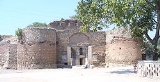
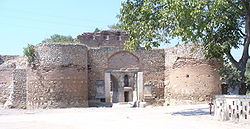
The city is surrounded on all sides by 5 km (3 mi) of walls about 10 m (33 ft) high. These are in turn surrounded by a double ditch on the land portions, and also include over 100 towers in various locations. Large gates on the three landbound sides of the walls provide the only entrance to the city.
Today the walls are pierced in many places for roads, but much of the early work survives and as a result it is a major tourist destination. The town has a population of about 15,000. It has been a district center of Bursa Province
since 1930. It was in the district of Kocaeli
between 1923–1927 and was a township of Yenişehir (bounded to Bilecik before 1926) district between 1927-1930.
 The place is said to have been colonized by Bottiaea
ns, and to have originally borne the name of Ancore (Steph. B.
s. v.) or Helicore (Geogr. Min. p. 40, ed. Hudson); but it was subsequently destroyed by the Mysians
. A few years after the death of Alexander the Great, Macedon
ian king Antigonus
— who had taken control of much of Asia Minor
upon the death of Alexander (under whom Antigonus had served as a general) — probably after his victory over Eumenes
, in 316 BC, rebuilt the town, and called it, after himself, Antigoneia . (Steph. B. l. c.; Eustath. ad Horn. II. ii. 863) Several other of Alexander's generals (known together as the Diadochi
(Latin; original Greek Διάδοχοι/Diadokhoi
"successors")) later conspired to remove Antigonus, and after defeating him the area was given to Thessalian
general Lysimachus
(Lysimakhos) (circa 355 BC-281 BC) in 301 BC as his share of the lands. He renamed it Nicaea (Greek: , also transliterated
as Nikaia or Nicæa; see also List of traditional Greek place names), in tribute to his wife Nicaea, a daughter of Antipater
. (Steph. B., Eustath., Strab., ll. cc.) According to another account (Memnon, ap. Phot. Cod. 224. p. 233, ed. Bekker), Nicaea was founded by men from Nicaea
near Thermopylae
, who had served in the army of Alexander the Great. The town was built with great regularity, in the form of a square, measuring 16 stadia in circumference; it had four gates, and all its streets intersected one another at right angles, so that from a monument in the centre all the four gates could be seen. (Strabo
xii. pp. 565 et seq.) This monument stood in the gymnasium, which was destroyed by fire, but was restored with increased magnificence by the younger Pliny
(Epist. x. 48), when he was governor of Bithynia
.
The city was built on an important crossroads between Galatia
and Phrygia
, and thus saw steady trade. Soon after the time of Lysimachus, Nicaea became a city of great importance, and the kings of Bithynia, whose era begins in 288 BC with Zipoetes, often resided at Nicaea. It has already been mentioned that in the time of Strabo it is called the metropolis of Bithynia, an honour which is also assigned to it on some coins, though in later times it was enjoyed by Nicomedia
. The two cities, in fact, kept up a long and vehement dispute about the precedence, and the 38th oration of Dio Chrysostom
us was expressly composed to settle the dispute. From this oration, it appears that Nicomedia alone had a right to the title of metropolis, but both were the first cities of the country.
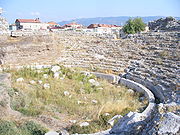 The younger Pliny makes frequent mention of Nicaea and its public buildings, which he undertook to restore when governor of Bithynia. (Epist. x. 40, 48, etc.) It was the birthplace of the astronomer Hipparchus
(ca. 194 BC), the mathematician and astronomer Sporus
(ca. 240) and the historian Dio Cassius
(ca. 165). It was the death-place of the comedian Philistion. The numerous coins of Nicaea which still exist attest the interest taken in the city by the emperors, as well as its attachment to the rulers; many of them commemorate great festivals celebrated there in honour of gods and emperors, as Olympia, Isthmia, Dionysia, Pythia, Commodia, Severia, Philadelphia, etc. Throughout the imperial period, Nicaea remained an important town; for its situation was particularly favourable, being only 40 km (25 mi) distant from Prusa
(Pliny
v. 32), and 70 km (43 mi) from Constantinople
. (It. Ant.
p. 141.) When Constantinople became the capital of the Eastern Empire, Nicaea did not lose in importance; for its present walls, which were erected during the last period of the Empire, enclose a much greater space than that ascribed to the place in the time of Strabo. Much of the existing architecture and defensive works date to this time, early 4th century.
Nicaea suffered much from earthquakes in 358, 362 and 368; after the last of which, it was restored by the emperor Valens
. During the Middle Ages it was for a long time a strong bulwark of the Byzantine
emperors against the Turks
.
 In the reign of Constantine, 325, the celebrated First Council of Nicaea
was held there against the Arian
heresy
, and the prelates there defined more clearly the concept of the Trinity
and drew up the Nicene Creed
. The doctrine
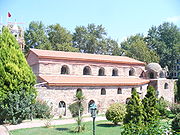
of the Trinity was finalized at the Council of Constantinople in 381 AD which expressly included the Holy Ghost as equal to the Father and the Son. The first Nicene Council was probably held in what would become the now ruined mosque of Orchan. The church of Hagia Sophia was built by Justinian I
in the middle of the city in the 6th century (modelled after the larger Hagia Sophia
in Constantinople), and it was there that the Second Council of Nicaea
met in 787 to discuss the issues of iconography
.
at Byzantium's request in 1095, and armies from Europe along with smaller units from Byzantium converged on the city in 1097. After the European armies laid siege to the city
and penetrated the walls, they were surprised to awake the next morning to see the Roman flags of Emperor Alexios I Komnenos
flying over the city. Robbed of their chance to plunder the city, the crusaders and Byzantines were soon at odds. In the peace which was afterwards concluded the city was ceded to the Byzantines.
The 12th century saw a period of relative stability and prosperity at Nicaea. The Komnenian emperors Alexios, John and Manuel campaigned extensively to strengthen the Byzantine presence in Asia Minor. Major fortifications were constructed across the region, especially by John and Manuel, which helped to protect the city and its fertile hinterland. There were also several military bases and colonies in the area, for example the one at Rhyndakos in Bithynia, where the emperor John spent a year training his troops in preparation for campaigns in southern Asia Minor.
Constantinople later fell in 1204 to the European armies in the Fourth Crusade
, who set up the Latin Empire
of Constantinople. They had poor control over the area, and a number of Byzantine successor states sprang up as well, including Epirus
and Trebizond
. However it was Nicaea that formed the core of the successor Byzantine Empire after Theodore Lascaris (who became Theodore I) founded the Empire of Nicaea
(western Asia Minor) there. Building on the strong military infrastructure built up in the area over the last century, Theodore I and his successors slowly expanded their domains, and in 1259 Michael VIII Palaeologus usurped the throne. He captured Constantinople from the Latins in 1261, and restored the Byzantine Empire.
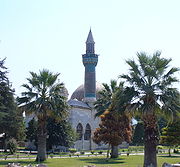
In 1331, the city was conquered and incorporated into the Ottoman Empire
by Orhan I
. Many of its public buildings were destroyed, and the materials were used by the Ottomans
in erecting their mosques and other edifices. With the fall of Constantinople
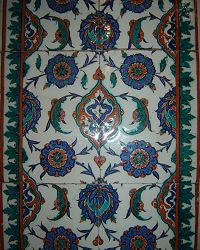
in 1453, the town lost a great degree of its importance, but later became a major center with the creation of a local faïence pottery
-making industry in the 17th century (known as the İznik Çini, Çin meaning China in – Chinese porcelain stood in great favour with the Sultans.) İznik tiles were used to decorate many of the mosques in Istanbul
designed by Mimar Sinan. However, this industry also moved to Istanbul, and İznik became a mainly agricultural minor town in the area when a major railway bypassed it in the 19th century. Currently the style of pottery referred to as the İznik Çini is to some extent produced locally, but mainly in Kütahya
, where the quality – which was in decline – has been restored to its former glory.
The Church of the Dormition, the principal church of Nicaea, was probably the most important Byzantine cathedral in Asia Minor
. It was decorated with very fine mosaics from the 9th century. The church was destroyed during the Greco-Turkish War (1919–1922).
Excavations are underway in the Ottoman kilns where the historic İznik tileware were made. The Hagia Sophia is also undergoing restoration.
İznik remains a titular see
of the Roman Catholic Church
, Nicaenus; the seat has been vacant since the death of its last bishop in 1976. It is also a titular metropolitan
see of the Ecumenical Patriarchate of Constantinople
. The incumbent 2001–2010 was the former Archbishop of Karelia and All Finland
, Metropolitan Johannes (Rinne)
.
Turkey
Turkey , known officially as the Republic of Turkey , is a Eurasian country located in Western Asia and in East Thrace in Southeastern Europe...
which is primarily known as the site of the First
First Council of Nicaea
The First Council of Nicaea was a council of Christian bishops convened in Nicaea in Bithynia by the Roman Emperor Constantine I in AD 325...
and Second
Second Council of Nicaea
The Second Council of Nicaea is regarded as the Seventh Ecumenical Council by Roman Catholics, Eastern Orthodox, Eastern Catholic Churches and various other Western Christian groups...
Councils of Nicaea, the first and seventh Ecumenical council
Ecumenical council
An ecumenical council is a conference of ecclesiastical dignitaries and theological experts convened to discuss and settle matters of Church doctrine and practice....
s in the early history of the Church, the Nicene Creed
Nicene Creed
The Nicene Creed is the creed or profession of faith that is most widely used in Christian liturgy. It is called Nicene because, in its original form, it was adopted in the city of Nicaea by the first ecumenical council, which met there in the year 325.The Nicene Creed has been normative to the...
, and as the capital city of the Empire of Nicaea
Empire of Nicaea
The Empire of Nicaea was the largest of the three Byzantine Greek successor states founded by the aristocracy of the Byzantine Empire that fled after Constantinople was occupied by Western European and Venetian forces during the Fourth Crusade...
. It served as the interim capital city of the Byzantine Empire
Byzantine Empire
The Byzantine Empire was the Eastern Roman Empire during the periods of Late Antiquity and the Middle Ages, centred on the capital of Constantinople. Known simply as the Roman Empire or Romania to its inhabitants and neighbours, the Empire was the direct continuation of the Ancient Roman State...
between 1204 and 1261, following the Fourth Crusade
Fourth Crusade
The Fourth Crusade was originally intended to conquer Muslim-controlled Jerusalem by means of an invasion through Egypt. Instead, in April 1204, the Crusaders of Western Europe invaded and conquered the Christian city of Constantinople, capital of the Eastern Roman Empire...
in 1204, until the recapture of Constantinople
Constantinople
Constantinople was the capital of the Roman, Eastern Roman, Byzantine, Latin, and Ottoman Empires. Throughout most of the Middle Ages, Constantinople was Europe's largest and wealthiest city.-Names:...
by the Byzantines in 1261.
The city lies in a fertile basin at the eastern end of Lake İznik
Lake Iznik
Lake İznik is a lake in the Bursa Province in Turkey. It is located at around and has an area of 290.00 km² and maximum depth of about 80 m. Its ancient name "Ascanius" is derived from Ashkuza, the Assyrian word for the Scythians.-History:...
, bounded by ranges of hills to the north and south. It is situated with its west wall rising from the lake itself, providing both protection from siege from that direction, as well as a source of supplies which would be difficult to cut off. The lake is large enough that it cannot be blockaded from the land easily, and the city was large enough to make any attempt to reach the harbour from shore-based siege weapons very difficult.
The city is surrounded on all sides by 5 km (3 mi) of walls about 10 m (33 ft) high. These are in turn surrounded by a double ditch on the land portions, and also include over 100 towers in various locations. Large gates on the three landbound sides of the walls provide the only entrance to the city.
Today the walls are pierced in many places for roads, but much of the early work survives and as a result it is a major tourist destination. The town has a population of about 15,000. It has been a district center of Bursa Province
Bursa Province
Bursa Province is a province in western Turkey, along the Sea of Marmara. Its adjacent provinces are Balıkesir to the west, Kütahya to the south, Bilecik and Sakarya to the east, Kocaeli to the northeast and Yalova to the north. The province has an area of 11,043 km2 and a population of 3,187,000...
since 1930. It was in the district of Kocaeli
Izmit
İzmit is a city in Turkey, administrative center of Kocaeli Province as well as the Kocaeli Metropolitan Municipality. It is located at the Gulf of İzmit in the Sea of Marmara, about east of Istanbul, on the northwestern part of Anatolia. The city center has a population of 294.875...
between 1923–1927 and was a township of Yenişehir (bounded to Bilecik before 1926) district between 1927-1930.
Early history, Roman and Byzantine Empires
Bottiaea
Bottiaea was a geographical region of ancient Macedonia and an administrative district of the Macedonian Kingdom. It was previously inhabited by the Bottiaeans, a people of uncertain origin, later expelled by the Macedonians into Bottike...
ns, and to have originally borne the name of Ancore (Steph. B.
Stephanus of Byzantium
Stephen of Byzantium, also known as Stephanus Byzantinus , was the author of an important geographical dictionary entitled Ethnica...
s. v.) or Helicore (Geogr. Min. p. 40, ed. Hudson); but it was subsequently destroyed by the Mysians
Mysians
Mysians were the inhabitants of Mysia, a region in northwestern Asia Minor.-Origins according to ancient authors:Their first mention is by Homer, in his list of Trojans allies in the Iliad, and according to whom the Mysians fought in the Trojan War on the side of Troy, under the command of Chromis...
. A few years after the death of Alexander the Great, Macedon
Macedon
Macedonia or Macedon was an ancient kingdom, centered in the northeastern part of the Greek peninsula, bordered by Epirus to the west, Paeonia to the north, the region of Thrace to the east and Thessaly to the south....
ian king Antigonus
Antigonus I Monophthalmus
Antigonus I Monophthalmus , son of Philip from Elimeia, was a Macedonian nobleman, general, and satrap under Alexander the Great. During his early life he served under Philip II, and he was a major figure in the Wars of the Diadochi after Alexander's death, declaring himself king in 306 BC and...
— who had taken control of much of Asia Minor
Asia Minor
Asia Minor is a geographical location at the westernmost protrusion of Asia, also called Anatolia, and corresponds to the western two thirds of the Asian part of Turkey...
upon the death of Alexander (under whom Antigonus had served as a general) — probably after his victory over Eumenes
Eumenes
Eumenes of Cardia was a Thracian general and scholar. He participated in the wars of the Diadochi as a supporter of the Macedonian Argead royal house.-Career:...
, in 316 BC, rebuilt the town, and called it, after himself, Antigoneia . (Steph. B. l. c.; Eustath. ad Horn. II. ii. 863) Several other of Alexander's generals (known together as the Diadochi
Diadochi
The Diadochi were the rival generals, family and friends of Alexander the Great who fought for the control of Alexander's empire after his death in 323 BC...
(Latin; original Greek Διάδοχοι/Diadokhoi
Diadochi
The Diadochi were the rival generals, family and friends of Alexander the Great who fought for the control of Alexander's empire after his death in 323 BC...
"successors")) later conspired to remove Antigonus, and after defeating him the area was given to Thessalian
Thessaly
Thessaly is a traditional geographical region and an administrative region of Greece, comprising most of the ancient region of the same name. Before the Greek Dark Ages, Thessaly was known as Aeolia, and appears thus in Homer's Odyssey....
general Lysimachus
Lysimachus
Lysimachus was a Macedonian officer and diadochus of Alexander the Great, who became a basileus in 306 BC, ruling Thrace, Asia Minor and Macedon.-Early Life & Career:...
(Lysimakhos) (circa 355 BC-281 BC) in 301 BC as his share of the lands. He renamed it Nicaea (Greek: , also transliterated
Transliteration
Transliteration is a subset of the science of hermeneutics. It is a form of translation, and is the practice of converting a text from one script into another...
as Nikaia or Nicæa; see also List of traditional Greek place names), in tribute to his wife Nicaea, a daughter of Antipater
Antipater
Antipater was a Macedonian general and a supporter of kings Philip II of Macedon and Alexander the Great. In 320 BC, he became Regent of all of Alexander's Empire. Antipater was one of the sons of a Macedonian nobleman called Iollas or Iolaus and his family were distant collateral relatives to the...
. (Steph. B., Eustath., Strab., ll. cc.) According to another account (Memnon, ap. Phot. Cod. 224. p. 233, ed. Bekker), Nicaea was founded by men from Nicaea
Nicaea (Locris)
Nicaea or Nikaia , was an ancient fortress of the Locri Epicnemidii, situated upon the sea, and close to the pass of Thermopylae. It is described by Aeschines as one of the places which commanded the pass. It was the first Locrian town after Alpenos, the latter being at the very entrance of the pass...
near Thermopylae
Thermopylae
Thermopylae is a location in Greece where a narrow coastal passage existed in antiquity. It derives its name from its hot sulphur springs. "Hot gates" is also "the place of hot springs and cavernous entrances to Hades"....
, who had served in the army of Alexander the Great. The town was built with great regularity, in the form of a square, measuring 16 stadia in circumference; it had four gates, and all its streets intersected one another at right angles, so that from a monument in the centre all the four gates could be seen. (Strabo
Strabo
Strabo, also written Strabon was a Greek historian, geographer and philosopher.-Life:Strabo was born to an affluent family from Amaseia in Pontus , a city which he said was situated the approximate equivalent of 75 km from the Black Sea...
xii. pp. 565 et seq.) This monument stood in the gymnasium, which was destroyed by fire, but was restored with increased magnificence by the younger Pliny
Pliny the Younger
Gaius Plinius Caecilius Secundus, born Gaius Caecilius or Gaius Caecilius Cilo , better known as Pliny the Younger, was a lawyer, author, and magistrate of Ancient Rome. Pliny's uncle, Pliny the Elder, helped raise and educate him...
(Epist. x. 48), when he was governor of Bithynia
Bithynia
Bithynia was an ancient region, kingdom and Roman province in the northwest of Asia Minor, adjoining the Propontis, the Thracian Bosporus and the Euxine .-Description:...
.
The city was built on an important crossroads between Galatia
Galatia
Ancient Galatia was an area in the highlands of central Anatolia in modern Turkey. Galatia was named for the immigrant Gauls from Thrace , who settled here and became its ruling caste in the 3rd century BC, following the Gallic invasion of the Balkans in 279 BC. It has been called the "Gallia" of...
and Phrygia
Phrygia
In antiquity, Phrygia was a kingdom in the west central part of Anatolia, in what is now modern-day Turkey. The Phrygians initially lived in the southern Balkans; according to Herodotus, under the name of Bryges , changing it to Phruges after their final migration to Anatolia, via the...
, and thus saw steady trade. Soon after the time of Lysimachus, Nicaea became a city of great importance, and the kings of Bithynia, whose era begins in 288 BC with Zipoetes, often resided at Nicaea. It has already been mentioned that in the time of Strabo it is called the metropolis of Bithynia, an honour which is also assigned to it on some coins, though in later times it was enjoyed by Nicomedia
Nicomedia
Nicomedia was an ancient city in what is now Turkey, founded in 712/11 BC as a Megarian colony and was originally known as Astacus . After being destroyed by Lysimachus, it was rebuilt by Nicomedes I of Bithynia in 264 BC under the name of Nicomedia, and has ever since been one of the most...
. The two cities, in fact, kept up a long and vehement dispute about the precedence, and the 38th oration of Dio Chrysostom
Dio Chrysostom
Dio Chrysostom , Dion of Prusa or Dio Cocceianus was a Greek orator, writer, philosopher and historian of the Roman Empire in the 1st century. Eighty of his Discourses are extant, as well as a few Letters and a funny mock essay In Praise of Hair, as well as a few other fragments...
us was expressly composed to settle the dispute. From this oration, it appears that Nicomedia alone had a right to the title of metropolis, but both were the first cities of the country.
Hipparchus
Hipparchus, the common Latinization of the Greek Hipparkhos, can mean:* Hipparchus, the ancient Greek astronomer** Hipparchic cycle, an astronomical cycle he created** Hipparchus , a lunar crater named in his honour...
(ca. 194 BC), the mathematician and astronomer Sporus
Sporus of Nicaea
Sporus of Nicaea was a Greek mathematician and astronomer, , probably Nicaea , ancient district Bithynia, in province Bursa, in modern day Turkey....
(ca. 240) and the historian Dio Cassius
Dio Cassius
Lucius Cassius Dio Cocceianus , known in English as Cassius Dio, Dio Cassius, or Dio was a Roman consul and a noted historian writing in Greek...
(ca. 165). It was the death-place of the comedian Philistion. The numerous coins of Nicaea which still exist attest the interest taken in the city by the emperors, as well as its attachment to the rulers; many of them commemorate great festivals celebrated there in honour of gods and emperors, as Olympia, Isthmia, Dionysia, Pythia, Commodia, Severia, Philadelphia, etc. Throughout the imperial period, Nicaea remained an important town; for its situation was particularly favourable, being only 40 km (25 mi) distant from Prusa
Prusa
Prusa may indicate a number of things:*Prusa Mendel, *Spelled Prūsa, the name for Prussia in indigenous Prussian language*An alternative rendering of the town of Bursa, Turkey*An alternative name for the ancient city of Cius, Turkey...
(Pliny
Pliny the Elder
Gaius Plinius Secundus , better known as Pliny the Elder, was a Roman author, naturalist, and natural philosopher, as well as naval and army commander of the early Roman Empire, and personal friend of the emperor Vespasian...
v. 32), and 70 km (43 mi) from Constantinople
Constantinople
Constantinople was the capital of the Roman, Eastern Roman, Byzantine, Latin, and Ottoman Empires. Throughout most of the Middle Ages, Constantinople was Europe's largest and wealthiest city.-Names:...
. (It. Ant.
Antonine Itinerary
The Antonine Itinerary is a register of the stations and distances along the various roads of the Roman empire, containing directions how to get from one Roman settlement to another...
p. 141.) When Constantinople became the capital of the Eastern Empire, Nicaea did not lose in importance; for its present walls, which were erected during the last period of the Empire, enclose a much greater space than that ascribed to the place in the time of Strabo. Much of the existing architecture and defensive works date to this time, early 4th century.
Nicaea suffered much from earthquakes in 358, 362 and 368; after the last of which, it was restored by the emperor Valens
Valens
Valens was the Eastern Roman Emperor from 364 to 378. He was given the eastern half of the empire by his brother Valentinian I after the latter's accession to the throne...
. During the Middle Ages it was for a long time a strong bulwark of the Byzantine
Byzantine Empire
The Byzantine Empire was the Eastern Roman Empire during the periods of Late Antiquity and the Middle Ages, centred on the capital of Constantinople. Known simply as the Roman Empire or Romania to its inhabitants and neighbours, the Empire was the direct continuation of the Ancient Roman State...
emperors against the Turks
Turkish people
Turkish people, also known as the "Turks" , are an ethnic group primarily living in Turkey and in the former lands of the Ottoman Empire where Turkish minorities had been established in Bulgaria, Cyprus, Bosnia and Herzegovina, Georgia, Greece, Kosovo, Macedonia, and Romania...
.
Nicaea in early Christianity
First Council of Nicaea
The First Council of Nicaea was a council of Christian bishops convened in Nicaea in Bithynia by the Roman Emperor Constantine I in AD 325...
was held there against the Arian
Arianism
Arianism is the theological teaching attributed to Arius , a Christian presbyter from Alexandria, Egypt, concerning the relationship of the entities of the Trinity and the precise nature of the Son of God as being a subordinate entity to God the Father...
heresy
Heresy
Heresy is a controversial or novel change to a system of beliefs, especially a religion, that conflicts with established dogma. It is distinct from apostasy, which is the formal denunciation of one's religion, principles or cause, and blasphemy, which is irreverence toward religion...
, and the prelates there defined more clearly the concept of the Trinity
Trinity
The Christian doctrine of the Trinity defines God as three divine persons : the Father, the Son , and the Holy Spirit. The three persons are distinct yet coexist in unity, and are co-equal, co-eternal and consubstantial . Put another way, the three persons of the Trinity are of one being...
and drew up the Nicene Creed
Nicene Creed
The Nicene Creed is the creed or profession of faith that is most widely used in Christian liturgy. It is called Nicene because, in its original form, it was adopted in the city of Nicaea by the first ecumenical council, which met there in the year 325.The Nicene Creed has been normative to the...
. The doctrine
Doctrine
Doctrine is a codification of beliefs or a body of teachings or instructions, taught principles or positions, as the body of teachings in a branch of knowledge or belief system...
of the Trinity was finalized at the Council of Constantinople in 381 AD which expressly included the Holy Ghost as equal to the Father and the Son. The first Nicene Council was probably held in what would become the now ruined mosque of Orchan. The church of Hagia Sophia was built by Justinian I
Justinian I
Justinian I ; , ; 483– 13 or 14 November 565), commonly known as Justinian the Great, was Byzantine Emperor from 527 to 565. During his reign, Justinian sought to revive the Empire's greatness and reconquer the lost western half of the classical Roman Empire.One of the most important figures of...
in the middle of the city in the 6th century (modelled after the larger Hagia Sophia
Hagia Sophia
Hagia Sophia is a former Orthodox patriarchal basilica, later a mosque, and now a museum in Istanbul, Turkey...
in Constantinople), and it was there that the Second Council of Nicaea
Second Council of Nicaea
The Second Council of Nicaea is regarded as the Seventh Ecumenical Council by Roman Catholics, Eastern Orthodox, Eastern Catholic Churches and various other Western Christian groups...
met in 787 to discuss the issues of iconography
Iconography
Iconography is the branch of art history which studies the identification, description, and the interpretation of the content of images. The word iconography literally means "image writing", and comes from the Greek "image" and "to write". A secondary meaning is the painting of icons in the...
.
Crusades
The city saw a long period of peace under Byzantine rule, which lasted until the rise of the Seljuk Turks. In 1077 they took the city, which changed hands several times in the next year until it was firmly in their control by 1078. Here they formed their capital. This event was instrumental in starting the First CrusadeFirst Crusade
The First Crusade was a military expedition by Western Christianity to regain the Holy Lands taken in the Muslim conquest of the Levant, ultimately resulting in the recapture of Jerusalem...
at Byzantium's request in 1095, and armies from Europe along with smaller units from Byzantium converged on the city in 1097. After the European armies laid siege to the city
Siege of Nicaea
The Siege of Nicaea took place from May 14 to June 19, 1097, during the First Crusade.-Background:Nicaea , located on the eastern shore of Lake İznik, had been captured from the Byzantine Empire by the Seljuk Turks in 1081, and formed the capital of the Sultanate of Rüm...
and penetrated the walls, they were surprised to awake the next morning to see the Roman flags of Emperor Alexios I Komnenos
Alexios I Komnenos
Alexios I Komnenos, Latinized as Alexius I Comnenus , was Byzantine emperor from 1081 to 1118, and although he was not the founder of the Komnenian dynasty, it was during his reign that the Komnenos family came to full power. The title 'Nobilissimus' was given to senior army commanders,...
flying over the city. Robbed of their chance to plunder the city, the crusaders and Byzantines were soon at odds. In the peace which was afterwards concluded the city was ceded to the Byzantines.
The 12th century saw a period of relative stability and prosperity at Nicaea. The Komnenian emperors Alexios, John and Manuel campaigned extensively to strengthen the Byzantine presence in Asia Minor. Major fortifications were constructed across the region, especially by John and Manuel, which helped to protect the city and its fertile hinterland. There were also several military bases and colonies in the area, for example the one at Rhyndakos in Bithynia, where the emperor John spent a year training his troops in preparation for campaigns in southern Asia Minor.
Constantinople later fell in 1204 to the European armies in the Fourth Crusade
Fourth Crusade
The Fourth Crusade was originally intended to conquer Muslim-controlled Jerusalem by means of an invasion through Egypt. Instead, in April 1204, the Crusaders of Western Europe invaded and conquered the Christian city of Constantinople, capital of the Eastern Roman Empire...
, who set up the Latin Empire
Latin Empire
The Latin Empire or Latin Empire of Constantinople is the name given by historians to the feudal Crusader state founded by the leaders of the Fourth Crusade on lands captured from the Byzantine Empire. It was established after the capture of Constantinople in 1204 and lasted until 1261...
of Constantinople. They had poor control over the area, and a number of Byzantine successor states sprang up as well, including Epirus
Despotate of Epirus
The Despotate or Principality of Epirus was one of the Byzantine Greek successor states of the Byzantine Empire that emerged in the aftermath of the Fourth Crusade in 1204. It claimed to be the legitimate successor of the Byzantine Empire, along with the Empire of Nicaea, and the Empire of Trebizond...
and Trebizond
Empire of Trebizond
The Empire of Trebizond, founded in April 1204, was one of three Byzantine successor states of the Byzantine Empire. However, the creation of the Empire of Trebizond was not directly related to the capture of Constantinople by the Fourth Crusade, rather it had broken away from the Byzantine Empire...
. However it was Nicaea that formed the core of the successor Byzantine Empire after Theodore Lascaris (who became Theodore I) founded the Empire of Nicaea
Empire of Nicaea
The Empire of Nicaea was the largest of the three Byzantine Greek successor states founded by the aristocracy of the Byzantine Empire that fled after Constantinople was occupied by Western European and Venetian forces during the Fourth Crusade...
(western Asia Minor) there. Building on the strong military infrastructure built up in the area over the last century, Theodore I and his successors slowly expanded their domains, and in 1259 Michael VIII Palaeologus usurped the throne. He captured Constantinople from the Latins in 1261, and restored the Byzantine Empire.
Ottoman Empire
In 1331, the city was conquered and incorporated into the Ottoman Empire
Ottoman Empire
The Ottoman EmpireIt was usually referred to as the "Ottoman Empire", the "Turkish Empire", the "Ottoman Caliphate" or more commonly "Turkey" by its contemporaries...
by Orhan I
Orhan I
Orhan I or Orhan Bey was the second bey of the nascent Ottoman Empire from 1326 to 1359...
. Many of its public buildings were destroyed, and the materials were used by the Ottomans
Ottoman Turks
The Ottoman Turks were the Turkish-speaking population of the Ottoman Empire who formed the base of the state's military and ruling classes. Reliable information about the early history of Ottoman Turks is scarce, but they take their Turkish name, Osmanlı , from the house of Osman I The Ottoman...
in erecting their mosques and other edifices. With the fall of Constantinople
Fall of Constantinople
The Fall of Constantinople was the capture of the capital of the Byzantine Empire, which occurred after a siege by the Ottoman Empire, under the command of Ottoman Sultan Mehmed II, against the defending army commanded by Byzantine Emperor Constantine XI...
in 1453, the town lost a great degree of its importance, but later became a major center with the creation of a local faïence pottery
Pottery
Pottery is the material from which the potteryware is made, of which major types include earthenware, stoneware and porcelain. The place where such wares are made is also called a pottery . Pottery also refers to the art or craft of the potter or the manufacture of pottery...
-making industry in the 17th century (known as the İznik Çini, Çin meaning China in – Chinese porcelain stood in great favour with the Sultans.) İznik tiles were used to decorate many of the mosques in Istanbul
Istanbul
Istanbul , historically known as Byzantium and Constantinople , is the largest city of Turkey. Istanbul metropolitan province had 13.26 million people living in it as of December, 2010, which is 18% of Turkey's population and the 3rd largest metropolitan area in Europe after London and...
designed by Mimar Sinan. However, this industry also moved to Istanbul, and İznik became a mainly agricultural minor town in the area when a major railway bypassed it in the 19th century. Currently the style of pottery referred to as the İznik Çini is to some extent produced locally, but mainly in Kütahya
Kütahya
Kütahya is a city in western Turkey with 212,444 inhabitants , lying on the Porsuk river, at 969 metres above sea level. It is the capital of Kütahya Province, inhabited by some 517 804 people...
, where the quality – which was in decline – has been restored to its former glory.
Ruins
The ancient walls, with their towers and gates, are in relatively good preservation. Their circumference is 3100 m (10,171 ft), being at the base from 5 to 7 m (16.4 to 23 ft) in thickness, and from 10 to 13 m (32.8 to 42.7 ft) in height; they contain four large and two small gates. In most places they are formed of alternate courses of Roman tiles and large square stones, joined by a cement of great thickness. In some places columns and other architectural fragments from the ruins of more ancient edifices have been inserted. As with those of Constantinople, the walls seem to have been built in the 4th century. Some of the towers have Greek inscriptions. The ruins of mosques, baths, and houses, dispersed among the gardens and apartment buildings that now occupy a great part of the space within the Roman and Byzantine fortifications, show that the Ottoman era town center, though now less considerable, was once a place of importance; but it never was as large as the Byzantine city. It seems to have been almost entirely constructed of the remains of the Byzantine era Nicaea, the walls of the ruined mosques and baths being full of the fragments of ancient Greek, Roman and Byzantine temples and churches. In the northwestern parts of the town, two moles extend into the lake and form a harbour; but the lake in this part has much retreated, and left a marshy plain. Outside the walls are the remnants of an ancient aqueduct.The Church of the Dormition, the principal church of Nicaea, was probably the most important Byzantine cathedral in Asia Minor
Asia Minor
Asia Minor is a geographical location at the westernmost protrusion of Asia, also called Anatolia, and corresponds to the western two thirds of the Asian part of Turkey...
. It was decorated with very fine mosaics from the 9th century. The church was destroyed during the Greco-Turkish War (1919–1922).
Excavations are underway in the Ottoman kilns where the historic İznik tileware were made. The Hagia Sophia is also undergoing restoration.
Contemporary influence
There is a prominent Turkish restaurant in London named after the city. İznik ceramic pottery and tiles feature centrally in the décor which is Ottoman in theme. This style of décor is very common in Turkish restaurants throughout the capital and in other cities around the globe.İznik remains a titular see
Titular see
A titular see in various churches is an episcopal see of a former diocese that no longer functions, sometimes called a "dead diocese". The ordinary or hierarch of such a see may be styled a "titular bishop", "titular metropolitan", or "titular archbishop"....
of the Roman Catholic Church
Roman Catholic Church
The Catholic Church, also known as the Roman Catholic Church, is the world's largest Christian church, with over a billion members. Led by the Pope, it defines its mission as spreading the gospel of Jesus Christ, administering the sacraments and exercising charity...
, Nicaenus; the seat has been vacant since the death of its last bishop in 1976. It is also a titular metropolitan
Metropolitan bishop
In Christian churches with episcopal polity, the rank of metropolitan bishop, or simply metropolitan, pertains to the diocesan bishop or archbishop of a metropolis; that is, the chief city of a historical Roman province, ecclesiastical province, or regional capital.Before the establishment of...
see of the Ecumenical Patriarchate of Constantinople
Ecumenical Patriarchate of Constantinople
The Ecumenical Patriarchate of Constantinople , part of the wider Orthodox Church, is one of the fourteen autocephalous churches within the communion of Orthodox Christianity...
. The incumbent 2001–2010 was the former Archbishop of Karelia and All Finland
Finnish Orthodox Church
The Finnish Orthodox Church is an autonomous Orthodox archdiocese of the Patriarchate of Constantinople. The Church has a legal position as a national church in the country, along with the Evangelical Lutheran Church of Finland....
, Metropolitan Johannes (Rinne)
John Rinne
John Wilho Rinne was the Orthodox Archbishop of Karelia and All Finland from 1987 to 2001.-Birth:Rinne was born in Turku, Finland on 16 August 1923 to a family belonging to the Evangelical Lutheran Church of Finland....
.
Notable people
- HipparchusHipparchusHipparchus, the common Latinization of the Greek Hipparkhos, can mean:* Hipparchus, the ancient Greek astronomer** Hipparchic cycle, an astronomical cycle he created** Hipparchus , a lunar crater named in his honour...
(2nd century BC) Greek astronomer, geographer, and mathematician - Sporus of NicaeaSporus of NicaeaSporus of Nicaea was a Greek mathematician and astronomer, , probably Nicaea , ancient district Bithynia, in province Bursa, in modern day Turkey....
(b. ca. 240; d. ca. 300) Greek mathematician and astronomer - Georgius Pachymeres (1242 – c. 1310), Byzantine historian
- Cassius Dio ( AD c.165–c.229), Roman historian
External links
- Smith, WilliamWilliam Smith (lexicographer)Sir William Smith Kt. was a noted English lexicographer.-Early life:Born at Enfield in 1813 of Nonconformist parents, he was originally destined for a theological career, but instead was articled to a solicitor. In his spare time he taught himself classics, and when he entered University College...
(editor); Dictionary of Greek and Roman GeographyDictionary of Greek and Roman GeographyThe Dictionary of Greek and Roman Geography, first published in 1854, was the last of a series of classical dictionaries edited by the English scholar William Smith , which included as sister works A Dictionary of Greek and Roman Antiquities and the Dictionary of Greek and Roman Biography and...
, "Nicaea", LondonLondonLondon is the capital city of :England and the :United Kingdom, the largest metropolitan area in the United Kingdom, and the largest urban zone in the European Union by most measures. Located on the River Thames, London has been a major settlement for two millennia, its history going back to its...
, (1854) - Hazlitt, Classical Gazetteer, "Nicæa"
- T. Bekker-Nielsen, Urban Life and Local Politics in Roman Bithynia: The Small World of Dion Chrysostomos Aarhus, 2008.
- Pictures of the city and many examples of the pottery it is famous for
- Pictures from an Istanbul museum where masterpieces of İznik "pottery" are on display Golyaka Village, Bursa (first comprehensive Village site in Bursa.
- İznik photos with descriptions İznik Web Portal
- The Enchanted Forest of Iznik