

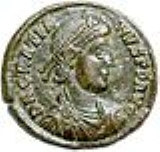
Gratian

Encyclopedia
- For other figures with this name, see Gratian (disambiguation)Gratian (disambiguation)Gratian can refer to:*Gratian the Elder, a 4th century Roman soldier. Father of the emperors Valens and Valentinian and grandfather of:*Gratian the later fourth century Roman Emperor*Gratian, a 5th century Romano-British usurper and emperor....
.
Gratian was Roman Emperor
Roman Emperor
The Roman emperor was the ruler of the Roman State during the imperial period . The Romans had no single term for the office although at any given time, a given title was associated with the emperor...
from 375 to 383.
The eldest son of Valentinian I
Valentinian I
Valentinian I , also known as Valentinian the Great, was Roman emperor from 364 to 375. Upon becoming emperor he made his brother Valens his co-emperor, giving him rule of the eastern provinces while Valentinian retained the west....
, during his youth Gratian accompanied his father on several campaigns along the Rhine and Danube
Danube
The Danube is a river in the Central Europe and the Europe's second longest river after the Volga. It is classified as an international waterway....
frontiers. Upon the death of Valentinian in 375, Gratian's brother Valentinian II
Valentinian II
Flavius Valentinianus , commonly known as Valentinian II, was Roman Emperor from 375 to 392.-Early Life and Accession :...
was declared emperor by his father's soldiers. In 378, Gratian's generals won a decisive victory over the Lentienses
Lentienses
The Lentienses were an Germanic tribe in the region between the river Danube in the North, the river Iller in the East, and Lake Constance in the South, in what is now south Germany. They were reported to be one of the most rebellious tribes at the time...
, a branch of the Alamanni
Alamanni
The Alamanni, Allemanni, or Alemanni were originally an alliance of Germanic tribes located around the upper Rhine river . One of the earliest references to them is the cognomen Alamannicus assumed by Roman Emperor Caracalla, who ruled the Roman Empire from 211 to 217 and claimed thereby to be...
, at the Battle of Argentovaria
Battle of Argentovaria
The Battle of Argentovaria was fought in May 378 between the Roman Empire and the invading army of the Lentienses, a branch of the Alamanni, at Argentovaria . With this defeat, the Lentienses disappear from history....
. Gratian subsequently led a campaign across the Rhine, the last emperor to do so, and attacked the Lentienses, forcing the tribe to surrender. That same year, his uncle Valens
Valens
Valens was the Eastern Roman Emperor from 364 to 378. He was given the eastern half of the empire by his brother Valentinian I after the latter's accession to the throne...
was killed in the Battle of Adrianople
Battle of Adrianople
The Battle of Adrianople , sometimes known as the Battle of Hadrianopolis, was fought between a Roman army led by the Roman Emperor Valens and Gothic rebels led by Fritigern...
against the Goths
Goths
The Goths were an East Germanic tribe of Scandinavian origin whose two branches, the Visigoths and the Ostrogoths, played an important role in the fall of the Roman Empire and the emergence of Medieval Europe....
- making Gratian essentially ruler of the entire Roman Empire. He favoured Christianity over traditional Roman religion
Religion in ancient Rome
Religion in ancient Rome encompassed the religious beliefs and cult practices regarded by the Romans as indigenous and central to their identity as a people, as well as the various and many cults imported from other peoples brought under Roman rule. Romans thus offered cult to innumerable deities...
, refusing the divine attributes of the Emperors
Imperial cult (ancient Rome)
The Imperial cult of ancient Rome identified emperors and some members of their families with the divinely sanctioned authority of the Roman State...
and removing the Altar of Victory
Altar of Victory
The Altar of Victory was located in the Roman Senate House bearing a gold statue of the goddess Victory. The altar was established by Octavian in 29 BC in honor of the defeat of Antony and Cleopatra at Actium. The statue depicted a winged woman, holding a palm and descending to present a laurel...
from the Roman Senate
Roman Senate
The Senate of the Roman Republic was a political institution in the ancient Roman Republic, however, it was not an elected body, but one whose members were appointed by the consuls, and later by the censors. After a magistrate served his term in office, it usually was followed with automatic...
.
Life
Gratian was the son of Emperor Valentinian IValentinian I
Valentinian I , also known as Valentinian the Great, was Roman emperor from 364 to 375. Upon becoming emperor he made his brother Valens his co-emperor, giving him rule of the eastern provinces while Valentinian retained the west....
by Marina Severa
Marina Severa
Marina Severa was the Empress of Rome and first wife of Emperor Valentinian I. She was the mother of later Emperor Gratian.-Name:Her full name is not actually known. Marina Severa is a combination of the two names given in primary sources...
, and was born at Sirmium
Sirmium
Sirmium was a city in ancient Roman Pannonia. Firstly mentioned in the 4th century BC and originally inhabited by the Illyrians and Celts, it was conquered by the Romans in the 1st century BC and subsequently became the capital of the Roman province of Lower Pannonia. In 294 AD, Sirmium was...
(now Sremska Mitrovica
Sremska Mitrovica
Sremska Mitrovica is a city and municipality located in the Vojvodina province of Serbia, on the left bank of the Sava river. As of 2002 the town had a total population of 39,041, while Sremska Mitrovica municipality had a population of 85,605...
, Serbia
Serbia
Serbia , officially the Republic of Serbia , is a landlocked country located at the crossroads of Central and Southeast Europe, covering the southern part of the Carpathian basin and the central part of the Balkans...
) in Pannonia
Pannonia
Pannonia was an ancient province of the Roman Empire bounded north and east by the Danube, coterminous westward with Noricum and upper Italy, and southward with Dalmatia and upper Moesia....
. He was named after his grandfather Gratian the Elder
Gratian the Elder
Gratianus Funarius, also known as Gratianus the Elder or Gratianus Major , was an Illyrian soldier of the Roman Empire who flourished in the 4th century...
. Gratian was first married to Flavia Maxima Constantia
Flavia Maxima Constantia
Flavia Maxima Constantia was the first Empress consort of Gratian of the Western Roman Empire.-Family:According to Ammianus Marcellinus, Constantia was a posthumous child of Constantius II by his third wife Faustina. Her paternal grandparents were Constantine the Great and Fausta.Her paternal...
, daughter of Constantius II
Constantius II
Constantius II , was Roman Emperor from 337 to 361. The second son of Constantine I and Fausta, he ascended to the throne with his brothers Constantine II and Constans upon their father's death....
. His second wife was Laeta
Laeta
-Empress:Gratian was first married to Flavia Maxima Constantia. The Chronicon Paschale dates the arrival of Constantia's remains in Constantinople to 31 August 383. She must have died earlier in the same year but the exact date and cause of her death are unknown. She was about twenty-one at the...
. Both marriages remained childless. His stepmother was Empress Justina and his paternal half siblings were Emperor Valentinian II
Valentinian II
Flavius Valentinianus , commonly known as Valentinian II, was Roman Emperor from 375 to 392.-Early Life and Accession :...
, Galla and Justa.
On 4 August 367 he received from his father the title of Augustus. On the death of Valentinian (17 November 375), the troops in Pannonia proclaimed his infant son (by a second wife Justina) emperor under the title of Valentinian II
Valentinian II
Flavius Valentinianus , commonly known as Valentinian II, was Roman Emperor from 375 to 392.-Early Life and Accession :...
.
Gratian acquiesced in their choice; reserving for himself the administration of the Gallic
Gauls
The Gauls were a Celtic people living in Gaul, the region roughly corresponding to what is now France, Belgium, Switzerland and Northern Italy, from the Iron Age through the Roman period. They mostly spoke the Continental Celtic language called Gaulish....
provinces
Roman province
In Ancient Rome, a province was the basic, and, until the Tetrarchy , largest territorial and administrative unit of the empire's territorial possessions outside of Italy...
, he handed over Italy
Italy
Italy , officially the Italian Republic languages]] under the European Charter for Regional or Minority Languages. In each of these, Italy's official name is as follows:;;;;;;;;), is a unitary parliamentary republic in South-Central Europe. To the north it borders France, Switzerland, Austria and...
, Illyricum
Praetorian prefecture of Illyricum
The praetorian prefecture of Illyricum was one of four praetorian prefectures into which the Late Roman Empire was divided.The administrative centre of the prefecture was Sirmium , and, after 379, Thessalonica...
and Africa to Valentinian and his mother, who fixed their residence at Mediolanum
Mediolanum
Mediolanum, the ancient Milan, was an important Celtic and then Roman centre of northern Italy. This article charts the history of the city from its settlement by the Insubres around 600 BC, through its conquest by the Romans and its development into a key centre of Western Christianity and capital...
. The division, however, was merely nominal, and the real authority remained in the hands of Gratian.
Gratian's general Mallobaudes
Mallobaudes
Mallobaudes or Mellobaudes was a 4th-century Frankish king who also held the Roman title of comes domesticorum.In 354 he was a tribunus armaturarum in the Roman army in Gaul, where he served under Silvanus, who usurped power in 355. Malobaudes tried unsuccessfully to intervene on his behalf...
, a king of the Franks
Franks
The Franks were a confederation of Germanic tribes first attested in the third century AD as living north and east of the Lower Rhine River. From the third to fifth centuries some Franks raided Roman territory while other Franks joined the Roman troops in Gaul. Only the Salian Franks formed a...
, and Naniemus, completely defeated the Lentienses
Lentienses
The Lentienses were an Germanic tribe in the region between the river Danube in the North, the river Iller in the East, and Lake Constance in the South, in what is now south Germany. They were reported to be one of the most rebellious tribes at the time...
, the southernmost branch of the Alamanni
Alamanni
The Alamanni, Allemanni, or Alemanni were originally an alliance of Germanic tribes located around the upper Rhine river . One of the earliest references to them is the cognomen Alamannicus assumed by Roman Emperor Caracalla, who ruled the Roman Empire from 211 to 217 and claimed thereby to be...
, in May 378 at the Battle of Argentovaria
Battle of Argentovaria
The Battle of Argentovaria was fought in May 378 between the Roman Empire and the invading army of the Lentienses, a branch of the Alamanni, at Argentovaria . With this defeat, the Lentienses disappear from history....
. Upon receiving news of the victory, Gratian personally led a campaign across the Upper Rhine into the territory of the Lentienses. After initial trouble facing the Lentienses on high ground, Gratian blockaded the enemy instead and received their surrender. The Lentienses were forced to supply young men to be levied into the Roman army, while the remainder were allowed to return home. Later that year, Valens met his death in the Battle of Adrianople
Battle of Adrianople
The Battle of Adrianople , sometimes known as the Battle of Hadrianopolis, was fought between a Roman army led by the Roman Emperor Valens and Gothic rebels led by Fritigern...
on 9 August. Valens refused to wait for Gratian and his army to arrive and assist in defeating the host of Goths
Goths
The Goths were an East Germanic tribe of Scandinavian origin whose two branches, the Visigoths and the Ostrogoths, played an important role in the fall of the Roman Empire and the emergence of Medieval Europe....
, Alans
Alans
The Alans, or the Alani, occasionally termed Alauni or Halani, were a group of Sarmatian tribes, nomadic pastoralists of the 1st millennium AD who spoke an Eastern Iranian language which derived from Scytho-Sarmatian and which in turn evolved into modern Ossetian.-Name:The various forms of Alan —...
and Huns
Huns
The Huns were a group of nomadic people who, appearing from east of the Volga River, migrated into Europe c. AD 370 and established the vast Hunnic Empire there. Since de Guignes linked them with the Xiongnu, who had been northern neighbours of China 300 years prior to the emergence of the Huns,...
; as a result, two-thirds of the eastern Roman army were killed as well.
In the same year, the government of the Eastern Empire devolved upon Gratian, but feeling himself unable to resist unaided the incursions of the barbarians, he promoted Theodosius I
Theodosius I
Theodosius I , also known as Theodosius the Great, was Roman Emperor from 379 to 395. Theodosius was the last emperor to rule over both the eastern and the western halves of the Roman Empire. During his reign, the Goths secured control of Illyricum after the Gothic War, establishing their homeland...
on 19 January 379 to govern that portion of the Empire. Gratianus and Theodosius then cleared the Illyricum
Illyricum
Illyricum can refer to:* Illyria, a region in the Balkans* Illyricum * Diocese of Illyricum* Praetorian prefecture of Illyricum...
of barbarian
Barbarian
Barbarian and savage are terms used to refer to a person who is perceived to be uncivilized. The word is often used either in a general reference to a member of a nation or ethnos, typically a tribal society as seen by an urban civilization either viewed as inferior, or admired as a noble savage...
s in the Gothic War (376-382).
For some years Gratian governed the Empire with energy and success but gradually sank into indolence, occupying himself chiefly with the pleasures of the chase, and became a tool in the hands of the Frankish
Franks
The Franks were a confederation of Germanic tribes first attested in the third century AD as living north and east of the Lower Rhine River. From the third to fifth centuries some Franks raided Roman territory while other Franks joined the Roman troops in Gaul. Only the Salian Franks formed a...
general Merobaudes
Merobaudes (general)
- Biography :Merobaudes was an official of Roman Emperor Julian . He was entrusted with the transportation of the corpse of the Emperor when Julian died during his military campaign against the Sasanids....
and bishop St. Ambrose
Ambrose
Aurelius Ambrosius, better known in English as Saint Ambrose , was a bishop of Milan who became one of the most influential ecclesiastical figures of the 4th century. He was one of the four original doctors of the Church.-Political career:Ambrose was born into a Roman Christian family between about...
of Milan
Milan
Milan is the second-largest city in Italy and the capital city of the region of Lombardy and of the province of Milan. The city proper has a population of about 1.3 million, while its urban area, roughly coinciding with its administrative province and the bordering Province of Monza and Brianza ,...
.
By taking into his personal service a body of Alans, and appearing in public in the dress of a Scythian warrior, after the disaster of the Battle of Adrianople, he aroused the contempt and resentment of his Roman troops. A Roman general named Magnus Maximus
Magnus Maximus
Magnus Maximus , also known as Maximianus and Macsen Wledig in Welsh, was Western Roman Emperor from 383 to 388. As commander of Britain, he usurped the throne against Emperor Gratian in 383...
took advantage of this feeling to raise the standard of revolt in Britain
Roman Britain
Roman Britain was the part of the island of Great Britain controlled by the Roman Empire from AD 43 until ca. AD 410.The Romans referred to the imperial province as Britannia, which eventually comprised all of the island of Great Britain south of the fluid frontier with Caledonia...
and invaded Gaul
Gaul
Gaul was a region of Western Europe during the Iron Age and Roman era, encompassing present day France, Luxembourg and Belgium, most of Switzerland, the western part of Northern Italy, as well as the parts of the Netherlands and Germany on the left bank of the Rhine. The Gauls were the speakers of...
with a large army. Gratian, who was then in Paris
Paris
Paris is the capital and largest city in France, situated on the river Seine, in northern France, at the heart of the Île-de-France region...
, being deserted by his troops, fled to Lyon
Lyon
Lyon , is a city in east-central France in the Rhône-Alpes region, situated between Paris and Marseille. Lyon is located at from Paris, from Marseille, from Geneva, from Turin, and from Barcelona. The residents of the city are called Lyonnais....
. There, through the treachery of the governor, Gratian was delivered over to one of the rebel generals, Andragathius, and assassinated on 25 August 383.
Empire and Orthodox Christianity
The reign of Gratian forms an important epoch in ecclesiastical history, since during that period Orthodox ChristianityOrthodox Christianity
The term Orthodox Christianity may refer to:* the Eastern Orthodox Church and its various geographical subdivisions...
for the first time became dominant throughout the empire.
Gratian also published an edict that all their subjects should profess the faith of the bishops of Rome and Alexandria (i.e., the Nicene faith). The move was mainly thrust at the various beliefs that had arisen out of Arianism
Arianism
Arianism is the theological teaching attributed to Arius , a Christian presbyter from Alexandria, Egypt, concerning the relationship of the entities of the Trinity and the precise nature of the Son of God as being a subordinate entity to God the Father...
, but smaller dissident sects, such as the Macedonians
Macedonians (religious group)
The Macedonians were a Christian sect of the 4th century, named after Bishop Macedonius I of Constantinople. They professed a belief similar to that of Arianism, but apparently denying the divinity of the Holy Spirit, and regarding the substance of Jesus Christ as being the same in kind as that of...
, were also prohibited.
Suppression of Paganism
Gratian, under the influence of his chief advisor the Bishop of Milan AmbroseAmbrose
Aurelius Ambrosius, better known in English as Saint Ambrose , was a bishop of Milan who became one of the most influential ecclesiastical figures of the 4th century. He was one of the four original doctors of the Church.-Political career:Ambrose was born into a Roman Christian family between about...
, took active steps to repress Pagan worship. This brought to an end a period of widespread, if unofficial, religious tolerance that had existed since the time of Julian. "In the long truce between the hostile camps", writes historian Samuel Dill "the pagan, the sceptic, even the formal, the lukewarm Christian, may have come to dream of a mutual toleration which would leave the ancient forms undisturbed but such men, living in a world of literary and antiquarian illusions, know little of the inner forces of the new Christian movement."
In 382, Gratian appropriated the income of the Pagan priests and Vestal Virgins, forbade legacies of real property to them and abolished other privileges belonging to the Vestals and to the pontiffs. He confiscated the personal possessions of the colleges of Pagan priests, which also lost all their privileges and immunities. Gratian declared that all of the Pagan temples and shrines were to be confiscated by the government and that their revenues were to be joined to the property of the royal treasury.
He ordered another removal of the Altar of Victory
Altar of Victory
The Altar of Victory was located in the Roman Senate House bearing a gold statue of the goddess Victory. The altar was established by Octavian in 29 BC in honor of the defeat of Antony and Cleopatra at Actium. The statue depicted a winged woman, holding a palm and descending to present a laurel...
from the Senate House
Roman Senate
The Senate of the Roman Republic was a political institution in the ancient Roman Republic, however, it was not an elected body, but one whose members were appointed by the consuls, and later by the censors. After a magistrate served his term in office, it usually was followed with automatic...
at Rome, despite protests of the pagan members of the Senate, and confiscated its revenues. Pagan Senators responded by sending an appeal to Gratian, reminding him that he was still the Pontifex Maximus
Pontifex Maximus
The Pontifex Maximus was the high priest of the College of Pontiffs in ancient Rome. This was the most important position in the ancient Roman religion, open only to patricians until 254 BC, when a plebeian first occupied this post...
and that it was his duty to see that the Pagan rites were properly performed. They appealed to Gratian to restore the Altar of Victory and the rights and privileges of the Vestal Virgins and priestly colleges. Gratian, at the urging of Ambrose, did not grant an audience to the Pagan Senators. In response to being reminded by the Pagans that he was still the head of the ancestral religion, Gratian refused to wear the insignia of the Pontifex Maximus as unbefitting a Christian
Christian
A Christian is a person who adheres to Christianity, an Abrahamic, monotheistic religion based on the life and teachings of Jesus of Nazareth as recorded in the Canonical gospels and the letters of the New Testament...
, renouncing the title and office of Pontifex Maximus under the influence of Ambrose, declaring that it was unsuitable for a Christian to hold this office. Gratian was quickly faced with a revolt from Magnus Maximus
Magnus Maximus
Magnus Maximus , also known as Maximianus and Macsen Wledig in Welsh, was Western Roman Emperor from 383 to 388. As commander of Britain, he usurped the throne against Emperor Gratian in 383...
to the throne because he was more sympathetic to the Pagan cause.
Notwithstanding his actions, Gratian was still deified after his death.
See also
- Battle of AdrianopleBattle of AdrianopleThe Battle of Adrianople , sometimes known as the Battle of Hadrianopolis, was fought between a Roman army led by the Roman Emperor Valens and Gothic rebels led by Fritigern...
- Altar of VictoryAltar of VictoryThe Altar of Victory was located in the Roman Senate House bearing a gold statue of the goddess Victory. The altar was established by Octavian in 29 BC in honor of the defeat of Antony and Cleopatra at Actium. The statue depicted a winged woman, holding a palm and descending to present a laurel...
- AmbrosiusAmbroseAurelius Ambrosius, better known in English as Saint Ambrose , was a bishop of Milan who became one of the most influential ecclesiastical figures of the 4th century. He was one of the four original doctors of the Church.-Political career:Ambrose was born into a Roman Christian family between about...
- Magnus MaximusMagnus MaximusMagnus Maximus , also known as Maximianus and Macsen Wledig in Welsh, was Western Roman Emperor from 383 to 388. As commander of Britain, he usurped the throne against Emperor Gratian in 383...
- MerobaudesMerobaudes (general)- Biography :Merobaudes was an official of Roman Emperor Julian . He was entrusted with the transportation of the corpse of the Emperor when Julian died during his military campaign against the Sasanids....
- Theodosius ITheodosius ITheodosius I , also known as Theodosius the Great, was Roman Emperor from 379 to 395. Theodosius was the last emperor to rule over both the eastern and the western halves of the Roman Empire. During his reign, the Goths secured control of Illyricum after the Gothic War, establishing their homeland...
- ValensValensValens was the Eastern Roman Emperor from 364 to 378. He was given the eastern half of the empire by his brother Valentinian I after the latter's accession to the throne...
External links
- Flavius Gratianus (AD 359 – AD 383)
- This list of Roman laws of the fourth century shows laws passed by Gratian relating to Christianity.