
All Topics  
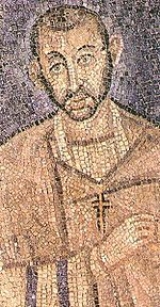
Ambrose

 
Ambrose

   Email Print
   Bookmark   Link


Ambrose


Saint Ambrose (c. between 337 and 340 – 4 April 397) was a bishop of Milan
Roman Catholic Archdiocese of Milan

The Archdiocese of Milan is a metropolitan see of the Catholic Church in Italy. It has long maintained its own rite: the Ambrosian rite. It is led by the Archbishop of Milan who serves as metropolitan bishop to the dioceses of Diocese of Bergamo, Diocese of Brescia, Diocese of Como, Diocese of Crema, Diocese of Cremona, Diocese of Lodi, Ro...
 who became one of the most influential ecclesiastical figures of the fourth century. He is counted as one of the four original doctors of the Church.

ose was born into a Roman Christian family between about 337 and 340 and was raised in Trier
Trier

Trier is a city in Germany on the banks of the Moselle River. It is the oldest city in Germany, founded in or before 16 BC. Trier is not the only city claiming to be Germany's oldest, but it is the only one that bases this assertion on having the longest history as a city, as opposed to a mere settlement or army camp....
.


Discussion
Ask a question about 'Ambrose'
Start a new discussion about 'Ambrose'
Answer questions from other users
Full Discussion Forum


Quotations


Accordingly, death is a harbor of peace for the just, but is believed a shipwreck for the wicked.

De bono mortis, 8, 31.

If you are at Rome, live in the Roman style; if you are elsewhere, live as they live there.

Jeremy Taylor, Ductor Dubiantum, I.i.5.

It did not please God to save his people through dialectic.

De fide, I, 5, 42.

It is not death therefore that is burdensome, but the fear of death.

De bono mortis, 8, 31.

When I am here, I do not fast on the Sabbath; when I am in Rome, I fast on the Sabbath.

Quoted in St. Augustine, Epistulae, XXXVI, 14 or 32.


Encyclopedia


Saint Ambrose (c. between 337 and 340 – 4 April 397) was a bishop of Milan
Roman Catholic Archdiocese of Milan

The Archdiocese of Milan is a metropolitan see of the Catholic Church in Italy. It has long maintained its own rite: the Ambrosian rite. It is led by the Archbishop of Milan who serves as metropolitan bishop to the dioceses of Diocese of Bergamo, Diocese of Brescia, Diocese of Como, Diocese of Crema, Diocese of Cremona, Diocese of Lodi, Ro...
 who became one of the most influential ecclesiastical figures of the fourth century. He is counted as one of the four original doctors of the Church.

Life


Worldly career

Ambrosestatue
Ambrose was born into a Roman Christian family between about 337 and 340 and was raised in Trier
Trier

Trier is a city in Germany on the banks of the Moselle River. It is the oldest city in Germany, founded in or before 16 BC. Trier is not the only city claiming to be Germany's oldest, but it is the only one that bases this assertion on having the longest history as a city, as opposed to a mere settlement or army camp....
. He was the son of a praetorian prefect of Gallia Narbonensis
Gallia Narbonensis

Gallia Narbonensis was a Roman province located in what is now Languedoc and Provence, in southern France. Narbonese Gaul "lay between the Alps, the Mediterranean Sea, and the C?vennes Mountains....
; his mother was a woman of intellect and piety. Ambrose's siblings, Satyrus (who is the subject of Ambrose's De excessu fratris Satyri) and Marcellina
Saint Marcellina

Saint Marcellina is a Catholic saint. She was the only sister of Saint Ambrose of Milan. Marcellina was born around the year 330, probably in Trier, where her father resided as praefectus praetorio Galliarum....
, are also venerated as saints. There is a legend that as an infant, a swarm of bee
Bee

Bees are flying insects closely related to wasps and ants. Bees are a monophyly lineage within the superfamily Apoidea, presently classified by the unranked taxon name Anthophila....
s settled on his face while he lay in his cradle, leaving behind a drop of honey
Honey

Honey is a sweet fluid produced by honey bees , and derived from the nectar of flowers. According to the United States National Honey Board and various international food regulations, "honey stipulates a pure product that does not allow for the addition of any other substance?this includes, but is not limited to, water or other sweeteners...
. His father considered this a sign
Christian symbolism

Christian symbolism invests objects or actions with an inner meaning expressing Christian ideas. Christianity has borrowed from the common stock of significant symbols known to most periods and to all regions of the world....
 of his future eloquence and honeyed tongue. For this reason, bees and beehives
Beehive (beekeeping)

A beehive is an enclosed structure in which some honey bee species of the genus Apis live and raise their young. Natural beehives are naturally-occurring structures occupied by honey bee colonies, while domesticated honey bees live in man-made beehives, often in an apiary....
 often appear in the saint's symbology
Saint symbology

Christianity has used symbolism from its very beginnings. Each saint has a story and a reason why he or she led an exemplary life. Symbols have been used to tell these stories throughout the history of the Church....
.

After the early death of his father, Ambrose followed his father's career. He was educated in Rome, studying literature
Literature

Literature is the art of written works. Literally translated, the word means "acquaintance with letters" . In Western culture the most basic written literary types include fiction and non-fiction....
, law
LAW

LAW may refer to:* Anti-tank warfare, e.g. the US Army M72 LAW or the British Army LAW 80*Palestinian Society for the Protection of Human Rights ...
, and rhetoric
Rhetoric

Rhetoric is the art of using language as a means to persuade. Along with logic and dialectic, rhetoric is one of the three ancient arts of discourse....
. Praetor
Praetor

Praetor was a Title#Titles_for_heads_of_state granted by the government of Ancient Rome to men acting in one of two official capacities: the commander of an army, either before it was mustered or more typically in the field, or an elected Magistratus assigned duties that varied depending on the historical period....
 Anicius Probus first gave him a place in the council and then in about 372 made him consular prefect of Liguria
Liguria

Liguria is a coastal Regions of Italy of north-western Italy, the third smallest of the Italian regions. Its capital is Genoa. It is a popular region with tourists for its beautiful beaches, picturesque little towns, and food....
 and Emilia
Emilia

Emilia may refer to any of the following:*People** Emilia of Gaeta, duchess of Gaeta** Emilia Rydberg, Ethiopian-Swedish pop singer** Emilia Jane Mills Webb , wife of William Frederick Webb...
, with headquarters at Milan
Milan

Milan is the second largest city of Italy, located in the plains of Lombardy. It is the capital in the Province of Milan, as well as the Regions of Italy capital of Lombardy....
, which was then beside Rome the second capital in Italy.

Ambrose was a governor in northern Italy before he became the Bishop of Milan. Ambrose never married.

Bishop of Milan

In the late 300s there was a deep conflict in the diocese of Milan between the Catholics and Arians
Arianism

Arianism is the theological teaching of Arius , a Christian priest, who was first ruled a heresy at the First Council of Nicea, later exonerated and then pronounced a heretic again after his death....
. In 374 the bishop of Milan, Auxentius
Auxentius

Auxentius might refer to:* Auxentius of Mopsuestia , a Christian martyr and saint.* Auxentius of Milan , an Arian Christian theologian.* Auxentius of Durostorum and Milan , an Arian Christian theologian, adopted son of Ulfilas....
, an Arian, died, and the Arians challenged the succession
Succession

Succession is the act or process of following in order or sequence. .Succession may further refer to, within the context of "order" and "sequence":...
. Ambrose went to the church where the election was to take place, to prevent an uproar, which was probable in this crisis. His address was interrupted by a call "Ambrose, bishop!", which was taken up by the whole assembly.

Ambrose was known to be Catholic in belief, but also acceptable to Arians due to the charity shown in theological matters in this regard. At first he energetically refused the office, for which he was in no way prepared: Ambrose was neither baptized nor formally trained in theology. Upon his appointment, St. Ambrose fled to a colleague's home to seek hiding. Upon receiving a letter from the Emperor praising the appropriateness of Rome appointing individuals evidently worthy of holy positions, St. Ambrose's host gave Ambrose up. Within a week, Ambrose was baptized, ordained and duly installed as bishop of Milan
Milan

Milan is the second largest city of Italy, located in the plains of Lombardy. It is the capital in the Province of Milan, as well as the Regions of Italy capital of Lombardy....
.

As bishop, he immediately adopted an ascetic lifestyle, apportioned his money to the poor, donating all of his land, making only provision for his sister Marcellina
Saint Marcellina

Saint Marcellina is a Catholic saint. She was the only sister of Saint Ambrose of Milan. Marcellina was born around the year 330, probably in Trier, where her father resided as praefectus praetorio Galliarum....
 (who later became a nun), and committed the care of his family to his brother. Ambrose also wrote a treatise by the name of "The Goodness Of Death".

Ambrose and Subordinationists

According to legend, Ambrose immediately and forcefully stopped Arianism
Arianism

Arianism is the theological teaching of Arius , a Christian priest, who was first ruled a heresy at the First Council of Nicea, later exonerated and then pronounced a heretic again after his death....
 in Milan. He moved more realistically and deliberately. In his pursuit of the study of theology with Simplician
Simplician

Saint Simplician succeeded Saint Ambrose as bishop of Milan in 397. He was already an old man by that time. He was considered responsible for the conversion of Augustine of Hippo, who praised him for his learning and zeal, and for that of Saint Alypius....
, a presbyter
Presbyter

Presbyter in the New Testament refers to a leader in local Christian congregations, then a synonym of episkopos . In modern usage, it is distinct from bishop and synonymous with priest, pastor, Elder , or religious minister in various Christian denominations....
 of Rome he was to excel. Using his excellent knowledge of Greek, which was then rare in the West, to his advantage, he studied the Hebrew Bible and Greek authors like Philo
Philo

Philo , known also as Philo of Alexandria , Philo Judaeus, Philo Judaeus of Alexandria, Yedidia and Philo the Jew, was a Hellenistic Judaism philosopher born in Alexandria, Egypt....
, Origen
Origen

Origen was an Early Christianity scholar, theology, and one of the most distinguished of the early Church father of the Christian Church. According to tradition, he is held to have been an Ancient Egypt who taught in Alexandria, reviving the Catechetical School of Alexandria where Clement of Alexandria had taught....
, Athanasius, and Basil of Caesarea
Basil of Caesarea

Basil of Caesarea, also called Saint Basil the Great, was the bishop of Caesarea Mazaca in Cappadocia, Asia Minor . He was an influential 4th century Christian theologian and monastic....
, with whom he was also exchanging letters. He applied this knowledge as preacher, concentrating especially on exegesis of the Old Testament, and his rhetorical abilities impressed Augustine of Hippo, who hitherto had thought poorly of Christian preachers.

In the confrontation with Arians, Ambrose sought to theologically refute their propositions, considered as heretical. The Arians appealed to many high level leaders and clergy in both the Western and Eastern empires. Although the western Emperor Gratian held orthodox
Orthodox Christianity

KAHThe term Orthodox Christianity may refer to:* The Eastern Orthodox Church: the Eastern Christianity churches of Byzantine Rite tradition that adhere to the first seven Ecumenical Councils, and are in full communion with the Ecumenical Patriarchate of Constantinople and with each other....
 belief in the Nicene creed, the younger Valentinian II
Valentinian II

Flavius Valentinianus Iunior , known usually by his anglicised name, Valentinian II, was a Roman Emperor from 375 to 392....
, who became his colleague in the empire, adhered to the Arian creed. Ambrose did not sway the young prince's position. In the East, Emperor Theodosius I
Theodosius I

Flavius Theodosius , also called Theodosius I and Theodosius the Great , was Roman Emperor from 379 to 395. Reuniting the eastern and western portions of the empire, Theodosius was the last emperor of both the Eastern Roman Empire and Western Roman Empire....
 likewise professed the Nicene creed; but there were many adherents of Arianism throughout his dominions, especially among the higher clergy.

In this contested state of religious opinion, two leaders of the Arians, bishops Palladius of Ratiaria and Secundianus of Singidunum, confident of numbers, prevailed upon Gratian
Gratian

Flavius Gratianus , known usually by the anglicised name Gratian, was a Western Roman Emperor from 375 to 383.He favoured the Christian religion against Roman polytheism, refusing the traditional polytheistic attributes of the emperors and removing the Altar of Victory from the Roman Senate....
 to call a general council from all parts of the empire. This request appeared so equitable that he complied without hesitation. However, Ambrose feared the consequences and prevailed upon the emperor to have the matter determined by a council of the Western bishops. Accordingly, a synod
Synod

A synod is a council of a Ecclesia , usually a Christianity church, convened to decide an issue of doctrine, administration or application. An ecumenical council is so named because it is a synod of the whole church ...
 composed of thirty-two bishops was held at Aquileia
Aquileia

Aquileia is an ancient history Roman Republic city in what is now Italy, at the head of the Adriatic Sea at the edge of the lagoons, about 10 km from the sea, on the river Natiso , the course of which has changed somewhat since Roman times....
 in the year 381. Ambrose was elected president and Palladius, being called upon to defend his opinions, declined. A vote was then taken, when Palladius and his associate Secundianus were deposed from the episcopal office.

Nevertheless, the increasing strength of the Arians proved a formidable task for Ambrose. In 385 or 386 the emperor and his mother Justina, along with a considerable number of clergy
Clergy

Clergy is the generic term used to describe the formal religious leadership within a given religion. The term comes from the Greek language ?????? - kleros, "a lot", "that which is assigned by lot" or metaphorically, "heritage"....
 and laity
Laity

In religious organizations, the laity comprises all persons who are not clergy. A person who is a member of a religious order who is not Holy Orders clergy is considered as a member of the laity, even though they are members of a religious order ....
, especially military, professed Arianism. They demanded two churches in Milan
Milan

Milan is the second largest city of Italy, located in the plains of Lombardy. It is the capital in the Province of Milan, as well as the Regions of Italy capital of Lombardy....
, one in the city (the basilica of the Apostles), the other in the suburbs (St Victor's), to the Arians. Ambrose refused and was required to answer for his conduct before the council. He went, his eloquence in defence of the Church reportedly overawed the ministers of Emperor Valentinian, so he was permitted to retire without making the surrender of the churches. The day following, when he was performing divine service in the basilica, the prefect of the city came to persuade him to give up at least the Portian basilica in the suburbs. As he still continued obstinate, the court proceeded to violent measures : the officers of the household were commanded to prepare the Basilica
Basilica

The Latin word basilica , was originally used to describe a ancient Rome public building , usually located in the Forum of a Roman town. In Hellenistic cities, public basilicas appeared in the 2nd century BC....
 and the Portian churches to celebrate divine service upon the arrival of the emperor and his mother at the ensuing festival of Easter
Easter

Easter is the most important religious feast in the Christianity liturgical year.Christians believe that Jesus was Resurrection of Jesus from the dead three days after his Crucifixion of Jesus, and celebrate this resurrection on Easter Day or Easter Sunday , two days after Good Friday....
.

In spite of Imperial opposition, Bishop Ambrose declared:

Ambrose and emperors


The imperial court was displeased with the religious principles of Ambrose, however his aid was soon solicited by the Emperor. When Magnus Maximus
Magnus Maximus

Magnus Clemens Maximus , also known as Maximianus, was a Hispanic Roman usurper of the Western Roman Empire from 383 until his death, in 388, by order of Emperor Theodosius I....
 usurped the supreme power in Gaul
Gaul

Gaul is the name used for the region of Western Europe comprising part of present day northern Italy, France, Belgium, western Switzerland and the parts of the Netherlands and Germany on the west bank of the River Rhine....
, and was meditating a descent upon Italy, Valentinian sent Ambrose to dissuade him from the undertaking, and the embassy was successful.

On a second attempt of the same kind Ambrose was again employed; and although he was unsuccessful, it cannot be doubted that, if his advice had been followed, the schemes of the usurper would have proved abortive; but the enemy was permitted to enter Italy
Italy

Italy , officially the Italian Republic , is a country located on the Italian Peninsula in Southern Europe and on the two largest islands in the Mediterranean Sea, Sicily and Sardinia....
; and Milan
Milan

Milan is the second largest city of Italy, located in the plains of Lombardy. It is the capital in the Province of Milan, as well as the Regions of Italy capital of Lombardy....
 was taken. Justina and her son fled; but Ambrose remained at his post, and did good service to many of the sufferers by causing the plate of the church to be melted for their relief.

Ambrose was equally zealous in combating the attempt made by the upholders of the old state religion to resist the enactments of Christian emperors. The pagan party was led by Quintus Aurelius Symmachus
Quintus Aurelius Symmachus

Quintus Aurelius Symmachus , the cultured and prominent son of a prominent father, Lucius Aurelius Avianius Symmachus, in the patrician gens Aurelia, held the offices of proconsul of Africa in 373, urban prefect of Rome in 384 and 385, and consul in 391....
, consul in 391, who presented to Valentinian II
Valentinian II

Flavius Valentinianus Iunior , known usually by his anglicised name, Valentinian II, was a Roman Emperor from 375 to 392....
 a forcible but unsuccessful petition praying for the restoration of the Altar of Victory
Altar of Victory

The Altar of Victory was located in the Roman Senate House bearing a gold statue of the goddess Nike . The altar was established by Augustus in 29 BC in honor of the defeat of Antony and Cleopatra at Actium....
 to its ancient station in the hall of the Roman Senate
Roman Senate

The Senate of the Roman Republic was a political institution in the ancient Roman Republic. According to the Greek historian Polybius, our principal source on the Constitution of the Roman Republic, the Roman Senate was the predominant branch of government....
, the proper support of seven Vestal Virgin
Vestal Virgin

In Ancient Rome, the Vestal Virgins , were the virgin holy female priests of Vesta , the goddess of the hearth. Their primary task was to maintain the sacred fire of Vesta....
s, and the regular observance of the other pagan ceremonies.

To this petition Ambrose replied in a letter to Valentinian, arguing that the devoted worshipers of idols
Idolatry

Idolatry is usually defined as worship of any cult image, idea, or Object , as opposed to the worship of a monotheistic God. It is considered a major sin in the Abrahamic religions whereas in religions where such activity is not considered as sin, the term "idolatry" itself is absent....
 had often been forsaken by their deities
List of deities

This list of deities is an index to polytheistic deity of the different religions, cultures and mythologies of the world, listed by type and by region....
; that the native valour of the Roman soldiers had gained their victories, and not the pretended influence of pagan priest
Priest

A priest or priestess is a person having the authority or power to administer religious rites; in particular, rites of sacrifice to, and propitiation of, a deity or deities....
s; that these idolatrous worshipers requested for themselves what they refused to Christians; that voluntary was more honourable than constrained virginity
Virginity

A Virgin is, originally, a woman who has never had sexual intercourse. Virginity is the state of being a virgin. The term has traditionally also been applied to men....
; that as the Christian ministers declined to receive temporal emoluments, they should also be denied to pagan priests; that it was absurd to suppose that God
God

God is a deity in theism and deism religions and other belief systems, representing either the sole deity in monotheism, or a principal deity in polytheism....
 would inflict a famine upon the empire for neglecting to support a religious system contrary to His will as revealed in the Holy Scriptures; that the whole process of nature encouraged innovations, and that all nations had permitted them even in religion; that heathen sacrifices were offensive to Christians; and that it was the duty of a Christian prince to suppress pagan ceremonies. In the epistles of Symmachus and of Ambrose both the petition and the reply are preserved.

To support the logic of his argument, Ambrose halted the celebration of the Eucharist
Eucharist

The Eucharist, also called Holy Communion or Lord's Supper and other names, is a Christianity sacrament commemorating, by consecrating bread and wine, the Last Supper, the final meal that Jesus Christ shared with his disciples before his arrest, and eventual crucifixion, when he gave them bread saying, "This is my body", and wine...
, essentially holding the Christian community hostage, until Theodosius agreed to abort the investigation without requiring reparations to be made by the bishop.

Theodosius I
Theodosius I

Flavius Theodosius , also called Theodosius I and Theodosius the Great , was Roman Emperor from 379 to 395. Reuniting the eastern and western portions of the empire, Theodosius was the last emperor of both the Eastern Roman Empire and Western Roman Empire....
, the emperor of the East, espoused the cause of Justina, and regained the kingdom. Theodosius was threatened with excommunication by Ambrose for the massacre
Massacre of Thessaloniki

The Massacre of Thessaloniki was a retaliatory action by the Roman Emperor Theodosius I in 390 against the inhabitants of the Greek city of Thessaloniki, who had risen in revolt....
 of 7,000 persons at Thessalonica in 390, after the murder of the Roman governor there by rioters. Ambrose told Theodosius to imitate David in his repentance as he had imitated him in guilt — Ambrose readmitted the emperor to the Eucharist only after several months of penance . This incident shows the strong position of a bishop in the Western part of the empire, even when facing a strong emperor — the controversy of John Chrysostom
John Chrysostom

'Saint John Chrysostom' , archbishop of Constantinople, was an important Early Church Father. He is known for his eloquence in Sermon and public speaking, his denunciation of abuse of authority by both ecclesiastical and political leaders, the Divine Liturgy of St....
 with a much weaker emperor a few years later in Constantinople led to a crushing defeat of the bishop.

Ambrose's influence upon Theodosius is credited with eliciting the enactment of the "Theodosian decrees" of 391 (see entry Theodosius I
Theodosius I

Flavius Theodosius , also called Theodosius I and Theodosius the Great , was Roman Emperor from 379 to 395. Reuniting the eastern and western portions of the empire, Theodosius was the last emperor of both the Eastern Roman Empire and Western Roman Empire....
).

In 392, after the death of Valentinian II
Valentinian II

Flavius Valentinianus Iunior , known usually by his anglicised name, Valentinian II, was a Roman Emperor from 375 to 392....
 and the acclamation of Eugenius
Eugenius

Flavius Eugenius was a Roman usurper against Roman Emperor Theodosius I. Though himself a Christian, he was the last Emperor to support Roman polytheism....
, Ambrose supplicated the emperor for the pardon of those who had supported Eugenius after Theodosius was eventually victorious. Soon after acquiring the undisputed possession of the Roman empire
Roman Empire

The Roman Empire was the Roman Republic phase of the Ancient Rome, characterised by an autocracy form of government and large territorial holdings in Europe and around the Mediterranean....
, Theodosius died at Milan in 395, and two years later (April 4, 397) Ambrose also died. He was succeeded as bishop of Milan by Simplician
Simplician

Saint Simplician succeeded Saint Ambrose as bishop of Milan in 397. He was already an old man by that time. He was considered responsible for the conversion of Augustine of Hippo, who praised him for his learning and zeal, and for that of Saint Alypius....
. Ambrose's body may still be viewed in the church of S. Ambrogio in Milan, where it has been continuously venerated — along with the bodies identified in his time as being those of Sts. Gervase and Protase — and is one of the oldest extant bodies of historical personages known outside Egypt
Egypt

Egypt is a country mainly in North Africa, with the Sinai Peninsula forming a land bridge in Western Asia. Covering an area of about , Egypt borders the Mediterranean Sea to the north, the Gaza Strip and Israel to the northeast, the Red Sea to the east, Sudan to the south and Libya to the west....
.

Character

Many circumstances in the history of Ambrose are characteristic of the general spirit of the times. The chief causes of his victory over his opponents were his great popularity and the reverence paid to the episcopal character at that period. But it must also be noted that he used several indirect means to obtain and support his authority with the people.

He was generous to the poor
Poverty

Poverty is the shortage of common things such as food, clothing, shelter and safe drinking water, all of which determine our quality of life. It may also include the lack of access to opportunities such as education and employment which aid the escape from poverty and/or allow one to enjoy the respect of fellow citizens....
; it was his custom to comment severely in his preaching on the public characters of his times; and he introduced popular reforms in the order and manner of public worship. It is alleged, too, that at a time when the influence of Ambrose required vigorous support, he was admonished in a dream to search for, and found under the pavement of the church, the remains of two martyr
Martyr

The term martyr is most commonly used today to describe an individual who sacrifices his or her life in order to further a cause or belief for many....
s, Gervasius and Protasius. The saints, although they would have had to have been hundreds of years old, looked as if they had just died. The applause of the people was mingled with the derision of the court party.

Theology

Ambrose ranks with Augustine, Jerome
Jerome

Saint Jerome was a Christian priest and Christian apologetics best known for translating the Vulgate. He is recognized by the Catholic Church as a canonized saint and Doctor of the Church, and his version of the Bible is still an important text in Catholicism....
, and Gregory the Great, as one of the Latin
Latin

Latin is an Italic language, historically spoken in Latium and Ancient Rome. Through the Military history of the Roman Empire, Latin spread throughout the Mediterranean and a large part of Europe....
 Doctors of the Church
Doctor of the Church

Doctor of the Church is a title given by a variety of Christian churches to individuals whom they recognize as having been of particular importance, particularly regarding their additions to theological or doctrinal matters....
. Theologians compare him with Hilary
Hilary

Hilary, from the Latin Hilarius meaning cheerful, may refer to:As a name* The given name or surname Hillary*People commonly known by the surname Hillary, or solely by the given name Hilary, Hillary, Hilarius or Hilaria, including:...
, who they claim fell short of Ambrose's administrative excellence but demonstrated greater theological
Theology

Theology is the study of the existence or attributes of a deity or gods, or more generally the study of religion or spirituality. It is sometimes contrasted with religious studies: theology is understood as the study of religion from an internal perspective , and religious studies as the study of religion from an external perspective....
 ability. He succeeded as a theologian despite his juridical training and his comparatively late handling of Biblical and doctrinal subjects. His spiritual successor, Augustine, whose conversion was helped by Ambrose's sermon
Sermon

A sermon is an public speaking by a prophet or member of the clergy. Sermons address a Bible, Theology, Religion, or Morality topic, usually expounding on a type of belief, law or Human behavior within both past and present contexts....
s, owes more to him than to any writer except Paul
Paul of Tarsus

Saint Paul, also called Paul the Apostle, the Apostle Paul or Paul of Tarsus , was a Hellenistic Judaism, who called himself the "Apostle to the Gentiles", and was, together with Saint Peter and James the Just, the most notable of early Christian missionaries....
.

One interpretation of Ambrose's writings is that he was a Christian universalist
Christian Universalism

Christian Universalism is a set of theological beliefs about God, Christ, and the origin and destiny of the human soul, emphasizing the unconditional parental love of God and God's plan to redeem, restore, and transform all people through Christ....
. It has been noted that Ambrose's theology was significantly influenced by that of Origen
Origen

Origen was an Early Christianity scholar, theology, and one of the most distinguished of the early Church father of the Christian Church. According to tradition, he is held to have been an Ancient Egypt who taught in Alexandria, reviving the Catechetical School of Alexandria where Clement of Alexandria had taught....
 and Didymus the Blind
Didymus the Blind

Didymus the Blind was an ecclesiastical writer of Alexandria whose famous catechetical school he led for about half a century.Although he became blind at the age of four, before he had learned to read, he succeeded in mastering the whole gamut of the sciences then known....
, two other early Christian universalists. One quotation cited in favor of this belief:

Our Savior has appointed two kinds of resurrection in the Apocalypse. 'Blessed is he that hath part in the first resurrection,' for such come to grace without the judgment. As for those who do not come to the first, but are reserved unto the second resurrection, these shall be disciplined until their appointed times, between the first and the second resurrection.


However, several other works by Ambrose have signified the mainstream view of salvation. For example:

The Jews feared to believe in manhood taken up into God, and therefore have lost the grace of redemption, because they reject that on which salvation depends.


Ambrose's intense episcopal consciousness furthered the growing doctrine
Doctrine

Doctrine is a codification of beliefs or "a body of teachers" or "instructions", taught principles or positions, as the body of teachings in a branch of knowledge or belief system....
 of the Church and its sacerdotal ministry, while the prevalent asceticism
Asceticism

Asceticism describes a life-style characterized by abstinence from various sorts of worldly pleasures often with the aim of pursuing religious and spirituality goals....
 of the day, continuing the Stoic
Stoicism

Stoicism was a school of Hellenistic philosophy founded in Athens by Zeno of Citium in the early third century B.C. The stoics considered passionate emotions to be the result of errors in judgment, and that a Sage , or person of "moral and intellectual perfection," would not have such emotions....
 and Cicero
Cicero

Marcus Tullius Cicero was a Ancient Rome philosopher, statesman, lawyer, political theorist, and Constitution of the Roman Republic. Cicero is widely considered one of Rome's greatest rhetoric and prose stylists....
nian training of his youth, enabled him to promulgate a lofty standard of Christian ethics
Ethics

Ethics is a word for a philosophy that encompasses proper conduct and good living. It is significantly broader than the common conception of ethics as the analyzing of right and wrong....
. Thus we have the De officiis ministrorum, De viduis, De virginitate and De paenitentia.

Mariology


The powerful mariology of Ambrose of Milan influenced contemporary Popes like Pope Damasus and Siricius and later, Pope Leo the Great. Central to Ambrose is the virginity
Virginity

A Virgin is, originally, a woman who has never had sexual intercourse. Virginity is the state of being a virgin. The term has traditionally also been applied to men....
 of Mary and her role as Mother of God.

  • The virgin birth is worthy of God. Which human birth would have been more worthy of God, than the one, in which the Immaculate Son of God maintained the purity of his immaculate origin while becoming human?


  • We confess, that Christ the Lord was born from a virgin, and therefore we reject the natural order of things. Because not from a man she conceived but from the Holy Spirit.


  • Christ is not divided but one. If we adore him as the Son of God, we do not deny his birth from the virgin... But nobody shall extend this to Mary. Mary was the temple of God but not God in the temple. Therefore only the one who was in the temple can be worshipped.


  • Yes, truly blessed for having surpassed the priest (Zechariah). While the priest denied, the Virgin rectified the error. No wonder that the Lord, wishing to rescue the world, began his work with Mary. Thus she, through whom salvation was being prepared for all people, would be the first to receive the promised fruit of salvation.


Ambrose viewed virginity
Virginity

A Virgin is, originally, a woman who has never had sexual intercourse. Virginity is the state of being a virgin. The term has traditionally also been applied to men....
 as superior to marriage and saw Mary as the model of virginity He is alleged to have founded an institution for virgins in Rome.

Writings

In matters of exegesis
Exegesis

Exegesis is a critical explanation or interpretation of a text.Biblical exegesis is a critical explanation or interpretation of the Bible....
 he is, like Hilary, an Alexandrian
Alexandrian

Alexandrian is either:* an adjective referring to a place called Alexandria, as in Alexandrian text-type* a person from and/or inhabiting a city called Alexandria...
. In dogma
Dogma

Dogma is the established belief or doctrine held by a religion, ideology or any kind of organization: it is authority and not to be disputed, doubted or heresy....
 he follows Basil of Caesarea
Basil of Caesarea

Basil of Caesarea, also called Saint Basil the Great, was the bishop of Caesarea Mazaca in Cappadocia, Asia Minor . He was an influential 4th century Christian theologian and monastic....
 and other Greek authors, but nevertheless gives a distinctly Western cast to the speculations of which he treats. This is particularly manifest in the weightier emphasis which he lays upon human sin
Sin

Sin is a term used mainly in a religion context to describe an act that violates a morality rule, or the state of having committed such a violation....
 and divine grace
Divine grace

In theology, grace may be described as 'enabling power sufficient for progression'. In Christianity, grace divine is an "unmerited favour" of God, indispensable gift from God for development, improvement, and character expansion, and without God's grace, there are certain limitations, weaknesses, flaws, impurities, and faults mankind cannot...
, and in the place which he assigns to faith
Faith

Faith is the confident belief in the truth of or trustworthiness of a person, idea, or thing. It is also used for a belief, characteristically without proof....
 in the individual Christian life.
  • De fide ad Gratianum Augustum (On Faith, to Gratian Augustus)
  • De officiis (On the Offices of Ministers, an important ecclesiastical handbook)
  • De Spiritu Sancto (On the Holy Ghost)
  • De incarnationis Dominicae sacramento (On the Sacrament of the Incarnation of the Lord)
  • De mysteriis (On the Mysteries)
  • Expositio evangelii secundum Lucam (Commentary on the Gospel according to Luke)
  • Ethical works: De bono mortis (Death as a Good); De fuga saeculi (Flight From the World); De institutione virginis et sanctae Mariae virginitate perpetua ad Eusebium (On the Birth of the Virgin and the Perpetual Virginity of Mary); De Nabuthae (On Naboth); De paenitentia (On Repentance); De paradiso (On Paradise); De sacramentis (On the Sacraments); De viduis (On Widows); De virginibus (On Virgins); De virginitate (On Virginity); Exhortatio virginitatis (Exhortation to Virginity); De sacramento regenerationis sive de philosophia (On the Sacrament of Rebirth, or, On Philosophy [fragments])
  • Homiletic commentaries on the Old Testament
    Old Testament

    In Western Christianity, the Old Testament refers to the books that form the first of the two-part Christianity Bible Biblical canon. These works correspond to the Hebrew Bible , with some variations and additions....
    : the Hexaemeron (Six Days of Creation); De Helia et ieiunio (On Elijah and Fasting); De Iacob et vita beata (On Jacob and the Happy Life); De Abraham
    Abraham

    Abraham is a man featured in the Book of Genesis and an important figure in several monotheistic religions. Judaism, Christianity and Islam traditions regard him as the founding Patriarchs of the Israelites, Ishmaelites and Edomite peoples....
    ; De Cain et Abel; De Ioseph (Joseph); De Isaac vel anima (On Isaac, or The Soul); De Noe (Noah); De interpellatione Iob et David (On the Prayer of Job and David); De patriarchis (On the Patriarchs); De Tobia (Tobit); Explanatio psalmorum (Explanation of the Psalms
    Psalms

    Psalms is a book of the Hebrew Bible , included in the collected works known as the "Writings" or Ketuvim....
    ); Explanatio symboli (Commentary on the Symbol).
  • De obitu Theodosii; De obitu Valentiniani; De excessu fratris Satyri (funeral orations)
  • 91 letters
  • A collection of hymns
  • Fragments of sermons
  • Ambrosiaster
    Ambrosiaster

    Ambrosiaster is the name given to the writer of a commentary on St Paul of Tarsus epistles, "brief in words but weighty in matter," and valuable for the criticism of the Latin text of the New Testament....
     or the "pseudo-Ambrose" is a brief commentary on Paul's Epistles, which was long attributed to Ambrose.


Church music


Ambrose is traditionally credited but not actually known to have composed any of the repertory of Ambrosian chant
Ambrosian chant

Ambrosian chant is the liturgical plainsong repertory of the Ambrosian rite of the Roman Catholic Church, related to but distinct from Gregorian chant....
 also known simply as "chant
Chant

Chant is the rhythmic speaking or singing of words or sounds, often primarily on one or two pitch es called reciting tones. Chants may range from a simple melody involving a limited set of note s to highly complex musical structures, often including a great deal of repetition of musical subphrases, such as Great Responsories and Offertory o...
, a method of chanting, or one side of the choir alternately responding to the other, much as the later pope St. Gregory I the Great is not known to have composed any Gregorian chant
Gregorian chant

Gregorian chant is the central tradition of Western plainsong, a form of monophony liturgy chant in Western Christianity that accompanied the celebration of Mass and other ritual services....
, the plainsong
Plainsong

Plainsong is a body of traditional songs used in the liturgy of the Roman Catholic Church. The liturgies of the Eastern Orthodox Church, though similar in many ways and probably older than the Roman tradition, are generally not classified as plainsong....
 or "Romish chant. However, Ambrosian chant was named in his honor due to his contributions to the music of the Church; he is credited with introducing hymnody from the Eastern Church into the West.

Catching the impulse from Hilary
Hilary of Arles

Saint Hilary of Arles was a bishop of Arles.In early youth he entered the abbey of L?rins Abbey then presided over by his kinsman Saint Honoratus , and succeeded Honoratus in the bishopric of Arles in 429....
 and confirmed in it by the success of Arian psalmody, Ambrose composed several original hymns
Hymn

A hymn is a type of song, usually religious, specifically written for the purpose of praise, adoration or prayer, and typically addressed to a deity/deities, a prominent figure or an epic tale....
 as well, four of which still survive, along with music which may not have changed too much from the original melodies. Each of these hymns has eight four-line stanza
Stanza

In poetry, a stanza is a unit within a larger poem. In modern poetry, the term is often equivalent with strophe; in popular vocal music, a stanza is typically referred to as a "Verse " ....
s and is written in strict iambic dimeter (that is 2 x 2 iambs). Marked by dignified simplicity, they served as a fruitful model for later times.
  • Deus Creator Omnium
  • Aeterne rerum conditor
  • Jam surgit hora tertia
  • Jam Christus astra ascendante"
  • Veni redemptor gentium (a Christmas
    Christmas

    Christmas , also referred to as Christmas Day, is an annual holiday celebrated on December 25 that commemorates the birth of Jesus. The day marks the beginning of the larger season of Christmastide, which lasts Twelve Days of Christmas....
     hymn)


In his writings, Ambrose refers only to the performance of psalms
Psalms

Psalms is a book of the Hebrew Bible , included in the collected works known as the "Writings" or Ketuvim....
, in which solo singing of psalm verses alternated with a congregational refrain called an
antiphon
Antiphon

An antiphon is a response, usually sung in Gregorian chant, to a psalm or some other part of a religious service, such as at Vespers or at a mass ....
.

St. Ambrose was also traditionally credited with composing the hymn
Te Deum
Te Deum

The Te Deum is an Early Christian hymn of praise. The hymn remains in regular use in the Roman Catholic Church in the Office of Readings found in the Liturgy of the Hours, and in thanksgiving to God for a special blessing either after Mass or Divine Office or as a separate religious ceremony....
, which he is said to have composed when he baptised St. Augustine of Hippo, his celebrated convert.

Ambrose and reading

Ambrose is the subject of a curious anecdote in Augustine's
Confessions which bears on the history of reading:

This is a celebrated passage in modern scholarly discussion. The practice of reading to oneself without vocalizing the text was less common in antiquity than it has since become. In a culture that set a high value on oratory and public performances of all kinds, in which the production of books was very labor-intensive, the majority of the population was illiterate, and where those with the leisure to enjoy literary works also had slaves to read for them, written texts were more likely to be seen as scripts for recitation than as vehicles of silent reflection. However, there is also abundant evidence that silent reading did occur in antiquity and that it was not usually regarded as unusual.

Ambrose and celibacy

Ambrose is yet again the subject of a curious anecdote in Augustine's
Confessions which bears on the history of celibacy:

Not until the fifth century in the West did celibacy come to be widely regarded as a requirement for all higher ranks of clergy; even then, and for long afterward, the rule was not generally enforced. To make celibacy a condition for full Christian profession by one who did not expect to take holy orders was even more extreme.

Further reading


  • Hexameron, De paradiso, De Cain, De Noe, De Abraham, De Isaac, De bono mortis – ed. C. Schenkl 1896, Vol. 32/1
  • De Iacob, De Ioseph, De patriarchis, De fuga saeculi, De interpellatione Iob et David, De apologia prophetae David, De Helia, De Nabuthae, De Tobia – ed. C. Schenkl 1897, Vol. 32/2
  • Expositio evangelii secundum Lucam – ed. C. Schenkl 1902, Vol. 32/4
· Expositio de psalmo CXVIII – ed. M. Petschenig 1913, Vol. 62; editio altera supplementis aucta – cur. M. Zelzer 1999
  • Explanatio super psalmos XII – ed. M. Petschenig 1919, Vol. 64; editio altera supplementis aucta – cur. M. Zelzer 1999
  • Explanatio symboli, De sacramentis, De mysteriis, De paenitentia, De excessu fratris Satyri, De obitu Valentiniani, De obitu Theodosii – ed. Otto Faller
    Otto Faller

    Rev.Otto Faller SJ was Provincial Superior of the Jesuit order in Germany, educator, teacher and Dean at Stella Matutina in Austria and Kolleg St....
     1955, Vol. 73
  • De fide ad Gratianum Augustum – ed. Otto Faller
    Otto Faller

    Rev.Otto Faller SJ was Provincial Superior of the Jesuit order in Germany, educator, teacher and Dean at Stella Matutina in Austria and Kolleg St....
     1962, Vol. 78
  • De spiritu sancto, De incarnationis dominicae sacramento – ed. Otto Faller
    Otto Faller

    Rev.Otto Faller SJ was Provincial Superior of the Jesuit order in Germany, educator, teacher and Dean at Stella Matutina in Austria and Kolleg St....
     1964, Vol. 79
  • Epistulae et acta – ed. Otto Faller
    Otto Faller

    Rev.Otto Faller SJ was Provincial Superior of the Jesuit order in Germany, educator, teacher and Dean at Stella Matutina in Austria and Kolleg St....
     (Vol. 82/1: lib. 1-6, 1968); Otto Faller
    Otto Faller

    Rev.Otto Faller SJ was Provincial Superior of the Jesuit order in Germany, educator, teacher and Dean at Stella Matutina in Austria and Kolleg St....
    , M. Zelzer ( Vol. 82/2: lib. 7-9, 1982); M. Zelzer ( Vol. 82/3: lib. 10, epp. extra collectionem. gesta concilii Aquileiensis, 1990); Indices et addenda – comp. M. Zelzer, 1996, Vol. 82/4


Several of Ambrose's works have recently been published in the bilingual Latin-German Fontes Christiani
Fontes Christiani

Fontes Christiani is a widely-cited German bilingual collection of patristic and medieval Latin works with modern German translations. Published initially by Herder publishers, a long-established German theological publisher beginning in 1988, it is now published by the Belgian company Brepols, a major specialized academic publisher in th...
 series (currently edited by Brepols
Brepols

Brepols was once one of the largest printing companies of the world and one of the main employers in Turnhout . Besides its printing business, Brepols is also active as a publisher....
).

Several religious brotherhoods which have sprung up in and around Milan at various times since the 14th century have been called Ambrosians. Their connection to Ambrose is tenuous
  • Ambrosian hymnography
    Ambrosian Hymnography

    Ambrose in the fourth century wrote hymns in a severe style, clothing Christian ideas in classical phraseology, and yet appealing to popular tastes....
  • Ambrosian Liturgy and Rite.
  • St. Ambrose Basilica
    Basilica of Sant'Ambrogio

    The Basilica of Sant'Ambrogio is a church in Milan, northern Italy....
    , Milan
    Milan

    Milan is the second largest city of Italy, located in the plains of Lombardy. It is the capital in the Province of Milan, as well as the Regions of Italy capital of Lombardy....


External links

  • Extensive bibliography
  • : text, concordances and frequency list
  • at The Online Library of Liberty
  • An fraternal order with the Saint as the primary patron.
  • An order within the Anglo-Lutheran Catholic Church (ALCC)
  • , Contributions to Sources of Anglo-Saxon Literary Culture, by Dabney Anderson Bankert, Jessica Wegmann, and Charles D. Wright.