
All Topics  
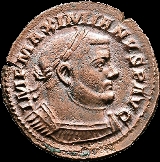
Maximian

 
Maximian

   Email Print
   Bookmark   Link


Maximian


Marcus Aurelius Valerius Maximianus Herculius (c. 250 – c. July 310), commonly referred to as Maximian, was Caesar
Caesar (title)

Caesar , Latin: Caesar , is a title of emperor character. It derives from the Roman naming convention#Cognomen of Julius Caesar, the Roman dictator....
 (junior Roman Emperor
Roman Emperor

The Roman Emperor was the ruler of the Roman Empire during the imperial period . The Romans had no single term for the office: Latin language titles such as imperator , Augustus , Caesar and princeps were all associated with it....
) from July 285 and Augustus (senior Roman Emperor) from April 1, 286 to May 1, 305. He shared the latter title with his co-emperor and superior, Diocletian
Diocletian

Gaius Aurelius Valerius Diocletianus , born Diocles and commonly known as Diocletian , was Roman Emperor from November 20, 284 to May 1, 305....
, whose political brain complemented Maximian's military brawn. Maximian established his residence at Trier
Trier

Trier is a city in Germany on the banks of the Moselle River. It is the oldest city in Germany, founded in or before 16 BC. Trier is not the only city claiming to be Germany's oldest, but it is the only one that bases this assertion on having the longest history as a city, as opposed to a mere settlement or army camp....
 but spent most of his time on his campaign .


Discussion
Ask a question about 'Maximian'
Start a new discussion about 'Maximian'
Answer questions from other users
Full Discussion Forum


Timeline

250   Born

286   Diocletian elevates Maximian as Caesar, or junior Emperor. Later in the year, Maximian is promoted to Augustus or co-Emperor.

287   Diocletian and Maximian become Roman Consuls

288   In Gaul, Maximian builds a fleet to fight Carausius.

289   Constantius Chlorus married Flavia Maximiana Theodora, stepdaughter of Maximian, after renouncing Helena, mother of Constantine I.

289   Maximian's attempt to reconquer Britain from the usurper Carausius fails due to bad weather.

290   Diocletian and Maximian meet in Milan on the five-year anniversary of their rule to discuss their successes and failures.

293   Diocletian and Maximian appoint Constantius Chlorus and Galerius as Caesars. This is considered the beginning of the Tetrarchy.

296   Maximian pacifies the area around the Danube.

297   Maximian ends the revolt in Mauritania


Encyclopedia


Marcus Aurelius Valerius Maximianus Herculius (c. 250 – c. July 310), commonly referred to as Maximian, was Caesar
Caesar (title)

Caesar , Latin: Caesar , is a title of emperor character. It derives from the Roman naming convention#Cognomen of Julius Caesar, the Roman dictator....
 (junior Roman Emperor
Roman Emperor

The Roman Emperor was the ruler of the Roman Empire during the imperial period . The Romans had no single term for the office: Latin language titles such as imperator , Augustus , Caesar and princeps were all associated with it....
) from July 285 and Augustus (senior Roman Emperor) from April 1, 286 to May 1, 305. He shared the latter title with his co-emperor and superior, Diocletian
Diocletian

Gaius Aurelius Valerius Diocletianus , born Diocles and commonly known as Diocletian , was Roman Emperor from November 20, 284 to May 1, 305....
, whose political brain complemented Maximian's military brawn. Maximian established his residence at Trier
Trier

Trier is a city in Germany on the banks of the Moselle River. It is the oldest city in Germany, founded in or before 16 BC. Trier is not the only city claiming to be Germany's oldest, but it is the only one that bases this assertion on having the longest history as a city, as opposed to a mere settlement or army camp....
 but spent most of his time on his campaign . In the late summer of 285, he suppressed rebels in Gaul known as the Bagaudae
Bagaudae

In the time of the Roman Empire bagaudae were groups of peasant insurgents who emerged during the "Crisis of the Third Century", and persisted particularly in the less-Romanised areas of Gaul and Hispania, where they were "exposed to the depredations of the late Roman state, and the great landowners and clerics who were its servants"....
. From 285 to 288, he fought against Germanic tribes along the Rhine frontier. Together with Diocletian, he ran a scorched earth
Scorched earth

A scorched earth policy is a military strategy or operational method which involves destroying anything that might be useful to the enemy while advancing through or withdrawing from an area....
 campaign deep into the territory of the Alamanni
Alamanni

The Alamanni, Allemanni, or Alemanni were originally an alliance of Germanic languagess located around the upper Main river . One of the earliest references to them is the cognomen Alamannicus assumed by Caracalla, who ruled the Roman Empire from 211?17 and claimed thereby to be their defeater....
 tribes in 288, temporarily relieving the Rhenish provinces from the threat of Germanic invasion.

The man he appointed to police the Channel
English Channel

The English Channel is an Arm of the Atlantic Ocean that separates England from northern France, and joins the North Sea to the Atlantic. It is about long and varies in width from at its widest, to only in the Strait of Dover....
 shores, Carausius
Carausius

Marcus Aurelius Mausaeus Carausius was a military commander of the Roman Empire in the 3rd century. He was a Menapii, born in the western part of Betuwe, who Roman usurper power in 286, declaring himself emperor of Roman Britain and northern Gaul....
, rebelled in 286, causing the secession of Britain and northwestern Gaul. Maximian failed to oust Carausius, and his invasion fleet was destroyed by storms in 289 or 290. Maximan's subordinate, Constantius
Constantius Chlorus

Flavius Valerius Constantius , also Constantius I, was an Roman emperor of the Western Roman Empire . He was commonly called Chlorus an epithet given to him by Byzantine Empire historians....
, campaigned against Carausius' successor, Allectus
Allectus

Allectus was a Roman Empire Roman usurper-Roman emperors in Roman Britain and northern Gaul from 293 to 296....
, while Maximian held the Rhenish frontier. The rebel leader was ousted in 296, and Maximian moved south to combat Moor
Moor

Moor may refer to:*an ethnic or racial designation, from Latin Maurus "of North Africa"**Moors, people of North Africa and Al-Andalus**Sri Lankan Moor, a minority ethnic group of Sri Lanka...
ish pirates in Iberia and Berber
Berber

Berber may refer to:*a member of the Berber people**the Berber languages, a family of Afro-Asiatic languages**Berberism, a political-cultural supporting a distinct Berber identity....
 incursions in Mauretania
Mauretania

In Antiquity, Mauretania was originally an independent Berber people monarchy on the Mediterranean coast of north Africa , corresponding to western Algeria, northern Morocco and Spain Plazas de soberan?a....
. When these campaigns concluded in 298, he departed for Italy, where he lived in comfort until 305. At Diocletian's behest, Maximian abdicated on May 1, 305, gave the Augustan office to Constantius, and retired to southern Italy.

In late 306, Maximian took the title of Augustus again and aided his son Maxentius
Maxentius

Marcus Aurelius Valerius Maxentius was Western Roman Emperor from 306 to 312. He was the son of former emperor Maximian, and the son-in-law of Galerius, also an emperor....
' rebellion in Italy. In April 307, he attempted to depose his son, but failed and fled to the court of Constantius' successor, Constantine
Constantine I

Flavius Valerius Aurelius Constantinus , commonly known in English_language as Constantine I, Constantine the Great, or Saint Constantine , was Roman Emperor from 306, and the undisputed holder of that office from 324 until his death in 337....
, in Trier. At the Council of Carnuntum
Carnuntum

Carnuntum was an important Roman Empire army camp in what is now Austria. It belonged originally to Noricum province, but after the 1st century was part of Pannonia....
 in November 308, Diocletian and his successor, Galerius
Galerius

Galerius Maximianus , formally Gaius Galerius Valerius Maximianus was Roman Emperor from 305 to 311....
, forced Maximian to renounce his imperial claim again. In early 310, Maximian attempted to seize Constantine's title while the emperor was on campaign on the Rhine. Few supported him, and he was captured by Constantine in Marseille. Maximian committed suicide in the summer of 310 on Constantine's orders. During Constantine's war with Maxentius, Maximian's image was purged from all public places. However, after Constantine ousted and killed Maxentius, Maximian's image was rehabilitated, and he was deified.

Early life

Maximian was born near Sirmium
Sirmium

Sirmium was an ancient city in Roman Pannonia. Sirmium originally was an Illyrians town conquered by the Ancient Rome in the 1st century BC. It was a very important town in the later Roman Empire, being the economic capital of Roman Pannonia and one of the four capital cities of the Roman Empire....
 (Sremska Mitrovica
Sremska Mitrovica

Sremska Mitrovica is a city and municipality located in the Vojvodina province of Serbia at 44.98? North, 19.61? East, on the left bank of the Sava river....
, Serbia
Serbia

Serbia , officially the Republic of Serbia , is a country in Central Europe and Balkans Europe, covering the southern part of the Pannonian Plain and the central part of the Balkans....
) in the province
Roman province

In Ancient Rome, a province was the basic, and until the Tetrarchy , largest territorial and administrative unit of the empire's territorial possessions outside of the Italia ....
 of Pannonia
Pannonia

Pannonia is an ancient province of the Roman Empire bounded north and east by the Danube, coterminous westward with Noricum and upper Italy, and southward with Dalmatia and upper Moesia....
, around 250 into a family of shopkeepers. Beyond that, the ancient sources contain vague allusions to Illyricum
Illyricum (Roman province)

The Roman province of Illyricum replaced the formerly independent kingdom of Illyria. It stretched from the Drin River river in modern Albania to Istria in the west and to the Sava river in the north....
 as his homeland, to his Pannonian virtues, and to his harsh upbringing along the war-torn Danube
Danube

The Danube is the longest river in the European Union and Europe's second longest river after the Volga.The river originates in the Black Forest in Germany as the much smaller Brigach and Breg River rivers which join at the eponymously named German town Donaueschingen, after which it is known as the Danube and flows eastwards for a distance...
 frontier. Maximian joined the army, serving with Diocletian under the emperors Aurelian
Aurelian

Lucius Domitius Aurelianus , known in English as Aurelian, Roman Emperor , was the second of several highly successful "soldier-emperors" who helped the Roman Empire regain its power during the latter part of the third century and the beginning of the fourth....
 (r. 270–275) and Probus
Probus

Marcus Aurelius Probus was a Roman Emperor .A native of Sirmium , in Pannonia, at an early age he entered the army, where he distinguished himself under the Emperors Valerian , Aurelian and Marcus Claudius Tacitus....
 (r. 276–282). He probably participated in the Mesopotamian campaign of Carus
Carus

Marcus Aurelius Carus was a Roman Emperor . During his short reign, Carus tried to follow the path of restoration of the empire strength marked by Aurelian and Probus....
 in 283 and attended Diocletian's election as emperor on November 20 284
284

Events...
 at Nicomedia
Nicomedia

Nicomedia was founded by Nicomedes I of Bithynia at the head of the Gulf of Astacus which opens to the Propontis. In earlier antiquity, the city was called Astacus or Olbia ....
. Maximian's swift appointment by Diocletian as Caesar is taken by the writer Stephen Williams and historian Timothy Barnes
Timothy Barnes

Timothy David Barnes is a United Kingdom Classics.Timothy David Barnes was born in Yorkshire in 1942. He was educated at Queen Elizabeth Grammar School, Wakefield until 1960, going up to Balliol College, Oxford, where he read Literae Humaniores, taking his Bachelor of Arts in 1964 and Master of Arts in 1967....
 to mean that the two men were longterm allies, that their respective roles were pre-agreed and that Maximian had probably supported Diocletian during his campaign against Carinus
Carinus

Marcus Aurelius Carinus was Roman Emperor and elder son of the Emperor Carus, on whose accession he was appointed governor of the western portion of the empire....
 (r. 283–285) but there is no direct evidence for this.

With his great energy, firm aggressive character and disinclination to rebel, Maximian was an appealing candidate for imperial office. The fourth-century historian Aurelius Victor
Aurelius Victor

Sextus Aurelius Victor was an historian and politician of the Roman Empire.Aurelius Victor was the author of a History of Rome from Augustus to Julian the Apostate , published ca....
 described Maximian as "a colleague trustworthy in friendship, if somewhat boorish, and of great military talents". Despite his other qualities, Maximian was uneducated and preferred action to thought. The panegyrist of 289, after comparing his actions to Scipio Africanus
Scipio Africanus

Publius Cornelius Scipio Africanus also known as Scipio Africanus, Scipio the Elder, and Africanus the Elder was a general in the Second Punic War and statesman of the Roman Republic....
' victories over Hannibal during the Second Punic War
Second Punic War

The Second Punic War lasted from 218 BC to 201 BC and involved combatants in the western and eastern Mediterranean. It was the second of three major wars between Carthage and the Roman Republic....
, suggested that Maximian has never heard of them. His ambitions were purely military; he left politics to Diocletian. The Christian
Christian

A Christian is a person who adheres to Christianity, a Monotheism#Christian view religion centered on the life and teachings of Jesus and interpreted by Christians to have been prophesied in the Hebrew Bible/Old Testament....
 rhetor
Rhetoric

Rhetoric is the art of using language as a means to persuade. Along with logic and dialectic, rhetoric is one of the three ancient arts of discourse....
 Lactantius
Lactantius

Lucius Caelius Firmianus Lactantius was an early Christian author ....
 suggested that Maximian shared Diocletian's basic attitudes but was less puritanical in his tastes, and took advantage of the sensual opportunities his position as emperor offered. Lactantius charged that Maximian defiled senator's daughters and traveled with young virgins to satisfy his unending lust, though Lactantius' credibility is undermined by his hostility towards pagans.

Maximian had two children with his Syria
Syria

Syria , officially the Syrian Arab Republic , is an Arab-majority country in Southwest Asia, bordering Lebanon and the Mediterranean Sea to the west, Israel to the southwest, Jordan to the south, Iraq to the east, and Turkey to the north....
n wife, Eutropia
Eutropia

Eutropia the wife of Roman Emperor Maximian.She was of Syrian origin. They had two children, Maxentius and Fausta, while elder daughters Flavia Maximiana Theodora and N, wife of Julius Julianus and mother of Julianus, and sons Eusebius and Afranius were the product of a previous marriage, divorced before 283, of Eutropia to Flavius Afrani...
: Maxentius and Fausta
Fausta

Fausta Flavia Maxima, Roman Empress, She was the daughter of the Roman Emperor Maximianus . To seal the alliance between them for control of the Tetrarchy, Maximianus married her to Constantine I in 307....
. There is no direct evidence in the ancient sources for their birthdates. Modern estimates of Maxentius' birth year have varied from circa 277 to circa 287, and most date Fausta's birth to circa 298. Theodora
Flavia Maximiana Theodora

File:Bronze-Flavia Maximiana Theodora-trier RIC 65.jpgFlavia Maximiana Theodora was the stepdaughter of Maximian. Her parents were Flavius Afranius Hannibalianus and wife, divorced before 283, Eutropia, later wife of Maximian....
, the wife of Constantius Chlorus, is often called Maximian's stepdaughter by ancient sources, leading to claims by Otto Seeck
Otto Seeck

Otto Seeck was a Germany classical historian. He was born in Riga.Received his teaching credentials in Berlin in 1877, and with the support of Theodor Mommsen was appointed to a position with the University of Greifswald, where he met Karl Julius Beloch who had quarrelled with Mommsen....
 and Ernest Stein that she was born from an earlier marriage between Eutropia and Afranius Hannibalianus. Barnes challenges this view, saying that all "stepdaughter" sources derive their information from the partially unreliable work of history Kaisergeschichte
Enmannsche Kaisergeschichte

The Enmannsche Kaisergeschichte is a modern term for a hypothesized Latin historical work, written in the 4th century but now lost.The German scholar Alexander Enmann made in 1884 a comparison of several late Roman historical works and found many similarities, which could not be explained by a direct literary relationship between the extant...
, while other, more reliable sources, refer to her as Maximian's natural daughter. Barnes concludes that Theodora was born no later than circa 275 to an unnamed earlier wife of Maximian, possibly one of Hannibalianus' daughters.

Appointment as Caesar


At Mediolanum
Mediolanum

Mediolanum, the ancient Milan, was an important Celts and then Ancient Rome centre of northern Italy. This article charts the history of the city from its settlement by the Insubres around 600 BC, through its conquest by the Ancient Rome and its development into a key centre of Western Christianity and capital of the Western Roman Empire, un...
 (Milan
Milan

Milan is the second largest city of Italy, located in the plains of Lombardy. It is the capital in the Province of Milan, as well as the Regions of Italy capital of Lombardy....
, Italy
Italy

Italy , officially the Italian Republic , is a country located on the Italian Peninsula in Southern Europe and on the two largest islands in the Mediterranean Sea, Sicily and Sardinia....
) in July 285, Diocletian proclaimed Maximian as his co-ruler, or Caesar. The reasons for this decision are complex. With conflict in every province of the empire, from Gaul to Syria, from Egypt to the lower Danube, Diocletian needed a lieutenant to manage his heavy workload. Historian Stephen Williams suggests that Diocletian considered himself a mediocre general and needed a man like Maximian to do most of his fighting.

Next, Diocletian was vulnerable in that he had no sons – just a daughter, Valeria – who could never succeed him. He was forced therefore to seek a co-ruler from outside his family and that co-ruler had to be someone he trusted. (The historian William Seston has argued that Diocletian, like heirless emperors before him, adopted Maximian as his filius Augusti ("Augustan son") upon his appointment to the office. Some agree, but the historian Frank Kolb
Frank Kolb

Frank Kolb is a Germany professor of ancient history at the Eberhard Karls University of T?bingen in Germany. He has been involved in a controversy over findings concerning the late Bronze Age in Troy, and accused Dr....
 has stated that arguments for the adoption are based on misreadings of the papyrological evidence. Maximian did take Diocletian's nomen
Roman naming conventions

By the Roman Republic and throughout the Roman Empire, a name in ancient Rome for a male citizen consisted of three parts : praenomen , nomen and cognomen ....
 (family name
Family name

A family name or last name is a type of surname and part of a personal name indicating the family to which the person belongs. The use of family names is widespread in cultures around the world....
) Valerius, however.)

Finally, Diocletian knew that single rule was dangerous and that precedent existed for dual rulership. Despite their military prowess, both sole-emperors Aurelian and Probus had been easily removed from power. In contrast, just a few years earlier, the emperor Carus and his sons had ruled jointly, albeit not for long. Even the first emperor, Augustus, (r. 27 BC–AD 19), had shared power with his colleagues and more formal offices of co-emperor had existed from Marcus Aurelius
Marcus Aurelius

Marcus Aurelius Antoninus Augustus was Roman Emperor from 161 to his death in 180. He was the last of the "Five Good Emperors", and is also considered one of the most important stoicism philosophy....
 (r. 161–180) on.

The dual system evidently worked well. About 287, the two rulers' relationship was re-defined in religious terms, with Diocletian assuming the title Iovius and Maximian Herculius. The titles were pregnant with symbolism: Diocletian-Jove
Jupiter (mythology)

In Roman mythology, Jupiter or Jove was the king of the gods,and the god of sky and thunder. He is the equivalent of Zeus in the Greek pantheon....
 had the dominant role of planning and commanding; Maximian-Hercules
Hercules

Hercules is the Ancient Rome name for the mythical Ancient Greece hero Heracles, son of Zeus and the mortal Alcmene. Early Roman sources suggest that the imported Greek hero supplanted a mythic Italian shepherd called "Recaranus" or "Garanus", famous for his strength....
 the hero
Hero

A hero , in Greek mythology and folklore, was originally a demigod, the offspring of a mortal and a deity,their Greek hero cult being one of the most distinctive features of Religion in ancient Greece....
ic role of completing assigned tasks. Yet despite the symbolism, the emperors were "gods" in the Imperial cult
Imperial cult (Ancient Rome)

The imperial cult in ancient Rome was the worship of a few select Roman Emperors as Roman godss once they were deceased; the only emperor to declare himself a god while still living was Domitian which caused outrage....
 tradition (although they may have been hailed as such in Imperial panegyrics). Instead, they were the gods' instruments, imposing the gods' will on earth. Once the rituals were over, Maximian assumed control of the government of the West and dispatched to Gaul to fight the rebels known as Bagaudae while Diocletian returned to the East.

Early campaigns in Gaul and Germany

The Bagaudae of Gaul are obscure figures, appearing fleetingly in the ancient sources, with their 285 uprising being their first appearance. The fourth-century historian Eutropius
Eutropius

IntroductionNot much is known about the early life of Eutropius because there are no written texts that document his life. Eutropius should not be confused with Eutropius of Valencia or Saint Eutropius....
 described them as rural people under the leadership of Amandus and Aelianus
Aelianus (rebel)

Aelianus was together with Amandus the leader of an insurrection of Gallic peasants, called Bagaudae, in the reign of Diocletian. It was put down by the Caesar Maximianus Hemilius....
, while Aurelius Victor called them bandits. The historian David S. Potter suggests that they were more than peasants, seeking either Gallic political autonomy or reinstatement of the recently deposed Carus (a native of Gallia Narbonensis
Gallia Narbonensis

Gallia Narbonensis was a Roman province located in what is now Languedoc and Provence, in southern France. Narbonese Gaul "lay between the Alps, the Mediterranean Sea, and the C?vennes Mountains....
, in what would become southern France
France

France , officially the French Republic , is a country whose Metropolitan France is located in Western Europe and that also comprises various Overseas departments and territories of France....
): in this case, they would be defecting imperial troops, not brigands. Although poorly equipped, led and trained – and therefore a poor match for Roman legions – Diocletian certainly considered the Bagaudae sufficient threat to merit an emperor to counter them.

Maximian traveled to Gaul, engaging the Bagaudae late in the summer of 285. Details of the campaign are sparse and provide no tactical detail: the historical sources dwell only on Maximian's virtues and victories. The 289 panegyric
Panegyrici Latini

The Panegyrici Latini or Latin Panegyrics is a collection of twelve Ancient Rome panegyric orations. The authors of most of the speeches in the collection are anonymous, but appear to have been Gallic in origin....
 to Maximian records that the rebels were defeated with a blend of harshness and leniency. As the campaign was against the empire's own citizens, and therefore distasteful, it went unrecorded in titles
Victory title

A victory title is an honorific title adopted by a successful military commander to commemorate his defeat of an enemy nation. This practice was first used by Ancient Rome and is still most commonly associated with the Romans, but it has also been adopted as a practice by many modern empires, especially Napoleonic, British and Russian....
 and official triumphs
Roman triumph

A Roman triumph was a civil religion and religious rite of ancient Rome, held to publically celebrate the achievements of an army commander who had won great military successes, originally and traditionally, who had successfully completed a war....
. Indeed, Maximian's panegyrist declares: "I pass quickly over this episode, for I see in your magnanimity you would rather forget this victory than celebrate it." By the end of the year, the revolt had significantly abated, and Maximian moved the bulk of his forces to the Rhine frontier, heralding a period of stability.

Maximian did not put down the Bagaudae swiftly enough to avoid a Germanic reaction. In the autumn of 285, two barbarian armies – one of Burgundians
Burgundians

File:Roman Empire 125.svgThe Burgundians were an East Germanic language Germanic tribes which may have emigrated from mainland Scandinavia to the island of Bornholm, whose old form in Old Norse still was Burgundarholmr , and from there to mainland Europe....
 and Alamanni, the other of Chaibones and Heruli
Heruli

The Heruli were a nomadic Germanic people, who were subjugated by the Ostrogoths, Huns, and Byzantine Empires in the 3rd to 5th centuries. The name is related to earl and was probably an honorific military title....
 – forded the Rhine and entered Gaul. The first army was left to die of disease and hunger, while Maximian intercepted and defeated the second. He then established a Rhine headquarters in preparation for future campaigns, either at Moguntiacum (Mainz
Mainz

Mainz is a city in Germany and the capital of the Germany States of Germany of Rhineland-Palatinate. It was a politically important seat of the Prince-elector of Mainz under the Holy Roman Empire, and previously was a Roman Empire fort city which commanded the west bank of the Rhine River and formed part of the northernmost frontier of th...
, Germany
Germany

Germany , officially the Federal Republic of Germany , is a country in Central Europe. It is bordered to the north by the North Sea, Denmark, and the Baltic Sea; to the east by Poland and the Czech Republic; to the south by Austria and Switzerland; and to the west by France, Luxembourg, Belgium, and the Netherlands....
), Augusta Treverorum (Trier, Germany), or Colonia Agrippina (Cologne
Cologne

Cologne is Germany's fourth-largest city , and is the largest city both in the German Federal State of North Rhine-Westphalia and within the Rhine-Ruhr, one of the major European metropolitan areas with more than ten million inhabitants....
, Germany).

Carausius


Although most of Gaul was pacified, regions bordering the English Channel still suffered from Frankish
Franks

The Franks or Frankish people were a West Germanic ethnic group first identified in the 3rd century as living north and east of the Lower Rhine River....
 and Saxon
Saxons

The Saxons were a confederation of Germanic peoples. Their modern-day descendants in Saxony are considered ethnic Germans; those in the eastern Netherlands are considered to be ethnic Dutch people; those in north eastern Belgium are considered to be ethnic Flemish people; and those in southern England ethnic English people ....
 piracy
Piracy

Piracy is a warlike act committed by a foreign nonstate actor, especially robbery or crime committed at sea, on a river, or sometimes on shore, either from a vessel flying no national flag, or one flying a national flag but without authorization from a nation....
. The emperors Probus and Carinus had begun to fortify the Saxon Shore
Saxon Shore

Saxon Shore could refer to one of the following:* Saxon Shore, a military command of the Late Roman Empire, encompassing southern Britain and the coasts of northern France....
, but much remained to be done. For example, there is no archaeological evidence of naval bases at Dover
Dover

Dover is a town and major ferry port in the county of Kent, in South East England. It faces France across the narrowest part of the English Channel....
 and Boulogne
Boulogne-sur-Mer

Boulogne-sur-Mer is a city in northern France. It is a Subprefectures in France of the Departments of France of Pas-de-Calais.The population of the city was 44,859 in the 1999 census, whereas that of the whole metropolitan area was 135,116....
 during 270–285. In response to the pirate problem, Maximian appointed Mausaeus Carausius, a Menapian
Menapii

Category:Tribes involved in Caesar's Gallic WarsThe Menapii were a Belgae tribe of northern Gaul in pre-Roman and Roman Empire times....
 from Germania Inferior
Germania Inferior

Germania Inferior was a Ancient Rome Roman provinces located on the left bank of the Rhine, in today's southern and western Netherlands, parts of Flanders, and North Rhine-Westphalia left of the Rhine....
 (southern and western Netherlands
Netherlands

The Netherlands is a country that is part of the Kingdom of the Netherlands. It is a parliamentary democratic constitutional monarchy. The Netherlands is located in North-West Europe, and bordered by the North Sea to the north and west, Belgium to the south, and Germany to the east....
) to command the Channel and to clear it of raiders. Carausius did well. By the end of 285, he was capturing pirate ships in great numbers.

Maximian soon heard that Carausius was waiting until the pirates had finished plundering before attacking and that their booty was going into Carausius' pockets instead of to the population at large or into the imperial treasury. Maximian ordered Carausius' arrest and execution, prompting him to flee the continent to Britain. Carausius' support among the British was strong, and at least two British legions (II Augusta and XX Valeria Victrix) defected to him, as did some or all of a legion near Boulogne (probably XXX Ulpia Victrix
Legio XXX Ulpia Victrix

Legio trigesima Ulpia Victrix was a Roman legion levied by the Emperor Trajan in 100 for the Dacian Wars. The legion was active until disbandment of the Rhine frontier in the beginning of the 5th century....
). Carausius quickly eliminated the few remaining loyalists in his army and declared himself Augustus.

Maximian could do little about the revolt. He had no fleet – he had given it to Casausius – and was busy quelling the Heruli and the Franks. Meanwhile, Carausius strengthened his position by enlarging his fleet, enlisting Frankish mercenaries, and paying his troops well. By the autumn of 286, Britain, much of northwestern Gaul, and the entire Channel coast, was under his control. Casausius declared himself head of an independent British state, an Imperium Britanniarum and issued coin of a markedly higher purity than that of Maximian and Diocletian, earning the support of British and Gallic merchants. Even Maximian's troops were vulnerable to Carausius' influence and wealth.

Maximian appointed Augustus

Spurred by the crisis with Carausius, on April 1, 286, Maximian took the title of Augustus This gave him the same status as Carausius – so the clash was between two Augusti, rather than between an Augustus and a Caesar – and, in imperial propaganda, Maximian was proclaimed Diocletian's brother, his equal in authority and prestige. Diocletian could not have been present at Maximian's appointment, causing Seeck to suggest that Maximian usurped the title and was only later recognized by Diocletian in hopes of avoiding civil war. This suggestion has not won much support, and the historian William Leadbetter has recently refuted it. Despite the physical distance between the emperors, Diocletian trusted Maximian enough to invest him with imperial powers, and Maximian still respected Diocletian enough to act in accordance with his will.

In theory, the Roman Empire was not divided by the dual imperium. Though divisions did take place – each emperor had his own court, army, and official residences – these were matters of practicality, not substance. Imperial propaganda from 287 on insists on a singular and indivisible Rome, a patrimonium indivisum. As the panegyrist of 289 declares to Maximian: "So it is that this great empire is a communal possession for both of you, without any discord, nor would we endure there to be any dispute between you, but plainly you hold the state in equal measure as once those two Heracleidae
Heracleidae

In Greek mythology, the Heracleidae or Heraclids were the numerous descendants of Heracles , especially applied in a narrower sense to the descendants of Hyllus, the eldest of his four sons by Deianira ....
, the Spartan Kings
Kings of Sparta

Sparta was an important Ancient Greece polis in the Peloponnesus. It was unusual among Greek city-states in that it maintained its kingship past the Archaic period in Greece....
, had done." Legal rulings were given and imperial celebrations took place in both emperors' names; the same coins were issued in both parts of the empire. Diocletian sometimes issued commands to Maximian's province of Africa; Maximian could presumably have done the same for Diocletian's territory.

Campaigns against Rhenish tribes


Campaigns in 286 and 287

Maximian realized that he could not immediately suppress Carausius and campaigned instead against Rhenish tribes. These tribes were probably greater threats to Gallic peace than Carausius in any case and included many supporters of Carausius. Although Maximian had many enemies along the river, they were more often in dispute with each other than in combat with the empire. Few clear dates survive for Maximian's campaigns on the Rhine beyond a general range of 285 to 288. While receiving the consular fasces on January 1, 287, Maximian was interrupted by news of a barbarian raid. Doffing his toga and donning his armor, he marched against the barbarians and, although they were not entirely dispersed, he celebrated a victory in Gaul later that year.

Maximian believed the Burgundian and Alemanni tribes of the Moselle
Moselle

Moselle is a departments of France in the east of France named after the Moselle River....
-Vosges
Vosges

This article is about the department of France named Vosges. For the mountain range, see Vosges Mountains.Vosges is a France departments of France, named after the local Vosges Mountains....
 region to be the greatest threat, so he targeted them first. He campaigned using scorched earth tactics, laying waste to their land and reducing their numbers through famine and disease. After the Burgundians and Alemanni, Maximian moved against the weaker Heruli and Chaibones. He cornered and defeated them in a single battle. He fought in person, riding along the battle line until the Germanic forces broke. Roman forces pursued the fleeing tribal armies and routed them. With his enemies from starvation, Maximian launched a great invasion across the Rhine. He moved deep into Germanic territory, bringing destruction to his enemies' homelands, and demonstrating the superiority of Roman arms. By the winter of 287, he had the advantage and the Rhenish lands were free of Germanic tribesmen. Maximian's panegyrist declared: "All that I see beyond the Rhine is Roman."

Joint campaign against the Alamanni

The following spring, as Maximian made preparations for dealing with Carausius, Diocletian returned from the East. The emperors met that year, but neither date nor place is known with certainty. They probably agreed on a joint campaign against the Alamanni and a naval expedition against Carausius.

Later in the year, Maximian led a surprise invasion of the Agri Decumates
Agri Decumates

Agri Decumates a province of the Roman Empire covering the Black Forest area between the the Main river and the sources of Danube and Rhine rivers, presently in Southwestern Germany ....
 – a region between the upper Rhine and upper Danube deep within Alamanni territory – while Diocletian invaded Germany via Raetia
Raetia

File:REmpire Rhetia.pngRaetia was a Roman province of the Roman Empire, bounded on the west by the country of the Helvetii, on the east by Noricum, on the north by Vindelicia, and on the south by Cisalpine Gaul....
. Both emperors burned crops and food supplies as they went, destroying the Germans' means of sustenance. They added large swathes of territory to the empire and allowed Maximian's build-up to proceed without further disturbance. In the aftermath of the war, towns along the Rhine were rebuilt, bridgeheads created on the eastern banks at such places as Mainz and Cologne, and a military frontier was established, comprising forts, roads, and fortified towns. A military highway through Tornacum (Tournai
Tournai

Tournai is a Walloon Region city and Municipalities in Belgium of Belgium located 85 kilometres southwest of Brussels, on the river Scheldt, in the province of Hainaut ....
, Belgium
Belgium

* A small German-speaking Community of Belgium exists in eastern Wallonia. Belgium's linguistic diversity and related political and cultural conflicts are reflected in the history of Belgium and a complex Communities and regions of Belgium....
), Bavacum (Bavay
Bavay

Bavay is a Communes of France in the Nord Departments of France in northern France.It lies 15 m. ESE of Valenciennes by railway....
, France), Atuatuca Tungrorum (Tongeren
Tongeren

Tongeren is a city and Arrondissement_of_Tongeren located in the Provinces of Belgium of Limburg , Flanders, Belgium. Tongeren is the oldest town in Belgium....
, Belgium), Mosae Trajectum (Maastricht
Maastricht

Maastricht is a city and a municipality in the Netherlands province of Limburg , of which it is the Capital . The city is situated on both sides of the Meuse River river in the south-eastern part of the Netherlands, near the Belgium and Germany borders....
, Netherlands), and Cologne connected points along the frontier.

Constantius, Gennobaudes, and resettlement

In early 288, Maximian appointed his praetorian prefect Flavius Constantius, husband of Maximian's daughter Theodora, to lead a campaign against Carausius' Frankish allies. These Franks controlled the Rhine estuaries
Estuary

An estuary is a semi-enclosed coastal body of water with one or more rivers or streams flowing into it, and with a free connection to the open sea....
, thwarting sea-attacks against Carausius. Constantius moved north through their territory, wreaking havoc, and reaching the North Sea
North Sea

The North Sea is a marginal sea, epeiric sea on the European continental shelf. The Dover Strait and the English Channel in the south and the Norwegian Sea in the north connect it to the Atlantic Ocean....
. The Franks sued for peace and in the subsequent settlement Maximian reinstated the deposed Frankish king Gennobaudes. Gennobaudes became Maximian's vassal and, with lesser Frankish chiefs in turn swearing loyalty to Gennobaudes, Roman regional dominance was assured.

Maximian allowed a settlement of Frisians
Frisians

The Frisians are an ethnic group of Germanic people living in coastal parts of The Netherlands and Germany. They are concentrated in the Dutch provinces of Friesland and Groningen and, in Germany, East Frisia and North Frisia....
, Salian Franks
Salian Franks

File:Seal_of_Childeric_I_Tournai tomb.jpgThe Salian Franks or Salii were a subgroup of the early Franks who originally had been living north of the limes in the coastal area above the Rhine River in the northern Netherlands, where today there still is a region called Salland....
, Chamavi
Chamavi

The Chamavi were a Germanic tribe of Late Antiquity and the Dark Ages. They first appear under that name in the 1st century AD Germania of Tacitus as a Germanic tribe that, for most of their history, existed along the North bank of the Lower Rhine in the region today called Hamaland after them, which is in the Gelderland province of the...
 and other tribes along a strip of Roman territory, either between the Rhine and Waal rivers from Noviomagus (Nijmegen
Nijmegen

Nijmegen is a municipality and a city in the east of the Netherlands, near the Germany border. It is considered to be the oldest city in the Netherlands and celebrated its 2000th year of existence in 2005....
, Netherlands) to Traiectum (Utrecht
Utrecht (city)

Utrecht city and municipality is the capital and most populous city of the Netherlands province of Utrecht . It is located in the North-Eastern end of the Randstad, and is the fourth largest city of the Netherlands, with a population of 300,030....
, Netherlands) or near Trier. These tribes were allowed to settle only on condition they acknowledged Roman dominance. Their presence, providing a ready pool of manpower and preventing the settlement of other Frankish tribes, gave Maximian a buffer along the northern Rhine and reduced his need to garrison the region.

Later campaigns in Britain and Gaul


Failed expedition against Carausius

Antoninianus Carausius Leg4 Ric 0069v
By 289, Maximian was prepared to invade Carausius' Britain but, for some reason, the plan failed. Maximian's panegyrist of 289 was optimistic about the campaign's prospects; but the panegyrist of 291 made no mention of it. Constantius' panegyrist suggested that his fleet was lost to a storm, but this might simply have been to diminish the embarrassment of defeat. Diocletian curtailed his Eastern province tour soon after, perhaps on learning of Maximian's failure. Diocletian returned in haste to the West, reaching Emesa by May 10, 290, and Sirmium on the Danube by July 1 290
290

Events...
.

Diocletian met Maximian in Milan either in late December 290 or January 291. Crowds gathered to witness the emperors descend on the city and the emperors devoted much time to public pageantry. Potter, among others, has surmised that the ceremonies were arranged to demonstrate Diocletian's continuing support for his faltering colleague. The rulers discussed matters of politics and war in secret, and they may have considered the idea of expanding the imperial college to include four emperors (the Tetrarchy
Tetrarchy

Tetrarchy can be applied to any system of government where power is divided between four individuals. The term is usually used to refer to the tetrarchy instituted by Roman Emperor Diocletian in 293 which lasted until c. 313....
). Meanwhile, a deputation from the Roman Senate met with the rulers and renewed their infrequent contact with the imperial office. The emperors would not meet again until 303.

Following Maximian's failure to invade in 289, an uneasy truce with Carausius began. Maximian tolerated Carausius' rule in Britain and on the continent but refused to grant the secessionist state formal legitimacy. For his part, Carausius was content with his territories beyond the Continental coast of Gaul. However, Diocletian would not long put up with such an affront to his dignity. Faced with Carausius' secession and further challenges on the Egyptian, Syrian, and Danubian borders, he realized that two emperors were insufficient to manage the empire. On March 1 293
293

Events...
 at Milan, Maximian appointed Constantius to the office of Caesar. On either the same day or a month later, Diocletian did the same for Galerius, thus establishing the "Tetrarchy", or "rule of four". Constantius was made to understand that he must succeed where Maximian had failed and defeat Carausius.

Campaign against Allectus

Quinarius Allectus Galley Ric 0128
Constantius met expectations quickly and efficiently, and by 293 had expelled Carausian forces from northern Gaul. In the same year, Casausius was assassinated and replaced by his treasurer, Allectus. Constantius marched up the coast to the Rhine and Scheldt estuaries where he was victorious over Carausius' Frankish allies, taking the title Germanicus maximus. His sights now set on Britain, Constantius spent the following years building an invasion fleet. Maximian, still in Italy after the appointment of Constantius, was appraised of the invasion plans and, in the summer of 296, returned to Gaul. There, he held the Rhenish frontiers against Carausius' Frankish allies while Constantius launched his invasion of Britain. Allectus was killed on the North Downs
North Downs

The North Downs are a ridge of chalk hills in south east England that stretch for 120 miles from Farnham in Surrey to the White Cliffs of Dover in Kent....
 in battle with Constantius' praetorian prefect, Asclepiodotus. Constantius himself had landed near Dubris
Dubris

Dubris or Portus Dubris was a town in Roman Britain. It is now Dover, Kent, England.As the closest point to continental Europe and the site of the estuary of the River Dour, Kent, the site chosen for Dover was ideal for a cross-channel port....
 (Dover) and marched on Londinium (London
London

London is the capital of both England and the United Kingdom, and the most populous municipality in the European Union. An important settlement for two millennia, History of London goes back to its founding by the Roman Empire....
), whose citizens greeted him as a liberator.

Campaigns in North Africa

With Constantius' victorious return, Maximian was able to focus on the conflict in Mauretania (Northwest Africa
Northwest Africa

Northwest Africa or Northwestern Africa is a variably defined region of North Africa. The term incorporates cardinal directions, and is used in various disciplines: geopolitics, archaeology, anthropology, meteoritics and genetics....
). As Roman authority weakened during the third century, nomadic Berber tribes harassed settlements in the region with increasingly severe consequences. In 289, the governor of Mauretania Caesariensis
Mauretania Caesariensis

File:Roman Africa.JPGMauretania Caesariensis was a Roman province located in northwestern Africa. It was the easternmost of the North African Roman provinces, mainly in present Algeria, with its capital at Caesaria , now Cherchell....
 (roughly modern Algeria
Algeria

Algeria , officially the People's Democratic Republic of Algeria, is a country located in North Africa. It is the largest country of the Mediterranean sea, second largest in the Arab World, and the second largest on the African continent and the eleventh-largest country in the world in terms of land area....
) gained a temporary respite by pitting a small army against the Bavares and Quinquegentiani
Quinquegentiani

The Quinquegentiani were a tribe in North Africa that revolted against Roman Empire rule in the late 3rd Century and were put down by the forces of Maximianus Herculius....
, but the raiders soon returned. In 296, Maximian raised an army, from Praetorian cohorts
Praetorian Guard

The Praetorian Guard was a special force of guards used by Roman empire List of Roman Emperorss. Before being appropriated for the use of the Emperors' personal guards, the title was used for the guards of Roman generals, at least since the rise to prominence of the Scipio family around 275 BC....
, Aquileia
Aquileia

Aquileia is an ancient history Roman Republic city in what is now Italy, at the head of the Adriatic Sea at the edge of the lagoons, about 10 km from the sea, on the river Natiso , the course of which has changed somewhat since Roman times....
n, Egyptian, and Danubian legionaries, Gallic and German auxiliaries
Auxiliaries (Roman military)

Auxiliaries formed the standing non-citizen corps of the Roman army of the Principate , alongside the citizen Roman legion. By the 2nd century, the auxilia contained the same number of infantry as the legions and in addition provided almost all the Roman army's Roman cavalry and more specialised troops ....
, and Thracian
Thrace

Thrace is a historical and geographic area in southeast Europe. Today the name Thrace designates a region spread over southern Bulgaria , northeastern Greece , and European Turkey ....
 recruits, advancing through Spain that autumn. He may have defended the region against raiding Moors
Moors

In the Spanish language, the term for Moors is Moro; in Portuguese language the word is mouro. There seems to have been some confusion about the relationship of the word moro/mouro to the word moreno , both from Greek language ma?ros, i.e....
 before crossing the Strait of Gibraltar
Strait of Gibraltar

The Strait of Gibraltar is the strait that connects the Atlantic Ocean to the Mediterranean Sea and separates Spain from Morocco. The name comes from Gibraltar, which in turn originates from the Arabic language Jebel Tariq meaning mountain of Tariq....
 into Mauretania Tingitana
Mauretania Tingitana

Mauretania Tingitana was a Roman province located in northwestern Africa, coinciding roughly with the northern part of modern Morocco and Spanish cities of Ceuta and Melilla....
 (roughly modern Morocco
Morocco

Morocco , officially the Kingdom of Morocco , is a country located in North Africa with a population of nearly 34 million and an area just under 447,000 km2....
) to protect the area from Frankish pirates.

By March 297, Maximian had begun a bloody offensive against the Berbers. The campaign was lengthy, and Maximian spent the winter of 297–298 resting in Carthage
Carthage

Carthage refers both to an ancient city in present-day Tunisia, and a modern-day suburb of Tunis. The civilization that developed within the city's sphere of influence is referred to as Punic or Carthaginian....
 before returning to the field. Not content to drive them back into their homelands in the Atlas Mountains
Atlas Mountains

The Atlas Mountains are a mountain range across a northern stretch of Africa extending about 2,400 km through Morocco, Algeria, and Tunisia. The highest peak is Jbel Toubkal, with an elevation of in southwestern Morocco....
 – from which they could continue to wage war – Maximian ventured deep into Berber territory. The terrain was unfavorable, and the Berbers were skilled at guerrilla warfare
Guerrilla warfare

Guerrilla warfare is the Irregular warfare warfare and combat with which a small group of combatants use mobile Military tactics to combat a larger and less mobile formal army....
, but Maximian pressed on. Apparently wishing to inflict as much punishment as possible on the tribes, he devastated previously secure land, killed as many as he could, and drove the remainder back into the Sahara
Sahara

The Sahara is the world's largest hot desert. At over 9,000,000 square kilometers , it covers most of Northern Africa, making it almost as large as the United States or the continent of Europe....
. His campaign was concluded by the spring of 298 and, on March 10, he made a triumphal entry into Carthage. Inscriptions there record the people's gratitude to Maximian, hailing him – as Constantius had been on his entry to London – as redditor lucis aeternae ("restorer of the eternal light"). Maximian returned to Italy in 299 to celebrate another triumph in Rome in the spring.

Leisure and retirement

After his Mauretanian campaign, Maximian returned to the north of Italy, living a life of leisure in palaces in Milan and Aquilea, and leaving warfare to his subordinate Constantius. Maximian was more aggressive in his relationship with the Senate than Constantius, and Lactantius contends that he terrorized senators, to the point of falsely charging and subsequently executing several, including the prefect of Rome in 301/2. In contrast, Constantius kept up good relations with the senatorial aristocracy and spent his time in active defense of the empire. He took up arms against the Franks in 300 or 301 and in 302 – while Maximian was resting in Italy – continued to campaign against Germanic tribes on the Upper Rhine.

Maximian was only disturbed from his rest in 303 by Diocletian's vicennalia, the 20-year anniversary of his reign, in Rome. Some evidence suggests that it was on then that Diocletian exacted a promise from Maximian to retire together, passing their titles as Augusti to the Caesars Constantius and Galerius. Presumably Maximian's son Maxentius and Constantius' son Constantine – children raised in Nicomedia together – would then become the new Caesars. While Maximian might not have wished to retire, Diocletian was still in control and there was little resistance. Before retirement, Maximian would receive one final moment of glory by officiating at the Secular Games
Secular games

The Secular Games were a religious celebration, involving sacrifices and theatre of ancient Rome performances, held in ancient Rome for three days and nights to mark the end of a saeculum and the beginning of the next....
 in 304.

On May 1, 305, in separate ceremonies in Milan and Nicomedia, Diocletian and Maximian retired simultaneously. The succession did not go not entirely to Maximian's liking: perhaps because of Galerius' influence, Severus
Flavius Valerius Severus

Flavius Valerius Severus was a Western Roman Emperor from 306 to 307.Severus was of humble birth, born in the Illyrian provinces around the middle of the third century AD....
 and Maximinus
Maximinus

title = Roman Emperor of the Roman Empire|name=Maximinus Daia|full name =Gaius Valerius Galerius Maximinus Daia| image =...
 were appointed Caesar, thus excluding Maxentius. Both the newly appointed Caesars had had long military careers and were close to Galerius: Severus was his nephew and Maximinus a former army comrade. Maximian quickly soured to the new tetrarchy, which saw Galerius assume the dominant position Diocletian once held. Although Maximian led the ceremony that proclaimed Severus Caesar, within two years he was sufficiently dissatisfied to support his son's rebellion against the new regime. Diocletian retired to the expansive palace
Diocletian's Palace

Diocletian's Palace is a building in Split , Croatia that was built by the emperor Diocletian at the turn of the fourth century AD.Diocletian built the massive palace in preparation for his retirement on May 1, 305 AD....
 he had built in his homeland, Dalmatia near Salona on the Adriatic
Adriatic Sea

The Adriatic Sea is a body of water separating the Italian Peninsula from the Balkan peninsula, and the system of the Apennine Mountains from that of the Dinaric Alps and adjacent ranges....
. Maximian retired to villas in Campania
Campania

Campania is a Regions of Italy of southern Italy in Europe. The region has a population of around 5.8 million people, making it the second-most-populous region of Italy, its total area of 13,595 km? makes it the most densely populated region in the country....
 or Lucania
Lucania

Lucania was an ancient district of southern Italy, extending from the Tyrrhenian Sea to the Gulf of Taranto. To the north it adjoined Campania, Samnium and Apulia, and to the south it was separated by a narrow isthmus from the district of Bruttium....
, where he lived a life of ease and luxury. Although far from the political centers of the empire, Diocletian and Maximian remained close enough to stay in regular contact.

Maxentius' rebellion

After the death of Constantius on July 25, 306, Constantine assumed the title of Augustus. This displeased Galerius, who instead offered Constantine the title of Caesar, which Constantine accepted. The title of Augustus then went to Severus. Maxentius was jealous of Constantine's power, and on October 28, 306, he persuaded a cohort of imperial guardsmen to declare him emperor. Uncomfortable with sole leadership, Maxentius sent a set of imperial robes to Maximian and saluted him as "Augustus for the second time", offering him theoretic equal rule but less actual power and a lower rank.

Galerius refused to recognize Maxentius and sent Severus with an army to Rome to depose him. As many of Severus' soldiers had served under Maximian, and had taken Maxentius' bribes, most of the army defected to Maxentius. Severus fled to Ravenna
Ravenna

Ravenna is a city and comune in the Emilia-Romagna region of Italy. The city is inland, but is connected to the Adriatic Sea by a canal. Ravenna once served as the seat of the Western Roman Empire and later the Ostrogoths and the Exarchate of Ravenna....
, which Maximian besieged. The city was strongly fortified so Maximian offered terms, which Severus accepted. Maximian then seized Severus and took him under guard to a public villa in southern Rome, where he was kept as a hostage. In the autumn of 307, Galerius led a second force against Maxentius but he again failed to take Rome, and retreated north with his army mostly intact.

While Maxentius built up Rome's defenses, Maximian made his way to Gaul to negotiate with Constantine. A deal was struck in which Contantine would marry Maximian's younger daughter Fausta and be elevated to Augustan rank in Maxentius' secessionist regime. In return, Constantine would reaffirm the old family alliance between Maximian and Constantius, and support Maxentius' cause in Italy but would remain neutral in the war with Galerius. The deal was sealed with a double ceremony in Trier in the late summer of 307, at which Constantine married Fausta and was declared Augustus by Maximian.

Maximian returned to Rome in the winter of 307–8 but soon fell out with his son and in the spring of 308 challenged his right to rule before an assembly of Roman soldiers. He spoke of Rome's sickly government, disparaged Maxentius for having weakened it, and ripped the imperial toga from Maxentius' shoulders. He expected the soldiers to recognize him but they sided with Maxentius, and Maximian was forced to leave Italy in disgrace.

On November 11, 308, to resolve the political instability, Galerius called Diocletian (out of retirement) and Maximian to a general council meeting at the military city of Carnuntum on the upper Danube. There, Maximian was forced to abdicate again and Constantine was again demoted to Caesar. Licinius
Licinius

Valerius Licinianus Licinius was Roman emperor from 308 to 324.Of Dacian peasant origin, born in Moesia Superior, Licinius accompanied his close childhood friend, the Emperor Galerius, on the Persian expedition in 297....
, a loyal military companion to Galerius, was appointed Augustus of the West. In early 309 Maximian returned to the court of Constantine in Gaul, the only court that would still accept him.

Rebellion against Constantine

In 310, Maximian rebelled against Constantine while the emperor was on campaign against the Franks. Maximian had been sent south to Arles with part of Constantine's army to defend against attacks by Maxentius in southern Gaul. In Arles, Maximian announced that Constantine was dead and took up the imperial purple
Tyrian purple

Tyrian purple , also known as royal purple, imperial purple or imperial dye, is a purple-red dye which was first produced by the ancient Phoenicians in the city of Tyre, Lebanon....
. In spite offering bribes to any who would support him as emperor, most of Constantine's army remained loyal, and Maximian was compelled to leave. Constantine soon heard of the rebellion, abandoned his campaign against the Franks, and moved quickly to southern Gaul, where he confronted the fleeing Maximian at Massilia (Marseille
Marseille

"Marseille" is the second-largest city of France and forms the third-largest aire urbaine, after those of Paris and Lyon, with a population recorded to be 1,516,340 at the 1999 census and estimated to be 1,605,000 in 2007....
). The town was better able to withstand a long siege than Arles, but it made little difference as loyal citizens opened the rear gates to Constantine. Maximian was captured, reproved for his crimes, and stripped of his title for the third and last time. Constantine granted Maximian some clemency but strongly encouraged his suicide. In July 310, Maximian hanged himself.

Despite the earlier rupture in relations, after Maximian's suicide Maxentius presented himself as his father's devoted son. He minted coins bearing his father's deified image and proclaimed his desire to avenge his death.

Constantine initially presented the suicide as an unfortunate family tragedy. By 311, however, he was spreading another version. According to this, after Constantine had pardoned him, Maximian planned to murder Constantine in his sleep. Fausta learned of the plot and warned Constantine, who put a eunuch
Eunuch

A eunuch is a castrated man, in particular one castrated early enough to have major hormonal consequences; the term usually refers to those castrated in order to perform a specific social function, as was common in many societies of the past....
 in his own place in bed. Maximian was apprehended when he killed the eunuch and was offered suicide, which he accepted. In addition to the propaganda, Constantine instituted a damnatio memoriae
Damnatio memoriae

Damnatio memoriae is the Latin language literally meaning "damnation of memory", in the sense of removed from the remembrance. It was a form of dishonor that could be passed by the Roman Senate upon treachery or others who brought discredit to the Roman State....
 on Maximian, destroying all inscriptions referring to him and eliminating any public work bearing his image.

Constantine defeated Maxentius at the Battle of the Milvian Bridge on October 28 312
312

Events...
. Maxentius died, and Italy came under Constantine's rule. Eutropia swore on oath that Maxentius was not Maximian's son, and Maximian's memory was rehabilitated. His apotheosis
Apotheosis

Apotheosis refers to the exaltation of a subject to divinity level. The term has meanings in theology, where it refers to a belief, and in art, where it refers to a genre....
 under Maxentius was declared null and void, and he was re-consecrated as a god, probably in 317. He began appearing on Constantine's coinage as divus, or divine, by 318, together with the deified Constantius and Claudius Gothicus
Claudius II

Marcus Aurelius Claudius , often referred to as Claudius Gothicus or Claudius II, was a Roman Emperor. He ruled the Roman Empire for less than two years , but during that brief time he managed to obtain some successes....
. The three were hailed as Constantine's forbears. They were called "the best of emperors". Through his daughters Fausta and Flavia, Maximian was grandfather or great-grandfather to every reigning emperor from 337 to 363.

See also

  • 20,000 Martyrs of Nicomedia
    20,000 Martyrs of Nicomedia

    The 20,000 Martyrs of Nicomedia died during the rule of Emperors Diocletian and Maximian in the early fourth century. A number of those executed, men, women, and children died by capital punishment, others were burned alive according to accounts....
     Executed partially during Maximian's reign.
  • Saints Sergius and Bacchus
    Saints Sergius and Bacchus

    Saints Sergius and Bacchus , were third century Roman Empire soldiers who are commemorated as martyrs by the Roman Catholic Church, Eastern Orthodoxy and Oriental Orthodoxy churches....
    , officers of Maximian's army who were executed for being Christians


External links