
See Also

Caligula

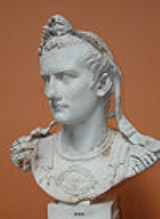
Gaius Julius Caesar Augustus Germanicus , most commonly known as Caligula, was the third Roman Emperor Roman Emperor

"Roman Emperor" is the term historians use to refer to rulers of the Roman Empire [i], after the epoch c ... 

 and a member of the Julio-Claudian dynasty Julio-Claudian Dynasty

The Julio-Claudian Dynasty refers to the first five Roman Emperors [i]: Augustus [i], Tiberius [i], Caligula [i] ... 

, ruling from 37 to 41. Known for his extreme extravagance, eccentricity, depravity and cruelty, he is remembered as a despot. He was assassinated Assassination

Assassination is the deliberate killing of an important person, usually a political figure or other stra... 

 in 41 by several of his own guards. The Roman historian Suetonius referred to Caligula as a "monster", and the surviving sources are universal in their condemnation. One popular tale, often cited as an example of his insanity and tyranny, is that Caligula appointed his favorite horse, Incitatus, to a seat on the senate and attempted to appoint it to the position of consul.

Discussions

  Discussion Features

   Ask a question about 'Caligula'

   Start a new discussion about 'Caligula'

   Answer questions about 'Caligula'

   'Caligula' discussion forum

Timeline

12   Born

29   Agrippina the Elder Agrippina the elder

Agrippina , most commonly known as Agrippina Major or Agrippina "the Elder", was one of th... 

 is exiled to the island of Pandataria Ventotene

Ventotene is an island in the Tyrrhenian Sea [i], off the coast of Campania [i], Italy [i]. ... 

, and her sons (except Caligula) are imprisoned by Sejanus.

37   Caligula's Caligula

Gaius Julius Caesar Augustus Germanicus , most commonly known as Caligula, was the third Roman Emperor [i] ... 

 attempt to have himself deified creates friction between himself and the Senate Roman Senate

The Roman Senate was the main governing council of both the Roman Republic [i], which started in 510 BC [i] ... 

37   The Roman Senate Roman Senate

The Roman Senate was the main governing council of both the Roman Republic [i], which started in 510 BC [i] ... 

 annuls Tiberius Tiberius

Tiberius Caesar Augustus, born Tiberius Claudius Nero , was the second Roman Emperor [i], from the ... 

' will and proclaims Caligula Roman Emperor Roman Emperor

"Roman Emperor" is the term historians use to refer to rulers of the Roman Empire [i], after the epoch c ... 

.

38   Apion heads a deputation to Caligula to complain about the Jew Jew

Jews are followers of Judaism [i] or, more generally, members of the Jewish people , an ethno [i] ... 

s in Alexandria Alexandria

Alexandria , , is the second-largest city in Egypt [i], and its largest seaport. ... 

.

39   Tigellinus, minister and favorite of the later Roman emperor Roman Emperor

"Roman Emperor" is the term historians use to refer to rulers of the Roman Empire [i], after the epoch c ... 

 Nero Nero

Nero 'Claudius Caesar Augustus Germanicus , born Lucius Domitius Ahenobarbus, also called ... 

, is banished for adultery Adultery

Adultery is generally defined as consensual sexual intercourse [i] by a married [i] person with ... 

 with Caligula's sisters.

39   Caligula is also a consul.

39   Caligula orders that a statue of himself be placed in the temple in Jerusalem Temple in Jerusalem

The Temple in Jerusalem or the Holy Temple was built in ancient Jerusalem [i] in the 10th century BCE [i] ... 

. The governor of Syria Syria

Syria , officially the Syrian Arab Republic , is a country in the Middle East [i]. ... 

, Publius Petronius, who is responsible for erecting the statue, faces mass demonstrations by Jews of the region and manages to delay construction of the statue until the death of Caligula (January 24 41).

40   The emperor Caligula is consul without colleague.

41   Consuls are the emperor Roman Emperor

"Roman Emperor" is the term historians use to refer to rulers of the Roman Empire [i], after the epoch c ... 

 Caligula and Gnaeus Sentius Saturninus

   More Events >>


Encyclopedia

Gaius Julius Caesar Augustus Germanicus , most commonly known as Caligula, was the third Roman Emperor Roman Emperor

"Roman Emperor" is the term historians use to refer to rulers of the Roman Empire [i], after the epoch c ... 

 and a member of the Julio-Claudian dynasty Julio-Claudian Dynasty

The Julio-Claudian Dynasty refers to the first five Roman Emperors [i]: Augustus [i], Tiberius [i], Caligula [i] ... 

, ruling from 37 to 41. Known for his extreme extravagance, eccentricity, depravity and cruelty, he is remembered as a despot. He was assassinated Assassination

Assassination is the deliberate killing of an important person, usually a political figure or other stra... 

 in 41 by several of his own guards.

The Roman historian Suetonius referred to Caligula as a "monster", and the surviving sources are universal in their condemnation. One popular tale, often cited as an example of his insanity and tyranny, is that Caligula appointed his favorite horse, Incitatus, to a seat on the senate and attempted to appoint it to the position of consul. The story, however, owes its unrelenting currency to its charm: it is based on a single misunderstood near-contemporary reference, in which Suetonius merely repeats an unattributed rumour that Caligula was thinking about doing it . Caligula is often alleged to have had incest Incest

Incest is sexual activity [i] between close family [i] members.
... 

uous relationships with his sisters, most notably his younger sister Drusilla Drusilla

Julia Drusilla was a daughter to Germanicus [i] and Agrippina the Elder [i]. ... 

, but there is no credible evidence to support such claims either. In short, the surviving sources are filled with anecdotes of Caligula's cruelty and insanity rather than an actual account of his reign, making any reconstruction of his time as Princeps nearly impossible. What does survive is the picture of a depraved, hedonistic ruler, an image that has made Caligula one of the most widely recognizable, if poorly documented, of all the Roman Emperors; the name "Caligula" itself has become synonymous with wanton hedonism, cruelty, tyranny, and insanity.

Early life

See Julio-Claudian Family Tree Julio-Claudian family tree

The Julio-Claudian Dynasty [i] of the early Roman Empire [i] has a family tree [i] complicated by multiple mar ... 

.


Caligula was born as Gaius Julius Caesar Germanicus on August 31, 12, at the resort of Antium, the third of six surviving children born to Augustus's adopted grandson, Germanicus Germanicus

Iulius Caesar Claudianus Germanicus was a member of the Julio-Claudian dynasty [i] of the early Roman Empire [i] ... 

, and Augustus's granddaughter, Agrippina the Elder Agrippina the elder

Agrippina , most commonly known as Agrippina Major or Agrippina "the Elder", was one of th... 

. Germanicus was son to Nero Claudius Drusus Nero Claudius Drusus

Nero Claudius Drusus Germanicus, born Decimus Claudius Drusus and variously called Drusus, '... 

 and Antonia Minor Antonia Minor

Antonia Minor, also known as Antonia the Younger or simply Antonia.
... 

. He was nephew to Claudius Claudius

Christoph Ludwig Agricola was a German [i] landscape painter [i]. ... 

 . Agrippina was daughter to Marcus Vipsanius Agrippa Marcus Vipsanius Agrippa

Marcus Vipsanius Agrippa was a Roman statesman and general.... 

 and Julia the Elder Julia the Elder

... no changes ... no changes ...... 

. They had four other sons , and three daughters .

Gaius' life started out promisingly, as he was the son of extremely famous parents. Germanicus was a grandson to Tiberius Claudius Nero and Livia Livia

Livia Drusilla, after 14 [i] called Julia Augusta was the wife of Caesar Augustus [i] and the most ... 

, Augustus's third wife, as well as an adoptive grandson of Augustus himself. He was thus a prominent member of the Julio-Claudian dynasty and was revered as son of the most beloved general of the Roman Empire Roman Empire

The Roman Empire was a phase of the ancient Roman [i] civilization characterized by an autocratic [i] ... 

. Agrippina was herself a granddaughter of Augustus and Scribonia. She was considered a model of the perfect Roman woman.


As a boy of just two or three, he accompanied his parents on military campaigns in the north of Germania Germania

Dating back to the Roman [i] era, Germania was the Latin [i] name for a geographical area t ... 

 and became the mascot of his father's army. The soldiers were amused whenever Agrippina would put young Gaius in a miniature soldier costume, and he was soon given his nickname Caligula, meaning "Little boot", after the small boots he wore as part of his costume. He would end up hating this name, but he also hated the name "Gaius".

The question of succession had arisen several times during the life of Augustus, leading to accusations of intrigue within the family. Caligula's father, Germanicus Germanicus

Iulius Caesar Claudianus Germanicus was a member of the Julio-Claudian dynasty [i] of the early Roman Empire [i] ... 

, was believed by many to have been Augustus's preferred successor, though at the time of Augustus's death he was too young to assume the office of Princeps. As a result, Augustus had promoted Tiberius Tiberius

Tiberius Caesar Augustus, born Tiberius Claudius Nero , was the second Roman Emperor [i], from the ... 

, with the caveat that Tiberus in turn adopt Germanicus. After a successful campaign in Germany and a Triumph Roman triumph

A Roman Triumph was a civil ceremony [i] and religious rite [i] of ancient Rome [i], held... 

 in Rome, Germanicus was sent east to distance him from Roman politics, and died on October 10, 19, claiming to have been poisoned by agents of Tiberius. Relations between his mother and Tiberius Tiberius

Tiberius Caesar Augustus, born Tiberius Claudius Nero , was the second Roman Emperor [i], from the ... 

 deteriorated rapidly amid accusations of murder and conspiracy.

The adolescent Caligula was sent to live first with his great-grandmother, and Tiberius's mother, Livia Livia

Livia Drusilla, after 14 [i] called Julia Augusta was the wife of Caesar Augustus [i] and the most ... 

, in 27, possibly as a hostage. Following Livia's falling-out with Tiberius and her death two years later, he was returned to his Julian relatives and remanded to his grandmother Antonia. During this period Caligula had little outside contact, and his sole companions were his three sisters, Agrippina the Younger Agrippina the Younger

Julia Agrippina , most commonly known as Agrippina Minor or Agrippina the Younger , was the... 

, Drusilla Drusilla

Julia Drusilla was a daughter to Germanicus [i] and Agrippina the Elder [i]. ... 

, and Julia Livilla Julia Livilla

Julia Livilla was the youngest child of Germanicus [i] and Agrippina the Elder [i] and one of Caligula [i] ... 

. Later, Caligula's accusers would focus on this close relationship, accusing the Emperor of having engaged in incest with all three, but especially Drusilla Drusilla

Julia Drusilla was a daughter to Germanicus [i] and Agrippina the Elder [i]. ... 

. Suetonius in particular writes a great deal about these supposed acts.

In 31, Caligula was remanded to the personal care of Tiberius on Capri Capri

Capri is an Italian [i] island [i] off the Sorrentine Peninsula [i]. ... 

 until the death of Tiberius and the ascension of Caligula in 37. By this time, Caligula was already in favor with Tiberius. Suetonius writes of extreme perversions happening on Capri, as Tiberius was without the people who managed to keep him in line , so he felt free to indulge in any perversion he desired. Whether this is true or not is hard to say. Unpopular Emperors such as Tiberius and Caligula may not have had the whole truth written about them, and gossip is common throughout ancient texts.


At this time, Tiberius's Praetorian Prefect, Sejanus, was extremely powerful in Rome, and began forming his own alliances against Tiberius's rule and his possible successors, attempting to court the supporters of the Julian line. Treason trials were commonly practiced, as Tiberius in his old age was growing increasingly paranoid and began to rely increasingly upon his friend Sejanus, who once saved his life. These trials were the main lever Sejanus used to strengthen his position and dispose of any opposition.

From a very early age Caligula learned to tread very carefully. According to both Tacitus Tacitus

Publius Cornelius Tacitus is one of the important historian [i]s of Roman Antiquity [i]. ... 

 and Suetonius, he surpassed his brothers in intelligence, and was an excellent natural actor, realizing the danger when other members of his family could not. Caligula survived when most of the other potential candidates to the throne were destroyed. His mother Agrippina was banished to the tiny island of Pandataria Ventotene

Ventotene is an island in the Tyrrhenian Sea [i], off the coast of Campania [i], Italy [i]. ... 

, where she starved herself to death. His two oldest brothers, Nero and Drusus, also died. Nero was banished to the island of Ponza Ponza

Ponza or Pontia is the largest of the Italian [i] Pontine Islands [i] archipelago [i], locat ... 

, while Drusus' body was found locked in a dungeon with stuffing from his mattress in his mouth to keep off the hunger pangs.

Suetonius writes of Caligula's servile nature towards Tiberius, and his indifferent nature towards his dead mother and brothers. By his own account, Caligula mentioned years later that this servility was a sham in order to stay alive, and on more than one occasion he very nearly killed Tiberius when his anger overwhelmed him. An observer said of Caligula: "Never was there a better servant or a worse master!" Caligula proved to have a flair for administration and won further favor with the ailing Tiberius by carrying out many of his duties for him. At night, Caligula would inflict torture on slaves and watch bloody gladiatorial games with glee. In 33, Tiberius gave Caligula the position of honorary quaestorship, the only form of public service Caligula would hold until his reign.

Early reign


When Tiberius died on March 16, 37, his estate and the titles of the Principate were left to Caligula and Tiberius's own grandson, Tiberius Gemellus Tiberius Gemellus

Tiberius Julius Caesar Nero , known as Tiberius Gemellus, was the son of Drusus [i] ... 

, who were to serve as joint heirs. Suetonius writes that the Prefect of the Praetorian Guard Naevius Sutorius Macro smothered Tiberius with a pillow to hasten Caligula's accession, much to the joy of the Roman people. Backed by Macro, Caligula had Tiberius’s will with regards to Tiberius Gemellus declared null and void on grounds of insanity, but otherwise carried out Tiberius' wishes. Caligula accepted the powers of the Principate as conferred by the Senate Roman Senate

The Roman Senate was the main governing council of both the Roman Republic [i], which started in 510 BC [i] ... 

, and entered Rome on March 28 amid a crowd that hailed him as "our baby" and "our star".

His first acts were generous in spirit, though more than likely political in nature. He granted bonuses to the Praetorian Guard Praetorian Guard

The Praetorian Guard comprised a special force of bodyguard [i]s used by Roman [i] Emperor [i] ... 

s, destroyed Tiberius's treason papers, declared that treason trials were a thing of the past, recalled exiles, and helped those who had been harmed by the Imperial tax Tax

A tax is a financial charge or other levy [i] imposed on an individual or a legal entity [i] by a state [i] ... 

 system. He was also known to put on lavish spectacles for the public, such as gladiator battles. These acts initially won him favor from the public.

Caligula was loved by many simply for being the beloved son of the popular Germanicus. Moreover, he was, unlike Tiberius, a direct blood descendant of Augustus, and therefore related to Julius Caesar Julius Caesar

Gaius Julius Caesar , July 12 [i] or July 13 [i], 100 BC [i] – March 15 [i], 44 BC [i]) was a Roman [i] ... 

. He was also a great-grandson of Mark Antony Mark Antony

Marcus Antonius , known in English [i] as Mark Antony, was a Roman [i] ... 

.

On becoming Emperor, Caligula performed a spectacular stunt. He ordered a temporary floating bridge Pontoon bridge

Pontoon bridges are floating [i] bridge [i]s supported by barge-or-boat-like pontoon [i]s to support the ... 

 to be built using ships as pontoon Pontoon

A pontoon is a flat-bottomed boat [i] or the floats used to support a structure on water. ... 

s, stretching for over two miles from the resort of Baiae Baiae

Baiae is a frazione [i] of the comune [i] of Bacoli [i], in the Campania [i] region of Italy [i] ... 

 to the neighboring port of Puteoli Pozzuoli

Pozzuoli is a city of the province of Napoli [i], in the Italian [i] region of Campania [i]. ... 

. He then proceeded to ride his favorite horse, Incitatus, across, wearing the breastplate of Alexander the Great Alexander the Great

Alexander the Great , also known as Alexander III, king of Macedon [i] , was one of the most succe ... 

. This act was in defiance of Tiberius's soothsayer Thrasyllus prediction that he had "no more chance of becoming Emperor than of riding a horse across the Gulf of Baiae".

However, following this auspicious start to his reign, Caligula fell seriously ill in October of 37, and, as Scullard remarks, "emerged as a monster of lust and diabolical cruelty".

There is some debate as to the chronology here. Many authors, including Michael Grant and Donna W. Hurley , state that the real break between Caligula and the Senate, and thereafter his extravagant behaviour, did not occur until 39. Though the exact cause of the argument between the young Caesar and the Senate is unclear, what sources remain seem to indicate that the Emperor had demanded a triumph and had been refused by the Senate. What is clear is that in 39 Caligula removed and replaced the Consuls without consulting the Senate, and publicly humiliated several Senators by forcing them to run alongside his chariot in their full robes. It is from this point on that there is a marked change in the biography of his life; the young man previously hailed as "our star" and "our baby" by the Roman people became a despotic tyrant.

Caligula and the Empire

During his short reign, Mauretania was annexed and reorganized into two provinces, Herod Agrippa Agrippa I

Agrippa I also called the Great, King of the Jews [i], the grandson of Herod the Great [i], and son of Aristobulus IV [i] ... 

 was appointed to a kingdom in Judaea Judea

Judea or Judaea is a term used for the mountainous southern part of the historic Land of Israel [i] ... 

, and severe riots took place in Alexandria Alexandria

Alexandria , , is the second-largest city in Egypt [i], and its largest seaport. ... 

 between Jews Jew

Jews are followers of Judaism [i] or, more generally, members of the Jewish people , an ethno [i]... 

 and Greek Greeks

The Greeks are an ethnic group [i] mostly found in the southern Balkan peninsula [i] of southeastern Europe [i] ... 

s. Though certainly of note, these events are largely ignored by the surviving sources, all of whom unanimously focus on the Emperor as a mentally unstable, homicidal and depraved madman.

Examples of his insanity focus on a handful of episodes in his life, notably Caligula's military activities on the northern frontier, and his religious policy. His northern campaigns are derided, with accounts of Gaul Gaul

Gaul was the name given, in ancient times, to the region of Western Europe [i] comprising present-day n ... 

s dressed up as Germans at his triumph, and Roman troops ordered to collect sea-shells as "spoils of the sea" and indicative of his victory against Neptune Poseidon

In Greek mythology [i], Poseidon was the god of the sea [i], as well as horse [i]s and, as "Earth-Shake ... 

. Numerous theories and suggestions have been put forth to attempt to explain these actions as anything other than those of a mad-man, the most reasonable suggestion being that Caligula went north to invade Britain Great Britain

Great Britain is an island lying off the northwestern coast of mainland Europe [i] and to the east of Ireland [i] ... 

 and win where even Julius Caesar Julius Caesar

Gaius Julius Caesar , July 12 [i] or July 13 [i], 100 BC [i] – March 15 [i], 44 BC [i]) was a Roman [i] ... 

 had been forced to retreat. His troops seem to have had a different campaign in mind, and upon arriving at the shores of the English Channel English Channel

The English Channel is the part of the Atlantic Ocean [i] that separates the island [i] of Great Britain [i] ... 

, the troops refused to go further, hence Caligula ordered them to collect sea-shells as their reward for the "campaign" that they refused to embark upon. Once again, however, due to the lack of sources, what precisely occurred and why is a matter of debate even among the primary sources for Caligula's reign.

Caligula's religious policy was a firm departure from the policy of his predecessors. Under Augustus, the Cult of the Deified Emperor had been established and promoted, especially in the western empire, and was generally the first organization established in any new Roman colony. Augustus proclaimed on multiple occasions that he was not himself personally divine; instead the Cult centered around his numen, his personal spirit, and gens, the collective spirit of his family and ancestors. After Augustus, Tiberius seems to have had little interest in the Cult, and its promulgation and expansion seems to have been on a local level and driven by local magistrates, rather than from a central organizational structure. Caligula expanded this Cult on an unprecedented scale. The temple of Castor and Pollux on the Forum was linked directly to the Imperial residence on the Palatine and dedicated to Caligula himself; he would appear here on occasions, dressed and presenting himself as a god, and demanding that those in his presence adopt sycophantic methods of acknowledging him. The nature of the Cult of the Deified Emperor changed from honoring the spirits around the Emperor to direct worship of Caligula himself. Likewise, Caligula's policies affected religious practice in the whole of the Empire, not just those practices associated with the Cult. The heads of the statues of many of the gods throughout Rome and the empire were replaced with Caligula's head, including many of the female statues, and Caligula demanded that he be worshipped as an embodiment of these gods, similar to the Hellenistic ruler-cults.

Caligula was especially paranoid of Jews Jew

Jews are followers of Judaism [i] or, more generally, members of the Jewish people , an ethno [i]... 

, having many killed for no reason, and he had statues of himself placed in all synagogue Synagogue

A synagogue is a Jew [i]ish place of religious worship. ... 

s. He even attempted to place a statue of himself as Zeus Zeus

In Greek mythology [i], Zeus is the highest ranking god [i] among the Olympian gods [i] ... 

 in the Holy of Holies Most Holy Place

The Most Holy Place also known as the Holiest of Holies, or Holy of Holies, in Hebrew [i] ... 

 in the Temple Temple

A temple is a structure reserved for religious or spiritual activities, such as prayer and sacrifice, or... 

 in Jerusalem Jerusalem

Jerusalem is Israel [i]'s capital [i] and largest city, with a population of 724,000 contained in 123 ... 

; Jews had been granted religious rights and freedom by Julius Caesar, and hitherto were generally treated as being outside the scope of Roman religious law. This attempt was delayed for years by the governor, Publius Petronius, and was finally ended due to the intervention of Herod Agrippa Agrippa I

Agrippa I also called the Great, King of the Jews [i], the grandson of Herod the Great [i], and son of Aristobulus IV [i] ... 

, a personal friend of the Emperor and client-king of Judea Judea

Judea or Judaea is a term used for the mountainous southern part of the historic Land of Israel [i] ... 

.

Downward spiral


Outlandish stories cluster about the raving emperor, illustrating his excessive cruelty, multiple and peculiar sexual escapades , or disrespect toward tradition and the Senate. The most recent detailed biography about his behavior aired on the History Channel The History Channel

The History Channel is a mainstream [i] cable [i] television [i] channel [i] ... 

 on August 19th, 2006. The sources describe his incest Incest

Incest is sexual activity [i] between close family [i] members.
... 

uous relationships with all three of his sisters, his disembowelment of his favorite sister in order to get to the child he impregnated her with resulting in her death, his subsequent declaring her to be a goddess, his selling to the highest bidder of the wives of high ranking Senate members during sexual orgies, his laughable military campaigns in the north, the plan to make his horse Incitatus a consul, and his habit of roaming the halls of his palace at night ordering the sun to rise. He also named his horse as a priest, and gave it a house to reside in, complete with a marble stable, golden manger, and jewel necklaces; and he later talked of making his horse a member of the Senate. He opened a brothel in his palace and had a habit of taking Senate members' wives with him to his private bedroom during social functions, while the husbands could merely look on as they left together, then he would recount the sexual acts he performed with the wives for all to hear, including her husband.

He comes across as aloof, arrogant, egotistical, and is generally portrayed as insane. He is said to have cried "I wish the Roman people had but a single neck" when an arena crowd applauded a faction he opposed. It is also said that when there were not enough convicts to fight lions & tigers in arena, he threw in some spectators. Suetonius wrote that he often uttered "Let them hate me, so long as they fear me", and described this as a familiar line of the tragic poet ; however, Suetonius also attributes the utterance of this line to Tiberius Tiberius

Tiberius Caesar Augustus, born Tiberius Claudius Nero , was the second Roman Emperor [i], from the ... 

.

What is documented is that he declared himself a living god, and even had a bridge constructed between his palace and Jupiter Jupiter

Jupiter is the fifth planet [i] from the Sun [i] and the largest [i] within the solar system [i] ... 

's Temple. He is also said to have made it a crime to look down on him from above, and not to leave him everything in a will. To the Roman people, this was considered nothing less than blasphemy.

Caligula was also incredibly self-indulgent, dramatic proof of which has been found with the discovery of two sunken ships at the bottom of Lake Nemi Lake Nemi

Lake Nemi is a small circular volcanic [i] lake in the Lazio [i] region of Italy [i] a few kilometers so ... 

. These two ships were by far the largest vessels in the ancient world; in fact their size was not even rivaled until after the Renaissance Renaissance

In the traditional view, the Renaissance was understood as a historical age in Europe [i] that follo ... 

. The smaller of the ships was designed as a temple dedicated to Diana . The larger ship was essentially an elaborate floating palace that counted marble floors and plumbing among its amenities, the sole role of which was to satisfy Caligula's increasingly hedonistic behavior.

Assassination

Caligula was murdered following a conspiracy amongst officers of the Praetorian Guard Praetorian Guard

The Praetorian Guard comprised a special force of bodyguard [i]s used by Roman [i] Emperor [i] ... 

, apparently for reasons of personal insult and spite. Some have suggested the plot was more extensive than the sources indicate, including many senators, imperial freedmen, and even the support of the next emperor Claudius Claudius

Christoph Ludwig Agricola was a German [i] landscape painter [i]. ... 

, but there is little if any evidence to support such claims.

What is known is that on January 24, 41, the praetorian tribune Cassius Chaerea and other guardsmen accosted Caligula while he was addressing an acting troupe of young men during a series of games held for the Divine Augustus. Chaerea had a distinguished record as one of Germanicus's best officers and had known Caligula since infancy. One possible motive provided by Suetonius is that Chaerea had experienced years of abuse by Caligula over his so-called effeminacy, possibly due to a wound to his genitalia; Suetonius records that Caligula commonly gave the watchwords "Priapus" or "Venus" when Chaerea was on duty. Chaerea requested the watchword from the Emperor and, after Caligula's response, struck the first blow. The co-conspirators quickly moved in and stabbed the Emperor to death, according to Josephus's account only a few feet away from his guard and entourage. By the time Caligula's German guard responded in a rage by attacking the co-conspirators and innocent civilians alike, the Emperor was already dead. It is believed that the final blow was to Caligula's genitalia, delivered by Chaerea. Chaerea and another aggrieved tribune, Cornelius Sabinus, also killed Caligula's wife Caesonia and their infant daughter, Julia Drusilla, by smashing her head against a wall.

Caligula's insanity

Recent sources say that Caligula probably had encephalitis. Ancient sources, like Roman biographers Suetonius and Cassius Dio, describe Caligula having a "brain fever". The symptoms of Caligula's condition as well can be attributed to an attack of meningitis. Philo of Alexandria Philo

Philo, known also as Philo of Alexandria and as Philo Judeaus, was a Hellenized [i] Jewish [i]... 

 reports it was nothing more than a nervous breakdown, as Caligula was not used to the pressures of constant attention after being out of the public eye for most of his life. Rome waited in horror, praying that their beloved Emperor would recover. He became better, but his reign took a sharp turn. The death of Gemellus and of Silanus, Caligula's father-in-law, took place right after Caligula recovered.

The question of whether or not Caligula was insane remains unanswered. Philo Philo

Philo, known also as Philo of Alexandria and as Philo Judeaus, was a Hellenized [i] Jewish [i]... 

, author of Legatio ad Caium and leader of a delegation sent to Caligula to seek relief from persecution by Alexandrian Greeks Greece

Greece
Greece lies at the juncture of Europe [i], Asia [i], and Africa [i]. ... 

, claimed that the emperor was no more than a vicious jokester. Based on the contemporary reports of his behavior, modern psychology would likely diagnose Caligula as delusional, and possibly suffering from antisocial personality disorder as a result of his traumatic upbringing.

However, given Caligula's unpopularity as emperor, it is difficult to separate fact from fiction. There are many famous stories attesting to his bizarre behavior as emperor: that he tried to make his beloved stallion, Incitatus, a consul, though this could have been a political statement indicating that he felt his horse was as well qualified for the position as any of the incumbents. Other stories claim that there existed incestuous relationship between Caligula and his sisters , a brothel he set up at the palace featuring the wives of prominent senators, his abandonment of a campaign in Britain that instead resulted in his soldiers collecting seashells as "spoils of the sea" in his battle with the sea god Neptune Neptune

Neptune is the eighth and outermost planet [i] in our solar system [i]. ... 

, wanting to erect a statue of himself in Jerusalem Jerusalem

Jerusalem is Israel [i]'s capital [i] and largest city, with a population of 724,000 contained in 123 ... 

 , his amusement with shutting down the granaries and starving the citizens, his hobby of watching executions as he ate, and labeling himself a "god". According to Suetonius he "often sent for men whom he had secretly killed, as though they were still alive, and remark off-handedly a few days later that they must have committed suicide". Regardless of the validity of any of these anecdotes, historians tend to agree on one fact, that Caligula was extremely unqualified and unprepared to be Emperor.

Alternative views

The lack of a full accounting of Caligula's reign, and the hyperbolic nature of the records that do remain, create several problems for historical analysis. It must be noted that, except for Philo's Embassy to Caius and mention in Josephus' Antiquities of the Jews, Chapters 6 through 8, all historical writings regarding Caligula are authored by Romans of Senatorial rank, a class of individuals whose power had been severely checked by the growth of the Principate. Additionally, in Roman politics sexual perversity was often presented hand in hand with poor government; Suetonius accuses Augustus, Tiberius, Caligula, and Nero all of sexually perverse behaviour, and also heavily criticizes many of the administrative aspects of these Emperor's rules. Therefore, much of what is recorded about Caligula, especially that coming from Suetonius, must be taken with a grain of salt.

It is known that in 39 there was a political break between Caligula and the Senate, and it is from this point forward that Caligula's reign takes on a decidedly despotic tone. The purges of Tiberius had removed from the Senate some of the staunchest supporters of the Julian line, of which Caligula was a prominent member. Caligula was thus presented with a Senate that, at best, offered half-hearted support. Additionally, the absence of Tiberius for much of his reign meant that the Senate, previously docile after almost 50 years under Augustus, had been forced to take up much of the administrative apparatus of the Empire once again. Caligula was thus faced with an uncooperative Senate that was once again beginning to rule the Empire as it had before Caesar and Augustus.

The position of the Princeps was an elaborate facade that required the most powerful man in Rome to act as if he were nothing more than a concerned citizen and magistrate under the Senate's supervision. Caligula, faced with an uncooperative Senate, seems to have quickly tired of this charade and decided to act indiscriminantly with the powers given to him as Princeps. The vast financial reserves that Tiberius had left behind were quickly spent and the imperial treasury emptied by the end of Caligula's brief reign. His reign saw the expansion of the imperial court and imperial palace into the Forum itself. Imperial duties and responsibilities that Tiberius had returned to the Senate were reclaimed as rights of the Princeps, and the powers of the Senate were further restricted. Perhaps modeling his rule after the Hellenistic monarchs, Caligula sought to make himself the center of all religious activity.

In essence, Caligula sought to take the Principate to its next logical step: a divine monarchy. However, the complexities of Roman society and Roman politics demanded that the facade of the "first-citizen" be continued. Suetonius compares Caligula to Julius Caesar; in the mind of the Roman Senate, the delicately balanced Principate had become little more than the tyranny it had rid itself of a century before. Thus, much of the sensational accusations leveled at Caligula could be viewed as politically motivated attacks against his character and his memory. It must be kept in mind that the records that we have of Caligula were all written by his political opponents, those most damaged by his attempt to enforce his absolute authority .

Popular culture

  • Caligula Caligula

    Gaius Julius Caesar Augustus Germanicus , most commonly known as Caligula, was the third Roman Emperor [i] ... 

    is also a controversial 1979 movie Film

    Film is a term that encompasses motion pictures as individual projects, as well as the field in general.... 

     starring Malcolm McDowell Malcolm McDowell

    Malcolm McDowell is an English [i] actor [i]. ... 

    , Teresa Ann Savoy, Helen Mirren Helen Mirren

    Dame Helen Mirren, DBE [i] is an Emmy Award [i]-winning English [i] ... 

    , and Peter O'Toole Peter O'Toole

    Peter Seamus O'Toole is an Irish [i]-born film and stage actor who was raised in England [i] ... 

    .
  • Actor Jay Robinson played Caligula in The Robe The Robe

    [i] written by [[Lloyd C. Douglas]... 

    1953 and its sequel Demetrius and the Gladiators Demetrius and the Gladiators

    Demetrius and the Gladiators is a 1954 [i] sword and sandal [i] drama film [i] and a se ... 

    1954.
  • John Hurt John Hurt

    John Vincent Hurt CBE [i] is an Academy Award [i] nominated English [i]... 

     played Caligula in the TV adaptation of Robert Graves Robert Graves

    Robert von Ranke Graves was an English [i] scholar, poet [i], and novelist [i]. ... 

    's book I, Claudius I, Claudius

    I, Claudius is a novel [i] by English [i] writer Robert Graves [i], first published in 1934 [i] ... 

    .
  • Caligula Caligula

    Gaius Julius Caesar Augustus Germanicus , most commonly known as Caligula, was the third Roman Emperor [i] ... 

    by Albert Camus Albert Camus

    Albert Camus was a French [i] author [i] and philosopher [i]. ... 

  • In Edgar Rice Burroughs Edgar Rice Burroughs

    Edgar Rice Burroughs was an American [i] author, best known for his creation of the jungle ... 

    ' novel I am a Barbarian the main character, the son of a chief of the Britons made captive by the Romans, becomes the personal slave and companion to a four-year-old boy whom he calls "Little Boots." Only ten himself, Britannicus soon realizes that he is serving the grandnephew of the emperor, one who bore a name that would be indelibly recorded on the pages of history -- Caligula.*
  • On Adult Swim Adult Swim

    Adult Swim, usually rendered [adult swim] on bumps [i], is the name for the adul ... 

    's The Venture Bros. The Venture Bros.

    The Venture Bros., sometimes elongated to The Venture Brothers, is an American [i] ... 

    , a 2006 episode has the family travel through different periods of time picking up various historical figures including Caligula. They had him hold the Hand of Osiris, which he hid in his rectum. Also, the group split up and Caligula was to team with Hank Venture, but after sexually embracing him, he was told to go alone.
  • On NBC's Seinfeld Seinfeld

    Seinfeld is an American [i] television [i] situation comedy [i] set in New York City [i] ... 

    , a 1995 episode, The Jimmy, found Jerry comparing his dentist, Tim Whatley, to Caligula when it appeared Whatley had sex with his assistant while Jerry was anesthetized. A later episode from 1997, The Blood The Blood

    The Blood are a London [i]-based Oi! [i] punk rock [i] band, formed in 1982.

... 

, shows George trying to integrate food into his sex life. Later on, at Monk's, George finds himself aroused by a meal, and in terror Jerry exclaims: "I'll tell you what you did, Caligula, you combined food and sex into one disgusting, uncontrollable urge!"
  • In a 1991 episode of Red Dwarf Red Dwarf

    Red Dwarf is a British [i] science fiction [i] sitcom [i] that ran for eight series, ... 

    , the crew encounters a number of historical figures, including Caligula, played by comedian Tony Hawks.
  • The psuedonym of Dark Funeral Dark Funeral

    Dark Funeral is a black metal [i] band from Sweden [i]. ... 

     vocalist is Emperor Magus Caligula.


  • On , Alexis Arquette appeared as Emperor Caligula in the episode "The God you Know"

See also

  • Nemi ships
  • Roman Empire Roman Empire

    The Roman Empire was a phase of the ancient Roman [i] civilization characterized by an autocratic [i] ... 


References


Bibliography

  • Caligula: the corruption of power by Anthony A. Barrett ISBN 0-7134-5487-3
  • Ludwig Quidde Ludwig Quidde

    Ludwig Quidde was a German [i] pacifist [i] who is mainly remembered today for his acer ... 

    's essay Caligula. Eine Studie über römischen Caesarenwahnsinn , in which Caligula is likened to the German Germany

    Germany , officially the Federal Republic of Germany , is a country [i] in central Europe [i]. ... 

     Emperor Emperor

    An emperor is a monarch [i], usually the sovereign [i] ruler of an empire [i] or another type o... 

     Wilhelm II William II, German Emperor

    William II or Wilhelm II , was the last German Emperor [i] and King of Prussia [i] , ruling both ... 

    .
  • Caligula is the title of a play by Albert Camus Albert Camus

    Albert Camus was a French [i] author [i] and philosopher [i]. ... 

    , which was the basis for a 1996 Hungarian movie and the 2001 made for TV version.
  • Grant, Michael, The Twelve Caesars. New York: Charles Scribner's Sons. 1975
  • Hurley, Donna W., An Historical and Historiographical Commentary on Suetonius' "Life of C. Caligula". Atlanta, Georgia: Scholars Press. 1993.

Primary sources

  • Philo of Alexandria Philo

    Philo, known also as Philo of Alexandria and as Philo Judeaus, was a Hellenized [i] Jewish [i]... 

    , :
    • On the Embassy to Gaius
    • Flaccus
  • Josephus Josephus

    Josephus , who became known, in his capacity as a Roman [i] citizen, as Flavius Josephus ... 

    , Antiquities of the Jews, , Books XVIII-XIX
  • E.M.Smallwood, Documents Illustrating the Principates of Gaius, Claudius and Nero
  • Suetonius, The Lives of the twelve Caesars: Caius Caligula

Secondary material

  • A. Barret, Caligula: The Corruption of Power, .