
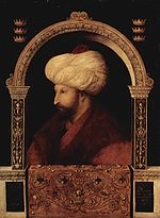
Mehmed II (
Ottoman TurkishThe Ottoman Turkish language or Ottoman language is the variety of the Turkish language that was used for administrative and literary purposes in the Ottoman Empire. It borrows extensively from Arabic and Persian, and was written in a variant of the Perso-Arabic script...
: محمد ثانى
), (also known as
el-Fātiḥ (الفاتح), "the Conqueror" in
Ottoman TurkishThe Ottoman Turkish language or Ottoman language is the variety of the Turkish language that was used for administrative and literary purposes in the Ottoman Empire. It borrows extensively from Arabic and Persian, and was written in a variant of the Perso-Arabic script...
, or, in modern
TurkishTurkish is a language spoken as a native language by over 83 million people worldwide, making it the most commonly spoken of the Turkic languages. Its speakers are located predominantly in Turkey and Northern Cyprus with smaller groups in Iraq, Greece, Bulgaria, the Republic of Macedonia, Kosovo,...
,
Fatih Sultan Mehmet; also called
Mahomet II in
early modern EuropeEarly modern Europe is the term used by historians to refer to a period in the history of Europe which spanned the centuries between the end of the Middle Ages and the beginning of the Industrial Revolution, roughly the late 15th century to the late 18th century...
) was
SultanSultan is a title with several historical meanings. Originally, it was an Arabic language abstract noun meaning "strength", "authority", "rulership", and "dictatorship", derived from the masdar سلطة , meaning "authority" or "power". Later, it came to be used as the title of certain rulers who...
of the
Ottoman EmpireThe Ottoman EmpireIt was usually referred to as the "Ottoman Empire", the "Turkish Empire", the "Ottoman Caliphate" or more commonly "Turkey" by its contemporaries...
(
RûmRûm, also Roum or Rhum , an indefinite term used at different times in the Muslim world to refer to the Balkans and Anatolia generally, and for the Byzantine Empire in particular, for the Seljuk Sultanate of Rûm in Asia Minor, and referring to Greeks living outside of Greece or non-muslims...
until the conquest) for a short time from 1444 to September 1446, and later from February 1451 to 1481. At the age of 21, he
conquered ConstantinopleThe Fall of Constantinople was the capture of the capital of the Byzantine Empire, which occurred after a siege by the Ottoman Empire, under the command of Ottoman Sultan Mehmed II, against the defending army commanded by Byzantine Emperor Constantine XI...
and brought an end to the
Byzantine EmpireThe Byzantine Empire was the Eastern Roman Empire during the periods of Late Antiquity and the Middle Ages, centred on the capital of Constantinople. Known simply as the Roman Empire or Romania to its inhabitants and neighbours, the Empire was the direct continuation of the Ancient Roman State...
, absorbing its administrative apparatus into the Ottoman state. Mehmet continued his conquests in Asia, with the Anatolian reunification, and in Europe, as far as
BelgradeBelgrade is the capital and largest city of Serbia. It is located at the confluence of the Sava and Danube rivers, where the Pannonian Plain meets the Balkans. According to official results of Census 2011, the city has a population of 1,639,121. It is one of the 15 largest cities in Europe...
. Mehmed II is regarded as a national hero in
TurkeyTurkey , known officially as the Republic of Turkey , is a Eurasian country located in Western Asia and in East Thrace in Southeastern Europe...
, and his name is given to Istanbul's
Fatih Sultan Mehmet BridgeThe Fatih Sultan Mehmet Bridge, also known as the Second Bosphorus Bridge , is a bridge in Istanbul, Turkey spanning the Bosphorus strait...
.
Early reign
Mehmed II was born on March 30, 1432, in
EdirneEdirne is a city in Eastern Thrace, the northwestern part of Turkey, close to the borders with Greece and Bulgaria. Edirne served as the capital city of the Ottoman Empire from 1365 to 1453, before Constantinople became the empire's new capital. At present, Edirne is the capital of the Edirne...
, then the capital city of the
Ottoman stateThe Ottoman EmpireIt was usually referred to as the "Ottoman Empire", the "Turkish Empire", the "Ottoman Caliphate" or more commonly "Turkey" by its contemporaries...
. His father was Sultan
Murad II Murad II Kodja was the Sultan of the Ottoman Empire from 1421 to 1451 ....
(1404–51) and his mother Valide Sultan
Hüma HatunHatice Âlime Hümâ Khātûn , Valide Sultan wife of Murad II and mother of Mehmed II, the Ottoman Sultan was born in the Devrekani county of Kastamonu Province in modern day Turkey...
, born in
DevrekaniDevrekani is a town and district of the Kastamonu Province in the Black Sea region of Turkey. According to the 2000 census, population of the district is 15,855 of which 6,174 live in the town of Devrekani. The district covers an area of , and the town lies at an elevation of .-External links:*...
county of
KastamonuKastamonu is the capital district of the Kastamonu Province, Turkey. According to the 2000 census, population of the district is 102,059 of which 64,606 live in the urban center of Kastamonu. The district covers an area of , and the town lies at an elevation of...
province, was a daughter of Abdullah of
HumZachlumia or Zahumlje was a medieval principality located in modern-day regions of Herzegovina and southern Dalmatia...
.
When Mehmed II was eleven years old he was sent to
Amasya- History :Its location in this steep valley makes the city a mountain stronghold, easy to defend, and thus Amasya has had a long and prominent history.-Antiquity:...
to govern and thus gain experience, as per the custom of Ottoman rulers before his time. After Murad II made peace with the Karaman Emirate in
AnatoliaAnatolia is a geographic and historical term denoting the westernmost protrusion of Asia, comprising the majority of the Republic of Turkey...
in August 1444, he abdicated the throne to his 12-year-old son Mehmed II. Sultan Murad II had sent him a number of teachers for him to study under.
This Islamic education had a great impact in molding the mindset of Mehmed and reinforcing his Muslim beliefs. He began to praise and promote the application of Sharia law. He was influenced in his practice of Islamic epistemology by contemporaneous practitioners of science - particularly by his mentor, Molla Gürani - and he followed their approach. The influence of Ak Şemseddin in Mehmed's life became predominant from a young age, especially in the imperative of fulfilling his Islamic duty to overthrow the Byzantine empire by conquering Constantinople.
In his first reign, he defeated the crusade led by János Hunyadi after the Hungarian incursions into his country broke the conditions of the truce
Peace of SzegedThe Treaty of Edirne and the Peace of Szeged were two halves of a peace treaty between Sultan Murad II of the Ottoman Empire and King Vladislaus of the Kingdom of Hungary. Despot Đurađ Branković of the Serbian Despotate also had a large role in the proceedings...
. Cardinal Julian Cesarini, the representative of the pope, had convinced the king of Hungary that breaking the truce with Muslims was not a betrayal.
At this time Mehmed II asked his father Murad II to reclaim the throne, but Murad II refused. Angry at his father, who had long since retired to a contemplative life in southwestern Anatolia, Mehmed II wrote: "
If you are the Sultan, come and lead your armies. If I am the Sultan I hereby order you to come and lead my armies." It was only after receiving this letter that Murad II led the Ottoman army and won the
Battle of VarnaThe Battle of Varna took place on November 10, 1444 near Varna in eastern Bulgaria. In this battle the Ottoman Empire under Sultan Murad II defeated the Polish and Hungarian armies under Władysław III of Poland and János Hunyadi...
in 1444.
It is said Murad II's return to the throne was forced by
Çandarlı Halil PaşaÇandarlı Halil Pasha was a highly influential Ottoman grand vizier under the Sultans Murat II and, for the first years of his reign, under Mehmet II . He was a member of the Çandarlı Family, considered to have contributed nearly as much as the ruling Ottoman dynasty to laying the foundations of...
, the
grand vizierGrand Vizier, in Turkish Vezir-i Azam or Sadr-ı Azam , deriving from the Arabic word vizier , was the greatest minister of the Sultan, with absolute power of attorney and, in principle, dismissable only by the Sultan himself...
at the time, who was not fond of Mehmed II's rule, because Mehmed II's influential teacher had a rivalry with Çandarlı. Çandarlı was later executed by Mehmed II during the siege of Constantinople on the grounds that he had been bribed by or had somehow helped the defenders.
During his early reign, he married a Christian
AlbanianAlbanians are a nation and ethnic group native to Albania and neighbouring countries. They speak the Albanian language. More than half of all Albanians live in Albania and Kosovo...
,
Valide SultanValide Sultan was the title held by the mother of a ruling Sultan in the Ottoman Empire. The Turkish pronunciation of the word Valide is . The title is sometimes translated as Queen Mother, although the position of Valide Sultan was quite different.The position was perhaps the most important...
Emine Gülbahar, the step-mother of his successor and son
Bayezid IIBayezid II or Sultân Bayezid-î Velî was the oldest son and successor of Mehmed II, ruling as Sultan of the Ottoman Empire from 1481 to 1512...
whose biological mother was
Mükrime Hatun300px|thumb|left|The son of Mükrime Hatun, II. BayezidMûkrîmā Khātûn, , was the third wife of Ottoman Sultan Mehmed II, the daughter of Süleyman Bey, the sixth ruler of Dulkadir State, and the biological mother of the Ottoman Sultan Bayezid II...
.
Conquest of Constantinople
When Mehmed II ascended the throne in 1451 he devoted himself to strengthening the Ottoman Navy, and in the same year made preparations for the taking of Constantinople. In the narrow Bosporus Straits, the fortress
AnadoluhisarıAnadoluhisarı is a fortress located in Istanbul, Turkey on the Anatolian side of the Bosporus, which also gives its name to the quarter around it...
had been built by his great-grandfather
Bayezid IBayezid I was the Sultan of the Ottoman Empire, from 1389 to 1402. He was the son of Murad I and Valide Sultan Gülçiçek Hatun.-Biography:Bayezid was born in Edirne and spent his youth in Bursa, where he received a high-level education...
on the Asiatic side; Mehmed erected an even stronger fortress called
RumelihisarıRumelihisarı is a fortress located in the Sarıyer district of Istanbul, Turkey, on a hill at the European side of the Bosporus. It gives the name of the quarter around it. It was built by the Ottoman Sultan Mehmed II between 1451 and 1452, before he conquered Constantinople...
on the European side, and thus having complete control of the strait. Having completed his fortresses, Mehmet proceeded to levy a toll on ships passing within reach of their cannon. A Venetian vessel refusing signals to stop, was sunk with a single shot and all the surviving sailors beheaded.
| MEHMED THE CONQUEROR ( Fatih Sultan Mehmed Khan Ghazi ) |
Left and Right: Portraits of MEHMED THE CONQUEROR Two at Center: The Conquest of Constantinople on 29 May 1453The Fall of Constantinople was the capture of the capital of the Byzantine Empire, which occurred after a siege by the Ottoman Empire, under the command of Ottoman Sultan Mehmed II, against the defending army commanded by Byzantine Emperor Constantine XI...
|
 |
 |
 |
 |
| Ottoman miniature depicting Fatih Sultan Mehmed Khan smelling a rose |
Entry of Fatih Sultan Mehmed into ConstantinopleThe Fall of Constantinople was the capture of the capital of the Byzantine Empire, which occurred after a siege by the Ottoman Empire, under the command of Ottoman Sultan Mehmed II, against the defending army commanded by Byzantine Emperor Constantine XI... by Jean-Joseph Benjamin-Constant. |
Fatih Sultan Mehmed Khan Fall of ConstantinopleThe Fall of Constantinople was the capture of the capital of the Byzantine Empire, which occurred after a siege by the Ottoman Empire, under the command of Ottoman Sultan Mehmed II, against the defending army commanded by Byzantine Emperor Constantine XI... by Fausto Zonaro (1854-1929)-Young life and early art career:Fausto Zonaro was born in Masi, a municipality in the Province of Padua, in what was then the Austrian Empire, in 1854. He was the eldest child of the mason Maurizio Zonaro and his wife Elisabetta Bertoncin. Maurizio Zonaro intended that his son Fausto should follow... . |
Fatih Sultan Mehmed Khan Portrait by Gentile BelliniGentile Bellini was an Italian painter. From 1474 he was the official portrait artist for the Doges of Venice.- Biography :... , 1479 (70 x 52 National Gallery, London). |
In 1453 Mehmed commenced the siege of Constantinople with an army between 80,000 to 200,000 troops and a navy of 320 vessels, though the bulk of them were transports and storeships. The city was now surrounded by sea and land; the fleet at the entrance of the Bosphorus was stretched from shore to shore in the form of a crescent, to intercept or repel any assistance from the sea for the besieged.
In early April, the
Siege of ConstantinopleThe Fall of Constantinople was the capture of the capital of the Byzantine Empire, which occurred after a siege by the Ottoman Empire, under the command of Ottoman Sultan Mehmed II, against the defending army commanded by Byzantine Emperor Constantine XI...
began. After several failed assaults, the city's walls held off the Turks with great difficulty, even with the use of the new Orban's bombard, a cannon similar to the Dardanelles Gun. The harbor of the
Golden HornThe Golden Horn is a historic inlet of the Bosphorus dividing the city of Istanbul and forming the natural harbor that has sheltered Greek, Roman, Byzantine, Ottoman and other ships for thousands of...
was blocked by a boom chain and defended by twenty-eight
warshipA warship is a ship that is built and primarily intended for combat. Warships are usually built in a completely different way from merchant ships. As well as being armed, warships are designed to withstand damage and are usually faster and more maneuvrable than merchant ships...
s.
On April 22, Mehmed transported his lighter warships overland, around the Genoese colony of Galata and into the Golden Horn's northern shore; eighty galleys were transported from the Bosphorus after paving a little over one-mile route with wood. Thus the Byzantines stretched their troops over a longer portion of the walls. A little over a month later, Constantinople fell on May 29 following a fifty-seven day siege. After this conquest, Mehmed moved the Ottoman capital from Adrianople to Constantinople. On his accession as conqueror of Constantinople, aged 21, Mehmed was reputed fluent in several languages, including
TurkishThe Ottoman Turkish language or Ottoman language is the variety of the Turkish language that was used for administrative and literary purposes in the Ottoman Empire. It borrows extensively from Arabic and Persian, and was written in a variant of the Perso-Arabic script...
,
GreekGreek is an independent branch of the Indo-European family of languages. Native to the southern Balkans, it has the longest documented history of any Indo-European language, spanning 34 centuries of written records. Its writing system has been the Greek alphabet for the majority of its history;...
,
HebrewHebrew is a Semitic language of the Afroasiatic language family. Culturally, is it considered by Jews and other religious groups as the language of the Jewish people, though other Jewish languages had originated among diaspora Jews, and the Hebrew language is also used by non-Jewish groups, such...
, Arabic,
PersianPersian is an Iranian language within the Indo-Iranian branch of the Indo-European languages. It is primarily spoken in Iran, Afghanistan, Tajikistan and countries which historically came under Persian influence...
, and Latin.
Reference is made to the prospective conquest of Constantinople in an authentic
hadithThe term Hadīth is used to denote a saying or an act or tacit approval or criticism ascribed either validly or invalidly to the Islamic prophet Muhammad....
, attributed to a saying of the Prophet
MuhammadMuhammad |ligature]] at U+FDF4 ;Arabic pronunciation varies regionally; the first vowel ranges from ~~; the second and the last vowel: ~~~. There are dialects which have no stress. In Egypt, it is pronounced not in religious contexts...
.
"Verily you shall conquer Constantinople. What a wonderful leader will he be, and what a wonderful army will that army be!" Ten years after the conquest of Constantinople Mehmed II visited the site of
TroyTroy was a city, both factual and legendary, located in northwest Anatolia in what is now Turkey, southeast of the Dardanelles and beside Mount Ida...
and boasted that he had avenged the
TrojansTroy was a city, both factual and legendary, located in northwest Anatolia in what is now Turkey, southeast of the Dardanelles and beside Mount Ida...
by having conquered the Greeks (Byzantines).
When Mehmed stepped into the ruins of the Boukoleon, known to the Ottomans and Persians as the Palace of the Caesars, probably built over a thousand years before by
Theodosius IITheodosius II , commonly surnamed Theodosius the Younger, or Theodosius the Calligrapher, was Byzantine Emperor from 408 to 450. He is mostly known for promulgating the Theodosian law code, and for the construction of the Theodosian Walls of Constantinople...
, he uttered the famous lines of Persian poetry:
- The spider weaves the curtains in the palace of the Caesars;
- the owl calls the watches in the towers of Afrasiab.
After the Fall of Constantinople, Mehmed claimed the title of "
CaesarCaesar is a title of imperial character. It derives from the cognomen of Julius Caesar, the Roman dictator...
" of
RomeThe Roman Empire was the post-Republican period of the ancient Roman civilization, characterised by an autocratic form of government and large territorial holdings in Europe and around the Mediterranean....
(
Kayser-i Rûm), although this claim was not recognized by the Patriarch of Constantinople, or Christian Europe. Mehmed's claim rested with the concept that Constantinople was the seat of the
Roman EmpireThe Roman Empire was the post-Republican period of the ancient Roman civilization, characterised by an autocratic form of government and large territorial holdings in Europe and around the Mediterranean....
, after the transfer of its capital to Constantinople in 330 AD and the fall of the
Western Roman EmpireThe Western Roman Empire was the western half of the Roman Empire after its division by Diocletian in 285; the other half of the Roman Empire was the Eastern Roman Empire, commonly referred to today as the Byzantine Empire....
. Mehmed also had a blood lineage to the Byzantine Imperial family; his predecessor, Sultan
Orhan IOrhan I or Orhan Bey was the second bey of the nascent Ottoman Empire from 1326 to 1359...
had married a Byzantine princess, and Mehmed may have claimed descent from
John Tzelepes KomnenosJohn Tzelepes Komnenos was the son of Isaac Komnenos.Starting about 1130 John and his father, who was a brother of Emperor John II Komnenos , plotted to overthrow his uncle the emperor. They made various plans and alliances with the Danishmend leader and other Turks who held parts of Asia Minor...
. He was not the only ruler to claim such a title, as there was the
Holy Roman EmpireThe Holy Roman Empire was a realm that existed from 962 to 1806 in Central Europe.It was ruled by the Holy Roman Emperor. Its character changed during the Middle Ages and the Early Modern period, when the power of the emperor gradually weakened in favour of the princes...
in Western Europe, whose emperor,
Frederick IIIFrederick the Peaceful KG was Duke of Austria as Frederick V from 1424, the successor of Albert II as German King as Frederick IV from 1440, and Holy Roman Emperor as Frederick III from 1452...
, traced his titular lineage from
CharlemagneCharlemagne was King of the Franks from 768 and Emperor of the Romans from 800 to his death in 814. He expanded the Frankish kingdom into an empire that incorporated much of Western and Central Europe. During his reign, he conquered Italy and was crowned by Pope Leo III on 25 December 800...
who obtained the title of Roman Emperor when he was crowned by
Pope Leo IIIPope Saint Leo III was Pope from 795 to his death in 816. Protected by Charlemagne from his enemies in Rome, he subsequently strengthened Charlemagne's position by crowning him as Roman Emperor....
in 800 - although never recognized as such by the Byzantine Empire.
The Byzantine historian Doukas, stated that after the conquest of Constantinople, Mehmed II ordered the 14-year old son of the Grand Duke
Lucas NotarasLoukas Notaras was the last Megas Doux of the Byzantine Empire. This position had been expanded under the late Palaiologid emperors and functioned as an unofficial Prime Minister, overseeing the Imperial Bureaucracy in place of the Megas Logothetes who had previously...
brought to him "for his pleasure". When the father refused to deliver his son to such a fate he had them both decapitated on the spot. Another contemporary Greek source,
Leonard of ChiosLeonard of Chios was a Greek-born Roman Catholic prelate.-Biography:Leonard's birth is of an uncertain date on the Island of Chios, then under Genoese domination and died in either Chios or in Italy in 1482. He himself says he was of humble parents, and he entered the Dominican Order in Chios....
, professor of theology and
ArchbishopAn archbishop is a bishop of higher rank, but not of higher sacramental order above that of the three orders of deacon, priest , and bishop...
of
MytileneMytilene is a town and a former municipality on the island of Lesbos, North Aegean, Greece. Since the 2011 local government reform it is part of the municipality Lesbos, of which it is a municipal unit. It is the capital of the island of Lesbos. Mytilene, whose name is pre-Greek, is built on the...
, tells the same story in his letter to
Pope NicholasPope Nicholas could refer to:*Pope Nicholas I*Pope Nicholas II*Pope Nicholas III*Pope Nicholas IV*Pope Nicholas V** Antipope Nicholas V...
. He describes Mehmed II requesting for the 14 year old handsome youth to be brought "for his pleasure".
This story was originally recorded by Doukas, a Byzantine Greek living in Constantinople at the time of the fall of the city, and does not appear in accounts by other Greeks who witnessed the conquest.
Some modern scholars believe that this tale is merely one of a long series of attempts to portray Muslims as morally inferior, and point to the story of Saint Pelagius as its probable inspiration.
Conquests in Asia
The conquest of Constantinople allowed Mehmed II to turn his attention to
AnatoliaAnatolia is a geographic and historical term denoting the westernmost protrusion of Asia, comprising the majority of the Republic of Turkey...
. Mehmed II tried to create a single political entity in
AnatoliaAnatolia is a geographic and historical term denoting the westernmost protrusion of Asia, comprising the majority of the Republic of Turkey...
by capturing Turkish states called Beyliks and the Greek
Empire of TrebizondThe Empire of Trebizond, founded in April 1204, was one of three Byzantine successor states of the Byzantine Empire. However, the creation of the Empire of Trebizond was not directly related to the capture of Constantinople by the Fourth Crusade, rather it had broken away from the Byzantine Empire...
in northeastern
AnatoliaAnatolia is a geographic and historical term denoting the westernmost protrusion of Asia, comprising the majority of the Republic of Turkey...
and allied himself with the
Crimean KhanateCrimean Khanate, or Khanate of Crimea , was a state ruled by Crimean Tatars from 1441 to 1783. Its native name was . Its khans were the patrilineal descendants of Toqa Temür, the thirteenth son of Jochi and grandson of Genghis Khan...
in the
CrimeaCrimea , or the Autonomous Republic of Crimea , is a sub-national unit, an autonomous republic, of Ukraine. It is located on the northern coast of the Black Sea, occupying a peninsula of the same name...
. Uniting the Anatolian Beyliks was first accomplished by Sultan
Bayezid IBayezid I was the Sultan of the Ottoman Empire, from 1389 to 1402. He was the son of Murad I and Valide Sultan Gülçiçek Hatun.-Biography:Bayezid was born in Edirne and spent his youth in Bursa, where he received a high-level education...
, more than fifty years earlier than Mehmed II but after the destructive
Battle of AnkaraThe Battle of Ankara or Battle of Angora, fought on July 20, 1402, took place at the field of Çubuk between the forces of the Ottoman sultan Bayezid I and the Turko-Mongol forces of Timur, ruler of the Timurid Empire. The battle was a major victory for Timur, and it led to a period of crisis for...
back in 1402, the newly formed Anatolian unification was gone. Mehmed II recovered the Ottoman power on other Turkish states. These conquests allowed him to push further into Europe.
Another important political entity which shaped the Eastern policy of Mehmed II was the
White Sheep TurcomansThe Aq Qoyunlu or Ak Koyunlu, also called the White Sheep Turkomans , was an Sunni Oghuz Turkic tribal federation that ruled parts of present-day Eastern Turkey, Armenia, Azerbaijan, northern Iraq, and Iran from 1378 to 1508.-History:According to chronicles from the Byzantine Empire, the Aq Qoyunlu...
. With the leadership of Uzun Hasan, this Turcoman kingdom gained power in the East but because of their strong relations with the Christian powers like Empire of Trebizond and the
Republic of VeniceThe Republic of Venice or Venetian Republic was a state originating from the city of Venice in Northeastern Italy. It existed for over a millennium, from the late 7th century until 1797. It was formally known as the Most Serene Republic of Venice and is often referred to as La Serenissima, in...
and the alliance between Turcomans and Karamanid tribe, Mehmed saw them as a threat to his own power. He led a successful campaign against Uzun Hasan in 1473 which resulted with the decisive victory of the Ottoman Empire in the
Battle of OtlukbeliThe Battle of Otlukbeli or Otluk Beli was a battle between Ak Koyunlu and the Ottoman Empire that was fought on August 11, 1473.- Reasons for the conflict :...
.
Conquests in Europe
After the Fall of Constantinople, Mehmed would also go on to conquer the
Despotate of MoreaThe Despotate of the Morea or Despotate of Mystras was a province of the Byzantine Empire which existed between the mid-14th and mid-15th centuries. Its territory varied in size during its 100 years of existence but eventually grew to take in almost all the southern Greek peninsula, the...
in the
PeloponneseThe Peloponnese, Peloponnesos or Peloponnesus , is a large peninsula , located in a region of southern Greece, forming the part of the country south of the Gulf of Corinth...
in 1460, and the
Empire of TrebizondThe Empire of Trebizond, founded in April 1204, was one of three Byzantine successor states of the Byzantine Empire. However, the creation of the Empire of Trebizond was not directly related to the capture of Constantinople by the Fourth Crusade, rather it had broken away from the Byzantine Empire...
in northeastern
AnatoliaAnatolia is a geographic and historical term denoting the westernmost protrusion of Asia, comprising the majority of the Republic of Turkey...
in 1461. The last two vestiges of Byzantine rule were thus absorbed by the Ottoman Empire. The conquest of Constantinople bestowed immense glory and prestige on the country.
Mehmed II advanced toward
Eastern EuropeEastern Europe is the eastern part of Europe. The term has widely disparate geopolitical, geographical, cultural and socioeconomic readings, which makes it highly context-dependent and even volatile, and there are "almost as many definitions of Eastern Europe as there are scholars of the region"...
as far as
BelgradeBelgrade is the capital and largest city of Serbia. It is located at the confluence of the Sava and Danube rivers, where the Pannonian Plain meets the Balkans. According to official results of Census 2011, the city has a population of 1,639,121. It is one of the 15 largest cities in Europe...
, and attempted to conquer the city from
John HunyadiJohn Hunyadi John Hunyadi (Hungarian: Hunyadi János , Medieval Latin: Ioannes Corvinus or Ioannes de Hunyad, Romanian: Iancu (Ioan) de Hunedoara, Croatian: Janko Hunjadi, Serbian: Сибињанин Јанко / Sibinjanin Janko, Slovak: Ján Huňady) John Hunyadi (Hungarian: Hunyadi János , Medieval Latin: ...
at the Siege of Belgrade in 1456. Hungarian commanders successfully defended the city and Ottomans retreated with heavy losses but at the end, Ottomans occupied nearly all of Serbia.
In 1463, after a dispute over the tribute paid annually by the Bosnian kingdom, Mehmed invaded Bosnia and conquered it very quickly, executing the last Bosnian king Stephen Tomašević and his uncle
RadivojRadivoj Ostojić was anti-king of Bosnia from 1432 until 1435. He was the older of the two illegitimate sons of King Stephen Ostoja of Bosnia, most likely born during his marriage to Kujava Radinović....
.
In 1462 Mehmed II came into conflict with Prince Vlad III Dracula of
WallachiaWallachia or Walachia is a historical and geographical region of Romania. It is situated north of the Danube and south of the Southern Carpathians...
. Vlad III, who had spent part of his childhood alongside Mehmed, ambushed several Ottoman forces, inflicting heavy casualties and viciously executing the survivors. Vlad III announced that he had impaled over 23,000 Turks, at which point Mehmed II decided to abandon his siege of Corinth and lead the attack against Dracula himself. This nearly proved fatal, when Vlad III counterattacked the much larger Ottoman army in 1462 during
the Night AttackThe Night Attack of Târgovişte was a skirmish fought between forces of Vlad III the Impaler of Wallachia and Mehmed II of the Ottoman Empire on Thursday, June 17, 1462. The conflict initially started with Vlad's refusal to pay the Jizya to the Sultan and intensified when Vlad Ţepeş invaded...
. Vlad III led a small force directly into Mehmed's camp as they slept, causing many casualties and attempting to personally assassinate Mehmed II. Forced to retreat from Wallachia due to Vlad's scorched earth policies and demoralizing brutality, Mehmed II left
Radu cel FrumosRadu III the Fair, Radu III the Handsome or Radu III the Beautiful , also known by his Turkish name Radu Bey , was the younger brother of Vlad Ţepeş and voivode of the principality of Wallachia, of the four brothers he converted to Islam and entered Ottoman service...
, Vlad's brother, with a small force in order to win over the local boyars, who had been persecuted by Vlad III. Radu eventually managed to take control of Wallachia and was honored the title of
BeyBey is a title for chieftain, traditionally applied to the leaders of small tribal groups. Accoding to some sources, the word "Bey" is of Turkish language In historical accounts, many Turkish, other Turkic and Persian leaders are titled Bey, Beg, Bek, Bay, Baig or Beigh. They are all the same word...
in the same year. After several more battles, his brother Vlad lost hold of his power and escaped from his country to Hungary, where he was imprisoned due to forged documents questioning his loyalty.
In 1475, the Ottomans suffered a great defeat at the hands of Stephen the Great of
MoldaviaMoldavia is a geographic and historical region and former principality in Eastern Europe, corresponding to the territory between the Eastern Carpathians and the Dniester river...
at the
Battle of VasluiThe Battle of Vaslui was fought on January 10, 1475 between Stephen III of Moldavia and the Ottoman Beylerbey of Rumelia, Hadân Suleiman Pasha. The battle took place at Podul Înalt , near the town of Vaslui, in Moldavia...
. In 1476, Mehmed won a
pyrrhic victoryA Pyrrhic victory is a victory with such a devastating cost to the victor that it carries the implication that another such victory will ultimately cause defeat.-Origin:...
against Stephen at the
Battle of Valea AlbăThe Battle of Valea Albă or Battle of Războieni or Battle of Akdere was an important event in the medieval history of Moldavia. It took place at Războieni, also known as Valea Albă, on July 26, 1476, between the Moldavian army of Ştefan cel Mare and an invading Ottoman army which was commanded...
. He besieged the capital of
SuceavaSuceava is the Suceava County seat in Bukovina, Moldavia region, in north-eastern Romania. The city was the capital of the Principality of Moldavia from 1388 to 1565.-History:...
, but could not take it, nor could he take the
Castle of Târgu NeamţNeamţ Citadel is a medieval fortress located in north-eastern part of Romania, near Târgu Neamţ, Neamţ County. It was built in 14th century Moldavia during Petru I of Moldavia's reign and expanded in the 15th century...
. With a plague running in his camp and food and water being very scarce, Mehmed was forced to retreat.
The Albanian resistance in
AlbaniaAlbania , officially known as the Republic of Albania , is a country in Southeastern Europe, in the Balkans region. It is bordered by Montenegro to the northwest, Kosovo to the northeast, the Republic of Macedonia to the east and Greece to the south and southeast. It has a coast on the Adriatic Sea...
between 1443 and 1468 led by George Kastrioti
SkanderbegGeorge Kastrioti Skanderbeg or Gjergj Kastrioti Skënderbeu , widely known as Skanderbeg , was a 15th-century Albanian lord. He was appointed as the governor of the Sanjak of Dibra by the Ottomans in 1440...
(
İskender Bey), an Albanian noble and a former member of the Ottoman ruling elite, prevented the Ottoman expansion into the
Italian peninsulaThe Italian Peninsula or Apennine Peninsula is one of the three large peninsulas of Southern Europe , spanning from the Po Valley in the north to the central Mediterranean Sea in the south. The peninsula's shape gives it the nickname Lo Stivale...
. Skanderbeg had united the
Albanian PrincipalitiesThe term Albanian Principalities refers to a number of principalities created in the Middle Ages in Albania and Epirus that were ruled by Albanian noblemen...
in a fight against the Empire in the
League of LezhëThe League of Lezhë was an alliance of Albanian Principalities forged in Lezhë on the 2nd of March 1444. It was initiated and organised by Skanderbeg with the aim of uniting the Albanian principalities that had been founded in the 12th - 14th centuries, to fight the Ottoman Armies...
in 1444. Mehmed II couldn't subjugate
AlbaniaAlbania , officially known as the Republic of Albania , is a country in Southeastern Europe, in the Balkans region. It is bordered by Montenegro to the northwest, Kosovo to the northeast, the Republic of Macedonia to the east and Greece to the south and southeast. It has a coast on the Adriatic Sea...
and
SkanderbegGeorge Kastrioti Skanderbeg or Gjergj Kastrioti Skënderbeu , widely known as Skanderbeg , was a 15th-century Albanian lord. He was appointed as the governor of the Sanjak of Dibra by the Ottomans in 1440...
while the latter was alive, even though twice (1466 and 1467) he led the Ottoman armies himself against
KrujëKrujë is a town in north central Albania and the capital of the municipality and the Krujë District. It has a population of about 15,900. Located between Mount Krujë and the Ishëm River, the city is only 20 km from the capital of Albania, Tirana....
. After death of
SkanderbegGeorge Kastrioti Skanderbeg or Gjergj Kastrioti Skënderbeu , widely known as Skanderbeg , was a 15th-century Albanian lord. He was appointed as the governor of the Sanjak of Dibra by the Ottomans in 1440...
in 1468,
AlbaniansAlbanians are a nation and ethnic group native to Albania and neighbouring countries. They speak the Albanian language. More than half of all Albanians live in Albania and Kosovo...
couldn't find a leader to replace him and Mehmed II eventually conquered
KrujëKrujë is a town in north central Albania and the capital of the municipality and the Krujë District. It has a population of about 15,900. Located between Mount Krujë and the Ishëm River, the city is only 20 km from the capital of Albania, Tirana....
and Albania on 1478.
Mehmed II invaded
ItalyItaly , officially the Italian Republic languages]] under the European Charter for Regional or Minority Languages. In each of these, Italy's official name is as follows:;;;;;;;;), is a unitary parliamentary republic in South-Central Europe. To the north it borders France, Switzerland, Austria and...
in 1480. The intent of his invasion was to capture
RomeRome is the capital of Italy and the country's largest and most populated city and comune, with over 2.7 million residents in . The city is located in the central-western portion of the Italian Peninsula, on the Tiber River within the Lazio region of Italy.Rome's history spans two and a half...
and "reunite the Roman Empire", and, at first, looked like he might be able to do it with the
easy captureIn 1480 and 1481 the city and fort of Otranto, in Apulia, southern Italy, were held by Ottoman troops.-Attack:On July 28, 1480, an Ottoman fleet of 128 ships of which 28 were galleys arrived near the Neapolitan city of Otranto in the region Apulia. Possibly these troops came from the siege of Rhodes...
of
OtrantoOtranto is a town and comune in the province of Lecce , in a fertile region once famous for its breed of horses.It is located on the east coast of the Salento peninsula. The Strait of Otranto, to which the city gives its name, connects the Adriatic Sea with the Ionian Sea and Italy with Albania...
in 1480 but Otranto was retaken by Papal forces in 1481 after the death of Mehmed.
Administrative actions
Mehmed II amalgamated the old Byzantine administration into the Ottoman state. He first introduced the word Politics into Arabic "Siyasah" from a book he published and claimed to be the collection of Politics doctrines of the Byzantine Caesars before him. He gathered Italian artists,
humanistsHumanism is an approach in study, philosophy, world view or practice that focuses on human values and concerns. In philosophy and social science, humanism is a perspective which affirms some notion of human nature, and is contrasted with anti-humanism....
and Greek scholars at his court, allowed the Byzantine Church to continue functioning, ordered the patriarch to translate
ChristianChristianity is a monotheistic religion based on the life and teachings of Jesus as presented in canonical gospels and other New Testament writings...
doctrine into Turkish, and called
Gentile BelliniGentile Bellini was an Italian painter. From 1474 he was the official portrait artist for the Doges of Venice.- Biography :...
from Venice to paint his portrait. Mehmed II also tried to get Muslim scientists and artists to his court in Constantinople, started a University, built mosques e.g. the
Fatih MosqueThe Fatih Mosque or Conqueror's Mosque in English) is an Ottoman imperial mosque located in the Fatih district of Istanbul, Turkey. It was one of the largest examples of Turkish-Islamic architecture in Istanbul and represented an important stage in the development of classic Turkish...
, waterways, and the
Topkapı PalaceThe Topkapı Palace is a large palace in Istanbul, Turkey, that was the primary residence of the Ottoman Sultans for approximately 400 years of their 624-year reign....
.
Mehmed II's reign is also well known for the religious tolerance with which he treated his subjects, especially among the conquered Christians, which was very unusual for Europe in the Middle Ages. His army recruited from the Devshirme, a group that took first-born Christian subjects at a young age that were destined for the sultans court. The less able, but physically strong were put into the army or the sultan's personal guard, the Janissaries.
Within Constantinople, Mehmed established a
milletMillet is a term for the confessional communities in the Ottoman Empire. It refers to the separate legal courts pertaining to "personal law" under which communities were allowed to rule themselves under their own system...
or an autonomous religious community, and appointed the former Patriarch as religious governor of the city. His authority extended only to the Orthodox Christians within the city, and this excluded the
GenoeseThe Most Serene Republic of Genoa |Ligurian]]: Repúbrica de Zêna) was an independent state from 1005 to 1797 in Liguria on the northwestern Italian coast, as well as Corsica from 1347 to 1768, and numerous other territories throughout the Mediterranean....
and
VenetianThe Republic of Venice or Venetian Republic was a state originating from the city of Venice in Northeastern Italy. It existed for over a millennium, from the late 7th century until 1797. It was formally known as the Most Serene Republic of Venice and is often referred to as La Serenissima, in...
settlements in the suburbs, and excluded Muslim and Jewish settlers entirely. This method allowed for an indirect rule of the Christian Byzantines and allowed the occupants to feel relatively autonomous even as Mehmed II began the Turkish remodeling of the city, turning it into the Turkish capital, which it remained until the 1920s.
Personal life
Mehmed II had several wives:
Validā KhātûnValide Sultan was the title held by the mother of a ruling Sultan in the Ottoman Empire. The Turkish pronunciation of the word Valide is . The title is sometimes translated as Queen Mother, although the position of Valide Sultan was quite different.The position was perhaps the most important...
Âminā Kul-Bahar KhātûnHer Majesty Emîne Kül-Bahār Khātûn or Gül-Bahār Khātûn I Her Majesty Emîne (Amînā) Kül-Bahār Khātûn or Gül-Bahār Khātûn I Her Majesty Emîne (Amînā) Kül-Bahār Khātûn or Gül-Bahār Khātûn I (née Amînā (Emîne) (ca. 1434 – 1492) was the first wife of Ottoman Sultan Mehmed II, and Vâlidā Khātûn to the...
, a
ChristianA Christian is a person who adheres to Christianity, an Abrahamic, monotheistic religion based on the life and teachings of Jesus of Nazareth as recorded in the Canonical gospels and the letters of the New Testament...
AlbanianAlbanians are a nation and ethnic group native to Albania and neighbouring countries. They speak the Albanian language. More than half of all Albanians live in Albania and Kosovo...
, who died in 1492, Gevher Khātûn; Gül-Şâh
(Kulshah) Khātûn; Mûkrîmā
(Sitt-î Mükrime) Khātûn; Çiçek Khātûn; Helenā Khātûn, who died in 1481, daughter of
Demetrios PalaiologosDemetrios Palaiologos or Demetrius Palaeologus , Despot in the Morea de facto 1436–1438 and 1451–1460 and de jure 1438–1451, previously governor of Lemnos 1422–1440, and of Mesembria 1440–1451...
and the
DespotDespot may refer to:* Despot , a Byzantine court title* Despotism, a form of government in which power is concentrated in the hands of an individual or a small groupPeople with the surname Despot:...
of
MoreaThe Despotate of the Morea or Despotate of Mystras was a province of the Byzantine Empire which existed between the mid-14th and mid-15th centuries. Its territory varied in size during its 100 years of existence but eventually grew to take in almost all the southern Greek peninsula, the...
; briefly Anna Khātûn, the daughter of the
EmperorAn emperor is a monarch, usually the sovereign ruler of an empire or another type of imperial realm. Empress, the female equivalent, may indicate an emperor's wife or a woman who rules in her own right...
of
TrebizondThe Empire of Trebizond, founded in April 1204, was one of three Byzantine successor states of the Byzantine Empire. However, the creation of the Empire of Trebizond was not directly related to the capture of Constantinople by the Fourth Crusade, rather it had broken away from the Byzantine Empire...
; and Alexias Khātûn, a
ByzantineByzantine usually refers to the Roman Empire during the Middle Ages.Byzantine may also refer to:* A citizen of the Byzantine Empire, or native Greek during the Middle Ages...
princess. Another son of his was
Djem ZizimPrince Cem , December 22, 1459 – February 25, 1495) was a pretender to the Ottoman throne in the 15th century. He was a son of Mehmed II the Conqueror and younger brother of Sultan Bayezid II. He was banished to Europe, first under the protection of the Knights Hospitaller of St...
, who died in 1495.
Death
Mehmed died on May 3, 1481, at the age of forty-nine. Mehmed's primary doctor, "Jacob Pasha" an Italian born convert to Islam was suspected of administering poison to Mehmed over a period of time and was executed.
Another source states that: "The likeliest possibility is that Mehmed was also poisoned by his Persian doctor. Despite numerous Venetian assassination attempts over the years, the finger of suspicion points most strongly at his son, Bayezit."
Mehmed was buried in his
TürbeTürbe is the Turkish word for "tomb", and for the characteristic mausoleums, often relatively small, of Ottoman royalty and notables. It is related to the Arabic turba, which can also mean a mausoleum, but more often a funerary complex, or a plot in a cemetery.-Characteristics:A typical türbe...
in the cemetery within the
Fatih MosqueThe Fatih Mosque or Conqueror's Mosque in English) is an Ottoman imperial mosque located in the Fatih district of Istanbul, Turkey. It was one of the largest examples of Turkish-Islamic architecture in Istanbul and represented an important stage in the development of classic Turkish...
Complex
Legacy
After the fall of Constantinople, he founded many universities and colleges in the city, some of which are still active. Mehmed II is also recognized as the first Sultan to codify criminal and constitutional law long before
Suleiman the MagnificentSuleiman I was the tenth and longest-reigning Sultan of the Ottoman Empire, from 1520 to his death in 1566. He is known in the West as Suleiman the Magnificent and in the East, as "The Lawgiver" , for his complete reconstruction of the Ottoman legal system...
and he thus established the classical image of the autocratic Ottoman sultan. Mehmed II's tomb is located at
Fatih MosqueThe Fatih Mosque or Conqueror's Mosque in English) is an Ottoman imperial mosque located in the Fatih district of Istanbul, Turkey. It was one of the largest examples of Turkish-Islamic architecture in Istanbul and represented an important stage in the development of classic Turkish...
in Istanbul.
During his thirty-one year rule, he waged several wars expanding the Ottoman Empire. The conquest of Constantinople, and all the Turkish kingdoms and territories of Asia Minor, Bosnia,
Kingdom of SerbiaThe Kingdom of Serbia was created when Prince Milan Obrenović, ruler of the Principality of Serbia, was crowned King in 1882. The Principality of Serbia was ruled by the Karađorđevic dynasty from 1817 onwards . The Principality, suzerain to the Porte, had expelled all Ottoman troops by 1867, de...
, and
AlbaniaAlbania , officially known as the Republic of Albania , is a country in Southeastern Europe, in the Balkans region. It is bordered by Montenegro to the northwest, Kosovo to the northeast, the Republic of Macedonia to the east and Greece to the south and southeast. It has a coast on the Adriatic Sea...
. He carried out many internal administrative reforms that put his country on the path to prosperity and paved the way for subsequent sultans to focus on expanding the State and the expansion into new territories. he also put the first principles of civil law and the Penal Code, changed corporal punishment, that was completed through
Suleiman the MagnificentSuleiman I was the tenth and longest-reigning Sultan of the Ottoman Empire, from 1520 to his death in 1566. He is known in the West as Suleiman the Magnificent and in the East, as "The Lawgiver" , for his complete reconstruction of the Ottoman legal system...
later.
Mehmed left behind an imposing reputation in both the Islamic and Christian worlds. The
Fatih Sultan Mehmet BridgeThe Fatih Sultan Mehmet Bridge, also known as the Second Bosphorus Bridge , is a bridge in Istanbul, Turkey spanning the Bosphorus strait...
was named after him that straddles the Bosporus Straits in Istanbul in the twentieth century. His name and picture appears on the paper currency of the Turkish thousand
LiraLira is the name of the monetary unit of a number of countries, as well as the former currency of Italy, Malta, San Marino and the Vatican City and Israel. The term originates from the value of a Troy pound of high purity silver. The libra was the basis of the monetary system of the Roman Empire...
note, which was in circulation between 1986 to 1992.
Mehmed II is the
eponymAn eponym is the name of a person or thing, whether real or fictitious, after which a particular place, tribe, era, discovery, or other item is named or thought to be named...
ous subject of Rossini's 1820 opera
Maometto IIMaometto II is an opera in two acts by Gioachino Rossini, to an Italian libretto by Cesare della Valle, set in the 1470s during the time of the war between the Turks and Venetians. Della Valle based his libretto on his earlier play Anna Erizo...
.
Mehmed II's portrait was depicted on the
reverseObverse and its opposite, reverse, refer to the two flat faces of coins and some other two-sided objects, including paper money, flags , seals, medals, drawings, old master prints and other works of art, and printed fabrics. In this usage, obverse means the front face of the object and reverse...
of the Turkish 1000
liraThe Turkish lira is the currency of Turkey and the de facto independent state of the Turkish Republic of Northern Cyprus. The lira is subdivided into 100 kuruş...
banknotes of 1986-1992.
It is notable that Mehmet II is not considered the first ruler of Constantinople of
TurkicThe Turkic peoples are peoples residing in northern, central and western Asia, southern Siberia and northwestern China and parts of eastern Europe. They speak languages belonging to the Turkic language family. They share, to varying degrees, certain cultural traits and historical backgrounds...
origin. Before him, the Christian
Leo IV the KhazarLeo IV the Khazar was Byzantine Emperor from 775 to 780 CE.Leo was the son of Emperor Constantine V by his first wife, Irene of Khazaria , the daughter of a Khagan of the Khazars...
was a
de jureDe jure is an expression that means "concerning law", as contrasted with de facto, which means "concerning fact".De jure = 'Legally', De facto = 'In fact'....
Roman Emperor.
Freedom of the Bosnian Franciscans
Mehmed II's
Firman on the freedom of the
Bosnian FranciscansFranciscan Province of Bosna Srebrena is a province of the Franciscan order of the Catholic Church in Bosnia and Herzegovina...
"I, the Sultan KhanKhan is an originally Altaic and subsequently Central Asian title for a sovereign or military ruler, widely used by medieval nomadic Turko-Mongol tribes living to the north of China. 'Khan' is also seen as a title in the Xianbei confederation for their chief between 283 and 289...
the Conqueror,
hereby declare the whole world that,
The Bosnian Franciscans granted with this sultanate firman are under my protection. And I command that:
No one shall disturb or give harm to these people and their churches!
They shall live in peace in my state.
These people who have become emigrants, shall have security and liberty.
They may return to their monasteries which are located in the borders of my state.
No one from my empire notable, vizierA vizier or in Arabic script ; ; sometimes spelled vazir, vizir, vasir, wazir, vesir, or vezir) is a high-ranking political advisor or minister in a Muslim government....
s, clerks or my maids will break their honour or give any harm to them!
No one shall insult, put in danger or attack these lives, properties, and churches of these people!
Also, what and those these people have brought from their own countries have the same rights...
By declaring this firman, I swear on my sword by the holy name of AllahAllah is a word for God used in the context of Islam. In Arabic, the word means simply "God". It is used primarily by Muslims and Bahá'ís, and often, albeit not exclusively, used by Arabic-speaking Eastern Catholic Christians, Maltese Roman Catholics, Eastern Orthodox Christians, Mizrahi Jews and...
who has created the ground and sky, Allah's prophet Mohammed, and 124,000 former prophetsMuslims identify the Prophets of Islam as those humans chosen by God and given revelation to deliver to mankind. Muslims believe that every prophet was given a belief to worship God and their respective followers believed it as well...
that; no one from my citizens will react or behave the opposite of this firman!"
This oath firman, which has provided independence and tolerance to the ones who are from another religion, belief, and race was declared by Mehmed II the Conqueror and granted to Angjeo Zvizdovic of the
Franciscan monastery in FojnicaFranciscan monastery of the Holy Spirit is a Bosnian Franciscan monastery in Fojnica, Bosnia and Herzegovina. It was founded in 1668 and it includes a library of ca...
, after the conquest of
Bosnia and HerzegovinaBosnia and Herzegovina , sometimes called Bosnia-Herzegovina or simply Bosnia, is a country in Southern Europe, on the Balkan Peninsula. Bordered by Croatia to the north, west and south, Serbia to the east, and Montenegro to the southeast, Bosnia and Herzegovina is almost landlocked, except for the...
on May 28 of 1463. The
firmanA firman is a royal mandate or decree issued by a sovereign in certain historical Islamic states, including the Ottoman Empire, Mughal Empire, State of Hyderabad, and Iran under Shah Mohammed Reza Pahlavi. The word firman comes from the meaning "decree" or "order"...
has been recently raised and published by the Ministry of Culture of Turkey for the 700th anniversary of the foundation of the Ottoman State. The edict was issued by the Sultan Mehmed II the Conqueror to protect the basic rights of the
BosnianBosnians are people who reside in, or come from, Bosnia and Herzegovina. By the modern state definition a Bosnian can be anyone who holds citizenship of the state. This includes, but is not limited to, members of the constituent ethnic groups of Bosnia and Herzegovina: Bosniaks, Bosnian Serbs and...
Christians when he conquered that territory in 1463. The original edict is still kept in the same monastery in
FojnicaFojnica is a town and municipality in central Bosnia and Herzegovina, located west of the capital Sarajevo. It lies in the valley of the Fojnička River, tributary of the river Bosna...
.
It is one of the oldest documents on religious freedom. Mehmed II's oath was entered into force in the
Ottoman EmpireThe Ottoman EmpireIt was usually referred to as the "Ottoman Empire", the "Turkish Empire", the "Ottoman Caliphate" or more commonly "Turkey" by its contemporaries...
on May 28, 1463. In 1971, the
United NationsThe United Nations is an international organization whose stated aims are facilitating cooperation in international law, international security, economic development, social progress, human rights, and achievement of world peace...
published a translation of the document in all the official U.N. languages.
See also
General:
SultanSultan is a title with several historical meanings. Originally, it was an Arabic language abstract noun meaning "strength", "authority", "rulership", and "dictatorship", derived from the masdar سلطة , meaning "authority" or "power". Later, it came to be used as the title of certain rulers who...
,
Byzantine EmpireThe Byzantine Empire was the Eastern Roman Empire during the periods of Late Antiquity and the Middle Ages, centred on the capital of Constantinople. Known simply as the Roman Empire or Romania to its inhabitants and neighbours, the Empire was the direct continuation of the Ancient Roman State...
,
Ottoman EmpireThe Ottoman EmpireIt was usually referred to as the "Ottoman Empire", the "Turkish Empire", the "Ottoman Caliphate" or more commonly "Turkey" by its contemporaries...
Events: Expansion of the Ottoman Empire,
Decline of the Byzantine EmpireThe decline of the Byzantine Empire was a process similar to the decline of the Western Roman Empire, in that it lasted many centuries. There is no clear consensus on when this process began; but many dates and time lines have been proposed by historians....
,
Fall of ConstantinopleThe Fall of Constantinople was the capture of the capital of the Byzantine Empire, which occurred after a siege by the Ottoman Empire, under the command of Ottoman Sultan Mehmed II, against the defending army commanded by Byzantine Emperor Constantine XI...
,
Battle of VarnaThe Battle of Varna took place on November 10, 1444 near Varna in eastern Bulgaria. In this battle the Ottoman Empire under Sultan Murad II defeated the Polish and Hungarian armies under Władysław III of Poland and János Hunyadi...
Locations:
TurkeyTurkey , known officially as the Republic of Turkey , is a Eurasian country located in Western Asia and in East Thrace in Southeastern Europe...
,
Fatih Sultan Mehmet BridgeThe Fatih Sultan Mehmet Bridge, also known as the Second Bosphorus Bridge , is a bridge in Istanbul, Turkey spanning the Bosphorus strait...
Other:
CemPrince Cem , December 22, 1459 – February 25, 1495) was a pretender to the Ottoman throne in the 15th century. He was a son of Mehmed II the Conqueror and younger brother of Sultan Bayezid II. He was banished to Europe, first under the protection of the Knights Hospitaller of St...
(His younger son)
Further reading
- Babinger, Franz, Mehmed the Conqueror and his Time. Princeton NJ: Princeton University Press, 1978. ISBN 0691 0 1078 1
- Dwight, Harrison Griswold, Constantinople, Old and New. New York: C. Scribner's Sons, 1915
- Hamlin, Cyrus, Among the Turks. New York: R. Carter & Bros, 1878
- Harris, Jonathan, The End of Byzantium. New Haven CT and London: Yale University Press, 2010. ISBN 978 0 30011786 8
- Imber, Colin, The Ottoman Empire. London: Palgrave/Macmillan, 2002. ISBN 0 333 613872
- Philippides, Marios, Emperors, Patriarchs, and Sultans of Constantinople, 1373-1513: An Anonymous Greek Chronicle of the Sixteenth Century. Brookline MA: Hellenic College Press, 1990. ISBN 0917 653 165
- Nehme, Lina Murr, "1453, Mahomet II impose le Schisme Orthodoxe". Lebanon, Aleph & Taw, 2003. ISBN 2-86839-816-2.
External links
[aged 49]