
See Also

Tiberius

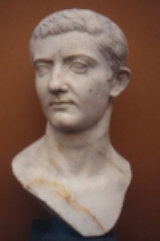
Tiberius Caesar Augustus, born Tiberius Claudius Nero , was the second Roman Emperor Roman Emperor

"Roman Emperor" is the term historians use to refer to rulers of the Roman Empire [i], after the epoch c ... 

, from the death of Augustus in AD 14 until his own death in 37. Tiberius was by birth a Claudian Claudius

Christoph Ludwig Agricola was a German [i] landscape painter [i]. ... 

, son of Tiberius Claudius Nero and Livia Drusilla Livia

Livia Drusilla, after 14 [i] called Julia Augusta was the wife of Caesar Augustus [i] and the most ... 

. His mother divorced his father and remarried to Augustus in 39 BC. Tiberius would later marry Augustus' daughter Julia the Elder Julia the Elder

... no changes ... no changes ...... 

  and even later be adopted by Augustus and by this act he became a Julian. The subsequent emperors after Tiberius would continue this blended dynasty of both families for the next forty years; historians have named it the Julio-Claudian dynasty Julio-Claudian Dynasty

The Julio-Claudian Dynasty refers to the first five Roman Emperors [i]: Augustus [i], Tiberius [i], Caligula [i] ... 

.

Discussions

  Discussion Features

   Ask a question about 'Tiberius'

   Start a new discussion about 'Tiberius'

   Answer questions about 'Tiberius'

   'Tiberius' discussion forum

Timeline

42 BC   Born

1   Tiberius, under order of Augustus, quelled revolts in Germania Germania

Dating back to the Roman [i] era, Germania was the Latin [i] name for a geographical area t ... 

 (1 - 5)

4   Emperor Caesar Augustus summons Tiberius to Rome, and names him his heir and future emperor.

4   Signature of a pact of non-aggression and friendship between the Roman Empire Roman Empire

The Roman Empire was a phase of the ancient Roman [i] civilization characterized by an autocratic [i] ... 

, represented by Tiberius, and the German tribe the Cherusci, represented by their King Segimer. Arminius Arminius

Arminius was a war chief of the Germanic tribe [i] of the Cherusci [i] who defeated a Roman army [i] ... 

 and Flavus, sons of Segimer, were brought into the Roman army as the Leaders of the auxiliary troops.

5   Tiberius conquers Germania Inferior Germania Inferior

[i] ... 

6   Tiberius makes Carnuntum Carnuntum

Carnuntum was an important Roman [i] fortress, originally belonging to Noricum [i] province ... 

 his base of operations against Maroboduus; The Roman legion Roman legion

The Roman legion was the basic military unit of the ancient Roman [i] army [i]. ... 

 XX ''Valeria Victrix'' fights with Tiberius against the Marcomanni.

8   Roman Roman Empire

The Roman Empire was a phase of the ancient Roman [i] civilization characterized by an autocratic [i] ... 

 general Tiberius defeats Dalmatians Dalmatia

Dalmatia is a region on the eastern coast of the Adriatic Sea [i], in modern Croatia [i], spreading be ... 

 on the river Bathinus.

12   Quirinius returns from Judea Judea

Judea or Judaea is a term used for the mountainous southern part of the historic Land of Israel [i] ... 

 to become a counselor to Tiberius

13   Tiberius made his triumphant procession through Rome Rome

Rome is the capital [i] of Italy [i] and of its region, called Latium [i]. ... 

 after siege of Germany Germany

Germany , officially the Federal Republic of Germany , is a country [i] in central Europe [i]. ... 

.

14   Tiberius succeeds his stepfather Augustus as Emperor of the Roman Empire Roman Empire

The Roman Empire was a phase of the ancient Roman [i] civilization characterized by an autocratic [i] ... 

.

   More Events >>


Encyclopedia

Tiberius Caesar Augustus, born Tiberius Claudius Nero , was the second Roman Emperor Roman Emperor

"Roman Emperor" is the term historians use to refer to rulers of the Roman Empire [i], after the epoch c ... 

, from the death of Augustus in AD 14 until his own death in 37. Tiberius was by birth a Claudian Claudius

Christoph Ludwig Agricola was a German [i] landscape painter [i]. ... 

, son of Tiberius Claudius Nero and Livia Drusilla Livia

Livia Drusilla, after 14 [i] called Julia Augusta was the wife of Caesar Augustus [i] and the most ... 

. His mother divorced his father and remarried to Augustus in 39 BC. Tiberius would later marry Augustus' daughter Julia the Elder Julia the Elder

... no changes ... no changes ...... 

  and even later be adopted by Augustus and by this act he became a Julian. The subsequent emperors after Tiberius would continue this blended dynasty of both families for the next forty years; historians have named it the Julio-Claudian dynasty Julio-Claudian Dynasty

The Julio-Claudian Dynasty refers to the first five Roman Emperors [i]: Augustus [i], Tiberius [i], Caligula [i] ... 

.

Tiberius Claudius Nero deserves recognition as one of Rome Ancient Rome

Ancient Rome was a civilization [i] that grew out of the city-state [i] of Rome [i], founded in the Italian Peninsula [i] ... 

's greatest generals, whose campaigns in Pannonia Pannonia

Pannonia is an ancient country bounded north and east by the Danube [i], conterminous westward with Noricum [i] ... 

, Illyricum Illyricum (Roman province)

Illyricum was the Roman province [i] established in place of the former kingdom of Illyria [i]. ... 

, Rhaetia Raetia

Raetia was a province [i] of the Roman Empire [i], bounded on the west by the country of ... 

 and Germania Germania

Dating back to the Roman [i] era, Germania was the Latin [i] name for a geographical area t ... 

 laid the foundations for the northern frontier. But he came to be remembered as a dark, reclusive, and sombre ruler , who never really desired to be Emperor. After the death of Tiberius’ son Drusus in 23, the quality of his rule declined, and ended in a Terror. In 26 Tiberius exiled himself from Rome and left administration largely in the hands of his unscrupulous Praetorian Prefects Lucius Aelius Sejanus and Quintus Naevius Macro. Caligula Caligula

Gaius Julius Caesar Augustus Germanicus , most commonly known as Caligula, was the third Roman Emperor [i] ... 

, Tiberius’ adopted grandson, succeeded the Emperor on his demise.

Early life

Tiberius Claudius Nero was born on 16 November 42 BC to Tiberius Nero and Livia Drusilla Livia

Livia Drusilla, after 14 [i] called Julia Augusta was the wife of Caesar Augustus [i] and the most ... 

. In 38 BC, a younger brother, Nero Claudius Drusus Nero Claudius Drusus

Nero Claudius Drusus Germanicus, born Decimus Claudius Drusus and variously called Drusus, '... 

, was born and the brothers developed a famously close relationship. From his birth in a noble family¹, Tiberius was destined for public life. But during his boyhood the old Roman Republic Roman Republic

The Roman Republic was a phase of the ancient Roman civilization [i] characterized by a republic [i]... 

an system of rule by Senate Roman Senate

The Roman Senate was the main governing council of both the Roman Republic [i], which started in 510 BC [i] ... 

 and magistrates; which had been tottering for decades, was finally toppled and replaced by an autocracy under the able and ambitious Octavian . It proved fateful for Tiberius when, in 39 BC at age three, his mother divorced his father Tiberius Nero and married Octavian, thereby making the infant Tiberius the stepson of the future ruler of the Roman Empire Roman Empire

The Roman Empire was a phase of the ancient Roman [i] civilization characterized by an autocratic [i] ... 

.

Tiberius's early life was relatively uneventful, even if the times were not. In 32 BC, as civil war loomed between Mark Antony Mark Antony

Marcus Antonius , known in English [i] as Mark Antony, was a Roman [i] ... 

 and Octavian, Tiberius made his first public appearance at the age of nine and delivered the eulogy at his natural father's funeral. In the years following the Battle of Actium Battle of Actium

The Battle of Actium was a naval battle [i] of the Roman Civil War [i] between Mark Antony [i] ... 

 in 31 BC, as Octavian secured his position as Roman Emperor Roman Emperor

"Roman Emperor" is the term historians use to refer to rulers of the Roman Empire [i], after the epoch c ... 

 and became Augustus, Tiberius grew to maturity and took his first real steps in public life. In 29 BC, he took part in Augustus' triumph Roman triumph

A Roman Triumph was a civil ceremony [i] and religious rite [i] of ancient Rome [i], held... 

 for the Actium campaign, riding on the left of Augustus in the triumphal chariot. Five years later, at the age of seventeen, he became a quaestor and was given the privilege of standing for the praetorship and consulship five years in advance of the age required by law.
He then began appearing in court as an advocate and was sent by Augustus to the East where, in 20 BC, he oversaw one of his stepfather's proudest successes. The Parthians Parthia

Parthia was a civilization situated in the northeast of modern Iran, but at its height covering all of ... 

, who had captured the standards of the legions Roman legion

The Roman legion was the basic military unit of the ancient Roman [i] army [i]. ... 

 lost in the failed Eastern campaigns of Marcus Crassus , Decidius Saxa , and Mark Antony , formally returned them to the Romans. After returning from the East, Tiberius was granted praetorian rank and, in 13 BC, he became consul.

Between his praetorship and consulship, he was on active duty with his brother, Nero Claudius Drusus Nero Claudius Drusus

Nero Claudius Drusus Germanicus, born Decimus Claudius Drusus and variously called Drusus, '... 

, combating the tribes in the Alps Alps

The Alps is the name for one of the great mountain range [i] systems of Europe [i], stretching from Austria [i] ... 

 . In 16 BC he discovered the sources of the Danube Danube

The Danube is the longest river [i] of the European Union [i] and Europe [i]'s second-longest .
... 

, and soon afterwards the bend of the middle course. His personal life was also blessed at this time by a happy marriage to Vipsania Agrippina Vipsania Agrippina

Vipsania Agrippina was the daughter of Marcus Vipsanius Agrippa [i] from his first wife Pomponia Caecilia Attica [i] ... 

, the daughter of Augustus’s life-long friend and right-hand man, Marcus Vipsanius Agrippa Marcus Vipsanius Agrippa

Marcus Vipsanius Agrippa was a Roman statesman and general.... 

. The marriage probably took place in 20 BC or 19 BC and during his consulship of 13 BC, his wife produced a son, Julius Caesar Drusus Julius Caesar Drusus

Tiberius Drusus Claudius Julius Caesar Nero or Julius Caesar Drusus or Drusus Julius Caesar, was t... 

.

When Agrippa died in 12 BC, Tiberius, on Augustus’s insistence, divorced Vipsania and married Agrippa's widow, Julia the Elder Julia the Elder

... no changes ... no changes ...... 

, who was also Augustus' daughter. The union was not a happy one and produced one child who died as an infant. Tiberius had been happily married to Vipsania and, following an embarrassing display in public, care was taken that their paths should never again cross. Nevertheless, Tiberius's elevation in his stepfather's succession scheme continued. He received important military commissions in Pannonia Pannonia

Pannonia is an ancient country bounded north and east by the Danube [i], conterminous westward with Noricum [i] ... 

 and Germania Germania

Dating back to the Roman [i] era, Germania was the Latin [i] name for a geographical area t ... 

 between 12 BC and 6 BC and proved very successful in the field. He was consul for a second time in 7 BC, and, in 6 BC, he was granted tribunician power ' and an extensive commission in the East. In essence, Tiberius had replaced Agrippa as Augustus’s successor. He was Julia's husband, the leading general in the state, and he enjoyed a share of the emperor's power. Everything seemed settled, until Tiberius himself confounded everyone's calculations.

Retirement to Rhodes


Without warning, in 6 BC Tiberius announced his withdrawal from public life and went to live on Rhodes Rhodes

[i] islands, and easternmost of the major islands of [[Greece]... 

 with some personal friends and an astrologer. The motives for Tiberius's withdrawal are unclear, but they are likely to have been connected with Augustus’s grandchildren Gaius and Lucius, whom Augustus had, in the absence of sons of his own, adopted. They, and not Tiberius, would preserve Augustus’s line. When they became of age, Tiberius would be superfluous, even a hindrance. Hence the commission in the East, a pretext to remove Tiberius from Rome, while Gaius and Lucius would be further promoted. Doubtless, the flagrantly promiscuous behaviour of Julia the Elder Julia the Elder

... no changes ... no changes ...... 

 also played a role . As the daughter of Augustus and the mother of prospective emperors, she believed that her future was assured. Tiberius found himself in the predicament of being married to a woman who disdained him as an unequal match, and whom he could not divorce.

But whatever Tiberius's motives, the move was not only a snub to Augustus, it was also highly inconvenient to his succession plans. Gaius Caesar Gaius Caesar

Gaius Julius Caesar Vipsanianus, most commonly known as Gaius Caesar, was the oldest son of Marcus Vipsanius Agrippa [i] ... 

 and Lucius Caesar were still too young to assume the heavy responsibilities of the Principate, and Augustus now had no immediate successor to assume power and see the boys to maturity, since Tiberius's brother Drusus had died of an illness, an infection in an injury caused by falling off his horse, in 9 BC. If anything had befallen Augustus during that time, the Principate would have descended into anarchy.

Whatever had been Augustus’s opinion of Tiberius, he seems to have had little patience with, or affection for him after his exile. Something of Augustus’s irritation is revealed by his repeated refusal to allow Tiberius to return to Rome after Tiberius realized the delicacy of his position on Rhodes; and this in spite of pressure brought to bear on Augustus by his influential and persuasive wife, Livia. When Tiberius's tribunician powers ran out in 1 BC, they were not renewed, and his situation became even more precarious. According to Suetonius, he was expecting a ship bearing the order for his death. Ultimately, however, a ship was to arrive with quite different tidings.

Heir to Augustus

Tragedy worked for the benefit of Tiberius. In AD 2, Lucius Caesar died of an illness at Massilia Massilia

Sorry, no overview for this topic 

. Augustus, resistant to the idea of allowing Tiberius to return, finally yielded to the requests of Livia and Gaius Caesar. Tiberius returned to Rome and lived as a private citizen when, unexpectedly, Gaius Caesar was wounded during a siege in Armenia Kingdom of Armenia

The Kingdom of Armenia was an independent kingdom from 190 BC to AD 165 [i], and a client state of the Roman Empire [i] ... 

  and died as a result . Augustus, devastated, was left without his adoptive sons and, more importantly, without an heir and successor. His careful planning for the succession had come to nothing. In the crisis, he turned once more to Tiberius.

Tiberius was summoned from private life and adopted as Augustus’s son. Also adopted by Augustus was Postumus Agrippa Agrippa Postumus

Marcus Vipsanius Agrippa Postumus, also known as Agrippa Postumus or Postumus Agrippa, was a... 

, the third son of Julia the Elder and Marcus Agrippa Marcus Vipsanius Agrippa

Marcus Vipsanius Agrippa was a Roman statesman and general.... 

. Tiberius, despite having a natural son, was required to adopt his nephew, Germanicus Germanicus

Iulius Caesar Claudianus Germanicus was a member of the Julio-Claudian dynasty [i] of the early Roman Empire [i] ... 

, the son of his brother Drusus. Augustus seemed to be re-establishing a slate of candidates, with Tiberius at its head and the others as potential substitutes in the event of disaster. Tiberius's forced adoption of Germanicus appears to have been Augustus’s attempt to mark out the succession in the third generation of the Principate.

From 4 to 14 Tiberius was clearly Augustus’s successor. When he was adopted, he also received grants of proconsular power and tribunician power; and in 13 his proconsular power was made co-extensive with that of Augustus’s. In effect, Tiberius was now co-emperor with Augustus so that when the latter finally died on 19 August, 14, Tiberius's position was unassailable and the continuation of the Principate a foregone conclusion. After fifty-five years living in the shadow of his stepfather, Tiberius finally assumed the mantle of sole ruler.

Early reign


The accession of Tiberius proved intensely awkward. After Augustus had been buried and deified, and his will read and honored, the Senate convened on 18 September to inaugurate the new reign and officially "confirm" Tiberius as emperor. Such a transfer of power had never happened before, and nobody, including Tiberius, appears to have known what to do. Tacitus Tacitus

Publius Cornelius Tacitus is one of the important historian [i]s of Roman Antiquity [i]. ... 

's account is the fullest of what happened. Tiberius came to the Senate to have various powers and titles voted to him. However, this too caused confusion, as he also had bestowed almost all of the imperial titles and powers on Tiberius, save for auctoritas, Augustus, Pater Patriae, and the Civic Crown . Perhaps in an attempt to imitate the tact of Augustus, Tiberius donned the mask of the reluctant public servant — and botched the performance. Rather than tactful, he came across to the Senators as obdurate and obstructive. He declared that he was too old for the responsibilities of the Principate, said he did not want the job, and asked if he could just take one part of the government for himself. The Senate was confused, not knowing how to read his behavior. Finally, one senator asked pointedly, "Sire, for how long will you allow the State to be without a head?" Tiberius relented and accepted the powers voted to him, and according to Tacitus and Suetonius, he refused to bear the titles Pater Patriae, Imperator, and Augustus, and declined the most solid emblem on the Princeps, the Civic Crown.

The first meeting between the Senate and the new Emperor established a blueprint for their later interaction. Throughout his reign, Tiberius was to baffle, befuddle, and frighten the Senators. He seems to have hoped that they would act on his implicit desires rather than on his explicit requests. There was trouble not only at Rome, however. The legions posted in Pannonia Pannonia

Pannonia is an ancient country bounded north and east by the Danube [i], conterminous westward with Noricum [i] ... 

 and in Germania Germania

Dating back to the Roman [i] era, Germania was the Latin [i] name for a geographical area t ... 

, the most powerful concentration of troops in the Empire, took the opportunity afforded by Augustus’s death to voice their complaints about the terms and conditions of their service, and that they had not received bonuses promised to them by Augustus. At that time, troops were paid from the Imperial treasury, as well as being allowed to supplement this income with a share of the captured booty from campaigns; however, Augustus had suspended military campaigns outside of Roman territory, and in his will had left instructions behind that the Empire was to expand no more. The generals Germanicus and Tiberius's son, Drusus, were dispatched with a small force to quell the uprising. Rather than simply quell the mutiny however, Germanicus rallied the mutineers and led them on a short campaign across the Rhine into Germanic territory, stating that whatever booty they could grab would count as their bonus. Germanicus's forces smashed across the Rhine and quickly occupied all of the territory between the Rhine and the Elbe Elbe

The River Elbe is one of the major waterways of Central Europe [i]. ... 

. Additionally, Tacitus records the capture of the Teutoburg forest and the reclaiming of standards lost years before when four Roman legions had been ambushed by a band of Germans.

Despite his difficult relationship with the Senate and the Rhine Rhine

The Rhine River is one of the longest and most important river [i]s in Europe [i] at 1,320 kilometres [i] ... 

 mutinies, Tiberius's first years were generally good. He stayed true to Augustus’s plans for the succession and clearly favored his adopted son Germanicus over his natural son, Drusus, as did the Roman populace. On Tiberius's request, Germanicus was granted proconsular power and assumed command in the prime military zone of Germania, where he suppressed the mutiny there and led the formerly restless legions on campaigns against Germanic tribes from 14 to 16.

After being recalled from Germania, Germanicus celebrated a triumph Roman triumph

A Roman Triumph was a civil ceremony [i] and religious rite [i] of ancient Rome [i], held... 

 in Rome in 17. While legally speaking, Germanicus had disobeyed orders from both Tiberius and Augustus, the popularity that Germanicus received from his exploits across the Rhine and from retrieving the lost standards was more than Tiberius, as a new and comparatively less popular Emperor, could possibly hope to compete with. In the same year, Germanicus was granted imperium maius over the East and, in 18, after being consul with Tiberius as his colleague, he was sent East, just as Tiberius himself had been almost four decades earlier, clearly indicating that Germanicus was to be considered the heir to Tiberius. The elevation of Germanicus was perhaps nothing more than a show to placate the Roman populace and remove Germanicus from Rome; Germanicus died in 19 and, on his deathbed, accused the governor of Syria Syria

Syria , officially the Syrian Arab Republic , is a country in the Middle East [i]. ... 

, Gnaeus Calpurnius Piso, of murdering him. Piso was a long-time friend of Tiberius and his appointee to the Syrian governorship, so suspicion for Germanicus’s death ultimately came to rest at the palace door.

When Germanicus Germanicus

Iulius Caesar Claudianus Germanicus was a member of the Julio-Claudian dynasty [i] of the early Roman Empire [i] ... 

’s widow, Agrippina the Elder Agrippina the elder

Agrippina , most commonly known as Agrippina Major or Agrippina "the Elder", was one of th... 

 returned to Italy carrying her popular husband's ashes, she publicly declared Piso guilty of murder and hinted at the involvement of more hidden agents. Piso was put on trial in the Senate, where he expected some help from his friend, Tiberius. Instead Tiberius remained motionless and let the proceedings take their course. Tacitus records a tradition that Piso, realising his peril, threatened to make public a document that would embarrass the Emperor, but that Sejanus dissuaded him with vain promises. Be that as it may, Piso abandoned his defence and committed suicide, while the incriminating document, if it had ever existed, was suppressed. The suspicious circumstances of Germanicus' death gave rise to much odium against the Emperor, while relations between Tiberius and Agrippina were permanently damaged.

With Germanicus dead and Nero Caesar Nero Caesar

Nero Iulius Caesar Germanicus was a close relative to the Roman Emperor [i]s of the Julio-Claudian dynasty [i] ... 

 the oldest son still hardly 15 years of age, Tiberius began elevating his own son Drusus with a view to the ultimate succession. In 21 Tiberius held the consulship with Drusus, just as in 18 he had held it with Germanicus. In 22 Drusus was accorded the tribunician power, a distinction reserved for the emperor or for his immediate successor. It looked as though Tiberius would be able to retire and leave his son in charge of affairs, as heir to the Principate. But now fate was to intervene and disturb everything.

Sejanus

Sejanus hailed from Volsinii in Etruria Etruria

Etruria — usually referred to in Greek and Latin source texts as Tyrrhenia — was a reg... 

, from the equites Equestrian (Roman)

An Equestrian was a member of one of the two upper social class [i]es in the Roman Republic [i] and earl... 

 family of Lucius Seius Strabo, who also shared the Praetorian Prefecture until 15 when his father was promoted to be Prefect of Aegyptus, the pinnacle of an equestrian career under the Principate. Sejanus enjoyed powerful connections to Senatorial houses and had been a companion to Gaius Caesar on his mission to the East, from 1 BC-4. Through a combination of energetic efficiency, fawning sycophancy, and outward displays of loyalty, he gained the position of Tiberius's closest friend and advisor.

Tiberius, whom historians depict by this stage as a tired and bitter old man, left more and more of the day-to-day running of the Empire to Sejanus. Sejanus created an atmosphere of fear in Rome, controlling a network of informers and spies whose incentive to accuse others of treason was a share in the accused's property after their conviction and death. Treason trials became commonplace; few members of the Roman aristocracy were completely safe. The trials played up to Tiberius' growing paranoia, which made him more reliant on Sejanus, as well as satisfying his greed ; they also allowed Sejanus to eliminate potential rivals.

One development that favored Sejanus was the concentration of all nine cohorts of the Praetorian Guard Praetorian Guard

The Praetorian Guard comprised a special force of bodyguard [i]s used by Roman [i] Emperor [i] ... 

 into a single camp at Rome. Augustus had billeted these troops discreetly in small towns around Rome, but now Tiberius — undoubtedly with Sejanus's encouragement — brought them into the city, probably in 17 or 18. Sejanus, therefore, as Praetorian Prefect, commanded some 9,000 troops within the city limits. As Sejanus's public profile became more and more pronounced, his statues were erected in public places, and, according to Tacitus, Tiberius openly praised him as "the partner of my labors". But Sejanus had his own ideas. He had used his influence over Tiberius to undermine the Emperor's relationship with his son Drusus. Secretly he seduced Livilla Livilla

(Claudia) Livia Julia, most commonly known by her family nickname of Livilla was the only daughter... 

, Drusus' wife. And then, in September of 23 Drusus died. The death of Tiberius' son meant that the succession was thrown into doubt.

Sejanus’s attacks against Agrippina and his proposal to marry Drusus's widow, Livilla, who was also Tiberius' niece, suggest that he was attempting to follow the precedent of Agrippa, that is, an outsider who became the emperor's effective heir through a combination of overt loyalty, necessity, and a family alliance forged by marriage. Tiberius, perhaps sensitive to this ambition, rejected Sejanus's initial proposal to marry Livilla in 25, but later put it about that he had withdrawn his objections so that, in 30, the betrothal went ahead. The Prefect's family connection to the Imperial house was now imminent.

In the years 21-22 Tiberius had made a lengthy excursion to Campania Campania

Campania is a region of Southern Italy [i], bordering on Lazio [i] to the north-west, Molise [i] to the ... 

. Now, in 26, he departed for Capri Capri

Capri is an Italian [i] island [i] off the Sorrentine Peninsula [i]. ... 

, never again to return to Rome. Inevitably, his absence was to result in a decline in the quality of government, since the Senate was unaccustomed to act without the Emperor. Moreover, Sejanus would control not only personal access to Tiberius, but even correspondence, for the imperial post was in the hands of Sejanus’ Praetorians. Thus Tiberius would increasingly see the outside world through the eyes of his Prefect.

The death of his mother Livia Livia

Livia Drusilla, after 14 [i] called Julia Augusta was the wife of Caesar Augustus [i] and the most ... 

 in 29 removed the last restraints on Tiberius' character. The death of Germanicus had put relations with Germanicus' family under great strain, and Sejanus was skilful at exploiting these tensions. Now, shortly after Livia's decease, Tiberius ordered the arrest of Agrippina and her eldest son Nero Caesar Nero Caesar

Nero Iulius Caesar Germanicus was a close relative to the Roman Emperor [i]s of the Julio-Claudian dynasty [i] ... 

. Declared a public enemy, Nero was confined on the island of Pontia ; his mother went to nearby Pandateria Ventotene

Ventotene is an island in the Tyrrhenian Sea [i], off the coast of Campania [i], Italy [i]. ... 

. There she was treated with great brutality, undergoing forcible feeding and losing an eye from the blow of a centurion. In 30 Nero was executed or driven to suicide, and in the same year Sejanus encompassed the arrest of Drusus, the second son of Agrippina, who was now incarcerated in a dungeon of the Palace. Sejanus may also have attempted the assassination of Caligula Caligula

Gaius Julius Caesar Augustus Germanicus , most commonly known as Caligula, was the third Roman Emperor [i] ... 

, but Tiberius summoned the young man to Capri. The same year saw the fall of Gaius Asinius Gallus, whom Tiberius had not forgiven for his marriage to Vipsania Vipsania Agrippina

Vipsania Agrippina was the daughter of Marcus Vipsanius Agrippa [i] from his first wife Pomponia Caecilia Attica [i] ... 

.

In 31 Sejanus held the consulship with the emperor as his colleague, an honor Tiberius reserved only for heirs to the Principate. Furthermore, when Sejanus surrendered the consulship in May, he was granted a share of the emperor's proconsular power. When he was summoned to a meeting of the Senate on 18 October in that year he probably expected to receive a share of the tribunician power; with that he would have become fully associated with the Emperor and his effective heir, such as he could be under the Principate. Instead, however, in his letter to the Senate Tiberius said he feared for his life and requested the arrest of Sejanus and two of his associates. The Senate now condemned Sejanus to death, and the execution was carried out without delay. A bloody purge then erupted in Rome, most of Sejanus' family and followers sharing his fate. Among the innocent victims of the purge were Sejanus' children. Aelius Strabo, the eldest, was the first to be executed. Upon learning of his death, Sejanus' former wife Apicata committed suicide , but not before addressing a letter to Tiberius claiming that Drusus had been poisoned, with the complicity of Livilla. Drusus' cupbearer Lygdus and Livilla's physician Eudemus were now tortured, and seemed to confirm Apicata's allegation. Livilla too perished, whether by execution or suicide.

Tiberius himself later claimed that he turned on Sejanus because he had been alerted to Sejanus's plot against Germanicus's family. This explanation has been rejected by most ancient and modern authorities, since Sejanus's demise did nothing to end Tiberius' persecution of that family: Nero Caesar, the eldest son, had been terminated in 30, when Tiberius had already begun to suspect Sejanus, Agrippina remained imprisoned on Pandateria, while her second son Drusus was still held in the Palace basement.

Augustus could not have foreseen the course of events leading to the calamity of 31. Yet the roots of that upheaval are to be traced back to Augustus’ own actions many years before: in 4, he had adopted Tiberius, on condition that the latter should first adopt Germanicus Germanicus

Iulius Caesar Claudianus Germanicus was a member of the Julio-Claudian dynasty [i] of the early Roman Empire [i] ... 

. Augustus' intention was that his own line should ultimately succeed to the Principate, since Germanicus was married to Augustus' granddaughter Agrippina. The result was to exalt Germanicus and his children at the expense of those of Tiberius. The effect of Augustus' dispensations was to create resentments within the ruling Julio-Claudian house that Sejanus' evil genius was to exploit - to disastrous effect. Masquerading as the guardian of Tiberius Gemellus Tiberius Gemellus

Tiberius Julius Caesar Nero , known as Tiberius Gemellus, was the son of Drusus [i] ... 

 "against the unjust displeasure of Agrippina" , he was able to wreak havoc on the house of Germanicus.

In addition Livilla's fears for her children had made it much easier for Sejanus to undermine her husband Drusus. Just as Drusus had always deferred to Germanicus, so it had seemed likely that had he become emperor he would have put Germanicus' sons before his own . Whether or not Drusus was murdered in 23 can no longer be determined. What is certain is that the revelations regarding Livilla destroyed Tiberius Gemellus Tiberius Gemellus

Tiberius Julius Caesar Nero , known as Tiberius Gemellus, was the son of Drusus [i] ... 

' credibility as a potential successor. Since Sejanus’ affair with Livilla had been going on for many years, who could now say for sure that Gemellus was not a bastard?

Lastly, Sejanus' long campaign of persecution played a decisive role in the formation of Caligula's personality. This was arguably the source of the paranoia that was to characterise his reign, as well as of his cynical and resentful attitude towards the Senate, the body which had condemned and humiliated his mother and brothers.

Final years


The catastrophe of Sejanus had a shattering effect on Tiberius, destroying his peace of mind and undermining his reason. A close friend and confidant had betrayed him. His withdrawal from public life seemed more complete in the last years. Letters kept him in touch with Rome, but it was the machinery of Augustus’s administration that kept the Empire running smoothly. According to Tacitus, Suetonius and Dio Cassius, Tiberius now gave himself up to sensual pleasures on Capri, notoriously involving children. If the reports are true, these pastimes should be seen as an aspect of his psychological collapse, though most of the claims seem to be inflated to hyperbole. He also became all but paranoid in his dealings with others and spent long hours brooding over the death of his son, Drusus, which had now been revealed to him as the work of his friend Sejanus; all who were implicated, he had executed. As a result, no measures were taken for the succession, beyond vague indications of favor to his great-nephew Caligula, Germanicus' and Agrippina's only surviving son, and Tiberius Gemellus, who was still only a child, and whose paternity was now open to doubt.

Rome's second Emperor died at the port town of Misenum Misenum

Misenum is the site of an ancient port in Campania [i], in southern Italy [i]. ... 

 on March 16, 37, at the age of seventy-seven. Later writers suggested that he was smothered at the behest of Caligula , though such accusations were usually made to Caligula's credit, rather than his detriment. Regardless, Tiberius was old and in poor health at his death. His complete unpopularity is proven by the failure of the Senate to vote him divine honours. Caligula never pushed for it, and his successor Claudius, who did force the deification of Tiberius’s mother Livia, certainly wasted no effort on Tiberius’s behalf. Tacitus, Dio Cassius and Suetonius certainly paint a bleak picture of Tiberius and his reign. According to Suetonius: "the people were so glad of his death, that at the first news of it some ran about shouting, "To the Tiber Tiber

The Tiber , the third-longest river [i] in Italy [i] at 406 km after the Po [i] and the Adige [i] ... 

 with Tiberius!," while others prayed to Mother Earth and the Manes to "allow the dead man no abode except among the damned."

In his will, Tiberius left the empire to both Caligula and Tiberius Gemellus, but soon after becoming Emperor, Caligula had Tiberius's will declared void and later had Gemellus killed.

The last years of Tiberius' reign, such as described by ancient historians, are little more than a catalogue of treason trials, suicides and executions. Yet the picture is one-sided, for these shocking events affected primarily the upper classes in Rome. Elsewhere in the Roman world the quality of government was generally good compared to previous centuries. In a reign of 23 years, Tiberius' rule, despite all its faults, proved a successful continuation of Augustus'.

Continuing legacy

In the Bible Bible

The Bible , is the name used by Jews [i] and Christians [i] for their differing canons [i]... 

, Tiberius is mentioned by name only once, in Luke 3:1, stating that John the Baptist John the Baptist

John the Baptist is regarded as a prophet [i] by four religion [i]s: Christianity [i], Islam [i], Mandaeanism [i] ... 

 entered on his public ministry in the fifteenth year of his reign. However, since it was during his reign that Jesus Jesus

Jesus,Some of the historians and Biblical scholars who place the birth and death of Jesus within this ra... 

 preached, many references to Caesar , without further specification, actually refer to Tiberius. It was during the reign of Tiberius that Jesus was put to death by crucifixion Crucifixion

Crucifixion is an ancient method of execution [i], where the victim was tied or nailed to a l ... 

 under the authority of the Roman governor of Judea Judea

Judea or Judaea is a term used for the mountainous southern part of the historic Land of Israel [i] ... 

 at the time, Pontius Pilate Pontius Pilate

Pontius Pilate was the governor [i] of the Roman [i] Iudaea Province [i] fro ... 

.

Similarly, the "Tribute Penny" referred to in and Mark 12:15 is popularly thought to be a silver Silver

Silver is a chemical element [i] with the symbol Ag . ... 

 denarius Denarius

The Roman [i] currency [i] system included the denarius after 211 BC, a small silver coin [i] ... 

 coin of Tiberius, although this association, like others, has been based only on the emperor's reign coinciding with the ministry of Jesus Jesus

Jesus,Some of the historians and Biblical scholars who place the birth and death of Jesus within this ra... 

, since the title of Caesar on coinage was very ambiguous at the time.

The town Tiberias Tiberias

Tiberias is a town on the western shore of the Sea of Galilee [i], Lower Galilee [i], Israel [i]. ... 

 on the western shore of the Sea of Galilee Sea of Galilee

The Sea of Galilee is Israel [i]'s largest freshwater [i] lake [i], approximately 53 kilometer [i]s in c... 

 was named in Tiberius's honour by Herod Antipas.

On August 12, 1956 skin-diver Raimondo Bucher claimed that he had discovered the grotto Grotto

A Grotto, when it is not an artificial garden feature [i], is a cave [i], small or quite large, usually ... 

 in which Tiberius swam with members of his court after he retired to Capri. Bucher accessed the high-vaulted grotto, adjoining the world-renowned Blue Grotto Blue Grotto

The Blue Grotto is a noted sea cave [i] on the coast of the Italian [i] island of Capri [i].
... 

, via an underwater tunnel. He said the remains of steps and other improvements were discovered dating to Roman times. The Blue Grotto was long considered to be the locale where Tiberius and his court bathed. However archaeologists Archaeology

Archaeology, archeology, or archology is the study of human [i] culture [i]s through... 

 proved that this contention did not coincide with the description given in historic records.

Tiberius has appeared in the movies Ben-Hur , Caligula Caligula

Gaius Julius Caesar Augustus Germanicus , most commonly known as Caligula, was the third Roman Emperor [i] ... 

, The Robe The Robe

[i] written by [[Lloyd C. Douglas]... 

, and I, Claudius I, Claudius

I, Claudius is a novel [i] by English [i] writer Robert Graves [i], first published in 1934 [i] ... 

. He also appeared the 1968 British television Television

Television is a telecommunication [i] system for
... 

 series The Caesars and the 2003 Italian/British mini series  .

In , Tiberius is one of the main enemies,

Footnotes

  1. For the etymology of the name, see under List of Roman praenomina.

Bibliography


Primary sources


Suetonius. The Lives of the twelve Caesars: TIberius


Secondary material

  • V.Ehrenberg & A.H.M.Jones, Documents Illustrating the Reigns of Augustus and Tiberius, 2nd ed. Oxford 1955
  • New York Times The New York Times

    The New York Times is a newspaper [i] published in New York City [i] by Arthur Ochs Sulzberger Jr. [i] ... 

    , Capri Grotto Found, Skin-Diver Links Discovery to Emperor Tiberius, August 13, 1956, Page 21.
  • Robin Seager, Tiberius, London 1972
  • Ronald Syme Ronald Syme

    Sir Ronald Syme OM [i], New Zealand [i]-born historian [i], was an eminent classicist [i] ... 

    , The Augustan Aristocracy, Oxford 1986

Biographical sketches


Other material