

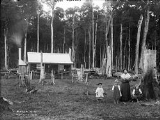
History of Australia

Encyclopedia
The History of Australia refers to the history of the area and people of Commonwealth of Australia and its preceding Indigenous and colonial societies. Aboriginal Australians are believed to have first arrived on the Australian mainland by boat from the Indonesian archipelago between 40,000 to 60,000 years ago. They established among the longest surviving artistic, musical and spiritual traditions known on earth.
The first uncontested landing in Australia by Europeans was by Dutch
navigator Willem Janszoon
in 1606. European explorers followed intermittently until, in 1770, James Cook
charted the East Coast of Australia for Britain
and returned with accounts favouring colonisation at Botany Bay
(now in Sydney), New South Wales
. A First Fleet
of British ships arrived at Sydney in January 1788 to establish a penal colony
. Other colonies were established by Britain around the continent and European explorers
sent deep into the interior throughout the 19th century. Introduced disease and conflict with the British colonists greatly weakened Indigenous Australia throughout the period.
Gold rushes
and agricultural industries brought prosperity and autonomous Parliamentary democracies began to be established throughout the six British colonies from the mid-19th century. The colonies voted by referendum
to unite in a federation
in 1901, and modern Australia came into being. Australia fought on the side of Britain in the World Wars and became a long-standing ally of the United States
when threatened by Imperial Japan during World War II
. Trade with Asia increased and a post-war multicultural immigration program received more than 6.5 million migrants from every continent. The population tripled in the six decades to around 21 million in 2010, with people originating from 200 countries sustaining the 14th biggest economy in the world.
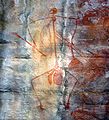
are believed to have arrived in Australia some 40,000 to 60,000 years ago, but possibly as early as 70,000 years ago. They developed a hunter-gatherer
lifestyle, established enduring spiritual
and artistic traditions and utilised stone technologies
. At the time of first Europe
an contact, it has been estimated the existing population was at least 350,000, while recent archaeological finds suggest that a population of 750,000 could have been sustained. People appear to have arrived by sea during a period of glaciation, when New Guinea
and Tasmania
were joined to the continent. The journey still required sea travel however, making them amongst the world’s earlier mariners.
The greatest population density developed in the southern and eastern regions, the River Murray valley in particular. Aborigines lived and utilised resources on the continent sustainably, agreeing to cease hunting and gathering at particular times to give populations and resources the chance to replenish. "Firestick farming" amongst northern Australian people was used to encourage plant growth that attracted animals. Aborigines were amongst the oldest, most sustainable and most isolated cultures on Earth prior to European settlement. The arrival of Australia's first people nevertheless affected the continent significantly, and, along with climate change, may have contributed to the extinction of Australia's megafauna
. The introduction of the dingo
dog by Aboriginal people around 3000–4000 years ago may, along with human hunting, have contributed to the extinction of the thylacine
, Tasmanian Devil
, and Tasmanian Native-hen
from mainland Australia.
The earliest human remains found to date are those found at Lake Mungo, a dry lake in the south west of New South Wales. Remains found at Mungo suggest one of the world's oldest known cremation
s, thus indicating early evidence for religious ritual among humans. According to Australian Aboriginal mythology
and the animist framework of the descendants of these early Australians, the Dreaming
is a sacred
era in which ancestral Totem
ic Spirit Beings formed The Creation. The Dreaming established the laws and structures of society and the ceremonies performed to ensure continuity of life and land. It was and remains a prominent feature of Australian Aboriginal art
.
Aboriginal art is believed to be the oldest continuing tradition of art in the world. Evidence of Aboriginal art can be traced back at least 30,000 years and is found throughout Australia (notably at Uluru
and Kakadu National Park
in the Northern Territory). In terms of age and abundance, cave art in Australia is comparable to that of Lascaux
and Altamira in Europe.
Despite considerable cultural continuity, life for Aborigines was not without significant changes. Some 10-12,000 years ago, Tasmania became isolated from the mainland, and some stone technologies failed to reach the Tasmanian people (such as the hafting of stone tools and the use of the Boomerang
). The land was not always kind; Aboriginal people of southeastern Australia endured "more than a dozen volcanic eruptions…(including) Mount Gambier
, a mere 1,400 years ago." There is evidence that when necessary, Aborigines could keep control of their population growth and in times of drought or arid areas were able to maintain reliable water supplies. In south eastern Australia, near present day Lake Condah, semi-permanent villages of beehive shaped shelters of stone developed, near bountiful food supplies. For centuries, Macassan
trade flourished with Aborigines on Australia's north coast, particularly with the Yolngu
people of northeast Arnhem Land
.
By 1788, the population existed as 250 individual nations, many of which were in alliance with one another, and within each nation there existed several clans, from as few as five or six to as many as 30 or 40. Each nation had its own language and a few had multiple, thus over 250 languages existed, around 200 of which are now extinct. "Intricate kinship rules ordered the social relations of the people and diplomatic messengers and meeting rituals smoothed relations between groups," keeping group fighting, sorcery and domestic disputes to a minimum.
The mode of life and material cultures varied greatly from nation to nation. Some early European observers like William Dampier
described the hunter-gatherer lifestyle of the Aborigines as arduous and "miserable". Captain Cook on the other hand, speculated in his journal that the "Natives of New Holland" might in fact be far happier than Europeans. Watkin Tench
, of the First Fleet
, wrote of an admiration for the Aborigines of Sydney as good natured and good humoured people, though he also reported violent hostility between the Eora
and Cammeraygal
peoples, and noted violent domestic altercations between his friend Bennelong
and his wife Barangaroo
. 19th century settlers like Edward Curr observed that Aborigines "suffered less and enjoyed life more than the majority of civilized(sic) men." Historian Geoffrey Blainey
wrote that the material standard of living for Aborigines was generally high, higher than that of many Europeans living at the time of the Dutch discovery of Australia.
Permanent European settlers arrived at Sydney in 1788 and came to control most of the continent by end of the 19th century. Bastions of largely unaltered Aboriginal societies survived, particularly in Northern and Western Australia into the 20th century, until finally, a group of Pintupi
people of the Gibson Desert
became the last people to be contacted by outsider ways in 1984. While much knowledge was lost, Aboriginal art, music and culture, often scorned by Europeans during the initial phases of contact, survived and in time came to be celebrated by the wider Australian community.
claimed the east coast of Australia for Britain in 1770, without conducting negotiations with the existing inhabitants. The first governor, Arthur Phillip
, was instructed explicitly to establish friendship and good relations with the Aborigines and interactions between the early newcomers and the ancient landowners varied considerably throughout the colonial period—from the mutual curiosity displayed by the early interlocutors Bennelong
and Bungaree
of Sydney, to the outright hostility of Pemulwuy
and Windradyne
of the Sydney region, and Yagan
around Perth. Bennelong and a companion became the first Australians to sail to Europe, where they met King George III. Bungaree accompanied the explorer Matthew Flinders
on the first circumnavigation of Australia. Pemulwuy was accused of the first killing of a white settler in 1790, and Windradyne resisted early British expansion beyond the Blue Mountains.
According to the historian Geoffrey Blainey
, in Australia during the colonial period: "In a thousand isolated places there were occasional shootings and spearings. Even worse, smallpox, measles, influenza and other new diseases swept from one Aboriginal camp to another ... The main conqueror of Aborigines was to be disease and its ally, demoralisation".
Even before the arrival of European settlers in local districts, European disease often preceded them. A smallpox epidemic was recorded in Sydney in 1789, which wiped out about half the Aborigines around Sydney." It then spread well beyond the then limits of European settlement, including much of southeastern Australia, reappearing in 1829–30, killing 40–60 percent of the Aboriginal population.
The impact of Europeans was profoundly disruptive to Aboriginal life and, though the extent of violence is debated, there was considerable conflict on the frontier. At the same time, some settlers were quite aware they were usurping the Aborigines place in Australia. In 1845, settler Charles Griffiths sought to justify this, writing; "The question comes to this; which has the better right – the savage, born in a country, which he runs over but can scarcely be said to occupy ... or the civilized man, who comes to introduce into this ... unproductive country, the industry which supports life."
From the 1960s, Australian writers began to re-assess European assumptions about Aboriginal Australia - with works including Alan Moorehead's
The Fatal Impact (1966) and Geoffrey Blainey's
landmark history Triumph of the Nomads (1975). In 1968, anthropologist W.E.H. Stanner
described the lack of historical accounts of relations between Europeans and Aborigines as "the great Australian silence." Historian Henry Reynolds
argues that there was a "historical neglect" of the Aborigines by historians until the late 1960s. Early commentaries often tended to describe Aborigines as doomed to extinction following the arrival of Europeans. William Westgarth’s 1864 book on the colony of Victoria observed; "the case of the Aborigines of Victoria confirms …it would seem almost an immutable law of nature that such inferior dark races should disappear." However, by the early 1970s historians like Lyndall Ryan, Henry Reynolds and Raymond Evans were trying to document and estimate the conflict and human toll on the frontier.
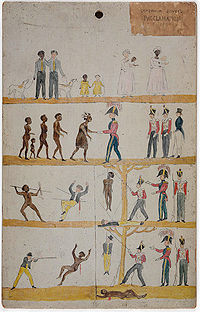
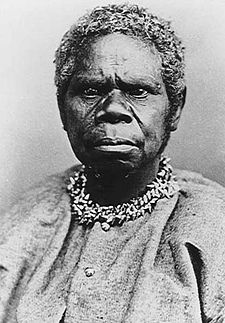 Many events illustrate violence and resistance as Aborigines sought to protect their lands from invasion and as settlers and pastoralists attempted to establish their presence. In May 1804, at Risdon Cove, Van Diemen's Land
, perhaps 60 Aborigines were killed when they approached the town. The British established a new outpost in Van Diemen's Land
(Tasmania) in 1803. Although Tasmanian history is amongst the most contested by modern historians, conflict between colonists and Aborigines was referred to in some contemporary accounts as the Black War
. The combined effects of disease, dispossession, intermarriage and conflict saw a collapse of the Aboriginal population from a few thousand people when the British arrived, to a few hundred by the 1830s. Estimates of how many people were killed during the period begin at around 300, though verification of the true figure is now impossible. In 1830 Governor George Arthur
sent an armed party (the Black Line
) to push the Big River and Oyster Bay tribes out of the British settled districts. The effort failed and George Augustus Robinson
proposed to set out unarmed to mediate with the remaining tribespeople in 1833. With the assistance of Truganini
as guide and translator, Robinson convinced remaining tribesmen to surrender to an isolated new settlement at Flinders Island
, where most later died of disease.
In 1838, at least twenty-eight Aborigines were murdered at the Myall Creek
in New South Wales, resulting in the unprecedented conviction and hanging of seven white settlers by the colonial courts. Aborigines also attacked white settlers - in 1838 fourteen Europeans were killed at Broken River in Port Phillip District, by Aborigines of the Ovens River, almost certainly in revenge for the illicit use of Aboriginal women. Captain Hutton of Port Phillip District once told Chief Protector of Aborigines George Augustus Robinson
that "if a member of a tribe offend, destroy the whole." Queensland’s Colonial Secretary A.H. Palmer wrote in 1884 "the nature of the blacks was so treacherous that they were only guided by fear – in fact it was only possible to rule…the Australian Aboriginal…by brute force" The most recent massacre of Aborigines was at Coniston
in the Northern Territory in 1928. There are numerous other massacre sites in Australia, although supporting documentation varies.
From the 1830s, colonial governments established the now controversial offices of the Protector of Aborigines
in an effort to avoid mistreatment of Indigenous peoples and conduct government policy towards them. Christian churches in Australia
sought to convert Aborigines, and were often used by government to carry out welfare and assimilation policies. Colonial churchmen such as Sydney's first Catholic archbishop, John Bede Polding strongly advocated for Aboriginal rights and dignity and prominent Aboriginal activist Noel Pearson (born 1965), who was raised at a Lutheran mission in Cape York
, has written that Christian missions throughout Australia's colonial history "provided a haven from the hell of life on the Australian frontier while at the same time facilitating colonisation".
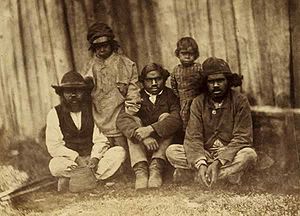 The Caledon Bay crisis
of 1932-4 saw one of the last incidents of violent interaction on the 'frontier' of indigenous and non-indigenous Australia, which began when the spearing of Japanese poachers who had been molesting Yolngu
women was followed by the killing of a policeman. As the crisis unfolded, national opinion swung behind the Aboriginal people involved, and the first appeal on behalf of an Indigenous Australian to the High Court of Australia
was launched. Following the crisis, the anthropologist Donald Thompson
was dispatched by the government to live among the Yolngu. Elsewhere around this time, activists like Sir Douglas Nicholls
were commencing their campaigns for Aboriginal rights within the established Australian political system and the age of frontier conflict closed.
Frontier encounters in Australia were not universally negative. Positive accounts of Aboriginal customs and encounters are also recorded in the journals of early European explorers, who often relied on Aboriginal guides and assistance: Charles Sturt
employed Aboriginal envoys to explore the Murray-Darling; the lone survivor of the Burke and Wills expedition was nursed by local Aborigines, and the famous Aboriginal explorer Jackey Jackey
loyally accompanied his ill-fated friend Edmund Kennedy
to Cape York
. Respectful studies were conducted by such as Walter Baldwin Spencer
and Frank Gillen in their renowned anthropological study The Native Tribes of Central Australia (1899); and by Donald Thompson
of Arnhem Land
(c.1935-1943). In inland Australia, the skills of Aboriginal stockmen became highly regarded and in the 20th century, Aboriginal stockmen like Vincent Lingiari
became national figures in their campagins for better pay and conditions.
The removal of indigenous children
, which the Human Rights and Equal Opportunity Commission
argue constituted attempted genocide, had a major impact on the Indigenous population. Such interpretations of Aboriginal history are disputed by Keith Windschuttle
as being exaggerated or fabricated for political or ideological reasons. This debate is part of what is known within Australia as the History Wars
.
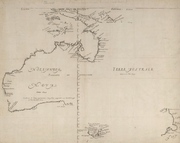 Several writers have tried to prove that Europeans visited Australia during the 16th century. Kenneth McIntyre
and others have argued that the Portuguese had secretly discovered Australia
in the 1520s. The presence of a landmass labelled "Jave la Grande
" on the Dieppe Maps
is often cited as evidence for a "Portuguese discovery". However, the Dieppe Maps also openly reflected the incomplete state of geographical knowledge at the time, both actual and theoretical. And it has been argued that Jave la Grande was a hypothetical notion, reflecting 16th century notions of cosmography
. Although theories of visits by Europeans, prior to the 17th century, continue to attract popular interest in Australia and elsewhere, they are generally regarded as contentious and lacking substantial evidence.
It is however, the crew of a Dutch ship, led by Willem Janszoon
, which is credited with the first authenticated European landing in Australia in 1606. That same year, a Spanish expedition sailing in nearby waters and led by Pedro Fernandez de Quiros had landed in the New Hebrides
and, believing them to be the fabled southern continent, named the land: Austrialis del Espiritu Santo Southern Land of the Holy Spirit. Later that year, De Quiros' deputy Luís Vaz de Torres
sailed through Australia's Torres Strait
and may have sighted Australia's northern coast.
In 1616, Dutch sea-captain Dirk Hartog
sailed too far whilst trying out Henderik Brouwer's recently discovered route from the Cape of Good Hope to Batavia, via the Roaring Forties. Reaching the western coast of Australia, he landed at Cape Inscription in Shark Bay on 25 October 1616. His is the first known record of a European visiting Western Australia's shores.
Although Abel Tasman
is best known for his voyage of 1642; in which he became the first known European to reach the islands of Van Diemen's Land
(later Tasmania
) and New Zealand
, and to sight the Fiji islands
, he also contributed significantly to the mapping of Australia proper. With three ships on his second voyage (Limmen, Zeemeeuw and the tender Braek) in 1644, he followed the south coast of New Guinea westward. He missed the Torres Strait
between New Guinea and Australia, but continued his voyage along the Australian coast and ended up mapping the north coast of Australia making observations on the land and its people.
By the 1650s, as a result of the Dutch discoveries, most of the Australian coast was charted reliably enough for the navigational standards of the day, and this was revealed for all to see in the map of the world inlaid into the floor of the Burgerzaal ("Burger's Hall") of the new Amsterdam Stadhuis ("Town Hall") in 1655. In 1664 the French geographer, Melchisedech Thévenot, published in Relations de Divers Voyages Curieux a map of New Holland drawn from the world map on the pavement of the Amsterdam Town Hall. Thévenot divided the continent in two, between Nova Hollandia to the west and Terre Australe to the east of a latitude staff running down the meridian equivalent to longitude 135 degrees East of Greenwich. Emanuel Bowen reproduced Thevenot's map in his Complete System of Geography (London, 1747), re-titling it A Complete Map of the Southern Continent and adding three inscriptions promoting the benefits of exploring and colonizing the country. One inscription said: "It is impossible to conceive a Country that promises fairer from its Situation than this of TERRA AUSTRALIS, no longer incognita, as this Map demonstrates, but the Southern Continent Discovered. It lies precisely in the richest climates of the World... and therefore whoever perfectly discovers and settles it will become infalliably possessed of Territories as Rich, as fruitful, and as capable of Improvement, as any that have hitherto been found out, either in the East Indies or the West." Bowen’s map was re-published in John Campbell’s editions of John Harris's Navigantium atque Itinerantium Bibliotheca, or Voyages and Travels (1744-1748, and 1764). This book also recommended a voyage be undertaken to explore the east coast of New Holland, with a view to a British colonization of the country: “The first Point, with respect to a Discovery, would be, to send a small Squadron on the Coast of Van Diemen's Land, and from thence round, in the same course taken by Captain Tasman, by the Coast of New Guiney; which might enable the Nations that attempted it, to come to an absolute Certainty with regard to its Commodities and Commerce... By this means all the back Coast of New Holland, and New Guiney, might be roughly examined; and we might know as well, and as certainly, as the Dutch, how far a Colony settled there might answer our Expectations.
Although various proposals for colonisation were made, notably by Pierre Purry from 1717 to 1744, none was officially attempted. Indigenous Australians
were less able to trade with Europeans than were the peoples of India, the East Indies
, China, and Japan. The Dutch East India Company
concluded that there was "no good to be done there". They turned down Purry’s scheme with the comment that, "There is no prospect of use or benefit to the Company in it, but rather very certain and heavy costs".
With the exception of further Dutch visits to the west, however, Australia remained largely unvisited by Europeans until the first British
explorations. John Callander put forward a proposal in 1766 for Britain to found a colony of banished convicts in the South Sea or in Terra Australis
to enable the mother country to exploit the riches of those regions. He said: "this world must present us with many things entirely new, as hitherto we have had little more knowledge of it, than if it had lain in another planet". In 1769, Lieutenant James Cook
in command of the HMS Endeavour
, traveled to Tahiti
to observe and record the transit of Venus
. Cook also carried secret Admiralty instructions to locate the supposed Southern Continent: "There is reason to imagine that a continent, or land of great extent, may be found to the southward of the track of former navigators." This continent was not found, as it only existed in the form of the yet to be discovered Antarctica, a much shrunken version of the Terra Australis
imagined by Alexander Dalrymple
and his fellow members of the Royal Society who had urged the Admiralty to undertake this mission. To save something useful from the expedition, Cook decided to survey the east coast of New Holland, the only major part of that continent that had not been charted in some form by Dutch navigators. On 19 April 1770, the crew of the Endeavour sighted the east coast of Australia and ten days later landed at Botany Bay
. Cook charted the east coast to its northern extent and, along with the ship's naturalist, Joseph Banks
, reported favourably on the possibilities of establishing a colony at Botany Bay. Cook formally took possession of the east coast of New Holland on 21/22 August 1770, and noted in his journal that he could, "land no more upon this Eastern coast of New Holland, and on the Western side I can make no new discovery the honour of which belongs to the Dutch Navigators and as such they may lay Claim to it as their property [italicised words crossed out in the original] but the Eastern Coast from the Latitude of 38 South down to this place I am confident was never seen or viseted by any European before us and therefore by the same Rule belongs to great Brittan [italicised words crossed out in the original]. Cook was careful therefore to take possession only of that part of the coastline not previously visited by Dutch navigators, i.e. from latitude 38ºS, Point Hicks, north of Van Diemens Land, to Cape York, East of Carpentaria.
In 1772, a French
expedition led by Louis Aleno de St Aloüarn
, became the first Europeans to formally claim sovereignty over the west coast of Australia
, but no attempt was made to follow this with colonisation.
The ambition of Sweden’s King Gustav III
to establish a colony for his country at the Swan River in 1786 remained stillborn. It was not until 1788 that economic, technological and political conditions in Great Britain made it possible and worthwhile for that country to make the large effort of sending the First Fleet
to New South Wales.
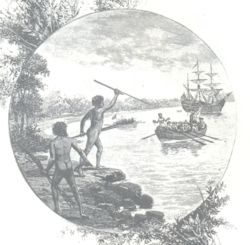 Seventeen years after Cook's landfall on the east coast of Australia, the British government decided to establish a colony at Botany Bay
.
The American Revolutionary War
of (1775–1783) saw Britain lose most of its North American colonies and consider establishing replacement territories. In 1779 Sir Joseph Banks, the eminent scientist who had accompanied James Cook
on his 1770 voyage, recommended Botany Bay
as a suitable site for settlement. Under Banks’s guidance, the American Loyalist
James Matra, who had also travelled with Cook, produced "A Proposal for Establishing a Settlement in New South Wales" (23 August 1783), proposing the establishment of a colony composed of American Loyalists, Chinese and South Sea Islanders (but not convicts).
Matra reasoned that: the country was suitable for plantations of sugar, cotton and tobacco; New Zealand timber and hemp or flax could prove valuable commodities; it could form a base for Pacific trade; and it could be a suitable compensation for displaced American Loyalists. Following an interview with Secretary of State Lord Sydney in 1784, Matra amended his proposal to include convicts as settlers, considering that this would benefit both "Economy to the Publick, & Humanity to the Individual".
Matra’s plan provided the original blueprint for settlement.
Records show the government was considering it in 1784. The London newspapers announced in November 1784 that: “A plan has been presented to the [Prime] Minister, and is now before the Cabinet, for instituting a new colony in New Holland. In this vast tract of land….every sort of produce and improvement of which the various soils of the earth are capable, may be expected”. The Government also incorporated the settlement of Norfolk Island
into their plan, with its attractions of timber and flax, proposed by Banks’s Royal Society colleagues, Sir John Call and Sir George Young.
At the same time, humanitarians and reformers were campaigning in Britain against the appalling conditions in British prisons and hulks. In 1777 prison reformer John Howard wrote The State of Prisons in England and Wales, exposing the harsh conditions of the prison system to "genteel society"." Penal transportation
was already well established as a central plank of English criminal law and until the American Revolution
about a thousand criminals per year were sent to Maryland and Virginia. It served as a powerful deterrent to law-breaking. According to historian David Hill, "Europeans knew little about the geography of the globe" and to "convicts in England, transportation to Botany Bay
was a frightening prospect." Echoing John Callander, he said Australia "might as well have been another planet."
In 1933, Sir Ernest Scott, stated the traditional view of the reasons for colonisation: “It is clear that the only consideration which weighed seriously with the Pitt Government was the immediately pressing and practical one of finding a suitable place for a convict settlement ”. In the early 1960s, historian Geoffrey Blainey
questioned the traditional view of foundation purely as a convict dumping ground. His book The Tyranny of Distance suggested ensuring supplies of flax and timber after the loss of the American colonies may have also been motivations, and Norfolk Island
was the key to the British decision. A number of historians responded and debate brought to light a large amount of additional source material on the reasons for settlement.
The decision to settle was taken when it seemed the outbreak of civil war in the Netherlands might precipitate a war in which Britain would be again confronted with the alliance of the three naval Powers, France, Holland and Spain, which had brought her to defeat in 1783. Under these circumstances, the strategic advantages of a colony in New South Wales described in James Matra's proposal were attractive. Matra wrote that such a settlement could facilitate attacks upon the Spanish in South America and the Philippines, and against the Dutch East Indies
. In 1790, during the Nootka Crisis
, plans were made for naval expeditions against Spain’s possessions in the Americas and the Philippines, in which New South Wales was assigned the role of a base for “refreshment, communication and retreat”. On subsequent occasions into the early 19th century when war threatened or broke out between Britain and Spain, these plans were revived and only the short length of the period of hostilities in each case prevented them from being put into effect.
The German scientist and man of letters Georg Forster
, who had sailed under Captain James Cook in the voyage of the Resolution (1772–1775), wrote in 1786 on the future prospects of the English colony: "New Holland, an island of enormous extent or it might be said, a third continent, is the future homeland of a new civilized society which, however mean its beginning may seem to be, nevertheless promises within a short time to become very important." And the merchant adventurer and would-be colonizer of southwestern Australia under the Swedish flag, William Bolts, said to the Swedish Ambassador in Paris, Erik von Staël in December 1789, that the British had founded at Botany Bay, “a settlement which in time will become of the greatest importance to the Commerce of the Globe”.
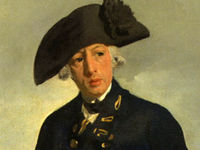
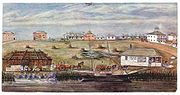 The territory claimed by Britain included all of Australia eastward of the meridian of 135° East and all the islands in the Pacific Ocean between the latitudes of Cape York
and the southern tip of Van Diemen’s Land (Tasmania). The western limit of 135° East was set at the meridian dividing New Holland from Terra Australis shown on Emanuel Bowen's Complete Map of the Southern Continent, published in John Campbell’s editions of John Harris's Navigantium atque Itinerantium Bibliotheca, or Voyages and Travels (1744-1748, and 1764). It was a vast claim which elicited excitement at the time: the Dutch translator of First Fleet officer and author Watkin Tench
's A Narrative of the Expedition to Botany Bay wrote: "a single province which, beyond all doubt, is the largest on the whole surface of the earth. From their definition it covers, in its greatest extent from East to West, virtually a fourth of the whole circumference of the Globe". Spanish naval commander Alessandro Malaspina
, who visited Sydney in March–April 1793 reported to his government that: “The transportation of the convicts constituted the means and not the object of the enterprise. The extension of dominion, mercantile speculations and the discovery of mines were the real object”. Frenchman François Péron
, of the Baudin expedition
visited Sydney in 1802 and reported to the French Government: “How can it be conceived that such a monstrous invasion was accomplished, with no complaint in Europe to protest against it? How can it be conceived that Spain, who had previously raised so many objections opposing the occupation of the Malouines (Falklands Islands), meekly allowed a formidable empire to arise to facing her richest possessions, an empire which must either invade or liberate them?
The colony included the current islands of New Zealand
. In 1817, the British government withdrew the extensive territorial claim over the South Pacific. In practice, the governors' writ had been shown not to run in the islands of the South Pacific. The Church Missionary Society had concerns over atrocities committed against the natives of the South Sea Islands, and the ineffectiveness of the New South Wales government to deal with the lawlessness. As a result, on 27 June 1817, Parliament passed an Act for the more effectual Punishment of Murders and Manslaughters committed in Places not within His Majesty's Dominions, which described Tahiti, New Zealand and other islands of the South Pacific as being not within His Majesty's dominions.
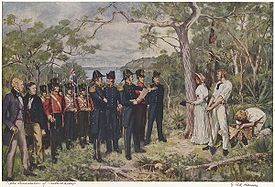
of 11 vessels under the command of Captain Arthur Phillip
in January 1788. It consisted of over a thousand settlers, including 778 convicts (192 women and 586 men). A few days after arrival at Botany Bay
the fleet moved to the more suitable Port Jackson
where a settlement was established at Sydney Cove
on 26 January 1788. This date later became Australia's national day, Australia Day
. The colony was formally proclaimed by Governor Phillip on 7 February 1788 at Sydney.
Sydney Cove offered a fresh water supply and a safe harbour, which Philip described as:
Governor Phillip was vested with complete authority over the inhabitants of the colony. Enlightened for his Age, Phillip's personal intent was to establish harmonious relations with local Aboriginal people and try to reform as well as discipline the convicts of the colony. Phillip and several of his officers - most notably Watkin Tench
- left behind journals and accounts of which tell of immense hardships during the first years of settlement. Often Phillip's officers despaired for the future of New South Wales. Early efforts at agriculture were fraught and supplies from overseas were scarce. Between 1788 and 1792 about 3546 male and 766 female convicts were landed at Sydney - many "professional criminals" with few of the skills required for the establishment of a colony. Many new arrivals were also sick or unfit for work and the conditions of healthy convicts only deteriorated with hard labour and poor sustenance in the settlement. The food situation reached crisis point in 1790 and the Second Fleet which finally arrived in June 1790 had lost a quarter of its 'passengers' through sickness, while the condition of the convicts of the Third Fleet appalled Phillip. from 1791 however, the more regular arrival of ships and the beginnings of trade lessened the feeling of isolation and improved supplies.
Phillip sent exploratory missions in search of better soils, fixed on the Parramatta region as a promising area for expansion, and moved many of the convicts from late 1788 to establish a small township, which became the main centre of the colony's economic life. This left Sydney Cove only as an important port and focus of social life. Poor equipment and unfamiliar soils and climate continued to hamper the expansion of farming from Farm Cove to Parramatta and Toongabbie, but a building programme, assisted by convict labour, advanced steadily. Between 1788-92, convicts and their gaolers made up the majority of the population - but after this, a population of emancipated convicts began to grow who could be granted land and these people pioneered a non-government private sector economy and were later joined by soldiers whose military service had expired - and finally, free settlers who began arriving from Britain. Governor Phillip departed the colony for England on 11 December 1792, with the new settlement having survived near starvation and immense isolation for four years
of the colonial government in Sydney, and a western half named New Holland
. The western boundary of 135° East of Greenwich was based on the Complete Map of the Southern Continent, published in Emanuel Bowen’s Complete System of Geography (London 1747), and reproduced in John Campbell’s editions of John Harris's Navigantium atque Itinerantium Bibliotheca, or Voyages and Travels (1744-48, and 1764). Bowen’s map was based on one by Melchisedec Thevenot and published in Relations des Divers Voyages (1663), which divided New Holland in the west from Terra Australis in the east by a latitude staff situated at 135° East. This division reproduced in Bowen’s map, provided a convenient western boundary for the British claim because, as Watkin Tench subsequently commented in A Narrative of the Expedition to Botany Bay, “By this partition, it may be fairly presumed, that every source of future litigation between the Dutch and us, will be for ever cut off, as the discoveries of English navigators only are comprized in this territory”. Thevenot said he copied his map from the one engraved in the floor of the Amsterdam Town Hall, but in that map there was no dividing line between New Holland and Terra Australis. Longitude 135° East reflected the line of division between the claims of Spain and Portugal established in the Treaty of Tordesillas in 1494, which had formed the basis of many subsequent claims to colonial territory. An Historical Narrative of the Discovery of New Holland and New South Wales, published in November 1786, contained "A General Chart of New Holland, including New South Wales & Botany Bay, with The Adjacent Countries, and New Discovered Islands", which showed all the territory claimed under the jurisdiction of the Governor of New South Wales.
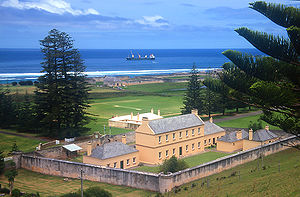
Romantic descriptions of the beauty, mild climate, and fertile soil of Norfolk Island
in the South Pacific led the British government to establish a subsidiary settlement of the New South Wales colony there in 1788. It was hoped that the giant Norfolk Island pine trees and flax plants growing wild on the island might provide the basis for a local industry which, particularly in the case of flax, would provide an alternative source of supply to Russia for an article which was essential for making cordage and sails for the ships of the British navy. However, the island had no safe harbor, which led the colony to be abandoned and the settlers evacuated to Tasmania in 1807. The island was subsequently re-settled as a penal settlement in 1824.
In 1798, George Bass
and Matthew Flinders
circumnavigated Van Diemen's Land, proving that it was an island. In 1802, Flinders successfully circumnavigated Australia for the first time.
Van Diemen's Land
, now known as Tasmania
, was settled in 1803, following a failed attempt to settle at Sullivan Bay
in what is now Victoria. Other British settlements followed, at various points around the continent, many of them unsuccessful. The East India Trade Committee recommended in 1823 that a settlement be established on the coast of northern Australia to forestall the Dutch, and Captain J.J.G.Bremer, RN, was commissioned to form a settlement between Bathurst Island and the Cobourg Peninsula
. Bremer fixed the site of his settlement at Fort Dundas
on Melville Island in 1824 and, because this was well to the west of the boundary proclaimed in 1788, proclaimed British sovereignty over all the territory as far west as Longitude 129˚ East.
The new boundary included Melville and Bathurst Islands, and the adjacent mainland. In 1826, the British claim was extended to the whole Australian continent when Major Edmund Lockyer
established a settlement on King George Sound
(the basis of the later town of Albany
), but the eastern border of Western Australia
remained unchanged at Longitude 129˚ East. In 1824, a penal colony was established near the mouth of the Brisbane River
(the basis of the later colony of Queensland
). In 1829, the Swan River Colony
and its capital of Perth
were founded on the west coast proper and also assumed control of King George Sound. Initially a free colony, Western Australia later accepted British convicts, because of an acute labour shortage.
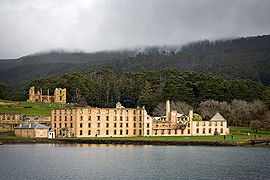
 Between 1788 and 1868, approximately 161,700 convicts (of whom 25,000 were women) were transported to the Australian colonies of New South Wales, Van Diemen’s land and Western Australia. Historian Lloyd Robson has estimated that perhaps two thirds were thieves from working class towns, particularly from the midlands and north of England. The majority were repeat offenders. Whether transportation managed to achieve its goal of reforming or not, some convicts were able to leave the prison system in Australia; after 1801 they could gain "tickets of leave" for good behaviour and be assigned to work for free men for wages. A few went on to have successful lives as emancipists, having been pardoned at the end of their sentence. Female convicts had fewer opportunities.
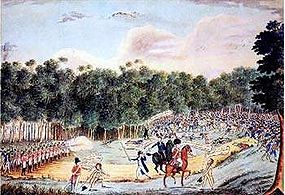
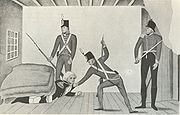
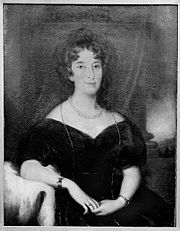 Some convicts, particularly Irish convicts, had been transported to Australia for political crimes or social rebellion, so authorities were consequently suspicious of the Irish and restricted the practice of Catholicism in Australia. The Irish led Castle Hill Rebellion of 1804 served to increase suspicions and repression. Church of England
clergy meanwhile worked closely with the governors
and Richard Johnson
, chaplain to the First Fleet
was charged by Governor Arthur Phillip
, with improving "public morality" in the colony and was also heavily involved in health and education. The Reverend Samuel Marsden
(1765–1838) had magisterial
duties, and so was equated with the authorities by the convicts, becoming known as the 'flogging parson' for the severity of his punishments
The New South Wales Corps
was formed in England in 1789 as a permanent regiment to relieve the marines who had accompanied the First Fleet
. Officers of the Corps soon became involved in the corrupt and lucrative rum trade in the colony. In the Rum Rebellion
of 1808, the Corps, working closely with the newly established wool trader John Macarthur
, staged the only successful armed takeover of government in Australian history, deposing Governor
William Bligh
and instigating a brief period of military rule in the colony prior to the arrival from Britain of Governor Lachlan Macquarie
in 1810.
Macquarie served as the last autocratic Governor of New South Wales, from 1810 to 1821 and had a leading role in the social and economic development of New South Wales which saw it transition from a penal colony
to a budding free society. He established public works, a bank
, churches, and charitable institutions and sought good relations with the Aborigines. In 1813 he sent Blaxland
, Wentworth
and Lawson across the Blue Mountains, where they found the great plains of the interior. Central, however to Macquarie's policy was his treatment of the emancipist
s, whom he decreed should be treated as social equals to free-settlers in the colony. Against opposition, he appointed emancipists to key government positions including Francis Greenway
as colonial architect and William Redfern
as a magistrate. London judged his public works to be too expensive and society was scandalised by his treatment of emancipists. Egalitarianism
would come to be considered a central virtue among Australians.
The first five Governors of New South Wales realised the urgent need to encourage free settlers, but the British government remained largely indifferent. As early as 1790, Governor Arthur Phillip wrote; "Your lordship will see by my…letters the little progress we have been able to make in cultivating the lands ... At present this settlement only affords one person that I can employ in cultivating the lands..." It was not until the 1820s that numbers of free settlers began to arrive and government schemes began to be introduced to encourage free settlers. Philanthropists Caroline Chisholm
and John Dunmore Lang
developed their own migration schemes. Land grants of crown land were made by Governors, and settlement schemes such as those of Edward Gibbon Wakefield
carried some weight in encouraging migrants to make the long voyage to Australia, as opposed to the United States or Canada.
Early colonial administrations were anxious to address the gender imbalance in the population brought about by the importation of large numbers of convict men. Between 1788 and 1792, around 3546 male to 766 female convicts were landed at Sydney. Women came to play an important role in education and welfare during colonial times. Governor Macquarie's wife, Elizabeth Macquarie
took an interest in convict women's welfare. Her contemporary Elizabeth Macarthur
was noted for her 'feminine strength' in assisting the establishment of the Australian merino wool industry during her husband John Macarthur
's enforced absence from the colony following the Rum Rebellion
. The Catholic Sisters of Charity
arriving in 1838 and set about pastoral care in a women's prison, visiting hospitals and schools and establishing employment for convict women. The sisters went on to establish hospitals in four of the eastern states, beginning with St Vincent's Hospital, Sydney
in 1857 as a free hospital for all people, but especially for the poor. Caroline Chisholm
(1808–1877) established a migrant women's shelter and worked for women's welfare in the colonies in the 1840s. Her humanitarian efforts later won her fame in England and great influence in achieving support for families in the colony. Sydney's first Catholic Bishop, John Bede Polding founded an Australian order of nuns - the Sisters of the Good Samaritan
- in 1857 to work in education and social work. The Sisters of St Joseph
, were founded in South Australia by Saint Mary MacKillop and Fr Julian Tenison Woods
in 1867. MacKillop travelled throughout Australasia
and established schools, convents and charitable institutions. She was canonised by Benedict XVI in 2010, becoming the first Australian to be so honoured by the Catholic Church.
From the 1820s, increasing numbers of squatters
occupied land beyond the fringes of European settlement. Often running sheep on large stations
with relatively few overheads, squatters could make considerable profits. By 1834, nearly 2 million kilograms of wool were being exported to Britain from Australia. By 1850, barely 2,000 squatters had gained 30 million hectares of land, and they formed a powerful and "respectable" interest group in several colonies.
In 1835, the British Colonial Office
issued the Proclamation of Governor Bourke
, implementing the legal doctrine of terra nullius
upon which British settlement was based, reinforcing the notion that the land belonged to no one prior to the British Crown taking possession of it and quashing any likelihood of treaties with Aboriginal peoples, including that signed by John Batman
. Its publication meant that from then, all people found occupying land without the authority of the government would be considered illegal trespassers.
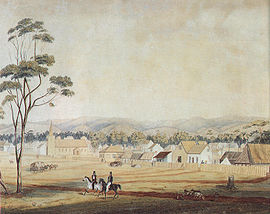
Separate settlements and later, colonies, were created from parts of New South Wales: South Australia
in 1836, New Zealand
in 1840, Port Phillip District
in 1834, later becoming the colony of Victoria
in 1851, and Queensland
in 1859. The Northern Territory
was founded in 1863 as part of South Australia. The transportation of convicts to Australia was phased out between 1840 and 1868.
Massive areas of land were cleared for agriculture and various other purposes in the first 100 years of Europeans settlement. In addition to the obvious impacts this early clearing of land and importation of hard-hoofed animals had on the ecology of particular regions, it severely affected indigenous Australians, by reducing the resources they relied on for food, shelter and other essentials. This progressively forced them into smaller areas and reduced their numbers as the majority died of newly introduced diseases and lack of resources. Indigenous resistance
against the settlers was widespread, and prolonged fighting between 1788 and the 1920s led to the deaths of at least 20,000 Indigenous people and between 2,000 and 2,500 Europeans. During the mid-late 19th century, many indigenous Australians in south eastern Australia were relocated, often forcibly, to reserves and missions. The nature of many of these institutions enabled disease to spread quickly and many were closed as their populations fell.
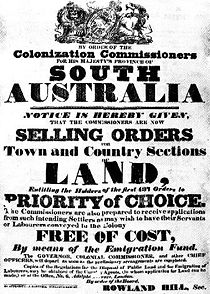 A group in Britain led by Edward Gibbon Wakefield
sought to start a colony based on free settlement rather than convict labour. In 1831 the South Australian Land Company was formed amid a campaign for a Royal Charter which would provide for the establishment of a privately financed "free" colony in Australia.
While New South Wales, Tasmania and (although not initially) Western Australia were established as convict settlements, the founders of South Australia had a vision of a colony with political and religious freedoms, together with opportunities for wealth through business and pastoral investments. The South Australia Act [1834], passed by the British Government which established the colony reflected these desires and included a promise of representative government when the population reached 50,000 people. South Australia thus became the only colony authorised by an Act of Parliament
, and which was intended to be developed at no cost to the British government. Transportation of convicts was forbidden, and 'poor Emigrants', assisted by an Emigration Fund, were required to bring their families with them. Significantly, the Letters Patent
enabling the South Australia Act 1834 included a guarantee of the rights of 'any Aboriginal Natives' and their descendants to lands they 'now actually occupied or enjoyed'.
In 1836, two ships of the South Australia Land Company left to establish the first settlement on Kangaroo Island
. The foundation of South Australia is now generally commemorated as Governor John Hindmarsh
's Proclamation of the new Province at Glenelg, on the mainland, on 28 December 1836. From 1843-1851, the Governor ruled with the assistance of an appointed Executive Council of paid officials. Land development and settlement was the basis of the Wakefield vision, so land law and regulations governing it were fundamental to the foundation of the Province and allowed for land to be be bought at a uniform price per acre (regardless of quality), with auctions for land desired by more than one buyer, and leases made available on unused land. Proceeds from land were to fund the Emigration Fund to assist poor settlers to come as tradesmen and labourers. Agitation for representative government quickly emerged. Most other colonies had been founded by Governors with near total authority, but in South Australia, power was initially divided between the Governor and the Resident Commissioner, so that government could not interfere with the business affairs or freedom of religion of the settlers. By 1851 the colony was experimenting with a partially elected council.
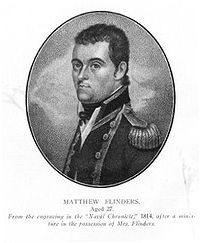 In 1798-9 George Bass
and Matthew Flinders
set out from Sydney in a sloop and circumnavigated Tasmania
, thus proving it to be an island. In 1801-02 Matthew Flinders in The Investigator lead the first circumnavigation of Australia. Aboard ship was the Aboriginal explorer Bungaree
, of the Sydney district, who became the first person born on the Australian continent to circumnavigate the Australian continent. Previously, the famous Bennelong
and a companion had become the first people born in the area of New South Wales to sail for Europe, when, in 1792 they accompanied Governor Phillip to England and were presented to King George III.
In 1813, Gregory Blaxland
, William Lawson and William Wentworth
succeeded in crossing the formidable barrier of forested gulleys and shere cliffs presented by the Blue Mountains, west of Sydney. At Mount Blaxland they looked out over "enough grass to support the stock of the colony for thirty years", and expansion of the British settlement into the interior could begin.
In 1824 the Governor Sir Thomas Brisbane
, commissioned Hamilton Hume
and former Royal Navy Captain William Hovell
to lead an expedition to find new grazing land in the south of the colony, and also to find an answer to the mystery of where New South Wales's western rivers flowed. Over 16 weeks in 1824-25, Hume and Hovell
journeyed to Port Phillip and back. They made many important discoveries including the Murray River
(which they named the Hume), many of its tributaries, and good agricultural and grazing lands between Gunning, New South Wales
and Corio Bay, Victoria.
Charles Sturt
led an expedition along the Macquarie River
in 1828 and discovered the Darling River
. A theory had developed that the inland rivers of New South Wales were draining into an inland sea. Leading a second expedition in 1829, Sturt followed the Murrumbidgee River
into a 'broad and noble river', the Murray River, which he named after Sir George Murray, secretary of state for the colonies. His party then followed this river to its junction with the Darling River
, facing two threatening encounters with local Aboriginal people along the way. Sturt continued down river on to Lake Alexandrina, where the Murray meets the sea in South Australia
. Suffering greatly, the party had to row hundreds of kilometres back upstream for the return journey.
Surveyor General Sir Thomas Mitchell conducted a series of expeditions from the 1830s to 'fill in the gaps' left by these previous expeditions. He was meticulous in seeking to record the original Aboriginal place names around the colony, for which reason the majority of place names to this day retain their Aboriginal titles.
The Polish scientist/explorer Count Paul Edmund Strzelecki conducted surveying work in the Australian Alps
in 1839 and became the first European to ascend Australia's highest peak, which he named Mount Kosciuszko
in honour of the Polish patriot Tadeusz Kosciuszko
.
European explorers made their last great, often arduous and sometimes tragic expeditions into the interior of Australia during the second half of the 19th century - some with the official sponsorship of the colonial authorities and others commissioned by private investors. By 1850, large areas of the inland were still unknown to Europeans. Trailblazers like Edmund Kennedy
and the Prussian naturalist Ludwig Leichhardt
, had met tragic ends attempting to fill in the gaps during the 1840s, but explorers remained ambitious to discover new lands for agriculture or answer scientific enquiries. Surveyors also acted as explorers and the colonies sent out expeditions to discover the best routes for lines of communication. The size of expeditions varied considerably from small parties of just two or three to large, well equipped teams led by gentlemen explorers assisted by smiths, carpenters, labourers and Aboriginal guides accompanied by horses, camels or bullocks.
In 1860, the ill fated Burke and Wills led the first north-south crossing of the continent from Melbourne to the Gulf of Carpentaria
. Lacking bushcraft and unwilling to learn from the local Aboriginal people, Burke and Wills died in 1861, having returned from the Gulf to their rendezvous point at Coopers Creek only to discover the rest of their party had departed the location only a matter of hours previously. Though an impressive feat of navigation, the expedition was an organisational disaster which continues to fascinate the Australian public.
In 1862, John McDouall Stuart
succeeded in traversing Central Australia from south to north. His expedition mapped out the route which was later followed by the Australian Overland Telegraph Line
.
Uluru
and Kata Tjuta
were first mapped by Europeans in 1872 during the expeditionary period made possible by the construction of the Australian Overland Telegraph Line
. In separate expeditions, Ernest Giles
and William Gosse
were the first European explorers to this area. While exploring the area in 1872, Giles sighted Kata Tjuta from a location near Kings Canyon
and called it Mount Olga, while the following year Gosse observed Uluru and named it Ayers Rock, in honor of the Chief Secretary of South Australia, Sir Henry Ayers. These barren dessert lands of Central Australia disappointed the Europeans as unpromising for pastoral expansion, but would later come to be appreciated as emblematic of Australia.
in Australia is traditionally attributed to Edward Hammond Hargraves, near Bathurst, New South Wales
, in February 1851 Traces of gold had nevertheless been found in Australia as early as 1823 by surveyor James McBrien. As by English law
all minerals belonged to the Crown, there was at first, "little to stimulate a search for really rich goldfields in a colony prospering under a pastoral economy." Richard Broome also argues that the California Gold Rush
at first overawed the Australian finds, until "the news of Mount Alexander
reached England in May 1852, followed shortly by six ships carrying eight tons of gold."
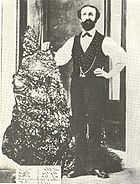 The gold rushes brought many immigrants to Australia from Great Britain, Ireland, continental Europe, North America and China. The Colony of Victoria
’s population grew rapidly, from 76,000 in 1850 to 530,000 by 1859. Discontent arose amongst diggers
almost immediately, particularly on the crowded Victorian fields. The causes of this were the colonial government’s administration of the diggings and the gold licence system. Following a number of protests and petitions for reform
, violence erupted at Ballarat
in late 1854.
Early on the morning of Sunday 3 December 1854, British soldiers and Police attacked a stockade built on the Eureka lead
holding some of the aggrieved diggers. In a short fight, at least 30 miners were killed and an unknown number wounded. O’Brien lists 5 soldiers of the 12th Regiment
and 40 Regiment
killed and 12 wounded Blinded by his fear of agitation with democratic overtones, local Commissioner Robert Rede had felt "it was absolutely necessary that a blow should be struck" against the miners.
But a few months later, a Royal commission made sweeping changes to the administration of Victoria’s goldfields. Its recommendations included the abolition of the licence, reforms to the police force and voting rights for miners holding a Miner’s Right. The Eureka flag
that was used to represent the Ballarat miners has been seriously considered by some as an alternative to the Australian flag
, because of its association with democratic developments.
In the 1890s, visiting author Mark Twain
characterised the battle at Eureka
as:
Later gold rushes occurred at the Palmer River
, Queensland
, in the 1870s, and Coolgardie
and Kalgoorlie
in Western Australia, in the 1890s. Confrontations between Chinese and European miners occurred on the Buckland River in Victoria and Lambing Flat
in New South Wales, in the late 1850s and early 1860s. Driven by European jealousy of the success of Chinese efforts as alluvial (surface) gold ran out, it fixed emerging Australian attitudes in favour of a White Australia policy
, according to historian Geoffrey Serle
.
New South Wales in 1855 was the first colony to gain responsible government
, managing most of its own affairs while remaining part of the British Empire. Victoria, Tasmania, and South Australia followed in 1856; Queensland, from its foundation in 1859; and Western Australia, in 1890. The Colonial Office in London retained control of some matters, notably foreign affairs, defence and international shipping.
The gold era led to a long period of prosperity, sometimes called "the long boom." This was fed by British investment and the continued growth of the pastoral and mining industries, in addition to the growth of efficient transport by rail
, river
and sea. By 1891, the sheep population of Australia was estimated at 100 million. Gold production had declined since the 1850s, but in the same year was still worth £5.2 million. Eventually the economic expansion ended; the 1890s were a period of economic depression, felt most strongly in Victoria, and its capital Melbourne
.
The late 19th century had however, seen a great growth in the cities of south eastern Australia. Australia's population (not including Aborigines, who were excluded from census calculations) in 1900 was 3.7 million, almost 1 million of whom lived in Melbourne
and Sydney
. More than two thirds of the population overall lived in cities and towns by the close of the century, making "Australia one of the most urbanised societies in the western world."
 Bushrangers, originally referred to runaway convicts in the early years of the British settlement of Australia
who had the survival skills necessary to use the Australia
n bush
as a refuge to hide from the authorities. The term "bushranger" then evolved to refer to those who abandoned social rights and privileges to take up "robbery under arms" as a way of life, using the bush as their base. These bushrangers were roughly analogous to British "highwaymen
" and American "Old West outlaws," and their crimes often included robbing small-town banks or coach services.
More than 2000 bushrangers are believed to have roamed the Australian countryside, beginning with the convict bolters and ending after Ned Kelly
's last stand at Glenrowan.
Bold Jack Donahue
is recorded as the last convict bushranger. He was reported in newspapers around 1827 as being responsible for an outbreak of bushranging on the road between Sydney
and Windsor
. Throughout the 1830s he was regarded as the most notorious bushranger in the colony. Leading a band of escaped convicts, Donahue became central to Australian folklore as the Wild Colonial Boy.
Bushranging was common on the mainland, but Van Diemen's Land
(Tasmania
) produced the most violent and serious outbreaks of convict bushrangers. Hundreds of convicts were at large in the bush, farms were abandoned and martial law was proclaimed. Indigenous outlaw Musquito
defied colonial law and led attacks on settlers.
The bushrangers' heyday was the Gold Rush
years of the 1850s and 1860s.
There was much bushranging activity in the Lachlan Valley
, around Forbes
, Yass
and Cowra
in News South Wales. Frank Gardiner
, John Gilbert
and Ben Hall led the most notorious gangs of the period. Other active bushrangers included Dan Morgan
, based in the Murray River
, and Captain Thunderbolt
, killed outside Uralla.
The increasing push of settlement, increased police efficiency, improvements in rail transport
and communications technology, such as telegraphy
, made it increasingly difficult for bushrangers to evade capture.
Among the last bushrangers were the Kelly Gang, led by Ned Kelly
, who were captured at Glenrowan in 1880, two years after they were outlawed. Kelly was born in Victoria
to an Irish convict
father, and as a young man he clashed with the Victoria Police
. Following an incident at his home in 1878, police parties searched for him in the bush. After he killed three policemen, the colony proclaimed Kelly and his gang wanted outlaw
s.
A final violent confrontation with police took place at Glenrowan
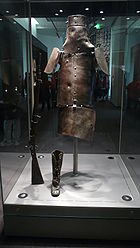
on 28 June 1880. Kelly, dressed in home-made plate metal armour
and helmet, was captured and sent to jail. He was hanged for murder at Old Melbourne Gaol in November 1880. His daring and notoriety made him an iconic
figure in Australian history, folklore, literature, art and film.
Some bushrangers, most notably Ned Kelly in his Jerilderie Letter
, and in his final raid on Glenrowan, explicitly represented themselves as political rebels. Attitudes to Kelly, by far the most well-known bushranger, exemplify the ambivalent views of Australians regarding bushranging.
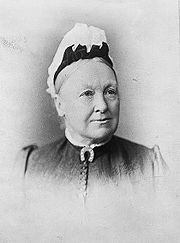 Traditional Aboriginal society had been governed by councils of elders and a corporate decision making process, but the first European-style governments established after 1788 were autocratic and run by appointed governors
- although English law was transplanted into the Australian colonies by virtue of the doctrine of reception
, thus notions of the rights and processes established by the Magna Carta
and the Bill of Rights 1689
were brought from Britain by the colonists. Agitation for representative government began soon after the settlement of the colonies.
The oldest legislative body in Australia, the New South Wales Legislative Council
, was created in 1825 as an appointed body to advise the Governor of New South Wales. William Wentworth
established the Australian Patriotic Association (Australia's first political party) in 1835 to demand democratic government for New South Wales. The reformist attorney general, John Plunkett
, sought to apply Enlightenment
principles to governance in the colony, pursuing the establishment of equality before the law, first by extending jury rights to emancipist
s, then by extending legal protections to convicts, assigned servants and Aborigines
. Plunkett twice charged the colonist perpetrators of the Myall Creek massacre
of Aborigines with murder, resulting in a conviction and his landmark Church Act of 1836 disestablished
the Church of England
and established legal equality between Anglicans
, Catholics, Presbyterians and later Methodists.
In 1840, the Adelaide City Council and the Sydney City Council were established. Men who possessed 1000 pounds worth of property were able to stand for election and wealthy landowners were permitted up to four votes each in elections. Australia's first parliamentary elections were conducted for the New South Wales Legislative Council
in 1843, again with voting rights (for males only) tied to property ownership or financial capacity. Voter rights were extended further in New South Wales in 1850 and elections for legislative councils were held in the colonies of Victoria, South Australia and Tasmania.
By the mid 19th century, there was a strong desire for representative and responsible government in the colonies of Australia, fed by the democratic spirit of the goldfields
evident at the Eureka Stockade
and the ideas of the great reform movements sweeping Europe
, the United States
and the British Empire. The end of convict transportation accelerated reform in the 1840s and 1850s. The Australian Colonies Government Act [1850] was a landmark development which granted representative constitutions to New South Wales, Victoria, South Australia and Tasmania and the colonies enthusiastically set about writing constitutions which produced democratically progressive parliaments - though the constitutions generally maintained the role of the colonial upper houses as representative of social and economic "interests" and all established Constitutional Monarchies
with the British monarch as the symbolic head of state.
In 1855, limited self government was granted by London to New South Wales, Victoria, South Australia and Tasmania. An innovative secret ballot
was introduced in Victoria, Tasmania and South Australia in 1856, in which the government supplied voting paper containing the names of candidates and voters could select in private. This system was adopted around the world, becoming known as the "Australian Ballot". 1855 also saw the granting of the right to vote to all male British subjects 21 years or over in South Australia
. This right was extended to Victoria in 1857 and New South Wales the following year. The other colonies followed until, in 1896, Tasmania became the last colony to grant universal male suffrage.
Propertied women in the colony of South Australia were granted the vote in local elections (but not parliamentary elections) in 1861. Henrietta Dugdale
formed the first Australian women's suffrage society in Melbourne
, Victoria in 1884. Women became eligible to vote for the Parliament of South Australia
in 1895. This was the first legislation in the world permitting women also to stand for election to political office and, in 1897, Catherine Helen Spence
became the first female political candidate for political office, unsuccessfully standing for election as a delegate to the Federal Convention on Australian Federation. Western Australia
granted voting rights to women in 1899.
Legally, Indigenous Australian males generally gained the right to vote during this period when Victoria, New South Wales, Tasmania and South Australia gave voting rights to all male British subjects over 21 - only Queensland and Western Australia barred Aboriginal people from voting. Thus, Aboriginal men and women voted in some jurisdictions for the first Commonwealth Parliament in 1901. Early federal parliamentary reform and judicial interpretation however sought to limit Aboriginal voting in practice - a situation which endured until rights activists began campaigning in the 1940s.
Though the various parliaments of Australia have been constantly evolving, the key foundations for elected parliamentary government have maintained an historical continuity in Australia from the 1850s into the 21st century.
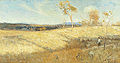 By the late 1880s, a majority of people living in the Australian colonies were native born, although over 90% were of British and Irish origin. Historian Don Gibb suggests that bushranger
Ned Kelly
represented one dimension of the emerging attitudes of the native born population. Identifying strongly with family and mates
, Kelly was opposed to what he regarded as oppression by Police and powerful Squatters
. Almost mirroring the Australian stereotype later defined by historian Russel Ward, Kelly became "a skilled bushman, adept with guns, horses and fists and winning admiration from his peers in the district." Journalist Vance Palmer suggested although Kelly came to typify "the rebellious persona of the country for later generations, (he really) belonged...to another period."

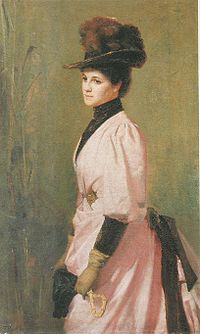 The origins of distinctly Australian painting is often associated with this period and the Heidelberg School
of the 1880s-1890s. Artists such as Arthur Streeton
, Frederick McCubbin
and Tom Roberts
applied themselves to recreating in their art a truer sense of light and colour as seen in Australian landscape. Like the European Impressionists, they painted in the open air. These artists found inspiration in the unique light and colour which characterises the Australian bush. Their most recognised work involves scenes of pastoral and wild Australia, featuring the vibrant, even harsh colours of Australian summers.
Australian literature
was equally developing a distinct voice. The classic Australian writers Henry Lawson
, Banjo Paterson
, Miles Franklin
, Norman Lindsay
, Steele Rudd
, Mary Gilmore
, C J Dennis and Dorothea McKellar were all forged by - and indeed helped to forge - this period of growing national identity. Views of Australia at times conflicted - Lawson and Paterson contributed a series of verses to The Bulletin
magazine in which they engaged in a literary debate about the nature of life in Australia: Lawson (a republican socialist) derided Paterson as a romantic, while Paterson (a country born city lawyer) thought Lawson full of doom and gloom. Paterson wrote the lyrics of the much-loved folksong Waltzing Matilda
in 1895. The song has often been suggested as an Australia's national anthem and Advance Australia Fair
, the Australian national anthem since the late 1970s, itself was written in 1887. Dennis wrote of laconic heroes in the Australian vernacular, while McKellar rejected a love of England's pleasant pastures in favour of what she termed a "Sunburnt Country" in her iconic poem: My Country
(1903).
A common theme throughout the nationalist art, music and writing of late 19th century was the romantic rural or bush
myth, ironically produced by one of the most urbanised societies in the world. Paterson's well known poem Clancy of the Overflow
, written in 1889, evokes the romantic myth. While bush ballads evidenced distinctively Australian popular medium of music and of literature, Australian artists of a more classical mould - such as the opera singer Dame Nellie Melba
, and painters John Peter Russell
and Rupert Bunny
- prefigured the 20th century expatriate Australians who knew little of 'stockyard and rails' but would travel abroad to influence Western art and culture.
to the south eastern cities by telegraph in 1877, helped break down inter-colonial rivalries.
Amid calls from London for the establishment of an intercolonial Australian army, and with the various colonies independently constructing railway lines, New South Wales Premier Henry Parkes
addressed a rural audience in his 1889 Tenterfield Oration
, stating that the time had come to form a national executive government:
Parkes' vision called for a convention of Parliamentary representatives from the different colonies, to draft a constitution for the establishment of a national parliament, with two houses to legislate on "all great subjects". Though Parkes would not live to see it, each of these things would be achieved within a decade, and he is remembered as the "father of federation".
By 1895, powerful interests including various colonial politicians, the Australian Natives' Association and some newspapers were advocating Federation
. Increasing nationalism
, a growing sense of national identity amongst white colonial Australians, as well as a desire for a national immigration policy, (to become the white Australia policy
), combined with a recognition of the value of collective national defence also encouraged the Federation movement. The vision of most colonists was probably staunchly imperial however.
At a Federation Conference banquet in 1890, Henry Parkes spoke of blood-kinship linking the colonies:
Despite a more radical vision for a separate Australia by some colonists, including writer Henry Lawson
, trade unionist William Lane
and as found in the pages of the Sydney Bulletin
, by the end of 1899, and after much colonial debate, the citizens of five of the six Australian colonies had voted in referendums in favour of a constitution to form a Federation
. Western Australia
voted to join in July 1900. The "Commonwealth of Australia Constitution Act (UK)" was passed on 5 July 1900 and given Royal Assent
by Queen Victoria
on 9 July 1900.
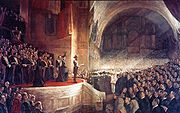 The Commonwealth of Australia came into being when the Federal Constitution
was proclaimed by the Governor General
, Lord Hopetoun
, on 1 January 1901. The first Federal elections
were held in March 1901 and resulted in a narrow majority for the Protectionist Party
over the Free Trade Party
with the Australian Labor Party
(ALP) polling third. Labor declared it would offer support to the party which offered concessions and Edmund Barton
's Protectionists formed a government, with Alfred Deakin
as Attorney General.
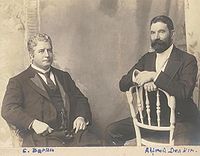
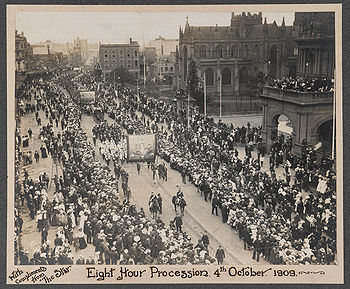 Barton promised to "create a high court, ...and an efficient federal public service... He proposed to extend conciliation and arbitration, create a uniform railway gauge between the eastern capitals, to introduce female federal franchise, to establish a...system of old age pensions." He also promised to introduce legislation to safeguard "White Australia
" from any influx of Asian or Pacific Island labour.
The Labor Party (the spelling "Labour" was dropped in 1912) had been established in the 1890s, after the failure of the Maritime
and Shearer’s
strikes. Its strength was in the Australian Trade Union movement
"which grew from a membership of just under 100,000 in 1901 to more than half a million in 1914." The platform of the ALP was democratic socialist. Its rising support at elections, together with its formation of federal government in 1904 under Chris Watson
, and again in 1908, helped to unify competing conservative, free market
and liberal
anti-socialists into the Commonwealth Liberal Party
in 1909. Although this party dissolved in 1916, a successor to its version of "liberalism" in Australia which in some respects comprises an alliance of Millsian
liberals and Burkian
conservatives united in support for individualism
and opposition to socialism
can be found in the modern Liberal Party
. To represent rural interests, the Country Party
(today's National Party) was founded in 1913 in Western Australia, and nationally in 1920, from a number of state-based farmer's parties.
The Immigration Restriction Act 1901
was one of the first laws passed by the new Australian parliament
. Aimed to restrict immigration from Asia (especially China), it found strong support in the national parliament, arguments ranging from economic protection to outright racism. The law permitted a dictation test in any European language to be used to in effect exclude non-"white" immigrants. The Labor Party wanted to protect "white" jobs and pushed for clearer restrictions. A few politicians spoke of the need to avoid hysterical treatment of the question. MP Bruce Smith said he had "no desire to see low-class Indians, Chinamen or Japanese...swarming into this country... But there is obligation...not (to) unnecessarily offend the educated classes of those nations" Donald Cameron, a member from Tasmania, expressed a rare note of dissension in the parliament, saying that no race on earth had been "treated in a more shameful manner than have the Chinese...". Outside parliament, Australia's first Catholic cardinal
, Patrick Francis Moran was politically active and denounced anti-Chinese legislation as "unchristian". The popular press mocked the cardinal's position and the small European population of Australia generally supported the legislation and remained fearful of being overwhelmed by an influx of non-British migrants from the vastly different cultures of the highly populated empires to Australia's north.
The law passed both houses of Parliament and remained a central feature of Australia's immigration laws until abandoned in the 1950s. In the 1930s, the Lyons government
unsuccessfully attempted to exclude Egon Erwin Kisch
, a Czechoslovakian communist author from entering Australia by means of a 'dictation test' in Scottish Gaelic. The High Court of Australia
ruled against this usage, and concerns emerged that the law could be used for such political purposes.
Before 1901, units of soldiers from all six Australian colonies had been active as part of British forces in the Boer War
. When the British government asked for more troops from Australia in early 1902, the Australian government obliged with a national contingent. Some 16,500 men had volunteered for service by the war's end in June 1902. But Australians soon felt vulnerable closer to home. The Anglo-Japanese Alliance
of 1902 "allowed the Royal Navy
to withdraw its capital ships from the Pacific by 1907. Australians saw themselves in time of war a lonely, sparsely populated outpost." The impressive visit of the US Navy's Great White Fleet
in 1908 emphasised to the government the value of an Australian navy
. The Defence Act of 1909 reinforced the importance of Australian defence, and in February 1910, Lord Kitchener
provided further advice on a defence scheme based on conscription
. By 1913, the battlecruiser Australia
led the fledgling Royal Australian Navy
. Historian Bill Gammage
estimates that on the eve of war, Australia had 200,000 men "under arms of some sort".
Historian Humphrey McQueen
has it that working and living conditions for Australia’s working classes in the early 20th century were of "frugal comfort." While the establishment of an Arbitration court for Labour disputes
was divisive, it was an acknowledgement of the need to set Industrial awards, where all wage earners in one industry enjoyed the same conditions of employment and wages. The Harvester Judgment
of 1907 recognised the concept of a basic wage and in 1908 the Federal government also began an old age pension scheme. Thus the new Commonwealth gained recognition as a laboratory for social experimentation and positive liberalism.
Catastrophic droughts plagued some regions in the late 1890s and early 20th century and together with a growing rabbit plague
, created great hardship in rural Australia. Despite this, a number of writers "imagined a time when Australia would outstrip Britain in wealth and importance, when its open spaces would support rolling acres of farms and factories to match those of the United States. Some estimated the future population at 100 million, 200 million or more." Amongst these was E. J. Brady
, whose 1918 book Australia Unlimited described Australia’s inland as ripe for development and settlement, "destined one day to pulsate with life."
With the encouragement of Queensland, in 1884, a British protectorate had been proclaimed over the southern coast of New Guinea and its adjacent islands. British New Guinea, was annexed outright in 1888. The possession was placed under the authority of the newly federated Commonwealth of Australia in 1902 and with passage of the Papua Act of 1905, British New Guinea became the Australian Territory of Papua, with formal Australian administration beginning in 1906.
.jpg) The outbreak of war in Europe in August 1914 automatically involved "all of Britain's colonies and dominions". Prime Minister Andrew Fisher
The outbreak of war in Europe in August 1914 automatically involved "all of Britain's colonies and dominions". Prime Minister Andrew Fisher
probably expressed the views of most Australians when during the election campaign of late July he said:
More than 416,000 Australian men volunteered to fight during the First World War between 1914 and 1918 from a total national population of 4.9 million. Historian Lloyd Robson estimates this as between one third and one half of the eligible male population. The Sydney Morning Herald
referred to the outbreak of war as Australia's "Baptism of Fire." 8,141 men were killed in 8 months of fighting at Gallipoli
, on the Turkish
coast. After the Australian Imperial Forces
(AIF) was withdrawn in late 1915, and enlarged to five divisions, most were moved to France to serve under British command.
Some forces remained in the Mid-East, including members of the Light Horse Regiment. Light horseman of the 4th and 12th Regiments captured heavily fortified Beersheba from Turk forces by means of a cavalry charge at full gallop on 31 October 1917. One of the last great cavalry charges in history, the attack opened a way for the allies to outflank the Gaza-Beersheba Line and drive the Ottomans back into Palestine.
The AIF's first experience of warfare on the Western Front
was also the most costly single encounter in Australian military history. In July 1916, at Fromelles
, in a diversionary attack during the Battle of the Somme, the AIF suffered 5,533 killed or wounded in 24 hours. Sixteen months later, the five Australian divisions became the Australian Corps
, first under the command of General Birdwood
, and later the Australian General Sir John Monash
. Two bitterly fought and divisive conscription referendums
were held in Australia in 1916 and 1917. Both failed, and Australia's army remained a volunteer force.
 John Monash
was appointed corps commander of the Australian forces in May 1918 and led some significant attacks in the final stages of the war. British Field Marshal Montgomery later called him "the best general on the western front in Europe". Monash made the protection of infantry a priority and sought to fully integrate all the new technologies of warfare in both the planning and execution of battles, thus he wrote that infantry should not be sacrificed needlessly to enemy bayonets and machine guns - but rather should "advance under the maximum possible protection of the maximum possible array of mechanical resources, in the form of guns, machine-guns, tanks, mortars and aeroplanes". His first operation at the relatively small Battle of Hamel
demonstrated the validity of his approach and later actions before the Hindenburg Line in 1918 confirmed it. Monash was knighted in the field of battle by King George V following 8 August advance during the Battle of Amiens
. General Eric von Ludendorff, the German commander, later wrote of 8 August 1918 as "the black day of the German Army... The 8th of August put the decline of [German] fighting power beyond all doubt". Amiens, fought between 8 and 11 August 1918, marked the beginning of the allied advance that culminated in the 11 November Armistice
ended the war.
Over 60,000 Australians had died during the conflict and 160,000 were wounded, a high proportion of the 330,000 who had fought overseas. Australia's annual holiday to remember its war dead is held on ANZAC Day
, 25 April, each year, the date of the first landings at Gallipoli in 1915. The choice of date is often mystifying to non-Australians; it was after all, an allied invasion that ended in military defeat. Bill Gammage
has suggested that the choice of 25 April has always meant much to Australians because at Gallipoli, "the great machines of modern war were few enough to allow ordinary citizens to show what they could do." In France, between 1916 and 1918, "where almost seven times as many (Australians) died,... the guns showed cruelly, how little individuals mattered."
In 1919, Prime Minister Billy Hughes
and former Prime Minister Joseph Cook
travelled to Paris to attend the Versailles peace conference
. Hughes's signing of the Treaty of Versailles
on behalf of Australia was the first time Australia had signed an international treaty. Hughes demanded heavy reparations from Germany and frequently clashed with U.S. President Woodrow Wilson
. At one point Hughes declared: "I speak for 60 000 [Australian] dead". He went on to ask of Wilson; "How many do you speak for?"
Hughes demanded that Australia have independent representation within the newly formed League of Nations
and was the most prominent opponent of the inclusion of the Japanese racial equality proposal, which as a result of lobbying by him and others was not included in the final Treaty, deeply offending Japan. Hughes was concerned by the rise of Japan. Within months of the declaration of the European War in 1914; Japan, Australia and New Zealand seized all German possessions in the South West Pacific. Though Japan occupied German possessions with the blessings of the British, Hughes was alarmed by this policy. In 1919 at the Peace Conference the Dominion leaders argued their case to keep their occupied German possessions and these territories were given a "Class C Mandates" to the respective Dominions. Japan obtained control over the South Pacific Mandate
, north of the equator. German New Guinea
, the Bismarck Archipelago
and Nauru
were assigned to Australia as League of Nations Mandate
s: in the category of territories "formerly governed [by the Central Powers
] and which are inhabited by peoples not yet able to stand by themselves under the strenuous conditions of the modern world". Thus the Territory of New Guinea
came under Australian administration.
led a new conservative force, the Nationalist Party
, formed from the old Liberal party
and breakaway elements of Labor (of which he was the most prominent), after the deep and bitter split over Conscription
. An estimated 12,000 Australians died as a result of the Spanish flu pandemic of 1919, almost certainly brought home by returning soldiers.
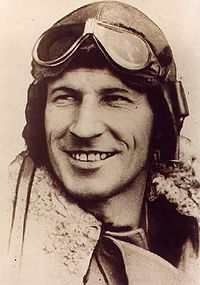
 The success of the Bolshevik Revolution in Russia posed a threat in the eyes of many Australians, although to a small group of socialists, it was an inspiration. The Communist Party of Australia
was formed in 1920 and, though remaining electorally insignificant, it obtained some influence in the trade union
movement and was banned during World War II
for its support for the Hitler-Stalin Pact and the Menzies Government
unsuccessfully tried to ban it again during the Korean War
. Despite splits, the party remained active until its dissolution at the end of the Cold War
.
The Country Party (today's National Party
) formed in 1920 to promulgate its version of agrarianism
, which it called "Countrymindedness". The goal was to enhance the status of the graziers (operators of big sheep ranches) and small farmers, and secure subsidies for them. Enduring longer than any other major party save the Labor party, it has generally operated in Coalition
with the Liberal Party
(since the 1940s), becoming a major party of government in Australia - particularly in Queensland.
Other significant after-effects of the war included ongoing industrial unrest, which included the 1923 Victorian Police strike
. Industrial disputes characterised the 1920s in Australia. Other major strikes occurred on the waterfront, in the coalmining and timber industries in the late 1920s. The union movement had established the Australian Council of Trade Unions
(ACTU) in 1927 in response to the Nationalist government's efforts to change working conditions and reduce the power of the unions.
The consumerism, entertainment culture, and new technologies that characterised the 1920s in the United States were also found in Australia. Prohibition
was not implemented in Australia, though anti-alcohol forces were successful in having hotels closed after 6 pm, and closed altogether in a few city suburbs.
The fledgling film industry declined through the decade, over 2 million Australians attending cinemas weekly at 1250 venues. A Royal Commission
in 1927 failed to assist and the industry that had begun so brightly with the release of the world's first feature film, The Story of the Kelly Gang
(1906), atrophied until its revival in the 1970s
.
Stanley Bruce
became Prime Minister in 1923, when members of the Nationalist Party Government voted to remove W.M. Hughes. Speaking in early 1925, Bruce summed up the priorities and optimism of many Australians, saying that "men, money and markets accurately defined the essential requirements of Australia" and that he was seeking such from Britain. The migration campaign of the 1920s, operated by the Development and Migration Commission, brought almost 300,000 Britons to Australia, although schemes to settle migrants and returned soldiers
"on the land" were generally not a success. "The new irrigation areas in Western Australia
and the Dawson Valley of Queensland
proved disastrous"
In Australia, the costs of major investment had traditionally been met by state and Federal governments and heavy borrowing from overseas was made by the governments in the 1920s. A Loan Council
set up in 1928 to coordinate loans, three quarters of which came from overseas. Despite Imperial preference
, a balance of trade was not successfully achieved with Britain. "In the five years from 1924..to..1928, Australia bought 43.4% of its imports from Britain and sold 38.7% of its exports. Wheat and wool made up more than two thirds of all Australian exports," a dangerous reliance on just two export commodities.
Australia embraced the new technologies of transport and communication. Coastal sailing ships were finally abandoned in favour of steam, and improvements in rail and motor transport heralded dramatic changes in work and leisure. In 1918 there were 50,000 cars and lorries in the whole of Australia. By 1929 there were 500,000. The stage coach company Cobb and Co
, established in 1853, finally closed in 1924. In 1920, the Queensland and Northern Territory Aerial Service (to become the Australian airline QANTAS
) was established. The Reverend John Flynn, founded the Royal Flying Doctor Service, the world's first air ambulance in 1928. Dare devil pilot, Sir Charles Kingsford Smith
pushed the new flying machines to the limit, completing a round Australia circuit in 1927 and in 1928 traversed the Pacific Ocean, via Hawaii and Fiji from the USA to Australia in the aircraft Southern Cross. He went on to global fame and a series of aviation records before vanishing on a night flight to Singapore in 1935.
 Australia achieved independent Sovereign Nation status after World War I, under the Statute of Westminster
. This formalised the Balfour Declaration of 1926, a report resulting from the 1926 Imperial Conference
of British Empire
leaders in London
, which defined Dominion
s of the British empire in the following way
However, Australia did not ratify the Statute of Westminster
until 1942. According to historian Frank Crowley
, this was because Australians had little interest in redefining their relationship with Britain until the crisis of World War Two.
The Australia Act 1986
removed any remaining links between the British Parliament and the Australian states.
From 1 February 1927 until 12 June 1931, the Northern Territory was divided up as North Australia
and Central Australia
at latitude 20°S
. New South Wales has had one further territory surrendered, namely Jervis Bay Territory
comprising 6,677 hectares, in 1915. The external territories were added: Norfolk Island
(1914); Ashmore Island, Cartier Islands
(1931); the Australian Antarctic Territory
transferred from Britain (1933); Heard Island, McDonald Islands, and Macquarie Island
transferred to Australia from Britain (1947).
The Federal Capital Territory (FCT) was formed from New South Wales in 1911 to provide a location for the proposed new federal capital of Canberra
(Melbourne
was the seat of government from 1901 to 1927). The FCT was renamed the Australian Capital Territory
(ACT) in 1938. The Northern Territory
was transferred from the control of the South Australian government to the Commonwealth in 1911.
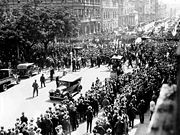 Australia was deeply affected by the Great Depression
of the 1930s, particularly due to its heavy dependence on export
s, especially primary products such as wool
and wheat
, Exposed by continuous borrowing to fund capital works in the 1920s, the Australian and state governments were "already far from secure in 1927, when most economic indicators took a turn for the worse. Australia's dependence of exports left her extraordinarily vulnerable to world market fluctuations," according to economic historian Geoff Spenceley. Debt by the state of New South Wales
accounted for almost half of Australia’s accumulated debt by December 1927. The situation caused alarm amongst a few politicians and economists, notably Edward Shann of the University of Western Australia
, but most political, union and business leaders were reluctant to admit to serious problems. In 1926, Australian Finance magazine described loans as occurring with a "disconcerting frequency" unrivalled in the British Empire: "It may be a loan to pay off maturing loans or a loan to pay the interest on existing loans, or a loan to repay temporary loans from the bankers... Thus, well before the Wall Street Crash of 1929
, the Australian economy was already facing significant difficulties. As the economy slowed in 1927, so did manufacturing and the country slipped into recession as profits slumped and unemployment rose.
At elections held in October 1929 the Labor Party
was swept to power in a landslide and Stanley Bruce
, the former Prime Minister, lost his own seat. The new Prime Minister, James Scullin
, and his largely inexperienced government were almost immediately faced with a series of crises. Hamstrung by their lack of control of the Senate, a lack of control over the banking system and divisions within their party over how best to deal with the situation, the government was forced to accept solutions that eventually split the party, as it had in 1917. Some gravitated to New South Wales Premier Lang, others to Prime Minister Scullin.
Various "plans" to resolve the crisis were suggested; Sir Otto Niemeyer
, a representative of the English banks who visited in mid 1930, proposed a deflationary plan, involving cuts to government spending and wages. Treasurer Ted Theodore
proposed a mildly inflationary plan, while the Labor Premier of New South Wales, Jack Lang
, proposed a radical plan which repudiated overseas debt. The "Premier's Plan" finally accepted by federal and state governments in June 1931, followed the deflationary model advocated by Niemeyer and included a reduction of 20% in government spending, a reduction in bank interest rates and an increase in taxation. In March 1931, Lang announced that interest due in London would not be paid and the Federal government stepped in to meet the debt. In May, the Government Savings Bank of New South Wales was forced to close. The Melbourne Premiers' Conference agreed to cut wages and pensions as part of a severe deflationary policy but Lang, renounced the plan. The grand opening of the Sydney Harbour Bridge
in 1932 provided little respite to the growing crisis straining the young federation. With multi-million pound debts mounting, public demonstrations and move and counter-move by Lang and the Scullin, then Lyons federal governments, the Governor of New South Wales, Philip Game
, had been examining Lang's instruction not to pay money into the Federal Treasury. Game judged it was illegal. Lang refused to withdraw his order and, on 13 May, he was dismissed by Governor Game
. At June elections, Lang Labor's seats collapsed.
May 1931 had seen the creation of a new conservative political force, the United Australia Party
formed by breakaway members of the Labor Party
combining with the Nationalist Party
. At Federal elections in December 1931, the United Australia Party
, led by former Labor member Joseph Lyons
, easily won office. They remained in power until September 1940. The Lyons government has often been credited with steering recovery from the depression, although just how much of this was owed to their policies remains contentious. Stuart Macintyre
also points out that although Australian GDP
grew from £386.9 million to £485.9 million between 1931-2 and 1938-9, real domestic product per head of population was still "but a few shillings greater in 1938-39 (£70.12), than it had been in 1920-21 (£70.04).
Australia recovered relatively quickly from the financial downturn of 1929-1930, with recovery beginning around 1932. Prime Minister Joseph Lyons favoured the tough economic measures of the Premiers' Plan, pursued an orthodox fiscal policy and refused to accept NSW Premier Jack Lang's proposals to default on overseas debt repayments. According to author Anne Henderson
of the Sydney Institute
, Lyons held a steadfast belief in "the need to balance budgets, lower costs to business and restore confidence" and the Lyons period gave Australia "stability and eventual growth" between the drama of the Depression and the outbreak of the Second World War. A lowering of wages was enforced and industry tariff protections maintained, which together with cheaper raw materials during the 1930s saw a shift from agriculture to manufacturing as the chief employer of the Australian economy - a shift which was consolidated by increased investment by the commonwealth government into defence and armaments manufacture. Lyons saw restoration of Australia's exports as the key to economic recovery.
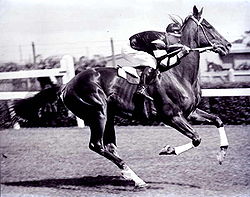 There is debate over the extent reached by unemployment in Australia, often cited as peaking at 29% in 1932. "Trade Union figures are the most often quoted, but the people who were there…regard the figures as wildly understating the extent of unemployment" wrote historian Wendy Lowenstein
in her collection of oral histories of the Depression. However, David Potts argues that "over the last thirty years …historians of the period have either uncritically accepted that figure (29% in the peak year 1932) including rounding it up to ‘a third,’ or they have passionately argued that a third is far too low." Potts suggests a peak national figure of 25% unemployed.
However, there seems little doubt that there was great variation in levels of unemployment. Statistics collected by historian Peter Spearritt show 17.8% of men and 7.9% of women unemployed in 1933 in the comfortable Sydney suburb of Woollahra
. In the working class suburb of Paddington
, 41.3% of men and 20.7% of women were listed as unemployed. Geoffrey Spenceley argues that apart from variation between men and women, unemployment was also much higher in some industries, such as the building and construction industry, and comparatively low in the public administrative and professional sectors.
In country areas, worst hit were small farmers in the wheat belts as far afield as north-east Victoria
and Western Australia, who saw more and more of their income absorbed by interest payments.
Extraordinary sporting successes did something to alleviate the spirits of Australians during the economic downturn. In a Sheffield Shield cricket match at the Sydney Cricket Ground
in 1930, Don Bradman, a young New South Welshman of just 21 years of age wrote his name into the record books by smashing the previous highest batting score in first-class cricket with 452 runs not out in just 415 minutes. The rising star's world beating cricketing exploits were to provide Australians with much needed joy to Australians through the emerging Great Depression
and Post World War Two recovery. Between 1929 and 1931 the legendary racehorse Phar Lap
dominated Australia's racing industry, at one stage winning fourteen races in a row. Famous victories included the 1930 Melbourne Cup
, following an assassination attempt and carrying 9 stone 12 pounds weight. Phar Lap sailed for the United States in 1931, going on to win North America's richest race, the Agua Caliente Handicap
in 1932. Soon after, on the cusp of US success, Phar Lap developed suspicious symptoms and died. Theories swirled that the champion race horse had been poisoned and a devoted Australian public went in to shock. The 1938 British Empire Games
were held in Sydney from 5–12 February, timed to coincide with Sydney's sesqui-centenary (150 years since the foundation of British settlement in Australia).
.jpg)
ese aggression in China
and Germany
’s aggression in Europe
. There was a difference in opinion over how the defence spending should be allocated however. The United Australia Party
government emphasised cooperation with Britain in "a policy of imperial defence." The lynchpin of this was the British naval base at Singapore
and the Royal Navy
battle fleet "which, it was hoped, would use it in time of need." Defence spending in the inter-war years reflected this priority. In the period 1921-1936 totalled £40 million on the Royal Australian Navy
, £20 million on the Australian Army
and £6 million on the Royal Australian Air Force
(established in 1921, the "youngest" of the three services). In 1939, the Navy, which included two heavy cruisers and four light cruisers, was the service best equipped for war.
Fearing Japanese intentions in the Pacific, Menzies established independent embassies in Tokyo and Washington in order to receive independent advice about developments. Gavin Long
argues that the Labor
opposition urged greater national self-reliance through a build up of manufacturing and more emphasis on the Army and RAAF
, as Chief of the General Staff, John Lavarack
also advocated. In November 1936, Labor leader John Curtin
said "The dependence of Australia upon the competence, let alone the readiness, of British statesmen to send forces to our aid is too dangerous a hazard upon which to found Australia’s defence policy." According to John Robertson, "some British leaders had also realised that their country could not fight Japan
and Germany
at the same time." But "this was never discussed candidly at…meeting(s) of Australian and British defence planners", such as the 1937 Imperial Conference.
By September 1939 the Australian Army numbered 3,000 regulars. A recruiting campaign in late 1938, led by Major-General Thomas Blamey
increased the reserve militia to almost 80,000. The first division raised for war was designated the 6th Division, of the 2nd AIF, there being 5 Militia Divisions on paper and a 1st AIF in the First World War.
, made a national radio broadcast:
.jpg)
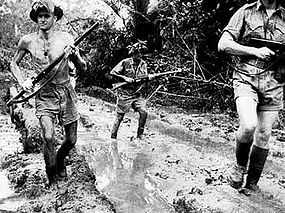
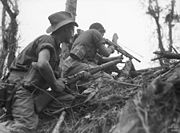 Thus began Australia's involvement in the six-year global conflict. Australians were to fight in an extraordinary variety of locations, from withstanding the advance of Hitler's Panzer
s in the Siege of Tobruk
; to turning back the advance of the Imperial Japanese Army
in the New Guinea Campaign
. From bomber missions over Europe and Mediterranean naval engagements, to facing Japanese mini-sub raids on Sydney Harbour and devastating air raids on the city of Darwin.
The recruitment of a volunteer military force for service at home and abroad was announced, the 2nd Australian Imperial Force and a citizen militia organised for local defence. Troubled by Britain's failure to increase defences at Singapore, Menzies was cautious in committing troops to Europe. By the end of June 1940, France, Norway and the Low Countries had fallen to Nazi Germany
. Britain stood alone with its dominion
s. Menzies called for "all-out war", increasing federal powers and introducing conscription. Menzies' minority government came to rely on just two independents after the 1940 election
In January 1941, Menzies flew to Britain to discuss the weakness of Singapore's defences. Arriving in London during The Blitz
, Menzies was invited into Winston Churchill
's British War Cabinet for the duration of his visit. Returning to Australia, with the threat of Japan imminent and with the Australian army suffering badly in the Greek
and Crete
campaigns, Menzies re-approached the Labor Party to form a War Cabinet. Unable to secure their support, and with an unworkable parliamentary majority, Menzies resigned as Prime Minister. The Coalition held office for another month, before the independents switched allegiance and John Curtin
was sworn in as Prime Minister. Eight weeks later, Japan attacked Pearl Harbor
.
From 1940 to 1941, Australian forces played prominent roles in the fighting in the Mediterranean theatre
, including Operation Compass
, the Siege of Tobruk
, the Greek campaign, the Battle of Crete
, the Syria-Lebanon campaign
and the Second Battle of El Alamein
.
A garrison of around 14,000 Australian soldiers, commanded by Lieutenant General Leslie Morshead
was besieged in Tobruk, Libya by the German-Italian army of General Erwin Rommel
between April and August 1941. The Nazi propagandist Lord Haw Haw derided the defenders as 'rats', a term the soldiers adopted as an ironic compliment: "The Rats of Tobruk
". Vital in the defence of Egypt and the Suez Canal, the Siege saw the advance of the German army halted for the first time and provided a morale boost for the British Commonwealth, which was then standing alone against Hitler.
The war came closer to home when HMAS Sydney
was lost with all hands in battle with the German raider Kormoran in November 1941.
With most of Australia’s best forces committed to fight against Hitler in the Middle East, Japan attacked Pearl Harbor, the US naval base in Hawaii, on 8 December 1941 (eastern Australia time). The British battleship HMS Prince of Wales and battlecruiser HMS Repulse
sent to defend Singapore were sunk soon afterwards. Australia was ill prepared for an attack, lacking armaments, modern fighter aircraft, heavy bombers, and aircraft carriers. While demanding reinforcements from Churchill, on 27 December 1941 Curtin published an historic announcement:
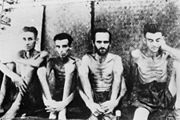
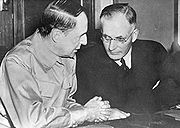 British Malaya quickly collapsed, shocking the Australian nation. British, Indian and Australian troops made a disorganised last stand at Singapore, before surrendering on 15 February 1942. Around 15,000 Australian soldiers became prisoners of war. Curtin predicted that the "battle for Australia" would now follow. On 19 February, Darwin
suffered a devastating air raid, the first time the Australian mainland had ever been attacked by enemy forces. Over the following 19 months, Australia was attacked from the air
almost 100 times.
Two battle-hardened Australian divisions were already steaming from the Mid-East for Singapore. Churchill wanted them diverted to Burma, but Curtin refused, and anxiously awaited their return to Australia. U.S. President Franklin D. Roosevelt
ordered his commander in the Philippines, General Douglas MacArthur
, to formulate a Pacific defence plan with Australia in March 1942. Curtin agreed to place Australian forces under the command of General MacArthur, who became "Supreme Commander of the South West Pacific". Curtin had thus presided over a fundamental shift in Australia's foreign policy. MacArthur moved his headquarters to Melbourne in March 1942 and American troops began massing in Australia. In late May 1942, Japanese midget submarine
s sank an accommodation vessel
in a daring raid on Sydney Harbour
. On 8 June 1942, two Japanese submarines briefly shelled Sydney's eastern suburbs and the city of Newcastle.
In an effort to isolate Australia, the Japanese planned a seaborne invasion of Port Moresby
, in the Australian Territory of New Guinea
. In May 1942, the U.S. Navy
engaged the Japanese in the Battle of the Coral Sea
and halted the attack. The Battle of Midway
in June effectively defeated the Japanese navy and the Japanese army launched a land assault on Moresby from the north. Between July and November 1942, Australian forces repulsed Japanese attempts on the city by way of the Kokoda Track
, in the highlands of New Guinea
. The Battle of Milne Bay
in August 1942 was the first Allied defeat of Japanese land forces.
Meanwhile in North Africa, the Axis Powers
had driven Allies back in to Egypt. A turning point came between July and November 1942, when Australia's 9th Division played a crucial role in some of the heaviest fighting of the First
and Second Battle of El Alamein
, which turned the North Africa Campaign in favour of the Allies.
The Battle of Buna-Gona
, between November 1942 and January 1943, set the tone for the bitter final stages of the New Guinea campaign
, which persisted into 1945. The offensives in Papua and New Guinea of 1943–44 were the single largest series of connected operations ever mounted by the Australian armed forces. Australian Prisoners of War were at this time suffering severe ill-treatment in the Pacific Theatre. In 1943, 2,815 Australian Pows died constructing Japan's Burma-Thailand Railway In 1944, the Japanese inflicted the Sandakan Death March on 2,000 Australian and British prisoners of war - only 6 survived. This was the single worst war crime perpetrated against Australians in war.
MacCarthur largely excluded Australian forces from the main push north into the Philippines and Japan. It was left to Australia to lead amphibious assaults against Japanese bases in Borneo
. Curtin suffered from ill health from the strains of office and died weeks before the war ended, replaced by Ben Chifley
.
Of Australia’s wartime population of seven million, almost one million men and women served in a branch of the services during the six years of warfare. By war’s end, gross enlistments totalled 727,200 men and women in the Australian Army
(of whom 557,800 served overseas), 216,900 in the RAAF and 48,900 in the RAN. Over 39,700 were killed or died as prisoners of war, about 8,000 of whom died as prisoners of the Japanese.

.jpg)
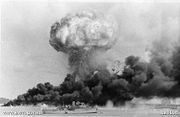 The Australian economy was markedly affected by World War II. Expenditure on war reached 37% of GDP by 1943-4, compared to 4% expenditure in 1939-1940. Total war expenditure was £2,949 million between 1939 and 1945.
Although the peak of Army enlistments occurred in June–July 1940, when over 70,000 enlisted, it was the Curtin Labor Government
, formed in October 1941, that was largely responsible for "a complete revision of the whole Australian economic, domestic and industrial life." Rationing of fuel, clothing and some food was introduced, (although less severely than in Britain) Christmas holidays curtailed, "brown outs" introduced and some public transport reduced. From December 1941, the Government evacuated all women and children from Darwin and northern Australia, and over 10,000 refugees arrived from South East Asia as Japan advanced. In January 1942, the Manpower Directorate was set up "to ensure the organisation of Australians in the best possible way to meet all defence requirements." Minister for War Organisation of Industry, John Dedman
introduced a degree of austerity and government control previously unknown, to such an extent that he was nicknamed "the man who killed Father Christmas."
In May 1942 uniform tax laws were introduced in Australia, as state governments relinquished their control over income taxation, "The significance of this decision was greater than any other… made throughout the war, as it added extensive powers to the Federal Government and greatly reduced the financial autonomy of the states."
Manufacturing grew significantly because of the war. "In 1939 there were only three Australian firms producing machine tools, but by 1943 there were more than one hundred doing so." From having few front line aircraft in 1939, the RAAF had become the fourth largest allied Air force by 1945. A number of aircraft were built under licence in Australia before the war’s end, notably the Beaufort
and Beaufighter, although the majority of aircraft were from Britain and later, the USA. The Boomerang fighter
, designed and built in four months of 1942, emphasised the desperate state Australia found itself in as the Japanese advanced.
Australia also created, virtually from nothing, a significant female workforce engaged in direct war production. Between 1939 and 1944 the number of women working in factories rose from 171,000 to 286,000. Dame Enid Lyons
, widow of former Prime Minster Joseph Lyons
, became the first woman elected to the House of Representatives
in 1943, joining the Robert Menzies' new centre-right Liberal Party of Australia
, formed in 1945. At the same election, Dorothy Tangney
became the first woman elected to the Senate
.
and the Liberal Party of Australia
dominated much of the immediate post war era, defeating the Labor government of Ben Chifley
in 1949, in part over a Labor proposal to nationalise banks and following a crippling coal strike led by the Australian Communist Party. Menzies became the country's longest-serving Prime Minister and the Liberal party, in coalition
with the rural based Country Party
, won every federal election until 1972.
As in the United States in the early 1950s, allegations of communist influence in society saw tensions emerge in politics. Refugees from Soviet
dominated Eastern Europe immigrated to Australia, while to Australia's north, Mao Zedong
's Communist Party of China
won the Chinese civil war
in 1949 and in June 1950, Communist North Korea
invaded South Korea
. The Menzies government responded to a United States led United Nations Security Council
request for military aid for South Korea and diverted forces from occupied Japan
to begin Australia's involvement in the Korean War
. After fighting to a bitter standstill, the UN and North Korean signed a ceasefire agreement in July 1953. Australian forces had participated in such major battles as Kapyong
and Maryang San. 17,000 Australians had served and casualties amounted to more than 1,500, of whom 339 were killed.
During the course of the Korean War
, the Liberal Government attempted to ban the Communist Party of Australia
, first by legislation in 1950 and later by referendum, in 1951. While both attempts were unsuccessful, further international events such as the defection of minor Soviet Embassy official Vladimir Petrov
, added to a sense of impending threat that politically favoured Menzies’ Liberal-CP government, as the Labor Party split over concerns about the influence of the Communist Party over the trade union
movement. The tensions led to another bitter split
and the emergence of the breakaway Democratic Labor Party
(DLP). The DLP remained an influential political force, often holding the balance of power in the Senate, until 1974. Its preferences supported the Liberal and Country Party. The Labor party was led by H.V. Evatt after Chifley’s death in 1951. Evatt had served as President of the United Nations General Assembly
during 1948-49 and helped draft the United Nations Universal Declaration of Human Rights (1948). Evatt retired in 1960, and Arthur Calwell
succeeded him as leader, with ayoung Gough Whitlam
as his deputy.
Menzies presided over a period of sustained economic boom and the beginnings of sweeping social change - with the arrivals of rock and roll music
and television in the 1950s. In 1958, Australian country music
singer Slim Dusty
, who would become the musical embodiment of rural Australia, had Australia's first international music chart hit with his bush ballad
"Pub With No Beer
", while rock and roll
er Johnny O'Keefe
's "Wild One
" became the first local recording to reach the national charts, peaking at #20. Before sleeping through the 1960s Australian cinema produced little of its own content in the 1950s, but British and Hollywood studios produced a string of successful epics from Australian literature
, featuring home grown stars Chips Rafferty
and Peter Finch
.
Menzies remained a staunch supporter of links to the monarchy
and Commonwealth of Nations
and formalised an alliance with the United States
, but also launched post-war trade with Japan, beginning a growth of Australian exports of coal, iron ore and mineral resources that would steadily climb until Japan became Australia's largest trading partner.
When Menzies retired in 1965, he was replaced as Liberal leader and Prime Minister by Harold Holt
. Holt drowned while swimming at a surf beach in December 1967 and was replaced by John Gorton
(1968–1971) and then by William McMahon
(1971–1972).
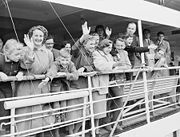 Following World War II, the Chifley
Labor government instigated a massive program of European immigration. In 1945, Minister for Immigration, Arthur Calwell
wrote “If the experience of the Pacific War has taught us one thing, it surely is that seven million Australians cannot hold three million square miles of this earth’s surface indefinitely.” All political parties shared the view that the country must "populate or perish.” Calwell stated a preference for ten British immigrants for each one from other countries; however, the numbers of British migrants fell short of what was expected, despite government assistance. Performers Barry
, Maurice
, Robin and Andy Gibb were a typical family of “10 pound poms,” whose family migrated to Brisbane in 1958 and later gained international fame as the Bee Gees
pop group.
Migration brought large numbers of southern and central Europeans to Australia for the first time. A 1958 government leaflet assured readers that unskilled non-British migrants were needed for “labour on rugged projects …work which is not generally acceptable to Australians or British workers.” The Australian economy stood in sharp contrast to war-ravaged Europe, and newly arrived migrants found employment in a booming manufacturing industry and government assisted programs such as the Snowy Mountains Scheme
. This hydroelectricity
and irrigation
complex in south-east Australia consisted of sixteen major dams and seven power stations constructed between 1949 and 1974. It remains the largest engineering project undertaken in Australia. Necessitating the employment of 100,000 people from over 30 countries
, to many it denotes the birth of multicultural Australia.
Some 4.2 million immigrants arrived between 1945 and 1985, about 40% of whom came from Britain and Ireland. The 1957 novel They're a Weird Mob
was a popular account of an Italian migrating to Australia, although written by Australian-born author John O'Grady
. The Australian population reached 10 million in 1959.
In May 1958, the Menzies
Government replaced the Immigration Act's arbitrarily applied dictation test with an entry permit system, that reflected economic and skills criteria. Further changes in the 1960s effectively ended the White Australia Policy
. It legally ended in 1973.
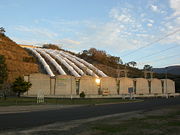
 Australia enjoyed significant growth in prosperity in the 1950s and 1960s. The manufacturing industry, previously playing a minor part in an economy dominated by primary production, greatly expanded. The first Holden
motor car came out of General Motors-Holden’s Fisherman’s Bend factory in November 1948. Car ownership rapidly increased – from 130 owners in every 1,000 in 1949 to 271 owners in every 1,000 by 1961. By the early 1960s, four competitors to Holden had set up Australian factories, employing between 80,000 and 100,000 workers, “at least four-fifths of them migrants.”
In the 1960s, about 60% of Australian manufacturing was protected by tariffs. Pressure from business interests and the union movement ensured these remained high. Historian Geoffrey Bolton suggests that this high tariff protection of the 1960s caused some industries to “lapse into lethargy,” neglecting research and development and the search for new markets. The CSIRO was expected to fulfil research and development.
Prices for wool and wheat remained high, with wool the mainstay of Australia’s exports. Sheep numbers grew from 113 million in 1950 to 171 million in 1965. Wool production increased from 518,000 to 819,000 tonnes in the same period. Wheat, wool and minerals ensured a healthy balance of trade between 1950 and 1966.
The great housing boom of the post war period saw rapid growth in the suburbs of the major Australian cities. By the 1966 census, only 14% lived in rural Australia, down from 31% in 1933 and only 8% lived on farms. Virtual full employment meant high standards of living and dramatic increases in home ownership, and by the Sixties, Australia had the most equitable spread of income in the world. However, not all felt the rapid suburban growth was desirable. Distinguished Architect and designer Robin Boyd
, a critic of Australia’s built surroundings, described Australia as “’the constant sponge lying in the Pacific’, following the fashions of overseas and lacking confidence in home-produced, original ideas.” In 1956, dadaist comedian Barry Humphries
performed the character of Edna Everage as a parody of a house-proud housewife of staid 1950s Melbourne suburbia (the character only later morphed into a critique of self-obsessed celebrity culture). It was the first of many of his satirical stage and screen creations based around quirky Australian characters: Sandy Stone
, a morose elderly suburbanite, Barry McKenzie
a naive Australian expat in London and Sir Les Patterson
, a vulgar parody of a Whitlam era politician.
Some writers defended suburban life, however. Journalist Craig Macgregor saw suburban life as a “…solution to the needs of migrants…” Hugh Stretton argued that “plenty of dreary lives are indeed lived in the suburbs… but most of them might well be worse in other surroundings.” Historian Peter Cuffley has recalled life for a child in a new outer suburb of Melbourne as having a kind of joyous excitement. “Our imaginations saved us from finding life too humdrum, as did the wild freedom of being able to roam far and wide in different kinds of (neighbouring) bushland…Children in the suburbs found space in backyards, streets and lanes, playgrounds and reserves…”
In 1954, the Menzies Government
formally announced the introduction of the new two-tiered TV system—a government-funded service run by the ABC
, and two commercial services in Sydney
and Melbourne
, with the 1956 Summer Olympics
in Melbourne
being a major driving force behind the introduction of television to Australia. Colour TV began broadcasting in 1975.
and the Malayan Emergency
and hosted British nuclear tests
after 1952. Australia was also the only Commonwealth country to offer support to the British during the Suez Crisis
.
Menzies oversaw an effusive welcome to Queen Elizabeth II on the first visit to Australia by a reigning monarch
, in 1954. He made the following remarks during a light-hearted speech to an American audience in New York, while on his way to attend her coronation in 1953;
However, as British influence declined in South East Asia, the US alliance came to have greater significance for Australian leaders and the Australian economy. British investment in Australia remained significant until the late 1970s, but trade with Britain declined through the 1950s and 1960s. In the late 1950s the Australian Army began to re-equip using US military equipment. In 1962, the US established a naval communications station at North West Cape
, the first of several built over the next decade. Most significantly, in 1962, Australian Army advisors
were sent to help train South Vietnamese forces, in a developing conflict in which the British had no part.
According to diplomat Alan Renouf
, the dominant theme in Australia’s foreign policy under Australia’s Liberal – Country Party governments of the 1950s and 1960s was anti-communism. Another former diplomat, Gregory Clark, suggested that it was specifically a fear of China that drove Australian foreign policy decisions for twenty years. The ANZUS
security treaty, which had been signed in 1951, had its origins in Australia’s and New Zealand’s fears of a rearmed Japan. Its obligations on the US, Australia and New Zealand are vague, but its influence on Australian foreign policy thinking, at times significant. The SEATO treaty, signed only three years later, clearly demonstrated Australia’s position as a US ally in the emerging cold war.
.jpg) By 1965, Australia had increased the size of the Australian Army Training Team Vietnam
By 1965, Australia had increased the size of the Australian Army Training Team Vietnam
(AATTV), and in April the Government made a sudden announcement that “after close consultation with the United States,” a battalion of troops was to be sent to South Vietnam. In parliament, Menzies emphasized the argument that “our alliances made demands on us.” The alliance involved was presumably, SEATO, and Australia was providing military assistance because South Vietnam, a signatory to SEATO, had apparently requested it. Documents released
in 1971 indicated that the decision to commit troops was made by Australia and the US, not at the request of South Vietnam. By 1968, there were three Australian Army battalions at any one time at the 1st Australian Task Force
(1ATF) base at Nui Dat
in addition to the advisors of the AATTV placed throughout Vietnam, and personnel reached a peak total of almost 8,000, comprising about one third of the Army’s combat capacity. Between 1962 and 1972 almost 60,000 personnel served in Vietnam, including ground troops, naval forces and air assets. The opposition Labor Party opposed military commitment to Vietnam and the national service required to support this level of commitment.
In July 1966, new Prime Minister Harold Holt
expressed his government’s support for the US and its role in Vietnam in particular. “I don’t know where people would choose to look for the security of this country were it not for the friendship and strength of the United States.” While on a visit in the same year to the US, Holt assured President Lyndon B. Johnson
The Liberal-CP Government was returned with a massive majority in elections held in December 1966, fought over national security issues including Vietnam. Arthur Calwell, who had been leader of the Labor Party since 1960, retired in favour of his deputy Gough Whitlam
a few months later.
Despite Holt’s sentiments and his government’s electoral success in 1966, the war became unpopular in Australia, as it did in the United States. The movements to end Australia’s involvement gathered strength after the Tet Offensive of early 1968 and compulsory national service (selected by ballot) became increasingly unpopular. In the 1969 elections
, the government hung on despite a significant decline in popularity. Moratorium marches held across Australia in mid 1970 attracted large crowds- the Melbourne march of 100,000 being led by Labor MP Jim Cairns
. As the Nixon administration proceeded with Vietnamization
of the war and began the withdrawal of troops, so did the Australian Government. In November 1970 1st Australian Task Force
was reduced to two battalions and in November 1971, 1ATF was withdrawn from Vietnam. The last military advisors of the AATTV were withdrawn by the Whitlam Labor Government in mid December 1972.
The Australian military presence in Vietnam had lasted 10 years, and in purely human cost, over 500 had been killed and more than 2,000 wounded. The war cost Australia $218 million between 1962 and 1972.
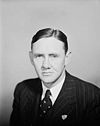 From the mid 1960s, evidence of a new and more strident nationalism began to emerge in Australia. In the early 1960s, the National Trust of Australia
began to be active in preserving Australia’s natural, cultural and historic heritage. Australian TV, while always dependent on US and British imports, saw locally made dramas and comedies appear, and programs such as Homicide developed strong local loyalty while Skippy the Bush Kangaroo
became a global phenomenon. Liberal Prime Minister John Gorton
, a battle scarred former fighter pilot who described himself as "Australian to the bootheels", established the Australian Council for the Arts, the Australian Film Development Corporation and the National Film and Television Training School.
The iconic Sydney Opera House
finally opened in 1973 after numerous delays. In the same year, Patrick White
became the first Australian to win a Nobel Prize for Literature. Australian History had begun to appear on school curriculums by the 1970s and from the early 1970s, the Australian cinema began to produce the Australian New Wave
of feature films based on uniquely Australian themes. Film funding began under the Gorton Government
, but it was the South Australian Film Corporation
that took the lead in supporting filmmaking and among their great successes were quintessential Australian films Sunday Too Far Away
(1974) Picnic at Hanging Rock
(1975), Breaker Morant
(1980) and Gallipoli
(1981). The national funding body, the Australian Film Commission
, was established in 1975.
Significant changes also occurred to Australia’s censorship laws after the new Liberal Minister for Customs and Excise, Don Chipp
, was appointed in 1969. In 1968, Barry Humphries and Nicholas Garland’s cartoon book featuring the larrikin character Barry McKenzie
was banned. Yet only a few years later, the book had been made as a film, partly with the support of government funding. Anne Pender suggests that the Barry Mckenzie character both celebrated and parodied Australian nationalism. Historian Richard White also argues that “while many of the plays, novels and films produced in the 1970s were intensely critical of aspects of Australian life, they were absorbed by the ‘new nationalism’ and applauded for their Australianness.”
In 1973, businessman Ken Myer
commented; “we like to think we have a distinct style of our own. We have outgrown a lot of our inadequacies.... There was a time when an interest in the arts threw doubts on one’s masculinity.” In 1973, historian Geoffrey Serle
, in his 1973 From Deserts the Prophets Come, argued that while Australia had finally arrived at “mature nationhood,” until that time that the “most important study of Australia had been found in creative treatments,” rather than academic study at universities and schools.
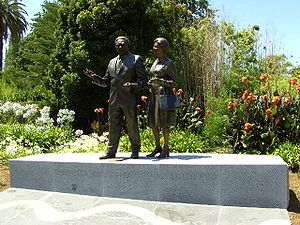
. In 1959 Aboriginal people became eligible for pensions and maternity allowances. In 1962, Robert Menzies
' Commonwealth Electoral Act provided that all Indigenous people should have the right to enrol and vote at federal elections (prior to this, indigenous people in Queensland, Western Australia and "wards of the state" in the Northern Territory had been excluded from voting unless they were ex-servicemen). In 1965, Queensland became the last state to confer state voting rights on Aboriginal people.
At a referendum put by the Holt
government in 1967, Australians voted by a 90% majority to change the Australian constitution to include all Aboriginal Australians in the national census and allow the Federal parliament to legislate on their behalf. A Council for Aboriginal Affairs was established; however the Federal parliament did relatively little with its new power until the election of the Whitlam Labor government in 1972.
Aboriginal Australians began to take up representation in Australian parliaments during the 1970s. In 1971 Neville Bonner
of the Liberal Party of Australia
was appointed by the Queensland Parliament to replace a retiring senator, becoming the first Aborigine in Federal Parliament. Bonner was returned as a Senator at the 1972 election and remained until 1983. Hyacinth Tungutalum
of the Country Liberal Party
in the Northern Territory
and Eric Deeral of the National Party
of Queensland, became the first Indigenous people elected to territory and state legislatures in 1974. In 1976, Sir Douglas Nicholls
was appointed Governor of South Australia, becoming the first Aborigine to hold vice-regal office in Australia. No indigenous person was elected to the House of Representatives, until West Australian Liberal
Ken Wyatt
, in August 2010.
Various groups and individuals were active in the pursuit of equality and social justice from the 1960s. In the mid 1960s, one of the earliest Aboriginal graduates from the University of Sydney
, Charles Perkins, helped organise freedom rides
into parts of Australia to expose discrimination and inequality. In 1966, the Gurindji people of Wave Hill station (owned by the Vestey Group
) commenced strike action in a quest for equal pay and recognition of land rights.
One of the first acts of the Whitlam government was to establish a Royal Commission into land rights
in the Northern Territory under Justice Woodward. Legislation based on its findings was passed into law by the Fraser Liberal-National Country Party Government in 1976, as the Aboriginal Land Rights Act 1976
.
In 1992, the High Court of Australia
handed down its decision in the Mabo Case, declaring the previous legal concept of terra nullius to be invalid. That same year, Prime Minister Paul Keating
said in his Redfern Park Speech
that European settlers were responsible for the difficulties Australian Aboriginal communities continued to face: ‘We committed the murders. We took the children from their mothers. We practiced discrimination and exclusion. It was our ignorance and our prejudice’. In 1999 Parliament passed a Motion of Reconciliation
drafted by Prime Minister John Howard
and Aboriginal Senator Aden Ridgeway
naming mistreatment of Indigenous Australians as the most "blemished chapter in our national history". In 2008, Prime Minister Kevin Rudd
issued a public apology to members of the Stolen Generations on behalf of the Australian Government.
Australia administered Papua New Guinea and Nauru for much of the 20th century. The Territory of Papua and New Guinea
was established by an administrative union between the Australian-administered territories of Papua and New Guinea in 1949. Under Liberal Minister for External Territories Andrew Peacock
, Papua and New Guinea adopted self-government in 1972 and on 15 September 1975, during the term of the Whitlam Government
in Australia, the Territory became the independent nation of Papua New Guinea
. Australia had captured the island of Nauru
from the German Empire in 1914. After Japanese occupation during World War II, it became a UN Trust Territory under Australia and remained so until achieving independence in 1968. In 1989 Nauru sued Australia in the International Court of Justice
in The Hague for damages caused by mining. Australia settled the case out of court agreeing to a lump sum settlement of A$107 million and an annual stipend of the equivalent of A$2.5 million toward environmental rehabilitation.
granted women the full adult wage. However, resistance to women being employed in certain industries remained until well into the 1970s. Because of obstruction from elements of the Unions movement, it would take until 1975 for women to be admitted as drivers on Melbourne’s trams
, and Sir Reginald Ansett refused to allow women to train as pilots as late as 1979.
Australia had led the world in bringing women's suffrage
rights during the late 19th century, and Edith Cowan
was elected to the West Australian Legislative Assembly in 1921. Dame Enid Lyons
, was the first woman to hold a Cabinet
post in the 1949 ministry of Robert Menzies
and finally, Rosemary Follett
was elected Chief Minister of the Australian Capital Territory
in 1989, becoming the first woman elected to lead a state or territory. By 2010, the people of Australia's oldest city, Sydney
had female leaders occupying every major political office above them, with Clover Moore
as Lord Mayor, Kristina Keneally
as Premier of New South Wales, Marie Bashir
as Governor of New South Wales, Julia Gillard
as Prime Minister, Quentin Bryce
as Governor General of Australia and Elizabeth II as Queen of Australia.
won office under Gough Whitlam
and introduced a significant program of social change and reform. Whitlam said before the election: “our program has three great aims. They are – to promote equality; to involve the people of Australia in … decision making…; and to liberate the talents and uplift the horizons of the Australian people.”
Whitlam’s actions were immediate and dramatic. Within a few weeks the last military advisors in Vietnam were recalled, and national service ended. The People’s Republic of China was recognised (Whitlam had visited China while Opposition Leader in 1971) and the embassy in Taiwan
closed. Over the next few years, university fees were abolished and a national health care scheme established. Significant changes were made to school funding, something Whitlam regarded as “the most enduring single achievement” of his government.
The Whitlam government’s agenda endeared it to some Australians, but not all. Some of the state governments were openly hostile to it, and as it did not control the senate, much of its legislation was rejected or amended. The Queensland Country Party
government of Joh Bjelke-Petersen
had particularly bad relations with the Federal government. Even after it was re-elected at elections in May 1974
, the Senate remained an obstacle to its political agenda. At the only joint sitting of parliament, in August 1974, six keys pieces of legislation were passed.
In 1974, Whitlam selected John Kerr, a former member of the Labor Party and presiding Chief Justice of New South Wales
to serve as Governor General. The Whitlam Government was re-elected with a decreased majority in the lower house in the 1974 Election
. In 1974–75 the government thought about borrowing US$4 billion in foreign loans. Minister Rex Connor
conducted secret discussions with a loan broker from Pakistan, and the Treasurer, Jim Cairns
, misled parliament over the issue. Arguing the government was incompetent following the Loans Affair
, the opposition Liberal-Country Party Coalition
delayed passage of the government’s money bills in the Senate, until the government would promise a new election. Whitlam refused, Malcolm Fraser
, leader of the Opposition insisted. The deadlock ended when the Whitlam government was dismissed by the Governor General, John Kerr on 11 November 1975 and Fraser was installed as caretaker Prime Minister, pending an election. The "reserve powers" granted to the Governor General
by the Australian Constitution, had allowed an elected government to be dismissed without warning by a representative of the Monarch.
At elections held in late 1975, Malcolm Fraser and the Coalition were elected in a landslide victory.
The Fraser Government won two subsequent elections. Fraser maintained some of the social reforms of the Whitlam era, while seeking increased fiscal restraint. His government included the first Aboriginal federal parliamentarian, Neville Bonner
, and in 1976, Parliament passed the Aboriginal Land Rights Act 1976
, which, while limited to the Northern Territory, affirmed "inalienable" freehold title to some traditional lands. Fraser established the multicultural broadcaster SBS
, welcomed Vietnamese
boat people refugees, opposed minority white rule in Apartheid South Africa and Rhodesia
and opposed Soviet expansionism. A significant program of economic reform however was not pursued and, by 1983, the Australian economy was in recession, amidst the effects of a severe drought. Fraser had promoted "states’ rights" and his government refused to use Commonwealth powers to stop the construction of the Franklin Dam
in Tasmania in 1982. A Liberal minister, Don Chipp
had split off from the party to form a new social liberal
party, the Australian Democrats
in 1977 and the Franklin Dam proposal contributed to the emergence of an influential Environmental movement in Australia
, with branches including the Australian Greens
, a political party which later emerged out of Tasmania
to pursue environmentalism
as well as left-wing social and economic policies.
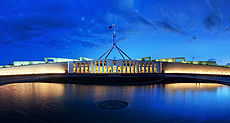 Bob Hawke
(b. 1929), a less polarising Labor leader than Whitlam
, defeated Fraser at the 1983 Election
. The new government stopped the Franklin Dam project via the High Court of Australia
. Hawke, together with treasurer Paul Keating
(b. 1944) broke with the Keynesian economics
that had traditionally been favoured by the Labor party. Instead they sought a more efficient economy and undertook micro-economic and industrial relations reform designed to increase efficiency and competitiveness. Hawke and Keating abandoned traditional Labor support for tariffs to protect industry and jobs. They moved to deregulate Australia’s financial system and ‘floated’ the Australian dollar
. After the initial failure of the Whitlam model and partial dismantling under Fraser, Hawke re-established a new, universal system of health insurance called Medicare
.
was celebrated in 1988 along with the opening of a new Parliament House
in Canberra. The following year the Australian Capital Territory achieved self government and Jervis Bay became a separate territory administered by the Minister for Territories.
. The Liberal-National Opposition
had proposed an ambitious plan of economic reform
to take to the 1993 Election, including the introduction of a Goods and Services Tax
. Keating shuffled treasurers, campaigned strongly against the tax, and won the 1993 Election. During his time in office, Keating emphasised links to the Asia Pacific region, co-operating closely with the Indonesian President, Suharto, and campaigned to increase the role of APEC as a major forum for economic co-operation. Keating was active in indigenous affairs and the High Court of Australia
's historic Mabo decision in 1992 required a legislative response to recognition of Indigenous title to land, culminating in the Native Title Act 1993
and the Land Fund Act 1994. In 1993, Keating established a Republic Advisory Committee, to examine options for Australia becoming a republic. With foreign debt, interest rates and unemployment still high, and after a series of ministerial resignations, Keating lost the 1996 Election to the Liberals' John Howard
.
A supporter of the US alliance
, Hawke committed Australian naval forces to the Gulf War
, following the 1990 invasion of Kuwait by Iraq. After four successful elections, but amid a deterioratingf Australian economy and rising unemployment, the intense rivalry between Hawke and Keating led the Labor Party to replace Hawke as leader and Paul Keating
became Prime Minister in 1991.
with a Liberal–National Party coalition served as Prime Minister
from 1996 until 2007, the second-longest prime ministerial term after Menzies. One of the first programs instigated by the Howard government
was a nationwide gun control scheme, following a mass shooting at Port Arthur. The government also introduced industrial relations reforms, particularly as regards efficiency on the waterfront. After the 1996 election, Howard and treasurer Peter Costello
proposed a Goods and Services Tax
(GST) which they successfully took to the electorate in 1998.
, including Operation Bel Isi (1998–2003); as well as Operation Helpem Fren and the Australian-led Regional Assistance Mission to Solomon Islands (RAMSI) in the early 2000s; and the 2006 East Timorese crisis
The Howard government expanded immigration overall but instituted often controversial tough immigration laws to discourage unauthorised arrivals of boat people. While Howard was a strong supporter of traditional links to the Commonwealth
and to the United States alliance
, trade with Asia, particularly China, continued to increase dramatically, and Australia endured an extended period of prosperity. Howard's term in office coincided with the 2001 11 September Terrorist Attacks. In the aftermath of this event, the government committed troops to the Afghanistan War
(with bi-partisan support) and the Iraq War (meeting with the disapproval of other political parties).
with Queen Elizabeth II as the Queen of Australia. A 1998 Constitutional Convention
was called to discuss Australia changing to a republic, but a subsequent 1999 referendum to establish a republic was marginally rejected. Australia's formal links to its British past are increasingly tenuous, although people-to-people and cultural connections between Australia and Britain remain significant.
in Sydney to great international acclaim. The Opening Ceremony
featured a host of iconic Australian imagery and history and the flame ceremony honoured women athletes, including swimmer Dawn Fraser
, with Aboriginal runner Cathy Freeman
lit the Olympic Flame
. Few international tourists came to Melbourne in 1956 for the Olympics that year, but Sydney gained global attention for a well-attended, efficiently organized world-class event. Prince Philip, representing Queen Elizabeth II opened the 1956 games but neither was invited in 2000, as the spirit of republicanism was too strong. In the long run, as Toohey (2008) reports, many of the hoped-for benefits failed to materialize. Nationwide levels of participation in physical activity and sport did not rise, although passive spectatorship (such as TV watching) did increase. Many of the costly facilities built for the games remained underutilized in their wake.
In 2001, Australia celebrated its Centenary of Federation, with a program of events, including the creation of the Centenary Medal
to honour people who have contributed to Australian society or government.
defeated Howard at the 2007 election, and held the office until June 2010, when he was replaced as the leader of the party by his colleague Julia Gillard
. Rudd used his term in office to symbolically ratify the Kyoto Protocol
and lead an historic parliamentary apology to the Stolen Generation
(those Indigenous Australians
who had been removed from their parents by the state during the early 20th century to the 1960s). The mandarin Chinese speaking former diplomat also pursued energetic foreign policy and initially sought to instigate a price on carbon in the Australian economy to combat global warming
. His prime ministership coincided with the initial phases of the Financial crisis of 2007–2010, to which his government responded through a large package of economic stimulus - the management of which later proved to be controversial.
Following two and half decades of economic reform and amidst booming trade with Asia, Australia avoided recession following the collapse of financial markets, in stark contrast to most other Western economies.
Rudd's successor, Julia Gillard, became the first woman to be elected Prime Minister of Australia when in 2010 she led the Labor Party to a narrow victory against the Liberal-National Coalition of Tony Abbott
, resulting in the first hung parliament
in Australia since the 1940 election
.
, who interpreted Australian history as a product of three great worldviews, Roman Catholicism, Protestant Christianity, and the Enlightenment.
Since 1970, a historiographical battle has erupted, with the traditionalists resisting a strong general move to incorporate and privilege aboriginal history, especially their mistreatment and loss or rights. Veracini, (2006) argues that the 1970s saw historians first paying attention to Aboriginal persistence and resistance, as the historiography emphasized on the contested nature of the invasion process. During the 1980s, an interpretative tradition stressing indigenous agency, transformation, and adaptation shifted the focus of historians' attention. Nettelbeck sees the national memory regarding racial relations shifting from a heroic glorification of the past to one of shame over the record of violence.
Furthermore historians have been studying other ethnic groups from their own perspective, such as the Chinese in Australia. The social history of families and everyday life has broadened from the domain of local specialists to professional historians using the techniques of Social history
. The historiography of cities has been enriched by the methods of Urban history
and by a policy orientation seeking to use the past to understand emerging problems. Women's history emerged from the feminist scholars in the 1970s and has become a firmly established perspective using the category of gender (along with race, ethnicity, and sexuality) to broaden the historiography.
Opening new terrain in recent years has been the history of the environment and environmentalism.
The influential historian Geoffrey Blainey
argued in the 1990s that the telling of Australian history had moved in his lifetime from an unduly positive rendition (the "three cheers view") to an unduly negative view (The "'black armband view'"). Blainey described the "Black Armband View" in 1993 as a view of Australian history which posited that "much of [pre-multicultural] Australian history had been a disgrace" and which focused mainly on the treatment of minority groups (especially Aborigines). This he contrasted with the 'Three Cheers' view, according to which: "nearly everything that came after [the convict era] was believed to be pretty good". Blainey argued that both such accounts of Australian history were inaccurate: "The Black Armband view of history might well represent the swing of the pendulum from a position that had been too favourable, too self congratulatory, to an opposite extreme that is even more unreal and decidedly jaundiced.".
Australia continues to provide military support to mentoring, operational and reconstruction activities in Afghanistan. The level and type of commitment has varied since operations commenced in October 2001 and has been complicated by the dual deployment of forces to the Middle East Area of Operations (MEAO). It is therefore a worthy exercise to track Australia’s level of commitment since the conflict began.[6]
Australia’s military contribution to the conflict in Afghanistan commenced in October 2001 when the first contingent of Special Forces troops departed Australia as part of Operation Slipper.[7] This level of commitment to military operations in Afghanistan remained consistent until the end of 2002 when allied operations shifted from combat missions to reconstruction activities. At that time, the Australian Government announced there were insufficient tasks to warrant keeping Special Forces elements in Afghanistan. As a result, the 200-strong Special Forces Task Force was withdrawn in November 2002.[8]
Australia continued to have a very small presence in Afghanistan in the form of two uniformed officer positions rotating through United Nations and land mine clearing missions.[9] It was not until August 2005 that Australia re-entered the Afghanistan conflict. In July 2005, the Government announced that, at the request of the Afghanistan Government, the US and allies, Australia would deploy a force of approximately 150 personnel for a period of 12 months to undertake security tasks similar to those of 2001 02.[10] Initially a Special Forces task group was deployed in August 2005 and, a year later, Australia’s first reconstruction task force deployed approximately 200 personnel.[11] Since then, the level of Australia’s military commitment has continued to rise with Australia’s authorised strength now reaching 1550 personnel.[12]
Operation Slipper is the Australian Defence Force (ADF) contribution to the war in Afghanistan. The operation commenced in late 2001 and is ongoing. ADF participation included two major activities centred on Afghanistan and the Persian Gulf.
Operation Slipper involves not only military elements deployed to Afghanistan, but also forces dual assigned to provide command, communications and logistics support to the Middle East Area of Operations (MEAO), including Afghanistan, Iraq (security and support for Australian embassy staff) and the Gulf of Aden (counter-terrorism and anti-piracy operations).
Operation Slipper is notable for the first Australian combat deaths since the Vietnam War, and to date all casualties have occurred during operations in Afghanistan.[14] 32 Australian soldiers have been killed and 213 wounded, the majority since October 2007.[1][15]
Two Australian soldiers have also been awarded the Victoria Cross (VC) for their bravery and efforts in the War in Afghanistan. This marks the first Victoria Cross recipients since the Vietnam War in 40 years.
The first uncontested landing in Australia by Europeans was by Dutch
Netherlands
The Netherlands is a constituent country of the Kingdom of the Netherlands, located mainly in North-West Europe and with several islands in the Caribbean. Mainland Netherlands borders the North Sea to the north and west, Belgium to the south, and Germany to the east, and shares maritime borders...
navigator Willem Janszoon
Willem Janszoon
Willem Janszoon , Dutch navigator and colonial governor, is probably the first European known to have seen the coast of Australia. His name is sometimes abbreviated to Willem Jansz....
in 1606. European explorers followed intermittently until, in 1770, James Cook
James Cook
Captain James Cook, FRS, RN was a British explorer, navigator and cartographer who ultimately rose to the rank of captain in the Royal Navy...
charted the East Coast of Australia for Britain
United Kingdom
The United Kingdom of Great Britain and Northern IrelandIn the United Kingdom and Dependencies, other languages have been officially recognised as legitimate autochthonous languages under the European Charter for Regional or Minority Languages...
and returned with accounts favouring colonisation at Botany Bay
Botany Bay
Botany Bay is a bay in Sydney, New South Wales, a few kilometres south of the Sydney central business district. The Cooks River and the Georges River are the two major tributaries that flow into the bay...
(now in Sydney), New South Wales
New South Wales
New South Wales is a state of :Australia, located in the east of the country. It is bordered by Queensland, Victoria and South Australia to the north, south and west respectively. To the east, the state is bordered by the Tasman Sea, which forms part of the Pacific Ocean. New South Wales...
. A First Fleet
First Fleet
The First Fleet is the name given to the eleven ships which sailed from Great Britain on 13 May 1787 with about 1,487 people, including 778 convicts , to establish the first European colony in Australia, in the region which Captain Cook had named New South Wales. The fleet was led by Captain ...
of British ships arrived at Sydney in January 1788 to establish a penal colony
Penal colony
A penal colony is a settlement used to exile prisoners and separate them from the general populace by placing them in a remote location, often an island or distant colonial territory...
. Other colonies were established by Britain around the continent and European explorers
European exploration of Australia
The European exploration of Australia encompasses several waves of seafarers and land explorers. Although Australia is often loosely said to have been discovered by Royal Navy Lieutenant James Cook in 1770, he was merely one of a number of European explorers to have sighted and landed on the...
sent deep into the interior throughout the 19th century. Introduced disease and conflict with the British colonists greatly weakened Indigenous Australia throughout the period.
Gold rushes
Australian gold rushes
The Australian gold rush started in 1851 when prospector Edward Hammond Hargraves claimed the discovery of payable gold near Bathurst, New South Wales, at a site Edward Hargraves called Ophir.Eight months later, gold was found in Victoria...
and agricultural industries brought prosperity and autonomous Parliamentary democracies began to be established throughout the six British colonies from the mid-19th century. The colonies voted by referendum
Referendum
A referendum is a direct vote in which an entire electorate is asked to either accept or reject a particular proposal. This may result in the adoption of a new constitution, a constitutional amendment, a law, the recall of an elected official or simply a specific government policy. It is a form of...
to unite in a federation
Federation
A federation , also known as a federal state, is a type of sovereign state characterized by a union of partially self-governing states or regions united by a central government...
in 1901, and modern Australia came into being. Australia fought on the side of Britain in the World Wars and became a long-standing ally of the United States
ANZUS
The Australia, New Zealand, United States Security Treaty is the military alliance which binds Australia and New Zealand and, separately, Australia and the United States to cooperate on defence matters in the Pacific Ocean area, though today the treaty is understood to relate to attacks...
when threatened by Imperial Japan during World War II
World War II
World War II, or the Second World War , was a global conflict lasting from 1939 to 1945, involving most of the world's nations—including all of the great powers—eventually forming two opposing military alliances: the Allies and the Axis...
. Trade with Asia increased and a post-war multicultural immigration program received more than 6.5 million migrants from every continent. The population tripled in the six decades to around 21 million in 2010, with people originating from 200 countries sustaining the 14th biggest economy in the world.
Aboriginal Australia
Aborigines before European contact
The ancestors of Indigenous AustraliansIndigenous Australians
Indigenous Australians are the original inhabitants of the Australian continent and nearby islands. The Aboriginal Indigenous Australians migrated from the Indian continent around 75,000 to 100,000 years ago....
are believed to have arrived in Australia some 40,000 to 60,000 years ago, but possibly as early as 70,000 years ago. They developed a hunter-gatherer
Hunter-gatherer
A hunter-gatherer or forage society is one in which most or all food is obtained from wild plants and animals, in contrast to agricultural societies which rely mainly on domesticated species. Hunting and gathering was the ancestral subsistence mode of Homo, and all modern humans were...
lifestyle, established enduring spiritual
Dreaming (spirituality)
The Dreaming is a common term within the animist creation narrative of indigenous Australians for a personal, or group, creation and for what may be understood as the "timeless time" of formative creation and perpetual creating....
and artistic traditions and utilised stone technologies
Stone Age
The Stone Age is a broad prehistoric period, lasting about 2.5 million years , during which humans and their predecessor species in the genus Homo, as well as the earlier partly contemporary genera Australopithecus and Paranthropus, widely used exclusively stone as their hard material in the...
. At the time of first Europe
Europe
Europe is, by convention, one of the world's seven continents. Comprising the westernmost peninsula of Eurasia, Europe is generally 'divided' from Asia to its east by the watershed divides of the Ural and Caucasus Mountains, the Ural River, the Caspian and Black Seas, and the waterways connecting...
an contact, it has been estimated the existing population was at least 350,000, while recent archaeological finds suggest that a population of 750,000 could have been sustained. People appear to have arrived by sea during a period of glaciation, when New Guinea
New Guinea
New Guinea is the world's second largest island, after Greenland, covering a land area of 786,000 km2. Located in the southwest Pacific Ocean, it lies geographically to the east of the Malay Archipelago, with which it is sometimes included as part of a greater Indo-Australian Archipelago...
and Tasmania
Tasmania
Tasmania is an Australian island and state. It is south of the continent, separated by Bass Strait. The state includes the island of Tasmania—the 26th largest island in the world—and the surrounding islands. The state has a population of 507,626 , of whom almost half reside in the greater Hobart...
were joined to the continent. The journey still required sea travel however, making them amongst the world’s earlier mariners.
The greatest population density developed in the southern and eastern regions, the River Murray valley in particular. Aborigines lived and utilised resources on the continent sustainably, agreeing to cease hunting and gathering at particular times to give populations and resources the chance to replenish. "Firestick farming" amongst northern Australian people was used to encourage plant growth that attracted animals. Aborigines were amongst the oldest, most sustainable and most isolated cultures on Earth prior to European settlement. The arrival of Australia's first people nevertheless affected the continent significantly, and, along with climate change, may have contributed to the extinction of Australia's megafauna
Australian megafauna
Australian megafauna are a number of large animal species in Australia, often defined as species with body mass estimates of greater than 30 kilograms, or equal to or greater than 30% greater body mass than their closest living relatives...
. The introduction of the dingo
Dingo
The Australian Dingo or Warrigal is a free-roaming wild dog unique to the continent of Australia, mainly found in the outback. Its original ancestors are thought to have arrived with humans from southeast Asia thousands of years ago, when dogs were still relatively undomesticated and closer to...
dog by Aboriginal people around 3000–4000 years ago may, along with human hunting, have contributed to the extinction of the thylacine
Thylacine
The thylacine or ,also ;binomial name: Thylacinus cynocephalus, Greek for "dog-headed pouched one") was the largest known carnivorous marsupial of modern times. It is commonly known as the Tasmanian tiger or the Tasmanian wolf...
, Tasmanian Devil
Tasmanian Devil
The Tasmanian devil is a carnivorous marsupial of the family Dasyuridae, now found in the wild only on the Australian island state of Tasmania. The size of a small dog, it became the largest carnivorous marsupial in the world following the extinction of the thylacine in 1936...
, and Tasmanian Native-hen
Tasmanian Native-hen
The Tasmanian Nativehen is a flightless rail and one of twelve species of birds endemic to the Australian island of Tasmania...
from mainland Australia.
The earliest human remains found to date are those found at Lake Mungo, a dry lake in the south west of New South Wales. Remains found at Mungo suggest one of the world's oldest known cremation
Cremation
Cremation is the process of reducing bodies to basic chemical compounds such as gasses and bone fragments. This is accomplished through high-temperature burning, vaporization and oxidation....
s, thus indicating early evidence for religious ritual among humans. According to Australian Aboriginal mythology
Australian Aboriginal mythology
Australian Aboriginal myths are the stories traditionally performed by Aboriginal peoples within each of the language groups across Australia....
and the animist framework of the descendants of these early Australians, the Dreaming
Dreaming (spirituality)
The Dreaming is a common term within the animist creation narrative of indigenous Australians for a personal, or group, creation and for what may be understood as the "timeless time" of formative creation and perpetual creating....
is a sacred
Sacred
Holiness, or sanctity, is in general the state of being holy or sacred...
era in which ancestral Totem
Totem
A totem is a stipulated ancestor of a group of people, such as a family, clan, group, lineage, or tribe.Totems support larger groups than the individual person. In kinship and descent, if the apical ancestor of a clan is nonhuman, it is called a totem...
ic Spirit Beings formed The Creation. The Dreaming established the laws and structures of society and the ceremonies performed to ensure continuity of life and land. It was and remains a prominent feature of Australian Aboriginal art
Australian Aboriginal art
Indigenous Australian art is art made by the Indigenous peoples of Australia and in collaborations between Indigenous and Non-Indigenous Australians . It includes works in a wide range of media including painting on leaves, wood carving, rock carving, sculpture, ceremonial clothing and sandpainting...
.
Aboriginal art is believed to be the oldest continuing tradition of art in the world. Evidence of Aboriginal art can be traced back at least 30,000 years and is found throughout Australia (notably at Uluru
Uluru
Uluru , also known as Ayers Rock, is a large sandstone rock formation in the southern part of the Northern Territory, central Australia. It lies south west of the nearest large town, Alice Springs; by road. Kata Tjuta and Uluru are the two major features of the Uluṟu-Kata Tjuṯa National Park....
and Kakadu National Park
Kakadu National Park
Kakadu National Park is in the Northern Territory of Australia, 171 km southeast of Darwin.Kakadu National Park is located within the Alligator Rivers Region of the Northern Territory of Australia. It covers an area of , extending nearly 200 kilometres from north to south and over 100 kilometres...
in the Northern Territory). In terms of age and abundance, cave art in Australia is comparable to that of Lascaux
Lascaux
Lascaux is the setting of a complex of caves in southwestern France famous for its Paleolithic cave paintings. The original caves are located near the village of Montignac, in the department of Dordogne. They contain some of the best-known Upper Paleolithic art. These paintings are estimated to be...
and Altamira in Europe.
Despite considerable cultural continuity, life for Aborigines was not without significant changes. Some 10-12,000 years ago, Tasmania became isolated from the mainland, and some stone technologies failed to reach the Tasmanian people (such as the hafting of stone tools and the use of the Boomerang
Boomerang
A boomerang is a flying tool with a curved shape used as a weapon or for sport.-Description:A boomerang is usually thought of as a wooden device, although historically boomerang-like devices have also been made from bones. Modern boomerangs used for sport are often made from carbon fibre-reinforced...
). The land was not always kind; Aboriginal people of southeastern Australia endured "more than a dozen volcanic eruptions…(including) Mount Gambier
Mount Gambier (volcano)
Mount Gambier is a maar complex in South Australia associated with the Newer Volcanics Province. It contains four lake-filled maars called Blue Lake, Valley Lake, Leg of Mutton Lake, and Brownes Lake...
, a mere 1,400 years ago." There is evidence that when necessary, Aborigines could keep control of their population growth and in times of drought or arid areas were able to maintain reliable water supplies. In south eastern Australia, near present day Lake Condah, semi-permanent villages of beehive shaped shelters of stone developed, near bountiful food supplies. For centuries, Macassan
Macassan contact with Australia
Macassan or more correctly Makassar trepangers from the southwest corner of Sulawesi visited the coast of northern Australia for hundreds of years to process trepang : a marine invertebrate prized for its culinary and medicinal values in Chinese markets.These visits have left their mark on the...
trade flourished with Aborigines on Australia's north coast, particularly with the Yolngu
Yolngu
The Yolngu or Yolŋu are an Indigenous Australian people inhabiting north-eastern Arnhem Land in the Northern Territory of Australia. Yolngu means “person” in the Yolŋu languages.-Yolŋu law:...
people of northeast Arnhem Land
Arnhem Land
The Arnhem Land Region is one of the five regions of the Northern Territory of Australia. It is located in the north-eastern corner of the territory and is around 500 km from the territory capital Darwin. The region has an area of 97,000 km² which also covers the area of Kakadu National...
.
By 1788, the population existed as 250 individual nations, many of which were in alliance with one another, and within each nation there existed several clans, from as few as five or six to as many as 30 or 40. Each nation had its own language and a few had multiple, thus over 250 languages existed, around 200 of which are now extinct. "Intricate kinship rules ordered the social relations of the people and diplomatic messengers and meeting rituals smoothed relations between groups," keeping group fighting, sorcery and domestic disputes to a minimum.
The mode of life and material cultures varied greatly from nation to nation. Some early European observers like William Dampier
William Dampier
William Dampier was an English buccaneer, sea captain, author and scientific observer...
described the hunter-gatherer lifestyle of the Aborigines as arduous and "miserable". Captain Cook on the other hand, speculated in his journal that the "Natives of New Holland" might in fact be far happier than Europeans. Watkin Tench
Watkin Tench
Lieutenant-General Watkin Tench was a British Marine officer who is best known for publishing two books describing his experiences in the First Fleet, which established the first settlement in Australia in 1788...
, of the First Fleet
First Fleet
The First Fleet is the name given to the eleven ships which sailed from Great Britain on 13 May 1787 with about 1,487 people, including 778 convicts , to establish the first European colony in Australia, in the region which Captain Cook had named New South Wales. The fleet was led by Captain ...
, wrote of an admiration for the Aborigines of Sydney as good natured and good humoured people, though he also reported violent hostility between the Eora
Eora
The Eora are the Aboriginal people of the Sydney area, south to the Georges River, north to the Hawkesbury River, and west to Parramatta. The indigenous people used this word to describe where they came from to the British. "Eora" was then used by the British to refer to those Aboriginal people...
and Cammeraygal
Cammeraygal
The Cammeraygal are an Indigenous Australian people that inhabited the Lower North Shore area of the present-day North Sydney Council in Sydney, Australia....
peoples, and noted violent domestic altercations between his friend Bennelong
Bennelong
Woollarawarre Bennelong was a senior man of the Eora, an Aboriginal people of the Port Jackson area, at the time of the first British settlement in Australia, in 1788...
and his wife Barangaroo
Barangaroo
Barangaroo was the second wife of Bennelong, who was interlocutor between the Aboriginal people and the early British colonists in New South Wales. Barangaroo was a member of the Cammeray clan...
. 19th century settlers like Edward Curr observed that Aborigines "suffered less and enjoyed life more than the majority of civilized(sic) men." Historian Geoffrey Blainey
Geoffrey Blainey
Geoffrey Norman Blainey AC , is a prominent Australian historian.Blainey was born in Melbourne and raised in a series of Victorian country towns before attending Wesley College and the University of Melbourne. While at university he was editor of Farrago, the newspaper of the University of...
wrote that the material standard of living for Aborigines was generally high, higher than that of many Europeans living at the time of the Dutch discovery of Australia.
Permanent European settlers arrived at Sydney in 1788 and came to control most of the continent by end of the 19th century. Bastions of largely unaltered Aboriginal societies survived, particularly in Northern and Western Australia into the 20th century, until finally, a group of Pintupi
Pintupi Nine
The Pintupi Nine is a group of nine Pintupi people who lived a traditional hunter-gatherer desert-dwelling life in Australia's Gibson Desert until 1984, when they made contact with their relatives near Kiwirrkurra. They are sometimes also referred to as "the lost tribe".They are believed to be the...
people of the Gibson Desert
Gibson Desert
The Gibson Desert covers a large dry area in the state of Western Australia and is still largely in an almost "pristine" state. It is about in size, making it the 5th largest desert in Australia, after the Great Sandy, Great Victoria, Tanami and Simpson deserts.-Location and description:The Gibson...
became the last people to be contacted by outsider ways in 1984. While much knowledge was lost, Aboriginal art, music and culture, often scorned by Europeans during the initial phases of contact, survived and in time came to be celebrated by the wider Australian community.
Impact of European settlement
The navigator James CookJames Cook
Captain James Cook, FRS, RN was a British explorer, navigator and cartographer who ultimately rose to the rank of captain in the Royal Navy...
claimed the east coast of Australia for Britain in 1770, without conducting negotiations with the existing inhabitants. The first governor, Arthur Phillip
Arthur Phillip
Admiral Arthur Phillip RN was a British admiral and colonial administrator. Phillip was appointed Governor of New South Wales, the first European colony on the Australian continent, and was the founder of the settlement which is now the city of Sydney.-Early life and naval career:Arthur Phillip...
, was instructed explicitly to establish friendship and good relations with the Aborigines and interactions between the early newcomers and the ancient landowners varied considerably throughout the colonial period—from the mutual curiosity displayed by the early interlocutors Bennelong
Bennelong
Woollarawarre Bennelong was a senior man of the Eora, an Aboriginal people of the Port Jackson area, at the time of the first British settlement in Australia, in 1788...
and Bungaree
Bungaree
Bungaree was an Aboriginal Australian from the Broken Bay area, who was known as an explorer, entertainer, and Aboriginal community leader He became a familiar sight in colonial Sydney, dressed in a succession of military and naval uniforms that had been given to him...
of Sydney, to the outright hostility of Pemulwuy
Pemulwuy
Pemulwuy was an Aboriginal Australian man born around 1750 in the area of Botany Bay in New South Wales. He is noted for his resistance to the European settlement of Australia which began with the arrival of the First Fleet in 1788. He is believed to have been a member of the Bidjigal clan of...
and Windradyne
Windradyne
Windradyne was an Aboriginal warrior and resistance leader of the Wiradjuri nation, in what is now central-western New South Wales, Australia; he was also known to the British settlers as Saturday...
of the Sydney region, and Yagan
Yagan
Yagan was an Australian Aboriginal warrior from the Noongar tribe who played a key part in early indigenous Australian resistance to British settlement and rule in the area of Perth, Western Australia. After he led a series of burglaries and robberies across the countryside, in which white...
around Perth. Bennelong and a companion became the first Australians to sail to Europe, where they met King George III. Bungaree accompanied the explorer Matthew Flinders
Matthew Flinders
Captain Matthew Flinders RN was one of the most successful navigators and cartographers of his age. In a career that spanned just over twenty years, he sailed with Captain William Bligh, circumnavigated Australia and encouraged the use of that name for the continent, which had previously been...
on the first circumnavigation of Australia. Pemulwuy was accused of the first killing of a white settler in 1790, and Windradyne resisted early British expansion beyond the Blue Mountains.
According to the historian Geoffrey Blainey
Geoffrey Blainey
Geoffrey Norman Blainey AC , is a prominent Australian historian.Blainey was born in Melbourne and raised in a series of Victorian country towns before attending Wesley College and the University of Melbourne. While at university he was editor of Farrago, the newspaper of the University of...
, in Australia during the colonial period: "In a thousand isolated places there were occasional shootings and spearings. Even worse, smallpox, measles, influenza and other new diseases swept from one Aboriginal camp to another ... The main conqueror of Aborigines was to be disease and its ally, demoralisation".
Even before the arrival of European settlers in local districts, European disease often preceded them. A smallpox epidemic was recorded in Sydney in 1789, which wiped out about half the Aborigines around Sydney." It then spread well beyond the then limits of European settlement, including much of southeastern Australia, reappearing in 1829–30, killing 40–60 percent of the Aboriginal population.
The impact of Europeans was profoundly disruptive to Aboriginal life and, though the extent of violence is debated, there was considerable conflict on the frontier. At the same time, some settlers were quite aware they were usurping the Aborigines place in Australia. In 1845, settler Charles Griffiths sought to justify this, writing; "The question comes to this; which has the better right – the savage, born in a country, which he runs over but can scarcely be said to occupy ... or the civilized man, who comes to introduce into this ... unproductive country, the industry which supports life."
From the 1960s, Australian writers began to re-assess European assumptions about Aboriginal Australia - with works including Alan Moorehead's
Alan Moorehead
Alan McCrae Moorehead OBE was a war correspondent and author of popular histories, most notably two books on the nineteenth-century exploration of the Nile, The White Nile and The Blue Nile . Australian-born, he lived in England, and Italy, from 1937.-Biography:Alan Moorehead was born in...
The Fatal Impact (1966) and Geoffrey Blainey's
Geoffrey Blainey
Geoffrey Norman Blainey AC , is a prominent Australian historian.Blainey was born in Melbourne and raised in a series of Victorian country towns before attending Wesley College and the University of Melbourne. While at university he was editor of Farrago, the newspaper of the University of...
landmark history Triumph of the Nomads (1975). In 1968, anthropologist W.E.H. Stanner
Bill Stanner
W.E.H. Stanner was an Australian anthropologist who worked extensively with Indigenous Australians. Stanner had a varied career that also included journalism in the 1930s, military service in World War II, and political advice on colonial policy in Africa and the South Pacific in the post-war...
described the lack of historical accounts of relations between Europeans and Aborigines as "the great Australian silence." Historian Henry Reynolds
Henry Reynolds (historian)
Henry Reynolds is an eminent Australian historian whose primary work has focused on the frontier conflict between European settlement of Australia and indigenous Australians.-Education and career:...
argues that there was a "historical neglect" of the Aborigines by historians until the late 1960s. Early commentaries often tended to describe Aborigines as doomed to extinction following the arrival of Europeans. William Westgarth’s 1864 book on the colony of Victoria observed; "the case of the Aborigines of Victoria confirms …it would seem almost an immutable law of nature that such inferior dark races should disappear." However, by the early 1970s historians like Lyndall Ryan, Henry Reynolds and Raymond Evans were trying to document and estimate the conflict and human toll on the frontier.
Van Diemen's Land
Van Diemen's Land was the original name used by most Europeans for the island of Tasmania, now part of Australia. The Dutch explorer Abel Tasman was the first European to land on the shores of Tasmania...
, perhaps 60 Aborigines were killed when they approached the town. The British established a new outpost in Van Diemen's Land
Van Diemen's Land
Van Diemen's Land was the original name used by most Europeans for the island of Tasmania, now part of Australia. The Dutch explorer Abel Tasman was the first European to land on the shores of Tasmania...
(Tasmania) in 1803. Although Tasmanian history is amongst the most contested by modern historians, conflict between colonists and Aborigines was referred to in some contemporary accounts as the Black War
Black War
The Black War is a term used to describe a period of conflict between British colonists and Tasmanian Aborigines in the early nineteenth century...
. The combined effects of disease, dispossession, intermarriage and conflict saw a collapse of the Aboriginal population from a few thousand people when the British arrived, to a few hundred by the 1830s. Estimates of how many people were killed during the period begin at around 300, though verification of the true figure is now impossible. In 1830 Governor George Arthur
George Arthur
Lieutenant-General Sir George Arthur, 1st Baronet KCH PC was Lieutenant Governor of British Honduras , Van Diemen's Land and Upper Canada . He also served as Governor of Bombay .-Early life:George Arthur was born in Plymouth, England...
sent an armed party (the Black Line
Black Line
The Black Line was an event that occurred in 1830 in Tasmania, or Van Diemen's Land as it was then known. After many years of conflict between British colonists and the Aborigines known as the Black War, Lieutenant-Governor George Arthur decided to remove all Aborigines from the settled areas in...
) to push the Big River and Oyster Bay tribes out of the British settled districts. The effort failed and George Augustus Robinson
George Augustus Robinson
George Augustus Robinson was a builder and untrained preacher. He was the Chief Protector of Aborigines in Port Phillip District from 1839 to 1849...
proposed to set out unarmed to mediate with the remaining tribespeople in 1833. With the assistance of Truganini
Truganini
Trugernanner , often referred to as Truganini, was a woman widely considered to be the last "full blood" Palawa ....
as guide and translator, Robinson convinced remaining tribesmen to surrender to an isolated new settlement at Flinders Island
Flinders Island
Flinders Island may refer to:In Australia:* Flinders Island , in the Furneaux Group, is the largest and best known* Flinders Island * Flinders Island , in the Investigator Group* Flinders Island...
, where most later died of disease.
In 1838, at least twenty-eight Aborigines were murdered at the Myall Creek
Myall Creek massacre
Myall Creek Massacre involved the killing of up to 30 unarmed Australian Aborigines by European settlers on 10 June 1838 at the Myall Creek near Bingara in northern New South Wales...
in New South Wales, resulting in the unprecedented conviction and hanging of seven white settlers by the colonial courts. Aborigines also attacked white settlers - in 1838 fourteen Europeans were killed at Broken River in Port Phillip District, by Aborigines of the Ovens River, almost certainly in revenge for the illicit use of Aboriginal women. Captain Hutton of Port Phillip District once told Chief Protector of Aborigines George Augustus Robinson
George Augustus Robinson
George Augustus Robinson was a builder and untrained preacher. He was the Chief Protector of Aborigines in Port Phillip District from 1839 to 1849...
that "if a member of a tribe offend, destroy the whole." Queensland’s Colonial Secretary A.H. Palmer wrote in 1884 "the nature of the blacks was so treacherous that they were only guided by fear – in fact it was only possible to rule…the Australian Aboriginal…by brute force" The most recent massacre of Aborigines was at Coniston
Coniston massacre
The Coniston massacre, which took place from 14 August to 18 October 1928 near the Coniston cattle station, Northern Territory, Australia, was the last known massacre of Indigenous Australians. People of the Warlpiri, Anmatyerre and Kaytetye groups were killed...
in the Northern Territory in 1928. There are numerous other massacre sites in Australia, although supporting documentation varies.
From the 1830s, colonial governments established the now controversial offices of the Protector of Aborigines
Protector of Aborigines
The role of Protectors of Aborigines resulted from a recommendation of the report of the Select Committee of the House of Commons on Aborigines . On 31 January 1838, Lord Glenelg, Secretary of State for War and the Colonies sent Governor Gipps the report.The report recommended that Protectors of...
in an effort to avoid mistreatment of Indigenous peoples and conduct government policy towards them. Christian churches in Australia
Christianity in Australia
Christianity is the largest religion listed by Australians in the national census. In the 2006 Census, 63.9% of Australians were listed as Christian. Australia has no official state religion and the Australian Constitution protects freedom of religion. The presence of Christianity in Australia...
sought to convert Aborigines, and were often used by government to carry out welfare and assimilation policies. Colonial churchmen such as Sydney's first Catholic archbishop, John Bede Polding strongly advocated for Aboriginal rights and dignity and prominent Aboriginal activist Noel Pearson (born 1965), who was raised at a Lutheran mission in Cape York
Cape York Peninsula
Cape York Peninsula is a large remote peninsula located in Far North Queensland at the tip of the state of Queensland, Australia, the largest unspoilt wilderness in northern Australia and one of the last remaining wilderness areas on Earth...
, has written that Christian missions throughout Australia's colonial history "provided a haven from the hell of life on the Australian frontier while at the same time facilitating colonisation".
Caledon Bay crisis
The Caledon Bay crisis refers to a series of killings at Caledon Bay in the Northern Territory of Australia during 1932–34. These events are widely seen as a turning point in relations between indigenous and non-indigenous Australians....
of 1932-4 saw one of the last incidents of violent interaction on the 'frontier' of indigenous and non-indigenous Australia, which began when the spearing of Japanese poachers who had been molesting Yolngu
Yolngu
The Yolngu or Yolŋu are an Indigenous Australian people inhabiting north-eastern Arnhem Land in the Northern Territory of Australia. Yolngu means “person” in the Yolŋu languages.-Yolŋu law:...
women was followed by the killing of a policeman. As the crisis unfolded, national opinion swung behind the Aboriginal people involved, and the first appeal on behalf of an Indigenous Australian to the High Court of Australia
High Court of Australia
The High Court of Australia is the supreme court in the Australian court hierarchy and the final court of appeal in Australia. It has both original and appellate jurisdiction, has the power of judicial review over laws passed by the Parliament of Australia and the parliaments of the States, and...
was launched. Following the crisis, the anthropologist Donald Thompson
Donald Thompson
Sir Donald Thompson was a British Conservative Party politician. He was a Member of Parliament from 1979 until 1997.Thompson attended Holy Trinity School, Halifax, and Hipperholme Grammar School...
was dispatched by the government to live among the Yolngu. Elsewhere around this time, activists like Sir Douglas Nicholls
Douglas Nicholls
Sir Douglas Ralph "Doug" Nicholls KCVO, OBE, was a prominent Aboriginal Australian from the Yorta Yorta people. He was a professional athlete, Churches of Christ pastor and church planter, ceremonial officer and a pioneering campaigner for reconciliation.Nicholls was the first Aboriginal person to...
were commencing their campaigns for Aboriginal rights within the established Australian political system and the age of frontier conflict closed.
Frontier encounters in Australia were not universally negative. Positive accounts of Aboriginal customs and encounters are also recorded in the journals of early European explorers, who often relied on Aboriginal guides and assistance: Charles Sturt
Charles Sturt
Captain Charles Napier Sturt was an English explorer of Australia, and part of the European Exploration of Australia. He led several expeditions into the interior of the continent, starting from both Sydney and later from Adelaide. His expeditions traced several of the westward-flowing rivers,...
employed Aboriginal envoys to explore the Murray-Darling; the lone survivor of the Burke and Wills expedition was nursed by local Aborigines, and the famous Aboriginal explorer Jackey Jackey
Jackey Jackey
William Westwood was often referred to as a "gentleman bushranger" because of his dress and respect for his victims. He got the name 'Jackey Jackey' from the aboriginal people...
loyally accompanied his ill-fated friend Edmund Kennedy
Edmund Kennedy
Edmund Besley Court Kennedy was an explorer in Australia in the mid nineteenth century. He was the Assistant-Surveyor of New South Wales, working with Sir Thomas Mitchell...
to Cape York
Cape York Peninsula
Cape York Peninsula is a large remote peninsula located in Far North Queensland at the tip of the state of Queensland, Australia, the largest unspoilt wilderness in northern Australia and one of the last remaining wilderness areas on Earth...
. Respectful studies were conducted by such as Walter Baldwin Spencer
Walter Baldwin Spencer
Sir Walter Baldwin Spencer KCMG was a British-Australian biologist and anthropologist.Baldwin was born in Stretford, Lancashire. His father, Reuben Spencer, who had come from Derbyshire in his youth, obtained a position with Rylands and Sons, cotton manufacturers, and rose to be chairman of its...
and Frank Gillen in their renowned anthropological study The Native Tribes of Central Australia (1899); and by Donald Thompson
Donald Thompson
Sir Donald Thompson was a British Conservative Party politician. He was a Member of Parliament from 1979 until 1997.Thompson attended Holy Trinity School, Halifax, and Hipperholme Grammar School...
of Arnhem Land
Arnhem Land
The Arnhem Land Region is one of the five regions of the Northern Territory of Australia. It is located in the north-eastern corner of the territory and is around 500 km from the territory capital Darwin. The region has an area of 97,000 km² which also covers the area of Kakadu National...
(c.1935-1943). In inland Australia, the skills of Aboriginal stockmen became highly regarded and in the 20th century, Aboriginal stockmen like Vincent Lingiari
Vincent Lingiari
Vincent Lingiarri, AM , was an Aboriginal rights activist who was appointed as a Member of the Order of Australia for his services to the Aboriginal people. Lingiarri was a member of the Gurindji people. In Vincent's earlier life he worked as a stockman at Wave Hill Cattle Station. He also played...
became national figures in their campagins for better pay and conditions.
The removal of indigenous children
Stolen Generation
The Stolen Generations were the children of Australian Aboriginal and Torres Strait Islander descent who were removed from their families by the Australian Federal and State government agencies and church missions, under acts of their respective parliaments...
, which the Human Rights and Equal Opportunity Commission
Human Rights and Equal Opportunity Commission
The Australian Human Rights Commission is a national human rights institution, a statutory body funded by, but operating independently of, the Australian Government. It has the responsibility for investigating alleged infringements under Australia’s anti-discrimination legislation...
argue constituted attempted genocide, had a major impact on the Indigenous population. Such interpretations of Aboriginal history are disputed by Keith Windschuttle
Keith Windschuttle
Keith Windschuttle is an Australian writer, historian, and ABC board member, who has authored several books from the 1970s onwards. These include Unemployment, , which analysed the economic causes and social consequences of unemployment in Australia and advocated a socialist response; The Media: a...
as being exaggerated or fabricated for political or ideological reasons. This debate is part of what is known within Australia as the History Wars
History wars
The history wars in Australia are an ongoing public debate over the interpretation of the history of the British colonisation of Australia and development of contemporary Australian society...
.
Early European explorers
Kenneth McIntyre
Kenneth Gordon McIntyre OBE was an Australian lawyer, historian and mathematician who is perhaps best known for his controversial book The Secret Discovery of Australia - Portuguese ventures 200 years before Captain Cook....
and others have argued that the Portuguese had secretly discovered Australia
Theory of Portuguese discovery of Australia
Although most historians hold that the European discovery of Australia began in 1606 with the voyage of the Dutch navigator Willem Janszoon on board the Duyfken, a theory exists that a Portuguese expedition arrived in Australia between 1521 and 1524...
in the 1520s. The presence of a landmass labelled "Jave la Grande
Jave la Grande
La grande isle de Java was, according to Marco Polo, the largest island in the world: his Java Minor was the actual island of Sumatra, which takes its name from the city of Samudera situated on its northern coast....
" on the Dieppe Maps
Dieppe maps
The Dieppe maps are a series of world maps produced in Dieppe, France, in the 1540s, 1550s and 1560s. They are large hand-produced maps, commissioned for wealthy and royal patrons, including Henry II of France and Henry VIII of England...
is often cited as evidence for a "Portuguese discovery". However, the Dieppe Maps also openly reflected the incomplete state of geographical knowledge at the time, both actual and theoretical. And it has been argued that Jave la Grande was a hypothetical notion, reflecting 16th century notions of cosmography
Cosmography
Cosmography is the science that maps the general features of the universe, describing both heaven and Earth...
. Although theories of visits by Europeans, prior to the 17th century, continue to attract popular interest in Australia and elsewhere, they are generally regarded as contentious and lacking substantial evidence.
It is however, the crew of a Dutch ship, led by Willem Janszoon
Willem Janszoon
Willem Janszoon , Dutch navigator and colonial governor, is probably the first European known to have seen the coast of Australia. His name is sometimes abbreviated to Willem Jansz....
, which is credited with the first authenticated European landing in Australia in 1606. That same year, a Spanish expedition sailing in nearby waters and led by Pedro Fernandez de Quiros had landed in the New Hebrides
New Hebrides
New Hebrides was the colonial name for an island group in the South Pacific that now forms the nation of Vanuatu. The New Hebrides were colonized by both the British and French in the 18th century shortly after Captain James Cook visited the islands...
and, believing them to be the fabled southern continent, named the land: Austrialis del Espiritu Santo Southern Land of the Holy Spirit. Later that year, De Quiros' deputy Luís Vaz de Torres
Luís Vaz de Torres
Luís Vaz de Torres , also Luis Váez de Torres in the Spanish spelling, was a 16th-17th century maritime explorer serving the Spanish Crown, noted for the first recorded navigation of the strait which separates the continent of Australia from the island of New Guinea, and which now bears his name...
sailed through Australia's Torres Strait
Torres Strait
The Torres Strait is a body of water which lies between Australia and the Melanesian island of New Guinea. It is approximately wide at its narrowest extent. To the south is Cape York Peninsula, the northernmost continental extremity of the Australian state of Queensland...
and may have sighted Australia's northern coast.
In 1616, Dutch sea-captain Dirk Hartog
Dirk Hartog
Dirk Hartog was a 17th century Dutch sailor and explorer. Dirk Hartog's expedition was the third European group to land on Australian soil. He was the first to leave behind an artifact to record his visit, the Hartog plate. His name is sometimes alternatively spelled Dirck Hartog or Dierick...
sailed too far whilst trying out Henderik Brouwer's recently discovered route from the Cape of Good Hope to Batavia, via the Roaring Forties. Reaching the western coast of Australia, he landed at Cape Inscription in Shark Bay on 25 October 1616. His is the first known record of a European visiting Western Australia's shores.
Although Abel Tasman
Abel Tasman
Abel Janszoon Tasman was a Dutch seafarer, explorer, and merchant, best known for his voyages of 1642 and 1644 in the service of the VOC . His was the first known European expedition to reach the islands of Van Diemen's Land and New Zealand and to sight the Fiji islands...
is best known for his voyage of 1642; in which he became the first known European to reach the islands of Van Diemen's Land
Van Diemen's Land
Van Diemen's Land was the original name used by most Europeans for the island of Tasmania, now part of Australia. The Dutch explorer Abel Tasman was the first European to land on the shores of Tasmania...
(later Tasmania
Tasmania
Tasmania is an Australian island and state. It is south of the continent, separated by Bass Strait. The state includes the island of Tasmania—the 26th largest island in the world—and the surrounding islands. The state has a population of 507,626 , of whom almost half reside in the greater Hobart...
) and New Zealand
New Zealand
New Zealand is an island country in the south-western Pacific Ocean comprising two main landmasses and numerous smaller islands. The country is situated some east of Australia across the Tasman Sea, and roughly south of the Pacific island nations of New Caledonia, Fiji, and Tonga...
, and to sight the Fiji islands
Fiji
Fiji , officially the Republic of Fiji , is an island nation in Melanesia in the South Pacific Ocean about northeast of New Zealand's North Island...
, he also contributed significantly to the mapping of Australia proper. With three ships on his second voyage (Limmen, Zeemeeuw and the tender Braek) in 1644, he followed the south coast of New Guinea westward. He missed the Torres Strait
Torres Strait
The Torres Strait is a body of water which lies between Australia and the Melanesian island of New Guinea. It is approximately wide at its narrowest extent. To the south is Cape York Peninsula, the northernmost continental extremity of the Australian state of Queensland...
between New Guinea and Australia, but continued his voyage along the Australian coast and ended up mapping the north coast of Australia making observations on the land and its people.
By the 1650s, as a result of the Dutch discoveries, most of the Australian coast was charted reliably enough for the navigational standards of the day, and this was revealed for all to see in the map of the world inlaid into the floor of the Burgerzaal ("Burger's Hall") of the new Amsterdam Stadhuis ("Town Hall") in 1655. In 1664 the French geographer, Melchisedech Thévenot, published in Relations de Divers Voyages Curieux a map of New Holland drawn from the world map on the pavement of the Amsterdam Town Hall. Thévenot divided the continent in two, between Nova Hollandia to the west and Terre Australe to the east of a latitude staff running down the meridian equivalent to longitude 135 degrees East of Greenwich. Emanuel Bowen reproduced Thevenot's map in his Complete System of Geography (London, 1747), re-titling it A Complete Map of the Southern Continent and adding three inscriptions promoting the benefits of exploring and colonizing the country. One inscription said: "It is impossible to conceive a Country that promises fairer from its Situation than this of TERRA AUSTRALIS, no longer incognita, as this Map demonstrates, but the Southern Continent Discovered. It lies precisely in the richest climates of the World... and therefore whoever perfectly discovers and settles it will become infalliably possessed of Territories as Rich, as fruitful, and as capable of Improvement, as any that have hitherto been found out, either in the East Indies or the West." Bowen’s map was re-published in John Campbell’s editions of John Harris's Navigantium atque Itinerantium Bibliotheca, or Voyages and Travels (1744-1748, and 1764). This book also recommended a voyage be undertaken to explore the east coast of New Holland, with a view to a British colonization of the country: “The first Point, with respect to a Discovery, would be, to send a small Squadron on the Coast of Van Diemen's Land, and from thence round, in the same course taken by Captain Tasman, by the Coast of New Guiney; which might enable the Nations that attempted it, to come to an absolute Certainty with regard to its Commodities and Commerce... By this means all the back Coast of New Holland, and New Guiney, might be roughly examined; and we might know as well, and as certainly, as the Dutch, how far a Colony settled there might answer our Expectations.
Although various proposals for colonisation were made, notably by Pierre Purry from 1717 to 1744, none was officially attempted. Indigenous Australians
Indigenous Australians
Indigenous Australians are the original inhabitants of the Australian continent and nearby islands. The Aboriginal Indigenous Australians migrated from the Indian continent around 75,000 to 100,000 years ago....
were less able to trade with Europeans than were the peoples of India, the East Indies
East Indies
East Indies is a term used by Europeans from the 16th century onwards to identify what is now known as Indian subcontinent or South Asia, Southeastern Asia, and the islands of Oceania, including the Malay Archipelago and the Philippines...
, China, and Japan. The Dutch East India Company
Dutch East India Company
The Dutch East India Company was a chartered company established in 1602, when the States-General of the Netherlands granted it a 21-year monopoly to carry out colonial activities in Asia...
concluded that there was "no good to be done there". They turned down Purry’s scheme with the comment that, "There is no prospect of use or benefit to the Company in it, but rather very certain and heavy costs".
With the exception of further Dutch visits to the west, however, Australia remained largely unvisited by Europeans until the first British
United Kingdom
The United Kingdom of Great Britain and Northern IrelandIn the United Kingdom and Dependencies, other languages have been officially recognised as legitimate autochthonous languages under the European Charter for Regional or Minority Languages...
explorations. John Callander put forward a proposal in 1766 for Britain to found a colony of banished convicts in the South Sea or in Terra Australis
Terra Australis
Terra Australis, Terra Australis Ignota or Terra Australis Incognita was a hypothesized continent appearing on European maps from the 15th to the 18th century...
to enable the mother country to exploit the riches of those regions. He said: "this world must present us with many things entirely new, as hitherto we have had little more knowledge of it, than if it had lain in another planet". In 1769, Lieutenant James Cook
James Cook
Captain James Cook, FRS, RN was a British explorer, navigator and cartographer who ultimately rose to the rank of captain in the Royal Navy...
in command of the HMS Endeavour
HMS Endeavour
HMS Endeavour may refer to one of the following ships:In the Royal Navy:, a 36-gun ship purchased in 1652 and sold in 1656, a 4-gun bomb vessel purchased in 1694 and sold in 1696, a fire ship purchased in 1694 and sold in 1696, a storeship hoy purchased in 1694 and sold in 1705, a storeship...
, traveled to Tahiti
Tahiti
Tahiti is the largest island in the Windward group of French Polynesia, located in the archipelago of the Society Islands in the southern Pacific Ocean. It is the economic, cultural and political centre of French Polynesia. The island was formed from volcanic activity and is high and mountainous...
to observe and record the transit of Venus
Transit of Venus
A transit of Venus across the Sun takes place when the planet Venus passes directly between the Sun and Earth, becoming visible against the solar disk. During a transit, Venus can be seen from Earth as a small black disk moving across the face of the Sun...
. Cook also carried secret Admiralty instructions to locate the supposed Southern Continent: "There is reason to imagine that a continent, or land of great extent, may be found to the southward of the track of former navigators." This continent was not found, as it only existed in the form of the yet to be discovered Antarctica, a much shrunken version of the Terra Australis
Terra Australis
Terra Australis, Terra Australis Ignota or Terra Australis Incognita was a hypothesized continent appearing on European maps from the 15th to the 18th century...
imagined by Alexander Dalrymple
Alexander Dalrymple
Alexander Dalrymple was a Scottish geographer and the first Hydrographer of the British Admiralty. He was the main proponent of the theory that there existed a vast undiscovered continent in the South Pacific, Terra Australis Incognita...
and his fellow members of the Royal Society who had urged the Admiralty to undertake this mission. To save something useful from the expedition, Cook decided to survey the east coast of New Holland, the only major part of that continent that had not been charted in some form by Dutch navigators. On 19 April 1770, the crew of the Endeavour sighted the east coast of Australia and ten days later landed at Botany Bay
Botany Bay
Botany Bay is a bay in Sydney, New South Wales, a few kilometres south of the Sydney central business district. The Cooks River and the Georges River are the two major tributaries that flow into the bay...
. Cook charted the east coast to its northern extent and, along with the ship's naturalist, Joseph Banks
Joseph Banks
Sir Joseph Banks, 1st Baronet, GCB, PRS was an English naturalist, botanist and patron of the natural sciences. He took part in Captain James Cook's first great voyage . Banks is credited with the introduction to the Western world of eucalyptus, acacia, mimosa and the genus named after him,...
, reported favourably on the possibilities of establishing a colony at Botany Bay. Cook formally took possession of the east coast of New Holland on 21/22 August 1770, and noted in his journal that he could, "land no more upon this Eastern coast of New Holland, and on the Western side I can make no new discovery the honour of which belongs to the Dutch Navigators and as such they may lay Claim to it as their property [italicised words crossed out in the original] but the Eastern Coast from the Latitude of 38 South down to this place I am confident was never seen or viseted by any European before us and therefore by the same Rule belongs to great Brittan [italicised words crossed out in the original]. Cook was careful therefore to take possession only of that part of the coastline not previously visited by Dutch navigators, i.e. from latitude 38ºS, Point Hicks, north of Van Diemens Land, to Cape York, East of Carpentaria.
In 1772, a French
France
The French Republic , The French Republic , The French Republic , (commonly known as France , is a unitary semi-presidential republic in Western Europe with several overseas territories and islands located on other continents and in the Indian, Pacific, and Atlantic oceans. Metropolitan France...
expedition led by Louis Aleno de St Aloüarn
Louis Aleno de St Aloüarn
Louis Francois Marie Aleno de Saint Aloüarn was a notable French naval officer and explorer.St Aloüarn was the first European to make a formal claim of sovereignty — on behalf of France — over the west coast of Australia, which was known at the time as "New Holland"...
, became the first Europeans to formally claim sovereignty over the west coast of Australia
Western Australia
Western Australia is a state of Australia, occupying the entire western third of the Australian continent. It is bounded by the Indian Ocean to the north and west, the Great Australian Bight and Indian Ocean to the south, the Northern Territory to the north-east and South Australia to the south-east...
, but no attempt was made to follow this with colonisation.
The ambition of Sweden’s King Gustav III
Gustav III of Sweden
Gustav III was King of Sweden from 1771 until his death. He was the eldest son of King Adolph Frederick and Queen Louise Ulrica of Sweden, she a sister of Frederick the Great of Prussia....
to establish a colony for his country at the Swan River in 1786 remained stillborn. It was not until 1788 that economic, technological and political conditions in Great Britain made it possible and worthwhile for that country to make the large effort of sending the First Fleet
First Fleet
The First Fleet is the name given to the eleven ships which sailed from Great Britain on 13 May 1787 with about 1,487 people, including 778 convicts , to establish the first European colony in Australia, in the region which Captain Cook had named New South Wales. The fleet was led by Captain ...
to New South Wales.
Plans for colonisation
Botany Bay
Botany Bay is a bay in Sydney, New South Wales, a few kilometres south of the Sydney central business district. The Cooks River and the Georges River are the two major tributaries that flow into the bay...
.
The American Revolutionary War
American Revolutionary War
The American Revolutionary War , the American War of Independence, or simply the Revolutionary War, began as a war between the Kingdom of Great Britain and thirteen British colonies in North America, and ended in a global war between several European great powers.The war was the result of the...
of (1775–1783) saw Britain lose most of its North American colonies and consider establishing replacement territories. In 1779 Sir Joseph Banks, the eminent scientist who had accompanied James Cook
James Cook
Captain James Cook, FRS, RN was a British explorer, navigator and cartographer who ultimately rose to the rank of captain in the Royal Navy...
on his 1770 voyage, recommended Botany Bay
Botany Bay
Botany Bay is a bay in Sydney, New South Wales, a few kilometres south of the Sydney central business district. The Cooks River and the Georges River are the two major tributaries that flow into the bay...
as a suitable site for settlement. Under Banks’s guidance, the American Loyalist
Loyalist
In general, a loyalist is someone who maintains loyalty to an established government, political party, or sovereign, especially during war or revolutionary change. In modern English usage, the most common application is to loyalty to the British Crown....
James Matra, who had also travelled with Cook, produced "A Proposal for Establishing a Settlement in New South Wales" (23 August 1783), proposing the establishment of a colony composed of American Loyalists, Chinese and South Sea Islanders (but not convicts).
Matra reasoned that: the country was suitable for plantations of sugar, cotton and tobacco; New Zealand timber and hemp or flax could prove valuable commodities; it could form a base for Pacific trade; and it could be a suitable compensation for displaced American Loyalists. Following an interview with Secretary of State Lord Sydney in 1784, Matra amended his proposal to include convicts as settlers, considering that this would benefit both "Economy to the Publick, & Humanity to the Individual".
Matra’s plan provided the original blueprint for settlement.
Records show the government was considering it in 1784. The London newspapers announced in November 1784 that: “A plan has been presented to the [Prime] Minister, and is now before the Cabinet, for instituting a new colony in New Holland. In this vast tract of land….every sort of produce and improvement of which the various soils of the earth are capable, may be expected”. The Government also incorporated the settlement of Norfolk Island
Norfolk Island
Norfolk Island is a small island in the Pacific Ocean located between Australia, New Zealand and New Caledonia. The island is part of the Commonwealth of Australia, but it enjoys a large degree of self-governance...
into their plan, with its attractions of timber and flax, proposed by Banks’s Royal Society colleagues, Sir John Call and Sir George Young.
At the same time, humanitarians and reformers were campaigning in Britain against the appalling conditions in British prisons and hulks. In 1777 prison reformer John Howard wrote The State of Prisons in England and Wales, exposing the harsh conditions of the prison system to "genteel society"." Penal transportation
Penal transportation
Transportation or penal transportation is the deporting of convicted criminals to a penal colony. Examples include transportation by France to Devil's Island and by the UK to its colonies in the Americas, from the 1610s through the American Revolution in the 1770s, and then to Australia between...
was already well established as a central plank of English criminal law and until the American Revolution
American Revolution
The American Revolution was the political upheaval during the last half of the 18th century in which thirteen colonies in North America joined together to break free from the British Empire, combining to become the United States of America...
about a thousand criminals per year were sent to Maryland and Virginia. It served as a powerful deterrent to law-breaking. According to historian David Hill, "Europeans knew little about the geography of the globe" and to "convicts in England, transportation to Botany Bay
Botany Bay
Botany Bay is a bay in Sydney, New South Wales, a few kilometres south of the Sydney central business district. The Cooks River and the Georges River are the two major tributaries that flow into the bay...
was a frightening prospect." Echoing John Callander, he said Australia "might as well have been another planet."
In 1933, Sir Ernest Scott, stated the traditional view of the reasons for colonisation: “It is clear that the only consideration which weighed seriously with the Pitt Government was the immediately pressing and practical one of finding a suitable place for a convict settlement ”. In the early 1960s, historian Geoffrey Blainey
Geoffrey Blainey
Geoffrey Norman Blainey AC , is a prominent Australian historian.Blainey was born in Melbourne and raised in a series of Victorian country towns before attending Wesley College and the University of Melbourne. While at university he was editor of Farrago, the newspaper of the University of...
questioned the traditional view of foundation purely as a convict dumping ground. His book The Tyranny of Distance suggested ensuring supplies of flax and timber after the loss of the American colonies may have also been motivations, and Norfolk Island
Norfolk Island
Norfolk Island is a small island in the Pacific Ocean located between Australia, New Zealand and New Caledonia. The island is part of the Commonwealth of Australia, but it enjoys a large degree of self-governance...
was the key to the British decision. A number of historians responded and debate brought to light a large amount of additional source material on the reasons for settlement.
The decision to settle was taken when it seemed the outbreak of civil war in the Netherlands might precipitate a war in which Britain would be again confronted with the alliance of the three naval Powers, France, Holland and Spain, which had brought her to defeat in 1783. Under these circumstances, the strategic advantages of a colony in New South Wales described in James Matra's proposal were attractive. Matra wrote that such a settlement could facilitate attacks upon the Spanish in South America and the Philippines, and against the Dutch East Indies
Dutch East Indies
The Dutch East Indies was a Dutch colony that became modern Indonesia following World War II. It was formed from the nationalised colonies of the Dutch East India Company, which came under the administration of the Netherlands government in 1800....
. In 1790, during the Nootka Crisis
Nootka Crisis
The Nootka Crisis was an international incident and political dispute between the Kingdom of Great Britain and the Kingdom of Spain, triggered by a series of events that took place during the summer of 1789 at Nootka Sound...
, plans were made for naval expeditions against Spain’s possessions in the Americas and the Philippines, in which New South Wales was assigned the role of a base for “refreshment, communication and retreat”. On subsequent occasions into the early 19th century when war threatened or broke out between Britain and Spain, these plans were revived and only the short length of the period of hostilities in each case prevented them from being put into effect.
The German scientist and man of letters Georg Forster
Georg Forster
Johann Georg Adam Forster was a German naturalist, ethnologist, travel writer, journalist, and revolutionary. At an early age, he accompanied his father on several scientific expeditions, including James Cook's second voyage to the Pacific...
, who had sailed under Captain James Cook in the voyage of the Resolution (1772–1775), wrote in 1786 on the future prospects of the English colony: "New Holland, an island of enormous extent or it might be said, a third continent, is the future homeland of a new civilized society which, however mean its beginning may seem to be, nevertheless promises within a short time to become very important." And the merchant adventurer and would-be colonizer of southwestern Australia under the Swedish flag, William Bolts, said to the Swedish Ambassador in Paris, Erik von Staël in December 1789, that the British had founded at Botany Bay, “a settlement which in time will become of the greatest importance to the Commerce of the Globe”.
Establishment of British colonies
Cape York Peninsula
Cape York Peninsula is a large remote peninsula located in Far North Queensland at the tip of the state of Queensland, Australia, the largest unspoilt wilderness in northern Australia and one of the last remaining wilderness areas on Earth...
and the southern tip of Van Diemen’s Land (Tasmania). The western limit of 135° East was set at the meridian dividing New Holland from Terra Australis shown on Emanuel Bowen's Complete Map of the Southern Continent, published in John Campbell’s editions of John Harris's Navigantium atque Itinerantium Bibliotheca, or Voyages and Travels (1744-1748, and 1764). It was a vast claim which elicited excitement at the time: the Dutch translator of First Fleet officer and author Watkin Tench
Watkin Tench
Lieutenant-General Watkin Tench was a British Marine officer who is best known for publishing two books describing his experiences in the First Fleet, which established the first settlement in Australia in 1788...
's A Narrative of the Expedition to Botany Bay wrote: "a single province which, beyond all doubt, is the largest on the whole surface of the earth. From their definition it covers, in its greatest extent from East to West, virtually a fourth of the whole circumference of the Globe". Spanish naval commander Alessandro Malaspina
Alessandro Malaspina
Alessandro Malaspina was an Italian nobleman who spent most of his life as a Spanish naval officer and explorer...
, who visited Sydney in March–April 1793 reported to his government that: “The transportation of the convicts constituted the means and not the object of the enterprise. The extension of dominion, mercantile speculations and the discovery of mines were the real object”. Frenchman François Péron
François Péron
François Auguste Péron was a French naturalist and explorer. He is credited with the first use of the term anthropology.-Explorations:...
, of the Baudin expedition
Nicolas Baudin
Nicolas-Thomas Baudin was a French explorer, cartographer, naturalist and hydrographer.Baudin was born a commoner in Saint-Martin-de-Ré on the Île de Ré. At the age of fifteen he joined the merchant navy, and at twenty joined the French East India Company...
visited Sydney in 1802 and reported to the French Government: “How can it be conceived that such a monstrous invasion was accomplished, with no complaint in Europe to protest against it? How can it be conceived that Spain, who had previously raised so many objections opposing the occupation of the Malouines (Falklands Islands), meekly allowed a formidable empire to arise to facing her richest possessions, an empire which must either invade or liberate them?
The colony included the current islands of New Zealand
New Zealand
New Zealand is an island country in the south-western Pacific Ocean comprising two main landmasses and numerous smaller islands. The country is situated some east of Australia across the Tasman Sea, and roughly south of the Pacific island nations of New Caledonia, Fiji, and Tonga...
. In 1817, the British government withdrew the extensive territorial claim over the South Pacific. In practice, the governors' writ had been shown not to run in the islands of the South Pacific. The Church Missionary Society had concerns over atrocities committed against the natives of the South Sea Islands, and the ineffectiveness of the New South Wales government to deal with the lawlessness. As a result, on 27 June 1817, Parliament passed an Act for the more effectual Punishment of Murders and Manslaughters committed in Places not within His Majesty's Dominions, which described Tahiti, New Zealand and other islands of the South Pacific as being not within His Majesty's dominions.
1788: New South Wales
The British colony of New South Wales was established with the arrival of the First FleetFirst Fleet
The First Fleet is the name given to the eleven ships which sailed from Great Britain on 13 May 1787 with about 1,487 people, including 778 convicts , to establish the first European colony in Australia, in the region which Captain Cook had named New South Wales. The fleet was led by Captain ...
of 11 vessels under the command of Captain Arthur Phillip
Arthur Phillip
Admiral Arthur Phillip RN was a British admiral and colonial administrator. Phillip was appointed Governor of New South Wales, the first European colony on the Australian continent, and was the founder of the settlement which is now the city of Sydney.-Early life and naval career:Arthur Phillip...
in January 1788. It consisted of over a thousand settlers, including 778 convicts (192 women and 586 men). A few days after arrival at Botany Bay
Botany Bay
Botany Bay is a bay in Sydney, New South Wales, a few kilometres south of the Sydney central business district. The Cooks River and the Georges River are the two major tributaries that flow into the bay...
the fleet moved to the more suitable Port Jackson
Port Jackson
Port Jackson, containing Sydney Harbour, is the natural harbour of Sydney, Australia. It is known for its beauty, and in particular, as the location of the Sydney Opera House and Sydney Harbour Bridge...
where a settlement was established at Sydney Cove
Sydney Cove
Sydney Cove is a small bay on the southern shore of Port Jackson , on the coast of the state of New South Wales, Australia....
on 26 January 1788. This date later became Australia's national day, Australia Day
Australia Day
Australia Day is the official national day of Australia...
. The colony was formally proclaimed by Governor Phillip on 7 February 1788 at Sydney.
Sydney Cove offered a fresh water supply and a safe harbour, which Philip described as:
Governor Phillip was vested with complete authority over the inhabitants of the colony. Enlightened for his Age, Phillip's personal intent was to establish harmonious relations with local Aboriginal people and try to reform as well as discipline the convicts of the colony. Phillip and several of his officers - most notably Watkin Tench
Watkin Tench
Lieutenant-General Watkin Tench was a British Marine officer who is best known for publishing two books describing his experiences in the First Fleet, which established the first settlement in Australia in 1788...
- left behind journals and accounts of which tell of immense hardships during the first years of settlement. Often Phillip's officers despaired for the future of New South Wales. Early efforts at agriculture were fraught and supplies from overseas were scarce. Between 1788 and 1792 about 3546 male and 766 female convicts were landed at Sydney - many "professional criminals" with few of the skills required for the establishment of a colony. Many new arrivals were also sick or unfit for work and the conditions of healthy convicts only deteriorated with hard labour and poor sustenance in the settlement. The food situation reached crisis point in 1790 and the Second Fleet which finally arrived in June 1790 had lost a quarter of its 'passengers' through sickness, while the condition of the convicts of the Third Fleet appalled Phillip. from 1791 however, the more regular arrival of ships and the beginnings of trade lessened the feeling of isolation and improved supplies.
Phillip sent exploratory missions in search of better soils, fixed on the Parramatta region as a promising area for expansion, and moved many of the convicts from late 1788 to establish a small township, which became the main centre of the colony's economic life. This left Sydney Cove only as an important port and focus of social life. Poor equipment and unfamiliar soils and climate continued to hamper the expansion of farming from Farm Cove to Parramatta and Toongabbie, but a building programme, assisted by convict labour, advanced steadily. Between 1788-92, convicts and their gaolers made up the majority of the population - but after this, a population of emancipated convicts began to grow who could be granted land and these people pioneered a non-government private sector economy and were later joined by soldiers whose military service had expired - and finally, free settlers who began arriving from Britain. Governor Phillip departed the colony for England on 11 December 1792, with the new settlement having survived near starvation and immense isolation for four years
Establishment of further colonies
After the founding of the colony of New South Wales in 1788, Australia was divided into an eastern half, named New South Wales, under the administrationAdministration (government)
The term administration, as used in the context of government, differs according to jurisdiction.-United States:In United States usage, the term refers to the executive branch under a specific president , for example: the "Barack Obama administration." It can also mean an executive branch agency...
of the colonial government in Sydney, and a western half named New Holland
New Holland (Australia)
New Holland is a historic name for the island continent of Australia. The name was first applied to Australia in 1644 by the Dutch seafarer Abel Tasman as Nova Hollandia, naming it after the Dutch province of Holland, and remained in use for 180 years....
. The western boundary of 135° East of Greenwich was based on the Complete Map of the Southern Continent, published in Emanuel Bowen’s Complete System of Geography (London 1747), and reproduced in John Campbell’s editions of John Harris's Navigantium atque Itinerantium Bibliotheca, or Voyages and Travels (1744-48, and 1764). Bowen’s map was based on one by Melchisedec Thevenot and published in Relations des Divers Voyages (1663), which divided New Holland in the west from Terra Australis in the east by a latitude staff situated at 135° East. This division reproduced in Bowen’s map, provided a convenient western boundary for the British claim because, as Watkin Tench subsequently commented in A Narrative of the Expedition to Botany Bay, “By this partition, it may be fairly presumed, that every source of future litigation between the Dutch and us, will be for ever cut off, as the discoveries of English navigators only are comprized in this territory”. Thevenot said he copied his map from the one engraved in the floor of the Amsterdam Town Hall, but in that map there was no dividing line between New Holland and Terra Australis. Longitude 135° East reflected the line of division between the claims of Spain and Portugal established in the Treaty of Tordesillas in 1494, which had formed the basis of many subsequent claims to colonial territory. An Historical Narrative of the Discovery of New Holland and New South Wales, published in November 1786, contained "A General Chart of New Holland, including New South Wales & Botany Bay, with The Adjacent Countries, and New Discovered Islands", which showed all the territory claimed under the jurisdiction of the Governor of New South Wales.
Romantic descriptions of the beauty, mild climate, and fertile soil of Norfolk Island
Norfolk Island
Norfolk Island is a small island in the Pacific Ocean located between Australia, New Zealand and New Caledonia. The island is part of the Commonwealth of Australia, but it enjoys a large degree of self-governance...
in the South Pacific led the British government to establish a subsidiary settlement of the New South Wales colony there in 1788. It was hoped that the giant Norfolk Island pine trees and flax plants growing wild on the island might provide the basis for a local industry which, particularly in the case of flax, would provide an alternative source of supply to Russia for an article which was essential for making cordage and sails for the ships of the British navy. However, the island had no safe harbor, which led the colony to be abandoned and the settlers evacuated to Tasmania in 1807. The island was subsequently re-settled as a penal settlement in 1824.
In 1798, George Bass
George Bass
George Bass was a British naval surgeon and explorer of Australia.-Early years:He was born on 30 January 1771 at Aswarby, a hamlet near Sleaford, Lincolnshire, the son of a tenant farmer, George Bass, and a local beauty named Sarah Nee Newman. His father died in 1777 when Bass was 6...
and Matthew Flinders
Matthew Flinders
Captain Matthew Flinders RN was one of the most successful navigators and cartographers of his age. In a career that spanned just over twenty years, he sailed with Captain William Bligh, circumnavigated Australia and encouraged the use of that name for the continent, which had previously been...
circumnavigated Van Diemen's Land, proving that it was an island. In 1802, Flinders successfully circumnavigated Australia for the first time.
Van Diemen's Land
Van Diemen's Land
Van Diemen's Land was the original name used by most Europeans for the island of Tasmania, now part of Australia. The Dutch explorer Abel Tasman was the first European to land on the shores of Tasmania...
, now known as Tasmania
Tasmania
Tasmania is an Australian island and state. It is south of the continent, separated by Bass Strait. The state includes the island of Tasmania—the 26th largest island in the world—and the surrounding islands. The state has a population of 507,626 , of whom almost half reside in the greater Hobart...
, was settled in 1803, following a failed attempt to settle at Sullivan Bay
Sorrento, Victoria
Sorrento is a township in Victoria, Australia, located on the shores of Port Phillip on the Mornington Peninsula, about one and a half hours south of Melbourne...
in what is now Victoria. Other British settlements followed, at various points around the continent, many of them unsuccessful. The East India Trade Committee recommended in 1823 that a settlement be established on the coast of northern Australia to forestall the Dutch, and Captain J.J.G.Bremer, RN, was commissioned to form a settlement between Bathurst Island and the Cobourg Peninsula
Cobourg Peninsula
The Cobourg Peninsula is located 350 kilometres east of Darwin in the Northern Territory, Australia. It is deeply indented with coves and bays, covers a land area of about 2,100 km², and is virtually uninhabited with a population ranging from about 20 to 30 in five family outstations, but...
. Bremer fixed the site of his settlement at Fort Dundas
Fort Dundas
Fort Dundas was a short lived British settlement on Melville Island between 1824 and 1828 in what is now the Northern Territory of Australia. The establishment of the settlement caused the border of New South Wales to be moved west from the 135th meridian to the Western Australia border .The...
on Melville Island in 1824 and, because this was well to the west of the boundary proclaimed in 1788, proclaimed British sovereignty over all the territory as far west as Longitude 129˚ East.
The new boundary included Melville and Bathurst Islands, and the adjacent mainland. In 1826, the British claim was extended to the whole Australian continent when Major Edmund Lockyer
Edmund Lockyer
Edmund Lockyer, – 10 June 1860) was a British soldier and explorer of Australia.Born in Plymouth, Devon, Lockyer was son of Thomas Lockyer, a sailmaker, and his wife Ann, née Grose. Lockyer began his army career as an ensign in the 19th Regiment in June 1803, was promoted lieutenant in early 1805...
established a settlement on King George Sound
King George Sound
King George Sound is the name of a sound on the south coast of Western Australia. Located at , it is the site of the city of Albany.The sound covers an area of and varies in depth from to ....
(the basis of the later town of Albany
Albany, Western Australia
Albany is a port city in the Great Southern region of Western Australia, some 418 km SE of Perth, the state capital. As of 2009, Albany's population was estimated at 33,600, making it the 6th-largest city in the state....
), but the eastern border of Western Australia
Western Australia
Western Australia is a state of Australia, occupying the entire western third of the Australian continent. It is bounded by the Indian Ocean to the north and west, the Great Australian Bight and Indian Ocean to the south, the Northern Territory to the north-east and South Australia to the south-east...
remained unchanged at Longitude 129˚ East. In 1824, a penal colony was established near the mouth of the Brisbane River
Brisbane River
The Brisbane River is the longest river in south east Queensland, Australia, and flows through the city of Brisbane, before emptying into Moreton Bay. John Oxley was the first European to explore the river who named it after the Governor of New South Wales, Thomas Brisbane in 1823...
(the basis of the later colony of Queensland
Queensland
Queensland is a state of Australia, occupying the north-eastern section of the mainland continent. It is bordered by the Northern Territory, South Australia and New South Wales to the west, south-west and south respectively. To the east, Queensland is bordered by the Coral Sea and Pacific Ocean...
). In 1829, the Swan River Colony
Swan River Colony
The Swan River Colony was a British settlement established in 1829 on the Swan River, in Western Australia. The name was a pars pro toto for Western Australia. In 1832, the colony was officially renamed Western Australia, when the colony's founding Lieutenant-Governor, Captain James Stirling,...
and its capital of Perth
Perth, Western Australia
Perth is the capital and largest city of the Australian state of Western Australia and the fourth most populous city in Australia. The Perth metropolitan area has an estimated population of almost 1,700,000....
were founded on the west coast proper and also assumed control of King George Sound. Initially a free colony, Western Australia later accepted British convicts, because of an acute labour shortage.
Convicts and colonial society
Church of England
The Church of England is the officially established Christian church in England and the Mother Church of the worldwide Anglican Communion. The church considers itself within the tradition of Western Christianity and dates its formal establishment principally to the mission to England by St...
clergy meanwhile worked closely with the governors
Governors of New South Wales
The Governor of New South Wales is the state viceregal representative of the Australian monarch, Queen Elizabeth II, who is equally shared with 15 other sovereign nations in a form of personal union, as well as with the eleven other jurisdictions of Australia, and resides predominantly in her...
and Richard Johnson
Richard Johnson (chaplain)
Richard Johnson was the first Christian cleric in Australia.Johnson was the son of John and Mary Johnson. He was born in Welton, Yorkshire and educated at Hull Grammar School under Joseph Milner. In 1780 he entered Magdalene College, Cambridge as a sizar and graduated in 1784...
, chaplain to the First Fleet
First Fleet
The First Fleet is the name given to the eleven ships which sailed from Great Britain on 13 May 1787 with about 1,487 people, including 778 convicts , to establish the first European colony in Australia, in the region which Captain Cook had named New South Wales. The fleet was led by Captain ...
was charged by Governor Arthur Phillip
Arthur Phillip
Admiral Arthur Phillip RN was a British admiral and colonial administrator. Phillip was appointed Governor of New South Wales, the first European colony on the Australian continent, and was the founder of the settlement which is now the city of Sydney.-Early life and naval career:Arthur Phillip...
, with improving "public morality" in the colony and was also heavily involved in health and education. The Reverend Samuel Marsden
Samuel Marsden
Samuel Marsden was an English born Anglican cleric and a prominent member of the Church Missionary Society, believed to have introduced Christianity to New Zealand...
(1765–1838) had magisterial
Magistrate
A magistrate is an officer of the state; in modern usage the term usually refers to a judge or prosecutor. This was not always the case; in ancient Rome, a magistratus was one of the highest government officers and possessed both judicial and executive powers. Today, in common law systems, a...
duties, and so was equated with the authorities by the convicts, becoming known as the 'flogging parson' for the severity of his punishments
The New South Wales Corps
New South Wales Corps
The New South Wales Corps was formed in England in 1789 as a permanent regiment to relieve the marines who had accompanied the First Fleet to Australia. The regiment, led by Major Francis Grose, consisted of three companies...
was formed in England in 1789 as a permanent regiment to relieve the marines who had accompanied the First Fleet
First Fleet
The First Fleet is the name given to the eleven ships which sailed from Great Britain on 13 May 1787 with about 1,487 people, including 778 convicts , to establish the first European colony in Australia, in the region which Captain Cook had named New South Wales. The fleet was led by Captain ...
. Officers of the Corps soon became involved in the corrupt and lucrative rum trade in the colony. In the Rum Rebellion
Rum Rebellion
The Rum Rebellion of 1808 was the only successful armed takeover of government in Australia's history. The Governor of New South Wales, William Bligh, was deposed by the New South Wales Corps under the command of Major George Johnston, working closely with John Macarthur, on 26 January 1808, 20...
of 1808, the Corps, working closely with the newly established wool trader John Macarthur
John Macarthur (wool pioneer)
John Macarthur was a British army officer, entrepreneur, politician, architect and pioneer of settlement in Australia. Macarthur is recognised as the pioneer of the wool industry that was to boom in Australia in the early 19th century and become a trademark of the nation...
, staged the only successful armed takeover of government in Australian history, deposing Governor
Governors of New South Wales
The Governor of New South Wales is the state viceregal representative of the Australian monarch, Queen Elizabeth II, who is equally shared with 15 other sovereign nations in a form of personal union, as well as with the eleven other jurisdictions of Australia, and resides predominantly in her...
William Bligh
William Bligh
Vice Admiral William Bligh FRS RN was an officer of the British Royal Navy and a colonial administrator. A notorious mutiny occurred during his command of HMAV Bounty in 1789; Bligh and his loyal men made a remarkable voyage to Timor, after being set adrift in the Bounty's launch by the mutineers...
and instigating a brief period of military rule in the colony prior to the arrival from Britain of Governor Lachlan Macquarie
Lachlan Macquarie
Major-General Lachlan Macquarie CB , was a British military officer and colonial administrator. He served as the last autocratic Governor of New South Wales, Australia from 1810 to 1821 and had a leading role in the social, economic and architectural development of the colony...
in 1810.
Macquarie served as the last autocratic Governor of New South Wales, from 1810 to 1821 and had a leading role in the social and economic development of New South Wales which saw it transition from a penal colony
Penal colony
A penal colony is a settlement used to exile prisoners and separate them from the general populace by placing them in a remote location, often an island or distant colonial territory...
to a budding free society. He established public works, a bank
Westpac
Westpac , is a multinational financial services, one of the Australian "big four" banks and the second-largest bank in New Zealand....
, churches, and charitable institutions and sought good relations with the Aborigines. In 1813 he sent Blaxland
Gregory Blaxland
Gregory Blaxland was a pioneer farmer and explorer in Australia.- Early life :Gregory Blaxland was born 17 June 1778 at Fordwich, Kent, England, the fourth son of John Blaxland, mayor from 1767 to 1774, whose family had owned estates nearby for generations, and Mary, daughter of Captain Parker,...
, Wentworth
William Wentworth
William Charles Wentworth was an Australian poet, explorer, journalist and politician, and one of the leading figures of early colonial New South Wales...
and Lawson across the Blue Mountains, where they found the great plains of the interior. Central, however to Macquarie's policy was his treatment of the emancipist
Emancipist
An emancipist was any of the convicts sentenced and transported under the convict system to Australia, who had been given conditional or absolute pardons...
s, whom he decreed should be treated as social equals to free-settlers in the colony. Against opposition, he appointed emancipists to key government positions including Francis Greenway
Francis Greenway
-References:* *...
as colonial architect and William Redfern
William Redfern
William Redfern was a leading surgeon in early colonial New South Wales.-Early life:Redfern appears to have been born in Canada and raised in Trowbridge, Wiltshire, England...
as a magistrate. London judged his public works to be too expensive and society was scandalised by his treatment of emancipists. Egalitarianism
Egalitarianism
Egalitarianism is a trend of thought that favors equality of some sort among moral agents, whether persons or animals. Emphasis is placed upon the fact that equality contains the idea of equity of quality...
would come to be considered a central virtue among Australians.
The first five Governors of New South Wales realised the urgent need to encourage free settlers, but the British government remained largely indifferent. As early as 1790, Governor Arthur Phillip wrote; "Your lordship will see by my…letters the little progress we have been able to make in cultivating the lands ... At present this settlement only affords one person that I can employ in cultivating the lands..." It was not until the 1820s that numbers of free settlers began to arrive and government schemes began to be introduced to encourage free settlers. Philanthropists Caroline Chisholm
Caroline Chisholm
Caroline Chisholm was a progressive 19th-century English humanitarian known mostly for her involvement with female immigrant welfare in Australia. She is commemorated on 16 May in the Calendar of saints of the Church of England...
and John Dunmore Lang
John Dunmore Lang
John Dunmore Lang , Australian Presbyterian clergyman, writer, politician and activist, was the first prominent advocate of an independent Australian nation and of Australian republicanism.-Background and Family:...
developed their own migration schemes. Land grants of crown land were made by Governors, and settlement schemes such as those of Edward Gibbon Wakefield
Edward Gibbon Wakefield
Edward Gibbon Wakefield was a British politician, the driving force behind much of the early colonisation of South Australia, and later New Zealand....
carried some weight in encouraging migrants to make the long voyage to Australia, as opposed to the United States or Canada.
Early colonial administrations were anxious to address the gender imbalance in the population brought about by the importation of large numbers of convict men. Between 1788 and 1792, around 3546 male to 766 female convicts were landed at Sydney. Women came to play an important role in education and welfare during colonial times. Governor Macquarie's wife, Elizabeth Macquarie
Elizabeth Macquarie
Elizabeth Macquarie was the second wife of Lachlan Macquarie who served as Governor of New South Wales from 1810 to 1821. She played a significant role in the establishment of the colony and is recognised in the naming of numerous Australian landmarks including Mrs Macquarie's Chair, Campbelltown...
took an interest in convict women's welfare. Her contemporary Elizabeth Macarthur
Elizabeth Macarthur
Elizabeth Macarthur was born in Devon, England, the daughter of provincial farmers, Richard and Grace Veale, of Cornish origin. Her father died when she was 7; her mother remarried when she was 11, leaving Elizabeth in the care of her grandfather John and friends. Elizabeth married Plymouth...
was noted for her 'feminine strength' in assisting the establishment of the Australian merino wool industry during her husband John Macarthur
John Macarthur (wool pioneer)
John Macarthur was a British army officer, entrepreneur, politician, architect and pioneer of settlement in Australia. Macarthur is recognised as the pioneer of the wool industry that was to boom in Australia in the early 19th century and become a trademark of the nation...
's enforced absence from the colony following the Rum Rebellion
Rum Rebellion
The Rum Rebellion of 1808 was the only successful armed takeover of government in Australia's history. The Governor of New South Wales, William Bligh, was deposed by the New South Wales Corps under the command of Major George Johnston, working closely with John Macarthur, on 26 January 1808, 20...
. The Catholic Sisters of Charity
Sisters of Charity of Australia
The Sisters of Charity of Australia is a congregation of Roman Catholic women religious who have served the people of Australia since 1838...
arriving in 1838 and set about pastoral care in a women's prison, visiting hospitals and schools and establishing employment for convict women. The sisters went on to establish hospitals in four of the eastern states, beginning with St Vincent's Hospital, Sydney
St Vincent's Hospital, Sydney
St Vincent's Public Hospital, Sydney is located in the inner city suburb of Darlinghurst. Though part of the New South Wales state public health system it remains under the auspices of the Sisters of Charity.-History:...
in 1857 as a free hospital for all people, but especially for the poor. Caroline Chisholm
Caroline Chisholm
Caroline Chisholm was a progressive 19th-century English humanitarian known mostly for her involvement with female immigrant welfare in Australia. She is commemorated on 16 May in the Calendar of saints of the Church of England...
(1808–1877) established a migrant women's shelter and worked for women's welfare in the colonies in the 1840s. Her humanitarian efforts later won her fame in England and great influence in achieving support for families in the colony. Sydney's first Catholic Bishop, John Bede Polding founded an Australian order of nuns - the Sisters of the Good Samaritan
Sisters of the Good Samaritan
The Congregation of the Sisters of the Good Samaritan is a Roman Catholic Congregation of religious women commenced by , Australia’s first Catholic bishop, in Sydney in 1857. The congregation was the first religious congregation to be founded in Australia. The sisters form an apostolic institute...
- in 1857 to work in education and social work. The Sisters of St Joseph
Sisters of St Joseph of the Sacred Heart
The Sisters of Saint Joseph of the Sacred Heart, often called the Josephites , were founded in Penola, South Australia in 1866 by Mary MacKillop and Father Julian Tenison Woods....
, were founded in South Australia by Saint Mary MacKillop and Fr Julian Tenison Woods
Julian Tenison Woods
Julian Edmund Tenison Woods was an English Roman Catholic priest and geologist, active in Australia. With Saint Mary MacKillop, he helped to found the Sisters of St Joseph of the Sacred Heart at Penola in 1866....
in 1867. MacKillop travelled throughout Australasia
Australasia
Australasia is a region of Oceania comprising Australia, New Zealand, the island of New Guinea, and neighbouring islands in the Pacific Ocean. The term was coined by Charles de Brosses in Histoire des navigations aux terres australes...
and established schools, convents and charitable institutions. She was canonised by Benedict XVI in 2010, becoming the first Australian to be so honoured by the Catholic Church.
From the 1820s, increasing numbers of squatters
Squatting (pastoral)
In Australian history, a squatter was one who occupied a large tract of Crown land in order to graze livestock. Initially often having no legal rights to the land, they gained its usage by being the first Europeans in the area....
occupied land beyond the fringes of European settlement. Often running sheep on large stations
Station (Australian agriculture)
Station is the term for a large Australian landholding used for livestock production. It corresponds to the North American term ranch or South American estancia...
with relatively few overheads, squatters could make considerable profits. By 1834, nearly 2 million kilograms of wool were being exported to Britain from Australia. By 1850, barely 2,000 squatters had gained 30 million hectares of land, and they formed a powerful and "respectable" interest group in several colonies.
In 1835, the British Colonial Office
Colonial Office
Colonial Office is the government agency which serves to oversee and supervise their colony* Colonial Office - The British Government department* Office of Insular Affairs - the American government agency* Reichskolonialamt - the German Colonial Office...
issued the Proclamation of Governor Bourke
Richard Bourke
General Sir Richard Bourke, KCB was Governor of the Colony of New South Wales, Australia between 1831 and 1837.-Early life and career:...
, implementing the legal doctrine of terra nullius
Terra nullius
Terra nullius is a Latin expression deriving from Roman law meaning "land belonging to no one" , which is used in international law to describe territory which has never been subject to the sovereignty of any state, or over which any prior sovereign has expressly or implicitly relinquished...
upon which British settlement was based, reinforcing the notion that the land belonged to no one prior to the British Crown taking possession of it and quashing any likelihood of treaties with Aboriginal peoples, including that signed by John Batman
John Batman
John Batman was an Australian grazier, businessman and explorer who is best known for his role in the founding of a settlement which became Melbourne and the colony of Victoria.-Life:...
. Its publication meant that from then, all people found occupying land without the authority of the government would be considered illegal trespassers.
Separate settlements and later, colonies, were created from parts of New South Wales: South Australia
South Australia
South Australia is a state of Australia in the southern central part of the country. It covers some of the most arid parts of the continent; with a total land area of , it is the fourth largest of Australia's six states and two territories.South Australia shares borders with all of the mainland...
in 1836, New Zealand
New Zealand
New Zealand is an island country in the south-western Pacific Ocean comprising two main landmasses and numerous smaller islands. The country is situated some east of Australia across the Tasman Sea, and roughly south of the Pacific island nations of New Caledonia, Fiji, and Tonga...
in 1840, Port Phillip District
Port Phillip District
The Port Phillip District was an historical administrative division of the Colony of New South Wales, existing from September 1836 until 1 July 1851, when it was separated from New South Wales and became the Colony of Victoria....
in 1834, later becoming the colony of Victoria
Victoria (Australia)
Victoria is the second most populous state in Australia. Geographically the smallest mainland state, Victoria is bordered by New South Wales, South Australia, and Tasmania on Boundary Islet to the north, west and south respectively....
in 1851, and Queensland
Queensland
Queensland is a state of Australia, occupying the north-eastern section of the mainland continent. It is bordered by the Northern Territory, South Australia and New South Wales to the west, south-west and south respectively. To the east, Queensland is bordered by the Coral Sea and Pacific Ocean...
in 1859. The Northern Territory
Northern Territory
The Northern Territory is a federal territory of Australia, occupying much of the centre of the mainland continent, as well as the central northern regions...
was founded in 1863 as part of South Australia. The transportation of convicts to Australia was phased out between 1840 and 1868.
Massive areas of land were cleared for agriculture and various other purposes in the first 100 years of Europeans settlement. In addition to the obvious impacts this early clearing of land and importation of hard-hoofed animals had on the ecology of particular regions, it severely affected indigenous Australians, by reducing the resources they relied on for food, shelter and other essentials. This progressively forced them into smaller areas and reduced their numbers as the majority died of newly introduced diseases and lack of resources. Indigenous resistance
Australian frontier wars
The Australian frontier wars were a series of conflicts fought between Indigenous Australians and European settlers. The first fighting took place in May 1788 and the last clashes occurred in the early 1930s. Indigenous fatalities from the fighting have been estimated as at least 20,000 and...
against the settlers was widespread, and prolonged fighting between 1788 and the 1920s led to the deaths of at least 20,000 Indigenous people and between 2,000 and 2,500 Europeans. During the mid-late 19th century, many indigenous Australians in south eastern Australia were relocated, often forcibly, to reserves and missions. The nature of many of these institutions enabled disease to spread quickly and many were closed as their populations fell.
Free colony at South Australia
Edward Gibbon Wakefield
Edward Gibbon Wakefield was a British politician, the driving force behind much of the early colonisation of South Australia, and later New Zealand....
sought to start a colony based on free settlement rather than convict labour. In 1831 the South Australian Land Company was formed amid a campaign for a Royal Charter which would provide for the establishment of a privately financed "free" colony in Australia.
While New South Wales, Tasmania and (although not initially) Western Australia were established as convict settlements, the founders of South Australia had a vision of a colony with political and religious freedoms, together with opportunities for wealth through business and pastoral investments. The South Australia Act [1834], passed by the British Government which established the colony reflected these desires and included a promise of representative government when the population reached 50,000 people. South Australia thus became the only colony authorised by an Act of Parliament
Act of Parliament
An Act of Parliament is a statute enacted as primary legislation by a national or sub-national parliament. In the Republic of Ireland the term Act of the Oireachtas is used, and in the United States the term Act of Congress is used.In Commonwealth countries, the term is used both in a narrow...
, and which was intended to be developed at no cost to the British government. Transportation of convicts was forbidden, and 'poor Emigrants', assisted by an Emigration Fund, were required to bring their families with them. Significantly, the Letters Patent
Letters patent
Letters patent are a type of legal instrument in the form of a published written order issued by a monarch or president, generally granting an office, right, monopoly, title, or status to a person or corporation...
enabling the South Australia Act 1834 included a guarantee of the rights of 'any Aboriginal Natives' and their descendants to lands they 'now actually occupied or enjoyed'.
In 1836, two ships of the South Australia Land Company left to establish the first settlement on Kangaroo Island
Kangaroo Island
Kangaroo Island is Australia's third-largest island after Tasmania and Melville Island. It is southwest of Adelaide at the entrance of Gulf St Vincent. Its closest point to the mainland is off Cape Jervis, on the tip of the Fleurieu Peninsula in the state of South Australia. The island is long...
. The foundation of South Australia is now generally commemorated as Governor John Hindmarsh
John Hindmarsh
Rear-Admiral Sir John Hindmarsh KH RN was a naval officer and the first Governor of South Australia, from 28 December 1836 to 16 July 1838.-Early life:...
's Proclamation of the new Province at Glenelg, on the mainland, on 28 December 1836. From 1843-1851, the Governor ruled with the assistance of an appointed Executive Council of paid officials. Land development and settlement was the basis of the Wakefield vision, so land law and regulations governing it were fundamental to the foundation of the Province and allowed for land to be be bought at a uniform price per acre (regardless of quality), with auctions for land desired by more than one buyer, and leases made available on unused land. Proceeds from land were to fund the Emigration Fund to assist poor settlers to come as tradesmen and labourers. Agitation for representative government quickly emerged. Most other colonies had been founded by Governors with near total authority, but in South Australia, power was initially divided between the Governor and the Resident Commissioner, so that government could not interfere with the business affairs or freedom of religion of the settlers. By 1851 the colony was experimenting with a partially elected council.
The Explorers
George Bass
George Bass was a British naval surgeon and explorer of Australia.-Early years:He was born on 30 January 1771 at Aswarby, a hamlet near Sleaford, Lincolnshire, the son of a tenant farmer, George Bass, and a local beauty named Sarah Nee Newman. His father died in 1777 when Bass was 6...
and Matthew Flinders
Matthew Flinders
Captain Matthew Flinders RN was one of the most successful navigators and cartographers of his age. In a career that spanned just over twenty years, he sailed with Captain William Bligh, circumnavigated Australia and encouraged the use of that name for the continent, which had previously been...
set out from Sydney in a sloop and circumnavigated Tasmania
Tasmania
Tasmania is an Australian island and state. It is south of the continent, separated by Bass Strait. The state includes the island of Tasmania—the 26th largest island in the world—and the surrounding islands. The state has a population of 507,626 , of whom almost half reside in the greater Hobart...
, thus proving it to be an island. In 1801-02 Matthew Flinders in The Investigator lead the first circumnavigation of Australia. Aboard ship was the Aboriginal explorer Bungaree
Bungaree
Bungaree was an Aboriginal Australian from the Broken Bay area, who was known as an explorer, entertainer, and Aboriginal community leader He became a familiar sight in colonial Sydney, dressed in a succession of military and naval uniforms that had been given to him...
, of the Sydney district, who became the first person born on the Australian continent to circumnavigate the Australian continent. Previously, the famous Bennelong
Bennelong
Woollarawarre Bennelong was a senior man of the Eora, an Aboriginal people of the Port Jackson area, at the time of the first British settlement in Australia, in 1788...
and a companion had become the first people born in the area of New South Wales to sail for Europe, when, in 1792 they accompanied Governor Phillip to England and were presented to King George III.
In 1813, Gregory Blaxland
Gregory Blaxland
Gregory Blaxland was a pioneer farmer and explorer in Australia.- Early life :Gregory Blaxland was born 17 June 1778 at Fordwich, Kent, England, the fourth son of John Blaxland, mayor from 1767 to 1774, whose family had owned estates nearby for generations, and Mary, daughter of Captain Parker,...
, William Lawson and William Wentworth
William Wentworth
William Charles Wentworth was an Australian poet, explorer, journalist and politician, and one of the leading figures of early colonial New South Wales...
succeeded in crossing the formidable barrier of forested gulleys and shere cliffs presented by the Blue Mountains, west of Sydney. At Mount Blaxland they looked out over "enough grass to support the stock of the colony for thirty years", and expansion of the British settlement into the interior could begin.
In 1824 the Governor Sir Thomas Brisbane
Thomas Brisbane
Major-General Sir Thomas Makdougall Brisbane, 1st Baronet GCH, GCB, FRS, FRSE was a British soldier, colonial Governor and astronomer.-Early life:...
, commissioned Hamilton Hume
Hamilton Hume
Hamilton Hume was the first Australian born explorer. Along with Hovell in 1824, Hume was part of an expedition that first took an overland route from Sydney to Port Phillip near the site of present day Melbourne...
and former Royal Navy Captain William Hovell
William Hovell
William Hilton Hovell was an English explorer of Australia.-Early life:Hovell was born in Yarmouth, Norfolk, England and went to sea as a boy, becoming a Royal Navy captain before settling in New South Wales, arriving in October 1813 aboard the Earl Spencer with his wife Esther née Arndell...
to lead an expedition to find new grazing land in the south of the colony, and also to find an answer to the mystery of where New South Wales's western rivers flowed. Over 16 weeks in 1824-25, Hume and Hovell
Hume and Hovell expedition
The Hume and Hovell expedition was one of the most important journeys of explorations undertaken in eastern Australia. In 1824 the Governor of New South Wales, Sir Thomas Brisbane, commissioned Hamilton Hume and former Royal Navy Captain William Hovell to lead an expedition to find new grazing land...
journeyed to Port Phillip and back. They made many important discoveries including the Murray River
Murray River
The Murray River is Australia's longest river. At in length, the Murray rises in the Australian Alps, draining the western side of Australia's highest mountains and, for most of its length, meanders across Australia's inland plains, forming the border between New South Wales and Victoria as it...
(which they named the Hume), many of its tributaries, and good agricultural and grazing lands between Gunning, New South Wales
Gunning, New South Wales
Gunning is a town on the Old Hume Highway, between Goulburn and Yass in the Southern Tablelands of New South Wales, Australia, about 260 km south-west of Sydney and 75 km north of the national capital, Canberra. On Census night 2006, Gunning had a population of 487 people...
and Corio Bay, Victoria.
Charles Sturt
Charles Sturt
Captain Charles Napier Sturt was an English explorer of Australia, and part of the European Exploration of Australia. He led several expeditions into the interior of the continent, starting from both Sydney and later from Adelaide. His expeditions traced several of the westward-flowing rivers,...
led an expedition along the Macquarie River
Macquarie River
The Macquarie River is one of the main inland rivers in New South Wales. Its headwaters rise in the central highlands of New South Wales near the town of Oberon. The river travels generally northwest past the towns of Bathurst, Wellington, Dubbo, Narromine, and Warren to the Macquarie Marshes...
in 1828 and discovered the Darling River
Darling River
The Darling River is the third longest river in Australia, measuring from its source in northern New South Wales to its confluence with the Murray River at Wentworth, New South Wales. Including its longest contiguous tributaries it is long, making it the longest river system in Australia.The...
. A theory had developed that the inland rivers of New South Wales were draining into an inland sea. Leading a second expedition in 1829, Sturt followed the Murrumbidgee River
Murrumbidgee River
The Murrumbidgee River is a major river in the state of New South Wales, Australia, and the Australian Capital Territory . A major tributary of the Murray River, the Murrumbidgee flows in a west-northwesterly direction from the foot of Peppercorn Hill in the Fiery Range of the Snowy Mountains,...
into a 'broad and noble river', the Murray River, which he named after Sir George Murray, secretary of state for the colonies. His party then followed this river to its junction with the Darling River
Darling River
The Darling River is the third longest river in Australia, measuring from its source in northern New South Wales to its confluence with the Murray River at Wentworth, New South Wales. Including its longest contiguous tributaries it is long, making it the longest river system in Australia.The...
, facing two threatening encounters with local Aboriginal people along the way. Sturt continued down river on to Lake Alexandrina, where the Murray meets the sea in South Australia
South Australia
South Australia is a state of Australia in the southern central part of the country. It covers some of the most arid parts of the continent; with a total land area of , it is the fourth largest of Australia's six states and two territories.South Australia shares borders with all of the mainland...
. Suffering greatly, the party had to row hundreds of kilometres back upstream for the return journey.
Surveyor General Sir Thomas Mitchell conducted a series of expeditions from the 1830s to 'fill in the gaps' left by these previous expeditions. He was meticulous in seeking to record the original Aboriginal place names around the colony, for which reason the majority of place names to this day retain their Aboriginal titles.
The Polish scientist/explorer Count Paul Edmund Strzelecki conducted surveying work in the Australian Alps
Australian Alps
The Australian Alps are the highest mountain ranges of mainland Australia. They are located in southeastern Australia and straddle the Australian Capital Territory, south-eastern New South Wales and eastern Victoria...
in 1839 and became the first European to ascend Australia's highest peak, which he named Mount Kosciuszko
Mount Kosciuszko
Mount Kosciuszko is a mountain located in the Snowy Mountains in Kosciuszko National Park. With a height of 2,228 metres above sea level, it is the highest mountain in Australia...
in honour of the Polish patriot Tadeusz Kosciuszko
Tadeusz Kosciuszko
Andrzej Tadeusz Bonawentura Kościuszko was a Polish–Lithuanian and American general and military leader during the Kościuszko Uprising. He is a national hero of Poland, Lithuania, the United States and Belarus...
.
European explorers made their last great, often arduous and sometimes tragic expeditions into the interior of Australia during the second half of the 19th century - some with the official sponsorship of the colonial authorities and others commissioned by private investors. By 1850, large areas of the inland were still unknown to Europeans. Trailblazers like Edmund Kennedy
Edmund Kennedy
Edmund Besley Court Kennedy was an explorer in Australia in the mid nineteenth century. He was the Assistant-Surveyor of New South Wales, working with Sir Thomas Mitchell...
and the Prussian naturalist Ludwig Leichhardt
Ludwig Leichhardt
Friedrich Wilhelm Ludwig Leichhardt, known as Ludwig Leichhardt, was a Prussian explorer and naturalist, most famous for his exploration of northern and central Australia.-Early life:...
, had met tragic ends attempting to fill in the gaps during the 1840s, but explorers remained ambitious to discover new lands for agriculture or answer scientific enquiries. Surveyors also acted as explorers and the colonies sent out expeditions to discover the best routes for lines of communication. The size of expeditions varied considerably from small parties of just two or three to large, well equipped teams led by gentlemen explorers assisted by smiths, carpenters, labourers and Aboriginal guides accompanied by horses, camels or bullocks.
In 1860, the ill fated Burke and Wills led the first north-south crossing of the continent from Melbourne to the Gulf of Carpentaria
Gulf of Carpentaria
The Gulf of Carpentaria is a large, shallow sea enclosed on three sides by northern Australia and bounded on the north by the Arafura Sea...
. Lacking bushcraft and unwilling to learn from the local Aboriginal people, Burke and Wills died in 1861, having returned from the Gulf to their rendezvous point at Coopers Creek only to discover the rest of their party had departed the location only a matter of hours previously. Though an impressive feat of navigation, the expedition was an organisational disaster which continues to fascinate the Australian public.
In 1862, John McDouall Stuart
John McDouall Stuart
John McDouall Stuart was one of the most accomplished and famous of all Australia's inland explorers. Stuart led the first successful expedition to traverse the Australian mainland from south to north and return, and the first to do so from a starting point in South Australia, achieving this...
succeeded in traversing Central Australia from south to north. His expedition mapped out the route which was later followed by the Australian Overland Telegraph Line
Australian Overland Telegraph Line
The Australian Overland Telegraph Line was a 3200 km telegraph line that connected Darwin with Port Augusta in South Australia. Completed in 1872 the Overland Telegraph Line allowed fast communication between Australia and the rest of the world. An additional section was added in 1877 with the...
.
Uluru
Uluru
Uluru , also known as Ayers Rock, is a large sandstone rock formation in the southern part of the Northern Territory, central Australia. It lies south west of the nearest large town, Alice Springs; by road. Kata Tjuta and Uluru are the two major features of the Uluṟu-Kata Tjuṯa National Park....
and Kata Tjuta
Kata Tjuta
Kata Tjuta, sometimes written Tjuṯa , and also known as Mount Olga , are a group of large domed rock formations or bornhardts located about southwest of Alice Springs, in the southern part of the Northern Territory, central Australia...
were first mapped by Europeans in 1872 during the expeditionary period made possible by the construction of the Australian Overland Telegraph Line
Australian Overland Telegraph Line
The Australian Overland Telegraph Line was a 3200 km telegraph line that connected Darwin with Port Augusta in South Australia. Completed in 1872 the Overland Telegraph Line allowed fast communication between Australia and the rest of the world. An additional section was added in 1877 with the...
. In separate expeditions, Ernest Giles
Ernest Giles
William Ernest Powell Giles , best known as Ernest Giles, was an Australian explorer who led three major expeditions in central Australia.- Early life :...
and William Gosse
William Gosse
William Christie Gosse , explorer, was born in Hertfordshire, England and migrated to Australia with his father in 1850. He was educated at J.L. Young's Adelaide Educational Institution and in 1859 he entered the Government service of South Australia. He held various positions in the survey...
were the first European explorers to this area. While exploring the area in 1872, Giles sighted Kata Tjuta from a location near Kings Canyon
Kings Canyon (Northern Territory)
Kings Canyon is part of the Watarrka National Park in Northern Territory, Australia. Sitting at the western end of the George Gill Range, it is 323 km southwest of Alice Springs and 1,316 km south of Darwin.- Description :...
and called it Mount Olga, while the following year Gosse observed Uluru and named it Ayers Rock, in honor of the Chief Secretary of South Australia, Sir Henry Ayers. These barren dessert lands of Central Australia disappointed the Europeans as unpromising for pastoral expansion, but would later come to be appreciated as emblematic of Australia.
Colonial self-government and the gold rushes
The discovery of goldAustralian gold rushes
The Australian gold rush started in 1851 when prospector Edward Hammond Hargraves claimed the discovery of payable gold near Bathurst, New South Wales, at a site Edward Hargraves called Ophir.Eight months later, gold was found in Victoria...
in Australia is traditionally attributed to Edward Hammond Hargraves, near Bathurst, New South Wales
Bathurst, New South Wales
-CBD and suburbs:Bathurst's CBD is located on William, George, Howick, Russell, and Durham Streets. The CBD is approximately 25 hectares and surrounds two city blocks. Within this block layout is banking, government services, shopping centres, retail shops, a park* and monuments...
, in February 1851 Traces of gold had nevertheless been found in Australia as early as 1823 by surveyor James McBrien. As by English law
English law
English law is the legal system of England and Wales, and is the basis of common law legal systems used in most Commonwealth countries and the United States except Louisiana...
all minerals belonged to the Crown, there was at first, "little to stimulate a search for really rich goldfields in a colony prospering under a pastoral economy." Richard Broome also argues that the California Gold Rush
California Gold Rush
The California Gold Rush began on January 24, 1848, when gold was found by James W. Marshall at Sutter's Mill in Coloma, California. The first to hear confirmed information of the gold rush were the people in Oregon, the Sandwich Islands , and Latin America, who were the first to start flocking to...
at first overawed the Australian finds, until "the news of Mount Alexander
Castlemaine, Victoria
Castlemaine is a city in Victoria, Australia, in the Goldfields region of Victoria about 120 kilometres northwest by road from Melbourne, and about 40 kilometres from the major provincial centre of Bendigo. It is the administrative and economic centre of the Shire of Mount Alexander. The...
reached England in May 1852, followed shortly by six ships carrying eight tons of gold."
Victoria (Australia)
Victoria is the second most populous state in Australia. Geographically the smallest mainland state, Victoria is bordered by New South Wales, South Australia, and Tasmania on Boundary Islet to the north, west and south respectively....
’s population grew rapidly, from 76,000 in 1850 to 530,000 by 1859. Discontent arose amongst diggers
Diggings
The Diggings was a colloquial term used to describe the gold rush locations in Australia during the 1850s. Gold miners - the diggers - would describe their journey "to the diggings" and say they were "at the diggings"...
almost immediately, particularly on the crowded Victorian fields. The causes of this were the colonial government’s administration of the diggings and the gold licence system. Following a number of protests and petitions for reform
Ballarat Reform League
The Ballarat Reform League was formed in November 11 1854 at Ballarat as a protest against the regulation of the gold diggings, specifically the League was formed with the view of abolishing the Miner's Licence and having the miners connected with the death of "John Martin", arrested...
, violence erupted at Ballarat
Ballarat, Victoria
Ballarat is a city in the state of Victoria, Australia, approximately west-north-west of the state capital Melbourne situated on the lower plains of the Great Dividing Range and the Yarrowee River catchment. It is the largest inland centre and third most populous city in the state and the fifth...
in late 1854.
Early on the morning of Sunday 3 December 1854, British soldiers and Police attacked a stockade built on the Eureka lead
Eureka Stockade
The Eureka Rebellion of 1854 was an organised rebellion by gold miners which occurred at Eureka Lead in Ballarat, Victoria, Australia. The Battle of Eureka Stockade was fought on 3 December 1854 and named for the stockade structure erected by miners during the conflict...
holding some of the aggrieved diggers. In a short fight, at least 30 miners were killed and an unknown number wounded. O’Brien lists 5 soldiers of the 12th Regiment
Suffolk Regiment
The Suffolk Regiment was an infantry regiment of the line in the British Army with a history dating back to 1685. It saw service for three centuries, before being amalgamated with the Royal Norfolk Regiment as the 1st East Anglian Regiment in 1959...
and 40 Regiment
40th (2nd Somersetshire) Regiment of Foot
The 40th Regiment of Foot was an infantry regiment of the British Army, formed in 1717 and amalgamated into The Prince of Wales's Volunteers in 1881.-Formation:...
killed and 12 wounded Blinded by his fear of agitation with democratic overtones, local Commissioner Robert Rede had felt "it was absolutely necessary that a blow should be struck" against the miners.
But a few months later, a Royal commission made sweeping changes to the administration of Victoria’s goldfields. Its recommendations included the abolition of the licence, reforms to the police force and voting rights for miners holding a Miner’s Right. The Eureka flag
Eureka Flag
The Eureka Flag is a design; a dark blue field with a central white symmetric cross consisting five eight-pointed stars, representing the Crux constellation....
that was used to represent the Ballarat miners has been seriously considered by some as an alternative to the Australian flag
Australian flag debate
The Australian flag debate is a debate over whether the Australian flag should be changed in order to remove the Union Flag from the canton, often in connection with the issue of republicanism in Australia...
, because of its association with democratic developments.
In the 1890s, visiting author Mark Twain
Mark Twain
Samuel Langhorne Clemens , better known by his pen name Mark Twain, was an American author and humorist...
characterised the battle at Eureka
Eureka Stockade
The Eureka Rebellion of 1854 was an organised rebellion by gold miners which occurred at Eureka Lead in Ballarat, Victoria, Australia. The Battle of Eureka Stockade was fought on 3 December 1854 and named for the stockade structure erected by miners during the conflict...
as:
Later gold rushes occurred at the Palmer River
Palmer River
The Palmer River is a river southwest of Cooktown in northeastern Australia. It was the site of a gold rush in the late 19th century which started in 1872. The Palmer River flows west across Cape York to the Gulf of Carpentaria, via the Mitchell River...
, Queensland
Queensland
Queensland is a state of Australia, occupying the north-eastern section of the mainland continent. It is bordered by the Northern Territory, South Australia and New South Wales to the west, south-west and south respectively. To the east, Queensland is bordered by the Coral Sea and Pacific Ocean...
, in the 1870s, and Coolgardie
Coolgardie, Western Australia
Coolgardie is a small town in the Australian state of Western Australia, east of the state capital, Perth. It has a population of approximately 800 people....
and Kalgoorlie
Kalgoorlie, Western Australia
Kalgoorlie, known as Kalgoorlie-Boulder, is a town in the Goldfields-Esperance region of Western Australia, and is located east-northeast of state capital Perth at the end of the Great Eastern Highway...
in Western Australia, in the 1890s. Confrontations between Chinese and European miners occurred on the Buckland River in Victoria and Lambing Flat
Lambing Flat riots
The Lambing Flat riots were a series of violent anti-Chinese demonstrations that took place in the Burrangong region, in New South Wales, Australia...
in New South Wales, in the late 1850s and early 1860s. Driven by European jealousy of the success of Chinese efforts as alluvial (surface) gold ran out, it fixed emerging Australian attitudes in favour of a White Australia policy
White Australia policy
The White Australia policy comprises various historical policies that intentionally restricted "non-white" immigration to Australia. From origins at Federation in 1901, the polices were progressively dismantled between 1949-1973....
, according to historian Geoffrey Serle
Geoffrey Serle
Geoffrey Serle AO was an Australian historian, who is perhaps best known for his books on the colony of Victoria; The Golden Age and The Rush to be Rich and his biographies of John Monash, John Curtin and Robin Boyd....
.
New South Wales in 1855 was the first colony to gain responsible government
Responsible government
Responsible government is a conception of a system of government that embodies the principle of parliamentary accountability which is the foundation of the Westminster system of parliamentary democracy...
, managing most of its own affairs while remaining part of the British Empire. Victoria, Tasmania, and South Australia followed in 1856; Queensland, from its foundation in 1859; and Western Australia, in 1890. The Colonial Office in London retained control of some matters, notably foreign affairs, defence and international shipping.
The gold era led to a long period of prosperity, sometimes called "the long boom." This was fed by British investment and the continued growth of the pastoral and mining industries, in addition to the growth of efficient transport by rail
Rail transport in Australia
Rail transport in Australia is a crucial aspect of the Australian transport network, and an enabler of the wider Australian economy. Rail in Australia is to a large extent state-based. The Australian rail network consists of a total of 41,461 km of track of three major gauges, of which...
, river
Murray River
The Murray River is Australia's longest river. At in length, the Murray rises in the Australian Alps, draining the western side of Australia's highest mountains and, for most of its length, meanders across Australia's inland plains, forming the border between New South Wales and Victoria as it...
and sea. By 1891, the sheep population of Australia was estimated at 100 million. Gold production had declined since the 1850s, but in the same year was still worth £5.2 million. Eventually the economic expansion ended; the 1890s were a period of economic depression, felt most strongly in Victoria, and its capital Melbourne
Melbourne
Melbourne is the capital and most populous city in the state of Victoria, and the second most populous city in Australia. The Melbourne City Centre is the hub of the greater metropolitan area and the Census statistical division—of which "Melbourne" is the common name. As of June 2009, the greater...
.
The late 19th century had however, seen a great growth in the cities of south eastern Australia. Australia's population (not including Aborigines, who were excluded from census calculations) in 1900 was 3.7 million, almost 1 million of whom lived in Melbourne
Melbourne
Melbourne is the capital and most populous city in the state of Victoria, and the second most populous city in Australia. The Melbourne City Centre is the hub of the greater metropolitan area and the Census statistical division—of which "Melbourne" is the common name. As of June 2009, the greater...
and Sydney
Sydney
Sydney is the most populous city in Australia and the state capital of New South Wales. Sydney is located on Australia's south-east coast of the Tasman Sea. As of June 2010, the greater metropolitan area had an approximate population of 4.6 million people...
. More than two thirds of the population overall lived in cities and towns by the close of the century, making "Australia one of the most urbanised societies in the western world."
The Bushrangers
History of Australia (1788-1850)
The history of Australia from 1788–1850 covers the early colonies period of Australia's history, from the arrival of the First Fleet of British ships at Sydney to establish the penal colony of New South Wales in 1788 to the European exploration of the continent and establishment of other colonies...
who had the survival skills necessary to use the Australia
Australia
Australia , officially the Commonwealth of Australia, is a country in the Southern Hemisphere comprising the mainland of the Australian continent, the island of Tasmania, and numerous smaller islands in the Indian and Pacific Oceans. It is the world's sixth-largest country by total area...
n bush
The Bush
"The bush" is a term used for rural, undeveloped land or country areas in certain countries.-Australia:The term is iconic in Australia. In reference to the landscape, "bush" describes a wooded area, intermediate between a shrubland and a forest, generally of dry and nitrogen-poor soil, mostly...
as a refuge to hide from the authorities. The term "bushranger" then evolved to refer to those who abandoned social rights and privileges to take up "robbery under arms" as a way of life, using the bush as their base. These bushrangers were roughly analogous to British "highwaymen
Highwayman
A highwayman was a thief and brigand who preyed on travellers. This type of outlaw, usually, travelled and robbed by horse, as compared to a footpad who traveled and robbed on foot. Mounted robbers were widely considered to be socially superior to footpads...
" and American "Old West outlaws," and their crimes often included robbing small-town banks or coach services.
More than 2000 bushrangers are believed to have roamed the Australian countryside, beginning with the convict bolters and ending after Ned Kelly
Ned Kelly
Edward "Ned" Kelly was an Irish Australian bushranger. He is considered by some to be merely a cold-blooded cop killer — others, however, consider him to be a folk hero and symbol of Irish Australian resistance against the Anglo-Australian ruling class.Kelly was born in Victoria to an Irish...
's last stand at Glenrowan.
Bold Jack Donahue
Jack Donahue
Jack Donohue was a bushranger in Australia. He had numerous ballads written about him, including Bold Jack Donahue.Jack Donahue was born in Dublin in 1806...
is recorded as the last convict bushranger. He was reported in newspapers around 1827 as being responsible for an outbreak of bushranging on the road between Sydney
Sydney
Sydney is the most populous city in Australia and the state capital of New South Wales. Sydney is located on Australia's south-east coast of the Tasman Sea. As of June 2010, the greater metropolitan area had an approximate population of 4.6 million people...
and Windsor
Windsor, New South Wales
Windsor is a town in the state of New South Wales, Australia. Windsor is located in the local government area of the City of Hawkesbury. It sits on the Hawkesbury River, on the north-western outskirts of the Sydney metropolitan area. At the 2006 census, Windsor had a population of...
. Throughout the 1830s he was regarded as the most notorious bushranger in the colony. Leading a band of escaped convicts, Donahue became central to Australian folklore as the Wild Colonial Boy.
Bushranging was common on the mainland, but Van Diemen's Land
Van Diemen's Land
Van Diemen's Land was the original name used by most Europeans for the island of Tasmania, now part of Australia. The Dutch explorer Abel Tasman was the first European to land on the shores of Tasmania...
(Tasmania
Tasmania
Tasmania is an Australian island and state. It is south of the continent, separated by Bass Strait. The state includes the island of Tasmania—the 26th largest island in the world—and the surrounding islands. The state has a population of 507,626 , of whom almost half reside in the greater Hobart...
) produced the most violent and serious outbreaks of convict bushrangers. Hundreds of convicts were at large in the bush, farms were abandoned and martial law was proclaimed. Indigenous outlaw Musquito
Musquito
Musquito was an Indigenous Australian outlaw, or bushranger, based in Van Diemens Land. He was born in Sydney Cove and transported to Van Diemens Land for murdering his wife....
defied colonial law and led attacks on settlers.
The bushrangers' heyday was the Gold Rush
Victorian gold rush
The Victorian gold rush was a period in the history of Victoria, Australia approximately between 1851 and the late 1860s. In 10 years the Australian population nearly tripled.- Overview :During this era Victoria dominated the world's gold output...
years of the 1850s and 1860s.
There was much bushranging activity in the Lachlan Valley
Lachlan River
- Course :The river rises in the central highland of New South Wales, part of the Great Dividing Range, 13 km east of Gunning. Its major headwaters, the Carcoar River, the Belubula River and the Abercrombie River converge near the town of Cowra. Minor tributaries include the Morongla Creek...
, around Forbes
Forbes, New South Wales
-Notable residents:*Carolyn Simpson - Judge of the Supreme Court of New South Wales; Member of the first all-female bench to sit in an Australian court*NSW Deputy Premier Carmel Tebbutt was born and raised in Forbes....
, Yass
Yass, New South Wales
Yass is a town in the Southern Tablelands of New South Wales, Australia in Yass Valley Shire. The name appears to have been derived from an Aboriginal word, "Yarrh" , said to mean 'running water'....
and Cowra
Cowra, New South Wales
Cowra is a town in the Central West region of New South Wales, Australia in the Cowra Shire. It is located on the Mid-Western Highway, 317 kilometres west of Sydney on the banks of the Lachlan River at an altitude of 310 metres above sea level. At the 2006 census Cowra had a population of 8,430...
in News South Wales. Frank Gardiner
Frank Gardiner
Frank Gardiner was a noted Australian bushranger of the 19th century. He was born in Scotland about 1827 and migrated from to Australia as a child with his parents in 1834,. His real name was Francis Christie, though he often used one of several other aliases including Gardiner, Clarke or Christie...
, John Gilbert
John Gilbert (bushranger)
Johnny Gilbert was an Australian bushranger shot dead by the police at the age of 23 near Binalong, New South Wales on 13 May 1865.John Gilbert was the only Australian bushranger never to go to prison...
and Ben Hall led the most notorious gangs of the period. Other active bushrangers included Dan Morgan
Dan Morgan (bushranger)
John Fuller was an Australian bushranger.Fuller was born in Appin, New South Wales, Australia around 1830 to George Fuller and Mary Owen. He was their illigitimate son and from the ages of 2 to 17 he lived with an adoptive father, John Roberts...
, based in the Murray River
Murray River
The Murray River is Australia's longest river. At in length, the Murray rises in the Australian Alps, draining the western side of Australia's highest mountains and, for most of its length, meanders across Australia's inland plains, forming the border between New South Wales and Victoria as it...
, and Captain Thunderbolt
Captain Thunderbolt
Frederick Wordsworth Ward was an Australian bushranger renowned for escaping from Cockatoo Island, and also for his reputation as the "gentleman bushranger" and his lengthy survival, being the longest roaming bushranger in Australian history.-Early years:Frederick Ward was the son of convict...
, killed outside Uralla.
The increasing push of settlement, increased police efficiency, improvements in rail transport
History of rail transport in Australia
Following the British model, Australians generally assumed in the 1850s that railways would be built by the private sector . Private companies built railways in the then colonies of Victoria, opened in 1854, and New South Wales, where the company was taken-over by the government before completion...
and communications technology, such as telegraphy
Telegraphy
Telegraphy is the long-distance transmission of messages via some form of signalling technology. Telegraphy requires messages to be converted to a code which is known to both sender and receiver...
, made it increasingly difficult for bushrangers to evade capture.
Among the last bushrangers were the Kelly Gang, led by Ned Kelly
Ned Kelly
Edward "Ned" Kelly was an Irish Australian bushranger. He is considered by some to be merely a cold-blooded cop killer — others, however, consider him to be a folk hero and symbol of Irish Australian resistance against the Anglo-Australian ruling class.Kelly was born in Victoria to an Irish...
, who were captured at Glenrowan in 1880, two years after they were outlawed. Kelly was born in Victoria
Victoria (Australia)
Victoria is the second most populous state in Australia. Geographically the smallest mainland state, Victoria is bordered by New South Wales, South Australia, and Tasmania on Boundary Islet to the north, west and south respectively....
to an Irish convict
Convicts in Australia
During the late 18th and 19th centuries, large numbers of convicts were transported to the various Australian penal colonies by the British government. One of the primary reasons for the British settlement of Australia was the establishment of a penal colony to alleviate pressure on their...
father, and as a young man he clashed with the Victoria Police
Victoria Police
Victoria Police is the primary law enforcement agency of Victoria, Australia. , the Victoria Police has over 12,190 sworn members, along with over 400 recruits, reservists and Protective Service Officers, and over 2,900 civilian staff across 393 police stations.-Early history:The Victoria Police...
. Following an incident at his home in 1878, police parties searched for him in the bush. After he killed three policemen, the colony proclaimed Kelly and his gang wanted outlaw
Outlaw
In historical legal systems, an outlaw is declared as outside the protection of the law. In pre-modern societies, this takes the burden of active prosecution of a criminal from the authorities. Instead, the criminal is withdrawn all legal protection, so that anyone is legally empowered to persecute...
s.
A final violent confrontation with police took place at Glenrowan
Glenrowan, Victoria
Glenrowan is a small town located in the Wangaratta Local Government Area of Victoria, Australia. It is 184 kilometres north-east of Melbourne and 14 kilometres from Wangaratta and located near the Warby Ranges and Mount Glenrowan...
on 28 June 1880. Kelly, dressed in home-made plate metal armour
Armour
Armour or armor is protective covering used to prevent damage from being inflicted to an object, individual or a vehicle through use of direct contact weapons or projectiles, usually during combat, or from damage caused by a potentially dangerous environment or action...
and helmet, was captured and sent to jail. He was hanged for murder at Old Melbourne Gaol in November 1880. His daring and notoriety made him an iconic
Cultural icon
A cultural icon can be a symbol, logo, picture, name, face, person, building or other image that is readily recognized and generally represents an object or concept with great cultural significance to a wide cultural group...
figure in Australian history, folklore, literature, art and film.
Some bushrangers, most notably Ned Kelly in his Jerilderie Letter
The Jerilderie Letter
The Jerilderie Letter was dictated by infamous bushranger Ned Kelly to Joe Byrne in 1879. The letter is named after the town of Jerilderie, New South Wales, Australia where the Kelly gang carried out a daring robbery.-External links:...
, and in his final raid on Glenrowan, explicitly represented themselves as political rebels. Attitudes to Kelly, by far the most well-known bushranger, exemplify the ambivalent views of Australians regarding bushranging.
Development of Australian democracy
Governors of New South Wales
The Governor of New South Wales is the state viceregal representative of the Australian monarch, Queen Elizabeth II, who is equally shared with 15 other sovereign nations in a form of personal union, as well as with the eleven other jurisdictions of Australia, and resides predominantly in her...
- although English law was transplanted into the Australian colonies by virtue of the doctrine of reception
Doctrine of reception
In common law, the doctrine of reception refers to the process in which the English law becomes applicable to a British Crown Colony, protectorate, or protected state....
, thus notions of the rights and processes established by the Magna Carta
Magna Carta
Magna Carta is an English charter, originally issued in the year 1215 and reissued later in the 13th century in modified versions, which included the most direct challenges to the monarch's authority to date. The charter first passed into law in 1225...
and the Bill of Rights 1689
Bill of Rights 1689
The Bill of Rights or the Bill of Rights 1688 is an Act of the Parliament of England.The Bill of Rights was passed by Parliament on 16 December 1689. It was a re-statement in statutory form of the Declaration of Right presented by the Convention Parliament to William and Mary in March 1689 ,...
were brought from Britain by the colonists. Agitation for representative government began soon after the settlement of the colonies.
The oldest legislative body in Australia, the New South Wales Legislative Council
New South Wales Legislative Council
The New South Wales Legislative Council, or upper house, is one of the two chambers of the parliament of New South Wales in Australia. The other is the Legislative Assembly. Both sit at Parliament House in the state capital, Sydney. The Assembly is referred to as the lower house and the Council as...
, was created in 1825 as an appointed body to advise the Governor of New South Wales. William Wentworth
William Wentworth
William Charles Wentworth was an Australian poet, explorer, journalist and politician, and one of the leading figures of early colonial New South Wales...
established the Australian Patriotic Association (Australia's first political party) in 1835 to demand democratic government for New South Wales. The reformist attorney general, John Plunkett
John Plunkett
John Hubert Plunkett was Attorney-General of New South Wales and elected as a member of the Legislative Assembly.-Early life:...
, sought to apply Enlightenment
Age of Enlightenment
The Age of Enlightenment was an elite cultural movement of intellectuals in 18th century Europe that sought to mobilize the power of reason in order to reform society and advance knowledge. It promoted intellectual interchange and opposed intolerance and abuses in church and state...
principles to governance in the colony, pursuing the establishment of equality before the law, first by extending jury rights to emancipist
Emancipist
An emancipist was any of the convicts sentenced and transported under the convict system to Australia, who had been given conditional or absolute pardons...
s, then by extending legal protections to convicts, assigned servants and Aborigines
Indigenous Australians
Indigenous Australians are the original inhabitants of the Australian continent and nearby islands. The Aboriginal Indigenous Australians migrated from the Indian continent around 75,000 to 100,000 years ago....
. Plunkett twice charged the colonist perpetrators of the Myall Creek massacre
Myall Creek massacre
Myall Creek Massacre involved the killing of up to 30 unarmed Australian Aborigines by European settlers on 10 June 1838 at the Myall Creek near Bingara in northern New South Wales...
of Aborigines with murder, resulting in a conviction and his landmark Church Act of 1836 disestablished
State religion
A state religion is a religious body or creed officially endorsed by the state...
the Church of England
Church of England
The Church of England is the officially established Christian church in England and the Mother Church of the worldwide Anglican Communion. The church considers itself within the tradition of Western Christianity and dates its formal establishment principally to the mission to England by St...
and established legal equality between Anglicans
Anglican Church of Australia
The Anglican Church of Australia is a member church of the Anglican Communion. It was previously officially known as the Church of England in Australia and Tasmania...
, Catholics, Presbyterians and later Methodists.
In 1840, the Adelaide City Council and the Sydney City Council were established. Men who possessed 1000 pounds worth of property were able to stand for election and wealthy landowners were permitted up to four votes each in elections. Australia's first parliamentary elections were conducted for the New South Wales Legislative Council
New South Wales Legislative Council
The New South Wales Legislative Council, or upper house, is one of the two chambers of the parliament of New South Wales in Australia. The other is the Legislative Assembly. Both sit at Parliament House in the state capital, Sydney. The Assembly is referred to as the lower house and the Council as...
in 1843, again with voting rights (for males only) tied to property ownership or financial capacity. Voter rights were extended further in New South Wales in 1850 and elections for legislative councils were held in the colonies of Victoria, South Australia and Tasmania.
By the mid 19th century, there was a strong desire for representative and responsible government in the colonies of Australia, fed by the democratic spirit of the goldfields
Australian gold rushes
The Australian gold rush started in 1851 when prospector Edward Hammond Hargraves claimed the discovery of payable gold near Bathurst, New South Wales, at a site Edward Hargraves called Ophir.Eight months later, gold was found in Victoria...
evident at the Eureka Stockade
Eureka Stockade
The Eureka Rebellion of 1854 was an organised rebellion by gold miners which occurred at Eureka Lead in Ballarat, Victoria, Australia. The Battle of Eureka Stockade was fought on 3 December 1854 and named for the stockade structure erected by miners during the conflict...
and the ideas of the great reform movements sweeping Europe
History of Europe
History of Europe describes the history of humans inhabiting the European continent since it was first populated in prehistoric times to present, with the first human settlement between 45,000 and 25,000 BC.-Overview:...
, the United States
History of the United States
The history of the United States traditionally starts with the Declaration of Independence in the year 1776, although its territory was inhabited by Native Americans since prehistoric times and then by European colonists who followed the voyages of Christopher Columbus starting in 1492. The...
and the British Empire. The end of convict transportation accelerated reform in the 1840s and 1850s. The Australian Colonies Government Act [1850] was a landmark development which granted representative constitutions to New South Wales, Victoria, South Australia and Tasmania and the colonies enthusiastically set about writing constitutions which produced democratically progressive parliaments - though the constitutions generally maintained the role of the colonial upper houses as representative of social and economic "interests" and all established Constitutional Monarchies
Constitutional monarchy
Constitutional monarchy is a form of government in which a monarch acts as head of state within the parameters of a constitution, whether it be a written, uncodified or blended constitution...
with the British monarch as the symbolic head of state.
In 1855, limited self government was granted by London to New South Wales, Victoria, South Australia and Tasmania. An innovative secret ballot
Secret ballot
The secret ballot is a voting method in which a voter's choices in an election or a referendum are anonymous. The key aim is to ensure the voter records a sincere choice by forestalling attempts to influence the voter by intimidation or bribery. The system is one means of achieving the goal of...
was introduced in Victoria, Tasmania and South Australia in 1856, in which the government supplied voting paper containing the names of candidates and voters could select in private. This system was adopted around the world, becoming known as the "Australian Ballot". 1855 also saw the granting of the right to vote to all male British subjects 21 years or over in South Australia
South Australia
South Australia is a state of Australia in the southern central part of the country. It covers some of the most arid parts of the continent; with a total land area of , it is the fourth largest of Australia's six states and two territories.South Australia shares borders with all of the mainland...
. This right was extended to Victoria in 1857 and New South Wales the following year. The other colonies followed until, in 1896, Tasmania became the last colony to grant universal male suffrage.
Propertied women in the colony of South Australia were granted the vote in local elections (but not parliamentary elections) in 1861. Henrietta Dugdale
Henrietta Dugdale
Henrietta Augusta Dugdale was a pioneer suffragist and radical in the Australian state of Victoria.She was born in London. Married at age 14 to a man named Davies, she and her husband moved to Melbourne. Following his death in 1859, she married William Dugdale and they had three children. Austin,...
formed the first Australian women's suffrage society in Melbourne
Melbourne
Melbourne is the capital and most populous city in the state of Victoria, and the second most populous city in Australia. The Melbourne City Centre is the hub of the greater metropolitan area and the Census statistical division—of which "Melbourne" is the common name. As of June 2009, the greater...
, Victoria in 1884. Women became eligible to vote for the Parliament of South Australia
Parliament of South Australia
The Parliament of South Australia is the bicameral legislature of the Australian state of South Australia. It consists of the Legislative Council and the House of Assembly. It follows a Westminster system of parliamentary government....
in 1895. This was the first legislation in the world permitting women also to stand for election to political office and, in 1897, Catherine Helen Spence
Catherine Helen Spence
Catherine Helen Spence was a Scottish-born Australian author, teacher, journalist, politician and leading suffragette. In 1897 she became Australia's first female political candidate after standing for the Federal Convention held in Adelaide...
became the first female political candidate for political office, unsuccessfully standing for election as a delegate to the Federal Convention on Australian Federation. Western Australia
Western Australia
Western Australia is a state of Australia, occupying the entire western third of the Australian continent. It is bounded by the Indian Ocean to the north and west, the Great Australian Bight and Indian Ocean to the south, the Northern Territory to the north-east and South Australia to the south-east...
granted voting rights to women in 1899.
Legally, Indigenous Australian males generally gained the right to vote during this period when Victoria, New South Wales, Tasmania and South Australia gave voting rights to all male British subjects over 21 - only Queensland and Western Australia barred Aboriginal people from voting. Thus, Aboriginal men and women voted in some jurisdictions for the first Commonwealth Parliament in 1901. Early federal parliamentary reform and judicial interpretation however sought to limit Aboriginal voting in practice - a situation which endured until rights activists began campaigning in the 1940s.
Though the various parliaments of Australia have been constantly evolving, the key foundations for elected parliamentary government have maintained an historical continuity in Australia from the 1850s into the 21st century.
Growth of nationalism
Bushranger
Bushrangers, or bush rangers, originally referred to runaway convicts in the early years of the British settlement of Australia who had the survival skills necessary to use the Australian bush as a refuge to hide from the authorities...
Ned Kelly
Ned Kelly
Edward "Ned" Kelly was an Irish Australian bushranger. He is considered by some to be merely a cold-blooded cop killer — others, however, consider him to be a folk hero and symbol of Irish Australian resistance against the Anglo-Australian ruling class.Kelly was born in Victoria to an Irish...
represented one dimension of the emerging attitudes of the native born population. Identifying strongly with family and mates
Mateship
Mateship is an Australian cultural idiom that embodies equality, loyalty and friendship. There are two types of mateship, the inclusive and the exclusive; the inclusive is in relation to a shared situation , whereas the exclusive type is toward a third party...
, Kelly was opposed to what he regarded as oppression by Police and powerful Squatters
Squatting (pastoral)
In Australian history, a squatter was one who occupied a large tract of Crown land in order to graze livestock. Initially often having no legal rights to the land, they gained its usage by being the first Europeans in the area....
. Almost mirroring the Australian stereotype later defined by historian Russel Ward, Kelly became "a skilled bushman, adept with guns, horses and fists and winning admiration from his peers in the district." Journalist Vance Palmer suggested although Kelly came to typify "the rebellious persona of the country for later generations, (he really) belonged...to another period."
Heidelberg School
The Heidelberg School was an Australian art movement of the late 19th century. The movement has latterly been described as Australian Impressionism....
of the 1880s-1890s. Artists such as Arthur Streeton
Arthur Streeton
Sir Arthur Ernest Streeton was an Australian landscape painter.-Early life:Streeton was born in Mount Duneed, near Geelong, and his family moved to Richmond in 1874. In 1882, Streeton commenced art studies with G. F. Folingsby at the National Gallery School.Streeton was influenced by French...
, Frederick McCubbin
Frederick McCubbin
Frederick McCubbin was an Australian painter who was prominent in the Heidelberg School, one of the more important periods in Australia's visual arts history....
and Tom Roberts
Tom Roberts
Thomas William Roberts , usually known simply as Tom, was a prominent Australian artist and a key member of the Heidelberg School.-Life:...
applied themselves to recreating in their art a truer sense of light and colour as seen in Australian landscape. Like the European Impressionists, they painted in the open air. These artists found inspiration in the unique light and colour which characterises the Australian bush. Their most recognised work involves scenes of pastoral and wild Australia, featuring the vibrant, even harsh colours of Australian summers.
Australian literature
Australian literature
Australian literature is the written or literary work produced in the area or by the people of the Commonwealth of Australia and its preceding colonies. During its early western history, Australia was a collection of British colonies, therefore, its literary tradition begins with and is linked to...
was equally developing a distinct voice. The classic Australian writers Henry Lawson
Henry Lawson
Henry Lawson was an Australian writer and poet. Along with his contemporary Banjo Paterson, Lawson is among the best-known Australian poets and fiction writers of the colonial period and is often called Australia's "greatest writer"...
, Banjo Paterson
Banjo Paterson
Andrew Barton "Banjo" Paterson, OBE was an Australian bush poet, journalist and author. He wrote many ballads and poems about Australian life, focusing particularly on the rural and outback areas, including the district around Binalong, New South Wales where he spent much of his childhood...
, Miles Franklin
Miles Franklin
Stella Maria Sarah Miles Franklin, known as Miles Franklin was an Australian writer and feminist who is best known for her novel My Brilliant Career, published in 1901...
, Norman Lindsay
Norman Lindsay
Norman Alfred William Lindsay was an Australian artist, sculptor, writer, editorial cartoonist, scale modeler, and boxer. He was born in Creswick, Victoria....
, Steele Rudd
Steele Rudd
Steele Rudd was the pseudonym of Arthur Hoey Davis an Australian author, best known for On Our Selection.-Early life:...
, Mary Gilmore
Mary Gilmore
Dame Mary Gilmore DBE was a prominent Australian socialist poet and journalist.-Early life:Mary Jean Cameron was born on 16 August 1865 at Cotta Walla near Goulburn, New South Wales...
, C J Dennis and Dorothea McKellar were all forged by - and indeed helped to forge - this period of growing national identity. Views of Australia at times conflicted - Lawson and Paterson contributed a series of verses to The Bulletin
The Bulletin
The Bulletin was an Australian weekly magazine that was published in Sydney from 1880 until January 2008. It was influential in Australian culture and politics from about 1890 until World War I, the period when it was identified with the "Bulletin school" of Australian literature. Its influence...
magazine in which they engaged in a literary debate about the nature of life in Australia: Lawson (a republican socialist) derided Paterson as a romantic, while Paterson (a country born city lawyer) thought Lawson full of doom and gloom. Paterson wrote the lyrics of the much-loved folksong Waltzing Matilda
Waltzing Matilda
"Waltzing Matilda" is Australia's most widely known bush ballad. A country folk song, the song has been referred to as "the unofficial national anthem of Australia"....
in 1895. The song has often been suggested as an Australia's national anthem and Advance Australia Fair
Advance Australia Fair
"Advance Australia Fair" is the official national anthem of Australia. Created by the Scottish-born composer, Peter Dodds McCormick, the song was first performed in 1878, but did not gain its status as the official anthem until 1984. Until then, the song was sung in Australia as a patriotic song...
, the Australian national anthem since the late 1970s, itself was written in 1887. Dennis wrote of laconic heroes in the Australian vernacular, while McKellar rejected a love of England's pleasant pastures in favour of what she termed a "Sunburnt Country" in her iconic poem: My Country
My Country
"My Country" is an iconic patriotic poem about Australia, written by Dorothea Mackellar at the age of 19 while homesick in England. After travelling through Europe extensively with her father during her teenage years she started writing the poem in London in 1904 and re-wrote it several times...
(1903).
A common theme throughout the nationalist art, music and writing of late 19th century was the romantic rural or bush
The Bush
"The bush" is a term used for rural, undeveloped land or country areas in certain countries.-Australia:The term is iconic in Australia. In reference to the landscape, "bush" describes a wooded area, intermediate between a shrubland and a forest, generally of dry and nitrogen-poor soil, mostly...
myth, ironically produced by one of the most urbanised societies in the world. Paterson's well known poem Clancy of the Overflow
Clancy of the Overflow
"Clancy of The Overflow" is a poem by Banjo Paterson, first published in The Bulletin, an Australian news magazine, on 21 December 1889. The poem is typical of Paterson, offering a romantic view of rural life, and is one of his best-known works.-History:...
, written in 1889, evokes the romantic myth. While bush ballads evidenced distinctively Australian popular medium of music and of literature, Australian artists of a more classical mould - such as the opera singer Dame Nellie Melba
Nellie Melba
Dame Nellie Melba GBE , born Helen "Nellie" Porter Mitchell, was an Australian operatic soprano. She became one of the most famous singers of the late Victorian Era and the early 20th century...
, and painters John Peter Russell
John Peter Russell
John Peter Russell was an Australian impressionist painter.-Life and work:John Peter Russell was born at the Sydney suburb of Darlinghurst, the eldest of four children of John Russell, a Scottish engineer, his wife Charlotte Elizabeth, née Nicholl, from London. J. P. Russell was a nephew of Sir...
and Rupert Bunny
Rupert Bunny
Rupert Charles Wulsten Bunny was an Australian painter, born in St Kilda, Victoria. He achieved success and critical acclaim as an expatriate in fin-de-siècle Paris....
- prefigured the 20th century expatriate Australians who knew little of 'stockyard and rails' but would travel abroad to influence Western art and culture.
Federation movement
Despite suspicion from some sections of the colonial community (especially in smaller colonies) about the value of nationhood, improvements in inter-colonial transport and communication, including the linking of PerthPerth, Western Australia
Perth is the capital and largest city of the Australian state of Western Australia and the fourth most populous city in Australia. The Perth metropolitan area has an estimated population of almost 1,700,000....
to the south eastern cities by telegraph in 1877, helped break down inter-colonial rivalries.
Amid calls from London for the establishment of an intercolonial Australian army, and with the various colonies independently constructing railway lines, New South Wales Premier Henry Parkes
Henry Parkes
Sir Henry Parkes, GCMG was an Australian statesman, the "Father of Federation." As the earliest advocate of a Federal Council of the colonies of Australia, a precursor to the Federation of Australia, he was the most prominent of the Australian Founding Fathers.Parkes was described during his...
addressed a rural audience in his 1889 Tenterfield Oration
Tenterfield Oration
The Tenterfield Oration was a speech given by Sir Henry Parkes at the Tenterfield School of Arts, New South Wales, Australia on 24 October 1889 asking for the Federation of the six Australian colonies, which were at the time self-governed but under the distant central authority of the British...
, stating that the time had come to form a national executive government:
Parkes' vision called for a convention of Parliamentary representatives from the different colonies, to draft a constitution for the establishment of a national parliament, with two houses to legislate on "all great subjects". Though Parkes would not live to see it, each of these things would be achieved within a decade, and he is remembered as the "father of federation".
By 1895, powerful interests including various colonial politicians, the Australian Natives' Association and some newspapers were advocating Federation
Federation of Australia
The Federation of Australia was the process by which the six separate British self-governing colonies of New South Wales, Queensland, South Australia, Tasmania, Victoria and Western Australia formed one nation...
. Increasing nationalism
Nationalism
Nationalism is a political ideology that involves a strong identification of a group of individuals with a political entity defined in national terms, i.e. a nation. In the 'modernist' image of the nation, it is nationalism that creates national identity. There are various definitions for what...
, a growing sense of national identity amongst white colonial Australians, as well as a desire for a national immigration policy, (to become the white Australia policy
White Australia policy
The White Australia policy comprises various historical policies that intentionally restricted "non-white" immigration to Australia. From origins at Federation in 1901, the polices were progressively dismantled between 1949-1973....
), combined with a recognition of the value of collective national defence also encouraged the Federation movement. The vision of most colonists was probably staunchly imperial however.
At a Federation Conference banquet in 1890, Henry Parkes spoke of blood-kinship linking the colonies:
Despite a more radical vision for a separate Australia by some colonists, including writer Henry Lawson
Henry Lawson
Henry Lawson was an Australian writer and poet. Along with his contemporary Banjo Paterson, Lawson is among the best-known Australian poets and fiction writers of the colonial period and is often called Australia's "greatest writer"...
, trade unionist William Lane
William Lane
William Lane was a journalist, advocate of Australian labour politics and a utopian.-Early life:Lane was born in Bristol, England, eldest son of James Lane,from Ireland a Protestant Master Gardener , and his English wife Caroline, née Hall...
and as found in the pages of the Sydney Bulletin
The Bulletin
The Bulletin was an Australian weekly magazine that was published in Sydney from 1880 until January 2008. It was influential in Australian culture and politics from about 1890 until World War I, the period when it was identified with the "Bulletin school" of Australian literature. Its influence...
, by the end of 1899, and after much colonial debate, the citizens of five of the six Australian colonies had voted in referendums in favour of a constitution to form a Federation
Federation of Australia
The Federation of Australia was the process by which the six separate British self-governing colonies of New South Wales, Queensland, South Australia, Tasmania, Victoria and Western Australia formed one nation...
. Western Australia
Western Australia
Western Australia is a state of Australia, occupying the entire western third of the Australian continent. It is bounded by the Indian Ocean to the north and west, the Great Australian Bight and Indian Ocean to the south, the Northern Territory to the north-east and South Australia to the south-east...
voted to join in July 1900. The "Commonwealth of Australia Constitution Act (UK)" was passed on 5 July 1900 and given Royal Assent
Royal Assent
The granting of royal assent refers to the method by which any constitutional monarch formally approves and promulgates an act of his or her nation's parliament, thus making it a law...
by Queen Victoria
Victoria of the United Kingdom
Victoria was the monarch of the United Kingdom of Great Britain and Ireland from 20 June 1837 until her death. From 1 May 1876, she used the additional title of Empress of India....
on 9 July 1900.
Foundation of the Commonwealth of Australia
Constitution of Australia
The Constitution of Australia is the supreme law under which the Australian Commonwealth Government operates. It consists of several documents. The most important is the Constitution of the Commonwealth of Australia...
was proclaimed by the Governor General
Governor-General of Australia
The Governor-General of the Commonwealth of Australia is the representative in Australia at federal/national level of the Australian monarch . He or she exercises the supreme executive power of the Commonwealth...
, Lord Hopetoun
John Hope, 1st Marquess of Linlithgow
John Adrian Louis Hope, 1st Marquess of Linlithgow KT, GCMG, GCVO, PC , also known as Viscount Aithrie before 1873 and as The 7th Earl of Hopetoun between 1873 and 1902, was a Scottish aristocrat, politician and colonial administrator. He is best known for his brief and controversial tenure as the...
, on 1 January 1901. The first Federal elections
Elections in Australia
Australia elects a legislature the Parliament of the Commonwealth of Australia using various electoral systems: see Australian electoral system. The Parliament consists of two chambers:...
were held in March 1901 and resulted in a narrow majority for the Protectionist Party
Protectionist Party
The Protectionist Party was an Australian political party, formally organised from 1889 until 1909, with policies centred on protectionism. It argued that Australia needed protective tariffs to allow Australian industry to grow and provide employment. It had its greatest strength in Victoria and in...
over the Free Trade Party
Free Trade Party
The Free Trade Party which was officially known as the Australian Free Trade and Liberal Association, also referred to as the Revenue Tariff Party in some states and renamed the Anti-Socialist Party in 1906, was an Australian political party, formally organised between 1889 and 1909...
with the Australian Labor Party
Australian Labor Party
The Australian Labor Party is an Australian political party. It has been the governing party of the Commonwealth of Australia since the 2007 federal election. Julia Gillard is the party's federal parliamentary leader and Prime Minister of Australia...
(ALP) polling third. Labor declared it would offer support to the party which offered concessions and Edmund Barton
Edmund Barton
Sir Edmund Barton, GCMG, KC , Australian politician and judge, was the first Prime Minister of Australia and a founding justice of the High Court of Australia....
's Protectionists formed a government, with Alfred Deakin
Alfred Deakin
Alfred Deakin , Australian politician, was a leader of the movement for Australian federation and later the second Prime Minister of Australia. In the last quarter of the 19th century, Deakin was a major contributor to the establishment of liberal reforms in the colony of Victoria, including the...
as Attorney General.
White Australia policy
The White Australia policy comprises various historical policies that intentionally restricted "non-white" immigration to Australia. From origins at Federation in 1901, the polices were progressively dismantled between 1949-1973....
" from any influx of Asian or Pacific Island labour.
The Labor Party (the spelling "Labour" was dropped in 1912) had been established in the 1890s, after the failure of the Maritime
1890 Australian maritime dispute
The 1890 Australian Maritime Dispute, commonly known as the 1890 Maritime Strike, was on a scale unprecedented in the Australian colonies to that point in time, causing political and social turmoil across all Australian colonies and in New Zealand, including the collapse of colonial governments in...
and Shearer’s
1891 Australian shearers' strike
350px|thumb|Shearers' strike camp, Hughenden, central Queensland, 1891.The 1891 shearers' strike is one of Australia's earliest and most important industrial disputes. Working conditions for sheep shearers in 19th century Australia weren't good. In 1891 wool was one of Australia's largest industries...
strikes. Its strength was in the Australian Trade Union movement
Australian labour movement
The Australian labour movement has its origins in the early 19th century and includes both trade unions and political activity. At its broadest, the movement can be defined as encompassing the industrial wing, the unions in Australia, and the political wing, the Australian Labor Party and minor...
"which grew from a membership of just under 100,000 in 1901 to more than half a million in 1914." The platform of the ALP was democratic socialist. Its rising support at elections, together with its formation of federal government in 1904 under Chris Watson
Chris Watson
John Christian Watson , commonly known as Chris Watson, Australian politician, was the third Prime Minister of Australia...
, and again in 1908, helped to unify competing conservative, free market
Free market
A free market is a competitive market where prices are determined by supply and demand. However, the term is also commonly used for markets in which economic intervention and regulation by the state is limited to tax collection, and enforcement of private ownership and contracts...
and liberal
Liberalism
Liberalism is the belief in the importance of liberty and equal rights. Liberals espouse a wide array of views depending on their understanding of these principles, but generally, liberals support ideas such as constitutionalism, liberal democracy, free and fair elections, human rights,...
anti-socialists into the Commonwealth Liberal Party
Commonwealth Liberal Party
The Commonwealth Liberal Party was a political movement active in Australia from 1909 to 1916, shortly after federation....
in 1909. Although this party dissolved in 1916, a successor to its version of "liberalism" in Australia which in some respects comprises an alliance of Millsian
John Stuart Mill
John Stuart Mill was a British philosopher, economist and civil servant. An influential contributor to social theory, political theory, and political economy, his conception of liberty justified the freedom of the individual in opposition to unlimited state control. He was a proponent of...
liberals and Burkian
Edmund Burke
Edmund Burke PC was an Irish statesman, author, orator, political theorist and philosopher who, after moving to England, served for many years in the House of Commons of Great Britain as a member of the Whig party....
conservatives united in support for individualism
Individualism
Individualism is the moral stance, political philosophy, ideology, or social outlook that stresses "the moral worth of the individual". Individualists promote the exercise of one's goals and desires and so value independence and self-reliance while opposing most external interference upon one's own...
and opposition to socialism
Socialism
Socialism is an economic system characterized by social ownership of the means of production and cooperative management of the economy; or a political philosophy advocating such a system. "Social ownership" may refer to any one of, or a combination of, the following: cooperative enterprises,...
can be found in the modern Liberal Party
Liberal Party of Australia
The Liberal Party of Australia is an Australian political party.Founded a year after the 1943 federal election to replace the United Australia Party, the centre-right Liberal Party typically competes with the centre-left Australian Labor Party for political office...
. To represent rural interests, the Country Party
National Party of Australia
The National Party of Australia is an Australian political party.Traditionally representing graziers, farmers and rural voters generally, it began as the The Country Party, but adopted the name The National Country Party in 1975, changed to The National Party of Australia in 1982. The party is...
(today's National Party) was founded in 1913 in Western Australia, and nationally in 1920, from a number of state-based farmer's parties.
The Immigration Restriction Act 1901
Immigration Restriction Act 1901
The Immigration Restriction Act 1901 was an Act of the Parliament of Australia which limited immigration to Australia and formed the basis of the White Australia policy. It also provided for illegal immigrants to be deported. It granted immigration officers a wide degree of discretion to prevent...
was one of the first laws passed by the new Australian parliament
Parliament of Australia
The Parliament of Australia, also known as the Commonwealth Parliament or Federal Parliament, is the legislative branch of the government of Australia. It is bicameral, largely modelled in the Westminster tradition, but with some influences from the United States Congress...
. Aimed to restrict immigration from Asia (especially China), it found strong support in the national parliament, arguments ranging from economic protection to outright racism. The law permitted a dictation test in any European language to be used to in effect exclude non-"white" immigrants. The Labor Party wanted to protect "white" jobs and pushed for clearer restrictions. A few politicians spoke of the need to avoid hysterical treatment of the question. MP Bruce Smith said he had "no desire to see low-class Indians, Chinamen or Japanese...swarming into this country... But there is obligation...not (to) unnecessarily offend the educated classes of those nations" Donald Cameron, a member from Tasmania, expressed a rare note of dissension in the parliament, saying that no race on earth had been "treated in a more shameful manner than have the Chinese...". Outside parliament, Australia's first Catholic cardinal
Cardinal (Catholicism)
A cardinal is a senior ecclesiastical official, usually an ordained bishop, and ecclesiastical prince of the Catholic Church. They are collectively known as the College of Cardinals, which as a body elects a new pope. The duties of the cardinals include attending the meetings of the College and...
, Patrick Francis Moran was politically active and denounced anti-Chinese legislation as "unchristian". The popular press mocked the cardinal's position and the small European population of Australia generally supported the legislation and remained fearful of being overwhelmed by an influx of non-British migrants from the vastly different cultures of the highly populated empires to Australia's north.
The law passed both houses of Parliament and remained a central feature of Australia's immigration laws until abandoned in the 1950s. In the 1930s, the Lyons government
Joseph Lyons
Joseph Aloysius Lyons, CH was an Australian politician. He was Labor Premier of Tasmania from 1923 to 1928 and a Minister in the James Scullin government from 1929 until his resignation from the Labor Party in March 1931...
unsuccessfully attempted to exclude Egon Erwin Kisch
Egon Erwin Kisch
Egon Erwin Kisch was a Czechoslovak writer and journalist, who wrote in German. Known as the The raging reporter from Prague, Kisch was noted for his development of literary reportage and his opposition to Adolf Hitler's Nazi regime.- Biography :Kisch was born into a wealthy, German-speaking...
, a Czechoslovakian communist author from entering Australia by means of a 'dictation test' in Scottish Gaelic. The High Court of Australia
High Court of Australia
The High Court of Australia is the supreme court in the Australian court hierarchy and the final court of appeal in Australia. It has both original and appellate jurisdiction, has the power of judicial review over laws passed by the Parliament of Australia and the parliaments of the States, and...
ruled against this usage, and concerns emerged that the law could be used for such political purposes.
Before 1901, units of soldiers from all six Australian colonies had been active as part of British forces in the Boer War
Second Boer War
The Second Boer War was fought from 11 October 1899 until 31 May 1902 between the British Empire and the Afrikaans-speaking Dutch settlers of two independent Boer republics, the South African Republic and the Orange Free State...
. When the British government asked for more troops from Australia in early 1902, the Australian government obliged with a national contingent. Some 16,500 men had volunteered for service by the war's end in June 1902. But Australians soon felt vulnerable closer to home. The Anglo-Japanese Alliance
Anglo-Japanese Alliance
The first was signed in London at what is now the Lansdowne Club, on January 30, 1902, by Lord Lansdowne and Hayashi Tadasu . A diplomatic milestone for its ending of Britain's splendid isolation, the alliance was renewed and extended in scope twice, in 1905 and 1911, before its demise in 1921...
of 1902 "allowed the Royal Navy
Royal Navy
The Royal Navy is the naval warfare service branch of the British Armed Forces. Founded in the 16th century, it is the oldest service branch and is known as the Senior Service...
to withdraw its capital ships from the Pacific by 1907. Australians saw themselves in time of war a lonely, sparsely populated outpost." The impressive visit of the US Navy's Great White Fleet
Great White Fleet
The Great White Fleet was the popular nickname for the United States Navy battle fleet that completed a circumnavigation of the globe from 16 December 1907 to 22 February 1909 by order of U.S. President Theodore Roosevelt. It consisted of 16 battleships divided into two squadrons, along with...
in 1908 emphasised to the government the value of an Australian navy
History of the Royal Australian Navy
The history of the Royal Australian Navy can be traced back to 1788 and the colonisation of Australia by the British. During the period until 1859, vessels of the Royal Navy made frequent trips to the new colonies. In 1859, the Australia Squadron was formed as a separate squadron and remained in...
. The Defence Act of 1909 reinforced the importance of Australian defence, and in February 1910, Lord Kitchener
Herbert Kitchener, 1st Earl Kitchener
Field Marshal Horatio Herbert Kitchener, 1st Earl Kitchener KG, KP, GCB, OM, GCSI, GCMG, GCIE, ADC, PC , was an Irish-born British Field Marshal and proconsul who won fame for his imperial campaigns and later played a central role in the early part of the First World War, although he died halfway...
provided further advice on a defence scheme based on conscription
Conscription in Australia
Conscription in Australia, or mandatory military service also known as National Service, has a controversial history dating back to the first years of nationhood...
. By 1913, the battlecruiser Australia
HMAS Australia (1911)
HMAS Australia was one of three s built for the defence of the British Empire. Ordered by the Australian government in 1909, she was launched in 1911, and commissioned as flagship of the fledgling Royal Australian Navy in 1913...
led the fledgling Royal Australian Navy
Royal Australian Navy
The Royal Australian Navy is the naval branch of the Australian Defence Force. Following the Federation of Australia in 1901, the ships and resources of the separate colonial navies were integrated into a national force: the Commonwealth Naval Forces...
. Historian Bill Gammage
Bill Gammage
William Leonard "Bill" Gammage AM is an Australian academic historian, Adjunct Professor and Senior Research Fellow at the Humanities Research Centre of Australian National University....
estimates that on the eve of war, Australia had 200,000 men "under arms of some sort".
Historian Humphrey McQueen
Humphrey McQueen
Humphrey McQueen is an Australian author, historian, and cultural commentator. He has written many books on a wide range of subjects covering history, the media, politics and the visual arts...
has it that working and living conditions for Australia’s working classes in the early 20th century were of "frugal comfort." While the establishment of an Arbitration court for Labour disputes
Conciliation and Arbitration Act 1904
The Conciliation and Arbitration Act 1904 was an Australian Commonwealth Government Act "relating to Conciliation and Arbitration for the Prevention and Settlement of Industrial Disputes extending beyond the Limits of any one State", and was assented to on 15 December 1904, almost four years after...
was divisive, it was an acknowledgement of the need to set Industrial awards, where all wage earners in one industry enjoyed the same conditions of employment and wages. The Harvester Judgment
Harvester Judgment
The Harvester Judgment was a benchmark legal case for ensuring workers in Australia were paid a fair basic wage. The case had national ramifications and was of international significance....
of 1907 recognised the concept of a basic wage and in 1908 the Federal government also began an old age pension scheme. Thus the new Commonwealth gained recognition as a laboratory for social experimentation and positive liberalism.
Catastrophic droughts plagued some regions in the late 1890s and early 20th century and together with a growing rabbit plague
Rabbits in Australia
In Australia, rabbits are a serious mammalian pest and are an invasive species. Annually, European rabbits cause millions of dollars of damage to crops.-Effects on Australia's ecology:...
, created great hardship in rural Australia. Despite this, a number of writers "imagined a time when Australia would outstrip Britain in wealth and importance, when its open spaces would support rolling acres of farms and factories to match those of the United States. Some estimated the future population at 100 million, 200 million or more." Amongst these was E. J. Brady
E. J. Brady
E. J. Brady was an Australian poet.He was born at Carcoar, New South Wales, and was educated both in the United States and Sydney...
, whose 1918 book Australia Unlimited described Australia’s inland as ripe for development and settlement, "destined one day to pulsate with life."
With the encouragement of Queensland, in 1884, a British protectorate had been proclaimed over the southern coast of New Guinea and its adjacent islands. British New Guinea, was annexed outright in 1888. The possession was placed under the authority of the newly federated Commonwealth of Australia in 1902 and with passage of the Papua Act of 1905, British New Guinea became the Australian Territory of Papua, with formal Australian administration beginning in 1906.
First World War
Andrew Fisher
Andrew Fisher was an Australian politician who served as the fifth Prime Minister on three separate occasions. Fisher's 1910-13 Labor ministry completed a vast legislative programme which made him, along with Protectionist Alfred Deakin, the founder of the statutory structure of the new nation...
probably expressed the views of most Australians when during the election campaign of late July he said:
More than 416,000 Australian men volunteered to fight during the First World War between 1914 and 1918 from a total national population of 4.9 million. Historian Lloyd Robson estimates this as between one third and one half of the eligible male population. The Sydney Morning Herald
The Sydney Morning Herald
The Sydney Morning Herald is a daily broadsheet newspaper published by Fairfax Media in Sydney, Australia. Founded in 1831 as the Sydney Herald, the SMH is the oldest continuously published newspaper in Australia. The newspaper is published six days a week. The newspaper's Sunday counterpart, The...
referred to the outbreak of war as Australia's "Baptism of Fire." 8,141 men were killed in 8 months of fighting at Gallipoli
Battle of Gallipoli
The Gallipoli Campaign, also known as the Dardanelles Campaign or the Battle of Gallipoli, took place at the peninsula of Gallipoli in the Ottoman Empire between 25 April 1915 and 9 January 1916, during the First World War...
, on the Turkish
Turkey
Turkey , known officially as the Republic of Turkey , is a Eurasian country located in Western Asia and in East Thrace in Southeastern Europe...
coast. After the Australian Imperial Forces
First Australian Imperial Force
The First Australian Imperial Force was the main expeditionary force of the Australian Army during World War I. It was formed from 15 August 1914, following Britain's declaration of war on Germany. Generally known at the time as the AIF, it is today referred to as the 1st AIF to distinguish from...
(AIF) was withdrawn in late 1915, and enlarged to five divisions, most were moved to France to serve under British command.
Some forces remained in the Mid-East, including members of the Light Horse Regiment. Light horseman of the 4th and 12th Regiments captured heavily fortified Beersheba from Turk forces by means of a cavalry charge at full gallop on 31 October 1917. One of the last great cavalry charges in history, the attack opened a way for the allies to outflank the Gaza-Beersheba Line and drive the Ottomans back into Palestine.
The AIF's first experience of warfare on the Western Front
Western Front (World War I)
Following the outbreak of World War I in 1914, the German Army opened the Western Front by first invading Luxembourg and Belgium, then gaining military control of important industrial regions in France. The tide of the advance was dramatically turned with the Battle of the Marne...
was also the most costly single encounter in Australian military history. In July 1916, at Fromelles
Battle of Fromelles
The Battle of Fromelles, sometimes known as the Action at Fromelles or the Battle of Fleurbaix , occurred in France between 19 July and 20 July 1916, during World War I...
, in a diversionary attack during the Battle of the Somme, the AIF suffered 5,533 killed or wounded in 24 hours. Sixteen months later, the five Australian divisions became the Australian Corps
Australian Corps
The Australian Corps was a World War I army corps that contained all five Australian infantry divisions serving on the Western Front. It was the largest corps fielded by the British Empire army in France...
, first under the command of General Birdwood
William Birdwood, 1st Baron Birdwood
Field Marshal William Riddell Birdwood, 1st Baron Birdwood, GCB, GCSI, GCMG, GCVO, GBE, CIE, DSO was a First World War British general who is best known as the commander of the Australian and New Zealand Army Corps during the Gallipoli Campaign in 1915.- Youth and early career :Birdwood was born...
, and later the Australian General Sir John Monash
John Monash
General Sir John Monash GCMG, KCB, VD was a civil engineer who became the Australian military commander in the First World War. He commanded the 13th Infantry Brigade before the War and then became commander of the 4th Brigade in Egypt shortly after the outbreak of the War with whom he took part...
. Two bitterly fought and divisive conscription referendums
Conscription in Australia
Conscription in Australia, or mandatory military service also known as National Service, has a controversial history dating back to the first years of nationhood...
were held in Australia in 1916 and 1917. Both failed, and Australia's army remained a volunteer force.
John Monash
General Sir John Monash GCMG, KCB, VD was a civil engineer who became the Australian military commander in the First World War. He commanded the 13th Infantry Brigade before the War and then became commander of the 4th Brigade in Egypt shortly after the outbreak of the War with whom he took part...
was appointed corps commander of the Australian forces in May 1918 and led some significant attacks in the final stages of the war. British Field Marshal Montgomery later called him "the best general on the western front in Europe". Monash made the protection of infantry a priority and sought to fully integrate all the new technologies of warfare in both the planning and execution of battles, thus he wrote that infantry should not be sacrificed needlessly to enemy bayonets and machine guns - but rather should "advance under the maximum possible protection of the maximum possible array of mechanical resources, in the form of guns, machine-guns, tanks, mortars and aeroplanes". His first operation at the relatively small Battle of Hamel
Battle of Hamel
The Battle of Hamel was a successful attack launched by the Australian Corps of the Australian Imperial Force and several American units against German positions in and around the town of Hamel in northern France during World War I....
demonstrated the validity of his approach and later actions before the Hindenburg Line in 1918 confirmed it. Monash was knighted in the field of battle by King George V following 8 August advance during the Battle of Amiens
Battle of Amiens
The Battle of Amiens , which began on 8 August 1918, was the opening phase of the Allied offensive later known as the Hundred Days Offensive that ultimately led to the end of the First World War...
. General Eric von Ludendorff, the German commander, later wrote of 8 August 1918 as "the black day of the German Army... The 8th of August put the decline of [German] fighting power beyond all doubt". Amiens, fought between 8 and 11 August 1918, marked the beginning of the allied advance that culminated in the 11 November Armistice
Armistice Day
Armistice Day is on 11 November and commemorates the armistice signed between the Allies of World War I and Germany at Compiègne, France, for the cessation of hostilities on the Western Front of World War I, which took effect at eleven o'clock in the morning—the "eleventh hour of the eleventh day...
ended the war.
Over 60,000 Australians had died during the conflict and 160,000 were wounded, a high proportion of the 330,000 who had fought overseas. Australia's annual holiday to remember its war dead is held on ANZAC Day
ANZAC Day
Anzac Day is a national day of remembrance in Australia and New Zealand, commemorated by both countries on 25 April every year to honour the members of the Australian and New Zealand Army Corps who fought at Gallipoli in the Ottoman Empire during World War I. It now more broadly commemorates all...
, 25 April, each year, the date of the first landings at Gallipoli in 1915. The choice of date is often mystifying to non-Australians; it was after all, an allied invasion that ended in military defeat. Bill Gammage
Bill Gammage
William Leonard "Bill" Gammage AM is an Australian academic historian, Adjunct Professor and Senior Research Fellow at the Humanities Research Centre of Australian National University....
has suggested that the choice of 25 April has always meant much to Australians because at Gallipoli, "the great machines of modern war were few enough to allow ordinary citizens to show what they could do." In France, between 1916 and 1918, "where almost seven times as many (Australians) died,... the guns showed cruelly, how little individuals mattered."
In 1919, Prime Minister Billy Hughes
Billy Hughes
William Morris "Billy" Hughes, CH, KC, MHR , Australian politician, was the seventh Prime Minister of Australia from 1915 to 1923....
and former Prime Minister Joseph Cook
Joseph Cook
Sir Joseph Cook, GCMG was an Australian politician and the sixth Prime Minister of Australia. Born as Joseph Cooke and working in the coal mines of Silverdale, Staffordshire during his early life, he emigrated to Lithgow, New South Wales during the late 1880s, and became General-Secretary of the...
travelled to Paris to attend the Versailles peace conference
Paris Peace Conference, 1919
The Paris Peace Conference was the meeting of the Allied victors following the end of World War I to set the peace terms for the defeated Central Powers following the armistices of 1918. It took place in Paris in 1919 and involved diplomats from more than 32 countries and nationalities...
. Hughes's signing of the Treaty of Versailles
Treaty of Versailles
The Treaty of Versailles was one of the peace treaties at the end of World War I. It ended the state of war between Germany and the Allied Powers. It was signed on 28 June 1919, exactly five years after the assassination of Archduke Franz Ferdinand. The other Central Powers on the German side of...
on behalf of Australia was the first time Australia had signed an international treaty. Hughes demanded heavy reparations from Germany and frequently clashed with U.S. President Woodrow Wilson
Woodrow Wilson
Thomas Woodrow Wilson was the 28th President of the United States, from 1913 to 1921. A leader of the Progressive Movement, he served as President of Princeton University from 1902 to 1910, and then as the Governor of New Jersey from 1911 to 1913...
. At one point Hughes declared: "I speak for 60 000 [Australian] dead". He went on to ask of Wilson; "How many do you speak for?"
Hughes demanded that Australia have independent representation within the newly formed League of Nations
League of Nations
The League of Nations was an intergovernmental organization founded as a result of the Paris Peace Conference that ended the First World War. It was the first permanent international organization whose principal mission was to maintain world peace...
and was the most prominent opponent of the inclusion of the Japanese racial equality proposal, which as a result of lobbying by him and others was not included in the final Treaty, deeply offending Japan. Hughes was concerned by the rise of Japan. Within months of the declaration of the European War in 1914; Japan, Australia and New Zealand seized all German possessions in the South West Pacific. Though Japan occupied German possessions with the blessings of the British, Hughes was alarmed by this policy. In 1919 at the Peace Conference the Dominion leaders argued their case to keep their occupied German possessions and these territories were given a "Class C Mandates" to the respective Dominions. Japan obtained control over the South Pacific Mandate
South Pacific Mandate
The was the Japanese League of Nations mandate consisting of several groups of islands in the Pacific Ocean which came under the administration of Japan after the defeat of the German Empire in World War I.-Early history:Under the terms of the Anglo-Japanese Alliance, after the start of World...
, north of the equator. German New Guinea
German New Guinea
German New Guinea was the first part of the German colonial empire. It was a protectorate from 1884 until 1914 when it fell to Australia following the outbreak of the First World War. It consisted of the northeastern part of New Guinea and several nearby island groups...
, the Bismarck Archipelago
Bismarck Archipelago
The Bismarck Archipelago is a group of islands off the northeastern coast of New Guinea in the western Pacific Ocean and is part of the Islands Region of Papua New Guinea.-History:...
and Nauru
Nauru
Nauru , officially the Republic of Nauru and formerly known as Pleasant Island, is an island country in Micronesia in the South Pacific. Its nearest neighbour is Banaba Island in Kiribati, to the east. Nauru is the world's smallest republic, covering just...
were assigned to Australia as League of Nations Mandate
League of Nations mandate
A League of Nations mandate was a legal status for certain territories transferred from the control of one country to another following World War I, or the legal instruments that contained the internationally agreed-upon terms for administering the territory on behalf of the League...
s: in the category of territories "formerly governed [by the Central Powers
Central Powers
The Central Powers were one of the two warring factions in World War I , composed of the German Empire, the Austro-Hungarian Empire, the Ottoman Empire, and the Kingdom of Bulgaria...
] and which are inhabited by peoples not yet able to stand by themselves under the strenuous conditions of the modern world". Thus the Territory of New Guinea
Territory of New Guinea
The Territory of New Guinea was the Australia-controlled, League of Nations-mandated territory in the north eastern part of the island of New Guinea, and surrounding islands, between 1920 and 1949...
came under Australian administration.
Men, money and markets: the 1920s
After the war, Prime Minister Billy HughesBilly Hughes
William Morris "Billy" Hughes, CH, KC, MHR , Australian politician, was the seventh Prime Minister of Australia from 1915 to 1923....
led a new conservative force, the Nationalist Party
Nationalist Party of Australia
The Nationalist Party of Australia was an Australian political party. It was formed on 17 February 1917 from a merger between the conservative Commonwealth Liberal Party and the National Labor Party, the name given to the pro-conscription defectors from the Australian Labor Party led by Prime...
, formed from the old Liberal party
Commonwealth Liberal Party
The Commonwealth Liberal Party was a political movement active in Australia from 1909 to 1916, shortly after federation....
and breakaway elements of Labor (of which he was the most prominent), after the deep and bitter split over Conscription
Conscription in Australia
Conscription in Australia, or mandatory military service also known as National Service, has a controversial history dating back to the first years of nationhood...
. An estimated 12,000 Australians died as a result of the Spanish flu pandemic of 1919, almost certainly brought home by returning soldiers.
Communist Party of Australia
The Communist Party of Australia was founded in 1920 and dissolved in 1991; it was succeeded by the Socialist Party of Australia, which then renamed itself, becoming the current Communist Party of Australia. The CPA achieved its greatest political strength in the 1940s and faced an attempted...
was formed in 1920 and, though remaining electorally insignificant, it obtained some influence in the trade union
Trade union
A trade union, trades union or labor union is an organization of workers that have banded together to achieve common goals such as better working conditions. The trade union, through its leadership, bargains with the employer on behalf of union members and negotiates labour contracts with...
movement and was banned during World War II
World War II
World War II, or the Second World War , was a global conflict lasting from 1939 to 1945, involving most of the world's nations—including all of the great powers—eventually forming two opposing military alliances: the Allies and the Axis...
for its support for the Hitler-Stalin Pact and the Menzies Government
Robert Menzies
Sir Robert Gordon Menzies, , Australian politician, was the 12th and longest-serving Prime Minister of Australia....
unsuccessfully tried to ban it again during the Korean War
Korean War
The Korean War was a conventional war between South Korea, supported by the United Nations, and North Korea, supported by the People's Republic of China , with military material aid from the Soviet Union...
. Despite splits, the party remained active until its dissolution at the end of the Cold War
Cold War
The Cold War was the continuing state from roughly 1946 to 1991 of political conflict, military tension, proxy wars, and economic competition between the Communist World—primarily the Soviet Union and its satellite states and allies—and the powers of the Western world, primarily the United States...
.
The Country Party (today's National Party
National Party of Australia
The National Party of Australia is an Australian political party.Traditionally representing graziers, farmers and rural voters generally, it began as the The Country Party, but adopted the name The National Country Party in 1975, changed to The National Party of Australia in 1982. The party is...
) formed in 1920 to promulgate its version of agrarianism
Agrarianism
Agrarianism has two common meanings. The first meaning refers to a social philosophy or political philosophy which values rural society as superior to urban society, the independent farmer as superior to the paid worker, and sees farming as a way of life that can shape the ideal social values...
, which it called "Countrymindedness". The goal was to enhance the status of the graziers (operators of big sheep ranches) and small farmers, and secure subsidies for them. Enduring longer than any other major party save the Labor party, it has generally operated in Coalition
Coalition (Australia)
The Coalition in Australian politics refers to a group of centre-right parties that has existed in the form of a coalition agreement since 1922...
with the Liberal Party
Liberal Party of Australia
The Liberal Party of Australia is an Australian political party.Founded a year after the 1943 federal election to replace the United Australia Party, the centre-right Liberal Party typically competes with the centre-left Australian Labor Party for political office...
(since the 1940s), becoming a major party of government in Australia - particularly in Queensland.
Other significant after-effects of the war included ongoing industrial unrest, which included the 1923 Victorian Police strike
1923 Victorian Police strike
The 1923 Victorian Police strike occurred in Melbourne, Victoria, Australia. On the eve of the Melbourne Spring Racing Carnival in November 1923, half the police force in Melbourne went on strike over the operation of a supervisory system using labour spies...
. Industrial disputes characterised the 1920s in Australia. Other major strikes occurred on the waterfront, in the coalmining and timber industries in the late 1920s. The union movement had established the Australian Council of Trade Unions
Australian Council of Trade Unions
The Australian Council of Trade Unions is the largest peak body representing workers in Australia. It is a national trade union centre of 46 affiliated unions.-History:The ACTU was formed in 1927 as the "Australian Council of Trade Unions"...
(ACTU) in 1927 in response to the Nationalist government's efforts to change working conditions and reduce the power of the unions.
The consumerism, entertainment culture, and new technologies that characterised the 1920s in the United States were also found in Australia. Prohibition
Prohibition
Prohibition of alcohol, often referred to simply as prohibition, is the practice of prohibiting the manufacture, transportation, import, export, sale, and consumption of alcohol and alcoholic beverages. The term can also apply to the periods in the histories of the countries during which the...
was not implemented in Australia, though anti-alcohol forces were successful in having hotels closed after 6 pm, and closed altogether in a few city suburbs.
The fledgling film industry declined through the decade, over 2 million Australians attending cinemas weekly at 1250 venues. A Royal Commission
Royal Commission
In Commonwealth realms and other monarchies a Royal Commission is a major ad-hoc formal public inquiry into a defined issue. They have been held in various countries such as the United Kingdom, Australia, Canada, New Zealand, and Saudi Arabia...
in 1927 failed to assist and the industry that had begun so brightly with the release of the world's first feature film, The Story of the Kelly Gang
The Story of the Kelly Gang
The Story of the Kelly Gang is a 1906 Australian film that traces the life of the legendary bushranger Ned Kelly . It was written and directed by Charles Tait. The film ran for more than an hour, and was the longest narrative film yet seen in Australia, and the world. Its approximate reel length...
(1906), atrophied until its revival in the 1970s
Australian New Wave
The Australian New Wave was an era of resurgence in worldwide popularity of Australian cinema...
.
Stanley Bruce
Stanley Bruce
Stanley Melbourne Bruce, 1st Viscount Bruce of Melbourne, CH, MC, FRS, PC , was an Australian politician and diplomat, and the eighth Prime Minister of Australia. He was the second Australian granted an hereditary peerage of the United Kingdom, but the first whose peerage was formally created...
became Prime Minister in 1923, when members of the Nationalist Party Government voted to remove W.M. Hughes. Speaking in early 1925, Bruce summed up the priorities and optimism of many Australians, saying that "men, money and markets accurately defined the essential requirements of Australia" and that he was seeking such from Britain. The migration campaign of the 1920s, operated by the Development and Migration Commission, brought almost 300,000 Britons to Australia, although schemes to settle migrants and returned soldiers
Soldier settlement (Australia)
Soldier settlement refers to the occupation and settlement of land throughout parts of Australia by returning discharged soldiers under schemes administered by the State Governments after World Wars I and II.- World War I :...
"on the land" were generally not a success. "The new irrigation areas in Western Australia
Western Australia
Western Australia is a state of Australia, occupying the entire western third of the Australian continent. It is bounded by the Indian Ocean to the north and west, the Great Australian Bight and Indian Ocean to the south, the Northern Territory to the north-east and South Australia to the south-east...
and the Dawson Valley of Queensland
Queensland
Queensland is a state of Australia, occupying the north-eastern section of the mainland continent. It is bordered by the Northern Territory, South Australia and New South Wales to the west, south-west and south respectively. To the east, Queensland is bordered by the Coral Sea and Pacific Ocean...
proved disastrous"
In Australia, the costs of major investment had traditionally been met by state and Federal governments and heavy borrowing from overseas was made by the governments in the 1920s. A Loan Council
Loan Council
The Loan Council is an Australian organisation that co-ordinates the financial borrowing arrangements of the Commonwealth of Australia and also the States; including New South Wales, Victoria, Queensland, South Australia, Western Australia, Tasmania, Northern Territory and the Australian Capital...
set up in 1928 to coordinate loans, three quarters of which came from overseas. Despite Imperial preference
Imperial Preference
Imperial Preference was a proposed system of reciprocally-levelled tariffs or free trade agreements between the dominions and colonies within the British Empire...
, a balance of trade was not successfully achieved with Britain. "In the five years from 1924..to..1928, Australia bought 43.4% of its imports from Britain and sold 38.7% of its exports. Wheat and wool made up more than two thirds of all Australian exports," a dangerous reliance on just two export commodities.
Australia embraced the new technologies of transport and communication. Coastal sailing ships were finally abandoned in favour of steam, and improvements in rail and motor transport heralded dramatic changes in work and leisure. In 1918 there were 50,000 cars and lorries in the whole of Australia. By 1929 there were 500,000. The stage coach company Cobb and Co
Cobb and Co
Cobb and Co is the name of a transportation company in Australia. It was prominent in the late 19th century when it operated stagecoaches to many areas in the outback and at one point in several other countries, as well....
, established in 1853, finally closed in 1924. In 1920, the Queensland and Northern Territory Aerial Service (to become the Australian airline QANTAS
Qantas
Qantas Airways Limited is the flag carrier of Australia. The name was originally "QANTAS", an initialism for "Queensland and Northern Territory Aerial Services". Nicknamed "The Flying Kangaroo", the airline is based in Sydney, with its main hub at Sydney Airport...
) was established. The Reverend John Flynn, founded the Royal Flying Doctor Service, the world's first air ambulance in 1928. Dare devil pilot, Sir Charles Kingsford Smith
Charles Kingsford Smith
Sir Charles Edward Kingsford Smith MC, AFC , often called by his nickname Smithy, was an early Australian aviator. In 1928, he earned global fame when he made the first trans-Pacific flight from the United States to Australia...
pushed the new flying machines to the limit, completing a round Australia circuit in 1927 and in 1928 traversed the Pacific Ocean, via Hawaii and Fiji from the USA to Australia in the aircraft Southern Cross. He went on to global fame and a series of aviation records before vanishing on a night flight to Singapore in 1935.
Dominion status
Statute of Westminster 1931
The Statute of Westminster 1931 is an Act of the Parliament of the United Kingdom. Passed on 11 December 1931, the Act established legislative equality for the self-governing dominions of the British Empire with the United Kingdom...
. This formalised the Balfour Declaration of 1926, a report resulting from the 1926 Imperial Conference
1926 Imperial Conference
The 1926 Imperial Conference was the sixth Imperial Conference held amongst the Prime Ministers of the dominions of the British Empire. It was held in London from 19 October to 22 November 1926...
of British Empire
British Empire
The British Empire comprised the dominions, colonies, protectorates, mandates and other territories ruled or administered by the United Kingdom. It originated with the overseas colonies and trading posts established by England in the late 16th and early 17th centuries. At its height, it was the...
leaders in London
London
London is the capital city of :England and the :United Kingdom, the largest metropolitan area in the United Kingdom, and the largest urban zone in the European Union by most measures. Located on the River Thames, London has been a major settlement for two millennia, its history going back to its...
, which defined Dominion
Dominion
A dominion, often Dominion, refers to one of a group of autonomous polities that were nominally under British sovereignty, constituting the British Empire and British Commonwealth, beginning in the latter part of the 19th century. They have included Canada, Australia, New Zealand, Newfoundland,...
s of the British empire in the following way
However, Australia did not ratify the Statute of Westminster
Statute of Westminster 1931
The Statute of Westminster 1931 is an Act of the Parliament of the United Kingdom. Passed on 11 December 1931, the Act established legislative equality for the self-governing dominions of the British Empire with the United Kingdom...
until 1942. According to historian Frank Crowley
Frank Crowley
Frank Crowley is a retired IrishFine Gael party politician and Teachta Dála for Cork North West.Crowley first stood for election in the Cork Mid constituency at the 1977 general election...
, this was because Australians had little interest in redefining their relationship with Britain until the crisis of World War Two.
The Australia Act 1986
Australia Act 1986
The Australia Act 1986 is the name given to a pair of separate but related pieces of legislation: one an Act of the Commonwealth Parliament of Australia, the other an Act of the Parliament of the United Kingdom...
removed any remaining links between the British Parliament and the Australian states.
From 1 February 1927 until 12 June 1931, the Northern Territory was divided up as North Australia
North Australia
North Australia can refer to a former territory, a former colony or a proposed state which would replace the current Northern Territory.-Colony :...
and Central Australia
Central Australia
Central Australia/Alice Springs Region is one of the five regions in the Northern Territory. The term Central Australia is used to describe an area centred on Alice Springs in Australia. It is sometimes referred to as Centralia; likewise the people of the area are sometimes called Centralians...
at latitude 20°S
20th parallel south
The 20th parallel south is a circle of latitude that is 20 degrees south of the Earth's equatorial plane. It crosses the Atlantic Ocean, Africa, the Indian Ocean, Australasia, the Pacific Ocean and South America....
. New South Wales has had one further territory surrendered, namely Jervis Bay Territory
Jervis Bay Territory
The Jervis Bay Territory is a territory of the Commonwealth of Australia. It was surrendered by the state of New South Wales to the Commonwealth Government in 1915 so that the Federal capital at Canberra would have "access to the sea"....
comprising 6,677 hectares, in 1915. The external territories were added: Norfolk Island
Norfolk Island
Norfolk Island is a small island in the Pacific Ocean located between Australia, New Zealand and New Caledonia. The island is part of the Commonwealth of Australia, but it enjoys a large degree of self-governance...
(1914); Ashmore Island, Cartier Islands
Cartier Islands
Cartier Island is an uninhabited and unvegetated sand cay in a platform reef in the Timor Sea north of Australia and south of Indonesia. It is located at 12°31'S 123°33'E, on the edge of the Sahul Shelf, about 300 kilometres off the north west coast of Western Australia, 200 kilometres south of the...
(1931); the Australian Antarctic Territory
Australian Antarctic Territory
The Australian Antarctic Territory is a part of Antarctica. It was claimed by the United Kingdom and placed under the authority of the Commonwealth of Australia in 1933. It is the largest territory of Antarctica claimed by any nation...
transferred from Britain (1933); Heard Island, McDonald Islands, and Macquarie Island
Macquarie Island
Macquarie Island lies in the southwest corner of the Pacific Ocean, about half-way between New Zealand and Antarctica, at 54°30S, 158°57E. Politically, it has formed part of the Australian state of Tasmania since 1900 and became a Tasmanian State Reserve in 1978. In 1997 it became a world heritage...
transferred to Australia from Britain (1947).
The Federal Capital Territory (FCT) was formed from New South Wales in 1911 to provide a location for the proposed new federal capital of Canberra
Canberra
Canberra is the capital city of Australia. With a population of over 345,000, it is Australia's largest inland city and the eighth-largest city overall. The city is located at the northern end of the Australian Capital Territory , south-west of Sydney, and north-east of Melbourne...
(Melbourne
Melbourne
Melbourne is the capital and most populous city in the state of Victoria, and the second most populous city in Australia. The Melbourne City Centre is the hub of the greater metropolitan area and the Census statistical division—of which "Melbourne" is the common name. As of June 2009, the greater...
was the seat of government from 1901 to 1927). The FCT was renamed the Australian Capital Territory
Australian Capital Territory
The Australian Capital Territory, often abbreviated ACT, is the capital territory of the Commonwealth of Australia and is the smallest self-governing internal territory...
(ACT) in 1938. The Northern Territory
Northern Territory
The Northern Territory is a federal territory of Australia, occupying much of the centre of the mainland continent, as well as the central northern regions...
was transferred from the control of the South Australian government to the Commonwealth in 1911.
Great Depression
Great Depression
The Great Depression was a severe worldwide economic depression in the decade preceding World War II. The timing of the Great Depression varied across nations, but in most countries it started in about 1929 and lasted until the late 1930s or early 1940s...
of the 1930s, particularly due to its heavy dependence on export
Export
The term export is derived from the conceptual meaning as to ship the goods and services out of the port of a country. The seller of such goods and services is referred to as an "exporter" who is based in the country of export whereas the overseas based buyer is referred to as an "importer"...
s, especially primary products such as wool
Wool
Wool is the textile fiber obtained from sheep and certain other animals, including cashmere from goats, mohair from goats, qiviut from muskoxen, vicuña, alpaca, camel from animals in the camel family, and angora from rabbits....
and wheat
Wheat
Wheat is a cereal grain, originally from the Levant region of the Near East, but now cultivated worldwide. In 2007 world production of wheat was 607 million tons, making it the third most-produced cereal after maize and rice...
, Exposed by continuous borrowing to fund capital works in the 1920s, the Australian and state governments were "already far from secure in 1927, when most economic indicators took a turn for the worse. Australia's dependence of exports left her extraordinarily vulnerable to world market fluctuations," according to economic historian Geoff Spenceley. Debt by the state of New South Wales
New South Wales
New South Wales is a state of :Australia, located in the east of the country. It is bordered by Queensland, Victoria and South Australia to the north, south and west respectively. To the east, the state is bordered by the Tasman Sea, which forms part of the Pacific Ocean. New South Wales...
accounted for almost half of Australia’s accumulated debt by December 1927. The situation caused alarm amongst a few politicians and economists, notably Edward Shann of the University of Western Australia
University of Western Australia
The University of Western Australia was established by an Act of the Western Australian Parliament in February 1911, and began teaching students for the first time in 1913. It is the oldest university in the state of Western Australia and the only university in the state to be a member of the...
, but most political, union and business leaders were reluctant to admit to serious problems. In 1926, Australian Finance magazine described loans as occurring with a "disconcerting frequency" unrivalled in the British Empire: "It may be a loan to pay off maturing loans or a loan to pay the interest on existing loans, or a loan to repay temporary loans from the bankers... Thus, well before the Wall Street Crash of 1929
Wall Street Crash of 1929
The Wall Street Crash of 1929 , also known as the Great Crash, and the Stock Market Crash of 1929, was the most devastating stock market crash in the history of the United States, taking into consideration the full extent and duration of its fallout...
, the Australian economy was already facing significant difficulties. As the economy slowed in 1927, so did manufacturing and the country slipped into recession as profits slumped and unemployment rose.
At elections held in October 1929 the Labor Party
Australian Labor Party
The Australian Labor Party is an Australian political party. It has been the governing party of the Commonwealth of Australia since the 2007 federal election. Julia Gillard is the party's federal parliamentary leader and Prime Minister of Australia...
was swept to power in a landslide and Stanley Bruce
Stanley Bruce
Stanley Melbourne Bruce, 1st Viscount Bruce of Melbourne, CH, MC, FRS, PC , was an Australian politician and diplomat, and the eighth Prime Minister of Australia. He was the second Australian granted an hereditary peerage of the United Kingdom, but the first whose peerage was formally created...
, the former Prime Minister, lost his own seat. The new Prime Minister, James Scullin
James Scullin
James Henry Scullin , Australian Labor politician and the ninth Prime Minister of Australia. Two days after he was sworn in as Prime Minister, the Wall Street Crash of 1929 occurred, marking the beginning of the Great Depression and subsequent Great Depression in Australia.-Early life:Scullin was...
, and his largely inexperienced government were almost immediately faced with a series of crises. Hamstrung by their lack of control of the Senate, a lack of control over the banking system and divisions within their party over how best to deal with the situation, the government was forced to accept solutions that eventually split the party, as it had in 1917. Some gravitated to New South Wales Premier Lang, others to Prime Minister Scullin.
Various "plans" to resolve the crisis were suggested; Sir Otto Niemeyer
Otto Niemeyer
Sir Otto Ernst Niemeyer, GBE, KCB was financial controller at the Treasury and a director at the Bank of England. He was also treasurer of the National Association of Mental Health post World War II...
, a representative of the English banks who visited in mid 1930, proposed a deflationary plan, involving cuts to government spending and wages. Treasurer Ted Theodore
Ted Theodore
Edward Granville Theodore was an Australian politician. He was Premier of Queensland 1919–25, a federal politician representing a New South Wales seat 1927–31, and Federal Treasurer 1929–30.-Early life:...
proposed a mildly inflationary plan, while the Labor Premier of New South Wales, Jack Lang
Jack Lang (Australian politician)
John Thomas Lang , usually referred to as J.T. Lang during his career, and familiarly known as "Jack" and nicknamed "The Big Fella" was an Australian politician who was Premier of New South Wales for two terms...
, proposed a radical plan which repudiated overseas debt. The "Premier's Plan" finally accepted by federal and state governments in June 1931, followed the deflationary model advocated by Niemeyer and included a reduction of 20% in government spending, a reduction in bank interest rates and an increase in taxation. In March 1931, Lang announced that interest due in London would not be paid and the Federal government stepped in to meet the debt. In May, the Government Savings Bank of New South Wales was forced to close. The Melbourne Premiers' Conference agreed to cut wages and pensions as part of a severe deflationary policy but Lang, renounced the plan. The grand opening of the Sydney Harbour Bridge
Sydney Harbour Bridge
The Sydney Harbour Bridge is a steel through arch bridge across Sydney Harbour that carries rail, vehicular, bicycle and pedestrian traffic between the Sydney central business district and the North Shore. The dramatic view of the bridge, the harbour, and the nearby Sydney Opera House is an iconic...
in 1932 provided little respite to the growing crisis straining the young federation. With multi-million pound debts mounting, public demonstrations and move and counter-move by Lang and the Scullin, then Lyons federal governments, the Governor of New South Wales, Philip Game
Philip Game
Air Vice-Marshal Sir Philip Woolcott Game GCB, GCVO, GBE, KCMG, DSO was a British Royal Air Force commander, who later served as Governor of New South Wales and Commissioner of Police of the Metropolis...
, had been examining Lang's instruction not to pay money into the Federal Treasury. Game judged it was illegal. Lang refused to withdraw his order and, on 13 May, he was dismissed by Governor Game
Lang Dismissal Crisis
The 1932 dismissal of Premier Jack Lang by New South Wales Governor Philip Game was the first real constitutional crisis in Australia. Lang remains the only Australian Premier to be removed from office by his Governor, using the Reserve Powers of the Crown....
. At June elections, Lang Labor's seats collapsed.
May 1931 had seen the creation of a new conservative political force, the United Australia Party
United Australia Party
The United Australia Party was an Australian political party that was founded in 1931 and dissolved in 1945. It was the political successor to the Nationalist Party of Australia and predecessor to the Liberal Party of Australia...
formed by breakaway members of the Labor Party
Australian Labor Party
The Australian Labor Party is an Australian political party. It has been the governing party of the Commonwealth of Australia since the 2007 federal election. Julia Gillard is the party's federal parliamentary leader and Prime Minister of Australia...
combining with the Nationalist Party
Nationalist Party of Australia
The Nationalist Party of Australia was an Australian political party. It was formed on 17 February 1917 from a merger between the conservative Commonwealth Liberal Party and the National Labor Party, the name given to the pro-conscription defectors from the Australian Labor Party led by Prime...
. At Federal elections in December 1931, the United Australia Party
United Australia Party
The United Australia Party was an Australian political party that was founded in 1931 and dissolved in 1945. It was the political successor to the Nationalist Party of Australia and predecessor to the Liberal Party of Australia...
, led by former Labor member Joseph Lyons
Joseph Lyons
Joseph Aloysius Lyons, CH was an Australian politician. He was Labor Premier of Tasmania from 1923 to 1928 and a Minister in the James Scullin government from 1929 until his resignation from the Labor Party in March 1931...
, easily won office. They remained in power until September 1940. The Lyons government has often been credited with steering recovery from the depression, although just how much of this was owed to their policies remains contentious. Stuart Macintyre
Stuart Macintyre
Stuart Forbes Macintyre , Australian historian, academic and public intellectual, is a former Dean of the Faculty of Arts at the University of Melbourne. He has been voted one of Australia's most influential public intellectuals...
also points out that although Australian GDP
Gross domestic product
Gross domestic product refers to the market value of all final goods and services produced within a country in a given period. GDP per capita is often considered an indicator of a country's standard of living....
grew from £386.9 million to £485.9 million between 1931-2 and 1938-9, real domestic product per head of population was still "but a few shillings greater in 1938-39 (£70.12), than it had been in 1920-21 (£70.04).
Australia recovered relatively quickly from the financial downturn of 1929-1930, with recovery beginning around 1932. Prime Minister Joseph Lyons favoured the tough economic measures of the Premiers' Plan, pursued an orthodox fiscal policy and refused to accept NSW Premier Jack Lang's proposals to default on overseas debt repayments. According to author Anne Henderson
Anne Henderson
Anne Henderson is an Australian writer, best known as the Deputy Director of The Sydney Institute and editor of The Sydney Papers....
of the Sydney Institute
Sydney Institute
The Sydney Institute, founded in 1989, is a privately funded, conservative, Australian current affairs forum. The Sydney Institute took over the resources of the Sydney Institute of Public Affairs which ceased activity in the late 1980s...
, Lyons held a steadfast belief in "the need to balance budgets, lower costs to business and restore confidence" and the Lyons period gave Australia "stability and eventual growth" between the drama of the Depression and the outbreak of the Second World War. A lowering of wages was enforced and industry tariff protections maintained, which together with cheaper raw materials during the 1930s saw a shift from agriculture to manufacturing as the chief employer of the Australian economy - a shift which was consolidated by increased investment by the commonwealth government into defence and armaments manufacture. Lyons saw restoration of Australia's exports as the key to economic recovery.
Wendy Lowenstein
Wendy Lowenstein was an Australian historian, author and teacher notable for her recording of people's everyday experiences and her advocacy of left wing politics...
in her collection of oral histories of the Depression. However, David Potts argues that "over the last thirty years …historians of the period have either uncritically accepted that figure (29% in the peak year 1932) including rounding it up to ‘a third,’ or they have passionately argued that a third is far too low." Potts suggests a peak national figure of 25% unemployed.
However, there seems little doubt that there was great variation in levels of unemployment. Statistics collected by historian Peter Spearritt show 17.8% of men and 7.9% of women unemployed in 1933 in the comfortable Sydney suburb of Woollahra
Woollahra, New South Wales
Woollahra is a suburb in the Eastern Suburbs of Sydney, in the state of New South Wales, Australia. Woollahra is located 5 kilometres east of the Sydney central business district, in the local government area of the Municipality of Woollahra. The Municipality of Woollahra takes its name from the...
. In the working class suburb of Paddington
Paddington, New South Wales
Paddington is an inner-city, eastern suburb of Sydney, in the state of New South Wales, Australia. Paddington is located 3 kilometres east of the Sydney central business district and lies across the local government areas of the City of Sydney and the Municipality of Woollahra...
, 41.3% of men and 20.7% of women were listed as unemployed. Geoffrey Spenceley argues that apart from variation between men and women, unemployment was also much higher in some industries, such as the building and construction industry, and comparatively low in the public administrative and professional sectors.
In country areas, worst hit were small farmers in the wheat belts as far afield as north-east Victoria
Victoria (Australia)
Victoria is the second most populous state in Australia. Geographically the smallest mainland state, Victoria is bordered by New South Wales, South Australia, and Tasmania on Boundary Islet to the north, west and south respectively....
and Western Australia, who saw more and more of their income absorbed by interest payments.
Extraordinary sporting successes did something to alleviate the spirits of Australians during the economic downturn. In a Sheffield Shield cricket match at the Sydney Cricket Ground
Sydney Cricket Ground
The Sydney Cricket Ground is a sports stadium in Sydney in Australia. It is used for Australian football, Test cricket, One Day International cricket, some rugby league and rugby union matches and is the home ground for the New South Wales Blues cricket team and the Sydney Swans of the Australian...
in 1930, Don Bradman, a young New South Welshman of just 21 years of age wrote his name into the record books by smashing the previous highest batting score in first-class cricket with 452 runs not out in just 415 minutes. The rising star's world beating cricketing exploits were to provide Australians with much needed joy to Australians through the emerging Great Depression
Great Depression
The Great Depression was a severe worldwide economic depression in the decade preceding World War II. The timing of the Great Depression varied across nations, but in most countries it started in about 1929 and lasted until the late 1930s or early 1940s...
and Post World War Two recovery. Between 1929 and 1931 the legendary racehorse Phar Lap
Phar Lap
Phar Lap was a champion Thoroughbred racehorse whose achievements captured the public's imagination during the early years of the Great Depression. Foaled in New Zealand, he was trained and raced in Australia. Phar Lap dominated Australian racing during a distinguished career, winning a Melbourne...
dominated Australia's racing industry, at one stage winning fourteen races in a row. Famous victories included the 1930 Melbourne Cup
Melbourne Cup
The Melbourne Cup is Australia's major Thoroughbred horse race. Marketed as "the race that stops a nation", it is a 3,200 metre race for three-year-olds and over. It is the richest "two-mile" handicap in the world, and one of the richest turf races...
, following an assassination attempt and carrying 9 stone 12 pounds weight. Phar Lap sailed for the United States in 1931, going on to win North America's richest race, the Agua Caliente Handicap
Agua Caliente Handicap
The Agua Caliente Handicap is a defunct thoroughbred horse race that was once the premier event at Agua Caliente Racetrack in Tijuana, Baja California, Mexico, and the richest race in North America...
in 1932. Soon after, on the cusp of US success, Phar Lap developed suspicious symptoms and died. Theories swirled that the champion race horse had been poisoned and a devoted Australian public went in to shock. The 1938 British Empire Games
1938 British Empire Games
The 1938 British Empire Games was the third British Empire Games, the Commonwealth Games being the modern-day equivalent. Held in Sydney, New South Wales, Australia from February 5–12, 1938, they were timed to coincide with Sydney's sesqui-centenary...
were held in Sydney from 5–12 February, timed to coincide with Sydney's sesqui-centenary (150 years since the foundation of British settlement in Australia).
Second World War
Defence policy in the 1930s
Until the late 1930s, defence was not a significant issue for Australians. At the 1937 elections, both political parties advocated increased defence spending, in the context of increased JapanJapan
Japan is an island nation in East Asia. Located in the Pacific Ocean, it lies to the east of the Sea of Japan, China, North Korea, South Korea and Russia, stretching from the Sea of Okhotsk in the north to the East China Sea and Taiwan in the south...
ese aggression in China
China
Chinese civilization may refer to:* China for more general discussion of the country.* Chinese culture* Greater China, the transnational community of ethnic Chinese.* History of China* Sinosphere, the area historically affected by Chinese culture...
and Germany
Germany
Germany , officially the Federal Republic of Germany , is a federal parliamentary republic in Europe. The country consists of 16 states while the capital and largest city is Berlin. Germany covers an area of 357,021 km2 and has a largely temperate seasonal climate...
’s aggression in Europe
Europe
Europe is, by convention, one of the world's seven continents. Comprising the westernmost peninsula of Eurasia, Europe is generally 'divided' from Asia to its east by the watershed divides of the Ural and Caucasus Mountains, the Ural River, the Caspian and Black Seas, and the waterways connecting...
. There was a difference in opinion over how the defence spending should be allocated however. The United Australia Party
United Australia Party
The United Australia Party was an Australian political party that was founded in 1931 and dissolved in 1945. It was the political successor to the Nationalist Party of Australia and predecessor to the Liberal Party of Australia...
government emphasised cooperation with Britain in "a policy of imperial defence." The lynchpin of this was the British naval base at Singapore
Singapore Naval Base
The Singapore Naval Base , situated in Sembawang at the northern tip of Singapore, was a Royal Navy Shore establishment as well as being a cornerstone of British Defence policy in the Far East between the World Wars.-History:After the Great War, the British government devoted...
and the Royal Navy
Royal Navy
The Royal Navy is the naval warfare service branch of the British Armed Forces. Founded in the 16th century, it is the oldest service branch and is known as the Senior Service...
battle fleet "which, it was hoped, would use it in time of need." Defence spending in the inter-war years reflected this priority. In the period 1921-1936 totalled £40 million on the Royal Australian Navy
Royal Australian Navy
The Royal Australian Navy is the naval branch of the Australian Defence Force. Following the Federation of Australia in 1901, the ships and resources of the separate colonial navies were integrated into a national force: the Commonwealth Naval Forces...
, £20 million on the Australian Army
Australian Army
The Australian Army is Australia's military land force. It is part of the Australian Defence Force along with the Royal Australian Navy and the Royal Australian Air Force. While the Chief of Defence commands the Australian Defence Force , the Army is commanded by the Chief of Army...
and £6 million on the Royal Australian Air Force
Royal Australian Air Force
The Royal Australian Air Force is the air force branch of the Australian Defence Force. The RAAF was formed in March 1921. It continues the traditions of the Australian Flying Corps , which was formed on 22 October 1912. The RAAF has taken part in many of the 20th century's major conflicts...
(established in 1921, the "youngest" of the three services). In 1939, the Navy, which included two heavy cruisers and four light cruisers, was the service best equipped for war.
Fearing Japanese intentions in the Pacific, Menzies established independent embassies in Tokyo and Washington in order to receive independent advice about developments. Gavin Long
Gavin Long
Gavin Merrick Long OBE was an Australian journalist and military historian. He was the general editor of the Australia in the War of 1939–1945 and the author of three of the 22 volumes in the series....
argues that the Labor
Australian Labor Party
The Australian Labor Party is an Australian political party. It has been the governing party of the Commonwealth of Australia since the 2007 federal election. Julia Gillard is the party's federal parliamentary leader and Prime Minister of Australia...
opposition urged greater national self-reliance through a build up of manufacturing and more emphasis on the Army and RAAF
Royal Australian Air Force
The Royal Australian Air Force is the air force branch of the Australian Defence Force. The RAAF was formed in March 1921. It continues the traditions of the Australian Flying Corps , which was formed on 22 October 1912. The RAAF has taken part in many of the 20th century's major conflicts...
, as Chief of the General Staff, John Lavarack
John Lavarack
Lieutenant General Sir John Dudley Lavarack KCMG, KCVO, KBE, CB, DSO was an Australian soldier who was Governor of Queensland from 1 October 1946 to 4 December 1957, the first Australian-born governor of that state....
also advocated. In November 1936, Labor leader John Curtin
John Curtin
John Joseph Curtin , Australian politician, served as the 14th Prime Minister of Australia. Labor under Curtin formed a minority government in 1941 after the crossbench consisting of two independent MPs crossed the floor in the House of Representatives, bringing down the Coalition minority...
said "The dependence of Australia upon the competence, let alone the readiness, of British statesmen to send forces to our aid is too dangerous a hazard upon which to found Australia’s defence policy." According to John Robertson, "some British leaders had also realised that their country could not fight Japan
Japan
Japan is an island nation in East Asia. Located in the Pacific Ocean, it lies to the east of the Sea of Japan, China, North Korea, South Korea and Russia, stretching from the Sea of Okhotsk in the north to the East China Sea and Taiwan in the south...
and Germany
Germany
Germany , officially the Federal Republic of Germany , is a federal parliamentary republic in Europe. The country consists of 16 states while the capital and largest city is Berlin. Germany covers an area of 357,021 km2 and has a largely temperate seasonal climate...
at the same time." But "this was never discussed candidly at…meeting(s) of Australian and British defence planners", such as the 1937 Imperial Conference.
By September 1939 the Australian Army numbered 3,000 regulars. A recruiting campaign in late 1938, led by Major-General Thomas Blamey
Thomas Blamey
Field Marshal Sir Thomas Albert Blamey GBE, KCB, CMG, DSO, ED was an Australian general of the First and Second World Wars, and the only Australian to date to attain the rank of field marshal....
increased the reserve militia to almost 80,000. The first division raised for war was designated the 6th Division, of the 2nd AIF, there being 5 Militia Divisions on paper and a 1st AIF in the First World War.
War
On 3 September 1939, the Prime Minister, Robert MenziesRobert Menzies
Sir Robert Gordon Menzies, , Australian politician, was the 12th and longest-serving Prime Minister of Australia....
, made a national radio broadcast:
Panzer
A Panzer is a German language word that, when used as a noun, means "tank". When it is used as an adjective, it means either tank or "armoured" .- Etymology :...
s in the Siege of Tobruk
Siege of Tobruk
The siege of Tobruk was a confrontation that lasted 240 days between Axis and Allied forces in North Africa during the Western Desert Campaign of the Second World War...
; to turning back the advance of the Imperial Japanese Army
Imperial Japanese Army
-Foundation:During the Meiji Restoration, the military forces loyal to the Emperor were samurai drawn primarily from the loyalist feudal domains of Satsuma and Chōshū...
in the New Guinea Campaign
New Guinea campaign
The New Guinea campaign was one of the major military campaigns of World War II.Before the war, the island of New Guinea was split between:...
. From bomber missions over Europe and Mediterranean naval engagements, to facing Japanese mini-sub raids on Sydney Harbour and devastating air raids on the city of Darwin.
The recruitment of a volunteer military force for service at home and abroad was announced, the 2nd Australian Imperial Force and a citizen militia organised for local defence. Troubled by Britain's failure to increase defences at Singapore, Menzies was cautious in committing troops to Europe. By the end of June 1940, France, Norway and the Low Countries had fallen to Nazi Germany
Nazi Germany
Nazi Germany , also known as the Third Reich , but officially called German Reich from 1933 to 1943 and Greater German Reich from 26 June 1943 onward, is the name commonly used to refer to the state of Germany from 1933 to 1945, when it was a totalitarian dictatorship ruled by...
. Britain stood alone with its dominion
Dominion
A dominion, often Dominion, refers to one of a group of autonomous polities that were nominally under British sovereignty, constituting the British Empire and British Commonwealth, beginning in the latter part of the 19th century. They have included Canada, Australia, New Zealand, Newfoundland,...
s. Menzies called for "all-out war", increasing federal powers and introducing conscription. Menzies' minority government came to rely on just two independents after the 1940 election
Australian federal election, 1940
Federal elections were held in Australia on 21 September 1940. All 74 seats in the House of Representatives, and 19 of the 36 seats in the Senate were up for election...
In January 1941, Menzies flew to Britain to discuss the weakness of Singapore's defences. Arriving in London during The Blitz
The Blitz
The Blitz was the sustained strategic bombing of Britain by Nazi Germany between 7 September 1940 and 10 May 1941, during the Second World War. The city of London was bombed by the Luftwaffe for 76 consecutive nights and many towns and cities across the country followed...
, Menzies was invited into Winston Churchill
Winston Churchill
Sir Winston Leonard Spencer-Churchill, was a predominantly Conservative British politician and statesman known for his leadership of the United Kingdom during the Second World War. He is widely regarded as one of the greatest wartime leaders of the century and served as Prime Minister twice...
's British War Cabinet for the duration of his visit. Returning to Australia, with the threat of Japan imminent and with the Australian army suffering badly in the Greek
Battle of Greece
The Battle of Greece is the common name for the invasion and conquest of Greece by Nazi Germany in April 1941. Greece was supported by British Commonwealth forces, while the Germans' Axis allies Italy and Bulgaria played secondary roles...
and Crete
Battle of Crete
The Battle of Crete was a battle during World War II on the Greek island of Crete. It began on the morning of 20 May 1941, when Nazi Germany launched an airborne invasion of Crete under the code-name Unternehmen Merkur...
campaigns, Menzies re-approached the Labor Party to form a War Cabinet. Unable to secure their support, and with an unworkable parliamentary majority, Menzies resigned as Prime Minister. The Coalition held office for another month, before the independents switched allegiance and John Curtin
John Curtin
John Joseph Curtin , Australian politician, served as the 14th Prime Minister of Australia. Labor under Curtin formed a minority government in 1941 after the crossbench consisting of two independent MPs crossed the floor in the House of Representatives, bringing down the Coalition minority...
was sworn in as Prime Minister. Eight weeks later, Japan attacked Pearl Harbor
Attack on Pearl Harbor
The attack on Pearl Harbor was a surprise military strike conducted by the Imperial Japanese Navy against the United States naval base at Pearl Harbor, Hawaii, on the morning of December 7, 1941...
.
From 1940 to 1941, Australian forces played prominent roles in the fighting in the Mediterranean theatre
Mediterranean Theatre of World War II
The African, Mediterranean and Middle East theatres encompassed the naval, land, and air campaigns fought between the Allied and Axis forces in the Mediterranean Basin, the Middle East and Africa...
, including Operation Compass
Operation Compass
Operation Compass was the first major Allied military operation of the Western Desert Campaign during World War II. British and Commonwealth forces attacked Italian forces in western Egypt and eastern Libya in December 1940 to February 1941. The attack was a complete success...
, the Siege of Tobruk
Siege of Tobruk
The siege of Tobruk was a confrontation that lasted 240 days between Axis and Allied forces in North Africa during the Western Desert Campaign of the Second World War...
, the Greek campaign, the Battle of Crete
Battle of Crete
The Battle of Crete was a battle during World War II on the Greek island of Crete. It began on the morning of 20 May 1941, when Nazi Germany launched an airborne invasion of Crete under the code-name Unternehmen Merkur...
, the Syria-Lebanon campaign
Syria-Lebanon campaign
The Syria–Lebanon campaign, also known as Operation Exporter, was the Allied invasion of Vichy French-controlled Syria and Lebanon, in June–July 1941, during World War II. Time Magazine referred to the fighting as a "mixed show" while it was taking place and the campaign remains little known, even...
and the Second Battle of El Alamein
Second Battle of El Alamein
The Second Battle of El Alamein marked a major turning point in the Western Desert Campaign of the Second World War. The battle took place over 20 days from 23 October – 11 November 1942. The First Battle of El Alamein had stalled the Axis advance. Thereafter, Lieutenant-General Bernard Montgomery...
.
A garrison of around 14,000 Australian soldiers, commanded by Lieutenant General Leslie Morshead
Leslie Morshead
Lieutenant General Sir Leslie James Morshead KCB, KBE, CMG, DSO, ED was an Australian soldier, teacher, businessman, and farmer, with a distinguished military career that spanned both world wars...
was besieged in Tobruk, Libya by the German-Italian army of General Erwin Rommel
Erwin Rommel
Erwin Johannes Eugen Rommel , popularly known as the Desert Fox , was a German Field Marshal of World War II. He won the respect of both his own troops and the enemies he fought....
between April and August 1941. The Nazi propagandist Lord Haw Haw derided the defenders as 'rats', a term the soldiers adopted as an ironic compliment: "The Rats of Tobruk
The Rats of Tobruk
The Rats of Tobruk was the name given to the soldiers of the garrison who held the Libyan port of Tobruk against the Afrika Corps, during the Siege of Tobruk in World War II...
". Vital in the defence of Egypt and the Suez Canal, the Siege saw the advance of the German army halted for the first time and provided a morale boost for the British Commonwealth, which was then standing alone against Hitler.
The war came closer to home when HMAS Sydney
HMAS Sydney (1934)
HMAS Sydney , named for the Australian city of Sydney, was one of three Modified Leander class light cruisers operated by the Royal Australian Navy...
was lost with all hands in battle with the German raider Kormoran in November 1941.
With most of Australia’s best forces committed to fight against Hitler in the Middle East, Japan attacked Pearl Harbor, the US naval base in Hawaii, on 8 December 1941 (eastern Australia time). The British battleship HMS Prince of Wales and battlecruiser HMS Repulse
HMS Repulse
Twelve ships of the Royal Navy have been named HMS Repulse.*Repulse was a 50-gun galleon also known as Due Repulse, launched in 1595 and in the records until 1645.*HMS Repulse was a 32-gun fifth-rate, originally the French ship Bellone...
sent to defend Singapore were sunk soon afterwards. Australia was ill prepared for an attack, lacking armaments, modern fighter aircraft, heavy bombers, and aircraft carriers. While demanding reinforcements from Churchill, on 27 December 1941 Curtin published an historic announcement:
Darwin, Northern Territory
Darwin is the capital city of the Northern Territory, Australia. Situated on the Timor Sea, Darwin has a population of 127,500, making it by far the largest and most populated city in the sparsely populated Northern Territory, but the least populous of all Australia's capital cities...
suffered a devastating air raid, the first time the Australian mainland had ever been attacked by enemy forces. Over the following 19 months, Australia was attacked from the air
Japanese air attacks on Australia, 1942-43
Between February 1942 and November 1943, during the Pacific War, the Australian mainland, domestic airspace, offshore islands and coastal shipping were attacked at least 97 times by aircraft from the Imperial Japanese Navy and Imperial Japanese Army Air Force...
almost 100 times.
Two battle-hardened Australian divisions were already steaming from the Mid-East for Singapore. Churchill wanted them diverted to Burma, but Curtin refused, and anxiously awaited their return to Australia. U.S. President Franklin D. Roosevelt
Franklin D. Roosevelt
Franklin Delano Roosevelt , also known by his initials, FDR, was the 32nd President of the United States and a central figure in world events during the mid-20th century, leading the United States during a time of worldwide economic crisis and world war...
ordered his commander in the Philippines, General Douglas MacArthur
Douglas MacArthur
General of the Army Douglas MacArthur was an American general and field marshal of the Philippine Army. He was a Chief of Staff of the United States Army during the 1930s and played a prominent role in the Pacific theater during World War II. He received the Medal of Honor for his service in the...
, to formulate a Pacific defence plan with Australia in March 1942. Curtin agreed to place Australian forces under the command of General MacArthur, who became "Supreme Commander of the South West Pacific". Curtin had thus presided over a fundamental shift in Australia's foreign policy. MacArthur moved his headquarters to Melbourne in March 1942 and American troops began massing in Australia. In late May 1942, Japanese midget submarine
Midget submarine
A midget submarine is any submarine under 150 tons, typically operated by a crew of one or two but sometimes up to 6 or 8, with little or no on-board living accommodation...
s sank an accommodation vessel
HMAS Kuttabul (ship)
HMAS Kuttabul was a Royal Australian Navy depot ship, and former Sydney harbour ferry. During the Japanese midget submarine attack on Sydney Harbour on 31 May 1942, Kuttabul was torpedoed and sunk, with 21 Commonwealth naval personnel aboard....
in a daring raid on Sydney Harbour
Attack on Sydney Harbour
In late May and early June 1942, during World War II, submarines belonging to the Imperial Japanese Navy made a series of attacks on the cities of Sydney and Newcastle in New South Wales, Australia...
. On 8 June 1942, two Japanese submarines briefly shelled Sydney's eastern suburbs and the city of Newcastle.
In an effort to isolate Australia, the Japanese planned a seaborne invasion of Port Moresby
Port Moresby
Port Moresby , or Pot Mosbi in Tok Pisin, is the capital and largest city of Papua New Guinea . It is located on the shores of the Gulf of Papua, on the southeastern coast of the island of New Guinea, which made it a prime objective for conquest by the Imperial Japanese forces during 1942–43...
, in the Australian Territory of New Guinea
Territory of New Guinea
The Territory of New Guinea was the Australia-controlled, League of Nations-mandated territory in the north eastern part of the island of New Guinea, and surrounding islands, between 1920 and 1949...
. In May 1942, the U.S. Navy
United States Navy
The United States Navy is the naval warfare service branch of the United States Armed Forces and one of the seven uniformed services of the United States. The U.S. Navy is the largest in the world; its battle fleet tonnage is greater than that of the next 13 largest navies combined. The U.S...
engaged the Japanese in the Battle of the Coral Sea
Battle of the Coral Sea
The Battle of the Coral Sea, fought from 4–8 May 1942, was a major naval battle in the Pacific Theater of World War II between the Imperial Japanese Navy and Allied naval and air forces from the United States and Australia. The battle was the first fleet action in which aircraft carriers engaged...
and halted the attack. The Battle of Midway
Battle of Midway
The Battle of Midway is widely regarded as the most important naval battle of the Pacific Campaign of World War II. Between 4 and 7 June 1942, approximately one month after the Battle of the Coral Sea and six months after Japan's attack on Pearl Harbor, the United States Navy decisively defeated...
in June effectively defeated the Japanese navy and the Japanese army launched a land assault on Moresby from the north. Between July and November 1942, Australian forces repulsed Japanese attempts on the city by way of the Kokoda Track
Kokoda Track campaign
The Kokoda Track campaign or Kokoda Trail campaign was part of the Pacific War of World War II. The campaign consisted of a series of battles fought between July and November 1942 between Japanese and Allied—primarily Australian—forces in what was then the Australian territory of Papua...
, in the highlands of New Guinea
New Guinea
New Guinea is the world's second largest island, after Greenland, covering a land area of 786,000 km2. Located in the southwest Pacific Ocean, it lies geographically to the east of the Malay Archipelago, with which it is sometimes included as part of a greater Indo-Australian Archipelago...
. The Battle of Milne Bay
Battle of Milne Bay
The Battle of Milne Bay, also known as Operation RE by the Japanese, was a battle of the Pacific campaign of World War II. Japanese marines attacked the Australian base at Milne Bay on the eastern tip of New Guinea on 25 August 1942, and fighting continued until the Japanese retreated on 5...
in August 1942 was the first Allied defeat of Japanese land forces.
Meanwhile in North Africa, the Axis Powers
Axis Powers
The Axis powers , also known as the Axis alliance, Axis nations, Axis countries, or just the Axis, was an alignment of great powers during the mid-20th century that fought World War II against the Allies. It began in 1936 with treaties of friendship between Germany and Italy and between Germany and...
had driven Allies back in to Egypt. A turning point came between July and November 1942, when Australia's 9th Division played a crucial role in some of the heaviest fighting of the First
First Battle of El Alamein
The First Battle of El Alamein was a battle of the Western Desert Campaign of the Second World War, fought between Axis forces of the Panzer Army Africa commanded by Field Marshal Erwin Rommel, and Allied forces The First Battle of El Alamein (1–27 July 1942) was a battle of the Western Desert...
and Second Battle of El Alamein
Second Battle of El Alamein
The Second Battle of El Alamein marked a major turning point in the Western Desert Campaign of the Second World War. The battle took place over 20 days from 23 October – 11 November 1942. The First Battle of El Alamein had stalled the Axis advance. Thereafter, Lieutenant-General Bernard Montgomery...
, which turned the North Africa Campaign in favour of the Allies.
The Battle of Buna-Gona
Battle of Buna-Gona
The Battle of Buna–Gona was a battle in the New Guinea campaign, a major part of the Pacific campaign of World War II. On 16 November 1942, Australian and United States forces attacked the main Japanese beachheads in New Guinea, at Buna, Sanananda and Gona. Both forces were riddled by disease and...
, between November 1942 and January 1943, set the tone for the bitter final stages of the New Guinea campaign
New Guinea campaign
The New Guinea campaign was one of the major military campaigns of World War II.Before the war, the island of New Guinea was split between:...
, which persisted into 1945. The offensives in Papua and New Guinea of 1943–44 were the single largest series of connected operations ever mounted by the Australian armed forces. Australian Prisoners of War were at this time suffering severe ill-treatment in the Pacific Theatre. In 1943, 2,815 Australian Pows died constructing Japan's Burma-Thailand Railway In 1944, the Japanese inflicted the Sandakan Death March on 2,000 Australian and British prisoners of war - only 6 survived. This was the single worst war crime perpetrated against Australians in war.
MacCarthur largely excluded Australian forces from the main push north into the Philippines and Japan. It was left to Australia to lead amphibious assaults against Japanese bases in Borneo
Borneo campaign (1945)
The Borneo Campaign of 1945 was the last major Allied campaign in the South West Pacific Area, during World War II. In a series of amphibious assaults between 1 May and 21 July, the Australian I Corps, under General Leslie Morshead, attacked Japanese forces occupying the island. Allied naval and...
. Curtin suffered from ill health from the strains of office and died weeks before the war ended, replaced by Ben Chifley
Ben Chifley
Joseph Benedict Chifley , Australian politician, was the 16th Prime Minister of Australia. He took over the Australian Labor Party leadership and Prime Ministership after the death of John Curtin in 1945, and went on to retain government at the 1946 election, before being defeated at the 1949...
.
Of Australia’s wartime population of seven million, almost one million men and women served in a branch of the services during the six years of warfare. By war’s end, gross enlistments totalled 727,200 men and women in the Australian Army
Australian Army
The Australian Army is Australia's military land force. It is part of the Australian Defence Force along with the Royal Australian Navy and the Royal Australian Air Force. While the Chief of Defence commands the Australian Defence Force , the Army is commanded by the Chief of Army...
(of whom 557,800 served overseas), 216,900 in the RAAF and 48,900 in the RAN. Over 39,700 were killed or died as prisoners of war, about 8,000 of whom died as prisoners of the Japanese.
Australian home front
Although the peak of Army enlistments occurred in June–July 1940, when over 70,000 enlisted, it was the Curtin Labor Government
John Curtin
John Joseph Curtin , Australian politician, served as the 14th Prime Minister of Australia. Labor under Curtin formed a minority government in 1941 after the crossbench consisting of two independent MPs crossed the floor in the House of Representatives, bringing down the Coalition minority...
, formed in October 1941, that was largely responsible for "a complete revision of the whole Australian economic, domestic and industrial life." Rationing of fuel, clothing and some food was introduced, (although less severely than in Britain) Christmas holidays curtailed, "brown outs" introduced and some public transport reduced. From December 1941, the Government evacuated all women and children from Darwin and northern Australia, and over 10,000 refugees arrived from South East Asia as Japan advanced. In January 1942, the Manpower Directorate was set up "to ensure the organisation of Australians in the best possible way to meet all defence requirements." Minister for War Organisation of Industry, John Dedman
John Dedman
John Dedman was a Minister in the Australian Labor Party governments led by John Curtin and Ben Chifley. He was responsible for organising production during World War II, establishing the Australian National University, reorganising the Commonwealth Scientific and Industrial Research Organisation ...
introduced a degree of austerity and government control previously unknown, to such an extent that he was nicknamed "the man who killed Father Christmas."
In May 1942 uniform tax laws were introduced in Australia, as state governments relinquished their control over income taxation, "The significance of this decision was greater than any other… made throughout the war, as it added extensive powers to the Federal Government and greatly reduced the financial autonomy of the states."
Manufacturing grew significantly because of the war. "In 1939 there were only three Australian firms producing machine tools, but by 1943 there were more than one hundred doing so." From having few front line aircraft in 1939, the RAAF had become the fourth largest allied Air force by 1945. A number of aircraft were built under licence in Australia before the war’s end, notably the Beaufort
Bristol Beaufort
The Bristol Beaufort was a British twin-engined torpedo bomber designed by the Bristol Aeroplane Company, and developed from experience gained designing and building the earlier Blenheim light bomber....
and Beaufighter, although the majority of aircraft were from Britain and later, the USA. The Boomerang fighter
CAC Boomerang
The CAC Boomerang was a World War II fighter aircraft designed and manufactured in Australia between 1942 and 1945. The Commonwealth Aircraft Corporation produced Boomerangs under the production contract numbers CA-12, CA-13, CA-14 and CA-19, with aircraft supplied under each subsequent contract...
, designed and built in four months of 1942, emphasised the desperate state Australia found itself in as the Japanese advanced.
Australia also created, virtually from nothing, a significant female workforce engaged in direct war production. Between 1939 and 1944 the number of women working in factories rose from 171,000 to 286,000. Dame Enid Lyons
Enid Lyons
Dame Enid Muriel Lyons, AD, GBE was an Australian politician and the first woman to be elected to the Australian House of Representatives as well as the first woman appointed to the federal Cabinet...
, widow of former Prime Minster Joseph Lyons
Joseph Lyons
Joseph Aloysius Lyons, CH was an Australian politician. He was Labor Premier of Tasmania from 1923 to 1928 and a Minister in the James Scullin government from 1929 until his resignation from the Labor Party in March 1931...
, became the first woman elected to the House of Representatives
Australian House of Representatives
The House of Representatives is one of the two houses of the Parliament of Australia; it is the lower house; the upper house is the Senate. Members of Parliament serve for terms of approximately three years....
in 1943, joining the Robert Menzies' new centre-right Liberal Party of Australia
Liberal Party of Australia
The Liberal Party of Australia is an Australian political party.Founded a year after the 1943 federal election to replace the United Australia Party, the centre-right Liberal Party typically competes with the centre-left Australian Labor Party for political office...
, formed in 1945. At the same election, Dorothy Tangney
Dorothy Tangney
Dame Dorothy Margaret Tangney DBE was an Australian politician and the first woman member of the Australian Senate.Dorothy Tangney started her career as a school teacher in Western Australia...
became the first woman elected to the Senate
Australian Senate
The Senate is the upper house of the bicameral Parliament of Australia, the lower house being the House of Representatives. Senators are popularly elected under a system of proportional representation. Senators are elected for a term that is usually six years; after a double dissolution, however,...
.
Post-war boom
Menzies and Liberal dominance 1949-72
Politically, Robert MenziesRobert Menzies
Sir Robert Gordon Menzies, , Australian politician, was the 12th and longest-serving Prime Minister of Australia....
and the Liberal Party of Australia
Liberal Party of Australia
The Liberal Party of Australia is an Australian political party.Founded a year after the 1943 federal election to replace the United Australia Party, the centre-right Liberal Party typically competes with the centre-left Australian Labor Party for political office...
dominated much of the immediate post war era, defeating the Labor government of Ben Chifley
Ben Chifley
Joseph Benedict Chifley , Australian politician, was the 16th Prime Minister of Australia. He took over the Australian Labor Party leadership and Prime Ministership after the death of John Curtin in 1945, and went on to retain government at the 1946 election, before being defeated at the 1949...
in 1949, in part over a Labor proposal to nationalise banks and following a crippling coal strike led by the Australian Communist Party. Menzies became the country's longest-serving Prime Minister and the Liberal party, in coalition
Coalition (Australia)
The Coalition in Australian politics refers to a group of centre-right parties that has existed in the form of a coalition agreement since 1922...
with the rural based Country Party
National Party of Australia
The National Party of Australia is an Australian political party.Traditionally representing graziers, farmers and rural voters generally, it began as the The Country Party, but adopted the name The National Country Party in 1975, changed to The National Party of Australia in 1982. The party is...
, won every federal election until 1972.
As in the United States in the early 1950s, allegations of communist influence in society saw tensions emerge in politics. Refugees from Soviet
Soviet Union
The Soviet Union , officially the Union of Soviet Socialist Republics , was a constitutionally socialist state that existed in Eurasia between 1922 and 1991....
dominated Eastern Europe immigrated to Australia, while to Australia's north, Mao Zedong
Mao Zedong
Mao Zedong, also transliterated as Mao Tse-tung , and commonly referred to as Chairman Mao , was a Chinese Communist revolutionary, guerrilla warfare strategist, Marxist political philosopher, and leader of the Chinese Revolution...
's Communist Party of China
Communist Party of China
The Communist Party of China , also known as the Chinese Communist Party , is the founding and ruling political party of the People's Republic of China...
won the Chinese civil war
Chinese Civil War
The Chinese Civil War was a civil war fought between the Kuomintang , the governing party of the Republic of China, and the Communist Party of China , for the control of China which eventually led to China's division into two Chinas, Republic of China and People's Republic of...
in 1949 and in June 1950, Communist North Korea
North Korea
The Democratic People’s Republic of Korea , , is a country in East Asia, occupying the northern half of the Korean Peninsula. Its capital and largest city is Pyongyang. The Korean Demilitarized Zone serves as the buffer zone between North Korea and South Korea...
invaded South Korea
South Korea
The Republic of Korea , , is a sovereign state in East Asia, located on the southern portion of the Korean Peninsula. It is neighbored by the People's Republic of China to the west, Japan to the east, North Korea to the north, and the East China Sea and Republic of China to the south...
. The Menzies government responded to a United States led United Nations Security Council
United Nations Security Council
The United Nations Security Council is one of the principal organs of the United Nations and is charged with the maintenance of international peace and security. Its powers, outlined in the United Nations Charter, include the establishment of peacekeeping operations, the establishment of...
request for military aid for South Korea and diverted forces from occupied Japan
Occupied Japan
At the end of World War II, Japan was occupied by the Allied Powers, led by the United States with contributions also from Australia, India, New Zealand and the United Kingdom. This foreign presence marked the first time in its history that the island nation had been occupied by a foreign power...
to begin Australia's involvement in the Korean War
Military history of Australia during the Korean War
The military history of Australia during the Korean War was very eventful. Japan's defeat in World War II heralded the end to 35 years of Japanese occupation of the Korean Peninsula...
. After fighting to a bitter standstill, the UN and North Korean signed a ceasefire agreement in July 1953. Australian forces had participated in such major battles as Kapyong
Battle of Kapyong
The Battle of Kapyong , also known as the Battle of Jiaping , was fought during the Korean War between United Nations forces—primarily Australian and Canadian—and the Chinese communist People's Volunteer Army...
and Maryang San. 17,000 Australians had served and casualties amounted to more than 1,500, of whom 339 were killed.
During the course of the Korean War
Korean War
The Korean War was a conventional war between South Korea, supported by the United Nations, and North Korea, supported by the People's Republic of China , with military material aid from the Soviet Union...
, the Liberal Government attempted to ban the Communist Party of Australia
Communist Party of Australia
The Communist Party of Australia was founded in 1920 and dissolved in 1991; it was succeeded by the Socialist Party of Australia, which then renamed itself, becoming the current Communist Party of Australia. The CPA achieved its greatest political strength in the 1940s and faced an attempted...
, first by legislation in 1950 and later by referendum, in 1951. While both attempts were unsuccessful, further international events such as the defection of minor Soviet Embassy official Vladimir Petrov
Petrov Affair
The Petrov Affair was a dramatic Cold War spy incident in Australia in April 1954, concerning Vladimir Petrov, Third Secretary of the Soviet embassy in Canberra.- History :...
, added to a sense of impending threat that politically favoured Menzies’ Liberal-CP government, as the Labor Party split over concerns about the influence of the Communist Party over the trade union
Trade union
A trade union, trades union or labor union is an organization of workers that have banded together to achieve common goals such as better working conditions. The trade union, through its leadership, bargains with the employer on behalf of union members and negotiates labour contracts with...
movement. The tensions led to another bitter split
Australian Labor Party split of 1955
The Australian Labor Party split of 1955 was a splintering of the Australian Labor Party along sectarian and ideological lines in the mid 1950s...
and the emergence of the breakaway Democratic Labor Party
Democratic Labor Party (historical)
The Democratic Labor Party was an Australian political party that existed from 1955 until 1978.-History:The DLP was formed as a result of a split in the Australian Labor Party that began in 1954. The split was between the party's national leadership, under the then party leader Dr H.V...
(DLP). The DLP remained an influential political force, often holding the balance of power in the Senate, until 1974. Its preferences supported the Liberal and Country Party. The Labor party was led by H.V. Evatt after Chifley’s death in 1951. Evatt had served as President of the United Nations General Assembly
President of the United Nations General Assembly
The President of the United Nations General Assembly is a position voted for by representatives in the United Nations General Assembly on a yearly basis.- Election :...
during 1948-49 and helped draft the United Nations Universal Declaration of Human Rights (1948). Evatt retired in 1960, and Arthur Calwell
Arthur Calwell
Arthur Augustus Calwell Australian politician, was a member of the Australian House of Representatives for 32 years from 1940 to 1972, Immigration Minister in the government of Ben Chifley from 1945 to 1949 and Leader of the Australian Labor Party from 1960 to 1967.-Early life:Calwell was born in...
succeeded him as leader, with ayoung Gough Whitlam
Gough Whitlam
Edward Gough Whitlam, AC, QC , known as Gough Whitlam , served as the 21st Prime Minister of Australia. Whitlam led the Australian Labor Party to power at the 1972 election and retained government at the 1974 election, before being dismissed by Governor-General Sir John Kerr at the climax of the...
as his deputy.
Menzies presided over a period of sustained economic boom and the beginnings of sweeping social change - with the arrivals of rock and roll music
Australian rock
Australian rock, sometimes called OZ Rock is used to describe the various rock and many pop bands and solo artists from Australia. Australia has a rich history of rock music and an appreciation of the roots of various rock genres, usually originating in the United States but also Britain, Ireland,...
and television in the 1950s. In 1958, Australian country music
Australian country music
Australian country music is a part of the music of Australia. There is a broad range of styles, from bluegrass, to yodelling to folk to the more popular. The genre has been influenced by Celtic and English folk music, by the traditions of Australian bush balladeers, as well as by popular American...
singer Slim Dusty
Slim Dusty
David Gordon "Slim Dusty " Kirkpatrick AO, MBE was an Australian country music singer-songwriter and producer, with a career spanning nearly eight decades. He was known to record songs in the legacy of Australian poets Henry Lawson and Banjo Patterson that represented the Australian Bush...
, who would become the musical embodiment of rural Australia, had Australia's first international music chart hit with his bush ballad
Bush ballad
Bush songs or bush ballads are a folk music and poetry tradition in Australia's outback. The rhyming songs, poems and tales often relate to the itinerant and rebellious spirit of Australia, a young country. The lyrical tradition of bush songs was born of settlers and influenced by Aboriginal...
"Pub With No Beer
Pub with No Beer
A Pub With No Beer is the title of a humorous country song made famous by country singers Slim Dusty and Bobbejaan Schoepen ....
", while rock and roll
Rock and roll
Rock and roll is a genre of popular music that originated and evolved in the United States during the late 1940s and early 1950s, primarily from a combination of African American blues, country, jazz, and gospel music...
er Johnny O'Keefe
Johnny O'Keefe
John Michael O'Keefe, known as Johnny O'Keefe was an Australian rock and roll singer whose career began in the 1950s. Some of his hits include "Wild One" , "Shout!" and "She's My Baby"...
's "Wild One
Wild One (Johnny O'Keefe song)
"Wild One" or "Real Wild Child" is an Australian rock and roll song written by Johnny Greenan, Johnny O'Keefe, and Dave Owens. Sydney disc jockey Tony Withers was credited with helping to get radio airplay for the song but writer credits on subsequent versions often omit Withers, who later worked...
" became the first local recording to reach the national charts, peaking at #20. Before sleeping through the 1960s Australian cinema produced little of its own content in the 1950s, but British and Hollywood studios produced a string of successful epics from Australian literature
Australian literature
Australian literature is the written or literary work produced in the area or by the people of the Commonwealth of Australia and its preceding colonies. During its early western history, Australia was a collection of British colonies, therefore, its literary tradition begins with and is linked to...
, featuring home grown stars Chips Rafferty
Chips Rafferty
Chips Rafferty MBE was an iconic Australian actor. Called "the living symbol of the typical Australian", Rafferty's career stretched from the 1940s until his death in 1971, and during this time he performed regularly in major Australian feature films as well as appearing in British and American...
and Peter Finch
Peter Finch
Peter Finch was a British-born Australian actor. He is best remembered for his role as "crazed" television anchorman Howard Beale in the film Network, which earned him a posthumous Academy Award for Best Actor, his fifth Best Actor award from the British Academy of Film and Television Arts, and a...
.
Menzies remained a staunch supporter of links to the monarchy
Monarchy in Australia
The Monarchy of Australia is a form of government in which a hereditary monarch is the sovereign of Australia. The monarchy is a constitutional one modelled on the Westminster style of parliamentary government, incorporating features unique to the Constitution of Australia.The present monarch is...
and Commonwealth of Nations
Commonwealth of Nations
The Commonwealth of Nations, normally referred to as the Commonwealth and formerly known as the British Commonwealth, is an intergovernmental organisation of fifty-four independent member states...
and formalised an alliance with the United States
ANZUS
The Australia, New Zealand, United States Security Treaty is the military alliance which binds Australia and New Zealand and, separately, Australia and the United States to cooperate on defence matters in the Pacific Ocean area, though today the treaty is understood to relate to attacks...
, but also launched post-war trade with Japan, beginning a growth of Australian exports of coal, iron ore and mineral resources that would steadily climb until Japan became Australia's largest trading partner.
When Menzies retired in 1965, he was replaced as Liberal leader and Prime Minister by Harold Holt
Harold Holt
Harold Edward Holt, CH was an Australian politician and the 17th Prime Minister of Australia.His term as Prime Minister was brought to an early and dramatic end in December 1967 when he disappeared while swimming at Cheviot Beach near Portsea, Victoria, and was presumed drowned.Holt spent 32 years...
. Holt drowned while swimming at a surf beach in December 1967 and was replaced by John Gorton
John Gorton
Sir John Grey Gorton, GCMG, AC, CH , Australian politician, was the 19th Prime Minister of Australia.-Early life:...
(1968–1971) and then by William McMahon
William McMahon
Sir William "Billy" McMahon, GCMG, CH , was an Australian Liberal politician and the 20th Prime Minister of Australia...
(1971–1972).
Post war immigration
Ben Chifley
Joseph Benedict Chifley , Australian politician, was the 16th Prime Minister of Australia. He took over the Australian Labor Party leadership and Prime Ministership after the death of John Curtin in 1945, and went on to retain government at the 1946 election, before being defeated at the 1949...
Labor government instigated a massive program of European immigration. In 1945, Minister for Immigration, Arthur Calwell
Arthur Calwell
Arthur Augustus Calwell Australian politician, was a member of the Australian House of Representatives for 32 years from 1940 to 1972, Immigration Minister in the government of Ben Chifley from 1945 to 1949 and Leader of the Australian Labor Party from 1960 to 1967.-Early life:Calwell was born in...
wrote “If the experience of the Pacific War has taught us one thing, it surely is that seven million Australians cannot hold three million square miles of this earth’s surface indefinitely.” All political parties shared the view that the country must "populate or perish.” Calwell stated a preference for ten British immigrants for each one from other countries; however, the numbers of British migrants fell short of what was expected, despite government assistance. Performers Barry
Barry Gibb
Barry Alan Crompton Gibb, CBE , is a singer, songwriter and producer. He was born in the Isle of Man to English parents. With his brothers Robin and Maurice, he formed The Bee Gees, one of the most successful pop groups of all time. The trio got their start in Australia, and found their major...
, Maurice
Maurice Gibb
Maurice Ernest Gibb, CBE was a musician, singer-songwriter and record producer. He was born on the Isle of Man, the twin brother of Robin Gibb, and younger brother to Barry. He is best known as a member of the singing/songwriting trio the Bee Gees, formed with his brothers...
, Robin and Andy Gibb were a typical family of “10 pound poms,” whose family migrated to Brisbane in 1958 and later gained international fame as the Bee Gees
Bee Gees
The Bee Gees are a musical group that originally comprised three brothers: Barry, Robin, and Maurice Gibb. The trio was successful for most of their 40-plus years of recording music, but they had two distinct periods of exceptional success: as a pop act in the late 1960s and early 1970s, and as a...
pop group.
Migration brought large numbers of southern and central Europeans to Australia for the first time. A 1958 government leaflet assured readers that unskilled non-British migrants were needed for “labour on rugged projects …work which is not generally acceptable to Australians or British workers.” The Australian economy stood in sharp contrast to war-ravaged Europe, and newly arrived migrants found employment in a booming manufacturing industry and government assisted programs such as the Snowy Mountains Scheme
Snowy Mountains Scheme
The Snowy Mountains scheme is a hydroelectricity and irrigation complex in south-east Australia. It consists of sixteen major dams; seven power stations; a pumping station; and 225 kilometres of tunnels, pipelines and aqueducts and was constructed between 1949 and 1974. The Chief engineer was Sir...
. This hydroelectricity
Hydroelectricity
Hydroelectricity is the term referring to electricity generated by hydropower; the production of electrical power through the use of the gravitational force of falling or flowing water. It is the most widely used form of renewable energy...
and irrigation
Irrigation in Australia
Irrigation in Australia is a widespread practice to supplement low rainfall levels in Australia with water from other sources to assist in the production of crops or pasture. As the driest inhabited continent, irrigation is required in many areas for production of crops for domestic and export use...
complex in south-east Australia consisted of sixteen major dams and seven power stations constructed between 1949 and 1974. It remains the largest engineering project undertaken in Australia. Necessitating the employment of 100,000 people from over 30 countries
Post war migrant arrivals, australia
In the immediate aftermath of World War II, Ben Chifley, Prime Minister of Australia from 1945 to 1949, established the Federal Department of Immigration and thereby launched a large scale immigration program...
, to many it denotes the birth of multicultural Australia.
Some 4.2 million immigrants arrived between 1945 and 1985, about 40% of whom came from Britain and Ireland. The 1957 novel They're a Weird Mob
They're a Weird Mob
They're a Weird Mob is a 1966 film based on the novel of the same name by John O'Grady under the pen name "Nino Culotta", the name of the main character of the book. It was one of the last collaborations of the British filmmakers Michael Powell and Emeric Pressburger...
was a popular account of an Italian migrating to Australia, although written by Australian-born author John O'Grady
John O'Grady
John Patrick O'Grady was an Australian writer. His works include the comic novel They're a Weird Mob and the poem The Integrated Adjective, sometimes known as Tumba-bloody-rumba.- Pseudonym :...
. The Australian population reached 10 million in 1959.
In May 1958, the Menzies
Robert Menzies
Sir Robert Gordon Menzies, , Australian politician, was the 12th and longest-serving Prime Minister of Australia....
Government replaced the Immigration Act's arbitrarily applied dictation test with an entry permit system, that reflected economic and skills criteria. Further changes in the 1960s effectively ended the White Australia Policy
White Australia policy
The White Australia policy comprises various historical policies that intentionally restricted "non-white" immigration to Australia. From origins at Federation in 1901, the polices were progressively dismantled between 1949-1973....
. It legally ended in 1973.
Economic growth and suburban living
Holden
GM Holden Ltd is an automaker that operates in Australia, based in Port Melbourne, Victoria. The company was founded in 1856 as a saddlery manufacturer. In 1908 it moved into the automotive field, before becoming a subsidiary of the U.S.-based General Motors in 1931...
motor car came out of General Motors-Holden’s Fisherman’s Bend factory in November 1948. Car ownership rapidly increased – from 130 owners in every 1,000 in 1949 to 271 owners in every 1,000 by 1961. By the early 1960s, four competitors to Holden had set up Australian factories, employing between 80,000 and 100,000 workers, “at least four-fifths of them migrants.”
In the 1960s, about 60% of Australian manufacturing was protected by tariffs. Pressure from business interests and the union movement ensured these remained high. Historian Geoffrey Bolton suggests that this high tariff protection of the 1960s caused some industries to “lapse into lethargy,” neglecting research and development and the search for new markets. The CSIRO was expected to fulfil research and development.
Prices for wool and wheat remained high, with wool the mainstay of Australia’s exports. Sheep numbers grew from 113 million in 1950 to 171 million in 1965. Wool production increased from 518,000 to 819,000 tonnes in the same period. Wheat, wool and minerals ensured a healthy balance of trade between 1950 and 1966.
The great housing boom of the post war period saw rapid growth in the suburbs of the major Australian cities. By the 1966 census, only 14% lived in rural Australia, down from 31% in 1933 and only 8% lived on farms. Virtual full employment meant high standards of living and dramatic increases in home ownership, and by the Sixties, Australia had the most equitable spread of income in the world. However, not all felt the rapid suburban growth was desirable. Distinguished Architect and designer Robin Boyd
Robin Boyd
Robin Gerard Penleigh Boyd CBE was an influential Australian architect, writer, teacher and social commentator...
, a critic of Australia’s built surroundings, described Australia as “’the constant sponge lying in the Pacific’, following the fashions of overseas and lacking confidence in home-produced, original ideas.” In 1956, dadaist comedian Barry Humphries
Barry Humphries
John Barry Humphries, AO, CBE is an Australian comedian, satirist, dadaist, artist, author and character actor, best known for his on-stage and television alter egos Dame Edna Everage, a Melbourne housewife and "gigastar", and Sir Les Patterson, Australia's foul-mouthed cultural attaché to the...
performed the character of Edna Everage as a parody of a house-proud housewife of staid 1950s Melbourne suburbia (the character only later morphed into a critique of self-obsessed celebrity culture). It was the first of many of his satirical stage and screen creations based around quirky Australian characters: Sandy Stone
Sandy Stone (Barry Humphries character)
Sandy Stone is a male character played by Australian comedian Barry Humphries. Described by John Betjeman as "this decent man from the suburbs", Stone is one of Humphries' more enduring characters....
, a morose elderly suburbanite, Barry McKenzie
Barry McKenzie
Barry "Bazza" McKenzie is a fictional character originally created by the Australian comedian Barry Humphries for a comic strip, written by Humphries and drawn by New Zealand artist Nicholas Garland, in the British satirical magazine Private Eye.-Background:The Private Eye comic strips were...
a naive Australian expat in London and Sir Les Patterson
Sir Les Patterson
Dr Sir Leslie Colin Patterson is a fictional character portrayed by the Australian comedian Barry Humphries. Obese, lecherous and offensive, this farting, belching, nose-picking figure of Rabelaisian excess is an antipodean Falstaff...
, a vulgar parody of a Whitlam era politician.
Some writers defended suburban life, however. Journalist Craig Macgregor saw suburban life as a “…solution to the needs of migrants…” Hugh Stretton argued that “plenty of dreary lives are indeed lived in the suburbs… but most of them might well be worse in other surroundings.” Historian Peter Cuffley has recalled life for a child in a new outer suburb of Melbourne as having a kind of joyous excitement. “Our imaginations saved us from finding life too humdrum, as did the wild freedom of being able to roam far and wide in different kinds of (neighbouring) bushland…Children in the suburbs found space in backyards, streets and lanes, playgrounds and reserves…”
In 1954, the Menzies Government
Robert Menzies
Sir Robert Gordon Menzies, , Australian politician, was the 12th and longest-serving Prime Minister of Australia....
formally announced the introduction of the new two-tiered TV system—a government-funded service run by the ABC
Australian Broadcasting Corporation
The Australian Broadcasting Corporation, commonly referred to as "the ABC" , is Australia's national public broadcaster...
, and two commercial services in Sydney
Sydney
Sydney is the most populous city in Australia and the state capital of New South Wales. Sydney is located on Australia's south-east coast of the Tasman Sea. As of June 2010, the greater metropolitan area had an approximate population of 4.6 million people...
and Melbourne
Melbourne
Melbourne is the capital and most populous city in the state of Victoria, and the second most populous city in Australia. The Melbourne City Centre is the hub of the greater metropolitan area and the Census statistical division—of which "Melbourne" is the common name. As of June 2009, the greater...
, with the 1956 Summer Olympics
1956 Summer Olympics
The 1956 Melbourne Summer Olympics, officially known as the Games of the XVI Olympiad, were an international multi-sport event which was held in Melbourne, Australia, in 1956, with the exception of the equestrian events, which could not be held in Australia due to quarantine regulations...
in Melbourne
Melbourne
Melbourne is the capital and most populous city in the state of Victoria, and the second most populous city in Australia. The Melbourne City Centre is the hub of the greater metropolitan area and the Census statistical division—of which "Melbourne" is the common name. As of June 2009, the greater...
being a major driving force behind the introduction of television to Australia. Colour TV began broadcasting in 1975.
Alliances 1950-1972
In the early 1950s, the Menzies government saw Australia as part of a “triple alliance,” in concert with both the US and traditional ally Britain. At first, “the Australian leadership opted for a consistently pro-British line in diplomacy,” while at the same time looking for opportunities to involve the US in South East Asia. Thus the government committed military forces to the Korean WarKorean War
The Korean War was a conventional war between South Korea, supported by the United Nations, and North Korea, supported by the People's Republic of China , with military material aid from the Soviet Union...
and the Malayan Emergency
Malayan Emergency
The Malayan Emergency was a guerrilla war fought between Commonwealth armed forces and the Malayan National Liberation Army , the military arm of the Malayan Communist Party, from 1948 to 1960....
and hosted British nuclear tests
British nuclear tests at Maralinga
British nuclear tests at Maralinga occurred between 1955 and 1963 at the Maralinga site, part of the Woomera Prohibited Area, in South Australia. A total of seven major nuclear tests were performed, with approximate yields ranging from 1 to 27 kilotons of TNT equivalent...
after 1952. Australia was also the only Commonwealth country to offer support to the British during the Suez Crisis
Suez Crisis
The Suez Crisis, also referred to as the Tripartite Aggression, Suez War was an offensive war fought by France, the United Kingdom, and Israel against Egypt beginning on 29 October 1956. Less than a day after Israel invaded Egypt, Britain and France issued a joint ultimatum to Egypt and Israel,...
.
Menzies oversaw an effusive welcome to Queen Elizabeth II on the first visit to Australia by a reigning monarch
Monarchy in Australia
The Monarchy of Australia is a form of government in which a hereditary monarch is the sovereign of Australia. The monarchy is a constitutional one modelled on the Westminster style of parliamentary government, incorporating features unique to the Constitution of Australia.The present monarch is...
, in 1954. He made the following remarks during a light-hearted speech to an American audience in New York, while on his way to attend her coronation in 1953;
However, as British influence declined in South East Asia, the US alliance came to have greater significance for Australian leaders and the Australian economy. British investment in Australia remained significant until the late 1970s, but trade with Britain declined through the 1950s and 1960s. In the late 1950s the Australian Army began to re-equip using US military equipment. In 1962, the US established a naval communications station at North West Cape
Naval Communication Station Harold E. Holt
Naval Communication Station Harold E. Holt is located on the northwest coast of Australia, north of the town of Exmouth, Western Australia. The town of Exmouth was built at the same time as the communications station to provide support to the base and to house dependent families of U.S...
, the first of several built over the next decade. Most significantly, in 1962, Australian Army advisors
Australian Army Training Team Vietnam
The Australian Army Training Team Vietnam was a specialist unit of the Australian Army that operated during the Vietnam War. Raised in 1962, the unit was raised solely for service as part of Australia's contribution to the war in Vietnam, providing training and assistance to South Vietnamese forces...
were sent to help train South Vietnamese forces, in a developing conflict in which the British had no part.
According to diplomat Alan Renouf
Alan Renouf
Alan Phillip Renouf was a prominent Australian government official during the 1970s. During 1978 and 1979 he was the Australian Ambassador to the United States...
, the dominant theme in Australia’s foreign policy under Australia’s Liberal – Country Party governments of the 1950s and 1960s was anti-communism. Another former diplomat, Gregory Clark, suggested that it was specifically a fear of China that drove Australian foreign policy decisions for twenty years. The ANZUS
ANZUS
The Australia, New Zealand, United States Security Treaty is the military alliance which binds Australia and New Zealand and, separately, Australia and the United States to cooperate on defence matters in the Pacific Ocean area, though today the treaty is understood to relate to attacks...
security treaty, which had been signed in 1951, had its origins in Australia’s and New Zealand’s fears of a rearmed Japan. Its obligations on the US, Australia and New Zealand are vague, but its influence on Australian foreign policy thinking, at times significant. The SEATO treaty, signed only three years later, clearly demonstrated Australia’s position as a US ally in the emerging cold war.
Vietnam War
Australian Army Training Team Vietnam
The Australian Army Training Team Vietnam was a specialist unit of the Australian Army that operated during the Vietnam War. Raised in 1962, the unit was raised solely for service as part of Australia's contribution to the war in Vietnam, providing training and assistance to South Vietnamese forces...
(AATTV), and in April the Government made a sudden announcement that “after close consultation with the United States,” a battalion of troops was to be sent to South Vietnam. In parliament, Menzies emphasized the argument that “our alliances made demands on us.” The alliance involved was presumably, SEATO, and Australia was providing military assistance because South Vietnam, a signatory to SEATO, had apparently requested it. Documents released
Pentagon Papers
The Pentagon Papers, officially titled United States – Vietnam Relations, 1945–1967: A Study Prepared by the Department of Defense, is a United States Department of Defense history of the United States' political-military involvement in Vietnam from 1945 to 1967...
in 1971 indicated that the decision to commit troops was made by Australia and the US, not at the request of South Vietnam. By 1968, there were three Australian Army battalions at any one time at the 1st Australian Task Force
1st Australian Task Force
The 1st Australian Task Force commanded the Australian and New Zealand Army units deployed to South Vietnam between 1966 and 1972. 1 ATF was based at Nui Dat in Phuoc Tuy Province...
(1ATF) base at Nui Dat
Nui Dat
Nui Dat in Phuoc Tuy Province was the location of a prominent Australian military base in South Vietnam during the Vietnam War. The site was chosen by Lieutenant General John Wilton in 1966 and was built mainly by men from the 6th Battalion, Royal Australian Regiment...
in addition to the advisors of the AATTV placed throughout Vietnam, and personnel reached a peak total of almost 8,000, comprising about one third of the Army’s combat capacity. Between 1962 and 1972 almost 60,000 personnel served in Vietnam, including ground troops, naval forces and air assets. The opposition Labor Party opposed military commitment to Vietnam and the national service required to support this level of commitment.
In July 1966, new Prime Minister Harold Holt
Harold Holt
Harold Edward Holt, CH was an Australian politician and the 17th Prime Minister of Australia.His term as Prime Minister was brought to an early and dramatic end in December 1967 when he disappeared while swimming at Cheviot Beach near Portsea, Victoria, and was presumed drowned.Holt spent 32 years...
expressed his government’s support for the US and its role in Vietnam in particular. “I don’t know where people would choose to look for the security of this country were it not for the friendship and strength of the United States.” While on a visit in the same year to the US, Holt assured President Lyndon B. Johnson
Lyndon B. Johnson
Lyndon Baines Johnson , often referred to as LBJ, was the 36th President of the United States after his service as the 37th Vice President of the United States...
The Liberal-CP Government was returned with a massive majority in elections held in December 1966, fought over national security issues including Vietnam. Arthur Calwell, who had been leader of the Labor Party since 1960, retired in favour of his deputy Gough Whitlam
Gough Whitlam
Edward Gough Whitlam, AC, QC , known as Gough Whitlam , served as the 21st Prime Minister of Australia. Whitlam led the Australian Labor Party to power at the 1972 election and retained government at the 1974 election, before being dismissed by Governor-General Sir John Kerr at the climax of the...
a few months later.
Despite Holt’s sentiments and his government’s electoral success in 1966, the war became unpopular in Australia, as it did in the United States. The movements to end Australia’s involvement gathered strength after the Tet Offensive of early 1968 and compulsory national service (selected by ballot) became increasingly unpopular. In the 1969 elections
Australian federal election, 1969
Federal elections were held in Australia on 25 October 1969. All 125 seats in the House of Representatives were up for election. The incumbent Liberal Party of Australia led by Prime Minister of Australia John Gorton with coalition partner the Country Party led by John McEwen defeated the Australian...
, the government hung on despite a significant decline in popularity. Moratorium marches held across Australia in mid 1970 attracted large crowds- the Melbourne march of 100,000 being led by Labor MP Jim Cairns
Jim Cairns
James Ford "J. F." Cairns , Australian politician, was prominent in the Labor movement through the 1960s and 1970s, and was briefly Deputy Prime Minister in the Whitlam government...
. As the Nixon administration proceeded with Vietnamization
Vietnamization
Vietnamization was a policy of the Richard M. Nixon administration during the Vietnam War, as a result of the Viet Cong's Tet Offensive, to "expand, equip, and train South Vietnam's forces and assign to them an ever-increasing combat role, at the same time steadily reducing the number of U.S....
of the war and began the withdrawal of troops, so did the Australian Government. In November 1970 1st Australian Task Force
1st Australian Task Force
The 1st Australian Task Force commanded the Australian and New Zealand Army units deployed to South Vietnam between 1966 and 1972. 1 ATF was based at Nui Dat in Phuoc Tuy Province...
was reduced to two battalions and in November 1971, 1ATF was withdrawn from Vietnam. The last military advisors of the AATTV were withdrawn by the Whitlam Labor Government in mid December 1972.
The Australian military presence in Vietnam had lasted 10 years, and in purely human cost, over 500 had been killed and more than 2,000 wounded. The war cost Australia $218 million between 1962 and 1972.
Arts and the “new nationalism”
National Trust of Australia
The Australian Council of National Trusts is the peak body for community-based, non-government organisations committed to promoting and conserving Australia's indigenous, natural and historic heritage....
began to be active in preserving Australia’s natural, cultural and historic heritage. Australian TV, while always dependent on US and British imports, saw locally made dramas and comedies appear, and programs such as Homicide developed strong local loyalty while Skippy the Bush Kangaroo
Skippy the Bush Kangaroo
Skippy the Bush Kangaroo is an Australian television series for children created by John McCallum, produced from 1966–1968, telling the adventures of a young boy and his intelligent pet kangaroo, in the Waratah National Park in Duffys Forest, near Sydney, New South Wales.Ninety-one 30-minute...
became a global phenomenon. Liberal Prime Minister John Gorton
John Gorton
Sir John Grey Gorton, GCMG, AC, CH , Australian politician, was the 19th Prime Minister of Australia.-Early life:...
, a battle scarred former fighter pilot who described himself as "Australian to the bootheels", established the Australian Council for the Arts, the Australian Film Development Corporation and the National Film and Television Training School.
The iconic Sydney Opera House
Sydney Opera House
The Sydney Opera House is a multi-venue performing arts centre in the Australian city of Sydney. It was conceived and largely built by Danish architect Jørn Utzon, finally opening in 1973 after a long gestation starting with his competition-winning design in 1957...
finally opened in 1973 after numerous delays. In the same year, Patrick White
Patrick White
Patrick Victor Martindale White , an Australian author, is widely regarded as an important English-language novelist of the 20th century. From 1935 until his death, he published 12 novels, two short-story collections and eight plays.White's fiction employs humour, florid prose, shifting narrative...
became the first Australian to win a Nobel Prize for Literature. Australian History had begun to appear on school curriculums by the 1970s and from the early 1970s, the Australian cinema began to produce the Australian New Wave
Australian New Wave
The Australian New Wave was an era of resurgence in worldwide popularity of Australian cinema...
of feature films based on uniquely Australian themes. Film funding began under the Gorton Government
Gorton Government
The Gorton Government refers to the federal Executive Government of Australia led by Prime Minister John Gorton. It was made up of members of a Liberal Party of Australia-Country Party of Australia coalition in the Australian Parliament from January 1968 to March 1971.-Background:The Liberal Party...
, but it was the South Australian Film Corporation
South Australian Film Corporation
South Australian Film Corporation is a South Australian Government statutory corporation established in 1972. Former State Premier Don Dunstan played an instrumental role in the foundation of the Corporation and its early film production activities....
that took the lead in supporting filmmaking and among their great successes were quintessential Australian films Sunday Too Far Away
Sunday Too Far Away
Sunday Too Far Away is an Australian feature film which was directed by Ken Hannam and released in 1975. It belongs to the Australian Film Renaissance which occurred during that decade....
(1974) Picnic at Hanging Rock
Picnic at Hanging Rock (film)
Picnic at Hanging Rock is a 1975 Australian feature film directed by Peter Weir and starring Anne-Louise Lambert, Helen Morse, Rachel Roberts and Vivean Gray. The film is adapted from the novel of the same name, by author Joan Lindsay....
(1975), Breaker Morant
Breaker Morant (film)
Breaker Morant is a 1980 Australian film about the court martial of Breaker Morant, directed by Bruce Beresford and starring British actor Edward Woodward as Harry "Breaker" Morant...
(1980) and Gallipoli
Gallipoli (1981 film)
Gallipoli is a 1981 Australian film, directed by Peter Weir and starring Mel Gibson and Mark Lee, about several young men from rural Western Australia who enlist in the Australian Army during the First World War. They are sent to Turkey, where they take part in the Gallipoli Campaign. During the...
(1981). The national funding body, the Australian Film Commission
Australian Film Commission
The Australian Film Commission was an Australian government agency with a mandate to promote the creation and distribution of films in Australia as well as to preserve the country's film history. It also had a production arm responsible for production and commissioning of films for government...
, was established in 1975.
Significant changes also occurred to Australia’s censorship laws after the new Liberal Minister for Customs and Excise, Don Chipp
Don Chipp
Donald Leslie Chipp, AO was an Australian politician, and the inaugural leader of the Australian Democrats.-Early life:...
, was appointed in 1969. In 1968, Barry Humphries and Nicholas Garland’s cartoon book featuring the larrikin character Barry McKenzie
Barry McKenzie
Barry "Bazza" McKenzie is a fictional character originally created by the Australian comedian Barry Humphries for a comic strip, written by Humphries and drawn by New Zealand artist Nicholas Garland, in the British satirical magazine Private Eye.-Background:The Private Eye comic strips were...
was banned. Yet only a few years later, the book had been made as a film, partly with the support of government funding. Anne Pender suggests that the Barry Mckenzie character both celebrated and parodied Australian nationalism. Historian Richard White also argues that “while many of the plays, novels and films produced in the 1970s were intensely critical of aspects of Australian life, they were absorbed by the ‘new nationalism’ and applauded for their Australianness.”
In 1973, businessman Ken Myer
Ken Myer
Kenneth Baillieu Myer AC DSC was an American-born Australian patron of the arts, humanities and sciences; diplomat; administrator; businessman; and philanthropist...
commented; “we like to think we have a distinct style of our own. We have outgrown a lot of our inadequacies.... There was a time when an interest in the arts threw doubts on one’s masculinity.” In 1973, historian Geoffrey Serle
Geoffrey Serle
Geoffrey Serle AO was an Australian historian, who is perhaps best known for his books on the colony of Victoria; The Golden Age and The Rush to be Rich and his biographies of John Monash, John Curtin and Robin Boyd....
, in his 1973 From Deserts the Prophets Come, argued that while Australia had finally arrived at “mature nationhood,” until that time that the “most important study of Australia had been found in creative treatments,” rather than academic study at universities and schools.
Civil rights for all Australians
Indigenous people
The 1960s was a key decade in the long campaigns for the rights of Indigenous AustraliansIndigenous Australians
Indigenous Australians are the original inhabitants of the Australian continent and nearby islands. The Aboriginal Indigenous Australians migrated from the Indian continent around 75,000 to 100,000 years ago....
. In 1959 Aboriginal people became eligible for pensions and maternity allowances. In 1962, Robert Menzies
Robert Menzies
Sir Robert Gordon Menzies, , Australian politician, was the 12th and longest-serving Prime Minister of Australia....
' Commonwealth Electoral Act provided that all Indigenous people should have the right to enrol and vote at federal elections (prior to this, indigenous people in Queensland, Western Australia and "wards of the state" in the Northern Territory had been excluded from voting unless they were ex-servicemen). In 1965, Queensland became the last state to confer state voting rights on Aboriginal people.
At a referendum put by the Holt
Harold Holt
Harold Edward Holt, CH was an Australian politician and the 17th Prime Minister of Australia.His term as Prime Minister was brought to an early and dramatic end in December 1967 when he disappeared while swimming at Cheviot Beach near Portsea, Victoria, and was presumed drowned.Holt spent 32 years...
government in 1967, Australians voted by a 90% majority to change the Australian constitution to include all Aboriginal Australians in the national census and allow the Federal parliament to legislate on their behalf. A Council for Aboriginal Affairs was established; however the Federal parliament did relatively little with its new power until the election of the Whitlam Labor government in 1972.
Aboriginal Australians began to take up representation in Australian parliaments during the 1970s. In 1971 Neville Bonner
Neville Bonner
Neville Thomas Bonner AO was an Australian politician, and the first indigenous Australian to become a member of the Parliament of Australia...
of the Liberal Party of Australia
Liberal Party of Australia
The Liberal Party of Australia is an Australian political party.Founded a year after the 1943 federal election to replace the United Australia Party, the centre-right Liberal Party typically competes with the centre-left Australian Labor Party for political office...
was appointed by the Queensland Parliament to replace a retiring senator, becoming the first Aborigine in Federal Parliament. Bonner was returned as a Senator at the 1972 election and remained until 1983. Hyacinth Tungutalum
Hyacinth Tungutalum
Hyacinth Gabriel Tungutalum was an Australian politician. He was the Country Liberal Party member for Tiwi in the Northern Territory Legislative Assembly from 1974 to 1977. Tungutalum was the first indigenous member of the Legislative Assembly.Tungutalum was a traditional owner on the Tiwi Islands...
of the Country Liberal Party
Country Liberal Party
The Northern Territory Country Liberal Party is a Northern Territory political party affiliated with both the National and Liberal parties...
in the Northern Territory
Northern Territory
The Northern Territory is a federal territory of Australia, occupying much of the centre of the mainland continent, as well as the central northern regions...
and Eric Deeral of the National Party
National Party of Australia
The National Party of Australia is an Australian political party.Traditionally representing graziers, farmers and rural voters generally, it began as the The Country Party, but adopted the name The National Country Party in 1975, changed to The National Party of Australia in 1982. The party is...
of Queensland, became the first Indigenous people elected to territory and state legislatures in 1974. In 1976, Sir Douglas Nicholls
Douglas Nicholls
Sir Douglas Ralph "Doug" Nicholls KCVO, OBE, was a prominent Aboriginal Australian from the Yorta Yorta people. He was a professional athlete, Churches of Christ pastor and church planter, ceremonial officer and a pioneering campaigner for reconciliation.Nicholls was the first Aboriginal person to...
was appointed Governor of South Australia, becoming the first Aborigine to hold vice-regal office in Australia. No indigenous person was elected to the House of Representatives, until West Australian Liberal
Liberal Party of Australia
The Liberal Party of Australia is an Australian political party.Founded a year after the 1943 federal election to replace the United Australia Party, the centre-right Liberal Party typically competes with the centre-left Australian Labor Party for political office...
Ken Wyatt
Ken Wyatt
Kenneth George Wyatt AM is a member of the Australian House of Representatives representing the electoral division of Hasluck in Western Australia for the Liberal Party of Australia...
, in August 2010.
Various groups and individuals were active in the pursuit of equality and social justice from the 1960s. In the mid 1960s, one of the earliest Aboriginal graduates from the University of Sydney
University of Sydney
The University of Sydney is a public university located in Sydney, New South Wales. The main campus spreads across the suburbs of Camperdown and Darlington on the southwestern outskirts of the Sydney CBD. Founded in 1850, it is the oldest university in Australia and Oceania...
, Charles Perkins, helped organise freedom rides
Freedom Ride (Australia)
The Freedom Ride of 1964 and 1965 was a significant event in the history of civil rights for Indigenous Australians.Inspired by the Freedom Riders of the American Civil Rights Movement, students from Sydney University formed a group called the Student Action for Aboriginals, led by Charles Perkins...
into parts of Australia to expose discrimination and inequality. In 1966, the Gurindji people of Wave Hill station (owned by the Vestey Group
Vestey Group
The Vestey Group is a privately owned UK group of companies, comprising an international food product business and significant cattle ranching and sugar cane farming interests in Brazil and Venezuela.-Business origins:William...
) commenced strike action in a quest for equal pay and recognition of land rights.
One of the first acts of the Whitlam government was to establish a Royal Commission into land rights
The Woodward Royal Commission
The full name of the Woodward Royal Commission is the Aboriginal Land Rights Commission.-History:In 1972 Gough Whitlam promised in his election campaign to investigate Aboriginal Land Rights in the Northern Territory of Australia....
in the Northern Territory under Justice Woodward. Legislation based on its findings was passed into law by the Fraser Liberal-National Country Party Government in 1976, as the Aboriginal Land Rights Act 1976
Aboriginal Land Rights Act 1976
In Australian history, the Aboriginal Land Rights Act established the basis upon which Aboriginal people in the Northern Territory could claim rights to land based on traditional occupation. The Act was strongly based on the recommendations of Justice Woodward, who chaired the Aboriginal Land...
.
In 1992, the High Court of Australia
High Court of Australia
The High Court of Australia is the supreme court in the Australian court hierarchy and the final court of appeal in Australia. It has both original and appellate jurisdiction, has the power of judicial review over laws passed by the Parliament of Australia and the parliaments of the States, and...
handed down its decision in the Mabo Case, declaring the previous legal concept of terra nullius to be invalid. That same year, Prime Minister Paul Keating
Paul Keating
Paul John Keating was the 24th Prime Minister of Australia, serving from 1991 to 1996. Keating was elected as the federal Labor member for Blaxland in 1969 and came to prominence as the reformist treasurer of the Hawke Labor government, which came to power at the 1983 election...
said in his Redfern Park Speech
Redfern Park Speech
The Redfern Park Speech was made on 10 December 1992 by the Prime Minister of Australia, Paul Keating at Redfern Park in Redfern, New South Wales...
that European settlers were responsible for the difficulties Australian Aboriginal communities continued to face: ‘We committed the murders. We took the children from their mothers. We practiced discrimination and exclusion. It was our ignorance and our prejudice’. In 1999 Parliament passed a Motion of Reconciliation
Motion of Reconciliation
The Motion of Reconciliation was a motion to the Australian Parliament introduced on 26 August 1999. Drafted by Prime Minister John Howard in consulation with Aboriginal Senator Aden Ridgeway , it dedicated the Parliament to the "cause of reconciliation" and recognised historic maltreatment of...
drafted by Prime Minister John Howard
John Howard
John Winston Howard AC, SSI, was the 25th Prime Minister of Australia, from 11 March 1996 to 3 December 2007. He was the second-longest serving Australian Prime Minister after Sir Robert Menzies....
and Aboriginal Senator Aden Ridgeway
Aden Ridgeway
Aden Derek Ridgeway , Australian politician, was a member of the Australian Senate for New South Wales, from 1999 to 2005, representing the Australian Democrats. During his term he was the only Aboriginal member of the Australian Parliament.-Early history:Ridgeway was born in Macksville, New South...
naming mistreatment of Indigenous Australians as the most "blemished chapter in our national history". In 2008, Prime Minister Kevin Rudd
Kevin Rudd
Kevin Michael Rudd is an Australian politician who was the 26th Prime Minister of Australia from 2007 to 2010. He has been Minister for Foreign Affairs since 2010...
issued a public apology to members of the Stolen Generations on behalf of the Australian Government.
PNG and Nauru
Australia administered Papua New Guinea and Nauru for much of the 20th century. The Territory of Papua and New Guinea
Territory of Papua and New Guinea
The Territory of Papua and New Guinea was established by an administrative union between the Australian-administered territories of Papua and New Guinea in 1949...
was established by an administrative union between the Australian-administered territories of Papua and New Guinea in 1949. Under Liberal Minister for External Territories Andrew Peacock
Andrew Peacock
Andrew Sharp Peacock AC, GCL , is a former Australian Liberal politician. He was a minister in the Gorton, McMahon and Fraser governments, and was federal leader of the Liberal Party of Australia 1983–1985 and 1989–1990...
, Papua and New Guinea adopted self-government in 1972 and on 15 September 1975, during the term of the Whitlam Government
Whitlam Government
The Whitlam Government refers to the federal Executive Government of Australia led by Prime Minister Gough Whitlam. It was made up of members of the Australian Labor Party in the Australian Parliament from 1972 to 1975.-Background:...
in Australia, the Territory became the independent nation of Papua New Guinea
Papua New Guinea
Papua New Guinea , officially the Independent State of Papua New Guinea, is a country in Oceania, occupying the eastern half of the island of New Guinea and numerous offshore islands...
. Australia had captured the island of Nauru
Nauru
Nauru , officially the Republic of Nauru and formerly known as Pleasant Island, is an island country in Micronesia in the South Pacific. Its nearest neighbour is Banaba Island in Kiribati, to the east. Nauru is the world's smallest republic, covering just...
from the German Empire in 1914. After Japanese occupation during World War II, it became a UN Trust Territory under Australia and remained so until achieving independence in 1968. In 1989 Nauru sued Australia in the International Court of Justice
International Court of Justice
The International Court of Justice is the primary judicial organ of the United Nations. It is based in the Peace Palace in The Hague, Netherlands...
in The Hague for damages caused by mining. Australia settled the case out of court agreeing to a lump sum settlement of A$107 million and an annual stipend of the equivalent of A$2.5 million toward environmental rehabilitation.
Women
In May 1974, the Commonwealth Court of Conciliation and ArbitrationCommonwealth Court of Conciliation and Arbitration
The Commonwealth Court of Conciliation and Arbitration is a defunct Australian court, which had jurisdiction to arbitrate interstate industrial disputes....
granted women the full adult wage. However, resistance to women being employed in certain industries remained until well into the 1970s. Because of obstruction from elements of the Unions movement, it would take until 1975 for women to be admitted as drivers on Melbourne’s trams
Trams in Melbourne
The Melbourne tramway network is a major form of public transport in Melbourne, the capital city of the state of Victoria, Australia. , the network consisted of of track, 487 trams, 28 routes, and 1,773 tram stops. It was therefore the largest urban tramway network in the world, ahead of the...
, and Sir Reginald Ansett refused to allow women to train as pilots as late as 1979.
Australia had led the world in bringing women's suffrage
Women's suffrage
Women's suffrage or woman suffrage is the right of women to vote and to run for office. The expression is also used for the economic and political reform movement aimed at extending these rights to women and without any restrictions or qualifications such as property ownership, payment of tax, or...
rights during the late 19th century, and Edith Cowan
Edith Cowan
Edith Dircksey Cowan , MBE was an Australian politician, social campaigner and the first woman elected to an Australian parliament....
was elected to the West Australian Legislative Assembly in 1921. Dame Enid Lyons
Enid Lyons
Dame Enid Muriel Lyons, AD, GBE was an Australian politician and the first woman to be elected to the Australian House of Representatives as well as the first woman appointed to the federal Cabinet...
, was the first woman to hold a Cabinet
Cabinet of Australia
The Cabinet of Australia is the council of senior ministers of the Crown, responsible to parliament. The Cabinet is appointed by the Governor-General, on the advice of the Prime Minister the Head of Her Majesty's Australian Government, and serves at the former's pleasure. The strictly private...
post in the 1949 ministry of Robert Menzies
Robert Menzies
Sir Robert Gordon Menzies, , Australian politician, was the 12th and longest-serving Prime Minister of Australia....
and finally, Rosemary Follett
Rosemary Follett
Rosemary Follett AO , Australian politician, was the first Chief Minister of the Australian Capital Territory. She was the first woman to become head of government in an Australian state or territory....
was elected Chief Minister of the Australian Capital Territory
Chief Minister of the Australian Capital Territory
The Chief Minister of the Australian Capital Territory is the head of government of the Australian Capital Territory. The leader of party with the largest representation of seats in the unicameral Australian Capital Territory Legislative Assembly usually takes on the role...
in 1989, becoming the first woman elected to lead a state or territory. By 2010, the people of Australia's oldest city, Sydney
Sydney
Sydney is the most populous city in Australia and the state capital of New South Wales. Sydney is located on Australia's south-east coast of the Tasman Sea. As of June 2010, the greater metropolitan area had an approximate population of 4.6 million people...
had female leaders occupying every major political office above them, with Clover Moore
Clover Moore
Clover Moore , is an Australian politician, the Lord Mayor of the City of Sydney and an independent member of the New South Wales Legislative Assembly, representing the electorate of Sydney. Moore is the first publicly elected female Lord Mayor of Sydney. Prior to the 2007 NSW state election, she...
as Lord Mayor, Kristina Keneally
Kristina Keneally
Kristina Kerscher Keneally MP, is an Australian politician and was the 42nd Premier of New South Wales. She was elected leader of the Australian Labor Party in New South Wales and thus Premier in 2009, but went on to lose government to the Liberal/National Coalition at the March 2011 state election...
as Premier of New South Wales, Marie Bashir
Marie Bashir
Marie Roslyn Bashir AC, CVO is the present Governor of New South Wales since 2001 and also the Chancellor of the University of Sydney since 2007. Born in Narrandera, New South Wales, Bashir graduated from the University of Sydney in 1956 and held various medical positions, with a particular...
as Governor of New South Wales, Julia Gillard
Julia Gillard
Julia Eileen Gillard is the 27th and current Prime Minister of Australia, in office since June 2010.Gillard was born in Barry, Vale of Glamorgan, Wales and migrated with her family to Adelaide, Australia in 1966, attending Mitcham Demonstration School and Unley High School. In 1982 Gillard moved...
as Prime Minister, Quentin Bryce
Quentin Bryce
Quentin Bryce, AC, CVO is the 25th and current Governor-General of Australia and former Governor of Queensland....
as Governor General of Australia and Elizabeth II as Queen of Australia.
"It's Time": Whitlam and Fraser
Elected in December 1972 after 23 years in opposition, LaborAustralian Labor Party
The Australian Labor Party is an Australian political party. It has been the governing party of the Commonwealth of Australia since the 2007 federal election. Julia Gillard is the party's federal parliamentary leader and Prime Minister of Australia...
won office under Gough Whitlam
Gough Whitlam
Edward Gough Whitlam, AC, QC , known as Gough Whitlam , served as the 21st Prime Minister of Australia. Whitlam led the Australian Labor Party to power at the 1972 election and retained government at the 1974 election, before being dismissed by Governor-General Sir John Kerr at the climax of the...
and introduced a significant program of social change and reform. Whitlam said before the election: “our program has three great aims. They are – to promote equality; to involve the people of Australia in … decision making…; and to liberate the talents and uplift the horizons of the Australian people.”
Whitlam’s actions were immediate and dramatic. Within a few weeks the last military advisors in Vietnam were recalled, and national service ended. The People’s Republic of China was recognised (Whitlam had visited China while Opposition Leader in 1971) and the embassy in Taiwan
Taiwan
Taiwan , also known, especially in the past, as Formosa , is the largest island of the same-named island group of East Asia in the western Pacific Ocean and located off the southeastern coast of mainland China. The island forms over 99% of the current territory of the Republic of China following...
closed. Over the next few years, university fees were abolished and a national health care scheme established. Significant changes were made to school funding, something Whitlam regarded as “the most enduring single achievement” of his government.
The Whitlam government’s agenda endeared it to some Australians, but not all. Some of the state governments were openly hostile to it, and as it did not control the senate, much of its legislation was rejected or amended. The Queensland Country Party
National Party of Australia
The National Party of Australia is an Australian political party.Traditionally representing graziers, farmers and rural voters generally, it began as the The Country Party, but adopted the name The National Country Party in 1975, changed to The National Party of Australia in 1982. The party is...
government of Joh Bjelke-Petersen
Joh Bjelke-Petersen
Sir Johannes "Joh" Bjelke-Petersen, KCMG , was an Australian politician. He was the longest-serving and longest-lived Premier of Queensland, holding office from 1968 to 1987, a period that saw considerable economic development in the state...
had particularly bad relations with the Federal government. Even after it was re-elected at elections in May 1974
Australian federal election, 1974
Federal elections were held in Australia on 18 May 1974. All 127 seats in the House of Representatives, and all 60 seats in the Senate were up for election, due to a double dissolution...
, the Senate remained an obstacle to its political agenda. At the only joint sitting of parliament, in August 1974, six keys pieces of legislation were passed.
In 1974, Whitlam selected John Kerr, a former member of the Labor Party and presiding Chief Justice of New South Wales
Chief Justice of New South Wales
The Chief Justice of New South Wales is the senior judge of the Supreme Court of New South Wales and the highest ranking judicial officer in the Australian state of New South Wales. The Chief Justice is both the judicial head of the Supreme Court as well as the administrative head...
to serve as Governor General. The Whitlam Government was re-elected with a decreased majority in the lower house in the 1974 Election
Australian federal election, 1974
Federal elections were held in Australia on 18 May 1974. All 127 seats in the House of Representatives, and all 60 seats in the Senate were up for election, due to a double dissolution...
. In 1974–75 the government thought about borrowing US$4 billion in foreign loans. Minister Rex Connor
Rex Connor
Reginald Francis Xavier "Rex" Connor , Australian politician, was a minister in the Whitlam government and promoted government investment to support national development...
conducted secret discussions with a loan broker from Pakistan, and the Treasurer, Jim Cairns
Jim Cairns
James Ford "J. F." Cairns , Australian politician, was prominent in the Labor movement through the 1960s and 1970s, and was briefly Deputy Prime Minister in the Whitlam government...
, misled parliament over the issue. Arguing the government was incompetent following the Loans Affair
Loans Affair
The Loans Affair, also called the Khemlani Affair, is the name given to the political scandal involving the Whitlam Government of Australia in 1975, in which it was accused of attempting to borrow money illegally from Middle Eastern countries by bypassing standard procedure as dictated by the...
, the opposition Liberal-Country Party Coalition
Coalition (Australia)
The Coalition in Australian politics refers to a group of centre-right parties that has existed in the form of a coalition agreement since 1922...
delayed passage of the government’s money bills in the Senate, until the government would promise a new election. Whitlam refused, Malcolm Fraser
Malcolm Fraser
John Malcolm Fraser AC, CH, GCL, PC is a former Australian Liberal Party politician who was the 22nd Prime Minister of Australia. He came to power in the 1975 election following the dismissal of the Whitlam Labor government, in which he played a key role...
, leader of the Opposition insisted. The deadlock ended when the Whitlam government was dismissed by the Governor General, John Kerr on 11 November 1975 and Fraser was installed as caretaker Prime Minister, pending an election. The "reserve powers" granted to the Governor General
Governor-General of Australia
The Governor-General of the Commonwealth of Australia is the representative in Australia at federal/national level of the Australian monarch . He or she exercises the supreme executive power of the Commonwealth...
by the Australian Constitution, had allowed an elected government to be dismissed without warning by a representative of the Monarch.
At elections held in late 1975, Malcolm Fraser and the Coalition were elected in a landslide victory.
The Fraser Government won two subsequent elections. Fraser maintained some of the social reforms of the Whitlam era, while seeking increased fiscal restraint. His government included the first Aboriginal federal parliamentarian, Neville Bonner
Neville Bonner
Neville Thomas Bonner AO was an Australian politician, and the first indigenous Australian to become a member of the Parliament of Australia...
, and in 1976, Parliament passed the Aboriginal Land Rights Act 1976
Aboriginal Land Rights Act 1976
In Australian history, the Aboriginal Land Rights Act established the basis upon which Aboriginal people in the Northern Territory could claim rights to land based on traditional occupation. The Act was strongly based on the recommendations of Justice Woodward, who chaired the Aboriginal Land...
, which, while limited to the Northern Territory, affirmed "inalienable" freehold title to some traditional lands. Fraser established the multicultural broadcaster SBS
Special Broadcasting Service
The Special Broadcasting Service is a hybrid-funded Australian public broadcasting radio and television network. The stated purpose of SBS is "to provide multilingual and multicultural radio and television services that inform, educate and entertain all Australians and, in doing so, reflect...
, welcomed Vietnamese
Vietnamese people
The Vietnamese people are an ethnic group originating from present-day northern Vietnam and southern China. They are the majority ethnic group of Vietnam, comprising 86% of the population as of the 1999 census, and are officially known as Kinh to distinguish them from other ethnic groups in Vietnam...
boat people refugees, opposed minority white rule in Apartheid South Africa and Rhodesia
Rhodesia
Rhodesia , officially the Republic of Rhodesia from 1970, was an unrecognised state located in southern Africa that existed between 1965 and 1979 following its Unilateral Declaration of Independence from the United Kingdom on 11 November 1965...
and opposed Soviet expansionism. A significant program of economic reform however was not pursued and, by 1983, the Australian economy was in recession, amidst the effects of a severe drought. Fraser had promoted "states’ rights" and his government refused to use Commonwealth powers to stop the construction of the Franklin Dam
Franklin Dam
The Franklin Dam or Gordon-below-Franklin Dam project was a proposed dam on the Gordon River in Tasmania, Australia, that was never constructed. The movement that eventually led to the project's cancellation became one of most significant environmental campaigns in Australian history.The dam was...
in Tasmania in 1982. A Liberal minister, Don Chipp
Don Chipp
Donald Leslie Chipp, AO was an Australian politician, and the inaugural leader of the Australian Democrats.-Early life:...
had split off from the party to form a new social liberal
Social liberalism
Social liberalism is the belief that liberalism should include social justice. It differs from classical liberalism in that it believes the legitimate role of the state includes addressing economic and social issues such as unemployment, health care, and education while simultaneously expanding...
party, the Australian Democrats
Australian Democrats
The Australian Democrats is an Australian political party espousing a socially liberal ideology. It was formed in 1977, by a merger of the Australia Party and the New LM, after principals of those minor parties secured the commitment of former Liberal minister Don Chipp, as a high profile leader...
in 1977 and the Franklin Dam proposal contributed to the emergence of an influential Environmental movement in Australia
Environmental Movement in Australia
Beginning as a conservation movement, the environmental movement in Australia was the first in the world to become a political movement and Australia was home to the world's first Green Party....
, with branches including the Australian Greens
Australian Greens
The Australian Greens, commonly known as The Greens, is an Australian green political party.The party was formed in 1992; however, its origins can be traced to the early environmental movement in Australia and the formation of the United Tasmania Group , the first Green party in the world, which...
, a political party which later emerged out of Tasmania
Tasmania
Tasmania is an Australian island and state. It is south of the continent, separated by Bass Strait. The state includes the island of Tasmania—the 26th largest island in the world—and the surrounding islands. The state has a population of 507,626 , of whom almost half reside in the greater Hobart...
to pursue environmentalism
Environmentalism
Environmentalism is a broad philosophy, ideology and social movement regarding concerns for environmental conservation and improvement of the health of the environment, particularly as the measure for this health seeks to incorporate the concerns of non-human elements...
as well as left-wing social and economic policies.
Hawke, Keating 1983-1996
Bob Hawke
Robert James Lee "Bob" Hawke AC GCL was the 23rd Prime Minister of Australia from March 1983 to December 1991 and therefore longest serving Australian Labor Party Prime Minister....
(b. 1929), a less polarising Labor leader than Whitlam
Gough Whitlam
Edward Gough Whitlam, AC, QC , known as Gough Whitlam , served as the 21st Prime Minister of Australia. Whitlam led the Australian Labor Party to power at the 1972 election and retained government at the 1974 election, before being dismissed by Governor-General Sir John Kerr at the climax of the...
, defeated Fraser at the 1983 Election
Australian federal election, 1983
Federal elections were held in Australia on 5 March 1983. All 125 seats in the House of Representatives, and all 64 seats in the Senate, were up for election, following a double dissolution...
. The new government stopped the Franklin Dam project via the High Court of Australia
High Court of Australia
The High Court of Australia is the supreme court in the Australian court hierarchy and the final court of appeal in Australia. It has both original and appellate jurisdiction, has the power of judicial review over laws passed by the Parliament of Australia and the parliaments of the States, and...
. Hawke, together with treasurer Paul Keating
Paul Keating
Paul John Keating was the 24th Prime Minister of Australia, serving from 1991 to 1996. Keating was elected as the federal Labor member for Blaxland in 1969 and came to prominence as the reformist treasurer of the Hawke Labor government, which came to power at the 1983 election...
(b. 1944) broke with the Keynesian economics
Keynesian economics
Keynesian economics is a school of macroeconomic thought based on the ideas of 20th-century English economist John Maynard Keynes.Keynesian economics argues that private sector decisions sometimes lead to inefficient macroeconomic outcomes and, therefore, advocates active policy responses by the...
that had traditionally been favoured by the Labor party. Instead they sought a more efficient economy and undertook micro-economic and industrial relations reform designed to increase efficiency and competitiveness. Hawke and Keating abandoned traditional Labor support for tariffs to protect industry and jobs. They moved to deregulate Australia’s financial system and ‘floated’ the Australian dollar
Australian dollar
The Australian dollar is the currency of the Commonwealth of Australia, including Christmas Island, Cocos Islands, and Norfolk Island, as well as the independent Pacific Island states of Kiribati, Nauru and Tuvalu...
. After the initial failure of the Whitlam model and partial dismantling under Fraser, Hawke re-established a new, universal system of health insurance called Medicare
Medicare (Australia)
Medicare is Australia's publicly funded universal health care system, operated by the government authority Medicare Australia. Medicare is intended to provide affordable treatment by doctors and in public hospitals for all resident citizens and permanent residents except for those on Norfolk Island...
.
Bicentennary 1988
The Australian BicentenaryAustralian Bicentenary
The bicentenary of Australia was celebrated in 1970 on the 200th anniversary of Captain James Cook landing and claiming the land, and again in 1988 to celebrate 200 years of permanent European settlement.-1970:...
was celebrated in 1988 along with the opening of a new Parliament House
Parliament House, Canberra
Parliament House is the meeting facility of the Parliament of Australia located in Canberra, the capital of Australia. The building was designed by Mitchell/Giurgola Architects and opened on 1988 by Elizabeth II, Queen of Australia...
in Canberra. The following year the Australian Capital Territory achieved self government and Jervis Bay became a separate territory administered by the Minister for Territories.
Economy
Unemployment reached 11.4% in 1992 - the highest since the Great DepressionGreat Depression
The Great Depression was a severe worldwide economic depression in the decade preceding World War II. The timing of the Great Depression varied across nations, but in most countries it started in about 1929 and lasted until the late 1930s or early 1940s...
. The Liberal-National Opposition
Coalition (Australia)
The Coalition in Australian politics refers to a group of centre-right parties that has existed in the form of a coalition agreement since 1922...
had proposed an ambitious plan of economic reform
Fightback!
Fightback! was a radical economic policy package, 650 pages long, proposed by then Liberal Party leader John Hewson.-Key elements:The key elements of Fightback! were:...
to take to the 1993 Election, including the introduction of a Goods and Services Tax
Goods and Services Tax (Australia)
The GST is a broad sales tax of 10% on most goods and services transactions in Australia. It is a value added tax, not a sales tax, in that it is refunded to all parties in the chain of production other than the final consumer....
. Keating shuffled treasurers, campaigned strongly against the tax, and won the 1993 Election. During his time in office, Keating emphasised links to the Asia Pacific region, co-operating closely with the Indonesian President, Suharto, and campaigned to increase the role of APEC as a major forum for economic co-operation. Keating was active in indigenous affairs and the High Court of Australia
High Court of Australia
The High Court of Australia is the supreme court in the Australian court hierarchy and the final court of appeal in Australia. It has both original and appellate jurisdiction, has the power of judicial review over laws passed by the Parliament of Australia and the parliaments of the States, and...
's historic Mabo decision in 1992 required a legislative response to recognition of Indigenous title to land, culminating in the Native Title Act 1993
Native Title Act 1993
The Native Title Act of 1993 provides for determinations of native title in Australia. The Act was passed by the Keating Labor Government in response to the High Court's decision in Mabo v Queensland...
and the Land Fund Act 1994. In 1993, Keating established a Republic Advisory Committee, to examine options for Australia becoming a republic. With foreign debt, interest rates and unemployment still high, and after a series of ministerial resignations, Keating lost the 1996 Election to the Liberals' John Howard
John Howard
John Winston Howard AC, SSI, was the 25th Prime Minister of Australia, from 11 March 1996 to 3 December 2007. He was the second-longest serving Australian Prime Minister after Sir Robert Menzies....
.
Foreign policy
Hawke and Keating stressed the positive role Australia could play as an an activist and independent "middle power."A supporter of the US alliance
ANZUS
The Australia, New Zealand, United States Security Treaty is the military alliance which binds Australia and New Zealand and, separately, Australia and the United States to cooperate on defence matters in the Pacific Ocean area, though today the treaty is understood to relate to attacks...
, Hawke committed Australian naval forces to the Gulf War
Gulf War
The Persian Gulf War , commonly referred to as simply the Gulf War, was a war waged by a U.N.-authorized coalition force from 34 nations led by the United States, against Iraq in response to Iraq's invasion and annexation of Kuwait.The war is also known under other names, such as the First Gulf...
, following the 1990 invasion of Kuwait by Iraq. After four successful elections, but amid a deterioratingf Australian economy and rising unemployment, the intense rivalry between Hawke and Keating led the Labor Party to replace Hawke as leader and Paul Keating
Paul Keating
Paul John Keating was the 24th Prime Minister of Australia, serving from 1991 to 1996. Keating was elected as the federal Labor member for Blaxland in 1969 and came to prominence as the reformist treasurer of the Hawke Labor government, which came to power at the 1983 election...
became Prime Minister in 1991.
Howard government, 1996-2007
John HowardJohn Howard
John Winston Howard AC, SSI, was the 25th Prime Minister of Australia, from 11 March 1996 to 3 December 2007. He was the second-longest serving Australian Prime Minister after Sir Robert Menzies....
with a Liberal–National Party coalition served as Prime Minister
Prime Minister of Australia
The Prime Minister of the Commonwealth of Australia is the highest minister of the Crown, leader of the Cabinet and Head of Her Majesty's Australian Government, holding office on commission from the Governor-General of Australia. The office of Prime Minister is, in practice, the most powerful...
from 1996 until 2007, the second-longest prime ministerial term after Menzies. One of the first programs instigated by the Howard government
Howard Government
The Howard Government refers to the federal Executive Government of Australia led by Prime Minister John Howard. It was made up of members of the Liberal–National Coalition, which won a majority of seats in the Australian House of Representatives at four successive elections. The Howard Government...
was a nationwide gun control scheme, following a mass shooting at Port Arthur. The government also introduced industrial relations reforms, particularly as regards efficiency on the waterfront. After the 1996 election, Howard and treasurer Peter Costello
Peter Costello
Peter Howard Costello AC is an Australian politician and lawyer who served as the Treasurer in the Australian government from 1996 to 2007. He is the longest-serving Treasurer in Australian history. Costello was a Member of the Australian House of Representatives from 1990 to 2009, representing...
proposed a Goods and Services Tax
Goods and Services Tax (Australia)
The GST is a broad sales tax of 10% on most goods and services transactions in Australia. It is a value added tax, not a sales tax, in that it is refunded to all parties in the chain of production other than the final consumer....
(GST) which they successfully took to the electorate in 1998.
Foreign policy
In 1999, Australia led a United Nations force into East Timor to help establish democracy and independence for that nation, following political violence. Australia committed to a number of other peacekeeping and stabilisation operations: notably in BougainvilleBougainville
-People:*Louis Antoine de Bougainville , French navigator, explorer and military commander*Hyacinthe de Bougainville , French naval officer and son of Louis Antoine de Bougainville-Places:...
, including Operation Bel Isi (1998–2003); as well as Operation Helpem Fren and the Australian-led Regional Assistance Mission to Solomon Islands (RAMSI) in the early 2000s; and the 2006 East Timorese crisis
The Howard government expanded immigration overall but instituted often controversial tough immigration laws to discourage unauthorised arrivals of boat people. While Howard was a strong supporter of traditional links to the Commonwealth
Commonwealth of Nations
The Commonwealth of Nations, normally referred to as the Commonwealth and formerly known as the British Commonwealth, is an intergovernmental organisation of fifty-four independent member states...
and to the United States alliance
ANZUS
The Australia, New Zealand, United States Security Treaty is the military alliance which binds Australia and New Zealand and, separately, Australia and the United States to cooperate on defence matters in the Pacific Ocean area, though today the treaty is understood to relate to attacks...
, trade with Asia, particularly China, continued to increase dramatically, and Australia endured an extended period of prosperity. Howard's term in office coincided with the 2001 11 September Terrorist Attacks. In the aftermath of this event, the government committed troops to the Afghanistan War
War in Afghanistan (2001–present)
The War in Afghanistan began on October 7, 2001, as the armed forces of the United States of America, the United Kingdom, Australia, and the Afghan United Front launched Operation Enduring Freedom...
(with bi-partisan support) and the Iraq War (meeting with the disapproval of other political parties).
Republicanism
Australia remains a constitutional monarchyConstitutional monarchy
Constitutional monarchy is a form of government in which a monarch acts as head of state within the parameters of a constitution, whether it be a written, uncodified or blended constitution...
with Queen Elizabeth II as the Queen of Australia. A 1998 Constitutional Convention
Australian Constitutional Convention 1998
The Australian Constitutional Convention 1998 was a Constitutional Convention which gathered at Old Parliament House, Canberra from 2–13 February 1998. It was called by the Howard Government to discuss whether Australia should become a republic...
was called to discuss Australia changing to a republic, but a subsequent 1999 referendum to establish a republic was marginally rejected. Australia's formal links to its British past are increasingly tenuous, although people-to-people and cultural connections between Australia and Britain remain significant.
2000 Olympics
Australia hosted the 2000 Summer Olympics2000 Summer Olympics
The Sydney 2000 Summer Olympic Games or the Millennium Games/Games of the New Millennium, officially known as the Games of the XXVII Olympiad, were an international multi-sport event which was celebrated between 15 September and 1 October 2000 in Sydney, New South Wales, Australia...
in Sydney to great international acclaim. The Opening Ceremony
2000 Summer Olympics Opening Ceremony
The Opening Ceremony of the 2000 Summer Olympics was described by IOC President Juan Antonio Samaranch as the most beautiful ceremony the world has ever seen. Held on the evening of Friday 15 September 2000, the Opening Ceremony represented everything Australian, from sea creatures and flora/fauna...
featured a host of iconic Australian imagery and history and the flame ceremony honoured women athletes, including swimmer Dawn Fraser
Dawn Fraser
Dawn Fraser AO, MBE is an Australian champion swimmer. She is one of only two swimmers to win the same Olympic event three times – in her case the 100 meters freestyle....
, with Aboriginal runner Cathy Freeman
Cathy Freeman
Catherine Astrid Salome "Cathy" Freeman, OAM is former Australian sprinter, who specialised in the 400 metres event. She became the Olympic champion for the women's 400 metres at the 2000 Summer Olympics, at which she lit the Olympic Flame.Freeman was the first ever Aboriginal...
lit the Olympic Flame
Olympic Flame
The Olympic Flame or Olympic Torch is a symbol of the Olympic Games. Commemorating the theft of fire from the Greek god Zeus by Prometheus, its origins lie in ancient Greece, where a fire was kept burning throughout the celebration of the ancient Olympics. The fire was reintroduced at the 1928...
. Few international tourists came to Melbourne in 1956 for the Olympics that year, but Sydney gained global attention for a well-attended, efficiently organized world-class event. Prince Philip, representing Queen Elizabeth II opened the 1956 games but neither was invited in 2000, as the spirit of republicanism was too strong. In the long run, as Toohey (2008) reports, many of the hoped-for benefits failed to materialize. Nationwide levels of participation in physical activity and sport did not rise, although passive spectatorship (such as TV watching) did increase. Many of the costly facilities built for the games remained underutilized in their wake.
In 2001, Australia celebrated its Centenary of Federation, with a program of events, including the creation of the Centenary Medal
Centenary Medal
The Centenary Medal is an award created by the Australian Government in 2001. It was established to commemorate the Centenary of Federation of Australia and to honour people who have made a contribution to Australian society or government...
to honour people who have contributed to Australian society or government.
Into the 21st century
The Labor Party's Kevin RuddKevin Rudd
Kevin Michael Rudd is an Australian politician who was the 26th Prime Minister of Australia from 2007 to 2010. He has been Minister for Foreign Affairs since 2010...
defeated Howard at the 2007 election, and held the office until June 2010, when he was replaced as the leader of the party by his colleague Julia Gillard
Julia Gillard
Julia Eileen Gillard is the 27th and current Prime Minister of Australia, in office since June 2010.Gillard was born in Barry, Vale of Glamorgan, Wales and migrated with her family to Adelaide, Australia in 1966, attending Mitcham Demonstration School and Unley High School. In 1982 Gillard moved...
. Rudd used his term in office to symbolically ratify the Kyoto Protocol
Kyoto Protocol
The Kyoto Protocol is a protocol to the United Nations Framework Convention on Climate Change , aimed at fighting global warming...
and lead an historic parliamentary apology to the Stolen Generation
Stolen Generation
The Stolen Generations were the children of Australian Aboriginal and Torres Strait Islander descent who were removed from their families by the Australian Federal and State government agencies and church missions, under acts of their respective parliaments...
(those Indigenous Australians
Indigenous Australians
Indigenous Australians are the original inhabitants of the Australian continent and nearby islands. The Aboriginal Indigenous Australians migrated from the Indian continent around 75,000 to 100,000 years ago....
who had been removed from their parents by the state during the early 20th century to the 1960s). The mandarin Chinese speaking former diplomat also pursued energetic foreign policy and initially sought to instigate a price on carbon in the Australian economy to combat global warming
Global warming
Global warming refers to the rising average temperature of Earth's atmosphere and oceans and its projected continuation. In the last 100 years, Earth's average surface temperature increased by about with about two thirds of the increase occurring over just the last three decades...
. His prime ministership coincided with the initial phases of the Financial crisis of 2007–2010, to which his government responded through a large package of economic stimulus - the management of which later proved to be controversial.
Following two and half decades of economic reform and amidst booming trade with Asia, Australia avoided recession following the collapse of financial markets, in stark contrast to most other Western economies.
Rudd's successor, Julia Gillard, became the first woman to be elected Prime Minister of Australia when in 2010 she led the Labor Party to a narrow victory against the Liberal-National Coalition of Tony Abbott
Tony Abbott
Anthony John "Tony" Abbott is the Leader of the Opposition in the Australian House of Representatives and federal leader of the centre-right Liberal Party of Australia. Abbott has represented the seat of Warringah since the 1994 by-election...
, resulting in the first hung parliament
Hung parliament
In a two-party parliamentary system of government, a hung parliament occurs when neither major political party has an absolute majority of seats in the parliament . It is also less commonly known as a balanced parliament or a legislature under no overall control...
in Australia since the 1940 election
Australian federal election, 1940
Federal elections were held in Australia on 21 September 1940. All 74 seats in the House of Representatives, and 19 of the 36 seats in the Senate were up for election...
.
Historiography
Ward (1970) identified three schools of historiography that had emerged by 1970. A "Whig" school (the dominant group) interprets Australia's history as "a series of democratic reforms" leading to a progressively improving society. Secondly, a "right of centre" school, which emphasize the role of overseas events such as British policy and the wars, and official decisions; and finally the influential position of Manning ClarkManning Clark
Charles Manning Hope Clark, AC , an Australian historian, was the author of the best-known general history of Australia, his six-volume A History of Australia, published between 1962 and 1987...
, who interpreted Australian history as a product of three great worldviews, Roman Catholicism, Protestant Christianity, and the Enlightenment.
Since 1970, a historiographical battle has erupted, with the traditionalists resisting a strong general move to incorporate and privilege aboriginal history, especially their mistreatment and loss or rights. Veracini, (2006) argues that the 1970s saw historians first paying attention to Aboriginal persistence and resistance, as the historiography emphasized on the contested nature of the invasion process. During the 1980s, an interpretative tradition stressing indigenous agency, transformation, and adaptation shifted the focus of historians' attention. Nettelbeck sees the national memory regarding racial relations shifting from a heroic glorification of the past to one of shame over the record of violence.
Furthermore historians have been studying other ethnic groups from their own perspective, such as the Chinese in Australia. The social history of families and everyday life has broadened from the domain of local specialists to professional historians using the techniques of Social history
Social history
Social history, often called the new social history, is a branch of History that includes history of ordinary people and their strategies of coping with life. In its "golden age" it was a major growth field in the 1960s and 1970s among scholars, and still is well represented in history departments...
. The historiography of cities has been enriched by the methods of Urban history
Urban History
Urban history is a field of history that examines the historical nature of cities and towns, and the process of urbanization. The approach tends to be multidisciplinary, crossing boundaries into fields like social history, architectural history, urban sociology, urban geography and archaeology.At...
and by a policy orientation seeking to use the past to understand emerging problems. Women's history emerged from the feminist scholars in the 1970s and has become a firmly established perspective using the category of gender (along with race, ethnicity, and sexuality) to broaden the historiography.
Opening new terrain in recent years has been the history of the environment and environmentalism.
The influential historian Geoffrey Blainey
Geoffrey Blainey
Geoffrey Norman Blainey AC , is a prominent Australian historian.Blainey was born in Melbourne and raised in a series of Victorian country towns before attending Wesley College and the University of Melbourne. While at university he was editor of Farrago, the newspaper of the University of...
argued in the 1990s that the telling of Australian history had moved in his lifetime from an unduly positive rendition (the "three cheers view") to an unduly negative view (The "'black armband view'"). Blainey described the "Black Armband View" in 1993 as a view of Australian history which posited that "much of [pre-multicultural] Australian history had been a disgrace" and which focused mainly on the treatment of minority groups (especially Aborigines). This he contrasted with the 'Three Cheers' view, according to which: "nearly everything that came after [the convict era] was believed to be pretty good". Blainey argued that both such accounts of Australian history were inaccurate: "The Black Armband view of history might well represent the swing of the pendulum from a position that had been too favourable, too self congratulatory, to an opposite extreme that is even more unreal and decidedly jaundiced.".
The Afghanistan War (2001-present)
After the terrorist attacks against the United States (US) on 11 September 2001, Australia joined the US-led International Coalition against Terrorism (the Coalition) by committing military assets and personnel to Coalition operations in Afghanistan—the US-led action is known as Operation Enduring Freedom (OEF–A).[1] On 14 September 2001, the Australian Government cited the terrorist attacks against the US as sufficient basis for invoking the mutual-defence clauses of the ANZUS Treaty. This was the first time the Treaty’s clauses on acting to meet a common danger had been invoked since it was enacted in 1952.[3] Parliament supported this decision on 17 September 2001.[4]Australia continues to provide military support to mentoring, operational and reconstruction activities in Afghanistan. The level and type of commitment has varied since operations commenced in October 2001 and has been complicated by the dual deployment of forces to the Middle East Area of Operations (MEAO). It is therefore a worthy exercise to track Australia’s level of commitment since the conflict began.[6]
Australia’s military contribution to the conflict in Afghanistan commenced in October 2001 when the first contingent of Special Forces troops departed Australia as part of Operation Slipper.[7] This level of commitment to military operations in Afghanistan remained consistent until the end of 2002 when allied operations shifted from combat missions to reconstruction activities. At that time, the Australian Government announced there were insufficient tasks to warrant keeping Special Forces elements in Afghanistan. As a result, the 200-strong Special Forces Task Force was withdrawn in November 2002.[8]
Australia continued to have a very small presence in Afghanistan in the form of two uniformed officer positions rotating through United Nations and land mine clearing missions.[9] It was not until August 2005 that Australia re-entered the Afghanistan conflict. In July 2005, the Government announced that, at the request of the Afghanistan Government, the US and allies, Australia would deploy a force of approximately 150 personnel for a period of 12 months to undertake security tasks similar to those of 2001 02.[10] Initially a Special Forces task group was deployed in August 2005 and, a year later, Australia’s first reconstruction task force deployed approximately 200 personnel.[11] Since then, the level of Australia’s military commitment has continued to rise with Australia’s authorised strength now reaching 1550 personnel.[12]
Operation Slipper is the Australian Defence Force (ADF) contribution to the war in Afghanistan. The operation commenced in late 2001 and is ongoing. ADF participation included two major activities centred on Afghanistan and the Persian Gulf.
Operation Slipper involves not only military elements deployed to Afghanistan, but also forces dual assigned to provide command, communications and logistics support to the Middle East Area of Operations (MEAO), including Afghanistan, Iraq (security and support for Australian embassy staff) and the Gulf of Aden (counter-terrorism and anti-piracy operations).
Operation Slipper is notable for the first Australian combat deaths since the Vietnam War, and to date all casualties have occurred during operations in Afghanistan.[14] 32 Australian soldiers have been killed and 213 wounded, the majority since October 2007.[1][15]
Two Australian soldiers have also been awarded the Victoria Cross (VC) for their bravery and efforts in the War in Afghanistan. This marks the first Victoria Cross recipients since the Vietnam War in 40 years.
See also
- Australian archaeologyAustralian archaeologyAustralian Archaeology is a large sub-field in the discipline of Archaeology. Archaeology in Australia takes three main forms, Aboriginal Archaeology , Historical Archaeology and Maritime Archaeology...
- Australian telegraphic historyAustralian telegraphic historyAustralia was a relatively early adopter of telegraph technology in the middle nineteenth century, despite its low population densities and the difficult conditions sometimes encountered in laying lines. From 1858 onwards, the major capitals were progressively linked, culminating in the addition...
- History of OceaniaHistory of OceaniaThe History of Oceania is the history of Australia, New Zealand, Papua New Guinea, Fiji and other Pacific island nations.-First settlement:Australia was settled by the Indigenous Australians between 40,000 and 125,000 years ago...
- History of monarchy in AustraliaHistory of monarchy in AustraliaAustralia is a constitutional monarchy whose Sovereign also serves as Monarch of the United Kingdom, New Zealand, Canada and twelve other former dependencies of the United Kingdom, as well as Papua New Guinea, which was formerly a dependency of Australia. They are now all fully independent nations,...
- List of place names of Dutch origin
- List of Prime Ministers of Australia
- Military history of AustraliaMilitary history of AustraliaThe military history of Australia spans the nation's 220-year modern history, from the early Australian frontier wars between Aborigines and Europeans to the ongoing conflicts in Iraq and Afghanistan in the early 21st century...
- Politics of AustraliaPolitics of AustraliaThe Politics of Australia take place within the framework of a parliamentary democracy, with electoral procedures appropriate to a two-party system. Australia is governed as a federation and as a constitutional monarchy, with an adversarial legislature based upon the Westminster system...
- Proclamation Declaring the Establishment of the Commonwealth of AustraliaProclamation Declaring the Establishment of the Commonwealth of AustraliaThe Proclamation Declaring the Establishment of the Commonwealth was a royal proclamation made by Queen Victoria on 17 September 1900 federating the six separate British colonies of New South Wales, Queensland, South Australia, Tasmania, Victoria and Western Australia under the name of the...
- Territorial evolution of AustraliaTerritorial evolution of AustraliaThis is a list of the evolution of the borders of the colonies and later states of Australia. It lists each change to the internal and external borders of Australia before and after Federation.-Pre-Federation:26 January 178816 July 18253 December 1825...
- White Australia PolicyWhite Australia policyThe White Australia policy comprises various historical policies that intentionally restricted "non-white" immigration to Australia. From origins at Federation in 1901, the polices were progressively dismantled between 1949-1973....
Reference books
- Barker, Anthony. What Happened When: A Chronology of Australia from 1788. Allen & Unwin. 2000. online edition
- Bambrick, Susan ed. The Cambridge Encyclopedia of Australia (1994)
- Basset, Jan. The Oxford Illustrated Dictionary of Australian History (1998)
- Davison, Graeme, John Hirst, and Stuart Macintyre, eds. The Oxford Companion to Australian History (2001) online at many academic libraries; also excerpt and text search
- Galligan, Brian, and Winsome Roberts, eds. Oxford Companion to Australian Politics (2007); online at many academic libraries
- O'Shane, Pat et al. Australia: The Complete Encyclopedia (2001)
- Serle. Percival, ed. Dictionary of Australian Biography (1949)online edition
- Shaw, John, ed. Collins Australian Encyclopedia (1984)
- Taylor, Peter. The Atlas of Australian History (1991)
Historical surveys
- Atkinson, Alan. The Europeans in Australia: A History. Vol. 2: Democracy. (2005). 440 pp.
- Bolton, Geoffrey. The Oxford History of Australia: Volume 5: 1942-1995. The Middle Way (2005)
- Clarke, Frank G. The History of Australia (2002). online edition
- Day, David. Claiming a Continent: A New History of Australia (2001);
- Edwards, John. Curtin's Gift: Reinterpreting Australia's Greatest Prime Minister, (2005) online edition
- Hughes, Robert. The Fatal Shore: The Epic of Australia’s Founding (1988). excerpt and text search
- Kelly, Paul. The End of Certainty: Power, Politics & Business in Australia (2008); originally published as The End of Certainty: The Story of the 1980s (1994)
- Kingston, Beverley. The Oxford History of Australia: Volume 3: 1860-1900 Glad, Confident Morning (1993)
- Kociumbas, Jan. The Oxford History of Australia: Volume 2: 1770-1860 Possessions (1995)
- Macintyre, Stuart. The Oxford History of Australia: Volume 4: 1901-42, the Succeeding Age (1993)
- Macintyre, Stuart. A Concise History of Australia (2nd. ed. 2009) excerpt and text search ISBN 0-521-60101-0
- Martin, A. W. Robert Menzies: A Life (2 vol 1993-99), online at ACLS e-books
- Megalogenis, George. The Longest Decade (2nd ed. 2008), politics 1990-2008
- Schreuder, Deryck, and Stuart Ward, eds. Australia's Empire (Oxford History of the British Empire Companion Series) (2008) excerpt and text search
- Welsh, Frank. Australia: A New History of the Great Southern Land (2008)
Primary sources
- Kemp, Rod, and Marion Stanton, eds. Speaking for Australia: Parliamentary Speeches That Shaped Our Nation Allen & Unwin, 2004 online edition
- Crowley, Frank, ed. Modern Australia in Documents, 1939-1970 (1973) Wren Publishing, Melbourne. ISBN 085885033X
External links
- Australia: The Official History, by John Hirst, February 2008, The MonthlyThe MonthlyThe Monthly is an Australian national magazine of politics, society and the arts, which is published eleven times per year on a monthly basis except the December/January issue. Founded in 2005, it is published by Melbourne property developer Morry Schwartz...
- History of the Australian nation - State Library of NSW
- The Australian History page at Project Gutenberg of Australia
- Bush Poetry a source of Australian History
- "Some Inspirational (Australian) People" Profiled by Laurence MacDonald Muir.
- "The Australian Empire" by Rob Robinson, 2009
- From Terra Australis to Australia, State Liberty of New South Wales
- European discovery and the colonisation of Australia - Australian Government
- Looking For Blackfellas Point History of European settlement and relations with Aboriginal people of South Eastern Australia, Australian Broadcasting Corporation