
All Topics  
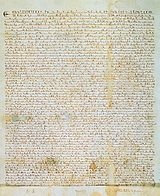
Magna Carta

 
Magna Carta

   Email Print
   Bookmark   Link


Magna Carta


Magna Carta (Latin
Latin

Latin is an Italic language, historically spoken in Latium and Ancient Rome. Through the Military history of the Roman Empire, Latin spread throughout the Mediterranean and a large part of Europe....
 for Great Charter, literally "Great Paper"), also called Magna Carta Libertatum (Great Charter of Freedoms), is an English
Kingdom of England

The Kingdom of England was, from 927 to 1707, a state in North-West Europe. The Kingdom of England spanned the southern two-thirds of the island of Great Britain and a number of smaller outlying islands?what is today the legal unit of England and Wales....
 legal charter
Charter

A charter is the grant of authority or rights, stating that the granter formally recognizes the prerogative of the recipient to exercise the rights specified....
, originally issued in the year 1215. It was written in Latin
Latin

Latin is an Italic language, historically spoken in Latium and Ancient Rome. Through the Military history of the Roman Empire, Latin spread throughout the Mediterranean and a large part of Europe....
.

Magna Carta required King John of England
John of England

John reigned as List of English monarchs from 6 April 1199, until his death. He succeeded to the throne as the younger brother of King Richard I of England, who died without issue....
 to proclaim certain rights (pertaining to nobles and barons), respect certain legal procedures, and accept that his will
Will (philosophy)

Will, or willpower, is a philosophy concept that is defined in several different ways....
 could be bound by the law
Rule of law

The rule of law is a legal concept which includes a number of interrelated principles. First, protecting the rule of law ensures that no one is above the law....
.


Discussion
Ask a question about 'Magna Carta'
Start a new discussion about 'Magna Carta'
Answer questions from other users
Full Discussion Forum


Recent Posts


Encyclopedia


Magna Carta (Latin
Latin

Latin is an Italic language, historically spoken in Latium and Ancient Rome. Through the Military history of the Roman Empire, Latin spread throughout the Mediterranean and a large part of Europe....
 for Great Charter, literally "Great Paper"), also called Magna Carta Libertatum (Great Charter of Freedoms), is an English
Kingdom of England

The Kingdom of England was, from 927 to 1707, a state in North-West Europe. The Kingdom of England spanned the southern two-thirds of the island of Great Britain and a number of smaller outlying islands?what is today the legal unit of England and Wales....
 legal charter
Charter

A charter is the grant of authority or rights, stating that the granter formally recognizes the prerogative of the recipient to exercise the rights specified....
, originally issued in the year 1215. It was written in Latin
Latin

Latin is an Italic language, historically spoken in Latium and Ancient Rome. Through the Military history of the Roman Empire, Latin spread throughout the Mediterranean and a large part of Europe....
.

Magna Carta required King John of England
John of England

John reigned as List of English monarchs from 6 April 1199, until his death. He succeeded to the throne as the younger brother of King Richard I of England, who died without issue....
 to proclaim certain rights (pertaining to nobles and barons), respect certain legal procedures, and accept that his will
Will (philosophy)

Will, or willpower, is a philosophy concept that is defined in several different ways....
 could be bound by the law
Rule of law

The rule of law is a legal concept which includes a number of interrelated principles. First, protecting the rule of law ensures that no one is above the law....
. It explicitly protected certain rights of the King's subjects, whether free or fettered—most notably the writ
Writ

In law, a writ is a formal written order issued by a body with administrative or judicial jurisdiction. In modern usage, this public body is generally a court....
 of habeas corpus
Habeas corpus

For the Living Things CD, see Habeas Corpus Habeas corpus is a legal action, or writ, through which a person can seek justice from the unlawful detention of him or herself, or of another person....
, allowing appeal against unlawful imprisonment.

Magna Carta was arguably the most significant early influence on the extensive historical process that led to the rule of constitutional law
Constitutional law

Constitutional law is the study of foundational or basic laws of nation states and other political organizations.Constitutions are the framework for government and may limit or define the authority and procedure of political bodies to execute new laws and regulations....
 today in the English speaking world. Magna Carta influenced the development of the common law
Common law

Common law refers to law and the corresponding Legal systems of the world developed through legal opinion of courts and similar tribunals , rather than through statute law or Executive ....
 and many constitutional documents, including the United States Constitution
United States Constitution

The Constitution of the United States of America is the supreme law of the United States. It is the foundation and source of the legal authority underlying the existence of the United States of America; the Federal Government of the United States; and all the State & local governments and Territorial Administrative bodies contained therein....
. Many clauses were renewed throughout the Middle Ages
Middle Ages

File:Karl 1 mit papst gelasius gregor1 sacramentar v karl d kahlen.jpgThe Middle Ages of European history are a period in history which lasted for roughly a millennium, commonly dated from the fall of the Roman Empire in the 5th century to the beginning of the Early Modern Period in the 16th century, marked by the division of Western Christi...
, and continued to be renewed as late as the 18th century. By the second half of the 19th century, however, most clauses in their original form had been repeal
Repeal

A repeal is the removal or reversal of a law. This is generally done when a law is no longer effective, or it is shown that a law is having far more negative consequences than were originally envisioned....
ed from English law
English law

English law is the Legal systems of the world of England and Wales, and is the basis of common law legal systems used in most Commonwealth of Nations countriesand the United States ....
.

Magna Carta was the first document forced onto an English King by a group of his subjects (the barons) in an attempt to limit his powers by law and protect their privileges. It was preceded by the 1100 Charter of Liberties
Charter of Liberties

The Charter of Liberties, also called the Coronation Charter, was a written proclamation by Henry I of England, issued upon his ascension to the throne in 1100....
 in which King Henry I
Henry I of England

Henry I was the fourth son of William I the Conqueror. He succeeded his elder brother William II of England as King of England in 1100 and defeated his eldest brother, Robert Curthose, to become Duke of Normandy in 1106....
 voluntarily stated what his own powers were under the law.

In practice, Magna Carta in the Medieval period mostly did not limit the power of Kings; but by the time of the English Civil War
English Civil War

The English Civil War was a series of armed conflicts and political machinations between Roundhead and Cavalier. The First English Civil War and Second English Civil War civil wars pitted the supporters of Charles I of England against the supporters of the Long Parliament, while the Third English Civil War saw fighting between supporters...
 it had become an important symbol for those who wished to show that the King was bound by the law.

Magna Carta is normally understood to refer to a single document, that of 1215. Various amended versions of Magna Carta appeared in subsequent years however, and it is the 1297 version which remains on the statute books of England and Wales
England and Wales

England and Wales is a legal unit within the United Kingdom. It consists of England and Wales, two of the four countries of the United Kingdom....
.

Background

Magcarta
After the Norman conquest of England
Norman conquest of England

The Norman conquest of England began in 1066 AD with the invasion of the Kingdom of England by the troops of William I of England, Duke of Normandy , and his victory at the Battle of Hastings....
 in 1066 and advances in the 12th century, the English King had by 1199 become a powerful and influential monarch in Europe. Factors contributing to this include the sophisticated centralised government created by the procedures of the new Norman
Normans

The Normans were the people who gave their names to Normandy, a region in northern France. They descended from Viking conquerors of the territory and the native population of mostly Frankish and Gallo-Roman stock....
 systems of governance and extensive Anglo-Norman
Anglo-Norman

The Anglo-Normans were mainly the descendants of the Normans who ruled England following the conquest by William I of England in 1066, although a few Normans were already in England before the conquest....
 land holdings in Normandy
Normandy

Normandy is a geographical region corresponding to the former Duchy of Normandy. It is situated along the coast of France south of the English Channel between Brittany and Picardy and comprises territory in northern France and the Channel Islands....
.

But after King John of England
John of England

John reigned as List of English monarchs from 6 April 1199, until his death. He succeeded to the throne as the younger brother of King Richard I of England, who died without issue....
 was crowned in the early 13th century, a series of failures at home and abroad, combined with perceived abuses of the king's power, led the English baron
Baron

Baron is a specific title of nobility. The word baron comes from Old French baron, itself from Old High German and latin baro meaning " man, warrior"; it merged with cognate Old English language beorn meaning "nobleman."...
s to revolt and attempt to restrain what the king could legally do.

France

King John's actions in France were a major cause of discontent in the realm. At the time of his accession to the throne after Richard's
Richard I of England

Richard I was King of England from 6 July 1189 until his death in 1199. He also ruled as Duke of Normandy, Duke of Aquitaine, Duke of Gascony, Lord of Ireland, Cyprus, Count of Anjou, Count of Nantes and Brittany at various times during the same period....
 death, there were no set rules to define the line of succession. King John, as Richard's younger brother, was crowned over Richard's nephew, Arthur of Brittany. Since Arthur still had a claim over the Anjou
Anjou

Anjou is a former county , duchy and Provinces of France centred on the city of Angers in the lower Loire Valley of western France. It corresponds largely to the present-day d?partement in France of Maine-et-Loire....
 empire, however, John needed the approval of the French king, Philip Augustus. To get it, John gave to Philip large tracts of the French-speaking Anjou territories.

When John later married Isabella of Angoulême
Isabella of Angoulême

Isabella of Angoul?me was Countess of Angoul?me and queen consort of England....
, her previous fiancé (Hugh IX of Lusignan
Hugh IX of Lusignan

Hugh IX the Brown of Lusignan or Hugh IV of La Marche or Hugues IX & IV le Brun de Lusignan was the grandson of Hugh VIII of Lusignan....
, one of John's vassal
Vassal

A vassal in the terminology that both preceded and accompanied the feudal of medieval Europe, is one who enters into mutual obligations with a monarch, usually of military support and mutual protection, in exchange for certain guarantees, which came to include the terrain held as a fiefdom....
s) appealed to Philip, who then declared forfeit
Forfeit

A forfeit can be one of several things:* Forfeit - for information about forfeiting in baseball* Forfeit a song on Chevelle's breakthrough Cd Wonder What's Next...
 all of John's French lands, including the rich Normandy. Philip declared Arthur as the true ruler of the Anjou throne and invaded John's French holdings in mid-1202 to give it to him. John had to act to save face, but his eventual actions did not achieve this—Arthur disappeared in suspicious circumstances, and John was widely believed to have murdered him, thus losing the little support he had from his French barons.

After the defeat of John's allies at the Battle of Bouvines
Battle of Bouvines

The Battle of Bouvines, July 27, 1214, was a conclusive medieval battle ending the twelve year old War of Bouvines that was important to the early development of both the France in the Middle Ages by confirming the French crown's sovereignty over the duchy of Normandy of Brittany and Normandy and also in forcing the English king...
, Philip retained all of John's northern French territories, including Normandy (although Aquitaine
Aquitaine

Aquitaine , archaic Guyenne/Guienne , is one of the 26 regions of France, in the south-western part of metropolitan France, along the Atlantic Ocean and the Pyrenees mountain range on the border with Spain....
 remained in English hands for a time). These serious military defeats, which lost to the English a major source of income, made John unpopular at home. Worse, to recoup his expenses, he had to further tax the already unhappy barons.

The Church

At the time of John’s reign there was still a great deal of controversy as to how the Archbishop of Canterbury
Archbishop of Canterbury

The Archbishop of Canterbury is the chief bishop and principal leader of the Church of England, the symbolic head of the worldwide Anglican Communion and the Diocesan Bishop of the Diocese of Canterbury, the Episcopal see that churches must be in communion with in order to be a part of the Anglican Communion....
 was to be elected, although it had become traditional that the monarch would appoint a candidate with the approval of the monks of Canterbury.

But in the early 13th century, the bishop
Bishop

A bishop is an ordination or consecration member of the Clergy#Christian clergy who is generally entrusted with a position of authority and oversight....
s began to want a say. To retain control, the monks elected one of their numbers to the role. But John, incensed at his lack of involvement in the proceedings, sent John de Gray
John de Gray

John de Gray was Bishop of Norwich in the English county of Norfolk, as well as being elected Archbishop of Canterbury, but was never confirmed as archbishop....
, the Bishop of Norwich
Bishop of Norwich

The Bishop of Norwich is the Ordinary of the Church of England Anglican Diocese of Norwich in the Province of Canterbury.The diocese covers most of the County of Norfolk and part of Suffolk....
, to Rome
Rome

Rome is the capital city of Italy and Lazio, and is Italy's largest and most populous city, with 2,724,347 residents in an urban area of some ....
 as his choice. Pope Innocent III
Pope Innocent III

Pope Innocent III was born in either 1160 or 1161, and died on July 16, 1216 at Perugia. He was born with the name Lotario de Conti, and he was pope from January 8, 1198 until his death....
 declared both choices invalid and persuaded the monks to elect Stephen Langton
Stephen Langton

Stephen Cardinal Langton was Archbishop of Canterbury between 1207 and his death in 1228 and was a central figure in the dispute between John of England and Pope Innocent III, which ultimately led to the issuing of Magna Carta in 1215....
. Nevertheless, John refused to accept this choice and exiled the monks from the realm. Infuriated, Innocent ordered an interdict
Interdict (Roman Catholic Church)

In the Roman Catholic Church, the word interdict usually refers to an ecclesiastical penalty. Interdicts may be real, local or personal....
 (prevention of public worship — mass, marriages, the ringing of church bells, etc.) in England in 1208, excommunicated
Excommunication

Excommunication is a religious censure used to deprive or suspend membership in a religious community. The word literally means putting [someone] out of full communion....
 John in 1209, and encouraged Philip to invade England in 1212.

John finally backed down and agreed to endorse Langton and allow the exiles to return. To completely placate the pope, he gave England and Ireland
Ireland

Ireland is the List of islands by area in Europe, and the twentieth-largest island in the world. It lies to the north-west of continental Europe and is surrounded by hundreds of islands and islet....
 as papal territories and rented them back as a fiefdom
Fiefdom

Under the system of feudalism, a fiefdom, fief, feud, feoff, or fee, often consisted of inheritance lands or revenue-producing property granted by a Allegiance lord, generally to a vassal, in return for a form of allegiance, originally to give him the means to fulfill his military duties when called upon....
 for 1,000 marks per annum. This surrender of autonomy
Autonomy

Autonomy is the right to self-government. Autonomy is a concept found in moral, political, and bioethics philosophy. Within these contexts, it refers to the capacity of a Rationality individual to make an informed, un-coerced decision....
 to a foreign power further enraged the barons.

Taxes

King John needed money for armies, but the loss of the French territories, especially Normandy, greatly reduced the state income, and a huge tax would have to be raised in order to attempt to reclaim these territories. Yet, it was difficult to raise taxes because of the tradition of keeping them at the same level.

John relied on clever manipulation of pre-existing rights, including those of forest law
Royal forest

A royal forest is an area of land where certain rights are reserved for a monarch or the aristocracy, usually set aside for hunting . The concept was introduced by the Normans to England in the 11th century, and at its peak in the late 12th and early 13th centuries, fully one third of the area of England was designated royal forest....
, a set of regulations about the king’s hunting preserves, which were easily broken and severely punished. John also increased the pre-existing scutage
Scutage

The tax of scutage or escuage, in the law of England under the feudal system, allowed a knight to "buy out" of the military service due to the Crown from the holder of a knight's fee....
 (feudal payment to an overlord replacing direct military service) eleven times in his seventeen years as king, as compared to eleven times in twice that period covering three monarchs before him. The last two of these increases were double the increase of their predecessors. He also imposed the first income tax, which raised what was, at the time, the extortionate sum of £70,000.

Rebellion and signing of the document


By 1215, some of the most important barons in England had had enough, and they entered London
London

London is the capital of both England and the United Kingdom, and the most populous municipality in the European Union. An important settlement for two millennia, History of London goes back to its founding by the Roman Empire....
 in force on 10 June 1215, with the city showing its sympathy with their cause by opening its gates to them. They, and many of the moderates not in overt rebellion, forced King John to agree to the "Articles of the Barons", to which his Great Seal
Great Seal of the Realm

The Great Seal of the Realm or Great Seal of the United Kingdom is a Seal that is used to symbolise the monarch's approval of important state documents....
 was attached in the meadow at Runnymede
Runnymede

Runnymede is a water-meadow alongside the River Thames in the England county of Surrey, and just over west of central London. It is notable for its association with the sealing of the Magna Carta, and as a consequence is the site of a collection of memorials....
 on 15 June 1215. In return, the barons renewed their oaths of fealty
Fealty

An oath of fealty, from the Latin fidelitas , is a pledge of allegiance of one person to another. Typically the oath is made upon a religious object such as a Bible or saint relic, thus binding the oath-taker before God.thus had to swear the oath....
 to King John on 19 June 1215. A formal document to record the agreement was created by the royal chancery
Lord Chancellor

The Lord High Chancellor of Great Britain, or Lord Chancellor, is a senior and important functionary in the government of the United Kingdom....
 on 15 July: this was the original Magna Carta. An unknown number of copies of it were sent out to officials, such as royal sheriff
Sheriff

A sheriff is in principle a legal official with responsibility for a county. In practice, the specific combination of legal, political, and ceremonial duties of a sheriff varies greatly from country to country....
s and bishops.

The most significant clause for King John at the time was clause 61, known as the "security clause", the longest portion of the document. This established a committee of 25 barons who could at any time meet and overrule the will of the King, through force by seizing his castles and possessions if needed. This was based on a medieval legal practice known as distraint
Distraint

Distraint or distress is "the seizure of someone?s property in order to obtain payment of renting or other money owed", especially in common law countries....
, but it was the first time it had been applied to a monarch. In addition, the King was to take an oath of loyalty to the committee.

Clause 61 essentially neutered John's power as a monarch, making him King in name only. He renounced it as soon as the barons left London, plunging England into a civil war
Civil war

A civil war is a war between organized groups to take control of a nation or region, or to change government policies. It is high-intensity conflict, often involving Regular Army, that is sustained, organized and large-scale....
, called the First Barons' War
First Barons' War

The First Barons' War was a combination of :* a civil war in the Kingdom of England, between :**the forces of a number of rebellious barons, led by Robert Fitzwalter, and...
. Pope Innocent III also annulled the "shameful and demeaning agreement, forced upon the King by violence and fear." He rejected any call for restraints on the King, saying it impaired John's dignity. He saw it as an affront to the Church's authority over the King and the 'papal territories' of England and Ireland, and he released John from his oath to obey it.

Magna Carta re-issued

John died during the war, from dysentery
Dysentery

Dysentery is a disorder of the digestive system that results in severe diarrhea containing mucus and/or blood in the feces. If untreated, Dysentery can be fatal....
, on 18 October 1216, and this quickly changed the nature of the war. His nine-year-old son, Henry III
Henry III of England

Henry III was the son and successor of John of England as King of England, reigning for fifty-six years from 1216 to his death. His contemporaries knew him as Henry of Winchester....
, was next in line for the throne. The royalists believed the rebel barons would find the idea of loyalty to the child Henry more palatable, so the boy was swiftly crowned in late October 1216, and the war ended.

Henry's regent
Regent

A regent, from the Latin regens "reigning", is a person selected to act as head of state because the ruler is a minor, not present or debilitated....
is reissued Magna Carta in his name on 12 November 1216, omitting some clauses, such as clause 61, and again in 1217. When he turned 18 in 1225, Henry III reissued Magna Carta, this time in a shorter version with only 37 articles.

Henry III ruled for 56 years (the longest reign of an English Monarch in the Medieval period) so that by the time of his death in 1272, Magna Carta had become a settled part of English legal precedent.

Henry III's son and heir Edward I
Edward I of England

Edward I , popularly known as Longshanks, the English Justinian, and the Hammer of the Scots , was a House of Plantagenet King of England who achieved historical fame by conquering large parts of Wales and almost succeeding in doing the same to Scotland....
's Parliament
Parliament of England

The Parliament of England was the legislature of the Kingdom of England. Its roots can be traced back to the early medieval period. In a series of developments, it came increasingly to constrain the power of the King of England, and went on after the Act of Union 1707 to merge with the Parliament of Scotland and form the main basis of the Pa...
 reissued Magna Carta for the final time on 12 October 1297, as part of a statute
Statute

A statute is a formal written enactment of a legislative authority that governs a country, state, city, or county. Typically, statutes command or prohibit something, or declare policy....
 called Confirmatio cartarum
Confirmation of Charters

The Confirmation of Charters was issued by Edward I of England in 1297. In the Confirmation, Edward reaffirmed Magna Carta and the Forest Charter....
, reconfirming Henry III's shorter version of Magna Carta from 1225.

Content

Magna Carta was originally written in Latin. A large part of Magna Carta was copied, nearly word for word, from the Charter of Liberties
Charter of Liberties

The Charter of Liberties, also called the Coronation Charter, was a written proclamation by Henry I of England, issued upon his ascension to the throne in 1100....
 of Henry I
Henry I of England

Henry I was the fourth son of William I the Conqueror. He succeeded his elder brother William II of England as King of England in 1100 and defeated his eldest brother, Robert Curthose, to become Duke of Normandy in 1106....
, issued when Henry I ascended to the throne in 1100, which bound the king to certain laws regarding the treatment of church officials and nobles, effectively granting certain civil liberties to the church and the English nobility.

The document commonly known as Magna Carta today is not the 1215 charter but a later charter of 1225, and is usually shown in the form of The Charter of 1297 when it was confirmed by Edward I. At the time of the 1215 charter, many of the provisions were not meant to make long term changes but simply to right the immediate wrongs, and therefore The Charter was reissued three times in the reign of Henry III (1216, 1217 and 1225) in order to provide for an updated version. After this, each individual king for the next two hundred years (until Henry V
Henry V of England

Henry V was one of the most significant English warrior kings of the 15th century. He was born at Monmouth, Wales, in the tower above the gatehouse of Monmouth Castle, and reigned as King of England from 1413 to 1422....
 in 1416) personally confirmed the 1225 charter in his own charter.

Rights still in force today


For modern times, the most enduring legacy of Magna Carta is considered the right of habeas corpus
Habeas corpus

For the Living Things CD, see Habeas Corpus Habeas corpus is a legal action, or writ, through which a person can seek justice from the unlawful detention of him or herself, or of another person....
. This right arises from what are now known as clauses 36, 38, 39, and 40 of the 1215 Magna Carta.

As the most recent version, it is the 1297 Charter which remains in legal force in England and Wales
England and Wales

England and Wales is a legal unit within the United Kingdom. It consists of England and Wales, two of the four countries of the United Kingdom....
. Using the clauses in the 1297 charter (the content and numbering are somewhat different from the 1215 Charter): Clause 1 guarantees the freedom of the English Church. Although this originally meant freedom from the King, later in history it was used for different purposes (see below). Clause 9 guarantees the “ancient liberties” of the City of London. Clause 29 guarantees a right to due process.

The repeal of clause 26 in 1829 was the first time a clause of Magna Carta was repealed. With the document's perceived protected status broken, in 150 years nearly the whole charter was repealed, leaving just Clauses 1, 9, and 29 still in force after 1969. Most of it was repealed in England and Wales by the Statute Law Revision Act 1863, and in Ireland
Ireland

Ireland is the List of islands by area in Europe, and the twentieth-largest island in the world. It lies to the north-west of continental Europe and is surrounded by hundreds of islands and islet....
 by the Statute Law (Ireland) Revision Act 1872.

Feudal rights still in place in 1225

Several clauses were present in the 1225 charter but are no longer in force and would have no real place in the post-feudal world. Clauses 2 to 7 refer to the feudal death duties, defining the amounts and what to do if an heir to a fiefdom is underage or is a widow. Clause 23 provides no town or person should be forced to build a bridge across a river. Clause 33 demands the removal of all fish weirs
Fishing weir

A fishing weir is an ancient type of fish trap that is traceable back to Ancient Rome times in the United Kingdom. It is also a technology used by, among others, North American Native Americans in the United States and early settlers to catch fish for trade and to feed their communities....
. Clause 43 gives special provision for tax on reverted estates and Clause 44 states that forest law should only apply to those in the king’s forest.

Feudal rights not in the 1225 charter

Some provisions have no bearing in the world today, since they are feudal rights and were not even included in the 1225 charter. Clauses 9 to 12, 14 to 16, and 25 to 26 deal with debt and taxes and Clause 27 with intestacy
Intestacy

Intestacy is the condition of the estate of a person who dies owning property greater than the sum of his or her enforceable debts and funeral expenses without having made a valid will or other binding declaration; alternatively where such a will or declaration has been made, but only applies to part of the estate , the remaining estate fo...
.

The other clauses state that no one may seize land in debt except as a last resort; that underage heirs and widows should not pay interest on inherited loans; that county rents will stay at their ancient amounts; and that the crown may only seize the value owed in payment of a debt, that aid (taxes for warfare or other emergency) must be reasonable, and that scutage (literally, shield-payment, payment in lieu of actual military service used to finance warfare) may only be sought with the consent of the kingdom.

Clause 14 states that the common consent of the kingdom was to be sought from a council of the archbishops, bishops, earls and greater Barons. This later became the great council, which led to the first parliament.

Judicial rights

Clauses 17 to 22 allowed for a fixed law court, which became the chancellery, and defines the scope and frequency of county assizes. They also state that fines should be proportionate to the offence, that they should not be influenced by ecclesiastical property in clergy trials, and that their peers should try people. Many think that this gave rise to jury and magistrate trial, but its only manifestation in the modern world was the right of a lord to a criminal trial in the House of Lords at first instance (abolished in 1948).

Clause 24 states that crown officials (such as sheriffs) may not try a crime in place of a judge. Clause 34 forbids repossession without a writ
Writ

In law, a writ is a formal written order issued by a body with administrative or judicial jurisdiction. In modern usage, this public body is generally a court....
 precipe. Clauses 36 to 38 state that writs for loss of life or limb are to be free, that someone may use reasonable force to secure their own land, and that no one can be tried on their own testimony alone.

Clauses 36, 38, 39 and 40 collectively define the right of Habeas Corpus. Clause 36 requires courts to make inquiries as to the whereabouts of a prisoner, and to do so without charging any fee. Clause 38 requires more than the mere word of an official, before any person could be put on trial. Clause 39 gives the courts exclusive rights to punish anyone. Clause 40 disallows the selling or the delay of justice. Clauses 36 and 38 were removed from the 1225 version, but were reinstated in later versions. The right of Habeas Corpus as such was first invoked in court in the year 1305.

Clause 54 says that no man may be imprisoned on the testimony of a woman except on the death of her husband.

Anti-corruption and fair trade

Clauses 28 to 32 state that no royal officer may take any commodity such as grain, wood or transport without payment or consent or force a knight to pay for something the knight could do himself, and that the king must return any lands confiscated from a felon within a year and a day.

Clause 35 sets out a list of standard measures, and Clauses 41 and 42 guarantee the safety and right of entry and exit of foreign merchants.

Clause 45 says that the King should only appoint royal officers where they are suitable for the post. In the United States
United States

The United States of America is a Federal government constitutional republic comprising U.S. state and a federal district. The country is situated mostly in central North America, where its Contiguous United States and Washington, D.C., the Capital districts and territories, lie between the Pacific Ocean and Atlantic Oceans, Borders of the U...
, the Supreme Court of California
Supreme Court of California

The Supreme Court of California is the state supreme court of California. It is headquartered in San Francisco, California, and regularly holds sessions at its branch offices in Los Angeles, California and Sacramento, California....
 interpreted clause 45 in 1974 as establishing a requirement at common law that a defendant faced with the potential of incarceration is entitled to a trial overseen by a law-trained judge.

Clause 46 provides for the guardianship of monasteries.

Temporary provisions

Some provisions were for immediate effect and were not in any later charter. Clauses 47 and 48 abolish most of Forest Law (these were later taken out of Magna Carta and formed into a separate charter, the Charter of the Forests). Clauses 49, 52 to 53 and 55 to 59 provide for the return of hostages, land and fines taken in John’s reign.

Article 50 states that no member of the D’Athée
Gérard D’Athée

G?rard D?Ath?e was a mercenary captain employed by King John of England from 1211 to 1215 to control southern Wales. He served King John in France as commander of Loches castle, one of the last castles to resist Philip Augustas in Normandy....
 family may be a royal officer. Article 51 calls for all foreign knights and mercenaries to leave the realm.

Articles 60, 62 and 63 provide for the application and observation of the Charter and say that the Charter is binding on the King and his heirs forever, but this was soon deemed dependent on each succeeding king reaffirming the Charter under his own seal.

Great Council

The first long-term constitutional effect arose from Clauses 14 and 61, which permitted a council composed of the most powerful men in the country to exist for the benefit of the state rather than in allegiance to the monarch. Members of the council were also allowed to renounce their oath of allegiance to the King in pressing circumstances and to pledge allegiance to the council and not to the King in certain instances. The common council was responsible for taxation, and although it was not representative, its members were bound by decisions made in their absence. The common council, later called the Great Council, was England's proto-parliament
Parliament

A parliament is a legislature, especially in those countries whose system of government is based on the Westminster system modeled after that of the United Kingdom....
.

The Great Council only existed to give input on the opinion of the kingdom as a whole, and it only had power to control scutage until 1258 when Henry III got into debt fighting in Sicily
Sicily

Sicily is an Autonomous regions with special statute of Italy. Of all the regions of Italy, Sicily covers the largest land area at 25,708 km? and currently has just over five million inhabitants....
 for the pope. The barons agreed to a tax in exchange for reform, leading to the Provisions of Oxford
Provisions of Oxford

The Provisions of Oxford were installed in 1258 by a group of barons led by Simon de Montfort, 6th Earl of Leicester; these documents are often regarded as England's first written constitution....
. But Henry got a papal bull
Papal bull

A Papal bull is a particular type of letters patent or charter issued by a pope. It is named after the bulla that was appended to the end to authenticate it....
 allowing him to set aside the provisions and in 1262 told royal officers to ignore the provisions and only to obey Magna Carta. The barons revolted and seized the Tower of London
Tower of London

Her Majesty's Royal Palace and Fortress, more commonly known as the Tower of London , is a historic monument in central London, England, on the north bank of the River Thames....
, the Cinque ports
Cinque Ports

The Confederation of Cinque Ports is a historic series of coastal towns in Kent and Sussex, at the eastern end of the English Channel where the crossing to the continent is narrowest....
 and Gloucester
Gloucester

Gloucester is a city status in the United Kingdom, Non-metropolitan district and county town of Gloucestershire in the South West England region of England....
. Initially the King surrendered, but when Louis IX of France
Louis IX of France

Louis IX , commonly Saint Louis, was List of French monarchs from 1226 to his death. He was also Counts of Artois from 1226 to 1237. Born at Poissy, near Paris, he was a member of the House of Capet and the son of Louis VIII of France and Blanche of Castile....
 arbitrated in favour of Henry, Henry crushed the rebellion. Later he ceded somewhat, passing the Statute of Marlborough
Statute of Marlborough

The Statute of Marlborough was a set of laws passed by Henry III of England of England in 1267. There were twenty-nine chapters, of which four are still in force....
 in 1267, which allowed writs for breaches of Magna Carta to be free of charge, enabling anyone to have standing to apply the Charter.

This secured the position of the Great Council forever, but its powers were still very limited. The council originally only met three times per year and so was subservient to the King’s council, Curiae Regis
Curia Regis

Curia regis is a Latin term meaning "royal council" or "Noble court."...
, who, unlike the Great Council, followed the king wherever he went.

Still, in some senses the council was an early form of parliament. It had the power to meet outside the authority of the King and was not appointed by him. While executive government descends from the Curiae Regis, parliament descends from the Great Council, which was later called the parliamentum. However, the Great Council was very different from modern parliament. There were no knights, let alone commons, and it was composed of the most powerful men, rather than elected citizens.

Magna Carta had little effect on subsequent development of parliament until the Tudor period. Knights and county representatives attended the Great Council (Simon de Montfort
Simon de Montfort, 6th Earl of Leicester

Simon de Montfort, 6th Earl of Leicester , was the principal leader of the baronial opposition to King Henry III of England. After the rebellion of 1263-1264, de Montfort became de facto ruler of England and called the De Montfort's Parliament in medieval Europe....
’s Parliament), and the council became far more representative under the model parliament of Edward I
Edward I of England

Edward I , popularly known as Longshanks, the English Justinian, and the Hammer of the Scots , was a House of Plantagenet King of England who achieved historical fame by conquering large parts of Wales and almost succeeding in doing the same to Scotland....
 which included two knights from each county, two burgesses from each borough and two citizens from each city. The Commons separated from the Lords in 1341. The right of the Commons to exclusively sanction taxes (based on a withdrawn provision of Magna Carta) was re-asserted in 1407, although it was not in force in this period. The power vested in the Great Council by, albeit withdrawn, Clause 14 of Magna Carta became vested in the House of Commons
British House of Commons

The House of Commons is the lower house of the Parliament of the United Kingdom, which also comprises the British monarchy and the House of Lords ....
 but Magna Carta was all but forgotten for about a century, until the Tudors.

Tudor dynasty

Magna Carta was the first entry on the statute books, but after 1472, it was not mentioned for a period of nearly 100 years. There was much ignorance about the document. The few who did know about the document spoke of a good king being forced by an unstable pope and rebellious barons “to attaine the shadow of seeming liberties” and that it was a product of a wrongful rebellion against the one true authority, the king. The original Magna Carta was seen as an ancient document with shadowy origins and as having no bearing on the Tudor world. Shakespeare
William Shakespeare

William Shakespeare was an English people poet and playwright, widely regarded as the greatest writer in the English language and the world's preeminent dramatist....
’s King John makes no mention of the Charter at all but focuses on the murder of Arthur. The Charter in the statute books was thought to have arisen from the reign of Henry III.

First uses of the charter as a bill of rights

This statute was used widely in the reign of Henry VIII
Henry VIII of England

Henry VIII was King of England from 21 April 1509 until his death. He was also Lordship of Ireland and claimant to the Early Modern France. Henry was the second monarch of the House of Tudor, succeeding his father, Henry VII of England....
 but was seen as no more special than any other statute and could be amended and removed. But later in the reign, the Lord Treasurer
Lord High Treasurer

The post of Lord High Treasurer or Lord Treasurer is an old England government position. The holder of the post is third highest of the Great Officer of State, ranking below the Lord High Chancellor and above the Lord President of the Council....
 stated in the Star Chamber
Star Chamber

The Star Chamber was an England court of law that sat at the royal Palace of Westminster until 1641. It was made up of Privy Counsellors, as well as common-law judges, and supplemented the activities of the common-law and equity courts in both civil and criminal matters....
 that many had lost their lives in the Baronial wars fighting for the liberties which were guaranteed by the Charter, and therefore it should not so easily be overlooked as a simple and regular statute.

The church often attempted to invoke the first clause of the Charter to protect itself from the attacks by Henry, but this claim was given no credence. Francis Bacon
Francis Bacon

Francis Bacon, 1st Viscount St Alban King's Counsel , son of Nicholas Bacon by his second wife Anne Bacon, was an English philosopher, statesman, scientist, lawyer, jurist, and author....
 was the first to try to use Clause 39 to guarantee due process in a trial.

Although there was a re-awakening of the use of Magna Carta in common law, it was not seen (as it was later) as an entrenched set of liberties guaranteed for the people against the Crown and Government. Rather, it was a normal statute, which gave a certain level of liberties, most of which could not be relied on, least of all against the king. Therefore, the Charter had little effect on the governance of the early Tudor period. Although lay parliament evolved from the Charter, by this stage the powers of parliament had managed to exceed those humble beginnings. The Charter had no real effect until the Elizabethan age
Elizabethan era

The Elizabethan era is associated with Elizabeth I of England's reign and is often considered to be the Golden Age in History of England. It was the height of the English Renaissance and saw the flowering of English poetry and English literature....
.

Reinterpretation of the charter

In the Elizabethan age, England was becoming a powerful force in Europe. In academia, earnest but futile attempts were made to prove that Parliament had Roman
Rome

Rome is the capital city of Italy and Lazio, and is Italy's largest and most populous city, with 2,724,347 residents in an urban area of some ....
 origins. The events at Runnymede in 1215 were "re-discovered", allowing a possibility to show the antiquity of Parliament, and Magna Carta became synonymous with the idea of an ancient house with origins in Roman government.

The Charter was interpreted as an attempt to return to a pre-Norman state of things. The Tudors saw the Charter as proof that their state of governance had existed since time immemorial and the Normans had been a brief break from this liberty and democracy. This claim is disputed in certain circles but explains how Magna Carta came to be regarded as such an important document.

Magna Carta again occupied legal minds, and it again began to shape how that government was run. Soon the Charter was seen as an immutable entity. In the trial of Arthur Hall
Arthur Hall

Arthur Hall may refer to:*Arthur Hall , head football coach at the University of Illinois, 1907-1912*Arthur David Hall III , American electrical engineer...
 for questioning the antiquity of the House, one of his alleged crimes was an attack on Magna Carta.

Edward Coke’s opinions

Coke
One of the first respected jurists to write seriously about the great charter was Edward Coke
Edward Coke

Sir Edward Coke , was a seventeenth-century England jurist and Member of Parliament whose writings on the English common law were the definitive legal texts for nearly 150 years....
, who had a great deal to say on the subject and was influential in the way Magna Carta was perceived throughout the Tudor and Stuart
Jacobean era

The Jacobean era refers to the period in England and Scotland history that coincides with the reign of King James I of England of England, who was also James VI of Scotland....
 periods, although his opinions changed across time and his writing in the Stuart period was more influential. In the Elizabethan period, Coke wrote of Parliament evolving alongside the monarchy and not existing by any allowance on the part of the monarch. However he was still fiercely loyal to Elizabeth, and the monarchy still judged the Charter in the same light it always had: an evil document forced out of their forefathers by brute force. He therefore prevented a re-affirmation of the charter from passing the House, and although he spoke highly of the charter, he did not speak out against imprisonments without due process. This came back to haunt him later when he moved for a reaffirmation of the charter.

Magna Carta’s role in the lead-up to the Civil War

By the time of the Stuarts, Magna Carta had attained an almost mythical status for its admirers and was seen as representing a ‘golden age’ of English liberties extant prior to the Norman invasion. Whether or not this 'golden age' ever truly existed is open to debate; regardless, proponents of its application to English law saw themselves as leading England back to a pre-Norman state of affairs. What is true, however is that this age existed in the hearts and minds of people of the time. Magna Carta was not important because of the liberties it bestowed, but simply as ‘proof’ of what had come before; many great minds influentially exalted the Charter; by the seventeenth century, Coke was talking of the Charter as an indispensable method of limiting the powers of the Crown, a popular principle in the Stuart period where the kings were proclaiming their divine right
Divine Right of Kings

The Divine Right of Kings is a politics and religion doctrine of royal absolutism. It asserts that a monarch is subject to no earthly authority, deriving his right to rule directly from the will of God....
 and were looking, in the minds of some of their subjects, towards becoming absolute monarchs.

It was not the content of the Charter which has made it so important in the history of England, but more how it has been perceived in the popular mind. This is something that certainly started in the Stuart period, as the Charter represented many things, which are not to be found in the Charter itself. Firstly it was used to claim liberties against the Government in general rather than just the Crown and the officers of the crown, secondly that it represented that the laws and liberties of England, specifically Parliament, dated back to a time immemorial and thirdly, that it was not only just but right to usurp a king who disobeyed the law.

For the last of these reasons Magna Carta began to represent a danger to the monarchy; Elizabeth
Elizabeth I of England

Elizabeth I was List of English monarchs and Queen of Ireland from 17 November 1558 until her death. Sometimes called The Virgin Queen, Gloriana, or Good Queen Bess, Elizabeth was the fifth and last monarch of the House of Tudor....
 ordered that John Coke
John Coke

Sir John Coke , England politician, was educated at Trinity College, Cambridge.Coke was the son of Richard and Mary Coke of Trusley, Derbyshire....
 stop a bill from going through Parliament which would have reaffirmed the validity of the Charter, and Charles I
Charles I of England

Charles I was List of English monarchs, List of monarchs of Scotland and King of Ireland from 27 March 1625 until his capital punishment on 30 January 1649....
 ordered the suppression of a book which Coke intended to write on Magna Carta. The powers of Parliament were growing, and on Coke’s death, parliament ordered his house to be searched; the manuscripts were recovered, and the book was published in 1642 (at the end of Charles I's Personal Rule
Personal Rule

The Personal Rule was the period from 1629 to 1640, when King Charles I of England of England, Scotland and Ireland ruled without recourse to Parliament of England....
). Parliament began to see Magna Carta as its best way of claiming supremacy over the crown and began to state that they were the sworn defenders of the liberties — fundamental and immemorial — which were to be found in the Charter.

In the four centuries since the Charter had originally catered for their creation, Parliament’s power had increased greatly from their original level where they existed only for the purpose that the king had to seek their permission in order to raise scutage. They had become the only body allowed to raise tax, a right which although descended from the 1215 Great Charter was not guaranteed by it, since it was removed from the 1225 edition. Parliament had become so powerful that the Charter was being used both by those wishing to limit Parliament's power (as a new organ of the Crown), and by those who wished Parliament to rival the king's power (as a set of principles Parliament was sworn to defend against the king). When it became obvious that some people wished to limit the power of Parliament by claiming it to be tantamount to the crown, Parliament claimed they had the sole right of interpretation of the Charter.

This was an important step; for the first time Parliament was claiming itself a body as above the law; whereas one of the fundamental principles in English law was that the law, Parliament, the monarch, and the church held all, albeit to different extents. Parliament was claiming exactly what Magna Carta wanted to prevent the king from claiming, a claim of not being subject to any higher form of power. This was not claimed until ten years after the death of Lord Coke, but he would not have agreed with this, because he claimed in the English Constitution the law was supreme and all bodies of government were subservient to the supreme law, which is to say the common law, as embodied in the Great Charter. These early discussions of Parliament sovereignty seemed to only involve the Charter as the entrenched law, and the discussions were simply about whether Parliament had enough power to repeal the document.

Although it was important for Parliament to be able to claim themselves more powerful than the King in the forthcoming struggle, the Charter provided for this very provision. Clause 61 of the Charter enables people to swear allegiance to what became the Great Council and later Parliament and therefore to renounce allegiance to the king. Moreover, Clause 61 allowed for the seizing of the kingdom by the body which later became Parliament if Magna Carta was not respected by the king or Lord Chief Justice. So there was no need to show any novel level of power in order to overthrow the king; it had already been set out in Magna Carta nearly half a millennium before. Parliament was not ready to repeal the Charter yet however, and in fact, it was cited as the reason why ship money
Ship money

Ship money was a tax, the levy of which by Charles I of England without the consent of British Parliament was one of the causes of the English Civil War....
 was illegal (the first time Parliament overruled the king).

Trial of Archbishop Laud

Further proof of the significance of Magna Carta is shown in the trial of Archbishop Laud in 1645. Laud was tried with attempting to subvert the laws of England including writing a condemnation of Magna Carta claiming that as the Charter came about due to rebellion it was not valid (a widely held opinion less than a century before, when the ‘true’ Magna Carta was thought to be the 1225 edition, with the 1215 edition being considered less valid for this very reason). However, Laud was not trying to say that Magna Carta was evil, and he actually used the document in his defence. He claimed his trial was against the right of the freedom of the church (as the Bishops were voted out of Parliament in order to allow for parliamentary condemnation of him) and, that he was not given the benefit of due process contrary to Clauses 1 and 39 of the Charter. By this stage, Magna Carta had passed a great distance beyond the original intentions for the document, and the Great Council had evolved beyond a body merely ensuring the application of the Charter. It had gotten to the stage where the Great Council or Parliament was inseparable from the ideas of the Crown as described in the Charter and therefore it was potentially not just the King that was bound by the Charter, but Parliament also.

Civil War and interregnum

After seven years of civil war, the king surrendered and was executed; it seemed Magna Carta no longer applied, as there was no King. Oliver Cromwell
Oliver Cromwell

Oliver Cromwell was an English people Military history of the United Kingdom and Politics of England leader best known for his involvement in making England into a republican Commonwealth and for his later role as Lord Protector of England, Scotland, and Ireland....
 was accused of destroying Magna Carta, and many thought he should be crowned just so that it would apply. Cromwell had much disdain for Magna Carta, at one point describing it as "Magna Farta" to a defendant who sought to rely on it.

In this time of foment, there were many revolutionary theorists, and many based their theories at least initially on Magna Carta, in the misguided belief that Magna Carta guaranteed liberty and equality for all.

Levellers

The Levellers
Levellers

The Levellers were members of a mid 17th century England political movement, who came to prominence during the English Civil Wars. They were not a political party in the modern sense of the word, and did not all conform to any specific manifesto....
 believed that all should be equal and free without distinction of class or status. They believed that Magna Carta was the ‘political bible’, which should be prized above any other law and that it could not be repealed. They prized it so highly that they believed all (such as Archbishop Laud) who “trod Magna Carta…under their feet” deserved to be attacked at all levels. The original idea was to achieve this through Parliament but there was little support, because at the time the Parliament was seeking to impose itself as above Magna Carta. The Levellers claimed Magna Carta was above any branch of government, and this led to the upper echelons of the Leveller movement denouncing Parliament. They claimed that Parliament’s primary purpose was not to rule the people directly but to protect the people from the extremes of the King; they claimed that Magna Carta adequately did this and therefore Parliament should be subservient to it.

After the Civil War, Cromwell refused to support the Levellers and was denounced as a traitor to Magna Carta. The importance of Magna Carta was greatly magnified in the eyes of the Levellers. John Lilburne
John Lilburne

John Lilburne , also known as Freeborn John, was an agitator in England before, during and after the English Civil Wars of 1642–1650....
, one of the leaders of the movement, was known for his great advocacy of the Charter and was often known to explain its purpose to lay people and to expose the misspeaking against it in the popular press of the time. He was quoted as saying the ground and foundation of my freedome I build upon the grand charter of England. However, as it became apparent that Magna Carta did not grant the level of liberty demanded by the Levellers, the movement reduced its advocacy of it. William Walwyn
William Walwyn

William Walwyn was an English pamphleteer and Leveller.The second son of Robert Walwyn of Newland, Worcestershire in Worcestershire and grandson of the Bishop of Hereford, Walwyn was apprenticed to a London silk merchant....
, another leader of the movement, advocated natural law and other doctrines as the primary principles of the movement. This was mainly because the obvious intention of Magna Carta was to grant rights only to the barons and the episcopacy, and not the general and egalitarian rights the Levellers were claiming. Also influential, however, was Spelman’s rediscovery of the existence of the feudal system at the time of Magna Carta, which seemed to have less and less effect on the world of the time. The only right, which the Levellers could trace back to 1215, possibly prized over all others, was the right to due process granted by Clause 39. One thing the Levellers did agree on with the popular beliefs of the time was that Magna Carta was an attempt to return to the fabled pre-Norman ‘golden age’.

Diggers

However, not all such groups advocated Magna Carta. The Diggers were a very early socialistic group who called for all land to be available to all for farming and the like. Gerrard Winstanley
Gerrard Winstanley

Gerrard Winstanley was an English people Protestantism religious reformer and political activist during the Protectorate of Oliver Cromwell. Winstanley was one of the founders of the English group known as the True Levellers for their beliefs, based upon Christian communism, and as the Diggers for their actions because they took over public...
, a leader of the group, despised Magna Carta as a show of the hypocrisy of the post-Norman law, since Parliament and the courts advocated Magna Carta and yet did not even follow it themselves. The Diggers did, however, believe in the pre-Norman golden age
Norman yoke

The Norman yoke is a term that emerged in England Nationalist discourse in the mid-17th century. It was a shorthand phrase, useful for attributing the oppressive aspects of feudalism in England to the impositions of William I of England, his retainers and their descendants....
 and wished to return to it, and they called for the abolition of all Norman and post-Norman law.

Charles II

The Commonwealth was relatively short lived however, and when Charles II took the throne in 1660, he vowed to respect both the common law and the Charter. Parliament was established as the everyday government of Britain, independent of the King but not more powerful. However, the struggles based on the Charter were far from over and took on the form of the struggle for supremacy between the two Houses of Parliament.

Within Parliament

In 1664, the British navy seized Dutch lands in both Africa
Africa

Africa is the world's second-largest and second most-populous continent, after Asia. At about 30.2 million km? including adjacent islands, it covers 6% of the Earth's total surface area and 20.4% of the total land area....
 and America
Americas

The Americas are the region of the Western hemisphere that consists of the continents of North America and South America with their associated islands and regions....
 leading to full-scale war with Holland
Holland

Holland is a name in common usage given to two regions in the western part of Netherlands. The name 'Holland' is also often mistakenly used to refer to the whole of The Netherlands....
 in 1665. The Lord Chancellor
Lord Chancellor

The Lord High Chancellor of Great Britain, or Lord Chancellor, is a senior and important functionary in the government of the United Kingdom....
 Edward Lord Clarendon
Edward Hyde, 1st Earl of Clarendon

Edward Hyde, 1st Earl of Clarendon was an England historian and statesman, and grandfather of two British monarchs, Mary II of England and Anne of Great Britain....
, resisted an alliance with the Spanish and Swedes in favour of maintaining a relationship with the French, who were the allies of the Dutch. This lack of a coherent policy led to the Second Anglo-Dutch War
Second Anglo-Dutch War

The Second Anglo-Dutch War was fought between England and the Dutch Republic from 4 March, 1665 until 31 July, 1667. England tried to end the Dutch domination of world trade....
 (1665-67), with the Dutch burning ships in the docks at Chatham, and the blame was placed on Clarendon. The Commons demanded that Clarendon be indicted before the Lords, but the Lords refused, citing the due process requirements of the Charter, giving Clarendon the time to escape to Europe.

A very similar set of events followed in 1678 when the Commons asked the Lords to indict Thomas Lord Danby
Thomas Osborne, 1st Duke of Leeds

Thomas Osborne, 1st Duke of Leeds , English statesman, commonly known also by his earlier title of Earl of Danby, served in a variety of offices under Kings Charles II of England and William III of England of England....
 on a charge of fraternising with the French. As with Clarendon the Lords refused, again citing Magna Carta and their own supremacy as the upper house. Before the quarrel could be resolved, Charles dissolved the Parliament. When Parliament was re-seated in 1681, again the Commons attempted to force an indictment in the Lords. This time Edward Fitzharris who was accused of writing libellously that the King was involved in a papist plot
Popish Plot

The Popish Plot was a fictitious conspiracy concocted by Titus Oates which gripped England in anti-Catholic hysteria from 1678 until 1681. Oates alleged that there existed an extensive Catholic conspiracy to assassinate Charles II of England....
 with the French (including the overthrowing of Magna Carta). However, the Lords doubted the veracity of the claim and refused to try Fitzharris saying Magna Carta stated that everyone must be subject to due process and therefore he must be tried in a lower court first. This time the Commons retorted that it was the Lords who were denying justice under Clause 39 and that the Commons were right to cite the Charter as their precedent. Again, before any true conclusions could be drawn Charles dissolved the Parliament, although more to serve his own ends and to rid himself of a predominantly Whig
British Whig Party

The Whigs are often described as one of two political party in Kingdom of England and later the United Kingdom from the late 17th to the mid-19th centuries....
 Parliament, and Fitzharris was tried in a regular court (the King’s Bench) and executed for treason. Here the Charter, once again, was used far beyond the content of its provisions, and simply being used as a representation of justice. Each house was claiming the Charter under Clause 39 supported its supremacy, but the power of the King was still too great for either house to come out fully as the more powerful.

Outside Parliament

The squabble also continued outside the Palace of Westminster. In 1667 the Lord Chief Justice and important member of the House of Lords, Lord Keeling
John Kelynge

John Kelynge King's Serjeant was an English judge and Lord Chief Justice of England and Wales....
, forced a grand jury of Somersetshire
Somerset

Somerset is a Counties of England in South West England. The county town is Taunton, which is in the south of the county. The Ceremonial counties of England of Somerset borders the counties of Bristol and Gloucestershire to the north, Wiltshire to the east, Dorset to the south-east, and Devon to the south-west....
 to return a verdict of murder when they wanted to return one of manslaughter. However, his biggest crime in the eyes of the Commons was that, when the jury objected on the grounds of Magna Carta, he scoffed and exclaimed "Magna what ado with this have we?" The Commons were incensed at this abuse of the Charter and accused him of endangering the liberties of the people. However, the Lords claimed he was just referring to the inappropriateness of the Charter in this context, but Keeling apologised anyway. In 1681 the next Lord Chief Justice, Lord Scroggs
William Scroggs

Sir William Scroggs , Lord Chief Justice of England and Wales, was the son of a butcher of sufficient means to give his son a university education....
, was condemned by the Commons first for being too severe in the so-called ‘papist plot trials’ and second for dismissing another Middlesex grand jury in order to secure against the indictment of the Duke of York, the Catholic younger brother of the King later to become James II
James II of England

James II and VII was List of English monarchs, List of Scottish monarchs, and King of Ireland from 6 February 1685. He was the last Roman Catholic Church monarch to reign over the Kingdoms of Kingdom of England, Kingdom of Scotland, and Kingdom of Ireland....
. Charles again dissolved Parliament before the Commons could impeach Scroggs, and removed him from office on a good pension. Just as it seemed that the Commons might be able to impose their supremacy over the Lords, the King intervened and proved he was still the most powerful force in the government. However, it was certainly beginning to become established that the Commons were the primary branch of Government, and they used the Charter as much as they could in order to achieve this end.

Supremacy of the Commons

This was not the end of the struggle however, and in 1679 the Commons passed the Habeas Corpus Act of 1679
Habeas Corpus Act 1679

The Habeas Corpus Act 1679 is an Act of Parliament of the Parliament of England passed during the reign of Charles II of England to define and strengthen the ancient prerogative writ of habeas corpus, whereby persons unlawfully detained can be ordered to be prosecuted before a court of law....
, which greatly reduced the powers of the Crown. The act passed through the Lords by a small majority, arguably establishing the Commons as the more powerful House. This was the first time since the importance of the Charter had been so magnified that the Government had admitted that the liberties granted by the Charter were inadequate. However, this did not completely oust the position of the Charter as a symbol of the law of the ‘golden age’ and the basis of common law.

It did not take long before the questioning of the Charter really took off and Sir Matthew Hale soon afterwards introduced a new doctrine of common law based on the principle that the Crown (including the government cabinet in that definition) made all law and could only be bound by the law of God, and showed that the 1215 charter was effectively overruled by the 1225 charter, further undermining the idea that the charter was unassailable, adding credence to the idea that the Commons were a supreme branch of Government. Some completely denied the relevance of the 1215 Charter as it was forced upon the King by rebellion (although the fact that the 1225 charter was forced on a boy by his guardians was overlooked). It was similarly argued against the Charter that it was nothing more than a relaxation of the rigid feudal laws and therefore had no meaning outside of that application.

Glorious Revolution

The danger posed by the fact that Charles II
Charles II of England

Charles II was the Monarchy of Kingdom of England, Kingdom of Scotland, and Kingdom of Ireland.His father Charles I of England Regicide#The regicide of Charles I of England at Palace of Whitehall on 30 January 1649, at the climax of the English Civil War....
 had no legitimate child was becoming more and more real, as this meant that the heir apparent was the Duke of York, a Catholic and firm believer in the divine right of kings, threatening the establishment of the Commons as the most powerful arm of government. Parliament did all it could to prevent James’s succession but was prevented when Charles dissolved the Parliament. In February 1685, Charles died of a stroke and James II assumed the thrones of England, Ireland and Scotland
Scotland

conventional_long_name = ScotlandAlba|common_name= Scotland|image_flag = Flag of Scotland.svg|flag_width = 130px...
. Almost straight away James attempted to impose Catholicism as the religion of the country and to regain the royal prerogative now vested in the Parliament. Parliament was slightly placated when James’s four-year-old son died in 1677 and it seemed his Protestant daughter Mary would take his throne. However when James' second wife, Mary of Modena
Mary of Modena

Mary of Modena was queen consort to James II of England....
, gave birth to a male heir in 1688 Parliament could not take the risk that another Catholic monarch would assume the throne and take away their power, and in 1688 the Convention Parliament declared that James had broken the contract of Magna Carta and nullified his claim to the throne. This finally proved that Parliament was the major power in the British Government; Mary
Mary II of England

Mary II reigned as List of English monarchs, List of Scottish monarchs, and King of Ireland from 1689 until her death. Mary, a Protestantism, came to the thrones following the Glorious Revolution, which resulted in the deposition of her Roman Catholic father, James II of England....
, James II's eldest daughter was invited to take the throne with her husband William of Orange
William III of England

William III was a Prince of Orange by birth. From 1672 onwards, he governed as List_of_stadtholders_for_the_Low_Countries_provinces William III of Orange over Holland, Zeeland, Utrecht, Guelders, and Overijssel of the Dutch Republic....
. Many thought that, with bringing in a new monarch, it would be prudent to define what powers this monarch should have, so the Bill of Rights
Bill of Rights 1689

The Bill of Rights is an Act of Parliament of the Parliament of England, whose long title is An Act Declaring the Rights and Liberties of the Subject and Settling the Succession of the Crown....
 was created. The Bill of Rights went far beyond what Magna Carta had ever set out to achieve. It stated that the Crown could not make law without Parliament. Although the raising of taxes was specifically mentioned, it did not limit itself to such, as Magna Carta did. However, one important thing to note is that the writers of the Bill did not seem to think that the Bill included any new provisions of law; all the powers it ‘removes’ from the crown it refers to as ‘pretended’ powers, insinuating that the rights of Parliament listed in the Bill already existed under a different authority, presumably Magna Carta. So the importance of Magna Carta was not completely extinguished at this point, although it was somewhat diminished.

Eighteenth century

The power of the Magna Carta myth still existed in the 18th century; in 1700 Samuel Johnson
Samuel Johnson

Samuel Johnson was an English author. Beginning as a Grub Street journalist, he made lasting contributions to English literature as a poet, essayist, moralist, novelist, literary critic, biographer, editor and lexicographer....
 talked of Magna Carta being “born with a grey beard” referring to the belief that the liberties set out in the Charter harked back to the Golden Age and time immemorial. However, ideas about the nature of law in general were beginning to change. In 1716 the Septennial Act was passed, which had a number of consequences. Firstly, it showed that Parliament no longer considered its previous statutes unassailable, as this act provided that the parliamentary term was to be seven years, whereas fewer than twenty-five years had passed since the Triennial Act (1694), which provided that a parliamentary term was to be three years. It also greatly extended the powers of Parliament. Previously, all legislation that passed in a parliamentary session had to be listed in the election manifesto, so in effect the electorate was consulted on all issues that were to be brought before Parliament. However, with a seven-year term, it was unlikely, if not impossible, that all the legislation passed would be discussed at the election. This gave Parliament the freedom to legislate as it liked during its term. This was not Parliamentary sovereignty
Parliamentary sovereignty

Parliamentary sovereignty, Sovereignty of Parliament, parliamentary supremacy, or legislative supremacy is a concept in constitutional law that applies to some parliamentary democracy....
 as understood today however, as although Parliament could overrule its own statutes, it was still considered itself bound by the higher law, such as Magna Carta. Arguments for Parliamentary sovereignty were not new; however, even its proponents would not have expected Parliament to be as powerful as it is today. For example, in the previous century, Coke had discussed how Parliament might well have the power to repeal the common law and Magna Carta, but they were, in practice, prohibited from doing so, as the common law and Magna Carta were so important in the constitution that it would be dangerous to the continuing existence of the constitution to ever repeal them.

Extent of the Commons' powers

In 1722 the Bishop of Rochester
Bishop of Rochester

The Bishop of Rochester, Kent is the Ordinary of the Church of England Diocese of Rochester in the Province of Canterbury.The diocese covers the west of the County of Kent....
 (Francis Atterbury
Francis Atterbury

Francis Atterbury , was an England man of letters, politician and bishop....
 (a Stuart Jacobite
Jacobitism

Jacobitism was the political movement dedicated to the restoration of the House of Stuart kings to the thrones of Kingdom of England, Kingdom of Scotland, and Kingdom of Ireland....
)), a member of the House of Lords, was accused of treason. The Commons locked him in the Tower of London, and introduced a bill intending to remove him from his post and send him into exile. This, once again, brought up the subject of which was the more powerful house, and exactly how far that power went. Atterbury claimed, and many agreed, that the Commons had no dominion over the Lords. Other influential people disagreed however; for example, the Bishop of Salisbury
Bishop of Salisbury

The Bishop of Salisbury is the Ordinary of the Church of England Diocese of Salisbury in the Province of Canterbury.The diocese covers much of the Counties of Wiltshire and Dorset....
 (also a Lord) was of the strong opinion that the powers of Parliament, mainly vested in the Commons, were sovereign and unlimited and therefore there could be no limit on those powers at all, implying the dominion of the lower house over the upper house. Many intellectuals agreed; Jonathan Swift
Jonathan Swift

Jonathan Swift was an Anglo-Irish satire, essayist, political pamphleteer , poet and cleric who became Dean of St. Patrick's Cathedral, Dublin, Dublin....
 went so far as to say that Parliament’s powers extended to altering or repealing Magna Carta. This claim was still controversial, and the argument incensed the Tories. Bolingbroke spoke of the day when “liberty is restored and the radiant volume of Magna Carta is returned to its former position of Glory”. This belief was anchored in the relatively new theory that when William the Conqueror invaded England he only conquered the throne, not the land, and he therefore assumed the same position in law as the Saxon rulers before him. The Charter was therefore a recapitulation or codification of these laws rather than (as previously believed) an attempt to reinstate these laws after the tyrannical Norman Kings. This implied that these rights had existed constantly from the ‘golden age immemorial
Time immemorial

Time immemorial is a phrase meaning time extending beyond the reach of memory, record, or tradition. The implication is that the subject referred to is, or can be regarded as, indefinitely ancient....
’ and could never be removed by any government. The Whigs on the other hand claimed that the Charter only benefited the nobility and the church and granted nowhere near the liberty they had come to expect. However although the Whigs attacked the content of the Charter, they did not actually attack the myth of the ‘golden age’ or attempt to say that the Charter could be repealed, and the myth remained as immutable as ever.

America

The 1765 Stamp Act
Stamp Act

A stamp act is a law enacted by a government that requires a tax to be paid on the transfer of certain documents. Those that pay the tax receive an official stamp on their documents....
 extended the stamp duty
Stamp duty

Stamp duty is a form of tax that is levied on documents. Historically, a physical stamp had to be attached to or impressed upon the document to denote that stamp duty had been paid before the document became legally effective....
, which had been in force on home territory since 1694 to cover the American colonies
Colonial America

The term colonial history of the United States refers to the history of the land that would become the United States from the start of European colonization of the Americas to the time of independence from Europe, and especially to the history of the thirteen colonies which declared themselves independent in 1776....
 as well. However, colonists of the Thirteen Colonies
Thirteen Colonies

The Thirteen Colonies were part of what became known as British America, a name that was used by Great Britain until the Treaty of Paris recognized the independence of the original thirteen United States of America in 1783....
 despised this since they were not represented in Parliament and refused to accept that an external body, which did not represent them, could tax them in what they saw was a denial of their rights as Englishmen
Rights of Englishmen

The Rights of Englishmen is a term that refers to the rights granted Kingdom of England British_subjects#Prior_to_1949 in the Magna Carta, the English Bill of Rights, and other foundational documents....
. The cry ‘no taxation without representation
No taxation without representation

"No taxation without representation" began as a slogan in the period 1763?1776 that summarized a primary grievance of the United Kingdom of Great Britain colonists in the Thirteen Colonies....
’ rang throughout the colonies.

The influence of Magna Carta can be clearly seen in the U.S. Bill of Rights
Bill of rights

A Bill of Rights is a list or summary of rights that are considered important and essential by a nation. The purpose of these bills is to protect those rights against infringement by the government....
, which enumerates various rights of the people and restrictions on government power, such as:

No person shall be ... deprived of life, liberty, or property, without due process
Due process

Due process is the principle that the government must respect all of the legal rights that are owed to a person according to the law of the land, instead of respecting merely some or most of those legal rights....
 of law.


Article 21 from the Declaration of Rights in the Maryland Constitution of 1776
Maryland Constitution of 1776

The Maryland Constitution of 1778 was the first of four constitutions under which the U.S. state of Maryland has been governed. It was that state's basic law from its adoption in 1776 until the Maryland Constitution of 1851 took effect on July 4th of that year....
 reads:
That no freeman ought to be taken, or imprisoned, or disseized of his freehold, liberties, or privileges, or outlawed, or exiled, or in any manner destroyed, or deprived of his life, liberty, or property, but by the judgment of his peers, or by the law of the land.


Parliamentary sovereignty

The doctrine of parliamentary supremacy (if not parliamentary sovereignty
Parliamentary sovereignty

Parliamentary sovereignty, Sovereignty of Parliament, parliamentary supremacy, or legislative supremacy is a concept in constitutional law that applies to some parliamentary democracy....
) had largely been established 1765 when William Blackstone
William Blackstone

Sir William Blackstone was an England jurist and professor who produced the historical and analytic treatise on the common law called Commentaries on the Laws of England, first published in four volumes over 1765–1769....
 argued strongly for sovereignty in his Commentaries on the English Law. He essentially argued that absolute supremacy must exist in one of the arms of Government; and he thought it resided in Parliament, as Parliament could legislate on anything, even legislating the impossible if they wished, regardless of whether it was practical. The debate over whether or not Parliament could limit or overrule the supposed rights granted by Magna Carta was to prove to be the basis for the discussion over parliamentary sovereignty. Blackstone thought however that despite Parliament's power, it should respect Magna Carta as a show of law from time immemorial. The other great legal mind of the time Jeremy Bentham
Jeremy Bentham

Jeremy Bentham was an England jurist, philosopher, and legal and social reformer. He was the brother of Samuel Bentham. He was a political radical, and a leading theorist in Anglo-American philosophy of law....
 used the Charter to attack legal abuses.

John Wilkes
In 1763 John Wilkes
John Wilkes

John Wilkes was an England Radicalism , journalist and politician.In the Middlesex election dispute, he fought for the right of voters?rather than the British House of Commons?to determine their representatives....
, an MP was arrested for writing an inflammatory pamphlet, No. 45, 23 April 1763. In his defence, he continually cited Magna Carta, and the weight that Magna Carta held at the time meant Parliament was wary of continuing the charge. He was released and awarded damages for the wrongful seizure of his papers, as the general warrant under which he was arrested was deemed illegal. He was still expelled from Parliament and spent a week in the Tower of London.

He spent a number of years abroad until 1768 when he returned and failed to be elected as the MP for London. Unperturbed he stood again for Middlesex but he was expelled again based on the earlier offence the next year. He stood again and was elected but the Commons ruled that he was ineligible to sit. At the next three re-elections Wilkes again was the champion, but the House did not relent and his opponent, Lutteral, was announced the winner.

The treatment of Wilkes caused a furore in Parliament, with Lord Camden denouncing the action as a contravention of Magna Carta. Wilkes made the issue a national one and the populace took up the issue. All over the country, there were prints of him being arrested whilst teaching his son about Magna Carta. He received the support of the Corporation of London, which had long sought to establish its supremacy over Parliament, based on the Charter.

Those who supported Wilkes often had little or no knowledge of the actual content of the Charter, or if they did, were looking to protect their own position based on it (such as the Corporation of London). Wilkes re-entered the House in 1774 having begun the cause for a reform movement to ‘restore the constitution’, through a more representative, less powerful, and shorter termed Parliament.

Granville Sharp
One of the principal reformists was the philanthropist Granville Sharp
Granville Sharp

Granville Sharp was one of the first United Kingdom campaigners for the Abolitionism. He also involved himself in trying to correct other social injustices....
. Sharp called for the reform of Parliament based on Magna Carta, and to back this up he devised the doctrine of accumulative authority. This doctrine stated that because almost innumerable parliaments had approved Magna Carta it would take the same number of Parliaments to repeal it. Like many others, Sharp accepted the supremacy of Parliament as an institution, but did not believe that this power was without restraint, and thought that Parliament could not repeal Magna Carta. Many reformists agreed that the Charter was a statement of the liberties of the mythical and immemorial golden age, and there was a popular movement to have a holiday to commemorate the signing of the Charter in a similar way to the American 4th of July holiday; however, very few went as far as Sharp.

Proposed reform of Magna Carta
Although there was a popular movement to resist the sovereignty of Parliament based on The Charter, others thought that too much was claimed for the Charter. Cartwright pointed out in 1774 that Magna Carta could not have existed unless there was a firm constitution beforehand. He went even further later and claimed that the Charter was not part of the constitution, but merely a codification of the constitution that existed at the time. Cartwright went on to suggest that there should be a new Magna Carta based on equality and rights for all, not just for landed persons.

People like Cartwright were showing that the rights granted by the Charter were out of pace with the changes that had happened in the intervening six centuries. There were certain provisions, such as Clauses 23 and 39, which were not only still valid then but still form the basis of important rights in the present English law. Undeniably, though, the importance of Magna Carta was diminishing and the arguments for having a fully sovereign Parliament were increasingly accepted. Many in the House still supported the Charter, such as Sir Francis Burdett, who in 1809 called for a return to the constitution of Magna Carta, and denounced the House of Commons for taking proceedings against the radical John Gale Jones, who had accused Parliament of acting in contravention of Magna Carta. Burdett was largely ignored, but he continued, claiming that the Long Parliament
Long Parliament

The Long Parliament is the name of the List of Parliaments of England called by Charles I of England, on 3 November 1640, following the Bishops' Wars....
 (1640-60) had usurped all the power then enjoyed by the Parliament of the time. He stated that Parliament was constantly contravening Magna Carta (although he was referring to its judicial not legislative practice), and that it did not have the right to do so. He received popular support and there were riots across London when he was arrested for these claims.

Chartists
The major breakthrough occurred in 1828 with the passing of the Offences Against the Person Act 1828
Offences Against the Person Act 1828

The Offences Against the Person Act 1828 was an Act of Parliament of the Parliament of the United Kingdom of the United Kingdom of Great Britain and Ireland....
, which for the first time repealed a clause of Magna Carta, namely Clause 36. With the myth broken, in one hundred and fifty years nearly the whole charter was repealed.

The Reform Act 1832
Reform Act 1832

The Representation of the People Act 1832, commonly known as the Reform Act 1832, was an Act of Parliament that introduced wide-ranging changes to the electoral system of the United Kingdom of Great Britain and Ireland....
 fixed some of the most glaring problems in the political system, but did not go nearly far enough for a group that called itself the Chartists
Chartism

Chartism was a movement for political and society reform movement in the United Kingdom during the mid-19th century between 1838 and 1848. It takes its name from the People's Charter of 1838, which stipulated the six main aims of the movement as:...
, who called for a return to the constitution of Magna Carta , and eventually created a codification of what they saw as the existing rights of the People, the People's Charter
People's Charter

People's Charter may refer to:* Chartism in the United Kingdom* People's Charter for Change, Peace and Progress in Fiji...
. At a rally for the Chartists in 1838 the Reverend Raynor demanded a return to the constitution of the Charter; freedom of speech, worship and congress. This is a perfect example of how the idea of the Charter went so far beyond its actual content: it depicted for many people the idea of total liberty. It was this over-exaggeration of the Charter that eventually led to its downfall. The more people expected to get from the Charter, the less Parliament was willing to attempt to cater to this expectation, and eventually writers such as Tom Paine refuted the claims about the Charter made by those such as the Chartists. This meant that the educated no longer supported these claims, and the power of Magna Carta as a symbol of freedom gradually faded into obscurity.

Influences on later constitutions

Many later attempts to draft constitutional forms of government, including the United States Constitution
United States Constitution

The Constitution of the United States of America is the supreme law of the United States. It is the foundation and source of the legal authority underlying the existence of the United States of America; the Federal Government of the United States; and all the State & local governments and Territorial Administrative bodies contained therein....
, trace their lineage back to this source document. The United States Supreme Court has explicitly referenced Lord Coke's analysis of Magna Carta as an antecedent of the Sixth Amendment's right to a speedy trial.

Magna Carta has influenced international law
International law

Public international law concerns the structure and conduct of states and intergovernmental organizations. To a lesser degree, international law also may affect multinational corporations and individuals, an impact increasingly evolving beyond domestic legal interpretation and enforcement....
 as well: Eleanor Roosevelt
Eleanor Roosevelt

Anna Eleanor Roosevelt was First Lady of the United States from 1933 to 1945. She supported the New Deal policies of her husband, President Franklin D....
 referred to the Universal Declaration of Human Rights
Universal Declaration of Human Rights

The Universal Declaration of Human Rights is a declaration adopted by the United Nations General Assembly . The Guinness Book of Records describes the UDHR as the "Most Translated Document" in the world....
 as "a Magna Carta for all mankind". Magna Carta is thought to be the crucial turning point in the struggle to establish freedom and a key element in the transformation of constitutional thinking throughout the world. When Englishmen left their homeland to establish colonies in the new world, they brought with them charters that guaranteed they and their heirs would ‘have and enjoy all liberties and immunities of free and natural subjects.” (qtd. from wall of National Archives). In 1606, Sir Edward Coke, who drafted the Virginia Charter, had highly praised Magna Carta, which reflected many of its values and themes into the Virginia Charter (Howard 28). Colonists were also aware of their rights that came from Magna Carta. When American colonists raised arms against England, they were fighting not so much for new freedom, but to preserve liberties, many of which dated back to the 13th century Magna Carta. In 1787 when the representatives of America gathered to draft a constitution, they built upon the legal system they knew and admired: English common law that had evolved from Magna Carta (National Archives). The ideas addressed in the great charter that are found today are particularly obvious. The American Constitution is the “Supreme Law of the Land,” recalling the manner in which Magna Carta had come to be regarded as fundamental law. This heritage is quite apparent. In comparing Magna Carta with the Bill of Rights: the Fifth Amendment guarantees: “No person shall be deprived of life, liberty or property without due process of law.” In addition, the United States Constitution included a similar writ in the Suspension Clause, article 1, section 9: “ The privilege of the writ habeas corpus shall not be suspended, unless when in cases of rebellion or invasion, the public safety may require it." Written 575 years earlier, Magna Carta states, “ No free man shall be taken, imprisoned, disseised, outlawed, banished, or in any way destroyed, not will we proceed against or prosecute him, except by the lawful judgment of his peers and by the law of the land.” (qtd. in Howard pg VI: Foreword). Each of these proclaim no man may be imprisoned or detained without proof that they did wrong.

Jews in England


Magna Carta contained two articles related to money lending and Jews in England
History of the Jews in England

The first written records of Jewish settlement in England date from the time of the Norman Conquest, mentioning Jews who arrived with William the Conqueror in 1066 although it is believed that there were Jews present in Great Britain since Roman times....
. Jewish involvement with money lending caused Christian resentment, because the Church forbade usury
Usury

Usury originally meant the charging of interest on loans. This would have included charging a fee for the use of money, such as at a bureau de change....
; it was seen as vice
Vice

Vice is a practice or habit considered immoral, depraved, and/or degrading in the associated society. In more minor usage, vice can refer to a fault, a defect, an infirmity or merely a bad habit....
 and was punishable by excommunication
Excommunication

Excommunication is a religious censure used to deprive or suspend membership in a religious community. The word literally means putting [someone] out of full communion....
, although Jews, as non-Christians, could not be excommunicated and were thus in a legal grey area. Secular leaders, unlike the Church, tolerated the practice of Jewish usury because it gave the leaders opportunity for personal enrichment. This resulted in a complicated legal situation: debtors were frequently trying to bring their Jewish creditors before Church courts, where debts would be absolved as illegal, while the Jews were trying to get their debtors tried in secular courts, where they would be able to collect plus interest. The relations between the debtors and creditors would often become very nasty. There were many attempts over centuries to resolve this problem, and Magna Carta contains one example of the legal code of the time on this issue:

If one who has borrowed from the Jews any sum, great or small, die before that loan be repaid, the debt shall not bear interest while the heir is under age, of whomsoever he may hold; and if the debt fall into our hands, we will not take anything except the principal sum contained in the bond. And if anyone die indebted to the Jews, his wife shall have her dower and pay nothing of that debt; and if any children of the deceased are left under age, necessaries shall be provided for them in keeping with the holding of the deceased; and out of the residue the debt shall be paid, reserving, however, service due to feudal lords; in like manner let it be done touching debts due to others than Jews.


After the Pope annulled Magna Carta, future versions contained no mention of Jews. The Church saw Jews as a threat to their authority, and the welfare of Christians, because of their special relationship to Kings as moneylenders. "Jews are the sponges of kings," wrote the theologian
Theology

Theology is the study of the existence or attributes of a deity or gods, or more generally the study of religion or spirituality. It is sometimes contrasted with religious studies: theology is understood as the study of religion from an internal perspective , and religious studies as the study of religion from an external perspective....
 William de Montibus, "they are bloodsucker
Leech

Leeches are annelids comprising the subclass Hirudinea. There are fresh water, terrestrial, and marine leeches. Like the Oligochaeta, they share the presence of a clitellum....
s of Christian purses, by whose robbery kings dispoil and deprive poor men of their goods." Thus the specific singling out of Jewish moneylenders seen in Magna Carta originated in part because of Christian nobles who permitted the otherwise illegal activity of usury, a symptom of the larger ongoing power struggle between Church and State
Separation of church and state (medieval)

The relationship between church and state during the medieval period went through a number of developments, roughly from the end of the Roman Empire through to the beginning of the Protestant Reformation....
 during the Middle Ages.

Popular perceptions

Detail of Magna Carta Monument

Symbol and practice


Magna Carta is often a symbol for the first time the citizens of England
England

native_name =|conventional_long_name = England|common_name = England|image_flag = Flag of England.svg|image_coat = England COA.svg|symbol_type = Royal Coat of Arms...
 were granted rights against an absolute king. However, in practice the Commons could not enforce Magna Carta in the few situations where it applied to them, so its reach was limited. Also, a large part of Magna Carta was copied, nearly word for word, from the Charter of Liberties of Henry I
Henry I of England

Henry I was the fourth son of William I the Conqueror. He succeeded his elder brother William II of England as King of England in 1100 and defeated his eldest brother, Robert Curthose, to become Duke of Normandy in 1106....
, issued when Henry I rose to the throne in 1100, which bound the king to laws which effectively granted certain civil liberties to the church and the English nobility.

Many documents form Magna Carta


The document commonly known as Magna Carta today is not the 1215 charter, but a later charter of 1225, and is usually shown in the form of the Charter of 1297 when it was confirmed by Edward I. At the time of the 1215 charter, many of the provisions were not meant to make long-term changes but simply to right some immediate wrongs; therefore, the Charter was reissued three times in the reign of Henry III (1216, 1217 and 1225). After this, each king for the next two hundred years (until Henry V
Henry V of England

Henry V was one of the most significant English warrior kings of the 15th century. He was born at Monmouth, Wales, in the tower above the gatehouse of Monmouth Castle, and reigned as King of England from 1413 to 1422....
 in 1416) personally confirmed the 1225 charter in his own charter. It should not be thought of as one document but rather a variety of documents coming together to form one Magna Carta, in the same way as the treaties of Rome and Nice (among others) come together to form the treaties of the European Union
European Union

The European Union is an economic and political union of 27 European Union member state, located primarily in Europe. It was established by the Treaty of Maastricht on 1 November 1993 upon the foundations of the pre-existing European Economic Community....
 and the European Community
European Community

The European Community is one of the three pillars of the European Union created under the Maastricht Treaty . It is based upon the principle of supranationalism and has its origins in the European Economic Community, the predecessor of the European Union....
.

The document was unsigned


Popular perception is that King John and the barons signed Magna Carta. There were no signatures on the original document, however, only a single seal placed by the king. The words of the charter--Data per manum nostram--signify that the document was personally given by the king's hand. By placing his seal on the document, the King and the barons followed common law that a seal was sufficient to authenticate a deed, though it had to be done in front of witnesses. John's seal was the only one, and he did not sign it. The barons neither signed nor attached their seals to it.

America


The document is also honoured in America, where it is an antecedent of the United States Constitution
United States Constitution

The Constitution of the United States of America is the supreme law of the United States. It is the foundation and source of the legal authority underlying the existence of the United States of America; the Federal Government of the United States; and all the State & local governments and Territorial Administrative bodies contained therein....
 and Bill of Rights. The United States has contributed the Runnymede Memorial and Lincoln Cathedral
Lincoln Cathedral

Lincoln Cathedral is a historic Anglican cathedral in Lincoln, Lincolnshire in England and seat of the Diocese of Lincoln in the Church of England....
 offers a Magna Carta Week. The UK lent one of the four remaining copies of Magna Carta to the U.S. for its bicentennial celebrations and donated a gold copy which is displayed in the U.S. National Archives Building
National Archives and Records Administration

The United States National Archives and Records Administration is an Independent agencies of the United States government charged with preserving and documenting government and historical records and with increasing public access to those documents....
 in Washington, D.C.
Washington, D.C.

Washington, D.C. , formally the District of Columbia and commonly referred to as Washington, the District, or simply D.C., is the Capital of the United States, founded on July 16, 1790....


21st Century Britain


In 2006, BBC History
BBC History (magazine)

BBC History is a magazine devoted to history enthusiasts of all levels of knowledge and interest. Being a United Kingdom publication, the magazine focuses particularly on United Kingdom history, but its remit is worldwide....
 held a poll to recommend a date for a proposed "Britain Day". 15 June, as the date of the signing of the original 1215 Magna Carta, received most votes, above other suggestions such as D-Day
Battle of Normandy

The Invasion of Normandy was the invasion and establishment of Western Allies forces in Normandy, France, during Operation Overlord in World War II....
, VE Day, and Remembrance Day
Remembrance Day

Remembrance Day – also known as Poppy Day, Armistice Day or Veterans Day – is a day to commemorate the sacrifices of members of the armed forces and of civilians in times of war, specifically since the World War I....
. The outcome was not binding, although the then Chancellor
Chancellor of the Exchequer

The Chancellor of the Exchequer is the title held by the British Cabinet of the United Kingdom Minister who is responsible for all economic and financial matters....
 Gordon Brown
Gordon Brown

James Gordon Brown UK Member of Parliament is a United Kingdom Labour Party politician and the Prime Minister of the United Kingdom. Brown assumed office in June 2007, after the resignation of Tony Blair and three days after becoming leader of the governing Labour Party....
 had previously given his support to the idea of a new national day to celebrate British identity
Britishness

Britishness is a term referring to a sense of national identity of the British people, and common culture of the United Kingdom.Britishness only became synonymous with a national civic identity with the formation in 1707 of the united Kingdom of Great Britain, which became the United Kingdom of Great Britain and Ireland and in turn, the U...
. It was used as the name for an anti-surveillance movement in the 2008 BBC series The Last Enemy
The Last Enemy (TV series)

The Last Enemy is a BBC TV series starring Benedict Cumberbatch and featuring Robert Carlyle and Max Beesley which first aired on 17 February, 2008....
. According to a poll carried out by YouGov
YouGov

YouGov is an international internet-based market research launched in the UK in May 2000 by Stephan Shakespeare and Nadhim Zahawi . In 2005 the company opened an office in the Middle East, YouGovSiraj, and in 2007 it further expanded by acquiring market research firms in the USA, Germany and Scandinavia, which are now part of the YouGov Gro...
 in 2008, 45% of the British public do not know what Magna Carta is. However, its perceived guarantee of trial by jury and other civil liberties led to Tony Benn
Tony Benn

Anthony "Tony" Neil Wedgwood Benn , formerly 2nd Viscount Stansgate, is a United Kingdom socialist politician and the current President of the Stop the War Coalition....
 to refer to the debate over whether to increase the maximum time terrorist suspects could be held without charge
Detention of suspects

Detention of suspects is the process of keeping a person who has been arrested in a police-cell, prison or other detention centre before trial or sentencing....
 from 28 to 42 days as "the day Magna Carta was repealed".

Usage of the definite article

Since there is no direct, consistent correlate of the English
English language

English is a West Germanic language that originated in Anglo-Saxon England and has lingua franca status in many parts of the world as a result of the military, economic, scientific, political and cultural influence of the British Empire in the 18th, 19th and early 20th centuries and that of the United States from the mid 20th century onwa...
 definite article
Definite Article

Definite Article is the title of British comedian Eddie Izzard's 1996 performance released on video and CD. The video/DVD and CD performances were both recorded on different nights at the Shaftesbury Theatre in London, England....
 in Latin, the usual academic convention is to refer to the document in English without the article as “Magna Carta” rather than “the Magna Carta”. According to the Oxford English Dictionary
Oxford English Dictionary

The Oxford English Dictionary , published by the Oxford University Press , is a comprehensive dictionary of the English language. Two fully-bound print editions of the OED have been published under its current name, in 1928 and 1989; as of December 2008 the dictionary's current editors have completed a quarter of the third edition....
, the first written appearance of the term was in 1218: “Concesserimus libertates quasdam scriptas in magna carta nostra de libertatibus” (Latin: “We concede the certain liberties here written in our great charter of liberties”). However, “the Magna Carta” is frequently used in both academic and non-academic speech. In the past, the document has also been referred to as “Magna Charta”.

Copies


Numerous copies were made each time it was issued, so all of the participants would each have one — in the case of the 1215 copy, one for the royal archives, one for the Cinque Ports
Cinque Ports

The Confederation of Cinque Ports is a historic series of coastal towns in Kent and Sussex, at the eastern end of the English Channel where the crossing to the continent is narrowest....
, and one for each of the 40 counties of the time. Several of those copies still exist and some are on permanent display. If there ever was one single 'master copy
Originality

Originality is the aspect of created or invented works by as being new or novel, and thus can be distinguished from replica, clones, forgery, or derivative works....
' of Magna Carta sealed by King John in 1215, it has not survived. Four contemporaneous copies (known as "exemplifications") remain, all of which are located in England:
  • The 'burnt copy', which was found in the records of Dover Castle
    Dover Castle

    Dover Castle is situated at Dover, Kent and has been described as the "Key to England" due to its defensive significance throughout history....
     in the 17th century and so is assumed to be the copy that was sent to the Cinque Ports
    Cinque Ports

    The Confederation of Cinque Ports is a historic series of coastal towns in Kent and Sussex, at the eastern end of the English Channel where the crossing to the continent is narrowest....
    . It was subsequently involved at a house fire at its owner's property, making it all but illegible. It is the only one of the four to have its seal surviving, although this too was melted out of shape in the fire. It is currently held by the British Library
    British Library

    The British Library is the national library of the United Kingdom. It is based in London and is one of the world's largest List of Research libraries, holding over 150 million items in all known languages and formats; books, journals, newspapers, magazines, Sound recording, patents, databases, maps, stamps, Printmaking, drawings and much mor...
    .
  • Another supposedly original, but possibly amended version of Magna Carta is on show just outside of the chamber of the House of Lords
    House of Lords

    The House of Lords is the second house of the Parliament of the United Kingdom and is also commonly referred to as "the Lords". The Parliament comprises the British monarchy, the British House of Commons , and the Lords....
     situated in Westminster Palace.
  • One owned by Lincoln Cathedral
    Lincoln Cathedral

    Lincoln Cathedral is a historic Anglican cathedral in Lincoln, Lincolnshire in England and seat of the Diocese of Lincoln in the Church of England....
    , normally on display at Lincoln Castle
    Lincoln Castle

    This article is about a Norman castle in Lincoln, England. Lincoln Castle is also the name of a paddle steamer which served as a ferry on the River Humber....
    . It has an unbroken attested history at Lincoln since 1216. We hear of it in 1800 when the Chapter Clerk of the Cathedral reported that he held it in the Common Chamber, and then nothing until 1846 when the Chapter Clerk of that time moved it from within the Cathedral to a property just outside. In 1848, Magna Carta was shown to a visiting group who reported it as “hanging on the wall in an oak frame in beautiful preservation”. It went to the New York World Fair
    1939 New York World's Fair

    1939 World's Fair redirects here. The term can also refer to the Golden Gate International Exposition, which was held in San Francisco/Oakland at the same time as the New York fair....
     in 1939 and so had to be held in Fort Knox
    Fort Knox

    Fort Knox is a United States United States Army post in Kentucky south of Louisville, Kentucky and north of Elizabethtown, Kentucky. The base, , covers parts of Bullitt County, Kentucky, Hardin County, Kentucky, and Meade County, Kentucky counties, with Hardin county receiving the largest benefit, economically....
    , next to the original of the US Constitution, until the end of the Second World War. Having returned to Lincoln, it has been back to America on various occasions since then. It was taken out of display for a time to undergo conservation in preparation for its visit to America, where it was exhibited at the Contemporary Art Center of Virginia from 30 March to 18 June 2007 in recognition of the Jamestown
    Jamestown, Virginia

    Jamestown, located on Jamestown Island in the Virginia Colony, was founded on May 14, 1607. It is commonly regarded as the first permanent England settlement in what is now the United States of America, following several earlier failed attempts....
     quadricentennial. From 4 July to 25 July, the document was displayed at the National Constitution Center
    National Constitution Center

    The National Constitution Center is a history museum on Independence Mall in Philadelphia, Pennsylvania, Pennsylvania, just two blocks from the Liberty Bell and Independence Hall , and across the street from ....
     in Philadelphia, returning to Lincoln Castle afterwards.
  • One owned by and displayed at Salisbury Cathedral
    Salisbury Cathedral

    building_name= Salisbury Cathedral|year_built=|year_end=|year_highest =|location= Salisbury, England|antenna_spire= 123m/404ft*|construction_period = 1220-1258 ...
    . It is the best conserved of the four.


Other early versions of Magna Carta survive. Durham Cathedral
Durham Cathedral

The Cathedral Church of Christ, Blessed Mary the Virgin and St Cuthbert of Durham, commonly referred to as Durham Cathedral, in the city of Durham, England, is the seat of the Anglican Church Bishop of Durham....
 possesses 1216, 1217, and 1225 copies.

A near perfect 1217 copy is held by Hereford Cathedral
Hereford Cathedral

The current Hereford Cathedral, located at Hereford in England, dates from 1079. Its most famous treasure is Hereford Mappa Mundi, a medi?val map of the world dating from the 13th century....
 and is occasionally displayed alongside the Mappa Mundi
Hereford Mappa Mundi

The Hereford Mappa mundi is a T and O map, dating to ca. 1300. It is currently on display in Hereford Cathedral in England....
 in the cathedral's chained library
Chained library

A chained library is a library where the books are attached to their bookcase by a chain, which is sufficiently long to allow the books to be taken from their shelves and read, but not removed from the library itself....
. Remarkably, the Hereford Magna Carta is the only one known to survive along with an early version of a Magna Carta ‘users manual’, a small document that was sent along with Magna Carta telling the Sheriff of the county to observe the conditions outlined in the document.

Four copies are held by the Bodleian Library
Bodleian Library

The Bodleian Library , the main research library of the University of Oxford, is one of the oldest library in Europe, and in England is second in size only to the British Library....
 in Oxford
Oxford

Oxford is a City status in the United Kingdom, and the county town of Oxfordshire, in South East England. It has a population of 151,000. The rivers River Cherwell and River Thames run through Oxford and meet south of the city centre....
. Three of these are 1217 issues and one a 1225 issue. On 10 Dec 2007, these were put on public display for the first time.

Au Magna Carta Place
In 1952 the Australian Government purchased a 1297 copy of Magna Carta for £12,500 from King's School, Bruton
King's School, Bruton

King's Bruton is an independent co-educational secondary school based in Bruton, Somerset, England. It was founded in 1519 and received royal foundation status around 30 years later in the reign of Edward VI of England....
, England. This copy is now on display in the Members' Hall of Parliament House
Parliament House, Canberra

File:Parliament House, Canberra.jpgParliament House is the meeting place of the Parliament of Australia. It is located in Canberra, the capital of Australia....
, Canberra. In January 2006, it was announced by the Department of Parliamentary Services that the document had been revalued down from A$40m to A$15m.

Only one copy (a 1297 copy with the royal seal of Edward I
Edward I of England

Edward I , popularly known as Longshanks, the English Justinian, and the Hammer of the Scots , was a House of Plantagenet King of England who achieved historical fame by conquering large parts of Wales and almost succeeding in doing the same to Scotland....
) is in private hands; it was held by the Brudenell family, earls of Cardigan
Cardigan

Cardigan could refer to any of the following:...
, who had owned it for five centuries, before being sold to the Perot
Ross Perot

Henry Ross Perot is an United States businessman from Texas, who is best known for seeking the office of President of the United States in U.S....
 Foundation in 1984. This copy, having been on long-term loan to the US National Archives, was auctioned at Sotheby's
Sotheby's

Sotheby's is the world's third oldest auction house in continuous operation....
 New York on 18 December 2007; The Perot Foundation sold it in order to "have funds available for medical research, for improving public education and for assisting wounded soldiers and their families." It fetched US$21.3 million, It was bought by David Rubenstein
David Rubenstein

David Rubenstein is the co-founder of Carlyle Group, an United States private equity firm. Rubenstein grew up in Baltimore, and graduated from the Baltimore City College and then from Duke University magna cum laude in 1970....
 of The Carlyle Group, who after the auction said, "I thought it was very important that the Magna Carta stay in the United States and I was concerned that the only copy in the United States might escape as a result of this auction." Rubenstein's copy is on permanent loan to the National Archives
National Archives and Records Administration

The United States National Archives and Records Administration is an Independent agencies of the United States government charged with preserving and documenting government and historical records and with increasing public access to those documents....
 in Washington, DC.

Participant list

Barons, Bishops and Abbots who were party to Magna Carta.

Barons


Surety Baron
Baron

Baron is a specific title of nobility. The word baron comes from Old French baron, itself from Old High German and latin baro meaning " man, warrior"; it merged with cognate Old English language beorn meaning "nobleman."...
s for the enforcement of Magna Carta:

  • William d'Aubigny, Lord of Belvoir Castle
    Belvoir Castle

    Belvoir Castle is a stately home in the England county of Leicestershire, overlooking the Vale of Belvoir . It is a Grade I listed building....
    .
  • Roger Bigod
    Roger Bigod, 2nd Earl of Norfolk

    Roger Bigod was the son of Hugh Bigod, 1st Earl of Norfolk and his first wife, Juliana de Vere. Although his father died in 1176 or 1177, Roger did not succeed to the Earl of Norfolk until 1189 for his claim had been disputed by his stepmother for her sons by Earl Hugh in the reign of Henry II of England....
    , Earl of Norfolk
    Earl of Norfolk

    Earl of Norfolk is a title which has been created several times in the Peerage of England. Created in 1070, the first major dynasty to hold the title was the 12th and 13th century Bigod family, and it then was later held by the Mowbrays, who were also made Duke of Norfolk....
     and Suffolk
    Earl of Suffolk

    Earl of Suffolk is a title that has been created four times in the Peerage of England. The first creation, in tandem with the creation of the title of Earl of Norfolk, came before 1069 in favour of Ralph the Staller; the title was forfeited by his heir, Ralph de Guader, in 1074....
    .
  • Hugh Bigod
    Hugh Bigod, 3rd Earl of Norfolk

    Hugh Bigod was the eldest son of Roger Bigod, 2nd Earl of Norfolk, and for a short time the 3rd earl of Norfolk.In 1215 he was one of the twenty-five sureties of Magna Carta of John of England....
    , Heir to the Earldoms of Norfolk
    Earl of Norfolk

    Earl of Norfolk is a title which has been created several times in the Peerage of England. Created in 1070, the first major dynasty to hold the title was the 12th and 13th century Bigod family, and it then was later held by the Mowbrays, who were also made Duke of Norfolk....
     and Suffolk
    Earl of Suffolk

    Earl of Suffolk is a title that has been created four times in the Peerage of England. The first creation, in tandem with the creation of the title of Earl of Norfolk, came before 1069 in favour of Ralph the Staller; the title was forfeited by his heir, Ralph de Guader, in 1074....
    .
  • Henry de Bohun
    Henry de Bohun, 1st Earl of Hereford

    Henry de Bohun, 1st Earl of Hereford was an England Normans Nobilityman.He was Earl of Hereford and Hereditary Constable of England from 1199 to 1220....
    , Earl of Hereford
    Earl of Hereford

    The title of Earl of Hereford was created six times in the Peerage of Peerage of England. See also Duke of Hereford, Viscount Hereford. Dates indicate the years the person held the title for....
    .
  • Richard de Clare
    Richard de Clare, 4th Earl of Hertford

    Richard de Clare, 4th Earl of Hertford was the son of Roger de Clare, 3rd Earl of Hertford and Maud de St. Hilary. More commonly known as the Earl of Clare, he had the moiety of the Giffard estates from his ancestor Rohese....
    , Earl of Hertford.
  • Gilbert de Clare
    Gilbert de Clare, 5th Earl of Hertford

    Gilbert de Clare, 5th Earl of Hertford was the son of Richard de Clare, 4th Earl of Hertford, from whom he inherited the Clare estates, from his mother, Amice Fitz William, the estates of Gloucester and the honour of St....
    , heir to the earldom of Hertford.
  • John FitzRobert
    John FitzRobert

    John FitzRobert is listed as one of the Surety Barons in Magna Carta where he is described as Lord of Warkworth Castle....
    , Lord of Warkworth Castle
    Warkworth Castle

    Warkworth Castle is a ruined, although reasonably well preserved castle, situated in Warkworth, Northumberland, Northumberland, on a defensive mound in a loop of the River Coquet....
    .
  • Robert Fitzwalter
    Robert Fitzwalter

    Lord Robert Fitzwalter , leader of the baronial opposition against John of England, belonged to the official aristocracy created by Henry I of England and Henry II of England....
    , Lord of Dunmow Castle.
  • William de Fortibus
    William de Forz, 3rd Earl of Albemarle

    William de Forz, 3rd Earl of Albemarle was an English nobleman. He is described by William Stubbs as "a feudal adventurer of the worst type". He was the son of William de Forz , and Hawisa, 2nd Countess of Albemarle, a daughter of William le Gros, 1st Earl of Albemarle....
    , Earl of Albemarle
    Earl of Albemarle

    Earl of Albemarle is a title created several times. The word Albemarle is an early variant of the French Aumale , other forms being Aubemarle and Aumerle, and is described in the patent of nobility granted in 1697 by William III of England to Arnold Joost van Keppel, 1st Earl of Albemarle as "a town and territory in the duchy of Normandy...
    .
  • William Hardel
    William Hardel

    William Hardel was Lord Mayor of the City of London in 1215 and was the only commononer whose signature appears on the Magna Carta....
    , **Mayor of the City of London
    City of London

    The City of London is a geographically small city status in the United Kingdom within Greater London, England. It is the historic core of London around which, along with Westminster, the modern conurbation grew....
    .
  • William de Huntingfield, Sheriff of Norfolk and Suffolk.
  • John de Lacy
    John de Lacy, 1st Earl of Lincoln

    John de Lacy was the 1st Earl of Lincoln, of the fifth creation. He was the eldest son and heir of Roger de Lacy and his wife, Maud or Matilda de Clere ....
    , Lord of Pontefract Castle
    Pontefract Castle

    Pontefract Castle is a castle in the town of Pontefract, in West Yorkshire, England. It was the site of the demise of Richard II of England, and later the place of a series of famous sieges during the English Civil War...
    .
  • William de Lanvallei
    William de Lanvallei

    William de Lanvallei was an English landowner, governor of Colchester Castle, and a Magna Carta surety. He was lord of Walkern.His daughter Hawise married John de Burgh ....
    , Lord of Standway Castle.
  • William Malet
    William Malet (Magna Carta)

    William Malet was one of the guarantors of the Magna Carta. Also known as William II Malet. He was Lord of the Manor of Curry Mallet and Shepton Mallet in Somerset, and served as sheriff of that shire....
    , Sheriff of Somerset
    Somerset

    Somerset is a Counties of England in South West England. The county town is Taunton, which is in the south of the county. The Ceremonial counties of England of Somerset borders the counties of Bristol and Gloucestershire to the north, Wiltshire to the east, Dorset to the south-east, and Devon to the south-west....
     and Dorset
    Dorset

    Dorset , is a Counties of England in South West England on the English Channel coast. The county town is Dorchester, Dorset, situated in the south of the county at ....
    .
  • Geoffrey de Mandeville, Earl of Essex
    Earl of Essex

    Earl of Essex is a title that has been held by several families and individuals, of which the best-known and most closely associated with the title was Robert Devereux, 2nd Earl of Essex ....
     and Gloucester
    Earl of Gloucester

    The title of Earl of Gloucester was created several times in the Peerage of Peerage of England. A mythical earl is also a character in William Shakespeare's play King Lear. See also Duke of Gloucester....
    .
  • William Marshall Jr, heir to the earldom of Pembroke
    William Marshal, 2nd Earl of Pembroke

    William Marshal, 2nd Earl of Pembroke was a middle age England nobility, and the son of the famous William Marshal, 1st Earl of Pembroke....
    .
  • Roger de Montbegon
    Roger de Montbegon

    Roger de Montbegon was a landowner in northern England , Baron of Hornby, Lancashire, and one of the Magna Carta sureties.There is a scholarly debate about his place in the list of sureties....
    , Lord of Hornby Castle, Lancashire
    Hornby Castle, Lancashire

    Hornby Castle overlooks the village of Hornby, Lancashire and the River Wenning in the River Lune, Lancashire, .The base of its octagonal tower dates from the 12th or 13th century but most of its structure dates from the 16th century....
    .
  • Richard de Montfichet
    Richard de Montfichet

    Richard de Montfichet or Richard de Munfichet was a Magna Carta surety. He was a landowner in Essex.His father was another Richard de Montfichet whose maternal grandfather was Richard de Luci....
    , Baron.
  • William de Mowbray
    Mowbray

    Mowbray , the name of an Anglo-Norman baronial house, derived from Montbray in Normandy south of St Lo. The heraldic badge of the house was a mulberry tree....
    , Lord of Axholme Castle.
  • Richard de Percy
    Richard de Percy

    Richard de Percy was one of the twenty five barons appointed to enforce the observance of Magna Carta. Along with his nephew William he was amongst the barons who rose in arms against John, but the latter made peace with Henry III of England, and had his lands restored to him....
    , Baron.
  • Saire/Saher de Quincy
    Saer de Quincy, 1st Earl of Winchester

    Saer de Quincy, 1st Earl of Winchester was one of the leaders of the baronial rebellion against King John of England, and a major figure in both Scotland and England in the decades around the turn of the twelfth and thirteenth centuries....
    , Earl of Winchester
    Earl of Winchester

    Earl of Winchester was a title that was created three times in the Peerage of England during the Middle Ages. The first was Saer de Quincy, who received the earldom in 1207/8 after his wife inherited half of the lands of the Beaumont earls of Leicester....
    .
  • Robert de Roos
    Robert de Ros

    Sir Robert de Ros or Roos of Fursan was the fourth baron by tenure of Hamlake manor .He was the son of Everard de Ros and Rose Trusbut....
    , Lord of Hamlake Castle.
  • Geoffrey de Saye
    Geoffrey de Saye

    Geoffrey de Say was an English nobleman, and Magna Carta surety.He held land at Edmonton, London and Sawbridgeworth. He had family claims to larger estates, but they had gone to the kinsman Geoffrey Fitz Peter, 1st Earl of Essex....
    , Baron.
  • Robert de Vere
    Robert de Vere, 3rd Earl of Oxford

    Robert de Vere was the second surviving son of Aubrey de Vere III, first earl of Oxford, and Agnes of Essex. Almost nothing of his life is known until he married in 1207 the widow Isabel de Bolebec, the aunt and co-heiress of his deceased sister-in-law....
    , heir to the earldom of Oxford
    Earl of Oxford

    Earl of Oxford was one of the older titles in the English peerage, and was held for several centuries by the de Vere family from 1141. It finally became dormant in 1703 with the death of the 20th Earl....
    .
  • Eustace de Vesci
    Eustace de Vesci

    Eustace de Vesci was lord of Alnwick Castle, and a Magna Carta surety.He was a leader in the First Barons' War, in 1215 marching south against John of England with Robert fitz Walter He supported Louis, the French dauphin, who was claiming the English throne He was killed at the siege of Barnard Castle....
    , Lord of Alnwick Castle
    Alnwick Castle

    Alnwick Castle is a castle and stately home in Alnwick, Northumberland, England and the residence of the Ralph Percy, 12th Duke of Northumberland, built immediately following the Norman conquest of England, and renovated and remodelled a number of times....
    .


Bishops


These bishops being witnesses (mentioned by the King as his advisers in the decision to sign the Charter):

  • Stephen Langton
    Stephen Langton

    Stephen Cardinal Langton was Archbishop of Canterbury between 1207 and his death in 1228 and was a central figure in the dispute between John of England and Pope Innocent III, which ultimately led to the issuing of Magna Carta in 1215....
    , Archbishop of Canterbury
    Archbishop of Canterbury

    The Archbishop of Canterbury is the chief bishop and principal leader of the Church of England, the symbolic head of the worldwide Anglican Communion and the Diocesan Bishop of the Diocese of Canterbury, the Episcopal see that churches must be in communion with in order to be a part of the Anglican Communion....
    , Cardinal of the Holy Roman Church
    Cardinal (Catholicism)

    A cardinal is a senior Ecclesiology official, usually a Bishop , of the Catholic Church. They are collectively known as the College of Cardinals, which as a body elects a new pope....
    ,
  • Henry, Archbishop of Dublin
    Archbishop of Dublin (Roman Catholic)

    Archbishop of Dublin is the title of the senior cleric who presides over the Archdiocese of Dublin . The Church of Ireland has a similar role, heading the Diocese of Dublin and Glendalough....
    , Henry de Loundres
    Henry de Loundres

    Henry de Loundres was an Anglo-Norman churchman who was Archbishop of Dublin , from 1213 to 1228 . He was an influential figure in the reign of John of England, an administrator and loyalist to the king, and is mentioned in the text of the Magna Carta, the terms of which he helped to negotiate....
    ,
  • E. Bishop of London
    Bishop of London

    The Bishop of London is the Ordinary of the Church of England Diocese of London in the Province of Canterbury.The diocese covers 458 km? of 17 boroughs of Greater London north of the Thames and a small part of the County of Surrey....
  • J. Bishop of Bath
    Bishop of Bath and Wells

    The Bishop of Bath and Wells heads the Church of England Diocese of Bath and Wells in the Province of Canterbury in England.The present diocese covers the vast majority of the county of Somerset and a small area of Dorset....
    , Jocelin of Wells
    Jocelin of Wells

    Jocelin of Wells, also known as Jocelinus Thoteman , was a medieval Bishop of Bath and Wells....
    ,
  • P. Bishop of Winchester
    Bishop of Winchester

    The Bishop of Winchester is the head of the Church of England diocese of Winchester, with his cathedra at Winchester Cathedral in Hampshire.The bishop is one of five Church of England bishops to be a Lord Spiritual regardless of their length of service....
    , Peter des Roches
    Peter des Roches

    Peter des Roches was bishop of Winchester in the reigns of King John of England and his son Henry III of England. Roches was not an Englishman, but a Poitiers....
    ,
  • H. Bishop of Lincoln
    Bishop of Lincoln

    The Bishop of Lincoln heads the Diocese of Lincoln in the Province of Canterbury. The bishops were in communion with the See of Rome until the English Reformation of the 1530s....
    , Hugh de Wells
    Hugh de Wells

    Hugh de Wells was a medieval Bishop of Lincoln....
    ,
  • R. Bishop of Salisbury
    Bishop of Salisbury

    The Bishop of Salisbury is the Ordinary of the Church of England Diocese of Salisbury in the Province of Canterbury.The diocese covers much of the Counties of Wiltshire and Dorset....
    , Herbert Poore
    Herbert Poore

    Herbert Poore was a medieval English clergyman who held the post of Bishop of Salisbury during the reigns of Richard I and John of England....
     aka "Robert",
  • W. Bishop of Rochester
    Bishop of Rochester

    The Bishop of Rochester, Kent is the Ordinary of the Church of England Diocese of Rochester in the Province of Canterbury.The diocese covers the west of the County of Kent....
    ,
  • W. Bishop of Worcester
    Bishop of Worcester

    The Bishop of Worcester is the Ordinary of the Church of England Anglican Diocese of Worcester in the Province of Canterbury, England.The diocese covers the county of Worcestershire, the Metropolitan Borough of Dudley, and parts of the City of Wolverhampton....
    , Walter de Gray
    Walter de Gray

    Walter de Gray was an English people prelate and statesman who rose to be Archbishop of York and Lord Chancellor....
    ,
  • J. Bishop of Ely
    Bishop of Ely

    The Bishop of Ely is the Ordinary of the Church of England Diocese of Ely in the Province of Canterbury.The diocese roughly covers the county of Cambridgeshire , together with a section of north-west Norfolk and has its Episcopal see in the Ely, Cambridgeshire, where the seat is located at the Ely Cathedral....
    , Geoffrey de Burgo
    Geoffrey de Burgo

    Geoffrey de Burgo was a medieval Bishop of Ely....
    ,
  • H. Bishop of Hereford
    Bishop of Hereford

    The Bishop of Hereford is the Ordinary of the Church of England Diocese of Hereford in the Province of Canterbury.The Episcopal see is in the Hereford where the seat is located at the Hereford Cathedral which was founded as a cathedral in 676....
    , Hugh de Mapenor
    Hugh de Mapenor

    Hugh de Mapenor was a medieval Bishop of Hereford. Although educated and given the title of magister, the details of his schooling are unknown....
    ,
  • R. Bishop of Chichester
    Bishop of Chichester

    The Bishop of Chichester is the Ordinary of the Church of England Diocese of Chichester in the Province of Canterbury. The diocese covers the Counties of East Sussex and West Sussex....
    , Richard Poore
    Richard Poore

    Richard Poore was a medieval English clergyman best known for his role in the construction of Salisbury Cathedral....
     (brother of Herbert/Robert above),
  • W. Bishop of Exeter
    Bishop of Exeter

    The Bishop of Exeter is the Ordinary of the Church of England Diocese of Exeter in the Province of Canterbury. The incumbent usually signs his name as Exoniensis or incorporates this in his signature....
    .


Abbots

These abbot
Abbot

The word abbot, meaning father, is a title given to the head of a monastery in various traditions, including Christianity. The office may also be given as an honorary title to a clergyman who is not actually the head of a monastery....
s being witnesses:

  • the Abbot of St. Edmunds
    Bury St. Edmunds Abbey

    The Abbey of Bury St Edmunds was once among the richest Benedictine monasteries in England. Its ruins lie in Bury St Edmunds, a town in the county of Suffolk, England....
  • the Abbot of St. Albans
    St Albans Cathedral

    St Albans Cathedral is an Church of England Cathedral church at St Albans, England. At 84 metres , its nave is the longest of any cathedral in England....
  • the Abbot of Bello
    Beaulieu Abbey

    Beaulieu Abbey, , was a Cistercian abbey located in Hampshire, England. It was founded in 1203-1204 by John of England and peopled by 30 monks sent from the abbey of C?teaux in France, the mother house of the Cistercian order....
  • the Abbot of St. Augustines in Canterbury
  • the Abbot of Evesham
    Evesham Abbey

    Evesham Abbey was founded by Saint Egwin at Evesham, Worcestershire in England around 701 A.D. following a vision of the Blessed Virgin Mary by Eof....
  • the Abbot of Westminster
    Westminster Abbey

    The Collegiate Church of St Peter at Westminster, which is almost always referred to popularly and informally as Westminster Abbey, is a large, mainly Gothic architecture Church , in Westminster, London, just to the west of the Palace of Westminster....
  • the Abbot of Peterborough
    Peterborough

    Peterborough is a cathedral city and unitary authority area in the East of England, with an estimated population of as of June 2006. For ceremonial counties of England purposes it is in the Counties of England of Cambridgeshire....
  • the Abbot of Reading
    Reading Abbey

    Reading Abbey is a large, ruins abbey in the centre of the town of Reading, Berkshire, in the England county of Berkshire. It was founded by Henry I of England in 1121 "for the salvation of my soul, and the souls of William I of England, and of William II of England, and Edith of Scotland, and all my ancestors and successors"....
  • the Abbot of Abingdon
    Abingdon Abbey

    Abingdon Abbey was a Order of St. Benedict monastery located in Abingdon, Oxfordshire, Historic counties of England in the county of Berkshire but now in Oxfordshire, England....
  • the Abbot of Malmesbury Abbey
    Malmesbury Abbey

    Malmesbury Abbey, at Malmesbury, Wiltshire in Wiltshire, England, was founded as a Benedictine monastery around 676 by the scholar-poet Aldhelm, a nephew of King Ine of Wessex....
  • the Abbot of Winchcomb
    Winchcombe Abbey

    Winchcombe Abbey is a now-vanished Benedictine abbey in Winchcombe, Gloucestershire, once the capital of Mercia, an Anglo Saxon kingdom at the time of the Heptarchy in England....
  • the Abbot of Hyde
  • the Abbot of Certesey
    Chertsey Abbey

    Chertsey Abbey, dedicated to St Peter, was a Benedictine monastery located at Chertsey in the England county of Surrey.It was founded by Saint Erkenwald, later Bishop of London, in 666 A.D and he became the first abbot....
  • the Abbot of Sherborne
    Sherborne Abbey

    The Abbey Church of St Mary the Virgin at Sherborne in the English county of Dorset, is usually called Sherborne Abbey. It has been an Anglo-Saxons cathedral , a Benedictine abbey and is now a parish church....
  • the Abbot of Cerne
    Cerne Abbey

    Cerne Abbey was a Benedictine monastery founded in 987 AD in the town now called Cerne Abbas by Ethelmar, Earl of Cornwall.King Canute is known to have plundered this monastery during an attack upon the town, but afterwards became a benefactor of it....
  • the Abbot of Abbotebir
    Abbotsbury Abbey

    The Abbey of St Peter was a Benedictine Monastery in the village of Abbotsbury in Dorset, England. The abbey was founded in the eleventh century by King Canute's steward Orc and his wife Thola....
  • the Abbot of Middleton
    Middleton

    Middleton may refer to:...
  • the Abbot of Selby
    Selby Abbey

    Selby Abbey is an Anglican Church of England parish church in the town of Selby, North Yorkshire....
  • the Abbot of Cirencester
    Cirencester Abbey

    Cirencester Abbey in Gloucestershire was founded as an Augustinians monastery in 1117 on the site of an earlier church, the oldest-known Saxon church in England, which had itself been built on the site of a Roman structure....
  • the Abbot of Hartstary


Others

  • Llywelyn the Great
    Llywelyn the Great

    Llywelyn the Great , ), full name Llywelyn ab Iorwerth, was a Prince of Kingdom of Gwynedd in north Wales and eventually de facto ruler over most of Wales....
     Also the other Welsh Princes
  • Master Pandulff, subdeacon and member of the Papal Household
  • Brother Aymeric, Master of the Knights Templar
    Knights Templar

    The Poor Fellow-Soldiers of Christ and of the Temple of Solomon , commonly known as the Knights Templar or the Order of the Temple , were among the most famous of the History of Christianity#Sanctification of knighthood military orders....
     in England
  • Alexander II of Scotland
    Alexander II of Scotland

    Alexander II , King of Scots, was the only son of William I of Scotland and Ermengarde of Beaumont. He was born at Haddington, East Lothian, East Lothian, in 1198, and spent time in England before succeeding to the kingdom on the death of his father on 4 December 1214, being crowned at Scone on 6 December the same year....


See also

  • The Baronial Order of Magna Charta
    The Baronial Order of Magna Charta

    The Baronial Order of Magna Charta is a scholarly, charitable, and lineage society founded in 1898. The BOMC was originally named The Baronial Order of Runnemede, but the name was subsequently changed to better reflect the organization's purposes relating to the Magna Charta and the promulgation of "freedom of man under the rule of law."...
  • Divine Right of Kings
    Divine Right of Kings

    The Divine Right of Kings is a politics and religion doctrine of royal absolutism. It asserts that a monarch is subject to no earthly authority, deriving his right to rule directly from the will of God....
  • Fundamental Laws of England
    Fundamental Laws of England

    In the 1760s William Blackstone described the Fundamental Laws of England in Commentaries on the Laws of England, Book the First - Chapter the First : Of the Absolute Rights of Individuals as "the absolute rights of every Englishman" and traced their basis and evolution as follows:...
  • History of democracy
    History of democracy

    Democracy is a political system in which all the members of the society have an equal share of formal political power. In modern representative democracy, this formal equality is embodied primarily in the right to vote....
  • Magna Carta Place
    Magna Carta Place

    Magna Carta Place is located in Canberra, Australia to the north-west of Old Parliament House. Centrally located in the place is a Magna Carta Monument which was provided as a gift to the people of Australia from the British Government to commemorate the centenary of Federation of Australia....
  • New Brabantian Constitution
    Joyous Entry

    A Joyous Entry was the first official peaceable visit of a reigning monarch, Reigning prince, duke or governor into a city#Middle Ages, mainly in the Duchy of Brabant or the County of Flanders and occasionally in France, Luxembourg or Hungary, often coinciding with granting more City rights in the Low Countries or privileges to the city....
  • Quia Emptores
    Quia Emptores

    Quia Emptores was a statute passed in 1290 by Edward I of England of Kingdom of England that prevented tenants from alienating their lands to others by subinfeudation....
  • subpoena ad testificandum
    Subpoena ad testificandum

    A subpoena ad testificandum is a court summons to appear and give oral testimony for use at a hearing or trial. The subpoena developed as a creative writ, the "writ subpoena", from the Court of Chancery....
  • Henry de Bracton
    Henry de Bracton

    Henry of Bracton, also Henry de Bracton, also Henrici Bracton,or Henry Bratton also Henry Bretton was an England jurist....
  • Cestui que
  • Statutes of Mortmain
    Statutes of Mortmain

    The Statutes of Mortmain were two enactments, in 1279 and 1290 by Edward I of England of England aimed at preserving the kingdom's revenues by preventing land from passing into the possession of the Church....
  • Charter of Liberties
    Charter of Liberties

    The Charter of Liberties, also called the Coronation Charter, was a written proclamation by Henry I of England, issued upon his ascension to the throne in 1100....
  • Concordat of Worms
    Concordat of Worms

    The Concordat of Worms, sometimes called the Pactum Calixtinum by papal historians, was an agreement between Pope Calixtus II and Holy Roman Emperor Henry V, Holy Roman Emperor on September 23 1122 near the city of Worms, Germany....


External links

  • , two copies from 1215 from the British Library
    British Library

    The British Library is the national library of the United Kingdom. It is based in London and is one of the world's largest List of Research libraries, holding over 150 million items in all known languages and formats; books, journals, newspapers, magazines, Sound recording, patents, databases, maps, stamps, Printmaking, drawings and much mor...
     in multi-media format.
  • Side-by-side Latin with English translation
  • Latin Text
  • by Peter Linebaugh U of C Press 2008
  • The influence of Magna Carta on the United States Constitution and Bill of Rights
  • English translations. Project Gutenberg
    Project Gutenberg

    Project Gutenberg, abbreviated as PG, is a volunteer effort to digitize, archive and distribute cultural works, as founder Michael Hart said "To encourage the creation and distribution of eBooks."....
     celebratory etext 10000
  • English translation, with introductory historical note. From the Internet Medieval Sourcebook.
  • from BBC News
  • from Unlock Democracy.
  • of a copy from 1297, previously owned by Ross Perot
    Ross Perot

    Henry Ross Perot is an United States businessman from Texas, who is best known for seeking the office of President of the United States in U.S....
     and given to the US National Archives
    National Archives and Records Administration

    The United States National Archives and Records Administration is an Independent agencies of the United States government charged with preserving and documenting government and historical records and with increasing public access to those documents....