

Qantas

Encyclopedia
Qantas Airways Limited (icon) is the flag carrier
of Australia. The name was originally "QANTAS", an initialism
for "Queensland and Northern Territory Aerial Services". Nicknamed "The Flying Kangaroo", the airline is based in Sydney, with its main hub at Sydney Airport
. It is Australia's largest airline, the oldest continuously operated airline in the world and the second oldest in the world overall. Qantas headquarters are located in the Qantas Centre in the Mascot
suburb of the City of Botany Bay
, Sydney, New South Wales.
Currently the airline is considered a four-star airline by research consultancy firm Skytrax
. In 2011, Qantas was voted the eighth best airline in the world by the firm, a drop from 2010 (seventh), 2009 (sixth), 2008 (third), 2007 (fifth), 2006 (second), and 2005 (second). In 2010, Qantas retained a 65 percent share of the Australian domestic market and carries 18.7% of all passengers travelling in and out of Australia.
on 16 November 1920 as Queensland and Northern Territory Aerial Services Limited. The airline's first aircraft was an Avro 504
K. The airline flew internationally from May 1935, when it commenced service from Darwin to Singapore
. In June 1959 Qantas entered the jet age when the first Boeing 707–138
was delivered .
FY 07/08 $1.4 billion. Revenue $16 billion
FY 08/09 $181 million. Revenue $14.6 billion [GFC impact]
FY 09/10 $377 million. Revenue $13.8 billion
FY 10/11 $552 million. Revenue $14.9 billion
suburb of the City of Botany Bay
, Sydney, New South Wales.
In 1920 Queensland and Northern Territory Aerial Services Ltd had its headquarters in Winton, Queensland
. In 1921 the head office moved to Longreach, Queensland. In 1930 the head office moved to Brisbane
. In 1957 a head head office, Qantas House, opened along Hunter Street in Sydney. In the 1970s a new A$50 million headquarters, consisting of twin skyscrapers, was being built in Sydney and expected to take one city block.The first and largest tower had an expected completion time in 1973.
 Qantas, through its Aboriginal and Torres Strait Islander Programme, has some links with the Aboriginal Australian community. As of 2007, the company has run the programme for more than ten years and 1–2% of its staff are Aboriginal and Torres Strait Islander. Qantas employs a full time Diversity Coordinator, who is responsible for the programme.
Qantas has also bought and donated some Aboriginal Art. In 1993, the airline bought a painting — Honey Ant and Grasshopper Dreaming — from the Central Australian desert region. As of 2007, this painting is on permanent loan to Yiribana at the Art Gallery of New South Wales
. In 1996, Qantas donated five extra bark paintings to the gallery. Qantas has also sponsored and supported Aboriginal artists in the past.
Qantas' present long-running advertising campaign features renditions by children's choirs of Peter Allen
's "I Still Call Australia Home
", set to footage of Australian scenery. A much earlier campaign aimed at American television audiences featured an Australian koala
, who detested Qantas for bringing tourists to destroy his quiet life (his key tagline: "I hate Qantas"). Qantas is the main and shirt sponsor of the "Qantas Wallabies
", the Australian national Rugby Union
team. They also sponsor and have shirt rights to the Socceroos, Australia's national football team. Qantas is now the sponsor for the Formula One
Australian Grand Prix
. It last sponsored the Australian Grand Prix
in 2001
. For many years between 1994 and 2004, Qantas sponsorship logos appeared at the credits for Neighbours, Wheel Of Fortune, Hey Hey It's Saturday (as its sponsor), originally under the banner of We choose to fly.... These replaced earlier sponsorship under the Australian Airlines brand in 1994.
Qantas also operates a freight service under the name Qantas Freight
.
in the 1940s and renamed Australian Airlines in 1986. Australian Airlines was bought by Qantas in 1992 and operated as a separate airline until 1996, when all domestic flights were rebranded as Qantas.
, in partnership with Japan Airlines
and Mitsubishi Corporation
.
This change has become necessary due to the fact that airlines such as Emirates, Singapore Airlines etc have equal or better service at a more competitive price . This problem with competition has arisen since deregulation of Australian routes (etc) during the mid-late 1980s. Included in the changes are the cessation of services to London via Hong Kong and Bangkok, for which Qantas is no longer taking reservations.
, Brisbane, Canberra
, Melbourne, Perth and Sydney as Qantas CityFlyer.
Antarctic flights
Qantas operates flightseeing charters to Antarctica on behalf of Croydon Travel. It first flew Antarctic flightseeing trips in 1977. They were suspended for a number of years due to the crash of Air New Zealand Flight 901
on Mt Erebus in 1979. Qantas restarted the flights in 1994. Although these flights do not touch down, they require specific polar operations and crew training due to factors like sector whiteout which contributed to the Air New Zealand disaster.
, Qantas also exchanges codeshare agreements with the following airlines:
known as QUBE (Qantas Universal Business Environment) to an outsourced solution provided by Amadeus
in late 2000. In September 2007 Qantas announced a ten year extension of the outsourcing agreement. In addition to using Amadeus' Altéa platform for reservation and inventory management Qantas extended usage of the system by adopting the departure control module in February 2008.
* First Class and Premium Economy offered on select aircraft.
As of October 2011 Qantas and its subsidiaries operate 288 aircraft, which includes 62 aircraft by Jetstar Airways
, 56 by the various QantasLink
-branded airlines, 10 by Jetconnect
, 10 by Network Aviation
, four by Express Freighters Australia
and five by Qantas Freight
.
Qantas has named its aircraft since 1926. Themes have included Greek gods, stars, people in Australian aviation history, and Australian birds. Since 1959, the majority of Qantas aircraft have been named after Australian cities. The Airbus A380
series, the flagship of the airline, is named after Australian aviation pioneers, with the first A380 named Nancy-Bird Walton.
Qantas has two aircraft painted in Australian Aboriginal art liveries: Wunala Dreaming (Boeing 747-400ER ), and Yananyi Dreaming (Boeing 737–800 ). Both carry striking, colourful liveries, designed by Australian Aborigines. There was previously a third livery Nalanji Dreaming (Boeing 747–300 ), but the aircraft was sold for spare parts in 2007.
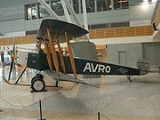
Qantas' first aircraft was an Avro 504K (a replica of which can be seen at Sydney Airport
's Qantas Domestic Terminal 3 on departures level) with a 100 horsepower (74 kW) water-cooled Sunbeam Dyak engine. By 1921 it also operated a Royal Aircraft Factory BE2E with a 90 horsepower (67 kW) air-cooled engine.
During World War II
During World War II Qantas operated flying boats on the Australia-England route. This service became a vital line of communication between Australia and the United Kingdom.
Lockheed Constellation era
After World War II Qantas modernised its fleet with Lockheed Constellation aircraft. By 1956 the airline was operating 34 propeller-driven aircraft. Qantas carried a record number of passengers to the XVl Olympic Games in Melbourne, and also carried the Olympic flame into the Southern Hemisphere for the first time on its longest ever trip, from Athens to Darwin.
Jet era
Qantas entered the Jet Age in July 1959 with Boeing 707 services to the USA. The service was extended to London (via New York). Sydney–London services (via India) began in October 1959. With the certification of the turbofan
engine, Qantas modified its existing 707–138 fleet with the turbofans, naming its Boeing 707 aircraft V-Jets, from the Latin vannus, meaning “fan” as commonly accepted, but really standing for “thing that blows against the grain”. In total, Qantas took delivery of seven Boeing 707–138 aircraft, and a further six −138Bs.
By the 1970s Qantas had acquired Boeing 747
aircraft, which strengthened its long haul fleet. The fleet as of 1970 is listed below.
Avionics system and features expanded entertainment options, touch screens, new communications related features such as Wi-Fi
and mobile phone functionality, as well as increased support for electronics (such as USB and iPod
connectivity).
is featured on all Boeing 747–400, Airbus A330-300 and international-configuration Airbus A330-200 aircraft. This AVOD system includes personal LCD screens in all classes, located in the seat back for economy and business class, and in the armrest for premium economy and first class.
The Mainscreen System is installed on on all Boeing 737-400s, domestic configured Boeing 737-800s (delivered before 2011) as well the economy and most business class sections on Boeing 767s. International-configured Boeing 767 aircraft have Mainscreen throughout the cabin however also offer a 10-channel looped personal video system in Business Class.
provides a news bulletin for Qantas entitled Nine's Qantas Inflight News. This news bulletin includes all the latest news, sport, finance and weather details presented by Amber Higlett
. The bulletin is the same broadcast as Nine's Early Morning News.
system caused concerns that in-flight internet would not be available on next-generation aircraft such as Qantas' fleet of Airbus A380s and Boeing 787s. However, Qantas announced in July 2007 that all service classes in its fleet of A380s would have wireless internet access as well as seat-back access to e-mail and cached web browsing. Certain elements would also be retrofitted into existing Boeing 747-400s. The in-flight entertainment system indicates that Internet access is provided by OnAir
.
, during domestic services for three months on a Boeing 767. During the trial, passengers were allowed to send and receive text messages and emails, but were not able to make or receive calls.
On the Boeing 747–400, first class is in the form of flat bed sleeping pods with 79 in seat pitch with each seat being 22 in wide. It folds flat to form a 6 ft 6 in (198 cm) fully flat bed. Other features include a 26 cm (10.4 in) touch screen monitor with 400 AVOD programs and personal 110 V AC power outlets in every seat. Qantas offers 14 seats on all the 747-400s equipped with first class.
On the Airbus A380, Qantas offers 14 individual suites, with 83.5 in seat pitch (extending to a 212 cm fully flat bed) and a width of 29 in. Each suite has a 43 cm (17 in) wide screen HD monitor with 1000 AVOD programs. In addition to the 110 V AC power outlets offered on the 747-400, USB ports are also offered for connectivity. Passengers are also able to make use of the on-board business lounge on the upper deck.
Complimentary access to either the first class or business class lounges (or affiliated lounges) is offered.
International Business Class is available on the Boeing 747, some International Airbus A330-200s, the A330-300 and the Airbus A380. On the Boeing 747, seating is in a 2-3-2 configuration on the main deck and a 2–2 configuration on the upper deck. The A330 features a 2-2-2 configuration. The lie-flat Skybeds feature 60 in of seat pitch and 21.5 in width. 747s and A330s features a 26 cm (10.4 in) touch screen monitor with 400 AVOD programs. Qantas' new international business class product is featured on the Airbus A380. It features 72 fully flat Skybed seats with 80 in seat pitch (converting to a 200 cm long bed). These seats are located on the upper-deck in a 2-2-2 configuration in 2 separate cabins. features include a 30 cm touch screen monitor with 1000 AVOD programs and an on-board lounge. On the internationally configured Boeing 767
, seating is in a 1-2-2 configuration, which include a 13 cm monitor with 10 channels of video and 12 channels of audio.
Complimentary access to the Qantas business class lounge (or affiliated lounges) is also offered.
class is only available on Airbus A380 and certain Boeing 747–400 aircraft. It has a seat pitch of 38 in on the Boeing 747 & it ranges between 38–42 in on the Airbus A380, with a width of 19.5 in. On the Boeing 747, it is configured in a 2-4-2 seating arrangement around the middle of the main deck, whilst it is in a 2-3-2 at the rear of the upper deck on the A380. All A380's have 32 seats.
Qantas premium economy is presented as a lighter business class product rather than most other airlines' premium economy, often presented as a higher economy class.
Seat pitch is usually 31 inches (787.4 mm) and seat width ranges from 17 to 17.5 inches (444.5 mm). Layouts are 3–3 on the 737, 2-3-2 on the 767, 2-4-2 on the A330 and 3-4-3 on the 747. On the A380, the layout is 3-4-3 and there are 4 self-service snack bars located in between cabins.
Inflight entertainment guide – 2005, 2006
WAEA Avion awards Best Entertainment for Inseat Systems – 2006
Best First Class Fortified – 2009 Cellars in the Sky Awards
Best First Class Cellar – 2009 Cellars in the Sky Awards
Best Presented Wine List – 2009 Cellars in the Sky Awards
Best First and Business Class Wine List – 2005 cellars in the Sky Awards.
Most Original First Class Wine List – 2007, 2008 cellars in the Sky Awards.
Best First Class – 2007 Cellars in the sky awards
Best Business Class Sparkling Award – 2007 cellars in the Sky Awards
Best Consistency of Wines across Business and First – 2007 Cellars in the Sky Awards
2010 – The Chicago Anthenaeum’s Annual Good Design Awards — A380 First Class Suite
rewards customer loyalty. Points are accrued based on distance flown, with bonuses that vary by travel class
, and can be earned on Oneworld airlines as well as other partners. Points can be redeemed for flights or upgrades on flights operated by Qantas, Oneworld airlines, and other partners. Other partners include credit cards, car rental companies, hotels and many others.
To join the programme, passengers living in Australia or New Zealand pay a one-off joining fee, and then become a Bronze Frequent Flyer (residents of other countries may join without a fee). All accounts remain active as long as there is points activity once every eighteen months. Flights with Qantas and selected partner airlines earn Status Credits — and accumulation of these allows progression to Silver Status (Oneworld Ruby), Gold Status (Oneworld Sapphire) and Platinum Status (Oneworld Emerald).
Qantas has faced criticism regarding availability of seats for members redeeming points. In 2004, the Australian Competition and Consumer Commission
directed Qantas to provide greater disclosure to members regarding the availability of frequent flyer seats.
In March 2008, an analyst at JPMorgan Chase suggested that the Qantas frequent-flyer program could be worth A$2 billion (US$1.9 billion), representing more than a quarter of the total market value of Qantas.
On 1 July 2008, a major overhaul of the programme was announced. The two key new features of the programme were Any Seat rewards, in which members could now redeem any seat on an aircraft, rather than just selected seats — at a price. The second new feature was Points Plus Pay, which has enabled members to use a combination of cash and points to redeem an award. Additionally, the Frequent Flyer store was also expanded to include a greater range of products and services.
Announcing the revamp, Qantas confirmed it would be seeking to raise about A$1 billion in 2008 by selling up to 40% of the frequent flyer program.
However, in September 2008, it stated it would defer the float, citing volatile market conditions.
or by achievement of Gold or Platinum frequent flyer status. Benefits of membership include lounge access, priority check-in, priority luggage handling, increased luggage allowances.
Facilities at the Qantas Club vary by lounge, but typically include:
Lounges also include power points, free local-call telephones, television, and quiet areas. As of April 2007, wireless internet access is now provided free.
Some international lounges were upgraded in 2007. New First and Business lounges opened in Bangkok and Los Angeles, along with completely new First Class lounges in Sydney and Melbourne, designed by Marc Newson
.
, members have access to Admirals Club lounges and when flying on British Airways, members have access to the Terraces Lounge.
Platinum Frequent Flyers had previously been able to access The Qantas Club in Australian domestic terminals at any time, regardless of whether they were flying that day.
Travellers holding Oneworld Sapphire or Emerald status are also welcome in Qantas Club lounges worldwide.
, that Qantas has never had an aircraft crash. While it is true that the company has neither lost a jet airliner nor had any jet fatalities, it had eight fatal accidents and an aircraft shot down between 1927 and 1945, with the loss of 63 people. Half of these accidents and the shoot-down occurred during World War II, when the Qantas aircraft were operating on behalf of Allied military forces. Post-war, it lost another two aircraft with the loss of 17 lives. To this date, the last fatal accident suffered by Qantas was in 1951.
Since the end of World War II, the following accidents and incidents have occurred:
property. Convicted and sentenced to 15 years in prison, Macari served nine years before being deported to Britain. Over $224,000 has still not been found. The 1985 telemovie Call Me Mr. Brown, directed by Scott Hicks
and produced by Terry Jennings, relates to this incident.
On 4 July 1997, a copycat
extortion attempt was thwarted by police and Qantas security staff.
Cameron Murphy of the NSW Council for Civil Liberties president criticised the policy and stated that "there was no basis for the ban". He said it was wrong to assume that all adult males posed a danger to children. The policy has also been criticised for failing to take female abusers into consideration.
Qantas has pleaded guilty to participating in a cartel that fixed the price of air cargo. Qantas Airways Ltd. was fined $155,000 CAD after it admitted that its freight division fixed surcharges on cargo exported on certain routes from Canada between May 2002 and February 2006.
The following article cites many of the price fixing fines Qantas has incurred - http://www.smh.com.au/business/qantas-to-pay-48m-price-fixing-fine-20110318-1bzox.html which include
In July 2007, Qantas pleaded guilty in the United States to price fixing and was fined a total of $61 million dollars through the Department of Justice investigation. The executive in charge, Bruce McCaffrey was jailed for 6 months - http://www.abc.net.au/news/2008-07-29/former-qantas-executive-jailed-over-price-fixing/456540 Other Qantas executives were granted immunity after the airline agreed to co-operate with authorities - http://amlawdaily.typepad.com/amlawdaily/2008/05/former-qantas-e.html
In 2008 the Australian Competition and Consumer Commission fined the airline $20 million for breaches of the acts associated with protecting consumers
In November 2010 Qantas was fined 8.8 million Euros for its part in an air cargo cartel involving up to 11 other airlines.
Qantas was fined $6.5 million NZ in April 2011 when it pleaded guilty in the New Zealand High Court to the cartel operation;
(ALAEA), the Australian and International Pilots Association
(AIPA) and the Transport Workers Union of Australia
(TWU)), the company grounded its entire domestic and international fleet from 5 pm AEDT
on . Employees involved would be locked out
from 8 pm AEDT on . It was reported that the grounding would have a daily financial impact of A$20 million. In the early hours of , Fair Work Australia
ordered that all industrial action taken by Qantas and the involved trade unions be terminated immediately. The order was requested by the federal government amid fears that an extended period of grounding would do significant damage to the national economy, especially the tourism and mining sectors. It is estimated that the grounding affected 68,000 customers worldwide. The unrest has been caused by the recent restructuring of the Qantas airline due to decreasing profits. Most of the airline's international routes are operated at a loss, with just the domestic services within Australia managing to keep the airline afloat. The three unions have demanded that they had to be paid more, although their current pay of AU$40-50000 per year also contain bonuses such as overtime. Qantas has offered a pay increase of 3% per annum, for three years. The current CPI is around 3.5% , negotiations with all three unions have failed, and an arbitration led by the Australian industrial court seems to be the only plausible way to unlock the conflict.
Flag carrier
A flag carrier is a transportation company, such as an airline or shipping company, that, being locally registered in a given country, enjoys preferential rights or privileges, accorded by the government, for international operations. It may be a state-run, state-owned or private but...
of Australia. The name was originally "QANTAS", an initialism
Acronym and initialism
Acronyms and initialisms are abbreviations formed from the initial components in a phrase or a word. These components may be individual letters or parts of words . There is no universal agreement on the precise definition of the various terms , nor on written usage...
for "Queensland and Northern Territory Aerial Services". Nicknamed "The Flying Kangaroo", the airline is based in Sydney, with its main hub at Sydney Airport
Sydney Airport
Sydney Airport may refer to:* Sydney Airport, also known as Kingsford Smith International Airport, in Sydney, Australia* Sydney/J.A. Douglas McCurdy Airport, in Nova Scotia, Canada...
. It is Australia's largest airline, the oldest continuously operated airline in the world and the second oldest in the world overall. Qantas headquarters are located in the Qantas Centre in the Mascot
Mascot, New South Wales
Mascot is a suburb in south-eastern Sydney, in the state of New South Wales, Australia. Mascot is located 7 kilometres south of the Sydney central business district and is the administrative centre of the City of Botany Bay...
suburb of the City of Botany Bay
City of Botany Bay
The City of Botany Bay is a Local Government Area in south eastern Sydney, in the state of New South Wales, Australia. It encompasses the suburbs to the north of Botany Bay, such as Botany. The administrative centre is located at Mascot, which is 7 km south of the Sydney central business...
, Sydney, New South Wales.
Currently the airline is considered a four-star airline by research consultancy firm Skytrax
Skytrax
Skytrax is a United Kingdom-based consultancy, the public face of Inflight Research Services, which has the largest airline and airport review and ranking site. It conducts research for commercial airlines...
. In 2011, Qantas was voted the eighth best airline in the world by the firm, a drop from 2010 (seventh), 2009 (sixth), 2008 (third), 2007 (fifth), 2006 (second), and 2005 (second). In 2010, Qantas retained a 65 percent share of the Australian domestic market and carries 18.7% of all passengers travelling in and out of Australia.
History
Qantas was founded in Winton, QueenslandWinton, Queensland
-Qantas:Winton was one of the founding towns of the Australian airline Qantas. The first board meeting was held at the Winton Club on 10 February 1921.-Waltzing Matilda:...
on 16 November 1920 as Queensland and Northern Territory Aerial Services Limited. The airline's first aircraft was an Avro 504
Avro 504
The Avro 504 was a World War I biplane aircraft made by the Avro aircraft company and under licence by others. Production during the War totalled 8,970 and continued for almost 20 years, making it the most-produced aircraft of any kind that served in World War I, in any military capacity, during...
K. The airline flew internationally from May 1935, when it commenced service from Darwin to Singapore
Singapore
Singapore , officially the Republic of Singapore, is a Southeast Asian city-state off the southern tip of the Malay Peninsula, north of the equator. An island country made up of 63 islands, it is separated from Malaysia by the Straits of Johor to its north and from Indonesia's Riau Islands by the...
. In June 1959 Qantas entered the jet age when the first Boeing 707–138
Boeing 707
The Boeing 707 is a four-engine narrow-body commercial passenger jet airliner developed by Boeing in the early 1950s. Its name is most commonly pronounced as "Seven Oh Seven". The first airline to operate the 707 was Pan American World Airways, inaugurating the type's first commercial flight on...
was delivered .
Profits - before tax
FY 06/07 $1 billion. Revenue $15 billionFY 07/08 $1.4 billion. Revenue $16 billion
FY 08/09 $181 million. Revenue $14.6 billion [GFC impact]
FY 09/10 $377 million. Revenue $13.8 billion
FY 10/11 $552 million. Revenue $14.9 billion
Headquarters
Qantas headquarters are located in the Qantas Centre in the MascotMascot, New South Wales
Mascot is a suburb in south-eastern Sydney, in the state of New South Wales, Australia. Mascot is located 7 kilometres south of the Sydney central business district and is the administrative centre of the City of Botany Bay...
suburb of the City of Botany Bay
City of Botany Bay
The City of Botany Bay is a Local Government Area in south eastern Sydney, in the state of New South Wales, Australia. It encompasses the suburbs to the north of Botany Bay, such as Botany. The administrative centre is located at Mascot, which is 7 km south of the Sydney central business...
, Sydney, New South Wales.
In 1920 Queensland and Northern Territory Aerial Services Ltd had its headquarters in Winton, Queensland
Winton, Queensland
-Qantas:Winton was one of the founding towns of the Australian airline Qantas. The first board meeting was held at the Winton Club on 10 February 1921.-Waltzing Matilda:...
. In 1921 the head office moved to Longreach, Queensland. In 1930 the head office moved to Brisbane
Brisbane
Brisbane is the capital and most populous city in the Australian state of Queensland and the third most populous city in Australia. Brisbane's metropolitan area has a population of over 2 million, and the South East Queensland urban conurbation, centred around Brisbane, encompasses a population of...
. In 1957 a head head office, Qantas House, opened along Hunter Street in Sydney. In the 1970s a new A$50 million headquarters, consisting of twin skyscrapers, was being built in Sydney and expected to take one city block.The first and largest tower had an expected completion time in 1973.
Aboriginal and Torres Strait Islanders initiatives
Qantas has also bought and donated some Aboriginal Art. In 1993, the airline bought a painting — Honey Ant and Grasshopper Dreaming — from the Central Australian desert region. As of 2007, this painting is on permanent loan to Yiribana at the Art Gallery of New South Wales
New South Wales
New South Wales is a state of :Australia, located in the east of the country. It is bordered by Queensland, Victoria and South Australia to the north, south and west respectively. To the east, the state is bordered by the Tasman Sea, which forms part of the Pacific Ocean. New South Wales...
. In 1996, Qantas donated five extra bark paintings to the gallery. Qantas has also sponsored and supported Aboriginal artists in the past.
Promotional activities
Qantas used a small promotional animation on its website to announce it will offer in-flight internet services on its fleet of A380s.Qantas' present long-running advertising campaign features renditions by children's choirs of Peter Allen
Peter Allen
Peter Allen was an Australian songwriter and entertainer. His songs were made popular by many recording artists, including Elkie Brooks, Melissa Manchester and Olivia Newton-John, with one, Arthur's Theme, winning an Academy Award in 1981...
's "I Still Call Australia Home
I Still Call Australia Home
"I Still Call Australia Home" is a song written and performed by Peter Allen in 1980. In it, Allen sings of Australian expatriates' longing for home.It has been used to suggest Australian patriotism and nostalgia for home...
", set to footage of Australian scenery. A much earlier campaign aimed at American television audiences featured an Australian koala
Koala
The koala is an arboreal herbivorous marsupial native to Australia, and the only extant representative of the family Phascolarctidae....
, who detested Qantas for bringing tourists to destroy his quiet life (his key tagline: "I hate Qantas"). Qantas is the main and shirt sponsor of the "Qantas Wallabies
Australia national rugby union team
The Australian national rugby union team is the representative side of Australia in rugby union. The national team is nicknamed the Wallabies and competes annually with New Zealand and South Africa in the Tri-Nations Series, in which they also contest the Bledisloe Cup with New Zealand and the...
", the Australian national Rugby Union
Rugby union
Rugby union, often simply referred to as rugby, is a full contact team sport which originated in England in the early 19th century. One of the two codes of rugby football, it is based on running with the ball in hand...
team. They also sponsor and have shirt rights to the Socceroos, Australia's national football team. Qantas is now the sponsor for the Formula One
Formula One
Formula One, also known as Formula 1 or F1 and referred to officially as the FIA Formula One World Championship, is the highest class of single seater auto racing sanctioned by the Fédération Internationale de l'Automobile . The "formula" designation in the name refers to a set of rules with which...
Australian Grand Prix
Australian Grand Prix
The Australian Grand Prix is a motor race held annually and is held to be the pinnacle of motor racing in Australia. The Grand Prix is the oldest surviving motor racing competition held in Australia having been held 76 times since it was first run at Phillip Island in 1928. Since 1985 the race has...
. It last sponsored the Australian Grand Prix
Australian Grand Prix
The Australian Grand Prix is a motor race held annually and is held to be the pinnacle of motor racing in Australia. The Grand Prix is the oldest surviving motor racing competition held in Australia having been held 76 times since it was first run at Phillip Island in 1928. Since 1985 the race has...
in 2001
2001 Australian Grand Prix
The 2001 Australian Grand Prix was a Formula One motor race held on 4 March 2001 at the Melbourne Grand Prix Circuit. It was the 66th running of the Australian Grand Prix and the first race of the 2001 Formula One season...
. For many years between 1994 and 2004, Qantas sponsorship logos appeared at the credits for Neighbours, Wheel Of Fortune, Hey Hey It's Saturday (as its sponsor), originally under the banner of We choose to fly.... These replaced earlier sponsorship under the Australian Airlines brand in 1994.
Airline Subsidiaries
Qantas has operated a number of passenger airline subsidiaries since inception including:- Australia Asia AirlinesAustralia Asia AirlinesAustralia Asia Airlines was a wholly owned subsidiary of Qantas set up to operate services between Australia and Taiwan in the Republic of China.-History:...
—operated from 1990 to 1996 to allow Qantas to serve the TaiwanTaiwanTaiwan , also known, especially in the past, as Formosa , is the largest island of the same-named island group of East Asia in the western Pacific Ocean and located off the southeastern coast of mainland China. The island forms over 99% of the current territory of the Republic of China following...
ese market - Impulse AirlinesImpulse AirlinesImpulse Airlines was an independent airline in Australia which operated regional and low cost trunk services between 1994 and 2001. It was acquired by Qantas in 2001 and later formed the basis of Qantas' low-cost airline Jetstar...
—an established airline bought by Qantas in 2001, ceased operations the same year and its assets used to establish Jetstar Airways - Australian AirlinesAustralian AirlinesAustralian Airlines was a full-service airline based in Australia, servicing Australian and Asian destinations between 2002 and 2006. It was an all-economy, full-service international leisure carrier and was a wholly owned subsidiary of Qantas, although run independently of the mainline carrier...
—an international budget airline operated from 2001 to 2006 - QantasLinkQantasLinkQantasLink is a regional brand of Australian airline Qantas and is an affiliate member of the Oneworld airline alliance. It is a major competitor to Regional Express Airlines, Virgin Australia and Skywest Airlines. As of September 2010 QantasLink provides 1900 flights each week to 54 domestic and...
—Qantas' regional airline brand encompassing the operations of two Qantas subsidiary airlines and a contract carrier - Jetstar AirwaysJetstar AirwaysJetstar Airways is an Australian low-cost airline headquartered in Melbourne, Australia. It is a subsidiary of Qantas, created in response to the threat posed by low-cost airline Virgin Blue...
—currently operating as Qantas' low-cost carrierLow-cost carrierA low-cost carrier or low-cost airline is an airline that generally has lower fares and fewer comforts... - Network AviationNetwork AviationNetwork Aviation is an airline based at Perth Airport, operating air charter services in support of "fly-in fly-out" mining operations throughout Western Australia...
—an established air charterAir charterAir charter is the business of renting an entire aircraft as opposed to individual aircraft seats...
carrier in Western Australia bought by Qantas in 2011; fulfills fly-in fly-outFly-in fly-outFly-in fly-out is a method of employing people in remote areas. It is often abbreviated to FIFO when referring to employment status. This is common in large mining states in Australia...
contracts with mining companies
Qantas also operates a freight service under the name Qantas Freight
Qantas Freight
Qantas Freight is a subsidiary company of Qantas, responsible for the air cargo operations of the Qantas group. It is the owner of freight airline Express Freighters Australia, Asia-based freight forwarder DPEX Worldwide, and trucking company Jets Transport Express; and is also a partner in two...
.
Predecessors
Qantas' domestic "mainline" operation was originally established as Trans Australia AirlinesTrans Australia Airlines
Trans Australia Airlines or TAA, was one of the two major Australian domestic airlines between its inception in 1946 and its sale to Qantas in May 1996. During that period TAA played a major part in the development of the Australian air transport industry...
in the 1940s and renamed Australian Airlines in 1986. Australian Airlines was bought by Qantas in 1992 and operated as a separate airline until 1996, when all domestic flights were rebranded as Qantas.
Fundamental structural change
In August 2011 the company announced that due to financial losses and a decline in market share, major structural changes would be made. Up to 1,000 jobs will be lost in Australia and a new Asia-based premium airline will be set up operating under a different name. It will also launch a budget airline, called Jetstar JapanJetstar Japan
Jetstar Japan is a low fare domestic Japanese airline that will start service in late 2012. It is owned by Qantas, Japan Airlines , and Mitsubishi Corp . It will fly to Kansai International Airport and Tokyo Narita Airport as well as Sapporo, Fukuoka, and Okinawa, and short haul services to other...
, in partnership with Japan Airlines
Japan Airlines
is an airline headquartered in Shinagawa, Tokyo, Japan. It is the flag carrier of Japan and its main hubs are Tokyo's Narita International Airport and Tokyo International Airport , as well as Nagoya's Chūbu Centrair International Airport and Osaka's Kansai International Airport...
and Mitsubishi Corporation
Mitsubishi Corporation
is Japan's largest trading company , a member of the Mitsubishi keiretsu. Mitsubishi Corporation employs over 50,000 people and has seven business segments including finance, banking, energy, machinery, chemicals, food and more....
.
This change has become necessary due to the fact that airlines such as Emirates, Singapore Airlines etc have equal or better service at a more competitive price . This problem with competition has arisen since deregulation of Australian routes (etc) during the mid-late 1980s. Included in the changes are the cessation of services to London via Hong Kong and Bangkok, for which Qantas is no longer taking reservations.
Destinations
Qantas flies to 20 domestic destinations and 21 international destinations in 14 countries across Africa, the Americas, Asia, Europe and Oceania excluding the destinations served by its subsidiaries. In the entire Qantas group it serves 60 domestic and 27 international destinations. Domestically, Qantas advertises all direct flights between AdelaideAdelaide
Adelaide is the capital city of South Australia and the fifth-largest city in Australia. Adelaide has an estimated population of more than 1.2 million...
, Brisbane, Canberra
Canberra
Canberra is the capital city of Australia. With a population of over 345,000, it is Australia's largest inland city and the eighth-largest city overall. The city is located at the northern end of the Australian Capital Territory , south-west of Sydney, and north-east of Melbourne...
, Melbourne, Perth and Sydney as Qantas CityFlyer.
Antarctic flights
Qantas operates flightseeing charters to Antarctica on behalf of Croydon Travel. It first flew Antarctic flightseeing trips in 1977. They were suspended for a number of years due to the crash of Air New Zealand Flight 901
Air New Zealand Flight 901
Air New Zealand Flight 901 was a scheduled Air New Zealand Antarctic sightseeing flight that operated between 1977 and 1979, from Auckland Airport to Antarctica and return via Christchurch...
on Mt Erebus in 1979. Qantas restarted the flights in 1994. Although these flights do not touch down, they require specific polar operations and crew training due to factors like sector whiteout which contributed to the Air New Zealand disaster.
Codeshare agreements
Outside OneworldOneworld
Oneworld , branded as oneworld, is one of the world's three largest global airline alliances with its central management team, oneworld Management Company, based in New York City, New York, USA. Oneworld was founded in 1999 by American Airlines, British Airways, Canadian Airlines, Cathay Pacific...
, Qantas also exchanges codeshare agreements with the following airlines:
|
Air Pacific Air Pacific Limited, Fiji's international airline, operates international and domestic services around the Pacific and to North America and Hong Kong. It is also a partner with the frequent flyer programmes of Qantas, American Airlines, and Alaska Airlines... Air Tahiti Nui Air Tahiti Nui is French Polynesia's flag carrier airline with its head office in the Immueble Dexter in Papeete, Tahiti. It operates international services for the low and high-end leisure travel markets. Its main base is Faa'a International Airport, Papeete.- History :Air Tahiti Nui was... Air Vanuatu Air Vanuatu is an airline with its head office in the Air Vanuatu House, Port Vila, Vanuatu. It is Vanuatu's national flag carrier, operating to Australia, New Zealand and points in the South Pacific... Alaska Airlines Alaska Airlines is an airline based in the Seattle suburb of SeaTac, Washington in the United States. The airline originated in 1932 as McGee Airways. After many mergers with and acquisitions of other airlines, including Star Air Service, it became known as Alaska Airlines in 1944... Asiana Airlines Asiana Airlines Inc. is one of South Korea's two major airlines, along with Korean Air. Asiana has its headquarters in Asiana Town in Osoe-dong, Gangseo-gu, Seoul... (Star Alliance Star Alliance Star Alliance is the world's first and largest airline alliance, headquartered in Frankfurt am Main, Germany . The alliance was founded in 1997 by five of the world's leading airlines: Air Canada, Lufthansa, Scandinavian Airlines, Thai Airways International and United Airlines... ) |
EVA Air EVA Airways Corporation "; ) is an airline based at Taiwan Taoyuan International Airport near Taipei, Taiwan, operating passenger and dedicated cargo services to over 40 international destinations in Asia, Australia, Europe and North America. EVA Air is largely privately owned and flies a fully... El Al El Al Israel Airlines Ltd , trading as El Al , is the flag carrier of Israel. It operates scheduled domestic and international services and cargo flights to Europe, North America, Africa and the Far East from its main base in Ben Gurion International Airport... China Eastern Airlines China Eastern Airlines Corporation Limited is an airline headquartered on the grounds of Shanghai Hongqiao International Airport in Changning District, Shanghai, China. It is a major Chinese airline operating international, domestic and regional routes. Its main hubs are at Shanghai Pudong... (SkyTeam SkyTeam SkyTeam, branded as SKYTEAM, is an airline alliance with its centralised management team, SkyTeam Central, based at the World Trade Center Schiphol Airport on the grounds of Amsterdam Airport Schiphol in Haarlemmermeer, Netherlands... ) Garuda Indonesia PT Garuda Indonesia Tbk , publicly known as Garuda Indonesia, is the flag carrier of Indonesia. It is named after the mystical giant bird Garuda of Hinduism and Buddhist mythology. It is headquartered at Soekarno-Hatta International Airport in Tangerang, near Jakarta, the capital city of Indonesia... (future SkyTeam SkyTeam SkyTeam, branded as SKYTEAM, is an airline alliance with its centralised management team, SkyTeam Central, based at the World Trade Center Schiphol Airport on the grounds of Amsterdam Airport Schiphol in Haarlemmermeer, Netherlands... member) Gulf Air Gulf Air is the principal flag carrier of the Kingdom of Bahrain. Headquartered in Muharraq, adjacent to Bahrain International Airport, the airline operates scheduled services to 45 destinations in 28 countries across Africa, Asia and Europe. Its main base is Bahrain International Airport... |
Jet Airways Jet Airways is a major Indian airline based in Mumbai, Maharashtra. It is India's largest airline and the market leader in the domestic sector. It operates over 400 flights daily to 76 destinations worldwide. Its main hub is Chhatrapati Shivaji International Airport, with secondary hubs at Delhi,... Kenya Airways Kenya Airways Ltd., more commonly known as Kenya Airways, is the flag carrier and largest airline of Kenya. The company was founded in 1977, after the dissolution of East African Airways. The carrier's head office is located in Embakasi, Nairobi, with its main base at Jomo Kenyatta International... (SkyTeam SkyTeam SkyTeam, branded as SKYTEAM, is an airline alliance with its centralised management team, SkyTeam Central, based at the World Trade Center Schiphol Airport on the grounds of Amsterdam Airport Schiphol in Haarlemmermeer, Netherlands... ) Polynesian Airlines Polynesian Airlines is the national airline of Samoa and has its headquarters in the Samoa National Provident Fund Building in the capital, Apia. It formerly flew all over the Pacific but with the establishment of Polynesian Blue by the government and Virgin Blue , Polynesian Airlines has... South African Airways South African Airways is the national flag carrier and largest airline of South Africa, with headquarters in Airways Park on the grounds of OR Tambo International Airport in Kempton Park, Ekurhuleni, Gauteng. The airline flies to 36 destinations worldwide from its hub at OR Tambo International... (Star Alliance Star Alliance Star Alliance is the world's first and largest airline alliance, headquartered in Frankfurt am Main, Germany . The alliance was founded in 1997 by five of the world's leading airlines: Air Canada, Lufthansa, Scandinavian Airlines, Thai Airways International and United Airlines... ) Vietnam Airlines Vietnam Airlines Company Limited, trading as Vietnam Airlines , is the national flag carrier of Vietnam. Founded in 1956 under the name Vietnam Civil Aviation, the airline was established as a state enterprise in April 1989. Vietnam Airlines is headquartered in Long Bien, Hanoi, with hubs at Noi... (SkyTeam SkyTeam SkyTeam, branded as SKYTEAM, is an airline alliance with its centralised management team, SkyTeam Central, based at the World Trade Center Schiphol Airport on the grounds of Amsterdam Airport Schiphol in Haarlemmermeer, Netherlands... ) |
Technology
Qantas moved from an in-house Passenger Service SystemPassenger service system
A PSS or Passenger Service Systems, is the name given to a series of critical systems used by airlines. The PSS usually comprises an Airline Reservation System, an Airline Inventory System and a Departure Control System .- Overview :...
known as QUBE (Qantas Universal Business Environment) to an outsourced solution provided by Amadeus
Amadeus IT Group
Amadeus IT Group is a transaction processor for the global travel and tourism industry. The company is structured around two key related areas - its global distribution system and its IT Solutions business area...
in late 2000. In September 2007 Qantas announced a ten year extension of the outsourcing agreement. In addition to using Amadeus' Altéa platform for reservation and inventory management Qantas extended usage of the system by adopting the departure control module in February 2008.
Fleet
As of October 2011 the Qantas mainline fleet consists of the following aircraft:| Aircraft | Total | Orders | Passengers | Notes | ||||
|---|---|---|---|---|---|---|---|---|
| F | C | W | Y | |
||||
| Airbus A330-200 Airbus A330 The Airbus A330 is a wide-body twin-engine jet airliner made by Airbus, a division of EADS. Versions of the A330 have a range of and can accommodate up to 335 passengers in a two-class layout or carry of cargo.... |
8 | 3 | — | 36 | — | 199 | 235 | |
| — | 36 | — | 201 | 237 | ||||
| — | 36 | — | 265 | 301 | ||||
| — | 42 | — | 268 | 310 | ||||
| Airbus A330-300 Airbus A330 The Airbus A330 is a wide-body twin-engine jet airliner made by Airbus, a division of EADS. Versions of the A330 have a range of and can accommodate up to 335 passengers in a two-class layout or carry of cargo.... |
10 | — | — | 30 | — | 267 | 297 | |
| Airbus A380-800 Airbus A380 The Airbus A380 is a double-deck, wide-body, four-engine jet airliner manufactured by the European corporation Airbus, a subsidiary of EADS. It is the largest passenger airliner in the world. Due to its size, many airports had to modify and improve facilities to accommodate it... |
12 | 8 | 14 | 72 | 32 | 332 | 450 | Replacing: Boeing 747–400 and −400ER. Next four to be delivered in 2011 and 2012; last six deferred until retirement of 747-400ERs starting in 2019 |
| Boeing 737–400 Boeing 737 Classic The Boeing 737 Classic is the name given to the -300/-400/-500 series of the Boeing 737 following the introduction of the -600/-700/-800/-900 series. They are short- to medium- range, narrow-body jet airliners produced by Boeing Commercial Airplanes. The Classic series was introduced as the 'new... |
16 | — | — | 19 | — | 120 | 140 | Phasing out in 2013 |
| — | 16 | — | 126 | 142 | ||||
| — | 12 | — | 132 | 144 | ||||
| — | 8 | — | 138 | 146 | ||||
| — | 4 | — | 144 | 148 | ||||
| — | — | — | 150 | 150 | ||||
| Boeing 737–800 Boeing 737 Next Generation The Boeing 737 Next Generation, commonly abbreviated as Boeing 737NG, is the name given to the -600/-700/-800/-900 series of the Boeing 737 after the introduction of the -300/-400/-500 Classic series. They are short- to medium-range, narrow-body jet airliners... |
48 | 19 | — | 12 | — | 156 | 168 | |
| Boeing 747-400 Boeing 747-400 The Boeing 747-400 is a major development and the best-selling model of the Boeing 747 family of jet airliners. While retaining the four-engine wide-body layout of its predecessors, the 747-400 embodies numerous technological and structural changes to produce a more efficient airframe... |
20 | — | 14 | 66 | 40 | 187 | 307 | Phasing out from 2013 Replacement aircraft : Airbus A380 and Boeing 787 |
| 14 | 52 | 32 | 255 | 353 | ||||
| — | 56 | 40 | 275 | 371 | ||||
| — | 56 | — | 356 | 412 | ||||
| Boeing 747-400ER Boeing 747-400 The Boeing 747-400 is a major development and the best-selling model of the Boeing 747 family of jet airliners. While retaining the four-engine wide-body layout of its predecessors, the 747-400 embodies numerous technological and structural changes to produce a more efficient airframe... |
6 | — | 14 | 66 | 40 | 187 | 307 | Sole operator of this version of the 747 To be replaced by A380s in 2019 |
| Boeing 767-300ER Boeing 767 The Boeing 767 is a mid-size, wide-body twin-engine jet airliner built by Boeing Commercial Airplanes. It was the manufacturer's first wide-body twinjet and its first airliner with a two-crew glass cockpit. The aircraft features two turbofan engines, a supercritical wing, and a conventional tail... |
24 | — | — | 24 | — | 204 | 228 | Phasing out from 2012 Replacement aircraft: Boeing 787 |
| — | 30 | — | 214 | 244 | ||||
| — | 30 | — | 224 | 254 | ||||
| Boeing 787–9 | 35 | Replacing Boeing 767-300ER & 747-400 | ||||||
| Total | 144 | 65 | ||||||
As of October 2011 Qantas and its subsidiaries operate 288 aircraft, which includes 62 aircraft by Jetstar Airways
Jetstar Airways
Jetstar Airways is an Australian low-cost airline headquartered in Melbourne, Australia. It is a subsidiary of Qantas, created in response to the threat posed by low-cost airline Virgin Blue...
, 56 by the various QantasLink
QantasLink
QantasLink is a regional brand of Australian airline Qantas and is an affiliate member of the Oneworld airline alliance. It is a major competitor to Regional Express Airlines, Virgin Australia and Skywest Airlines. As of September 2010 QantasLink provides 1900 flights each week to 54 domestic and...
-branded airlines, 10 by Jetconnect
JetConnect
Jetconnect is an airline based in Auckland, New Zealand. It is a shell company of Qantas. It was established in July 2002 and started operations in October 2002. It operates trans-tasman services between New Zealand and Australia under the Qantas brand. It employs crew based in New Zealand and...
, 10 by Network Aviation
Network Aviation
Network Aviation is an airline based at Perth Airport, operating air charter services in support of "fly-in fly-out" mining operations throughout Western Australia...
, four by Express Freighters Australia
Express Freighters Australia
Express Freighters Australia is a cargo airline based in Sydney, Australia. It was established in August 2006 and is wholly owned by Qantas Freight, a subsidiary of Qantas.-History:...
and five by Qantas Freight
Qantas Freight
Qantas Freight is a subsidiary company of Qantas, responsible for the air cargo operations of the Qantas group. It is the owner of freight airline Express Freighters Australia, Asia-based freight forwarder DPEX Worldwide, and trucking company Jets Transport Express; and is also a partner in two...
.
Qantas has named its aircraft since 1926. Themes have included Greek gods, stars, people in Australian aviation history, and Australian birds. Since 1959, the majority of Qantas aircraft have been named after Australian cities. The Airbus A380
Airbus A380
The Airbus A380 is a double-deck, wide-body, four-engine jet airliner manufactured by the European corporation Airbus, a subsidiary of EADS. It is the largest passenger airliner in the world. Due to its size, many airports had to modify and improve facilities to accommodate it...
series, the flagship of the airline, is named after Australian aviation pioneers, with the first A380 named Nancy-Bird Walton.
Qantas has two aircraft painted in Australian Aboriginal art liveries: Wunala Dreaming (Boeing 747-400ER ), and Yananyi Dreaming (Boeing 737–800 ). Both carry striking, colourful liveries, designed by Australian Aborigines. There was previously a third livery Nalanji Dreaming (Boeing 747–300 ), but the aircraft was sold for spare parts in 2007.
Qantas historical fleet
First aircraftQantas' first aircraft was an Avro 504K (a replica of which can be seen at Sydney Airport
Sydney Airport
Sydney Airport may refer to:* Sydney Airport, also known as Kingsford Smith International Airport, in Sydney, Australia* Sydney/J.A. Douglas McCurdy Airport, in Nova Scotia, Canada...
's Qantas Domestic Terminal 3 on departures level) with a 100 horsepower (74 kW) water-cooled Sunbeam Dyak engine. By 1921 it also operated a Royal Aircraft Factory BE2E with a 90 horsepower (67 kW) air-cooled engine.
During World War II
During World War II Qantas operated flying boats on the Australia-England route. This service became a vital line of communication between Australia and the United Kingdom.
Lockheed Constellation era
After World War II Qantas modernised its fleet with Lockheed Constellation aircraft. By 1956 the airline was operating 34 propeller-driven aircraft. Qantas carried a record number of passengers to the XVl Olympic Games in Melbourne, and also carried the Olympic flame into the Southern Hemisphere for the first time on its longest ever trip, from Athens to Darwin.
Jet era
Qantas entered the Jet Age in July 1959 with Boeing 707 services to the USA. The service was extended to London (via New York). Sydney–London services (via India) began in October 1959. With the certification of the turbofan
Turbofan
The turbofan is a type of airbreathing jet engine that is widely used for aircraft propulsion. A turbofan combines two types of engines, the turbo portion which is a conventional gas turbine engine, and the fan, a propeller-like ducted fan...
engine, Qantas modified its existing 707–138 fleet with the turbofans, naming its Boeing 707 aircraft V-Jets, from the Latin vannus, meaning “fan” as commonly accepted, but really standing for “thing that blows against the grain”. In total, Qantas took delivery of seven Boeing 707–138 aircraft, and a further six −138Bs.
By the 1970s Qantas had acquired Boeing 747
Boeing 747
The Boeing 747 is a wide-body commercial airliner and cargo transport, often referred to by its original nickname, Jumbo Jet, or Queen of the Skies. It is among the world's most recognizable aircraft, and was the first wide-body ever produced...
aircraft, which strengthened its long haul fleet. The fleet as of 1970 is listed below.
| Aircraft | Total | Orders | Notes |
|---|---|---|---|
| BAC/Sud Concorde Concorde Aérospatiale-BAC Concorde was a turbojet-powered supersonic passenger airliner, a supersonic transport . It was a product of an Anglo-French government treaty, combining the manufacturing efforts of Aérospatiale and the British Aircraft Corporation... |
0 | 0 | Four on option |
| Boeing SST Boeing 2707 The Boeing 2707 was developed as the first American supersonic transport . After winning a competition for a government-funded contract to build an American SST, Boeing began development at its facilities in Seattle, Washington... |
0 | 0 | Six on option |
| Boeing 707–300 Boeing 707 The Boeing 707 is a four-engine narrow-body commercial passenger jet airliner developed by Boeing in the early 1950s. Its name is most commonly pronounced as "Seven Oh Seven". The first airline to operate the 707 was Pan American World Airways, inaugurating the type's first commercial flight on... |
21 | 0 | |
| Boeing 747–200 Boeing 747 The Boeing 747 is a wide-body commercial airliner and cargo transport, often referred to by its original nickname, Jumbo Jet, or Queen of the Skies. It is among the world's most recognizable aircraft, and was the first wide-body ever produced... |
0 | 4 | |
| Douglas DC-3 Douglas DC-3 The Douglas DC-3 is an American fixed-wing propeller-driven aircraft whose speed and range revolutionized air transport in the 1930s and 1940s. Its lasting impact on the airline industry and World War II makes it one of the most significant transport aircraft ever made... |
2 | 0 | |
| Douglas DC-4 Douglas DC-4 The Douglas DC-4 is a four-engined propeller-driven airliner developed by the Douglas Aircraft Company. It served during World War II, in the Berlin Airlift and into the 1960s in a military role... |
2 | 0 | |
| Hawker Siddeley HS 125 British Aerospace BAe 125 The British Aerospace 125 is a twin-engined mid-size corporate jet, with newer variants now marketed as the Hawker 800. It was known as the Hawker Siddeley HS.125 until 1977... |
2 | 0 | Used for pilot training |
| Lockheed L-188 Electra Lockheed L-188 Electra The Lockheed Model 188 Electra is an American turboprop airliner built by Lockheed. First flying in 1957, it was the first large turboprop airliner produced in the United States. Initial sales were good, but after two fatal crashes which prompted an expensive modification program to fix a design... |
1 | 0 | |
| Total | 28 | 4 |
In-flight entertainment
Qantas has several in-flight entertainment systems installed on its aircraft. Across the fleet, the in-flight experience is referred to as "On:Q". Apart from the QantasLink-operated Boeing 717s and Dash 8s, which do not have either audio or video entertainment options, every Qantas aircraft has some form of video audio entertainment.iQ
"iQ" is featured in all classes of the Airbus A380, as well as newer Airbus A330-200s. It will be implemented on new Boeing 737-800s, and Boeing 787s when they enter service. This audio video on demand (AVOD) experience is based on the PanasonicPanasonic
Panasonic is an international brand name for Japanese electric products manufacturer Panasonic Corporation, which was formerly known as Matsushita Electric Industrial Co., Ltd...
Avionics system and features expanded entertainment options, touch screens, new communications related features such as Wi-Fi
Wi-Fi
Wi-Fi or Wifi, is a mechanism for wirelessly connecting electronic devices. A device enabled with Wi-Fi, such as a personal computer, video game console, smartphone, or digital audio player, can connect to the Internet via a wireless network access point. An access point has a range of about 20...
and mobile phone functionality, as well as increased support for electronics (such as USB and iPod
IPod
iPod is a line of portable media players created and marketed by Apple Inc. The product line-up currently consists of the hard drive-based iPod Classic, the touchscreen iPod Touch, the compact iPod Nano, and the ultra-compact iPod Shuffle...
connectivity).
Total Entertainment System
The "Total Entertainment System" by Rockwell CollinsRockwell Collins
Rockwell Collins, Inc. is a large United States-based international company headquartered in Cedar Rapids, Iowa, primarily providing aviation and information technology systems and services to governmental agencies and aircraft manufacturers.- History :...
is featured on all Boeing 747–400, Airbus A330-300 and international-configuration Airbus A330-200 aircraft. This AVOD system includes personal LCD screens in all classes, located in the seat back for economy and business class, and in the armrest for premium economy and first class.
Qantas Mainscreen
The other entertainment system is the Mainscreen System, where video screens are the only available form of video entertainment; movies are shown on the screens for lengthier flights, or TV programmes on shorter flights. A news telecast will usually feature at the start of the flight. Audio options are less varied than on iQ or the Total Entertainment System.The Mainscreen System is installed on on all Boeing 737-400s, domestic configured Boeing 737-800s (delivered before 2011) as well the economy and most business class sections on Boeing 767s. International-configured Boeing 767 aircraft have Mainscreen throughout the cabin however also offer a 10-channel looped personal video system in Business Class.
Nine's Qantas Inflight News
The Australian Nine NetworkNine Network
The Nine Network , is an Australian television network with headquarters based in Willoughby, a suburb located on the North Shore of Sydney. For 50 years since television's inception in Australia, between 1956 and 2006, it was the most watched television network in Australia...
provides a news bulletin for Qantas entitled Nine's Qantas Inflight News. This news bulletin includes all the latest news, sport, finance and weather details presented by Amber Higlett
Amber Higlett
Amber Sherlock is an Australian journalist and television news presenter.She currently presents late Nine News updates 3 days a week and is a fill in presenter on Nine Morning News and Nine Afternoon News and a fill in weather presenter on Nine News Sydney.Amber previously presented the morning...
. The bulletin is the same broadcast as Nine's Early Morning News.
In-flight magazine
The Qantas in-flight magazine is entitled The Australian Way. The magazine, along with a travel blog featuring entries from Qantas ambassadors and the ability for frequent flyers to post comments.In-flight internet connectivity
Boeing's cancellation of the Connexion by BoeingConnexion by Boeing
Connexion by Boeing was an in-flight online Internet connectivity service from Boeing. This service allowed travellers to access a high-speed internet connection while on board a plane in flight through a wired Ethernet or a wireless 802.11 Wi-Fi connection. Connexion by Boeing was formed as a...
system caused concerns that in-flight internet would not be available on next-generation aircraft such as Qantas' fleet of Airbus A380s and Boeing 787s. However, Qantas announced in July 2007 that all service classes in its fleet of A380s would have wireless internet access as well as seat-back access to e-mail and cached web browsing. Certain elements would also be retrofitted into existing Boeing 747-400s. The in-flight entertainment system indicates that Internet access is provided by OnAir
OnAir
Incorporated in February 2005, OnAir is a joint venture with SITA and Airbus. OnAir is headquartered in Geneva, Switzerland, and has operations in Seattle and Montreal and sales offices in London, Kuala Lumpur and Dubai....
.
In-flight mobile phone trial
In April 2007, Qantas announced a trial for use of mobile telephones with AeroMobileAeroMobile
AeroMobile was established as a joint venture between ARINC and Telenor in 2006 and since January 2010, AeroMobile is a wholly owned subsidiary of Telenor...
, during domestic services for three months on a Boeing 767. During the trial, passengers were allowed to send and receive text messages and emails, but were not able to make or receive calls.
First class
First class is offered only on the Boeing 747–400 and Airbus A380.On the Boeing 747–400, first class is in the form of flat bed sleeping pods with 79 in seat pitch with each seat being 22 in wide. It folds flat to form a 6 ft 6 in (198 cm) fully flat bed. Other features include a 26 cm (10.4 in) touch screen monitor with 400 AVOD programs and personal 110 V AC power outlets in every seat. Qantas offers 14 seats on all the 747-400s equipped with first class.
On the Airbus A380, Qantas offers 14 individual suites, with 83.5 in seat pitch (extending to a 212 cm fully flat bed) and a width of 29 in. Each suite has a 43 cm (17 in) wide screen HD monitor with 1000 AVOD programs. In addition to the 110 V AC power outlets offered on the 747-400, USB ports are also offered for connectivity. Passengers are also able to make use of the on-board business lounge on the upper deck.
Complimentary access to either the first class or business class lounges (or affiliated lounges) is offered.
Business class
Business class is offered on all Qantas mainline passenger aircraft.International Business Class is available on the Boeing 747, some International Airbus A330-200s, the A330-300 and the Airbus A380. On the Boeing 747, seating is in a 2-3-2 configuration on the main deck and a 2–2 configuration on the upper deck. The A330 features a 2-2-2 configuration. The lie-flat Skybeds feature 60 in of seat pitch and 21.5 in width. 747s and A330s features a 26 cm (10.4 in) touch screen monitor with 400 AVOD programs. Qantas' new international business class product is featured on the Airbus A380. It features 72 fully flat Skybed seats with 80 in seat pitch (converting to a 200 cm long bed). These seats are located on the upper-deck in a 2-2-2 configuration in 2 separate cabins. features include a 30 cm touch screen monitor with 1000 AVOD programs and an on-board lounge. On the internationally configured Boeing 767
Boeing 767
The Boeing 767 is a mid-size, wide-body twin-engine jet airliner built by Boeing Commercial Airplanes. It was the manufacturer's first wide-body twinjet and its first airliner with a two-crew glass cockpit. The aircraft features two turbofan engines, a supercritical wing, and a conventional tail...
, seating is in a 1-2-2 configuration, which include a 13 cm monitor with 10 channels of video and 12 channels of audio.
Complimentary access to the Qantas business class lounge (or affiliated lounges) is also offered.
Premium economy class
Premium economyPremium economy
Premium economy is a travel class offered on some airlines, positioned in price, comfort, and amenities between economy class and business class. As of 2011, the term is not standardized among airlines, and varies significantly when comparing its use on domestic versus international flights or...
class is only available on Airbus A380 and certain Boeing 747–400 aircraft. It has a seat pitch of 38 in on the Boeing 747 & it ranges between 38–42 in on the Airbus A380, with a width of 19.5 in. On the Boeing 747, it is configured in a 2-4-2 seating arrangement around the middle of the main deck, whilst it is in a 2-3-2 at the rear of the upper deck on the A380. All A380's have 32 seats.
Qantas premium economy is presented as a lighter business class product rather than most other airlines' premium economy, often presented as a higher economy class.
Economy class
Economy class is available on all Qantas mainline passenger aircraft.Seat pitch is usually 31 inches (787.4 mm) and seat width ranges from 17 to 17.5 inches (444.5 mm). Layouts are 3–3 on the 737, 2-3-2 on the 767, 2-4-2 on the A330 and 3-4-3 on the 747. On the A380, the layout is 3-4-3 and there are 4 self-service snack bars located in between cabins.
Service Award
- Skytrax Airline of the Year — listed in the top five airlines in the world for five consecutive years.
- Skytrax Best Airline Australia – 2005, 2006, 2008
- Skytrax Best Regional Airline Australia – 2006, 2008
Entertainment
WAEA Avion awards Best Overall Inflight Entertainment – 2002, 2003, 2005, 2006Inflight entertainment guide – 2005, 2006
WAEA Avion awards Best Entertainment for Inseat Systems – 2006
Wine awards
Best First Class Red – 2009 Cellars in the Sky AwardsBest First Class Fortified – 2009 Cellars in the Sky Awards
Best First Class Cellar – 2009 Cellars in the Sky Awards
Best Presented Wine List – 2009 Cellars in the Sky Awards
Best First and Business Class Wine List – 2005 cellars in the Sky Awards.
Most Original First Class Wine List – 2007, 2008 cellars in the Sky Awards.
Best First Class – 2007 Cellars in the sky awards
Best Business Class Sparkling Award – 2007 cellars in the Sky Awards
Best Consistency of Wines across Business and First – 2007 Cellars in the Sky Awards
Design Awards
2009 Australian International Design Award of the Year – A380 Economy Seat2010 – The Chicago Anthenaeum’s Annual Good Design Awards — A380 First Class Suite
Qantas Frequent Flyer
The Qantas Frequent Flyer programmeFrequent flyer program
A frequent flyer program is a loyalty program offered by many airlines. Typically, airline customers enrolled in the program accumulate frequent flyer miles corresponding to the distance flown on that airline or its partners. There are other ways to accumulate miles...
rewards customer loyalty. Points are accrued based on distance flown, with bonuses that vary by travel class
Travel class
A travel class is a quality of accommodation on public transport. The accommodation could be a seat or a cabin for example. Higher travel classes are more comfortable and more expensive.-Airline booking codes:...
, and can be earned on Oneworld airlines as well as other partners. Points can be redeemed for flights or upgrades on flights operated by Qantas, Oneworld airlines, and other partners. Other partners include credit cards, car rental companies, hotels and many others.
| Tier Level | Benefits | Requirements |
|---|---|---|
| Bronze |
|
Membership fee for Australia and New Zealand residents Free membership for residents of other countries |
| Silver |
|
Earn 300 Status credits to qualify, 250 Status credits per year thereafter to retain |
| Gold |
|
Earn 700 Status credits to qualify, 600 Status credits per year thereafter to retain |
| Platinum |
|
Earn 1400 Status credits to qualify, 1200 Status credits per year thereafter to retain |
| Platinum One |
|
Earn 3600 Status credits to qualify and retain , 2700 Status credits must be on Qantas marked flights with QF- Flight Number |
To join the programme, passengers living in Australia or New Zealand pay a one-off joining fee, and then become a Bronze Frequent Flyer (residents of other countries may join without a fee). All accounts remain active as long as there is points activity once every eighteen months. Flights with Qantas and selected partner airlines earn Status Credits — and accumulation of these allows progression to Silver Status (Oneworld Ruby), Gold Status (Oneworld Sapphire) and Platinum Status (Oneworld Emerald).
Qantas has faced criticism regarding availability of seats for members redeeming points. In 2004, the Australian Competition and Consumer Commission
Australian Competition and Consumer Commission
The Australian Competition and Consumer Commission is an independent authority of the Australia government. It was established in 1995 with the amalgamation of the Australian Trade Practices Commission and the Prices Surveillance Authority to administer the Trade Practices Act 1974...
directed Qantas to provide greater disclosure to members regarding the availability of frequent flyer seats.
In March 2008, an analyst at JPMorgan Chase suggested that the Qantas frequent-flyer program could be worth A$2 billion (US$1.9 billion), representing more than a quarter of the total market value of Qantas.
On 1 July 2008, a major overhaul of the programme was announced. The two key new features of the programme were Any Seat rewards, in which members could now redeem any seat on an aircraft, rather than just selected seats — at a price. The second new feature was Points Plus Pay, which has enabled members to use a combination of cash and points to redeem an award. Additionally, the Frequent Flyer store was also expanded to include a greater range of products and services.
Announcing the revamp, Qantas confirmed it would be seeking to raise about A$1 billion in 2008 by selling up to 40% of the frequent flyer program.
However, in September 2008, it stated it would defer the float, citing volatile market conditions.
The Qantas Club
The Qantas Club is the business-class airline lounge for Qantas with airport locations around Australia and the world. The Qantas Club offers membership by paid subscription (one year, two years or four years)or by achievement of Gold or Platinum frequent flyer status. Benefits of membership include lounge access, priority check-in, priority luggage handling, increased luggage allowances.
Facilities at the Qantas Club vary by lounge, but typically include:
- Business Lounge — workstations, internet access, facsimile, photocopying facilities;
- Showers — self-contained washrooms with free toiletries;
- Bar — free bar, staffed from early afternoon (domestic) or open 24 hours with self-service (international).
Lounges also include power points, free local-call telephones, television, and quiet areas. As of April 2007, wireless internet access is now provided free.
Some international lounges were upgraded in 2007. New First and Business lounges opened in Bangkok and Los Angeles, along with completely new First Class lounges in Sydney and Melbourne, designed by Marc Newson
Marc Newson
Marc Newson was born in Sydney, Australia. Now based in London, he is a successful industrial designer who works in aircraft design, product design, furniture design, jewellery, and clothing. He incorporates a design style known as biomorphism to his various designs...
.
Lounge access
Members are permitted to enter domestic Qantas Clubs when flying on Qantas or Jetstar flights along with one guest who need not be travelling. Internationally, the guest must be travelling with the member. When flying with American AirlinesAmerican Airlines
American Airlines, Inc. is the world's fourth-largest airline in passenger miles transported and operating revenues. American Airlines is a subsidiary of the AMR Corporation and is headquartered in Fort Worth, Texas adjacent to its largest hub at Dallas/Fort Worth International Airport...
, members have access to Admirals Club lounges and when flying on British Airways, members have access to the Terraces Lounge.
Platinum Frequent Flyers had previously been able to access The Qantas Club in Australian domestic terminals at any time, regardless of whether they were flying that day.
Travellers holding Oneworld Sapphire or Emerald status are also welcome in Qantas Club lounges worldwide.
Aircraft incidents and accidents
It is often claimed, most notably in the 1988 movie Rain ManRain Man
Rain Man is a 1988 drama film written by Barry Morrow and Ronald Bass and directed by Barry Levinson. It tells the story of an abrasive and selfish yuppie, Charlie Babbitt, who discovers that his estranged father has died and bequeathed all of his multimillion-dollar estate to his other son,...
, that Qantas has never had an aircraft crash. While it is true that the company has neither lost a jet airliner nor had any jet fatalities, it had eight fatal accidents and an aircraft shot down between 1927 and 1945, with the loss of 63 people. Half of these accidents and the shoot-down occurred during World War II, when the Qantas aircraft were operating on behalf of Allied military forces. Post-war, it lost another two aircraft with the loss of 17 lives. To this date, the last fatal accident suffered by Qantas was in 1951.
Since the end of World War II, the following accidents and incidents have occurred:
- On 7 April 1949, Avro LancastrianAvro Lancastrian|-See also:-References:NotesBibliography* Franks, Richard A. The Avro Lancaster, Manchester and Lincoln: A Comprehensive Guide for the Modeller. London: SAM Publications, 2000. ISBN 0-9533465-3-6....
VH-EAS swung on landing at Dubbo during a training flight, causing the gear to collapse. The aircraft was destroyed by fire, but the crew evacuated safely. - On 16 July 1951, de Havilland Australia DHA-3 DroverDe Havilland Australia DHA-3 DroverThe de Havilland Australia DHA-3 Drover is a small transport aircraft that was built by de Havilland Australia in the 1940s and 1950s. The aircraft had some similarities with the two-engine British-built de Havilland Dove but used a trimotor configuration.-Design and development:Design work on the...
VH-EBQ crashed off the coast of New Guinea (in the Huon Gulf near the mouth of the Markham River) after the centre engine's propeller failed. The pilot and the six passengers on board were killed. To date, this was the last fatal accident suffered by Qantas. - On 24 August 1960, Lockheed Super Constellation VH-EAC crashed on take-off at MauritiusMauritiusMauritius , officially the Republic of Mauritius is an island nation off the southeast coast of the African continent in the southwest Indian Ocean, about east of Madagascar...
en route to the Cocos Islands. The take-off was aborted following an engine failure, the aircraft ran off the runway, and was destroyed by fire. There were no fatalities. - On 23 September 1999, Boeing 747–400 VH-OJH, operating as Qantas Flight 1Qantas Flight 1Qantas Flight 1 is the flight number of the flagship Sydney to London route of Australia's Qantas, travelling via Bangkok.- Flight :Qantas flights travel between London and Australia on a route known as the "Kangaroo Route"...
, overran the runway while landing at BangkokBangkokBangkok is the capital and largest urban area city in Thailand. It is known in Thai as Krung Thep Maha Nakhon or simply Krung Thep , meaning "city of angels." The full name of Bangkok is Krung Thep Mahanakhon Amon Rattanakosin Mahintharayutthaya Mahadilok Phop Noppharat Ratchathani Burirom...
, Thailand, during a heavy thunderstorm. The aircraft came to a stop on a golf course, but without fatalities. The Australian Transport Safety BureauAustralian Transport Safety BureauThe Australian Transport Safety Bureau is Australia’s national transport safety investigator. The ATSB is the federal government body responsible for investigating transport-related accidents and incidents within Australia. It covers air, sea and rail travel. The Australian Transport Safety...
criticised numerous inadequacies in Qantas' operational and training processes. - On 25 July 2008, Boeing 747–400 VH-OJK, en route from Hong Kong to Melbourne operating as Qantas Flight 30Qantas Flight 30Qantas Flight 30 was a Qantas Boeing 747-438, construction number 25067, registered in Australia as VH-OJK. QF30 was a scheduled flight from London Heathrow Airport to Melbourne Airport with a stopover in Hong Kong International Airport on 25 July 2008. The flight was interrupted when an oxygen...
, suffered a rapid decompression and made an emergency landing in ManilaNinoy Aquino International AirportThe Ninoy Aquino International Airport or NAIA , also known as Manila International Airport , is the airport serving the general area of Manila and its surrounding metropolitan area...
after an explosion. There were no injuries. The ATSB officially stated that the incident was caused by the failure of an oxygen tank. - On 7 October 2008, Airbus A330-300 VH-QPA, travelling from SingaporeSingapore Changi AirportSingapore Changi Airport , Changi International Airport, or simply Changi Airport, is the main airport in Singapore. A major aviation hub in Southeast Asia, it is about north-east from the commercial centre in Changi, on a site....
to PerthPerth AirportPerth Airport is an Australian domestic and international airport serving Perth, the capital and largest city of Western Australia. The airport itself is located in the suburb of Perth Airport....
as Qantas Flight 72Qantas Flight 72Qantas Flight 72 was a scheduled flight from Singapore Changi Airport to Perth Airport on 7 October 2008 that made an emergency landing at Learmonth airport near the town of Exmouth, Western Australia following an inflight accident featuring a pair of sudden uncommanded pitch-down manoeuvres that...
, suffered a rapid loss of altitude in two sudden uncommanded pitch down manoeuvres causing serious injuries while 80 nautical miles (148.2 km) from LearmonthRAAF LearmonthRAAF Learmonth, also known as Learmonth Airport , is a joint use Royal Australian Air Force base and civil airport. It is located near the town of Exmouth on the north-west coast of Western Australia. As an RAAF base, Learmonth is one of the RAAF's three 'bare bases'...
, Australia. The aircraft safely landed in Learmonth, with 14 people requiring transportation by air ambulanceAir ambulanceAn air ambulance is an aircraft used for emergency medical assistance in situations where either a traditional ambulance cannot reach the scene easily or quickly enough, or the patient needs to be transported over a distance or terrain that makes air transportation the most practical transport....
to PerthPerth, Western AustraliaPerth is the capital and largest city of the Australian state of Western Australia and the fourth most populous city in Australia. The Perth metropolitan area has an estimated population of almost 1,700,000....
. Another 30 people also required hospital treatment, while an additional 30 people had injuries not requiring hospital treatment. Initial investigations identified an inertial reference system fault in the Number-1 Air Data Inertial Reference Unit as the likely origin of the event. On receiving false indication of a very high angle of attack, the flight control systems commanded a pitch down movement, reaching a maximum of 8.5 degrees pitch down. - On 4 November 2010 Qantas Flight 32Qantas Flight 32Qantas Flight 32 was a Qantas passenger flight that on 4 November 2010 suffered an uncontained engine failure and was forced to make an emergency landing at Singapore Changi Airport. The failure was the first of its kind for the four-engined Airbus A380, the world's largest passenger aircraft...
, an Airbus A380 named "Nancy-Bird Walton" and registered VH-OQA, fitted with four Trent 972Rolls-Royce Trent 900The Rolls-Royce Trent 900 is a series of turbofan engines, developed from the RB211 and is one of the family of Trent engines.-Design and development:...
engines manufactured by Rolls-RoyceRolls-Royce plcRolls-Royce Group plc is a global power systems company headquartered in the City of Westminster, London, United Kingdom. It is the world’s second-largest maker of aircraft engines , and also has major businesses in the marine propulsion and energy sectors. Through its defence-related activities...
, suffered an uncontained turbine disc failure of its left inboard engine shortly after taking off from Singapore Changi AirportSingapore Changi AirportSingapore Changi Airport , Changi International Airport, or simply Changi Airport, is the main airport in Singapore. A major aviation hub in Southeast Asia, it is about north-east from the commercial centre in Changi, on a site....
. The flight returned to Singapore and landed safely, and all 433 passengers and 26 crew on board survived uninjured. Cowling parts of the failed engine fell over BatamBatamBatam is an island and city in Riau Islands Province of Indonesia, known for its free trade zone area as part of the Sijori Growth Triangle, is located off Singapore's south coast...
island, IndonesiaIndonesiaIndonesia , officially the Republic of Indonesia , is a country in Southeast Asia and Oceania. Indonesia is an archipelago comprising approximately 13,000 islands. It has 33 provinces with over 238 million people, and is the world's fourth most populous country. Indonesia is a republic, with an...
.
Extortion attempts
On 26 May 1971, Qantas received a call from a "Mr. Brown" claiming that there was a bomb planted on a Hong Kong-bound jet and demanding $500,000 in unmarked $20 notes. He was treated seriously when he directed police to an airport locker where a functional bomb was found. Arrangements were made to pick up the money in front of the head office of the airline in the heart of the Sydney business district. Qantas paid the money and it was collected, after which Mr. Brown called again, advising the 'bomb on the plane' story was a hoax. The initial pursuit of the perpetrator was bungled by the New South Wales Police Force who, despite having been advised of the matter from the time of the first call, failed to establish adequate surveillance of the pick-up of the money. Directed not to use their radios (for fear of being "overheard"), the police were unable to communicate adequately. Tipped off by a still-unidentified informer, the police arrested an Englishman, Peter Macari, finding more than $138,000 hidden in an AnnandaleAnnandale, New South Wales
Annandale is a suburb of Inner West Sydney in the state of New South Wales, Australia. Annandale is located within 3-5 kilometres west of the Sydney central business district and is part of the local government area of the Municipality of Leichhardt. Annandale's northern end lies on Rozelle Bay,...
property. Convicted and sentenced to 15 years in prison, Macari served nine years before being deported to Britain. Over $224,000 has still not been found. The 1985 telemovie Call Me Mr. Brown, directed by Scott Hicks
Scott Hicks
Robert Scott Hicks is a film director from Australia. He is best known as the screenwriter and director of Shine, the Oscar-winning biopic of pianist David Helfgott. Hicks's work has been nominated for an Academy Award as well as winning an Emmy Award.-Personal life:Hicks was born in Uganda, the...
and produced by Terry Jennings, relates to this incident.
On 4 July 1997, a copycat
Copycat crimes
A copycat crime is a criminal act that is modelled or inspired by a previous crime that has been reported in the media or described in fiction.-Copycat effect:...
extortion attempt was thwarted by police and Qantas security staff.
Sex discrimination controversy
In November 2005, it was revealed that Qantas has a policy of not seating adult male passengers next to unaccompanied children. This led to accusations of discrimination. The policy came to light following an incident in 2004 when Mark Wolsay, who was seated next to a young boy on a Qantas flight in New Zealand, was asked to change seats with a female passenger. A steward informed him that "it was the airline's policy that only women were allowed to sit next to unaccompanied children".Cameron Murphy of the NSW Council for Civil Liberties president criticised the policy and stated that "there was no basis for the ban". He said it was wrong to assume that all adult males posed a danger to children. The policy has also been criticised for failing to take female abusers into consideration.
Price fixing
A Class Action law suit brought by Melbourne Law firm Maurice Blackburn alleging price fixing on air cargo freight was commenced in 2006. The lawsuit was settled early in 2011 with Qantas agreeing to pay in excess of $21 million dollars to settle the case - http://www.eyefortransport.com/content/qantas-settles-us-class-action-lawsuitQantas has pleaded guilty to participating in a cartel that fixed the price of air cargo. Qantas Airways Ltd. was fined $155,000 CAD after it admitted that its freight division fixed surcharges on cargo exported on certain routes from Canada between May 2002 and February 2006.
The following article cites many of the price fixing fines Qantas has incurred - http://www.smh.com.au/business/qantas-to-pay-48m-price-fixing-fine-20110318-1bzox.html which include
In July 2007, Qantas pleaded guilty in the United States to price fixing and was fined a total of $61 million dollars through the Department of Justice investigation. The executive in charge, Bruce McCaffrey was jailed for 6 months - http://www.abc.net.au/news/2008-07-29/former-qantas-executive-jailed-over-price-fixing/456540 Other Qantas executives were granted immunity after the airline agreed to co-operate with authorities - http://amlawdaily.typepad.com/amlawdaily/2008/05/former-qantas-e.html
In 2008 the Australian Competition and Consumer Commission fined the airline $20 million for breaches of the acts associated with protecting consumers
In November 2010 Qantas was fined 8.8 million Euros for its part in an air cargo cartel involving up to 11 other airlines.
Qantas was fined $6.5 million NZ in April 2011 when it pleaded guilty in the New Zealand High Court to the cartel operation;
2011 industrial unrest and grounding of fleet
In response to ongoing industrial unrest over failed negotiations involving three unions (the Australian Licenced Aircraft Engineers AssociationAustralian Licenced Aircraft Engineers Association
The Australian Licenced Aircraft Engineers Association is an Australian employee organisation which is registered with the Australian Industrial Relations Commission and affiliated with the Australian Council of Trade Unions...
(ALAEA), the Australian and International Pilots Association
Australian and International Pilots Association
The Australian and International Pilots Association is a trade union and professional association formed in 1981 to represent Qantas and its related companies pilots and flight engineers. The AIPA broke away from the Australian Federation of Air Pilots in the early 1980s...
(AIPA) and the Transport Workers Union of Australia
Transport Workers Union of Australia
The Transport Workers Union of Australia is a trade union with over 80,000 members throughout Australia. It has 5 main branches in Australia* Australian Capital Territory/New South Wales* Queensland* Victoria/Tasmania...
(TWU)), the company grounded its entire domestic and international fleet from 5 pm AEDT
Time in Australia
Australia uses Standard time, i.e: the same well defined time for a region. The proper names of Australia's time zones are Australian Western Standard Time , Australian Central Standard Time , and Australian Eastern Standard Time...
on . Employees involved would be locked out
Lockout (industry)
A lockout is a work stoppage in which an employer prevents employees from working. This is different from a strike, in which employees refuse to work.- Causes :...
from 8 pm AEDT on . It was reported that the grounding would have a daily financial impact of A$20 million. In the early hours of , Fair Work Australia
Fair Work Australia
Fair Work Australia is the Australian industrial relations institution created by the Federal ALP Government's Fair Work Act 2009.. It commenced operation on 1 July 2009.-Functions:...
ordered that all industrial action taken by Qantas and the involved trade unions be terminated immediately. The order was requested by the federal government amid fears that an extended period of grounding would do significant damage to the national economy, especially the tourism and mining sectors. It is estimated that the grounding affected 68,000 customers worldwide. The unrest has been caused by the recent restructuring of the Qantas airline due to decreasing profits. Most of the airline's international routes are operated at a loss, with just the domestic services within Australia managing to keep the airline afloat. The three unions have demanded that they had to be paid more, although their current pay of AU$40-50000 per year also contain bonuses such as overtime. Qantas has offered a pay increase of 3% per annum, for three years. The current CPI is around 3.5% , negotiations with all three unions have failed, and an arbitration led by the Australian industrial court seems to be the only plausible way to unlock the conflict.
See also
- Ansett AustraliaAnsett AustraliaAnsett Australia, Ansett, Ansett Airlines of Australia, or ANSETT-ANA as it was commonly known in earlier years, was a major Australian airline group, based in Melbourne. The airlines flew domestically within Australia and to destinations in Asia during its operation in 1996...
- Keith ThieleKeith ThieleKeith Frederick Thiele DSO, DFC & 2 Bars was an officer of the Royal New Zealand Air Force during the Second World War. He is one of four New Zealand born airmen to receive two medal bars to his Distinguished Flying Cross.-Career:...
- The Double Sunrise
- Transport in AustraliaTransport in Australia-Roads:Australia has the second highest level of car ownership in the world. It has three to four times more road per capita than Europe and seven to nine times more than Asia. Australia also has the third highest per capita rate of fuel consumption in the world. Perth, Adelaide and Brisbane are...
- Virgin Australia