


Individualism

Encyclopedia
Individualism is the moral
stance, political philosophy
, ideology, or social outlook that stresses "the moral worth of the individual
". Individualists promote the exercise of one's goals and desires and so value independence
and self-reliance
while opposing most external interference upon one's own interests, whether by society
, family
or any other group or institution
.
Individualism makes the individual its focus and so starts "with the fundamental premise that the human individual is of primary importance in the struggle for liberation." Classical liberalism
(including libertarianism
), existentialism
and anarchism
(especially individualist anarchism
) and Objectivism
are examples of movements that take the human individual as a central unit of analysis.
It has also been used as a term denoting "The quality of being an individual; individuality" related to possessing "An individual characteristic; a quirk
." Individualism is thus also associated with art
istic and bohemian
interests and lifestyles where there is a tendency towards self creation and experimentation as opposed to tradition or popular mass opinions and behaviors as so also with humanist
philosophical positions and ethics.
, the word "individualism" was first introduced, as a pejorative, by the Owenites
in the late 1830s, although it is unclear if they were influenced by Saint-Simonianism
or came up with it independently. A more positive use of the term in Britain came to be used with the writings of James Elishama Smith
, who was a millenarian and a Christian Israelite. Although an early Owenite socialist, he eventually rejected its collective idea of property, and found in individualism a "universalism" that allowed for the development of the "original genius." Without individualism, Smith argued, individuals cannot amass property to increase one's happiness. William Maccall, another Unitarian
preacher, and probably an acquaintance of Smith, came somewhat later, although influenced by John Stuart Mill
, Thomas Carlyle
, and German Romanticism
, to the same positive conclusions, in his 1847 work "Elements of Individualism".
, an individual is a person
or any specific object in a collection. In the 15th century and earlier, and also today within the fields of statistics
and metaphysics
, individual means "indivisible", typically describing any numerically singular thing, but sometimes meaning "a person." (q.v. "The problem of proper name
s"). From the 17th century on, individual indicates separateness, as in individualism. Individuality is the state or quality of being an individual
; a person separate from other persons and possessing his or her own needs, goals, and desires.
). The individualist does not lend credence to any philosophy that requires the sacrifice of the self-interest of the individual for any higher social causes. Jean-Jacques Rousseau
would argue, however, that his concept of "general will
" in the "social contract
" is not the simple collection of individual wills and precisely furthers the interests of the individual (the constraint of law
itself would be beneficial for the individual, as the lack of respect for the law necessarily entails, in Rousseau's eyes, a form of ignorance
and submission to one's passions
instead of the preferred autonomy of reason
).
Societies and groups can differ in the extent to which they are based upon predominantly "self-regarding" (individualistic, and arguably self-interested) rather than "other-regarding" (group-oriented, and group, or society-minded) behavior. Ruth Benedict
made a distinction, relevant in this context, between "guilt" societies
(e.g., medieval Europe) with an "internal reference standard", and "shame" societies
(e.g., Japan
, "bringing shame upon one's ancestors") as opposed to an "external reference standard", where people look to their peers for feedback on whether an action is "acceptable" or not (also known as "group-think").
The extent to which society or groups are "individualistic" can vary from time to time, and from country to country. For example, Japanese society is more group-oriented (e.g., decisions tend to be taken by consensus among groups, rather than by individuals), and it has been argued that "personalities are less developed" (than is usual in the West). Compare individualistic culture
.
John Kenneth Galbraith
made a classic distinction between "private affluence and public squalor" in the USA, and private squalor and public affluence in (for example) Europe, and there is a correlation between individualism and degrees of public-sector intervention and taxation.
Individualism is often contrasted either with totalitarianism
or with collectivism
, but in fact there is a spectrum of behaviors at the societal level ranging from highly individualistic societies through mixed societies (a term the UK
has used in the post-World War II
period) to collectivist. Also, many collectivists (particularly supporters of collectivist anarchism
or libertarian socialism
) point to the enormous differences between liberty-minded collectivism and totalitarian practices.
Individualism, sometimes closely associated with certain variants of anarchism
or liberalism
, typically takes it for granted that individuals know best and that public authority or society
has the right to interfere in the person's decision-making process only when a very compelling need to do so arises (and maybe not even in those circumstances). This type of argument can occur in policy debates regarding regulation of industries, as well as in relation to personal choice of lifestyle.
"Liberalism
and anarchism
are two political philosophies that are fundamentally concerned with individual
freedom yet differ from one another in very distinct ways. Anarchism shares with liberalism a radical commitment to individual freedom while rejecting liberalism's competitive property relations."
nations, and was recognized as an important value by many Western philosophers throughout history, in particular since the Enlightenment. It is often rejected by collectivist, Islamic, or confucian societies in Asia or the Middle East. The Roman Emperor Marcus Aurelius wrote praising "the idea of a polity administered with regard to equal rights and equal freedom of speech, and the idea of a kingly government which respects most of all the freedom of the governed".
Modern liberalism has its roots in the Age of Enlightenment
and rejects many foundational
assumptions that dominated most earlier theories of government, such as the Divine Right of Kings
, hereditary status, and established religion
. John Locke
is often credited with the philosophical foundations of classical liberalism. He wrote "no one ought to harm another in his life, health, liberty, or possessions."
In the 17th century, liberal ideas began to influence governments in Europe, in nations such as The Netherlands, Switzerland, England and Poland, but they were strongly opposed, often by armed might, by those who favored absolute monarchy and established religion. In the 18th century, in America, the first modern liberal state was founded, without a monarch or a hereditary aristocracy. The American Declaration of Independence includes the words (which echo Locke) "all men are created equal; that they are endowed by their Creator with certain unalienable rights; that among these are life, liberty, and the pursuit of happiness; that to insure these rights, governments are instituted among men, deriving their just powers from the consent of the governed."
Liberalism comes in many forms. According to John N. Gray, the essence of liberalism is toleration of different beliefs and of different ideas as to what constitutes a good life.
which considers the state
undesirable, unnecessary and harmful, and instead promotes a stateless society, or anarchy
. It seeks to diminish or even abolish authority
in the conduct of human relations.
For influential Italian anarchist Errico Malatesta
"All anarchists, whatever tendency they belong to, are individualists in some way or other. But the opposite is not true; not by any means. The individualists are thus divided into two distinct categories: one which claims the right to full development for all human individuality, their own and that of others; the other which only thinks about its own individuality and has absolutely no hesitation in sacrificing the individuality of others. The Tsar of all the Russias belongs to the latter category of individualists. We belong to the former."
and their will
over any kinds of external determinants such as groups, society, traditions, and ideological systems. Individualist anarchism is not a single philosophy but refers to a group of individualistic philosophies that sometimes are in conflict.
In 1793, William Godwin
, who has often been cited as the first anarchist, wrote Political Justice
, which some consider to be the first expression of anarchism. Godwin, a philosophical anarchist, from a rationalist and utilitarian basis opposed revolutionary action and saw a minimal state
as a present "necessary evil" that would become increasingly irrelevant and powerless by the gradual spread of knowledge. Godwin advocated individualism, proposing that all cooperation in labour be eliminated on the premise that this would be most conducive with the general good.
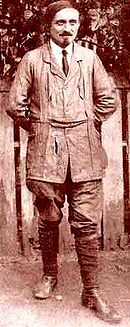 An influential form of individualist anarchism, called "egoism," or egoist anarchism
, was expounded by one of the earliest and best-known proponents of individualist anarchism, the German Max Stirner
. Stirner's The Ego and Its Own
, published in 1844, is a founding text of the philosophy. According to Stirner, the only limitation on the rights of the individual is their power to obtain what they desire, without regard for God, state, or morality. To Stirner, rights were spooks
in the mind, and he held that society does not exist but "the individuals are its reality". Stirner advocated self-assertion and foresaw unions of egoists
, non-systematic associations continually renewed by all parties' support through an act of will, which Stirner proposed as a form of organization in place of the state
. Egoist anarchists claim that egoism will foster genuine and spontaneous union between individuals. "Egoism" has inspired many interpretations of Stirner's philosophy. It was re-discovered and promoted by German philosophical anarchist and LGBT
activist John Henry Mackay
.
Josiah Warren
is widely regarded as the first American anarchist, and the four-page weekly paper he edited during 1833, The Peaceful Revolutionist, was the first anarchist periodical published,. For American anarchist historian Eunice Minette Schuster "It is apparent...that Proudhonian Anarchism was to be found in the United States at least as early as 1848 and that it was not conscious of its affinity to the Individualist Anarchism of Josiah Warren
and Stephen Pearl Andrews
...William B. Greene presented this Proudhonian Mutualism in its purest and most systematic form.". Henry David Thoreau
(1817–1862) was an important early influence in individualist anarchist thought in the United States and Europe. Thoreau was an American author, poet, naturalist, tax resister, development critic
, surveyor, historian, philosopher, and leading transcendentalist. He is best known for his books Walden
, a reflection upon simple living
in natural surroundings, and his essay, Civil Disobedience
, an argument for individual resistance to civil government in moral opposition to an unjust state. Later Benjamin Tucker
fused Stirner´s egoism with the economics of Warren and Proudhon in his eclectic
influential publication Liberty.
From these early influences individualist anarchism in different countries attracted a small but diverse following of bohemian artists and intellectuals, free love
and birth control
advocates (see Anarchism and issues related to love and sex
), individualist naturist
s nudists (see anarcho-naturism
), freethought
and anti-clearical
activists as well as young anarchist outlaws in what came to be known as illegalism
and individual reclamation
(see European individualist anarchism and individualist anarchism in France
). These authors and activists included Oscar Wilde
, Emile Armand
, Han Ryner
, Henri Zisly
, Renzo Novatore
, Miguel Gimenez Igualada
, Adolf Brand
and Lev Chernyi
among others.
position that moral agents ought to do what is in their own self-interest. It differs from psychological egoism
, which claims that people
do only act in their self-interest. Ethical egoism also differs from rational egoism
, which holds merely that it is rational
to act in one's self-interest. These doctrines may, though, be combined with ethical egoism.
Ethical egoism contrasts with ethical altruism
, which holds that moral agents have an obligation
to help and serve others. Egoism and altruism both contrast with ethical utilitarianism
, which holds that a moral agent should treat one's self
(also known as the subject
) with no higher regard than one has for others (as egoism does, by elevating self-interests and "the self" to a status not granted to others), but that one also should not (as altruism does) sacrifice one's own interests to help others' interests, so long as one's own interests (i.e. one's own desires
or well-being) are substantially-equivalent to the others' interests and well-being. Egoism, utilitarianism, and altruism are all forms of consequentialism
, but egoism and altruism contrast with utilitarianism, in that egoism and altruism are both agent-focused forms of consequentialism (i.e. subject-focused or subjective
), but utilitarianism is called agent-neutral (i.e. objective
and impartial) as it does not treat the subject's (i.e. the self's, i.e. the moral "agent's") own interests as being more or less important than if the same interests, desires, or well-being were anyone else's.
Ethical egoism does not, however, require moral agents to harm the interests and well-being of others when making moral deliberation; e.g. what is in an agent's self-interest may be incidentally detrimental, beneficial, or neutral in its effect on others. Individualism allows for others' interest and well-being to be disregarded or not, as long as what is chosen is efficacious in satisfying the self-interest of the agent. Nor does ethical egoism necessarily entail that, in pursuing self-interest, one ought always to do what one wants to do; e.g. in the long term, the fulfilment of short-term desires may prove detrimental to the self
. Fleeting pleasance, then, takes a back seat to protracted eudaemonia. In the words of James Rachels
, "Ethical egoism [...] endorses selfishness, but it doesn't endorse foolishness."
Ethical egoism is sometimes the philosophical basis for support of libertarianism
or individualist anarchism
as in Max Stirner
, although these can also be based on altruistic motivations. These are political positions based partly on a belief that individuals should not coercively prevent others from exercising freedom of action.
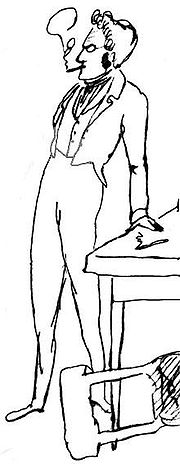
, posthumously regarded as the father of existentialism, maintained that the individual solely has the responsibilities of giving one's own life meaning
and living that life passionately and sincerely
, in spite of many existential obstacles and distractions including despair, angst
, absurdity
, alienation, and boredom
.
Subsequent existential philosophers retain the emphasis on the individual, but differ, in varying degrees, on how one achieves and what constitutes a fulfilling life, what obstacles must be overcome, and what external and internal factors are involved, including the potential consequences of the existence
or non-existence
of God. Many existentialists have also regarded traditional systematic or academic philosophy, in both style and content, as too abstract and remote from concrete human experience. Existentialism became fashionable in the post-World War
years as a way to reassert the importance of human individuality and freedom.
without recourse to knowledge
and reason
. Thus, freethinkers strive to build their opinions on the basis of fact
s, scientific inquiry
, and logic
al principles, independent of any logical fallacies
or intellectually limiting effects of authority
, confirmation bias
, cognitive bias
, conventional wisdom
, popular culture
, prejudice
, sectarianism
, tradition
, urban legend
, and all other dogma
s. Regarding religion
, freethinkers hold that there is insufficient evidence to support the existence of supernatural
phenomena.
that attaches importance to human dignity, concerns, and capabilities, particularly rationality
. Although the word has many senses, its meaning comes into focus when contrasted to the supernatural
or to appeals to authority
. Since the 19th century, humanism has been associated with an anti-clericalism
inherited from the 18th-century Enlightenment
philosophes. 21st century Humanism tends to strongly endorse human rights
, including reproductive rights
, gender equality
, social justice
, and the separation of church and state
. The term covers organized non-theistic religions
, secular humanism
, and a humanistic life stance.
which argues that pleasure
is the only intrinsic good
. The basic idea behind hedonistic thought is that pleasure is the only thing that is good for a person. This is often used as a justification for evaluating actions in terms of how much pleasure and how little pain (i.e. suffering
) they produce. In very simple terms, a hedonist strives to maximize this net pleasure (pleasure minus pain).
, placed value on physical pleasures, meaning those experienced through the five senses. As a philosophy, libertinism gained new-found adherents in the 17th, 18th, and 19th centuries, particularly in France
and Britain
. Notable among these were John Wilmot, 2nd Earl of Rochester
, and the Marquis de Sade
. "Libertine" is defined today as "a dissolute person; usually a person who is morally unrestrained".
is a system of philosophy created by philosopher and novelist Ayn Rand
(1905–1982) that holds: reality
exists independent of consciousness; human beings gain knowledge
rationally from perception through the process of concept formation and inductive and deductive logic; the moral purpose of one's life is the pursuit of one's own happiness or rational self-interest. Rand thinks the only social system consistent with this morality is full respect for individual rights
, embodied in pure laissez faire capitalism
; and the role of art
in human life is to transform man's widest metaphysical ideas, by selective reproduction of reality, into a physical form—a work of art—that he can comprehend and to which he can respond emotionally. Objectivism celebrates man as his own hero, "with his own happiness as the moral purpose of his life, with productive achievement as his noblest activity, and reason as his only absolute."
lacks moral legitimacy and -in contrast to revolutionary anarchism- does not advocate violent revolution to eliminate it but advocate peaceful evolution to superate it. Though philosophical anarchism does not necessarily imply any action or desire for the elimination of the State, philosophical anarchists do not believe that they have an obligation or duty to obey the State, or conversely, that the State has a right to command.
Philosophical anarchism is a component especially of individualist anarchism
. Philosophical anarchists of historical note include Mohandas Gandhi, William Godwin
, Pierre-Joseph Proudhon
, Max Stirner
, Benjamin Tucker
, and Henry David Thoreau
. Contemporary philosophical anarchists include A. John Simmons and Robert Paul Wolff
.
, it may hold that the nature and existence of every object depends solely on someone's subjective awareness of it. For example, Wittgenstein wrote in Tractatus Logico-Philosophicus
: "The subject doesn't belong to the world, but it is a limit of the world" (proposition 5.632). Metaphysical subjectivism is the theory that reality is what we perceive to be real, and that there is no underlying true reality that exists independently of perception. One can also hold that it is consciousness
rather than perception that is reality (subjective idealism
). In probability
, a subjectivism stands for the belief that probabilities are simply degrees-of-belief by rational agents in a certain proposition, and which have no objective reality in and of themselves.
Ethical subjectivism
stands in opposition to moral realism
, which claims that moral propositions refer to objective facts, independent of human opinion; to error theory, which denies that any moral propositions are true in any sense; and to non-cognitivism
, which denies that moral sentences express propositions at all. The most common forms of ethical subjectivism are also forms of moral relativism
, with moral standards held to be relative to each culture or society (c.f. cultural relativism
), or even to every individual. The latter view, as put forward by Protagoras
, holds that there are as many distinct scales of good and evil as there are subjects in the world. Moral subjectivism is that species of moral relativism that relativizes moral value to the individual subject.
of economic individualism holds that each individual should be allowed autonomy
in making his or her own economic decisions as opposed to those decisions being made by the state
, the community
, the corporation
etc. for him or her.
, Western Europe
, and the Americas
. It followed earlier forms of liberalism in its commitment to personal freedom and popular government, but differed from earlier forms of liberalism in its commitment to free markets and classical economics
. Notable classical liberals in the 19th century include Jean-Baptiste Say
, Thomas Malthus
, and David Ricardo
. Classical liberalism was revived in the 20th century by Ludwig von Mises
and Friedrich Hayek
, and further developed by Milton Friedman
, Robert Nozick
, Loren Lomasky
, and Jan Narveson
.
The phrase classical liberalism is also sometimes used to refer to all forms of liberalism before the 20th century. And, after 1970, the phrase began to be used by Libertarians to describe their belief in the primacy of economic freedom and minimal government. It is sometimes difficult to tell which meaning is intended in a given source.
there are adherents to mutualism
(Pierre Joseph Proudhon, Emile Armand
), early Benjamin Tucker
); natural rights
positions (Early Benjamin Tucker, Lysander Spooner
, Josiah Warren
); and egoist
ic disrespect for "ghosts" such as private property and markets (Max Stirner
, John Henry Mackay
, Lev Chernyi
, later Benjamin Tucker
, Renzo Novatore
, illegalism
).
, who envisioned a society where each person might possess a means of production
, either individually or collectively, with trade representing equivalent amounts of labor in the free market
. Integral to the scheme was the establishment of a mutual-credit bank which would lend to producers at a minimal interest rate only high enough to cover the costs of administration. Mutualism is based on a labor theory of value
which holds that when labor or its product is sold, in exchange, it ought to receive goods or services embodying "the amount of labor necessary to produce an article of exactly similar and equal utility". Receiving anything less would be considered exploitation, theft of labor, or usury
.
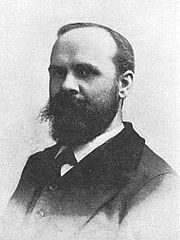
, and sometimes left libertarianism) is a group of political philosophies
that promote a non-hierarchical, non-bureaucratic, stateless society
without private property in the means of production
. Libertarian socialism is opposed to all coercive forms of social organization, and promotes free association
in place of government and opposes what it sees as the coercive social relations of capitalism, such as wage labor. The term libertarian socialism is used by some socialists to differentiate their philosophy from state socialism
or by some as a synonym for left anarchism
.
Adherents of libertarian socialism assert that a society based on freedom and equality can be achieved through abolishing authoritarian institutions that control certain means of production
and subordinate the majority to an owning class or political and economic elite. Libertarian socialism also constitutes a tendency of thought that promotes the identification, criticism and practical dismantling of illegitimate authority in all aspects of life.
Accordingly, libertarian socialists believe that "the exercise of power in any institutionalized form—whether economic, political, religious, or sexual—brutalizes both the wielder of power and the one over whom it is exercised". Libertarian socialists generally place their hopes in decentralized means of direct democracy
such as libertarian municipalism
, citizens' assemblies, trade union
s and workers' council
s.
Political philosophies commonly described as libertarian socialist include most varieties of anarchism
(especially anarchist communism
, anarchist collectivism
, anarcho-syndicalism
, mutualism
) as well as autonomism
, communalism
, participism
, some versions of "utopian socialism
and individualist anarchism
., and also libertarian Marxist philosophies such as council communism
and Luxemburgism
.
) is a term that has been used to describe several different libertarian
political movements and theorists.
Left-libertarianism, as defended by contemporary theorists such as Peter Vallentyne
, Hillel Steiner
, and Michael Otsuka
, is a doctrine that has a strong commitment to personal liberty and has an egalitarian view concerning natural resources
, believing that it is illegitimate for anyone to claim private ownership
of resources to the detriment of others. Some left-libertarians of this type support some form of income redistribution on the grounds of a claim by each individual to be entitled to an equal share of natural resources. Social anarchists, including Murray Bookchin
, anarcho-communists such as Peter Kropotkin
and anarcho-collectivists such as Mikhail Bakunin
, are sometimes called left-libertarian. Noam Chomsky
also refers to himself as a left libertarian. The term is sometimes used synonymously with libertarian socialism
or used in self-description by geoists
who support individuals paying rent to the community for the use of land. Left libertarian parties, such as Green, share with "traditional socialism a distrust of the market, of private investment, and of the achievement ethic, and a commitment to expansion of the welfare state."
or a variety of different libertarian views some label "right" of mainstream libertarianism including "libertarian conservatism
".
Stanford Encyclopedia of Philosophy
calls it "right libertarianism" but states: "Libertarianism is often thought of as 'right-wing' doctrine. This, however, is mistaken for at least two reasons. First, on social—rather than economic—issues, libertarianism tends to be 'left-wing'. It opposes laws that restrict consensual and private sexual relationships between adults (e.g., gay sex, non-marital sex, and deviant sex), laws that restrict drug use, laws that impose religious views or practices on individuals, and compulsory military service. Second, in addition to the better-known version of libertarianism—right-libertarianism—there is also a version known as 'left-libertarianism
'. Both endorse full self-ownership, but they differ with respect to the powers agents have to appropriate unappropriated natural resources (land, air, water, etc.)."
, the word "society" cannot refer to anything more than a very large collection of individuals. Society does not have an existence above or beyond these individuals, and thus cannot be properly said to carry out actions, since actions require intentionality, intentionality requires an agent, and society as a whole cannot be properly said to possess agency; only individuals can be agents. The same holds for the government. Under this view, a government is composed of individuals; despite that democratic governments are elected by popular vote, the fact remains that all of the activities of government are carried out by means of the intentions and actions of individuals. Strictly speaking, the government itself does not act. For example, the point is sometimes made that "we" have decided to enact a certain policy, and sometimes this usage is used to imply that the entity known as "society" supports the policy and thus it is justified. The methodological individualist points out that "we" in fact did not enact or carry out this policy; among those who voted, a certain group of people voted for the policy, individuals all, and another group voted against it. The decision that emerged was not made by the "people", or by the "government"; it was made by those on the winning side of the vote. This is significant because in any collective there exists individuals who oppose the policy whose wills are being overridden, and the use of "we" tends to obscure that fact. The individualist wishes to highlight the importance of the individual and prevent subsumption into a collective. For these reasons, methodological individualists tend to disagree with claims such as "we deserve the government we have, because we are doing it to ourselves," since perhaps that individual and very possibly many others disagree with the actions of the individuals who hold government power. That said, many individualists are willing to use "we" in reference to government or society as a convenient shorthand as long as the fact that these entities are composed of individuals is kept in mind.
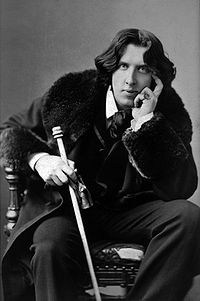 The anarchist writer and bohemian
Oscar Wilde
wrote in his famous essay The Soul of Man under Socialism
that "Art
is individualism, and individualism is a disturbing and disintegrating force. There lies its immense value. For what it seeks is to disturb monotony of type, slavery of custom, tyranny of habit, and the reduction of man to the level of a machine." For anarchist historian George Woodcock
"Wilde's aim in The Soul of Man under Socialism
is to seek the society most favorable to the artist...for Wilde art is the supreme end, containing within itself enlightenment and regeneration, to which all else in society must be subordinated...Wilde represents the anarchist as aesthete." The word individualism in this way has been used to denote a personality with a strong tendency towards self creation and experimentation as opposed to tradition or popular mass opinions and behaviors
Anarchist writer Murray Bookchin
describes a lot of individualist anarchism
as people who "expressed their opposition in uniquely personal forms, especially in fiery tracts, outrageous behavior, and aberrant lifestyles in the cultural ghettos of fin de sicle New York, Paris, and London. As a credo, individualist anarchism remained largely a bohemian
lifestyle, most conspicuous in its demands for sexual freedom ('free love
') and enamored of innovations in art, behavior, and clothing."
In relation to this view of individuality, French Individualist anarchist Emile Armand
advocates egoist
ical denial of social conventions and dogmas to live in accord to one's own ways and desires in daily life since he emphasized anarchism as a way of life and practice. In this way he manifests "So the anarchist individualist tends to reproduce himself, to perpetuate his spirit in other individuals who will share his views and who will make it possible for a state of affairs to be established from which authoritarianism has been banished. It is this desire, this will, not only to live, but also to reproduce oneself, which we shall call "activity".
In the book Imperfect garden : the legacy of humanism, humanist philosopher Tzvetan Todorov
identifies individualism as an important current of socio-political thought within modernity and as examples of it he mentions Michel de Montaigne
, François de La Rochefoucauld
, Marquis de Sade
, and Charles Baudelaire
In La Rochefoucauld, he identifies a tendency similar to stoicism
in which "the honest person works his being in the manner of an sculptor who searches the liberation of the forms which are inside a block of marble
, to extract the truth of that matter." In Baudelaire he finds the dandy
trait in which one searches to cultivate "the idea of beauty within oneself, of satisfying one´s passions of feeling and thinking."
The Russian-American
poet Joseph Brodsky
one manifested that "The surest defense against Evil is extreme individualism, originality of thinking, whimsicality, even—if you will—eccentricity. That is, something that can't be feigned, faked, imitated; something even a seasoned imposter couldn't be happy with." Ralph Waldo Emerson
famously declared", “Whoso would be a man must be a nonconformist”—a point of view developed at length in both the life and work of (Henry David) Thoreau
. Equally memorable and influential on Walt Whitman
is Emerson’s idea that “a foolish consistency is the hobgoblin of small minds, adored by little statesmen and philosophers and divines.”...Emerson opposes on principle the reliance on social structures (civil, religious) precisely because through them the individual approaches the divine second hand, mediated by the once original experience of a genius from another age: “An institution,” as he explains, “is the lengthened shadow of one man.” To achieve this original relation one must “Insist on one’s self; never imitate” for if the relationship is secondary the connection is lost."
Moral
A moral is a message conveyed or a lesson to be learned from a story or event. The moral may be left to the hearer, reader or viewer to determine for themselves, or may be explicitly encapsulated in a maxim...
stance, political philosophy
Political philosophy
Political philosophy is the study of such topics as liberty, justice, property, rights, law, and the enforcement of a legal code by authority: what they are, why they are needed, what, if anything, makes a government legitimate, what rights and freedoms it should protect and why, what form it...
, ideology, or social outlook that stresses "the moral worth of the individual
Individual
An individual is a person or any specific object or thing in a collection. Individuality is the state or quality of being an individual; a person separate from other persons and possessing his or her own needs, goals, and desires. Being self expressive...
". Individualists promote the exercise of one's goals and desires and so value independence
Independence
Independence is a condition of a nation, country, or state in which its residents and population, or some portion thereof, exercise self-government, and usually sovereignty, over its territory....
and self-reliance
Self-Reliance
Self-Reliance is an essay written by American Transcendentalist philosopher and essayist, Ralph Waldo Emerson. It contains the most thorough statement of one of Emerson's repeating themes, the need for each individual to avoid conformity and false consistency, and follow his or her own instincts...
while opposing most external interference upon one's own interests, whether by society
Society
A society, or a human society, is a group of people related to each other through persistent relations, or a large social grouping sharing the same geographical or virtual territory, subject to the same political authority and dominant cultural expectations...
, family
Family
In human context, a family is a group of people affiliated by consanguinity, affinity, or co-residence. In most societies it is the principal institution for the socialization of children...
or any other group or institution
Institution
An institution is any structure or mechanism of social order and cooperation governing the behavior of a set of individuals within a given human community...
.
Individualism makes the individual its focus and so starts "with the fundamental premise that the human individual is of primary importance in the struggle for liberation." Classical liberalism
Classical liberalism
Classical liberalism is the philosophy committed to the ideal of limited government, constitutionalism, rule of law, due process, and liberty of individuals including freedom of religion, speech, press, assembly, and free markets....
(including libertarianism
Libertarianism
Libertarianism, in the strictest sense, is the political philosophy that holds individual liberty as the basic moral principle of society. In the broadest sense, it is any political philosophy which approximates this view...
), existentialism
Existentialism
Existentialism is a term applied to a school of 19th- and 20th-century philosophers who, despite profound doctrinal differences, shared the belief that philosophical thinking begins with the human subject—not merely the thinking subject, but the acting, feeling, living human individual...
and anarchism
Anarchism
Anarchism is generally defined as the political philosophy which holds the state to be undesirable, unnecessary, and harmful, or alternatively as opposing authority in the conduct of human relations...
(especially individualist anarchism
Individualist anarchism
Individualist anarchism refers to several traditions of thought within the anarchist movement that emphasize the individual and his or her will over external determinants such as groups, society, traditions, and ideological systems. Individualist anarchism is not a single philosophy but refers to a...
) and Objectivism
Objectivism
Objectivism or Objectivist may refer to:* Any standpoint that stresses objectivity, including;* Philosophical objectivity, realism, the conviction that reality is mind-independent* Moral objectivism, the view that some ethics are absolute...
are examples of movements that take the human individual as a central unit of analysis.
It has also been used as a term denoting "The quality of being an individual; individuality" related to possessing "An individual characteristic; a quirk
Idiosyncrasy
An idiosyncrasy is an unusual feature of a person . The term is often used to express eccentricity or peculiarity. A synonym may be .-Etymology:...
." Individualism is thus also associated with art
Art
Art is the product or process of deliberately arranging items in a way that influences and affects one or more of the senses, emotions, and intellect....
istic and bohemian
Bohemianism
Bohemianism is the practice of an unconventional lifestyle, often in the company of like-minded people, with few permanent ties, involving musical, artistic or literary pursuits...
interests and lifestyles where there is a tendency towards self creation and experimentation as opposed to tradition or popular mass opinions and behaviors as so also with humanist
Humanism
Humanism is an approach in study, philosophy, world view or practice that focuses on human values and concerns. In philosophy and social science, humanism is a perspective which affirms some notion of human nature, and is contrasted with anti-humanism....
philosophical positions and ethics.
Etymology
In the English languageEnglish language
English is a West Germanic language that arose in the Anglo-Saxon kingdoms of England and spread into what was to become south-east Scotland under the influence of the Anglian medieval kingdom of Northumbria...
, the word "individualism" was first introduced, as a pejorative, by the Owenites
Owenism
Owenism is the utopian socialist philosophy of 19th century social reformer Robert Owen and his followers and successors, who are known as Owenites....
in the late 1830s, although it is unclear if they were influenced by Saint-Simonianism
Saint-Simonianism
Saint-Simonianism was a French political and social movement of the first half of the 19th century, inspired by the ideas of Claude Henri de Rouvroy, comte de Saint-Simon ....
or came up with it independently. A more positive use of the term in Britain came to be used with the writings of James Elishama Smith
James Elishama Smith
James Elishama Smith, often called Shepherd Smith was a British journalist and religious writer.Smith studied at Glasgow University. Hearing Edward Irving preach in 1828, he became a millenarian and associated with followers of Joanna Southcott. For a couple of years he became a Christian...
, who was a millenarian and a Christian Israelite. Although an early Owenite socialist, he eventually rejected its collective idea of property, and found in individualism a "universalism" that allowed for the development of the "original genius." Without individualism, Smith argued, individuals cannot amass property to increase one's happiness. William Maccall, another Unitarian
Unitarianism
Unitarianism is a Christian theological movement, named for its understanding of God as one person, in direct contrast to Trinitarianism which defines God as three persons coexisting consubstantially as one in being....
preacher, and probably an acquaintance of Smith, came somewhat later, although influenced by John Stuart Mill
John Stuart Mill
John Stuart Mill was a British philosopher, economist and civil servant. An influential contributor to social theory, political theory, and political economy, his conception of liberty justified the freedom of the individual in opposition to unlimited state control. He was a proponent of...
, Thomas Carlyle
Thomas Carlyle
Thomas Carlyle was a Scottish satirical writer, essayist, historian and teacher during the Victorian era.He called economics "the dismal science", wrote articles for the Edinburgh Encyclopedia, and became a controversial social commentator.Coming from a strict Calvinist family, Carlyle was...
, and German Romanticism
Romanticism
Romanticism was an artistic, literary and intellectual movement that originated in the second half of the 18th century in Europe, and gained strength in reaction to the Industrial Revolution...
, to the same positive conclusions, in his 1847 work "Elements of Individualism".
The individual
As commonly usedVernacular
A vernacular is the native language or native dialect of a specific population, as opposed to a language of wider communication that is not native to the population, such as a national language or lingua franca.- Etymology :The term is not a recent one...
, an individual is a person
Person
A person is a human being, or an entity that has certain capacities or attributes strongly associated with being human , for example in a particular moral or legal context...
or any specific object in a collection. In the 15th century and earlier, and also today within the fields of statistics
Statistics
Statistics is the study of the collection, organization, analysis, and interpretation of data. It deals with all aspects of this, including the planning of data collection in terms of the design of surveys and experiments....
and metaphysics
Metaphysics
Metaphysics is a branch of philosophy concerned with explaining the fundamental nature of being and the world, although the term is not easily defined. Traditionally, metaphysics attempts to answer two basic questions in the broadest possible terms:...
, individual means "indivisible", typically describing any numerically singular thing, but sometimes meaning "a person." (q.v. "The problem of proper name
Proper name
"A proper name [is] a word that answers the purpose of showing what thing it is that we are talking about" writes John Stuart Mill in A System of Logic , "but not of telling anything about it"...
s"). From the 17th century on, individual indicates separateness, as in individualism. Individuality is the state or quality of being an individual
Individual
An individual is a person or any specific object or thing in a collection. Individuality is the state or quality of being an individual; a person separate from other persons and possessing his or her own needs, goals, and desires. Being self expressive...
; a person separate from other persons and possessing his or her own needs, goals, and desires.
Individualism and society
An individualist enters into society to further his or her own interests, or at least demands the right to serve his or her own interests, without taking the interests of society into consideration (an individualist need not be an egoistEgoist anarchism
Egoist anarchism is a school of anarchist thought that originated in the philosophy of Max Stirner, a nineteenth century Hegelian philosopher whose "name appears with familiar regularity in historically orientated surveys of anarchist thought as one of the earliest and best-known exponents of...
). The individualist does not lend credence to any philosophy that requires the sacrifice of the self-interest of the individual for any higher social causes. Jean-Jacques Rousseau
Jean-Jacques Rousseau
Jean-Jacques Rousseau was a Genevan philosopher, writer, and composer of 18th-century Romanticism. His political philosophy influenced the French Revolution as well as the overall development of modern political, sociological and educational thought.His novel Émile: or, On Education is a treatise...
would argue, however, that his concept of "general will
General will
The general will , made famous by Jean-Jacques Rousseau, is a concept in political philosophy referring to the desire or interest of a people as a whole. As used by Rousseau, the "general will" is identical to the rule of law, and to Spinoza's mens una.The notion of the general will is wholly...
" in the "social contract
Social Contract (Rousseau)
Of The Social Contract, Or Principles of Political Right by Jean-Jacques Rousseau, is the book in which Rousseau theorized about the best way in which to set up a political community in the face of the problems of commercial society which he had already identified in his Discourse on Inequality...
" is not the simple collection of individual wills and precisely furthers the interests of the individual (the constraint of law
Law
Law is a system of rules and guidelines which are enforced through social institutions to govern behavior, wherever possible. It shapes politics, economics and society in numerous ways and serves as a social mediator of relations between people. Contract law regulates everything from buying a bus...
itself would be beneficial for the individual, as the lack of respect for the law necessarily entails, in Rousseau's eyes, a form of ignorance
Ignorance
Ignorance is a state of being uninformed . The word ignorant is an adjective describing a person in the state of being unaware and is often used as an insult...
and submission to one's passions
Passion (emotion)
Passion is a term applied to a very strong feeling about a person or thing. Passion is an intense emotion compelling feeling, enthusiasm, or desire for something....
instead of the preferred autonomy of reason
Reason
Reason is a term that refers to the capacity human beings have to make sense of things, to establish and verify facts, and to change or justify practices, institutions, and beliefs. It is closely associated with such characteristically human activities as philosophy, science, language, ...
).
Societies and groups can differ in the extent to which they are based upon predominantly "self-regarding" (individualistic, and arguably self-interested) rather than "other-regarding" (group-oriented, and group, or society-minded) behavior. Ruth Benedict
Ruth Benedict
Ruth Benedict was an American anthropologist, cultural relativist, and folklorist....
made a distinction, relevant in this context, between "guilt" societies
Guilt society
In cultural anthropology, a guilt society is the concept that the primary method of social control in a given society is the inculcation of feelings of guilt for behaviors that the individual believes to be undesirable...
(e.g., medieval Europe) with an "internal reference standard", and "shame" societies
Shame society
In cultural anthropology, a shame society is the concept that, in a given society, the primary device for gaining control over children and maintaining social order is the inculcation of shame and the complementary threat of ostracism...
(e.g., Japan
Japan
Japan is an island nation in East Asia. Located in the Pacific Ocean, it lies to the east of the Sea of Japan, China, North Korea, South Korea and Russia, stretching from the Sea of Okhotsk in the north to the East China Sea and Taiwan in the south...
, "bringing shame upon one's ancestors") as opposed to an "external reference standard", where people look to their peers for feedback on whether an action is "acceptable" or not (also known as "group-think").
The extent to which society or groups are "individualistic" can vary from time to time, and from country to country. For example, Japanese society is more group-oriented (e.g., decisions tend to be taken by consensus among groups, rather than by individuals), and it has been argued that "personalities are less developed" (than is usual in the West). Compare individualistic culture
Individualistic culture
Individualistic culture is a society which is characterized by individualism, not collectivism.-High power-distance:In the context of Hofstede's concepts, one can classify an individualistic culture as a high power-distance culture because of the strict socio-economic statuses and the emphasis on...
.
John Kenneth Galbraith
John Kenneth Galbraith
John Kenneth "Ken" Galbraith , OC was a Canadian-American economist. He was a Keynesian and an institutionalist, a leading proponent of 20th-century American liberalism...
made a classic distinction between "private affluence and public squalor" in the USA, and private squalor and public affluence in (for example) Europe, and there is a correlation between individualism and degrees of public-sector intervention and taxation.
Individualism is often contrasted either with totalitarianism
Totalitarianism
Totalitarianism is a political system where the state recognizes no limits to its authority and strives to regulate every aspect of public and private life wherever feasible...
or with collectivism
Collectivism
Collectivism is any philosophic, political, economic, mystical or social outlook that emphasizes the interdependence of every human in some collective group and the priority of group goals over individual goals. Collectivists usually focus on community, society, or nation...
, but in fact there is a spectrum of behaviors at the societal level ranging from highly individualistic societies through mixed societies (a term the UK
United Kingdom
The United Kingdom of Great Britain and Northern IrelandIn the United Kingdom and Dependencies, other languages have been officially recognised as legitimate autochthonous languages under the European Charter for Regional or Minority Languages...
has used in the post-World War II
World War II
World War II, or the Second World War , was a global conflict lasting from 1939 to 1945, involving most of the world's nations—including all of the great powers—eventually forming two opposing military alliances: the Allies and the Axis...
period) to collectivist. Also, many collectivists (particularly supporters of collectivist anarchism
Collectivist anarchism
Collectivist anarchism is a revolutionary doctrine that advocates the abolition of both the state and private ownership of the means of production...
or libertarian socialism
Libertarian socialism
Libertarian socialism is a group of political philosophies that promote a non-hierarchical, non-bureaucratic, stateless society without private property in the means of production...
) point to the enormous differences between liberty-minded collectivism and totalitarian practices.
Individualism, sometimes closely associated with certain variants of anarchism
Anarchism
Anarchism is generally defined as the political philosophy which holds the state to be undesirable, unnecessary, and harmful, or alternatively as opposing authority in the conduct of human relations...
or liberalism
Liberalism
Liberalism is the belief in the importance of liberty and equal rights. Liberals espouse a wide array of views depending on their understanding of these principles, but generally, liberals support ideas such as constitutionalism, liberal democracy, free and fair elections, human rights,...
, typically takes it for granted that individuals know best and that public authority or society
Society
A society, or a human society, is a group of people related to each other through persistent relations, or a large social grouping sharing the same geographical or virtual territory, subject to the same political authority and dominant cultural expectations...
has the right to interfere in the person's decision-making process only when a very compelling need to do so arises (and maybe not even in those circumstances). This type of argument can occur in policy debates regarding regulation of industries, as well as in relation to personal choice of lifestyle.
Political individualism
Individualists are chiefly concerned with protecting individual autonomy against obligations imposed by social institutions (such as the state or religious morality). For L. Susan BrownL. Susan Brown
L. Susan Brown is a Canadian anarcho-communist writer and theoretician.Brown is best-known for her germinal text The Politics of Individualism , in which she makes a distinction between "existential individualism" and "instrumental individualism" and examines how these forms are utilized in...
"Liberalism
Liberalism
Liberalism is the belief in the importance of liberty and equal rights. Liberals espouse a wide array of views depending on their understanding of these principles, but generally, liberals support ideas such as constitutionalism, liberal democracy, free and fair elections, human rights,...
and anarchism
Anarchism
Anarchism is generally defined as the political philosophy which holds the state to be undesirable, unnecessary, and harmful, or alternatively as opposing authority in the conduct of human relations...
are two political philosophies that are fundamentally concerned with individual
Individual
An individual is a person or any specific object or thing in a collection. Individuality is the state or quality of being an individual; a person separate from other persons and possessing his or her own needs, goals, and desires. Being self expressive...
freedom yet differ from one another in very distinct ways. Anarchism shares with liberalism a radical commitment to individual freedom while rejecting liberalism's competitive property relations."
Liberalism
Liberalism (from the Latin liberalis, "of freedom; worthy of a free man, gentlemanlike, courteous, generous") is the belief in the importance of individual freedom. This belief is widely accepted in the United States, Europe, Australia and other WesternWestern world
The Western world, also known as the West and the Occident , is a term referring to the countries of Western Europe , the countries of the Americas, as well all countries of Northern and Central Europe, Australia and New Zealand...
nations, and was recognized as an important value by many Western philosophers throughout history, in particular since the Enlightenment. It is often rejected by collectivist, Islamic, or confucian societies in Asia or the Middle East. The Roman Emperor Marcus Aurelius wrote praising "the idea of a polity administered with regard to equal rights and equal freedom of speech, and the idea of a kingly government which respects most of all the freedom of the governed".
Modern liberalism has its roots in the Age of Enlightenment
Age of Enlightenment
The Age of Enlightenment was an elite cultural movement of intellectuals in 18th century Europe that sought to mobilize the power of reason in order to reform society and advance knowledge. It promoted intellectual interchange and opposed intolerance and abuses in church and state...
and rejects many foundational
Foundationalism
Foundationalism is any theory in epistemology that holds that beliefs are justified based on what are called basic beliefs . This position is intended to resolve the infinite regress problem in epistemology...
assumptions that dominated most earlier theories of government, such as the Divine Right of Kings
Divine Right of Kings
The divine right of kings or divine-right theory of kingship is a political and religious doctrine of royal and political legitimacy. It asserts that a monarch is subject to no earthly authority, deriving his right to rule directly from the will of God...
, hereditary status, and established religion
State religion
A state religion is a religious body or creed officially endorsed by the state...
. John Locke
John Locke
John Locke FRS , widely known as the Father of Liberalism, was an English philosopher and physician regarded as one of the most influential of Enlightenment thinkers. Considered one of the first of the British empiricists, following the tradition of Francis Bacon, he is equally important to social...
is often credited with the philosophical foundations of classical liberalism. He wrote "no one ought to harm another in his life, health, liberty, or possessions."
In the 17th century, liberal ideas began to influence governments in Europe, in nations such as The Netherlands, Switzerland, England and Poland, but they were strongly opposed, often by armed might, by those who favored absolute monarchy and established religion. In the 18th century, in America, the first modern liberal state was founded, without a monarch or a hereditary aristocracy. The American Declaration of Independence includes the words (which echo Locke) "all men are created equal; that they are endowed by their Creator with certain unalienable rights; that among these are life, liberty, and the pursuit of happiness; that to insure these rights, governments are instituted among men, deriving their just powers from the consent of the governed."
Liberalism comes in many forms. According to John N. Gray, the essence of liberalism is toleration of different beliefs and of different ideas as to what constitutes a good life.
Anarchism
Anarchism is a political philosophyPolitical philosophy
Political philosophy is the study of such topics as liberty, justice, property, rights, law, and the enforcement of a legal code by authority: what they are, why they are needed, what, if anything, makes a government legitimate, what rights and freedoms it should protect and why, what form it...
which considers the state
State (polity)
A state is an organized political community, living under a government. States may be sovereign and may enjoy a monopoly on the legal initiation of force and are not dependent on, or subject to any other power or state. Many states are federated states which participate in a federal union...
undesirable, unnecessary and harmful, and instead promotes a stateless society, or anarchy
Anarchy
Anarchy , has more than one colloquial definition. In the United States, the term "anarchy" typically is meant to refer to a society which lacks publicly recognized government or violently enforced political authority...
. It seeks to diminish or even abolish authority
Authority
The word Authority is derived mainly from the Latin word auctoritas, meaning invention, advice, opinion, influence, or command. In English, the word 'authority' can be used to mean power given by the state or by academic knowledge of an area .-Authority in Philosophy:In...
in the conduct of human relations.
For influential Italian anarchist Errico Malatesta
Errico Malatesta
Errico Malatesta was an Italian anarcho-communist. He was an insurrectionary anarchist early in his life. He spent much of his life exiled from his homeland of Italy and in total spent more than ten years in prison. He wrote and edited a number of radical newspapers and was also a friend of...
"All anarchists, whatever tendency they belong to, are individualists in some way or other. But the opposite is not true; not by any means. The individualists are thus divided into two distinct categories: one which claims the right to full development for all human individuality, their own and that of others; the other which only thinks about its own individuality and has absolutely no hesitation in sacrificing the individuality of others. The Tsar of all the Russias belongs to the latter category of individualists. We belong to the former."
Individualist anarchism
Individualist anarchism refers to several traditions of thought within the anarchist movement that emphasize the individualIndividual
An individual is a person or any specific object or thing in a collection. Individuality is the state or quality of being an individual; a person separate from other persons and possessing his or her own needs, goals, and desires. Being self expressive...
and their will
Will (philosophy)
Will, in philosophical discussions, consonant with a common English usage, refers to a property of the mind, and an attribute of acts intentionally performed. Actions made according to a person's will are called "willing" or "voluntary" and sometimes pejoratively "willful"...
over any kinds of external determinants such as groups, society, traditions, and ideological systems. Individualist anarchism is not a single philosophy but refers to a group of individualistic philosophies that sometimes are in conflict.
In 1793, William Godwin
William Godwin
William Godwin was an English journalist, political philosopher and novelist. He is considered one of the first exponents of utilitarianism, and the first modern proponent of anarchism...
, who has often been cited as the first anarchist, wrote Political Justice
Political Justice
Enquiry Concerning Political Justice and its Influence on Modern Morals and Manners outlines the political philosophy of the 18th-century philosopher William Godwin....
, which some consider to be the first expression of anarchism. Godwin, a philosophical anarchist, from a rationalist and utilitarian basis opposed revolutionary action and saw a minimal state
Limited government
Limited government is a government which anything more than minimal governmental intervention in personal liberties and the economy is generally disallowed by law, usually in a written constitution. It is written in the United States Constitution in Article 1, Section 8...
as a present "necessary evil" that would become increasingly irrelevant and powerless by the gradual spread of knowledge. Godwin advocated individualism, proposing that all cooperation in labour be eliminated on the premise that this would be most conducive with the general good.
Egoist anarchism
Egoist anarchism is a school of anarchist thought that originated in the philosophy of Max Stirner, a nineteenth century Hegelian philosopher whose "name appears with familiar regularity in historically orientated surveys of anarchist thought as one of the earliest and best-known exponents of...
, was expounded by one of the earliest and best-known proponents of individualist anarchism, the German Max Stirner
Max Stirner
Johann Kaspar Schmidt , better known as Max Stirner , was a German philosopher, who ranks as one of the literary fathers of nihilism, existentialism, post-modernism and anarchism, especially of individualist anarchism...
. Stirner's The Ego and Its Own
The Ego and Its Own
The Ego and Its Own is a philosophical work by German philosopher Max Stirner . This work was first published in 1845, although with a stated publication date of "1844" to confuse the Prussian censors.-Content:...
, published in 1844, is a founding text of the philosophy. According to Stirner, the only limitation on the rights of the individual is their power to obtain what they desire, without regard for God, state, or morality. To Stirner, rights were spooks
Reification (fallacy)
Reification is a fallacy of ambiguity, when an abstraction is treated as if it were a concrete, real event, or physical entity. In other words, it is the error of treating as a "real thing" something which is not a real thing, but merely an idea...
in the mind, and he held that society does not exist but "the individuals are its reality". Stirner advocated self-assertion and foresaw unions of egoists
Union of egoists
Max Stirner's idea of the "Union of Egoists" , was first expounded in The Ego and Its Own. The Union is understood as a non-systematic association, which Stirner proposed in contradistinction to the state. The Union is understood as a relation between egoists which is continually renewed by all...
, non-systematic associations continually renewed by all parties' support through an act of will, which Stirner proposed as a form of organization in place of the state
State (polity)
A state is an organized political community, living under a government. States may be sovereign and may enjoy a monopoly on the legal initiation of force and are not dependent on, or subject to any other power or state. Many states are federated states which participate in a federal union...
. Egoist anarchists claim that egoism will foster genuine and spontaneous union between individuals. "Egoism" has inspired many interpretations of Stirner's philosophy. It was re-discovered and promoted by German philosophical anarchist and LGBT
LGBT
LGBT is an initialism that collectively refers to "lesbian, gay, bisexual, and transgender" people. In use since the 1990s, the term "LGBT" is an adaptation of the initialism "LGB", which itself started replacing the phrase "gay community" beginning in the mid-to-late 1980s, which many within the...
activist John Henry Mackay
John Henry Mackay
John Henry Mackay was an individualist anarchist, thinker and writer. Born in Scotland and raised in Germany, Mackay was the author of Die Anarchisten and Der Freiheitsucher . Mackay was published in the United States in his friend Benjamin Tucker's magazine, Liberty...
.
Josiah Warren
Josiah Warren
Josiah Warren was an individualist anarchist, inventor, musician, and author in the United States. He is widely regarded as the first American anarchist, and the four-page weekly paper he edited during 1833, The Peaceful Revolutionist, was the first anarchist periodical published, an enterprise...
is widely regarded as the first American anarchist, and the four-page weekly paper he edited during 1833, The Peaceful Revolutionist, was the first anarchist periodical published,. For American anarchist historian Eunice Minette Schuster "It is apparent...that Proudhonian Anarchism was to be found in the United States at least as early as 1848 and that it was not conscious of its affinity to the Individualist Anarchism of Josiah Warren
Josiah Warren
Josiah Warren was an individualist anarchist, inventor, musician, and author in the United States. He is widely regarded as the first American anarchist, and the four-page weekly paper he edited during 1833, The Peaceful Revolutionist, was the first anarchist periodical published, an enterprise...
and Stephen Pearl Andrews
Stephen Pearl Andrews
Stephen Pearl Andrews was an American individualist anarchist and author of several books on Individualist anarchism.-Early life and work:...
...William B. Greene presented this Proudhonian Mutualism in its purest and most systematic form.". Henry David Thoreau
Henry David Thoreau
Henry David Thoreau was an American author, poet, philosopher, abolitionist, naturalist, tax resister, development critic, surveyor, historian, and leading transcendentalist...
(1817–1862) was an important early influence in individualist anarchist thought in the United States and Europe. Thoreau was an American author, poet, naturalist, tax resister, development critic
Development criticism
Development criticism refers to criticisms of technological development.-Notable development critics:*Edward Abbey*John Africa*Stafford Beer *Charles A...
, surveyor, historian, philosopher, and leading transcendentalist. He is best known for his books Walden
Walden
Walden is an American book written by noted Transcendentalist Henry David Thoreau...
, a reflection upon simple living
Simple living
Simple living encompasses a number of different voluntary practices to simplify one's lifestyle. These may include reducing one's possessions or increasing self-sufficiency, for example. Simple living may be characterized by individuals being satisfied with what they need rather than want...
in natural surroundings, and his essay, Civil Disobedience
Civil Disobedience (Thoreau)
Civil Disobedience is an essay by American transcendentalist Henry David Thoreau that was first published in 1849...
, an argument for individual resistance to civil government in moral opposition to an unjust state. Later Benjamin Tucker
Benjamin Tucker
Benjamin Ricketson Tucker was a proponent of American individualist anarchism in the 19th century, and editor and publisher of the individualist anarchist periodical Liberty.-Summary:Tucker says that he became an anarchist at the age of 18...
fused Stirner´s egoism with the economics of Warren and Proudhon in his eclectic
Eclectic
Eclectic may refer to:* Eclecticism, a philosophical movement, artistic movement, etc.**Eclecticism in art**Eclecticism in music* Eclectic, Alabama, a village of about 1,000 people in central Alabama...
influential publication Liberty.
From these early influences individualist anarchism in different countries attracted a small but diverse following of bohemian artists and intellectuals, free love
Free love
The term free love has been used to describe a social movement that rejects marriage, which is seen as a form of social bondage. The Free Love movement’s initial goal was to separate the state from sexual matters such as marriage, birth control, and adultery...
and birth control
Birth control
Birth control is an umbrella term for several techniques and methods used to prevent fertilization or to interrupt pregnancy at various stages. Birth control techniques and methods include contraception , contragestion and abortion...
advocates (see Anarchism and issues related to love and sex
Anarchism and issues related to love and sex
Anarchism has been an important advocate of free love since its birth. Later a strong tendency of free love appeared alongside anarcha-feminism and advocacy of LGBT rights...
), individualist naturist
Naturism
Naturism or nudism is a cultural and political movement practising, advocating and defending social nudity in private and in public. It may also refer to a lifestyle based on personal, family and/or social nudism....
s nudists (see anarcho-naturism
Anarcho-naturism
Anarcho-naturism appeared in the late 19th century as the union of anarchist and naturist philosophies. Mainly it had importance within individualist anarchist circles in Spain, France, Portugal...
), freethought
Freethought
Freethought is a philosophical viewpoint that holds that opinions should be formed on the basis of science, logic, and reason, and should not be influenced by authority, tradition, or other dogmas...
and anti-clearical
Anti-clericalism
Anti-clericalism is a historical movement that opposes religious institutional power and influence, real or alleged, in all aspects of public and political life, and the involvement of religion in the everyday life of the citizen...
activists as well as young anarchist outlaws in what came to be known as illegalism
Illegalism
Illegalism is an anarchist philosophy that developed primarily in France, Italy, Belgium, and Switzerland during the early 1900s as an outgrowth of individualist anarchism...
and individual reclamation
Individual reclamation
Individual reclamation is a form of direct action, characterized by the individual theft of resources from the rich by the poor...
(see European individualist anarchism and individualist anarchism in France
Individualist anarchism in France
Individualist anarchism refers to several traditions of thought within the anarchist movement that emphasize the individual and his or her will over external determinants such as groups, society, traditions, and ideological systems....
). These authors and activists included Oscar Wilde
Oscar Wilde
Oscar Fingal O'Flahertie Wills Wilde was an Irish writer and poet. After writing in different forms throughout the 1880s, he became one of London's most popular playwrights in the early 1890s...
, Emile Armand
Emile Armand
Emile Armand was the most influential French individualist anarchist at the beginning of the 20th century and also a dedicated free love/polyamory, intentional community, and pacifist/antimilitarist writer, propagandist and activist...
, Han Ryner
Han Ryner
Jacques Élie Henri Ambroise Ner , also known by the pseudonym Han Ryner, was a French individualist anarchist philosopher and activist and a novelist...
, Henri Zisly
Henri Zisly
Henri Zisly was a french individualist anarchist and naturist. He participated alongside Henry Beylie and Emile Gravelle in many journals such as La nouvelle humanité and La Vie naturelle, which promoted anarchist-naturism.In 1902 he is one of the main initiators along Georges Butaud and Sophie...
, Renzo Novatore
Renzo Novatore
- Life :Abele Ricieri Ferrari was born in Arcola, Liguria, Italy on May 12, 1890 in a poor peasant family. He did not adjust to school discipline and quit in the first year never coming back after that. While he worked in his father's farm, he self educated himself with an emphasis in poetry and...
, Miguel Gimenez Igualada
Miguel Giménez Igualada
Miguel Giménez Igualada, , was a Spanish individualist anarchist writer also known as Miguel Ramos Giménez and Juan de Iniesta.- Life :In his youth, Igualada engaged in illegalist activities...
, Adolf Brand
Adolf Brand
Adolf Brand was a German writer, individualist anarchist and pioneering campaigner for the acceptance of male bisexuality and homosexuality.-Biography:...
and Lev Chernyi
Lev Chernyi
Pável Dimítrievich Turchanínov , known by the pseudonym Lev Chernyi , was a Russian anarchist theorist, activist and poet, and a leading figure of the Third Russian Revolution. His early thought was individualist, rejecting anarcho-communism as a threat to individual liberty...
among others.
Ethical egoism
Ethical egoism (also called simply egoism) is the normative ethicalNormative ethics
Normative ethics is the study of ethical action. It is the branch of philosophical ethics that investigates the set of questions that arise when considering how one ought to act, morally speaking...
position that moral agents ought to do what is in their own self-interest. It differs from psychological egoism
Psychological egoism
Psychological egoism is the view that humans are always motivated by self-interest, even in what seem to be acts of altruism. It claims that, when people choose to help others, they do so ultimately because of the personal benefits that they themselves expect to obtain, directly or indirectly,...
, which claims that people
People
People is a plurality of human beings or other beings possessing enough qualities constituting personhood. It has two usages:* as the plural of person or a group of people People is a plurality of human beings or other beings possessing enough qualities constituting personhood. It has two usages:*...
do only act in their self-interest. Ethical egoism also differs from rational egoism
Rational egoism
In ethical philosophy, rational egoism is the principle that an action is rational if and only if it maximizes one's self-interest. The view is a normative form of egoism. However, it is different from other forms of egoism, such as ethical egoism and psychological egoism...
, which holds merely that it is rational
Rationality
In philosophy, rationality is the exercise of reason. It is the manner in which people derive conclusions when considering things deliberately. It also refers to the conformity of one's beliefs with one's reasons for belief, or with one's actions with one's reasons for action...
to act in one's self-interest. These doctrines may, though, be combined with ethical egoism.
Ethical egoism contrasts with ethical altruism
Altruism (ethics)
Altruism is an ethical doctrine that holds that individuals have a moral obligation to help, serve, or benefit others, if necessary at the sacrifice of self interest. Auguste Comte's version of altruism calls for living for the sake of others...
, which holds that moral agents have an obligation
Obligation
An obligation is a requirement to take some course of action, whether legal or moral. There are also obligations in other normative contexts, such as obligations of etiquette, social obligations, and possibly...
to help and serve others. Egoism and altruism both contrast with ethical utilitarianism
Utilitarianism
Utilitarianism is an ethical theory holding that the proper course of action is the one that maximizes the overall "happiness", by whatever means necessary. It is thus a form of consequentialism, meaning that the moral worth of an action is determined only by its resulting outcome, and that one can...
, which holds that a moral agent should treat one's self
Self (philosophy)
The philosophy of self defines the essential qualities that make one person distinct from all others. There have been numerous approaches to defining these qualities. The self is the idea of a unified being which is the source of consciousness. Moreover, this self is the agent responsible for the...
(also known as the subject
Subject (philosophy)
In philosophy, a subject is a being that has subjective experiences, subjective consciousness or a relationship with another entity . A subject is an observer and an object is a thing observed...
) with no higher regard than one has for others (as egoism does, by elevating self-interests and "the self" to a status not granted to others), but that one also should not (as altruism does) sacrifice one's own interests to help others' interests, so long as one's own interests (i.e. one's own desires
Desire (philosophy)
In philosophy, desire has been identified as a philosophical problem since Antiquity. In Plato's The Republic, Socrates argues that individual desires must be postponed in the name of the higher ideal....
or well-being) are substantially-equivalent to the others' interests and well-being. Egoism, utilitarianism, and altruism are all forms of consequentialism
Consequentialism
Consequentialism is the class of normative ethical theories holding that the consequences of one's conduct are the ultimate basis for any judgment about the rightness of that conduct...
, but egoism and altruism contrast with utilitarianism, in that egoism and altruism are both agent-focused forms of consequentialism (i.e. subject-focused or subjective
Subjectivity
Subjectivity refers to the subject and his or her perspective, feelings, beliefs, and desires. In philosophy, the term is usually contrasted with objectivity.-Qualia:...
), but utilitarianism is called agent-neutral (i.e. objective
Objectivity (philosophy)
Objectivity is a central philosophical concept which has been variously defined by sources. A proposition is generally considered to be objectively true when its truth conditions are met and are "mind-independent"—that is, not met by the judgment of a conscious entity or subject.- Objectivism...
and impartial) as it does not treat the subject's (i.e. the self's, i.e. the moral "agent's") own interests as being more or less important than if the same interests, desires, or well-being were anyone else's.
Ethical egoism does not, however, require moral agents to harm the interests and well-being of others when making moral deliberation; e.g. what is in an agent's self-interest may be incidentally detrimental, beneficial, or neutral in its effect on others. Individualism allows for others' interest and well-being to be disregarded or not, as long as what is chosen is efficacious in satisfying the self-interest of the agent. Nor does ethical egoism necessarily entail that, in pursuing self-interest, one ought always to do what one wants to do; e.g. in the long term, the fulfilment of short-term desires may prove detrimental to the self
Self (philosophy)
The philosophy of self defines the essential qualities that make one person distinct from all others. There have been numerous approaches to defining these qualities. The self is the idea of a unified being which is the source of consciousness. Moreover, this self is the agent responsible for the...
. Fleeting pleasance, then, takes a back seat to protracted eudaemonia. In the words of James Rachels
James Rachels
James Rachels was an American philosopher who specialized in ethics.-Biography:Rachels was born in Columbus, Georgia, and graduated from Mercer University in 1962. He received his Ph.D. in 1967 from the University of North Carolina, Chapel Hill, studying under Professors W. D. Falk and E. M. Adams...
, "Ethical egoism [...] endorses selfishness, but it doesn't endorse foolishness."
Ethical egoism is sometimes the philosophical basis for support of libertarianism
Libertarianism
Libertarianism, in the strictest sense, is the political philosophy that holds individual liberty as the basic moral principle of society. In the broadest sense, it is any political philosophy which approximates this view...
or individualist anarchism
Individualist anarchism
Individualist anarchism refers to several traditions of thought within the anarchist movement that emphasize the individual and his or her will over external determinants such as groups, society, traditions, and ideological systems. Individualist anarchism is not a single philosophy but refers to a...
as in Max Stirner
Max Stirner
Johann Kaspar Schmidt , better known as Max Stirner , was a German philosopher, who ranks as one of the literary fathers of nihilism, existentialism, post-modernism and anarchism, especially of individualist anarchism...
, although these can also be based on altruistic motivations. These are political positions based partly on a belief that individuals should not coercively prevent others from exercising freedom of action.
Existentialism
Existentialism is a term applied to the work of a number of 19th- and 20th-century philosophers who, despite profound doctrinal differences, generally held that the focus of philosophical thought should be to deal with the conditions of existence of the individual person and his or her emotions, actions, responsibilities, and thoughts. The early 19th century philosopher Søren KierkegaardSøren Kierkegaard
Søren Aabye Kierkegaard was a Danish Christian philosopher, theologian and religious author. He was a critic of idealist intellectuals and philosophers of his time, such as Georg Wilhelm Friedrich Hegel, Friedrich Wilhelm Joseph Schelling and Karl Wilhelm Friedrich Schlegel...
, posthumously regarded as the father of existentialism, maintained that the individual solely has the responsibilities of giving one's own life meaning
Meaning (existential)
In existentialism, meaning is understood as the worth of life. Meaning in existentialism is unlike typical conceptions of "the meaning of life", because it is descriptive. Due to the method of existentialism, prescriptive or declarative statements about meaning are unjustified. Meaning is only...
and living that life passionately and sincerely
Authenticity (philosophy)
Authenticity is a technical term in existentialist philosophy, and is also used in the philosophy of art and psychology. In philosophy, the conscious self is seen as coming to terms with being in a material world and with encountering external forces, pressures and influences which are very...
, in spite of many existential obstacles and distractions including despair, angst
Angst
Angst is an English, German, Danish, Norwegian and Dutch word for fear or anxiety . It is used in English to describe an intense feeling of apprehension, anxiety or inner turmoil...
, absurdity
Absurdism
In philosophy, "The Absurd" refers to the conflict between the human tendency to seek value and meaning in life and the human inability to find any...
, alienation, and boredom
Boredom
Boredom is an emotional state experienced when an individual is without any activity or is not interested in their surroundings. The first recorded use of the word boredom is in the novel Bleak House by Charles Dickens, written in 1852, in which it appears six times, although the expression to be a...
.
Subsequent existential philosophers retain the emphasis on the individual, but differ, in varying degrees, on how one achieves and what constitutes a fulfilling life, what obstacles must be overcome, and what external and internal factors are involved, including the potential consequences of the existence
Christian existentialism
Christian existentialism describes a group of writings that take a philosophically existentialist approach to Christian theology. The school of thought is often traced back to the work of the Danish philosopher and theologian considered the father of existentialism, Søren Kierkegaard...
or non-existence
Atheist existentialism
Atheist existentialism or atheistic existentialism is a kind of existentialism which strongly diverged from the Christian works of Søren Kierkegaard and has developed within the context of an atheistic worldview....
of God. Many existentialists have also regarded traditional systematic or academic philosophy, in both style and content, as too abstract and remote from concrete human experience. Existentialism became fashionable in the post-World War
World war
A world war is a war affecting the majority of the world's most powerful and populous nations. World wars span multiple countries on multiple continents, with battles fought in multiple theaters....
years as a way to reassert the importance of human individuality and freedom.
Freethought
Freethought holds that individuals should not accept ideas proposed as truthTruth
Truth has a variety of meanings, such as the state of being in accord with fact or reality. It can also mean having fidelity to an original or to a standard or ideal. In a common usage, it also means constancy or sincerity in action or character...
without recourse to knowledge
Knowledge
Knowledge is a familiarity with someone or something unknown, which can include information, facts, descriptions, or skills acquired through experience or education. It can refer to the theoretical or practical understanding of a subject...
and reason
Reason
Reason is a term that refers to the capacity human beings have to make sense of things, to establish and verify facts, and to change or justify practices, institutions, and beliefs. It is closely associated with such characteristically human activities as philosophy, science, language, ...
. Thus, freethinkers strive to build their opinions on the basis of fact
Fact
A fact is something that has really occurred or is actually the case. The usual test for a statement of fact is verifiability, that is whether it can be shown to correspond to experience. Standard reference works are often used to check facts...
s, scientific inquiry
Scientific method
Scientific method refers to a body of techniques for investigating phenomena, acquiring new knowledge, or correcting and integrating previous knowledge. To be termed scientific, a method of inquiry must be based on gathering empirical and measurable evidence subject to specific principles of...
, and logic
Logic
In philosophy, Logic is the formal systematic study of the principles of valid inference and correct reasoning. Logic is used in most intellectual activities, but is studied primarily in the disciplines of philosophy, mathematics, semantics, and computer science...
al principles, independent of any logical fallacies
Fallacy
In logic and rhetoric, a fallacy is usually an incorrect argumentation in reasoning resulting in a misconception or presumption. By accident or design, fallacies may exploit emotional triggers in the listener or interlocutor , or take advantage of social relationships between people...
or intellectually limiting effects of authority
Authority
The word Authority is derived mainly from the Latin word auctoritas, meaning invention, advice, opinion, influence, or command. In English, the word 'authority' can be used to mean power given by the state or by academic knowledge of an area .-Authority in Philosophy:In...
, confirmation bias
Confirmation bias
Confirmation bias is a tendency for people to favor information that confirms their preconceptions or hypotheses regardless of whether the information is true.David Perkins, a geneticist, coined the term "myside bias" referring to a preference for "my" side of an issue...
, cognitive bias
Cognitive bias
A cognitive bias is a pattern of deviation in judgment that occurs in particular situations. Implicit in the concept of a "pattern of deviation" is a standard of comparison; this may be the judgment of people outside those particular situations, or may be a set of independently verifiable...
, conventional wisdom
Conventional wisdom
Conventional wisdom is a term used to describe ideas or explanations that are generally accepted as true by the public or by experts in a field. Such ideas or explanations, though widely held, are unexamined. Unqualified societal discourse preserves the status quo. It codifies existing social...
, popular culture
Popular culture
Popular culture is the totality of ideas, perspectives, attitudes, memes, images and other phenomena that are deemed preferred per an informal consensus within the mainstream of a given culture, especially Western culture of the early to mid 20th century and the emerging global mainstream of the...
, prejudice
Prejudice
Prejudice is making a judgment or assumption about someone or something before having enough knowledge to be able to do so with guaranteed accuracy, or "judging a book by its cover"...
, sectarianism
Sectarianism
Sectarianism, according to one definition, is bigotry, discrimination or hatred arising from attaching importance to perceived differences between subdivisions within a group, such as between different denominations of a religion, class, regional or factions of a political movement.The ideological...
, tradition
Tradition
A tradition is a ritual, belief or object passed down within a society, still maintained in the present, with origins in the past. Common examples include holidays or impractical but socially meaningful clothes , but the idea has also been applied to social norms such as greetings...
, urban legend
Urban legend
An urban legend, urban myth, urban tale, or contemporary legend, is a form of modern folklore consisting of stories that may or may not have been believed by their tellers to be true...
, and all other dogma
Dogma
Dogma is the established belief or doctrine held by a religion, or a particular group or organization. It is authoritative and not to be disputed, doubted, or diverged from, by the practitioners or believers...
s. Regarding religion
Religion
Religion is a collection of cultural systems, belief systems, and worldviews that establishes symbols that relate humanity to spirituality and, sometimes, to moral values. Many religions have narratives, symbols, traditions and sacred histories that are intended to give meaning to life or to...
, freethinkers hold that there is insufficient evidence to support the existence of supernatural
Supernatural
The supernatural or is that which is not subject to the laws of nature, or more figuratively, that which is said to exist above and beyond nature...
phenomena.
Humanism
Humanism is a perspective common to a wide range of ethical stancesEthics
Ethics, also known as moral philosophy, is a branch of philosophy that addresses questions about morality—that is, concepts such as good and evil, right and wrong, virtue and vice, justice and crime, etc.Major branches of ethics include:...
that attaches importance to human dignity, concerns, and capabilities, particularly rationality
Rationalism
In epistemology and in its modern sense, rationalism is "any view appealing to reason as a source of knowledge or justification" . In more technical terms, it is a method or a theory "in which the criterion of the truth is not sensory but intellectual and deductive"...
. Although the word has many senses, its meaning comes into focus when contrasted to the supernatural
Supernatural
The supernatural or is that which is not subject to the laws of nature, or more figuratively, that which is said to exist above and beyond nature...
or to appeals to authority
Authority
The word Authority is derived mainly from the Latin word auctoritas, meaning invention, advice, opinion, influence, or command. In English, the word 'authority' can be used to mean power given by the state or by academic knowledge of an area .-Authority in Philosophy:In...
. Since the 19th century, humanism has been associated with an anti-clericalism
Anti-clericalism
Anti-clericalism is a historical movement that opposes religious institutional power and influence, real or alleged, in all aspects of public and political life, and the involvement of religion in the everyday life of the citizen...
inherited from the 18th-century Enlightenment
Age of Enlightenment
The Age of Enlightenment was an elite cultural movement of intellectuals in 18th century Europe that sought to mobilize the power of reason in order to reform society and advance knowledge. It promoted intellectual interchange and opposed intolerance and abuses in church and state...
philosophes. 21st century Humanism tends to strongly endorse human rights
Human rights
Human rights are "commonly understood as inalienable fundamental rights to which a person is inherently entitled simply because she or he is a human being." Human rights are thus conceived as universal and egalitarian . These rights may exist as natural rights or as legal rights, in both national...
, including reproductive rights
Reproductive rights
Reproductive rights are legal rights and freedoms relating to reproduction and reproductive health. The World Health Organization defines reproductive rights as follows:...
, gender equality
Gender equality
Gender equality is the goal of the equality of the genders, stemming from a belief in the injustice of myriad forms of gender inequality.- Concept :...
, social justice
Social justice
Social justice generally refers to the idea of creating a society or institution that is based on the principles of equality and solidarity, that understands and values human rights, and that recognizes the dignity of every human being. The term and modern concept of "social justice" was coined by...
, and the separation of church and state
Separation of church and state
The concept of the separation of church and state refers to the distance in the relationship between organized religion and the nation state....
. The term covers organized non-theistic religions
Religious humanism
Religious humanism is an integration of humanist ethical philosophy with religious rituals and beliefs that center on human needs, interests, and abilities.-Origins:...
, secular humanism
Secular humanism
Secular Humanism, alternatively known as Humanism , is a secular philosophy that embraces human reason, ethics, justice, and the search for human fulfillment...
, and a humanistic life stance.
Hedonism
Hedonism is a school of ethicsEthics
Ethics, also known as moral philosophy, is a branch of philosophy that addresses questions about morality—that is, concepts such as good and evil, right and wrong, virtue and vice, justice and crime, etc.Major branches of ethics include:...
which argues that pleasure
Pleasure
Pleasure describes the broad class of mental states that humans and other animals experience as positive, enjoyable, or worth seeking. It includes more specific mental states such as happiness, entertainment, enjoyment, ecstasy, and euphoria...
is the only intrinsic good
Intrinsic value (ethics)
Intrinsic value is an ethical and philosophic property. It is the ethical or philosophic value that an object has "in itself" or "for its own sake", as an intrinsic property...
. The basic idea behind hedonistic thought is that pleasure is the only thing that is good for a person. This is often used as a justification for evaluating actions in terms of how much pleasure and how little pain (i.e. suffering
Suffering
Suffering, or pain in a broad sense, is an individual's basic affective experience of unpleasantness and aversion associated with harm or threat of harm. Suffering may be qualified as physical or mental. It may come in all degrees of intensity, from mild to intolerable. Factors of duration and...
) they produce. In very simple terms, a hedonist strives to maximize this net pleasure (pleasure minus pain).
Libertinism
A libertine is one devoid of most moral restraints, which are seen as unnecessary or undesirable, especially one who ignores or even spurns accepted morals and forms of behavior sanctioned by the larger society. Libertines, also known as rakesRake (character)
A rake, short for rakehell, is a historic term applied to a man who is habituated to immoral conduct, frequently a heartless womanizer. Often a rake was a man who wasted his fortune on gambling, wine, women and song, incurring lavish debts in the process...
, placed value on physical pleasures, meaning those experienced through the five senses. As a philosophy, libertinism gained new-found adherents in the 17th, 18th, and 19th centuries, particularly in France
France
The French Republic , The French Republic , The French Republic , (commonly known as France , is a unitary semi-presidential republic in Western Europe with several overseas territories and islands located on other continents and in the Indian, Pacific, and Atlantic oceans. Metropolitan France...
and Britain
United Kingdom
The United Kingdom of Great Britain and Northern IrelandIn the United Kingdom and Dependencies, other languages have been officially recognised as legitimate autochthonous languages under the European Charter for Regional or Minority Languages...
. Notable among these were John Wilmot, 2nd Earl of Rochester
John Wilmot, 2nd Earl of Rochester
John Wilmot, 2nd Earl of Rochester , styled Viscount Wilmot between 1652 and 1658, was an English Libertine poet, a friend of King Charles II, and the writer of much satirical and bawdy poetry. He was the toast of the Restoration court and a patron of the arts...
, and the Marquis de Sade
Marquis de Sade
Donatien Alphonse François, Marquis de Sade was a French aristocrat, revolutionary politician, philosopher, and writer famous for his libertine sexuality and lifestyle...
. "Libertine" is defined today as "a dissolute person; usually a person who is morally unrestrained".
Objectivism
ObjectivismObjectivism (Ayn Rand)
Objectivism is a philosophy created by the Russian-American philosopher and novelist Ayn Rand . Objectivism holds that reality exists independent of consciousness, that human beings have direct contact with reality through sense perception, that one can attain objective knowledge from perception...
is a system of philosophy created by philosopher and novelist Ayn Rand
Ayn Rand
Ayn Rand was a Russian-American novelist, philosopher, playwright, and screenwriter. She is known for her two best-selling novels The Fountainhead and Atlas Shrugged and for developing a philosophical system she called Objectivism....
(1905–1982) that holds: reality
Reality
In philosophy, reality is the state of things as they actually exist, rather than as they may appear or might be imagined. In a wider definition, reality includes everything that is and has been, whether or not it is observable or comprehensible...
exists independent of consciousness; human beings gain knowledge
Knowledge
Knowledge is a familiarity with someone or something unknown, which can include information, facts, descriptions, or skills acquired through experience or education. It can refer to the theoretical or practical understanding of a subject...
rationally from perception through the process of concept formation and inductive and deductive logic; the moral purpose of one's life is the pursuit of one's own happiness or rational self-interest. Rand thinks the only social system consistent with this morality is full respect for individual rights
Individual rights
Group rights are rights held by a group rather than by its members separately, or rights held only by individuals within the specified group; in contrast, individual rights are rights held by individual people regardless of their group membership or lack thereof...
, embodied in pure laissez faire capitalism
Capitalism
Capitalism is an economic system that became dominant in the Western world following the demise of feudalism. There is no consensus on the precise definition nor on how the term should be used as a historical category...
; and the role of art
Art
Art is the product or process of deliberately arranging items in a way that influences and affects one or more of the senses, emotions, and intellect....
in human life is to transform man's widest metaphysical ideas, by selective reproduction of reality, into a physical form—a work of art—that he can comprehend and to which he can respond emotionally. Objectivism celebrates man as his own hero, "with his own happiness as the moral purpose of his life, with productive achievement as his noblest activity, and reason as his only absolute."
Philosophical anarchism
Philosophical anarchism is an anarchist school of thought which contends that the StateSovereign state
A sovereign state, or simply, state, is a state with a defined territory on which it exercises internal and external sovereignty, a permanent population, a government, and the capacity to enter into relations with other sovereign states. It is also normally understood to be a state which is neither...
lacks moral legitimacy and -in contrast to revolutionary anarchism- does not advocate violent revolution to eliminate it but advocate peaceful evolution to superate it. Though philosophical anarchism does not necessarily imply any action or desire for the elimination of the State, philosophical anarchists do not believe that they have an obligation or duty to obey the State, or conversely, that the State has a right to command.
Philosophical anarchism is a component especially of individualist anarchism
Individualist anarchism
Individualist anarchism refers to several traditions of thought within the anarchist movement that emphasize the individual and his or her will over external determinants such as groups, society, traditions, and ideological systems. Individualist anarchism is not a single philosophy but refers to a...
. Philosophical anarchists of historical note include Mohandas Gandhi, William Godwin
William Godwin
William Godwin was an English journalist, political philosopher and novelist. He is considered one of the first exponents of utilitarianism, and the first modern proponent of anarchism...
, Pierre-Joseph Proudhon
Pierre-Joseph Proudhon
Pierre-Joseph Proudhon was a French politician, mutualist philosopher and socialist. He was a member of the French Parliament, and he was the first person to call himself an "anarchist". He is considered among the most influential theorists and organisers of anarchism...
, Max Stirner
Max Stirner
Johann Kaspar Schmidt , better known as Max Stirner , was a German philosopher, who ranks as one of the literary fathers of nihilism, existentialism, post-modernism and anarchism, especially of individualist anarchism...
, Benjamin Tucker
Benjamin Tucker
Benjamin Ricketson Tucker was a proponent of American individualist anarchism in the 19th century, and editor and publisher of the individualist anarchist periodical Liberty.-Summary:Tucker says that he became an anarchist at the age of 18...
, and Henry David Thoreau
Henry David Thoreau
Henry David Thoreau was an American author, poet, philosopher, abolitionist, naturalist, tax resister, development critic, surveyor, historian, and leading transcendentalist...
. Contemporary philosophical anarchists include A. John Simmons and Robert Paul Wolff
Robert Paul Wolff
Robert Paul Wolff is a contemporary American political philosopher and professor at the University of Massachusetts Amherst. Wolff has written widely on many topics in political philosophy such as Marxism, tolerance , political justification and democracy. Wolff is also well known for his work on...
.
Subjectivism
Subjectivism is a philosophical tenet that accords primacy to subjective experience as fundamental of all measure and law. In extreme forms like SolipsismSolipsism
Solipsism is the philosophical idea that only one's own mind is sure to exist. The term comes from Latin solus and ipse . Solipsism as an epistemological position holds that knowledge of anything outside one's own mind is unsure. The external world and other minds cannot be known, and might not...
, it may hold that the nature and existence of every object depends solely on someone's subjective awareness of it. For example, Wittgenstein wrote in Tractatus Logico-Philosophicus
Tractatus Logico-Philosophicus
The Tractatus Logico-Philosophicus is the only book-length philosophical work published by the Austrian philosopher Ludwig Wittgenstein in his lifetime. It was an ambitious project: to identify the relationship between language and reality and to define the limits of science...
: "The subject doesn't belong to the world, but it is a limit of the world" (proposition 5.632). Metaphysical subjectivism is the theory that reality is what we perceive to be real, and that there is no underlying true reality that exists independently of perception. One can also hold that it is consciousness
Consciousness
Consciousness is a term that refers to the relationship between the mind and the world with which it interacts. It has been defined as: subjectivity, awareness, the ability to experience or to feel, wakefulness, having a sense of selfhood, and the executive control system of the mind...
rather than perception that is reality (subjective idealism
Subjective idealism
Subjective idealism, or empirical idealism, is the monistic metaphysical doctrine that only minds and mental contents exist. It entails and is generally identified or associated with immaterialism, the doctrine that physical things do not exist...
). In probability
Probability
Probability is ordinarily used to describe an attitude of mind towards some proposition of whose truth we arenot certain. The proposition of interest is usually of the form "Will a specific event occur?" The attitude of mind is of the form "How certain are we that the event will occur?" The...
, a subjectivism stands for the belief that probabilities are simply degrees-of-belief by rational agents in a certain proposition, and which have no objective reality in and of themselves.
Ethical subjectivism
Ethical subjectivism
Ethical subjectivism is the meta-ethical view which claims that:# Ethical sentences express propositions.# Some such propositions are true.# Those propositions are about the attitudes of people.This makes ethical subjectivism a form of cognitivism...
stands in opposition to moral realism
Moral realism
Moral realism is the meta-ethical view which claims that:# Ethical sentences express propositions.# Some such propositions are true.# Those propositions are made true by objective features of the world, independent of subjective opinion....
, which claims that moral propositions refer to objective facts, independent of human opinion; to error theory, which denies that any moral propositions are true in any sense; and to non-cognitivism
Non-cognitivism
Non-cognitivism is the meta-ethical view that ethical sentences do not express propositions and thus cannot be true or false...
, which denies that moral sentences express propositions at all. The most common forms of ethical subjectivism are also forms of moral relativism
Moral relativism
Moral relativism may be any of several descriptive, meta-ethical, or normative positions. Each of them is concerned with the differences in moral judgments across different people and cultures:...
, with moral standards held to be relative to each culture or society (c.f. cultural relativism
Cultural relativism
Cultural relativism is the principle that an individual human's beliefs and activities should be understood by others in terms of that individual's own culture. This principle was established as axiomatic in anthropological research by Franz Boas in the first few decades of the 20th century and...
), or even to every individual. The latter view, as put forward by Protagoras
Protagoras
Protagoras was a pre-Socratic Greek philosopher and is numbered as one of the sophists by Plato. In his dialogue Protagoras, Plato credits him with having invented the role of the professional sophist or teacher of virtue...
, holds that there are as many distinct scales of good and evil as there are subjects in the world. Moral subjectivism is that species of moral relativism that relativizes moral value to the individual subject.
Economic individualism
The doctrineDoctrine
Doctrine is a codification of beliefs or a body of teachings or instructions, taught principles or positions, as the body of teachings in a branch of knowledge or belief system...
of economic individualism holds that each individual should be allowed autonomy
Autonomy
Autonomy is a concept found in moral, political and bioethical philosophy. Within these contexts, it is the capacity of a rational individual to make an informed, un-coerced decision...
in making his or her own economic decisions as opposed to those decisions being made by the state
Sovereign state
A sovereign state, or simply, state, is a state with a defined territory on which it exercises internal and external sovereignty, a permanent population, a government, and the capacity to enter into relations with other sovereign states. It is also normally understood to be a state which is neither...
, the community
Community
The term community has two distinct meanings:*a group of interacting people, possibly living in close proximity, and often refers to a group that shares some common values, and is attributed with social cohesion within a shared geographical location, generally in social units larger than a household...
, the corporation
Corporation
A corporation is created under the laws of a state as a separate legal entity that has privileges and liabilities that are distinct from those of its members. There are many different forms of corporations, most of which are used to conduct business. Early corporations were established by charter...
etc. for him or her.
Classical liberalism
Classical liberalism is a political ideology that developed in the 19th century in EnglandEngland
England is a country that is part of the United Kingdom. It shares land borders with Scotland to the north and Wales to the west; the Irish Sea is to the north west, the Celtic Sea to the south west, with the North Sea to the east and the English Channel to the south separating it from continental...
, Western Europe
Western Europe
Western Europe is a loose term for the collection of countries in the western most region of the European continents, though this definition is context-dependent and carries cultural and political connotations. One definition describes Western Europe as a geographic entity—the region lying in the...
, and the Americas
Americas
The Americas, or America , are lands in the Western hemisphere, also known as the New World. In English, the plural form the Americas is often used to refer to the landmasses of North America and South America with their associated islands and regions, while the singular form America is primarily...
. It followed earlier forms of liberalism in its commitment to personal freedom and popular government, but differed from earlier forms of liberalism in its commitment to free markets and classical economics
Classical economics
Classical economics is widely regarded as the first modern school of economic thought. Its major developers include Adam Smith, Jean-Baptiste Say, David Ricardo, Thomas Malthus and John Stuart Mill....
. Notable classical liberals in the 19th century include Jean-Baptiste Say
Jean-Baptiste Say
Jean-Baptiste Say was a French economist and businessman. He had classically liberal views and argued in favor of competition, free trade, and lifting restraints on business...
, Thomas Malthus
Thomas Malthus
The Reverend Thomas Robert Malthus FRS was an English scholar, influential in political economy and demography. Malthus popularized the economic theory of rent....
, and David Ricardo
David Ricardo
David Ricardo was an English political economist, often credited with systematising economics, and was one of the most influential of the classical economists, along with Thomas Malthus, Adam Smith, and John Stuart Mill. He was also a member of Parliament, businessman, financier and speculator,...
. Classical liberalism was revived in the 20th century by Ludwig von Mises
Ludwig von Mises
Ludwig Heinrich Edler von Mises was an Austrian economist, philosopher, and classical liberal who had a significant influence on the modern Libertarian movement and the "Austrian School" of economic thought.-Biography:-Early life:...
and Friedrich Hayek
Friedrich Hayek
Friedrich August Hayek CH , born in Austria-Hungary as Friedrich August von Hayek, was an economist and philosopher best known for his defense of classical liberalism and free-market capitalism against socialist and collectivist thought...
, and further developed by Milton Friedman
Milton Friedman
Milton Friedman was an American economist, statistician, academic, and author who taught at the University of Chicago for more than three decades...
, Robert Nozick
Robert Nozick
Robert Nozick was an American political philosopher, most prominent in the 1970s and 1980s. He was a professor at Harvard University. He is best known for his book Anarchy, State, and Utopia , a right-libertarian answer to John Rawls's A Theory of Justice...
, Loren Lomasky
Loren Lomasky
Loren Lomasky is an American philosopher, currently a Professor of Political philosophy, Policy and Law at the University of Virginia. Lomasky earned his PhD from the University of Connecticut, and has previously taught at Bowling Green State University in Ohio, the University of Minnesota in...
, and Jan Narveson
Jan Narveson
Jan Narveson, OC is professor of philosophy emeritus at the University of Waterloo, in Waterloo, Ontario, Canada. An anarcho-capitalist and contractarian, Narveson's form of libertarian anarchism is deeply influenced by the thought of Robert Nozick and David Gauthier.Narveson was born in Erskine,...
.
The phrase classical liberalism is also sometimes used to refer to all forms of liberalism before the 20th century. And, after 1970, the phrase began to be used by Libertarians to describe their belief in the primacy of economic freedom and minimal government. It is sometimes difficult to tell which meaning is intended in a given source.
Individualist anarchism and economics
In regards to economic questions within individualist anarchismIndividualist anarchism
Individualist anarchism refers to several traditions of thought within the anarchist movement that emphasize the individual and his or her will over external determinants such as groups, society, traditions, and ideological systems. Individualist anarchism is not a single philosophy but refers to a...
there are adherents to mutualism
Mutualism (economic theory)
Mutualism is an anarchist school of thought that originates in the writings of Pierre-Joseph Proudhon, who envisioned a society where each person might possess a means of production, either individually or collectively, with trade representing equivalent amounts of labor in the free market...
(Pierre Joseph Proudhon, Emile Armand
Emile Armand
Emile Armand was the most influential French individualist anarchist at the beginning of the 20th century and also a dedicated free love/polyamory, intentional community, and pacifist/antimilitarist writer, propagandist and activist...
), early Benjamin Tucker
Benjamin Tucker
Benjamin Ricketson Tucker was a proponent of American individualist anarchism in the 19th century, and editor and publisher of the individualist anarchist periodical Liberty.-Summary:Tucker says that he became an anarchist at the age of 18...
); natural rights
Natural rights
Natural and legal rights are two types of rights theoretically distinct according to philosophers and political scientists. Natural rights are rights not contingent upon the laws, customs, or beliefs of any particular culture or government, and therefore universal and inalienable...
positions (Early Benjamin Tucker, Lysander Spooner
Lysander Spooner
Lysander Spooner was an American individualist anarchist, political philosopher, Deist, abolitionist, supporter of the labor movement, legal theorist, and entrepreneur of the nineteenth century. He is also known for competing with the U.S...
, Josiah Warren
Josiah Warren
Josiah Warren was an individualist anarchist, inventor, musician, and author in the United States. He is widely regarded as the first American anarchist, and the four-page weekly paper he edited during 1833, The Peaceful Revolutionist, was the first anarchist periodical published, an enterprise...
); and egoist
Egoist anarchism
Egoist anarchism is a school of anarchist thought that originated in the philosophy of Max Stirner, a nineteenth century Hegelian philosopher whose "name appears with familiar regularity in historically orientated surveys of anarchist thought as one of the earliest and best-known exponents of...
ic disrespect for "ghosts" such as private property and markets (Max Stirner
Max Stirner
Johann Kaspar Schmidt , better known as Max Stirner , was a German philosopher, who ranks as one of the literary fathers of nihilism, existentialism, post-modernism and anarchism, especially of individualist anarchism...
, John Henry Mackay
John Henry Mackay
John Henry Mackay was an individualist anarchist, thinker and writer. Born in Scotland and raised in Germany, Mackay was the author of Die Anarchisten and Der Freiheitsucher . Mackay was published in the United States in his friend Benjamin Tucker's magazine, Liberty...
, Lev Chernyi
Lev Chernyi
Pável Dimítrievich Turchanínov , known by the pseudonym Lev Chernyi , was a Russian anarchist theorist, activist and poet, and a leading figure of the Third Russian Revolution. His early thought was individualist, rejecting anarcho-communism as a threat to individual liberty...
, later Benjamin Tucker
Benjamin Tucker
Benjamin Ricketson Tucker was a proponent of American individualist anarchism in the 19th century, and editor and publisher of the individualist anarchist periodical Liberty.-Summary:Tucker says that he became an anarchist at the age of 18...
, Renzo Novatore
Renzo Novatore
- Life :Abele Ricieri Ferrari was born in Arcola, Liguria, Italy on May 12, 1890 in a poor peasant family. He did not adjust to school discipline and quit in the first year never coming back after that. While he worked in his father's farm, he self educated himself with an emphasis in poetry and...
, illegalism
Illegalism
Illegalism is an anarchist philosophy that developed primarily in France, Italy, Belgium, and Switzerland during the early 1900s as an outgrowth of individualist anarchism...
).
Mutualism
Mutualism is an anarchist school of thought which can be traced to the writings of Pierre-Joseph ProudhonPierre-Joseph Proudhon
Pierre-Joseph Proudhon was a French politician, mutualist philosopher and socialist. He was a member of the French Parliament, and he was the first person to call himself an "anarchist". He is considered among the most influential theorists and organisers of anarchism...
, who envisioned a society where each person might possess a means of production
Means of production
Means of production refers to physical, non-human inputs used in production—the factories, machines, and tools used to produce wealth — along with both infrastructural capital and natural capital. This includes the classical factors of production minus financial capital and minus human capital...
, either individually or collectively, with trade representing equivalent amounts of labor in the free market
Free market
A free market is a competitive market where prices are determined by supply and demand. However, the term is also commonly used for markets in which economic intervention and regulation by the state is limited to tax collection, and enforcement of private ownership and contracts...
. Integral to the scheme was the establishment of a mutual-credit bank which would lend to producers at a minimal interest rate only high enough to cover the costs of administration. Mutualism is based on a labor theory of value
Labor theory of value
The labor theories of value are heterodox economic theories of value which argue that the value of a commodity is related to the labor needed to produce or obtain that commodity. The concept is most often associated with Marxian economics...
which holds that when labor or its product is sold, in exchange, it ought to receive goods or services embodying "the amount of labor necessary to produce an article of exactly similar and equal utility". Receiving anything less would be considered exploitation, theft of labor, or usury
Usury
Usury Originally, when the charging of interest was still banned by Christian churches, usury simply meant the charging of interest at any rate . In countries where the charging of interest became acceptable, the term came to be used for interest above the rate allowed by law...
.
Libertarian socialism
Libertarian socialism (sometimes called social anarchismSocial anarchism
Social anarchism is a term originally used in 1971 by Giovanni Baldelli as the title of his book where he discusses the organization of an ethical society from an anarchist point of view...
, and sometimes left libertarianism) is a group of political philosophies
Political philosophy
Political philosophy is the study of such topics as liberty, justice, property, rights, law, and the enforcement of a legal code by authority: what they are, why they are needed, what, if anything, makes a government legitimate, what rights and freedoms it should protect and why, what form it...
that promote a non-hierarchical, non-bureaucratic, stateless society
Stateless society
A stateless society is a society that is not governed by a state. In stateless societies, there is little concentration of authority; most positions of authority that do exist are very limited in power and are generally not permanently held positions; and social bodies that resolve disputes through...
without private property in the means of production
Means of production
Means of production refers to physical, non-human inputs used in production—the factories, machines, and tools used to produce wealth — along with both infrastructural capital and natural capital. This includes the classical factors of production minus financial capital and minus human capital...
. Libertarian socialism is opposed to all coercive forms of social organization, and promotes free association
Free association (communism and anarchism)
In the anarchist, Marxist and socialist sense, free association is a kind of relation between individuals where there is no state, social class or authority, in a society that had abolished the private property of means of production...
in place of government and opposes what it sees as the coercive social relations of capitalism, such as wage labor. The term libertarian socialism is used by some socialists to differentiate their philosophy from state socialism
State socialism
State socialism is an economic system with limited socialist characteristics, such as public ownership of major industries, remedial measures to benefit the working class, and a gradual process of developing socialism through government policy...
or by some as a synonym for left anarchism
Left anarchism
Left anarchism or left-wing anarchism refer to left-wing forms of anarchism. It posits a future society in which private property is replaced by reciprocity and non-hierarchical society...
.
Adherents of libertarian socialism assert that a society based on freedom and equality can be achieved through abolishing authoritarian institutions that control certain means of production
Means of production
Means of production refers to physical, non-human inputs used in production—the factories, machines, and tools used to produce wealth — along with both infrastructural capital and natural capital. This includes the classical factors of production minus financial capital and minus human capital...
and subordinate the majority to an owning class or political and economic elite. Libertarian socialism also constitutes a tendency of thought that promotes the identification, criticism and practical dismantling of illegitimate authority in all aspects of life.
Accordingly, libertarian socialists believe that "the exercise of power in any institutionalized form—whether economic, political, religious, or sexual—brutalizes both the wielder of power and the one over whom it is exercised". Libertarian socialists generally place their hopes in decentralized means of direct democracy
Direct democracy
Direct democracy is a form of government in which people vote on policy initiatives directly, as opposed to a representative democracy in which people vote for representatives who then vote on policy initiatives. Direct democracy is classically termed "pure democracy"...
such as libertarian municipalism
Libertarian municipalism
Libertarian municipalism is a term first used by libertarian socialist theorist Murray Bookchin, and is used to describe a system in which libertarian institutions of directly democratic assemblies would oppose and replace the state with a confederation of free municipalities...
, citizens' assemblies, trade union
Trade union
A trade union, trades union or labor union is an organization of workers that have banded together to achieve common goals such as better working conditions. The trade union, through its leadership, bargains with the employer on behalf of union members and negotiates labour contracts with...
s and workers' council
Workers' council
A workers' council, or revolutionary councils, is the phenomenon where a single place of work or enterprise, such as a factory, school, or farm, is controlled collectively by the workers of that workplace, through the core principle of temporary and instantly revocable delegates.In a system with...
s.
Political philosophies commonly described as libertarian socialist include most varieties of anarchism
Anarchism
Anarchism is generally defined as the political philosophy which holds the state to be undesirable, unnecessary, and harmful, or alternatively as opposing authority in the conduct of human relations...
(especially anarchist communism
Anarchist communism
Anarchist communism is a theory of anarchism which advocates the abolition of the state, markets, money, private property, and capitalism in favor of common ownership of the means of production, direct democracy and a horizontal network of voluntary associations and workers' councils with...
, anarchist collectivism
Collectivist anarchism
Collectivist anarchism is a revolutionary doctrine that advocates the abolition of both the state and private ownership of the means of production...
, anarcho-syndicalism
Anarcho-syndicalism
Anarcho-syndicalism is a branch of anarchism which focuses on the labour movement. The word syndicalism comes from the French word syndicat which means trade union , from the Latin word syndicus which in turn comes from the Greek word σύνδικος which means caretaker of an issue...
, mutualism
Mutualism (economic theory)
Mutualism is an anarchist school of thought that originates in the writings of Pierre-Joseph Proudhon, who envisioned a society where each person might possess a means of production, either individually or collectively, with trade representing equivalent amounts of labor in the free market...
) as well as autonomism
Autonomism
Autonomism refers to a set of left-wing political and social movements and theories close to the socialist movement. As an identifiable theoretical system it first emerged in Italy in the 1960s from workerist communism...
, communalism
Communalism (Political Philosophy)
Communalism is a libertarian socialist political philosophy coined by author and activist Murray Bookchin as a political system to complement his environmental philosophy of social ecology....
, participism
Participism
Participism is a libertarian socialist political philosophy consisting of two independently created economic and political systems: participatory economics or "parecon" and participatory politics or "parpolity"...
, some versions of "utopian socialism
Utopian socialism
Utopian socialism is a term used to define the first currents of modern socialist thought as exemplified by the work of Saint-Simon, Charles Fourier, and Robert Owen which inspired Karl Marx and other early socialists and were looked on favorably...
and individualist anarchism
Individualist anarchism
Individualist anarchism refers to several traditions of thought within the anarchist movement that emphasize the individual and his or her will over external determinants such as groups, society, traditions, and ideological systems. Individualist anarchism is not a single philosophy but refers to a...
., and also libertarian Marxist philosophies such as council communism
Council communism
Council communism is a current of libertarian Marxism that emerged out of the November Revolution in the 1920s, characterized by its opposition to state capitalism/state socialism as well as its advocacy of workers' councils as the basis for workers' democracy.Originally affiliated with the...
and Luxemburgism
Luxemburgism
Luxemburgism is a specific revolutionary theory within Marxism, based on the writings of Rosa Luxemburg. According to M. K...
.
Left-libertarianism
Left-libertarianism (sometimes synonymous with left-wing libertarianism and libertarian socialismLibertarian socialism
Libertarian socialism is a group of political philosophies that promote a non-hierarchical, non-bureaucratic, stateless society without private property in the means of production...
) is a term that has been used to describe several different libertarian
Libertarianism
Libertarianism, in the strictest sense, is the political philosophy that holds individual liberty as the basic moral principle of society. In the broadest sense, it is any political philosophy which approximates this view...
political movements and theorists.
Left-libertarianism, as defended by contemporary theorists such as Peter Vallentyne
Peter Vallentyne
Peter Vallentyne is Florence G. Kline Professor of Philosophy at the University of Missouri in Columbia, Missouri. He holds dual citizenship in the United States and Canada....
, Hillel Steiner
Hillel Steiner
Hillel Steiner is a Canadian political theorist and is Emeritus Professor of Political Philosophy at the University of Manchester. He was elected to the Fellowship of the British Academy in 1999....
, and Michael Otsuka
Michael Otsuka
Michael Otsuka is Professor of Philosophy at University College London. He previously taught at UCLA and the University of Colorado. He has written extensively in political philosophy on topics such as equality and left-libertarianism...
, is a doctrine that has a strong commitment to personal liberty and has an egalitarian view concerning natural resources
Natural Resources
Natural Resources is a soul album released by Motown girl group Martha Reeves and the Vandellas in 1970 on the Gordy label. The album is significant for the Vietnam War ballad "I Should Be Proud" and the slow jam, "Love Guess Who"...
, believing that it is illegitimate for anyone to claim private ownership
Property
Property is any physical or intangible entity that is owned by a person or jointly by a group of people or a legal entity like a corporation...
of resources to the detriment of others. Some left-libertarians of this type support some form of income redistribution on the grounds of a claim by each individual to be entitled to an equal share of natural resources. Social anarchists, including Murray Bookchin
Murray Bookchin
Murray Bookchin was an American libertarian socialist author, orator, and philosopher. A pioneer in the ecology movement, Bookchin was the founder of the social ecology movement within anarchist, libertarian socialist and ecological thought. He was the author of two dozen books on politics,...
, anarcho-communists such as Peter Kropotkin
Peter Kropotkin
Prince Pyotr Alexeyevich Kropotkin was a Russian zoologist, evolutionary theorist, philosopher, economist, geographer, author and one of the world's foremost anarcho-communists. Kropotkin advocated a communist society free from central government and based on voluntary associations between...
and anarcho-collectivists such as Mikhail Bakunin
Mikhail Bakunin
Mikhail Alexandrovich Bakunin was a well-known Russian revolutionary and theorist of collectivist anarchism. He has also often been called the father of anarchist theory in general. Bakunin grew up near Moscow, where he moved to study philosophy and began to read the French Encyclopedists,...
, are sometimes called left-libertarian. Noam Chomsky
Noam Chomsky
Avram Noam Chomsky is an American linguist, philosopher, cognitive scientist, and activist. He is an Institute Professor and Professor in the Department of Linguistics & Philosophy at MIT, where he has worked for over 50 years. Chomsky has been described as the "father of modern linguistics" and...
also refers to himself as a left libertarian. The term is sometimes used synonymously with libertarian socialism
Libertarian socialism
Libertarian socialism is a group of political philosophies that promote a non-hierarchical, non-bureaucratic, stateless society without private property in the means of production...
or used in self-description by geoists
Geolibertarianism
Geolibertarianism is a political movement that strives to reconcile libertarianism and Georgism .Geolibertarians are advocates of geoism, which is the position that all natural resources – most importantly land – are common assets to which all individuals have an equal right to access; therefore if...
who support individuals paying rent to the community for the use of land. Left libertarian parties, such as Green, share with "traditional socialism a distrust of the market, of private investment, and of the achievement ethic, and a commitment to expansion of the welfare state."
Right-libertarianism
Right-libertarianism or right libertarianism is a phrase used by some to describe either non-collectivist forms of libertarianismLibertarianism
Libertarianism, in the strictest sense, is the political philosophy that holds individual liberty as the basic moral principle of society. In the broadest sense, it is any political philosophy which approximates this view...
or a variety of different libertarian views some label "right" of mainstream libertarianism including "libertarian conservatism
Libertarian conservatism
Libertarian conservatism, also known as conservative libertarianism , includes political ideologies which meld libertarianism and conservatism...
".
Stanford Encyclopedia of Philosophy
Stanford Encyclopedia of Philosophy
The Stanford Encyclopedia of Philosophy is a freely-accessible online encyclopedia of philosophy maintained by Stanford University. Each entry is written and maintained by an expert in the field, including professors from over 65 academic institutions worldwide...
calls it "right libertarianism" but states: "Libertarianism is often thought of as 'right-wing' doctrine. This, however, is mistaken for at least two reasons. First, on social—rather than economic—issues, libertarianism tends to be 'left-wing'. It opposes laws that restrict consensual and private sexual relationships between adults (e.g., gay sex, non-marital sex, and deviant sex), laws that restrict drug use, laws that impose religious views or practices on individuals, and compulsory military service. Second, in addition to the better-known version of libertarianism—right-libertarianism—there is also a version known as 'left-libertarianism
Left-libertarianism
Left-libertarianism names several related but distinct approaches to politics, society, culture, and political and social theory, which stress equally both individual freedom and social justice.-Schools of thought:...
'. Both endorse full self-ownership, but they differ with respect to the powers agents have to appropriate unappropriated natural resources (land, air, water, etc.)."
Methodological individualism
For some individualists, who hold a view known as methodological individualismMethodological individualism
Methodological individualism is the theory that social phenomena can only be accurately explained by showing how they result from the intentional states that motivate the individual actors. The idea has been used to criticize historicism, structural functionalism, and the roles of social class,...
, the word "society" cannot refer to anything more than a very large collection of individuals. Society does not have an existence above or beyond these individuals, and thus cannot be properly said to carry out actions, since actions require intentionality, intentionality requires an agent, and society as a whole cannot be properly said to possess agency; only individuals can be agents. The same holds for the government. Under this view, a government is composed of individuals; despite that democratic governments are elected by popular vote, the fact remains that all of the activities of government are carried out by means of the intentions and actions of individuals. Strictly speaking, the government itself does not act. For example, the point is sometimes made that "we" have decided to enact a certain policy, and sometimes this usage is used to imply that the entity known as "society" supports the policy and thus it is justified. The methodological individualist points out that "we" in fact did not enact or carry out this policy; among those who voted, a certain group of people voted for the policy, individuals all, and another group voted against it. The decision that emerged was not made by the "people", or by the "government"; it was made by those on the winning side of the vote. This is significant because in any collective there exists individuals who oppose the policy whose wills are being overridden, and the use of "we" tends to obscure that fact. The individualist wishes to highlight the importance of the individual and prevent subsumption into a collective. For these reasons, methodological individualists tend to disagree with claims such as "we deserve the government we have, because we are doing it to ourselves," since perhaps that individual and very possibly many others disagree with the actions of the individuals who hold government power. That said, many individualists are willing to use "we" in reference to government or society as a convenient shorthand as long as the fact that these entities are composed of individuals is kept in mind.
Individualism as creative independent lifestyle
Bohemianism
Bohemianism is the practice of an unconventional lifestyle, often in the company of like-minded people, with few permanent ties, involving musical, artistic or literary pursuits...
Oscar Wilde
Oscar Wilde
Oscar Fingal O'Flahertie Wills Wilde was an Irish writer and poet. After writing in different forms throughout the 1880s, he became one of London's most popular playwrights in the early 1890s...
wrote in his famous essay The Soul of Man under Socialism
The Soul of Man under Socialism
"The Soul of Man under Socialism" is an 1891 essay by Oscar Wilde in which he expounds an anarchist worldview. The creation of "The Soul of Man" followed Wilde's conversion to anarchist philosophy, following his reading of the works of Peter Kropotkin....
that "Art
Art
Art is the product or process of deliberately arranging items in a way that influences and affects one or more of the senses, emotions, and intellect....
is individualism, and individualism is a disturbing and disintegrating force. There lies its immense value. For what it seeks is to disturb monotony of type, slavery of custom, tyranny of habit, and the reduction of man to the level of a machine." For anarchist historian George Woodcock
George Woodcock
George Woodcock was a Canadian writer of political biography and history, an anarchist thinker, an essayist and literary critic. He was also a poet, and published several volumes of travel writing. He founded in 1959 the journal Canadian Literature, the first academic journal specifically...
"Wilde's aim in The Soul of Man under Socialism
The Soul of Man under Socialism
"The Soul of Man under Socialism" is an 1891 essay by Oscar Wilde in which he expounds an anarchist worldview. The creation of "The Soul of Man" followed Wilde's conversion to anarchist philosophy, following his reading of the works of Peter Kropotkin....
is to seek the society most favorable to the artist...for Wilde art is the supreme end, containing within itself enlightenment and regeneration, to which all else in society must be subordinated...Wilde represents the anarchist as aesthete." The word individualism in this way has been used to denote a personality with a strong tendency towards self creation and experimentation as opposed to tradition or popular mass opinions and behaviors
Anarchist writer Murray Bookchin
Murray Bookchin
Murray Bookchin was an American libertarian socialist author, orator, and philosopher. A pioneer in the ecology movement, Bookchin was the founder of the social ecology movement within anarchist, libertarian socialist and ecological thought. He was the author of two dozen books on politics,...
describes a lot of individualist anarchism
Individualist anarchism
Individualist anarchism refers to several traditions of thought within the anarchist movement that emphasize the individual and his or her will over external determinants such as groups, society, traditions, and ideological systems. Individualist anarchism is not a single philosophy but refers to a...
as people who "expressed their opposition in uniquely personal forms, especially in fiery tracts, outrageous behavior, and aberrant lifestyles in the cultural ghettos of fin de sicle New York, Paris, and London. As a credo, individualist anarchism remained largely a bohemian
Bohemianism
Bohemianism is the practice of an unconventional lifestyle, often in the company of like-minded people, with few permanent ties, involving musical, artistic or literary pursuits...
lifestyle, most conspicuous in its demands for sexual freedom ('free love
Free love
The term free love has been used to describe a social movement that rejects marriage, which is seen as a form of social bondage. The Free Love movement’s initial goal was to separate the state from sexual matters such as marriage, birth control, and adultery...
') and enamored of innovations in art, behavior, and clothing."
In relation to this view of individuality, French Individualist anarchist Emile Armand
Emile Armand
Emile Armand was the most influential French individualist anarchist at the beginning of the 20th century and also a dedicated free love/polyamory, intentional community, and pacifist/antimilitarist writer, propagandist and activist...
advocates egoist
Ethical egoism
Ethical egoism is the normative ethical position that moral agents ought to do what is in their own self-interest. It differs from psychological egoism, which claims that people can only act in their self-interest. Ethical egoism also differs from rational egoism, which holds merely that it is...
ical denial of social conventions and dogmas to live in accord to one's own ways and desires in daily life since he emphasized anarchism as a way of life and practice. In this way he manifests "So the anarchist individualist tends to reproduce himself, to perpetuate his spirit in other individuals who will share his views and who will make it possible for a state of affairs to be established from which authoritarianism has been banished. It is this desire, this will, not only to live, but also to reproduce oneself, which we shall call "activity".
In the book Imperfect garden : the legacy of humanism, humanist philosopher Tzvetan Todorov
Tzvetan Todorov
Tzvetan Todorov is a Franco-Bulgarian philosopher. He has lived in France since 1963 with his wife Nancy Huston and their two children, writing books and essays about literary theory, thought history and culture theory....
identifies individualism as an important current of socio-political thought within modernity and as examples of it he mentions Michel de Montaigne
Michel de Montaigne
Lord Michel Eyquem de Montaigne , February 28, 1533 – September 13, 1592, was one of the most influential writers of the French Renaissance, known for popularising the essay as a literary genre and is popularly thought of as the father of Modern Skepticism...
, François de La Rochefoucauld
François de La Rochefoucauld (writer)
François VI, Duc de La Rochefoucauld, Prince de Marcillac was a noted French author of maxims and memoirs. The view of human conduct his writings describe has been summed up by the words "everything is reducible to the motive of self-interest", though the term "gently cynical" has also been applied...
, Marquis de Sade
Marquis de Sade
Donatien Alphonse François, Marquis de Sade was a French aristocrat, revolutionary politician, philosopher, and writer famous for his libertine sexuality and lifestyle...
, and Charles Baudelaire
Charles Baudelaire
Charles Baudelaire was a French poet who produced notable work as an essayist, art critic, and pioneering translator of Edgar Allan Poe. His most famous work, Les Fleurs du mal expresses the changing nature of beauty in modern, industrializing Paris during the nineteenth century...
In La Rochefoucauld, he identifies a tendency similar to stoicism
Stoicism
Stoicism is a school of Hellenistic philosophy founded in Athens by Zeno of Citium in the early . The Stoics taught that destructive emotions resulted from errors in judgment, and that a sage, or person of "moral and intellectual perfection," would not suffer such emotions.Stoics were concerned...
in which "the honest person works his being in the manner of an sculptor who searches the liberation of the forms which are inside a block of marble
Marble
Marble is a metamorphic rock composed of recrystallized carbonate minerals, most commonly calcite or dolomite.Geologists use the term "marble" to refer to metamorphosed limestone; however stonemasons use the term more broadly to encompass unmetamorphosed limestone.Marble is commonly used for...
, to extract the truth of that matter." In Baudelaire he finds the dandy
Dandy
A dandy is a man who places particular importance upon physical appearance, refined language, and leisurely hobbies, pursued with the appearance of nonchalance in a cult of Self...
trait in which one searches to cultivate "the idea of beauty within oneself, of satisfying one´s passions of feeling and thinking."
The Russian-American
Russian American
Russian Americans are primarily Americans who traces their ancestry to Russia. The definition can be applied to recent Russian immigrants to the United States, as well as to settlers of 19th century Russian settlements in northwestern America which includes today's California, Alaska and...
poet Joseph Brodsky
Joseph Brodsky
Iosif Aleksandrovich Brodsky , was a Russian poet and essayist.In 1964, 23-year-old Brodsky was arrested and charged with the crime of "social parasitism" He was expelled from the Soviet Union in 1972 and settled in America with the help of W. H. Auden and other supporters...
one manifested that "The surest defense against Evil is extreme individualism, originality of thinking, whimsicality, even—if you will—eccentricity. That is, something that can't be feigned, faked, imitated; something even a seasoned imposter couldn't be happy with." Ralph Waldo Emerson
Ralph Waldo Emerson
Ralph Waldo Emerson was an American essayist, lecturer, and poet, who led the Transcendentalist movement of the mid-19th century...
famously declared", “Whoso would be a man must be a nonconformist”—a point of view developed at length in both the life and work of (Henry David) Thoreau
Henry David Thoreau
Henry David Thoreau was an American author, poet, philosopher, abolitionist, naturalist, tax resister, development critic, surveyor, historian, and leading transcendentalist...
. Equally memorable and influential on Walt Whitman
Walt Whitman
Walter "Walt" Whitman was an American poet, essayist and journalist. A humanist, he was a part of the transition between transcendentalism and realism, incorporating both views in his works. Whitman is among the most influential poets in the American canon, often called the father of free verse...
is Emerson’s idea that “a foolish consistency is the hobgoblin of small minds, adored by little statesmen and philosophers and divines.”...Emerson opposes on principle the reliance on social structures (civil, religious) precisely because through them the individual approaches the divine second hand, mediated by the once original experience of a genius from another age: “An institution,” as he explains, “is the lengthened shadow of one man.” To achieve this original relation one must “Insist on one’s self; never imitate” for if the relationship is secondary the connection is lost."
See also
- ConformityConformityConformity is the process by which an individual's attitudes, beliefs, and behaviors are influenced by other people.Conformity may also refer to:*Conformity: A Tale, a novel by Charlotte Elizabeth Tonna...
- DecadenceDecadenceDecadence can refer to a personal trait, or to the state of a society . Used to describe a person's lifestyle. Concise Oxford Dictionary: "a luxurious self-indulgence"...
- IndividuationIndividuationIndividuation is a concept which appears in numerous fields and may be encountered in work by Arthur Schopenhauer, Carl Jung, Gilbert Simondon, Bernard Stiegler, Gilles Deleuze, Henri Bergson, David Bohm, and Manuel De Landa...
- VoluntaryismVoluntaryismVoluntarism, or voluntaryism, is a philosophy according to which all forms of human association should be voluntary. This moral principle is called the non-aggression principle, which prohibits the initiation of aggressive force or coercion...
- Anti-individualismAnti-individualismAnti-individualism is an approach in various areas of thinking and philosophy. These areas have in common the view that what seems to be internal to the individual is to some degree dependent on the social environment...
Further reading
- Shanahan, Daniel. (1991) Toward a Genealogy of Individualism. Amherst, MA: University of Massachusetts Press. ISBN 0-87023-811-6.
- Watt, IanIan WattIan Watt was a literary critic, literary historian and professor of English at Stanford University. His Rise of the Novel: Studies in Defoe, Richardson and Fielding is an important work in the history of the genre...
. (1996) Myths of Modern Individualism. Cambridge: Cambridge University Press. ISBN 0-521-48011-6. - Barzilai, GadGad BarzilaiGad Barzilai is a scholar of political science and law, famous for his work on the politics of law, human rights and communities. He is a professor of law, societies and justice, and international studies at University of Washington...
. (2003). Communities and Law. Ann Arbor: University of Michigan Press. ISBN 0-472-11315-1. - Fruehwald, Edwin, A Biological Basis of Rights, 19 Southern California Interdisciplinary Law Journal 195 (2010).