
All Topics  
Boomerang

 
Boomerang

   Email Print
   Bookmark   Link


Boomerang


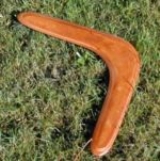
Boomerangs are curved pieces of wood used as weapons and sport equipment. Boomerangs come in many shapes and sizes depending on their geographic or tribal origins and intended function. The most recognisable type is the returning boomerang, which is a throwing stick that travels in a elliptical path and returns to its point of origin when thrown correctly.


Discussion
Ask a question about 'Boomerang'
Start a new discussion about 'Boomerang'
Answer questions from other users
Full Discussion Forum


Encyclopedia


Boomerang
Boomerangs are curved pieces of wood used as weapons and sport equipment. Boomerangs come in many shapes and sizes depending on their geographic or tribal origins and intended function. The most recognisable type is the returning boomerang, which is a throwing stick that travels in a elliptical path and returns to its point of origin when thrown correctly. Although non-returning boomerangs (throw sticks or kylie's) were used as weapons, returning boomerangs have only ever been used for leisure or recreation. Modern returning boomerangs can be almost any size or shape and are made from a variety materials.

Historical evidence also points to the use of non-returning boomerangs by the ancient Egyptians
Egyptians

Egyptians is the name of the nationality and Mediterranean North African ethnic group native to Egypt.Egyptian identity is closely tied to the Geography of Egypt, dominated by the lower Nile Valley, the small strip of cultivable land stretching from the Cataracts of the Nile to the Mediterranean Sea and enclosed by desert both to the Easte...
, Native Americans
Native Americans in the United States

Native Americans in the United States are the Indigenous peoples of the Americas from the regions of North America now encompassed by the continental United States United States, including parts of Alaska and the island state of Hawaii....
 of California
California

California is a U.S. state on the West Coast of the United States of the United States, along the Pacific Ocean. It is bordered by Oregon to the north, Nevada to the east, Arizona to the southeast, and to the south the Mexico state of Baja California....
 and Arizona
Arizona

The State of Arizona is a U.S. state located in the Southwestern United States of the United States. The capital and largest city is Phoenix, Arizona....
, and inhabitants of southern India
India

India, officially the Republic of India , is a country in South Asia. It is the List of countries and outlying territories by total area country by geographical area, the List of countries by population country, and the most populous liberal democracy in the world....
 for killing birds, rabbits, and other small animals. Indeed, some boomerangs were not thrown at all, but were used in hand-to-hand combat by Indigenous Australians
Indigenous Australians

Indigenous Australians are the first human inhabitants of the Australian continent and its nearby islands and their descendants. Indigenous Australians are distinguished as either Australian Aborigines or Torres Strait Islanders, who currently together make up about 2.6% of Australia's population....
.

Boomerangs can be variously used as hunting weapons, percussive musical instruments, battle clubs, fire-starters, decoys for hunting waterfowl, and as recreational play toys. The smallest boomerang may be less than 10 cm from tip-to-tip, and the largest over 2 meters in length. Tribal boomerangs may be inscribed and/or painted with designs meaningful to its maker. Most boomerangs seen today are of the tourist or competition sort, and are almost invariably of the returning type.

Etymology

The word Boomerang has been adapted from an extinct Aboriginal language of New South Wales
New South Wales

New South Wales is Australia's oldest and most populous States and territories of Australia, located in the south-east of the country, north of Victoria and south of Queensland....
, Australia
Australia

Australia, officially the Commonwealth of Australia, is a country in the southern hemisphere comprising the Australia of the world's smallest continent, the major island of Tasmania, and numerous list of islands of Australia in the Indian Ocean and Pacific Oceans....
. Another variant, perhaps, was "wo-mur-rang" (1798). The noun
Noun

In linguistics, a noun is a member of a large, open class lexical category whose members can occur as the main word in the subject of a clause, the object of a verb, or the object of a preposition....
 form is from 1827 and the verb
Verb

In syntax, a verb is a word that usually denotes an action , an occurrence , or a state of being . Depending on the language, a verb may vary in form according to many factors, possibly including its grammatical tense, grammatical aspect, grammatical mood and grammatical voice....
 is from 1880.

History

Boomerangs are probably the first heavier-than-air flying machine
Flying Machine

"Flying Machine" is a two-track, US-only, promotional CD single release by United Kingdom rock band The Stairs. Both tracks on the single also appear on the album Mexican R'n'B....
 ever invented by human beings. In 1909 the Ngarrindjeri genius depicted on the Australian $50 note, David Unaipon, patented an invention for a rotary wing aircraft based on his study of boomerang aerodynamics. The oldest Australian Aboriginal boomerangs are ten thousand years old but older hunting sticks have been discovered in Europe
Europe

Europe is, conventionally, one of the world's seven continents. Comprising the westernmost peninsula of Eurasia, Europe is generally divided from Asia to its east by the water divide of the Ural Mountains, the Ural , the Caspian Sea, and by the Caucasus Mountains to the southeast....
, where they seem to have formed part of the stone age
Stone Age

The Stone Age is a broad prehistory time period during which humans widely used Rock for toolmaking.Stone tools were made from a variety of different kinds of stone....
 arsenal of weapons. One boomerang that was discovered in a cave in the Carpathian Mountains
Carpathian Mountains

The Carpathian Mountains or Carpathians are a range of mountains forming an arc of roughly 1,500 km across Central Europe and Eastern Europe, making them the largest mountain range in Europe....
 in Poland
Poland

Poland , officially the Republic of Poland , is a country in Central Europe. Poland is bordered by Germany to the west; the Czech Republic and Slovakia to the south; Ukraine, Belarus and Lithuania to the east; and the Baltic Sea and Kaliningrad Oblast, a Russian Enclave and exclave, to the north....
 was made of mammoth's tusk and is believed, based on AMS dating
Accelerator mass spectrometry

Accelerator mass spectrometry differs from other forms of mass spectrometry in that it accelerates ions to extraordinarily high kinetic energy before mass analysis....
 of objects found with it, to be about 30,000 years old. King Tutankhamun, the famous Pharaoh
Pharaoh

Pharaoh is a title used in many modern discussions of the ancient Egyptian rulers of all periods. In antiquity this title began to be used for the ruler who was the religious and political leader of united ancient Egypt, only during the New Kingdom, specifically, during the middle of the Eighteenth dynasty of Egypt....
 of ancient Egypt
Egypt

Egypt is a country mainly in North Africa, with the Sinai Peninsula forming a land bridge in Western Asia. Covering an area of about , Egypt borders the Mediterranean Sea to the north, the Gaza Strip and Israel to the northeast, the Red Sea to the east, Sudan to the south and Libya to the west....
, who died over 3,000 years ago, owned a collection of boomerangs of both the straight flying (hunting
Hunting

Hunting is the practice of pursuing living animals for food, recreation, or trade. In present-day use, the term refers to lawful hunting, as distinguished from poaching, which is the killing, trapping or capture of the hunted species contrary to law....
) and returning variety.

No one knows for sure how the returning boomerang was first invented, but some modern boomerang makers speculate that it developed from the flattened throwing stick
Throwing Stick

The throwing stick is one of the first weapons used by early humans and cultures all around the world. In essence, it is a short stave or wooden club thrown as a projectile to hunt small game such as rabbits or waterfowl....
, still used by the Australian Aborigines
Australian Aborigines

Australian Aborigines are a Class of peoples who are identified by Australian law as being members of a Race indigenous to the Australia .In the High Court of Australia, Australian Aborigines have been specifically identified as a group of people who share, in common, biological ancestry back to the original occupants of this continent....
 and some other tribal people around the world, including the Navajo Indians in America. A hunting
Hunting

Hunting is the practice of pursuing living animals for food, recreation, or trade. In present-day use, the term refers to lawful hunting, as distinguished from poaching, which is the killing, trapping or capture of the hunted species contrary to law....
 boomerang is delicately balanced and much harder to make than a returning one. Probably, the curving flight characteristic of returning boomerangs was first noticed by stone age
Stone Age

The Stone Age is a broad prehistory time period during which humans widely used Rock for toolmaking.Stone tools were made from a variety of different kinds of stone....
 hunters trying to "tune" their hunting sticks to fly straight.

The name of the boomerang comes from the language of the Indigenous Australian
Indigenous Australians

Indigenous Australians are the first human inhabitants of the Australian continent and its nearby islands and their descendants. Indigenous Australians are distinguished as either Australian Aborigines or Torres Strait Islanders, who currently together make up about 2.6% of Australia's population....
 Turuwal
Turuwal

The Turuwal people were an Australian Aborigine sub-group of the Dharuk language nation based in New South Wales, Australia. They are famous for the name of the boomerang coming from their language....
 tribe of Aborigines
Indigenous Australians

Indigenous Australians are the first human inhabitants of the Australian continent and its nearby islands and their descendants. Indigenous Australians are distinguished as either Australian Aborigines or Torres Strait Islanders, who currently together make up about 2.6% of Australia's population....
 who lived south of Sydney
Sydney

Sydney is the List of cities in Australia by population in Australia, with a metropolitan area population of approximately 4.34 million . It is the List of Australian capital cities of New South Wales, and was the site of the first British Empire colony in Australia....
, Australia
Australia

Australia, officially the Commonwealth of Australia, is a country in the southern hemisphere comprising the Australia of the world's smallest continent, the major island of Tasmania, and numerous list of islands of Australia in the Indian Ocean and Pacific Oceans....
. They were also mistakenly referred to as a woomerang, in confusion with the woomera
Woomera (spear-thrower)

A woomera is an Australian Indigenous Australians spear-throwing device usually used for larger prey or when there is a greater distance to be overcome....
.
Sportbumerangs

Modern Use

Today, boomerangs are mostly used as sporting items. There are different types of throwing contests: accuracy of return; aussie round; trick catch; maximum time aloft
Maximum time aloft

Maximum Time Aloft is a type of boomerang competition involving specially engineered boomerangs. They are launched high, and enter a stable hover....
; fast catch; and endurance (see below). The modern sport boomerang (often referred to as a 'boom' or 'rang'), is made of Finnish
Finland

Finland , officially the Republic of Finland , is a Nordic countries situated in the Fennoscandian region of northern Europe. It borders Sweden on the west, Russia on the east, and Norway on the north, while Estonia lies to its south across the Gulf of Finland....
 birch plywood
Plywood

Sorry, no overview for this topic
, hardwood
Hardwood

The term hardwood is used to describe wood from non-monocot flowering plant trees and for those trees themselves. These are usually broad-leaved; in temperate and boreal latitudes they are mostly deciduous, but in tropics and subtropics mostly evergreen....
, plastic
Plastic

Plastic is the general common term for a wide range of synthetic or semisynthetic organic chemistry solid materials suitable for the manufacture of industrial products....
 or composite material
Composite material

Composite materials are engineered materials made from two or more constituent materials with significantly different physical or chemical properties which remain separate and distinct on a macroscopic level within the finished structure....
s and comes in many different shapes and colours. Most sport boomerangs typically weigh less than 100 gram
Gram

The gram , ; symbol g, is a Physical unit of mass.Originally defined as "the absolute weight of a volume of pure water equal to the cube of the hundredth part of a metre, and at the temperature of melting ice" , a gram is now defined as one one-thousandth of the SI base unit, the kilogram, or Scientific notation kg, which itself is...
s, with MTA boomerangs (boomerangs used for the maximum time aloft event) often under 25 grams.

In 2008, Japan
Japan

Japan is an island country in East Asia. Located in the Pacific Ocean, it lies to the east of the Sea of Japan, People's Republic of China, North Korea, South Korea and Russia, stretching from the Sea of Okhotsk in the north to the East China Sea and Taiwan in the south....
ese astronaut
Astronaut

An astronaut or cosmonaut is a person trained by a List of human spaceflight programs to command, pilot, or serve as a crew member of a spacecraft....
 Takao Doi
Takao Doi

Takao Doi is a Japanese astronaut and a veteran of two NASA space shuttle missions.Doi holds a doctorate from the University of Tokyo in aerospace engineering, and has studied and published in the fields of propulsion systems, and microgravity technology....
 verified that boomerangs also function in zero gravity
Weightlessness

Weightlessness is a phenomenon experienced by people during free-fall. Although the term #Zero gravity is often used as a synonym, weightlessness in orbit is not the result of the force of gravity being eliminated or even significantly reduced ....
 as they do on Earth
Earth

Earth is the third planet from the Sun. Earth is the largest of the terrestrial planets in the Solar System in diameter, mass and density. It is also referred to as the World and Wiktionary:Terra.Note that by International Astronomical Union convention, the term "Terra" is used for naming extensive land masses, rather...
. He repeated the same experiment that German Astronaut Ulf Meerbold performed aboard Spacelab in 1992 and French Astronaut Jean-François Clervoy later performed aboard MIR in 1997.

Hunting

It is believed that the shape and elliptical flight path of the returning boomerang makes it useful for hunting. Noise generated by the movement of the boomerang through the air, and, by a skilled thrower, lightly clipping leaves of a tree whose branches house birds, would help scare the birds towards the thrower. This was used to frighten flocks or groups of birds into nets that were usually strung up between trees or thrown by hidden hunters.

Boomerangs (termed "throwsticks") for hunting larger prey, such as kangaroo
Kangaroo

A kangaroo is a marsupial from the family Macropodidae . In common use the term is used to describe the largest species from this family, the Red Kangaroo, the Antilopine Kangaroo, and the Eastern Grey Kangaroo and Western Grey Kangaroo of the Macropus genus....
, were used for small prey as well. These throwsticks fly in a nearly straight path when thrown horizontally and are heavy enough to take down a kangaroo on impact to the legs or knees. For hunting emu
Emu

The Emu , Dromaius novaehollandiae, is the largest bird native to Australia and the only Extant taxon member of the genus Dromaius. It is also the second-largest extant bird in the world by height, after its ratite relative, the ostrich....
, the throwstick is thrown toward the neck, breaking it.

Communication

It has been documented that Western Victorian "aboriginals" used the returnable boomerang, in addition to hunting, as a means of communication over long distances . This visual communication is especially useful when winds or distance make impossible other well known methods of communication such as cooee
Cooee

Cooee! is a shout used in the Australian Outback mainly to attract attention, find missing people, or indicate one's own location. When done correctly - loudly and shrilly - a call of "cooee" can carry over a considerable distance....
.

Design

Boomerangs   Melbourne Show 2005
A boomerang is a rotating wing. Though it is not a requirement that the boomerang be in its traditional shape, it is usually flat. A falling boomerang starts spinning and most then fall in a spiral. When the boomerang is thrown with high spin, the wing
Wing

A wing is a surface used to produce Lift for flight through the Earth's atmosphere or another gaseous or fluid medium. The wing shape is usually an airfoil....
s produce lift
Lift (force)

In the context of a fluid flow relative to a body, the lift force is the Vector #Vector components of the aerodynamic force that is perpendicular to the oncoming flow direction....
. Larger boomerangs are used in hunting, thus they drop on the ground after striking the target. Smaller ones are used in sport, and are the only boomerangs that return to the thrower. Because of its rapid spinning, a boomerang flies in a curve rather than a straight line. When thrown correctly a boomerang returns to its starting point.

Returning boomerangs consist of two or more arms or wing
Wing

A wing is a surface used to produce Lift for flight through the Earth's atmosphere or another gaseous or fluid medium. The wing shape is usually an airfoil....
s, connected at an angle. Each wing is shaped as an aerofoil, so air travels faster over one side of the wing than the other. This difference in air speed creates suction or lift
Lift (force)

In the context of a fluid flow relative to a body, the lift force is the Vector #Vector components of the aerodynamic force that is perpendicular to the oncoming flow direction....
 along what is roughly a plane which intersects the aerofoil at a near right angle along the long axis of the wing.

These wings are set so that the lift created by each wing opposes the lift of the other, but at an angle such that the flight pattern is constantly shifted as the forces of lift, drag, speed, rotational inertia etc. 'attempt' to reach equilibrium.

Gyroscopic precession is what makes the boomerang return to the thrower when thrown correctly. This is also what makes the boomerang fly straight up into the air when thrown incorrectly. With the exception of long-distance boomerangs, they should not be thrown sidearm or like a Frisbee
Frisbee

Flying discs are disc-shaped objects, which are generally plastic and roughly 20 to 25 centimeters in diameter, with a lip. The shape of the disc, an airfoil in cross-section, allows it to flight by generating lift as it moves through the air while rotating....
, but rather thrown with the long axis of the wings rotating in an almost-vertical plane. When throwing a returning boomerang correctly it is important to follow the correct instructions to achieve a successful return.

Some boomerangs have turbulator
Turbulator

A turbulator is a device for improving the flow of air over a wing.When air flows over the wing of an aircraft, there is a layer of air called the boundary layer between the wing's surface and where the air is undisturbed....
s—bumps or pits on the top surface that act to increase the lift as boundary layer transition activators (to keep attached turbulent flow instead of laminar separation).

Fast Catch boomerangs usually have three or more symmetrical wings (in the planform
Planform

A planform or plan view is a vertical orthographic projection of an object on a horizontal plane, like a map.In aviation, a planform is the shape and layout of an fixed-wing aircraft's wing and fuselage....
 view), whereas a Long Distance boomerang is most often shaped similar to a question mark. Maximum Time Aloft boomerangs mostly have one wing considerably longer than the other. This feature, along with carefully executed bends and twists in the wings, help to set up an 'auto-rotation' effect to maximise the boomerang's hover-time in descending from the highest point in its flight.

Throwing technique


A right-handed boomerang is thrown with an counter-clockwise spin causing a counter-clockwise flight (as seen from above). Conversely, a left-handed boomerang is constructed as a mirror image with the aerofoils' leading edges on the left side of the wings, as seen from above, causing it to produce lift when circling clockwise. Although appearing symmetrical from a plan view, the leading edges are on opposite sides of the wings so as to present the leading edges of the aerofoil to the wind when spinning.

Most sport boomerangs are in the range of about 2.5 to 4 ounce
Ounce

This article is about the unit of mass. For the unit of force, see Pound-force. For the unit of volume, see Fluid ounce. For all other uses, see Ounce ....
s. The range on most is between 25 and 40 yards/metres. Use treeless, large open spaces, that are twice as large as you might imagine you need. A right- or left-handed boomerang can be thrown with either hand, but the flight direction will depend upon the boomerang, not the thrower. Throwing a boomerang with the wrong hand requires a throwing motion that many throwers may find awkward.

For right-handers, stand sideways with feet-apart, left foot forward so as to point in the direction of flight. Hold the right wing tip, flat side down, using the thumb and one, two, or three fingers, tilting the boomerang upright at a ten to thirty degree angle from vertical. Aim at, or just above, the horizon. Then sharply step forward with the right foot, launching the boomerang in a similar way to throwing a spear or ball. Launch crisply using a whip-like flick at the end of the throw to cause counter-clockwise spin. The strength of throw must be varied according to the speed of the wind — the stronger the wind, the less power is required to make the return journey.

The boomerang should initially curve around, climbing gently, level out in mid-flight, arc around descending slowly, and then finish by popping up slightly, hovering then stalling in front of, or just behind the thrower. Ideally, it should hover momentarily, to allow the catcher to clamp their hands shut decisively and firmly on the horizontal boomerang from above and below, sandwiching the centre between the catcher's hands. In other words, avoid painful wing strikes to the hand by not sticking fingers directly into the edge of the fast-spinning wing rotor.

Boomerangs shouldn't be thrown level like a flying disc, as it will turn upwards abruptly in the direction of the top of its aerofoils, so if that direction happens to be up rather than to the side it may soar up so high and quickly down again that the subsequent landing causes damage to the boomerang or whatever it might land on.

Wind speed and direction are very important for a successful throw. A right-handed boomerang is thrown with the wind on your left cheek. The angle to the wind depends on the boomerang, but starting with a 45 degree angle is recommended. Depending on where the boomerang lands, this angle can be modified so that a closer return is achieved. For example, if the boomerang lands too far on the left, turn to throw more to the right of the wind the next time. If the return goes over your head then throw softer. If it falls short then throw harder. As for the wind speed, a light wind of three to five miles an hour is ideal. If the wind is strong enough to fly a kite, then that's usually too strong for boomerangs.

You can modify various actions to achieve a closer return according to the conditions. You can vary: the throw angle to the wind, the tilt, the power, the spin, and the inclination in order to vary the return point so that you can perfect your catching. Turn your face to the wind and turn slightly to each side until your forehead feels cooled equally on both sides. Now you can more accurately assess the direction of the wind and hence your throw angle. Always return to the same throw point and then use a background target object in order to throw in a consistent direction relative to the wind each time.

Competitions and records

In international competition, a world cup is held every second year, with teams from Germany
Germany

Germany , officially the Federal Republic of Germany , is a country in Central Europe. It is bordered to the north by the North Sea, Denmark, and the Baltic Sea; to the east by Poland and the Czech Republic; to the south by Austria and Switzerland; and to the west by France, Luxembourg, Belgium, and the Netherlands....
 and the United States
United States

The United States of America is a Federal government constitutional republic comprising U.S. state and a federal district. The country is situated mostly in central North America, where its Contiguous United States and Washington, D.C., the Capital districts and territories, lie between the Pacific Ocean and Atlantic Oceans, Borders of the U...
 dominating international competition. The individual World Champion title was won in 2000, 2002 and 2004 by Swiss thrower Manuel Schütz. In 2006, Fridolin Frost from Germany won the title, with Manuel Schütz finishing third.

Competition disciplines

Modern boomerang tournaments usually involve some or all of the events listed below In all disciplines the boomerang must travel at least 20 meters from the thrower. Throwing takes place individually. The thrower stands at the centre of concentric rings marked on an open field.
  • Aussie Round: considered by many to be the ultimate test of boomeranging skills. The boomerang should ideally cross the 50 meter circle and come right back to the centre. Each thrower has five attempts. Points are awarded for distance, accuracy and the catch.
  • Accuracy: points are awarded according to how close the boomerang lands to the centre of the rings. The thrower must not touch the boomerang after it has been thrown. Each thrower has five attempts. In major competitions there are two accuracy disciplines: Accuracy 100 and Accuracy 50
  • Endurance: points are awarded for the number of catches achieved in 5 minutes.
  • Fast Catch: the time taken to throw and catch the boomerang five times. The winner has the fastest timed catches.
  • Trick Catch/Doubling: points are awarded for trick catches behind the back, between the feet, etc. In Doubling the thrower has to throw two boomerangs at the same time and catch them in sequence in a special way.
  • Consecutive Catch: points are awarded for the number of catches achieved before the boomerang is dropped. The event is not timed.
  • MTA 100 (Maximal Time Aloft, field size: 100 metres): points are awarded for the length of time spent by the boomerang in the air. The field is normally a circle measuring 100 metres. An alternative to this discipline, without the 100 metre restriction is called MTA unlimited.
  • Long Distance: the boomerang is thrown from the middle point of a 40 metre baseline. The furthest distance travelled by the boomerang away from the baseline is measured. On returning the boomerang must cross the baseline again but does not have to be caught. A special section is dedicated to LD below.
  • Juggling: as with Consecutive Catch, only with two boomerangs. At any given time one boomerang must be in the air.


There are many other boomerang disciplines, many played just for fun, but most of these are not considered official competition events.

World records

(May 2008)
Discipline Result Name Year Tournament
Accuracy 100 99 points Alex Opri (D) 2007 Viareggio (ITA)
Accuracy 50 68 points Thomas Stehrenberger (CH) 2001 Lausanne (CH)
Aussie Round 99 points Fridolin Frost (D) 2007 Viareggio (ITA)
Endurance 81 catches Manuel Schütz (CH) 2005 Milano (I)
Fast Catch 14.55 s Adam Ruhf (USA) 2002 Emmaus (USA)
Trick Catch/Doubling 390 points Manuel Schütz (CH) 2004 Milano (I)
Consecutive Catch 1297 catches Manuel Schütz (CH) 2005 Aalen (D)
MTA 100 104.87 s Eric Darnell (USA) 1997 Portland (USA)
MTA unlimited 229.82 s Betsylew Miale-Gix (USA) 2008 Tucson (USA)
Long Distance 238 m Manuel Schütz (CH) 1999 Kloten (CH)
Non-discipline record: Smallest Boomerang: Sadir Kattan of Australia in 1997 with 48 mm [1.8 in] long and 45 mm [1.77 in] wide. This tiny boomerang flew the required 20 metres, returning to the accuracy circles on 22 March 1997 at the Australian National Championships.

Long distance boomerangs


Long distance boomerang throwers aim to have the boomerang go the furthest possible while returning close to the throwing point. In competition the boomerang must intersect an imaginary surface defined as an infinite vertical extrude of a 40 m large line centred on the thrower. Outside of competitions the definition is not so strict and the thrower is happy whenever he does not have to travel 50 m after the throw to recover the boomerang.

General properties


Long distance boomerangs are optimised to have minimal drag while still having enough lift to fly and return. For this reason they have a very narrow throwing window which discourages many beginners from continuing with this discipline. For the same reason, the quality of manufactured long distance boomerangs is often non-deterministic.

Today's long distance boomerangs have almost all an S or ? shape and have all a profile on both sides (the profile on the bottom side is sometimes called an undercut). This is to minimise drag and lower the lift. Lift must be low because the boomerang is thrown with almost total layover (flat). Long distance boomerangs are most frequently made of composite material, mainly glass fiber epoxy composites.

Flight path


The projection of the flight path of long distance boomerang on the ground resembles a water drop. For older types of long distance boomerangs (all types of so called big hooks), the first and last third of the flight path are very low while the middle third is a fast climbing followed by a fast descent. Nowadays boomerangs are made in a way that their whole flight path is almost planar with a constant climbing during the first half of the trajectory and then a rather constant descent during the second half.

From theoretical point of view, long distance boomerangs are interesting also for the following reason: for achieving a different behaviour during different flight phases, the ratio of the rotation frequency to the forward velocity has a U shaped function, i.e. its derivate crosses 0. Practically it means that the boomerang being at the furthest point has a forward velocity very low. The kinetic energy of the forward component is then stored in the potential energy. This is not true for other types of boomerangs where the loss of kinetic energy is non-reversible (the MTAs also store kinetic energy in potential energy during the first half of the flight but then the potential energy is lost directly by the drag).

Interest in the discipline


Long distance boomerang throwing had been considered as the royal competition in the 20th century but with new materials and approach that coincides with the 21st century, throwing 100 m became normal and the interest in this category declined. Following reasons explain the evolution:
  • Throwing technique: The throwing technique is slightly different and less natural as the boomerang must be thrown almost horizontally lied down but aiming high yet with maximal power used.
  • Deceiving exercising: Long distance boomerangs are more difficult to make or to acquire because they must be much more optimized to achieve good performance which requires more workload. On the other hand they are easy to lose because at 100 m only individuals with good vision still see them clearly and sometimes they do not even make the turn and continue straight forward. It also matters that not all fields are big enough, flat and empty to allow exercising.
  • Put apart in tournaments: Due to difficulties to organise competition in this category the events are often separated from the rest of disciplines and scheduled as the last day of the whole tournament, often a Monday.


On the other hand the long distance throwers being very few compared to other disciplines still benefit from a family like spirit present on all LD events.

Related terms

Kylie is one of the Aboriginal words for the hunting stick used in warfare and for hunting animals. Instead of following a curved flight path, it flies in a straight line from the thrower. They are typically much larger than boomerangs. It can travel very long distances, and due to its size and hook shape can cripple or kill an animal or human opponent. The word is perhaps an English corruption of a word meaning boomerang taken from one of the Western Desert languages, for example, the Warlpiri
Warlpiri

The Warlpiri are a group of Indigenous Australians, many of whom speak the Warlpiri language. There are 5,000–6,000 Warlpiri, living mostly in a few towns and settlements scattered through their traditional land in Australia's Northern Territory, north and west of Alice Springs....
 word karli.

See also

  • Batarang
    Batarang

    A batarang is a roughly bat-shaped throwing weapon used by the DC Comics superhero Batman. The name is a portmanteau of bat and boomerang, and was originally spelled baterang....
  • Roomarang
    Roomarang

    Roomarang is a type of Boomerang, the only difference being that Roomarangs are made from Ethylene-vinyl acetate foam which makes them safe as an indoor toy....
  • Throwing Stick
    Throwing Stick

    The throwing stick is one of the first weapons used by early humans and cultures all around the world. In essence, it is a short stave or wooden club thrown as a projectile to hunt small game such as rabbits or waterfowl....


External links

  • , The Maths and Physics of a Boomerang
  • an online dissertation
  • , a beginner's to advanced guide to throwing boomerangs.