
All Topics  
Wall Street Crash of 1929

 
Wall Street Crash of 1929

   Email Print
   Bookmark   Link


Wall Street Crash of 1929


The Wall Street Crash of 1929, also known as the Great Crash, was the most devastating stock market crash
Stock market crash

A stock market crash is a sudden dramatic decline of stock prices across a significant cross-section of a stock market. Crashes are driven by panic as much as by underlying economic factors....
 in the history of the United States
United States

The United States of America is a Federal government constitutional republic comprising U.S. state and a federal district. The country is situated mostly in central North America, where its Contiguous United States and Washington, D.C., the Capital districts and territories, lie between the Pacific Ocean and Atlantic Oceans, Borders of the U...
, taking into consideration the full extent and longevity of its fallout.

Three phrases — Black Thursday, Black Monday, and Black Tuesday — are commonly used to describe this collapse of stock values.


Discussion
Ask a question about 'Wall Street Crash of 1929'
Start a new discussion about 'Wall Street Crash of 1929'
Answer questions from other users
Full Discussion Forum


Recent Posts


Encyclopedia


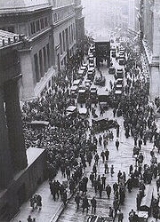
Crowd Outside Nyse
The Wall Street Crash of 1929, also known as the Great Crash, was the most devastating stock market crash
Stock market crash

A stock market crash is a sudden dramatic decline of stock prices across a significant cross-section of a stock market. Crashes are driven by panic as much as by underlying economic factors....
 in the history of the United States
United States

The United States of America is a Federal government constitutional republic comprising U.S. state and a federal district. The country is situated mostly in central North America, where its Contiguous United States and Washington, D.C., the Capital districts and territories, lie between the Pacific Ocean and Atlantic Oceans, Borders of the U...
, taking into consideration the full extent and longevity of its fallout.

Three phrases — Black Thursday, Black Monday, and Black Tuesday — are commonly used to describe this collapse of stock values. All three are appropriate, for the crash was not a one-day affair. The initial crash occurred on Thursday, October 24, 1929, but it was the catastrophic downturn of Monday, October 28 and Tuesday, October 29 that precipitated widespread panic and the onset of unprecedented and long-lasting consequences for the United States. The collapse continued for a month.

Economists and historians disagree as to what role the crash played in subsequent economic, social, and political events. In a 1998 article The Economist
The Economist

The Economist is an English-language weekly news and international relations publication owned by The Economist Newspaper Ltd. and edited in London....
 argued, "Briefly, the Depression did not start with the stockmarket crash." Nor was it clear at the time of the crash that a depression was starting. On November 23, 1929, The Economist asked: "Can a very serious Stock Exchange collapse produce a serious setback to industry when industrial production is for the most part in a healthy and balanced condition? ... Experts are agreed that there must be some setback, but there is not yet sufficient evidence to prove that it will be long or that it need go to the length of producing a general industrial depression." But The Economist cautioned: "Some bank failures, no doubt, are also to be expected. In the circumstances will the banks have any margin left for financing commercial and industrial enterprises or will they not? The position of the banks is without doubt the key to the situation, and what this is going to be cannot be properly assessed until the dust has cleared away."

The October 1929 crash came during a period of declining real estate values in the United States (which peaked in 1925) near the beginning of a chain of events that led to the Great Depression
Great Depression

File:International depression.pngThe Great Depression was a worldwide economic Recession starting in most places in 1929 and ending at different times in the 1930s or early 1940s for different countries....
, a period of economic decline in the industrialized nations
Developed country

The term developed country is used to describe countries that have a high level of development according to some criteria. Which criteria, and which countries are classified as being developed, is a contentious issue and there is fierce debate about this....
.

At the time of the unbelieveable crash, New York City
New York City

The City of New York is the List of United States cities by population in the United States, while the New York metropolitan area ranks among the List of urban areas by population....
 had grown to be a major metropolis
Metropolis

A metropolis , also referred to as a metropolitan, is a big city, in most cases with over half a million inhabitants in the city proper, and with a population of at least one million living in its Agglomeration....
, and its Wall Street
Wall Street

Wall Street is a street in lower Manhattan, New York City, New York, United States. It runs east from Broadway to South Street on the East River, through the historical center of the Financial District, Manhattan....
 district was one of the world's leading financial centers. The New York Stock Exchange
New York Stock Exchange

New York Stock Exchange is a stock exchange based in New York City, New York. It is the largest stock exchange in the world by United States dollar market capitalization of its listed companies' Security ....
 (NYSE) was the largest stock market in the world.

The Roaring Twenties
Roaring Twenties

Roaring Twenties is a phrase used to describe the 1920s, principally in North America, that emphasizes the period's social, artistic, and cultural dynamism....
, which was a precursor to the Crash, was a time of prosperity and excess in the city, and despite warnings against speculation, many believed that the market could sustain high price levels. Shortly before the crash, Irving Fisher
Irving Fisher

Irving Fisher was an United States Economics, health campaigner, and Eugenics, and one of the earliest American Neoclassical economics and, although he was perhaps the first celebrity economist, his reputation today is probably higher than it was in his lifetime....
 famously proclaimed, "Stock prices have reached what looks like a permanently high plateau." The euphoria and financial gains of the great bull market were shattered on Black Thursday, when share price
Share price

A share price is the price of a single share of a company's stock. Once the stock is purchased, the owner becomes a Stock#Shareholder of the company that issued the share....
s on the NYSE collapsed. Stock prices fell on that day and they continued to fall, at an unprecedented rate, for a full month.

In the days leading up to Black Tuesday, the market was severely unstable. Periods of selling and high volumes of trading were interspersed with brief periods of rising prices and recovery. Economist and author Jude Wanniski
Jude Wanniski

Jude Thaddeus Wanniski was an American journalism, conservative commentator, and political economist. He is perhaps best known as the associate editor of The Wall Street Journal from 1972 to 1978....
 later correlated these swings with the prospects for passage of the Smoot-Hawley Tariff Act
Smoot-Hawley Tariff Act

File:Smoot and Hawley standing together, April 11, 1929.jpgThe Smoot-Hawley Tariff Act...
, which was then being debated in Congress. After the crash, the Dow Jones Industrial Average
Dow Jones Industrial Average

The Dow Jones Industrial Average is one of several stock market index, created by nineteenth-century The Wall Street Journal editor and Dow Jones & Company co-founder Charles Dow....
 (DJIA) recovered early in 1930, only to reverse and crash again, reaching a low point of the great bear market
Market trends

A Market trend is the direction in which a financial market is moving. Market trends can be classified as primary trends, secondary trends , and secular trends ....
 in 1932. On July 8, 1932 the Dow reached its lowest level of the 20th century and did not return to pre-1929 levels until 23 November 1954.

Timeline

1930 67b
After a six-year run when the world saw the Dow Jones Industrial Average increase in value fivefold, prices peaked at 381.17 on September 3, 1929. The market then fell sharply for a month, losing 17% of its value on the initial leg down.

Prices then recovered more than half of the losses over the next week, only to turn back down immediately afterwards. The decline then accelerated into the so-called "Black Thursday", October 24, 1929. A record number of 12.9 million shares were traded on that day.

At 1 p.m. on Friday, October 25, several leading Wall Street bankers met to find a solution to the panic and chaos on the trading floor. The meeting included Thomas W. Lamont
Thomas W. Lamont

Thomas William Lamont, Jr. was an United States banker.Lamont was born in Claverack, New York. He graduated from Phillips Exeter Academy in 1888 and earned his degree from Harvard University in 1892....
, acting head of Morgan Bank; Albert Wiggin, head of the Chase National Bank
Chase Manhattan Bank

Chase is the consumer and commercial banking division of JPMorgan Chase. The bank was known as Chase Manhattan Bank until it merged with JPMorgan in 2000....
; and Charles E. Mitchell
Charles E. Mitchell

Charles Edwin Mitchell was an American banker whose incautious securities policies facilitated the speculation which led to the Crash of 1929. His firm's abuses brought an end to ownership of investment affiliates by commercial banks....
, president of the National City Bank
Citibank

Citibank is a major international bank, founded in 1812 as the City Bank of New York, later First National City Bank of New York. Citibank is now the consumer banking arm of financial services giant Citigroup, one of the largest companies in the world....
. They chose Richard Whitney
Richard Whitney (financier)

Richard Whitney was an United States financier, president of the New York Stock Exchange 1930?1935, and a convicted embezzler.Richard Whitney was born into a wealthy Boston, Massachusetts, family, growing up friends of the Boston Brahmin elite....
, vice president of the Exchange, to act on their behalf. With the bankers' financial resources behind him, Whitney placed a bid to purchase a large block of shares in U.S. Steel
U.S. Steel

The United States Steel Corporation , more commonly known as U.S. Steel, is an integrated steel producer with major production operations in the United States, Canada, and Central Europe....
 at a price well above the current market. As traders watched, Whitney then placed similar bids on other "blue chip" stocks. This tactic was similar to a tactic that ended the Panic of 1907
Panic of 1907

The Panic of 1907, also known as the 1907 Bankers' Panic, was a financial crisis that occurred in the United States when the New York Stock Exchange fell close to 50 percent from its peak the previous year....
, and succeeded in halting the slide that day. In this case, however, the respite was only temporary.

Over the weekend, the events were covered by the newspapers across the United States. On Monday, October 28, the first "Black Monday", more investors decided to get out of the market, and the slide continued with a record loss in the Dow for the day of 13%. The next day, "Black Tuesday", October 29, 1929, about 16 million shares were traded. The volume on stocks traded on October 29, 1929 was "...a record that was not broken for nearly 40 years, in 1968." Author Richard M. Salsman
Richard Salsman

Richard M. Salsman is an American economist and lecturer. His work incorporates Objectivist philosophy and supply-side economics . In particular, Salsman admires the ideas of economists such as Jean-Baptiste Say and Carl Menger as opposed to more modern supply-siders such as Arthur Laffer....
 wrote that on October 29—amid rumors that U.S. President Herbert Hoover
Herbert Hoover

Herbert Clark Hoover was the List of Presidents of the United States President of the United States . Besides his political career, Hoover was a professional mining engineer and author....
 would not veto the pending Hawley-Smoot Tariff bill—stock prices crashed even further." William C. Durant
William C. Durant

William Crapo "Billy" Durant was a leading pioneer of the United States automobile industry, the founder of General Motors and Chevrolet who created the system of multi-brand holding companies with different lines of cars....
 joined with members of the Rockefeller family
Rockefeller family

The Rockefeller family, the renowned Cleveland, Ohio family of John D. Rockefeller and his brother William Rockefeller , is an United States industry, banking, and political family of German American origin that made the world's largest private fortune in the History of the petroleum industry in North America during the late 19th and early...
 and other financial giants to buy large quantities of stocks in order to demonstrate to the public their confidence in the market, but their efforts failed to stop the slide. The DJIA lost another 12% that day. The ticker
Ticker tape

Ticker tape was used by ticker tape machines, the Ticker tape timer, stock ticker machines, or just stock tickers....
 did not stop running until about 7:45 that evening. The market lost $14 billion in value that day, bringing the loss for the week to $30 billion, ten times more than the annual budget of the federal government, far more than the U.S. had spent in all of World War I.


Dow Jones Industrial Average for 10/28/1929 and 10/29/1929
datechange% changeclose
October 28, 1929-38.33-12.82260.64
October 29, 1929-30.57-11.73230.07


An interim bottom occurred on November 13, with the Dow closing at 198.60 that day. The market recovered for several months from that point, with the Dow reaching a secondary peak (ie, dead cat bounce
Dead cat bounce

A dead cat bounce is a Literal_and_figurative_language term used by Trader in the finance industry to describe a pattern wherein a spectacular decline in the price of a stock is immediately followed by a moderate and temporary rise before resuming its downward movement, with the connotation that the rise was not an indication of improving ci...
) at 294.0 in April 1930. The market embarked on a steady slide in April 1931 that did not end until 1932 when the Dow closed at 41.22 on July 8, concluding a shattering 89% decline from the peak. This was the lowest the stock market had been since the 19th century.

Economic fundamentals


The crash followed a speculative
Speculation

Speculation is the assumption of the risk of loss, in return for the uncertain possibility of a reward. Only if one may safely say that a particular position involves no risk may one say, strictly speaking, that such a position represents an "investment." Financial speculation involves the trade, and short-selling of stocks, bond , commodity...
 boom that had taken hold in the late 1920s, which had led hundreds of thousands of Americans to invest heavily in the stock market, a significant number even borrowing money
Leverage (finance)

In finance, leverage is borrowing money to supplement existing funds for investment in such a way that the potential positive or negative outcome is magnified and/or enhanced....
 to buy more stock. By August 1929, brokers were routinely lending small investors more than 2/3 of the face value of the stocks they were buying. Over $8.5 billion was out on loan, more than the entire amount of currency circulating in the U.S. The rising share prices encouraged more people to invest; people hoped the share prices would rise further. Speculation thus fueled further rises and created an economic bubble
Economic bubble

An economic bubble is ?trade in high volumes at prices that are considerably at variance with Intrinsic value ?.While some economists deny that bubbles occur, the cause of bubbles remains a challenge to those who are convinced that asset prices often deviate strongly from intrinsic values....
. The average P/E
P/E ratio

The P/E ratio of a stock is a measure of the price paid for a Share relative to the annual net income or profit earned by the firm per share....
 (price to earnings) ratio of S&P Composite stocks was 32.6 in September 1929, clearly above historical norms. Most economists view this event as the most dramatic in modern economic history. On October 24, 1929 (with the Dow just past its September 3 peak of 381.17), the market finally turned down, and panic selling started. 12,894,650 shares were traded in a single day as people desperately tried to mitigate the situation. This mass sale is often considered a major contributing factor to the Great Depression
Great Depression

File:International depression.pngThe Great Depression was a worldwide economic Recession starting in most places in 1929 and ending at different times in the 1930s or early 1940s for different countries....
. Some hold that political over-reactions to the crash, such as the passage of the Smoot-Hawley Tariff Act
Smoot-Hawley Tariff Act

File:Smoot and Hawley standing together, April 11, 1929.jpgThe Smoot-Hawley Tariff Act...
 through the U.S. Congress, caused more harm than the crash itself. According to Thomas K. McCraw, a professor at the Harvard Business School
Harvard Business School

Harvard Business School is a business school in the United States. It is one of the graduate schools of Harvard University.Founded in 1908, Harvard Business School started with 59 students....
, the Smoot-Hawley Tariff Act "...exacerbated the problem by preventing Europe
Europe

Europe is, conventionally, one of the world's seven continents. Comprising the westernmost peninsula of Eurasia, Europe is generally divided from Asia to its east by the water divide of the Ural Mountains, the Ural , the Caspian Sea, and by the Caucasus Mountains to the southeast....
ans from selling enough goods in the United States to earn enough money to pay off their debts from World War I."

Official investigation of the Crash

In 1931, the Pecora Commission
Pecora Commission

The Pecora Commission is the name commonly used to describe the commission established on March 4, 1932, by the United States Senate Committee on Banking, Housing, and Urban Affairs to investigate the causes of the Wall Street Crash of 1929....
 was established by the U.S. Senate
United States Senate

The United States Senate is the upper house of the Bicameralism United States Congress, the lower house being the United States House of Representatives....
 to study the causes of the crash. The U.S. Congress passed the Glass-Steagall Act
Glass-Steagall Act

The Glass-Steagall Act of 1933 established the Federal Deposit Insurance Corporation in the United States and included banking reforms, some of which were designed to control speculation....
 in 1933, which mandated a separation between commercial bank
Commercial bank

A commercial bank is a type of financial intermediary and a type of bank. Commercial banking is also known as business banking. It is a bank that provides checking accounts, savings accounts, and money market accounts and that accepts time deposits....
s, which take deposits and extend loan
Loan

A loan is a type of debt. This article focuses exclusively on monetary loans, although, in practice, any material object might be lent. Like all debt instruments, a loan entails the redistribution of financial assets over time, between the wiktionary:lender and the wiktionary:borrower....
s, and investment banks, which underwrite
Underwriting

Underwriting refers to the process that a large financial service provider uses to assess the eligibility of a customer to receive their products ....
, issue, and distribute stock
STOCK

Software for fixed assets management and stock control developed in 2004. Stocktaking process is carried using a hand-held mobile terminal equipped with barcode reader or RFID technology....
s, bond
Bond (finance)

In finance, a bond is a debt security , in which the authorized issuer owes the holders a debt and, depending on the terms of the bond, is obliged to pay interest and/or to repay the principal at a later date, termed Maturity ....
s, and other securities
Security (finance)

A security is a fungible, negotiable instrument representing financial value. Securities are broadly categorized into debt securities , and stock securities; e.g., common stocks....
.

After the experience of the 1929 crash, stock markets around the world instituted measures to temporarily suspend trading in the event of rapid declines, claiming that they would prevent such panic sales. The one-day crash of Black Monday
Black Monday (1987)

In financial markets, Black Monday refers to Monday, October 19, 1987, when stock markets around the world Stock market crash, shedding a huge value in a very short time....
, October 19, 1987, however, was even more severe than the crash of 1929, when the Dow Jones Industrial Average fell a full 22.6%. (The markets quickly recovered, posting the largest one-day increase since 1933 only two days later.)

Effects and academic debate

Together, the 1929 stock market crash and the Great Depression
Great Depression

File:International depression.pngThe Great Depression was a worldwide economic Recession starting in most places in 1929 and ending at different times in the 1930s or early 1940s for different countries....
 "...was the biggest financial crisis of the" 20th century. "The panic of October 1929 has come to serve as a symbol of the economic contraction that gripped the world during the next decade." "The crash of 1929 caused 'fear mixed with a vertiginous disorientation', but 'shock was quickly cauterized with denial, both official and mass-delusional'." "The falls in share prices on October 24 and 29, 1929 ... were practically instantaneous in all financial markets, except Japan." The Wall Street Crash had a major impact on the U.S. and world economy, and it has been the source of intense academic debate—historical, economic and political—from its aftermath until the present day. "Some people believed that abuses by utility holding companies contributed to the Wall Street Crash of 1929 and the Depression that followed." "Many people blamed the crash on commercial banks that were too eager to put deposits at risk on the stock market. "

The "1929 crash brought the Roaring Twenties
Roaring Twenties

Roaring Twenties is a phrase used to describe the 1920s, principally in North America, that emphasizes the period's social, artistic, and cultural dynamism....
 shuddering to a halt." As "tentatively expressed" by "economic historian Charles Kindleberger", in 1929 there was no "...lender of last resort effectively present", which, if it had existed and were "properly exercised", would have been "key in shortening the business slowdown[s] that normally follows financial crises." The crash marked the beginning of widespread and long-lasting consequences for the United States. The main question is: Did the "'29 Crash spark The Depression?", or did it merely coincide with the bursting of a credit-inspired economic bubble? The decline in stock prices caused bankruptcies and severe macroeconomic difficulties including business closures, firing of workers and other economic repression measures. The resultant rise of mass unemployment and the depression is seen as a direct result of the crash, though it is by no means the sole event that contributed to the depression; it is usually seen as having the greatest impact on the events that followed. Therefore the Wall Street Crash is widely regarded as signaling the downward economic slide that initiated the Great Depression.

True or not, the consequences were dire for almost everybody. "Most academic experts agree on one aspect of the crash: It wiped out billions of dollars of wealth in one day, and this immediately depressed consumer buying." The failure set off a worldwide run on US gold deposits (i.e., the dollar), and forced the Federal Reserve to raise interest rates into the slump. Some 4,000 lenders were ultimately driven to the wall. Also, the uptick rule
Uptick rule

The uptick rule is a securities trading rule used to regulate short selling in financial markets. The rule mandates, subject to certain exceptions, that, when sold, a listed Security must either be sold short at a price above the price at which the immediately preceding sale was effected or at the last sale price if it is higher than the la...
, which "...allowed short selling only when the last tick in a stock’s price was positive," "...was implemented after the 1929 market crash to prevent short sellers from driving the price of a stock down in a bear run."

Many academics see the Wall Street Crash of 1929 as part of a historical process that was a part of the new theories of boom and bust
Boom and bust

File:California Gold Rush handbill.jpgThe term boom and bust refers to a great buildup in the price of a particular commodity or, alternately, the localized rise in an economy, often based upon the value of a single commodity, followed by a downturn as the commodity price falls due to a change in economic circumstances or the collapse o...
. According to economists such as Joseph Schumpeter
Joseph Schumpeter

Joseph Alois Schumpeter was an economist and political scientist born in Moravia, then Austria-Hungary, now Czech Republic. He popularized the term "creative destruction" in economics....
 and Nikolai Kondratieff the crash was merely a historical event in the continuing process known as economic cycles. The impact of the crash was merely to increase the speed at which the cycle proceeded to its next level.

Milton Friedman
Milton Friedman

Milton Friedman was an United States economist, statistician and public intellectual, and a recipient of the Nobel Memorial Prize in Economic Sciences....
's A Monetary History of the United States, co-written with Anna Schwartz
Anna Schwartz

Anna Jacobson Schwartz is an economist at the National Bureau of Economic Research in New York City. She is a past president of the Western Economic Association ....
, makes the arguement that what made the "great contraction" so severe was not the downturn in the business cycle, trade protectionism ,or the 1929 stock market crash. But instead what plunged the country into a deep depression was the collapse of the banking system during three waves of panics over the 1930-33 period.

See also

  • List of personalities associated with Wall Street
    List of personalities associated with Wall Street

    Over the years, certain persons associated with Wall Street have become relatively well-known. Although their reputation is usually limited to members of the stock brokerage/banking community, several have gained national and international recognition....
  • Charles E. Mitchell
    Charles E. Mitchell

    Charles Edwin Mitchell was an American banker whose incautious securities policies facilitated the speculation which led to the Crash of 1929. His firm's abuses brought an end to ownership of investment affiliates by commercial banks....
  • Glass-Steagall Act
    Glass-Steagall Act

    The Glass-Steagall Act of 1933 established the Federal Deposit Insurance Corporation in the United States and included banking reforms, some of which were designed to control speculation....


Further reading

  • Bierman, Harold. "The 1929 Stock Market Crash". EH.Net Encyclopedia, edited by Robert Whaples. August 11, 2004. URL http://eh.net/encyclopedia/article/Bierman.Crash
  • Brooks, John. (1969). Once in Golconda: A True Drama of Wall Street 1920-1938. New York: Harper & Row. ISBN 0-393-01375-8.
  • Galbraith, John Kenneth. (1954). The Great Crash: 1929. Boston: Houghton Mifflin. ISBN 0-395-85999-9.
  • Klein, Maury. (2001). Rainbow's End: The Crash of 1929. New York: Oxford University Press. ISBN 0-195-13516-4.
  • Klingaman, William K. (1989). 1929: The Year of the Great Crash. New York: Harper & Row. ISBN 0-060-16081-0.
  • Rothbard, Murray N.
  • Salsman, Richard M. “The Cause and Consequences of the Great Depression” in The Intellectual Activist, .
  • “Part 1: What Made the Roaring ’20s Roar”, June, 2004, pp. 16–24.
  • “Part 2: Hoover’s Progressive Assault on Business”, July, 2004, pp. 10–20.
  • “Part 3: Roosevelt's Raw Deal”, August, 2004, pp. 9–20.
  • “Part 4: Freedom and Prosperity”, January, 2005, pp. 14–23.


  • Shachtman, Tom. (1979). The Day America Crashed. New York: G.P. Putnam. ISBN 0-399-11613-3.
  • Thomas, Gordon, and Max Morgan-Witts. (1979). The Day the Bubble Burst: A Social History of the Wall Street Crash of 1929. Garden City, NY: Doubleday. ISBN 0-385-14370-2.